➡️ PART 3 ENDING PART➡️
“I think they already know you came here.”
Mrs. Whitaker said it quietly, but every word landed like something dropped on glass.
My phone vibrated again inside my purse.
Dale.
Then Pam.
Then Alan.
Three names.
Three people who had spent the last six weeks telling me Grandpa’s estate was simple.
The house would be sold.
The tractor would be sold.
The furniture would be divided.
The basement was junk.
No drama.
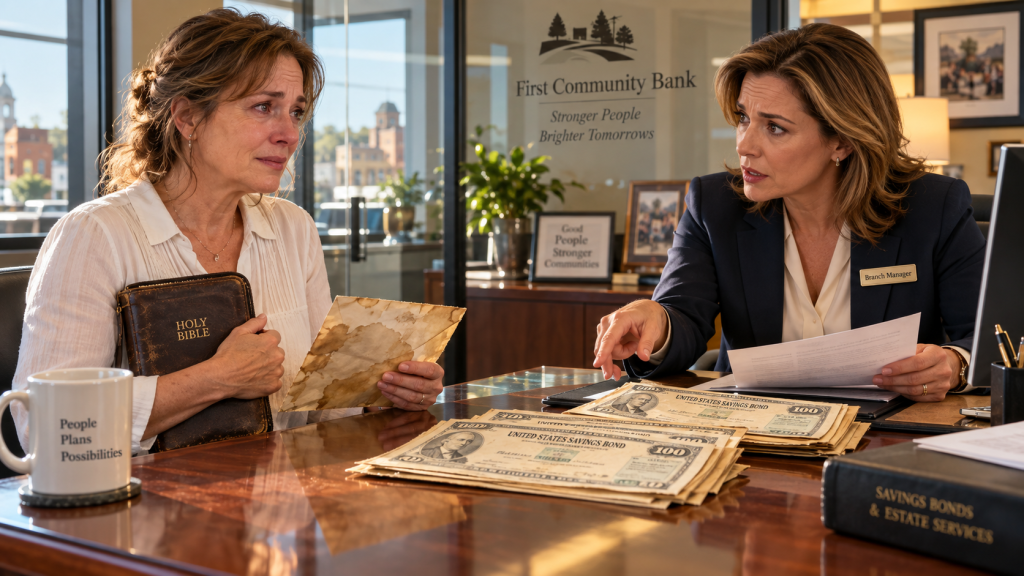
I looked down at the seventeen savings bonds arranged across Mrs. Whitaker’s desk.
They did not look dramatic.
Old paper.
Faded green ink.
Creased corners.
Grandpa Henry’s name.
My maiden name.
Henry Harper OR Nancy Lee Harper.
Seventeen times.
My throat tightened.
“What exactly did Dale ask you?”
I whispered.
Mrs. Whitaker folded her hands.
“I need to be careful about what I disclose, but because your name appears on these instruments and because the earlier inquiry concerned your ownership interest, our compliance department wants the situation documented.”
“That sounds like banker language for something bad.”
A tiny smile crossed her face.
“It means I don’t want to speculate.”
That was fair.
Then she turned one of the bonds around so I could see the serial number.
“Three weeks ago, your cousin came into this branch with a photocopy of a savings bond bearing this same registration.”
My stomach dropped.
“A photocopy?”
“Yes.”
“He had already found them.”
“I cannot tell you what he physically possessed.”
She paused.
“But the copy he showed us had this serial number.”
I stared at the bond.
The same one with Pam’s sticky note on the back.
Ask Dale if N.L.H. can be excluded if unclaimed.
My skin went cold.
Mrs. Whitaker continued.
“He identified himself as the personal representative of Henry Harper’s estate.”
“He asked whether bonds registered to Henry Harper or Nancy Lee Harper could be redeemed by the estate if Nancy Lee Harper could not be located.”
I almost laughed.
It came out as a broken sound.
“Couldn’t be located?”
Mrs. Whitaker looked at me.
I held up my phone.
“Dale texted me yesterday to ask whether I could clean Grandpa’s basement for three hundred dollars.”
She closed her eyes briefly.
That was the first time I saw anger on her face.
Professional anger.
Quiet.
Controlled.
More frightening than shouting.
“What did he tell you about me?”
“He said the other named owner had married years ago and might no longer use that name.”
“That part’s true.”
I said.
“I’ve been Nancy Ellis for twenty-six years.”
“He also indicated he did not know how to contact you.”
I stared.
“He called me four times last week.”
Mrs. Whitaker nodded once.
Then reached for her desk phone.
“I’m going to ask our compliance officer to preserve the notes from his visit.”
My phone buzzed again.
Pam.
I turned it facedown.
“Can they take these from me?”
“Who?”
“My cousins.”
“No one here is taking them from you today.”
She chose each word carefully.
“Final ownership and redemption will require verification of identity, your name change, Mr. Harper’s death, and the bond registration.”
She pointed toward the stack.
“But based on what is printed here, you appear to have a direct ownership interest that cannot simply be erased because another relative prefers a different result.”
My eyes burned.
Direct ownership interest.
Such cold words.
Yet no one in my family had used the word yours.
Not Dale.
Not Pam.
Not Alan.
Grandpa had.
Seventeen times.
I whispered:
“What should I do?”
Mrs. Whitaker surprised me.
“Get your own lawyer.”
Not the estate lawyer.
Not Dale.
Mine.
She continued.
“And make copies of everything.”
“Do not give the originals to a family member.”
“Do not sign anything you do not understand.”
“And until you’ve received legal advice, I would keep communication in writing whenever possible.”
My phone buzzed again.
Dale.
“What about the bonds?”
First Farmers had safe-deposit boxes.
By noon, seventeen savings bonds, Pam’s sticky note, and the water-stained envelope were locked in a small metal box under my name.
Mrs. Whitaker watched me place them inside.
Cody, the young teller, witnessed the inventory because compliance wanted a record of what had been presented.
I signed a receipt.
Then Mrs. Whitaker photocopied the fronts and backs with my permission.
When she reached the sticky note, she stopped.
“Pam is your cousin too?”
“Yes.”
“Recognize the handwriting?”
“I do.”
“Do you have examples?”
“Birthday cards.”
“Text messages probably.”
“Keep them.”
I nodded.
My phone vibrated again.
This time Dale left a voicemail.
I listened with Mrs. Whitaker sitting across from me.
His voice came through low and angry.
“Nancy, I don’t know what you think you’re doing, but those bonds were in Grandpa’s house, which means they belong to the estate. Don’t cash anything. Don’t sign anything. Bring them back. You’re creating a problem where there doesn’t need to be one.”
Mrs. Whitaker raised one eyebrow.
The message continued.
“And if somebody at the bank is telling you otherwise, they don’t understand the probate situation.”
Then:
“Call me before you make this worse.”
The voicemail ended.
I sat there staring at the phone.
Mrs. Whitaker said:
“Save that.”
I did.
Pam’s voicemail came next.
Her tone was softer.
That made it worse.
“Nancy, please don’t let Dale’s temper upset you. We were going to explain everything after the estate sale. Grandpa bought a lot of things over the years and didn’t always understand how they were titled. Nobody is trying to take anything from you. We just need everything handled fairly.”
Fairly.
That word.
I had heard it my whole life.
It usually meant someone wanted me to stop counting.
Alan left no voicemail.
Only a text.
What did you find? Dale is losing his mind. Please don’t turn this into a war.
I stared at it until the letters blurred.
No drama.
No war.
No problem.
Everyone had a word for my reaction.
Nobody had a word for what Dale and Pam had already done.
I typed:
I found 17 bonds registered to Grandpa or me. Dale previously contacted the bank about them and said he couldn’t locate me. Pam’s handwriting is on one. I am getting my own lawyer. Please do not ask me to hand anything over.
Alan replied almost immediately.
Jesus.
Then:
I didn’t know.
I wanted to believe him.
So I did one thing differently.
I did not decide yet.
That afternoon, Mrs. Whitaker gave me the name of the county bar association referral line.
Not a specific lawyer.
Professional boundaries.
I appreciated them more every hour.
By four o’clock, I had an appointment the next morning with an attorney named Judith Sloan.
At five, Dale’s truck pulled into my driveway.
I saw it through the kitchen window.
My stomach dropped.
He did not text first.
Of course not.
He knocked.
Then knocked harder.
I stood behind the locked door.
“Nancy.”
I said nothing.
“Nancy, I know you’re in there.”
I picked up my phone.
“Go home, Dale.”
He laughed once.
Through the door.
“This is ridiculous.”
“You came to my house without asking.”
“We need to talk.”
“We can talk by text.”
“I’m not discussing Grandpa’s estate like teenagers.”
I almost smiled.
He had lied to a bank about being unable to contact me.
Now apparently communication standards mattered.
“Go home.”
His hand hit the door.
Not a punch.
A flat slap.
Enough to make me step backward.
“Those bonds were in estate property.”
I gripped my phone.
“They’re secure.”
“Where?”
“Not here.”
That was true.
The silence outside changed.
Then:
“You took them to the bank.”
I said nothing.
Dale muttered something.
Then louder:
“You think Grandpa meant to leave you forty thousand dollars?”
My heart stopped.
Forty thousand.
I had never mentioned a value.
Mrs. Whitaker had not calculated one for me yet.
I moved closer to the door.
“How much are they worth, Dale?”
Silence.
I asked again.
“How much?”
“You know what I mean.”
“No.”
My hand started shaking.
“You just said forty thousand.”
“Figure of speech.”
“Seventeen old savings bonds is a strange thing to guess a number for.”
He cursed.
Then:
“Open the door.”
“No.”
“Nancy.”
“No.”
Another silence.
Then he changed tactics.
“You’re embarrassing yourself.”
There it was.
The family’s favorite emergency brake.
Shame.
“You’ve always been like this.”
“Like what?”
“Ready to believe people are looking down on you.”
I closed my eyes.
I was sixteen again.
Twenty-three.
Thirty-one.
Sitting at Thanksgiving while Dale joked that Grandpa buying me tires proved I could not manage money.
Everyone laughing.
Me laughing too because refusing would have made me sensitive.
Dale continued.
“Grandpa helped you more than anybody.”
“One set of tires.”
“Oh, come on.”
“You brought it up for twenty years.”
“Because you always act like nobody ever did anything for you.”
Something inside me became very calm.
“Did you find the bonds before I did?”
Silence.
Then:
“No.”
I opened my eyes.
“Pam’s note is stuck to one.”
Nothing.
“Goodnight, Dale.”
I stepped away.
He stood on the porch another minute.
Then left.
I saved the doorbell-camera video.
For once, being the cautious divorced woman everyone teased for keeping receipts felt useful.
Judith Sloan’s office occupied the second floor above a pharmacy downtown.
She was maybe fifty-five, with silver-framed glasses and a desk so clean it made me nervous.
I told her everything.
The basement.
The envelope.
Dale’s call.
Burn it.
Pam’s sticky note.
The bank.
The voicemails.
My porch.
She listened without interrupting.
Then she asked:
“Who is the personal representative of Henry Harper’s estate?”
“Dale.”
“Court appointed?”
“I think so.”
“That’s not the same as knowing.”
Fair.
She opened the county probate docket on her computer.
There it was.
Estate of Henry Joseph Harper.
Petitioner:
Dale Harper.
Letters issued five weeks earlier.
Personal representative.
My chest tightened.
Judith clicked through the public filings.
“Do you have a copy of the will?”
“Dale emailed one.”
“Bring it up.”
I found it.
Grandpa’s will was nine years old.
Simple.
House and personal property sold unless the grandchildren agreed otherwise.
Residual estate divided equally among four grandchildren:
Dale.
Pam.
Alan.
Me.
Twenty-five percent each.
I frowned.
“If he included the bonds in the estate, I’d still get a quarter.”
“Yes.”
“Why would he risk this just to stop me from getting all of them?”
Judith looked at me.
“People do remarkable things over amounts smaller than this.”
Then:
“Also, if the bonds pass directly to you, they never become part of the residue.”
“So the other three get nothing from them.”
“Potentially.”
She clicked another filing.
“Here is the preliminary inventory.”
My skin went cold.
There was the house.
Estimated value.
Tractor.
Furniture.
Bank account.
Pickup truck.
And:
U.S. Savings Bonds — estimated face amount $22,000 — ownership under review.
I stared.
“He already listed them.”
“Yes.”
“How could he list bonds he claims he didn’t know I found?”
Judith did not answer.
She did not need to.
I whispered:
“He found them.”
“Or knew enough about them to put them on the inventory.”
She scrolled.
“The inventory was filed eight days ago.”
Eight days.
I had found the envelope yesterday.
My hands went numb.
Judith turned toward me.
“Nancy, I need you to understand the difference between what we suspect and what we can prove.”
I nodded.
“Dale clearly knew about savings bonds before you discovered them.”
“That is in a sworn court filing.”
“He also contacted the bank.”
“We have your account of what the branch manager told you, and the bank may have records.”
“Pam’s note suggests she knew your initials were associated with the bonds.”
“But I am not going to accuse either of them of fraud until we have the documents.”
I liked her immediately.
Facts first.
Family later.
“What happens now?”
“We notify the estate formally that you claim ownership based on the registration.”
“Then we request the representative’s records concerning the bonds.”
“His communications with the bank.”
“Copies.”
“Notes.”
“Anything submitted to Treasury.”
“If he acted properly, we’ll see that.”
“And if he didn’t?”
Judith looked at me.
“Then the probate court has remedies.”
Not prison.
Not television.
Remedies.
Good.
“What about redeeming them?”
“Wait until we confirm title and documentation.”
“Why?”
“Because I want the cleanest record possible.”
“Nothing stops family conflict like being right slowly.”
That sounded like something Grandpa would say.
I almost smiled.
Then Judith asked:
“Did your grandfather ever mention savings bonds to you?”
“No.”
“Did he ever call you Nancy Lee?”
“All the time.”
“Anyone else?”
“My mother when she was mad.”
That earned the smallest smile.
“Do you have documents tying Nancy Lee Harper to your current legal identity?”
“Birth certificate.”
“Marriage certificate.”
“Divorce decree.”
“Excellent.”
She started a checklist.
“Now tell me about your grandfather.”
The question surprised me.
“What does that have to do with the bonds?”
“Intent may matter less than registration legally.”
she said.
“But it can matter a great deal when relatives start telling a court that an elderly man was confused.”
I thought about Grandpa.
Henry Harper.
Eighty-eight when he died.
Stubborn until the end.
He stopped driving at eighty-five because the doctor threatened him, not because he agreed.
He could tell you the price of corn in 1977 but forget where he left his glasses.
He kept cash in three places because banks “liked paperwork too much.”
He paid taxes in February every year because “April is for fools.”
Confused?
Sometimes about his television remote.
Not about money.
I told Judith.
She wrote.
Then asked:
“Any longtime attorney?”
I remembered a name.
“Mr. Kline.”
“First name?”
“Walter, maybe.”
“He did Grandpa’s old farm lease.”
“Retired?”
“I think.”
Judith wrote that too.
“We’ll find out.”
That afternoon, Alan came to my house.
He texted first.
Progress.
I almost said no.
Then let him come.
My brother stood in my kitchen holding two coffees.
Peace offering.
He looked exhausted.
“I really didn’t know.”
I believed him more this time.
“Sit.”
He sat.
I told him about the estate inventory.
His face changed.
“He listed the bonds?”
“Yes.”
“Eight days ago?”
“Yes.”
Alan rubbed both hands over his face.
“Dale told me the estate had about twenty-two thousand in old bonds that might be worthless.”
My heart tightened.
“Did he say whose names were on them?”
“No.”
“Did he show them?”
“No.”
“What exactly did he say?”
Alan thought.
“He said Grandpa had savings bonds in the basement but the paperwork was messed up.”
“Pam said something about an old name being on them.”
“Whose old name?”
“He didn’t say.”
My throat tightened.
Then:
“Alan, why did you keep telling me no drama?”
He looked down.
Because he knew.
Not the bonds.
Something else.
“I’m tired.”
he said.
“That’s not an answer.”
“I know.”
He rubbed his forehead.
“Every time this family fights, somebody calls me.”
“Dale calls.”
“Pam calls.”
“You call.”
“I’m supposed to explain everybody to everybody.”
I stared.
“So your solution was to tell me to shut up.”
“I didn’t say shut up.”
“You said no drama.”
He winced.
Same thing.
He knew.
“I’m sorry.”
No defense.
Good.
Then he looked at me.
“I thought this was one of those things where Dale was bossy and you got mad because he was bossy.”
“He told a bank he couldn’t find me.”
“I know.”
“He knew about assets in my name.”
“I know.”
“He may have hidden them.”
Alan closed his eyes.
“I know.”
I started crying.
Not because of Dale.
Because my brother finally said:
I know.
No minimizing.
Alan reached toward me.
Stopped.
We had never been a hugging family.
“Do you want…”
He awkwardly opened his arms.
I laughed through tears.
“You look constipated.”
“Do you want a hug or not?”
“Yes.”
He hugged me.
Badly.
Brothers.
Then he said into my hair:
“I’m sorry I made peace mean you swallowing everything.”
That sentence undid me.
I cried harder.
Alan stood there patting my back like he was burping a baby.
Eventually we sat again.
He said:
“There’s something else.”
Of course.
“What?”
“Grandpa had a black notebook.”
I knew it.
He kept account numbers, tractor maintenance, birthdays, and suspiciously detailed weather notes inside.
“Dale took it the day after Grandpa died.”
My stomach tightened.
“Why?”
“He said he needed it for bills.”
“Where is it?”
“I don’t know.”
“Did you see anything about the bonds?”
“No.”
Then:
“But I saw your name.”
I froze.
“Where?”
“Near the back.”
“I didn’t read it.”
“He was flipping pages.”
“There was a list of names.”
“Dale.”
“Pam.”
“Me.”
“You.”
“Amounts maybe.”
My heart pounded.
“What kind of amounts?”
“I don’t know.”
Alan looked ashamed.
“I should have paid attention.”
“No.”
I shook my head.
“Don’t start doing what I do.”
“What?”
“Turning hindsight into a moral test.”
He stared.
“Therapy?”
“Waitressing.”
We almost smiled.
I called Judith.
She added the black notebook to the document request.
Dale’s attorney responded three days later.
Very formal.
Very offended.
The estate denied wrongdoing.
The bonds had been “located during preliminary cleanout activity.”
Their ownership was “uncertain due to the use of an outdated surname.”
The personal representative had sought “routine banking guidance.”
No effort had been made to deprive me of anything.
Pam’s sticky note was characterized as “informal estate research.”
I read the letter twice.
Then called Judith.
“Can lawyers just write fiction on letterhead?”
“Constantly.”
“Does it help?”
“Sometimes.”
“What now?”
“We ask questions they have to answer more specifically.”
Discovery sounds exciting until you experience it.
It is mostly paper.
Emails.
Receipts.
Copies.
Requests.
Deadlines.
But paper is patient.
People forget what they said.
Paper waits.
First came the bank’s preserved notes.
Dale had not merely called.
He had visited.
Mrs. Whitaker had written a contemporaneous service memo:
Customer Dale Harper presented photocopy of U.S. savings bond registered HENRY HARPER OR NANCY LEE HARPER. States he is estate representative. Asked whether estate may redeem if second owner “cannot be found.” Advised registration prevents estate redemption without proper determination and supporting documentation. Customer stated N.L.H. married and “nobody knows where she is.”
Nobody knows where she is.
I read that in Judith’s office.
Then laughed.
Judith looked at me.
“What?”
“I catered Dale’s daughter’s graduation party eighteen months ago.”
She stopped.
“Put that in an affidavit.”
I did.
There were photographs.
Of course there were.
Me holding a tray beside Dale.
Pam at the dessert table.
Date stamped.
Family can turn evidence into comedy without meaning to.
Then came an email Dale sent Pam two days after his bank visit.
Subject:
BONDS
Pam:
If Nancy never claims them, can we treat them as estate property? She’s Ellis now, not Harper.
Dale:
Bank says name change doesn’t matter if we can identify her. Need another way.
My hands went cold.
Another email.
Pam:
What if she never knows?
Dale:
Don’t put that in email.
I looked at Judith.
She slowly removed her glasses.
“Well.”
One word.
Enough.
The next email was worse.
Pam:
I put them behind the furnace. Don’t leave them in the desk where Alan could see.
There.
The room disappeared.
Pam had hidden them.
Not Grandpa.
Not dust.
Not accident.
My cousin had taken seventeen savings bonds bearing my name and shoved them behind the furnace.
Then left a sticky note attached to one.
I whispered:
“She hid them.”
“Yes.”
“They paid me to clean the basement where they hid them.”
“Yes.”
“Why?”
Judith read farther.
The answer was in Dale’s reply.
Good. Sale company won’t go behind there. After closing we’ll figure out Treasury. Nancy can do the junk because she won’t know what she’s looking at.
I stopped breathing.
She won’t know what she’s looking at.
I had spent years feeling ashamed because my family thought I was not sophisticated.
I waited tables.
Raised two boys.
Balanced rent against groceries.
Used coupons.
Bought secondhand furniture.
Dale managed agricultural equipment sales.
Pam married a dentist.
They spoke retirement-account language.
Property language.
Tax language.
I spoke:
Table twelve needs coffee.
Soccer fee due Friday.
Transmission sounds bad.
Grandpa needs cardiology Tuesday.
And because my life had required different knowledge, they decided I would not recognize my own name on seventeen bonds.
I cried.
Not quietly.
Judith let me.
Then she said:
“Nancy.”
I looked up.
“They underestimated the wrong skill.”
“What skill?”
“Paying attention.”
I laughed through tears.
Maybe.
Grandpa used to say I could hear a mouse cough in another room.
Probably because I had raised boys.
The email chain continued.
Dale and Pam had copied the bonds.
Pam hid them.
Dale listed them on the estate inventory anyway as “ownership under review.”
His plan, as best the documents suggested, was to keep the original instruments out of sight while investigating whether there was any way the estate could claim them if I never asserted ownership.
It was not a clever plan.
It was an entitled one.
Those can look similar until documents arrive.
Alan knew none of it.
His emails with Dale were mostly:
When is sale?
Do I need to move Grandpa’s tools?
Can we please stop fighting over furniture?
My brother really had just wanted no drama.
He had not understood that sometimes demanding peace protects the person creating the problem.
He understood now.
The black notebook arrived after Judith formally demanded it.
Dale claimed he had forgotten it was in his truck console.
Of course.
Grandpa’s handwriting filled the pages.
Fuel receipts.
Doctor numbers.
A list of people who owed him tools.
Weather.
Then near the back:
Things bought for kids/grandkids. Don’t let them argue after I’m dead.
That line made me laugh.
Failed plan, Grandpa.
Below were names.
Dale:
Money toward first truck.
Tuition help.
Equipment loan forgiven.
Pam:
Nursing school.
Wedding.
Hutch promised “if she wants it.”
Alan:
House down payment.
Roof.
Then:
Nancy Lee — savings bonds. Started 1984. Keep her name. Tires $612, gift not loan.
I stared.
Tires.
Six hundred twelve dollars.
The help Dale brought up at Thanksgiving for twenty years.
Grandpa had written gift not loan.
As though he knew somebody would turn kindness into debt.
Below it:
She pays me back in time. Doctors, groceries, house. Don’t count that.
I broke.
Judith pushed the tissues toward me.
Grandpa had counted everything except the thing I gave most.
Time.
I had driven him to doctors.
Brought groceries.
Changed lightbulbs he pretended he could still reach.
Sat through four-hour cardiology appointments.
Cleaned his refrigerator after the power went out.
None of it felt like repayment.
Family was supposed to do that.
Apparently Grandpa agreed.
Don’t count that.
I cried until my head hurt.
Then Judith turned another page.
There was a phone number.
Walter Kline.
Grandpa’s old attorney.
Retired.
Still alive.
Judith contacted him.
Mr. Kline had closed his practice eight years earlier, but his archived estate-planning files had been transferred to another firm.
With proper authorization through the probate process, a relevant memorandum surfaced.
Dated fourteen years earlier.
Grandpa had met with Kline about updating his will.
One note read:
Client reports 17 U.S. savings bonds jointly registered in his name and granddaughter Nancy Lee Harper. Client states registration intentional and wishes them to remain with Nancy if she survives him. Explained non-probate character depends on registration and Treasury rules. Client understands.
Intentional.
One word.
The whole argument died inside me.
Grandpa was not confused.
The old surname was not a mistake.
He knew exactly whose name was there.
Mine.
Nancy Lee Harper.
The girl before Ellis.
Before marriage.
Before divorce.
Before sons.
Before waitressing.
Before relatives decided one set of tires described my whole financial character.
Grandpa had begun buying those bonds when I was fourteen.
The first was dated two days after my birthday.
The next, Christmas.
Another after high-school graduation.
Then one the year I moved into my first apartment.
He had kept buying them quietly until 1991.
I never knew.
Maybe he intended to tell me.
Maybe he forgot.
Maybe, in the end, he assumed the name printed across them would be enough.
It should have been.
Judith filed a petition asking the probate court to address Dale’s conduct as personal representative.
I hated that.
Not because it was wrong.
Because once filed, the family secret stopped being ours.
Court clerks could see it.
Lawyers.
The judge.
Documents.
Dale called Alan.
Alan refused to mediate.
Progress.
Pam called me from a number I did not recognize.
I answered by mistake.
“Nancy.”
My stomach tightened.
“Pam.”
She started crying immediately.
“I made a mistake.”
I said nothing.
“Dale said the bonds were probably estate property.”
“You hid them.”
“I was trying to keep them safe.”
“Behind the furnace?”
Silence.
I almost laughed.
She tried again.
“We didn’t know whether Grandpa had titled them correctly.”
“You wrote asking whether I could be excluded if unclaimed.”
“I meant excluded from the redemption paperwork.”
“That is not what you wrote.”
“You know how texts and notes look without context.”
“Pam.”
I closed my eyes.
“You asked what would happen if I never knew.”
She stopped.
That was in email.
No interpretation.
“I’m sorry.”
she whispered.
“Why?”
She started to answer.
I interrupted.
“No.”
“Tell me what you are sorry for.”
Silence.
Then:
“For hiding them.”
“And?”
“For not telling you.”
“And?”
“For hoping they could go through the estate.”
There.
Better.
“Why?”
Pam cried harder.
“Because it didn’t feel fair.”
That stunned me.
“Fair?”
“Grandpa helped you all the time.”
I laughed.
One set of tires.
The mythology again.
“He helped everyone.”
“That’s not how it felt.”
“No.”
I said.
“That’s how you all kept telling the story.”
Silence.
Then I told her about the notebook.
Wedding.
Tuition.
Hutch.
Equipment.
Truck.
Roof.
Pam stopped crying.
Not because she was less upset.
Because she had not known.
Grandpa had helped each of us quietly.
Then we compared loudly.
That was the family disease.
Pam whispered:
“He paid my nursing-school balance?”
“Yes.”
“I thought Dad did.”
“He gave money to your dad for it.”
Silence.
Then:
“Oh.”
I almost felt sorry for her.
Almost.
She said:
“I thought he always rescued you.”
“No.”
I looked toward my kitchen window.
“He helped me once when I needed tires.”
“And you all made sure I never forgot.”
Pam whispered:
“I’m sorry.”
This time it sounded different.
Still not enough.
But different.
“I need to go.”
“Are you going to make Dale lose the estate?”
I stopped.
There.
Even now.
“Dale’s job as executor depends on what Dale did.”
I said.
“Not what I expose.”
Then I hung up.
The probate hearing happened six weeks later.
I had never been inside a courtroom except for my divorce years ago.
This one was smaller.
Less dramatic.
Wood benches.
Fluorescent lights.
A judge who looked tired before our family ever arrived.
Dale sat with his attorney.
Pam behind him.
Alan beside me.
Judith arranged folders.
So much paper to explain seventeen pieces of paper.
The judge reviewed the evidence.
Estate inventory.
Bank memo.
Emails.
Grandpa’s notebook.
Attorney memorandum.
Dale’s lawyer argued there had been no completed theft.
The bonds remained intact.
I found them.
No redemption occurred.
Dale had been trying to clarify ownership.
Judith did not use theatrical language.
She did something worse.
She read his own words.
Need another way.
Don’t put that in email.
Nancy can do the junk because she won’t know what she’s looking at.
The courtroom became very quiet.
Dale stared at the table.
The judge asked him directly:
“Why did you state to the bank that Nancy Lee Harper could not be located?”
Dale’s mouth opened.
He looked at his attorney.
The judge waited.
Finally:
“I meant I didn’t know whether she could be located under that name.”
I almost stood up.
Judith touched my wrist lightly.
Stay.
The judge said:
“You had her telephone number.”
“Yes.”
“You communicated with her?”
“Yes.”
“You later hired her to clean the property?”
Dale swallowed.
“Yes.”
“And your co-beneficiary Pam Harper moved the original instruments behind the furnace?”
Dale stared.
“I knew she moved them.”
“Why?”
“To keep them separate.”
“From whom?”
Silence.
The judge did not need to raise her voice.
“Mr. Harper, a personal representative does not create private hiding places for disputed assets and then tell a financial institution that a co-owner cannot be located.”
That sentence felt better than any insult I had imagined.
Not because she destroyed him.
Because she named the behavior plainly.
Dale’s appointment as personal representative was suspended that day.
Later, after further review, a neutral professional fiduciary was appointed to administer the remainder of Grandpa’s estate.
Dale was ordered to turn over records.
Certain estate expenses he had charged personally were disallowed.
He had to repay some money.
Not prison.
No handcuffs.
Consequences.
The neutral administrator also reviewed the tractor sale Dale had been arranging.
Turns out he planned to sell it to his brother-in-law for less than half the appraised value.
That sale was cancelled.
The tractor eventually brought nearly eleven thousand dollars at auction.
Pam’s walnut hutch was appraised too.
Grandpa’s notebook said:
Pam—hutch promised if she wants it.
So she got it.
I did not object.
That surprised her.
“Why?”
she asked later.
“Because Grandpa wanted you to have it.”
Simple.
Her face crumpled.
The point had never been to take something from her.
It was to stop her from taking something from me.
The Treasury paperwork took time.
Of course.
Nothing involving the government and thirty-year-old paper moves at the speed of family rage.
I produced my birth certificate.
Marriage record showing Nancy Lee Harper became Nancy Lee Ellis.
Grandpa’s death certificate.
Identification.
Bond forms.
More forms.
Signatures.
Verification.
Mrs. Whitaker helped where the bank could.
Judith handled what belonged with legal counsel.
Eventually, ownership was confirmed.
The seventeen bonds belonged to me as surviving co-owner under their registration.
No estate split.
No quarter shares.
Mine.
When the final redemption values were calculated, I sat in Mrs. Whitaker’s glass office again.
Cody was no longer watching nervously from the teller station.
He waved when I came in.
Mrs. Whitaker placed a printed sheet in front of me.
The total was a little over forty-four thousand dollars.
Not millions.
Not enough to turn me into a different person.
Enough to matter.
More money than I had ever had in one place.
I stared.
“Are you all right?”
Mrs. Whitaker asked.
“I don’t know.”
“Reasonable.”
I laughed.
Then cried.
She handed me tissues.
Apparently banks keep good tissues.
I thought of fourteen-year-old Nancy.
The first bond.
Grandpa buying it.
Never telling me.
I thought of twenty-seven-year-old me, newly divorced, two little boys, working doubles.
There were months when forty-four dollars would have changed the week.
Grandpa had forty-four thousand dollars slowly growing behind my name while I clipped coupons at the kitchen table.
Anger flickered.
Why didn’t he tell me?
Why did he let me struggle?
Then I remembered.
These were not forty-four thousand then.
Some bonds could not have solved every problem.
Grandpa had helped in other ways.
Tires.
Groceries sometimes.
Watching the boys.
Cash folded inside birthday cards.
And maybe he had been saving these for later.
Maybe old men are allowed imperfect plans too.
I whispered:
“I wish he had told me.”
Mrs. Whitaker said nothing.
Good.
There was no banker answer for that.
The funds went into an account in my name.
Not because I had grand plans.
Because I needed somewhere for them to sit while I stopped shaking.
I did not tell the family the exact amount.
Not at first.
For once, they could live without my financial details.
Dale somehow guessed close anyway.
People who count other people’s money develop talent.
The estate sale happened three months later under neutral administration.
I went.
I almost didn’t.
Grandpa’s house looked wrong with price tags.
Five dollars on the lamp beside his chair.
Twenty on a toolbox.
Three on the ceramic bowl Grandma used for potato salad.
Strangers opened drawers.
Measured tables.
Tested the recliner.
I wanted to shout:
That chair knows him.
Of course chairs do not know people.
Grief does strange things.
Alan walked beside me.
“You okay?”
“No.”
“Same.”
We went to the basement.
Empty now.
The shelves cleared.
Furnace exposed.
Loose panel removed.
I stood where I had sat beside the dead cricket and first read my own name.
Alan said:
“Three hundred bucks was insulting.”
I laughed.
“Very.”
“You cashed the check?”
“What check?”
“He never paid you?”
I stared.
We both burst out laughing.
Of course.
Dale had offered me three hundred dollars to clean the basement where he and Pam had hidden forty-four thousand dollars of bonds bearing my name.
And never paid me.
Some details are so perfect they stop hurting.
Later, Judith sent a demand through the estate accounting for the agreed cleaning expense.
The neutral administrator approved it as a legitimate estate cost.
I received a check.
Three hundred dollars.
I framed it.
Not permanently.
For about six months.
Then one of my sons said:
“Mom, this is weird.”
He was right.
I cashed it.
Bought dinner.
My sons did not know the full story until the legal mess settled.
Nathan was thirty-two.
Eli twenty-nine.
When I told them, Nathan became furious.
“I’m going to Dale’s.”
“No.”
“Mom.”
“No.”
“He hid money from you.”
“I have lawyers.”
“That’s not as satisfying.”
“Correct.”
Eli sat quietly.
Then asked:
“Why did Grandpa put your name on them?”
“I don’t know.”
That bothered me most.
All the documents proved what.
Not why.
Then Alan brought me something.
Grandpa’s Bible.
Not the one I had used to hide the bonds.
His.
Black leather.
Cracked spine.
Inside the back cover was an index card.
Not a legal document.
No date.
Grandpa’s handwriting.
A list.
Dale—likes machines, argues too much.
I laughed immediately.
Pam—good nurse, worries about what people think.
Alan—peacemaker. Needs backbone.
Alan read that over my shoulder.
“Rude.”
I laughed harder.
Then:
Nancy Lee—works hard. Always thinks she has to earn help. Don’t let her.
I stopped.
Below it:
Bonds started for her because Mike never saved a dime. Keep separate.
Mike.
My father.
Grandpa’s son.
The man we rarely discussed.
My father was not dead when I was little.
Worse in some ways.
Unreliable.
He floated in and out.
Promised birthday visits.
Missed them.
Borrowed money.
Lost jobs.
Eventually moved west and called once a year until even that stopped.
Grandpa had never criticized him directly in front of me.
Now I understood.
The bonds were not about my sons.
Not my divorce.
Not waitressing.
They began before all of that.
Grandpa had looked at his own son and decided someone needed to put something aside for the girl who might otherwise inherit only broken promises.
Always thinks she has to earn help. Don’t let her.
I sat at my table holding the card.
Nathan asked:
“Mom?”
I started crying.
My sons had seen me cry before.
Divorce.
Grandpa.
Bills.
But this was different.
“I thought he pitied me.”
I whispered.
Eli shook his head.
“That doesn’t sound like pity.”
No.
It didn’t.
It sounded like Grandpa.
Plain.
Almost grumpy.
Protective without announcing it.
For years, I had believed being the relative who needed tires made me lesser.
Grandpa had never thought that.
Other people had built the story.
Then I helped them keep it alive.
Because shame becomes familiar.
And familiar stories are hard to challenge even when evidence sits in seventeen pieces of government paper.
Alan changed after the probate case.
Not dramatically.
People rarely become different overnight.
But he stopped saying no drama.
The first time Dale called him complaining that I had “turned everyone against him,” Alan said:
“No. Your emails did that.”
Then hung up.
He told me afterward.
I almost applauded.
“Look at you.”
“Grandpa said I needed backbone.”
“Posthumous bullying works.”
We laughed.
Our relationship improved because we stopped using him as family Switzerland.
If I had a problem with Pam, I spoke to Pam.
Or didn’t.
If Dale was angry, that belonged to Dale.
Alan got to be my brother instead of everyone’s emergency diplomat.
That was better for both of us.
Pam wrote me a letter almost a year after Grandpa died.
Not an email.
Paper.
Maybe she knew paper had become important.
She said:
Nancy, I have rewritten this four times because every version kept explaining why I did what I did. I am trying not to do that.
Good beginning.
I hid the bonds. I knew your name was on them. I hoped there was a way to make them part of the estate because I thought that would be more fair to the rest of us. I had no right to decide that.
I kept reading.
I also believed a story about you that our family repeated for years—that Grandpa always rescued you and that you received more because your life was messier. I never counted what he gave me because mine came in forms that looked respectable. Tuition. Wedding help. Furniture. Yours came as tires, groceries, and time with your boys, so we called it rescue instead of help. That was cruel.
I cried.
Not because the apology fixed it.
Because it was accurate.
Accuracy matters.
The worst part is that when I found the bonds, I did not think, Nancy should know. I thought, How do we keep this from changing the estate?
She continued.
I am sorry for hiding them. I am sorry for the note. I am sorry for assuming you would throw the envelope away because you “wouldn’t know what you were looking at.”
There it was.
No escape.
Then:
I don’t expect you to trust me because I finally learned to write an honest letter.
Good.
I folded it.
Did not answer for three months.
Then sent one card.
I believe your apology is sincere. I am not ready to have the relationship we had before. I’m not sure I want that relationship back. But I appreciate you telling the truth. —Nancy
That was enough.
Dale never apologized like that.
He apologized strategically.
At first:
“I’m sorry this got out of hand.”
Not good.
Then:
“I’m sorry you felt excluded.”
Worse.
Then, two years later, after almost no contact:
“I should have told you about the bonds when we found them.”
Closer.
I asked:
“Why didn’t you?”
He looked at me.
We were at Alan’s daughter’s wedding.
Neutral territory.
He had gray in his beard now.
“I thought Grandpa giving you all of them was unfair.”
There.
Finally.
“Why?”
“Because there were four of us.”
“And Grandpa bought them.”
“Yes.”
“With his money.”
“Yes.”
“And put my name on them.”
Dale looked away.
“I know.”
“You thought your idea of fairness should overrule his decision.”
He swallowed.
“Yes.”
No explanation.
That was his best apology.
I accepted the answer.
Not the behavior.
We became civil.
Not close.
That was fine.
Blood does not require access.
Family can shrink without becoming failure.
I did not give the bond money to my sons.
That surprised everyone.
Including me.
My first instinct was:
Nathan needs a new roof.
Eli has student loans.
I should divide it.
Then I read Grandpa’s index card again.
Always thinks she has to earn help. Don’t let her.
So I did something almost scandalous.
I kept most of it.
I paid off the remaining balance on my car.
Replaced my own leaking gutters.
Opened a retirement account with professional advice.
Put money aside for emergencies.
Then I used two thousand dollars for something completely unnecessary.
I went to Maine.
Alone.
I had always wanted to see the coast.
Never did because there was always a reason.
Boys.
Work.
Grandpa.
Money.
Divorce.
Later.
I booked a modest room overlooking gray water.
The first morning, I bought coffee and sat near the harbor wearing a sweater too thin for the wind.
I thought about Grandpa.
He would have hated what the hotel cost.
That made me smile.
I took his old magnifying glass with me.
Ridiculous travel companion.
It sat on the hotel desk.
The same one I had used at 2:13 in the morning to study the bonds under yellow kitchen light.
I held it up toward the ocean once.
Everything warped.
I laughed alone.
People nearby probably thought I was strange.
Fine.
I had spent too much of my life trying not to look foolish in front of people who were willing to hide my property behind a furnace.
Strangers at the coast could survive me.
Nathan eventually asked:
“Did you ever wish the bonds were worth millions?”
I laughed.
“Of course.”
“Really?”
“Yes.”
“I’m not spiritually evolved.”
He smiled.
Then:
“But would it have changed the story?”
I thought.
“No.”
Forty-four thousand mattered because it was enough to tempt people.
Enough to help me.
Not enough to explain everything.
The real value was the name.
Nancy Lee Harper.
My name before life complicated it.
Grandpa had placed it beside his while I was still a girl.
No one could say I manipulated him when he was old.
No one could say I charmed him after the divorce.
No one could say I drove him to appointments for inheritance.
The oldest bond predated all of that.
That mattered to me.
Maybe more than the money.
I had spent years feeling as though every kindness I received came with a courtroom attached.
Exhibit A:
Tires.
Exhibit B:
Groceries.
Exhibit C:
Grandpa babysat.
Therefore Nancy owes gratitude forever.
The bonds told a different story.
Grandpa had not been keeping score against me.
He had been keeping something for me.
There is a difference.
Three years after Grandpa died, First Farmers remodeled.
Mrs. Whitaker retired not long after.
I attended her little retirement reception because by then we occasionally exchanged Christmas cards.
Cody was now an assistant branch manager.
That made me feel ancient.
He came over carrying cake.
“Mrs. Ellis.”
“You look twelve.”
“I have two children.”
“Impossible.”
He laughed.
Mrs. Whitaker joined us.
“How are you?”
“Boring.”
“Excellent.”
I thanked her again.
She waved it away.
“You brought the bonds.”
“I almost burned them.”
Her expression changed.
“Your cousin really told you that?”
“Yes.”
“Burn it. It’s not yours.”
She shook her head.
“Terrible legal advice.”
I laughed.
Then became serious.
“If you hadn’t taken me into your office…”
She stopped me.
“I recognized a registration issue.”
“That’s my job.”
“Nancy, you kept the envelope.”
“You made the appointment.”
There it was again.
People who help rarely want the mythology.
Maybe because they know how many exits require the person in danger to step through.
I smiled.
“Fine.”
“We both did our jobs.”
“Deal.”
She raised her plastic cup of punch.
“To paperwork.”
I raised mine.
“To paperwork.”
Grandpa’s house sold.
The new owners painted the kitchen white.
I drove by once.
Hated it.
Then reminded myself it was their house.
The basement window had new glass.
The furnace had probably been replaced.
The hiding place behind it no longer existed.
Good.
Not every place needs preservation.
Some places are allowed to become ordinary again.
The walnut hutch sat in Pam’s dining room.
She sent me a photograph once.
Grandpa’s old ceramic bowl on top.
I replied with a heart.
That was the first warm message between us in almost two years.
Small.
Enough.
Dale bought a different tractor at auction later.
Probably complained about the price.
Alan developed a backbone and became annoying.
Grandpa would have approved.
And me?
I became Nancy Ellis.
Still.
I did not change back to Harper.
For a while, I considered it.
The bonds had made the maiden name feel important.
Then I realized a name did not need to be reclaimed by paperwork to remain mine.
Nancy Lee Harper was the girl Grandpa protected on paper.
Nancy Ellis was the woman who found the envelope, went to the bank, hired a lawyer, and refused to burn evidence because a cousin told her to.
Both belonged to me.
I kept both.
Five years later, Nathan’s oldest daughter turned fourteen.
My granddaughter Sophie.
Same age I had been when Grandpa bought the first bond.
That hit me unexpectedly.
At her birthday dinner, everyone gave her gift cards.
Headphones.
Clothes.
I gave her a small envelope.
Not a savings bond.
Times had changed.
Inside was paperwork for a modest custodial investment account I had started in her name, with her parents handling it appropriately until adulthood.
Nothing huge.
I could afford fifty dollars a month.
Maybe more sometimes.
She stared at the page.
“What is this?”
“Boring future money.”
She looked horrified.
Nathan laughed.
“Grandma has become Grandpa.”
I pointed at him.
“Watch your tone.”
Sophie asked:
“Why?”
That question.
Why.
I thought about giving her the whole story.
Too long.
Birthday cake waiting.
So I said:
“Because sometimes the nicest gift you can give someone is something they don’t need today.”
She accepted that.
Later, when she was older, I told her everything.
The basement.
The envelope.
The bank.
Dale.
Pam.
Probate.
Grandpa.
She listened with the intense moral certainty of a nineteen-year-old.
“I would never forgive them.”
I smiled.
“You might.”
“No.”
“Okay.”
She narrowed her eyes.
“You forgave them?”
“Parts.”
“That sounds vague.”
“It is.”
I explained.
Forgiveness did not mean giving Dale my financial information again.
It did not mean trusting Pam with documents.
It did not mean pretending the bonds had been a misunderstanding.
It meant I no longer needed anger every morning to remember what happened.
Records remembered for me.
Boundaries remembered.
I could let anger sleep.
Sophie thought about that.
Then:
“Still would’ve sued.”
I laughed.
“We did go to probate court.”
“Oh.”
“Young people.”
No respect for procedure.
The Bible cover survived everything.
The old zippered one from vacation Bible school.
Broken handle.
Blue vinyl.
Gold cross nearly rubbed off.
For years I kept it in my hall closet.
Empty.
Sometimes I opened it and remembered the weight of the envelope inside.
Not heavy physically.
Heavy because I knew something might be taken if I slept too deeply.
Eventually, I put my actual Bible back in it.
That felt right.
Not symbolic.
Practical.
Still zipped.
Still ugly.
One Sunday, a woman from church noticed.
“That thing is falling apart.”
“It has experience.”
She laughed.
I did not explain.
Some objects get to keep their own history.
The last thing Grandpa gave me was not the bonds.
Not really.
It was a sentence I found in the black notebook years after he died.
I had copied several pages before the original eventually went into the family archive box we shared.
Near the back, below tire sizes and a note about replacing the furnace filter, he had written:
People fight hardest over what they think proves who mattered. Don’t let them use my stuff for that.
I do not know what argument caused him to write it.
Maybe none.
Maybe he knew us.
Grandpa was not sentimental.
He would have hated how much meaning I eventually placed on every scrap of his handwriting.
But he was right.
The tractor did not prove Dale mattered.
The hutch did not prove Pam mattered.
The roof money did not prove Alan mattered.
The savings bonds did not prove I mattered more.
They proved Grandpa made choices.
Specific ones.
Imperfect ones.
Personal ones.
The problem came when we treated his belongings like a scoreboard after he was gone.
I had done that too.
For a while, the bonds became proof that I had secretly been Grandpa’s favorite.
That story comforted me.
Then I let it go.
I did not need to win childhood after the man was dead.
Grandpa loved us differently.
Helped us differently.
Got irritated with all of us.
Probably complained about me to the others.
Love does not need rankings to be real.
What the bonds proved was narrower.
Clearer.
He intended them for me.
That was enough.
One summer, years later, Dale and I ended up sitting beside each other at a family picnic.
Nobody planned it.
Every other chair was taken.
We sat.
Awkward.
For ten minutes, we discussed weather.
Then he said:
“You know what I hated most about that whole thing?”
I almost laughed.
“Dangerous question.”
“That you were right.”
I looked at him.
He stared toward the yard where our grandchildren were running through a sprinkler.
“I had spent years thinking you were the one who always needed Grandpa.”
He said.
“Then the notebook came out.”
“Turns out I took more money from him than you ever did.”
I said nothing.
Dale rubbed his hands together.
“He gave me twelve thousand toward my first equipment business.”
“I barely remembered it as help.”
“I called it investment.”
I knew.
The notebook had.
“Your tires were six hundred bucks.”
“Six hundred twelve.”
He smiled.
“Of course you know.”
“Trauma has receipts.”
He laughed.
Then became serious.
“I was a jerk.”
“Yes.”
“I knew you’d say that.”
“Why ask for honesty late in life and then get picky?”
Fair.
He looked at me.
“I’m sorry I told you to burn it.”
That sentence.
After all those years.
My throat tightened.
“Why did you?”
“Panic.”
“Because if you burned it, the proof disappeared.”
“Yes.”
He swallowed.
“I knew the bank had already told me your name mattered.”
“There was no explanation I could give you that would make the bonds ours.”
“So I wanted the paper gone.”
Plain truth.
Ugly.
Useful.
I nodded.
“Thank you.”
He looked surprised.
“That’s it?”
“What do you want?”
“I don’t know.”
“Public flogging?”
“Maybe not.”
We both smiled.
I did not hug him.
Did not declare everything repaired.
But that was the first conversation we had where neither of us lied about the center of it.
Sometimes reconciliation is not closeness.
Sometimes it is finally having one accurate conversation.
When I turned seventy, my sons threw me a birthday dinner.
I hated the number.
They enjoyed that.
Eli gave a speech.
Unnecessary.
He said:
“Our mother has two financial rules.”
I stared.
“Do not do this.”
He ignored me.
“Rule one: if somebody tells you to burn a document, don’t.”
Everyone laughed.
Even Dale.
“Rule two: always check behind the furnace.”
More laughter.
I covered my face.
Nathan raised his glass.
“To Grandma Nancy.”
I groaned.
Sophie shouted:
“To paperwork!”
That one got me.
Mrs. Whitaker would have approved.
I laughed until I cried.
Then, after dinner, my sons gave me a small box.
Inside was Grandpa’s magnifying glass.
They had taken it to a local woodworker, who repaired the loose handle and made a simple stand.
A tiny brass plate beneath it read:
NANCY LEE — LOOK CLOSER
I started crying again.
“Too much?”
Nathan asked.
“Yes.”
“Do you hate it?”
“No.”
I held the magnifying glass.
Same cloudy lens.
Same scratch near the edge.
I remembered 2:13 a.m.
Tap water.
Yellow kitchen light.
Seventeen serial numbers.
Fear.
I had not known then whether I was holding money, evidence, or family dynamite.
Turned out it was all three.
But mostly it was a question.
Would I trust what was in front of me?
Or would I let someone louder tell me it meant something else?
For most of my life, louder people won too often.
Dale with his jokes.
Pam with her polite certainty.
Alan with no drama.
Even me, inside my own head:
Don’t make trouble.
Don’t look greedy.
Don’t be the divorced cousin asking for more.
Don’t embarrass yourself.
Grandpa’s name sat beside mine on every bond.
That should have been simple.
Family made it complicated.
The bank made it procedural.
The court made it factual.
Time made it smaller.
And eventually, I understood.
The money was never something I stole from the estate.
The fight was never proof I was greedy.
The fact that I had needed help before did not make me less entitled to what was already mine.
Grandpa had given me help without turning it into a debt.
That may have been the greatest inheritance.
Because once I understood it, I stopped letting other people invoice me for kindness.
If someone helped me, I said thank you.
Not:
I owe you my silence forever.
If someone gave me something, I received it.
Not:
I must spend the next twenty years proving I deserved it.
If I needed help, I asked when I could.
Still badly.
Still with too many apologies.
But better.
The seventeen bonds are gone now.
Redeemed.
Paper converted into numbers.
Numbers spent, saved, invested, and scattered into ordinary life.
A car balance.
Gutters.
Retirement.
Maine.
A few emergency gifts to my sons I made sure to call gifts.
Not loans.
I wrote it down too.
Gift. Not loan.
Grandpa’s language.
Some money remains.
Not much.
Enough.
But I still have the water-stained envelope.
The bank returned it after everything settled.
It sits inside the old Bible cover.
Empty.
On the front, Grandpa’s blocky handwriting:
For Nancy Lee Harper.
I run my finger over it sometimes.
No one writes that name anymore.
But I know her.
The girl it belonged to.
She spent years believing she was the relative who needed too much.
The woman she became learned something else.
Needing help does not make you a debt.
Struggling does not make you less trustworthy.
And if somebody tries to convince you that your own name does not mean what it plainly says—
look closer.
Save the paper.
Ask questions.
Go to the bank.
That Saturday in Grandpa’s basement, Dale and Pam thought they were giving me three hundred dollars to remove junk.
Instead, they sent me downstairs to find the one thing they most wanted left unseen.
Maybe there is justice in that.
Not the dramatic kind.
No sirens.
No prison doors.
Just a loose piece of paneling catching my sleeve.
An envelope sliding into the light.
My name.
Grandpa’s name.
Seventeen quiet pieces of proof.
Dale told me to burn them.
I didn’t.
And because I didn’t, I learned something worth far more than the final redemption amount.
I had spent half my life believing that being overlooked meant I mattered less.
Grandpa had put my name beside his decades before anyone started arguing over his things.
He had seen me.
He had planned for me.
And when everyone else tried to turn that gift into another reason for me to feel ashamed, the truth was already sitting there in ink.
All I had to do was stop apologizing long enough to read it.
THE END STORIES! THANK YOU FOR READING GOOD LUCK !❤️
Related Posts