➡️ PART 3 ENDING PART➡️
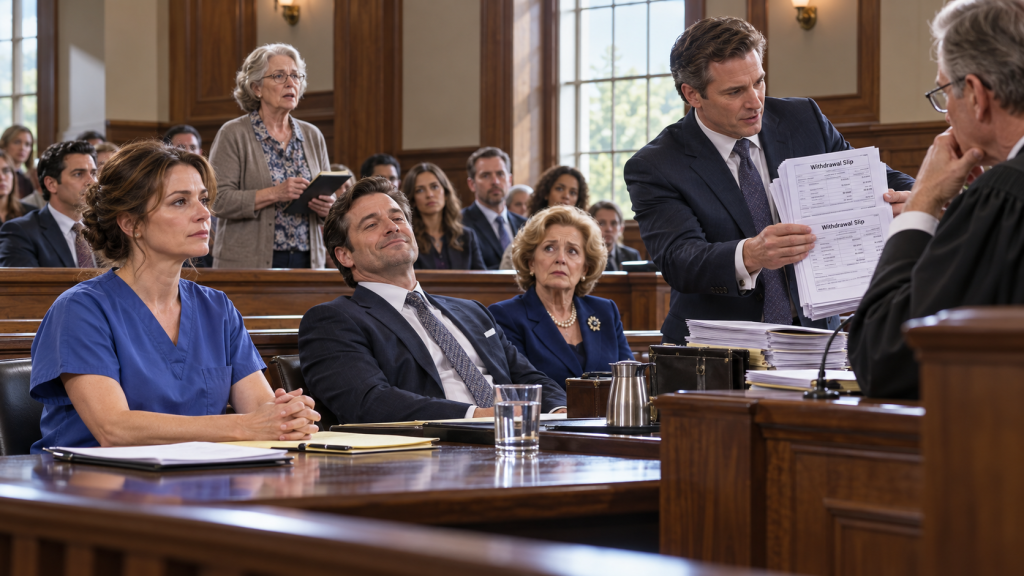
“Your Honor, we also recovered security footage showing who handed Mrs. Brooks’s license to his mother before the first withdrawal.”
Nobody breathed.
Not me.
Not my lawyer.
Not my husband.
Especially not my husband.
The smile he had been wearing twenty minutes earlier was gone so completely that I almost wondered whether I had imagined it.
His attorney, Mr. Dalton, leaned toward him and whispered something fast.
My husband—Dean—didn’t answer.
He was staring at Dana Price.
The blonde bank investigator stood in the second row holding my grandmother’s emerald ring in one hand and a narrow black folder in the other.
Behind Dean, his mother, Marilyn, made a sound like a breath had caught somewhere painful.
The judge looked at Dana.
“You have footage of Mr. Brooks?”
“Yes, Your Honor.”
Dean’s attorney stood immediately.
“We object to any characterization before we understand what footage she’s referring to.”
Judge Holloway looked at him.
“You may object when evidence is offered, Mr. Dalton. At the moment, I’m asking a witness a question.”
He sat.
Slowly.
Dana opened the black folder.
“The bank’s internal fraud investigation identified surveillance footage from the Route 9 branch parking area dated March twenty-ninth.”
My attorney, Mara Ellis, looked toward me.
March twenty-ninth.
Three days before the first withdrawal.
Dana continued.
“The video shows Mr. Dean Brooks parking beside a silver SUV registered to Marilyn Brooks.”
Marilyn stopped moving.
Dana’s voice remained calm.
“Mr. Brooks exits his vehicle carrying a white envelope. Mrs. Brooks exits the SUV. They speak for approximately two minutes. Mr. Brooks hands her the envelope.”
The judge asked:
“Do you know what was inside?”
“Not from the video alone.”
I already knew the answer was coming.
Dana continued.
“However, the branch camera captures Mrs. Brooks removing several items from the envelope while still standing beside the vehicle.”
She opened another page.
“One item appears to be a driver’s license.”
My hands became cold.
“The license she later presented at the teller window was Mrs. Angela Brooks’s license.”
Dean’s attorney stood again.
“Appearance is not identification.”
Dana nodded.
“That is correct.”
Then she looked at him.
“So we examined additional evidence.”
I had been a nurse for almost twenty years.
I had watched surgeons tell families that scans were worse than expected.
I had watched people sit perfectly still because moving would make the truth feel more real.
Dean looked exactly like that.
Dana said:
“The account-access records show that Mrs. Brooks’s online banking password was changed from the IP address assigned to the marital residence twelve days before the first withdrawal.”
My stomach turned.
Dean and I had still been living together.
Sleeping in the same bed.
He had changed my password while I was probably working a twelve-hour shift.
Dana continued.
“The bank also determined that three security-alert emails connected to the withdrawals were automatically forwarded to an email account created using Mr. Brooks’s secondary phone number.”
Mara had told me some of this the day before.
Hearing it in court was different.
In private, evidence is information.
In a courtroom, evidence becomes something the other person can no longer edit.
Judge Holloway looked toward Dean.
He stared at the table.
Dana continued.
“After Ms. Wilkes contacted Mrs. Brooks, counsel notified First Federal. We reopened the account investigation and coordinated with law enforcement because the customer also reported that an heirloom ring appearing in Ms. Wilkes’s description had disappeared from her home.”
I almost interrupted.
I had not filed a police report when the ring vanished.
Why would I?
My husband had spent two weeks convincing me I had lost it.
I had called St. Luke’s security.
Checked every locker.
Asked environmental services to look beneath cabinets.
Called the laundry.
Posted in the nurses’ group chat.
Emerald ring, two small diamonds, belonged to my grandmother. Please let me know if anyone finds it.
Dean had watched me search.
He once kissed my forehead and said:
“It’ll turn up, Ang.”
Now that same ring rested in Dana’s palm.
Dana looked down at it.
“A pawn transaction was located using the ring’s description and photographs supplied by Mrs. Brooks.”
Dean’s lawyer already knew where this was going.
He closed his eyes.
“The seller,” Dana said, “presented a driver’s license in the name of Dean Brooks.”
My heart gave one hard beat.
His mother whispered:
“Dean.”
He did not turn around.
Judge Holloway’s expression became very still.
“Ms. Price, where is the ring now?”
Dana held it slightly higher.
“It was recovered through coordination with the pawnshop and local investigators and is being held as evidence. I brought it today pursuant to subpoena.”
My eyes filled.
I wanted to take it.
Put it on.
Hold it in my fist.
Something.
But it was evidence now.
Even my grandmother had been drafted into the case.
Dean suddenly stood.
“Your Honor, I need a recess.”
His attorney grabbed his sleeve.
Judge Holloway’s eyes hardened.
“Mr. Brooks, your attorney speaks for you.”
Dean sat.
His mother started crying.
Not quietly anymore.
Judge Holloway looked toward Mara.
“Ms. Ellis?”
Mara stood.
“Your Honor, at this stage we’re requesting permission to continue with Ms. Wilkes’s testimony regarding identification, followed by Ms. Price regarding the bank investigation.”
Mr. Dalton stood.
“We request a continuance.”
Mara answered:
“My client has spent six months being accused in pleadings of dissipating marital funds. Mr. Brooks introduced the withdrawal slips himself today.”
That mattered.
Dean’s side had brought the slips.
They were supposed to be the knife.
Now the handle was pointing the other direction.
Judge Holloway looked at Mr. Dalton.
“How long have you had these slips?”
He hesitated.
“Approximately four months.”
“How long has your client maintained that Mrs. Brooks made the withdrawals?”
“Since they were discovered.”
“And today you presented them to establish marital waste.”
“Yes.”
Judge Holloway looked at Dana.
Then Joyce.
Then Dean.
“Twenty-minute recess.”
The gavel struck once.
The courtroom erupted into movement.
I stayed seated.
Mara leaned toward me.
“Don’t speak to anyone.”
I nodded.
“Especially Dean.”
“I know.”
“Especially Marilyn.”
“I know.”
“And if Dana approaches—”
“I know.”
Mara smiled slightly.
“You’re irritatingly trainable.”
“Nurse.”
We like instructions when they make sense.
Dean stood across the aisle.
His attorney moved directly in front of him.
I could not hear everything.
Only pieces.
“What else?”
“Tell me now.”
“Dean.”
“Do not lie to me.”
That last one came from his own lawyer.
I nearly laughed.
Marilyn pushed herself out of the front-row seat.
She turned toward me.
Mara stood at once.
“Mrs. Brooks, please do not approach my client.”
Marilyn’s face twisted.
“I need to talk to Angela.”
“No.”
“It’s family.”
Mara’s expression changed.
“This is precisely the moment when family stops being a legal argument.”
Marilyn stared at me.
“Angela.”
I folded my hands.
The same way I had when Dean’s lawyer first held up the slips.
I said nothing.
She cried.
Then turned away.
The blonde investigator, Dana, walked toward the hall.
As she passed, she looked at me once.
Not triumphant.
Not apologetic.
Just steady.
Joyce stayed in her seat.
The retired teller’s hands were shaking.
I moved toward her before Mara could stop me.
“Angela.”
“Two feet.”
I said.
“I’m only going two feet.”
Mara sighed.
I crouched beside Joyce.
She looked terrified.
“I should’ve known.”
“No.”
“Honey, I stamped those slips.”
“You’re here.”
“I looked at that license four times.”
“You’re here.”
“She wore that ring and I told her how beautiful it was.”
Joyce started crying.
“I helped somebody steal from you.”
I took her hand.
“You called me after you retired.”
“I read that article three times.”
The county paper had published a short report when our divorce case became unusually contentious.
It had mentioned the allegation that I withdrew marital savings before filing.
Not because I was important.
Because small counties occasionally treat divorce filings like spectator sports when enough money is involved.
Joyce said:
“I saw your picture.”
“I knew immediately.”
“Why didn’t you tell the bank earlier?”
She looked ashamed.
“Because I was retired.”
“I thought maybe I remembered wrong.”
“Then I dreamed about the ring.”
My throat tightened.
“You came anyway.”
She nodded.
“I couldn’t let you carry it.”
That sentence stayed with me.
Twenty minutes later, court resumed.
Joyce testified first.
Her voice shook for the first three questions.
Then something happened.
The more specific the questions became, the steadier she got.
How long at First Federal?
Twenty-two years.
Did she remember the withdrawals?
Yes.
Why?
Large cash withdrawals were unusual at her window.
The same customer came repeatedly.
The customer wore an antique emerald ring.
The customer mentioned it had belonged to her grandmother.
Did Joyce believe the identification at the time?
Yes.
Why?
The woman presented my driver’s license.
Knew my date of birth.
Address.
Account information.
Signature card details.
And answered a security question regarding the street where I grew up.
My stomach turned.
Dean knew all of those things.
My mother-in-law knew most.
The woman wore oversized glasses.
Her hair had been dyed darker and cut roughly like mine.
She claimed she had lost weight after changing medication.
Joyce noticed the license picture did not look perfect.
But the license was valid.
The account details matched.
The signature looked close.
And the branch was short-staffed.
That was the ugly truth.
Fraud does not always require genius.
Sometimes it requires one rushed person trusting documents designed to be trusted.
Mara asked:
“Mrs. Wilkes, do you see the woman who appeared at your window?”
Joyce looked at Marilyn.
“Yes.”
“Please identify her for the record.”
Joyce swallowed.
“That woman.”
She pointed.
“Mrs. Marilyn Brooks.”
Marilyn sobbed.
Dean stared straight ahead.
His lawyer did not turn around.
Then Mr. Dalton cross-examined.
He was good.
Much better than I wanted him to be.
“Mrs. Wilkes, you saw hundreds of customers each month?”
“Yes.”
“You retired shortly after these transactions?”
“Yes.”
“You are seventy years old?”
“Seventy-one.”
“Memory can change over time?”
“Yes.”
“You initially approved all four transactions?”
“Yes.”
“You did not report concerns about identity fraud then?”
“No.”
He lifted one withdrawal slip.
“You certified this transaction.”
“Yes.”
“So at the time, you believed the woman was Angela Brooks.”
“Yes.”
“Yet now, months later, after reading a newspaper article, you’ve changed your mind.”
Joyce looked at him.
“No.”
Mr. Dalton paused.
“You just said—”
“I changed whose name I put with the face.”
Silence.
Joyce continued.
“I remember the woman.”
“I remembered her before I knew who she was.”
“I remember the ring.”
“I remember the voice.”
“I remember telling her my sister had an emerald like it.”
“I remember she said, ‘Mine was my grandmother’s.’”
Joyce pointed toward Marilyn.
“That is the woman.”
Mr. Dalton sat.
My hands were shaking now.
Not Joyce’s.
Mine.
Dana testified next.
She was clinical.
Security footage.
IP logs.
Email forwarding.
Pawn record.
Account records.
The bank’s internal procedures.
She did not call Dean a thief.
Did not need to.
At one point Mara asked:
“Did your investigation identify where the withdrawn funds went?”
Dean’s lawyer stood.
“Objection. Foundation.”
The judge let Dana explain.
Three of the cash withdrawals were followed within forty-eight hours by deposits into Marilyn’s account.
Not identical amounts.
That would have been obvious.
Smaller.
Structured.
Nine thousand.
Eight thousand five hundred.
Seven thousand.
Then payments from Marilyn’s account went to:
A boat lender.
A marine electronics dealer.
A storage-facility account controlled by Dean.
The fourth withdrawal—eighteen thousand dollars—did not appear in banking records.
At first.
Then investigators found a safe-deposit box Marilyn had opened ten days after the last withdrawal.
When law enforcement later executed a warrant as part of the fraud investigation, the box contained:
$14,600 in cash.
A copy of my driver’s license.
Two preprinted withdrawal slips.
And an envelope with Dean’s handwriting.
Dana did not read the whole note.
Only one line.
If they ask why you need cash, say home repairs. Don’t mention me.
Dean finally looked at me.
For six months, I had imagined what I would feel if proof appeared.
Victory?
Rage?
Relief?
I felt tired.
So tired.
Because evidence does not return the nights you lay awake wondering whether maybe you did something and forgot.
It does not give back the hours I searched St. Luke’s for my grandmother’s ring.
It does not erase the way Dean said:
“You work too much, Ang. Maybe you’re more scattered than you think.”
That sentence had done more damage than the money.
He made me distrust my own memory.
My own hands.
My own mind.
Dana continued.
The bank’s investigation concluded the four withdrawals were fraudulent.
First Federal would reimburse the account subject to final processing and coordination with law enforcement.
Sixty-one thousand dollars.
Restored.
Not by Dean.
By the bank.
The bank would pursue its own remedies.
Mara sat.
Dean’s attorney requested immediate recess and a continuance of the divorce property hearing.
Judge Holloway granted part of it.
Then she looked directly at me.
“Mrs. Brooks.”
I stood.
“Yes, Your Honor?”
“Based on the evidence presented today, I am not making a final criminal determination. That belongs elsewhere.”
“Yes.”
“But for purposes of this domestic proceeding, I find substantial evidence that the withdrawals attributed to you were not made by you.”
I stopped breathing.
There.
Not stolen.
Not irresponsible.
Not forgetful.
Not the nurse who emptied the savings.
The judge continued.
“The court will not treat the sixty-one thousand dollars as dissipation by Mrs. Brooks.”
My eyes filled.
Mara touched my elbow.
“Sit.”
I did.
The court continued the remaining property issues.
Ordered preservation of assets.
Ordered Dean not to sell or encumber the boat.
Directed both parties to provide full financial disclosures.
And referred copies of the transcript and exhibits as appropriate to investigators already involved.
Then Judge Holloway looked at Dean.
Her expression was not theatrical.
Worse.
Disappointed.
“Mr. Brooks, you are represented by counsel. Follow his advice.”
Dean nodded.
“Yes, Your Honor.”
His voice was barely audible.
Court adjourned.
Everyone stood.
I remained seated for a moment.
Mara whispered:
“You okay?”
“No.”
“Good.”
I looked at her.
She shrugged.
“If you said yes, I’d worry.”
I laughed.
Then cried.
Both at once.
Joyce waited near the courtroom door.
Dana was packing documents.
Dean’s mother had disappeared into the hall.
Dean stayed with his lawyer.
I saw his shoulders moving.
He might have been crying.
I did not go closer.
The first person I hugged was Joyce.
She whispered:
“I am so sorry.”
I said:
“You gave me my name back.”
She shook her head.
“No, honey.”
“Your name was always yours.”
I cried harder.
Maybe.
But for six months, everyone else had been using it differently.
Thief.
Liar.
Spendthrift.
Unstable.
Forgetful.
A name can remain yours legally while still being dragged through other people’s mouths.
Dana approached.
She held a small evidence pouch.
Inside was the ring.
I could see the green stone.
My grandmother’s ring.
The same tiny scratch near one diamond.
I touched the plastic.
“When can I have it?”
“Not today.”
I nodded.
Evidence.
Of course.
She said:
“But it will come back.”
I looked at her.
“Promise?”
She smiled gently.
“I’m careful with that word.”
Then:
“But yes, barring something unusual, it should eventually be released to you.”
Good enough.
Outside the courthouse, reporters from the county paper were waiting.
One asked:
“Mrs. Brooks, do you have anything to say about today’s testimony?”
Mara started to move me past them.
I stopped.
She looked at me.
“One sentence.”
she warned.
I turned toward the reporter.
“I did not withdraw that money.”
That was all.
No attack.
No revenge quote.
Just correction.
The next morning, the county paper printed:
BANK INVESTIGATION DISPUTES WITHDRAWAL CLAIM IN BROOKS DIVORCE
Underneath was my photograph.
Not flattering.
I did not care.
I bought six copies.
Mara laughed when she saw them.
“What are you doing?”
“Correcting the archive.”
I mailed one to my sister.
One to my mother.
One to St. Luke’s break room.
Petty?
Maybe.
Necessary?
Absolutely.
The criminal investigation moved faster after the hearing.
Not fast.
Nothing legal is actually fast once you want it to be.
Investigators interviewed Marilyn.
Dean.
Bank employees.
The pawnshop owner.
His employer.
Me.
Again.
And again.
I learned that Dean had not been in North Dakota continuously the way he claimed.
His pipeline schedule was three weeks on, one week off.
He had been home before the first withdrawal.
Then gone for the next three.
The perfect alibi, he thought.
He gave Marilyn my driver’s license before leaving.
My license had gone missing from my wallet for two days.
I remembered that.
I had blamed myself.
Then it mysteriously reappeared.
Dean said:
“You probably left it in the truck.”
Another small lie.
Another little push away from trusting myself.
Investigators recovered deleted texts from Marilyn’s phone.
Not magical recovery from nowhere.
Her cloud backup still held them.
One from Dean:
She never uses Route 9 branch. Joyce there is older. Be confident.
Another:
Wear the emerald ring. Makes it look normal. Ang always wears jewelry.
I had worn that ring to our niece’s wedding.
Marilyn had complimented it.
Another message:
Once savings is gone, she’ll take settlement. She won’t have money to keep paying lawyers.
That one almost broke me.
The sixty-one thousand dollars was not simply theft.
It was strategy.
Dean wanted me financially tired.
Scared.
Unable to fight.
His first settlement offer suddenly made sense.
I would take $18,000 cash.
A smaller share of the home equity.
My retirement.
He would keep the boat, truck, equipment, and several investment accounts.
And we would each waive claims to “prior disputed withdrawals.”
He told me:
“It’s the only way we stop bleeding attorney fees.”
He knew exactly why I had less money to fight with.
The withdrawn savings had funded the trap.
Mara read the recovered message.
Then removed her glasses.
“I would like five minutes alone with a heavy object.”
I laughed.
“Professional ethics?”
“Unfortunately.”
The rest of the money trail became clearer.
Marilyn had deposited roughly twenty-four thousand into her account.
From there, $17,800 went toward Dean’s boat loan and marine equipment.
Another $4,000 paid legal-retainer expenses before I even knew he had consulted a divorce attorney.
The remaining amounts moved through cash.
The $14,600 in the safe-deposit box accounted for much of it.
Several thousand had been spent.
Restaurants.
Hotel.
Fuel.
Cash purchases.
One charge led investigators to a woman in Fargo.
That was when I learned about Beth.
Not the blonde in court.
Beth.
Thirty-seven.
Divorced.
Worked in procurement for a company contracting on the pipeline project.
Dean had been seeing her for approximately eight months before he filed.
Strangely, that was not the worst revelation anymore.
If you had told me six months earlier my husband had a girlfriend, I would have thought my heart had an absolute bottom.
It turns out betrayal has basements.
Beth had not known about the withdrawals.
At least investigators found no evidence she did.
She believed Dean was already separated.
Of course.
There must be a pamphlet men receive.
I’m basically separated.
My wife and I live separate lives.
We’re only staying together for finances.
Classic.
Beth cooperated.
Ended the relationship.
Sent me one email.
I am sorry. I did not know the truth. I won’t contact you again.
I never replied.
Not every woman connected to your husband’s dishonesty requires your energy.
Marilyn was different.
She had known me twenty years.
She watched me bring casseroles to her after knee surgery.
I had changed her bandages after a skin procedure.
Picked her up when her car broke down.
Sat beside her when her sister died.
Then she put on my grandmother’s ring and became me long enough to take my savings.
That betrayal had no convenient label.
One afternoon, three months after the hearing, I found her waiting outside St. Luke’s employee entrance.
She stood beside a bench in a brown coat.
No navy suit.
No courtroom.
Just Marilyn.
I stopped ten feet away.
“You shouldn’t be here.”
“I know.”
“There is an order that says you do not contact me about the case.”
“This isn’t about the case.”
“It all is.”
She cried.
“I need two minutes.”
I should have walked away.
I didn’t.
Maybe because I wanted to see whether she could say it.
Not explain.
Say it.
“I’m sorry.”
she whispered.
I waited.
She wiped her face.
“Dean told me the money was his.”
There it was.
Explanation.
I turned.
“No.”
“Angela, please.”
I stopped.
She continued quickly.
“He said you had already taken money from another account.”
“He said you were going to clean him out.”
“He said he had been putting his whole paycheck into savings while you spent yours.”
I looked at her.
“You knew I was a nurse.”
“Yes.”
“You knew I worked doubles.”
“Yes.”
“You knew the savings existed before his pipeline job.”
Her face crumpled.
“Yes.”
“You knew my grandmother’s ring was mine.”
“Yes.”
“You wore it anyway.”
She began shaking.
“Yes.”
“Did Dean force you?”
“No.”
“Threaten you?”
“No.”
“Did he tell you the withdrawals were legal?”
“He said because you were married, it was all both of yours.”
I laughed.
“That wasn’t my question.”
She closed her eyes.
“No.”
“No what?”
“No, I didn’t think what we were doing was legal.”
There.
The sentence I needed.
Not:
He confused me.
Not:
I thought it was his.
“I knew it was wrong.”
she whispered.
I nodded.
“Thank you.”
She looked up.
“For what?”
“For not making me listen to another lie.”
She cried.
“I thought I was helping my son.”
“You were.”
Her eyes widened.
“You helped him steal.”
“You helped him lie.”
“You helped him make his wife look unstable.”
“That is what you helped him do.”
She sobbed.
I felt something painful and clean settle inside me.
Not forgiveness.
Truth.
She said:
“I’ll pay back whatever they tell me.”
“Good.”
“I’ll testify.”
“Good.”
“I know you’ll never forgive me.”
I thought.
“I don’t know.”
Her face changed.
“But forgiveness is not the same as having you in my life.”
She nodded.
“I understand.”
“Do you?”
“Yes.”
“I hope so.”
Then I walked inside.
I never had another private conversation with Marilyn.
That sounds cold.
It was not.
Sometimes closure is refusing to keep reopening a wound simply because the person who caused it has finally become ready to examine it.
Marilyn eventually entered a plea.
She cooperated.
Admitted impersonating me at the bank.
Admitted using my license.
Admitted signing my name.
Admitted taking the ring from my jewelry box after Dean told her where I kept it.
That detail hurt.
He had not stolen it himself.
He sent his mother into our bedroom.
She opened my jewelry box.
Selected the emerald ring.
Put it on.
Then walked into a bank pretending to be me.
You can forgive many things.
You never forget the architecture of them.
Her cooperation mattered in sentencing.
She paid restitution connected to the fraud and bank losses.
She received criminal penalties that included probation and other conditions rather than disappearing into some dramatic life sentence.
I did not attend sentencing.
I was working.
A patient needed me.
That mattered more.
Dean fought longer.
His lawyer attacked the investigation.
The bank procedures.
His mother’s credibility.
The recovered messages.
The money trail.
Then the evidence kept accumulating.
The pawn record had his signature.
His license.
The shop’s camera.
The email forwarding.
The messages.
The boat payment.
The safe-deposit note.
At some point, defense becomes arithmetic.
Too many facts on one side.
He eventually entered a plea too.
Several charges resolved together.
Forgery.
Identity-related fraud.
Theft-related conduct.
I do not remember every statutory name.
I remember what he said in court.
That mattered more.
He stood wearing a gray suit.
The same one he used for weddings.
He said:
“I convinced myself the savings were partly mine, so taking them was not stealing.”
His attorney had probably prepared that sentence.
Then Dean went off script.
I could tell because his lawyer looked up sharply.
“But that isn’t the truth.”
The courtroom became still.
“The truth is I wanted Angela scared.”
My hands tightened.
“I thought if she believed the bank records were against her, she would settle quickly.”
He stared at the floor.
“I knew she had worked for that money.”
“I knew the ring belonged to her grandmother.”
“I knew my mother was committing fraud for me.”
His voice broke.
“And I let my wife think she was losing her memory.”
That one nearly destroyed me.
He looked toward me.
I did not look away.
“I am sorry.”
The judge later imposed the sentence.
Custody time.
Probation afterward.
Restitution.
Financial penalties.
Conditions.
People expected me to feel satisfied.
I didn’t.
Consequences are necessary.
That does not mean they taste good.
When somebody you loved for seventeen years is taken through a side door after sentencing, you do not suddenly become a stranger to every good morning that came before.
I remembered him holding my hair when I was sick.
Repairing my mother’s porch.
Driving four hours through an ice storm when my car broke down.
Dancing badly at our wedding.
Then I remembered him changing my bank password.
Both men were him.
That was the hardest truth.
Villains would be easier.
The divorce resumed after the criminal facts became clearer.
This time, when we entered Judge Holloway’s courtroom, nobody smiled.
Dean’s mother did not attend.
Beth did not exist in the case beyond relevant financial evidence.
Dana sat in the hall for part of the morning but was not needed.
Joyce did not have to return.
Good.
She had already given enough.
The bank restored the $61,000 to the marital account, with adjustments handled through its fraud process.
That did not mean Dean walked away from responsibility.
The bank pursued restitution through the criminal case.
In the divorce, Judge Holloway considered the concealed spending, boat payments, litigation conduct, and other financial behavior in dividing property.
I did not receive everything.
I had never asked for everything.
I received my fair share.
A little more in some categories because of proven marital waste.
The house—the modest three-bedroom we had finally bought when I was forty-one—went to me subject to refinancing.
Not the big-yard dream house.
That one never happened.
But this house had a maple tree out front and enough grass in back for a table.
I wanted it.
The boat went to Dean.
Mara asked whether I wanted to force a sale.
“No.”
She looked surprised.
“Why?”
“I never want to see it again.”
Fair.
My retirement remained mine.
His remained his subject to division required by law.
The savings were accounted for.
The hidden expenses were accounted for.
The final order contained one paragraph I read more than any dollar figure.
The Court finds that Angela Brooks did not make or authorize the four disputed withdrawals from the First Federal savings account and did not dissipate marital funds as alleged.
I asked Mara for a certified copy.
She laughed.
“Planning to frame it?”
“No.”
I did.
Not in the living room.
I’m not insane.
In my office.
Bottom drawer.
Sometimes you need an official document confirming something you always knew about yourself.
When the divorce became final, Dean looked at me across the hallway.
He had not yet begun serving the custodial portion of his sentence.
He looked smaller.
Not physically.
The swagger was gone.
“Ang.”
I stopped.
Mara waited nearby.
“I’m sorry.”
“I know.”
“Do you?”
“Yes.”
“Does that help?”
I thought.
“Sometimes.”
He nodded.
Then:
“I really did love you.”
My eyes filled despite myself.
“I know.”
“That doesn’t make sense, does it?”
“It makes terrible sense.”
He looked confused.
I continued.
“People hurt people they love every day.”
“Love doesn’t prevent selfishness.”
“Character is what’s supposed to help with that.”
He looked down.
“I failed.”
“Yes.”
I did not soften it.
Then I added:
“But you are more than the worst thing you did to me.”
He looked up.
That was probably kinder than he deserved that day.
I did not say it for him.
I said it because I needed the opposite to be true too.
I was more than the worst thing done to me.
We signed final papers.
Mara and I went for lunch.
I ordered pie first.
She stared.
“Divorce tradition?”
“New one.”
Good.
Three weeks later, Dana called.
“The ring can be released.”
I drove to the police property office myself.
No courier.
No lawyer.
Me.
The employee behind the window checked identification.
I almost laughed.
“Something funny?”
“No.”
I handed over my license.
He compared my face.
Carefully.
Good.
Then he asked me to sign.
My real signature.
Angela Brooks still, technically? After divorce maybe she might return maiden name. Did user give maiden? No. Could keep Brooks or restore maiden later. Maybe she decides to keep Brooks because professional identity? Hmm. Let’s choose she restores maiden name in divorce: Angela Reed maybe. But user premise name Brooks. The story can mention she thought about changing but kept Brooks because nursing license and career? Yet “name cleared” matters. Could retain. Let’s say I kept Brooks—not for Dean, but because it had been mine in my career and I wasn’t surrendering it. Good.
I signed:
Angela Brooks.
People asked why I kept his last name.
Simple.
I had been Angela Brooks at St. Luke’s for seventeen years.
Hundreds of patients knew Nurse Brooks.
My degrees.
Licenses.
Career.
Mortgage.
My name had become mine too.
I did not want to rearrange myself because Dean had misused it.
The property clerk returned the ring in a small plastic bag.
I sat in my car for ten minutes before opening it.
The emerald looked dull under cloudy light.
I cleaned it on my scrub top.
Then put it on.
My grandmother wore it for forty-one years.
My mother wore it twice.
I had worn it through nursing school graduation.
Our wedding.
My fortieth birthday.
Then Marilyn wore it to steal my savings.
For months, I thought that had contaminated it.
It hadn’t.
Objects do not inherit guilt.
People assign meaning.
I wore it home.
The first thing I did was call Joyce.
She answered on the fourth ring.
“Angela?”
“How did you know?”
“Nobody calls anymore except doctors and scammers.”
I laughed.
“I got the ring back.”
Silence.
Then she cried.
“Oh, honey.”
“I wanted you to know.”
“I’m glad.”
“Can I take you to lunch?”
“No.”
I frowned.
“Why?”
“I’m taking you.”
We compromised.
Diner.
Separate checks.
She cheated and paid while I was in the bathroom.
Retired tellers are criminals in small ways.
Joyce told me about her grandchildren.
I told her about St. Luke’s.
Then she said:
“I still feel guilty.”
I put down my fork.
“Stop.”
“I should’ve looked harder.”
“Maybe.”
She flinched.
I continued.
“But if guilt brought you to me, let it finish its job.”
“What does that mean?”
“You came.”
“You testified.”
“You stood up when your knees were shaking.”
“You cannot spend the rest of your life punishing yourself to prove you understand.”
She stared.
Then smiled.
“You sound like a nurse.”
“I charge by the hour.”
She laughed.
We became friends.
Not best friends.
Lunch every few months.
Christmas card.
The strange kind of friendship built by one terrible day.
First Federal also sent me a formal apology.
Long.
Corporate.
“We regret.”
“Procedural failures.”
“Enhanced verification protocols.”
The branch changed certain processes for large cash withdrawals.
Good.
I did not need someone fired.
I needed fewer people to experience what I had.
Dana eventually told me the bank used my case in internal fraud training.
Imagine.
My grandmother’s ring became PowerPoint.
Life is strange.
At St. Luke’s, the gossip changed slowly.
That was harder than court.
Courts can issue findings.
Coworkers have memories.
Some had believed me from the beginning.
Others had not.
One nurse, Jenny, had once said in the break room:
“Stress makes people do weird things.”
At the time I knew exactly what she meant.
Maybe Angela took the money.
Maybe she doesn’t remember.
After the hearing, she approached me beside the medication room.
“I owe you an apology.”
I looked at her.
“For?”
She started crying immediately.
“I thought maybe…”
“I know.”
“I never said it directly.”
“You didn’t have to.”
“I’m sorry.”
I could have made her suffer.
Instead I said:
“Next time someone says they didn’t do something, maybe leave room for the possibility that they know their own life.”
She nodded.
“I will.”
That was enough.
Another coworker never apologized.
Fine.
Not every relationship needs repair.
The house took work.
Refinancing on one nursing income was possible but uncomfortable.
The divorce settlement helped.
I picked up extra shifts for a while.
Irony.
But this time the money went toward something I chose.
I painted the bedroom.
Dean had always liked beige.
Every wall in our marriage was beige.
I painted it deep green.
Melissa? Different story. Need no carryover. Angela maybe has sister? Not introduced. We can give friend “Rosa” from work. Better.
My friend Rosa from night shift came over.
She stared at the wall.
“That is extremely green.”
“Good.”
“You okay?”
“Never better.”
I replaced the dining table.
Kept the old sofa.
Sold Dean’s recliner.
Donated his fishing magazines.
He took personal things through arranged pickup.
No dramatic bonfire.
No throwing clothes on lawns.
I had spent enough time cleaning messes at work.
I did not need to create another.
The bass boat disappeared from my life too.
I heard he eventually had to sell it to satisfy part of his financial obligations.
That was almost poetic.
I refused to enjoy it too much.
Almost.
A year after the divorce, I turned forty-three.
No party.
I worked until seven.
Came home.
Put frozen pizza in the oven.
Then stood at my back window looking at the small yard.
The yard Dean had said we could improve “once things settled.”
Things had settled.
Not the way we imagined.
I thought about the house I had saved for through all those double shifts.
Big yard.
Porch.
Maybe a garden.
I had used some of the recovered savings on attorney expenses and household stability.
There was still enough left, with my share of equity and settlement, to make a decision.
I could stay.
Or move.
For the first time, nobody else had a vote.
I called a realtor.
Six months later, I sold the three-bedroom house.
People thought I was giving up something I had “won.”
They missed the point.
I did not want to spend the next twenty years living inside proof.
I found a small brick house twenty minutes from St. Luke’s.
One acre.
Not huge.
Enough.
A wraparound porch that needed repair.
Two oak trees.
A patch of soil behind the garage.
The first time I walked the property, the realtor said:
“There’s room for a garden.”
That did it.
I bought it.
Not cash.
I am a nurse, not a lottery winner.
Reasonable mortgage.
Large down payment.
My name only.
At closing, the title agent pushed documents toward me.
I read every page.
Every single page.
She looked at the clock twice.
I did not care.
When she asked:
“Ready to sign?”
I said:
“Now I am.”
My signature looked beautiful.
Not because it was fancy.
Because it belonged to me.
I planted tomatoes that spring.
Killed half.
Nurses are not automatically farmers.
Joyce brought me basil.
Rosa brought wine.
My mother brought opinions.
Life returned in ordinary pieces.
That surprised me.
I thought recovery would arrive like court.
A ruling.
A gavel.
A formal finding.
Instead it looked like buying bath towels nobody else chose.
Sleeping diagonally.
Leaving dishes until morning.
Taking a weekend off.
Removing Dean from the emergency contact line at work.
Small acts.
One day, I noticed I had gone three hours without thinking about him.
Then half a day.
Then a full one.
Healing is rude like that.
It happens without announcing itself.
Dean wrote me letters while he served his sentence.
I did not read the first three.
Mara kept them.
“You’re not obligated.”
“I know.”
The fourth came after six months.
The envelope sat on my kitchen counter for a week.
Then I opened it.
Dean wrote:
Ang,
I have spent a lot of time trying to understand why I did what I did without turning the explanation into an excuse.
Good beginning.
I was angry that you wanted a divorce before I felt ready to lose the life we had. I was already seeing Beth, which makes that sentence hypocritical, but I still thought I should control when the marriage ended and how much it cost me.
I stared.
At least honest.
I told myself the savings were half mine. Then I told myself your nursing income was why we had money, but my pipeline work was why we had a future. Then I told myself you would take too much if the court saw the full picture. Every step made the next one easier.
There.
A staircase.
When Mom agreed to help, I used that as proof that I wasn’t crazy. I should have used it as proof that two people can be wrong together.
I laughed once.
Despite myself.
Then:
The worst thing I did wasn’t taking the money. It was watching you question yourself.
My hands began to shake.
You asked me one night whether you had been sleepwalking because you could not explain why the bank said you had withdrawn cash.
I remembered.
Oh God.
I told you maybe stress was affecting you. I knew exactly where the money was.
I stopped reading.
Walked outside.
Sat on the porch.
For twenty minutes, I stared at my yard.
Then I went back.
I don’t expect forgiveness. I want you to know I understand that part now.
I folded the letter.
Put it back in the envelope.
Cried until my head hurt.
Then I called Mara.
“I read it.”
She waited.
“Well?”
“I hate him.”
“Okay.”
“I love him.”
“Also okay.”
“I never want to see him again.”
“That can coexist too.”
Thank God for lawyers who understand human contradiction.
I eventually replied.
One page.
Dean,
The money was replaceable. My ring was recoverable. Even the marriage could end and still leave me with a life. The thing you almost took that frightened me most was trust in my own mind.
I believe you understand that now.
I hope you become someone who never does that to another person again.
I am not ready for contact beyond necessary matters.
Angela
He wrote back once.
I understand.
Then stopped.
That was respect.
Late.
Still real.
Marilyn sent no more letters.
She respected the boundary too.
Years later, when she became ill, Dean’s sister contacted me.
Not asking me to visit.
Just informing me.
I sent a card.
Nothing more.
People found that strange.
“After what she did?”
Yes.
A card is not absolution.
Kindness does not require amnesia.
Marilyn died two years later.
I went to the funeral.
Sat in the back.
No one asked me to.
Dean was there.
Out of custody by then.
Older.
Thinner.
We had not seen each other in nearly three years.
After the service, he approached.
“Thank you for coming.”
“I knew her a long time.”
“Yes.”
We stood awkwardly.
Then he said:
“She kept a photograph of you.”
I frowned.
“What?”
“From our wedding.”
I did not know what to do with that.
So I said:
“I’m sorry you lost your mother.”
His eyes filled.
“Thank you.”
Then we separated.
No closure speech.
Life does not owe you one at every funeral.
Dean rebuilt too.
I heard through mutual friends that he returned to pipeline work.
No management role at first.
Later, another company gave him responsibility.
He completed financial counseling.
Paid what he owed.
Sold the boat.
Moved into an apartment.
Beth did not return.
He remained single for years.
Not my concern.
Then, unexpectedly, he sent me an email five years after our divorce.
I’m getting remarried next month. I wanted you to hear from me, not someone else.
I stared.
Then replied:
I wish you both well. Be honest with her.
His answer:
I will.
I hope he was.
That was enough.
I never remarried.
Not because I became cynical.
I dated.
A physical therapist named Warren for three years.
Good man.
Loved hiking.
Hated tomatoes.
Impossible flaw.
We eventually decided we were better as friends.
No betrayal.
No courtroom.
Just two adults who wanted different daily lives.
That ending taught me something too.
Not every relationship has to explode in order to end.
A gift.
I stayed at St. Luke’s until fifty-eight.
Not because I had to.
Because I still loved nursing.
Not every shift.
Anyone who claims that is selling something.
But enough.
I reduced doubles.
Took vacations.
Used my paid time off instead of hoarding it like wartime sugar.
The savings account rebuilt.
Slowly.
Legitimately.
Every payday, I still moved half.
Habit.
But the goal changed.
Not the house.
I already had it.
I saved because savings meant options.
Leave a bad job.
Fix the roof.
Help my mother.
Rest.
Money stopped being a scoreboard between me and Dean.
It became what it should have been all along.
Stored choice.
Joyce attended my retirement party.
By then she walked with a cane.
She brought an envelope.
Inside was a photocopy of the first withdrawal slip.
I stared at her.
“What kind of retirement gift is this?”
She laughed.
“Turn it over.”
On the back she had written:
A bad piece of paper can lie for a while. It cannot make the truth disappear forever. Love, Joyce.
I cried.
Then hugged her.
She whispered:
“You kept your name.”
“Yes.”
“I’m glad.”
So was I.
Dana sent flowers.
Of course she did not attend.
Bank investigators apparently have lives.
Mara came.
Drank two glasses of champagne.
Then told everyone:
“I saved this woman.”
I shouted:
“You billed me.”
She yelled back:
“Same thing.”
Good party.
After retirement, I finally had time for the yard.
The tomatoes improved.
I planted hydrangeas.
A fig tree.
Then, near the porch, I planted an emerald green Japanese maple.
Rosa said:
“That’s a little on the nose.”
I said:
“I earned symbolism.”
The grandmother’s ring stayed on my right hand.
Not every day.
But often.
People occasionally complimented it.
For years, every compliment sent me back to Joyce’s teller window.
Beautiful ring.
It was my grandmother’s.
Marilyn had spoken my history with my jewelry on her hand.
That memory used to make me sick.
Eventually, the ring became mine again.
A stranger at a grocery store once said:
“That’s gorgeous.”
I smiled.
“Thank you.”
Nothing else.
No story.
That was healing too.
You know a wound has changed when you stop needing everyone to understand how you got it.
The county paper published another article years later about First Federal’s new fraud controls.
My case was mentioned anonymously.
I recognized it immediately.
“An impersonation case involving repeated in-person cash withdrawals.”
The branch now required enhanced identity verification for large transactions when appearance differed materially from identification.
Two employees for higher amounts.
Extra alerts.
Small things.
Procedures.
Maybe somebody else would keep their savings because Joyce once lost sleep.
That mattered.
I visited the Route 9 branch exactly once after everything.
New counters.
New tellers.
Joyce long retired.
A young woman asked:
“How can I help you?”
“I need a cashier’s check.”
She asked for identification.
Looked at my face.
Looked again.
“Can you confirm your address?”
I smiled.
“Absolutely.”
She seemed confused by my enthusiasm.
Good.
The cashier’s check was for the last payment on my mortgage.
I carried it to closing the next day.
At sixty-one, the little brick house with the porch and acre was mine.
Completely.
I came home.
Sat on the front steps.
Held a glass of iced tea.
No husband.
No lawyer.
No bank.
No one telling me what I had done.
I thought of the savings account I had built twelve hours at a time.
Sixty-one thousand dollars.
Gone.
Returned.
Then spent differently over years.
Money circulates.
Time does not.
That became the part I protected most.
I stopped working doubles for people who never learned my first name.
Stopped saying yes automatically.
Stopped explaining every no.
A patient once asked me near retirement:
“Were you always this calm?”
I almost laughed.
“No.”
“What changed?”
“Court.”
He thought I was joking.
Good.
Calm is not personality.
Sometimes it is what remains after you survive enough noise.
Dean and I saw each other one last time before I retired.
Not planned.
Hardware store.
He stood in plumbing.
I stood in gardening.
Very symbolic if you’re annoying.
He saw me.
Smiled carefully.
“Ang.”
“Dean.”
He looked at my ring.
Not wedding ring.
Grandmother’s.
His face changed.
“You got it back.”
“Years ago.”
“I know.”
“I mean…”
He stopped.
“I’m glad you wear it.”
I looked at him.
“Me too.”
Silence.
Then he said:
“I told my wife about everything.”
I nodded.
“Before we married.”
“Good.”
“She asked me why I would tell her something that made me look terrible.”
“What did you say?”
“That if I only tell the parts where I look good, she isn’t marrying me.”
That was a good answer.
I smiled.
“You learned something.”
“Expensively.”
“Mara would approve.”
He laughed.
Then:
“How are you?”
I thought.
“Good.”
Simple.
True.
“You?”
“Good.”
Maybe.
We both chose to believe it.
Then he said:
“I still have one question.”
“What?”
“Why didn’t you yell that day?”
I frowned.
“Court?”
“Yes.”
“When they showed the withdrawal slips.”
“You just sat there.”
“I thought you’d scream.”
I remembered.
His smile.
Should’ve taken the settlement, Ang.
My folded hands.
Why didn’t I yell?
“At first?”
I said.
“I was afraid.”
He looked surprised.
“Of what?”
“That Joyce might be wrong.”
There it was.
Even with a witness.
Even with the ring description.
Six months of being doubted had damaged me enough that part of me still feared reality would betray me again.
Then I continued.
“And after she stood up?”
“Yes?”
“I didn’t need to yell.”
He looked down.
“No.”
“You didn’t.”
That was all.
We went to separate aisles.
I bought potting soil.
He bought a faucet.
Ordinary endings are underrated.
When Joyce died at eighty-one, her daughter called me.
I attended the memorial.
On the table beside her photograph was an old First Federal name badge.
JOYCE WILKES
TELLER
I touched it.
The woman behind the glass.
People overlook tellers.
Nurses.
Receptionists.
Cashiers.
People whose jobs involve seeing thousands of small moments.
But Joyce remembered.
A ring.
A voice.
A face that did not quite match a license.
And months later, she chose discomfort over silence.
At the memorial, her daughter handed me a small envelope.
“Mom wrote this for you.”
Inside:
Angela,
The worst mistake I made at the bank was thinking certainty had to come before speaking. Sometimes concern is enough reason to ask another question.
Thank you for forgiving an old teller who should have asked one sooner.
I sat in my car and cried.
She still thought she needed forgiveness.
Maybe we all do.
I wrote her daughter later:
Your mother did more than testify for me. She reminded me that correcting a mistake matters.
That became important as I got older.
Because eventually, I stopped thinking about Dean only as the man who tried to frame me.
I remembered the later man too.
The one who confessed.
Paid restitution.
Told his next wife the truth.
Stayed away when I asked.
He could not undo what he did.
He did something smaller and more difficult.
He stopped pretending he hadn’t done it.
I never reconciled with him.
That was not required for his change to matter.
Forgiveness does not always end in reunion.
Sometimes it simply means you can say someone’s name without your body preparing for war.
That was enough.
At sixty-five, I finally bought the thing I had once planned to buy with part of our savings.
Not a bass boat.
God forbid.
A greenhouse.
Small.
Eight by twelve.
Behind the garage.
I grew herbs.
Tomatoes.
Peppers.
The first winter, I sat inside with a space heater and laughed because Dean once called my nursing job a hobby.
Gardening was my hobby.
Nursing had been the income that built everything.
Words matter.
For years, he called his financial choices investments and mine spending.
His job risk.
Mine hobby.
His boat asset.
My savings available.
That language had shaped our marriage before I noticed.
After the divorce, I became careful about nouns.
Work is work.
Money is money.
Fraud is fraud.
Love is love.
None should be renamed merely because the truth makes somebody uncomfortable.
My niece once asked me:
“Aunt Angela, how did you know Grandma’s ring would prove it?”
“I didn’t.”
“What?”
“Joyce knew the ring mattered.”
“I just answered the phone.”
She frowned.
“But you won.”
I smiled.
“Life is not a game where good people collect clues in the right order.”
“Sometimes somebody remembers.”
“Sometimes a camera works.”
“Sometimes evidence is lost.”
“You protect yourself as best you can.”
“Then you tell the truth.”
She looked disappointed.
Children want destiny.
Adults should teach documentation.
I gave her a fireproof file box when she got married.
She laughed.
“Aunt Angela.”
“Marriage gift.”
“Normal people give towels.”
“Normal people lose paperwork.”
She uses the file box.
Good.
The certified divorce order remained in mine.
So did the bank letter confirming fraud.
Pawn recovery receipt.
Joyce’s note.
Not because I needed to prove myself every morning.
Because there is a difference between living in the past and keeping records.
I learned that the expensive way.
One rainy afternoon after retirement, I took the original newspaper clipping from six months before the hearing.
The one that mentioned:
Husband alleges wife withdrew marital savings before divorce filing.
I had hated that article.
For years, it sat folded behind the corrected story.
I finally read both.
First allegation.
Then correction.
My life in two pieces of cheap paper.
I almost threw the first away.
Then stopped.
Kept both.
Because clearing your name does not require pretending it was never dirtied.
The before makes the after visible.
That evening, I sat on the porch.
Rain moved through the maple leaves.
Grandmother’s ring on my hand.
House paid.
Garden wet.
Life quiet.
I thought about the divorce courtroom again.
The exact second before Joyce pointed.
My husband smiling.
His mother behind him.
His lawyer holding slips with my forged name.
Everyone waiting.
The judge asking:
“Do you see her?”
Joyce’s finger lifting.
My whole life balanced on one old woman’s memory.
At the time, I thought the important answer was:
“It was the one in the navy suit.”
Years later, I think the important answer came before that.
“I am.”
The judge asked whether the teller was present.
Joyce stood.
Knees shaking.
And said:
“I am.”
She showed up.
That was the moment.
Truth does not speak by itself.
People have to carry it into the room.
Joyce did.
Dana did.
Mara did.
Eventually Dean did too.
And so did I.
For six months, I had been defending myself with sentences that sounded weaker every time I repeated them.
I didn’t do it.
That isn’t my signature.
I wasn’t at that branch.
People wanted evidence.
Fair.
But the absence of evidence had made me start treating my own certainty like arrogance.
By the time I reached court, folding my hands was the only thing keeping them from shaking.
Then Joyce stood.
And evidence finally caught up to truth.
That taught me something I carried into nursing until my last day.
When a patient says:
“That pain is different.”
Listen.
When an old woman says:
“I know my body.”
Listen.
When someone says:
“That signature isn’t mine.”
You do not have to abandon verification.
You should verify.
But verification begins with enough respect to look.
That is all I had needed from the bank.
From Dean’s family.
From some friends.
From myself.
Look again.
Years later, I was asked to speak at a local nursing-school graduation because apparently surviving divorce makes you inspirational if you are old enough.
I nearly declined.
Then went.
I stood at the podium looking at rows of graduates.
I told them no details about Dean.
Not their business.
I said:
“You are entering a profession where people will hand you facts that don’t fit the chart.”
“Do not become so loyal to the chart that you stop seeing the person.”
I thought of the withdrawal slips.
Stamped.
Signed.
Official.
Wrong.
“Paper can be wrong.”
“People can lie.”
“Systems can fail.”
“Your job is not to distrust everything.”
“Your job is to notice when something does not fit and have the courage to ask again.”
Afterward, a graduate named Kayla found me.
“My mom got accused of stealing at work once.”
“I’m sorry.”
“She didn’t do it.”
“I believe you.”
Kayla cried.
Such a small sentence.
Maybe we should use it more carefully.
And more often.
I am seventy now.
Still in the brick house.
The maple tree has grown tall enough to shade half the porch.
The greenhouse roof leaks.
I keep saying I’ll fix it.
Rosa says I’ve become Dean because I ignore maintenance.
Cruel.
Possibly true.
My grandmother’s ring spends more time in the safe than on my hand now.
My knuckles swell.
Age.
Sometimes I take it out.
Not to remember the fraud.
To remember Grandma.
That was the final reclamation.
For a long time, whenever I saw the emerald, I saw Marilyn at Joyce’s window.
Now I see Grandma’s hands rolling biscuit dough.
Her house smelled like coffee and Ivory soap.
She sang hymns badly.
She left me that ring because I was the only granddaughter who visited every Sunday during nursing school.
The ring belonged to that story first.
Fraud was only one chapter.
People who hurt you should not be allowed to become the permanent narrator of things that existed before them.
Not jewelry.
Not houses.
Not names.
Not your own life.
I kept Brooks.
Some people never understood.
“You could’ve gone back to your maiden name.”
Yes.
I could have.
But Brooks had been printed on my nursing badge for almost two decades.
Students called me Mrs. Brooks.
Patients remembered Nurse Brooks.
It was on my degree certifications.
My house.
My retirement accounts.
Dean did not own the name because his father carried it before I did.
I had lived inside it.
Worked inside it.
Survived inside it.
So I kept it.
Not for him.
For me.
That is another kind of taking something back.
The last time I saw Dean was at a mutual friend’s memorial when we were both in our sixties.
He walked with a slight limp.
I had arthritis in both knees.
Time finally humbled us equally.
He sat beside me because every other chair was full.
For ten minutes, neither of us spoke.
Then he whispered:
“Do you still have the ring?”
“Yes.”
“Good.”
A minute later:
“Do you still have the court order?”
I laughed.
“In a fireproof box.”
“Of course.”
Then:
“Do you hate me?”
I looked at the photograph of our friend near the flowers.
“No.”
He exhaled.
“Did you once?”
“Yes.”
“Fair.”
We sat quietly.
Then he said:
“I used to think the worst punishment was prison.”
I did not answer.
“It wasn’t.”
“What was?”
He stared at his hands.
“Realizing you were right to stop trusting me.”
That was sad.
Not satisfying.
I said:
“You built trust once.”
“You could build it with other people.”
“I did.”
He smiled faintly.
“My wife trusts me.”
“Good.”
“I don’t deserve how much.”
“Do not make her pay for what you did to me by refusing to accept what she gives you.”
He looked at me.
Then laughed softly.
“You still sound like a nurse.”
“Occupational damage.”
Our friend’s daughter began the memorial speech.
We stopped talking.
When it ended, Dean hugged me.
Brief.
Appropriate.
“Take care, Ang.”
“You too.”
He walked away.
That was the last time.
I heard he died several years later.
Heart attack.
Sudden.
His wife called me herself.
I sent flowers.
Attended no funeral.
Not because of anger.
Because that chapter no longer needed me standing in the room.
I sat on my porch instead.
Wore Grandma’s ring.
Remembered a younger Dean teaching me to cast a fishing line.
He was patient.
I was terrible.
We laughed until sunset.
That memory was true.
So was the bank fraud.
People are not edited into consistency by death.
I let both truths remain.
Then I went inside and made dinner.
Life continued.
If you ask me now what Dean stole, I could give you the official list.
Sixty-one thousand dollars.
My grandmother’s ring.
Months of legal fees.
Sleep.
Trust.
But if you ask what I got back, the list is longer.
The money.
The ring.
The house equity.
My reputation.
My confidence in my own memory.
My career.
My name.
My peace.
Some came through court.
Some through time.
Some I had to give back to myself.
That last category mattered most.
No judge can order it.
At my divorce hearing, Dean’s lawyer placed four withdrawal slips in front of a judge and said they proved I emptied our savings.
Every slip carried my name.
Official teller stamps.
Dates.
Amounts.
Documents that looked like facts.
Dean smiled at me.
His mother sat behind him in navy.
I folded my hands.
At the time, people thought I was calm.
I wasn’t.
I was terrified.
But somewhere behind Dean sat a retired teller who had lost sleep over a ring.
Beside his mother sat a bank investigator with a folder.
And buried inside security footage was the moment my husband handed another woman my identity.
Truth was already in the room.
I simply did not know how much of it had arrived.
That is what I remember whenever someone says:
“Why didn’t you fight harder when nobody believed you?”
I did fight.
I just stopped performing it.
There is a difference.
I hired a lawyer.
Saved emails.
Requested records.
Answered questions.
Waited.
Then when Joyce called, I listened.
When she offered to testify, I let her.
When evidence arrived, I did not need to scream louder than it.
Sometimes the strongest sentence in the room is:
No. That is not my signature.
Then you let the truth catch up.
And eventually, if you are lucky, it does.
The bank returned the money.
The court cleared my name.
The ring came home.
The marriage ended.
And years later, in a small brick house with an acre of grass and a greenhouse that still leaks when it rains, I finally understood something my grandmother used to say whenever one of us children blamed ourselves for somebody else’s bad behavior.
She would tap the kitchen table and say:
“Baby, you don’t carry what you didn’t pack.”
For six months, Dean packed a lie with my name on it and handed it to me.
I nearly carried it.
Then Joyce stood up.
Dana opened a folder.
Mara asked the right questions.
And I set it down.
I never picked it up again.
THE END STORIES! THANK YOU FOR READING GOOD LUCK !❤️
Related Posts