➡️ PART 3 ENDING PART➡️
“I was the nurse who carried Lily out of the hospital.”
The woman said it so quietly that, for one impossible second, I thought the wind had rearranged her words.
Logan did not.
He stepped in front of me so quickly that his bare feet crushed two of the severed lilies scattered across the grass.
“Carried her where?”
The elderly woman looked at him.
She had gray hair pulled into a loose knot, pale blue eyes, and the exhausted face of someone who had rehearsed a confession so many times that the words had worn grooves into her.
“My name is Margaret Sloan.”
“That isn’t what I asked.”
“Logan.”
I reached for his shoulder.
He pulled away.
Not from me.
From everything.
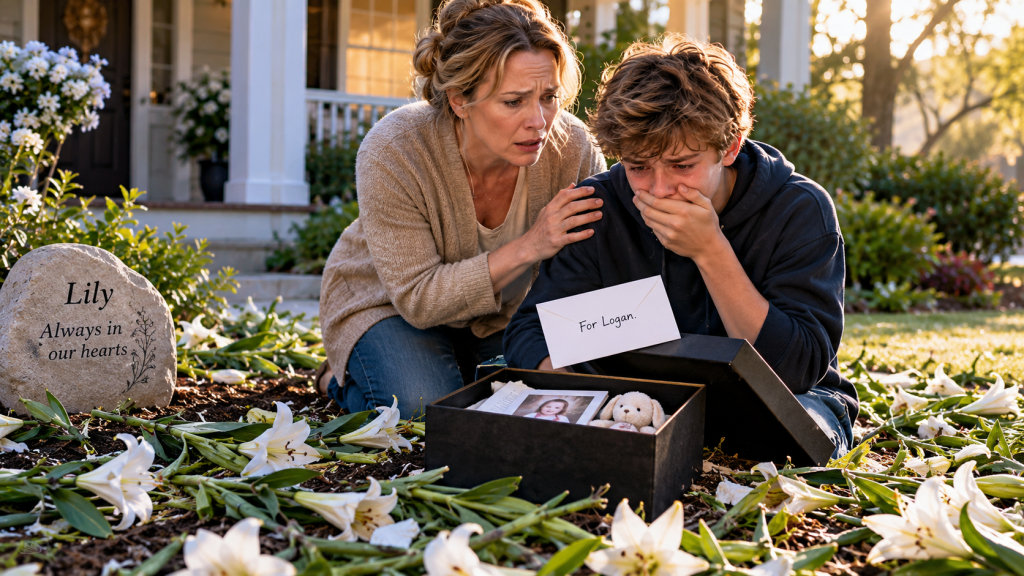
His sister’s flowers were lying around his feet.
A hospital bracelet with her name was inside a black box.
A photograph proved she had been alive three days after the day I had been told she died.
And now a stranger was standing at the edge of our lawn telling him she had once carried Lily somewhere.
My son’s entire life had just cracked open before breakfast.
He deserved to be angry.
Margaret looked toward the porch.
“Could we go inside?”
“No.”
Logan’s voice broke.
“You came here.”
“You cut down every flower I planted for her.”
“You left that box in the garden.”
“You tell me right here.”
Margaret closed her eyes.
“You’re right.”
She looked at the ruined lilies.
“I should not have touched them.”
“Then why did you?”
“Because I was afraid.”
Logan laughed sharply.
“You were afraid?”
“Yes.”
His face twisted.
“Of flowers?”
“Of knocking on the door.”
That stopped him for half a second.
Margaret continued.
“I have driven past this house four times in the last month.”
“I sat in my car two streets away twice.”
“I brought the box yesterday morning and took it home again.”
Her eyes filled.
“I knew if I placed it on your porch, your mother might think it was some sick prank.”
“I knew if I mailed it, I might lose my nerve and disappear.”
“So you destroyed my garden?”
Logan demanded.
Margaret flinched.
“Yes.”
Then, to my surprise, she did not defend herself.
“I did something cruel to force you to see something I was too cowardly to say face-to-face.”
“I am sorry.”
“I know sorry doesn’t repair the flowers.”
Logan stared at her.
“It was Lily’s garden.”
“I know.”
“No, you don’t.”
His voice rose.
“I planted those every year.”
“One for every birthday she never got.”
Margaret began crying.
“She got them.”
The world stopped again.
I heard myself whisper:
“What?”
Margaret looked at me.
“Birthdays.”
“She had birthdays.”
Logan’s face went completely white.
Margaret pressed one hand to her chest.
“Lily lived, Emily.”
I gripped the porch railing.
Not because I felt faint.
Because the earth seemed unreliable.
The garden.
The grave.
Fifteen candles every year.
Logan choosing one flower.
My daughter’s name written on forms beside the word deceased.
None of it made sense beside:
Lily lived.
“Where is she?”
I asked.
Margaret looked down.
“I know where she was taken.”
“That isn’t what I asked.”
“I know.”
“Where is my daughter?”
“I believe I know where she is now.”
Logan made a broken sound.
I grabbed Margaret’s arm.
Hard.
“You believe?”
She did not pull away.
“The family that raised her still lives at the address I found.”
“What family?”
I could barely speak.
“What are you talking about?”
Margaret looked toward the black box.
“The flash drive explains part of it.”
“I can explain the rest.”
“Then explain it.”
She nodded.
We went inside.
I hated letting her cross the threshold.
That is difficult to explain.
She was the first person who had brought me proof that Lily might be alive.
She was also admitting she had participated in taking her from me.
Both truths entered my kitchen together.
Logan put the black box on the table.
He did not sit.
Neither did I.
Margaret sat only after I told her to.
Her hands trembled badly.
She looked around my kitchen.
At Logan’s school photograph on the refrigerator.
At the calendar.
At the vase where yesterday I had planned to place Lily’s birthday flower after we returned from the cemetery.
Margaret noticed the empty vase.
Her face folded.
“I’m sorry.”
“Stop saying that.”
Logan snapped.
She nodded.
“You’re right.”
I sat across from her.
“Start at the beginning.”
Margaret placed both hands on the table.
“Fifteen years ago, I was a maternity nurse at St. Catherine’s Medical Center.”
That was the hospital.
I had not been back since Logan was born.
Even driving past it could make my chest tighten.
“I remember.”
“You came in at thirty-five weeks.”
“Thirty-five weeks and four days.”
Margaret nodded.
“You developed severe bleeding during labor.”
“Yes.”
“You needed an emergency cesarean.”
“Yes.”
My memories of that night existed like photographs dropped into water.
Bright lights.
Someone asking my name.
A doctor telling me not to fight the mask.
A baby crying.
Then another.
Thomas?
Wait, no father established. Do not introduce. Keep.
I remembered asking:
“Both?”
A nurse saying:
“Two babies.”
Then nothing.
When I woke, Logan was in neonatal care.
Lily was not.
A doctor had eventually sat beside my bed.
He said there had been a respiratory emergency.
He said they tried.
He said he was sorry.
Margaret continued.
“Logan was born first.”
“I know.”
“Twelve minutes before Lily.”
“I know.”
“Lily had trouble breathing immediately after delivery.”
My nails dug into my palms.
“She needed assisted ventilation briefly.”
“How briefly?”
“Minutes.”
I stared.
Margaret’s eyes filled.
“She stabilized.”
Logan grabbed the back of a chair.
“Stabilized?”
“Yes.”
“So she didn’t die.”
“No.”
I stopped breathing.
There it was.
Not a theory.
Not a possibility.
A direct answer.
“No.”
Margaret looked at me.
“Lily did not die.”
I closed my eyes.
Fifteen years of grief entered the room all at once.
Not grief for death.
Grief for theft.
There is a difference.
Death has no intention.
Nobody chooses it for you.
The pain is terrible, but it is clean in one way.
A theft has hands.
A decision.
A door somebody opened.
A lie somebody repeated.
“Who?”
I asked.
Margaret went still.
“Who did this?”
“Dr. Aaron Vale.”
I knew the name.
The obstetrician on call.
Not my regular doctor.
A respected man.
White hair even then.
Soft voice.
He was the one who told me Lily had died.
My stomach turned.
Margaret continued.
“And a hospital social worker named Celeste Ward.”
“Why?”
“I didn’t understand everything that night.”
“Then tell me what you understood.”
Margaret nodded.
She looked at Logan.
Then back at me.
“About four hours after the birth, Dr. Vale told me that Lily was being transferred.”
“To another hospital?”
“That’s what I assumed.”
“She was stable enough to transport.”
“I was given a packet.”
“Transfer documents.”
“Identification band.”
“Receiving information.”
“I was told an outside pediatric transport was waiting at a service entrance.”
I stared.
“Was there?”
“No.”
Margaret swallowed.
“There was a private vehicle.”
Logan whispered:
“You put her in a car?”
Margaret closed her eyes.
“Yes.”
He turned away.
His shoulders shook.
Margaret continued.
“A woman was waiting with a baby carrier.”
“Celeste Ward was with her.”
“I asked where the transport team was.”
“Dr. Vale told me the family had arranged private neonatal transfer.”
“That did happen occasionally with concierge patients.”
“I knew it was unusual.”
“Did you ask?”
“Yes.”
“What did he say?”
“That you had signed a transfer and temporary guardianship authorization before surgery because you understood one twin might require specialized care.”
I stared at her.
“I signed nothing.”
“I know that now.”
“You knew I was unconscious.”
“You saw me.”
“Yes.”
“You knew I couldn’t have signed after surgery.”
“Yes.”
“What about before?”
She looked ashamed.
“I did not know whether paperwork had been signed earlier.”
I stood so fast the chair fell backward.
“You carried my daughter out of a hospital because someone showed you a piece of paper?”
“No.”
Margaret stood too.
“I carried her because my supervising physician ordered a transfer and handed me what appeared to be signed authorization.”
“You didn’t verify it.”
“No.”
“You didn’t come to my room.”
“No.”
“You didn’t ask me.”
“No.”
Each answer made the room smaller.
Logan turned.
“You could have stopped it.”
Margaret looked at him.
“Yes.”
No excuse.
That almost made it worse.
“What happened next?”
I asked.
Margaret sat again.
“The woman in the car was named Rebecca Bennett.”
“Who is that?”
“The woman who raised Lily.”
Logan stared.
“You know her name?”
“Yes.”
“Then why did you say you believe you know where Lily is?”
“Because the last verified address I found is six months old.”
“Found how?”
Margaret reached toward the black box.
“May I?”
Logan pushed it toward her.
She removed the flash drive.
“Everything I kept is on this.”
“Scanned records.”
“Photographs.”
“Copies of notes.”
“A recording.”
“What recording?”
“Celeste Ward.”
The social worker.
My skin went cold.
“When?”
“Eleven months ago.”
“What did she say?”
Margaret looked at me.
“The truth.”
I almost laughed.
“What truth?”
“That Lily was never transferred for medical care.”
“She was placed privately with the Bennetts.”
Placed.
The word made me nauseous.
Like furniture.
Like a child could be moved between houses with a signature.
“Adopted?”
I asked.
Margaret hesitated.
“The Bennetts believed it was an adoption.”
Logan’s face changed.
“Believed?”
“Yes.”
“According to Celeste, they had been on a private adoption list for almost three years.”
“They had suffered multiple pregnancy losses.”
“They paid fees to a foundation connected to Dr. Vale.”
“Celeste told them a mother of twins had decided she could only raise one child and wanted the other adopted immediately.”
I made a sound I did not recognize.
Logan grabbed my arm.
“They told them I gave her away?”
“Yes.”
“I named her.”
My voice broke.
“Her name was Lily before she was born.”
“I had two bassinets ready.”
“I had two car seats.”
“I had matching blankets my mother knitted.”
Margaret started crying again.
“I know.”
“How?”
“Because those details were in your chart.”
Of course.
I looked at the hospital bracelet.
LILY CARTER — BABY GIRL
“What did they name her?”
I asked.
Margaret’s mouth trembled.
“They kept Lily.”
I stared.
“What?”
“Celeste told the Bennetts that you had requested her first name remain Lily.”
The room dissolved.
Not literally.
But every edge blurred.
I put one hand over my mouth.
Lily.
She had been Lily somewhere.
Not only in our house.
Not only in a cemetery.
Not only in Logan’s garden.
My daughter had heard her own name.
Had written it on homework.
Had been called to dinner.
Had had teachers say it.
Friends text it.
Someone had shouted it across a playground.
Lily had not vanished from the world.
Only from me.
Logan sat down hard.
“She knows her name.”
He began crying.
“My sister knows her name.”
I held him.
For a minute, no one spoke.
Then Logan pulled away.
“Does she know about us?”
Margaret looked down.
“I don’t know.”
“That’s a yes-or-no question.”
“I genuinely don’t know.”
“Does she know she’s adopted?”
“I believe so.”
“Does she know she has a twin?”
“I don’t know.”
Logan wiped his face angrily.
“We need to go.”
“Where?”
“To her.”
I grabbed his hand.
“We can’t just show up.”
“Yes, we can.”
“No.”
“She’s my sister.”
“I know.”
“She’s your daughter.”
“I know.”
“Then what are we doing sitting here?”
“Logan.”
His entire body was shaking.
I held his face.
“We have had fifteen years to miss her.”
“She may have had fifteen minutes.”
He froze.
The sentence hurt me as I said it.
But it was true.
Lily might be asleep somewhere right now.
Maybe she had celebrated her fifteenth birthday yesterday with cake and friends.
Maybe she believed Rebecca Bennett was simply Mom.
Maybe some man had kissed her forehead and called her his daughter.
Maybe she knew she was adopted.
Maybe not.
Maybe the truth would destroy her morning the way it had destroyed ours.
We could not love her by detonating her life.
Not even to reclaim ours.
Logan looked at the floor.
“I hate this.”
“I know.”
Margaret whispered:
“There is another reason you should not go there yet.”
I turned.
“What?”
“Police need to see the files.”
I stared.
“You haven’t gone to police?”
“I did.”
“When?”
“Yesterday afternoon.”
That surprised me.
“They told me not to contact you until an investigator called.”
“So why are you here?”
“Because I waited fifteen years once.”
Her voice broke.
“I could not make myself wait another day.”
I almost admired that.
Almost.
Then remembered the flowers.
“Who else knows?”
“A detective.”
“My attorney.”
“A former records clerk.”
“And Celeste.”
“Dr. Vale?”
“Dead.”
The word came quickly.
“When?”
“Two years ago.”
I felt nothing.
Then felt guilty for feeling nothing.
Then stopped caring.
“Celeste?”
“Alive.”
“Where?”
“Under investigation now.”
Logan looked at the flash drive.
“What is the recording?”
Margaret closed her eyes.
“Celeste had cancer.”
“Last year she contacted me.”
“She said she wanted to confess before treatment because she was afraid she might die.”
“She did not die.”
“Treatment worked.”
“Convenient.”
Logan muttered.
Margaret nodded sadly.
“Yes.”
“What did she confess?”
I asked.
“Dr. Vale ran a private adoption foundation on the side.”
“He told vulnerable mothers he could arrange placements.”
“Some were legitimate.”
“Some apparently were not.”
I felt sick.
“How many babies?”
“I don’t know.”
“Police are trying to determine that.”
“But Lily?”
Margaret nodded.
“Celeste said Dr. Vale had promised the Bennetts a newborn placement.”
“The birth mother they expected changed her mind two days before your delivery.”
“Then you arrived.”
“Twins.”
“One boy.”
“One girl.”
“You hemorrhaged.”
“She said Vale saw an opportunity.”
I gripped the table.
“He told the Bennetts that a mother had unexpectedly chosen adoption.”
“He created relinquishment paperwork.”
“Celeste forged your signature.”
“Vale signed as witness.”
“And the death?”
Margaret’s face changed.
“That was the part Celeste claimed she did not plan.”
“What does that mean?”
“Vale needed your family to stop asking where Lily was.”
“He could not call her transferred forever.”
“He entered a false neonatal death notation into the hospital chart.”
“A clerk later created the corresponding documents based on his certification.”
I whispered:
“And the grave?”
Margaret looked at me.
I had buried a white casket.
Tiny.
Closed.
The funeral director told me hospital policy discouraged viewing because of the circumstances.
I had been weak enough to believe whatever anyone said.
“Celeste said the funeral home received a sealed hospital container with instructions that remains were not to be viewed.”
My stomach rolled.
“What was in it?”
“I don’t know.”
Margaret answered quickly.
“I truly don’t.”
“The police are addressing that.”
Logan stood and walked out of the kitchen.
I heard the back door slam.
I started after him.
Margaret said:
“Emily.”
I turned.
She looked destroyed.
“There is something else in the box.”
Of course there was.
There is always something else when the first truth was built from lies.
She lifted a thin plastic sleeve beneath the photograph.
Inside was a folded sheet of paper.
“What is it?”
“A copy of the intake form the Bennetts received.”
I opened it.
Typed words.
Private Newborn Placement Summary.
Infant female.
Born at St. Catherine’s.
Birth mother: confidential.
Sibling status:
My breath stopped.
Twin male retained by biological mother.
Logan.
They knew.
The Bennetts had been told Lily had a twin.
I looked at Margaret.
“You said you didn’t know whether Lily knew.”
“I don’t.”
“But her parents knew.”
“They knew there was a twin.”
“They were told the mother wanted no contact.”
I stared at the paper.
No contact.
A phrase I had never spoken.
A boundary invented for me.
I went outside.
Logan was in the garden on his knees.
He was gathering the severed lilies.
One by one.
Putting them into a pile.
I sat beside him.
He did not look at me.
“She has parents.”
he said.
“Yes.”
“I hate them.”
“You don’t know them.”
“They took her.”
“Maybe they thought I gave her to them.”
“They should have checked.”
“Maybe they did.”
“How?”
“I don’t know.”
He crushed a stem in his fist.
“They had fifteen years with her.”
I had no answer.
“They got first steps.”
“Yes.”
“First day of school.”
“Yes.”
“Christmas.”
“Yes.”
“Every birthday.”
His voice cracked.
“And I planted flowers for a grave.”
I started crying.
Logan looked at me.
“Mom, I loved someone who wasn’t dead.”
I pulled him into my arms.
“That love wasn’t wasted.”
“How do you know?”
“Because love doesn’t become meaningless just because the story underneath it changes.”
He cried against me.
“I talked to her at the cemetery.”
“I know.”
“I told her everything.”
“I know.”
“What if she hates flowers?”
I laughed through tears.
“I don’t know.”
That was when he laughed too.
For three seconds.
Then cried harder.
We stayed in the ruined garden until a car pulled into the driveway.
This time it was a police sedan.
Margaret had called them.
Detective Nora Fields was patient.
Too patient.
I hated her at first for asking questions in an even voice.
Then realized evenness was probably what kept people like me from falling apart completely.
She took the black box.
Photographed everything.
The bracelet.
The photograph.
The letter.
The flash drive.
The intake form.
I made her give me a receipt for every item.
I was done trusting institutions with things belonging to my daughter.
She did.
No argument.
Good.
Then she sat at the kitchen table and said:
“We need DNA.”
“How long?”
“We can expedite because this involves an active investigation and possible identity fraud involving a minor.”
“How long?”
“Days for preliminary results if the lab accepts urgency.”
“Days?”
Logan snapped.
Detective Fields did not flinch.
“I know that sounds unbearable.”
“You don’t.”
“No.”
She nodded.
“I don’t.”
That made me trust her slightly more.
She continued.
“We also need to contact the Bennett family through appropriate channels.”
“I want to do it.”
I said.
“I understand.”
“That wasn’t a request.”
Her eyes softened.
“Emily, Lily is fifteen.”
“I know exactly how old she is.”
“Yes.”
“And she may have no idea the circumstances of her adoption are in question.”
“She may be in school today.”
“She may have friends who know nothing.”
“We need to protect her while we determine what is true.”
I hated every word.
Because every word made sense.
Logan asked:
“Can we see a picture?”
Detective Fields looked at Margaret.
Margaret hesitated.
Then opened her phone.
“I have one.”
My heart stopped.
“How?”
“Public school arts page.”
I almost laughed at the absurdity.
Fifteen years of missing my child.
The internet had a photograph.
Margaret turned the screen toward us.
A girl stood beside a painted mural.
Brown hair.
Long.
White T-shirt.
Paint on one cheek.
Smiling.
I knew her.
I didn’t.
Both.
Her face was not mine exactly.
Not Logan’s exactly.
But there was something around the eyes.
A seriousness beneath the smile.
A small cleft in the left eyebrow Logan had too.
Could be coincidence.
Could be genetics.
Could be my desperate mind building bridges across anything it could find.
Under the photograph:
Lily Bennett, freshman volunteer
Lily.
I touched the screen.
My daughter.
Maybe.
My daughter.
Alive.
Logan sat beside me.
“That’s her.”
I whispered:
“We don’t know yet.”
He looked at me.
“That’s her.”
I could not argue.
That night neither of us slept.
At two in the morning, I found Logan outside with a flashlight.
Replanting bulbs.
I wrapped a coat around myself.
“What are you doing?”
He did not look up.
“Fixing it.”
“The flowers are cut.”
“Bulbs aren’t.”
Of course.
Lilies return from bulbs.
The tops had been destroyed.
The life below remained.
That felt too symbolic even for me.
I did not say it.
I knelt.
We worked until three.
Two days later, DNA technicians collected samples from me and Logan.
The Bennetts agreed to provide Lily’s sample after police contacted them.
That fact alone nearly broke me.
They agreed.
They were real.
They had answered the phone.
They had a daughter named Lily.
Detective Fields would not tell me much.
Only:
“They are cooperating.”
“What did they say?”
“I can’t give you a full interview summary.”
“Did they know?”
“They deny knowing anything was unlawful.”
“Do you believe them?”
“I’m still investigating.”
Fair.
I hated fair.
On the third day, Rebecca Bennett called me.
Not supposed to.
Just like Margaret.
People become bad at waiting when children are involved.
My phone showed an unknown number.
I answered.
“Hello?”
A woman breathed.
Then:
“Emily?”
I sat down.
“Who is this?”
“My name is Rebecca Bennett.”
I could not breathe.
She began crying immediately.
“I’m sorry.”
I closed my eyes.
Everybody was sorry.
“I don’t know what to say.”
she whispered.
“Then don’t say sorry yet.”
Silence.
“Tell me about her.”
Rebecca sobbed.
“What?”
“Tell me about Lily.”
The words came out like begging.
“Please.”
For the next hour, a stranger told me about my daughter.
Lily hated bananas.
Loved drawing.
Played violin badly but enthusiastically.
Could not stand scary movies.
Had once broken her wrist falling off a scooter at nine.
Was allergic to shellfish.
Preferred winter to summer.
Had a habit of reading the last page of books early, which offended Rebecca deeply.
I laughed.
Actually laughed.
Then cried.
Rebecca continued.
“She knows she was adopted.”
My heart stopped.
“She does?”
“Yes.”
“We told her when she was little.”
“Does she know about Logan?”
Silence.
Then:
“Yes.”
Logan was sitting across from me by then.
He had heard Rebecca’s name and come running.
I put the call on speaker only after asking.
Rebecca said:
“She knows she had a twin brother.”
Logan covered his mouth.
I whispered:
“What did you tell her?”
“What we were told.”
“That her birth mother loved her but could only raise one child.”
I closed my eyes.
“That she wanted Lily to have opportunities.”
“That she requested no contact until adulthood.”
My voice broke.
“I never said any of that.”
“I know.”
Rebecca sobbed.
“I know now.”
Then Logan spoke.
“Did she ever ask about me?”
Silence.
Rebecca’s voice softened.
“Is this Logan?”
“Yes.”
“She asks about you every birthday.”
My son bowed over the kitchen table.
No sound.
Just tears.
Rebecca continued.
“She wonders whether you look like her.”
“She wonders which of you was taller as a baby.”
“She asks whether you like art.”
“She once made me search whether twins can feel each other’s emotions.”
Logan laughed through tears.
“I hate art.”
Rebecca laughed too.
It was the strangest sound.
A mother I had never met laughing with my son about the daughter she had raised.
Nothing in grief had prepared me for that.
Then I asked the hardest question.
“Does Lily know now?”
Rebecca stopped.
“Yes.”
My hand tightened around the phone.
“How is she?”
“Angry.”
“Scared.”
“Confused.”
“She thinks we stole her.”
Logan looked up.
“Did you?”
He said it before I could stop him.
Rebecca went quiet.
“I don’t believe we did.”
Logan’s face hardened.
Rebecca continued.
“We used a lawyer.”
“We paid agency fees.”
“We received court papers.”
“We met Celeste.”
“We were told Emily had signed everything.”
“My husband and I believed the adoption was legal.”
“Then why didn’t you meet me?”
I asked.
“We asked.”
My breath caught.
Rebecca said:
“Celeste told us you did not want direct contact.”
“She said seeing us might make you change your mind.”
“She called it protecting your decision.”
I laughed bitterly.
“Convenient.”
“Yes.”
“Did you ever see my signature?”
“A copy.”
“Did it look real?”
“I didn’t know your signature.”
Of course.
She cried.
“I am not asking you to forgive us.”
“I’m trying to tell you we didn’t know.”
I believed she might be telling the truth.
That was almost disappointing.
Anger likes a clean target.
Reality rarely provides one.
Then Rebecca said:
“Lily wants to talk to Logan.”
Logan shot upright.
“What?”
“She asked if she could.”
He looked at me.
I was not ready.
He was.
Both mattered.
I asked:
“Now?”
“No.”
“Not now.”
Rebecca took a breath.
“She wants DNA results first.”
That was my daughter.
Or at least, I instantly decided it sounded like her.
Proof before emotion.
Good.
“We’ll wait.”
Logan said.
His voice shook.
“We’ll wait.”
The preliminary DNA result came the next morning.
Detective Fields came in person.
She stood on the porch.
I knew before she spoke.
Maybe because police do not drive to your house to tell you nothing happened.
“Emily.”
I grabbed Logan’s hand.
Fields held a folder.
“The laboratory found results consistent with you being Lily Bennett’s biological mother.”
The world became soundless.
She continued.
“And Logan’s profile is consistent with a full sibling relationship, including the expected relationship for dizygotic twins.”
Logan squeezed my hand so hard it hurt.
I whispered:
“She’s mine.”
Detective Fields’ eyes filled.
“Yes.”
I sat down on the porch step.
Fifteen years.
Five thousand four hundred and something mornings.
A grave.
A garden.
A birthday flower.
And my daughter had been alive through all of them.
Logan ran into the yard.
Not away.
Just moving because his body could not contain what he felt.
He stopped in the garden.
Looked at the bare stems.
Then shouted.
Not words.
Just a sound.
Joy and rage together.
I understood it.
I made the same sound into my hands.
That afternoon, Lily called.
Video.
We planned it through Rebecca.
A therapist was present on their side.
Detective Fields recommended that.
So did mine.
I hated that I needed a therapist to meet my own daughter.
Then thanked God someone understood how impossible the moment was.
The screen rang.
Logan sat beside me.
His knee bouncing so hard the table shook.
I reached to stop it.
Then noticed mine was doing the same thing.
The call connected.
Rebecca appeared first.
Her face red from crying.
Then the camera shifted.
A girl sat beside her.
Lily.
My Lily.
She looked straight into the screen.
No one spoke.
I had imagined this moment a thousand times since seeing her picture.
Every imagined sentence disappeared.
She was real.
She tucked her hair behind one ear.
Logan did the same thing.
Both stopped.
They stared at each other.
Then Lily laughed.
A tiny shocked laugh.
Logan laughed too.
“Oh my God.”
she whispered.
My son covered his mouth.
“You do that.”
“What?”
“The ear thing.”
“You just did it.”
“So did you.”
For some reason, that broke all of us.
Rebecca cried.
I cried.
Logan cried.
Lily cried while laughing.
Then she looked at me.
Everything stopped.
“Hi.”
she said.
One syllable.
I had no strength for more.
“Hi, Lily.”
Her eyes filled.
“You really named me that?”
“Yes.”
“Before I was born?”
“Yes.”
“Why?”
I smiled through tears.
“Because when I was pregnant, Logan kicked constantly.”
He looked offended.
“You did.”
I continued.
“You were quieter.”
“Every ultrasound technician said you curled up like you were trying to sleep through the appointment.”
“I told my mother you seemed peaceful.”
“She said, ‘Then give the child a peaceful name.’”
“I liked Lily.”
Lily wiped her face.
“Rebecca told me you asked them to keep it.”
I looked at Rebecca.
“No.”
Rebecca cried.
“I know.”
Lily looked down.
“So that was a lie too.”
I wanted to reach through the screen.
“Not everything in your life is a lie.”
She looked at me.
“That matters.”
“Rebecca and Jonathan raised you.”
“They love you.”
“You love them.”
“That isn’t fake because someone lied about me.”
Rebecca covered her face.
Lily looked between us.
“Are you mad at them?”
“Yes.”
Rebecca looked up.
I continued.
“I’m mad at everyone right now.”
That made Lily laugh weakly.
“But I don’t know enough yet to decide who deserves what part.”
She nodded.
Then Logan asked:
“Do you hate lilies?”
She blinked.
“What?”
He looked terrified.
“Flowers.”
“Lilies.”
She shrugged.
“No.”
He exhaled so dramatically we all laughed.
“Good.”
“Why?”
Logan looked at me.
I nodded.
He told her.
Five years old.
One white lily.
Then another every birthday.
The garden.
The grave.
Yesterday.
The severed flowers.
The black box.
By the time he finished, Lily was sobbing.
“You planted fifteen?”
“Fourteen before yesterday.”
“I was supposed to plant number fifteen.”
He laughed.
“Then somebody apparently decided emotional terrorism was the best delivery method.”
Margaret deserved that.
Lily wiped her face.
“So there’s a whole garden?”
“Yes.”
“For me?”
“Yes.”
She whispered:
“I’ve never had a garden.”
Logan cried.
Then Lily said:
“Can I see it?”
He carried the phone outside.
Showed her bare stems.
Broken blooms.
Replanted soil.
Lily stared through the screen.
“It’s kind of destroyed.”
“Temporarily.”
He sounded defensive.
“The bulbs are okay.”
She smiled.
“Can we plant one together?”
Logan stopped walking.
“What?”
“When we meet.”
“If we meet.”
He looked hurt.
Lily saw it.
“When we meet.”
she corrected quickly.
“Can we plant number fifteen together?”
My son sat in the grass.
“Yes.”
That was the first promise they made each other.
The investigation took months.
Truth came in pieces.
None of them felt as dramatic as the first box.
That was almost worse.
A life-changing lie had been maintained with ordinary paperwork.
Signatures.
Forms.
Emails.
A sealed file.
Dr. Vale had operated a private adoption foundation connected to his practice.
Some placements were legal.
Some records were questionable.
In Lily’s case, investigators found evidence that Celeste forged my relinquishment forms after I became incapacitated.
Vale certified witnessing a signature I did not make.
A false death notation was entered into my medical file.
The hospital records clerk who processed subsequent documents had apparently trusted the physician certification.
The funeral arrangement was made through a service Vale regularly used.
I never learned every detail of how the little grave had been created.
I learned enough.
The tiny sealed casket had not contained Lily.
That was the only fact that mattered.
I did not attend when authorities opened it.
Logan did not either.
We had buried grief there.
I did not need to see what props had been used to support the lie.
Celeste eventually admitted what she had done.
Not immediately.
At first, she minimized.
Said Vale controlled everything.
Said she believed I would be unable to raise twins.
Said the Bennetts were good people.
As though poverty, exhaustion, or one doctor’s opinion could convert a mother into an unsigned consent form.
Detective Fields asked me whether I wanted to hear Celeste’s recorded confession.
I said yes.
Then changed my mind.
Then said yes again.
The recording lasted forty-three minutes.
I listened once.
Never again.
The part I remember most was Celeste saying:
“Dr. Vale told me the girl would have a better life.”
I paused the recording.
A better life.
That sentence has excused terrible things throughout history.
Sometimes children do need protection from dangerous homes.
Sometimes adoption saves lives.
But nobody had asked whether my home was dangerous.
Nobody had given me the chance to fail.
Nobody had let me succeed.
They simply decided.
For me.
For Lily.
For Logan.
For the Bennetts.
Everyone’s life bent around the arrogance of two people who believed they could choose whose motherhood mattered.
Margaret cooperated completely.
She surrendered her old notes.
Her copies.
Her transport log.
Her email correspondence.
She admitted her own part.
The authorities treated her differently because she had not created the scheme, had later preserved evidence, and came forward voluntarily.
I was not involved in deciding what punishment she received.
That surprised people.
“Don’t you want her punished?”
I wanted fifteen years back.
No judge could order that.
Margaret and I did not become friends.
That would have been too neat.
But she came one afternoon in spring.
She stood at the end of the driveway holding a flat cardboard box.
Logan was inside doing homework.
I walked out.
“What is that?”
“Bulbs.”
I looked at her.
“Lilies?”
“Yes.”
“Why?”
“I know I can’t repair what I cut.”
“No.”
“I thought maybe I could replace some.”
I crossed my arms.
“Why did you really cut them?”
She looked at the garden.
Then answered more honestly than before.
“Because I hated them.”
That surprised me.
“What?”
“Every year I drove past on the birthday.”
My stomach tightened.
“You knew about the garden?”
“After Logan was six.”
“How?”
“I looked you up.”
My anger returned instantly.
“You watched us?”
“From a distance.”
“Why?”
“Guilt.”
“That doesn’t explain the flowers.”
Margaret cried.
“Every lily reminded me that you thought she was dead.”
“And every year I told myself I would come tell you.”
“I never did.”
“So when I finally came…”
She looked ashamed.
“I cut down the evidence of my cowardice.”
That answer was ugly.
Which is why I believed it.
She did not cut them as some poetic signal.
She cut them because looking at them hurt her.
Then used the destruction to force herself to confess.
Human beings are rarely noble even when doing something necessary.
I took the box.
“Logan may never forgive you.”
“I know.”
“I may not either.”
“I know.”
“Thank you for the bulbs.”
She nodded.
Then turned to leave.
“Margaret.”
She stopped.
“If you had told us five years ago…”
“I know.”
“No.”
I waited until she faced me.
“You don’t get to say you know.”
She stared.
“My son spent ten birthdays grieving somebody who was alive.”
“My daughter spent ten birthdays wondering why a mother had given her away.”
“You knew enough to change both of those things.”
Her face collapsed.
“Yes.”
“That is yours to carry.”
I said.
“Not mine.”
Then I went inside.
That was the last time we spoke for several years.
Lily’s relationship with us grew slowly.
That was harder than discovering her.
Discovery feels like motion.
Relationship requires patience.
At first, we video-called once a week.
Then twice.
Logan and Lily texted almost immediately.
At two in the morning.
Constantly.
I worried.
Rebecca worried.
Then both of us realized keeping twins who had lost fifteen years to one scheduled weekly conversation was ridiculous.
They needed each other in their own way.
They compared everything.
Favorite foods.
Music.
Handwriting.
Height.
Report cards.
Dreams.
Birthmarks.
Logan was taller.
Lily was more organized.
Logan hated math.
Lily loved it.
Lily painted.
Logan couldn’t draw a recognizable tree.
They both despised pickles.
That fact impressed them more than DNA.
One night, Logan came into my room holding his phone.
“Mom.”
“What?”
“She has the same nightmare.”
My heart stopped.
“What nightmare?”
“Falling.”
“Just falling.”
“No place.”
“No stairs.”
“Nothing.”
“I have it too.”
I stared.
“Twins can have common themes without it meaning anything mystical.”
“I know.”
He rolled his eyes.
“Let us have one weird twin thing.”
Fair.
They met in person six weeks after the DNA result.
Neutral place.
A family counseling center with a garden out back.
I hated the idea.
I wanted our house.
Our kitchen.
Lily’s garden.
But Lily asked for neutral.
So neutral it was.
Rebecca and Jonathan arrived first with Lily.
I had never met Jonathan.
He was tall, graying, wearing a sweater that looked selected by someone who wanted to appear nonthreatening.
Poor man.
No sweater could solve that afternoon.
Rebecca looked smaller than I imagined.
Lily stood between them.
Logan was beside me.
No one moved.
Then Lily walked forward.
Logan walked forward.
They stopped three feet apart.
Stared.
Lily smiled.
“You’re taller.”
Logan said:
“You’re bossier on video.”
She laughed.
Then they hugged.
It was not cinematic.
No music.
No slow motion.
Just two fifteen-year-olds holding each other too tightly.
Logan buried his face in her hair.
Lily grabbed the back of his shirt.
Both shook.
I heard Lily whisper:
“I’m sorry.”
Logan pulled back.
“For what?”
“I don’t know.”
“Don’t be.”
Then:
“You didn’t leave.”
Her face crumpled.
“You didn’t either.”
That was their beginning.
Mine with Lily was harder.
She approached me slowly.
I wanted to touch her.
Didn’t.
“Can I hug you?”
I asked.
She nodded.
Then suddenly threw herself into me.
For one second, my body remembered something my mind could not.
Her weight.
Not the newborn weight.
A deeper recognition.
Maybe imaginary.
I do not care.
I held my daughter.
Fifteen years late.
I did not say:
My baby.
I wanted to.
But Lily was not a baby.
She was fifteen.
She belonged to herself before she belonged to anyone else.
So I said:
“I’m so glad you’re here.”
She cried against me.
“I thought you didn’t want me.”
I closed my eyes.
“Never.”
“Not one second.”
“I was told you died.”
“I buried you.”
She sobbed.
“I’m sorry.”
“No.”
I pulled back.
“No more sorry from you.”
“You did nothing.”
She nodded.
Then looked toward Rebecca.
“I love them.”
My heart hurt.
“I know.”
“I don’t want to leave them.”
“I know.”
“Does that hurt you?”
I could have lied.
“No.”
Instead:
“Yes.”
She flinched.
I touched her face.
“But hurting does not make you wrong.”
Her eyes filled.
“You are allowed to love the people who raised you.”
“You do not owe me hatred of them to prove you’re my daughter.”
Rebecca cried openly.
Jonathan turned away.
That sentence saved us later.
Maybe not completely.
But enough.
Because the custody question became ugly in everyone’s heads before it became legal.
People asked:
“Are you getting her back?”
As though she were a stolen necklace.
Lily was a person.
Fifteen years old.
She had a bedroom in the Bennett house.
A school.
Friends.
A dog named Moose.
A violin teacher.
A best friend called Tessa.
Jonathan had taught her to ride a bike.
Rebecca had held her through pneumonia.
Those facts did not erase what happened to me.
My motherhood did not erase theirs.
There was no clean arrangement.
Eventually, with lawyers, therapists, and court supervision, a plan formed.
The adoption records were reopened.
My biological parentage was formally recognized.
The fraudulent documents were corrected to the extent the law allowed.
The Bennetts remained Lily’s day-to-day parents while the case was reviewed because no one with sense wanted to rip a fifteen-year-old from the only household she remembered.
I received legal contact rights under an interim agreement.
More importantly, Lily’s own wishes were heard.
She wanted us.
She also wanted them.
So the adults learned to tolerate complexity.
She spent alternate weekends with us at first.
Then school breaks.
Then longer summers.
We attended her concerts.
The Bennetts attended Logan’s track meets.
The first few times were awkward enough to make furniture uncomfortable.
Rebecca and I learned to speak carefully.
She once said:
“My daughter—”
Then stopped.
Looked at me.
I said:
“You can say it.”
She cried.
Another time I told someone:
“My daughter Lily—”
Rebecca’s face changed.
I saw it.
We had to keep reminding ourselves that grammar was not custody.
“Mother” was not a chair with only one seat.
Lily called Rebecca Mom.
She called me Emily for almost a year.
That hurt.
Of course it did.
I never corrected her.
Then one afternoon, she was in my kitchen with Logan making grilled cheese.
She burned one side.
I laughed.
She said:
“Mom, stop.”
Everything stopped.
Lily stopped.
Logan stopped.
I stopped.
She stared at me.
Then at the sandwich.
Her face turned red.
“I—”
I forced myself to breathe.
“You burned it.”
“What?”
“The sandwich.”
She looked at me.
I smiled.
“It’s terrible.”
Logan started laughing.
Lily threw a dish towel at him.
Nobody discussed the word.
That night, after she went home, I sat in the kitchen and cried for forty minutes.
The next week she called me Emily again.
That was okay.
Love does not become real because of titles.
Eventually, she found her own language.
Rebecca remained Mom.
I became Mom Emily for a while.
Then sometimes Mom.
Sometimes Emily.
I answered to all of it.
Logan never cared.
“She can call you Supreme Leader if she comes over Friday.”
Sibling priorities.
On their sixteenth birthday, the garden bloomed again.
The bulbs survived.
Some Margaret had brought grew too.
Logan and Lily chose one new white lily together.
They planted it in the center.
Exactly where the black box had been.
Lily held the bulb.
“This is weird.”
“What?”
Logan asked.
“I’m planting my own memorial flower.”
He considered.
“Technically it’s a formerly memorial flower.”
“That is not better.”
I laughed.
They covered the bulb.
Then Lily stood and looked at the rows.
Fourteen older plantings.
One year of regrowth.
One new bulb.
“Can we stop calling it Lily’s garden?”
Logan looked hurt.
“For what?”
“I don’t know.”
She looked at me.
“Is that bad?”
“No.”
“It’s yours.”
She thought.
Then said:
“What about the Twin Garden?”
Logan groaned.
“That sounds like a retirement community.”
Lily shoved him.
Eventually they called it the Twelve-Minute Garden.
Because that was the distance between them at birth.
Twelve minutes.
Then fifteen years.
Then no distance anyone else got to dictate.
Every birthday after that, they planted together.
Not a memorial.
A marker.
Proof that a tradition can change meaning without losing its history.
The grave was harder.
The first time Lily asked to see it, I said no.
Instantly.
Too instantly.
She looked shocked.
I apologized.
Then explained.
“I don’t know what seeing it will do to you.”
She crossed her arms.
“I don’t either.”
“You shouldn’t have to see a grave with your name on it.”
“But it exists.”
Yes.
“I want to see what you visited.”
I looked at Logan.
He nodded.
So we went.
The cemetery was quiet.
Cloudy.
I had been there hundreds of times.
Never with Lily.
The marker read:
LILY CARTER
Born and died the same date.
A lie carved in stone.
Lily stood in front of it.
Hands in her coat pockets.
She did not cry.
For several minutes.
Then she said:
“That’s creepy.”
Logan burst out laughing.
I did too.
Probably inappropriate.
Necessary.
Lily crouched.
Touched her own name.
Then:
“Can we change it?”
I had never thought about that.
“Probably.”
“What would you want it to say?”
She looked at us.
“Not dead.”
Fair.
Eventually, after legal records were corrected enough for the cemetery to permit changes, we replaced the marker.
Not with a grave marker.
With a small memorial stone.
It said:
FOR THE YEARS WE THOUGHT WERE LOST
AND THE LOVE THAT WASN’T
No death date.
No lie.
The plot remained.
Not because Lily was buried there.
Because our grief had been.
Places can hold feelings even when they do not hold bodies.
The criminal cases took years.
I will not turn this into a courtroom story.
That is not what mattered most.
Celeste Ward faced charges related to forged records and the fraudulent placement.
Others were investigated.
The hospital reached a civil settlement with me and with the Bennetts after internal failures became clear.
I signed nothing that required silence about Lily’s identity.
That mattered.
The money helped pay for therapy, lawyers, travel, and eventually college funds.
But no amount matched fifteen years.
There is no market value for a missed first word.
No invoice for birthdays.
No settlement table where someone says:
First day of kindergarten: $50,000.
Broken arm: $20,000.
Nightmares: negotiable.
Money can repair practical damage.
It cannot purchase chronology.
Dr. Vale was dead.
Some people told me that was unfair because he never had to answer me.
They were right.
I had speeches prepared for a man who could no longer hear them.
Eventually I stopped giving them in my head.
The dead do not become accountable because we rehearse arguments.
I gave my energy to the living.
Margaret.
That relationship surprised me most.
Two years after she brought the box, Logan invited her to the garden.
I did not.
He did.
I asked why.
He shrugged.
“She told the truth.”
“Fifteen years late.”
“I know.”
“She cut your flowers.”
“I know.”
“You were furious with her.”
“I still am sometimes.”
“Then why?”
He looked at me.
“Because Lily wants to meet her.”
Of course.
Lily had questions.
Margaret came.
No flowers.
Smart.
She stood at the edge of the Twelve-Minute Garden.
Lily approached.
Margaret began crying.
“You look like…”
She stopped.
“Like what?”
Lily asked.
“Like yourself.”
Good answer.
Lily crossed her arms.
“You carried me out.”
“Yes.”
“Did I cry?”
Margaret looked stunned.
Then smiled through tears.
“Yes.”
“A lot?”
“Enormously.”
Logan laughed.
Lily glared.
Margaret continued.
“You had a very angry cry.”
“Your whole face turned red.”
“Did you hold me?”
“Yes.”
“For how long?”
“Maybe six minutes from nursery to vehicle.”
Lily absorbed that.
“What did you say?”
Margaret’s face broke.
“I said, ‘It’s okay, little one.’”
Lily looked away.
“It wasn’t.”
“No.”
“Did you know my name?”
“Yes.”
“Did you say it?”
Margaret nodded.
“Once.”
“What did you say?”
Margaret covered her mouth.
Then forced the words.
“‘It’s okay, Lily.’”
My daughter cried.
Margaret did too.
Lily asked:
“Why didn’t you stop?”
No soft version.
Margaret answered.
“Because I was trained to obey physicians.”
“Because the paperwork looked official.”
“Because I was afraid of losing my job.”
“Because I told myself somebody else must know more than I did.”
“Because I was a coward.”
Lily looked at her for a long time.
Then:
“I don’t forgive you.”
Margaret nodded.
“I know.”
“But I’m glad you said my name.”
That was all.
It was more than I expected.
Years passed.
The twin relationship became normal enough to be annoying.
That was beautiful.
They fought.
Actually fought.
About music in the car.
Borrowed hoodies.
Who got the bathroom first when Lily stayed over.
Whether Logan was allowed to tell one of Lily’s friends an embarrassing story.
The first time they yelled at each other, I stood frozen in the hallway.
Terrified.
Then Lily slammed a door.
Logan yelled:
“Fine!”
I started crying.
Logan found me.
“Mom, what?”
“You’re fighting.”
“Yes?”
“You lost fifteen years.”
He stared.
Then laughed.
“We’re not wasting time by being siblings.”
I looked at him.
“That is what siblings do.”
He was right.
I had romanticized their reunion.
Wanted every moment sacred.
They did not.
They wanted to be teenagers.
Good.
Lily eventually transferred schools for her final year.
Her choice.
Not because Rebecca and Jonathan pushed.
Not because I asked.
She wanted to live closer to Logan for one year before college.
The arrangement was strange.
Weekdays with us.
Weekends mostly with the Bennetts.
Two homes.
Two mothers.
One very overpacked backpack.
Rebecca cried the first Sunday night after dropping her off.
I invited her inside.
She almost refused.
Then came in.
We sat at my kitchen table.
The same table where Margaret confessed.
Rebecca said:
“I feel like I’m losing her.”
I knew that sentence too well.
“I’m sorry.”
She looked at me.
“Do you ever hate me?”
Honesty again.
“Sometimes.”
She nodded.
“Do you?”
she asked.
“What?”
“Hate me?”
I almost smiled.
“Yes.”
Her eyebrows rose.
“Sometimes.”
We both laughed.
Then cried.
Rebecca said:
“I hate that you exist.”
“I know.”
“Not you.”
“I know.”
“I hate what your existence means about how I got to be her mother.”
I understood.
“And I hate what your motherhood means about what I lost.”
She took my hand.
That was the first time.
“We’re stuck with each other.”
she said.
“Apparently.”
We became something with no good name.
Not friends exactly.
Not rivals.
Co-witnesses.
Two women who loved the same girl from different directions.
Jonathan and Logan became oddly close.
Fishing.
Of all things.
Jonathan loved it.
Logan had never gone.
First time back, Logan told me:
“He says Lily hates fishing.”
I said:
“Good.”
“Why?”
“I need at least one genetic contribution.”
He rolled his eyes.
At eighteen, Lily petitioned to amend her name.
Not erase Bennett.
That was important to her.
She became:
Lily Carter Bennett.
Carter in the middle.
Bennett last.
She told me:
“I don’t want to replace one family with another.”
“I want both visible.”
I cried.
Rebecca cried.
Jonathan pretended not to.
Logan complained:
“So I get no extra name?”
“You got fifteen years with Mom.”
Lily said.
He stopped joking.
Then she added:
“You can have Bennett if you want.”
“No thanks.”
Sibling peace restored.
College separated them by four hours.
They hated it.
Then adapted.
Logan studied engineering.
Lily studied art conservation.
That felt almost suspiciously poetic, but she chose it because she liked old paintings.
Not because of our story.
At least that’s what she insisted.
“People keep saying it’s because I was ‘restored,’”
she told me.
“If one more person says that, I’m changing majors.”
Fair.
She became very good.
Logan became the kind of engineer who called me to explain bridges I had not asked about.
Life continued.
That is the part nobody tells you about miracles.
They become schedules.
Laundry.
Flights.
Forgotten birthdays.
Bad grades.
Good jobs.
Taxes.
That is how you know they are real.
If Lily had remained only a miracle, I would never truly have gotten her back.
I got her in the ordinary.
That was better.
Margaret died when the twins were twenty-three.
Her daughter contacted me.
She left something for Logan and Lily.
A small envelope.
Inside were two photographs.
One of the hospital nursery.
One of the service exit.
And a note.
I spent years believing confession would make me feel lighter. It did not. Some weight belongs to us because we earned it. But telling the truth allowed the people I hurt to stop carrying the part that was mine.
Underneath:
Logan, I am sorry for the flowers.
Then:
Lily, I am sorry for the door.
That line destroyed me.
The door.
The service door she carried Lily through.
Not the whole hospital.
Not the whole scheme.
One door.
Sometimes a life changes at a door.
Lily kept the note.
Logan kept the photographs.
Neither attended Margaret’s funeral.
I did.
I sat in the back.
No one recognized me.
Her daughter did.
Afterward, she hugged me.
“She talked about you.”
“I’m sure.”
“She never expected forgiveness.”
“Good.”
That sounds cruel.
It wasn’t.
Expecting forgiveness can become another demand on the person you hurt.
Margaret finally understood that.
I respected her for learning it.
Not enough to erase.
Enough.
At twenty-five, Logan got married.
Lily stood beside him.
Not as bridesmaid.
As best woman.
His choice.
She gave a speech.
Started with:
“I have known my brother for ten years.”
The room became quiet.
Then she smiled.
“And unfortunately, that has been more than enough.”
Everyone laughed.
She told stories.
The garden.
Their first fight.
Logan teaching her to drive stick and screaming like he was facing death.
Then she grew serious.
“When we were fifteen, I thought finding out I had a twin meant I had to choose whether my first life was real or my second one was.”
She looked at Rebecca.
At me.
“At some point I realized lives don’t work like that.”
“They stack.”
“Love stacks too.”
My throat closed.
“I lost fifteen years with Logan.”
“But he spent those fifteen years planting something for me.”
“So maybe love was growing somewhere I couldn’t see it.”
She raised her glass.
“To my brother.”
“To the world’s most emotionally expensive gardener.”
Logan cried.
Then said:
“You’re paying for therapy.”
Beautiful.
Lily married three years later.
She carried white lilies.
Of course.
Not because I suggested it.
She did.
Her bouquet had fifteen white lilies.
One for each year apart.
And a sixteenth pale green stem.
For the year they found each other.
Rebecca walked her halfway down the aisle.
I walked the other half.
Lily insisted.
At the midpoint, Rebecca took my hand.
For one second, the three of us stood together.
No one in the wedding program explained it.
They didn’t need to.
Lily squeezed both our hands.
Then walked forward alone for the final steps.
That was her idea.
“My whole life, adults decided where I went.”
she told us at rehearsal.
“I want the last steps to be mine.”
I cried for an hour.
At the reception, Logan danced with her.
Not formal.
Ridiculous.
Then I saw them slip outside.
I followed a few minutes later.
They were standing near the venue garden.
Logan held a small pot.
Lily stared at him.
“You did not.”
He grinned.
“One more.”
A lily bulb.
She laughed.
“In wedding clothes?”
“Tradition.”
They planted it beside a stone wall.
The venue owner had agreed.
They covered it with soil.
Then Lily looked at me.
“You coming?”
I knelt with them.
Three hands in dirt.
No grave.
No black box.
No lie.
Just planting.
When I turned seventy? Wait Emily age unspecified. Don’t introduce exact. Later life.
Years after the twins left home, the original garden changed.
Some bulbs died.
Others multiplied.
White lilies spread beyond the neat rows Logan had once planted.
I stopped correcting them.
Let them grow where they wanted.
Every birthday, the twins still came if they could.
If not, one of them sent bulbs.
One year Logan was overseas for work.
Lily planted two.
One for him.
One for herself.
I teased:
“You’re both alive.”
She said:
“Exactly.”
The garden had finally become celebration without needing death beneath it.
That was the biggest change.
Sometimes visitors asked why so many lilies.
I gave different answers depending on my mood.
“Family tradition.”
“Twins.”
“Long story.”
All true.
I stopped telling strangers the whole thing.
Trauma does not have to remain public just because truth once needed witnesses.
The lawsuit records existed.
The news covered parts of the hospital investigation.
Other families came forward.
That was painful.
Lily was not the only child whose paperwork raised questions.
Some cases turned out legitimate.
Some did not.
I spoke publicly once.
Only once.
At a hearing about hospital record safeguards.
I said:
“When systems trust authority more than mothers, paperwork can become a weapon.”
Then:
“Verification is not disrespect.”
“If somebody is unconscious, a signature affecting custody of her child deserves more than one person’s word.”
I did not become an activist forever.
Others did.
Good.
I had already spent too much life inside that hospital’s decisions.
I wanted to garden.
Cook.
Watch grandchildren.
Complain about knees.
Normal things.
That was my rebellion.
Logan became a father first.
A little girl.
He named her Nora.
After Detective Fields.
I laughed when he told me.
“Nora is going to be unbearable.”
“She already knows.”
Detective Fields cried when invited to the christening.
Lily became a mother later.
A boy.
She named him Samuel.
No symbolic reason.
She just liked it.
Thank God.
Not every name needs trauma.
The first time I held Lily’s son, I looked at his tiny hospital bracelet.
His mother’s name.
His name.
Barcode.
Date.
My hands shook.
Lily noticed.
“You okay?”
“Yes.”
She knew I was lying.
She sat beside me.
“They checked everything.”
she said.
“I know.”
“I signed my own papers.”
“I know.”
“Rebecca was there.”
“I know.”
“You were there.”
“I know.”
She touched my arm.
“He’s here.”
That sentence healed something I did not know remained open.
He’s here.
Yes.
Sometimes certainty needs repetition.
I looked at my grandson.
No black box.
No forged name.
No sealed door.
Just here.
On the twins’ thirtieth birthday, they returned to the original garden.
Logan brought his daughter.
Lily brought Samuel.
The children ran between flowers.
My knees were too old to kneel comfortably.
So I sat on the porch.
Logan came beside me.
“Mom.”
“Yes?”
“Do you remember number one?”
“The first lily?”
“Yes.”
“Of course.”
He smiled.
“I barely do.”
“You were five.”
“I remember asking.”
“I don’t remember planting it.”
I looked at the garden.
“I remember everything.”
He leaned against the railing.
“Do you regret telling me about Lily when I was little?”
I was surprised.
“No.”
“Never?”
“No.”
“Why?”
“Because she existed.”
I looked at him.
“You deserved to know you had a sister.”
“Even when I believed she was dead.”
He nodded.
“I think planting the flowers saved me from feeling like something was missing and nobody would name it.”
My throat tightened.
Then he smiled.
“Turns out something was missing.”
“Yes.”
We watched Lily chasing her son.
Logan whispered:
“Do you ever think about who we’d be if none of it happened?”
All the time.
But I said:
“Less than I used to.”
“Why?”
“Because imaginary lives don’t age with us.”
He frowned.
I explained.
“The version where Lily came home from the hospital is always a baby in my mind.”
“Then a toddler.”
“Then maybe a schoolgirl.”
“But I don’t know that woman.”
“I know this Lily.”
He looked toward his sister.
“She’s annoying.”
“Deeply.”
We laughed.
That was acceptance.
Not thinking what happened was acceptable.
Never.
Acceptance is recognizing that the life you have is the only one available to love.
I loved this one.
Scars and all.
Rebecca died before me.
Cancer.
Lily was thirty-seven.
By then, calling her mother arrangements complicated? No issue.
I went to the hospital.
Sat beside Rebecca.
Just us.
She looked very small.
“You came.”
“Of course.”
She smiled.
“Do you remember our first phone call?”
“Yes.”
“You asked me to tell you about her.”
“Yes.”
“I thought you were going to scream.”
“I considered it.”
She laughed weakly.
Then:
“Thank you.”
“For?”
“For not making her choose.”
My eyes filled.
“You didn’t either.”
She nodded.
“We got lucky.”
I thought of the word.
Lucky.
Strange choice.
Then understood.
Not lucky in what happened.
Lucky in what we did after.
“Yes.”
I said.
“We did.”
Rebecca squeezed my hand.
“Will you look after Jonathan?”
I laughed.
“He is a grown man.”
“You know what I mean.”
“Yes.”
“And Lily?”
I looked at her.
“Always.”
She smiled.
“Me too.”
Those were among her last words.
At the funeral, Lily sat between Jonathan and me.
She held both our hands.
No one found it strange.
That family had become real through repetition.
Afterward, Lily gave me a box.
Not black.
A cedar box.
Inside were copies of every letter Rebecca had written to the adoption foundation when Lily was a baby.
Questions.
Updates.
Photographs.
One letter said:
If Lily’s birth mother ever changes her mind about contact, please tell her we will respect whatever level she requests. We want Lily to know where she came from when it is safe.
The foundation had never forwarded it.
I cried.
For years, part of me had wondered whether Rebecca could have done more.
Maybe she could have.
Maybe I could have too if our positions were reversed.
But she had asked.
She had been lied to.
That mattered.
I placed the letters beside Margaret’s note.
Not because the stories were the same.
Because both proved something about silence.
Some people stay silent out of fear.
Some speak and are blocked.
From the outside, both look like absence.
Documentation matters.
So does context.
When Jonathan died years later, Lily inherited his house.
She did not sell it immediately.
For a while, she could not.
Eventually she did.
She kept the brass height marks from the kitchen doorway.
Jonathan had marked Lily’s growth every birthday.
Five.
Six.
Seven.
All the way to eighteen.
She had a carpenter remove that strip of wood.
Then brought it to my house.
“Look.”
She held it beside the porch.
My throat tightened.
Fifteen birthdays I missed, measured in pencil.
She looked at the lilies.
“You had flowers.”
“I had inches.”
I cried.
She cried.
Then she mounted the strip of wood inside her own home.
Both histories.
Again.
Stacked.
The original hospital closed eventually.
Financial problems after the investigations.
Part of the building was demolished.
Someone sent me a photograph.
I deleted it.
I did not need to watch walls fall.
Buildings are rarely the whole crime.
People are.
Systems are.
Silence is.
The demolition would not rebuild fifteen years.
The garden did more for me than rubble ever could.
When I became old enough that maintaining the house was difficult, Logan and Lily both offered solutions.
Carefully.
Very carefully.
After what our family had survived, nobody made plans for me without asking.
Logan said:
“Mom, what do you want?”
I laughed.
“What?”
“Nothing.”
He stared.
“You’re laughing at me.”
“Yes.”
“Why?”
“Because once upon a time adults made decisions about people they claimed to know better than.”
He winced.
“Fair.”
I chose to move into a smaller home near Lily.
Not with her.
Near.
Logan complained she won geography.
I told him to relocate.
He declined.
We took bulbs from the garden.
Not all.
The new owners of my old house agreed to keep a section.
The rest we divided.
Some went with Logan.
Some with Lily.
Some with me.
The Twelve-Minute Garden multiplied.
Three gardens now.
That felt right.
Love had once been forced into one grave and one patch of dirt.
Now it spread.
The last time the three of us planted lilies together, I could not kneel.
So Logan dug.
Lily planted.
I supervised.
My strongest skill by then.
Lily said:
“Do you ever think Margaret knew what she started by cutting those flowers?”
“Yes.”
“What?”
“A terrible morning.”
Logan laughed.
“No, I mean all this.”
I looked around.
Our children.
Grandchildren.
Three generations moving through the yard.
“No.”
I said.
“She didn’t start this.”
They looked at me.
“You did.”
I pointed at Logan.
“At five.”
His face softened.
“One flower.”
“Yes.”
“You loved your sister when the only thing you knew about her was absence.”
Then I looked at Lily.
“And you spent your childhood wondering about the brother you were told you couldn’t meet.”
“You both kept a place for each other.”
“That existed before Margaret came.”
The black box did not create the bond.
It revealed where the bond had been pointing.
Lily wiped her eyes.
“Mom.”
By then, the word had no hesitation.
No qualifier.
Still not erasing Rebecca.
Never.
Simply mine too.
I looked at my children.
Twelve minutes apart.
Fifteen years apart.
Then a lifetime spent closing the distance.
People sometimes ask whether I forgave.
They want one answer.
Margaret.
Celeste.
The hospital.
Rebecca.
Myself.
As if forgiveness were a single switch controlling every wound.
No.
I forgave differently.
Rebecca did not need forgiveness for loving Lily.
She needed understanding for believing a lie.
Margaret received some forgiveness and some distance.
Celeste never became part of my life.
I released my obsession with her before I released anger.
Those are not the same thing.
The hospital received legal accountability, not emotional absolution.
And myself?
That was hardest.
For years after finding Lily, I blamed the woman I had been in that hospital bed.
Why didn’t I demand to see the body?
Why didn’t I question the papers?
Why didn’t I notice contradictions?
Why did I accept a closed casket?
Why didn’t I search harder?
Therapy gave me the answer I resisted.
Because I had just nearly bled to death.
Because a doctor lied.
Because a hospital backed him.
Because grief disorients.
Because institutions are built on trust.
Because no reasonable mother expects she must investigate whether a physician secretly gave away her newborn.
I eventually stopped putting the criminal responsibility on the weakest person in the room.
Me.
That was forgiveness too.
Not sentimental.
Accurate.
Logan once told me:
“You were the only person in that hospital who did nothing wrong.”
I corrected him.
“You were there.”
“So was Lily.”
He smiled.
“Fine.”
“Three of you.”
Good.
That became our rule.
Put responsibility where it belongs.
Not where guilt finds the easiest home.
The black box stayed with me for years.
Empty.
Evidence returned eventually.
Bracelet.
Photograph.
Letters.
The box itself sat on a shelf.
At first I hated it.
Then it became just a box.
One day, Lily asked for it.
“Why?”
“I want it.”
“For what?”
“Art project.”
I raised an eyebrow.
“Should I be worried?”
“Always.”
She took it.
Months later, she brought it back.
The black exterior remained.
But inside she had lined it with white paper.
On the underside of the lid, she had painted fifteen tiny lilies.
Then one open door.
I stared.
“What is this?”
She sat beside me.
“The box used to be where the truth waited.”
“Now it’s where I keep copies of both my birth certificates.”
I looked at her.
Both histories.
Again.
She smiled.
“And Logan’s first terrible drawing of us.”
From age fifteen.
Stick figures.
One with long hair.
One with absurdly long arms.
“Why keep that?”
“Evidence he cannot draw.”
Good.
The box had changed meaning too.
Objects can.
Gardens can.
Names can.
Families can.
That is the thing I understand now.
Truth does not always restore the life that should have been.
Sometimes it gives you the materials to build a different honest one.
When I was told Lily died, I believed grief meant loving someone who could never return.
When I learned she lived, I discovered a stranger carrying my daughter’s face.
Then I learned motherhood can include meeting your own child.
Asking permission to hug her.
Learning her favorite food.
Learning which stories belong to another mother.
Loving without demanding repayment for missed years.
That was the hardest part.
I wanted fifteen years paid back.
Life does not issue refunds.
Lily could not become five.
Logan could not plant the first flower knowing she was alive.
I could not hear her first word.
So we stopped trying to recover time.
We made new time.
Breakfasts.
Birthdays.
Arguments.
Road trips.
Hospital visits.
Weddings.
Grandchildren.
Gardens.
Ordinary days.
Thousands of them.
Eventually, there were more days after finding Lily than before.
I noticed the anniversary.
Fifteen years after the black box.
The twins turned thirty.
We sat in the garden.
I looked at them and realized:
I had now known Lily for as many years as I had missed her.
The thought stole my breath.
She noticed.
“What?”
I told them.
Logan counted.
Then smiled.
“Tomorrow you’ve known her longer.”
Lily cried.
I did too.
The next morning, she called at 7:01.
“Congratulations.”
“For what?”
“You’re officially caught up.”
I laughed.
“No.”
I said.
“You don’t catch up.”
She became quiet.
“Sorry.”
“No.”
“I mean we did something better.”
“What?”
“We kept going.”
She cried.
That is what I would tell the woman kneeling among severed flowers if I could travel back.
I would not tell her:
Everything will be fine.
It wasn’t.
I would not say:
You get Lily back.
Too simple.
I would say:
Your daughter is alive.
Your son’s love was not wasted.
The truth will hurt worse before it helps.
The family you recover will not look like the family you imagined.
You will have to share words like mother.
You will hate innocent people for receiving what was stolen from you.
Then you may love them because they loved her well.
You will learn that being right does not automatically make you gentle.
Be gentle anyway.
You will spend years separating accountability from revenge.
You will discover that lilies grow from bulbs even after somebody cuts every visible flower.
And one day, you will sit in a garden while both of your children argue about who was supposed to bring dessert.
And the argument will be the most beautiful sound in the world.
That is what happened.
Not a miracle.
Not exactly.
Truth.
Work.
Time.
Choice.
When Logan was five, he asked:
“Mom, if Lily can’t have birthdays with us, can we grow her flowers instead?”
For ten years, we thought we were planting for someone who could not see them.
We were wrong.
But the flowers were never wasted.
They taught Logan how to keep love alive without proof.
They gave me somewhere to put grief.
Then, on their fifteenth birthday, someone cut every flower down.
For one morning, I thought the garden had been destroyed.
It hadn’t.
The roots were still there.
We just couldn’t see them.
That became the story of my family.
For fifteen years, I thought one of my children was gone.
She wasn’t.
For fifteen years, Lily thought the mother who gave birth to her had chosen absence.
I hadn’t.
For fifteen years, Logan believed the sister he spoke to at a grave could never answer.
Then she did.
The first time Lily stood beside that garden in person, she knelt beside the empty center and pressed her palm into the dirt.
Logan handed her the bulb.
She looked at him.
“Twelve minutes older?”
“Yes.”
“You sure you know what you’re doing?”
“I’ve had practice.”
She smiled.
Then they planted together.
I watched from the porch.
My children.
Both.
Alive.
No silver lining can justify what happened to us.
I never say everything happens for a reason.
Some things happen because people lie.
Because systems fail.
Because cowardice wears authority.
Because somebody decides they know what is best for another person.
But what happens next can still have meaning.
We decide that part.
So every year now, on the twins’ birthday, we do not take a lily to a grave.
We plant one.
Not for death.
Not for what we lost.
For time.
For truth.
For the years that came back in a form we never expected.
And before we cover the bulb, Logan always says the same thing.
“Ready?”
Lily answers:
“Together.”
Then they place their hands in the dirt.
Twelve minutes apart.
Never again fifteen years.
THE END STORIES! THANK YOU FOR READING GOOD LUCK !❤️
Related Posts