➡️ PART 3 ENDING PART➡️
“Nancy,” the wedding coordinator said, “before anyone pays another dollar, there’s something about these wedding accounts you need to see.”
For a moment, nobody moved.
Susan stood on my porch clutching her expensive purse.
Jessica was beside Liam with her arms folded tightly across her chest.
Liam looked as if he had slept in his clothes.
And the coordinator, Caroline Mercer, was holding a thick cream-colored folder against her body like something inside it had become heavier during the drive over.
I opened the door wider.
“Come in.”
Susan started forward first.
I held up a hand.
“Caroline.”
Then I looked at Liam.
“You.”
Jessica’s face changed.
“What about me?”
“You can come in too.”
I looked at Susan.
“You can wait on the porch.”
Her mouth fell open.
“Nancy.”
“You came here this morning to tell me I was destroying a wedding over a seat.”
“I think we’ve covered your position.”
“This is my house.”
Susan stared at me.
Then Liam said quietly:
“Mom.”
I looked at him.
Not angry.
Just tired.
“If she comes inside, I’m leaving the door open and Maya is staying in the room when she gets here.”
Jessica frowned.
“Maya?”
“She’s on her way.”
I had called my daughter twenty minutes earlier.
Not to assemble a team.
Because I had finally understood something about family conflict.
Private conversations are useful when everyone is honest.
They become dangerous when people keep rewriting what happened afterward.
I wanted fewer versions.
More witnesses.
Susan’s cheeks reddened.
But she entered.
I led everyone to the dining room.
George and I had bought that table the first year we owned the house.
Six chairs originally.
Then two more when the children got older and holidays expanded.
There were small scratches near one corner from the year Liam decided a butter knife could be used as a screwdriver.
A faint hot-pan mark George always promised to refinish.
He never did.
I sat at the head of the table.
Not because I needed to make a statement.
Because it was my usual chair.
Caroline opened the folder.
“First, I need to be very clear.”
She looked at me.
“The venue made an administrative mistake.”
Jessica stiffened.
Caroline continued.
“We allowed modifications to the event contract without confirming every additional expense directly with the cardholder.”
My stomach tightened.
“What modifications?”
She pulled out the first page.
“Your original financial authorization covered the venue deposit and the initial package.”
I remembered.
Months earlier.
I had sat at this same table with Liam and Jessica.
We went through the wedding estimate.
Venue.
Food.
Basic flowers.
Photography.
I had said:
“Your father and I always planned to help you with your wedding.”
Help.
That word again.
I never signed a blank check.
But perhaps I had acted like one.
Caroline slid a spreadsheet toward me.
“The original package was considerably smaller than what is currently booked.”
I looked at the numbers.
My eyes stopped.
Then went back to the top.
Premium open bar upgrade.
Four thousand eight hundred dollars.
Late-night food station.
One thousand six hundred.
Additional floral installation over the dance floor.
Three thousand one hundred.
Custom lounge furniture.
One thousand nine hundred.
Farewell brunch.
Two thousand four hundred.
Extra transportation.
Nine hundred.
Champagne wall.
Eight hundred fifty.
Welcome boxes for hotel guests.
One thousand two hundred.
Additional photography coverage.
Seven hundred fifty.
My mouth went dry.
I looked at the total.
“Eleven thousand five hundred?”
Caroline nodded.
“In additional contracted services.”
Jessica immediately said:
“Not all of that was Nancy’s responsibility.”
Caroline looked at her.
“No.”
Then:
“But the card on file was Nancy’s.”
My stomach turned.
I looked at my son.
“Did you know?”
Liam rubbed both hands over his face.
“Some.”
That word.
Some.
“How much is some?”
He looked at Jessica.
I snapped:
“No.”
He looked back at me.
“Do not look at her for the answer.”
His face went pale.
“I knew about the bar.”
“And?”
“The late-night food.”
“And?”
“The shuttle.”
“And?”
He went quiet.
I stared.
“Did you know my card was being used?”
He swallowed.
“I thought you knew about the upgrades.”
“That wasn’t the question.”
Silence.
“Liam.”
“Yes.”
The word barely came out.
I leaned back.
Something inside me became very still.
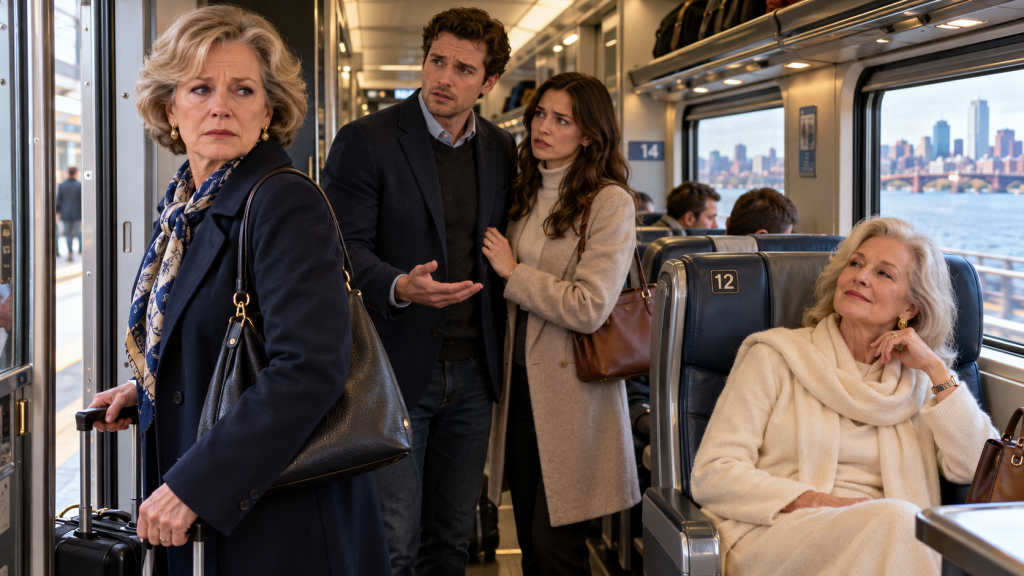
The train seat had hurt.
The moved luggage.
The assumption.
But this was different.
This had numbers.
Approvals.
A paper trail.
I looked at Jessica.
“What did you think I had agreed to?”
She crossed her arms.
“We talked about wanting the wedding to feel special.”
“I have had conversations about wanting a beach house.”
“That is not financial authorization.”
Susan exhaled sharply.
“Oh, for heaven’s sake.”
Caroline looked at her.
Susan continued.
“Nancy, you knew what kind of wedding they were planning.”
“No.”
I turned toward her.
“I knew the kind of wedding they originally priced.”
“This is what weddings cost now.”
“Apparently only when other people are paying.”
Her face hardened.
“That is unfair.”
“No.”
I touched the spreadsheet.
“This is arithmetic.”
Caroline cleared her throat.
“There’s more.”
Nobody spoke.
She pulled out a series of printed emails.
Jessica’s email address.
Susan’s.
Caroline’s assistant.
The florist.
Venue sales staff.
One message from Susan read:
Nancy is covering the wedding costs. Please keep the existing card on file and make the upgrade. She wants Liam and Jessica to have the full experience.
My fingers went cold.
I read it again.
She wants.
My desires had become a sentence Susan could write for me.
Another email.
Jessica this time.
Nancy is fine with the additional lounge furniture. She told us she doesn’t want us stressing over money this weekend.
I looked at her.
“When did I say that?”
Jessica’s face flushed.
“You said you didn’t want us stressed.”
“When?”
“Months ago.”
“I said I didn’t want wedding planning to ruin your engagement.”
“That is not the same sentence.”
“I know that now.”
I laughed.
Not because anything was funny.
“Now.”
Caroline slid another page forward.
“The reason I came here personally is this.”
There was an authorization request.
Not signed.
Just a draft.
A final credit-card authorization for the remaining venue balance.
The amount was nearly twelve thousand dollars.
My card number was masked.
My name printed below.
No signature.
Caroline said:
“My assistant was told you would sign this when you arrived in Boston.”
I looked up.
“By whom?”
Nobody answered.
Caroline did.
“Jessica.”
My son closed his eyes.
Jessica spoke quickly.
“Because you were coming.”
“Yes.”
“On the train.”
“Yes.”
“With my late husband’s cuff links in my bag and every vendor confirmation in a folder.”
My voice shook.
“I was coming to support you.”
“I wasn’t coming to sign whatever happened to be placed under my hand.”
Jessica said:
“You would have paid it.”
There it was.
Not:
I thought you had agreed.
Not:
I misunderstood.
You would have.
Maya walked through my front door at that exact moment.
“I’m here.”
She entered the dining room.
Looked at the faces.
Then at me.
“What happened?”
I slid the spreadsheet toward her.
“Apparently I would have paid it.”
Maya read.
Her eyes widened.
Then she looked at Liam.
“Seriously?”
He said:
“I screwed up.”
Jessica immediately turned.
“Liam.”
He looked at her.
“I did.”
Then at me.
“I screwed up.”
That was the first useful sentence he had said since the train.
I did not reward it.
Not yet.
Caroline continued.
“The venue can still hold the wedding date until noon.”
She looked at Liam and Jessica.
“But replacement payment has to be arranged for the outstanding balance.”
“And we need written decisions today about which optional services remain.”
Susan stared.
“Today?”
“The event is tomorrow.”
“Yes, Susan.”
Caroline’s voice remained professional.
“Today.”
Jessica looked panicked.
“What happens to the deposits Nancy cancelled yesterday?”
“Some are partially refundable.”
“Some are not.”
“Those vendors will deal directly with Nancy because her name is on those contracts.”
“What happens to us?”
Caroline asked:
“Financially?”
“Yes.”
“You may replace the contracts yourselves if vendors are still available.”
“And if we can’t?”
“Then those services are cancelled.”
Susan looked toward me.
“Nancy.”
I almost smiled.
There was the tone.
The one people use when they believe reason means returning to what benefits them.
I folded my hands.
“No.”
She had not yet asked.
That was how predictable this had become.
She stared.
“You don’t even know what I was going to say.”
“Yes, I do.”
I looked at Liam.
Then Jessica.
“If you want the wedding to happen tomorrow, you need to decide what wedding you can afford.”
Jessica’s eyes filled.
“Do you understand that people are already traveling?”
“Yes.”
“My dress is here.”
“Yes.”
“The hotel block is full.”
“Yes.”
“You’re my son’s mother.”
“Yes.”
Every sentence struck some old maternal instinct inside me.
Fix it.
Don’t let them hurt.
You can afford it.
George would want happiness.
Then I looked at the emails.
Nancy wants.
No.
George had wanted us to help Liam start well.
He had not said:
Teach him that his mother’s money appears whenever adulthood becomes uncomfortable.
I said:
“I am not paying the remaining balance.”
Jessica stood.
“This is insane.”
Maya started to speak.
I held up one finger.
My daughter stopped.
Good.
I wanted my own words.
Jessica’s face was wet now.
“All because my mother sat in your seat.”
“No.”
I stood too.
“This is the last time I am explaining this.”
I looked at Liam.
“You moved my belongings.”
“You reassigned something I had chosen and paid for.”
“You did it without asking.”
“Then when I arrived, you told me not to make it a thing.”
I touched the spreadsheet.
“That seat was one example.”
“This is another.”
“The bridal shower was another.”
“The guest room was another.”
“The authorized-user card was another.”
“The savings account was another.”
Liam looked up sharply.
“The savings account?”
Jessica went still.
Susan stopped breathing.
I walked to the sideboard and picked up the folder I had printed the night before.
I placed it in front of Liam.
“This account.”
He opened it.
Transaction history.
Contributions.
Transfers.
His face changed as he read.
“Mom.”
“I moved my contributions.”
His head snapped up.
“You emptied it?”
“No.”
“I left every dollar that came from you.”
“And the portion of gifts that were clearly yours.”
“More than ninety percent of the account came from me and your father.”
His face went white.
Jessica said:
“You can’t just take money out of a shared account.”
Maya laughed once.
I looked at her.
She covered her mouth.
Sorry.
I looked back at Jessica.
“I can remove my own money from an account where I am a legal owner.”
“I documented every contribution.”
“I did not touch Liam’s money.”
Liam looked at the transfer history.
Then at Jessica.
A different expression.
“Why did so much go to your checking?”
She froze.
I watched him.
Interesting.
He knew transfers occurred.
But perhaps not all of them.
Jessica said:
“We needed wedding deposits.”
“How much?”
“Liam.”
“How much?”
She looked at Susan.
Of course.
Liam turned.
“Stop looking at your mother.”
It was the exact thing I had said to him minutes earlier.
A strange sadness moved through me.
Children repeat lessons fastest when pain teaches them.
Jessica whispered:
“About seven thousand.”
Liam stared.
“Seven?”
“You knew we were using some.”
“I knew about two thousand.”
Susan said:
“This is not the time.”
Maya turned toward her.
“I’m fascinated by when you think the time is.”
“Maya.”
I said.
She leaned back.
Fair.
Liam’s voice shook.
“What was the rest?”
Jessica’s face crumpled.
“Deposits.”
“For what?”
“Welcome party.”
“I thought your mom paid that.”
Susan said:
“I covered part.”
Jessica continued.
“Hair and makeup deposits.”
“Hotel upgrades.”
“The designer invitations.”
Liam stared.
“We already paid for invitations.”
“Those were the original ones.”
“What original ones?”
Silence.
His face changed.
“You reordered them?”
Jessica whispered:
“The paper looked cheap.”
Maya closed her eyes.
Even Caroline looked down at her folder.
Liam sat slowly.
“How much is this wedding?”
No one answered.
He looked at Caroline.
“Everything.”
She hesitated.
Then named a number.
I will not repeat it because even now, years later, the number makes me feel slightly ill.
It was more than George and I had spent on the down payment for our first house.
Liam stared at Jessica.
“We said forty.”
Jessica said:
“It grew.”
“By almost double?”
“We had more guests.”
“Your mother added people.”
Susan stiffened.
“Do not put this on me.”
Liam laughed bitterly.
“Who else?”
Jessica’s eyes filled.
“You wanted your work people.”
“Eight.”
“Eight people.”
He rubbed his face.
“You told me your mom was covering the extras.”
“She said she would help.”
Susan interrupted:
“I said I would contribute what I could.”
Jessica turned.
“You told me not to worry.”
“I did not mean spend whatever you wanted.”
The room became quiet.
There it was.
Three generations of the same sentence.
I thought someone else would cover it.
I sat down.
Suddenly I was exhausted.
Caroline closed the folder.
“I think the family needs to talk.”
She looked at me.
“I’ll email you copies of everything involving your card and contracts.”
“Thank you.”
Then she looked at Liam and Jessica.
“I need your decision by noon.”
She left.
The front door closed.
No one spoke.
Finally Maya said:
“Wow.”
I almost laughed.
Liam looked at me.
“Do you still have Dad’s cuff links?”
The question nearly broke me.
My hand moved instinctively toward the place where my purse would have been if I had still been on that train.
The velvet box was upstairs.
“Yes.”
He nodded.
Then looked down.
“I don’t deserve them.”
That hurt.
I had been angry.
Still was.
But mothers know the difference between accountability and annihilation.
I said:
“That is not what I said.”
He looked up.
“You disappointed me.”
“You treated me badly.”
“You acted entitled.”
“None of those sentences means you are beyond being your father’s son.”
His eyes filled.
I continued.
“But those cuff links are not the problem we solve first.”
He nodded.
Then he did something I had not expected.
He turned to Jessica.
“Wedding’s off.”
She stopped breathing.
“What?”
Susan shot to her feet.
“Absolutely not.”
Liam looked at her.
“It is not your wedding.”
Then at Jessica.
“We’re not getting married tomorrow.”
She stared.
“Because of your mother?”
“No.”
He looked at the papers.
“Because I don’t know what we’re doing.”
Her face collapsed.
“We love each other.”
“I know.”
“Then what are you saying?”
“I’m saying we were about to get married while hiding money from each other.”
“I’m saying I have apparently been letting you move money out of an account without knowing how much.”
“I’m saying we planned a wedding we cannot afford because every time the bill got bigger, somebody said Mom would handle it.”
He looked at me.
“I helped create that.”
Then back to Jessica.
“And you did too.”
Susan said:
“You are humiliating my daughter.”
Liam turned.
“No.”
“I’m postponing a wedding.”
“Humiliation was my mother standing in a train aisle while we told her not to make her own seat a thing.”
Silence.
I did not feel victorious.
That is important.
My son had finally understood.
And it hurt him.
Watching someone you love understand their own behavior is not satisfying when the lesson breaks something they wanted.
Jessica whispered:
“You promised me tomorrow.”
Liam started crying.
“I know.”
“So did you.”
The wedding did not happen that Saturday.
People were already in Boston.
Some were angry.
Some understood.
Most received a short message:
Due to personal circumstances, the wedding has been postponed. We are sorry for the inconvenience and appreciate your privacy.
No details.
No public blame.
No social-media statement.
No revenge.
Caroline helped unwind what could be unwound.
I lost money.
More than I wanted to.
Some deposits were nonrefundable.
That was my consequence too.
I had signed contracts.
I had allowed the arrangement to grow without tracking it closely.
I did not sue my son for the deposits.
I did not demand immediate repayment.
I simply stopped paying anything further.
Jessica’s family paid their own hotel expenses.
Susan paid for the room she had upgraded.
Liam and Jessica absorbed several penalties themselves.
Painful.
Appropriate.
The premium bar vanished.
The champagne wall vanished.
The floral ceiling vanished.
Funny how many “essential” things disappear when the person choosing them has to pay.
For nearly three weeks, Liam barely spoke to me.
That was harder than I expected.
Maya came over often.
She helped me put the guest room back together.
Not into storage.
Into a room.
Fresh sheets.
A lamp.
George’s old reading chair by the window.
One afternoon, Maya was hanging curtains when she said:
“You know you’re allowed to miss him.”
I looked at her.
“Who?”
“Liam.”
“I talk to him.”
“You text him about insurance paperwork.”
“That counts.”
“No.”
She climbed down from the step stool.
“You’re doing the thing where boundaries become armor.”
I stared.
“When did you become wise?”
“Watching all of you make terrible decisions.”
Fair.
I sat on the bed.
“I’m scared if I soften, everything goes back.”
Maya sat beside me.
“Then soften without giving money.”
I laughed.
“That simple?”
“No.”
“But money and love are not the same lever unless you keep attaching them.”
That one hurt because it was true.
I had spent years expressing love financially.
George and I helped with tuition.
Car repairs.
Deposits.
Emergency cards.
House fund.
Wedding.
Partly generosity.
Partly habit.
Partly because writing a check was easier than saying:
I miss you.
Come have dinner.
Why don’t you call?
Are you okay?
Do you need me, or do you need money?
Maya said:
“You were right to stop funding everything.”
“Thank you.”
“But don’t make Liam buy access to you now.”
I looked at her.
“What does that mean?”
“Don’t sit here waiting for an apology perfect enough to earn his mother back.”
I cried.
Quietly.
Then:
“You always liked him better.”
Maya laughed.
“Absolutely not.”
Good.
I called Liam that evening.
Not about the wedding.
“Hi.”
A pause.
“Hi, Mom.”
“I made too much soup.”
Another pause.
“Is that code?”
“No.”
“I genuinely made too much soup.”
He almost laughed.
I heard it.
Then:
“Okay.”
“Do you want some?”
He was quiet.
“Yes.”
He came alone.
At seven.
No suitcase.
No expectation of sleeping over.
I handed him a container.
He stood in the kitchen.
Then looked at George’s mug on the shelf.
“I’m sorry.”
I said nothing.
He continued.
“Not because I want the wedding money back.”
“Good.”
“I’m sorry because when you got on that train, I knew 12A was your seat.”
“I knew you chose it.”
“I knew your bag was there.”
“I moved it anyway.”
His eyes filled.
“I told myself Susan gets motion sick.”
“She probably does.”
“But I didn’t ask you.”
“No.”
“I knew you’d say fine.”
I swallowed.
“That’s the part.”
He nodded.
“I counted on it.”
Silence.
Then:
“I did that with the card too.”
“The house.”
“The account.”
“Everything.”
He looked at me.
“I think I got used to your yes before I even asked.”
There are apologies that explain.
Apologies that excuse.
And apologies that finally name the injury accurately.
That one did.
I sat.
“Come here.”
He hugged me.
My son was thirty-one.
For one second he felt eight.
George’s funeral? No, George died later, likely Liam adult. Still.
He cried into my shoulder.
“I miss Dad.”
That broke me.
“I know.”
“I kept thinking if he was here, none of this would have happened.”
I pulled back.
“No.”
Liam stared.
“Your father loved you.”
“He also spoiled you in some ways.”
Liam almost smiled.
“He did.”
“George believed helping you meant giving you a runway.”
“He never wanted the runway to become your permanent address.”
That made him laugh through tears.
I continued.
“He would have been disappointed.”
Liam looked down.
“And then he would have expected you to do better.”
His eyes filled again.
“Do you think he’d still want me to have the cuff links?”
“Yes.”
Immediate.
“But not today.”
He smiled sadly.
“Fair.”
Jessica did not come to my house for two months.
She and Liam did not break up.
They also did not immediately set another wedding date.
They began counseling.
Separately at first.
Then together.
That surprised me more than if they had simply ended things.
Jessica moved temporarily into Susan’s guest room.
The one apparently reserved for book club.
Book club survived.
Miraculously.
Liam stayed in their apartment.
They split shared expenses.
Went through every account.
Every credit card.
Every wedding debt.
I learned later that Jessica had been carrying more debt than Liam knew.
Not enormous.
Enough.
Designer purchases.
Travel.
A graduate-school balance.
She had been ashamed.
Susan knew.
Instead of encouraging her to tell Liam, Susan had helped her “manage appearances.”
There was that word again.
Appearance.
A wedding had been built on it.
Eventually Jessica called me.
“Can we meet?”
I hesitated.
Then said yes.
Coffee shop.
Public.
Neutral.
She arrived without her mother.
That mattered.
We sat.
She looked thinner.
Tired.
No engagement ring.
I noticed.
She noticed me noticing.
“I’m still engaged.”
she said.
“I didn’t ask.”
“I know.”
She wrapped both hands around her coffee.
Then:
“I’m sorry.”
I waited.
“I’ve said that to myself a hundred times and it sounded better.”
“It usually does.”
She smiled weakly.
Then:
“I treated you like money.”
That was blunt.
Accurate.
I said nothing.
She continued.
“Not only money.”
“I liked you.”
“I do like you.”
“But I also started seeing you as the person who could make problems disappear.”
My throat tightened.
“When the florist cost more, Nancy.”
“When the shower deposit was short, Nancy.”
“When Liam and I wanted something we couldn’t afford, we talked about whether you could.”
“Not whether we should.”
There.
“I’m ashamed.”
I believed her.
“What changed?”
“The train?”
She shook her head.
“Liam.”
“What about him?”
“He asked me after the wedding was postponed if I would still marry him if his mother had no money.”
My chest tightened.
Jessica looked down.
“I got angry.”
“Because the answer was yes.”
“But I hated that he had reason to ask.”
She wiped her eyes.
“Then he asked himself the opposite.”
“If he would still marry me if my mother stopped paying for things.”
“We both realized we had let our parents become part of the architecture of our adult life.”
That was a good phrase.
I did not tell her.
She continued.
“I also owe you a more specific apology.”
Good.
“I told vendors you approved things you did not approve.”
“Yes.”
“I justified it because I thought you would say yes anyway.”
“Yes.”
“That was wrong.”
“Yes.”
She swallowed.
“And I moved your bag on the train.”
My eyes lifted.
“Liam helped.”
“I know.”
“I suggested it.”
“Why?”
She looked embarrassed.
“Mom said she felt sick.”
“We thought you missed the train.”
“You were three minutes late.”
“Yes.”
“And honestly?”
I waited.
“I thought you’d adjust.”
There it was.
The whole story in one sentence.
I nodded.
“I usually did.”
Jessica cried.
“I’m sorry.”
I believed that too.
But trust is not a light switch.
“I accept your apology.”
Her face softened.
“That does not mean we go back to how things were.”
“I know.”
“Good.”
Then she said:
“I don’t want your money.”
I almost smiled.
“You may want some money someday.”
“Most people do.”
“I mean for the wedding.”
“I know.”
She looked at me.
“If Liam and I get married, we are paying for it.”
I believed she meant it.
At least that day.
I said:
“Then plan a wedding you can afford.”
She nodded.
“That’s what we’re doing.”
Susan took much longer.
At first, she did not apologize at all.
She told mutual family members I had “withdrawn support at the eleventh hour.”
Technically true.
Conveniently incomplete.
I did not campaign against her.
No group texts.
No screenshots sent to relatives.
No social-media post.
I had learned something from George.
Paper lasts longer than gossip.
If anyone asked directly, I said:
“I stopped paying for expenses I had not authorized.”
That was enough.
Months later, Susan appeared at my house again.
This time she called first.
Progress.
I let her in.
She looked around the guest room when we passed.
“Liam’s things are gone.”
“Yes.”
“He told me.”
We sat in the kitchen.
No expensive purse held like a shield this time.
Just Susan.
She said:
“I was angry at you.”
“I know.”
“I thought you humiliated Jessica.”
“I know.”
“I thought you were punishing everyone because you felt slighted.”
“I know.”
She stared.
“You’re not going to argue?”
“No.”
She exhaled.
Then:
“I was wrong.”
I waited.
She looked toward the window.
“When Jessica was growing up, I could not give her what some of her friends had.”
“My husband left.”
“Money was tight.”
“I learned to make everything look fine.”
Good school clothes from outlet stores.
Trips paid in installments.
Nice birthday parties assembled with coupons.
I listened.
She continued.
“When she got engaged to Liam and I realized your family had more money…”
She stopped.
Not rich.
George and I were not rich.
Comfortable after decades of discipline.
There is a difference.
But from Susan’s side, perhaps we looked wealthy.
She said:
“I wanted my daughter to finally have the wedding I couldn’t give her.”
“So you decided I could.”
Her face tightened.
“Yes.”
Honesty.
“I hated myself for it after I said it aloud.”
“Good.”
She almost smiled.
“I deserve that.”
Then:
“The seat.”
I looked at her.
“I really do get motion sick.”
“I believe you.”
“I should have asked.”
“Yes.”
“She told me you wouldn’t mind.”
“Jessica?”
Susan nodded.
“I should still have asked you myself.”
“Yes.”
She looked down.
“I didn’t because I knew if I asked, there was a chance you’d say no.”
That was the same problem again.
People avoid consent when they prefer certainty.
Susan continued.
“I’m sorry.”
I nodded.
“Thank you.”
She looked almost disappointed.
No hug.
No immediate friendship.
Good apologies do not buy closeness.
They make closeness possible if future behavior supports it.
That is enough.
Liam and Jessica waited eight months before setting another wedding date.
Forty-six guests.
Not two hundred.
A small historic inn outside Boston.
Lunch reception instead of evening gala.
Beer and wine.
No champagne wall.
No custom lounge furniture.
No farewell brunch.
Jessica wore the same dress.
Already paid for.
Liam wore a suit he owned.
The total budget was less than one quarter of the original event.
They paid it themselves.
Susan contributed a fixed amount toward flowers.
Fixed.
Agreed.
Written down.
I contributed nothing to the wedding expenses.
Not because I was punishing them.
Because they needed to know they could begin their marriage without reaching into my pocket.
Two weeks before the ceremony, Liam came to my house.
He stood in the kitchen.
Nervous.
“Mom.”
“Yes?”
“Can I ask you for something?”
My stomach tightened.
Old reflex.
“How much?”
He laughed.
“Not money.”
Good start.
“What?”
“Dad’s cuff links.”
I looked at him.
Months earlier, I would have handed them over immediately.
Now I asked myself one question.
Do I want to?
Yes.
That mattered.
I went upstairs.
Opened my dresser.
The velvet box sat exactly where I had placed it after stepping off the train.
I brought it down.
Liam did not reach for it.
He waited.
I opened the box.
George’s cuff links.
Simple silver.
Tiny scratches.
He wore them to our twenty-fifth anniversary dinner.
To Maya’s graduation.
To Liam’s college ceremony.
Liam’s eyes filled.
“I thought you might decide not to give them to me.”
“Why?”
“Because of everything.”
I shook my head.
“Your father’s love is not a prize I control.”
He cried.
So did I.
I placed the box in his hand.
Then:
“But there’s something else.”
I went to the drawer.
Pulled out an envelope.
Liam froze.
“What’s that?”
“Don’t panic.”
Inside was a letter George had written years earlier.
Not to Liam specifically.
A note I found after his death in an old desk file.
He had written about both children.
Ordinary things.
Insurance.
House.
A few wishes.
One line about Liam:
Help him when he needs it, but make sure he learns the pride of carrying his own weight. He’ll hate it before he understands it.
Liam read it.
Then laughed and cried at the same time.
“Dad was annoying.”
“Deeply.”
He read it again.
“Did you remember this during the wedding?”
“No.”
I smiled sadly.
“I found it while clearing the guest room.”
Of course.
The room we reclaimed had given something back.
Liam folded the letter.
“Can I keep a copy?”
“Yes.”
“Not the original?”
“No.”
He laughed.
“Boundaries.”
“Exactly.”
The second wedding was beautiful.
Not because it cost less.
Because it felt honest.
When I arrived, there was a place card on the first row.
Nancy.
No seat number.
No drama.
Susan sat across the aisle.
She smiled.
I smiled back.
Nobody moved anybody’s bag.
Maya sat beside me and whispered:
“Disappointingly normal.”
“Behave.”
“I am.”
When Liam entered, I saw George immediately.
Not literally.
Something in the shoulders.
The nervous smile.
Then the silver cuff links caught the light.
My breath disappeared.
Liam saw me.
Touched one cuff.
A tiny acknowledgment.
I cried before the ceremony even began.
Jessica walked in alone.
That was her choice.
Her father had been absent most of her life.
Susan offered.
Jessica said she wanted to walk herself.
I respected that.
At the front, Liam took her hands.
No orchestra.
No cathedral arrangement.
No floral ceiling.
Just two adults standing in a room they could afford.
The officiant spoke about marriage as a daily practice of choosing each other honestly.
I almost laughed.
They had apparently chosen a very targeted officiant.
During the vows, Jessica’s voice broke.
Liam cried.
Maya cried.
Susan cried.
I cried.
Family tradition.
Afterward, we ate roast chicken, vegetables, and a lemon cake from a local bakery.
No seven-tier display.
It tasted excellent.
At one point, Liam tapped his glass.
My entire body tensed.
Speeches.
Dangerous.
He smiled.
“I promise this is short.”
Everyone laughed.
Then he looked toward me.
“Eight months ago, I almost got married in a wedding I could not afford.”
Jessica nodded beside him.
“We.”
Liam corrected.
“We could not afford.”
More laughter.
Then he became serious.
“I thought being an adult meant having the things adults are supposed to have.”
“Apartment.”
“Career.”
“Nice wedding.”
“What I did not understand was that if somebody else is constantly paying for the life you want, you are not fully making the choices you think you are.”
He looked at me.
“My mother helped me for years.”
“She helped me so consistently that I stopped seeing help and started seeing access.”
My throat tightened.
He continued.
“That was my failure.”
“Not hers.”
Then he smiled slightly.
“And she corrected it.”
Maya whispered:
“Violently.”
I elbowed her.
Liam continued.
“The first wedding did not happen because Jessica and I needed time to learn whether we could build a marriage without using our parents as financial scaffolding.”
Susan wiped her eyes.
Liam looked at her too.
“We are grateful for the support our families have given us.”
“But today is ours because the choices are ours.”
He raised his glass.
“To help that stays help.”
Not ownership.
Not debt.
Not entitlement.
Just help.
We drank.
I cried into my napkin.
After dinner, Jessica came to sit beside me.
“I saved you cake.”
She handed me a plate.
“Thank you.”
She smiled.
Then:
“Your seat okay?”
I stared.
She looked terrified for half a second.
Then I burst out laughing.
So did she.
Susan heard from across the table and covered her face.
“Too soon?”
Jessica asked.
“Eight months.”
I said.
“Apparently enough.”
Something loosened.
Not erased.
Loosened.
That is often the best forgiveness can do.
Liam and Jessica did not become magically perfect with money.
Of course not.
Six months into marriage, they argued about furniture.
One wanted a new dining table.
The other wanted to pay down a credit card.
They called me.
I answered.
Liam said:
“What do you think?”
I replied:
“I think married adults get to decide.”
Silence.
Then Jessica laughed.
“Nice try.”
I said:
“Do you want my opinion or my money?”
Both yelled:
“OPINION.”
Progress.
I gave the opinion.
They bought a cheaper table.
Paid extra on the card.
No one died.
I changed too.
That part matters.
It would be easy to tell the story as though my family had been entitled and I had simply been generous.
The truth was more uncomfortable.
I liked being needed.
After George died, especially.
Paying for things gave me a role.
Liam called about a car problem?
I could fix it.
Maya needed a deposit?
I could help.
Wedding shortfall?
Put it on my card.
Money became a language I spoke fluently when grief had made other languages difficult.
I could not make George come back.
But I could make invoices disappear.
That felt powerful.
Useful.
Loved.
Then usefulness became expectation.
Expectation became entitlement.
And entitlement became resentment.
Not all of that belonged to the children.
Some belonged to me.
So I changed how I helped.
When Maya asked for help replacing her refrigerator, I said:
“How much do you need?”
Not:
I’ll buy it.
She named an amount.
I gave what I was comfortable giving.
The rest was hers.
When Liam’s car needed repairs, I did not offer.
He did not ask.
He paid.
When I gave birthday money, it was a gift.
No hidden expectations.
When I said no, I tried not to accompany it with twelve paragraphs of guilt.
Harder than it sounds.
I met with a financial adviser.
Updated my will.
Removed outdated account permissions.
Closed the old shared savings account after Liam transferred his portion.
Created separate beneficiary arrangements.
Maya and Liam received equal treatment.
Not because equality always means identical dollars.
Because in this case, it felt right.
I also created a small travel account.
For me.
That felt scandalous.
George would have approved.
Probably.
He liked trains.
One year after the Boston wedding, I took the train again.
Same route.
Alone.
I was visiting an old college friend.
When I boarded, someone was sitting in my reserved window seat.
A young man.
Headphones.
Backpack.
He looked up.
I said:
“I think that’s my seat.”
He checked his ticket.
“Oh.”
“Sorry.”
Then he moved.
That was all.
No family pattern.
No money.
No betrayal.
Just a seat.
I sat down.
Placed my bag beside my feet.
Looked out the window.
And laughed softly.
The woman across the aisle gave me a strange look.
I did not explain.
For months after that first trip, I had treated 12A like a symbol.
Maybe it was.
But sitting there again taught me something better.
Sometimes a seat is only a seat when the people around you respect that it belongs to you.
The pain had never been losing the window.
It was being told my preference did not matter because everyone expected my generosity to continue anyway.
Once that changed, the seat became ordinary again.
I liked ordinary.
Susan and I became something close to friends.
Not quickly.
Not dramatically.
We were two mothers who had each made our children’s adulthood more complicated in different ways.
She overmanaged Jessica.
I overfunded Liam.
She had taught her daughter to protect appearances.
I had taught my son that Mom had a financial safety net large enough to absorb poor planning.
We both had things to undo.
One afternoon, years later, we had coffee.
Susan said:
“Do you know Jessica still hates window seats?”
I stared.
“What?”
“She gets motion sick, but she prefers the aisle now.”
We laughed.
Then she added:
“She says the window has too much family history.”
Fair.
Susan became serious.
“I really was awful that morning.”
“Yes.”
“You could soften that.”
“No.”
She laughed.
Then:
“I thought if you paid, you must not mind.”
I looked at her.
“I thought the same thing sometimes.”
She blinked.
“What?”
“I thought if I kept offering, everyone would understand it meant love.”
“Turns out money is terrible at reading subtext.”
Susan smiled.
“That should be on a pillow.”
“Please don’t.”
We sat.
No competition.
No wedding.
No daughter and son between us.
Just two women old enough to recognize that generosity without conversation can create very expensive misunderstandings.
Maya married later.
Small courthouse ceremony.
She paid for everything.
Mostly to annoy me.
I offered a fixed gift.
She accepted half.
Also to annoy me.
At dinner afterward, she said:
“See?”
“What?”
“No crisis.”
“Your wedding has twelve people.”
“Exactly.”
Liam laughed.
Jessica said:
“We support minimalism now.”
Everyone looked at her.
She raised both hands.
“I learned.”
We laughed.
Then Maya gave me a small box.
Inside was the old train ticket.
12A.
I stared.
“How do you have this?”
“You dropped it in the folder that day.”
“I found it while we were cleaning the guest room.”
I turned it over.
On the back she had written:
THREE MINUTES LATE. YEARS OVERDUE.
I cried.
Then laughed.
“That is unbelievably dramatic.”
“I’m your daughter.”
Fair.
I kept the ticket.
Not because I wanted to stay angry.
Because sometimes an ordinary object marks the moment you finally saw something clearly.
Liam became a father four years after the postponed wedding.
A little boy.
George.
They named him George.
I cried for two days.
When baby George was six months old, Liam called.
“Mom, can you watch him Saturday?”
My heart exploded.
“Yes.”
Then I stopped.
“What time?”
Liam laughed.
“Look at you.”
“What?”
“Asking details before agreeing to labor.”
“Do you want childcare or a lecture?”
“Childcare.”
“Then answer.”
Nine to three.
Fine.
He dropped George off with diapers, milk, extra clothes, written schedule.
And a twenty-dollar bill.
I stared.
“What is this?”
“Food.”
“For a six-month-old?”
“For you.”
I laughed.
“Take it back.”
“No.”
“Liam.”
He smiled.
“Everybody buys their own food.”
Wrong story? This phrase from another story, not this one. Don’t cross stories. Need avoid. Let’s adjust. Since inside writing block already maybe can’t edit? We can continue and maybe contextualize? But should not mix. Better correct mentally before final, but we’re in final. We need ensure no cross contamination. I have not sent yet? I am composing. I can replace that line. Let’s continue with different:
He smiled. “For lunch. I’m trying not to assume.”
Good.
I stared at him.
Then took the twenty.
Not because I needed it.
Because I understood the gesture.
After he left, I used my own money to order lunch anyway and put the twenty into baby George’s little savings jar.
Old habits.
But chosen.
That mattered.
As Liam became a parent, he called more often.
Not for money.
Questions.
Fevers.
Car seats.
Daycare.
Why does the baby scream at 4:00 p.m.?
No one knows.
Parenthood.
One night, he said:
“I understand now why you kept helping.”
My throat tightened.
“Do you?”
“When George cries, I want to fix it before I even know what he needs.”
I smiled.
“Yes.”
“And sometimes the fastest thing is not the best thing.”
“Yes.”
He was quiet.
Then:
“I’m sorry I made your help into an obligation.”
I closed my eyes.
We had repaired so much already.
Still, apologies can keep deepening.
“I know.”
Then he said:
“I hope I don’t do that to him.”
“You will do something to him.”
He laughed.
“Comforting.”
“You’re his parent.”
“You’ll get something wrong.”
“Then hopefully you notice and repair it.”
That was all any of us could promise.
George’s cuff links eventually passed to little George.
Not because Liam died.
Years later, when my grandson graduated from college, Liam brought the velvet box to my house.
“Think Dad would approve?”
I cried immediately.
“Your father?”
“My dad.”
He smiled.
“Yes.”
We gave them to young George together.
He had heard the story.
Not all the wedding details.
Enough.
He opened the box.
“These are really old.”
Liam looked offended.
“They are vintage.”
I laughed.
Young George wore them to his graduation dinner.
One fell off in the restaurant.
We spent fifteen minutes crawling under tables.
His grandfather’s dignity surviving by a thread.
Family.
I am older now.
Old enough that the guest room is used more often because grandchildren visit.
Old enough that Liam sometimes offers to drive me to appointments.
The first time he reached for my car keys automatically, I looked at him.
He stopped.
“May I?”
I smiled.
“Yes.”
Small question.
Huge history.
He helps me with finances sometimes now too.
Not because he regained some automatic family right.
Because I asked.
We sit at my dining table.
The scratched one.
George’s table.
Liam goes through statements with me.
He never moves money without showing me.
Never signs.
Never assumes.
Once I said:
“You don’t need to explain every line.”
He replied:
“Yes, I do.”
I understood.
Then:
“You’ll make me anxious.”
“Fine.”
“Explain every line.”
We laughed.
Trust after entitlement is rebuilt in boring repetitions.
Permission.
Confirmation.
Transparency.
Boring can be beautiful.
Jessica and I once talked about the original wedding dress.
She still had it.
The same dress she eventually wore at the smaller ceremony.
“I almost sold it after the postponement.”
she said.
“Why didn’t you?”
“I realized the dress hadn’t done anything wrong.”
I laughed.
That sentence belonged on a pillow too.
Then she said:
“I used to hate looking at the pictures from our actual wedding because I knew what happened before.”
“What changed?”
“I stopped thinking the smaller wedding was the consolation prize.”
My throat tightened.
“What was it?”
“The first honest thing we paid for together.”
That was beautiful.
I told her.
She smiled.
“Also the lemon cake was better.”
True.
Years after the train incident, I finally asked Liam something that had bothered me.
We were on my porch.
Autumn.
The garden mostly finished.
George’s old coffee mug in my hand.
“Did you really think 34C was acceptable?”
Liam laughed so suddenly coffee came out his nose.
“Mom.”
“I’m serious.”
“Beside the restroom?”
“I know.”
“You moved your own mother from a window seat near the family to an aisle seat beside the toilets.”
He covered his face.
“I was panicking.”
“About?”
“Getting everybody settled.”
“Susan felt sick.”
“Jessica was stressed.”
“The conductor was rushing us.”
“I saw an empty seat.”
“And?”
He looked at me.
“I knew you would take it.”
There.
Even after all these years.
The clean truth.
I nodded.
“That’s what I thought.”
He became serious.
“I hate that.”
“Don’t.”
“Why?”
“Because you don’t do it anymore.”
He smiled.
Then:
“I still owe you a train ticket.”
“You owe me nothing.”
He raised one eyebrow.
“Growth?”
“Mostly.”
We laughed.
The strangest part is that I did not become less generous after all this.
I became more deliberate.
Before, I helped because the need appeared.
Or because someone assumed.
Or because saying no made me afraid I would seem selfish.
Now I give because I choose.
There is so much more joy in chosen generosity.
When Maya needed help during maternity leave, I gave her a fixed amount.
No strings.
When Liam and Jessica wanted to replace their roof, I did not offer.
They handled it.
When my grandson studied abroad, I paid for his plane ticket as a graduation gift.
I told him exactly what I was paying for.
Nothing else.
He thanked me.
No assumption.
No resentment.
Clear kindness feels lighter.
George had been right all along.
Help someone start well.
Not carry.
Help is a hand.
Carrying is a permanent arrangement.
And permanent arrangements should never be created by silence.
The wedding-planning folder still exists.
Not the original contracts.
Those are long gone.
But the cream-colored folder Caroline brought to my house that morning sat in my desk for years.
Eventually I cleaned it out.
Emails.
Upgrade sheets.
The draft credit-card authorization.
I shredded almost everything.
Maya was horrified.
“Historical documents!”
“They are catering emails.”
“Family history.”
“Go home.”
I kept one page.
The original wedding budget.
Before everything expanded.
At the bottom, in George’s handwriting from years earlier—because I had used an old notebook page when Liam first called about engagement expenses—were five words:
Help him. Don’t do it.
I had forgotten writing them down.
George had said it when Liam was in college, struggling with a class.
I wanted to call the professor.
George stopped me.
“Help him.”
Then:
“Don’t do it.”
That philosophy applied to more than school.
It took me years to understand.
When I think about that first train now, I no longer see Susan first.
I see Liam.
Standing beneath the luggage rack.
My son.
Relieved when he thought I would move to seat 34C without argument.
That is the detail that hurt enough to change me.
Relief.
He was relieved because my surrender had become dependable.
But I also see myself.
Standing there.
Still.
Realizing I did not have to cooperate with my own erasure simply because making a scene would inconvenience other people.
I did not scream.
I did not drag Susan out of the seat.
I stepped off.
That was all.
A train left.
A wedding was postponed.
Contracts were cancelled.
Money moved.
Locks changed.
People cried.
And eventually, a family learned to ask before taking.
Not perfectly.
Better.
I learned too.
That is important.
Boundaries are not only instructions for other people.
They are promises to yourself about what you will stop volunteering against your own wishes.
For years, I thought my kindness lived in how much I could absorb.
More cost.
More inconvenience.
More storage.
More assumptions.
Move my seat.
Fine.
Use my card.
Fine.
Store your boxes.
Fine.
Take from the account.
Fine.
Need more?
Fine.
Until one day it wasn’t.
And the world did not end.
My son still loved me.
His marriage eventually happened.
Jessica became family.
Susan became someone I could drink coffee with.
Maya remained insufferably perceptive.
I kept my house.
My money stopped being family weather.
And George’s cuff links reached the son he always meant them for.
Nothing important was destroyed by my saying no.
Only the arrangements that depended on me never saying it.
On the tenth anniversary of Liam and Jessica’s actual wedding, they invited the family to dinner.
Small restaurant.
No event planner.
No champagne wall.
Thank God.
At dessert, Liam handed me an envelope.
I groaned.
“What now?”
“Open it.”
Inside was a train ticket.
Boston.
Window seat.
12A.
I stared.
“For when?”
“Next month.”
“Why?”
Jessica smiled.
“We’re taking you to see that exhibit you keep talking about.”
I looked at Liam.
“You bought my ticket?”
“Yes.”
“Your money?”
He laughed.
“Yes, Mom.”
“Your card?”
“Yes.”
“No authorized-user funny business?”
“Please stop.”
Everyone laughed.
Then Jessica said:
“And Susan has her own seat.”
Susan raised her glass from across the table.
“Aisle.”
We all laughed harder.
I looked at the ticket again.
12A.
For a second, I could barely see it through tears.
Liam reached across the table.
“You don’t have to go.”
That was the best part.
Not:
We bought it, so come.
Not:
Don’t make this a thing.
You don’t have to go.
Choice.
I looked at him.
“I want to.”
He smiled.
“Good.”
On the morning of that trip, I arrived at the station twenty minutes early.
Growth comes in strange forms.
Liam saw me and laughed.
“Afraid we’ll give your seat away?”
“Deeply.”
Jessica hugged me.
Susan carried motion-sickness tablets.
Maya came only to wave us off and make jokes.
When the train doors opened, we boarded.
I found 12A.
Empty.
My bag stayed beside me until I put it away myself.
Susan sat across the aisle.
Liam and Jessica behind us.
The conductor called for everyone to settle.
For one second, I remembered the first time.
Three minutes late.
My son’s relieved face.
Seat 34C.
The platform.
The message.
My financial support for the wedding ends today.
I had believed then that I was ending something.
I know better now.
I was separating things that should never have become the same.
Love.
Money.
Access.
Help.
Obligation.
Once separated, each became cleaner.
I looked out the window as the train began to move.
Liam leaned forward between the seats.
“Mom?”
“Yes?”
“Seat okay?”
I turned toward him.
Then toward Susan.
She laughed before I answered.
I smiled.
“It’s perfect.”
And this time, when the train carried us toward Boston, nobody owed anybody the view.
We were simply going together.
That was all I had wanted in the first place.
Not repayment.
Not gratitude measured in dollars.
Not control over my son’s wedding.
A place beside the people I loved that did not disappear the moment somebody else wanted it.
George had once said we should help Liam start well.
For years, I thought the help was the money.
I was wrong.
The most important help I ever gave my son was stepping off that first train and forcing him to learn that love is not unlimited access to another person’s wallet, house, time, or willingness to adjust.
And the most important thing he gave me in return was proof that a grown child can learn.
He could apologize.
He could change.
He could build a marriage with his own hands.
He could come back to his mother without reaching for her credit card.
The train seat was never really the inheritance.
Neither was the wedding money.
The inheritance George and I wanted to leave our children was simpler.
Know what belongs to you.
Respect what belongs to someone else.
Ask.
Listen.
Help when you choose.
Stand on your own feet when you can.
And never mistake someone’s generosity for proof that they have stopped needing respect.
It took one window seat, a moving train, a cancelled wedding, and a very expensive lesson for all of us to understand that.
But we did.
And when Boston appeared beyond the glass, Liam leaned forward again and said:
“Mom, we’re almost there.”
I smiled at my son’s reflection in the window.
This time, we were.
THE END STORIES! THANK YOU FOR READING GOOD LUCK !❤️
Related Posts