➡️ PART 3 ENDING PART➡️
Sarah’s words seemed to hang above the aisle.
“Mrs. Vale, your bridal company has been using property owned by Evelyn’s holding trust for almost four years—and the lease has never been paid.”
My mother stared at her.
For once, Beatrice Vale had no answer prepared.
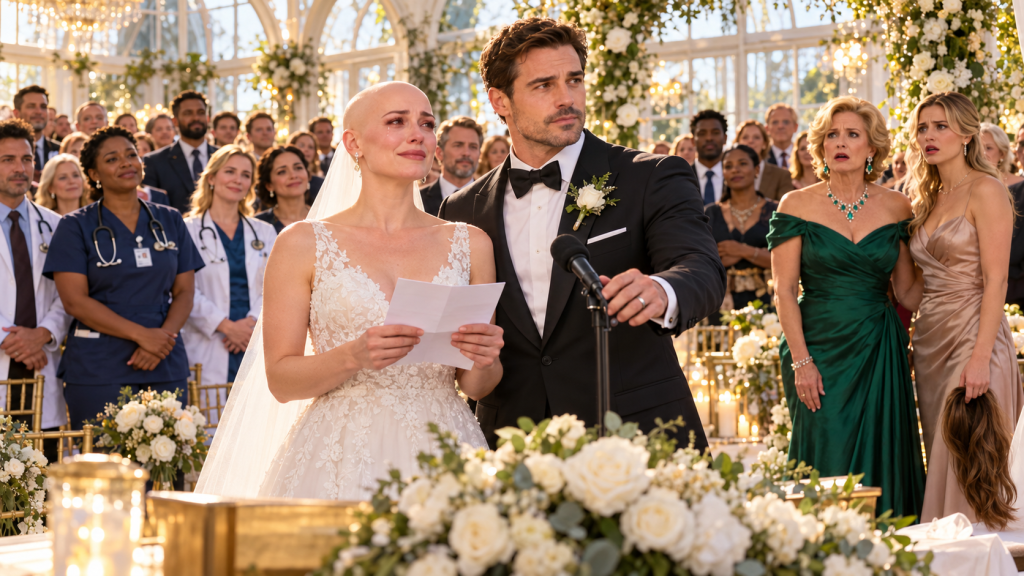
The wig was still hanging from her hand.
My wig.
The one she had ripped from my head in front of 114 people because she thought exposing my illness would make Silas reconsider marrying me.
Instead, she stood beneath the glass roof of the conservatory holding proof of nothing except her own cruelty.
Khloe’s mouth opened.
“What?”
Sarah did not look at her.
She kept her eyes on my mother.
“The commercial building on West Ashford Avenue,” she said. “The one containing Vale Bridal Atelier.”
My mother’s voice came out sharp.
“That property belongs to Vale Holdings.”
“No,” Sarah replied. “Vale Holdings has been the tenant.”
Silence.
My mother shook her head.
“You don’t know what you’re talking about.”
Sarah closed the folder.
“I do.”
Then she looked at me.
Not Silas.
Me.
That mattered.
“Evelyn?”
She was asking whether I wanted this continued.
I looked around the room.
At the people standing.
At Dr. Evans, the oncologist who had told me there were nights when survival meant drinking three sips of water and calling that enough.
At Sarah, who once sat on the floor beside my desk while I vomited into a trash can between calculations because I refused to leave a municipal design review unfinished.
At nurses who had seen my bare head long before my mother decided it was useful as a weapon.
At engineers who had watched me present filtration projections while my hands trembled from chemotherapy.
At Silas.
Still beside me.
Still looking at my face.
Not my scalp.
My face.
Then I looked at my mother.
“Give me the wig.”
Her fingers tightened.
I held out my hand.
“Now.”
She hesitated.
Not because she wanted the wig.
Because surrendering anything to me felt like losing.
Silas did not intervene.
Neither did Sarah.
Good.
This one was mine.
“Mom.”
My voice was steady.
“Give it back.”
Slowly, Beatrice lowered her hand.
I took the wig.
The strands were tangled where she had grabbed them.
The lace edge had torn slightly.
It had cost nearly three thousand dollars.
Custom made.
Matched to photographs of my hair before treatment.
A year earlier, I had cried when I first put it on because for five minutes I recognized the woman in the mirror again.
Now I looked at it differently.
Not as hair.
Armor.
Useful when I wanted it.
Heavy when I didn’t.
I handed it to Sarah.
“Hold this for me.”
My mother stared.
I turned back toward the altar.
The room remained standing.
I lifted the microphone from Silas’s hand.
My scalp felt cold beneath the conservatory air.
For one second, the old panic returned.
The childhood voice.
Too plain.
Too sick.
Too difficult.
Too visible.
Then I looked at the people around me.
I had already survived being seen.
I said:
“Please sit down.”
Nobody moved.
A strange laugh escaped me.
“Seriously.”
I looked toward Dr. Evans.
“My oncologist has spent enough time standing because of me.”
He smiled.
Chairs began scraping.
One by one, our guests sat.
My mother and sister remained standing.
Not by choice.
No chairs had been placed behind the altar.
I looked at Beatrice.
“The property issue is not going to be resolved at my wedding.”
Her eyes flashed.
“Then why did she bring it up?”
Because I had known she might try something.
That was the truth.
Not this.
I had expected criticism.
A speech.
Perhaps a comment about my appearance.
I had not imagined she would actually tear something off my body while I was speaking vows.
Sarah had insisted on keeping the folder nearby because two weeks earlier my mother had threatened to “ruin” the wedding if I did not let her bridal boutique supply the gown and publish photographs.
She had said:
“You owe this family some benefit from marrying a Thorne.”
That was when I finally gave our attorney permission to finish reviewing the old commercial lease.
I looked at my mother.
“Sarah brought the documents because you threatened me last week.”
Beatrice’s face changed.
Khloe turned toward her.
“You did what?”
My mother ignored her.
I continued.
“You said if I did not turn this wedding into advertising for Vale Bridal, you would make sure everyone understood what kind of daughter I really was.”
Several guests shifted.
Silas’s jaw tightened.
I kept going.
“I assumed that meant another speech about how selfish I am.”
I touched my bare scalp.
“I underestimated you.”
For the first time, my mother looked ashamed.
It lasted less than a second.
Then she straightened.
“I was trying to stop you from building a marriage on deception.”
Silas laughed once.
Not humor.
Disbelief.
My mother pointed at my head.
“He has never had to live with what you really are.”
The room went cold.
Khloe whispered:
“Mom.”
But Beatrice had spent her life believing the cruelest sentence won if spoken confidently enough.
She continued.
“You hide behind wigs and work and these people who feel sorry for you.”
My fingers tightened around the microphone.
Old Evelyn would have tried to convince her.
I’m in remission.
I’m not hiding.
They don’t pity me.
My hair is growing back.
Please understand.
I did none of that.
Instead I asked:
“Are you finished?”
She blinked.
“What?”
“Are you finished?”
“I’m your mother.”
“That is not an answer.”
The words came easier than I expected.
Her face hardened.
“You would humiliate your own mother at your wedding?”
Silas started to move.
I touched his arm.
No.
Mine.
I looked at Beatrice.
“You tore my wig off while I was reading vows.”
“You called me a bald cancer patient into a microphone.”
“You tried to make the man I love recoil from me in front of everyone who supported me through treatment.”
My voice shook once.
I let it.
“You do not get to redefine what happened because you dislike how people responded.”
She stared.
Then:
“I only wanted him to know the truth.”
I smiled sadly.
“He knows.”
I turned toward Silas.
“Do you?”
His eyes filled.
“Yes.”
“All of it?”
“The parts you’ve trusted me with.”
That answer.
Not:
Yes, I know everything.
Because nobody knows everything about another person.
The parts you trusted me with.
I nearly lost my composure.
Silas took my hand.
Then he looked at my mother.
“Beatrice.”
His voice was quiet.
“I knew Evelyn during chemotherapy.”
“I knew her when she wore scarves.”
“I knew her when she wore this wig.”
“I knew her when she wore no head covering at all because even silk hurt her skin.”
He looked at me.
“I know what her surgical scars look like.”
“I know where the port scar sits.”
“I know she still checks her neck in the mirror when she is frightened the lymphoma has returned.”
My breath stopped.
He knew that.
I had never told him.
Of course he knew.
He continued.
“I know she wakes up two days before every scan and pretends she isn’t afraid.”
A tear slid down my face.
“So no, you did not reveal something to me.”
He looked back at Beatrice.
“You only revealed something about yourself.”
My mother’s lips parted.
No answer.
Khloe stared at the floor.
Silas squeezed my hand.
Then he turned to me.
“May I say something else?”
I nodded.
He took the microphone.
“I was supposed to wait until my vows.”
Soft laughter moved through the room.
He smiled.
Then looked directly into my eyes.
“Evelyn, if your hair never grows back, I will love you.”
“If it grows to your waist, I will love you.”
“If cancer never returns, I will be grateful beyond language.”
“If it does return, I will still be there.”
My eyes blurred.
“I cannot promise you health.”
“I cannot promise you that we will never be afraid.”
“I cannot even promise I will always know the right thing to say.”
A few people laughed because anyone who knew Silas knew he sometimes needed six sentences where one would do.
“But I can promise that no version of your body will ever be evidence against your worth in our home.”
That was when I cried.
Not pretty tears.
Not bridal tears.
Cancer tears.
Childhood tears.
The kind that come from realizing somebody has touched the exact wound you spent years pretending was scar tissue.
Silas lifted my hand.
“And I do.”
The officiant blinked.
“We are not technically there yet.”
The room laughed.
Even me.
Silas smiled.
“Then consider it advance notice.”
I looked at my mother.
Beatrice’s eyes were wet.
I could not tell whether she was ashamed, furious, or simply horrified that the room had refused to move according to her script.
Maybe all three.
I handed the microphone back to the officiant.
Then I said:
“Mom, you and Khloe need to leave.”
Khloe’s head lifted.
“What?”
My mother said:
“You cannot be serious.”
“I am.”
“This is my daughter’s wedding.”
“Yes.”
“And you just assaulted the bride.”
Silas’s father, Arthur Thorne, had been silent until then.
He stood from the front row.
Arthur was not intimidating because he was wealthy.
He was intimidating because he rarely wasted motion.
“Beatrice.”
he said.
“You have been asked to leave.”
My mother looked at him.
Finally someone with a surname she respected.
That made me sadder than angry.
She lowered her voice.
“Dr. Thorne, surely you understand emotions are high.”
Arthur stared.
“I understand my future daughter-in-law was humiliated during her wedding ceremony.”
Beatrice’s face tightened at future daughter-in-law.
He continued.
“And I understand she asked you to leave.”
Nothing else.
Security stood near the conservatory doors.
We had hired two guards because some medical-foundation donors were attending.
I had thought it excessive.
Apparently not.
Khloe looked at me.
“Evelyn.”
Her voice was different.
Not mocking.
Lost.
“Do I have to leave too?”
That question hurt.
She had laughed.
The sound still lived in my head.
“Why did you laugh?”
She flinched.
My mother turned.
“Khloe, we’re leaving.”
I did not look away.
“Why?”
Khloe’s eyes filled.
“I don’t know.”
“That isn’t true.”
She stared at me.
The entire room was listening.
Maybe that was unfair.
Maybe public cruelty creates public consequences.
Both.
Khloe whispered:
“Because Mom did.”
I felt something inside me go quiet.
Not healed.
Clear.
She continued.
“I thought…”
She wiped her face.
“I thought if I didn’t laugh, she’d turn on me too.”
My mother’s face changed.
“Khloe.”
“No.”
My sister looked at her.
“You do.”
The room became still again.
“You turn on whoever ruins the picture.”
Beatrice looked stunned.
Khloe continued.
“I’m sorry.”
Then she looked at me.
“I’m sorry.”
I believed she meant it in that second.
I did not trust it yet.
Those are different.
I said:
“You still need to leave.”
Khloe nodded.
No argument.
My mother grabbed her arm.
“Come on.”
Khloe pulled away.
Not dramatically.
Just enough.
“I can walk.”
They left separately.
That detail mattered later.
The conservatory doors closed.
For a few seconds, nobody knew what to do.
There is no etiquette guide for continuing a wedding after the bride’s mother rips off her medical wig and gets escorted out.
The officiant cleared his throat.
“I have performed two hundred and eleven weddings.”
Everyone looked at him.
“This is new.”
The room laughed.
Hard.
Necessary.
I wiped my face.
Then looked at Sarah.
“My wig.”
She held it up.
“Do you want it?”
I thought.
A full minute earlier, I would have said yes automatically.
Cover.
Repair.
Return to the face in the photographs.
Instead I looked at Silas.
Not for permission.
To see whether I wanted his eyes while I decided.
I did.
Then I said:
“No.”
Sarah smiled.
“Okay.”
She placed it carefully in its box.
I took the vows from the floor.
I had dropped them at some point.
One corner was bent.
My handwriting blurred from tears.
I laughed.
“Where was I?”
Silas said:
“Something about loving my obsessive labeling system.”
“That sounds too generous.”
More laughter.
The officiant stepped back.
I started again.
Not from the beginning.
From where I had stopped.
“My love, you met me when I was very tired of being brave.”
My voice shook.
“You never once asked me to perform strength for you.”
Silas’s eyes filled.
“You let me be frightened.”
“You let me be angry.”
“You sat beside me in infusion rooms and talked about groundwater modeling because sometimes I needed one part of the world to remain boring.”
A nurse in the second row laughed through tears.
“You never told me cancer made me inspiring.”
“Thank you.”
Silas smiled.
“You told me cancer made me late for dinner.”
“That too.”
I looked at the guests.
Then back at him.
“I used to think love meant becoming easy enough that nobody had a reason to leave.”
“That belief nearly made me disappear.”
My throat tightened.
“You taught me love can survive inconvenience.”
“Scars.”
“Fear.”
Silence.”
“Bad scans.”
“Good scans.”
“Hair.”
“No hair.”
“And very bad coffee.”
“That was the hospital.”
Silas protested.
“I brought some of it.”
“Exactly.”
Laughter again.
Then I finished.
“I promise I will not make myself smaller to keep peace in our home.”
Silas’s face changed.
That vow was not traditional.
It was the most important one I made.
“I promise to tell you when I am afraid.”
“When I am angry.”
“When I need you.”
“And when I need space.”
“I promise that illness will never make me your child, and love will never make you my owner.”
His eyes closed briefly.
“And I promise to choose you—not because you saved me, but because beside you I learned I never needed to be saved from being myself.”
Silence.
Beautiful silence.
Then Silas read his vows.
He cried halfway through.
I enjoyed that.
We exchanged rings.
When the officiant finally asked:
“Silas Thorne, do you take Evelyn Vale—”
Silas interrupted.
“Yes.”
The room exploded in laughter.
“Sir, I am required to finish.”
“Yes.”
“Please let me.”
Silas looked apologetic.
The officiant finished.
“Yes.”
Then my turn.
“Evelyn Vale, do you take Silas Thorne…”
I looked at the man in front of me.
At my bare scalp reflected faintly in the conservatory glass.
At the empty chair where my mother had sat.
At the full rows behind us.
“I do.”
The applause felt like weather.
We kissed.
And for one minute, I forgot the property.
The wig.
Cancer.
My mother.
All of it.
I was simply married.
That should have been the end of the day’s drama.
It was not.
At the reception, Sarah found me near the garden doors.
I had wrapped a soft ivory scarf around my head.
Not because I was ashamed.
Because the conservatory became cold after sunset.
Choice changed the meaning of the cloth.
“You okay?”
she asked.
“No.”
“Good answer.”
I smiled.
She handed me champagne.
I took one sip.
Then:
“What exactly is in that folder?”
Sarah’s face changed.
“We can do this tomorrow.”
“No.”
“Evelyn.”
“I’m not going to call Mom.”
“I’m not going to march into the boutique.”
“But if my mother was willing to humiliate me over business leverage, I need to know the situation.”
Sarah nodded.
We moved into a small side room.
Silas joined us.
I almost told him I could handle it.
Then stopped.
Marriage.
Letting people stand beside you without assuming presence means takeover.
He sat.
Sarah opened the folder.
The story went back four years.
Before lymphoma.
Before Silas.
Before I knew how much damage my family’s version of love had done.
Vale Bridal Atelier operated out of a three-story restored building near the historic shopping district.
My mother had always acted as though our family owned it.
Technically, her company never had.
She leased it for years from an older property owner named Daniel Pritchard.
Four years earlier, Pritchard decided to sell.
My mother’s boutique was struggling with cash flow because she had expanded too aggressively and spent heavily on renovations and marketing.
At the time, I had recently received a substantial performance bonus and exercised equity from an infrastructure venture.
I also had money inherited from my grandmother.
My financial adviser suggested commercial property as part of a diversified holding trust I had created for long-term assets.
Then Pritchard’s building appeared on the market.
My mother called me crying.
If someone else bought it, she said, they might raise the rent or end the lease.
I did something I had never told her.
I bought the building.
Not directly.
My trust did.
I thought anonymity would protect both of us.
She would not feel indebted to me.
I would not become entangled in daily business.
Her existing lease transferred to the new owner.
For the first six months, Vale Bridal paid rent normally through its bookkeeper.
Then payments became late.
Then partial.
Then stopped.
My management company sent notices.
My mother negotiated extensions through her accountant.
Because the property sat inside a portfolio and my manager handled it, I barely looked.
Then cancer arrived.
Everything else became noise.
During chemotherapy, I instructed my financial adviser not to disturb me with routine property issues unless urgent.
The management company accumulated arrears.
The trust had enough reserves to carry expenses.
No mortgage.
Taxes paid.
Insurance paid.
My mother’s boutique continued operating.
I did not enforce aggressively.
Partly because she was my mother.
Mostly because I was trying not to die.
Then last month, after remission, my advisers conducted a full review of personal holdings because Silas and I were combining certain estate-planning documents before marriage.
That was when the unpaid balance reached my attention.
Sarah knew because I had asked her—along with an independent commercial engineer—to inspect the building after my manager reported unauthorized alterations to a load-bearing interior wall.
Of course my mother had remodeled without approval.
Of course.
Silas read the summary.
“How much?”
I told him.
He stopped.
“That much?”
Nearly four years of commercial rent, penalties mostly waived by the manager, property tax allocations, repair costs, and insurance adjustments.
It was a large number.
Enough to destroy a small boutique if demanded immediately.
Sarah said:
“Your counsel was preparing options.”
I nodded.
“Before today.”
“Yes.”
Silas looked at me.
“What were you planning?”
I stared at the numbers.
“Restructure.”
Sarah nodded.
“She planned to forgive part of the arrears if the business signed a proper lease, stopped unapproved construction, and adopted a payment schedule.”
Silas leaned back.
“So your mother has spent years taking rent from you at home while not paying rent on a building you own.”
I laughed.
A terrible sound.
When you say family dysfunction plainly, it often sounds unbelievable.
“Yes.”
My mother had charged me $900 a month to live in the basement after chemotherapy started.
I had paid it because she said household expenses were rising.
I had slept beneath exposed pipes while my own trust quietly subsidized her boutique.
Silas closed his eyes.
“That is…”
“Don’t.”
I touched his hand.
“Please don’t tell me what I should feel yet.”
He nodded immediately.
“Okay.”
That mattered.
I looked at Sarah.
“Was Mom aware I owned it?”
“We don’t know.”
“The tenant was notified when ownership transferred, but the owner was listed as Larkspur Asset Trust with a management company.”
My middle name was Lark.
My mother could have noticed.
Probably didn’t.
She rarely asked about my finances unless she wanted something.
“So she may genuinely not know.”
“Yes.”
I sat quietly.
That changed the revenge fantasy.
My mother had not knowingly refused to pay me.
She had knowingly refused to pay somebody.
Still wrong.
Different.
I said:
“Tomorrow.”
Sarah nodded.
“We handle it tomorrow.”
Silas closed the folder.
“Tonight you dance with me.”
I looked at him.
“That sounded controlling.”
His face fell.
Then I smiled.
“I’m kidding.”
He stared.
“Too soon.”
“Definitely.”
We danced.
Without the wig.
That surprised me.
At first, every turn made me feel air move over my scalp.
I imagined photographs.
Comments.
My mother’s voice.
Then Silas stepped on my dress.
I shouted.
He apologized.
Everyone laughed.
Normal embarrassment replaced cruel embarrassment.
That was healing already.
Dr. Evans danced with me once.
Badly.
He looked at my head.
Then said:
“Good shape.”
I stared.
“What?”
“Your skull.”
“Robert.”
“Oncology gave me terrible small-talk skills.”
I laughed.
Then he became serious.
“You okay with the photographs?”
I looked toward the photographer.
She had been discreet.
I knew what he meant.
Cancer patients lose control over their bodies so often.
Appointments.
Exams.
Needles.
Scans.
People photographing you without asking becomes another intrusion.
“I want them.”
“All?”
I thought.
“Yes.”
“Even that moment?”
My mother with my wig raised.
I closed my eyes.
“No.”
Then:
“Actually…”
I looked across the room.
Silas talking to his father.
Khloe’s empty chair.
“Keep one.”
Dr. Evans raised an eyebrow.
“Why?”
“Because someday I may forget how little power it had.”
He smiled.
“Good reason.”
The wedding ended at midnight.
Silas and I did not leave for a honeymoon immediately.
We had planned three days at home before traveling.
Thank God.
The next morning, I woke at six despite sleeping three hours.
Silas was still asleep.
I went to the bathroom.
Turned on the light.
Looked in the mirror.
Bare head.
Soft new growth beginning near the crown.
Scalp pale.
Small scar near my neck.
I had seen myself like this a thousand times.
That morning was different.
My mother had tried to use this face as punishment.
I studied it.
Nothing happened.
No collapse.
No revelation.
Just me.
I opened the wig box.
The lace front was damaged.
Could be repaired.
I lifted it.
Then put it back.
Not forever.
I liked the wig.
That was important too.
Rejecting shame did not require rejecting beauty.
I could wear hair because I enjoyed it.
A scarf because I was cold.
Nothing because I wanted air.
The goal was not to turn baldness into moral superiority.
The goal was choice.
Silas appeared behind me.
He looked half asleep.
“You vanished.”
“I was six feet away.”
“I’m newly married. I panic easily.”
I smiled.
He looked at the wig.
“Do you want me to call the maker?”
“Later.”
“Okay.”
I looked at him through the mirror.
“Do you really think my skull has a good shape?”
He stared.
“Did Evans say that?”
“Yes.”
“He said mine looked lumpy once.”
“That helps.”
Silas wrapped his arms around my waist carefully.
Then:
“Your mother has called fourteen times.”
I stiffened.
He felt it.
“Your phone is on silent.”
“Good.”
“Khloe texted too.”
“What?”
“I didn’t read it.”
I looked at him.
“Thank you.”
Again.
Choice.
I read Khloe’s message first.
I am sorry. I know that is not enough. Mom is furious and says Sarah lied about the building. I don’t know what is true. I am staying at a hotel because I don’t want to be around her today. I won’t come to your house. Please tell me if/when you want to talk.
Better than expected.
Mom’s messages were not.
Call me immediately.
You embarrassed me in front of the Thornes.
That woman Sarah is lying about my property.
If you think you can threaten my business because of a wedding misunderstanding, you are making a serious mistake.
Wedding misunderstanding.
I put the phone down.
Silas watched my face.
“What do you want?”
That question.
Again.
I loved him for learning it.
“I want coffee.”
“Excellent.”
“And my lawyer.”
“Less romantic.”
We met our attorney, Miriam Price, at noon.
Commercial law.
Calm.
Sixty.
Impossible to manipulate.
She had represented my trust for years.
She explained the options.
The boutique’s lease had technically expired while rent arrears continued under a holdover arrangement.
My management company had not moved to evict because I had instructed them to seek accommodation.
The property ownership was clear.
The debt complicated.
Some late fees questionable because of management errors.
Some tenant improvements might offset certain claims.
No simple gotcha.
Good.
I did not want one anymore.
“What do you recommend?”
Miriam said:
“That depends on your goal.”
“Everyone asks that.”
“Good professionals do.”
I smiled.
“I don’t want to destroy the boutique.”
Silas said nothing.
Miriam nodded.
“Why?”
“Because employees work there.”
“Seventeen.”
Sarah had told me.
“Because brides have deposits.”
“Because vendors have contracts.”
“And because despite everything, my mother built something real.”
That hurt to say.
I had spent years resenting Vale Bridal.
It still represented work.
I continued.
“But I am not subsidizing it indefinitely.”
Miriam nodded.
“So we separate boundary from punishment.”
“Yes.”
We prepared formal notice.
Not an ambush.
Not a wedding threat.
The company had options:
Sign a new market-rate lease with an arrears settlement.
Move to another location under an agreed timeline.
Or propose purchase of the building at independently appraised value with legitimate financing.
No special family discount unless I chose one separately.
No use of my marriage.
No publicity.
No access to wedding photographs.
And no direct negotiations with me for ninety days.
All communications through counsel.
Silas smiled when he heard that last part.
“You like it.”
“I love it.”
The letter went out.
My mother responded personally.
Of course.
A thirty-two-minute voicemail.
I listened to two minutes.
Stopped.
Forwarded it to Miriam.
That was growth.
Khloe asked to meet two weeks later.
I agreed.
Public place.
Not because I feared violence.
Because old family dynamics become stronger in familiar rooms.
We met at a café.
She looked different without my mother beside her.
Smaller.
Less polished.
More human.
She sat.
“I’m sorry.”
No preamble.
I waited.
“For laughing.”
I nodded.
“I knew it was cruel before I did it.”
That mattered.
“Why?”
“I told you.”
“Because Mom was watching.”
“Yes.”
She looked at the table.
“But that’s not enough.”
“No.”
“I’ve laughed at you for years because it kept me on her side.”
There it was.
Not one wedding.
A system.
Khloe continued.
“When you got sick, I was scared.”
I stared.
“You never came downstairs.”
“I know.”
“You posted from Paris while I was vomiting through chemotherapy.”
She flinched.
“I know.”
“You used Mom’s boutique account to pay for that trip.”
Her eyes lifted.
“You knew?”
“I helped reconcile a bank statement once.”
She looked ashamed.
“I told myself you wanted privacy.”
“No.”
“I wanted my family.”
She cried.
I let her.
“I didn’t know how to be around cancer.”
“Then you learn.”
“I know that now.”
“You ask.”
“I know.”
“You sit there.”
“I know.”
Her tears fell harder.
“I thought if I went downstairs, I would see what could happen to me.”
That sentence surprised me.
“What?”
“You were thirty.”
“So was I almost.”
“We were sisters.”
“You got cancer.”
She looked at me.
“I thought if I looked at you, I would have to admit I could get sick too.”
Fear.
Again.
My mother used image.
Khloe used avoidance.
Both let me disappear because my illness frightened them.
“I’m sorry.”
she whispered.
I believed her more this time.
I still did not forgive immediately.
“Are you still working with Mom?”
“Not really.”
“What does that mean?”
“She wants me to post content for the boutique.”
“I told her I need space.”
“That’s new.”
Khloe almost smiled.
“Everything feels new.”
Then:
“Did you really own the building?”
“Yes.”
“For four years?”
“Yes.”
“Why didn’t you tell us?”
Because maybe I enjoyed being the invisible rescuer too.
That truth embarrassed me.
“I thought anonymity would prevent resentment.”
Khloe laughed sadly.
“Great plan.”
“Apparently.”
“Did Mom know?”
“I don’t think so.”
Khloe looked surprised.
“You’re not going to claim she did?”
“No.”
“Why?”
“Because truth matters even when the uglier version would feel better.”
She stared.
Then nodded.
“Okay.”
She took a breath.
“Mom says you’re stealing her life.”
“I’m asking her company to pay for the building it uses.”
“I know.”
“She says you only bought it so you could control her someday.”
“That’s false.”
“I know.”
“Do you?”
Khloe looked at me.
“I’m trying to.”
We sat quietly.
Then she asked:
“Can I ever come to your house?”
My throat tightened.
Not:
Do you forgive me?
Something practical.
A boundary.
“Not yet.”
She nodded.
“Okay.”
That was the first test she passed without me administering one.
Three months later, my mother’s company chose the lease option.
Not because Beatrice apologized.
She didn’t.
Because Vale Bridal could not afford relocation and could not finance purchase.
Miriam negotiated with Beatrice’s attorney.
A legitimate attorney, thankfully.
The arrears were reduced after accounting adjustments.
A portion converted into a structured repayment schedule.
Market rent began.
Unauthorized renovations had to be inspected and corrected.
Vale Bridal retained its location.
Seventeen employees kept their jobs.
My mother called the settlement “financial abuse.”
I did not respond.
Not every accusation deserves rebuttal.
Then something unexpected happened.
Once the boutique had to pay its actual occupancy cost, the business numbers became impossible to ignore.
Vale Bridal was less profitable than Beatrice pretended.
The image was expensive.
Imported fixtures.
Extravagant launch parties.
Influencer sponsorships.
Khloe’s travel content charged partly to marketing.
My mother had built a company where looking successful cost nearly as much as being successful earned.
That sentence could have described our family.
Khloe stopped accepting business-paid travel.
She found work independently creating content for hotels and regional tourism boards.
Smaller clients.
Less glamorous.
Her own money.
She moved into an apartment.
Not funded by Mom.
That changed her faster than any apology.
My mother became furious.
“You’re abandoning the family business.”
Khloe told her:
“I’m working.”
“You work for us.”
“No.”
Simple.
My mother did not know what to do with daughters who discovered the word no in the same year.
Silas and I took our honeymoon late.
Scotland.
Rain every day.
Perfect.
I wore the wig twice.
Scarves three times.
Nothing the rest.
A woman in a café stared at my scalp.
Old Evelyn would have spiraled.
New Evelyn stared back.
The woman smiled.
Then touched her own head.
A thin line of regrowth beneath a cap.
Cancer too.
We did not speak.
Didn’t need to.
Sometimes seeing another body survive is enough.
My scans remained clear.
Three months.
Six months.
One year.
Every appointment still terrified me.
Remission is not forgetting.
It is learning to live in the space between appointments.
Silas never said:
“It will be fine.”
He said:
“I’m here.”
Better.
At our first anniversary, he gave me a photograph.
Not the kiss.
Not the dress.
Not the conservatory.
The moment immediately after my mother removed the wig.
I almost recoiled.
Then looked closer.
In the photograph, Beatrice stood behind me holding the hairpiece.
Khloe’s mouth was open mid-laugh.
I stood at the altar bareheaded.
But Silas was not looking at my mother.
Not the wig.
Not the guests.
He was looking at me.
Only me.
On the back he had written:
You thought this was the moment everyone saw what cancer had taken. It was the moment I saw what it could never touch.
I cried.
Then told him it was unbearably sentimental.
He said marriage had damaged him.
We framed it.
Not in the living room.
Too much.
In our bedroom.
Choice.
My relationship with Khloe improved slowly.
She came to my house six months after the wedding.
I invited her.
She arrived carrying no camera.
No makeup bag.
No gift from Mom.
Just herself.
We drank tea.
Awkwardly.
Then she asked:
“Can I see your filtration prototype?”
I laughed.
“You’ve never asked about my work.”
“I know.”
“Do you actually care?”
“I’m trying to find out.”
Fair.
I showed her.
Not the proprietary technical details that would bore even devoted siblings.
The concept.
Solar-powered modular filtration.
Designed for small municipalities and communities where centralized infrastructure was expensive.
Khloe stared at the diagrams.
“You built this during chemo?”
“Most of the early control-system integration, yes.”
She looked at me.
“I thought you were downstairs sleeping.”
“I did that too.”
Tears filled her eyes.
“We had no idea who you were.”
I corrected her.
“You had opportunities.”
She nodded.
“You’re right.”
Then:
“I had no idea because I didn’t look.”
That was better.
One year became two.
My hair grew back.
Different.
Curlier.
Darker.
Cancer hair.
The first time it reached my ears, Silas said I looked like an exhausted 1980s rock star.
I threatened divorce.
Dr. Evans approved.
Eventually I stopped wearing the wig entirely.
Not because I conquered insecurity.
Because the new hair became easier.
I donated two unused wigs to a local oncology nonprofit.
I kept the damaged wedding wig.
People asked why.
Because not everything painful needs disposal.
Some things become evidence.
My mother and I did not speak for eleven months.
Not once.
At first, I waited for her to call.
Then I stopped.
Silence changed.
When I was a child, my mother’s silence meant punishment.
She could go two days without speaking if I disappointed her.
I would apologize for things I did not understand just to make sound return.
As an adult, silence became space.
I learned to live inside it.
Then one February afternoon, Beatrice appeared at Emerald Infrastructure.
No appointment.
Reception called me.
“Your mother is here.”
My stomach dropped automatically.
That annoyed me.
Body memory.
“Did she say why?”
“No.”
“Is she causing a problem?”
“She’s sitting.”
Progress already.
I almost refused.
Then:
“Send her up.”
She entered my office wearing navy.
No emerald.
No dramatic jewelry.
Her hair perfect.
Of course.
She looked around.
Photographs of water-treatment installations.
Awards.
Maps.
A small framed wedding picture.
Not the wig moment.
She stared at everything.
“I’ve never been here.”
“No.”
“You never invited me.”
“I did.”
She looked at me.
“When?”
“Three times.”
Her face tightened.
“I don’t remember.”
“I know.”
She sat without asking.
Old habit.
Then:
“The boutique may close.”
I had heard.
Sales down.
Debt repayment.
Changing bridal market.
Khloe no longer subsidized marketing labor.
“You know?”
“Yes.”
“Of course.”
She looked tired.
I had never seen my mother look tired without immediately trying to fix it.
I waited.
“The rent is too high.”
“It’s market.”
“I know.”
That surprised me.
She continued.
“We could relocate.”
“Yes.”
“Or close.”
“Yes.”
She stared at her hands.
“I thought you’d enjoy this.”
“No.”
“Why not?”
“Because I’m not fifteen.”
Harsh.
True.
She flinched.
Then:
“Do you hate me?”
The question sounded almost childlike.
I took a breath.
“No.”
“Do you forgive me?”
“Not completely.”
Her face tightened.
At least I was honest.
She nodded.
“I came to apologize.”
I waited.
She looked toward the wedding photograph.
Then at me.
“I should not have touched your wig.”
The sentence was too small.
I said nothing.
She tried again.
“I should not have humiliated you.”
Better.
“I was angry.”
Still explanation.
She saw my face.
Stopped.
Then:
“No.”
She shook her head.
“I keep doing that.”
“Doing what?”
“Making my feelings the reason.”
There.
A crack.
She looked at me.
“I wanted to hurt you.”
That landed differently.
“I was angry that you would not let me control the wedding.”
“I was angry that the Thornes respected you without going through me.”
“I was angry that people admired your work and your recovery and I had nothing to do with either.”
My chest tightened.
She continued.
“When you were sick…”
Her voice broke.
“I was afraid.”
There it was.
Khloe too.
“What were you afraid of?”
“You dying.”
I stared.
“You had a strange way of showing it.”
“I know.”
She cried.
My mother.
Beatrice Vale.
Crying without checking whether anyone was watching.
“I couldn’t stand looking at you.”
“Because you looked like me.”
“What?”
She touched her hair.
“My sister died of leukemia when I was eighteen.”
I froze.
I knew Aunt Miriam died young.
Family story said infection.
No one discussed details.
“She lost her hair.”
my mother said.
“She became thin.”
“Everyone looked at her differently.”
“After she died, my mother removed every photograph from the house where Miriam looked sick.”
My throat tightened.
Beatrice continued.
“She said we should remember her beautiful.”
I understood.
Not excuse.
Lineage.
My grandmother taught my mother illness was something to edit.
My mother built a bridal boutique selling perfect images.
Then cancer came for her daughter.
She did what she had been trained to do.
Hide the sick version.
I whispered:
“You put me in the basement.”
She covered her face.
“I know.”
“You charged me rent.”
“I know.”
“You let clients think I had gone away.”
“I know.”
“You never sat through one infusion.”
She sobbed.
“I know.”
I had imagined this confrontation for years.
In every fantasy, I felt victorious.
I did not.
I felt exhausted.
She looked at me.
“I cannot change that.”
“No.”
“I cannot make your wedding unhappen.”
“No.”
“I can say I am sorry without asking you to make me feel better.”
That was new.
So I let the silence stay.
She cried.
I did not rescue.
Eventually I said:
“Thank you.”
Her face lifted.
Not forgiveness.
Recognition.
“Will you save the boutique?”
There it was.
Of course.
I almost laughed.
She looked ashamed.
“I had to ask.”
“No.”
Her face fell.
“I will not forgive the arrears.”
“I will not lower rent below market.”
“I will not invest.”
She nodded slowly.
“But.”
She looked up.
“If you decide to close, my property manager will give you reasonable time under the lease terms to wind down.”
“No ambush.”
“No humiliation.”
“No wedding revenge.”
Her eyes filled.
“Why?”
“Because seventeen people work there.”
“And because I don’t want to become you to prove I survived you.”
That hurt her.
Needed.
She nodded.
The boutique closed six months later.
Not with scandal.
A final sale.
Appointments completed.
Deposits honored.
Employees received notice.
Some found positions with other designers.
My mother sold the brand name to a younger bridal company.
The building was renovated.
Eventually leased to a physical-therapy practice and design studio.
Life moved on.
My mother did not.
Not immediately.
Without Vale Bridal, she lost the identity she had built for thirty years.
For months, she stayed home.
Khloe visited.
I did not.
Then Beatrice began therapy.
At sixty-two.
I know because she told me.
Not to impress.
Just information.
We started meeting every six weeks.
Neutral places.
Coffee.
Park.
Lunch.
No holidays first.
No unsupervised emotional marathons.
Boundaries can be boring.
Good.
She asked about my scans.
Not:
How does your hair look?
Scans.
I told her enough.
She asked about Emerald Infrastructure.
I explained projects.
She did not understand half.
She listened anyway.
One day she said:
“I used to think your job was something you did because you didn’t have taste.”
I stared.
“That may be the worst apology you’ve ever started.”
She laughed.
Then:
“I think I dismissed anything I couldn’t understand.”
Better.
I nodded.
“Yes.”
My relationship with Khloe became easier faster because sisters are not mothers.
Different wound.
She apologized more naturally.
Also failed more naturally.
Once she posted a photograph of me at a family lunch without asking.
My hair was short.
I texted:
Take it down.
Ten seconds later:
Done. Sorry.
No argument.
That tiny exchange meant more than a thousand-word apology.
Consent.
Respect.
Repair.
Khloe’s influencer career changed too.
She stopped curating luxury she could not afford.
At first her following dropped.
Then something strange happened.
She started talking honestly about debt, family pressure, building a career after losing financial support, and living in a small apartment after years of staged five-star travel.
People liked her more.
Not everyone.
Enough.
One of her most popular videos showed her cooking badly in a cramped kitchen.
Mom commented:
Your knife technique is appalling.
Khloe replied:
Therapy says I should accept criticism only when useful. Unfortunately, this is useful.
I laughed for ten minutes.
Our family learned humor after cruelty stopped being its engine.
That mattered.
Three years after the wedding, my remission scans remained clear.
At the appointment, Dr. Evans leaned against the counter.
“You’re boring.”
I smiled.
“Best compliment.”
“Come back in six months.”
“Still?”
“You enjoy seeing me.”
“No.”
“Your insurance does.”
I threw a tissue at him.
In the parking garage, I sat in my car and cried.
Every clear scan made me cry.
People assume good news erases fear.
It doesn’t.
Good news releases fear your body had been holding until permission arrived.
I called Silas.
“Clear.”
He exhaled.
Not dramatic.
Just:
“Okay.”
Then:
“I’m coming home early.”
“You don’t need to.”
“I want to.”
Good answer.
That evening, Beatrice texted:
Khloe told me the scan was clear. I’m grateful. No need to respond.
I stared.
No demand.
No performance.
I responded anyway.
Thank you.
Progress.
Four years after the wedding, Sarah became chief technical officer at Emerald.
She had earned it long before.
At the promotion dinner, she brought the wig box.
I stared.
“You stole this?”
“You left it in my office after the wedding.”
“For four years?”
“I forget things.”
“You run infrastructure projects worth nine figures.”
“Different filing system.”
She handed it to me.
The wig remained damaged.
I had forgotten it physically existed.
“What should I do with it?”
she asked.
I opened the box.
Brunette waves.
Perfect color.
One torn section at the base.
I touched it.
Then closed the lid.
“Keep it.”
“Why me?”
“You held it when I didn’t want to.”
Sarah’s eyes filled.
“That’s disgustingly sentimental.”
“Silas infected me.”
She kept it.
Years later, she displayed it privately in her home office beside a photo of us at the municipal research pavilion.
Not as a trophy.
A reminder.
Support sometimes means holding something for a person until they decide whether they want it back.
Silas and I built a marriage.
Real one.
Not permanent wedding music.
He annoyed me.
I annoyed him.
We fought about dishes.
Work travel.
His inability to replace empty cereal boxes.
My habit of replying to emails at midnight.
Once I accused him of using concern about my fatigue to control me.
He went silent.
That word carried history.
Then he said:
“I’m sorry it felt that way.”
Not:
I’m not your mother.
Not:
You’re overreacting.
Then:
“Can I explain what I meant?”
“Yes.”
Healthy conflict felt almost suspicious at first.
No punishment afterward.
No silent treatment.
No public humiliation.
Just two people sometimes wrong in the same room.
That was more romantic than vows.
We decided not to have children immediately.
Then cancer treatment made fertility complicated.
That became another grief.
My mother once would have said something unbearable about womanhood.
She did not.
When I told her we were considering different options, she said:
“What do you want?”
I almost laughed.
Family phrase now.
“We don’t know.”
“Then you don’t know.”
Simple.
We eventually chose not to pursue more aggressive fertility treatment.
Later, we became foster parents to a twelve-year-old girl named Maya for nearly two years before she reunified safely with extended family.
That experience changed us.
I will not turn her into a sentimental ending.
She belonged to herself.
Not a cure for infertility.
Not a replacement child.
We loved her.
She loved us in the complicated way children sometimes love temporary adults.
Years later, she still sent birthday messages.
That was enough.
My mother met Maya once after we had established enough stability.
Before the visit, I told Beatrice:
“You do not comment on her clothes.”
“I know.”
“Her hair.”
“I know.”
“Her weight.”
“I know.”
“Her manners unless safety is involved.”
My mother looked offended.
“I’ve been in therapy four years.”
“I’m aware.”
“Evelyn.”
I smiled.
“Growth requires maintenance.”
Maya liked her.
Of course.
Children enjoy cosmic irony.
At dinner, Beatrice complimented Maya’s drawing.
Nothing else.
I almost cried.
People can learn.
That does not erase what they did before learning.
Both.
Five years after my wedding, Beatrice asked for the wedding photographs.
I froze.
“Why?”
“I want one.”
“Which?”
“You without the wig.”
My body tightened.
She saw it.
“Not the moment I took it.”
I waited.
“The one after.”
I knew exactly which.
Silas and me laughing as the officiant scolded him for saying yes too early.
My bare head.
His hand around mine.
Joy.
“Why?”
My mother looked down.
“Because I spent most of my life thinking love was easier to deserve when you looked beautiful.”
She swallowed.
“I want a picture that reminds me I was wrong.”
My eyes filled.
I sent it.
A month later, I visited her apartment.
The photograph was framed.
Not hidden.
Living room.
No boutique glamour shots.
No staged family portrait.
Us.
At first I was angry.
Then something softened.
She had not displayed the humiliation.
She displayed what came after.
Choice.
I said nothing.
Neither did she.
At six years remission, Dr. Evans used the word I had once been afraid to imagine.
“Excellent long-term outlook.”
Not guarantee.
Medicine rarely gives those.
Enough.
I called Silas.
Then Sarah.
Then Khloe.
Then my mother.
That order would have once started a war.
Beatrice did not ask why she was fourth.
Progress.
She cried.
“I’m so happy.”
“Me too.”
Then:
“I’m sorry I wasn’t there.”
Not:
I wish I had been.
Not making herself tragic.
Just sorry.
I said:
“I know.”
That was enough.
The Thorne Medical Foundation later funded a patient-support initiative for people undergoing cancer treatment while maintaining employment.
Silas asked whether I wanted my name associated.
“No.”
“Why?”
“Because not everything needs to become branding.”
He laughed.
“My wife, the anti-foundation foundation spouse.”
We supported transportation.
Meal assistance.
Temporary housing.
Wig grants too.
Yes.
Wigs.
Because rejecting shame does not mean pretending appearance never matters.
Some patients wanted wigs.
Some scarves.
Some nothing.
The program paid for choice.
That was the principle.
At the launch, a young woman asked me privately:
“Did losing your hair make you stronger?”
I smiled.
“No.”
She looked surprised.
“Cancer did not owe me strength.”
“Losing my hair made me lose my hair.”
She laughed.
“What made you stronger?”
“Practice.”
“At what?”
“Saying what I wanted.”
That answer became more true every year.
My mother and I never returned to the closeness we might have had in another life.
That deserves saying.
Stories often turn apology into restoration.
Real boundaries can survive forgiveness.
We loved each other.
Carefully.
I did not give her a key to my house.
I did not invite her into medical appointments.
I did not discuss every disagreement with Silas.
She was not entitled to those spaces because therapy made her kinder.
But we had lunch.
Birthdays.
Some holidays.
She came to my office once a year and pretended to understand water infrastructure.
I attended a small exhibition when she began designing dresses independently again—not as a business empire, just occasionally for friends and charity auctions.
She designed one dress for a cancer-survivor fundraiser.
Before showing it, she called me.
“Is this exploitative?”
I laughed.
“At least you’re asking.”
She sent photographs.
Simple ivory gown.
Adjustable neckline for port scars.
Soft lining for sensitive skin.
No wigs in the campaign.
Models chose.
I cried after hanging up.
Not because it fixed the basement.
It didn’t.
Because people can take a shame they once enforced and decide not to enforce it anymore.
That matters.
Khloe and I became sisters for the first time as adults.
Not competitors.
Not the pretty one and the smart one.
Those roles were my mother’s architecture.
We demolished them.
Slowly.
Khloe visited Emerald one afternoon wearing no makeup.
I said:
“You look tired.”
She stared.
“That used to be an insult in our family.”
“I meant you look tired.”
“I am.”
“Coffee?”
“Yes.”
Normal.
Beautiful.
She eventually married a photographer named Luis.
Small wedding.
Forty people.
Before the ceremony, Khloe called me into the dressing room.
She held a hairpiece extension.
“Does this look ridiculous?”
“Yes.”
She gasped.
I laughed.
“Do you like it?”
“Yes.”
“Then wear it.”
She looked at me.
“That’s annoyingly healthy.”
“Therapy by osmosis.”
At her wedding, Beatrice behaved.
Mostly.
At one point she tried to adjust Khloe’s veil without asking.
Khloe slapped her hand lightly.
“Mom.”
Beatrice stopped.
“Sorry.”
One word.
No scene.
I watched from across the room and nearly cried.
Cycles break quietly too.
Then Beatrice came to me.
“You look beautiful.”
I stiffened.
She noticed.
Then corrected herself.
“You look happy.”
Better.
“I am.”
Years passed.
Cancer became a chapter instead of the title.
That surprised me most.
For a long time, every introduction in my own head contained it.
Evelyn.
Stage 2 lymphoma.
Remission.
Scan in three months.
Eventually:
Evelyn.
Engineer.
Wife.
Sister.
Difficult daughter.
Bad gardener.
Excellent project manager.
Occasionally former cancer patient.
Life grew around illness until illness became one room in a larger house.
That is what I wanted when I was sick but did not know how to imagine.
At ten years remission, Silas and I returned to the conservatory where we married.
Oak Ridgerest still rented it for events.
We booked it for an anniversary dinner.
Not a renewal ceremony.
No need.
Thirty people.
People who remained close.
Sarah.
Dr. Evans, now retired.
Khloe and Luis.
Arthur Thorne, older.
Beatrice.
Yes.
My mother.
She entered the conservatory and stopped.
I watched memory cross her face.
The aisle.
The glass.
The place where she stood holding my wig.
For a second, I thought inviting her had been cruel.
Then she looked at me.
“Do you want me here?”
There it was.
Choice.
I nodded.
“Yes.”
She breathed out.
“Okay.”
Dinner was beautiful.
No speeches planned.
Naturally, Silas made one.
“I promised ten years ago that no version of Evelyn’s body would be evidence against her worth in our home.”
He looked at me.
“I did not realize she would use that promise to justify wearing my sweatshirts permanently.”
Laughter.
I pointed at him.
“They’re comfortable.”
“They’re mine.”
“Marriage.”
He continued.
“Ten years ago, everyone remembers the dramatic part.”
His eyes moved briefly toward Beatrice.
No cruelty.
Just fact.
“But my favorite part came after.”
He looked at me.
“She picked up her vows.”
“She finished.”
My throat tightened.
“That is Evelyn.”
“Not because she is endlessly resilient.”
“She hates being called resilient.”
“I do.”
“She will discuss this for hours.”
Laughter.
“But because she has learned the difference between enduring something and choosing what comes next.”
Silas raised his glass.
“To what came next.”
We drank.
Then, to my surprise, my mother stood.
I stiffened.
Old reflex.
She had no microphone.
Good.
She looked at me.
“I won’t make a speech.”
Everyone laughed because of course everyone remembered.
Beatrice smiled sadly.
“I only want to say something to Evelyn.”
I waited.
“Ten years ago, in this room, I thought I could embarrass you back into being the daughter I understood.”
The room quieted.
“I am sorry.”
No explanation.
No dead sister.
No boutique.
No fear.
Just:
“I am sorry.”
She sat.
That was the best apology she ever gave me.
Because it required nothing.
I did not stand.
Did not hug her for the room.
I touched her shoulder later.
Privately.
Enough.
Dr. Evans found me near the doors afterward.
“You still have the wig?”
“Sarah does.”
“She kept it?”
“Yes.”
“Strange woman.”
“Engineer.”
“Same thing.”
He looked at me.
“You know what I remember about treatment?”
“What?”
“You kept bringing calculations to infusion.”
“I had deadlines.”
“You had lymphoma.”
“Both.”
He smiled.
“Exactly.”
Then:
“You never let cancer become the only fact in the room.”
I thought about my mother ripping off the wig.
“That took a while.”
“Yes.”
“Still.”
He hugged me.
I cried.
Again.
Cancer made me cry easily.
Or age.
Or life.
Fine.
Sarah gave me the damaged wig back that night.
Not in a box.
Mounted behind glass.
I stared.
Below it, a tiny plaque:
PROPERTY OF EVELYN VALE THORNE
NOT EVIDENCE OF VALUE
I laughed so hard I bent over.
Silas loved it.
We hung it in my home office.
Not because I needed the reminder anymore.
Because absurdity deserves preservation.
Years later, when younger engineers joined Emerald and noticed it, they asked:
“What’s the story?”
Sometimes I told them.
Sometimes:
“Long wedding.”
That became enough.
My mother died when I was fifty-eight.
Quietly.
A stroke.
No long illness.
Khloe called me.
I got to the hospital in time.
Beatrice was unconscious.
I sat beside her.
Held her hand.
No dramatic reconciliation.
We had already done the work while she was awake.
That is a gift people underestimate.
Do not save every important sentence for deathbeds.
She never woke.
I whispered:
“I love you.”
True.
Then:
“I forgive what I can.”
Also true.
“I’m keeping the rest as information.”
Silas later said only I could turn a deathbed into a boundary workshop.
Fair.
At her funeral, Khloe wore emerald.
I wore navy.
People spoke about Vale Bridal.
Her taste.
Her drive.
The dresses she made.
I thought of the basement too.
Both.
After the service, a woman approached me.
Former boutique employee.
“Your mother changed in the last years.”
I nodded.
“She apologized to us once.”
“For what?”
“Making us hide illness.”
My throat tightened.
Apparently an employee had developed breast cancer.
Years earlier, Beatrice would have quietly removed her from client-facing appointments.
This time, she asked what the employee wanted.
She wanted to keep working part-time.
Beatrice accommodated.
“She told us she had made mistakes with you.”
the woman said.
I cried.
Not because I needed Mom redeemed.
Because change had traveled beyond our family.
That was worth something.
Khloe and I cleaned out Beatrice’s apartment together.
In a drawer, we found the wedding photograph.
The one without the wig.
Behind it was a note.
My mother’s handwriting.
This is the day my daughter stopped asking permission to exist in front of me. I hated it. Then I learned from it.
I sat on the floor.
Khloe read over my shoulder.
“Wow.”
“Yes.”
“Mom wrote that?”
“Yes.”
Khloe cried.
“So are we supposed to forgive everything now?”
I looked at her.
“No.”
She laughed through tears.
“Good.”
“We’re supposed to tell the truth.”
She nodded.
We kept the photograph.
I kept the note.
Years after that, Silas and I were asked to speak together at a cancer-support event.
I almost declined.
I disliked survivor narratives packaged neatly.
Then the organizer said:
“You can talk about that.”
So I did.
I stood at a podium.
Hair gray now.
My own.
Though by then I knew better than to treat “my own hair” as some moral achievement.
I told them about chemotherapy.
Work.
Fear.
Family shame.
The wig.
Not every detail.
Enough.
Then I said:
“When my mother removed my wig at my wedding, she believed she was revealing the worst thing about me.”
The room went quiet.
“She was wrong twice.”
“First, baldness was never the worst thing about me.”
Some laughter.
“Second, she was not revealing me.”
“She was revealing the shame she had attached to illness.”
I looked across the audience.
People in scarves.
Wigs.
Caps.
Bare heads.
Hair.
No hair.
Caregivers.
“I spent years thinking healing meant becoming comfortable with every version of my appearance.”
“It doesn’t.”
“Sometimes you won’t feel beautiful.”
“Sometimes you will.”
“Sometimes you will want a wig.”
“Sometimes you will hate the wig.”
“Sometimes you will want no one to photograph you.”
“Sometimes you will want photographs because you are tired of disappearing.”
My voice shook.
“The goal is not to become invulnerable.”
“The goal is for your choices about your body to belong to you.”
Silas sat in the front row.
Eyes wet.
I smiled.
“And if someone loves you only when illness is invisible, that is information.”
The room went silent.
“Painful information.”
“Useful information.”
Then:
“I was lucky.”
“Not because cancer made me stronger.”
“It did not.”
“I was lucky because when someone tried to turn my body into evidence against my lovability, the man beside me refused the premise.”
I looked at Silas.
“He did not say, ‘You are beautiful even though you are bald.’”
“He said, in effect, ‘Your baldness is not a case requiring defense.’”
That was the heart of it.
I had spent childhood defending myself.
My choices.
My clothes.
My career.
My body.
My illness.
My lack of interest in being like Khloe.
My refusal to become Mom.
Silas loved me without turning me into a trial.
That is what changed everything.
After the event, a young woman approached.
Twenty-six.
Fresh chemo.
Wig slightly crooked.
She whispered:
“My mother hates seeing me without this.”
I understood.
“What do you want?”
She looked startled.
“I don’t know.”
“Good place to start.”
She laughed.
Then cried.
I hugged her only after asking.
Choice.
Always choice.
When I became chair of Emerald Infrastructure years later, Sarah joked that I had finally turned into corporate royalty.
I reminded her she was CTO and therefore equally doomed.
We expanded the filtration system internationally.
Communities I never visited used designs that began on a laptop in a basement while my family filmed lifestyle videos upstairs.
That irony stopped hurting eventually.
The basement did not become a symbol of my weakness.
It became where I worked because there was a table.
Still, I never romanticized it.
I deserved better then.
Success afterward does not retroactively make neglect useful.
That distinction mattered.
At sixty-five, I retired from daily operations.
Partly.
Engineers do not retire.
They send emails nobody requested.
Silas retired later.
We traveled.
Quietly.
No influencer content.
Khloe mocked us.
She had largely left social media by then.
Her work became consulting.
Life loops.
One afternoon, she and I sat on a beach.
She looked at my gray hair.
“Do you ever miss the wig?”
I laughed.
“No.”
Then thought.
“Sometimes.”
“Really?”
“Yes.”
“It looked good.”
She smiled.
“Mom hated that it looked expensive.”
“Of course she did.”
Then Khloe became serious.
“I still hear myself laughing.”
I knew what she meant.
The wedding.
“So do I.”
She looked sick.
“I wish you didn’t.”
“I wish you hadn’t.”
Silence.
Then I said:
“But it isn’t the loudest thing I remember anymore.”
She looked at me.
“What is?”
Silas saying:
I am not marrying a wig.
The guests standing.
My own vows.
The applause.
The dance.
My scalp cold beneath the glass roof.
Freedom.
I said:
“The part after.”
Khloe cried.
I took her hand.
Not because everything was erased.
Because it was not.
Memory does not have to disappear for love to return.
That was another thing my family learned late.
On our fortieth wedding anniversary, Silas gave me no gift.
I complained.
He said:
“You have me.”
I threatened divorce.
Then he led me into the study.
The old damaged wig was gone from its frame.
“What did you do?”
“Relax.”
“Never.”
He had replaced it with the original wedding vows.
Mine on one side.
His on the other.
Between them, a photograph.
Bare head.
Bent parchment.
His hand holding mine.
Below:
I DO.
I cried.
Again.
Silas said:
“You have always been easy to manipulate with stationery.”
“Shut up.”
We stood there.
Older.
His hair mostly gone now.
Mine gray.
Cancer decades behind us but never entirely absent.
Then he said:
“Can I tell you a secret?”
“Yes.”
“I was terrified when your mother pulled off the wig.”
I stared.
“You looked calm.”
“I’m a biomedical scientist.”
“We train for panic with posture.”
“What were you afraid of?”
“That you would run.”
I laughed.
“Not that you wouldn’t want me?”
He looked offended.
“Evelyn.”
I smiled.
“What?”
“No.”
He touched my face.
“I was afraid you would believe her.”
That silenced me.
Because he understood.
The danger was never that Silas would suddenly see I had no hair.
The danger was that my mother might drag me backward into believing exposure made me unworthy.
She almost did.
For one second.
Then the room stood.
Then Silas spoke.
Then I finished my vows.
And most importantly, I chose what happened next.
That remained the defining moment.
Not cancer.
Not the lease.
Not the building.
Not the Thorne name.
Not my mother’s cruelty.
Choice.
My mother had ripped something from me.
I spent the rest of my life discovering how many things she could never take.
My work.
My marriage.
My friendships.
My body.
Even when illness changed it.
My ability to tell the truth.
My right to decide who entered my life.
My right to decide who left.
And eventually, my ability to love her without surrendering those rights again.
Years after everyone involved was gone except Khloe and me, my niece asked about the wedding story.
Family legend had become absurdly exaggerated.
Apparently in one version, Silas had my mother arrested at the altar.
In another, I bought her boutique during the reception and bulldozed it.
I was offended.
“I am an environmental engineer.”
“Bulldozing a perfectly usable building would be irresponsible.”
My niece laughed.
“So what really happened?”
I told her.
The wig.
The laughter.
The guests standing.
Silas.
The property.
The years after.
She listened.
Then asked:
“Did Grandma become a good person?”
Children love categories.
I thought.
“She became a better person.”
“Is that the same?”
“No.”
“Did you forgive her?”
“Some things.”
“Not everything?”
“No.”
“Can you love someone if you don’t forgive everything?”
“Yes.”
She considered that.
“Complicated.”
“Very.”
Then:
“Was Uncle Silas really that romantic?”
“Unfortunately.”
She laughed.
“What was the best thing he said?”
I could have chosen the microphone speech.
The body.
Hair.
Illness.
Instead:
“He asked what I wanted.”
My niece frowned.
“That’s it?”
“Yes.”
She was disappointed.
She would understand later.
People talk constantly about love as grand gestures.
Standing at altars.
Defending someone publicly.
Buying rings.
Taking microphones.
Those moments matter.
But the safest love I ever knew sounded like:
What do you want?
Do you want the wig?
Do you want me to stay?
Do you want advice?
Do you want to talk about the scan?
Do you want your mother here?
Do you want silence?
Do you want to dance?
Do you want my hand?
That question gave me back pieces of myself my family trained me to surrender.
My mother’s love had often meant:
Here is what you should want.
Silas taught me the difference.
So did Sarah.
So eventually did Khloe.
Even Beatrice learned near the end.
And I learned to ask it of myself.
What do I want?
Not:
What makes everyone calm?
What photographs well?
What proves I am strong?
What keeps Mom happy?
What makes cancer look inspirational?
What makes Silas proud?
Me.
What do I want?
That question built the rest of my life.
If I return to the wedding in my mind now, I no longer see my mother’s hand first.
I see my own.
Holding the vows.
Steady after one tremor.
I see the paper.
I see Silas.
I see the 114 people rising.
Not because they pitied a bald woman.
Because cruelty had entered the room and they refused to sit comfortably inside it.
Then I see myself taking the microphone.
Asking them to sit.
Taking back the ceremony.
That is the part I am proud of.
Not surviving cancer.
Survival was biology, medicine, luck, treatment, science, nurses, doctors, my own stubborn body, all mixed together.
I am proud that after my mother tried to reduce me to illness, I refused to let the wedding become a story about her.
I finished.
That was mine.
And when the officiant asked whether I took Silas Thorne to be my husband, I said yes with my bare head uncovered beneath a glass ceiling, surrounded by people who had already seen me sick, afraid, exhausted, brilliant, angry, difficult, loving, and alive.
Nobody needed a wig to recognize the bride.
Especially me.
THE END STORIES! THANK YOU FOR READING GOOD LUCK !❤️
Related Posts