➡️ PART 3 ENDING PART➡️
“No. I think I’m finally telling someone what you’ve been doing.”
For one second, my husband did not move.
Neither did I.
The sirens outside grew louder until the sound seemed to fill every room of the house.
Daniel’s face changed again.
Not the sudden sweetness he had put on when Nina returned for her forgotten nursing bag.
Not the hard, private expression I knew too well.
This was something else.
Calculation.
His eyes moved toward the front windows.
Then to Nina’s phone.
Then to me.
He stepped away from the door.
Just one step.
Enough to make it look voluntary.
Enough to make it look as though he had never been blocking us at all.
“There,” he said, forcing a laugh. “Nobody’s stopping anybody.”
Nina did not answer.
She kept herself between him and me while still leaving enough space that I did not feel trapped by her either.
That small detail stayed with me.
She did not replace his control with hers.
She simply made room.
Outside, car doors slammed.
Daniel straightened his shirt.
I knew that movement.
He had done it before company arrived.
Before family dinners.
Before doctors’ appointments.
Before church.
As if decency were something he could button into place.
Then he looked at me.
His voice dropped.
“You need to think very carefully about what you say.”
Nina heard him.
So did I.
For years, sentences like that had worked because he never had to explain what they meant.
I knew.
Think carefully meant:
Remember who pays the mortgage.
Remember you need rides to treatment.
Remember who knows your medication schedule.
Remember your body is weak.
Remember nobody wants to take care of a sick woman forever.
Remember what happens after people go home.
But there were footsteps on the porch now.
And for once, after was not going to belong only to him.
Someone knocked.
Then a man’s voice called from outside.
“Police department.”
Nina looked at me.
“Do you want me to open the door?”
I nodded.
Daniel muttered:
“This is insane.”
Nina opened it.
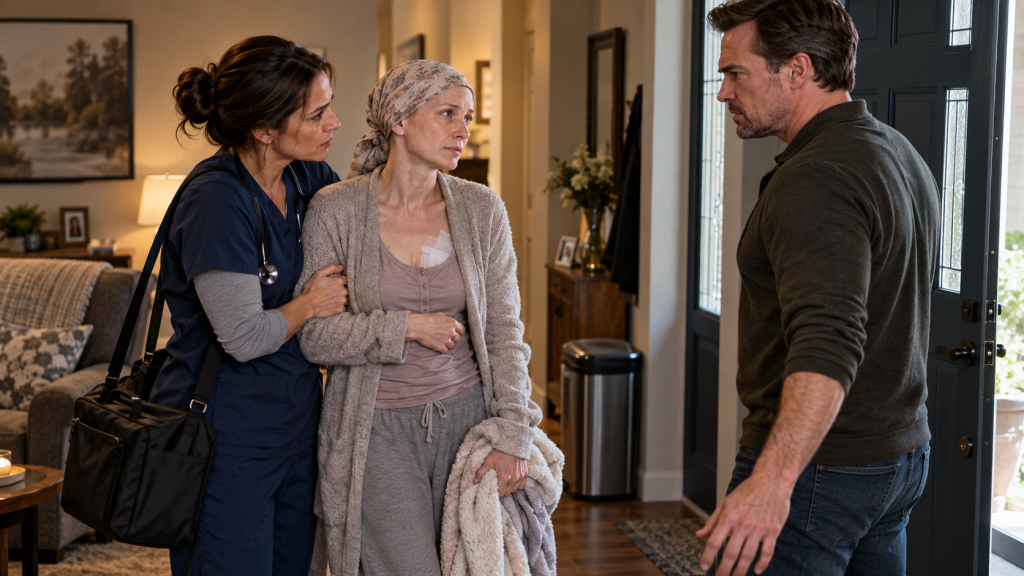
Two officers entered.
A man and a woman.
Behind them stood two paramedics carrying a medical bag.
The female officer took in the room first.
The trash can beside my chair.
The stained dressing.
Nina.
Daniel.
Me.
She did not rush toward anyone.
Did not start shouting.
She said:
“My name is Officer Lena Ortiz. Can everyone stay where they are for a moment?”
Daniel lifted both hands.
“Absolutely. This is a misunderstanding.”
Of course it was.
Everything was always a misunderstanding once another person could see it.
Officer Ortiz looked toward me.
“Ma’am, what’s your name?”
My mouth was dry.
“Claire Ellis.”
“Claire, are you injured?”
I touched the edge of the dressing without meaning to.
“Yes.”
Daniel interrupted.
“She had cancer surgery three weeks ago. The wound has been difficult.”
Officer Ortiz turned toward him.
“I’ll speak with you separately.”
“I’m her husband.”
“I understand.”
“She’s heavily medicated.”
Nina spoke before I could.
“She is alert, oriented, and able to answer questions. I saw her thirty minutes ago. Her dressing was clean when I left.”
Daniel looked at her with hatred so brief most people might have missed it.
I did not.
Nina did not either.
Officer Ortiz said:
“Sir, step into the living room with Officer Greene.”
Daniel stared at me.
“I’m not leaving my wife alone when she’s like this.”
There it was again.
When she’s like this.
Weak.
Sick.
Unreliable.
Officer Greene moved slightly closer.
“Sir.”
Daniel’s jaw worked.
Then he went.
Not because he respected me.
Because a badge had said what I had been saying for years.
No.
Move.
Stop.
The living-room door did not close all the way.
I could hear Daniel immediately begin explaining.
Cancer.
Pain medication.
Nausea.
Stress.
He loved me.
He was exhausted.
Caregiving was difficult.
I almost laughed.
Not because any of those things were false.
That was what made Daniel dangerous.
He rarely built his lies from nothing.
He built them around facts.
I did have cancer.
I was taking pain medicine.
I did vomit after dinner.
Caregiving was exhausting.
He was stressed.
Then he placed those truths around his violence like walls and waited for people to assume the room inside must be honest too.
Officer Ortiz crouched several feet away.
Not close enough to crowd me.
“Claire, I’m going to ask what happened. Take your time.”
I looked at Nina.
She remained beside the door.
Bag in one hand.
Phone in the other.
I breathed.
“My husband waited until Nina left.”
I said.
Then stopped.
The sentence sounded unbelievable even to me.
Officer Ortiz waited.
“He shoved my head over the trash can because I couldn’t keep dinner down.”
My voice began shaking.
“He said I was wasting food.”
I had not planned to say that part.
It came anyway.
“Then he pushed his finger into the surgical area.”
The paramedic’s expression changed.
“Where?”
he asked gently.
I pointed.
“Here.”
“Over the incision?”
“Yes.”
“Was the dressing stained before?”
“No.”
Nina said:
“It was clean at 6:12 p.m. when I completed my assessment.”
The officer looked at her.
“You documented that?”
“Yes.”
“Charted electronically?”
“Yes.”
She gave her full name.
Nina Patel, registered nurse.
Home oncology care.
She explained she had assessed my incision.
No fresh drainage.
No bleeding.
Then she left.
Realized she had forgotten her bag.
Returned.
Found me bent beside the trash can.
Fresh stain.
Daniel standing beside me.
He answered for me when she asked what happened.
That sequence mattered.
At the time, I had thought only courage mattered.
Later, attorneys would explain that timing mattered too.
Documentation mattered.
The forgotten bag mattered.
The clean dressing mattered.
A nurse’s observation before and after mattered.
Tiny facts became a bridge out of a room I had believed no one else could enter.
The paramedic approached.
“Claire, I’d like to look at the dressing. Is that okay?”
Is that okay?
I nearly cried.
“Yes.”
He pulled on gloves.
He did not remove the dressing completely.
Only examined what he could.
The stain had spread farther.
Not huge.
Enough.
“We need to get you evaluated.”
he said.
Daniel heard from the next room.
“No.”
Everyone turned.
He stepped into the doorway.
“She doesn’t need an ambulance.”
Officer Greene moved between us.
Daniel continued.
“We were just at the hospital four days ago. She has a follow-up Tuesday.”
The paramedic said:
“This requires evaluation tonight.”
Daniel looked at me.
“Claire, tell them you don’t want to go.”
My body responded before my mind.
Shoulders drawing inward.
Eyes dropping.
Years of training.
Officer Ortiz noticed.
“Sir, go back into the other room.”
Daniel ignored her.
“Claire.”
I looked up.
His voice softened.
That was worse.
“Come on.”
Come on.
The same tone he used after apologies.
After he slammed a cabinet beside my face and later brought tea.
After he gripped my wrist hard enough to leave four marks and then rubbed lotion over them before the nurse arrived.
After he disconnected my phone charger because I had called my sister twice in one day and said:
“You need to rest, not gossip.”
Come on.
Come back into the version of us where nobody else gets a vote.
I looked at Officer Ortiz.
“I want to go to the hospital.”
Daniel’s mouth flattened.
“Fine.”
he said.
“Then I’ll drive her.”
“No.”
I said.
The room went silent.
His eyes found mine.
I had said no to the ride.
Such a ridiculous thing.
Such a tiny thing.
But for the last year, Daniel had driven me everywhere.
Appointments.
Scans.
Pharmacy.
Surgery.
I had surrendered my car keys after treatment made me dizzy one afternoon.
He never returned them.
Eventually I stopped asking.
Now I said:
“No. I’m going with them.”
Daniel laughed once.
Then turned away.
Officer Greene took him farther into the living room.
The paramedics helped me onto a stretcher.
I hated the stretcher.
It made me feel sick.
Helpless.
Like proof Daniel had been right when he called me fragile.
Nina bent near me.
“You can walk if the paramedics think it’s medically safe.”
One of them nodded.
“We can use a wheelchair instead if that feels better.”
I looked at the stretcher.
Then the wheelchair.
Choice again.
“Wheelchair.”
I said.
They brought one.
I sat.
Pain pulled beneath my dressing.
I gasped.
Nina’s hand moved instinctively toward my shoulder.
Then stopped before touching.
“Can I?”
she asked.
I nodded.
She rested her hand lightly there.
I cried.
Not because it hurt.
Because nobody had asked me permission to touch me in my own house for so long that the question itself felt like mercy.
As the paramedics wheeled me toward the front door, Daniel called:
“Claire.”
I turned.
Officer Greene stood beside him.
My husband looked smaller from across the room.
Not harmless.
Smaller.
“You’re going to regret making this public.”
My stomach turned.
Officer Ortiz’s expression sharpened.
“What do you mean by that?”
Daniel immediately shook his head.
“Nothing.”
“I mean our marriage.”
“He’s threatening me.”
I said.
The words came out before fear could stop them.
Daniel looked stunned.
Maybe I was too.
Officer Ortiz wrote something down.
“No.”
Daniel said.
“I am telling my wife that private problems don’t need police.”
Officer Ortiz replied:
“She said she experienced that as a threat.”
“I don’t care how she experienced—”
He stopped himself.
Too late.
No one said anything.
That sentence followed us out.
At the hospital, I was taken to a private examination room.
The same hospital where I had undergone cancer surgery three weeks earlier.
I knew the corridors.
The elevator chime.
The smell.
The horrible abstract paintings near oncology.
There is something cruel about returning to the place where people tried to heal you because someone at home chose to injure the same body.
Nina came too.
Her agency supervisor told her she could remain long enough to complete the necessary clinical handoff and statement.
She sat in a chair by the wall.
Not beside me.
Not hovering.
There.
A doctor named Dr. Miriam Lee examined the incision.
She removed the dressing carefully.
I stared at the ceiling.
“Claire.”
she said.
“Yes?”
“The incision has partially reopened at one section.”
My heart started pounding.
“Do I need surgery again?”
“Not necessarily.”
She examined further.
“There’s superficial bleeding and tissue irritation. We’re going to image the area and make sure there is no deeper injury.”
I covered my face.
“I’m sorry.”
The doctor stopped.
“For what?”
“I don’t know.”
That was the truth.
Sorry for bleeding.
Sorry for making trouble.
Sorry for being sick.
Sorry for needing care.
Sorry my husband’s violence had created more work for women already working twelve-hour shifts.
Dr. Lee said:
“You do not need to apologize for being here.”
I started crying.
Again.
I was beginning to understand how many sentences I should have heard years earlier.
They ran bloodwork.
Imaging.
Checked for internal bleeding.
Thankfully, there was no major internal injury.
The incision needed cleaning, reinforcement, and monitoring.
Pain medication.
Antibiotics because of the risk of contamination and wound complication.
They photographed the injury with my consent.
Documented it.
Then someone from the hospital’s domestic-violence response team arrived.
Her name was Carmen Reyes.
She wore no police uniform.
No white coat.
Just dark slacks, a soft sweater, and an identification badge.
She sat near the door.
“Claire, I’m an advocate.”
she said.
“My job is not to tell you what to do.”
That got my attention.
Everyone in my marriage had been telling me what to do.
“Then what do you do?”
“I help you understand choices.”
I almost laughed.
Of course.
Choices.
Apparently freedom was made of them.
Carmen asked whether Daniel had hurt me before.
My mouth opened.
Closed.
Nina looked at the floor.
Not watching me.
Giving me privacy in a room she was still physically inside.
I said:
“Yes.”
The word hurt more than expected.
“How long?”
“I don’t know.”
“When did you first become afraid of him?”
Different question.
Better question.
I knew exactly.
“About eighteen months ago.”
“What happened?”
I stared at my hands.
I had not been sick then.
Not visibly.
I had found a lump.
Nothing diagnosed yet.
I was frightened.
I told Daniel I wanted to call my sister, Rebecca, before the appointment.
He said:
“Why? So she can turn it into a family drama?”
I called anyway.
Afterward, he took my phone and put it in his desk drawer.
Not violently.
Almost joking.
“You’ll get it back when you stop spiraling.”
I had laughed.
I had actually laughed.
It seemed petty.
Controlling.
Annoying.
Not abuse.
Then came diagnosis.
Cancer changed our marriage, but not in the way people expected.
Daniel became wonderful.
At first.
Drove me to every appointment.
Took notes.
Organized medication.
Cooked.
Updated relatives.
Everyone praised him.
“You’re so lucky.”
My sister said.
“What a husband.”
Friends said.
Daniel loved hearing that.
Caregiver.
Devoted husband.
Rock.
Then slowly, care became control.
He answered doctors before I could.
Told people I was sleeping when I was not.
Cancelled visits because he said I was too tired.
Put my pain medication in a locked box “so nothing got mixed up.”
Started giving me each dose himself.
If I asked early, he accused me of dependency.
If I asked late, he said I was irresponsible.
When nausea made eating difficult, he kept track of every bite.
“You need calories.”
True.
Then:
“If you won’t eat what I make, don’t complain you’re weak.”
Then:
“You wasted twenty dollars of groceries.”
Then one night, when I vomited after three bites of pasta, he grabbed the back of my neck and held my face over the sink.
“You’re going to clean this.”
He apologized later.
Said he was exhausted.
I believed him because I was exhausted too.
Then he squeezed my arm.
Then blocked a doorway.
Then grabbed my chin during an argument.
Then shoved me onto the bed when I tried to call Rebecca.
Then pressed near an IV bruise because I said I wanted to stay with my sister after chemotherapy.
Each time, he had a reason.
Stress.
Fear.
Money.
My “attitude.”
My medication.
Cancer.
Always cancer.
Cancer became the perfect accomplice because it explained everything visible.
Why I was thin.
Why I bruised.
Why I looked tired.
Why I seemed frightened.
Why I cancelled plans.
Why I cried.
Why my memory sometimes slipped.
Why my body hurt.
Daniel could do almost anything and say:
Treatment.
And people nodded sympathetically.
I told Carmen all of that.
Not cleanly.
Not in order.
I jumped months.
Forgot details.
Remembered others suddenly.
She never corrected the sequence.
At one point I said:
“I should have left after the first time.”
Carmen asked:
“Where would you have gone?”
“My sister’s.”
“Did you have access to your car?”
I stopped.
“Not by then.”
“Your own bank account?”
“No.”
“Medication?”
“Daniel controlled it.”
“House keys?”
“Yes.”
“Phone consistently?”
I looked down.
“No.”
“Were you recovering from active cancer treatment?”
“Yes.”
She nodded.
Not absolution.
Context.
I understood.
Leaving is a verb people imagine requires only legs.
Sometimes it requires transportation.
Money.
Medication.
A safe place.
Energy.
Privacy.
A body strong enough to survive the move.
I had been measuring life in showers and spoonfuls of soup.
Daniel knew that.
He made my weakness part of the architecture.
Carmen asked:
“Do you want to return home tonight?”
“No.”
Immediate.
“Do you have somewhere safe to go?”
“Rebecca.”
“Does Daniel know where she lives?”
“Yes.”
My stomach dropped.
“Then maybe not tonight.”
We made a plan.
Not forever.
Tonight.
That was how I survived cancer too.
One infusion.
One scan.
One night.
The hospital had access to a confidential emergency shelter program, but because of my medical needs, Carmen recommended a protected hotel placement coordinated with advocacy services until a safer arrangement could be made with my sister.
I hated the idea.
Shelter.
Hotel.
Domestic violence.
Those words belonged to other women.
Women with black eyes.
Women in television movies.
Women whose husbands screamed constantly.
Daniel did not scream constantly.
He brought flowers to chemotherapy.
He knew how I took my coffee.
He once slept in a plastic hospital chair for fourteen hours beside me.
He also pressed his finger into a surgical wound because dinner did not stay down.
Both.
That word would become important later.
Both.
Dr. Lee returned.
“Claire, I need to ask a medical question.”
I nodded.
“Who manages your medications at home?”
“My husband.”
“Do you know what you’ve been taking?”
I listed what I could.
Pain medicine.
Antiemetic.
Antibiotic recently completed.
Something for reflux.
Stool softener.
She checked the medication list in my electronic chart.
Then asked:
“When did you last take your prescribed pain medication?”
I thought.
“Maybe noon.”
“It was scheduled more recently if needed.”
“Daniel said I shouldn’t take too much.”
“Was your pain controlled?”
“No.”
That answer embarrassed me.
Dr. Lee said:
“Going forward, we’ll make sure you understand your own schedule and have direct access consistent with your prescription.”
Direct access.
To medicine prescribed to my body.
I closed my eyes.
“How did I let this happen?”
The doctor answered softly:
“One decision at a time, probably.”
That sentence stayed.
Because that was how control happened.
Not one dramatic surrender.
I did not wake one morning and hand Daniel my independence.
I let him drive because chemo made me dizzy.
Then let him manage appointments because he was organized.
Then medication because my brain felt foggy.
Then bank statements because I was exhausted.
Then visitors because he said I needed rest.
Then food.
Then my phone.
Then my answers.
Control entered disguised as help.
By the time it stopped asking permission, I was already used to thanking it.
Officer Ortiz returned to the hospital later that night.
She had spoken with Daniel.
He denied intentionally injuring me.
He said I became hysterical after vomiting.
He claimed he placed his hand near the surgical area only to steady me.
He said I misinterpreted pressure because of medication.
Then Nina gave her statement.
Then the hospital documented the fresh wound.
Then Officer Ortiz told me something I did not expect.
“Daniel also admitted blocking the door.”
My breath caught.
“What?”
“He described it as trying to prevent you from leaving while medically unstable.”
Of course.
Protection again.
“What happens now?”
I asked.
“That depends on several things.”
She explained the immediate process in general terms.
A report.
Possible arrest.
Prosecutor review.
Protection options.
She did not promise charges.
Did not promise conviction.
Did not tell me justice would be easy.
I appreciated that.
Then:
“He is not coming here tonight.”
I breathed.
“Okay.”
“Do you want to request an emergency protective order?”
My body tightened.
Marriage vows flashed through my mind.
Sickness and health.
For better or worse.
Nobody tells you there are versions of worse you are not required to remain beside.
“Yes.”
I whispered.
Then louder:
“Yes.”
Daniel was arrested that night based on the officers’ investigation, Nina’s observations, my statement, and the documented injury.
The exact legal charges were something my attorney would explain later.
At that moment, the only thing that mattered was that I would not have to wonder whether he was waiting outside the hospital.
When Carmen told me he had been taken into custody, I cried.
Not relief only.
Grief.
My husband had been arrested.
My husband.
The man from our wedding photographs.
The man who proposed beside a lake.
The man who held my mother’s hand at her funeral.
The man who beat eggs for me during chemotherapy because the smell of fried food made me sick.
The man who hurt me.
Again:
Both.
I learned that leaving abuse does not require rewriting every good day into a lie.
Some days were good.
Some love was real.
It was still not safe enough to stay.
Rebecca arrived the next morning.
My older sister.
Sixty-seven.
Retired librarian.
Five feet three inches of righteous fury.
She walked into the hospital room carrying a sweater, reading glasses, my favorite lip balm, and enough anger to power a small city.
She stopped beside my bed.
Looked at the dressing.
Then at me.
“You told me he was helping.”
My face crumpled.
“I know.”
She sat.
“Why didn’t you tell me?”
I started crying.
“I don’t know.”
That was not true.
I knew.
Because she would have believed me.
And belief would have required action.
Because I was afraid Daniel would punish me after she left.
Because I was embarrassed.
Because everyone admired him.
Because Rebecca had told me once, years earlier, that Daniel talked over me too much, and I had defended him.
Because admitting she had seen something meant admitting I had spent years teaching her not to trust what she saw.
Because cancer had already made me feel like a burden.
Adding an abusive husband seemed unbearable.
I said:
“I thought you’d say I should have known.”
Rebecca stared at me.
Then:
“I’m your sister, not an internet comment section.”
I laughed through tears.
That helped.
Then she asked:
“Can I hug you?”
There it was again.
Permission.
I nodded.
She held me carefully.
Avoiding the incision.
Avoiding everything tender.
When she pulled away, her eyes were red.
“Come live with me.”
“Daniel knows your address.”
“Then we change things.”
“It’s not that simple.”
“No.”
she said.
“It isn’t.”
That mattered.
She did not say:
Just leave.
She said:
Then we change things.
Carmen helped coordinate safety planning.
Daniel’s access to the home.
Keys.
Garage codes.
Shared phone plan.
Location sharing.
Banking.
My medications.
Medical portal passwords.
Emergency contacts.
I began discovering how thoroughly my life had become entangled with him.
Daniel was listed as the first contact on every form.
He had access to my patient portal.
He knew my appointment schedule.
He was authorized to speak to the oncology team.
He knew security questions.
Passwords.
My sister and I spent two days untangling a marriage from a medical crisis.
My oncology clinic removed Daniel from information access at my request.
They added a note requiring direct confirmation from me before sharing appointment details.
I changed my emergency contact to Rebecca.
When the receptionist asked:
“Relationship?”
I said:
“Sister.”
Such a normal word.
It made me cry.
The receptionist handed me tissues without comment.
I changed my pharmacy pickup authorization.
Changed passwords.
Opened an individual bank account with legal advice before moving funds that belonged only to me.
My attorney warned me not to make impulsive transfers involving marital assets.
So I didn’t.
That felt important.
Leaving Daniel did not mean becoming reckless.
Freedom did not require chaos.
My first night outside the hospital was spent in a hotel arranged through the advocacy program.
Rebecca stayed in the adjoining room.
I refused to stay alone.
The sheets smelled like bleach.
The air conditioner rattled.
At 11:43 p.m., someone laughed in the hallway and I almost called security.
At midnight, I checked the lock three times.
At 1:15, I woke because I dreamed Daniel was pressing into my wound again.
I sat upright.
Pain.
Dark room.
For one second, I did not know where I was.
Then Rebecca knocked lightly on the connecting door.
“Claire?”
I froze.
“How did you know?”
“You yelled.”
I looked at the door.
“Come in.”
She did.
Sat on the edge of the chair.
Not the bed.
“What do you need?”
I almost said:
Nothing.
Automatic.
Instead:
“Can you stay until I fall asleep?”
“Yes.”
No speech.
She stayed.
Nina called two days later.
Not directly at first.
Her supervisor asked whether I consented to contact.
I said yes.
Nina sounded nervous.
“How are you?”
“Alive.”
“Good start.”
I smiled.
Then:
“You forgot your bag.”
Silence.
“Yes.”
“If you hadn’t…”
I could not finish.
Nina interrupted gently.
“Claire.”
I waited.
“I forgot a nursing bag.”
“You told the truth.”
I cried.
She continued.
“I need you to hear this because I think you’re building a story where I rescued you.”
Did everyone around me suddenly become professionally annoying?
“I came back.”
she said.
“You answered.”
My throat tightened.
“You could have told me you fell.”
“I almost did.”
“But you didn’t.”
She was right.
I had looked at the door.
Her bag.
Daniel’s hand.
And stopped protecting him.
Nina said:
“I was a witness.”
“You were the one who changed the story.”
I held the phone tighter.
“I don’t feel brave.”
“Good.”
I almost laughed.
“Why does everyone say that?”
“Because courage often feels terrible.”
She was quiet.
Then:
“You don’t have to turn this into a heroic memory.”
“It can just be the moment you told the truth.”
That was better.
The moment I told the truth.
Not escaped.
Not healed.
Not became strong.
Told.
Everything else came afterward.
My cancer did not stop because my marriage became a crisis.
That offended me.
I wanted one catastrophe at a time.
Life refused.
I still had oncology appointments.
Bloodwork.
Scans.
Follow-up surgery evaluation.
The wound Daniel aggravated delayed part of my recovery.
Not dramatically.
Enough.
Extra visits.
More pain.
More worry about infection.
I was furious.
Not because cancer frightened me less.
Because he had taken a body already fighting one battle and made it fight another.
At my first follow-up without him, I sat alone in the waiting room until Rebecca arrived carrying two coffees.
“I thought you said nine-thirty.”
“It is nine-twenty.”
“That’s ten minutes early.”
“You’re welcome.”
I laughed.
The oncologist, Dr. Hassan, entered.
He had treated me for almost a year.
He looked at Rebecca.
Then me.
“Where is Daniel?”
The room changed.
I swallowed.
“He won’t be attending anymore.”
Dr. Hassan paused.
I had spent months watching him speak primarily to Daniel when I was tired.
Not because he was malicious.
Because Daniel took up conversational space and I surrendered it.
This time, the doctor looked only at me.
“Understood.”
No prying.
Then:
“Claire, I saw the hospital note. Are you safe today?”
“Yes.”
“Do you want any additional support from our social-work team?”
“I already have some.”
“Good.”
Then he opened my chart.
“Let’s talk about you.”
Those words.
Me.
Not my husband.
Not my abuse.
Not even cancer as identity.
Me.
My scan showed no immediate evidence of new disease.
Treatment remained focused on recovery and surveillance.
Good news.
I cried in the parking lot anyway.
Rebecca waited.
Afterward I said:
“I thought leaving Daniel would make everything feel better.”
She looked at me.
“Why?”
“I don’t know.”
“You still have cancer recovery.”
“Yes.”
“You’re ending a marriage.”
“Yes.”
“You’re sleeping badly.”
“Yes.”
“You have stitches.”
“Yes.”
She sipped coffee.
“Seems ambitious to also demand happiness.”
I stared.
“Retirement has made you unbearable.”
“I was unbearable before.”
True.
Daniel was released pending court proceedings under restrictions that included no contact with me except through attorneys and compliance with the protective order.
The first violation came indirectly.
His mother called.
“Claire.”
I almost did not answer.
Elaine had always been kind to me.
Or I thought.
“He’s devastated.”
she said.
I closed my eyes.
“Elaine, I can’t discuss Daniel.”
“He says you told the police he stabbed you.”
“What?”
“I know that sounds extreme.”
“I never said that.”
“I knew it.”
Relief entered her voice.
Then:
“So maybe this can be cleared up.”
There it was.
The trap.
One exaggerated rumor corrected, therefore everything false.
“No.”
I said.
“What?”
“He did not stab me.”
I breathed.
“He shoved my head down when I was vomiting and intentionally pressed into my surgical wound.”
Silence.
Elaine whispered:
“He said he was checking the dressing.”
“No.”
“How can you know what he intended?”
My entire body went cold.
Because he had told me.
Tell the nurse cancer did it.
I had almost forgotten the sentence amid everything else.
Not forgotten.
Buried.
I told Elaine.
She began crying.
“I don’t understand.”
“Neither did I for a long time.”
Then she said:
“He’s my son.”
I understood that.
Maybe more than she expected.
“You can love him.”
I said.
“You cannot contact me for him.”
She went quiet.
“Is that what this is?”
“Yes.”
I ended the call.
Reported it to my advocate and attorney.
Not because Elaine was dangerous.
Because boundaries only become real when maintained the first time they are tested.
Daniel sent flowers through a delivery service the next week.
No name.
He did not need one.
My favorite lilies.
I stared at them in Rebecca’s foyer.
My sister said:
“Trash?”
I almost said yes.
Then:
“No.”
I removed one lily.
Placed it in a small glass.
“Why?”
Rebecca asked.
“Because I like lilies.”
We threw the rest away.
That became another lesson.
Daniel did not own everything I had loved while married to him.
Not lilies.
Not certain songs.
Not Italian food.
Not the lake where he proposed.
I did not have to surrender beautiful things because he had once stood beside them.
My attorney was named Grace Kim.
She had the emotional warmth of a stapler.
I loved her immediately.
She listened to the history.
Asked for dates.
Records.
Financial documents.
Photos.
Hospital reports.
Nina’s statement would be handled through the criminal process, but the divorce and protective issues were separate.
Grace said:
“I need to warn you about something.”
“What?”
“Daniel may become very reasonable.”
I stared.
“He already knows how.”
“That’s my point.”
She folded her hands.
“People expect abusive spouses to arrive in court looking monstrous.”
“They often arrive organized.”
“Polite.”
“Concerned.”
“He may frame himself as an exhausted caregiver.”
“He may point to your medication.”
“Cancer.”
“Memory.”
“Emotional state.”
My stomach turned.
“He already does.”
“Then do not panic when he keeps doing it.”
Grace’s voice remained calm.
“Your job is not to perform perfect victimhood.”
“What does that mean?”
“You can have loved him.”
“You can have sent affectionate texts.”
“You can have defended him.”
“You can have returned after previous incidents.”
“You can have thanked him for caring for you.”
“None of those facts mean the later injury did not occur.”
I cried.
I had been terrified by my own phone.
Years of messages.
Thank you for taking care of me.
Love you.
Sorry I’m so difficult today.
You’re the best nurse.
Would people read those and think I lied?
Grace shook her head.
“Relationships are evidence of relationships.”
“Not proof that harm could not happen inside them.”
Both.
Again.
The criminal case developed slowly.
Daniel’s defense questioned whether the wound might have opened from vomiting.
Medical experts reviewed the records.
Nina’s documentation mattered.
The dressing clean minutes before.
Her return.
What she saw.
My immediate statement.
Daniel’s instruction before she reentered:
Tell the nurse cancer did it.
I had told Officer Ortiz that on the night.
Daniel denied saying it.
No recording.
Just my word.
That hurt.
Then something unexpected emerged.
Not a secret camera.
Not a dramatic hidden confession.
A voicemail.
Daniel had called his brother earlier that afternoon and accidentally failed to disconnect after leaving a message.
The accidental recording did not capture violence.
It captured him complaining about me.
“I swear, she throws up every meal and then I’m the one cleaning it.”
His brother replied later by text:
She has cancer, man. Chill out.
Daniel responded:
Easy for you to say when you don’t live with it.
Those messages did not prove assault.
They did prove something about the caregiving story he tried to present.
Not everything.
Context.
The case was eventually resolved without a trial after Daniel entered a plea to charges reflecting the assaultive conduct and violation of my physical safety.
The legal wording mattered to the court.
The emotional wording mattered to me.
At the plea hearing, he had to acknowledge that he intentionally used unlawful physical force during an argument while I was recovering from surgery.
He did not have to say he was evil.
Good.
That word would not have helped me.
He had to say what he did.
When the judge asked whether he understood that my illness did not excuse his conduct, Daniel said:
“Yes.”
I cried.
Not because the judge said something profound.
Because cancer had been his excuse for so long.
Finally, someone placed the responsibility back where it belonged.
Not the disease.
Not dinner.
Not medication.
Him.
The sentence included incarceration, probation, mandated intervention programming, and continued restrictions on contacting me.
I am intentionally not romanticizing punishment.
Prison did not heal my wound.
A conviction did not make the marriage disappear.
The court could hold Daniel legally responsible.
It could not give me back the months I spent afraid in my own bedroom.
Healing remained mine.
Annoyingly.
Our divorce took longer.
Money became the battlefield Daniel understood best.
He claimed he had sacrificed work opportunities to care for me.
Partly true.
He had reduced travel.
Taken leave.
He wanted credit for mortgage payments made while I was in treatment.
Fine.
The lawyers handled numbers.
What I refused to do was turn the divorce into proof that every good thing he had ever done had been fake.
He had cared for me sometimes.
He had also weaponized care.
Both.
Grace helped separate legal fairness from emotional revenge.
We divided property.
I retained what I was entitled to.
He retained what he was entitled to.
No cinematic destruction.
No secret account suddenly revealed with millions.
No humiliating him in court.
I did not need to become cruel to prove I was free.
The hardest possession was the house.
Our house.
Three bedrooms.
Oak table.
Yellow kitchen.
The trash can.
The doorway.
I thought I wanted it.
Then I went back once with Rebecca and a police escort arrangement authorized for collecting belongings.
I stood in the kitchen.
Everything looked smaller.
I touched the back of the chair where I had tried to stand.
Looked at the door Daniel blocked.
The trash can was gone.
Probably thrown away.
Good.
Rebecca asked:
“Do you still want the house?”
“No.”
Immediate.
We sold it as part of the divorce resolution.
People said:
“Don’t let him take your home.”
He didn’t.
A home should not require bravery to enter.
I chose another one.
A small apartment first.
Then, after treatment stabilized, a little townhouse with two bedrooms and a ridiculous balcony that barely fit one chair.
Mine.
The first night there, I ate toast for dinner.
Halfway through, nausea came.
Not cancer nausea.
Memory.
My body remembered food as a test.
If I finished, safe.
If I vomited, anger.
I stood over the sink shaking.
Then I did something that would sound pathetic to anyone who had never been afraid of being sick.
I took the toast.
Dropped it in the trash.
And walked away.
No one shouted.
No one grabbed my head.
No one accused me of wasting food.
I sat on the kitchen floor and cried for twenty minutes.
Over toast.
That was recovery too.
Nina stopped being my home nurse after the agency reassigned my case.
Not because she had done anything wrong.
Because after becoming a witness, keeping clear professional boundaries protected both of us.
I understood.
Another nurse, Maribel, took over.
The first visit, she asked:
“Do you want me to come in alone?”
My stomach tightened.
Then I realized.
No husband.
No gatekeeper.
“Yes.”
She came in.
Set down her bag.
Checked vitals.
Dressing.
Medication.
Asked:
“Who helps you at home?”
“My sister comes by.”
“Anyone else?”
“Friends.”
“Do you want anyone present during visits?”
“No.”
“Okay.”
So simple.
Months later, Nina and I met once through a hospital-supported survivor appreciation event.
Not privately arranged.
Nothing inappropriate.
I saw her across the room.
We hugged.
With permission.
Always.
She said:
“You look different.”
I touched my hair.
It had begun growing back more evenly after treatment.
“Hair?”
“No.”
I smiled.
“Then what?”
“You answer faster.”
That stunned me.
“What?”
“When people ask what you want.”
I almost cried.
Of course she noticed.
She had been there when yes and no had each cost me everything.
Cancer surveillance became its own rhythm.
Scans.
Waiting.
Results.
My body recovering.
Then another scare.
A lymph node that required imaging.
Benign.
More waiting.
Cancer taught me uncertainty.
Abuse taught me hypervigilance.
Together they made me unbearable for a while.
Every ache:
Recurrence.
Every unknown car:
Daniel.
Every delayed text from Rebecca:
Disaster.
My therapist, Dr. Simone Brooks, asked:
“What happens in your mind when something is uncertain?”
“I prepare.”
“For what?”
“Worst case.”
“And when worst case does not happen?”
“I prepare for why I missed it.”
She stared.
I hated her too.
Apparently therapy is mostly paying someone to ask rude questions calmly.
We worked.
Slowly.
Not on becoming fearless.
On allowing uncertainty to exist without immediately appointing it an emergency.
Some days I succeeded.
Others I checked the front lock six times.
Healing was not a staircase.
More like a badly designed parking garage.
Circles.
Ramps.
Occasional wrong floor.
Still movement.
Rebecca gave me a key to her house.
Then insisted I give it back.
I stared.
“What?”
“You have your own place now.”
“So?”
“So I want you to ask before barging in.”
I laughed.
“You gave me the key during the emergency.”
“Exactly.”
She held out her hand.
“This is not an emergency anymore.”
That hurt at first.
Then I understood.
She was returning me to ordinary adulthood.
Not patient.
Not victim.
Sister.
I gave back the key.
She gave me a new one six months later.
“For emergencies.”
I rolled my eyes.
“Difference?”
“Now we agree what it means.”
Boundaries.
Everywhere.
Good.
My hair grew.
My surgical scar flattened.
The dressing disappeared.
That surprised me.
For months, the dressing had been symbolic.
The place Daniel touched.
The evidence.
Then skin closed.
The scar remained.
At first I hated it.
Not because of surgery.
Because he had made it part of violence.
I felt as though Daniel had written himself into my body.
Dr. Brooks challenged that.
“Who made the incision?”
“The surgeon.”
“Why?”
“To remove the tumor.”
“What did the scar originally represent?”
“Treatment.”
“Survival?”
I flinched.
“I hate that word.”
“Fine.”
“Treatment.”
She nodded.
“Daniel does not get retroactive authorship.”
That sentence changed something.
I stopped touching the scar and thinking:
His finger.
Started thinking:
My surgeon.
My body.
My healing.
One night, months later, I stood in front of the mirror.
Lifted my shirt.
Looked.
Not beautiful.
Not ugly.
Skin.
Mine.
I said it aloud.
“Mine.”
Ridiculous.
Powerful.
Mine.
The divorce became final fourteen months after Nina forgot her bag.
I stood outside the courthouse with Grace.
No celebration.
Rebecca wanted champagne.
I said no.
She bought cake instead.
At home, she put one candle in it.
“What is that?”
“Symbolism.”
“You’re a retired librarian. You should know symbolism needs meaning.”
“One year of freedom?”
“It’s been fourteen months.”
“Budget symbolism.”
I laughed.
We ate cake.
Then I went to bed early.
At 2:00 a.m., I woke and cried.
Marriage ended.
Even unsafe marriages contain futures you once loved.
The vacations we would not take.
Retirement plans.
The porch we once talked about building.
Daniel’s hand in mine before surgery, when I was genuinely terrified and he genuinely held on.
I mourned those things.
Grief did not mean I wanted him back.
That distinction saved me from shame.
You can grieve a burning house without wanting to move back inside.
Two years after the assault, my oncology team used a phrase I had been afraid to imagine.
“No evidence of disease at this time.”
Not cure.
Not forever.
Enough.
Dr. Hassan smiled.
Rebecca cried.
I sat there stunned.
Then asked:
“When’s the next scan?”
Everyone laughed.
Trauma personality.
Fine.
We celebrated with lunch.
I ordered soup.
Halfway through, I could not finish.
I looked at the bowl.
For one heartbeat, Daniel existed across the table in my nervous system.
Waste.
Calories.
Ungrateful.
Then I put down the spoon.
Rebecca asked:
“You done?”
“Yes.”
“Want dessert?”
I stared.
“Yes.”
She smiled.
Progress.
Daniel wrote me a letter after completing part of his court-mandated program.
Contact had to go through approved legal channels because the protective restrictions were still relevant.
Grace asked whether I wanted it.
“No.”
Then:
“Yes.”
Then:
“Not today.”
The letter sat sealed in her office for six months.
Eventually, I read it.
Daniel wrote:
Claire,
For a long time, I described what I did as something that happened because you were sick. I understand now how cowardly that was.
I stopped.
Breathed.
Continued.
Your cancer did not make me control your medication.
Your nausea did not make me punish you for vomiting.
Your weakness did not make me block doors.
Your surgery did not make me press on the wound.
My hands shook.
No excuses.
Not yet.
I told myself I was doing everything for you and that because I was doing so much, I had earned obedience.
That sentence made me put the letter down.
Earned obedience.
There it was.
The logic underneath everything.
Care as debt.
He cooked, therefore I obeyed.
Drove, therefore I obeyed.
Changed dressings, therefore I obeyed.
Sacrificed, therefore my body owed him cooperation.
He continued.
I resented that everyone praised me for being a caregiver while I felt angry all the time. Instead of telling someone I needed help, I decided your illness was something you were doing to me.
I cried.
Not for him.
Maybe partly.
When you became more dependent, I became more controlling. I used your dependence to feel powerful at a time when cancer made me feel powerless.
That sounded like therapy.
Good therapy.
Then:
None of that changes what I did.
Good.
I am not asking you to forgive me or answer.
Better.
I am sorry I made your illness more dangerous.
That line broke me.
Because yes.
That was what he had done.
Cancer already threatened my body.
He made home another threat.
I hope your treatment worked.
I folded the letter.
Did not answer.
For years, I had needed him to admit what he did.
Then he did.
And I discovered an apology is not a bridge unless both people want to cross.
I did not.
That did not make his apology worthless.
It made it his responsibility, not my obligation.
I kept the letter for a year.
Then shredded it.
Not dramatically.
Office shredder.
Three pages.
Done.
My life became boring.
Gloriously.
I joined a morning walking group for cancer survivors and anyone else who woke too early.
I hated the phrase warrior.
So did most of them.
We called ourselves the Sidewalk Complaints Department.
Every Tuesday and Thursday.
Six-thirty.
Coffee afterward.
We discussed knees.
Medication prices.
Adult children.
Dogs.
Sometimes cancer.
Never inspirationally.
I made a friend named Sonia who had survived ovarian cancer and two terrible marriages.
She said:
“Congratulations. You completed the deluxe package.”
I laughed harder than I should have.
Sonia invited me on a trip to Vancouver.
My first instinct:
No.
Travel.
Medication.
Scans.
What if something happened?
Then I noticed the voice asking permission in my head.
Not Daniel’s exactly.
Mine, trained by him.
I called Dr. Hassan.
Asked practical questions.
Got travel insurance.
Packed medication.
Went.
On the second day, Sonia and I got lost in the rain.
Completely.
We stood under an awning laughing.
I realized nobody knew exactly where I was.
Not Rebecca.
Not a husband.
No shared location.
No one monitoring whether I ate.
I was lost.
And safe.
That distinction felt miraculous.
Three years after the divorce, I ran into Daniel’s brother at a grocery store.
Not Daniel.
His brother, Aaron.
The one who had received Daniel’s complaint about my vomiting.
Aaron froze.
“Claire.”
“Hi.”
He looked embarrassed.
“I’m sorry.”
I knew immediately.
“For what?”
“I should have checked on you.”
I stared.
He continued.
“Daniel said things.”
“I thought he was venting.”
“He said caregiving was breaking him.”
“I told him to calm down.”
“I never asked whether you were safe.”
My chest tightened.
“You didn’t know.”
“I knew he sounded angry.”
Both.
Again.
I said:
“You were his brother.”
Aaron nodded.
“I was also an adult.”
Fair.
We stood beside canned tomatoes.
Strange place for accountability.
He said:
“I don’t expect you to make me feel better.”
Good.
“I wanted you to know I think about it.”
I nodded.
“Thank you.”
Then I walked away.
Not every apology needs a relationship afterward.
Four years after the night Nina returned, St. Vincent’s invited me to speak privately with a group of home-health nurses during a training session about patient autonomy and domestic abuse.
My first answer was no.
Then I thought.
Not because I owed anyone advocacy.
I didn’t.
Because there was one thing I wanted nurses to know.
So I went.
No stage.
Twenty nurses in a conference room.
Nina was not there.
Deliberately.
This was not about reenacting our moment.
I told them:
“Do not assume the person who seems most helpful is necessarily the safest person in the room.”
They listened.
“Daniel knew my medications better than I did.”
“He drove me.”
“He changed dressings.”
“He could name every doctor.”
“If you asked who supported me, I would have pointed at him.”
I paused.
“Also ask whether the patient can answer without that person.”
A nurse raised her hand.
“What could someone have asked that might have helped sooner?”
I thought.
Not:
Does your husband hit you?
I would have said no.
At first.
Not:
Are you abused?
I did not use that word.
Maybe:
“Who controls your medication?”
“Can you call someone privately if you want?”
“Do you ever feel afraid to disagree with the person helping you?”
“Can I speak to you alone for part of the visit?”
I told them.
Then:
“And if the patient says everything is fine, do not assume you failed.”
The room quieted.
“I had several chances before I was ready.”
“Readiness is not always courage.”
“Sometimes it is logistics.”
“Sometimes the safest answer today is the answer that keeps someone alive until tomorrow.”
That came from Carmen.
I credited her.
At the end, a young nurse approached.
“My mother stayed with my father for twenty years.”
I looked at her.
“She lied to everyone.”
Then immediately:
“Sorry.”
I smiled sadly.
“She may have been surviving everyone.”
The nurse cried.
So did I.
Training complete.
Apparently.
My relationship with my body changed more slowly than everything else.
Cancer made me mistrust it.
Daniel made me feel ashamed of needing it.
Hungry.
Nauseated.
Tired.
In pain.
Bodies are inconvenient.
That does not make them disobedient.
It took years to learn.
I went swimming for the first time after surgery at sixty-one? Wait narrator age never specified. Don’t invent inconsistency. Could be late fifties/sixties. We haven’t given age. Fine.
I wore a one-piece bathing suit.
The scar showed slightly near the side.
I almost changed.
Then Sonia said:
“If anybody cares, drown them.”
“Not legal.”
“Details.”
I swam.
Water moved over the scar.
Nothing happened.
Again, healing often looked disappointingly ordinary.
No music.
No epiphany.
Just one length of the pool.
Then another.
Five years after the assault, I got a call from Nina.
This time through an appropriate contact because she had received permission from me through the survivor program before reaching out.
She was retiring from home-health nursing.
“Congratulations.”
I said.
“My knees are retiring.”
“Good for them.”
We laughed.
Then she said:
“I wanted to ask something.”
“What?”
“Do you still remember the bag?”
I looked toward my bookshelf.
I had thought about it less over the years.
“Yes.”
“I do too.”
“What kind was it?”
She laughed.
“What?”
“I’ve always imagined it.”
“Ugly navy canvas.”
“Disappointing.”
“Very.”
Then Nina became serious.
“I almost didn’t go back for it.”
My throat tightened.
“I was already in the car.”
“What changed your mind?”
“I had patient notes in the side pocket.”
“Couldn’t leave them.”
Professional responsibility.
A forgotten bag.
Paperwork.
A life turning on something almost stupidly ordinary.
I said:
“If you had driven away…”
Nina interrupted.
“No.”
Still.
After five years.
“No alternate universes.”
I smiled.
“You told the truth when you had the opening.”
“What if I hadn’t?”
“You might have found another.”
“Or someone else might.”
“Or maybe not.”
Her honesty hurt.
Then:
“But you did.”
Yes.
I did.
We sat in silence over the phone.
Finally I said:
“Thank you for asking whether I wanted you to stay.”
Nina’s voice softened.
“That was the question?”
“Yes.”
Not:
What did he do?
Not:
Why haven’t you left?
Do you want me to stay?
The first choice.
Then:
Do you want to be alone with him?
No.
Then:
Do you want to leave the room?
Yes.
A whole life built from two answers.
No.
Yes.
That was how I learned to trust my own voice again.
I never remarried.
Not because I stopped believing in love.
Because I discovered I liked living alone.
People treated that like an injury at first.
“You’ll meet someone.”
Maybe.
“Don’t let Daniel ruin love.”
He didn’t.
I loved friends.
My sister.
Nieces.
Walking group.
Travel.
Myself on good days.
A quiet house.
No television unless I wanted it.
Cereal for dinner.
Windows open at midnight.
That was love too.
Years later, I dated a man named Peter for almost two years.
Kind.
Divorced.
Terrible dancer.
One night, he reached across the table while I was talking and touched my wrist unexpectedly.
My body jerked.
He pulled back immediately.
“Sorry.”
No offense.
No:
It was just a touch.
No:
You know I’m not Daniel.
He said:
“Should I ask first?”
I nodded.
“Yes.”
“Okay.”
He did.
Every time until I told him he no longer needed to in ordinary situations.
We ended the relationship later because we wanted different lives.
No betrayal.
No violence.
No failure.
That relationship taught me something important.
Safety does not guarantee forever.
And endings do not prove relationships were unsafe.
Sometimes people simply end.
I had forgotten that possibility existed.
My final major oncology milestone came years after the surgery.
Dr. Hassan had more gray hair.
So did I.
He reviewed the scan.
Then looked at me.
“Everything looks excellent.”
I waited.
“That’s it?”
“That’s it.”
“When do I come back?”
He smiled.
“We’re spacing surveillance farther now.”
My stomach tightened.
Less surveillance should have felt good.
It didn’t.
He noticed.
“This can be uncomfortable.”
“Yes.”
“I’m supposed to be happy.”
“You’re allowed to be complicated.”
Everyone in my life had learned that word.
Complicated.
I walked outside.
Called Rebecca.
“Good scan.”
She shouted.
I held the phone away.
Then:
“They don’t want me back as often.”
“Excellent.”
“I hate it.”
“Also excellent.”
“What?”
“You finally have enough health to complain about not being monitored.”
I laughed.
Then cried.
Of course.
Years after the divorce, I saw Daniel once.
Unexpectedly.
At a hospital fundraiser.
Of all places.
I almost left.
He saw me first.
Stopped.
We had not been face-to-face since court.
He looked older.
So did I.
For a second, my body remembered him faster than my mind.
Heart racing.
Hands cold.
Then I felt my feet inside my shoes.
Floor beneath me.
Crowd around us.
Current year.
Current body.
Safe.
Daniel did not approach immediately.
He waited.
Then mouthed:
“Okay?”
Question.
Permission.
I could have turned away.
Instead I nodded once.
He approached slowly.
Stopped several feet away.
“Claire.”
“Daniel.”
His eyes moved toward my face.
Not my body.
Not the scar.
“How are you?”
“Good.”
True.
He looked relieved.
Not entitled to the relief.
Still human.
“I heard your scans were good.”
My stomach tightened.
“How?”
“Aaron mentioned it years ago.”
Of course.
I nodded.
“They are.”
“I’m glad.”
Silence.
Then Daniel said:
“I won’t keep you.”
Good.
Before he turned, I asked:
“Are you doing okay?”
The question surprised both of us.
He swallowed.
“Yes.”
Then:
“Better than the man I was.”
I looked at him.
“I hope so.”
“I know that doesn’t—”
“I know.”
He stopped.
Then:
“I’m sorry.”
Not new.
Still true.
“I know.”
I said.
That was all.
We walked in opposite directions.
My heart pounded for twenty minutes.
But I stayed at the fundraiser.
A year earlier, I might have left.
Not because leaving would have been weak.
Because this time, I wanted to stay.
Choice.
Always.
When Rebecca turned seventy-five, we took a trip together.
She chose Maine.
I complained about the cold.
She reminded me I chose Vancouver once.
Sisters preserve evidence forever.
We rented a small cottage near the water.
One morning, I became sick after breakfast.
Probably rich food.
Maybe nerves.
I barely made it to the bathroom.
Vomited.
My body shook.
Then a memory rose so suddenly I could smell our old kitchen.
Trash can.
Daniel’s hand.
The incision.
I sat on the bathroom floor.
Rebecca knocked.
“Claire?”
“I’m fine.”
Pause.
Then:
“Do you want me to come in?”
My eyes filled.
“No.”
“Okay.”
No hurt.
No insisting.
No opening the door anyway.
Ten minutes later, I washed my face.
Came out.
Rebecca was reading on the sofa.
She looked up.
“Tea?”
“Yes.”
No lecture about eating.
No worry disguised as anger.
Tea.
I sat beside her.
The sea outside was gray.
Beautiful.
I thought:
This is what ordinary care feels like.
It leaves room.
People sometimes asked when I knew I had finally healed.
I never knew how to answer.
There was no day.
No certificate.
No scan that showed absence of fear.
No judge who declared my nervous system free.
Healing was scattered.
The first time I threw away food without guilt.
The first night I slept without checking the lock.
The first appointment where I answered every question myself.
The first vacation.
The first time someone touched my wrist, apologized, and did not make my flinch about his feelings.
The first time I saw Daniel and did not collapse.
The first time I looked at my scar and thought surgery before I thought violence.
The first time I vomited and nobody punished me.
The first time I said:
“No.”
And did not explain.
That one may have been my favorite.
A friend invited me somewhere.
I did not want to go.
She asked:
“Dinner Friday?”
“No.”
I waited.
No excuse.
No cancer.
No fatigue.
No appointment.
She said:
“Another time.”
That was all.
I went home and laughed in my car.
People who have always been allowed to say no will never understand the extravagance.
Nina died many years later.
Cancer, cruelly enough.
Her daughter contacted me because Nina had kept my Christmas cards.
I had sent one every year after the survivor event.
Nothing intimate.
A small tradition.
Her daughter said:
“She talked about you once.”
I cried.
“What did she say?”
“That she forgot her bag.”
I laughed.
Of course.
Then:
“She said it was the most important mistake she ever made.”
My throat closed.
I attended the memorial.
Sat in the back.
Nurses everywhere.
Photographs of Nina young.
Older.
Laughing.
Holding grandchildren.
At the end, her daughter approached.
“Claire?”
“Yes.”
She handed me something.
A small cloth keychain.
Navy blue.
Attached to an old zipper pull.
“What is this?”
“From her nursing bag.”
I stared.
“The bag?”
“Long gone.”
she said.
“But she saved this.”
I cried so hard her daughter hugged me.
After asking.
Even there.
Permission.
I kept the zipper pull in a drawer.
Not on display.
I did not need a shrine to the worst day of my marriage.
But sometimes, when I found it while looking for batteries or tape, I held it.
A reminder that ordinary people do not always know when they are standing beside someone’s exit.
Sometimes they simply ask a question.
Then stay long enough to hear the answer.
Rebecca died before me too.
Older sister privilege.
She would hate me saying that.
At the end, it was peaceful.
Heart failure.
Hospice.
I sat beside her.
She looked tiny beneath the blanket.
“Claire.”
“Yes?”
“You still overpack.”
I laughed through tears.
“Dying and still criticizing luggage.”
“Someone has to.”
She slept.
Woke later.
Then whispered:
“Were you happy?”
The question surprised me.
“When?”
“After.”
I knew what she meant.
After Daniel.
After cancer.
After everything.
“Yes.”
I said.
Not every day.
But yes.
Rebecca smiled.
“Good.”
Then:
“I was so scared you’d go back.”
I stared.
“You never said.”
“You had enough fear.”
My eyes filled.
“Would you have hated me?”
“No.”
Immediate.
“I would’ve kept a room ready.”
That sentence broke me.
Maybe that is family.
Not:
I will control you into safety.
A room ready.
A door unlocked.
A place.
Rebecca died two days later.
I missed her terribly.
Still do.
But grief no longer made me afraid of love.
Loss is not proof attachment was foolish.
It is proof something existed worth missing.
Daniel once taught me the opposite without saying it.
Dependence is danger.
Need is debt.
I learned better.
When I think back to the night everything changed, people assume the most important moment was when the police arrived.
It wasn’t.
Or when Daniel was arrested.
No.
The sentence that changed my life came earlier.
Nina standing in my kitchen.
Looking at the fresh stain.
Then asking:
“Do you want me to stay?”
That question contained something my marriage had slowly taken away.
Not rescue.
Authority.
Mine.
Do you want?
I said yes.
Then:
“Do you want to be alone with him?”
No.
Then:
“Do you want to leave the room?”
Yes.
I had spent months answering questions according to what would make Daniel easier.
What do you want for dinner?
Whatever you made.
Do you need pain medicine?
Whatever you think.
Should your sister visit?
If you want.
Are you too tired to go?
Maybe.
Do you remember what the doctor said?
You remember better.
One question at a time, my preferences became negotiable.
Then irrelevant.
Nina returned and handed them back.
Not by telling me what I should do.
By asking.
That is the part I wish more people understood about helping someone who has been controlled.
Do not become another commander.
Offer a door.
Name choices.
Stay.
Believe what they say about their own fear.
And understand that even if they do not walk through today, the door still matters.
I was lucky.
That word is complicated.
I had cancer.
My husband abused me.
Lucky seems obscene.
But I was lucky that Nina forgot her bag.
Lucky the dressing had been clean minutes earlier.
Lucky I had enough voice left to tell the truth.
Lucky the officers listened.
Lucky my sister had a room.
Lucky the wound did not become a major surgical emergency.
Lucky treatment worked.
Luck and harm can exist together.
Both.
Always both.
On the tenth anniversary of the night I left, I did something Rebecca would have mocked.
I bought myself lilies.
One bouquet.
White.
Daniel used to send lilies.
For years, I avoided them.
Then I reclaimed one at a time.
That anniversary, I bought twelve.
Put them in a blue vase on my kitchen table.
My kitchen.
Different house by then.
Sunny.
Small.
A bowl of lemons near the window.
No trash can beside a chair.
I cooked pasta.
Ate half.
Could not finish.
I smiled.
Placed the rest in the refrigerator.
No test.
No threat.
No performance.
After dinner, I lifted my shirt in the bathroom mirror.
The scar was pale.
Almost ordinary.
I traced beside it.
Not directly over it.
My body had survived surgery.
Cancer treatment.
A man’s cruelty.
More importantly, it had survived years of my own suspicion.
I had blamed it for becoming weak.
For needing help.
For making me dependent.
But bodies are allowed to need care.
Need does not surrender personhood.
Illness does not cancel consent.
Dependence does not create ownership.
Caregiving does not purchase obedience.
Those truths sound obvious when written cleanly.
Living them took me years.
I lowered my shirt.
Turned off the light.
Then my phone rang.
For one second, old fear.
Unknown number.
I answered.
“Hello?”
A woman.
Young.
“Nina Patel’s daughter gave me your number through the survivor program. I hope that’s okay.”
My heart tightened.
“Yes.”
“She said you sometimes talk to patients.”
Only if requested and arranged.
Boundaries.
Good.
“I’m recovering from surgery.”
the woman said.
“My husband handles everything.”
I sat down.
There are moments when history tries to become destiny.
This was not one.
I did not assume.
Did not ask:
Does he hurt you?
I said:
“What would be helpful right now?”
Silence.
Then she cried.
“I don’t know.”
“That’s okay.”
We talked.
Not about leaving.
Not yet.
About medication access.
Private communication with nurses.
Emergency contacts.
Whether she had somewhere to go if she ever wanted.
At the end, she said:
“I feel stupid.”
I knew that sentence.
“No.”
Then I stopped myself.
Not even that.
Do not replace her judgment.
I said:
“What makes you feel that way?”
She answered.
We talked more.
Before hanging up, I said:
“You do not have to decide your whole life tonight.”
I had learned that from Carmen.
One night.
One choice.
Enough.
Afterward, I stood in my kitchen.
Lilies open beneath the light.
My scar quiet under my shirt.
I thought of Nina.
Rebecca.
Officer Ortiz.
Dr. Lee.
Carmen.
Grace.
Dr. Brooks.
Women and men who had each given something different.
Not rescue.
Witness.
Information.
A couch.
A legal boundary.
A medical chart.
A question.
A room.
The rest was mine.
That is important too.
I left.
I testified.
I signed divorce papers.
I learned my medication.
I went to scans.
I sold the house.
I bought another.
I threw away toast.
I traveled.
I swam.
I said no.
I said yes.
I lived.
No one did those things for me.
They helped.
I chose.
There is dignity in remembering both.
If I could return to that kitchen now, to the moment Daniel’s finger lifted from my dressing and the front doorknob began to turn, I would recognize the woman bent over the trash can.
At the time, I thought she was pathetic.
Sick.
Thin.
Scared.
Dependent.
Unable to keep down dinner.
Unable to manage her own medication.
Unable to stop her husband.
Now I know better.
She was surviving two illnesses.
One in her body.
One in her home.
Only one of them was cancer.
The door opened.
Nina walked in.
Daniel lied.
And for the first time, I did not help him.
That was all.
No speech.
No sudden strength.
I simply stopped carrying his lie.
It turned out his lie was much heavier than I understood.
Once I put it down, I could finally use both hands for myself.
Years later, I no longer remember exactly what dinner was that night.
Chicken, maybe.
Rice.
Something bland.
I no longer remember the shirt I wore.
Or the weather.
Or which siren arrived first.
But I remember the clock.
I remember Nina’s navy bag.
I remember the stain spreading across white gauze.
I remember Daniel saying:
“She doesn’t know what she’s saying.”
And I remember the moment I realized I did.
I knew exactly what I was saying.
He hurt me.
I wanted her to stay.
I did not want to be alone with him.
I wanted to leave.
Four truths.
Enough to rebuild an entire life.
The cancer did not do it.
The medication did not invent it.
Pain did not confuse me.
I knew.
And when someone finally asked, I answered.
That was where my life began again.
Not when the divorce became final.
Not when the scan came back clear.
Not when the scar faded.
In that kitchen.
Beside the trash can.
With blood beginning to show through the dressing and a forgotten nursing bag sitting near the door.
My husband thought the worst thing that could happen was that another person would see what he had done.
He was wrong.
The worst thing for him was that, once somebody else saw it—
I saw it too.
And after that, I could never unknow it.
THE END STORIES! THANK YOU FOR READING GOOD LUCK !❤️
Related Posts