➡️ PART 3 ENDING PART➡️
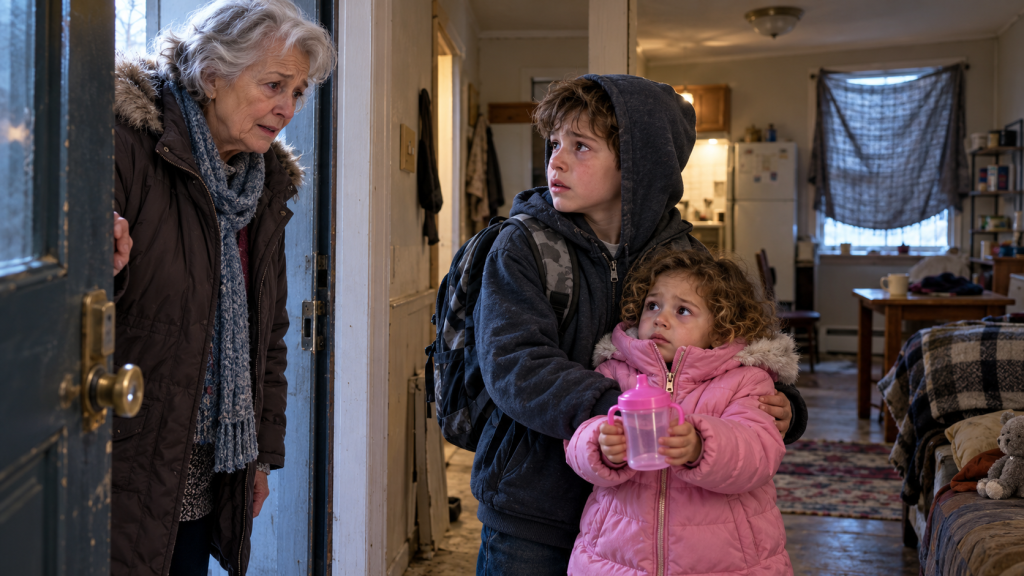
“This time, sweetheart, I’m calling someone who can help all three of you.”
Bentley’s hand closed around my wrist.
Not hard.
Desperate.
“No.”
His face changed so fast that for one terrible second, he did not look ten years old anymore.
He looked like somebody who had already learned what adults could take away.
“Miss Arlene, please.”
Behind him, Maddie began crying because Bentley was crying.
She still held the empty sippy cup.
Pink coat zipped all the way to her chin.
Bare feet on a cold floor.
I looked at the closed bedroom door.
Something had fallen behind it.
Amber had been discharged from the hospital three days earlier.
She was somewhere on the other side.
And my ten-year-old neighbor was begging me not to let the world find out.
I crouched slowly because my knees no longer trusted sudden movement.
“Bentley.”
He shook his head before I could continue.
“They’ll split us up.”
His voice cracked.
“Mama said they did that to her.”
My throat tightened.
Amber at my kitchen table almost a year earlier.
Coffee between her hands.
Three foster homes in four years.
Nobody’s ever splitting up my babies. Not ever.
I understood then what fear had built inside this house.
Amber had not simply taught Bentley to be afraid of child welfare.
Life had.
Her own childhood had.
Stories had.
Maybe experiences.
Maybe warnings.
Enough that a ten-year-old had decided going to school was more dangerous than taking care of a three-year-old alone.
I covered his little hand with mine.
“I cannot promise you what every grown-up will do.”
He started crying harder.
“But I can promise you this.”
I looked straight at him.
“I will tell everybody who comes through this door that you and Maddie belong together.”
His lip trembled.
“And I will stay until somebody explains every single thing to us.”
He whispered:
“What if they don’t listen?”
“Then I’ll get louder.”
That almost made him smile.
Almost.
Then another sound came from the bedroom.
A low moan.
Bentley turned immediately.
“Mama.”
He ran.
I followed.
He opened the bedroom door.
Amber was on the floor between the bed and dresser.
Still wearing hospital sweatpants.
One arm bent awkwardly beneath her.
Her skin was gray.
Not pale.
Gray.
There was a bandage around her lower leg, and even from the doorway I could smell something wrong.
Heat.
Sweat.
Something medicinal and sour.
Her eyes opened halfway.
“Bent?”
“I’m here, Mom.”
He dropped to his knees.
Amber tried to push herself up.
Couldn’t.
Then she saw me.
Her entire face filled with terror.
“No.”
she whispered.
Not:
Help.
No.
“Arlene, please.”
“I’m calling an ambulance.”
“No.”
“You’re sick.”
“My kids.”
Her eyes went to Bentley.
Then Maddie.
Maddie had climbed onto the edge of the bed and was patting her mother’s hair.
“Mama sleepy.”
Amber started sobbing.
I had never seen a person cry while barely conscious.
“Don’t let them take them.”
I held my phone so tightly my fingers hurt.
“I’m going to get you medical help.”
“Arlene.”
“Your children are staying together as long as I have anything to say about it.”
“I can’t promise more than that.”
Her eyes closed.
That ended the argument.
I called 911.
The dispatcher told me not to move Amber unless she was in immediate danger.
I unlocked the front door.
Turned on every light.
Then realized the toilet would not flush.
The sink gave one miserable cough of air.
No water.
Because my son had shut it off.
The thought hit me so hard I had to sit down for one second.
Bentley hovered over Amber.
Maddie pressed against his side.
I looked around the bedroom.
Two empty gallon jugs.
An open package of crackers.
Children’s books.
A plastic cup.
Three hospital discharge papers on the floor.
A prescription bottle.
Almost full.
I picked it up only long enough to read the label.
Antibiotic.
Amber should have been taking it regularly.
There was a note on the discharge sheet:
Take with food and full glass of water.
I stared toward the kitchen.
No water.
Bentley saw what I was looking at.
“Mama said it made her sick.”
“When did she take it?”
He looked ashamed.
“I don’t know.”
That was not his shame to carry.
I put the bottle down.
“Okay.”
Sirens came three minutes later.
Those three minutes felt longer than my entire seventieth year.
Two paramedics came in first.
Then another emergency worker.
They asked me to take the children into the living room.
Bentley refused.
“I stay with her.”
One paramedic crouched.
A woman with gray streaks in her hair.
“What’s your name?”
“Bentley.”
“I’m Carla.”
“I’m going to help your mom.”
“I need some room to do that.”
Bentley swallowed.
Then asked the question that broke something in every adult standing there.
“Are you going to tell people we were here by ourselves?”
Carla did not lie.
“We may have to talk to people who help families when there’s an emergency.”
Bentley stepped backward.
“No.”
I put my arm around him.
He did not pull away.
Carla looked at me.
I said:
“I’m their neighbor and landlord.”
Then I corrected myself.
“No.”
I swallowed.
“I own the duplex.”
That felt different.
Responsibility had a title.
Carla asked:
“Can they stay with you while we work?”
“Yes.”
Immediate.
Bentley looked up.
“What about Mom?”
“You can see her before they take her.”
I said.
“If the paramedics say it’s okay.”
Carla nodded.
Good.
Bentley carried Maddie next door to my kitchen.
Not me.
Him.
She had one arm around his neck.
The other still held the empty cup.
I turned on my faucet.
Water rushed out.
Maddie heard it and wriggled down.
“Water!”
She held up the cup.
I filled it.
She drank too fast.
I pulled it gently away.
“Slow.”
Bentley stood at the counter.
Backpack still on.
I had not noticed until then.
He had worn it inside the house all day.
A disguise.
Every morning at 7:10, he put on the backpack.
Used my bathroom.
Filled the bottle.
Walked to the corner.
Waited.
Let the bus leave.
Then came home through the alley.
A ten-year-old performing school attendance for one audience.
Me.
Maybe other neighbors.
Maybe himself.
I took the backpack from his shoulders.
It was heavier than I expected.
Inside:
Two picture books.
A box of crackers.
Three diapers.
A shirt for Maddie.
Her little socks.
Two empty water bottles.
His school folder.
And one folded sheet of notebook paper.
I did not open it.
Not mine.
I put the backpack by my table.
Bentley asked:
“Can Maddie have cereal?”
“Yes.”
“When did you eat?”
He shrugged.
“Bentley.”
“Yesterday.”
My heart stopped.
“What yesterday?”
“Cereal.”
“What else?”
“Crackers.”
I opened my refrigerator.
Eggs.
Cheese.
Leftover chicken soup.
Milk.
Applesauce.
I wanted to put everything on the table.
Instead I remembered my own children sick and hungry.
Too much at once could make them feel worse.
I poured small bowls of cereal.
Cut a banana.
Toast.
Bentley ate slowly at first.
Then faster.
He kept glancing toward the shared wall.
As though he could see through it.
Maddie ate with both hands.
Milk dripping down her coat.
I did not care.
Carla appeared in my doorway.
“Ms. Arlene?”
I stood.
“Is she alive?”
“Yes.”
My knees nearly gave.
“She’s very ill.”
“We’re transporting her now.”
“What’s wrong?”
“We can’t diagnose it here.”
Carla lowered her voice.
“She has a high fever, low blood pressure, and the wound on her leg looks infected.”
“She also appears dehydrated.”
I looked toward my sink.
Water still running slightly because I had not turned the handle all the way off.
Carla followed my eyes.
“Was the water off next door?”
I nodded.
“For how long?”
My mouth went dry.
“About eleven days.”
Her face changed.
“I didn’t know.”
I said quickly.
Then hated myself.
Because I had known enough.
Bentley using my bathroom.
Water bottle.
Saltines.
Amber’s missing car.
Notice curling on the door.
I had not known the whole truth.
But I had known something was wrong.
And I had let Doug’s sentence become mine.
Let me handle it.
Carla said nothing.
She did not need to.
Then:
“Police and a child welfare worker are on the way.”
Bentley heard.
His spoon dropped.
“No.”
He stood so fast the chair scraped backward.
“No, no, no.”
I went to him.
He backed away from me too.
“You promised.”
“I promised I’d stay.”
“You said we’d stay together.”
“I said I would tell everybody you need to.”
He was crying now.
“You lied.”
The words hurt.
Because from his side, perhaps I had.
I knelt.
“Bentley, listen to me.”
He shook his head.
“You can hate me right now.”
“I mean it.”
“You can be furious.”
“But I am not going to leave your mom sick on the floor because everybody is scared.”
His chest shook.
“And I am not going to pretend two children being alone for eleven days is something we can fix by hiding it.”
Maddie began crying too.
I held out my arms.
Neither child came.
That was fair.
Then Carla said gently:
“Bentley, your mom asked for you.”
He ran.
They brought Amber through my side of the porch because the stretcher maneuver was easier.
She looked smaller under blankets.
Her eyes barely opened.
Bentley walked beside her.
Maddie in my arms now.
Amber reached for him.
Her hand missed.
Bentley caught it.
“I’m sorry, Mom.”
My heart broke.
Amber whispered:
“No.”
Then again, stronger:
“No.”
Her eyes focused on him.
“You did good.”
That sentence scared me.
Not because it was unkind.
Because Bentley should never have had to do “good” at this.
Amber looked at me.
“Together.”
I nodded.
“I’ll keep saying it.”
That was all I could promise.
They loaded her into the ambulance.
Bentley stood in my yard watching until it disappeared.
Then a police car pulled up.
Behind it, a county vehicle.
Bentley’s entire body stiffened.
I took his hand.
This time he let me.
The child welfare worker was named Tamara Lewis.
Mid-forties.
Warm voice.
No nonsense.
She sat at my kitchen table while Officer Jennings spoke with Bentley carefully.
Not interrogating him.
Trying to understand the timeline.
Bentley answered in pieces.
Amber got hurt at work eleven days earlier.
A heavy cart had pinned her leg against a loading platform.
She fell.
Hit her head.
A coworker called an ambulance.
Before leaving, Amber phoned her friend Kayla.
Not her sister.
I had assumed.
Bentley called her Aunt Kayla because that was what the children called her.
Amber and Kayla had met in foster care as teenagers.
Not blood.
Chosen family.
Kayla promised to come.
She did.
The first night.
Then the second morning she left.
“Why?”
Tamara asked gently.
Bentley stared at the table.
“She said she had to go get clothes.”
“Did she come back?”
“No.”
“Did you call her?”
“Yes.”
“What happened?”
“Her phone turned off.”
“Did you call your mom?”
Bentley nodded.
“What did you tell her?”
He started crying.
“That Aunt Kayla was here.”
Tamara waited.
“Why?”
“So Mama could get better.”
He wiped his face with his sleeve.
“She said if the hospital found out we didn’t have anybody, somebody would come get us.”
Maddie played with measuring spoons on my floor.
Unaware.
Bentley continued.
“Mama said people split brothers and sisters.”
Tamara did not defend the system.
I appreciated that.
Instead she said:
“That has happened to children.”
Bentley looked up.
My heart tightened.
Then Tamara added:
“But my job right now is to find the safest way to keep your family connected.”
Connected.
Not promise.
Truth.
Bentley said:
“I can take care of Maddie.”
“I know you have.”
Tamara replied.
“But you should not have had to.”
Bentley’s face folded.
He looked down.
For the first time, somebody had praised him without endorsing what had happened.
Tamara asked about food.
There had been cereal.
Peanut butter.
Bread.
Canned soup they could not make after the water was shut off unless Bentley carried water from my house.
He used the toilet only when he came to me.
Maddie wore pull-ups overnight.
During the day, Bentley put dirty toilet paper into grocery bags because he could not flush.
My stomach rolled.
He bathed Maddie once using water from bottles.
After that, he wiped her with baby wipes.
There had been heat.
Barely.
Amber’s electric account was active, but Bentley turned the thermostat down because he had heard his mother worry about the bill.
Ten years old.
Managing utilities.
Rationing food.
Hiding from a school bus.
Changing pull-ups.
Reading picture books aloud.
I looked toward the shared wall.
The little bear had been looking for his mama.
Of course he had.
Amber called the house from the hospital around eight that night.
Tamara put the phone on speaker only after Amber and Bentley both agreed.
Her voice sounded weak.
But awake.
“Baby?”
Bentley pressed close to the phone.
“Mom.”
“I’m okay.”
He sobbed.
“No, you’re not.”
Amber cried too.
“No.”
Then:
“I’m sorry.”
Bentley said:
“I told them.”
“I know.”
“I’m sorry.”
“Stop.”
Amber’s voice became firmer.
“You did nothing wrong.”
He covered his face.
Maddie shouted:
“Mama!”
Amber laughed and cried at the same time.
“Hi, bug.”
“You sleeping hospital.”
“Yeah.”
“When home?”
A long pause.
“Not tonight.”
Maddie frowned at the phone.
“Tomorrow?”
“I don’t know.”
Tamara closed her eyes briefly.
Amber then asked:
“Are they together?”
“Yes.”
Tamara said.
“Both children are together right now at Ms. Arlene’s.”
Amber breathed.
“Please.”
Her voice cracked.
“I’ll do anything.”
“I’ll take classes.”
“I’ll sign whatever.”
“I can’t lose them.”
Tamara replied:
“We’re working on a temporary safety plan.”
“That does not mean anyone has decided permanent placement.”
“We need to make sure they’re safe while you’re hospitalized.”
Amber asked:
“Can they stay with Arlene?”
I looked at Tamara.
She looked at me.
I answered before she could ask.
“Yes.”
Tamara held up one hand.
“Possibly.”
Reality.
Background check.
Home check.
Sleeping arrangements.
Medication storage.
Smoke detectors.
A lot of questions.
I answered them all.
Seventy.
Widowed.
No criminal record.
No guns.
Two bedrooms.
One had become Ray’s old den after he died.
Could be changed back.
Yes, I could manage stairs.
No, I was not on medications that impaired me.
Yes, my son had keys.
That answer stopped me.
Doug.
He had keys.
To my house.
To theirs.
Control over the water account.
Property management authorization.
I looked at Tamara.
“I need to change some things.”
Doug arrived at 8:40.
I had not called him.
Officer Jennings had.
My son walked into my kitchen looking furious.
Not frightened.
Furious.
That told me too much.
“What is going on?”
His eyes moved from Tamara to Bentley.
Then Maddie asleep on my couch.
Then me.
“Ma.”
I stood.
“Lower your voice.”
He stared.
“This is my property management issue.”
“No.”
I said.
“It’s my property.”
He blinked.
For twenty years after Ray died—no, six years—Doug had handled everything.
Rent.
Repairs.
Taxes sometimes.
He had begun talking about the right side as though it belonged to him.
I had allowed that because paperwork tired me.
Because conflict tired me.
Because Doug was competent.
Or I thought he was.
He looked at Bentley.
“Where’s Amber?”
“Hospital.”
“What happened?”
“She nearly collapsed.”
He swore quietly.
Then:
“This is exactly why she shouldn’t have those kids alone if she can’t handle—”
I crossed the kitchen in three steps.
Fast for seventy.
“Stop.”
Doug looked at me.
I had never spoken to him like that.
Not when he wrecked Ray’s truck at seventeen.
Not when he dropped out of community college.
Not when he divorced.
“Do not finish that sentence.”
He stared.
“Ma, I’m saying—”
“You shut off their water.”
His jaw tightened.
“They weren’t paying.”
“You shut off water to a house with two children living in it.”
“I didn’t know they were alone.”
“You knew they lived there.”
“That’s different.”
“No.”
My voice shook.
“It isn’t.”
Tamara watched.
Officer Jennings too.
Doug noticed.
His face changed.
Defensive now.
Official audience.
“The water account is in Mom’s name.”
he said.
“She authorized me to manage utilities.”
I felt sick.
That was true.
“I authorized you to pay bills and handle repairs.”
“I did not tell you to use water as an eviction tool.”
“They were behind.”
“Eleven days.”
“Rent matters, Ma.”
“So does drinking water.”
“They could’ve called.”
Bentley flinched.
I saw it.
My son did not.
That made me angrier.
“He came to my door every morning with a water bottle.”
Doug looked at him then.
Really looked.
Bentley’s hoodie.
Thin wrists.
Face too serious.
Doug said nothing.
I continued.
“He asked me for crackers.”
“Two sleeves.”
“He used my bathroom because yours had no running water.”
Doug’s face changed slightly.
Not enough.
Then he said:
“Amber should have told somebody.”
I laughed.
The sound scared even me.
“She did.”
He frowned.
“What?”
“Did she contact you from the hospital?”
Silence.
There.
I felt it before he answered.
“Doug.”
He looked away.
“She texted.”
“What did she say?”
“That she’d been hurt at work and rent would be late.”
My hands went cold.
“When?”
“Before the notice.”
“And what did you say?”
He rubbed his neck.
“That the rent was still due.”
I stared.
“You knew she was injured.”
“I did not know she was hospitalized that long.”
“Did you ask?”
“No.”
“Did you go inside?”
“No.”
“Did you check whether the children had water before shutting it off?”
“No.”
His voice became defensive again.
“But I didn’t know Kayla wasn’t there.”
“You didn’t know Kayla existed.”
That shut him up.
He had assumed.
Just as I had.
Tamara spoke for the first time.
“Mr. Hensley? Is that your last name?”
“Yes.”
“I’m not here to determine housing-law issues.”
she said.
“But the condition of the home and utility shutoff will be documented as part of the safety assessment.”
Doug turned toward me.
“Ma, you need to be careful what you say.”
There it was.
My own son warning me.
As though truth were more dangerous than what happened.
I walked to the kitchen drawer.
Pulled out Ray’s ring of keys.
Red tag:
RIGHT SIDE.
I removed the duplicate set Doug used.
Placed them on the table.
“Give me yours.”
He stared.
“What?”
“Your keys.”
“Ma.”
“You’re not managing the rental anymore.”
His face went white.
“You can’t be serious.”
“I am.”
“You don’t know how to run that place.”
“I managed a household before you could tie your shoes.”
“That’s not the same thing.”
“No.”
I looked at Bentley.
“It isn’t.”
I had failed at this part.
I knew it.
That did not mean Doug got to keep doing it badly because I was embarrassed to take responsibility.
“Keys.”
He pulled the ring from his pocket.
Dropped it onto the table.
Hard.
“You’re going to get walked all over.”
I nodded.
“Maybe.”
Then:
“But nobody is losing water because my feelings about rent are more important than basic decency.”
Doug shook his head.
“This is emotional.”
“Yes.”
I said.
“There are two hungry children in my house and their mother is in the hospital.”
“I am emotional.”
He stared.
Then walked out.
The door slammed.
Maddie woke crying.
Bentley rushed to her.
My son did not come back.
The water was restored the next morning.
I called the utility department myself at eight.
It took forms.
A past-due balance.
A reconnection fee.
A lecture from a supervisor after I explained the situation.
I deserved part of it.
The account was mine.
Even if Doug made the call, my name sat above the meter.
I paid.
Not Amber.
Me.
Then I hired a plumber to inspect everything because cold houses and shut water frightened me.
No burst pipes.
Small mercy.
The furnace needed service.
Another thing Doug had postponed.
I approved it.
Then I called an attorney.
Not to go after Amber.
To find out what I had done.
Or allowed.
Her name was Joanne Fields.
She specialized in landlord-tenant and small property matters.
I told her everything.
When I finished, she said:
“First, stop communicating about the tenancy through your son.”
“Done.”
“Second, do not destroy records.”
“I won’t.”
“Third, do not pressure the tenant to waive anything in exchange for rent relief.”
“I wasn’t going to.”
“Good.”
Then:
“You may have legal exposure.”
My stomach tightened.
“I understand.”
“Do you?”
I thought about saying yes.
Then didn’t.
“No.”
“Good answer.”
She explained enough for me to understand that shutting off essential utilities to pressure a tenant could create serious problems.
The exact consequences depended on facts and local law.
We would handle it properly.
No secret agreements.
No retaliatory eviction.
No handwritten promises.
Paper.
Transparency.
I had spent a lifetime thinking kindness meant informality.
Turns out sometimes the kindest thing is a clear document both people can read.
Tamara completed the emergency home assessment on my side that afternoon.
Maddie slept in my spare room.
Bentley on the pullout sofa for one night.
Then Doug’s daughter? No. We don’t need.
The county approved a temporary arrangement allowing the children to remain together with me while Amber was hospitalized, subject to daily contact and further review.
Not permanent.
Not foster adoption.
Nothing dramatic.
A safety plan.
Bentley asked Tamara three times:
“Can Maddie stay?”
Each time she said:
“Yes, tonight.”
At first I hated that answer.
Then I understood.
Do not promise a child what the system has not decided.
Give him the truth he can stand on today.
So we lived by nights.
Tonight, together.
Tomorrow, we ask again.
Amber had a serious infection in the leg injury and dehydration.
The doctors expected recovery, but she needed several more days in the hospital.
A hospital social worker called.
There were workers’ compensation forms.
Short-term disability paperwork.
An emergency food application.
A charity pharmacy program.
Things Amber had been too injured and frightened to organize.
The social worker asked me:
“Did she have anyone helping before?”
I almost said:
Me.
Then stopped.
No.
Not really.
I had watched Maddie twice.
Shared coffee.
Accepted a grocery-store pie.
That is neighborly.
It is not the same thing as asking whether someone drowning wants a hand.
Bentley returned to school three days later.
Getting him there was its own battle.
“I can’t.”
he said.
“You can.”
“What if Mom comes home?”
“She won’t today.”
“What if Maddie needs me?”
“I’m here.”
“She doesn’t listen to you.”
Maddie shouted from the living room:
“Yes I do!”
Bentley glared.
Traitor.
I knelt.
“Your job is school.”
His face hardened.
“My job is Maddie.”
“No.”
That word hurt him.
I softened.
“You did a grown-up job because no grown-up was there.”
“That does not make it your job forever.”
He looked away.
“I kept her safe.”
“Yes.”
“You did.”
“And now other people have to take over.”
His eyes filled.
“What if they mess up?”
I thought of Doug.
Me.
Kayla.
Amber’s fear.
Fair question.
“Then you tell someone.”
“Who?”
“Me.”
“Your teacher.”
“Your counselor.”
“Your mom when she’s better.”
“Tamara.”
“Keep telling until somebody listens.”
Bentley stared.
Then:
“What if nobody does?”
I swallowed.
“Then I hope you knock on the door at 7:10.”
He almost smiled.
That morning, I drove him to school.
He refused to take the bus.
Fine.
One thing at a time.
The principal met us privately.
School counselor.
No punishment for absences.
No dramatic questioning in front of classmates.
They arranged breakfast.
Homework support.
A check-in every morning.
Bentley clutched his backpack straps.
Before going into class, he asked:
“Can I call at lunch?”
“Yes.”
“Can you send a picture of Maddie?”
“Yes.”
“Can she wear the yellow shirt?”
“Yes.”
He hesitated.
Then:
“She likes applesauce but only the strawberry one.”
“I know.”
“How?”
“She told me.”
He looked offended that Maddie had developed independent communication.
Good.
He went to class.
I sat in my car and cried.
Not because he was brave.
I had begun to hate adults calling children brave when what they meant was:
You survived something we should have prevented.
I cried because he got to be ten for six hours.
Amber came home eight days after I found her.
Not to the right side immediately.
The safety plan required certain things first.
Working utilities.
Food.
Follow-up care.
A reliable adult support plan.
Medication access.
School attendance.
No disappearing caregiver.
Kayla finally resurfaced.
She had been arrested on an unrelated warrant the day after leaving the children.
No one knew because Bentley did not know her last name well enough to search, and Amber’s phone had been lost during transfer between hospital units.
When Amber learned, she closed her eyes.
“That doesn’t make it okay.”
she said.
No.
It explained.
Did not erase.
Kayla later apologized.
Amber did not rely on her for childcare again.
Good.
The first time Amber came to my side after discharge, she used a walker.
Bentley ran to her.
Stopped halfway.
As though he had suddenly remembered he was angry.
Amber saw.
She held out her arms.
He did not go.
My heart hurt.
She lowered them.
“Okay.”
Good.
No demand.
Bentley said:
“You lied.”
Amber closed her eyes.
“Yes.”
“You said Aunt Kayla was there.”
“I thought she would be.”
“You said nobody was splitting us up.”
Amber began crying.
“I was scared.”
“So was I.”
“I know.”
“No, you don’t.”
He ran to my spare room.
Door slammed.
Amber started after him.
Tamara, who was there for the transition meeting, put up one hand.
“Give him a minute.”
Amber sat.
Her face folded into both hands.
“I ruined him.”
“No.”
I said too quickly.
Tamara looked at me.
I stopped.
Again.
Do not rush to erase someone’s guilt just because witnessing it is uncomfortable.
Amber lifted her head.
“I put him in charge.”
Tamara said:
“You made decisions from fear that put too much responsibility on him.”
Amber nodded.
“That is something you’ll need to repair.”
“Repair?”
Amber whispered.
“Not erase.”
Tamara said.
That word mattered.
Repair.
You cannot erase eleven days.
But you can build around them.
The right side was ready two days later.
Water.
Heat.
Refrigerator full.
Smoke detectors replaced.
Bedroom window repaired.
I paid for all of it.
Not charity.
Responsibility where it was mine.
The rent issue came next.
Amber owed rent.
That was true.
She had missed most of one month because workers’ compensation had been delayed.
I wanted to forgive everything immediately.
Joanne, my attorney, told me:
“You can waive rent if you want.”
“But document it.”
“Do not make emotional promises that create confusion later.”
So I wrote a letter with her help.
One month’s rent waived.
Late fees removed.
Water reconnection costs entirely mine.
Lease renewed for one year at the same base rent.
No retaliation.
Utilities handled according to a clear written arrangement.
Repair requests to me and a professional property manager I hired for the paperwork, not Doug.
Amber read it twice.
Then:
“Why?”
I looked at her.
“Because I own the house.”
“That doesn’t mean—”
“No.”
I stopped.
“I mean I own what happened on the landlord side too.”
Her eyes filled.
“Doug did it.”
“I let Doug manage without checking.”
“You didn’t know.”
“I knew enough to ask more questions.”
She looked away.
Then:
“I lied too.”
“Yes.”
I said gently.
“You did.”
“I told the hospital the kids were with someone when I didn’t know for sure.”
“Yes.”
“I told Bentley not to tell.”
“Yes.”
She cried.
I reached across the table.
Stopped before touching.
She looked at my hand.
Then nodded.
I took hers.
“We can both be responsible for different things without deciding either of us is beyond repair.”
She squeezed my fingers.
That was the beginning.
Doug did not speak to me for almost two months.
My only child.
Forty-five years since I first held him.
He missed Thanksgiving.
Called my sister instead to say I was “choosing tenants over family.”
She told him:
“No, she’s choosing not to let you run her property.”
Bless sisters.
Christmas came.
He sent a card.
No call.
I cried anyway.
Not because I regretted taking the keys.
Because consequences hurt the person setting the boundary too.
People do not talk about that enough.
Sometimes the right decision breaks your heart and remains right.
In January, Doug appeared at my door.
7:10 in the morning.
I almost laughed at the time.
He stood on the porch holding coffee.
“Can I come in?”
Not:
Open up.
Progress.
I let him.
He sat at my kitchen table.
The same table where Bentley had eaten cereal.
He looked older than two months earlier.
“Water shutoff was wrong.”
No preamble.
I waited.
“I knew it then.”
That surprised me.
“Then why?”
Doug stared into his cup.
“Because it works.”
My stomach turned.
He continued.
“I had a tenant before Amber.”
“Years ago.”
“On another property I managed.”
“He stopped paying.”
“I kept giving extensions.”
“He left owing four months and trashed the place.”
“I got obsessed with not being the sucker again.”
I listened.
“That doesn’t excuse it.”
he said.
“No.”
“I started thinking every late tenant was testing me.”
“Every explanation was manipulation.”
“Every request for time meant they’d take more if I gave it.”
He looked at me.
“Then you kept overruling late fees.”
“I thought you were naive.”
“Maybe I was sometimes.”
I said.
He nodded.
“But I went the other direction.”
“Yes.”
He rubbed his hands.
“Did Bentley really come over every morning?”
“Yes.”
“For water?”
“Yes.”
Doug closed his eyes.
“Jesus.”
“He asked for crackers.”
His face tightened.
I continued.
“You want the part that should stay with you?”
He looked at me.
“On the sixth morning, he asked for two sleeves.”
Doug started crying.
Quietly.
My son had not cried in front of me since Ray’s funeral.
I let him.
Then he said:
“I didn’t know.”
“I know.”
“I swear, Ma.”
“I know.”
“I thought Amber had taken off.”
“I thought maybe the kids were with somebody.”
“I didn’t check.”
“No.”
“That’s the part.”
I said.
“You didn’t check.”
He nodded.
“I’m sorry.”
Not:
Sorry you’re upset.
Not:
Sorry it got complicated.
I believed him.
Then he asked:
“Can I manage again someday?”
“No.”
His face fell.
I reached across the table.
“Not because I hate you.”
“I need property management to be professional now.”
“Written.”
Inspected.
Documented.
“You are my son.”
“I want you back in that job.”
He cried harder.
“I thought helping you with the rental was being your son.”
“So did I.”
That was part of the problem.
We had mixed family and business until neither had proper boundaries.
Doug eventually helped me with other things.
Gutters.
Taxes.
Taking me to eye appointments.
Never rent.
That was healthier.
Amber’s recovery took months.
The warehouse job did not survive in the same form.
She went through workers’ compensation and rehabilitation.
Eventually she returned on restricted duty.
Then moved to a daytime position with fewer hours but a steadier schedule.
She hated needing help.
I recognized that.
Different reasons.
Same posture.
Whenever I offered something, she said:
“We’re fine.”
Even when we both knew they were not.
So I learned to ask smaller questions.
“Can I take Maddie to preschool Tuesday?”
“Do you want this soup?”
“I’m going to the store. Milk?”
Specific.
Not rescue.
Not:
Tell me everything you need.
People who have spent their lives surviving often cannot answer that question.
Too large.
Bentley started counseling through school.
At first he refused to talk.
Apparently he spent three sessions discussing video games.
The counselor told Amber:
“That counts.”
Eventually he talked about the eleven days.
About checking the window every time a car stopped.
About hiding when someone knocked.
About being afraid Maddie would cry too loudly.
About walking to the bus stop every morning because he thought neighbors would call police if they realized he was not in school.
About rationing crackers.
About his mother.
About me.
One day he came over after school.
No knock at 7:10.
Three-thirty now.
Backpack slung over one shoulder.
He handed me a folded sheet of notebook paper.
The same one I had seen in his backpack.
“I want you to read it.”
I opened it.
His handwriting was uneven.
A list.
If something happens:
1. Maddie eats breakfast.
2. Fill bottles at Miss Arlene’s.
3. Don’t let Maddie answer door.
4. Walk to bus stop so people think school.
5. Read bear book when she cries.
6. Mom comes back.
That last line destroyed me.
Not:
Call 911.
Not:
Tell teacher.
Mom comes back.
Faith as emergency planning.
I looked up.
Bentley stared at the floor.
“I made it the first night.”
I folded the paper carefully.
“Do you want it back?”
“No.”
“What do you want me to do with it?”
He shrugged.
“Keep it.”
So I did.
For years.
Not because I wanted evidence of his suffering.
Because he wanted one adult to hold the list so he did not have to.
Spring came.
The curled ten-day notice disappeared from Amber’s door.
I removed it myself.
It had been there through rain and cold.
Paper soft at the corners.
I almost threw it away.
Then kept it long enough to show my attorney and preserve records.
After everything settled, I shredded it.
No ceremony.
Just paper.
The city inspector returned once.
Everything passed.
Tamara’s case stayed open for months.
Home visits.
Check-ins.
Parenting support.
School attendance.
Medical follow-up.
Amber hated it at first.
Every knock made her shoulders rise.
One afternoon after Tamara left, she said:
“I feel like I’m being punished for getting hurt.”
I understood why it felt that way.
But I also remembered Bentley’s list.
“You’re being watched more closely because the kids were alone.”
Amber’s eyes filled.
“I know.”
“It can feel unfair and still be necessary.”
She nodded.
Then:
“I wish people had watched me this closely when I was a kid.”
That sentence stayed with me.
Systems can terrify people for reasons that did not begin with the current worker standing at the door.
Tamara understood that too.
She never promised Amber the past had been handled correctly.
She focused on now.
Eventually the case closed.
Not with fireworks.
A letter.
Services completed.
Children safe.
Case closure.
Amber held the paper at my kitchen table.
She cried.
Then laughed.
Then cried again.
Bentley asked:
“Does this mean they can’t split us?”
Amber looked at Tamara.
Tamara said:
“It means I’m not your worker anymore.”
Bentley frowned.
“That’s not what I asked.”
Smart boy.
Tamara smiled.
“It means there is no current plan to remove either of you from your mother.”
Truth.
Specific.
Bentley exhaled.
Then hugged her.
She cried too.
Everybody in my life had become too emotional.
One year after the morning I entered the right side, Bentley knocked on my door at 7:10.
My heart stopped.
I opened it.
He stood there taller.
New backpack.
Hair sticking up.
I stared.
“What’s wrong?”
He grinned.
“Nothing.”
“Then why are you here?”
He held out a water bottle.
I almost cried.
“Can I fill this?”
I stared at him.
He laughed.
“Our water works.”
“I know.”
“I forgot to fill it.”
I took the bottle.
“Get in here.”
He came in.
Used my sink.
Filled it himself.
No bathroom.
No crackers.
Then:
“Bus is coming.”
“I know.”
He started toward the door.
I said:
“Bentley.”
He turned.
“Yeah?”
“Are you getting on it?”
He rolled his eyes.
“Miss Arlene.”
“Answer.”
“Yes.”
I watched from the porch.
He walked to the corner.
Bus arrived.
Doors opened.
He climbed in.
The bus pulled away.
And he did not come back through the alley.
I stood there crying in my robe.
Mrs. Alvarez from across the street probably thought I was losing my mind.
Fine.
Maddie remembered almost none of it consciously.
That seemed like mercy.
She remembered “Miss Arlene cereal.”
A pink coat.
Sleeping in my spare room.
The little bear book.
Years later, when she was seven, she found that book in a box.
“The Little Bear?”
she asked.
Bentley froze.
Amber froze.
I saw it.
Maddie did not.
“Read it.”
she said.
Bentley looked at me.
Then at his mother.
Amber nodded.
He sat beside Maddie.
Opened the book.
His voice was deeper now.
Still careful.
“The little bear looked for his mama…”
Amber left the room.
I followed a minute later.
Found her on my porch crying.
“She doesn’t remember.”
she whispered.
“Maybe not.”
“I do.”
“I know.”
“Bentley does.”
“Yes.”
She looked toward the window.
“I hate that he remembers.”
I sat beside her.
“Memory isn’t only damage.”
She looked at me.
“That sounds like something on a mug.”
“Probably.”
I shrugged.
“He also remembers that he kept going.”
“That you came back.”
“That people eventually helped.”
“That he went back to school.”
“That Maddie stayed with him.”
Amber wiped her face.
“Do you think he forgives me?”
I hated that question.
“Ask him when you’re ready to hear whatever answer he has.”
She nodded.
It took her another year.
Bentley told her:
“I was mad.”
“Still am sometimes.”
Then:
“But I know you didn’t leave because you wanted to.”
Not full absolution.
Better.
Real.
Doug apologized to Amber personally two years after the shutoff.
I did not arrange it.
He asked her whether she was willing to meet.
She said yes.
My kitchen.
Neutral ground.
He said:
“I shut off the water because I wanted rent paid.”
No excuses.
“I knew you had children.”
“I did not know they were alone.”
“But I also did not check.”
“I treated the water like leverage.”
“I was wrong.”
Amber listened.
Then:
“Did you think people like me only understand consequences?”
Doug looked ashamed.
“Yes.”
She nodded.
“People said that about my mom too.”
Silence.
“I accept your apology.”
Doug exhaled.
Amber continued.
“I don’t trust you.”
He nodded.
“Fair.”
That was it.
No hug.
No friendship.
Consequences do not need decoration.
Years later, when Doug came to fix my porch rail, Bentley held the ladder.
They talked about baseball.
Life does strange things when enough time passes and nobody demands forgetting.
I stopped renting the other side myself when I turned seventy-five.
Not immediately.
For five more years, I used a professional manager.
Every lease had clear utility responsibilities.
No shutoffs to pressure payment.
Repair timelines.
Emergency contacts.
Late-rent procedures that involved written notices and actual conversations.
Business.
Real business.
Not cruelty wearing a spreadsheet.
Amber remained until Bentley finished middle school.
Then she found a small house through a first-time homebuyer program.
Nothing fancy.
Two bedrooms.
Tiny yard.
She brought me over before closing.
“Tell me I’m making a mistake.”
I walked through.
Old carpet.
Good roof.
Ugly cabinets.
Maddie had already chosen a corner for a purple beanbag.
Bentley inspected the garage as though he were buying property.
I said:
“The cabinets are a crime.”
Amber laughed.
Then started crying.
“I never thought I’d have my name on a house.”
I looked at her.
“You do.”
At closing, I watched the kids afterward while she signed papers.
When she picked them up, she held the keys out.
Her hand shook.
Maddie shouted:
“OUR HOUSE!”
Bentley smiled.
Not huge.
He had become a teenager.
They ration joy too.
But I saw it.
The day they moved out of the right side, I walked through after the truck left.
Empty rooms.
Nail holes.
One stain on the carpet where Maddie spilled purple juice.
Closet marks measuring the children’s height.
Bentley had grown almost nine inches since the morning he asked to use my bathroom.
In the kitchen, there was an envelope on the counter.
MISS ARLENE
Inside was a card.
Amber wrote:
You did not save us. I want to say that first because people like to tell stories where one good person rescues one struggling mother. That isn’t what happened.
I sat down.
You opened a door. You made a phone call I was terrified of. You admitted where you had been wrong. You gave us time to get steady without asking us to be grateful every morning forever. That mattered.
My eyes filled.
Thank you for letting my children stay together. Thank you for making Bentley go back to being a child. Thank you for never calling me a bad mother on the days I was afraid I might be one.
Then Bentley had written below:
Thanks for the water. Sorry I lied about the bus.
I laughed through tears.
Maddie’s contribution was a purple drawing of four stick figures.
One very tall.
One medium.
One tiny.
One with gray hair standing beside a blue rectangle.
The blue rectangle had a label:
BATHRUM
Accurate enough.
I framed that one.
Naturally.
After Amber moved, I sold the duplex.
Not because of the memories.
Because I was done being a landlord.
Ray had been good at it.
I had been decent sometimes.
Careless sometimes.
Doug had been harsh.
I learned.
Enough.
A young couple bought it.
They planned to live on the left and rent the right.
At closing, the husband said:
“We’re hoping the rent helps with groceries.”
I laughed.
Ray’s exact logic.
I looked at him.
“Then remember the people paying the rent need groceries too.”
He smiled politely.
Probably thought I was a strange old woman.
Fine.
I gave them the keys.
Not the red tag.
I kept that.
It hangs in my kitchen now.
No lock belongs to it anymore.
Just a red piece of plastic.
RIGHT SIDE.
A reminder.
Ownership gives you rights.
It also gives you responsibility.
I had understood the first part longer.
Bentley graduated from high school eight years after the morning at my door.
Amber saved me a seat.
Front section.
Maddie, eleven now, talked through half the ceremony until Amber threatened to move her.
Doug came too.
That surprised me.
Bentley had invited him.
When his name was called, I stood before I realized I was standing.
Amber laughed.
“Sit down, Arlene.”
“No.”
Bentley crossed the stage.
Tall.
Healthy.
Embarrassed by applause.
Diploma in hand.
For one second, I saw the ten-year-old in the hoodie.
Backpack on both shoulders.
Water bottle.
Saltines.
Then he was eighteen again.
After the ceremony, he found me.
Held out a gift bag.
“You graduated.”
I said.
“Why am I getting a present?”
“Open it.”
Inside was a children’s picture book.
Not the original.
A new copy.
The Little Bear Finds Home.
I started crying before I opened the cover.
Inside, Bentley had written:
Miss Arlene, I used to think being strong meant making sure nobody found out. Thank you for teaching me sometimes being strong means opening the door. —Bentley
I could not speak.
He looked uncomfortable.
“Okay, too much.”
I hugged him.
He let me.
Then whispered:
“I remember being mad at you.”
“I remember.”
“I thought you ruined everything.”
“I know.”
He stepped back.
“You didn’t.”
“No.”
I looked toward Amber.
Maddie.
Doug.
His school friends.
“You all rebuilt it.”
Bentley smiled.
That distinction mattered.
He became an EMT.
Of course he did.
I tried not to make the story too neat.
He insisted it had nothing to do with childhood.
“People always think everything is trauma.”
he said.
“Maybe I just like emergencies.”
“That is concerning.”
He laughed.
But I knew part of him remembered Carla.
The paramedic who had looked at a frightened ten-year-old and refused to lie.
Maddie became obsessed with animals.
Wanted to be a veterinarian.
Then a marine biologist.
Then a singer.
As of the last time I asked, she wanted to own a dog bakery.
She had time.
Amber eventually became a shift trainer at the warehouse’s daytime operation.
She still limped slightly when cold weather came.
She hated winter.
Understandably.
She never missed rent again while she lived beside me.
I told her repeatedly that was not a moral achievement.
She told me to mind my business.
Good.
Doug and I repaired too.
Slowly.
He never managed my finances again without me knowing every line.
I stopped handing responsibility to him just because he was my son.
We became better when our roles became simpler.
He was not my property manager.
I was not his supervisor.
He was my son.
I was his mother.
That was plenty.
One Father’s Day—Ray long gone, but habits survive—Doug came over with burgers.
We sat on my porch.
He looked toward the right side, then already sold by then to another family.
“You think Dad would’ve been ashamed of me?”
I looked at him.
“Probably for the water.”
He winced.
I continued.
“And then he would’ve expected you to fix what you could.”
Doug nodded.
“Do you think he’d be ashamed of you?”
Fair.
I smiled sadly.
“For letting you handle everything without paying attention?”
“Maybe.”
We sat.
Then I said:
“Good thing dead people don’t get to grade us forever.”
Doug laughed.
Ray would have liked that.
People sometimes tell the story wrong.
They say:
“Arlene found two abandoned children next door.”
They were not abandoned.
Their mother was hurt.
Terrified.
Failed by a caregiver.
Then trapped by her own fear.
They say:
“She rescued them.”
No.
I opened a door.
Late.
Much later than I wish I had.
Professionals treated Amber.
School staff helped Bentley.
Tamara built the safety plan.
A lawyer fixed the tenancy issues.
Amber did therapy.
Paperwork.
Work.
Parenting.
Recovery.
Bentley survived something no child should have had to manage.
Maddie grew up loved.
Doug confronted what he had become.
I confronted what I had allowed.
Everybody carried something.
That is less satisfying than one hero.
More true.
At eighty, I still wake early.
Habit.
Most mornings I am awake before seven.
Sometimes, when the house is quiet, I look at the clock.
7:08.
7:09.
7:10.
For years, some part of me expected the knock.
Three light taps.
Bentley in his hoodie.
Miss Arlene, can I use your bathroom?
If I could go back to the first morning, I would still let him in.
Of course.
But I would not stop at the bathroom.
I would ask:
“Why is your water off?”
“Where is your mother?”
“Who is with Maddie?”
“Did you eat?”
Not because every child asking for a bathroom is hiding a crisis.
Because asking one gentle question costs less than assuming.
I had spent nine mornings thinking I was being kind.
Letting him use the toilet.
Filling the bottle.
Handing him crackers.
I was kind.
I was also missing the story.
Both can be true.
That was difficult for me.
I wanted kindness to excuse inattention.
It doesn’t.
Good intentions are lovely.
Attention is better.
I still have Bentley’s emergency list.
Not framed.
Not displayed.
Folded inside the picture book he gave me at graduation.
Sometimes I read it.
1. Maddie eats breakfast.
2. Fill bottles at Miss Arlene’s.
3. Don’t let Maddie answer door.
4. Walk to bus stop so people think school.
5. Read bear book when she cries.
6. Mom comes back.
That last line still gets me.
Because she did.
Not exactly the same mother who left for work that night.
None of them came back exactly the same.
Neither did I.
Sometimes surviving changes the definition of home.
Home stopped being the right side or left side of a duplex.
For Bentley, home became a place where he no longer had to pretend he was at school.
For Maddie, a place where the water came out when she lifted the handle.
For Amber, a place where accepting help did not mean someone could claim her children.
For Doug, maybe a place where business did not excuse cruelty.
For me?
Home became the place where I stopped saying:
“Let somebody else handle it.”
A few months ago, Bentley came by.
Twenty-two now.
EMT uniform.
He parked in front of my current little house because I no longer live on Kilgore Avenue.
He knocked at 7:10.
On purpose.
I opened the door.
“You think you’re funny.”
“A little.”
He held up a water bottle.
I stared.
He laughed.
“Can I fill it?”
I moved aside.
“Get in here.”
He went to the sink.
Filled it.
Drank.
Then looked at my bathroom door.
“No.”
I pointed.
“You have a home.”
He grinned.
We sat at my table.
He told me about work.
A child with asthma.
An elderly man who refused an ambulance.
A woman who reminded him of Amber.
Then he got quiet.
“Miss Arlene?”
“Yes?”
“Did you ever think about not calling?”
I knew immediately what he meant.
“That day?”
“Yes.”
I was quiet.
“For maybe five seconds.”
“Why?”
“Because you were begging me.”
He nodded.
“I hated you.”
“I know.”
“For a while.”
“I know.”
He looked at his bottle.
“If you hadn’t…”
I stopped him.
“No alternate life.”
He looked up.
“What?”
“I don’t know what would have happened.”
“Maybe your mom would’ve gotten better anyway.”
“Maybe somebody else would’ve come.”
“Maybe you would’ve called later.”
“I’m not going to make myself the single door between tragedy and happiness.”
He smiled.
“Therapy?”
“Age.”
Then I said:
“But I’m glad I called.”
He nodded.
“Me too.”
That was enough.
Before leaving, he stood in my doorway.
Same boy.
Different body.
Different life.
“Tell Maddie I want those cookies she keeps promising.”
“She says they’re dog biscuits.”
“She has poor boundaries.”
He laughed.
Then hugged me.
When he pulled away, I looked at the clock.
7:42.
“Your bus is gone.”
He smiled.
“Good thing I have a truck.”
I watched him leave.
And for the first time, 7:10 felt like only a time.
Not a warning.
Not a secret.
Just morning.
Ray used to tell me the duplex paid for our groceries.
He was right.
Forty years of rent helped keep food in our refrigerator.
But in the end, that building taught me something Ray never had to put in a ledger.
A house can belong to you on paper and still be somebody else’s shelter.
Those are not the same kind of ownership.
One gives you keys.
The other demands care.
For nine mornings, a ten-year-old boy crossed the line between our two homes carrying an empty water bottle, and I thought I was witnessing a small problem.
A shutoff.
Late rent.
A mother behind on bills.
I was wrong.
I was watching a child hold an entire family together with crackers, tap water, and a picture book.
He should never have had to.
The bravest thing Bentley eventually did was not keeping Maddie fed.
Not fooling me about school.
Not staying alone in that cold duplex.
It was learning, years later, that needing adults did not make him weak.
And the most important thing I did was not opening the right-side door with Ray’s old key.
It was what came after.
I stopped pretending ownership ended where discomfort began.
I called for help.
I stayed.
I listened when Bentley hated me.
I admitted what my son had done.
I admitted what I had failed to see.
I restored the water.
And when the people who knew better arrived, I moved over and let them do their jobs.
Sometimes love is not rescue.
Sometimes it is refusing to keep a dangerous secret simply because someone frightened asks you to.
Sometimes it is a glass of water.
Sometimes it is a bed for one night.
Sometimes it is a ten-year-old boy finally getting on the school bus and not coming back through the alley.
And sometimes, years later, it is a knock at 7:10 in the morning—
with nobody on the other side afraid of being found.
THE END STORIES! THANK YOU FOR READING GOOD LUCK !❤️
Related Posts