➡️ PART 3 ENDING PART➡️
“Why did your husband just try to access the trust account your mother left you?”
For a few seconds, I forgot how to breathe.
Dad stood in the doorway of the nursery with his phone extended toward me.
Wren slept in the crib beside the window, one tiny fist tucked beneath her cheek, completely unaware that every adult around her had apparently decided six days after her birth was the ideal time to detonate my life.
I looked at the screen.
A security notification.
CALDWELL FAMILY TRUST — UNRECOGNIZED ACCESS ATTEMPT
Below it was a timestamp.
9:17 p.m.
Less than ten minutes after Roland had ended his call with Gregory.
My stomach turned.
“What exactly happened?”
Dad came farther into the room.
He did not hand me the phone immediately.
Instead, he looked at my face.
“You’re pale.”
“I gave birth six days ago, Dad.”
“I know.”
“And my husband apparently just tried to get into an account that isn’t his.”
“I know that too.”
“Give me the phone.”
He hesitated.
Not because he was hiding anything.
Because he was my father, and suddenly I was sixteen again in his eyes.
“Dad.”
He handed it over.
I read every line.
The family office used a private portal for the trust my mother had created before she died.
I had access.
Dad received duplicate security notifications because he had once served as trustee and still remained an authorized emergency contact for administrative issues.
Most months, I forgot the portal existed.
I had never depended on the money.
That had been deliberate.
When I married Roland, I had a career.
A salary.
Savings.
A car in my own name.
I wanted my marriage built around the life the two of us created, not around a fortune my mother had placed behind legal walls before I was old enough to understand what inheritance meant.
Roland knew the trust existed.
He had signed paperwork acknowledging it when we married.
Dad had insisted.
Roland had joked about it afterward.
“Your father really thinks I’m coming for the family millions?”
I had rolled my eyes.
“There are no family millions you need to worry about.”
That had been technically true.
Because they had never been his.
I never told him the exact balance.
He never asked.
Until, apparently, that night.
I enlarged the notice.
“Dad, this only says someone tried.”
“Yes.”
“How do you know it was Roland?”
Dad’s jaw tightened.
“The system logged the device.”
My eyes lifted.
“What device?”
“Your home laptop.”
Cold spread through me.
The laptop sat on a desk in the den.
The same computer I had used three months earlier when I logged into the trust portal to update my mailing address after the bank changed systems.
I remembered Roland standing behind me.
“Is that your mother’s account?”
“Yes.”
“That thing your dad manages?”
“Not anymore.”
“How much is in it?”
I had laughed because he sounded casual.
“Enough that Dad pays people to make sure I don’t do anything stupid with it.”
Roland had laughed too.
I had forgotten the conversation.
Apparently he had not.
Dad continued.
“The person using the laptop requested a password reset.”
My throat tightened.
“Could that happen accidentally?”
“No.”
“Dad.”
“I’m not saying what the intention was.”
His voice remained steady.
“I’m telling you what the security record shows.”
“He entered your birth date.”
My stomach dropped.
“Then part of your Social Security number.”
I stared at him.
“And then?”
“The system rejected the device because the login behavior was unusual.”
“He tried to change the recovery phone number.”
My fingers went numb.
“To what?”
Dad did not need to answer.
I already knew.
“Roland’s?”
“Yes.”
I looked toward Wren.
Her chest rose.
Fell.
Rose.
Everything inside me suddenly became very quiet.
Not peaceful.
Quiet the way the world gets when fear has finally become too large for panic.
Dad took the phone from my hand.
“Simone.”
“I need my laptop.”
“No.”
My head snapped toward him.
“What?”
“You need sleep.”
“I need to know what my husband was doing.”
“You will.”
“Now.”
Dad’s expression changed.
Not angry.
Sad.
“Sweetheart, you have been awake for almost twenty hours.”
“I have been awake for six days.”
“Exactly.”
He crouched in front of me.
When I was little, Dad solved problems with money.
Private schools.
Drivers.
Tutors.
A beautiful home.
After Mom died, he handled grief by expanding Caldwell Logistics into three new states and making sure I never lacked anything except the one thing I wanted.
Him.
For years, that distance sat between us.
Neither of us knew what to do with it.
Now he reached for my hand.
“You called me.”
he said.
“I came.”
My eyes filled.
“I know.”
“Let me help without taking over.”
That sentence stopped me.
Because that was the line.
The difference.
Roland had made choices for me all evening.
Stay home.
Rest.
Don’t make things difficult.
Your car is easier for me to take.
My father was standing in front of me asking how to help without stealing my decision.
I looked down at our hands.
“Freeze everything.”
I whispered.
Dad nodded.
“Already temporarily restricted.”
“No transfers.”
“No password changes.”
“Nothing.”
“Done.”
“I want copies of every access log.”
“Done.”
“I want to know whether any money moved.”
“None did.”
Air returned to my lungs.
Then:
“And I want my own attorney.”
Dad’s eyebrows lifted.
“Not Caldwell Logistics counsel.”
“No.”
“Not your lawyer.”
“No.”
“Someone who represents me.”
A faint smile crossed his face.
“That sounds like your mother.”
I started crying.
Of all the things he could have said.
He sat beside me on the rug.
Neither of us spoke until Wren woke.
The gates opened at 11:42 that night.
Not for Roland.
For a delivery truck bringing Wren’s bassinet from my house.
Raymond had returned with diapers, clothing, my medication, the pump I had left charging beside the couch, and the documents I asked him to collect.
Roland was not allowed inside while Raymond was there.
Dad had made that clear.
At 12:06, the intercom rang.
Gregory answered.
I heard his low voice downstairs.
Then footsteps.
Dad appeared in the nursery doorway.
“Roland is at the gate.”
I looked at Wren.
She was feeding.
My body ached.
The stitches from giving birth pulled every time I shifted.
I had barely slept.
Every part of me wanted to hand the entire world to somebody else and say:
Handle it.
Instead I asked:
“Is he alone?”
“No.”
Of course.
“Who?”
“His mother.”
I laughed.
One short, disbelieving sound.
“Faye?”
“No.”
“Just his mother.”
Of course she came.
The woman who had texted me:
He deserves one peaceful night away from you.
Six days after I delivered his child.
Dad waited.
“What do you want me to do?”
There it was again.
My choice.
“Tell Roland I’ll speak to him tomorrow.”
Dad nodded.
“And his mother?”
“I have nothing to say to her tonight.”
“Okay.”
He turned.
“Dad?”
He stopped.
“Don’t threaten him.”
His eyebrows rose.
“I wasn’t planning to.”
“Don’t talk about lawyers.”
“Money.”
“The trust.”
“Caldwell Logistics.”
“I don’t want this turned into some rich father intimidating my husband.”
His face softened.
“Simone.”
“Yes?”
“I have made a lot of mistakes as your father.”
My throat tightened.
“But I do know the difference between protecting my daughter and owning her marriage.”
He looked toward Wren.
“I’m going to tell your husband that his wife and child are safe, that you will contact him tomorrow, and that he should go home.”
“That’s all.”
I nodded.
“Thank you.”
He left.
Ten minutes later, the gate camera showed Roland’s car pulling away.
His mother’s car followed.
I expected relief.
Instead, I started sobbing into my daughter’s yellow blanket.
Morning came without my permission.
At seven, I woke in my childhood bedroom.
For half a second, I did not know where I was.
Then I heard Wren.
I sat up too quickly.
Pain pulled through my abdomen.
“Easy.”
A woman I had never met was already standing beside the bassinet.
I froze.
Dad appeared behind her.
“This is Dr. Avery.”
I stared.
“Dad.”
“She is not here because I think something is wrong.”
Dr. Avery smiled.
“I’m actually a postpartum nurse practitioner.”
I looked at him.
“You hired a medical professional overnight?”
“I asked whether she would come check on you.”
“Dad.”
Dr. Avery raised a hand.
“I can leave.”
“No.”
I looked at Wren.
Then at my own hands.
“No.”
I was too tired to perform independence for anyone.
“Stay.”
She checked my blood pressure.
Asked about bleeding.
Pain.
Feeding.
Sleep.
Mood.
Headache.
Swelling.
The ordinary questions nobody at Roland’s family dinner had apparently remembered mattered.
When she finished, she said:
“You need rest.”
I laughed.
“Everyone keeps saying that.”
“Do they provide it?”
That shut me up.
Dad looked away.
I almost smiled.
Dr. Avery continued.
“Rest is not an instruction.”
“It is something other people help create.”
That sentence entered my body like medicine.
I cried.
Again.
Apparently postpartum hormones and betrayal had transformed me into a leaking faucet.
Dr. Avery did not look alarmed.
She handed me a tissue.
Then helped me make a plan for the day.
Feed Wren.
Eat.
Shower.
Sleep.
One phone call with my attorney if I still wanted it.
Nothing else.
No marriage decisions.
No family summit.
No explaining myself to six relatives.
I agreed.
Mostly.
At nine-thirty, I spoke with Elena Ward.
My attorney.
Not Dad’s.
Not the company’s.
Mine.
She had a calm voice and no interest in dramatic conclusions.
I liked her immediately.
I told her everything.
The dinner.
The car.
The infant seat.
The message from Roland’s mother.
Leaving.
The trust portal.
The attempted recovery-number change.
Elena listened.
Then asked:
“Do you believe Roland intended to take money?”
“I don’t know.”
“Good.”
I frowned.
“Good?”
“Good that you’re not claiming to know what you don’t.”
She continued.
“We document the access attempt.”
“We secure your financial accounts.”
“We preserve messages.”
“And then you decide what you want regarding the marriage.”
“What should I want?”
Elena paused.
“That is not a legal question.”
I almost laughed.
“Right.”
She continued.
“If you want separation, we can discuss separation.”
“If you want to return home with boundaries, that is also your decision.”
“If you want time, take time.”
“There is no legal prize for deciding your entire future while six days postpartum.”
I closed my eyes.
“Thank you.”
“One more thing.”
“Yes?”
“Do not use your father’s money or influence to threaten Roland.”
“I won’t.”
“I assumed you wouldn’t.”
“But everyone around you is frightened and angry.”
“Fear makes people reach for leverage.”
That landed.
I thought of Roland trying to access my trust.
Leverage.
Maybe.
We still did not know.
He called at ten-fifteen.
I answered.
Not because I was ready.
Because I wanted to hear him without his mother in the room.
“Simone.”
His voice sounded destroyed.
“Hi.”
“Is Wren okay?”
The fact that he asked first helped.
A little.
“Yes.”
“Can I see her?”
“Yes.”
Immediately.
He went quiet.
I continued.
“I’m not keeping your daughter from you.”
“Thank you.”
“But we need to talk first.”
“I know.”
“Alone.”
“Yes.”
“Your mother is not coming.”
Silence.
Then:
“Okay.”
“And Faye is not coming.”
“Okay.”
“I want you here at one.”
“Your dad’s?”
“Yes.”
Another pause.
“Will he be there?”
“In the house.”
“Not in the conversation.”
“Okay.”
Then he said:
“Simone.”
“What?”
“I’m sorry.”
I shut my eyes.
“Save it.”
He went quiet.
“I don’t mean that cruelly.”
“I need you to tell me exactly what you’re sorry for when you get here.”
“I don’t want one word covering ten things.”
His breathing changed.
“Okay.”
“And Roland?”
“Yes?”
“I know about the trust login.”
Silence.
Not confusion.
Not:
What login?
Silence.
That told me enough to make my stomach turn.
“I’ll explain.”
he whispered.
“I hope so.”
I hung up.
Roland arrived at 12:56.
Alone.
He had changed clothes.
Jeans.
Gray sweater.
No dinner jacket.
No performance.
Gregory showed him to the library.
I chose that room deliberately.
Not Dad’s office.
Not the formal sitting room.
A room with old books, two ordinary chairs, and windows facing the garden.
Neutral enough.
Dad stayed upstairs with Wren.
When I entered, Roland stood immediately.
His eyes were red.
He looked at my face.
Then my hospital bracelet.
I had forgotten I was still wearing it.
His expression broke.
“Simone.”
I sat.
He remained standing.
“Sit.”
He did.
For several seconds, neither of us spoke.
Then he said:
“I’m sorry I left you.”
I waited.
He understood.
“And I’m sorry I took your car.”
I nodded once.
“I’m sorry the car had Wren’s base and bag in it.”
His voice lowered.
“I didn’t think.”
“That is part of the problem.”
“I know.”
“No.”
I shook my head.
“Don’t say ‘I know’ because you want to move to the next sentence.”
“Tell me what you understand.”
He looked down.
Then back at me.
“You had given birth six days earlier.”
“You were still bleeding.”
“You were barely sleeping.”
“Wren had been cluster feeding all night.”
“You had asked me twice that morning to pick up your prescription.”
My eyes filled.
I had forgotten that part.
He had.
He continued.
“I took the only car with the infant seat so I could go eat dinner.”
“I left you alone.”
“My mother sent you that message.”
“Did you know she sent it?”
“No.”
Immediate.
I believed him.
“Did you know she felt that way?”
He hesitated.
“Yes.”
There.
“How?”
“She’d been saying you were…”
He stopped.
“What?”
“Overwhelmed.”
I stared.
“That sounds charitable.”
He looked ashamed.
“She said you were making everything about the baby.”
I almost laughed.
“I had a baby.”
“I know.”
“Six days ago.”
“I know.”
“Who else should it have been about?”
His face crumpled.
“I know.”
This time I let him have the words.
Then:
“What did you tell her about me?”
He looked toward the floor.
“That you were emotional.”
My chest tightened.
“What else?”
“That you wanted me home all the time.”
“Did I?”
“No.”
“What did I ask?”
“You asked me to take the night feed with the bottle once.”
I waited.
“And?”
“To make sure you could shower before noon.”
My eyes burned.
“And?”
“To tell my family not to visit without texting first.”
“That’s it?”
“Yes.”
I leaned back.
“Roland, you described normal postpartum needs to your mother as though I had become controlling.”
“I didn’t mean—”
“It doesn’t matter what word you meant.”
“She arrived at the conclusion that her son needed one peaceful night away from the woman who had just delivered his daughter.”
He covered his face.
“I’m sorry.”
I looked at him.
“Why didn’t you defend me?”
His hands dropped.
“I don’t know.”
“No.”
“Try harder.”
He swallowed.
“Because it was easier.”
The truth.
I said nothing.
He continued.
“My mother has always made things easier when I agree with her.”
“If I pushed back, she’d turn dinner into a fight.”
“So you let me become the difficult one when I wasn’t even there.”
“Yes.”
“That was cowardly.”
“Yes.”
I nodded.
“Now the trust.”
His face changed.
There it was.
The thing he wanted least to discuss.
I asked:
“Why did you try to access it?”
“I panicked.”
“That describes a feeling.”
“Not an action.”
He stared.
Then:
“When Gregory said Caldwell residence, Mom asked whether your father was Nathaniel Caldwell.”
“I told her I didn’t know.”
“You knew his name.”
“I knew his name.”
“I didn’t know Caldwell Logistics was his.”
“You came to our wedding.”
“He didn’t talk about work.”
“You never asked.”
“I know.”
“No.”
I rubbed my forehead.
“Continue.”
Roland shifted.
“Faye looked him up.”
Of course.
“She showed me articles.”
“Your father.”
“The company.”
“Some business magazine thing about family holdings.”
“And?”
“And I realized…”
“What?”
“That you were rich.”
I stared.
“I am not my father.”
“You know what I mean.”
“Actually, I don’t.”
His face tightened.
“I realized your family had money.”
“Yes.”
“And then?”
“I started wondering what else I didn’t know.”
The audacity almost impressed me.
“So you responded to discovering I had family wealth by trying to get into my private trust account.”
“When you say it like that—”
“There is no better way to say it.”
He closed his eyes.
“I was angry.”
“At me?”
“Yes.”
“Why?”
“Because I thought you’d hidden an entire life from me.”
I went still.
“My childhood home has gates.”
“You met my father.”
“You knew my maiden name.”
“You signed a prenuptial acknowledgment listing the Caldwell Family Trust.”
“You joked about it.”
“I told you my mother left me an inheritance.”
“I didn’t hide its existence.”
“You didn’t tell me how much.”
“No.”
“Why?”
“Because it was not household income.”
“It was separate.”
“It existed before you.”
“And because Dad raised me around people who treated numbers like identity.”
“I wanted one place in my life where I wasn’t introduced by a balance sheet.”
He looked wounded.
“You didn’t trust me.”
My jaw tightened.
“I trusted you enough to marry you.”
“I trusted you with my medical decisions.”
“My home.”
“My body.”
“Our daughter.”
“I did not give you passwords to an inheritance that legally belonged to me alone.”
“That isn’t mistrust.”
“That is a boundary.”
He looked away.
Then:
“I wasn’t trying to steal it.”
I believed he believed that.
“What were you trying to do?”
“See it.”
“Why change the recovery number?”
He froze.
Exactly.
“Roland.”
“I thought if I got locked out—”
“You were already locked out.”
“I know.”
He rubbed his face.
“I wasn’t thinking.”
“I wanted to know what you could do.”
“What I could do?”
His eyes met mine.
“If you left.”
The room went very still.
There it was.
Not curiosity.
Not just money.
Fear looking for leverage.
I whispered:
“You were checking how independent I could be.”
“No.”
“Then what does ‘what you could do’ mean?”
“I thought your father might take you and Wren away.”
“My father cannot take me anywhere.”
“You left with his driver.”
“Because you took my car.”
He flinched.
I continued.
“I called my father because my husband left me six days postpartum without transportation while his mother told me he deserved peace away from me.”
“I did not get kidnapped by wealth.”
“I asked for help.”
Roland started crying.
“I know.”
I stared.
He continued.
“When I saw the Escalade…”
He laughed bitterly at himself.
“I suddenly thought maybe none of our life mattered because you had this other world you could go back to.”
My anger softened around the edges.
Not disappeared.
But I understood the fear.
Then I looked at the trust-access record on the table.
Understanding did not erase the choice.
“You could have asked.”
“I know.”
“You could have said, ‘Simone, I didn’t know your family had this kind of money. Why didn’t we talk about it?’”
“I know.”
“You could have been hurt.”
“Angry.”
“Confused.”
“All of that was available to you.”
“I know.”
“But instead you used my personal information to try to get into an account that was not yours.”
His face broke.
“Yes.”
I nodded.
“That scares me.”
“More than the dinner.”
He looked stunned.
“Really?”
“Yes.”
“The dinner told me you took me for granted.”
“The trust told me that when you’re frightened, you might cross a boundary and explain it afterward.”
He cried harder.
I did not comfort him.
That was difficult.
I loved him.
Still.
That was the part no story ever prepares you for.
Betrayal does not always kill love on impact.
Sometimes love remains seated in the room, horrified by what the person beside it has done.
After several minutes, Roland asked:
“Are you leaving me?”
I looked at him.
“I already left the house.”
“You know what I mean.”
“Yes.”
“Are we done?”
I stared at my hands.
My wedding ring felt heavy.
“I don’t know.”
He closed his eyes.
“I want to say no because Wren is six days old.”
“I want to say yes because Wren is six days old.”
He looked up.
I continued.
“I don’t want her first lesson about marriage to be that becoming vulnerable makes a woman easier to disregard.”
Roland whispered:
“I don’t want that either.”
“Then you have work to do whether we stay married or not.”
He nodded.
“What do you want me to do?”
The question mattered.
Not:
What do I need to do to get you home?
What do you want me to do?
I answered carefully.
“First, you see your daughter.”
His face broke.
“Thank you.”
“You don’t thank me for that.”
“She’s yours too.”
He nodded.
“Second, you do not bring your mother here.”
“Okay.”
“Third, you do not ask me when I’m coming home.”
His face fell.
“Okay.”
“Fourth, you find a therapist.”
“For us?”
“For you.”
He looked surprised.
“Why?”
“Because couples therapy cannot teach you why your first response to fear was secret financial access.”
“That is yours to understand.”
He nodded slowly.
“And us?”
“Later.”
“If I want.”
“Yes.”
I continued.
“Fifth, you learn how to care for Wren.”
He looked offended.
“I know how.”
“Do you?”
“I can change her.”
“Feed her?”
“I can give a bottle.”
“Sterilize pump parts?”
He went quiet.
“Track diapers?”
Silence.
“Know which cream goes where?”
He almost smiled.
“No.”
“Then learn.”
“I will.”
“Not because you’re auditioning to get me back.”
“Because you are her father.”
“Yes.”
I leaned back.
“And sixth…”
He waited.
“Your mother does not get to speak about me the way she did and still expect ordinary access to my baby.”
Roland stiffened.
“She’s Wren’s grandmother.”
“And I’m Wren’s mother.”
Silence.
“I am not using Wren to punish her.”
“If your mother can acknowledge what she did and respect boundaries, we can discuss visits.”
“But she does not get to call me a burden one week after childbirth and then walk into the nursery as if nothing happened.”
He nodded.
“I understand.”
I believed he was beginning to.
Dad brought Wren down.
He did not enter the room.
Just handed her to me.
Then left.
Roland stood.
The second he saw his daughter, his entire body changed.
“Hi.”
His voice cracked.
He came closer.
Stopped.
“Can I hold her?”
I nodded.
He washed his hands without being asked.
That tiny thing almost made me cry.
Then he took Wren.
Carefully.
Awkwardly.
His eyes filled.
“Hey, birdie.”
That was what he had called her before she was born.
He sat.
For twenty minutes, we did not talk about marriage.
We watched our daughter sleep in his arms.
Then she woke.
Made a face.
Started crying.
Roland panicked.
“What does she need?”
I almost answered automatically.
Then stopped.
“Figure it out.”
He stared.
“Simone.”
“You’re her father.”
He checked her diaper.
Dry.
He tried rocking.
No.
Then:
“She ate when?”
“Forty minutes ago.”
“Maybe gas?”
“Maybe.”
He shifted her against his shoulder.
Patted too lightly.
I corrected his hand position.
He tried again.
Wren burped.
Roland looked absurdly proud.
I laughed.
The first time I had laughed with him since giving birth.
His eyes met mine.
For one dangerous second, we were us again.
Then I remembered the trust.
The dinner.
The car.
Love does not become simple because a baby burps.
I looked away.
Roland left at three.
Without asking when I was coming home.
I noticed.
That night his mother texted.
I would like to see my granddaughter.
Nothing about me.
I did not answer.
Two minutes later:
I understand you’re upset, but keeping Wren from family is not healthy.
I stared.
Then sent one response.
You told me your son deserved a peaceful night away from me six days after I gave birth to his child. Until you can acknowledge why that was cruel without blaming my reaction, I am not discussing visits.
Her reply came quickly.
I was defending my son.
I put the phone down.
There it was.
Not ready.
Fine.
Consequences did not need constant explanation.
Faye tried next.
Simone, this has gotten blown way out of proportion. Come on. We all say things when we’re stressed.
I did not answer.
Then:
Also nobody knew your dad was THE Nathaniel Caldwell lol. You could’ve warned us.
That message told me everything.
I blocked her for a month.
Not forever.
Just peace.
Dad and I began repairing something too.
That surprised me.
Maybe because I had gone to his house for protection and found an old wound waiting underneath.
On my fourth night there, he sat beside me on the back terrace while Wren slept in a portable bassinet.
He asked:
“Why didn’t you tell me Roland’s family treated you like that?”
I looked at him.
“Because until last week, I would have said they didn’t.”
He nodded.
Then:
“Why didn’t you tell Roland more about the family?”
There was no accusation.
I appreciated that.
I thought.
“Because I spent half my childhood wishing we were normal.”
Dad looked hurt.
I continued.
“After Mom died, everything became staff.”
“Drivers.”
“Housekeepers.”
“Assistants.”
“People who knew where I was because you didn’t.”
He looked down.
“I know.”
“No.”
I smiled sadly.
“You know now.”
His eyes filled.
Fair.
I continued.
“When I met Roland, he had never heard of the foundation.”
“He didn’t care what kind of car you drove.”
“He thought Gregory was your friend when he answered the phone at Christmas.”
Dad almost laughed.
“I liked that.”
“I liked being Simone.”
“Not Nathaniel Caldwell’s daughter.”
He was quiet.
Then:
“I’m sorry my money ever made you feel like you had to hide from it.”
My throat tightened.
“I’m sorry I made money do work I should have done myself.”
There it was.
No excuses.
Dad looked toward Wren.
“When your mother died, I thought providing for you was the one part I could control.”
“So I provided harder.”
I laughed through tears.
“That sounds like you.”
“I missed things.”
“Yes.”
“Too many.”
“Yes.”
He nodded.
Then:
“I renovated your grandmother’s townhouse because I was afraid you’d need somewhere.”
I looked at him.
“But I should have told you.”
“Yes.”
His face tightened.
“I told myself it was a surprise.”
I smiled.
“Control dressed as generosity.”
He looked at me.
“Exactly.”
We sat in silence.
Then Dad said:
“You don’t have to live there.”
“I know.”
“You can sell it.”
“I know.”
“Rent it.”
“I know.”
“Set it on fire, though I suspect there are insurance complications.”
I laughed.
“There he is.”
He smiled.
Then:
“It belongs to you.”
That sentence sounded different now.
Not money.
Choice.
Two weeks after Wren was born, I moved into my grandmother’s townhouse.
Not permanently.
At least that was what I told everyone.
It sat on a quiet street beneath old magnolia trees.
Three bedrooms.
Warm brick.
A narrow garden.
My grandmother had lived there after Grandpa died.
I remembered afternoons baking biscuits in her kitchen.
I remembered being eleven and hiding in the guest room after Mom’s funeral because adults kept touching my hair and telling me to be brave.
Dad had renovated carefully.
New plumbing.
Updated kitchen.
Fresh paint.
He had kept Grandma’s brass stair rail.
Her little tiled fireplace.
The stained-glass panel beside the front door.
When I walked in carrying Wren, I cried.
Not because it was beautiful.
Because something old had been preserved without being frozen.
Maybe I could do that too.
Roland visited every day at first.
Not all day.
Two hours.
Then three.
Sometimes I left him alone with Wren while I showered.
The first time, I stood under hot water for eleven uninterrupted minutes.
I nearly wept from luxury.
He learned bottles.
Laundry.
Swaddling.
The impossible physics of newborn socks.
He downloaded the pediatrician’s app.
Made his own list of questions.
One afternoon I found him asleep in the rocking chair with Wren on his chest.
My heart broke all over again.
This was the man I had expected.
This was the father he could be.
Why had I needed to leave for him to become visible?
That question prevented me from confusing improvement with restoration.
Roland began therapy.
He did not tell me details.
Good.
They were his.
After six weeks, he said:
“I think I’ve spent my whole life confusing keeping my mother happy with keeping the peace.”
I looked at him.
“That sounds expensive.”
“It is.”
I smiled.
He continued.
“She gets upset.”
“I fix it.”
“She complains.”
“I agree.”
“She criticizes someone I love…”
He stopped.
“You stay silent.”
“Yes.”
I appreciated that he said it.
Then:
“I always thought not choosing sides made me neutral.”
“It didn’t.”
“No.”
He looked at Wren asleep in the stroller.
“It made the person willing to be most unreasonable the person who got the most power.”
That was better.
I said:
“And the trust?”
His face tightened.
“I thought access would make me less afraid.”
“Did it?”
“No.”
“It made me someone I don’t like.”
He looked at me.
“I haven’t forgiven myself for that.”
“That’s not my job.”
“I know.”
Good answer.
His mother took almost three months.
Her first apology was terrible.
I’m sorry if my message upset you.
No.
Second:
I’m sorry things were misinterpreted.
Worse.
Third came after Roland apparently told her he would not bring Wren to family gatherings unless I was respected as Wren’s mother.
That one was longer.
She asked to meet.
I agreed.
Neutral café.
Daytime.
Wren with Dad.
Not Roland.
His mother arrived fifteen minutes early.
No makeup.
No grand performance.
She sat across from me.
“I was cruel.”
Good beginning.
I waited.
She continued.
“When Roland called after Wren was born, he sounded exhausted.”
“I heard him complain.”
“I heard you asking him for things in the background.”
“Water.”
“Food.”
“Helping with the baby.”
She closed her eyes.
“I decided he was being overwhelmed by you.”
I stared.
“You did not ask how I was.”
“No.”
“You did not ask what I had physically been through.”
“No.”
“You did not ask how much sleep I had.”
“No.”
“Why?”
Her eyes filled.
“Because he’s my son.”
“That does not answer it.”
She nodded.
“You’re right.”
Then:
“I think I saw care as something women provide.”
The honesty surprised me.
She continued.
“When Roland was tired, I thought somebody was failing him.”
“When you were tired, I thought motherhood was hard.”
My throat tightened.
There it was.
A whole generation of injustice in two sentences.
She whispered:
“That is ugly.”
“Yes.”
“I know.”
I let her have it.
Then:
“The dinner?”
She looked ashamed.
“I told Faye not to set a place for you.”
My stomach turned.
Roland had not known that.
I could tell.
“Why?”
“I thought you wouldn’t come.”
“You didn’t invite me.”
“I know.”
“Then you texted that he deserved peace away from me.”
Her eyes filled.
“I was angry.”
“At me for what?”
“For changing him.”
I stared.
She looked down.
“When you married, he came less often.”
“When you got pregnant, he talked about the baby constantly.”
“I felt…”
She stopped.
“Replaced?”
Her face crumpled.
“Yes.”
There.
Not my fault.
Still useful truth.
I said:
“You blamed the woman building a family with your adult son for the fact that your role changed.”
“Yes.”
“And six days after I gave birth, you took advantage of a vulnerable moment to remind me I was outside your definition of family.”
She cried.
“Yes.”
I sat back.
For a while, neither of us spoke.
Then she said:
“I am sorry.”
No if.
No but.
Good.
“I don’t expect you to forgive me.”
“I may.”
I said.
“Eventually.”
Her eyes lifted.
“But forgiveness and access are not the same thing.”
She nodded.
“I understand.”
“Wren will know you.”
Tears filled her eyes.
“But visits happen through me or Roland.”
“No unannounced drop-ins.”
“No comments about me being overprotective because I set a feeding schedule.”
“No telling Wren that Mommy keeps her from Grandma.”
Her face tightened.
Then softened.
“Okay.”
“And if you have a problem with me, you speak to me.”
“Not around me through Roland.”
She nodded.
“Okay.”
That was the beginning.
Not reconciliation.
Structure.
Sometimes love needs structure before warmth can return.
Faye never apologized properly.
She sent a gift basket.
Then a note saying:
Hope we can move past all the drama.
I sent the basket to the postpartum nurses at the hospital.
The note went in the trash.
I did not hate her.
I simply stopped giving her intimacy she had not earned.
At family events later, we were civil.
That was enough.
Not every relationship needs a redemption arc.
At four months postpartum, Roland and I began couples therapy.
I was ready then.
Not before.
Our therapist asked:
“What would reconciliation require?”
Roland answered first.
“For Simone to trust me again.”
The therapist shook her head.
“No.”
He looked confused.
She turned to me.
“What would it require?”
I thought.
“Me not being required to trust him before there is something new to trust.”
The therapist nodded.
“Exactly.”
Roland looked at his hands.
That session changed everything.
Trust was not homework I owed the marriage.
It was the outcome of repeated behavior.
For months, Roland became predictable.
He said where he was going.
Not because I demanded tracking.
Because he had learned secrecy and ambiguity no longer counted as harmless.
He transferred my car title fully back to my exclusive control because it had always been mine but we had mixed practical use.
He bought his own replacement vehicle.
Never touched my laptop.
Never asked about the trust.
When financial paperwork related to Wren came up, he brought it to me unopened if it was addressed to me.
Small things.
Boring things.
Trust likes boring.
But there was another problem.
I changed.
That is what people sometimes forget when they talk about repairing a marriage.
One person can do everything requested and still discover the version of the relationship they are trying to restore no longer fits.
Six months after Wren was born, Roland asked when I would move home.
He had earned the right to ask.
Not the answer he wanted.
We sat in the townhouse kitchen.
Wren asleep upstairs.
I looked around.
Grandma’s tile.
My coffee cup.
A stack of my mail.
My life.
“I don’t want to.”
His face fell.
“Ever?”
“I don’t know.”
“Why?”
I thought.
“Because I like hearing myself think here.”
He looked hurt.
“That sounds like being around me erased you.”
“Sometimes it did.”
“I’m not doing that anymore.”
“I know.”
“That’s why I’m still here.”
He stared.
I continued.
“But improvement does not make the old house feel safe to me.”
“I walk into that kitchen and remember your note—no, my note on the counter.”
“I remember realizing my husband had taken my car.”
“I remember your mother’s message.”
“I remember feeling like I needed permission to be tired.”
Roland cried.
“We can sell it.”
I almost smiled.
“Maybe.”
“Move somewhere else together.”
“Maybe.”
His eyes searched mine.
“You keep saying maybe.”
“Because that is the truth.”
He nodded.
Then:
“Do you still love me?”
“Yes.”
Immediate.
That hurt us both.
He whispered:
“Is it enough?”
I looked at him.
“No.”
He closed his eyes.
Love is necessary for marriage.
It is not always sufficient.
That was the hardest truth of the year.
At nine months, I stopped wearing my wedding ring.
Not dramatically.
One morning I took it off before washing bottles.
Then did not put it back.
Roland noticed that evening.
He did not ask.
Two days later, I said:
“I want a legal separation.”
His face went pale.
“Okay.”
No pleading.
No accusation.
Just okay.
That almost made me reconsider.
Not because separation was wrong.
Because he had finally become capable of respecting a decision he hated.
Too late is a cruel phrase.
Sometimes change arrives after the relationship needed it.
Still, change matters.
Even if it saves the person rather than the marriage.
Our separation was not war.
Dad wanted to pay for the best lawyers in Atlanta.
I told him absolutely not.
“I already have a good attorney.”
“She can be better.”
“Dad.”
He stopped.
Growth.
Roland hired his own.
We developed a parenting schedule appropriate for Wren’s age and routine.
No courtroom theatrics.
No one tried to prove the other parent dangerous.
Because he wasn’t.
Roland had failed me badly.
He was not a bad father.
Those truths could coexist.
I refused to use Wren as evidence in our marriage.
He did too.
That may be the best thing we accomplished together.
The trust-access incident remained documented.
No money had moved.
No account had been taken over.
I chose not to build my future around punishing him for an attempt that had failed and that he admitted.
My attorney made sure financial boundaries were formally clear.
Passwords changed.
Security updated.
Recovery contacts changed.
The family office removed Dad as emergency administrator at my request once everything stabilized.
That surprised him.
“You don’t want me notified?”
“No.”
“Why?”
“Because I’m thirty-four, Dad.”
He smiled.
“Fair.”
I appointed an independent fiduciary contact instead.
Not because Dad had done anything wrong.
Because independence should not require running from one man’s control directly into another man’s protection.
Dad understood.
Eventually.
I did begin using part of the trust.
That may have been the most difficult thing for me.
For years, I had been proud that I barely touched it.
I had confused refusing inherited help with moral virtue.
Then one evening, Dad asked:
“What do you think your mother left it for?”
I answered:
“My future.”
He nodded.
“Is this not your future?”
I looked at Wren.
Sleeping against my chest.
The townhouse needed no mortgage.
My job had generous leave, but not endless leave.
I wanted more time before returning.
I wanted postpartum help two mornings a week.
I wanted therapy.
I wanted to stop making every choice based on proving I could survive without family money.
So I took a modest distribution.
Paid for a postpartum doula.
Extended my leave.
Started a college account for Wren from my own income later, not because I needed to perform self-sufficiency, but because I wanted to.
Money became a tool.
Not a secret.
Not identity.
Not leverage.
That was what my mother had intended.
I think.
I wish she had lived long enough to tell me.
Dad became a grandfather in a way he had never quite managed to be a father.
Not because he was better with babies.
He was terrible.
The first diaper he changed was backward.
Wren urinated on his shirt during the second.
He stood frozen holding her at arm’s length.
I laughed until my stitches hurt.
But he showed up.
Not with gifts every time.
With time.
He sat on the floor.
Read books badly.
Learned which bottle Wren preferred.
Turned his phone off during visits.
One afternoon, I found him asleep beside her play mat, his hand resting near hers.
I took a photograph.
Then cried in the kitchen.
Not only because it was beautiful.
Because I was grieving the father I could have had too.
Healing does that.
It gives you something and reminds you what was missing.
When Wren turned one, Roland and I were still separated.
We had stopped pretending reconciliation was the goal of every conversation.
That made us kinder.
He arrived at her birthday carrying one present.
A book.
Not a mountain of gifts designed to prove devotion.
His mother came later.
Asked before picking Wren up.
Another small miracle.
Faye sent a card.
Fine.
Dad grilled badly.
Raymond came with his wife.
Gregory appeared for cake despite insisting staff should not attend family parties.
I told him after the year he had survived with us, he qualified.
At some point, I looked around the townhouse garden.
My father.
My estranged husband.
My former mother-in-law—no, not former yet.
Friends.
Wren smashing cake into her hair.
Family.
Not one table.
Not one definition.
People who were learning how to make room without ownership.
That felt closer to family than anything I had grown up believing.
Three months later, Roland asked me to dinner.
Not to discuss Wren.
Us.
I went.
He chose a quiet restaurant.
No parents.
No lawyers.
No therapists.
Just two people who had once promised forever before learning how long forever actually asks you to pay attention.
He said:
“I think we should divorce.”
My heart broke.
Even though I knew.
Even though I had considered saying the same thing.
Tears filled my eyes.
“Why?”
Because grief sometimes asks questions whose answers it already knows.
Roland looked down.
“I spent the first six months of separation trying to become good enough for you to come back.”
I listened.
“Then my therapist asked what would happen if you never did.”
“I hated him.”
I almost smiled.
“He made me answer.”
Roland continued.
“I realized I needed to change even if the marriage ended.”
“Because otherwise I was making my improvement another transaction.”
My throat tightened.
“That’s…”
“I know.”
“Annoyingly mature?”
“Very.”
He smiled sadly.
Then:
“I love you.”
“I love you too.”
“But I think every time you look at me, part of you is checking whether I’m about to take your choices again.”
Tears slid down my face.
“And every time you hesitate, I panic and start trying to prove something.”
“We’re kinder apart.”
I hated that he was right.
I whispered:
“I don’t want Wren to think divorce means we failed.”
“It doesn’t.”
“No.”
“It means we stopped making a child responsible for the promise adults made before they knew who they were going to become.”
Roland cried.
So did I.
We sat there holding hands across the table.
Then I said:
“I’m sorry.”
He shook his head.
“No.”
“I am.”
“For what?”
“For all the ways I hid too.”
His eyebrows lifted.
“I didn’t hide another person.”
“I didn’t take your money.”
“But I did keep part of myself sealed off.”
“Family.”
“Money.”
My fear of depending on anyone.”
I looked at him.
“That does not excuse what you did.”
“No.”
“But I want my part named too.”
He nodded.
“Okay.”
We cried for the marriage.
Not because it had been a lie.
Because it had been real.
And it was ending.
Those are different kinds of grief.
The divorce was finalized quietly.
Wren was almost two.
No dramatic courthouse steps.
No families glaring.
No one “won.”
I kept the townhouse.
It had always been mine.
Roland kept the house we had shared after buying out my marital interest through the process we agreed to.
He sold it six months later.
That surprised me.
“Why?”
I asked.
He smiled.
“Too many ghosts.”
I understood.
He bought a smaller home fifteen minutes from me.
Not next door.
Thank God.
Close enough to co-parent.
Far enough to have separate lives.
His mother changed too.
Slowly.
She never became my mother.
I never needed her to.
But she became a grandmother I could trust.
The first time Wren stayed with her for an afternoon, I nearly canceled three times.
Then she sent me a photograph.
Wren asleep on her chest.
Caption:
No advice. No commentary. She is safe. Enjoy your afternoon.
I cried.
Then went to lunch with a friend.
Did not rush back.
Growth.
Faye remained Faye.
At Wren’s third birthday, she made one comment about how “all this could’ve been avoided if everyone had communicated.”
I looked at her.
She stopped herself.
Then said:
“Actually, never mind.”
I smiled.
Progress comes in strange forms.
Roland remarried when Wren was five.
Her name was Elise.
The first time I met her, I was prepared to dislike her.
She was lovely.
Annoying.
She asked questions without pretending expertise.
She never tried to become Wren’s mother.
She became another adult who loved her.
When Roland told me he planned to propose, he did not ask permission.
Good.
He told me because our daughter’s life would change.
Better.
I cried after the call.
Not because I wanted him back.
Because there is something strange about watching a person who once belonged to your future build one without you.
Then I made tea.
Let myself grieve.
Went on.
I did not remarry quickly.
Or dramatically.
For several years, I did not date at all.
I was tired of relationships being treated as the measure of whether a woman had healed.
I worked.
Raised Wren.
Travelled with Dad.
Learned to cook three things my grandmother used to make.
Started wearing my mother’s old gold watch.
Used money from the trust to endow a nursing scholarship in her name.
Not because I needed to prove generosity.
Because it felt right.
At thirty-nine, I met someone.
David.
A widowed architect with one teenage son and a pathological commitment to arriving everywhere twelve minutes early.
The first time he asked me about my family, I told him more than I had told Roland in years.
Not because David earned instant access.
Because I had learned that hiding to test whether someone loves the unadorned version of you is still a kind of test.
I did not want to test anymore.
I wanted to observe.
He knew about Dad.
The company.
The trust.
The divorce.
Everything relevant.
He said:
“Okay.”
That was it.
No fascination.
No insecurity.
No sudden interest in account structures.
I almost proposed to him myself.
Almost.
Dad lived long enough to see Wren turn ten.
By then he was slower.
Still impossible.
Still correcting people’s driving from the passenger seat.
One afternoon, we sat in his garden.
The same place where Roland and I had begun dismantling our marriage years earlier.
Dad said:
“I worried when you divorced.”
I looked at him.
“You hid it well.”
“I have staff.”
I laughed.
Then:
“Why?”
“Because I thought maybe I had made leaving too easy.”
My chest tightened.
“What?”
“The house.”
“The money.”
“Everything.”
He looked ashamed.
“I wondered whether if you hadn’t had somewhere comfortable to go, you would have worked harder to stay.”
I stared at him.
Then understood the guilt beneath the words.
“Dad.”
He looked at me.
“I left because I needed to leave.”
“Yes.”
“The townhouse did not end my marriage.”
“It gave me somewhere safe enough to think.”
He nodded.
“I know that now.”
“And money did not make leaving easy.”
“No?”
“No.”
I smiled sadly.
“Nothing makes leaving someone you love easy.”
He looked toward the lawn.
Then:
“Your mother would have known that.”
My eyes filled.
“You miss her.”
“Every day.”
He rarely said that.
I reached for his hand.
He let me.
Then:
“Dad?”
“Yes?”
“Thank you for coming when I called.”
His face broke.
“All those years I should’ve come without being asked.”
I squeezed his hand.
“You came when it mattered.”
He cried.
So did I.
Sometimes repair is not pretending the past was better.
It is allowing the present to be.
Dad died two years later.
Peacefully.
At home.
Wren held one hand.
I held the other.
Roland came to the funeral.
So did his mother.
Elise stayed quietly beside Wren.
David held my coat.
No one competed for a role.
Family had become something wider than I could have imagined on that night six days after giving birth.
After the service, Gregory found me.
Older now.
Retired.
Still somehow perfectly dressed.
He handed me a cream envelope.
I stared.
“No.”
He smiled.
“Your father had a flair for repetition.”
My hands shook.
Inside was a brass key.
I laughed through tears.
Another key.
Another home?
No.
This one belonged to Dad’s old desk.
The note said:
Simone,
You once called because you needed somewhere safe to go. I am proud that eventually you built safety inside yourself.
I stopped reading.
Could not breathe.
Then:
The desk key is for the bottom drawer. There is nothing valuable in it, unless you count letters your mother wrote you when you were a baby and I was too cowardly to give you because I could not read them without falling apart.
I covered my mouth.
Dad.
Still complicated.
Even after death.
Forgive me for the years I provided instead of showing up. Thank you for letting me learn the difference before it was too late.
Love, Dad
I cried into Gregory’s shoulder.
He pretended not to notice.
Professional to the end.
In the bottom desk drawer were eighteen letters from my mother.
Some addressed to me.
Some to Dad about me.
One written the week after I was born.
Nathaniel, she is so small that I keep thinking love will be enough to protect her from everything. I know it won’t. Promise me we will teach her that protection is not the same as control.
I sat on the floor of Dad’s office and sobbed.
My mother had written the central lesson of my life before I could hold my own head up.
Protection is not control.
It took all of us decades.
Dad.
Me.
Roland.
Maybe even his mother.
We kept confusing love with deciding for someone else.
Then wondering why the person felt unseen.
Wren is sixteen now.
Too tall.
Opinionated.
Beautiful.
Last month, she asked why her father and I divorced.
Not the child-sized answer.
The real one.
We sat in my kitchen.
She said:
“Dad says it’s your story to tell too.”
That alone told me how far he had come.
So I told her.
Not every ugly detail.
Enough.
The family dinner.
The car.
The message.
Calling Grandpa.
The trust account.
Separation.
Therapy.
Trying.
Ending.
Wren listened.
Then asked:
“Was Dad bad?”
I looked at her.
“No.”
“Did he do bad things?”
“Yes.”
“Did you?”
“Yes.”
She frowned.
“What did you do?”
“I hid parts of myself because I thought that was how I could know whether someone loved the real me.”
“That sounds stupid.”
“It was.”
Teenagers are mercilessly efficient.
She thought.
“Do you still love Dad?”
I smiled.
“Yes.”
Her eyes widened.
“Like love-love?”
“Not the way I did.”
“But there are many ways to love a person.”
“He is your father.”
“He was my husband.”
“He is someone who hurt me.”
“He is also someone who changed.”
“Those truths do not have to fight.”
She was quiet.
Then:
“Why didn’t you get back together if he changed?”
There it was.
The question adults ask too.
I looked at my daughter.
“Because change does not always restore compatibility.”
“Sometimes it creates two healthier people who still shouldn’t be married.”
She nodded slowly.
Then:
“Dad said you saved him.”
I laughed.
“No.”
“What?”
“He saved himself.”
“I left a consequence.”
“That is not the same thing.”
She smiled.
“You sound like Grandpa.”
“I’ll recover.”
A week later, Roland called.
“Wren told me you gave her the story.”
“Yes.”
“Thank you.”
“For what?”
“For not turning me into a monster.”
I leaned against the kitchen counter.
“You never were one.”
“I was pretty terrible.”
“Yes.”
He laughed.
“Thanks.”
Then:
“I told Elise about the trust thing before we married.”
“Good.”
“She asked if I had lost my mind.”
“Smart woman.”
“Yes.”
He became quiet.
Then:
“Simone.”
“Yeah?”
“I’m still sorry.”
Fifteen years later.
I did not need it.
That was how I knew healing had happened.
“I know.”
I said.
“And I forgive you.”
Silence.
Then he breathed out.
“Thank you.”
“Don’t get dramatic.”
“Wouldn’t dream of it.”
We laughed.
Hung up.
Life continued.
Sometimes people hear the first part of the story and expect the ending to be about money.
The Cadillac.
The gates.
Caldwell Logistics.
The trust.
Grandmother’s townhouse.
They imagine Roland discovering I came from wealth and suddenly realizing he had mistreated the wrong woman.
I hate that interpretation.
It suggests a woman deserves respect because her father has money.
I deserved respect when Roland thought my father was a quiet retired businessman.
I deserved respect in our ordinary house.
In sweatpants.
Bleeding after childbirth.
Holding a six-day-old baby.
I deserved a plate at that dinner even if I had not possessed a dollar outside our joint checking account.
The Escalade did not make me valuable.
The trust did not make his mother’s message worse.
My father’s name did not transform abandonment into wrongdoing.
The money only revealed something.
How quickly everyone’s behavior changed once they realized I had options.
That was the part I never forgot.
People should not have to prove they can leave before they are treated well enough to stay.
The trust account became almost irrelevant after that night.
I never lost a dime.
Roland never tried again.
The security attempt became one of the most important events in my marriage not because of the money, but because it showed me what fear could make him justify.
He later told me his therapist called it “control seeking.”
I called it:
Don’t ever do that again.
Both were accurate.
My mother-in-law and I eventually became almost friendly.
Not close.
There was too much history.
But real.
When Wren was twelve, she and I sat together at a school recital.
Roland and Elise were late because of traffic.
She looked at me.
Then whispered:
“I think about that message sometimes.”
I knew which one.
“So do I.”
“I wish I could take it back.”
“I know.”
She looked toward Wren onstage.
“I thought being a good mother meant protecting my son from discomfort.”
My throat tightened.
“And?”
“I made him less capable of facing it.”
That was honest.
Then:
“I’m sorry you paid for some of that.”
I nodded.
“Thank you.”
No grand hug.
No tears.
Just truth arriving late.
Sometimes late truth is still worth having.
Faye never changed much.
At a holiday gathering years later, she looked around David’s house and asked whether Dad had bought it for us.
I smiled.
“No.”
“Oh.”
Disappointed.
Then:
“Well, I guess it doesn’t matter.”
I took a sip of wine.
“It never did.”
She did not understand.
That was okay.
Not every person is required to understand the lesson for you to live it.
The brass key from Dad’s first envelope still hangs in my kitchen.
The key to Grandma’s townhouse.
I never changed the lock after moving in.
Not because I forgot.
Because that house became mine in a way it had never been before.
Eventually David moved in.
Years later.
Slowly.
He asked where I wanted his things.
That question made me love him more than flowers ever could.
We married in the garden when Wren was thirteen.
Twenty guests.
Roland brought Wren.
Elise helped her with the dress.
My former mother-in-law came.
No Faye.
My choice.
Before the ceremony, Wren stood beside me.
“You nervous?”
“Yes.”
“Want Grandpa?”
My throat tightened.
“He’s here enough.”
She nodded.
Then:
“Are you walking yourself?”
I smiled.
“Yes.”
“Good.”
She kissed my cheek.
I walked toward David.
Not away from an old life.
Toward a new one.
There is a difference.
In my vows, I did not promise obedience.
Or forever without change.
I promised honesty.
Choice.
Space.
David promised the same.
Afterward, during dinner, Wren stood to give an unauthorized speech.
Teenagers.
She said:
“My mom has this thing about doors.”
I stared.
Nobody else understood.
She continued.
“When I was a baby, she left one house and went through another door that was already open for her.”
“She says the important part wasn’t that somebody rescued her.”
“It was that eventually she learned she could open doors herself.”
I started crying.
David squeezed my hand.
Wren smiled.
“So anyway, if David ever locks one, Mom knows where the locksmith lives.”
Everyone laughed.
Including me.
Especially me.
I still have the note I left Roland.
The original one.
He gave it back to me during the divorce.
Folded.
Soft at the edges.
Wren and I are safe. We’re staying with my family. When you’re ready to explain why your mother counts as family and we do not, you may call me.
For years, I thought the key sentence was:
When you’re ready to explain.
Now I think it was:
Wren and I are safe.
Safety first.
Explanation later.
That was the order I had never learned before.
I used to think good wives stayed in the room until everybody understood each other.
Sometimes you leave the room first.
Then decide whether the conversation deserves another chance.
My daughter knows that too.
Not because I taught her to run.
Because I taught her she has doors.
People.
Money of her own someday.
Skills.
A name.
A voice.
Options.
I have never told her that independence means never needing anyone.
That was another mistake I made.
I needed Dad.
I needed Raymond.
Gregory.
Dr. Avery.
Elena.
Roland, eventually, as Wren’s father.
Friends.
David.
Strength is not the absence of needing people.
It is having enough agency to choose who gets access to your vulnerability.
That is what I want Wren to inherit.
Not only money.
Not houses.
Not the Caldwell name.
Choice.
The night I left with Raymond, I believed I was walking away from my marriage.
I wasn’t.
Not yet.
I was walking away from one terrible evening.
The marriage ended later.
After months of honesty.
Work.
Therapy.
Apologies.
Attempts.
That matters to me.
Because I do not want Wren growing up believing one failure always means a person should be discarded.
But I also do not want her believing effort automatically earns reconciliation.
Sometimes someone changes beautifully.
You can be grateful.
You can forgive them.
You can love what they become.
And still know the relationship has reached its end.
That was Roland and me.
It was sad.
It was not a tragedy.
Our tragedy would have been staying long enough to turn love into resentment and teaching Wren to call it commitment.
People also ask whether I regret not telling Roland exactly how wealthy my family was.
Yes.
And no.
I do not regret keeping my mother’s trust separate.
I do regret believing secrecy could protect me from being valued for the wrong reasons.
The right person cannot prove their motives against information you deliberately withhold.
That was unfair.
With David, I did better.
I told the truth early.
Then watched what he did with it.
That is healthier than hiding a door and waiting to see whether someone tries to break through it.
Lessons can belong to both people in a failed marriage.
That does not distribute blame equally.
It distributes growth honestly.
Dad’s house eventually sold after he died.
I did not keep it.
Too large.
Too many rooms where grief lived.
I kept the letters.
A few photographs.
Mom’s watch.
One chair from his library.
Gregory got Dad’s old fountain pen.
Raymond received the vintage car they had argued about for fifteen years.
The rest went where Dad instructed.
Caldwell Logistics no longer belongs entirely to our family either.
Professional management.
Independent board.
Wren will inherit wealth someday.
But by then, I hope it feels like a tool, not a personality.
I made sure her trust documents contain something my mother’s did not.
A letter.
Not legal.
Personal.
It says:
Wren,
Money can give you options. It cannot tell you which option is right.
Never stay somewhere cruel because leaving is expensive.
Never leave somewhere loving just because you can afford to.
Do not use money to control people.
Do not let people control you because they have it.
And please do not marry anyone who takes your car six days after you give birth.
I added that last line later.
She laughed when I showed her the draft.
I told her she was not supposed to see it yet.
She said:
“Then don’t leave documents open on your desk.”
Fair.
Sometimes, late at night, I still think about that family dinner I never attended.
Seven places set beneath warm pendant lights.
Roland beside his mother.
No plate for me.
Maybe that image once felt like proof I had been excluded.
Now it feels smaller.
A table.
One table.
One evening.
Family was never decided there.
Not really.
Family was my father answering the phone without demanding explanations.
Raymond securing Wren’s infant seat before touching my suitcase.
Gregory saying:
“Miss Caldwell and her daughter are resting.”
Dr. Avery reminding me rest required support.
Roland learning to care for his child whether or not I came home.
My father learning that help should not become control.
My former mother-in-law learning a son’s comfort was not more important than a new mother’s humanity.
Me learning that calling for help did not make me weak.
Wren learning she belongs wherever she is loved without being diminished.
That is family.
Not the number of plates.
The quality of the room made for you.
Wren once asked me:
“Why did Grandma text that Dad deserved a peaceful night away from you?”
She was fourteen.
Old enough.
I said:
“Because she loved him badly for a moment.”
Wren frowned.
“How can you love someone badly?”
I thought.
“By believing love means protecting them from every discomfort, even when that hurts someone else.”
She nodded.
“Did Dad love you badly?”
“Sometimes.”
“Did you love him badly?”
“Sometimes.”
“How?”
“I hid things because I was afraid of being misunderstood.”
“I tried to be low-maintenance so nobody could accuse me of needing too much.”
“That made it harder for people to know what I actually needed.”
Wren thought.
Then:
“Love seems complicated.”
“Yes.”
“Maybe I’ll get a dog.”
I laughed.
“Not four animals.”
“Why?”
“Family history.”
Six days after giving birth, I thought the great revelation of my life was that my husband’s family did not consider me family.
I was wrong.
The greater revelation was that I had spent too many years allowing other people’s treatment of me to define whether I belonged.
I belonged to myself first.
That sounds selfish when you have been taught that women prove love through depletion.
It isn’t.
Belonging to yourself means you can give without disappearing.
Love without surrendering judgment.
Raise a child without making her your possession.
Marry without erasing the life you had before.
Leave without pretending every good memory was false.
Forgive without reopening every door.
And ask your father to come get you when you are too tired to drive yourself out.
I still remember the Escalade headlights crossing the living-room wall.
The sound of Raymond fastening the infant seat.
The weight of Wren against my chest.
The key on the kitchen island.
My note.
The front door closing.
At the time, I thought I was walking away because Roland had chosen dinner over me.
Years later, I understand it was bigger.
I walked away because for one terrible evening, everyone around me had treated my needs as an inconvenience that could be postponed.
I had just brought a human being into the world.
I was exhausted.
Bleeding.
Terrified.
In love with my daughter.
Needing care.
And the people closest to me behaved as though needing anything made me difficult.
It did not.
Need is not failure.
Vulnerability is not permission.
And motherhood should never begin with a woman being told she has become too inconvenient to include.
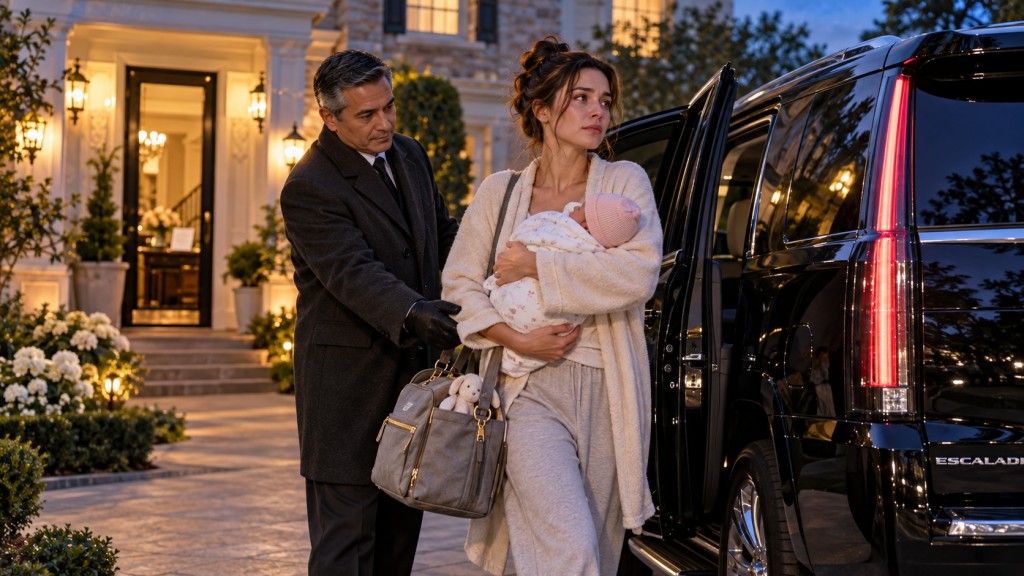
The black Escalade did not save me.
My father’s money did not save me.
The townhouse did not save me.
They helped.
That distinction matters.
What saved me was believing I was allowed to use the help.
For years I had thought independence meant refusing every hand until I could no longer stand.
Now I know better.
Sometimes independence is choosing the hand.
That night, I chose Dad’s.
Later, I chose my lawyer’s.
My doctor’s.
My therapist’s.
Roland’s, when it concerned Wren.
David’s, when I was ready.
And sometimes no one’s.
Choice.
Again and again.
That was the real inheritance.
There is one photograph from Wren’s first week that I keep framed.
Not the hospital picture.
Not Roland holding her.
Not Dad.
It was taken the morning after I arrived at the Caldwell house.
I am sitting in my childhood bedroom.
Hair unwashed.
Face swollen.
Hospital bracelet still on.
Wren asleep against my chest.
The brass townhouse key lies on the blanket beside us.
I look exhausted.
Nothing glamorous.
Nothing triumphant.
Dad took the picture without my noticing.
On the back, years later, he wrote:
The day my daughter remembered she could come home without moving backward.
That sentence made me cry harder than almost anything he ever gave me.
Because that was exactly what happened.
I went home.
Not to become Nathaniel Caldwell’s little girl again.
To rest long enough to become myself.
Then I left that house too.
By choice.
And built another.
Today, the brass key hangs beside my front door.
David once asked why I kept an old key after changing the townhouse locks years earlier.
I told him:
“Because it opened more than the door.”
He called that sentimental.
I accused him of having no soul.
Normal marriage.
Good.
Sometimes when I pass it, I remember Roland’s mother’s text.
He deserves one peaceful night away from you.
She intended those words to put me in my place.
In a strange way, they did.
Just not the place she imagined.
They put me in the car.
Through the gates.
Into the room my father had prepared.
Then eventually into a life where no one’s peace required my disappearance.
And that is the life I kept.
THE END STORIES! THANK YOU FOR READING GOOD LUCK !❤️
Related Posts