➡️ PART 3 ENDING PART➡️
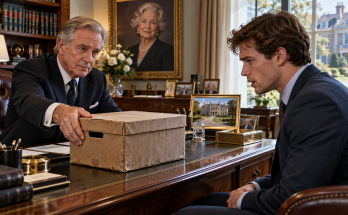
The man who stepped out of the black SUV was Richard Price.
Caleb’s father.
Everybody on our street knew Richard.
He owned two construction companies, a commercial landscaping business, and a chain of storage facilities on the north side of town.
He donated to school fundraisers.
His name appeared on the bronze plaque outside the community center.
People shook his hand differently than they shook everyone else’s.
A little longer.
A little more carefully.
Caleb turned toward him.
“Dad.”
Richard did not answer.
He held the second envelope in one hand.
His face was difficult to read.
Caleb pointed toward me.
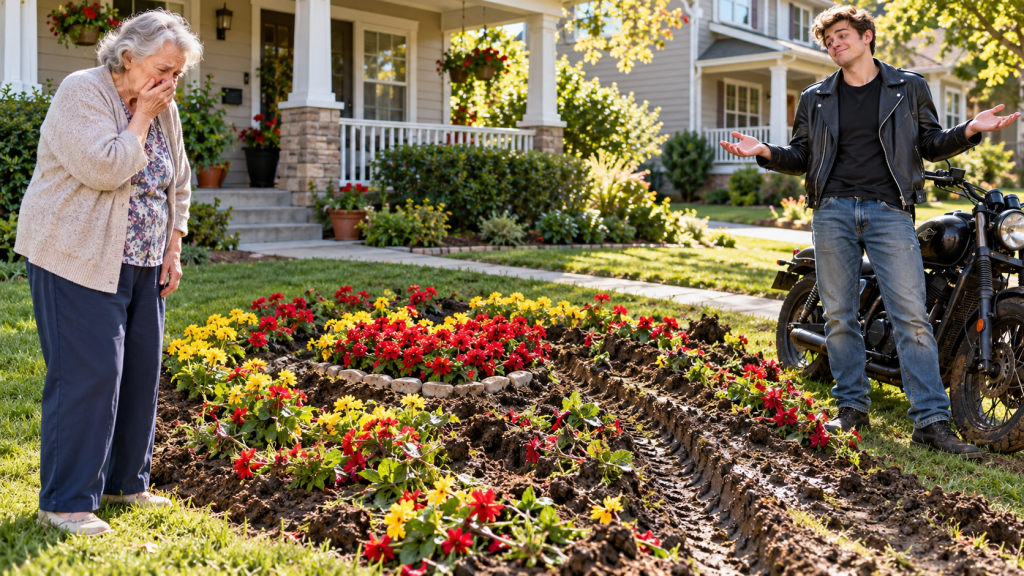
“She called the cops because I went over some flowers.”
Richard looked at the ruined garden.
Then he looked at the muddy tracks across my lawn.
Then at the motorcycle.
Finally, he looked at his son.
“Did you?”
Caleb shrugged.
“It was an accident.”
I almost spoke.
Richard held up one finger.
Not toward me.
Toward Caleb.
“Was it an accident?”
Caleb’s jaw tightened.
“I cut across the lawn.”
“Why?”
“Because I didn’t feel like going around.”
Richard stared at him.
“And the flowers?”
“I didn’t see them until I was already—”
“That’s not what the video shows.”
Caleb stopped.
So did I.
Richard lifted the envelope.
“Mine includes still photographs.”
Caleb’s face changed.
His father continued.
“You looked directly at the flower bed before you drove through it.”
Silence.
Caleb glanced at me.
Then toward the house four doors down where retired Captain Frank Nolan lived.
“You people are insane.”
Richard’s voice sharpened.
“No.”
Caleb turned.
“Dad—”
“Do not.”
That was the first time I saw fear replace arrogance completely.
Not fear of police.
Fear of his father.
Richard walked toward the motorcycle.
He circled it once.
Then extended his hand.
“Keys.”
Caleb laughed.
“You’re serious?”
“Keys.”
“It’s my bike.”
Richard looked at him.
“The title says Price Construction.”
Caleb went still.
Interesting.
The motorcycle was not his at all.
Richard held out his hand again.
“Keys.”
Caleb’s cheeks flushed.
“You gave it to me.”
“I let you use it.”
“For graduation.”
“You didn’t graduate.”
That sentence landed like a plate breaking.
I looked away instinctively.
Caleb’s face turned red.
“Really?”
he whispered.
“You’re doing this here?”
Richard’s jaw tightened.
“You were comfortable humiliating Mrs. Sloan in her own yard.”
My name.
Margaret Sloan.
I had not realized until that moment that Richard knew it.
Caleb pulled the keys from his pocket and slapped them into his father’s palm.
Richard caught them.
Then said:
“Go inside.”
Caleb laughed bitterly.
“You can’t order me around.”
“You are twenty-two years old, living in my house, driving my company’s motorcycle, using insurance I pay for.”
His voice remained calm.
“That gives you several options.”
“None of them involve standing on Mrs. Sloan’s lawn arguing with an incident report in your hand.”
Caleb’s face twisted.
Then he turned and walked toward their house.
At the edge of my lawn, he looked back at me.
Not smug now.
Angry.
That almost felt worse.
Because arrogance can become resentment very quickly when consequences arrive.
Richard waited until his son disappeared inside.
Then looked at me.
“I’m sorry.”
I folded my arms.
“For which part?”
He flinched.
Good.
Not because I wanted to hurt him.
Because apologies should survive questions.
“For the garden.”
he said.
“For Caleb’s behavior.”
“And probably for more things I don’t know about yet.”
That was more honest than I expected.
Then he lifted the envelope.
“I’d like to pay for everything.”
I knew that would come.
Not because Richard was evil.
Because money had become his family’s first language for inconvenience.
“I have an estimate scheduled.”
I said.
“Send it directly to me.”
“No.”
His eyebrows rose.
“I mean the restitution goes through the process that has already started.”
His expression hardened slightly.
“Mrs. Sloan, I’m not trying to avoid responsibility.”
“I didn’t say you were.”
“I can have my landscaping crew here this afternoon.”
“No.”
That surprised him.
“I own the best landscaping company in the county.”
“I know.”
“They can restore this exactly.”
“No, they can’t.”
He looked toward the flowers.
I continued.
“They can replace soil.”
“They can replace plants.”
“They cannot restore it exactly.”
Richard’s face softened.
“I understand.”
I looked at him.
“Do you?”
He hesitated.
Then:
“No.”
That answer made me trust him slightly more.
Across the street, Dottie Keller’s curtain moved.
She had watched everything the day before.
Then lowered her eyes when Caleb noticed.
I had been angry with her.
Not as angry as I was with him.
Still.
Angry.
Now she stood behind the glass again.
Richard followed my gaze.
Something in his face changed.
“Did people see?”
“Yes.”
“And no one said anything?”
“Not yesterday.”
He looked toward his own house.
“I see.”
I almost said:
Do you?
But did not.
Some realizations need quiet.
Richard looked at the damaged garden one last time.
Then walked home carrying his son’s motorcycle keys.
The bike remained beside the curb.
Silent.
For the first time all summer.
Frank Nolan came over fifteen minutes later.
He was seventy-four and had spent thirty-seven years in law enforcement before retiring to grow tomatoes, complain about his knees, and watch the street with the observational intensity of a man who had once been paid to notice things.
“You all right?”
he asked.
“I’m fine.”
“That means no.”
“I’m seventy-one.”
“It means no in every generation.”
He crouched near the flower bed.
Slowly.
His knees complained audibly.
“You got photographs before touching anything yesterday?”
“Yes.”
“Good.”
“You told me to.”
“Still good.”
Frank had been the one call I made.
Not because I expected favors.
I had known him twelve years.
He had never once offered one.
When I called and told him what happened, he said:
“First, take pictures.”
Then:
“Second, do not argue with that boy again.”
Then he walked over, checked the camera mounted above his garage, and found that it covered enough of my front yard to show the entire thing.
Caleb entering the grass.
Looking toward the flower bed.
Accelerating.
Mud.
Broken stems.
Me coming outside.
Even his shrug.
No sound.
But attitude does not always require audio.
Frank helped me make the report through normal channels.
No shortcuts.
No threatening phone call from an old captain.
Just evidence.
A statement.
A witness.
A process.
“You know Richard offered to pay.”
I said.
Frank snorted.
“Of course he did.”
“He seemed sincere.”
“He probably is.”
Frank straightened painfully.
“Being sincere and being part of the problem can happen at the same time.”
I looked toward the Price house.
“You think Richard is the problem?”
Frank sighed.
“I think Richard has spent twenty-two years loving that boy by removing consequences before they get close enough to teach him anything.”
That sentence stayed with me.
By noon, Dottie crossed the street.
She carried banana bread.
Guilt apparently bakes well.
“Margaret.”
“Dottie.”
She looked at the flowers.
Then at me.
“I’m sorry.”
I waited.
She held the loaf tighter.
“I should have said something yesterday.”
“Yes.”
Her face crumpled a little.
I immediately wanted to rescue her.
Old habit.
I didn’t.
Dottie continued.
“I saw the whole thing.”
“I know.”
“When he looked at me…”
She swallowed.
“I got scared.”
“Of Caleb?”
“Of his family.”
That mattered.
“Why?”
Dottie looked toward Richard’s house.
“My nephew worked for one of Richard’s companies.”
“Years ago.”
“There was a dispute.”
“Nothing terrible.”
“But lawyers got involved.”
“I suppose I’ve had it in my head ever since that you don’t make trouble for people with that much money.”
I looked at her.
“Did Richard threaten your nephew?”
“No.”
“Caleb?”
“No.”
“So you were afraid of what might happen.”
“Yes.”
She looked ashamed.
“I’m sorry.”
I accepted the banana bread.
Not the same thing as accepting the apology.
Then I said:
“Will you give a statement?”
Her eyes widened.
“You already have Frank’s video.”
“That isn’t what I asked.”
Dottie looked across the road.
Then nodded.
“Yes.”
Something small changed on our street that afternoon.
Not because one elderly woman suddenly became brave.
Because another stopped pretending fear had made her blind.
Over the next week, something unexpected happened.
People started talking.
Not gossip.
At first.
Statements.
Mr. Carmichael at the end of the block had photographs of motorcycle tracks through his side lawn from three weeks earlier.
He had never reported it.
The Petersons had a damaged sprinkler head after Caleb cut across the edge of their property.
They had replaced it themselves.
A mother around the corner said Caleb had nearly hit her eight-year-old while racing through the intersection.
No collision.
No citation.
She had called Richard directly.
Richard apologized.
Then sent a gift basket.
A gift basket.
When Frank told me that, I almost laughed.
“What was in it?”
“Cheese.”
“That seems appropriate.”
Frank stared.
“Why?”
“I don’t know.”
We laughed.
But underneath the humor was something uncomfortable.
Every incident had been small enough to explain away.
A lawn.
A sprinkler.
Noise.
A blocked driveway.
Near miss.
Nothing catastrophic.
So people absorbed it.
Richard apologized.
Paid.
Repaired.
Smoothed.
Caleb learned something from each incident.
Unfortunately, it was the wrong lesson.
Problems disappeared.
Not behavior.
I did not begin a neighborhood campaign.
That is important.
I did not march door to door collecting accusations against Caleb Price.
I did not want his life destroyed because he ruined my garden.
I wanted one thing:
For what happened on my property to be treated as real simply because it belonged to me.
Other people chose what to do with their own experiences.
Some reported.
Some didn’t.
That was theirs.
Three days after the incident, Richard returned.
Alone.
No SUV.
He walked.
That surprised me.
I was in the flower bed removing plants that could not be saved.
He stopped at the sidewalk.
“May I come onto the lawn?”
The question almost hurt.
Permission.
Small word.
Huge difference.
“Yes.”
He stepped carefully around the damaged soil.
He held no check.
Good.
“I spoke to my son.”
“I assumed.”
“He says you’re trying to ruin his future.”
I sat back on my heels.
“And what do you say?”
Richard sighed.
“I told him his future should be sturdy enough to survive an incident report.”
I almost smiled.
He looked at the bed.
“What were these?”
“Zinnias.”
“Marigolds.”
“A few red salvias near the back.”
“Same every year?”
“Yes.”
“For your husband.”
I nodded.
Richard crouched.
His knees seemed better than Frank’s.
Money, apparently, buys cartilage.
“What was his name?”
“Henry.”
Richard looked at me.
“I’m sorry about Henry.”
“Thank you.”
“How long?”
“Six years.”
His face softened.
“I lost my wife when Caleb was twelve.”
That surprised me.
I knew Richard was widowed.
I had not known when.
“Cancer?”
I asked.
He nodded.
“Fast.”
“I’m sorry.”
He looked toward his house.
“Caleb changed after that.”
There it was.
The beginning of an excuse.
I felt myself harden.
Richard noticed.
“I’m not excusing him.”
he said quickly.
“Good.”
“I’m explaining me.”
That made me listen.
He rubbed soil between his fingers.
“After Melissa died, Caleb was angry at everything.”
“Teachers.”
“Coaches.”
“Me.”
“Himself.”
“He got into fights.”
“Broke things.”
“I kept thinking he had already lost enough.”
“So every time there was a consequence…”
“You removed it.”
“Yes.”
His voice was quiet.
“I called principals.”
“Paid damages.”
“Found another program.”
“Another school.”
“Another opportunity.”
“When he crashed his first car, I bought another one because I told myself taking transportation away would interfere with college.”
I looked toward the motorcycle.
It was gone now.
Probably stored in Richard’s garage.
“The bike?”
Richard laughed without humor.
“He wanted it after his junior year.”
“He had done poorly.”
“I said if he brought his grades up, I’d get it.”
“Did he?”
“No.”
“You bought it anyway.”
“Yes.”
“Why?”
Richard looked ashamed.
“Because he was unhappy.”
There it was.
The mistake parents make out of love.
Treating unhappiness as an emergency.
Richard continued.
“He came home from college three weeks ago.”
“You said graduation yesterday.”
“He was supposed to graduate in May.”
“What happened?”
“He was suspended.”
I stared.
“Academic?”
“No.”
“Conduct.”
Richard looked toward the street.
“There was drinking.”
“Property damage.”
“No one hurt.”
“His mother’s death doesn’t explain that at twenty-two.”
“No.”
Richard whispered.
“It explains why I kept teaching him consequences were optional.”
We sat in silence beside the ruined flowers.
Then he said:
“I owe the neighborhood an apology.”
“Maybe.”
“And you.”
“You already apologized.”
“No.”
He looked at me.
“I said I was sorry for what Caleb did.”
“I have not apologized for all the times I made his behavior somebody else’s inconvenience to carry.”
That was different.
I nodded.
“Then apologize by stopping.”
Richard looked toward his house.
“I am.”
The city attorney’s office contacted me the following week.
Nothing dramatic.
No prison.
No television courtroom.
The video showed conduct the city believed could support property-damage and traffic-related charges.
Caleb had no adult criminal record.
Important.
His prior school conduct was not the same thing.
The prosecutor explained several possible outcomes.
Restitution.
Fines.
Driving consequences depending on the traffic citation.
Community service.
A diversionary or restorative arrangement if appropriate and if everyone agreed.
I listened.
Then said:
“I do not want a twenty-two-year-old’s life destroyed over flowers.”
The prosecutor nodded.
“I understand.”
“But I do not want this dismissed because his father can write a check either.”
“I understand that too.”
“Do you?”
“Yes.”
She smiled faintly.
“Those are not contradictory positions.”
That sentence relieved me.
I had worried they were.
People often act as if accountability must be either nothing or destruction.
There is a large country between the two.
Caleb hired a lawyer.
Richard did not choose him.
That mattered too.
Caleb used money from an account his mother had left him.
His choice.
His cost.
According to Richard, it was the first bill in years his son had been required to pay for a problem he created.
Caleb hated everyone.
Especially me.
I knew because one afternoon I found a folded note in my mailbox.
Not a threat.
Worse in a different way.
I hope you’re happy.
No signature.
Didn’t need one.
I stared at the sentence.
Was I happy?
No.
My garden was still ruined.
Henry was still dead.
Caleb was angry.
The street was tense.
Nothing about this felt happy.
I turned the note over.
Blank.
Then walked across the street.
Not to Caleb’s house.
To Frank’s.
I showed him.
“Keep it.”
he said.
“Why?”
“Because if this escalates, documentation matters.”
“He didn’t threaten me.”
“No.”
Frank looked at the note.
“But emotional people sometimes revise history.”
I kept it.
Later, it became unnecessary.
I was glad.
The landscaping estimate came to $1,840.
More than the flowers.
Soil repair.
Edging.
Replacing damaged irrigation.
Replanting.
Labor.
Richard would have paid it before I finished reading.
The formal restitution process made Caleb responsible.
That mattered.
He could pay over time.
His lawyer asked whether I would accept a lower amount in exchange for quick resolution.
I said no.
Not because I wanted more money.
Because the estimate was real.
I did not inflate it.
I did not ask for sentimental value.
No court could price that anyway.
I asked for what it cost to restore the physical damage.
Nothing more.
Nothing less.
Henry’s memory was not for sale.
Then the prosecutor proposed a restorative conference.
Optional.
I nearly refused.
The idea of sitting across from Caleb while he explained that flowers grow back made my stomach hurt.
My advocate said:
“You can say no.”
That made saying yes possible.
Choice matters.
I agreed under conditions.
Richard would not speak for him.
Caleb’s lawyer could be present.
No private deal.
No pressure to forgive.
No requirement that I accept an apology.
The prosecutor agreed.
So did Caleb.
Reluctantly, I later learned.
The meeting took place in a plain conference room.
Nothing cinematic.
A round table.
Plastic water bottles.
A box of tissues nobody wanted to acknowledge.
Caleb sat across from me.
No leather jacket.
No helmet.
No smirk.
Just a twenty-two-year-old man in a gray sweater who suddenly looked younger than I remembered.
Richard sat near the wall.
Silent.
His promise.
The facilitator began.
Then asked Caleb to describe what happened.
He said:
“I drove across Mrs. Sloan’s lawn.”
“And?”
“I damaged the flower bed.”
“And?”
Caleb looked irritated.
“I shouldn’t have.”
I waited.
The facilitator did too.
Silence made him uncomfortable.
Good.
Then:
“I knew the flowers were there.”
There.
Truth.
“Why did you go through them?”
Caleb looked down.
“Because Derek dared me.”
I blinked.
“What?”
He rubbed both hands together.
“A friend.”
“We were riding.”
“He said I wouldn’t cut across the yard because everybody knew people on this street complained about me.”
My chest tightened.
“So you did it because someone dared you?”
Caleb’s face reddened.
“Yes.”
“Were you filming?”
Silence.
The facilitator leaned forward.
“Caleb?”
“Yes.”
My anger sharpened.
“There’s a video?”
“It was on Derek’s phone.”
“Where?”
“Deleted.”
His lawyer added quietly:
“A copy was preserved before deletion.”
Of course.
Apparently one of the friends had posted part of it to a private social account.
Someone saved it.
The clip showed Caleb laughing before turning onto my grass.
That explained why the city attorney had sounded more certain than I expected.
I stared at him.
“You didn’t just take a shortcut.”
“No.”
“You used my property as a joke.”
He swallowed.
“Yes.”
“And when I told you my husband planted the garden?”
Caleb’s face changed.
“I thought you were trying to guilt me.”
“Was I?”
“No.”
His voice was smaller.
“What did you think when you said they were just flowers?”
He looked away.
“I wanted you to stop talking.”
There.
Not evil.
Worse in an ordinary way.
He had not believed flowers were meaningless.
He had simply decided my meaning was inconvenient.
The facilitator asked if I wanted to explain the garden.
At first I thought:
He already knows.
Then I realized he knew one sentence.
My husband planted it.
That was not the same as knowing.
So I told him about Henry.
We moved into the house in 1997.
The front yard was bare except for one dying shrub and grass that surrendered every July.
Henry decided a week before our tenth anniversary that I needed “something alive to complain about.”
He dug the bed himself.
Badly.
The first version was crooked.
He planted red and yellow because those were the colors in the bouquet he had carried on our first date.
Not our anniversary.
I had simplified that over the years.
Memory edits.
The first summer, rabbits ate half the flowers.
Henry declared war.
Built a fence so ugly I made him remove it.
The next year, he changed the pattern.
By year five, the arrangement became what I repeated afterward.
Red in the back.
Yellow along the front.
Small curve on the left where the soil stayed wetter.
For nearly two decades, we planted it together.
Then Henry got sick.
Pancreatic cancer.
Fast.
Cruel.
His last spring, he could not kneel.
He sat in a folding chair while I planted.
He kept correcting me.
“Too close.”
“Too deep.”
“Margaret, that line is crooked.”
I finally threw a gardening glove at him.
He laughed until coughing made him stop.
I had forgotten that part until I said it aloud.
Caleb did not look at me.
I continued.
“Two weeks before he died, I told him I would keep the garden exactly the same.”
Henry said:
“Don’t.”
I stopped.
Even the facilitator looked surprised.
Because I had never told that part.
Perhaps I had barely admitted it to myself.
Henry had looked toward the flowers and said:
“Gardens aren’t photographs, Maggie.”
I had gotten angry.
“I’m trying to tell you I’ll take care of it.”
He reached for my hand.
“I know.”
Then:
“Just don’t spend the rest of your life proving I was here.”
I cried.
Right there in the conference room.
Not because of Caleb.
Because I could hear Henry again.
For six years, I had kept the garden exact.
Same colors.
Same arrangement.
Same border.
I called it devotion.
Maybe part of it was fear.
If I changed the pattern, perhaps I was admitting the life we shared was becoming history.
I looked at Caleb.
“So no.”
I said.
“The flowers themselves were not priceless.”
“You were right about one thing.”
His eyes lifted.
“They can grow back.”
His face crumpled slightly.
“But when you said it, you meant nothing was lost because something could be replaced.”
“That’s not the same thing.”
Caleb whispered:
“I know.”
For the first time, I believed he might.
Then he apologized.
Not beautifully.
Real apologies are often clumsy.
“I’m sorry I drove through it.”
He swallowed.
“I’m sorry I laughed.”
“I’m sorry I thought because people were scared to say anything, that meant everybody was okay with me.”
Richard looked down.
Caleb continued.
“My dad always fixed stuff.”
Richard’s face tightened.
“I thought that was what money was for.”
I looked at Richard.
He accepted the sentence without defending himself.
Good.
Caleb said:
“I’m not blaming him.”
He looked toward his father.
Then back at me.
“I knew what I was doing.”
That mattered.
He continued.
“I was angry about college.”
“About being home.”
“About everybody knowing I got suspended.”
“I was acting like…”
He stopped.
“Like what?”
I asked.
He gave a humorless laugh.
“Like if I was the biggest problem in the room, nobody could ask why I was failing.”
That was the first moment I saw not a reckless boy or rich man’s son.
Just a frightened young adult.
Still responsible.
Still capable of hurting people.
Human.
I knew something about hiding grief inside bad behavior.
Maybe everyone does by seventy-one.
The final agreement was not mine alone to dictate.
The prosecutor handled the legal structure.
Caleb accepted responsibility.
Paid restitution.
Completed a driving-safety program.
Lost use of the company motorcycle permanently because Richard sold it.
Some license consequences followed the traffic side of the case.
And he agreed to a substantial number of community-service hours.
His lawyer suggested a food bank.
The facilitator asked whether I had preferences.
I surprised myself.
“Not my garden.”
Caleb looked up.
I continued.
“I don’t want service that requires me to supervise him.”
Fair.
They agreed.
He completed most of his hours with the city parks department and a community garden program.
I found the irony almost offensive.
Then funny.
Life has no subtlety.
Richard sold the motorcycle.
Caleb claimed it was worth far more than the restitution.
Richard told him:
“That is not the point.”
The proceeds went back to the company because the company owned it.
Caleb had to pay restitution from his own savings and wages.
That mattered more.
He got a summer job.
Not at Richard’s company.
His father refused.
“Why?”
I asked Richard when he told me months later.
“Because working for me would still mean I could soften things.”
So Caleb got a job at a warehouse across town.
Early shifts.
Hot.
Not glamorous.
He lasted.
That surprised everyone.
Perhaps especially him.
The garden was repaired by a local nursery.
Not Richard’s company.
My choice.
A woman named Teresa ran the nursery.
She came with old photographs of Henry’s pattern that I had collected from family albums.
We stood in the yard.
“Exact restoration?”
she asked.
I opened my mouth.
Yes.
Then heard Henry.
Gardens aren’t photographs, Maggie.
I looked at the bare patch.
“No.”
Teresa waited.
“I want the same colors.”
“Red and yellow.”
“Yes.”
“But change the curve.”
She smiled.
“How?”
I looked toward the porch.
Henry’s old chair was gone.
I had thrown it out after it rusted.
Still, I could see him there.
“Make it wider.”
I said.
“And put something white near the middle.”
“White?”
“Yes.”
“What kind?”
Teresa suggested white alyssum.
Small.
Soft.
Not dramatic.
I nodded.
“Do that.”
Why white?
No grand symbolic reason.
Maybe because Henry never chose it.
Maybe because I did.
That was enough.
The restored garden did not look the same.
At first, I hated it.
I stood on the porch that first evening staring at the white flowers like intruders.
Then the sunset hit them.
They glowed.
I cried.
“Show-off.”
I whispered to Henry.
The garden had changed.
He had not vanished.
That was the first gift hidden inside the damage.
I would never thank Caleb for destroying it.
Important.
Suffering does not become good because something later grows around it.
But once damage exists, we are allowed to build something different instead of worshipping the exact shape we lost.
Caleb stayed away.
For almost six months.
Good.
I did not need a redemption montage in my front yard.
He completed his requirements.
Went back to college the following semester after his suspension ended.
Different housing.
No motorcycle.
Richard told me Caleb paid his own portion of tuition that year from savings and work.
I said:
“That is none of my business.”
Richard smiled.
“You’re right.”
Progress for him too.
Richard changed in smaller ways.
When Caleb got a parking ticket, Richard did not pay it.
This became neighborhood news because apparently we were all pathetic.
When someone complained about construction debris from one of Richard’s companies, he sent a crew to clean it.
Normal.
No gift basket.
Dottie said:
“I’m almost disappointed.”
“Were you hoping for cheese?”
“Yes.”
We laughed.
Richard also attended a neighborhood association meeting.
Not as a sponsor.
Not at the front.
He sat in the back.
When traffic safety came up, he stood.
“I have contributed to the idea that my family gets special treatment.”
The room went still.
I wanted to disappear on his behalf.
He continued.
“I thought solving problems quickly was responsible.”
“Sometimes it was.”
“Sometimes I paid for damage without requiring my son to understand what he had done.”
“That was not responsible.”
No speech longer than that.
He sat.
No applause.
Good.
Accountability does not need applause.
It needs repetition.
A year after the garden was destroyed, I found an envelope on my porch.
I froze.
Then saw Caleb’s handwriting.
Inside was a photograph.
A community garden.
Raised beds.
Children painting signs.
On the back:
Mrs. Sloan, I did my final service hours here. I know this doesn’t replace anything. I just thought you might like to see something I didn’t ruin. — Caleb
I laughed.
Then cried.
Then became irritated with myself for crying.
I put the photograph in a kitchen drawer.
Not framed.
Not shrine.
Just kept.
That summer, Caleb came home from college again.
The whole neighborhood noticed.
Of course.
But there was no engine announcing him.
He drove an old silver sedan.
Quiet enough that Dottie complained she could no longer tell when he arrived.
One afternoon, I was weeding near the yellow border when he stopped at the sidewalk.
He did not step onto the lawn.
“Mrs. Sloan?”
I looked up.
“Caleb.”
“Can I come over?”
There was the question.
Again.
Permission.
“Yes.”
He walked carefully.
Not theatrically.
Just aware.
He stood beside the bed.
The flowers were taller now.
White alyssum spilling over the border.
He noticed.
“You changed it.”
“Yes.”
His face tightened.
“Because of me?”
I considered.
“After you.”
Different.
He understood.
“I’m sorry.”
“You already apologized.”
“I know.”
“Then don’t make me keep accepting it.”
He smiled.
Small.
Fair.
Then he held out a paper packet.
Seeds.
Red and yellow zinnias.
Cheap.
Maybe three dollars.
“I didn’t know if this was stupid.”
“It might be.”
He laughed.
Then:
“The garden place I volunteered at had extras.”
I took them.
“Thank you.”
He looked toward the flowers.
“Your husband would’ve hated me.”
“Probably.”
Caleb’s face fell.
I continued.
“For about a month.”
He looked at me.
“Then he would’ve tried to feed you.”
“Why?”
“Henry thought food solved character defects.”
Caleb laughed.
“So did it?”
“Not once.”
We stood beside the garden.
Not friends.
Not family.
Something simpler.
Two people connected by a bad afternoon and what came after.
Caleb graduated the following year.
Really graduated.
Richard did not buy him another motorcycle.
I know because Dottie asked.
Neighborhood intelligence remained relentless.
Caleb got a job two states away.
Before leaving, he came by one final time.
No gift.
Good.
He stood at the porch.
“I wanted to say goodbye.”
“Goodbye.”
He laughed.
“You make emotional moments difficult.”
“I’m seventy-three now.”
“I’ve earned efficiency.”
He nodded.
Then looked toward the flower bed.
“Can I ask you something?”
“Depends.”
“When you told me they weren’t just flowers…”
He paused.
“Why didn’t you yell?”
That surprised me.
“I wanted to.”
“Why didn’t you?”
I thought.
“My husband yelled enough for both of us.”
Caleb smiled.
Then I became serious.
“Because I knew you wanted a fight.”
His eyebrows rose.
“You did?”
“Yes.”
“You were standing there with the engine running and your friend watching.”
“You wanted me to scream.”
“Then you could call me crazy.”
“Make it funny.”
“Tell the story later.”
Caleb looked down.
“That’s true.”
“I was not going to give you the scene you wanted.”
“So you called the police.”
“Yes.”
He laughed.
“That was worse.”
“Only because you were used to arguments disappearing.”
He nodded.
Then:
“I used to think everybody was scared of my dad.”
“Some people were.”
“He never asked them to be.”
“No.”
Caleb stared at the street.
“I think I liked it anyway.”
“I know.”
He looked at me.
“How?”
“You smiled when Dottie went inside.”
His face flushed.
“You saw that?”
“Yes.”
Caleb was quiet.
Then:
“That’s the part I hate most.”
I understood.
Sometimes the worst memory is not what we damaged.
It is the moment we enjoyed being someone who could.
Good that he hated it.
Better that he did not have to hate himself forever.
I said:
“Then don’t be that person again.”
He nodded.
“I’m trying.”
“That is more useful than hating yourself.”
He smiled sadly.
Then left.
Richard remained my neighbor.
Without Caleb in the house, he became quieter.
We never became close.
We did become friendly.
He shoveled my walkway once.
I brought him soup when he had knee surgery.
Normal neighbor things.
No envelopes.
No power.
No moral debts.
Once, sitting on my porch, he said:
“I spent years thinking good parenting meant making sure my kid never fell too far.”
I looked at him.
“And?”
“I never noticed I was removing the ground.”
That was a good line.
I told him so.
He looked offended.
“It’s not a line.”
“It is now.”
We laughed.
Then he said:
“Do you blame me?”
“For the garden?”
“For Caleb.”
I took my time.
“Some.”
He nodded.
Fair.
“I blame you for teaching him that money could soften consequences.”
“I blame him for what he chose to do with that lesson.”
“And I blame the rest of us a little for treating your reputation like a law nobody could challenge.”
Richard looked toward Dottie’s house.
“Even you?”
“Before the garden, yes.”
“You never complained.”
“Exactly.”
We sat quietly.
Then:
“Funny.”
he said.
“What?”
“My money made people think I was more powerful than I actually was.”
“And that belief made Caleb think he was powerful too.”
“Yes.”
I looked at him.
“Money is strange.”
Richard laughed.
“You sound like someone who never had enough of it.”
“I had Henry.”
He smiled.
“Fair.”
The second summer after the incident, the white alyssum reseeded itself.
I had not planned that.
It appeared beyond the border.
Little white flowers pushing into the grass.
For thirty years, I would have pulled them.
Henry liked lines.
The garden had a pattern.
Order.
But I left them.
At first three.
Then eight.
Then a small unruly patch.
Dottie came over.
“You know those escaped.”
“Yes.”
“You’re leaving them?”
“Yes.”
She looked concerned.
“Are you unwell?”
“Probably.”
We laughed.
The garden became less exact.
More alive.
I began planting different varieties.
A deeper red.
A pale yellow.
One year, orange appeared because the nursery mislabeled a tray.
Henry would have complained.
I kept them.
Memory survived orange.
Miracle.
I started telling people the truth about the garden when they asked.
Not:
My husband planted this exact arrangement, and I preserved it perfectly.
Instead:
“My husband started it.”
Important difference.
Started.
Not froze.
Henry built the first border.
Then thirty years happened.
Rabbits.
Droughts.
Cancer.
Widowhood.
A motorcycle.
New soil.
White flowers.
Me.
Gardens are not photographs.
He had been right.
I hated that.
Years later, Caleb sent me a wedding invitation.
I stared at it.
Dottie nearly fell out of her chair when I told her.
“Are you going?”
“No.”
“Why not?”
“He lives two states away.”
“So?”
“I am seventy-six.”
“You went to Florida last year.”
“That had a beach.”
“Fair.”
I sent a card.
No money.
Seeds.
Red and yellow zinnias.
Inside I wrote:
Things grow better when you remember they belong somewhere before you arrive. Congratulations. — Margaret
Then worried it sounded threatening.
Richard laughed for ten minutes.
Caleb apparently loved it.
A year after that, he visited with his wife.
Her name was Sofia.
She knew the story.
Unfortunately.
She looked at the flower bed.
“So this is the famous garden.”
I stared at Caleb.
He covered his face.
“I told her.”
“Clearly.”
Sofia smiled.
“He tells people you scared him straight.”
“No.”
I said.
“Consequences scared him straight.”
Caleb nodded.
“She’s very precise.”
“She’s a nightmare.”
Sofia laughed.
Good.
Then she crouched near the red flowers.
“They’re beautiful.”
“Thank you.”
Caleb looked at me.
“Still just flowers?”
I raised one eyebrow.
He smiled.
“Sorry.”
Then, more seriously:
“I know better.”
That was enough.
Richard moved away eventually.
Downsized.
Too much house.
He sold to a young family with three children.
Before leaving, he came across the street.
“I wanted to thank you.”
“For what?”
He looked offended.
“Can old people not accept gratitude?”
“I’m older than you.”
“By two years.”
“Wisdom accumulates quickly.”
He laughed.
Then:
“For not trying to destroy him.”
I frowned.
“That was never mine to do.”
“I know.”
He looked toward my garden.
“You could have pushed harder.”
“For what?”
“More charges.”
“Publicity.”
“Humiliation.”
I shook my head.
“I wanted what happened recognized.”
“Not multiplied.”
Richard nodded.
“I don’t think I understood that at first.”
“Most people confuse justice with making the other person hurt as much as they hurt you.”
“And you don’t?”
“I did for about twenty minutes.”
He laughed.
Then I said:
“Henry used to tell me revenge is exhausting because you have to keep checking whether the other person is miserable enough.”
Richard smiled.
“Smart man.”
“Sometimes.”
We hugged.
Awkwardly.
Then he moved away.
Frank Nolan died at eighty-one.
Heart attack.
Fast.
His daughter gave me a copy of the original security video because she found it among files he had saved for reasons no one could explain.
I watched it once.
Terrible decision.
There was the motorcycle.
The lawn.
The flower bed.
Mud flying.
Me coming outside.
Caleb shrugging.
Dottie retreating.
No sound.
Still painful.
Then the camera angle caught something I had forgotten.
After Caleb rode away, I stood alone beside the garden.
For almost thirty seconds, I did nothing.
Then I bent down.
Picked up one broken flower.
Held it.
The woman on the video looked older than I remembered being.
Small.
Still.
I wanted to hug her.
Then she walked inside.
To make the call.
I deleted the recording.
I did not need evidence anymore.
Dottie asked why.
“History.”
I said.
She nodded toward the garden.
“That’s history too.”
“Yes.”
“But I can stand inside this version.”
She understood.
I am eighty now.
The garden no longer resembles Henry’s original design.
Not exactly.
The red and yellow remain.
They always will while I am here.
The white flowers spread wherever they please.
I have lavender now.
A small rose bush near the porch.
One orange section Henry would consider a personal insult.
I sit outside most mornings.
Coffee.
Knees covered with a blanket when it is cold.
Sometimes people walking by stop to look.
Children pick flowers if they ask.
That word again.
Ask.
I almost always say yes.
A few months ago, a boy from down the street kicked a soccer ball into the garden.
It broke two stems.
He came running onto the lawn.
Then froze when he saw me.
“Mrs. Sloan, I’m sorry.”
Maybe I have a reputation now.
Terrible.
He looked terrified.
I walked over.
He pointed.
“It was an accident.”
I looked at the stems.
Then at him.
“Did you mean to?”
“No.”
“Can you help me stake this one?”
His shoulders dropped.
“Yes.”
We fixed what we could.
His ball had knocked petals everywhere.
He looked miserable.
“They’ll grow back.”
he whispered.
For one second, the whole past opened.
Motorcycle.
Mud.
Smirk.
Henry.
Court.
Seeds.
Then I smiled.
“Yes.”
I said.
“Some of them will.”
Different sentence now.
Different meaning.
The boy helped me.
Then asked before stepping through the bed to retrieve his ball.
I showed him where to walk.
Small things.
That is how communities change.
Not through one dramatic lesson.
Through repeated ordinary respect.
Caleb called me on my eightieth birthday.
I have no idea how he remembered.
Probably Richard.
He had a little boy by then.
Three years old.
Caleb said:
“He keeps digging up Sofia’s flowers.”
I laughed.
“Genetics.”
“That’s not funny.”
“Extremely.”
Then his voice softened.
“I told him they’re not his to dig up.”
I looked out at the garden.
“Good.”
“He doesn’t understand.”
“He’s three.”
“I know.”
“But I want him to.”
“He will.”
Caleb went quiet.
Then:
“Mrs. Sloan?”
“Yes?”
“I never thanked you.”
“For what?”
“For making me pay.”
My throat tightened.
“That is a strange birthday message.”
He laughed.
“I’m serious.”
“Your father could’ve paid it.”
“I know.”
“I wanted him to.”
“I know.”
“If he had…”
Caleb paused.
“I think I would’ve stayed exactly the same.”
I stared at the red flowers outside.
“You changed yourself.”
I said.
“Don’t give me too much credit.”
“Can I give you some?”
“Very little.”
He laughed.
“Fair.”
Then:
“Happy birthday.”
“Thank you.”
After we hung up, I cried.
Old women are allowed.
People still hear the story sometimes and say:
“I would’ve flattened his motorcycle.”
No.
That would have made a satisfying ten seconds and a terrible legal problem.
Others say:
“I would’ve poured sugar in the gas tank.”
Again, no.
Revenge makes good fantasies because fantasies do not send invoices.
What I did was less dramatic.
I took photographs.
Made a report.
Used evidence.
Asked for restitution.
Let a process do what anger could not.
That did not make me weak.
It also did not make me saintly.
I wanted to hurt Caleb when I saw that smirk.
I wanted him to understand loss immediately.
But you cannot teach respect by proving that whoever is angriest gets to destroy the other person’s property.
So I called someone who knew what procedure looked like.
Then I waited.
That was harder.
And better.
The little surprise beside Caleb’s motorcycle was only paper.
Photographs.
A report.
A notice.
Nothing damaged.
Nothing sabotaged.
Nothing threatening.
The power came from what the paper meant:
Someone saw.
Someone documented.
Someone would speak.
Someone had decided money and reputation were not the same as permission.
His expression disappeared because for the first time, a problem his father could easily pay for was being treated as something he had to answer for.
That was the surprise.
Not the envelope.
Accountability.
Richard once told me he hated that word.
“Why?”
I asked.
“Because everybody uses it when they want punishment.”
“Maybe.”
I said.
“But I think accountability is simpler.”
“How?”
“Your action belongs to you.”
He looked at me.
“And?”
“So does the repair.”
That became my definition.
Caleb drove through the garden.
The damage belonged to him.
But the garden afterward belonged to me.
I chose what grew there next.
That distinction gave me more peace than any court outcome.
Henry had planted red and yellow flowers because they reminded him of our first date.
For years, I repeated his pattern because I thought preserving the shape preserved the love.
Then a reckless boy destroyed the shape in less than ten seconds.
I thought the garden was gone.
It wasn’t.
The pattern was.
The flowers were.
The soil was torn.
But thirty years of mornings with Henry had never been inside those stems.
That realization hurt.
Then freed me.
Memory does not live in objects because objects never change.
Memory lives because we do.
We carry it differently at seventy-one than at forty.
Differently at eighty than at seventy-one.
The love changes shape.
It does not become less real.
The first summer after the garden was rebuilt, I stood beside the white flowers and apologized to Henry.
Out loud.
“I changed your pattern.”
A breeze moved through the leaves.
Nothing supernatural.
Just weather.
Still, I smiled.
“I know.”
I whispered.
“You told me to.”
Then:
“You could have been nicer about it.”
That also sounded like marriage.
Caleb had said:
“They’re just flowers.”
He was wrong.
Then he said:
“They’ll grow back.”
He was right.
But not in the way he meant.
They did not grow back because what happened did not matter.
They grew back because damage is not always the final author.
Some plants died.
Some roots survived.
Some were replaced.
Some new things appeared where I had never planned to put them.
That is not restoration.
It is continuation.
There is a difference.
I think that is what people misunderstand about forgiveness too.
I never told Caleb:
It’s okay.
It was not okay.
I did not erase restitution.
Did not ask the prosecutor to pretend nothing happened.
Did not tell the neighborhood they had overreacted.
I allowed consequences to remain.
Then I allowed him to become more than them.
Both mattered.
If forgiveness requires pretending the damage did not happen, I am not interested.
If it means refusing to chain a twenty-two-year-old forever to the worst ten seconds of his summer, then perhaps I forgave him.
Eventually.
Quietly.
Without ceremony.
The old garden existed because Henry loved me.
The new one exists because I still do.
That may sound selfish.
At eighty, I am comfortable with some selfishness.
I maintain it because I enjoy the color.
Because children stop to look.
Because bees come.
Because Dottie still crosses the street with banana bread when she feels guilty about nothing in particular.
Because Frank’s tomatoes are gone now, and I miss seeing him argue with squirrels.
Because Richard learned to let his son fall far enough to stand up on his own.
Because Caleb learned that a person does not become invisible simply because she is old, quiet, or afraid of your family’s name.
And because Henry was right.
Gardens are not photographs.
They are alive.
Alive things change.
One spring morning, decades after Henry first dug that crooked strip of earth, I planted the red and yellow zinnia seeds Caleb had given me.
Not all of them had remained viable.
Some did.
They bloomed beside the white alyssum.
Red.
Yellow.
White.
Old memory.
New consequence.
Something chosen by Henry.
Something brought by the boy who destroyed it.
Something chosen by me.
All growing in the same soil.
I stood there for a long time.
Then laughed.
Life is not subtle.
But sometimes it is beautiful anyway.
And for the first time since that motorcycle tore across my lawn, I understood that the real surprise waiting for Caleb the next morning had never been the envelope beside his bike.
It was the discovery that other people’s lives did not become small simply because he had failed to notice them.
Once he learned that, everything changed.
His father.
Our street.
Him.
Me.
Even the garden.
Especially the garden.
Because yes—
the flowers grew back.
Not the same ones.
Not in the same pattern.
And thank God for that.
THE END STORIES! THANK YOU FOR READING GOOD LUCK !❤️
Related Posts