➡️ PART 3 ENDING PART➡️
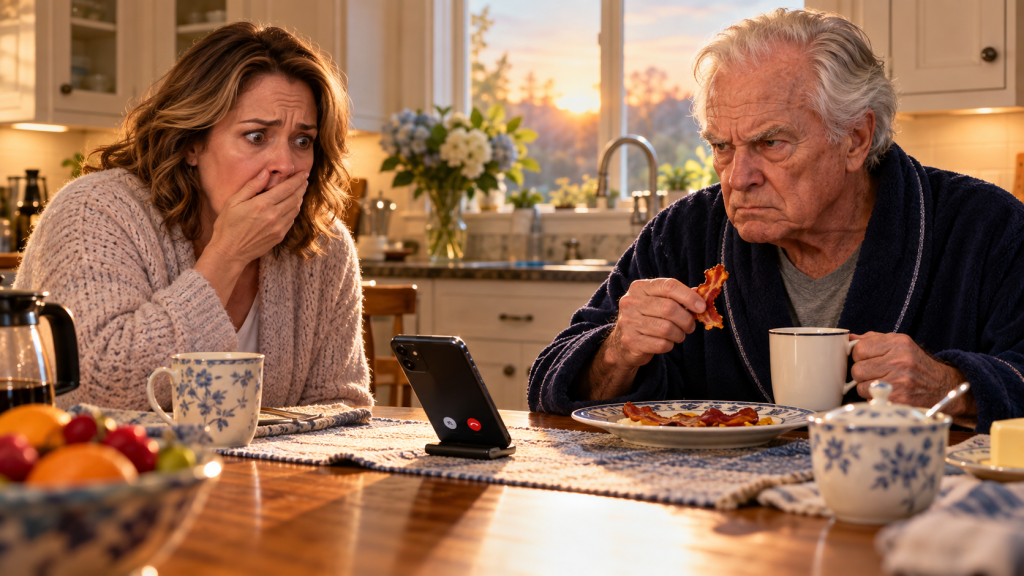
The pounding on Vanessa’s car window came through the speaker.
Then a man’s voice, muffled but firm.
“Ms. Cole? We need to discuss your father’s accounts.”
Dad looked at me.
For the first time that morning, something close to satisfaction touched his face.
Not happiness.
Not revenge.
Relief.
The kind that comes when a lie finally collides with a fact too solid to move.
On the phone, Vanessa whispered:
“What?”
Grant said something I couldn’t make out.
The man outside the car repeated himself.
“Ms. Vanessa Cole?”
Dad leaned toward the phone.
“Go ahead, sweetheart.”
Vanessa’s breathing sharpened.
“Dad, what did you do?”
Dad looked at the bacon on his plate.
Then at me.
Then back at the phone.
“I stayed alive.”
He ended the call.
For several seconds, neither of us moved.
Then Dad picked up the strip of bacon he had abandoned.
He looked at it.
Put it back down.
Apparently even bacon had limits.
I sat across from him.
“What happens now?”
Dad rubbed both hands over his face.
The fury disappeared.
Suddenly he looked seventy-nine.
Not the father who had just dismantled my sister’s fantasy with one phone call.
Just an old man in a navy robe who had learned that one of his children had lied about his death before breakfast.
“I don’t know.”
he said.
That frightened me more than the anger.
Dad always knew.
Or pretended to.
When Mom died, he knew which funeral home.
When the roof leaked, he knew which contractor.
When doctors changed medications, he carried a notebook and knew every dosage better than they did.
When I moved three states away at twenty-six, he knew exactly what it meant.
At least according to him.
“You’re leaving.”
he had said.
Not:
You got the job.
Not:
I’m proud of you.
Just:
You’re leaving.
For years afterward, Vanessa became the daughter who stayed.
I became the daughter who left.
Families love simple stories.
They require less maintenance than truth.
Now Dad stared at his breakfast and admitted he did not know what came next.
I reached across the table.
“Then we do the next thing.”
His eyes lifted.
“What’s that?”
“Call Samuel.”
Dad looked toward the clock.
6:51 a.m.
“Too early.”
“He’s an estate lawyer.”
“He chose this.”
Dad almost smiled.
I called.
Samuel Brooks answered on the fourth ring.
“Someone had better be dead.”
Dad looked at me.
I looked at him.
Then we both laughed.
Not because it was funny.
Because sometimes your body chooses laughter when the alternative is breaking something.
Samuel went silent.
“Natalie?”
“It’s me.”
“What happened?”
“Vanessa called.”
Dad leaned toward the phone.
“And announced my death.”
Samuel said nothing for a full five seconds.
Then:
“I’m going to need coffee.”
Dad muttered:
“Bring your own.”
Samuel ignored him.
“Start from the beginning.”
So I did.
The 6:30 call.
Harold supposedly finding Dad.
The claimed inheritance.
The locks.
The truck.
The accounts.
Grant laughing.
The statement that Dad knew who really loved him.
Dad interrupting.
Vanessa panicking.
The man at the car asking about the bank accounts.
Samuel listened without interrupting.
At the end, he sighed.
“This is worse than I expected.”
Dad’s jaw tightened.
“What did you expect?”
“That once the bank flagged the transactions, Vanessa and Grant might try to explain them.”
“They are apparently pursuing a more theatrical strategy.”
Dad stared at the phone.
“What happens at the bank?”
“Nothing happens without you.”
Samuel said.
“The fraud alert is active.”
“The old authority Vanessa had for bill-paying has been revoked.”
“The institution has instructions not to release information or funds without the new verification process.”
“What man was at her car?”
“I don’t know yet.”
“It could be bank security.”
“It could be an investigator connected to the report.”
“I’ll find out.”
Dad leaned back.
“I want to go home.”
“No.”
Samuel and I said it together.
Dad looked offended.
“It’s my house.”
“Yes.”
I said.
“Which is exactly why we are not driving six hours so you can walk into it angry and alone.”
“I am not angry.”
I raised an eyebrow.
Dad looked away.
Samuel said:
“Do not return until I’ve spoken with the bank, the local police department, and the locksmith.”
Dad frowned.
“Locksmith?”
“Vanessa said she was changing the locks.”
Dad’s mouth tightened.
“She wouldn’t.”
I said nothing.
Two days earlier, he would have said she wouldn’t take money either.
Samuel heard the silence.
“Exactly.”
he said.
There was a reason Dad was sitting in my kitchen that morning.
Vanessa did not know it.
Grant did not know it.
Until forty-eight hours earlier, neither had known Dad had discovered the missing money.
I had not known either.
Dad called me late Monday night.
Not crying.
My father did not cry easily.
He sounded embarrassed.
That was worse.
“Natalie.”
he said.
“I think something’s wrong with my bank account.”
I was standing in a grocery-store aisle holding a jar of spaghetti sauce.
“What happened?”
“I’m probably confused.”
Dad had never described himself that way.
My heart changed speed.
“What do you mean?”
“I found transfers.”
“What transfers?”
“I don’t know.”
That was the second sentence that frightened me.
Dad kept immaculate records.
He still balanced a paper checkbook.
In 2026.
The man distrusted autopay as a moral principle.
I abandoned the grocery cart beside canned tomatoes and drove home while he read me dates and amounts.
Four thousand.
Six thousand five hundred.
Two thousand eight hundred.
Then larger ones.
Twelve.
Fifteen.
Eleven.
Not all at once.
Over almost two years.
Money moving from an account Vanessa had access to while helping Dad manage bills after his shoulder surgery.
Some payments had descriptions that sounded ordinary.
Home repairs.
Medical reimbursement.
Insurance.
Household expenses.
Then Dad compared them with actual bills.
They did not match.
He had not noticed at first because Vanessa paid many legitimate expenses too.
Electricity.
Property taxes.
Roof work.
His supplemental health plan.
Dad had trusted her.
That was the first thing he kept saying.
“I trusted her.”
Not:
She stole.
Not:
Grant took it.
Just:
I trusted her.
By midnight, he had counted approximately ninety-four thousand dollars he could not explain.
“I’m coming.”
I said.
“No.”
“I’m coming.”
“It’s a six-hour drive.”
“I know how roads work.”
“Natalie.”
“Pack a bag.”
He hated that.
Good.
Sometimes children earn the right to be bossy.
I arrived before dawn.
Dad was waiting on his porch with one suitcase and a grocery bag full of financial statements.
I will never forget that bag.
The handles were stretched white from the weight.
A lifetime of trust reduced to paper.
We went to the bank first.
Dad asked questions.
The branch manager answered carefully.
Vanessa had been given limited access several years earlier to help with household payments when Dad’s shoulder surgery made driving and paperwork difficult.
Some transfers fell within the apparent authority she had.
Others did not.
Several went to an account connected with Grant.
Dad’s face went white.
The manager referred the matter to the fraud department.
Then Samuel.
Then another attorney who specialized in elder financial exploitation.
I hated that phrase.
Dad hated it more.
“I’m not helpless.”
he snapped.
“No one said you were.”
the attorney told him.
“Exploitation is about conduct.”
“Not intelligence.”
Dad stopped arguing.
Mostly.
By Tuesday afternoon, old permissions were revoked.
Accounts were restricted.
A new trust had been signed.
The house and truck were moved under its protection.
I became trustee.
Not owner.
That distinction mattered.
Dad remained beneficiary while alive.
The trust existed to make sure nobody could sell, mortgage, transfer, or “manage” major assets because he happened to be sick, tired, frightened, or temporarily unable to handle paperwork.
“Why Natalie?”
Samuel asked him directly while we sat in his office.
Dad did not answer immediately.
I assumed he would say:
Because Vanessa stole.
Instead:
“Because Natalie says no to me.”
I stared.
Samuel smiled.
Dad continued.
“Vanessa wants me happy.”
“Natalie wants me clear.”
That may have been the first compliment Dad ever gave me that sounded like criticism.
I kept it.
He spent Tuesday night at my house because Samuel advised him not to confront anyone until the bank reviewed the records.
Dad hated the idea.
Then slept eleven hours straight.
Wednesday morning he ate my bacon.
At 6:30, Vanessa killed him.
At least over the phone.
Harold Pike called at 7:20.
Before I could say hello, he shouted:
“Frank, are you dead?”
Dad grabbed the phone.
“Unfortunately not.”
Harold barked a laugh so loud I pulled the phone away.
Then his voice changed.
“Vanessa used my name?”
“Yes.”
“Said I found you?”
“Yes.”
“That girl has lost her mind.”
Dad said nothing.
Harold softened.
“You okay?”
“I don’t know.”
There it was again.
Harold did not joke after that.
He said:
“I’m coming over.”
Dad frowned.
“You’re four hours away.”
“Then I’ll be there in four hours.”
“You’re seventy-eight.”
“You’re dead.”
Dad laughed.
Real this time.
Harold did not come.
I stopped him.
But I loved him for trying.
By eight, we knew who had knocked on Vanessa’s car.
A bank security officer accompanied by a local detective.
Vanessa and Grant had gone to Dad’s bank branch that morning.
Before calling me.
That detail landed hard.
They had apparently arrived shortly after opening, expecting to meet with a banker about “Dad’s accounts.”
They had not presented a death certificate.
There was no forged document.
Thank God.
They did, however, tell the branch employee that Dad was “unavailable” and that they needed information urgently because of an estate issue.
The fraud flag triggered the security process.
The detective wanted to ask about prior transfers.
Vanessa had not been arrested.
Neither had Grant.
Not then.
They had been asked to come inside and speak.
Samuel advised Dad to say nothing publicly and let investigators work.
My father hated letting other people work.
This was the man who once followed a plumber into the crawlspace because he “wanted to see what ninety dollars an hour looked like.”
He spent the morning pacing.
At ten, he said:
“I want to go home.”
“No.”
At ten-thirty:
“We should leave.”
“No.”
At eleven:
“My medication is there.”
“You packed it.”
He glared.
At eleven-fifteen:
“I’m the father.”
I looked at him.
“You are seventy-nine.”
“And?”
“I am fifty-one.”
He stared.
Then:
“That makes me feel old.”
“Good.”
He sat down.
By noon, anger gave way to grief.
Dad went quiet at the kitchen table.
The same chair where he had been declared dead six hours earlier.
I made sandwiches.
He did not eat.
Finally he said:
“I did this.”
I looked at him.
“Did what?”
“Vanessa.”
“No.”
He shook his head.
“You don’t understand.”
“Then explain.”
Dad stared toward the window.
“After your mother died, you left.”
“I had already moved.”
“You know what I mean.”
I did.
Mom died nine years after I moved away.
For the first year, I flew home every six or seven weeks.
Called daily.
Handled insurance disputes from three states away.
Booked doctors.
Sent groceries.
Paid for someone to clear snow after Dad had a minor cardiac procedure because he refused to hire anybody himself.
Vanessa lived twenty minutes away.
She did the visible things.
Meals.
Laundry.
Appointments.
She deserved credit for them.
But somehow, over the years, physical proximity became morality.
Vanessa stayed.
Natalie left.
Dad continued.
“I used to tell her she was the one I could count on.”
My jaw tightened.
“I know.”
His eyes flicked toward me.
“You heard?”
“Many times.”
He swallowed.
“I told Grant the house would probably be theirs eventually.”
My stomach dropped.
“When?”
“Years ago.”
“You never told me that.”
“It wasn’t a promise.”
“Did Vanessa know that?”
Dad closed his eyes.
“Yes.”
There it was.
Not justification.
Context.
Dad continued.
“I said you had your career.”
“Your own house.”
“That you didn’t need anything.”
“And Vanessa was here.”
I stared at him.
“Need has nothing to do with ownership.”
“I know that now.”
I almost snapped that he should have known earlier.
Then stopped.
He already did.
That was the pain on his face.
Dad whispered:
“I made staying close sound like she was earning me.”
My anger softened.
Not vanished.
Changed.
He rubbed his eyes.
“I made her think the house was payment.”
“The truck.”
“Maybe everything.”
“No.”
I said.
“Dad.”
“You did not make her take ninety-four thousand dollars.”
“No.”
“I didn’t.”
“You did not make her call me and say you were dead.”
“No.”
“You did not make Grant laugh.”
His eyes filled.
“I gave them the story.”
I understood what he meant.
Families build myths.
Then people learn to live inside them.
Vanessa was the loyal daughter.
I was the absent one.
Grant was the son-in-law who “helped.”
Dad was the aging patriarch whose property would someday reward faithfulness.
Once that story became comfortable, perhaps taking a little early stopped feeling like theft.
Still theft.
But greed rarely introduces itself honestly.
It says:
You deserve this.
You’ve done enough.
He was going to give it to you anyway.
Dad whispered:
“I owe you an apology.”
I looked away.
Not now.
Not because I did not want it.
Because I had waited too long to accept one cheaply.
“What happens next matters more.”
I said.
He nodded.
That was the beginning.
We returned to Dad’s town the next morning.
Not alone.
Samuel met us there.
So did a locksmith.
And Harold, because apparently retired funeral directors cannot be stopped by ordinary law.
He stood beside his old pickup wearing a red flannel shirt.
When Dad got out of my car, Harold spread both arms.
“Miracle.”
Dad walked past him.
Harold grabbed him anyway.
They hugged.
Hard.
Dad’s face disappeared against Harold’s shoulder.
I looked away.
Men their age often hide tenderness inside insults.
Sometimes the body ignores them.
The house looked normal from the street.
That was unsettling.
Curtains open.
Porch light off.
Newspaper gone.
Dad’s mailbox emptied.
Then the locksmith told us the front lock had been changed.
Dad went absolutely still.
“They did it.”
he whispered.
Samuel said:
“We anticipated this.”
“I didn’t.”
Dad looked like something inside him had cracked.
Not because of the lock.
Because a changed lock makes betrayal physical.
Metal.
Door.
Key no longer fitting the place where you have lived thirty-eight years.
The locksmith confirmed the new hardware had been installed the previous afternoon.
Vanessa had scheduled it.
Dad stood in his own driveway holding a useless key.
I wanted to scream.
Samuel calmly produced the trust paperwork and identification needed.
The lock was changed again.
This time under Dad’s authority.
When the door opened, we went inside.
His office had been searched.
No doubt.
Desk drawers open.
File cabinet unlocked.
Papers shifted.
Grant had apparently taken a box of estate documents.
Dad’s old will was missing.
So were several bank folders.
The computer had been moved.
Nothing smashed.
Nothing dramatic.
Just disturbed.
That made it worse.
They had not entered like thieves.
They had entered like heirs.
Harold stood in the doorway.
“Frank.”
Dad raised a hand.
“Don’t.”
He walked to his desk.
Opened the top drawer.
Empty.
For years, Dad kept Mom’s wedding ring in a velvet box there.
My heart stopped.
“Her ring.”
I whispered.
Dad’s face went gray.
Samuel called the detective.
Vanessa brought the ring back that afternoon.
Through her lawyer.
That was when we learned she had taken the estate box.
She claimed she was “protecting documents” because Dad had disappeared without telling her where he was.
Her attorney returned everything.
Will.
Property papers.
Ring.
Old vehicle title.
Insurance files.
Nothing appeared destroyed.
But possession tells its own story.
Dad held Mom’s ring in his palm for a long time.
Then put it in his pocket.
He never stored it in that desk again.
The confrontation I expected did not happen immediately.
No shouting on the front lawn.
No Vanessa storming through the door.
Lawyers intervened.
Thank God.
Dad gave a formal statement about the missing money.
Investigators reviewed records.
Vanessa was interviewed.
Grant was interviewed separately.
Their stories did not align.
That mattered.
Eventually, more facts emerged.
Some of the $94,000 had been used for legitimate expenses on Dad’s behalf.
Roof repairs.
Taxes.
Medical costs.
That amount was separated out.
Dad had missed some records.
Good.
Truth should shrink accusations when facts demand it.
But a large amount remained unexplained.
Then explained badly.
Transfers to Vanessa and Grant’s joint account.
Payments toward Grant’s struggling landscaping business.
Credit-card debt.
A boat loan.
Money used for their kitchen remodel.
When investigators asked about authority, Grant apparently said:
“Frank told us the house would be ours anyway.”
That sentence traveled back through attorneys.
Dad read it twice.
Then placed the paper down.
“Advance inheritance.”
he whispered.
I looked at him.
“What?”
“That’s what he called it once.”
“When?”
“Last Christmas.”
Dad stared at the wall.
“Grant joked that if I kept living forever, he’d have to ask for his inheritance early.”
I felt sick.
“And you?”
“I laughed.”
There are jokes people regret only after realizing someone else was not joking.
Vanessa requested a family meeting.
Samuel advised against it while the financial investigation was open.
Dad insisted.
Eventually lawyers agreed on a controlled meeting in Samuel’s conference room.
No Grant.
Vanessa came alone.
I almost did not attend.
Dad asked me to.
So I sat beside him.
Not because I was favored now.
Because he wanted a witness who would not soften things for him.
Vanessa entered wearing no makeup.
I noticed because she always wore makeup.
She looked older than I remembered.
Not evil.
That annoyed me.
Villains should make life simpler by looking like villains.
My sister looked exhausted.
Her eyes found Dad first.
“Daddy.”
Dad flinched.
She sat.
No hug.
Samuel remained in the room.
Vanessa looked at me.
“I’m sorry about the phone call.”
I said nothing.
Dad did.
“Which part?”
Her face tightened.
“All of it.”
“That is not an answer.”
She looked down.
“I’m sorry I said you were dead.”
“Why did you?”
Silence.
Dad waited.
Vanessa looked toward Samuel.
He said nothing.
Finally:
“Grant thought Natalie knew where you were.”
My body went cold.
Dad leaned forward.
“What?”
“You stopped answering.”
“You weren’t at the house.”
“The bank started rejecting things.”
“We knew something was happening.”
“So you told Natalie I died?”
Vanessa started crying.
“We wanted to see what she knew.”
There it was.
Not a death announcement.
A trap.
Dad went perfectly still.
Vanessa continued through tears.
“Grant said if Natalie knew about the accounts or new documents, she would slip.”
I stared.
“So you called to tell me my father was dead to trick me into revealing whether he had contacted me?”
She looked at me.
“Yes.”
My stomach turned.
“And the inheritance story?”
“Grant thought…”
“No.”
Dad interrupted.
“What did you think?”
Vanessa cried harder.
“I thought Natalie would start demanding things.”
“She always acts like she doesn’t care about the house.”
Dad’s face hardened.
“She never asked me for the house.”
“I know.”
“You told her she was excluded.”
“I know.”
“You said I knew who really loved me.”
Vanessa covered her face.
“I know.”
Dad sat back.
“I would like you to stop telling me what you know.”
Silence.
Then he asked:
“Why change the locks?”
Vanessa lowered her hands.
“We thought you had gone to rewrite everything.”
Dad almost laughed.
“I had.”
She closed her eyes.
“You see?”
He stared.
“No.”
“You do not get to turn the consequence into proof that the fear was justified.”
That was my father at his clearest.
Then came the money.
Dad did not shout.
He listed amounts.
Dates.
Accounts.
Vanessa listened.
At first she explained.
Some were reimbursements.
Some were things Dad had verbally approved.
A few were.
Samuel had records.
Then they reached the transfers connected to Grant’s business.
Vanessa stopped.
Dad asked:
“Did I approve those?”
“No.”
“Did I know?”
“No.”
“Did you intend to repay me?”
Silence.
“Vanessa.”
“Yes.”
“When?”
“We thought the business would recover.”
Dad’s eyes closed.
“We.”
She cried.
“Grant said you had told him the house would be ours.”
“So?”
“He said…”
She swallowed.
“He said the money would be ours eventually too.”
Dad opened his eyes.
“And you believed that.”
“Yes.”
I expected Dad to explode.
Instead he looked devastated.
“That is not inheritance.”
he whispered.
“That is waiting for me to stop breathing.”
Vanessa started sobbing.
“No.”
“You called Natalie and told her I had stopped breathing.”
Dad’s voice cracked.
“What am I supposed to call that?”
Vanessa could not answer.
Neither could I.
Then Dad did something I did not expect.
He apologized.
To Vanessa.
“I taught you something wrong.”
She looked up.
I stared at him.
Dad continued.
“When your mother died, you stayed close.”
“You helped me.”
“I leaned on you too much.”
“I told people you were the daughter who stayed.”
“I said Natalie had gone off and built her own life.”
“I made you feel like proximity was proof of love.”
Vanessa cried silently.
Dad’s eyes moved toward me.
“I made Natalie sound selfish because she left town.”
My throat tightened.
Then back to Vanessa.
“I told you the house would probably be yours because you were here.”
“I should not have said that.”
She whispered:
“Daddy…”
He raised one hand.
“No.”
“Listen.”
“I am sorry for teaching you to think being near me meant you were earning pieces of my life.”
Vanessa’s face crumpled.
“But.”
Dad’s voice changed.
“I did not teach you to lie.”
“I did not teach you to take money without asking.”
“I did not teach you to announce my death.”
“You chose those things.”
“That part belongs to you.”
I had never heard accountability stated more cleanly.
Context.
Not absolution.
Dad had found the line.
Vanessa whispered:
“Are you cutting me out?”
Dad stared.
There it was.
Even now.
Inheritance.
He almost smiled.
Sad.
“That is what you want to know?”
“No.”
she said quickly.
Then corrected herself.
“Yes.”
At least truth.
Dad leaned back.
“I changed the estate plan.”
She began crying again.
He continued.
“Natalie is trustee while I’m alive if I need help.”
“That does not mean she gets everything.”
Vanessa looked at me.
I shook my head.
I had not asked.
Dad said:
“The trust pays for me first.”
“My house.”
“My medical care.”
“My life.”
“My old age.”
“Whatever I need.”
Vanessa nodded.
“If anything remains after I die, the trust says what happens.”
“What?”
she whispered.
Dad looked at Samuel.
Then back.
“That is none of your business while I am alive.”
Silence.
I almost laughed.
Dad did not.
Then he added:
“What you owe me will be accounted for.”
Vanessa’s face fell.
“Fairly.”
“Documented.”
“Not emotionally.”
“And I am not discussing inheritance with either daughter again.”
His eyes moved to me.
“Either.”
I nodded.
Good.
The investigation lasted months.
Long enough for anger to lose some of its drama.
Long enough for facts to become dull.
That is often what truth does.
It stops being cinematic and becomes paperwork.
Grant had been more involved than Vanessa initially admitted.
Not mastermind.
I dislike that word.
People use it to make one person responsible for another adult’s choices.
Grant encouraged.
Pressured.
Rationalized.
Benefited.
Vanessa participated.
She had initiated some transfers herself.
Authorized others.
Used money.
Hidden statements.
There was no innocent spouse buried beneath an evil husband.
There was a marriage in which two people taught each other entitlement.
Eventually, formal charges followed regarding some unauthorized transfers and false financial representations.
I did not attend every hearing.
Neither did Dad.
Samuel handled what he could.
Another lawyer handled the criminal side.
Grant fought everything.
Vanessa did not.
Eventually she accepted responsibility under an agreement requiring repayment, financial penalties, and supervision.
Grant’s case took longer and ended more harshly because of separate conduct investigators uncovered involving his business.
Dad did not celebrate.
Neither did I.
Punishment is less satisfying when the person being punished once braided your hair before school.
Vanessa and Grant separated the following year.
Then divorced.
She blamed him at first.
Dad stopped her.
“Grant didn’t call Natalie using your mouth.”
That line ended the conversation.
Later Vanessa said:
“I know.”
And this time, Dad let her say it.
Because she finally did.
Dad stayed in the house another eighteen months.
New locks.
New bank.
Professional bill-pay service.
No daughter had direct financial control alone.
Not even me.
That was Dad’s idea.
“I trust you.”
he said.
“Then why the service?”
“Because trust should not need temptation.”
I stared.
“Who are you?”
“An old man who paid a lawyer too much money.”
Fair.
The trustee structure required documentation for large transactions.
Dad hated it.
Also loved it.
He had discovered that safeguards are not insults.
Sometimes they are peace.
The truck stayed.
Grant never evaluated it.
Dad drove it another year even though the suspension complained and the driver’s seat leaned slightly left.
Then one afternoon, Harold refused to ride in it.
“This truck is trying to kill me.”
Dad said:
“You worked around dead bodies for forty years.”
“Exactly.”
“I know what they look like.”
Dad sold the truck.
Used the money to buy a smaller SUV.
Not part of anyone’s inheritance.
His.
That distinction became important.
Dad sold the house too.
That shocked everyone.
Especially Vanessa.
Not because she expected it anymore.
Because some part of all of us believed that house was permanent.
Thirty-eight years.
Mom’s rose bushes.
Height marks on the laundry-room door.
Christmases.
Arguments.
The kitchen Grant once promised to renovate before Dad was even dead.
Dad called me after signing the listing agreement.
“You mad?”
“Why would I be mad?”
“You grew up there.”
“So?”
He was quiet.
Then:
“I thought houses were supposed to stay in families.”
“Why?”
“Tradition.”
“Tradition is peer pressure from dead people.”
Dad laughed for five minutes.
Harold stole that line and used it at a funeral.
Apparently it went badly.
Dad sold the house.
Bought a two-bedroom condo near the lake.
Five minutes from Harold.
No stairs.
Wide doors.
A balcony.
He spent some of the proceeds on a ridiculous fishing boat.
Vanessa stared when she saw it.
Dad smiled.
“Your inheritance is floating.”
For once, she laughed.
Progress.
My relationship with Vanessa did not repair because Dad wanted it to.
He was smart enough not to demand that.
At first we spoke only about him.
Appointments.
Holidays.
Medication changes.
No money.
No old grievances.
Then, one afternoon, two years after the fake death call, Vanessa called me.
“Are you busy?”
“Yes.”
“Oh.”
“I can still talk.”
She laughed awkwardly.
Then silence.
Finally:
“I need to apologize.”
“You already did.”
“No.”
Her voice trembled.
“I apologized for lying.”
“I never apologized for why I lied.”
I waited.
Vanessa said:
“I hated that you left.”
That surprised me.
“You spent twenty years telling everyone I was selfish for leaving.”
“I know.”
“Why did you hate it?”
“Because I stayed.”
The answer came sharp.
Then softer.
“Mom was sick.”
“Dad was stubborn.”
“Somebody always needed something.”
“You had work.”
Airports.”
“Your own apartment.”
“Then your own house.”
“I was twenty minutes away and every emergency became mine.”
My anger shifted.
I had known she carried more of the physical work.
I had perhaps not known how much she resented it.
“You could have asked me for help.”
“I did.”
“When?”
She laughed bitterly.
“Not directly.”
“Then no.”
We both knew indirect requests had poisoned the family.
Vanessa continued.
“I think every time Dad said, ‘Thank God you stayed,’ I heard payment.”
“Not money at first.”
“Recognition.”
“Then the house.”
“Then…”
She cried.
“Grant started saying we deserved something for everything we did.”
I sat down.
“What did you think I deserved?”
Silence.
Then:
“Nothing.”
There it was.
“I needed you to deserve nothing because otherwise staying here didn’t make me special.”
That sentence hurt.
It also told the truth.
Vanessa continued:
“When Dad disappeared and the accounts froze, Grant said you had finally come back to take everything.”
“And I believed him because it fit the story I had been telling myself for years.”
I closed my eyes.
“What story?”
“That you only came home when money was involved.”
I laughed sadly.
“I drove six hours because Dad sounded scared.”
“I know.”
“Now.”
“Yes.”
She whispered:
“I’m sorry.”
I did not say it was fine.
It was not.
I said:
“Thank you.”
That was enough for that day.
Dad apologized to me privately much later.
Not in Samuel’s office.
Not during a crisis.
That made it matter more.
We were sitting on his condo balcony.
He had overcooked two steaks.
I said nothing because he was proud.
He looked at the lake.
“Natalie.”
“Yes?”
“You know I was angry when you moved.”
“I had gathered that.”
“I made it sound like ambition was abandonment.”
I looked at him.
He continued.
“Your mother told me I was being ridiculous.”
“That sounds like Mom.”
“She said if we did our jobs right, you were supposed to leave.”
I laughed.
Dad did not.
“I didn’t listen.”
His eyes filled.
“I liked needing Vanessa.”
“She made staying easy.”
“You called.”
“You sent things.”
“You came when it mattered.”
“But because you weren’t physically here, I discounted it.”
I stared at the lake.
“Why?”
Dad thought.
“Because I missed you.”
Simple.
I looked at him.
He shrugged.
“I turned missing you into criticism because criticism felt less weak.”
That was the most Dad sentence ever spoken.
I laughed through tears.
He continued.
“I’m sorry.”
I breathed.
For years I had imagined an apology.
I thought it would repair some ancient fracture.
Instead, it simply sat between us.
Warm.
Late.
Real.
“I forgive you.”
I said.
Dad looked surprised.
“So fast?”
“You’ve been irritating me about this for twenty-five years.”
He laughed.
Then we ate bad steak.
That was one of my favorite evenings with him.
Dad lived another seven years.
That is the part nobody expected on the morning Vanessa declared him dead.
Seven years.
Birthdays.
Hospital visits.
Fishing.
Two bouts of pneumonia.
One new hip.
Three arguments with his condo association.
A brief feud over bird feeders.
Grandchildren graduating.
Harold turning eighty-five and still refusing to die first.
Dad used his money.
Aggressively.
Not wastefully.
Joyfully.
He took an Alaskan cruise with Harold.
Bought hearing aids he had refused for years because “they cost too much.”
Paid someone to clean his condo twice a month.
Donated to the community food pantry.
Bought himself a recliner so expensive I accused him of laundering money through furniture.
He said:
“It’s coming out of your inheritance.”
I answered:
“Spend faster.”
That became our joke.
Vanessa laughed too eventually.
Because she had learned.
The money was Dad’s while Dad was alive.
Revolutionary.
He never gave either of us large cash gifts.
Not after what happened.
Birthdays returned to ordinary.
Books.
Sweaters.
Gift cards.
Once he gave Vanessa an envelope and she went pale.
Inside was a coupon for a car wash.
We laughed until Dad nearly needed oxygen.
Humor returned carefully.
That may have been the clearest sign we were healing.
Not forgetting.
Healing.
Vanessa repaid what the settlement required over several years.
Some came from selling her house after the divorce.
Some through monthly payments.
Dad did not forgive the debt.
I once asked why.
He looked offended.
“Because forgiveness and accounting are different departments.”
Samuel loved that.
But Dad did forgive her emotionally.
Not all at once.
There was no scene.
He simply began calling her again.
Then inviting her to lunch.
Then allowing her to take him to appointments.
Important word:
Allowing.
No bank access.
No keys beyond an emergency key registered with the condo office.
No authority over finances.
Trust did not return in the same shape.
It did not need to.
Relationships can heal without returning every privilege.
That lesson saved us all.
Grant disappeared from our lives almost completely.
He moved away after the divorce.
Once, years later, Dad received a Christmas card from him.
No money request.
No apology either.
Just:
Hope you’re well.
Dad stared.
Then put it in the recycling bin.
I asked:
“No response?”
Dad shrugged.
“Not every door needs reopening.”
Another expensive lawyer lesson, apparently.
The actual death call came on a Sunday morning.
Seven years and three months after the fake one.
6:42 a.m.
My phone lit up.
Vanessa.
For half a second, my body remembered everything.
The kitchen.
Bacon.
Dad alive across the table.
Then I answered.
“Vanessa?”
She was crying.
Not sighing.
Crying so hard she could barely speak.
“Natalie…”
My hand tightened around the phone.
I knew before she said it.
“Dad died last night.”
This time there was no father across from me.
No coffee mug.
No navy robe.
No raised eyebrow.
Just an empty kitchen in my own house and morning light beginning to spread across the counter.
I closed my eyes.
“How?”
“His heart.”
She swallowed.
“Harold was with him.”
That detail almost destroyed me.
Of course Harold was there.
Dad and Harold had watched a football game.
Dad complained of chest pressure afterward.
Harold called an ambulance.
At the hospital, Dad arrested.
They could not bring him back.
He was eighty-six.
He had been laughing an hour earlier.
That was something.
I sat down.
Vanessa whispered:
“I’m sorry.”
“For what?”
“The last time I said those words.”
My eyes filled.
I had not thought about it yet.
Now I could think of nothing else.
“I know.”
she cried.
“I know this is awful.”
“No.”
I said.
“This time you’re telling me the truth.”
We both broke.
I drove home.
Not because there was property to secure.
Not because locks were being changed.
Not because anyone had called a bank.
Because my father was dead.
Really dead.
And my sister needed me.
That difference felt enormous.
Harold met us at the hospital.
He looked a hundred years old.
Maybe grief does that.
He hugged Vanessa first.
Then me.
“I found him.”
he whispered.
My stomach twisted at the echo.
Seven years earlier, Vanessa had used Harold’s name because she believed it made the lie credible.
Now the truth had chosen him.
Harold cried into my shoulder.
“I’m sorry.”
“You called the ambulance.”
“I should have…”
“No.”
I stopped him.
“We are not doing that.”
Maybe I had learned from Dad.
Blame likes empty rooms.
Someone has to refuse to furnish them.
Dad’s estate was almost boring.
Samuel had retired the previous year, but his partner handled it.
The trust worked exactly as designed.
Dad’s medical care and living expenses had been paid.
The condo sold.
The boat went to Harold.
Harold protested.
Then accepted because Dad’s note said:
If you sell it, I will haunt you.
Mom’s wedding ring went to Vanessa.
That surprised her.
Dad had written:
Your mother would want you to have it. Wear it as jewelry, not evidence.
Vanessa cried for an hour.
Dad’s watch went to me.
The same watch he wore when he dropped me at college.
The same one he checked every ten minutes the day I moved away because he did not want me to know he was emotional.
There was money left.
Not as much as anyone had once imagined.
Good.
Dad had lived.
What remained was divided between Vanessa and me after outstanding restitution adjustments already documented years earlier.
No surprise heir.
No punishment clause.
No final revenge.
Just arithmetic.
Vanessa stared at the distribution.
Then at me.
“I thought he might leave me nothing.”
I said:
“He spent seven years trying not to make love look like money.”
She nodded.
“I know.”
Then:
“Do you think he forgave me?”
I looked at Mom’s ring in her hand.
“Yes.”
She cried.
“Do you?”
That was harder.
I thought about the fake call.
Grant laughing.
My father standing beside the phone.
Years of being called the daughter who left.
Vanessa’s apology.
Her repayments.
The way she cared for Dad again without touching his finances.
The call this morning.
Truthful.
Broken.
Sister.
“Yes.”
I said.
Her face crumpled.
“But I didn’t forget.”
She nodded.
“I don’t want you to.”
Good answer.
At Dad’s funeral, Harold gave the eulogy.
Dangerous decision.
He began:
“Frank Cole died once before.”
Every member of our immediate family froze.
Harold looked at us.
Then said:
“According to unreliable sources.”
A few people laughed.
Vanessa covered her face.
I almost killed him.
Then Harold became serious.
“The strange thing is, after that first death, Frank started living differently.”
The room quieted.
“He sold the big house.”
“Bought a boat he couldn’t operate.”
Dad absolutely could operate it.
Poorly.
“Spent money he had been saving for people who were still alive enough to earn their own.”
More laughter.
Then:
“He learned that his daughters were not roles.”
“One wasn’t the good daughter.”
“One wasn’t the runaway.”
“They were women.”
“They disappointed him.”
“He disappointed them.”
“They came back anyway.”
My throat tightened.
Vanessa took my hand.
Harold continued.
“Frank spent too many years thinking legacy meant what was left after he was gone.”
“Then he learned legacy is mostly what you do before you leave.”
Silence.
“That’s harder.”
I cried.
Everyone did.
Even Harold.
He ended with:
“And if anybody renovates his old kitchen, wherever that house is now, I hope they have the decency not to tell him.”
Dad would have loved it.
After the funeral, Vanessa and I sat on the steps outside the church.
No crowd.
No Grant.
No Dad.
Just sisters.
She held Mom’s ring.
I wore Dad’s watch.
“Remember the morning I called?”
she asked.
“Yes.”
“Do you ever laugh about it?”
I looked at her.
“Sometimes.”
She stared.
“Really?”
“Dad’s face when Grant said he was finally out of the family.”
Vanessa groaned.
“I want to die.”
“Careful.”
She stared at me.
Then we both started laughing.
Hard.
Inappropriate.
Helpless.
Funerals contain the strangest laughter.
Then she said:
“I don’t know why you forgave me.”
I thought.
“I didn’t forgive the call.”
She looked confused.
“I forgave you.”
“What’s the difference?”
“A call can stay unforgivable.”
“A person can become more than the worst call she ever made.”
Vanessa looked down.
“Dad teach you that?”
“No.”
“Expensive therapy.”
She laughed.
Good.
I kept the old recording of that first call for years.
Not because I wanted evidence.
The case was long over.
I kept it because the phone had captured Dad’s voice.
“Vanessa.”
Calm.
Alive.
Then:
“Before you renovate my kitchen, sweetheart…”
Every once in a while, after he truly died, I played that part.
Never the whole call.
Just his voice.
Maybe that is strange.
Grief is allowed strange things.
The man had been dead for years before my mind stopped expecting him to answer when I called his number.
Eventually, I deleted the recording.
Not accidentally.
On purpose.
My finger hovered over the screen.
Vanessa sat beside me.
“You sure?”
“Yes.”
“Why?”
“Because I have better recordings.”
Videos of Dad on the boat.
Dad arguing with Harold.
Dad singing terribly at his eighty-third birthday.
Dad complaining about a waiter who brought unsweetened tea.
A life.
Not a confrontation.
I deleted the lie.
Kept the man.
That felt right.
Vanessa and I never became the sisters we might have been if our family had learned better habits earlier.
There was too much history.
But we became something real.
We called.
Not every day.
Sometimes every week.
Sometimes a month passed.
No guilt accounting.
If she needed help, she asked directly.
If I could not help, I said no.
We practiced.
Families need practice like anything else.
Once, she asked me to loan her ten thousand dollars for a car.
I stared at the text.
Then called.
“Can you repay it?”
“Yes.”
“Do you have financing options?”
“Yes, but the rate is awful.”
I thought.
Then said:
“No.”
Silence.
My body waited for explosion.
Vanessa said:
“Okay.”
That was it.
I nearly cried.
Three letters.
Okay.
No:
You abandoned me.
No:
Family helps family.
No:
Dad would have wanted—
Just okay.
She financed the car.
Paid the higher rate.
Survived.
So did our relationship.
That may sound small.
It wasn’t.
Years after Dad’s death, Vanessa visited me.
We sat at the same kitchen table where he had eaten bacon on the morning she killed him.
Figuratively.
Important clarification.
I made breakfast.
She looked at Dad’s old chair.
“Was he really sitting there?”
“Yes.”
“In the robe?”
“Yes.”
“Eating bacon?”
“Yes.”
She covered her face.
“I was horrible.”
“Yes.”
“Can you stop agreeing so fast?”
“No.”
She laughed.
Then looked toward the window.
“What do you think would’ve happened if he hadn’t been with you?”
I thought.
The lie would have collapsed quickly.
I would have called Harold.
The hospital.
Police.
Somebody.
But the emotional trap might have worked differently.
I might have panicked.
Might have believed the inheritance story for an hour.
Might have rushed home and found Vanessa and Grant in Dad’s office.
Perhaps Dad would have returned to chaos.
Who knows.
“I don’t know.”
I said.
She nodded.
Then:
“I think I wanted you to hurt.”
There it was.
Years later.
Still new honesty.
“Why?”
“Because I felt like I had hurt for years while you got to leave.”
I stared.
“You thought my life was easy.”
“Yes.”
“Was it?”
“No.”
“How do you know?”
She smiled sadly.
“Because eventually I asked.”
That sentence made me cry.
Too late.
Still beautiful.
The truth was, neither sister had known the other.
I saw Vanessa as Dad’s favorite.
Protected.
Rewarded.
Close.
She saw me as free.
Independent.
Untouched by family obligation.
Both pictures contained truth.
Neither contained a whole woman.
Dad had helped create that.
So had Mom sometimes.
So had we.
The fake death call did not begin the fracture.
It merely said the quiet part into a phone.
You left.
I stayed.
Therefore I deserve more.
That belief almost destroyed us.
Dad’s trust documents contained one line I did not notice until years later.
Samuel’s successor sent me an archived copy when I was organizing papers.
Under the trustee section, Dad had written a handwritten instruction:
No child earns more love by living closer. No child loses love by building a life elsewhere.
Not legally necessary.
Probably not legally elegant.
Samuel had allowed it anyway.
I stared at the sentence.
Then mailed Vanessa a copy.
She called crying.
“I hate him.”
“No, you don’t.”
“I know.”
We both laughed.
That was Dad’s actual inheritance.
Not the condo proceeds.
Not the boat.
Not the watch.
A corrected sentence.
Families sometimes spend generations living by rules nobody remembers making.
Someone has to edit them.
Dad did.
Late.
Still.
I think about his first apology sometimes.
The balcony.
Bad steak.
“I turned missing you into criticism because criticism felt less weak.”
That was Dad.
But it was also Vanessa.
Maybe me too.
I had turned feeling excluded into distance.
Vanessa turned feeling abandoned into entitlement.
Dad turned grief into favoritism.
Grant turned expectation into permission.
Everyone kept translating vulnerable feelings into harder languages.
Money.
Property.
Sarcasm.
Blame.
Then one ridiculous phone call made translation impossible.
Dad was alive.
The inheritance did not exist yet.
And suddenly every story had to face the person it had been written around.
If there is a lesson, it is not:
Never trust family.
That is too easy.
Nor:
Always protect your money.
Although, please, use decent paperwork.
Dad would insist.
The deeper lesson is that inheritance can poison relationships long before anyone dies if people begin treating a living person like a future estate.
A house is not an inheritance while the owner is eating breakfast.
A truck is not an inheritance while the owner can still drive it badly.
A bank account is not an inheritance because somebody once said, “It’ll probably be yours someday.”
And care is not an installment plan toward ownership.
You do not earn a parent’s property by living close.
You do not lose your place in a family by moving away.
Love is not mileage.
It is not hours logged.
It is not receipts.
And it is certainly not a down payment on somebody else’s death.
It took us an ugly way to learn that.
We learned.
When Dad actually died, there was no argument over his kitchen.
No changing locks.
No racing to banks.
No boxes disappearing from offices.
Vanessa and I spent the first day choosing a photograph for the funeral.
We argued about that.
Of course.
She wanted a formal portrait.
I wanted one of Dad holding a fish and looking ridiculous.
Harold settled it.
“We use both.”
So we did.
That is what healthy family conflict looked like by then.
Annoyance.
Discussion.
Compromise.
Nobody had to die twice.
Sometimes I still wake early.
6:30.
Coffee.
Quiet kitchen.
And for half a second, if the light is right, I can almost see Dad in the chair.
Navy robe.
Fork in one hand.
Reaching for bacon he absolutely should not have been eating.
Then my phone stays silent.
No Vanessa.
No fake death.
No real death.
Just memory.
I used to think that morning was the day our family broke.
It wasn’t.
We had been cracked for years.
That morning was the day the crack became visible enough that nobody could keep putting a rug over it.
Painful.
Necessary.
My sister once called me and said:
“Dad died last night.”
He was sitting three feet away.
Seven years later, she called and said the same words.
That time he wasn’t.
The first call exposed what greed, resentment, and old family roles had turned us into.
The second revealed how much we had changed.
On the first call, Vanessa talked about locks, accounts, trucks, wills, and who deserved what.
On the second, she said only:
“Natalie, I need you.”
And I went.
Not because I had been the better daughter.
Not because she had finally earned forgiveness.
Not because Dad left me anything.
I went because she was my sister.
Dad was our father.
And by then, all three of us had finally learned that those words were enough.
No house required.
No inheritance.
No scoreboard.
Just enough.
THE END STORIES! THANK YOU FOR READING GOOD LUCK !❤️
Related Posts