“Please, Mom. I made a terrible mistake.” Rain ran from Derek’s hair onto my porch. The six hundred forty dollars trembled between his hands. For a few seconds, I simply stared at him.
This was the same man who, twenty-four hours earlier, had stood in his kitchen and smiled as he charged me for the privilege of washing his clothes, cooking his meals, and getting up at two in the morning with his son.
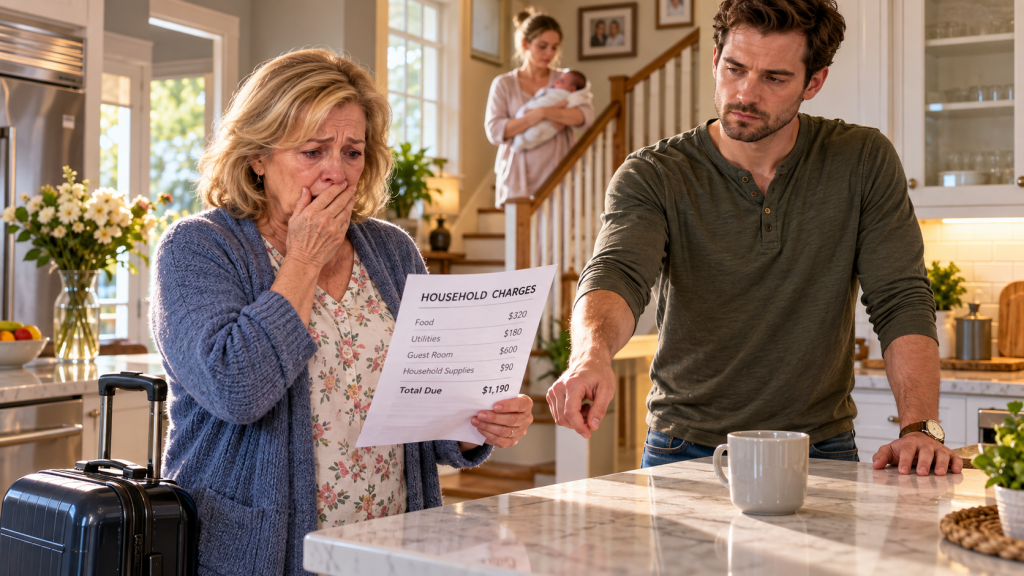
Now he was kneeling in the rain.
Part of me wanted to let him stay there.
The angrier part.
The wounded part.
But humiliation had already caused enough damage in our family.
“Get up, Derek.”
He shook his head.
“Please.”
“I said get up.”
His eyes lifted toward me.
“I don’t want you begging.”
I opened the screen door.
“I want you explaining.”
He slowly stood.
That was when headlights swept across my driveway.
A familiar SUV pulled in behind his car.
My heart sank.
Casey stepped out.
She was wearing sweatpants, slippers, and one of Derek’s old hoodies.
My grandson’s infant carrier hung from her arm.
“Mom.”
She was crying before she reached the porch.
I immediately reached for the baby.
Some instincts outrun anger.
“Why did you bring him out in this weather?”
“I couldn’t stay home.”
She looked at Derek.
“And apparently my husband had decided to drive four hours without telling me.”
Derek lowered his head.
“Casey—”
“Not yet.”
That voice.
I knew that voice.
She had gotten it from me.
She handed me the carrier.
“Can we come inside?”
I looked at the three of them.
My daughter.
My son-in-law.
My newborn grandson sleeping through a family collapse.
Then I stepped aside.
“Yes.”
Ten minutes later, Derek sat at my kitchen table with a towel around his shoulders.
Casey was in the living room feeding the baby.
The six hundred forty dollars lay between us.
Untouched.
I made coffee.
Not because anyone needed caffeine.
Because sometimes a woman needs something ordinary to do with her hands while her family disintegrates.
Derek watched me.
“Mary—”
I turned.
“No.”
He stopped.
“I have exactly three questions before you tell me anything else.”
He nodded.
“First: Did Casey know you were going to charge me?”
His eyes dropped.
“No.”
“Second: Is the mortgage really dependent on the money I’ve been sending?”
He swallowed.
“Yes.”
My stomach tightened.
“Third: What haven’t you told my daughter?”
Silence.
There it was.
The question that mattered.
He looked toward the living room.
“Derek.”
He rubbed both hands over his face.
“A lot.”
I sat down.
“What does ‘a lot’ mean?”
He closed his eyes.
“I lost my position six months ago.”
I stared.
“What?”
“I didn’t lose the job entirely.”
“They eliminated my department.”
“I took another position in the company.”
“For less money?”
He nodded.
“How much less?”
“About eighteen thousand a year.”
I sat back.
Casey appeared in the doorway.
The baby against her shoulder.
“What?”
Derek turned.
Her face had gone white.
“What did you just say?”
“Casey—”
“You told me you transferred because the hours were better.”
“They were.”
“That isn’t what I asked.”
He stood.
She backed away.
“Don’t.”
He sat immediately.
Good.
Casey stared at him.
“You have been making eighteen thousand dollars less for six months?”
“Yes.”
“And you never told me?”
“I was going to.”
“When?”
No answer.
She laughed.
It was the laugh people make when reality has become too ridiculous for crying.
“We had a baby, Derek.”
“I know.”
“I stopped working in the third trimester.”
“I know.”
“We made a budget.”
“I know.”
Her voice rose.
“No, apparently I made a fantasy.”
The baby stirred.
She immediately lowered her voice.
That tiny movement broke my heart more than the shouting.
Even furious, she was still somebody’s mother now.
Casey whispered:
“What else?”
Derek looked at me.
I shook my head.
“Look at your wife.”
He did.
“There’s credit-card debt.”
Casey went still.
“How much?”
“Twenty-three thousand.”
Her lips parted.
I felt physically sick.
“Derek.”
she whispered.
He started crying.
“Some of it was the furnace.”
“We knew about the furnace.”
“Some was your unpaid leave.”
“We had savings.”
“Not enough.”
“What happened to the savings?”
He could barely answer.
“The roof.”
Casey stared.
“You told me insurance covered the roof.”
“Most of it.”
“How much didn’t it cover?”
“Eleven thousand.”
“Eleven—”
She stopped.
Pressed her hand against the baby’s back.
Then whispered:
“What else?”
Derek looked shattered.
“I borrowed money from my dad.”
That was when my stomach truly dropped.
Because I knew Derek’s father.
Frank Lawson.
A man who once charged his own seventeen-year-old son interest on money borrowed to repair a car needed to get to work.
“How much?”
I asked.
Derek looked at me.
“Ten thousand.”
“At what interest?”
He looked embarrassed.
Casey whispered:
“Interest?”
Derek closed his eyes.
“Eight percent.”
I laughed once.
“Your father charged you interest?”
“He offered.”
“No.”
I leaned forward.
“He loaned.”
“Offering is what family does when they don’t profit from your panic.”
Derek winced.
I regretted the sharpness.
Not the truth.
Casey slowly sat across from him.
Her face had become frighteningly calm.
“What did you use the ten thousand for?”
“Bills.”
“Which bills?”
“Mortgage.”
“Car.”
“Groceries.”
“Your prenatal appointments.”
“Our deductible.”
She stared.
“Why didn’t you tell me?”
Derek started crying harder.
“Because you were pregnant.”
“So?”
“You were scared.”
“So you thought financial fraud by omission would calm me?”
“I didn’t think of it like that.”
“Clearly.”
He put his face in his hands.
“I thought I could fix it.”
The sentence hung in the room.
I had heard that sentence from men my entire life.
Husbands.
Fathers.
Brothers.
I thought I could fix it.
Sometimes it meant:
I didn’t want you to know I was failing.
Sometimes:
I valued appearing in control more than giving you informed choices.
Casey’s voice broke.
“You let me buy a crib.”
Derek looked up.
“What?”
“Three months ago.”
“The walnut one.”
“Seven hundred dollars.”
“You told me we were okay.”
“I wanted you to have the one you liked.”
She stared at him.
“I wanted the truth.”
That sentence quieted everyone.
Even the baby.
I looked at the six hundred forty dollars.
Then at Derek.
“Now explain this.”
He didn’t pretend not to understand.
“I was short.”
“How short?”
“Seven hundred and eighty dollars before payday.”
“And your solution was to charge me six hundred forty.”
His eyes filled.
“Yes.”
“For food.”
“Yes.”
“For utilities.”
“Yes.”
“For a room.”
He whispered:
“Yes.”
“The room where I slept four hours a night because I was helping your wife with your baby.”
He flinched.
“Yes.”
I leaned back.
“And you smiled.”
He looked sick.
“What?”
“When I paid you.”
“You smiled.”
“I know.”
“Why?”
Tears spilled down his face.
“Because I was relieved.”
That answer stopped me.
Not proud.
Relieved.
He continued.
“The checking account was overdrawn.”
“Dad’s loan payment was due.”
“The electric bill was due.”
“I’d been staring at the numbers for two days.”
“Then you put the cash on the table and…”
He covered his face.
“I could breathe.”
For one second, I understood.
Then I remembered what understanding can become if you are not careful.
Excuse.
So I said:
“I understand why the money felt like relief.”
He looked up.
“I do not understand why you decided I deserved an invoice.”
His shoulders collapsed.
Casey whispered:
“Was that your idea?”
He hesitated.
I noticed.
“So whose was it?”
He stared at the table.
“My dad said something.”
Of course.
“What?”
Derek looked embarrassed.
“He called the night before you left.”
“He asked if I had gotten through the month.”
“I told him no.”
“He asked why expenses were so high.”
“I said you’d been staying with us.”
Casey looked furious.
“I cannot believe this.”
Derek continued.
“He said…”
He stopped.
“What did he say?”
I asked.
He swallowed.
“He said, ‘If somebody stays under your roof for two weeks, they pay their share. Family isn’t an excuse to become a hotel.’”
I actually laughed.
Not happily.
“My God.”
“He asked what groceries cost.”
“What utilities increased.”
“What the room would cost if we rented it.”
“And you sat down and calculated it.”
Derek nodded.
Casey’s eyes filled.
“You listened to him.”
“I was panicking.”
“You listened to him instead of talking to me.”
“Yes.”
“To Mom.”
“Yes.”
“To literally anybody who loves you without charging eight percent.”
He started sobbing.
“Yes.”
I stood.
Went to my office.
Opened the top drawer of my desk.
And pulled out a yellow legal pad.
I had written the numbers that morning.
Not because I planned to use them.
Because anger sometimes wants arithmetic.
I returned to the kitchen and placed the sheet in front of Derek.
He stared.
Casey leaned over.
At the top I had written:
MARY’S TWO-WEEK HOUSEHOLD SERVICES
Underneath:
Fourteen nights of infant care.
Laundry.
Cooking.
Cleaning.
Grocery runs.
Two pharmacy runs.
One pediatrician trip.
Three hours holding a crying baby while both parents slept.
Six dinners prepared.
Ten breakfasts.
Nine loads of laundry.
Fourteen days away from my own home.
Then I had assigned modest hourly rates.
Not luxury rates.
Not professional nurse rates.
Just ordinary local childcare and housekeeping estimates.
At the bottom:
Estimated value: $4,860.
Derek’s face crumpled.
Casey covered her mouth.
I tapped the line below.
There I had written:
Amount owed: $0.
Derek looked at me.
I said:
“That is what family means to me.”
His eyes filled.
“You didn’t owe me four thousand eight hundred sixty dollars.”
“I didn’t owe you six hundred forty.”
“Neither calculation belongs in a loving home unless everyone agrees beforehand that the relationship is transactional.”
I pushed his cash back toward him.
He shook his head.
“No.”
“Yes.”
“I don’t want it.”
“Neither did I.”
He stared.
I continued.
“This is not about the money.”
“If I keep it just to make you hurt, then I am doing the same thing you did.”
“I’m turning family into a bill.”
He began crying again.
I pushed the money toward Casey instead.
“Put this back in your household account.”
Derek looked at me.
I raised one finger.
“Do not misunderstand me.”
He froze.
“My monthly twelve hundred dollars is not restarting.”
His face fell.
Casey nodded slowly.
Good.
She understood.
I continued.
“And I am not paying your credit cards.”
“Or your father.”
“Or your mortgage indefinitely.”
“I will never let my grandson go hungry.”
“I will never let my daughter stand alone if she truly needs help.”
“But I will not subsidize a household where one spouse hides the numbers from the other and calls the secrecy protection.”
Derek nodded.
“I understand.”
“No.”
I looked directly at him.
“You’re beginning to.”
That night, Casey stayed with me.
Derek drove home alone.
He didn’t argue.
Didn’t beg.
Didn’t ask when she was coming back.
Before leaving, he stood in my doorway.
“Mary?”
“Yes.”
“I’m sorry.”
“I know.”
“I’m going to fix this.”
I felt anger rise again.
“No.”
He blinked.
“Stop saying that.”
“What?”
“‘I’m going to fix this.’”
His face fell.
I continued.
“You are not repairing a dishwasher.”
“You are going to tell the truth.”
“Then Casey decides what can be rebuilt.”
His eyes filled.
He nodded.
“You’re right.”
“I know.”
He almost smiled.
Then left.
Casey slept in my old guest room.
My grandson slept in a bassinet beside her.
At three in the morning, I heard him crying.
I found my daughter sitting in bed feeding him.
Tears rolled silently down her face.
I sat beside her.
“I feel stupid.”
“No.”
“I didn’t know any of it.”
“That does not make you stupid.”
“How did I not know our own income changed?”
“Because you trusted your husband.”
She looked at me.
“That’s supposed to make me feel better?”
“No.”
I touched her shoulder.
“It is supposed to keep you from taking responsibility for information somebody deliberately withheld.”
She stared at the baby.
“I thought we were okay.”
“I know.”
“I bought things.”
“Normal things.”
“I ordered takeout.”
“You were nine months pregnant.”
“I bought a crib.”
“You bought furniture for your baby.”
She started crying harder.
“What if I caused this?”
“No.”
I said it firmly.
“Do not help Derek escape responsibility by taking some of it for him.”
Her eyes lifted.
“This is his lie.”
“His fear.”
“His decision.”
“You can decide later what you forgive.”
“But do not rewrite yourself into the cause.”
She nodded.
Then whispered:
“Did you really pay the hospital balance?”
“Yes.”
“All of it?”
“Yes.”
“Eighteen thousand seven hundred?”
“Yes.”
Her mouth trembled.
“Mom.”
“I had the money.”
“That’s not the point.”
“I know.”
She leaned her head against mine.
“Why?”
I looked at my grandson.
Tiny mouth.
Tiny fist curled near his cheek.
“Because I remember bringing you home.”
Casey cried.
“I remember being afraid of every bill.”
“Your father had just started his business.”
“We were living on almost nothing.”
“My mother paid one utility bill without telling me.”
“It was eighty-four dollars.”
I still remembered.
“Eighty-four dollars felt like someone opening a window.”
I kissed her hair.
“I wanted you to have a window.”
She sobbed against me.
We sat there until morning.
At nine, Derek emailed Casey.
Not texted.
Emailed.
Subject line:
Everything.
Attached were statements.
Credit cards.
Pay stubs.
The loan from his father.
Mortgage history.
Car payment.
Retirement account.
Savings.
Everything.
Casey opened it at my kitchen table.
I made oatmeal.
She read for nearly an hour.
Then said:
“Mom.”
I looked up.
“He hasn’t been spending on himself.”
“What?”
She turned the laptop.
I didn’t need to see every detail.
The spending was exactly what he had said.
Furnace.
Roof.
Medical bills.
Groceries.
Mortgage.
Baby supplies.
No gambling.
No mistress.
No secret car.
No luxury purchases.
Fear.
Debt.
Shame.
I was relieved.
Then Casey whispered:
“I almost wish there was something dramatic.”
I understood.
“Something easier to hate.”
“Yes.”
We both looked at the numbers.
An affair would have been cleaner emotionally.
A secret addiction would have given the betrayal a name.
Instead, her husband had lied because he was frightened of disappointing her.
That did not make it harmless.
It made it sadder.
There was one item she did not recognize.
A monthly transfer of three hundred dollars.
Casey pointed.
“What’s that?”
I leaned closer.
The recipient name was abbreviated.
R.L.
Her face went pale.
“Oh God.”
“Do you know?”
“No.”
She called Derek.
Speakerphone.
He answered instantly.
“Casey?”
“What is R.L.?”
Silence.
My stomach tightened.
Then Derek sighed.
“Rachel Lawson.”
Casey frowned.
“Who is Rachel Lawson?”
“My sister.”
I stared.
Derek had a sister?
Casey looked at me.
I shook my head.
She whispered:
“You don’t have a sister.”
“Yes.”
“I do.”
The room changed.
“What?”
“She’s my half sister.”
“My dad’s daughter from before he married my mom.”
Casey stared at the phone.
“Six years, Derek.”
“I know.”
“Six years and you never told me you have a sister?”
“She doesn’t speak to Dad.”
“That is not an answer.”
“No.”
Derek sounded exhausted.
“She was fourteen when he kicked her out.”
My stomach turned.
“Why?”
I asked.
Derek went quiet.
“Because she refused to start paying rent.”
Everything inside me froze.
Casey stared at me.
I stared back.
There it was.
The pattern.
Older than yesterday’s invoice.
Older than Derek’s panic.
Derek continued.
“She moved in with her mother full-time.”
“Dad called her ungrateful.”
“They barely spoke after that.”
“I was nine.”
“Why do you send her money?”
“She has MS.”
Casey covered her mouth.
“Is she okay?”
“Some months.”
“She can’t always work full-time.”
“So you send three hundred dollars.”
“When I can.”
My anger softened in spite of myself.
Then hardened again.
“You help your sister every month.”
I said.
“Yes.”
“For free.”
“Yes.”
“And you charged me for the guest room.”
Silence.
“That’s when I knew I had become my father.”
Derek whispered.
The sentence hit harder than anything else.
He came back that afternoon.
Not to take Casey home.
To tell the rest.
He sat at my table again.
No rain this time.
No kneeling.
Better.
“Dad has always kept score.”
he said.
“Everything.”
“When I turned sixteen, he started charging me for car insurance.”
“Reasonable.”
I said.
“Yes.”
“But then he charged me for gas when he drove me to school.”
“Ten dollars a week.”
“Laundry detergent.”
“Food if friends stayed over.”
“When I turned eighteen, rent started the morning after my birthday.”
Casey listened silently.
Derek continued.
“My mom used to slip money back to us.”
“Dad called that weakness.”
“Rachel refused.”
“They fought.”
“She said children shouldn’t owe their parents for growing up.”
“Dad told her the real world charges everybody.”
“She left.”
He looked at me.
“I hated him for it.”
My chest tightened.
“And yesterday?”
“I heard his voice come out of mine.”
He cried.
“I made the list.”
“Food.”
“Utilities.”
“Guest room.”
“I looked at it and knew it felt wrong.”
“Then I looked at the bank balance.”
“And I gave it to you anyway.”
I nodded.
That mattered.
Not pretending he had not known.
He knew.
Fear won.
He continued.
“When you paid without arguing…”
He started sobbing.
“I felt relieved.”
“Then after you drove away, I went upstairs.”
“Casey had changed the sheets in the guest room.”
“She found your hair tie on the nightstand.”
“She held it up and said, ‘Mom always leaves something behind.’”
His face collapsed.
“And I thought…”
He could barely finish.
“I thought, yes.”
“She left us six hundred forty dollars.”
That was when the shame arrived.
Casey did not go home that day.
Or the next.
For two weeks, she stayed with me.
Derek visited the baby.
He changed diapers.
Brought formula.
Washed bottles.
Then left.
No sleeping over.
No pretending nothing had happened.
They started marriage counseling.
And financial counseling.
Separate appointments at first.
Together later.
I did not attend.
That was another lesson I had to learn.
Helping is not taking over.
Frank called me on the fourth day.
I almost did not answer.
Then did.
“Mary.”
His voice carried the confidence of a man who had never doubted his own interpretation of events.
“Frank.”
“I understand you’ve caused some trouble.”
I actually smiled.
“Interesting opening.”
“My son says Casey has left the house.”
“Temporarily.”
“Because you got offended over six hundred dollars.”
There it was.
I closed my eyes.
“No.”
“That is not why.”
“He was trying to teach everybody responsibility.”
I laughed.
“Frank, your son was hiding twenty-three thousand dollars in credit-card debt from his wife.”
Silence.
“He told you?”
“He told Casey.”
“He should not have involved you.”
I stared at the wall.
“Your daughter-in-law and newborn grandson are in my house.”
“I was already involved.”
Frank’s voice hardened.
“You baby these kids.”
“They’re adults.”
“Adults pay their way.”
I thought about Rachel.
The fourteen-year-old girl he had charged rent.
I said:
“Does that include children?”
Silence.
“What did Derek tell you?”
“Enough.”
Frank sighed sharply.
“Rachel made her own choices.”
“At fourteen.”
“She wanted adult freedoms.”
“So you gave her an invoice.”
“I gave her responsibility.”
I almost hung up.
Then decided I wanted to understand the disease before ending the call.
“Frank, if your wife sat beside you in the hospital for two weeks, would you bill her for parking?”
“That’s different.”
“Why?”
“She’s my wife.”
“If your son cared for you after surgery, would you charge him utilities?”
“Don’t be ridiculous.”
“If your daughter cooked your meals—”
“That’s family.”
I went silent.
So did he.
Then I said:
“Exactly.”
He hung up.
Two days later, Frank appeared at my house.
Uninvited.
Of course.
Derek was visiting the baby.
Casey stood when she saw her father-in-law through the window.
“Oh no.”
Derek looked terrified.
Not of conflict.
Of becoming nine again.
I saw it instantly.
Frank walked in after I opened the door.
He did not ask.
He looked at Derek.
“Get your things.”
Derek frowned.
“What?”
“Casey too.”
“I’m ending this nonsense.”
I crossed my arms.
“In my house?”
Frank looked at me.
“Mary, with respect—”
“That phrase rarely improves what follows.”
His jaw tightened.
He turned back to Derek.
“You made a mistake.”
“You apologize.”
“Everybody moves on.”
Casey stared.
“Everybody?”
Frank ignored her.
“You’re letting women turn this into something bigger.”
I felt Derek shrink.
It was almost physical.
Then my grandson made a small sound from his bassinet.
Derek looked at him.
Something changed.
He stood.
“Dad.”
Frank smiled as though victory had arrived.
“Good.”
Derek said:
“You need to leave.”
Silence.
Frank’s smile disappeared.
“What?”
“You heard me.”
“This is Mary’s house.”
“She invited me.”
“She did not invite you.”
Frank stared.
“I’m your father.”
“Yes.”
“And you loaned me money when I was scared.”
“I did.”
“You also charged me interest.”
“I taught you responsibility.”
Derek shook his head.
“No.”
“You taught me that help always comes with a meter running.”
Frank’s face darkened.
“Watch yourself.”
Derek’s hands shook.
But he did not sit.
“You did it to Rachel.”
“You did it to me.”
“And I did it to Mary.”
Frank scoffed.
“You’re blaming me because you gave your mother-in-law a reasonable bill?”
Derek’s voice broke.
“She got up five nights with my son.”
“Seven.”
Casey corrected quietly.
Derek nodded.
“Seven.”
“She cooked twelve meals.”
“Washed my clothes.”
“Cleaned my kitchen.”
“Held my wife while she cried.”
“And I charged her one hundred fifty dollars for the bed she barely slept in.”
Frank said nothing.
Derek continued.
“If that sounds reasonable to you, I don’t want your definition of reasonable.”
Frank stared at his son.
Then at me.
I said nothing.
This was not my fight.
It was Derek’s.
Finally.
Frank said:
“You’ll regret talking to me like this.”
Derek nodded.
“Maybe.”
Then:
“But I already regret talking to her like you.”
Frank left.
No slammed door.
No dramatic threat.
Just a man walking out of a house where his rules had stopped working.
Derek sat down afterward.
His hands shook for ten minutes.
I made him tea.
Free of charge.
Three weeks later, Casey went home.
Not because everything was fixed.
Because there was enough truth to begin.
She and Derek created one account spreadsheet together.
No hidden cards.
No hidden loans.
No surprise transfers.
They kept separate personal spending accounts and one household account.
Every Friday, they had what they called the “twenty-minute ugly meeting.”
Twenty minutes to talk about the numbers they wanted least to discuss.
Sometimes boring.
Sometimes painful.
Always honest.
Derek hated them.
That was probably why they worked.
They sold his car.
Not because I demanded it.
It was newer than they needed.
They replaced it with an older sedan.
Derek picked up weekend contracting work.
Casey returned to part-time work when she was ready.
Not early.
That mattered.
I refused to let money rush her postpartum recovery.
For three months, instead of sending twelve hundred dollars into their general account, I paid one specific bill directly.
Childcare.
Only after Casey returned to work.
We all knew the amount.
We all knew when it would end.
Help.
Not mystery.
Not control.
That difference mattered.
The eighteen-thousand-seven-hundred-dollar hospital bill remained paid.
Derek tried to repay me.
Every month, he sent two hundred dollars.
Every month, I sent it back.
Finally, I called.
“Stop.”
“I owe you.”
“No.”
“You paid our bill.”
“Yes.”
“I want to repay it.”
“Why?”
“Because I don’t want to owe you.”
There it was.
The old wound.
I softened.
“Derek.”
“Yes?”
“If the only way you can receive love is by turning it into a debt, your father is still collecting interest.”
Silence.
I continued.
“That bill was a gift.”
“Gifts are not loans with bad paperwork.”
He started crying.
“What do I do with that?”
“Say thank you.”
Long silence.
Then:
“Thank you.”
“You’re welcome.”
He never tried to repay it again.
Instead, on my birthday that year, he donated two hundred dollars to a local postpartum support program in my name.
I cried.
That was different.
Love moving forward instead of backward.
Rachel entered our lives six months later.
Derek’s half sister.
I met her at Casey’s kitchen table.
She was thirty-seven.
Thin.
Funny.
Walked with a cane on bad days.
She looked like Derek around the eyes.
When he introduced us, she smiled.
“So you’re the famous Mary.”
I groaned.
“Apparently.”
She looked at Derek.
“He invoiced you?”
“Rachel.”
she said.
“You left that part out.”
Derek turned red.
I liked her immediately.
Later, while Derek was outside, Rachel said:
“He’s terrified of being Dad.”
I looked at her.
“He should be more afraid of not noticing when he becomes him.”
She nodded.
“He is now.”
Then she told me something Derek never had.
After their father kicked her out at fourteen, Derek secretly gave her his lunch money for months.
Nine years old.
He would tell his mother he wasn’t hungry.
Then hide five-dollar bills in Rachel’s backpack when she visited.
“He’s always been generous.”
she said.
“That’s why this thing with you scared him so badly.”
I stared out the window at Derek rocking his son.
Rachel continued.
“People think becoming your parents means becoming exactly like them.”
“It doesn’t.”
“Sometimes it means repeating one sentence at the worst moment of your life.”
That stayed with me.
One sentence.
Everybody pays their share.
Derek had inherited it.
Then decided not to pass it on.
That was the real lesson.
My grandson, Oliver, turned one.
We had his party in Casey and Derek’s backyard.
Nothing fancy.
Cupcakes.
Balloons.
A plastic kiddie pool he refused to sit in.
Frank was not invited.
His relationship with Derek remained strained.
Not gone.
Strained.
Derek had started speaking to him again under very specific boundaries.
No financial advice.
No comments about Casey.
No unannounced visits.
No money exchanged.
Frank hated all four.
Good boundaries usually irritate the people who benefited from their absence.
Rachel came.
So did I.
Near the end of the afternoon, Derek tapped a spoon against a glass.
I immediately pointed at him.
“No.”
Everyone laughed.
He smiled.
“I’m not proposing.”
“Still no.”
He ignored me.
“Mary.”
I groaned.
He walked over carrying a small frame.
Inside was the original invoice.
Food — $310.
Utilities — $180.
Guest room — $150.
TOTAL — $640.
My mouth fell open.
“You kept that?”
He smiled nervously.
“I did.”
Across it, in red ink, he had written:
PAID IN FULL BY A LESSON I WILL NEVER FORGET.
Underneath:
FAMILY RATE: $0.
I started laughing.
Then crying.
Then both.
Derek’s eyes filled.
“I wanted to throw it away.”
“But my counselor told me shame likes hiding evidence.”
“So I kept it.”
He looked at Oliver.
“One day, when he’s old enough, I’m going to show it to him.”
I frowned.
“Why traumatize the child?”
Everyone laughed.
Derek smiled.
“So he knows there was a day his dad confused money with responsibility.”
“And that somebody loved him enough to correct him.”
My throat closed.
I looked at him.
“Your wife corrected you.”
He nodded.
“You did too.”
“And you listened.”
He looked at me.
“Eventually.”
Fair.
I hugged him.
Not because the invoice was forgotten.
Because the man who wrote it no longer defended it.
Frank died six years later.
Heart attack.
Sudden.
Derek called me from the hospital parking lot.
“Mom?”
He had started calling me that again slowly.
I never asked.
“Yes?”
“He’s gone.”
I closed my eyes.
“I’m sorry.”
Silence.
Then:
“I’m angry.”
“I know.”
“And sad.”
“I know.”
“I thought we’d have more time.”
I understood.
Grief does not check whether a relationship was healthy before entering.
I drove to him.
Four hours.
Again.
This time, when I arrived, Derek met me in the parking lot.
He took my suitcase.
Old habit.
I said:
“You’re not charging me for the room, are you?”
He laughed so hard he cried.
Then hugged me.
“No.”
“Good.”
“I can’t afford your rates.”
We stood there holding each other.
After Frank’s funeral, Derek found boxes in his father’s office.
Receipts.
Ledgers.
Records.
Every loan.
Every payment.
Every debt.
Frank had kept everything.
There was even a page labeled:
DEREK — AGES 16–22
Car insurance.
Fuel.
Phone bill.
Rent.
Loan.
Interest.
At the bottom, a number.
BALANCE: $0
Derek stared at it for a long time.
Then said:
“His whole life was a receipt.”
Rachel stood beside him.
She found her own folder.
Thinner.
Because she left earlier.
Inside was a page showing unpaid “room and board” from when she was fourteen.
Frank had carried that number for more than twenty years.
He never collected it.
Never destroyed it either.
Rachel stared.
Then laughed.
“I owe Dad $1,870.”
Derek looked horrified.
She tore the page in half.
Then again.
Then again.
“So much better.”
Derek looked at his folder.
I expected him to tear it too.
He didn’t.
He closed it.
“Why keep it?”
I asked.
He looked at me.
“Because I want to remember what Oliver will never receive from me.”
That was the moment I knew the lesson had become permanent.
Not because he hated his father.
Because he was choosing what stopped with him.
Casey and Derek had a second child.
A girl.
Lucy.
When she was born, I came for ten days.
Derek prepared the guest room himself.
Fresh sheets.
Flowers.
A basket with snacks.
On the pillow was a handwritten card.
I opened it.
ROOM RATE: One hug from each grandchild. No late fees.
I laughed.
Casey walked in behind me.
“He thinks he’s funny.”
“He is not.”
Derek called from downstairs:
“I heard that.”
The visit felt different.
Not because I did less.
I still cooked.
Still folded laundry.
Still took an early-morning bottle.
But Derek asked.
“Can I do that?”
“Do you need rest?”
“Are you sure?”
Gratitude had become visible.
That matters more than people think.
People do not usually resent helping.
They resent being treated as though their help cost nothing because they cost nothing.
One morning, I woke to find breakfast waiting for me.
Derek had made pancakes.
Bad pancakes.
Oliver was now seven and whispered:
“Dad burns them.”
“I know.”
He frowned.
“You know?”
“I’ve known your father a long time.”
Derek placed a plate in front of me.
“No invoice.”
I smiled.
“You’re never escaping that, are you?”
“Probably not.”
Good.
Some family stories should remain just embarrassing enough to keep us humble.
My monthly twelve-hundred-dollar transfers never resumed.
That surprises people when I tell the story.
They expect the lesson to end with Derek apologizing and me restoring everything.
No.
Forgiveness is not a subscription renewal.
Casey and Derek learned to support their own household.
I helped sometimes.
Birthdays.
Emergencies.
College funds for the children.
Once, when their water heater died, I paid half as a Christmas gift.
Everything transparent.
Everything named.
No invisible money quietly holding up a lifestyle they thought they could afford.
They became stronger because the help became honest.
So did I.
I learned that secret generosity can create its own problems.
Not moral problems.
But confusion.
By quietly sending twelve hundred dollars every month, I had protected Casey from stress.
I had also helped hide the true cost of their life.
Derek’s lie was his.
But my secrecy had unintentionally made it easier for him to pretend everything was fine.
That was a hard truth.
I changed too.
Years passed.
Oliver became a teenager.
Tall.
Kind.
A little sarcastic.
Definitely Casey’s son.
One Thanksgiving, he found the framed invoice in Derek’s office.
He carried it to the table.
“What is this?”
Every adult froze.
Derek slowly put down his fork.
“Ah.”
Oliver read:
“Food, three hundred ten dollars.”
“Utilities, one eighty.”
“Guest room, one fifty.”
He looked at me.
“Grandma?”
“Yes?”
“Dad charged you rent?”
The room erupted.
Lucy nearly fell out of her chair laughing.
Derek covered his face.
“I knew this day would come.”
Oliver stared.
“Why?”
Derek looked at him.
Then something beautiful happened.
He did not minimize it.
Did not say he was stressed.
Did not say I misunderstood.
Did not blame Frank.
He said:
“Because I was scared about money and I behaved badly.”
Oliver waited.
Derek continued.
“Grandma had spent two weeks helping us after you were born.”
“She cooked.”
“Cleaned.”
“Stayed up with you.”
“And I treated her like a hotel guest.”
Oliver looked horrified.
“Dad.”
“I know.”
“What did Grandma do?”
I smiled.
“Paid him.”
Oliver’s mouth fell open.
“Why?”
“Because sometimes the fastest way to understand somebody’s values is to stop arguing with them and let the bill come due.”
Derek laughed.
Oliver looked at the red writing.
FAMILY RATE: $0.
“What happened after?”
Derek took a breath.
“I learned that paying your share and appreciating people are not the same thing.”
“And I learned that being scared doesn’t give you permission to be disrespectful.”
Oliver nodded slowly.
Then asked:
“Did you give her the money back?”
“Yes.”
“Good.”
Lucy looked at me.
“Did you keep it?”
“No.”
“Why not?”
“Because I wanted a son-in-law, not a customer.”
Derek’s eyes filled.
Even after all those years.
Some sentences keep their roots.
Oliver looked at his father.
“Grandpa Frank taught you that?”
Derek nodded.
“Partly.”
“Was he bad?”
The room went quiet.
Derek thought carefully.
“No.”
I watched him.
“He loved me.”
“He also taught me some things I had to unlearn.”
That may have been the wisest thing I ever heard him say.
Not monster.
Not saint.
Human.
Oliver nodded.
Then:
“You’re not charging me rent at fourteen, right?”
Derek laughed.
“Absolutely.”
Oliver stopped laughing.
“What?”
“When you turn fourteen, rent is twelve hugs a month.”
“Dad.”
“Nonnegotiable.”
Lucy shouted:
“I’m moving out.”
We laughed until dessert.
When I turned seventy-five, Derek gave a speech.
I had specifically asked everyone not to.
Naturally, nobody respected me.
He stood in my backyard.
Gray beginning at his temples.
Casey beside him.
Oliver in college.
Lucy finishing high school.
My life everywhere.
He held up a piece of paper.
I groaned.
“If that is an invoice, I’m leaving my own birthday.”
Everyone laughed.
He looked at me.
“Seventeen years ago, I handed Mary a bill for six hundred forty dollars.”
Someone who had never heard the story gasped.
Derek smiled.
“Yes.”
“I was an idiot.”
Casey called:
“Confirmed.”
More laughter.
Then he became serious.
“I thought responsibility meant nobody should ever cost you anything.”
“I thought being a provider meant hiding fear.”
“I thought asking for help made me weak.”
“And I thought money could tell me whether something was fair.”
He looked at me.
“Mary taught me that family isn’t free because it costs nothing.”
“It is priceless because the people giving to you are choosing not to charge.”
My eyes filled.
He continued.
“That distinction changed my marriage.”
“My relationship with my children.”
“My sister.”
“My own father before he died.”
“And me.”
He looked at Casey.
“I almost lost this.”
Then at Oliver and Lucy.
“And maybe someday I would have taught them the same fear I inherited.”
He turned back to me.
“You didn’t just refuse my invoice.”
“You stopped it from becoming an inheritance.”
That was when I cried.
Not elegant tears.
The ugly ones.
Age had not improved that.
Later that night, after everyone left, Derek helped me stack chairs.
I said:
“You made me sound wiser than I was.”
He smiled.
“You were pretty terrifying.”
“Better.”
He carried two chairs into the garage.
Then asked:
“Do you know what I remember most?”
“The six hundred forty dollars?”
“No.”
“The zero.”
I stared.
“What zero?”
“Your invoice.”
He put the chairs down.
“Four thousand eight hundred sixty dollars of work.”
“Amount owed: zero.”
His eyes filled.
“That destroyed me.”
“Why?”
“Because I realized you could have made me feel small.”
“You didn’t.”
I leaned against the doorway.
“I wanted to.”
He laughed.
“I know.”
“I had a few excellent speeches prepared.”
“What stopped you?”
I thought about it.
Then said:
“Casey.”
He looked confused.
“She loved you.”
“I was furious at you.”
“But I knew if I humiliated you, she would eventually have to carry that too.”
Derek’s eyes filled.
“I didn’t deserve that restraint.”
“No.”
I smiled.
“But family rarely deserves every mercy it receives.”
He hugged me.
Long.
Quiet.
No debt.
At eighty-one, I moved into a smaller house.
My knees were done negotiating with stairs.
Casey wanted me closer.
Derek wanted me to move into their guest room.
I stared at him.
He immediately said:
“Free.”
I laughed.
“No.”
“Why?”
“Because I enjoy having my own refrigerator.”
He looked offended.
“Our refrigerator is excellent.”
“Your children drink milk directly from containers.”
“Allegedly.”
I moved twelve minutes away.
Close enough for dinner.
Far enough to ignore them.
Perfect.
One afternoon, Oliver came over.
Twenty-three now.
First real job.
First apartment.
Terrified.
He sat at my kitchen table with a spreadsheet.
I nearly laughed.
“What?”
“Dad helped me make a budget.”
“Oh no.”
“He’s different now.”
“I know.”
Oliver showed me.
Rent.
Utilities.
Food.
Savings.
Then:
“I don’t think I can afford the apartment I want.”
I smiled.
“What did your father say?”
“That wanting something doesn’t make the math rude.”
I laughed.
“That sounds like him.”
Oliver looked at me.
“Grandma?”
“Yes?”
“Can I borrow two thousand dollars for the deposit?”
There it was.
The family test.
I asked:
“Can you afford the monthly rent without me?”
“Yes.”
“Can you repay me?”
“Yes.”
“When?”
“Four months.”
I thought.
Then wrote him a check.
He reached for it.
I held on.
“One condition.”
His face fell.
“What?”
“No interest.”
He smiled.
“Dad said you’d say that.”
“Your dad talks too much.”
Oliver repaid me in three months.
I put the money into his birthday card the following year.
He called me furious.
I laughed for ten minutes.
Generational healing can be extremely annoying.
Casey once asked me whether I would change anything.
We were sitting on my porch.
Older women now.
My daughter had silver hair.
That was rude of time.
“About what?”
“The two weeks after Oliver was born.”
I thought.
“I would tell you about the twelve hundred dollars.”
She nodded.
“Anything else?”
“I’d still come.”
“Still do the laundry?”
“Probably.”
“Night feedings?”
“Maybe fewer.”
She laughed.
Then:
“Would you still pay Derek the six hundred forty?”
I smiled.
“Yes.”
She stared.
“Really?”
“Yes.”
“Why?”
“Because if I had argued, he might have defended it.”
“If I had refused, he might have turned it into a fight about money.”
“But I paid.”
“I let him feel exactly what he thought he wanted.”
“And then?”
“And then reality arrived.”
Casey smiled.
“You are scary.”
“I know.”
She rested her head against my shoulder.
“Thank you for not making me choose between you.”
That sentence mattered more than she knew.
I kissed her hair.
“I was angry at Derek.”
“I never stopped loving you.”
She whispered:
“I know.”
Good.
That was all I ever wanted her to know.
Derek eventually became the kind of father who annoyed his children by refusing repayment for small things.
Too far in the opposite direction sometimes.
Oliver once complained:
“Dad tried to pay for my tires.”
I said:
“Let him.”
“I’m thirty.”
“So?”
“He says family helps.”
I smiled.
“Tell him family also respects adults.”
Oliver stared.
“You created this monster.”
“Correct.”
Balance.
Always balance.
The original six hundred forty dollars?
It eventually ended up somewhere meaningful.
Casey had put it into a separate savings envelope after I returned it.
She forgot about it.
Years later, when Rachel needed a mobility ramp at her house, Casey found the envelope while cleaning out an old desk.
Exactly six hundred forty dollars.
Not enough for the whole ramp.
But enough to start.
When Derek saw the amount, he laughed.
Then cried.
They used it.
Rachel’s ramp still has a little brass plate near the rail.
Derek had it engraved.
Not with his name.
Not mine.
Just:
NO ONE GETS CHARGED FOR COMING HOME.
That was perhaps a little dramatic.
I loved it anyway.
People sometimes hear this story and tell me Derek got what he deserved.
I never like that sentence.
What did he deserve?
To lose his wife?
His child?
His family?
No.
He deserved consequences.
Truth.
Embarrassment, perhaps.
The discomfort of seeing himself clearly.
But I never wanted his destruction.
I wanted his growth.
There is a difference.
Revenge wants someone to hurt because you hurt.
Love with boundaries wants them to understand why the hurt must stop.
Sometimes they do.
Sometimes they don’t.
I was lucky.
Derek did.
He did not become perfect.
Neither did I.
Years later, he once forgot Mother’s Day.
I threatened to charge interest.
He sent flowers the next morning.
I invoiced him for emotional damages.
He paid in chocolate.
Acceptable.
Family.
The day he handed me that bill, I thought he had changed overnight.
He hadn’t.
Fear had simply uncovered an old lesson he had never realized was still living inside him.
His father had taught him:
Everything has a price.
Every favor creates debt.
Every dependent person is a cost.
Then life gave Derek a wife recovering from childbirth.
A newborn son.
A shrinking paycheck.
A broken furnace.
A leaking roof.
Bills he could not control.
And the old lesson rose from the basement.
He repeated it.
Once.
That one time almost broke us.
But he did something his father rarely did.
He admitted he was wrong.
Not immediately.
Not gracefully.
But fully.
And that was enough to begin.
As for me, I learned something too.
There is a difference between helping someone and making it possible for them never to see what help costs you.
For years, I quietly sent money.
Quietly paid bills.
Quietly stepped in.
Partly because I loved Casey.
Partly because I liked being the mother who could fix things.
There is pride even in generosity if you are not careful.
After the invoice, I stopped making secret rescues.
I still helped.
But I said what I was doing.
How long.
Why.
And what I expected in return.
Usually nothing.
But nothing is clearer when spoken.
The last time Derek and I talked about the six hundred forty dollars, he was sixty-seven.
I was ninety.
We sat outside Casey’s house while great-grandchildren ran through sprinklers.
Imagine that.
The newborn whose night feedings started this whole disaster now had children of his own.
Derek handed me lemonade.
I said:
“How much?”
He stared.
Then laughed so loudly everyone looked over.
“Never letting me live that down?”
“Absolutely not.”
He sat beside me.
After a while, he said:
“Best six hundred forty dollars I ever lost.”
I looked at him.
“You didn’t lose it.”
“What do you call it?”
“Tuition.”
He smiled.
“For what class?”
I watched Oliver scoop up his little daughter after she fell.
Casey laughing with Lucy.
Rachel under the shade with her cane beside her.
A family that had stopped keeping emotional ledgers.
“Family.”
I said.
Derek looked at me.
Then nodded.
“Worth it.”
I smiled.
“Yes.”
I was sixty-one when my son-in-law charged me six hundred forty dollars for staying in his house.
At the time, I thought the insult was the bill.
It wasn’t.
The insult was what the bill said without words.
Your cooking has no value.
Your lost sleep has no value.
Your care has no value.
Your presence is a cost.
So I paid it.
Not because he was right.
Because sometimes arguing with a person’s values only gives them another chance to defend them.
I paid.
I went home.
I stopped the invisible support he had mistaken for his own financial stability.
And when the truth arrived, I did not make him crawl forever.
I made him stand.
Look at his wife.
Look at the numbers.
Look at himself.
Then choose who he wanted to become.
That was the lesson.
Not:
Never charge your mother-in-law.
Though I recommend it.
The real lesson was this:
Gratitude is not saying thank you after someone saves you.
Gratitude is understanding that the person helping you has a life, a body, a bank account, and limits of their own.
Love is not free because it costs nothing.
Love is freely given despite the cost.
And once you understand that, you stop asking what everyone owes you.
You start noticing what they have already given.
Derek eventually noticed.
The meals.
The laundry.
The night feedings.
The hospital bill.
The monthly transfers.
The four-hour drives.
The second chances.
But more importantly, he noticed what Casey gave.
Trust.
Motherhood.
Patience.
And what his children would someday give him.
Time.
Forgiveness.
Home.
He stopped keeping score.
And in the end, that was worth far more than the six hundred forty dollars he once thought I owed him.
THE END STORIES! THANK YOU FOR READING GOOD LUCK !❤️
Related Posts