For several seconds, I could only stare at her. Maya stood in the middle of the living room with both hands clenched at her sides, breathing like someone who had just stepped out onto a ledge. “Please take me to a different hospital before he comes back.”
My eyes dropped to the medical proxy in my hand. Then to the wheelchair. Then back to Maya. “You’re asking me to take you somewhere Mark doesn’t use.” “Yes.” “Why?” “Because every doctor Dad takes me to hears his version before they hear mine.” Her voice was clear.
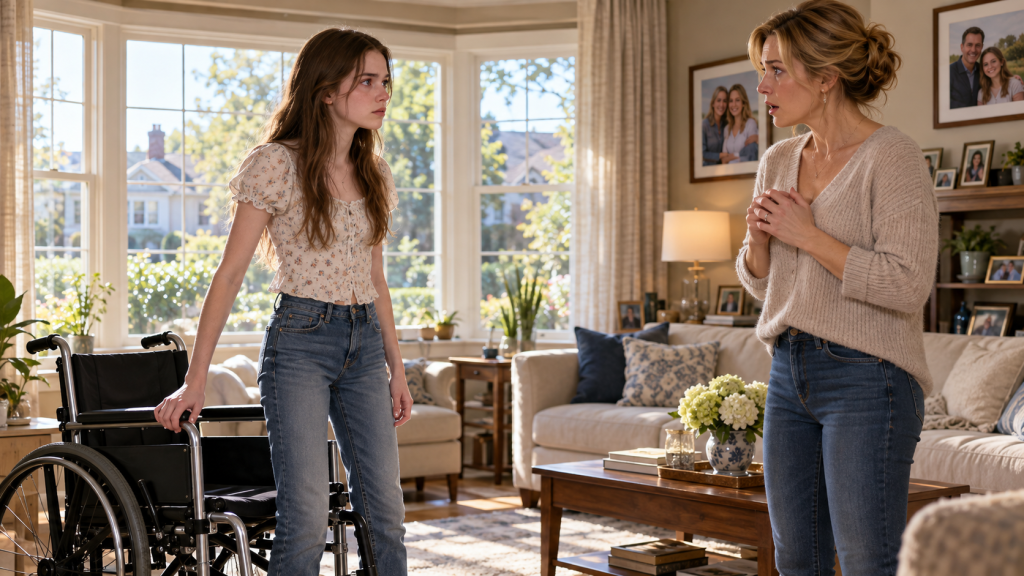
Soft, but clear. Nothing like the fragile whispers I had been told exhausted her for hours afterward. I felt my stomach twist. “Maya, I need you to tell me exactly what you’re afraid will happen if your father finds out.” She looked toward the front window.
“He’ll say I’m confused.”
“He’ll say I’m having an episode.”
“He’ll say I don’t understand my own condition.”
“And if that doesn’t work?”
She swallowed.
“He’ll bring Grandma.”
The way she said Barbara’s name frightened me more than if she had said police.
“What does your grandmother do?”
Maya looked down.
“She reminds me what happens when I embarrass the family.”
I stepped closer.
“What happens?”
For the first time since she had stood, Maya’s knees seemed to weaken.
She reached for the back of the sofa.
Not because she could not walk.
Because she was terrified.
“They take things away.”
“What things?”
“My phone.”
“Internet.”
“Books.”
“Sometimes food I like.”
“They don’t starve me.”
She said that quickly.
Too quickly.
“They just say my stomach is too sensitive.”
My throat tightened.
“What else?”
“They stop letting me talk to anyone.”
“You barely talk to anyone now.”
“I know.”
The answer nearly broke me.
I looked toward the hallway.
The house suddenly felt different.
Not adapted.
Controlled.
The widened doorways.
The downstairs bedroom.
The locked medication cabinet.
The parental filters.
The schedules.
The cameras I had never questioned because Mark said they were for Maya’s safety.
Cameras.
My blood went cold.
“Maya.”
“Yes?”
“Are there cameras inside this house?”
She nodded.
“Where?”
“Living room.”
“Kitchen.”
“Hallway.”
“Dad’s office.”
“Your bedroom?”
“No.”
“Yours?”
She hesitated.
“Yes.”
I stared.
“In your bedroom?”
“He says it’s for seizures.”
“You don’t have seizures.”
“No.”
“Does he watch it?”
“I don’t know when.”
My skin crawled.
Then Maya looked toward the ceiling.
“There.”
I followed her eyes.
A small white device near the smoke detector.
I had seen it every day.
Never thought about it twice.
“Is it recording now?”
“Probably.”
My pulse exploded.
“Then he knows you’re standing.”
“Maybe not yet.”
“Why?”
“He doesn’t watch continuously.”
“How do you know?”
“Because if he did, I would’ve been caught years ago.”
I stared at her.
Years.
“How long have you been getting out of the chair?”
“Since I recovered.”
“How long after you got sick?”
“About seven months.”
I did the math.
More than two years.
“You’ve been pretending for over two years?”
Tears filled her eyes.
“Yes.”
“Maya…”
“I know.”
“No.”
I shook my head.
“I’m not blaming you.”
She looked away.
“I blame me.”
“Don’t.”
“I helped him.”
“You were fourteen.”
“I lied to doctors.”
“You were fourteen.”
“I acted weak at fundraisers.”
“You were a child.”
“I let people donate money.”
“You were a frightened child being controlled by adults.”
She looked at me.
“Will the police see it that way?”
The question was so practical, so terrified, that I realized she had thought about this many times.
Not escape.
Consequences.
That is what trapped people think about when they have been taught that truth is dangerous.
“I don’t know exactly how everyone will respond.”
I said.
“But I know what we are not going to do.”
“What?”
“We are not going to decide the outcome before asking for help.”
Her face crumpled.
“You believe me?”
I looked at the wheelchair.
At the old phone.
At the drawer full of documents.
At the seventeen-year-old standing in front of me.
“Yes.”
Her lips trembled.
“Even though I lied to you?”
“Yes.”
“Why?”
“Because people who are safe don’t usually spend two years pretending they can’t walk.”
She started crying.
Not loudly.
That made it worse.
I stepped forward.
“Can I hug you?”
She stared.
Then nodded.
I wrapped my arms around her.
She was stiff at first.
Then she folded against me.
For the first time, she hugged me back.
Not the limp, one-sided embrace I had always been told was all she could tolerate.
A real hug.
Two arms around my waist.
Her face against my shoulder.
“I’m sorry.”
she whispered.
“You have nothing to apologize to me for.”
“I watched you take care of me.”
“You needed care.”
“Not like that.”
“You needed somebody in the house who wasn’t part of this.”
She cried harder.
Then she pulled back.
“We have to go.”
“Yes.”
“Now.”
“Yes.”
I looked around.
No bag.
No plan.
No certainty.
Just one thing I knew.
If Mark saw her standing through those cameras, the clock had already started.
I grabbed my purse.
Then stopped.
“What medications are you supposed to take today?”
Her face changed.
“Don’t give me the afternoon ones.”
That frightened me.
“Why?”
“They make me sleepy.”
“What are they for?”
“Dad says muscle spasms.”
“Do you have muscle spasms?”
“Not anymore.”
“Does the prescription bottle have your name?”
“Yes.”
“Were they prescribed by a doctor?”
“Yes.”
“Do the doctors know you’re walking?”
“No.”
My stomach turned.
“We’re taking the medication bottles with us.”
Maya’s eyes widened.
“They’re locked.”
“I have the key.”
Mark had given it to me that morning.
Trusting me to continue the system.
He had no idea he had handed me the means to document it.
We went to the master bathroom.
The steel cabinet was built into the wall.
I unlocked it.
Inside were seven prescription bottles.
Supplements.
A digital blood pressure cuff.
A pill organizer labeled by day and time.
I took photographs before touching anything.
Not because I was suddenly an investigator.
Because something inside me understood that proof mattered when a powerful adult had spent years controlling the narrative.
Then I put every bottle into a grocery bag.
Maya watched.
“Dad will know.”
“I know.”
“He counts them.”
That sentence stopped me.
“What?”
“He checks.”
“How often?”
“Every night.”
“Why?”
“He says medication compliance is important.”
“Has he ever punished you for not taking something?”
Maya looked at the floor.
“Yes.”
“How?”
“He makes me take it while he watches.”
My chest tightened.
I forced myself not to ask more.
Hospital first.
Evidence later.
Safety first.
Everything else afterward.
I grabbed Mark’s printed medical spreadsheet from the kitchen.
The proxy.
The medication list.
Emergency contacts.
Then Maya said:
“Wait.”
She went to the drawer where the old phone had been hidden.
Underneath the bank statements were three flash drives.
A notebook.
And a manila envelope.
She placed all of it into a backpack.
“What’s in those?”
“Things.”
“What things?”
“Recordings.”
My heart started pounding.
“Of Mark?”
“Yes.”
“Barbara?”
“Yes.”
“How did you record them?”
“The old phone.”
“When?”
“When they thought I couldn’t understand.”
I stared.
“They talked in front of you?”
“All the time.”
“Because they thought you couldn’t—”
“Because they thought I was too scared to ever tell.”
That was worse.
We left through the front door.
I expected an alarm.
A phone call.
Mark’s voice from nowhere.
Nothing happened.
The suburban street looked painfully normal.
A sprinkler arced across somebody’s lawn.
A delivery truck stopped three houses down.
A man jogged past with headphones.
The world did not know a girl who had been presented publicly as profoundly disabled had just walked out of her house under her own power.
Maya stopped at the porch steps.
I instinctively moved toward the ramp.
She shook her head.
“No.”
Then she used the stairs.
Slowly.
One hand on the railing.
Four steps.
That was all.
But watching her descend them made me cry.
She noticed.
“Claire.”
“I’m okay.”
“You’re crying.”
“I know.”
“Why?”
“Because I’ve spent two years believing stairs were impossible for you.”
She looked back at the ramp.
“He built that before I was even discharged from rehab.”
I turned.
“What?”
“The ramp.”
“When?”
“Right after I got sick.”
“Before doctors knew what your recovery would be?”
“Yes.”
I stared at the expensive concrete ramp Mark had once described as proof of his devotion.
For the first time, I wondered whether he had been preparing for a disability.
Or creating one.
We got into my car.
Maya sat in the passenger seat.
No transfer board.
No lifting.
No wheelchair folded into the trunk.
She clicked the seat belt herself.
Then stared at her hands.
“What hospital?”
I asked.
“Anywhere Dad doesn’t use.”
I thought quickly.
Mark’s doctors were tied to one network across Charlotte.
We drove to a large hospital across town that was affiliated with a different system.
Halfway there, my phone rang.
Mark.
Maya saw the screen.
Her face drained.
“Don’t answer.”
I hesitated.
Then let it ring.
A message appeared.
Why did the living room camera go offline?
I had not turned it off.
Maybe the internet had glitched.
Maybe he had checked.
Another message.
Claire?
Then another.
Call me now.
Maya’s breathing quickened.
“Keep driving.”
“I am.”
“He knows.”
“He knows something.”
“He’ll call Grandma.”
“She’s on a plane.”
“Not yet.”
“What?”
“Their connection.”
She swallowed.
“They’re flying through Dallas.”
My phone rang again.
Barbara.
I stared at it.
Maya whispered:
“See?”
I let it ring.
Then Mark called again.
This time I answered.
Not because I wanted to.
Because ignoring him forever would tell him more than I was ready to reveal.
“Hi.”
“Where are you?”
No hello.
No concern.
Just location.
“Out.”
“With Maya?”
“Yes.”
Silence.
“Where?”
“I had an errand.”
“You took Maya out?”
“Yes.”
“Without the wheelchair van?”
His voice changed.
Too quickly.
Too sharp.
“She’s in my car.”
“How?”
I looked at Maya.
She stared ahead.
“I transferred her.”
“You’re not supposed to do that alone.”
“You left me medical authority.”
“That doesn’t mean you improvise.”
“I’m not improvising.”
“Bring her home.”
“We’re already out.”
“Claire.”
His tone dropped.
The voice he used when he wanted obedience to sound like reason.
“Maya gets disoriented.”
“She needs routine.”
“I know what your spreadsheet says.”
“Then follow it.”
Maya’s hand began trembling.
I reached across and squeezed it.
Mark heard the movement.
“What’s happening?”
“Nothing.”
“Put Maya on.”
“No.”
Silence.
“What?”
“She doesn’t feel like talking.”
“Put her on.”
“She said no.”
I had never said those words to him about Maya.
She said no.
The quiet on the other end lasted three seconds.
Then:
“Claire, I don’t know what she’s told you.”
There it was.
My heart turned cold.
“What do you think she told me?”
He caught himself.
“Nothing.”
“Then why would you say that?”
“Because she gets confused when routines change.”
“About what?”
“Her condition.”
I looked at Maya.
She mouthed:
He knows.
Mark continued.
“Sometimes she believes she can do things she can’t.”
I almost laughed.
“Like what?”
“Walking.”
The word came too fast.
He knew.
He had seen.
Or he had always known she could.
“Interesting.”
I said.
“What does that mean?”
“Nothing.”
“Claire.”
“Where are you?”
I stared at the road.
“I’m taking her for a medical evaluation.”
He exploded.
“No.”
Not concern.
Not confusion.
No.
“You have no reason to do that.”
“She asked.”
“Maya cannot make informed medical decisions alone.”
“She’s seventeen.”
“She has cognitive impairment.”
I looked at her.
Her face went white.
He had never told me that.
Not once.
“What cognitive impairment?”
“Processing issues.”
“Since when?”
“Claire, stop interrogating me and bring her home.”
“No.”
Silence.
Then his voice dropped to something cold.
“You are making a serious mistake.”
Maya closed her eyes.
I had heard enough.
“Maybe.”
I said.
“But if I am, an independent doctor can tell me.”
I hung up.
My hands were shaking.
Maya whispered:
“He’ll come back.”
“He’s in Arizona.”
“He’ll leave the wedding.”
I believed her.
At the hospital, the emergency department receptionist looked confused when Maya walked in.
Understandably.
I had arrived carrying a wheelchair cushion but no wheelchair.
A grocery bag full of medication.
A notarized proxy.
And a seventeen-year-old asking for privacy from her father.
I did not dramatize.
I simply said:
“She says she has been falsely represented as unable to walk and unable to communicate.”
That got attention.
A nurse took us to a private room.
A physician came in.
Dr. Lila Monroe.
Calm.
Forties.
No connection to Mark’s network.
She introduced herself directly to Maya.
Not me.
That alone almost made Maya cry.
“Maya, I’m going to ask you questions.”
Dr. Monroe said.
“If you want Claire to stay, she can.”
“If you want her to leave, she will.”
Maya looked at me.
“Stay.”
I nodded.
Then Dr. Monroe asked:
“Can you tell me why you came today?”
Maya spoke for almost twenty minutes.
At first haltingly.
Then steadily.
She told the story I had only begun to hear.
Three years earlier, she had suffered a severe viral infection.
Real.
She had been hospitalized.
Real.
She developed profound weakness afterward.
Real.
For months, walking was difficult.
Speech became slow when she was exhausted.
Real.
Physical therapy helped.
By the next spring, she was walking short distances again.
By summer, she could walk around the house normally.
Doctors expected continued recovery.
Then Mark stopped outpatient therapy.
“Why?”
Dr. Monroe asked.
Maya swallowed.
“He said it was making me worse.”
“Did you think it was?”
“No.”
“Did the therapists?”
“No.”
“Do you know why he stopped?”
“He got angry after one of them said I should return to school part-time.”
My chest tightened.
Dr. Monroe wrote something down.
“What happened after that?”
“Dad said the doctor thought my recovery had plateaued.”
“Did a doctor tell you that directly?”
“No.”
“Did you attend appointments?”
“Yes.”
“Did doctors speak to you?”
“Sometimes.”
“Did you answer?”
“I tried.”
“What happened?”
“Dad answered first.”
I felt sick.
Dr. Monroe looked at me briefly.
Then back to Maya.
“When did you begin using the wheelchair full-time?”
“After Dad said I had fallen.”
“Had you?”
“I tripped.”
“Were you injured?”
“No.”
“He told everyone you had a collapse?”
“Yes.”
Maya’s face reddened.
“He made me use the chair after that.”
“Why did you comply?”
Maya looked down.
“He said Mom was trying to take me away.”
There it was.
Sarah.
Dr. Monroe asked:
“What did he tell you about your mother?”
“That she wanted custody because she wanted access to fundraiser money.”
“Did she?”
“I don’t know.”
“What else?”
“That she had told the court I was faking.”
“Did that frighten you?”
“Yes.”
“Why?”
“Because Dad said if the judge believed I was faking, I could be charged with fraud.”
I closed my eyes.
Fourteen.
He had told a fourteen-year-old she could go to prison if she admitted she recovered.
Dr. Monroe’s face remained professional.
But her pen stopped moving.
“What did your father ask you to do?”
“Act tired.”
“Speak slowly.”
“Stay in the chair.”
“Let him answer.”
“Did your grandmother know?”
“Yes.”
“What did she do?”
“She practiced with me.”
My stomach twisted.
“Practiced?”
Dr. Monroe asked.
“How to look sick.”
Silence filled the room.
Maya continued.
“She’d say not to sit too straight.”
“She’d say healthy people use their hands too much when they talk.”
“She told me to keep my face blank if someone asked difficult questions.”
My hands went cold.
Barbara.
The woman who hugged Maya goodbye that morning and reminded me to lock the deadbolts.
Dr. Monroe asked:
“Were you ever told what would happen if you refused?”
Maya nodded.
“Dad said Mom would be blamed for confusing me.”
“Grandma said if I exposed them, people would think I planned it too.”
“Did anyone threaten to hurt you physically?”
Maya shook her head.
“No.”
That almost made it worse.
No bruises.
No dramatic violence.
Just fear.
Dependency.
Control.
Isolation.
A child taught that truth would destroy every adult around her.
Dr. Monroe examined her.
Neurological assessment.
Strength.
Balance.
Reflexes.
Walking.
Maya walked the hallway.
Turned.
Walked back.
She tired more quickly than an average seventeen-year-old.
Her legs trembled after repeated squats.
She had clearly deconditioned after years of unnecessary wheelchair dependence.
But she walked.
She climbed three steps with a rail.
She stood unassisted.
She spoke normally for nearly an hour.
Dr. Monroe did not declare anything instantly.
Good doctors rarely do.
She ordered bloodwork.
Reviewed medications.
Called a hospital pharmacist.
Then requested neurology and adolescent medicine consultation.
A social worker arrived.
Then a child-protection specialist.
The room filled slowly with professionals who kept doing one thing Mark rarely did.
They asked Maya.
Not me.
Not a file.
Not a parent.
Maya.
My phone buzzed continuously.
Mark.
Barbara.
Mark.
Unknown number.
Mark.
A voicemail came through.
I did not play it.
Then another.
Finally, a text:
I am at the airport. We’re coming home. Do NOT authorize anything invasive.
My pulse jumped.
I showed the social worker.
Her name was Keisha Bryant.
She read it.
“Does Maya want contact with her father right now?”
Maya immediately said:
“No.”
Keisha nodded.
“Then we document that.”
It sounded so simple.
No.
Documented.
Respected.
Maya started crying.
Keisha looked at her.
“What happened?”
Maya wiped her face.
“No one ever writes down what I want.”
The room went quiet.
That sentence might have been the saddest thing I heard all day.
The neurologist arrived that afternoon.
Dr. Evan Patel.
He reviewed old records electronically after Maya signed the necessary releases and I provided the temporary proxy documentation.
What he found made him frown.
Not because the records said what Mark claimed.
Because they did not.
He scrolled through one old note.
“Here.”
He turned the screen slightly.
“Physical therapy documented independent ambulation for twenty-five feet two years ago.”
I stared.
Maya looked down.
Dr. Patel continued.
“Another note recommends gradual return to school.”
“Another says strength improved substantially.”
Then he found something else.
A neurologist’s note.
Sixteen months earlier.
Objective findings do not explain reported degree of mobility loss. Recommend reassessment of functional status and private interview with patient.
My heart pounded.
“What happened after that?”
Dr. Patel scrolled.
“Follow-up canceled.”
“By whom?”
He looked.
“Parent.”
Maya whispered:
“Dad.”
Another specialist had recommended reducing one medication because of sedation.
The next month, the prescription had been renewed by a different provider after Mark reported worsening symptoms.
Dr. Patel said carefully:
“I’m not saying the medication caused everything.”
“But some of what you’re prescribed can worsen fatigue, dizziness, and weakness.”
“Were you taking all of these as scheduled?”
Maya looked at me.
Then him.
“When Dad watched.”
“What about when he didn’t?”
“I hid some.”
My stomach dropped.
“Where?”
“In the vent behind my dresser.”
I closed my eyes.
A seventeen-year-old secretly avoiding medication she believed she did not need.
Dr. Patel remained calm.
“Thank you for telling me.”
“Do not take anything further until we reconcile the list.”
The hospital did not accuse Mark of intentionally poisoning her.
They did not need melodrama.
The evidence was already serious enough.
A recovered teenager had been kept in unnecessary disability behavior.
Treatments had been continued despite contradictory findings.
Medical information had been filtered through a controlling parent.
Access to independent care had been restricted.
That afternoon, child protective services opened an emergency investigation.
Because Maya was seventeen, the process was unusual.
She was old enough to express clear preferences.
Young enough that the law still treated her as a minor.
Keisha explained options.
Temporary safety placement.
A relative.
A family friend.
Hospital observation.
Possibly her mother, depending on legal history and immediate clearance.
At the word mother, Maya looked up.
“Can you find her?”
Keisha nodded.
“If you want us to.”
“Yes.”
I almost spoke.
Then stopped.
Maya had asked.
That was enough.
Sarah was found in less than two hours.
Not missing.
Not unstable.
Not unreachable.
She lived forty minutes away.
Forty.
For years, Mark had spoken about her as if she had vanished across an ocean.
Sarah arrived at the hospital just after seven that evening.
I saw her before Maya did.
She stepped off the elevator wearing jeans, a blue sweater, and no makeup.
Her hair was half out of a ponytail.
She looked like someone who had driven too fast and cried the entire way.
Keisha met her first.
Verified identity.
Spoke privately.
Reviewed the situation.
Then Sarah saw me.
She stopped.
I had spent years disliking this woman.
Quietly.
Morally.
I had believed she abandoned her sick daughter.
I had believed she could not handle the burden.
I had believed Mark.
Sarah looked at me.
“You’re Claire.”
“Yes.”
Her eyes filled.
“Is she really walking?”
I swallowed.
“Yes.”
Sarah covered her mouth.
A sound escaped her.
Not joy exactly.
Grief wearing joy’s face.
“Oh my God.”
She started crying.
I did too.
“I’m sorry.”
I said.
Her eyes snapped to mine.
“For what?”
“I believed him.”
Sarah laughed bitterly through tears.
“So did a judge.”
That stopped me.
Keisha asked whether Sarah wanted a moment.
She shook her head.
“I’ve had three years of moments.”
Then she entered Maya’s room.
I stayed near the doorway.
Maya sat on the edge of the hospital bed.
Feet touching the floor.
Sarah saw her.
Stopped.
Neither moved.
Then Sarah whispered:
“Baby.”
Maya’s face broke.
“Mom.”
Sarah crossed the room.
Not running.
Almost.
Maya stood.
That was the moment.
The one I will remember until I die.
Sarah had last seen her daughter in a wheelchair during supervised visitation nearly two years earlier.
Now Maya stood.
Sarah collapsed to her knees before reaching her.
Maya dropped down too.
They held each other on the hospital floor.
No one spoke.
No one needed to.
I turned away because some reunions belong to the people who survived the separation.
Later, Sarah told me what Mark had never told.
When Maya first began improving, Sarah celebrated.
Mark did not.
At first, she thought it was fear.
He had built his identity around being the heroic father of a disabled child.
Fundraisers had started small.
Meal trains.
Church donations.
Then larger campaigns.
A local foundation paid for the ramp.
A fundraiser covered specialized equipment.
A business sponsored a “Walk for Maya” event that raised more than forty thousand dollars.
When Maya improved, Sarah wanted the campaigns stopped.
Mark said:
“People already committed.”
Then:
“We can use the money for future care.”
Then:
“She could relapse.”
Then:
“Why are you trying to take resources away from your own daughter?”
Sarah grew suspicious.
She asked for accounting.
Mark refused.
Their marriage deteriorated.
When she threatened to contact fundraiser organizers, Mark filed for primary custody.
He argued Sarah denied the severity of Maya’s condition.
He brought medical records.
Videos.
Testimony from Barbara.
A family friend.
Even photographs of Maya in the wheelchair.
Sarah told the court Maya could walk.
Mark played a video recorded after an argument.
Maya crying.
Weak.
Saying:
“I can’t stand.”
Maya covered her face when Sarah described it.
“I remember.”
Sarah reached for her.
“You were scared.”
“Dad said if I stood for you, they’d arrest you.”
Sarah closed her eyes.
“What?”
Maya started sobbing.
“He said you were trying to make me look healthy so you could steal fundraiser money.”
Sarah stared.
“No.”
“I know now.”
“Oh, sweetheart.”
“I’m sorry.”
Sarah pulled her close.
“No.”
“You do not apologize to me.”
Maya cried harder.
I recognized the sentence.
I had said the same thing hours earlier.
Safe adults repeat the truth until fear gets tired.
Sarah had fought custody.
Lost primary placement.
Received supervised visitation.
Then Mark alleged she was upsetting Maya.
Visits became less frequent.
Maya began refusing them.
Not because she did not want her mother.
Because Mark told her every visit could be used as proof Sarah was manipulating her.
Eventually, Sarah stopped forcing contact.
That decision tortured her.
“I thought if I kept pushing, he’d cut me out completely.”
She said.
“So I sent letters.”
Maya looked confused.
“What letters?”
Sarah stared.
“I wrote every week.”
Maya’s face went white.
“I never got them.”
Sarah closed her eyes.
Of course.
Mark intercepted the mail.
A detail I had noticed.
A detail I had excused.
My stomach turned.
“How many?”
Maya whispered.
Sarah’s voice broke.
“One hundred and twenty-eight.”
Silence.
“I kept copies.”
Maya covered her mouth.
“One hundred and twenty-eight?”
“Yes.”
Sarah cried.
“I wrote about everything.”
“Your birthday.”
“Your old dog.”
“Your aunt’s wedding.”
“I sent photos.”
“I sent books.”
“I sent cards.”
Maya whispered:
“Dad said you forgot my birthday.”
Sarah made a sound that did not seem human.
I left the room.
I couldn’t bear it.
In the hallway, I leaned against the wall and cried.
Keisha found me.
“You okay?”
“No.”
“Good answer.”
I laughed through tears.
“I lived in that house.”
“Yes.”
“I saw things.”
“Yes.”
“I explained them away.”
“Yes.”
“I let him answer for her.”
Keisha leaned beside me.
“So did everyone.”
“That doesn’t help.”
“It isn’t supposed to excuse you.”
I looked at her.
She continued.
“But guilt can become very self-centered if you make the entire story about what you should have noticed.”
That hit.
“She is the person this happened to.”
I nodded.
“What do I do?”
“Believe her.”
“Support her.”
“Tell the truth.”
“And do not make her comfort you.”
I took a breath.
“Right.”
That became my rule.
Mark arrived at the hospital at 11:14 p.m.
He had taken the first available flight back.
Barbara came with him.
I knew because security called the unit.
They were not allowed upstairs immediately.
CPS had placed restrictions pending assessment.
Mark demanded to see his daughter.
Barbara demanded to know why Sarah was there.
The scene stayed downstairs.
I did not witness most of it.
Thank God.
Keisha later told me Mark became increasingly agitated when informed Maya had requested no contact.
“She can’t request that.”
he said.
“She doesn’t understand.”
That sentence apparently changed the social worker’s expression.
Because Maya had spent six hours demonstrating she understood perfectly.
Mark insisted I had manipulated her.
Sarah had manipulated her.
Hospital staff had confused her.
The new doctors did not understand her history.
Everyone except Mark was unreliable.
That pattern mattered.
Then Barbara made a mistake.
A large one.
She said:
“You can’t let Maya walk around unsupervised.”
Security had not told her Maya was walking.
Neither had I.
Neither had Sarah.
Keisha asked:
“How do you know she’s walking?”
Barbara froze.
According to Keisha, Mark turned toward his mother so quickly it was almost comical.
Barbara tried to recover.
“Claire must have told us.”
I had not.
Then she said:
“We saw something on the camera.”
There it was.
The camera.
The controlled house.
The monitoring.
The knowledge.
Mark could no longer claim he had just discovered Maya’s ability that day.
Investigators later reviewed home-security data.
It became one of the strangest pieces of evidence.
The camera system automatically saved motion clips.
Not all footage.
Just selected events.
Mark thought the archive supported him.
It did not.
Over nearly two years, dozens of clips showed Maya standing briefly when alone.
Walking from the couch to a shelf.
Bending to pick something up.
Once dancing for six seconds when music played before suddenly freezing as Mark entered.
And there were clips showing Mark seeing her upright.
Not surprised.
Angry.
In one video, Maya stood near the kitchen island holding a mug.
Mark entered.
She froze.
He closed the distance between them.
No audio.
But he pointed toward the wheelchair.
Maya sat.
That single clip destroyed a large part of his public story.
He knew.
Not suspected.
Knew.
The next morning, the hospital performed further assessments.
No rare progressive muscular disorder appeared in the available records.
No specialist had formally diagnosed the condition Mark described to friends and fundraisers.
Instead, records contained vague references to post-viral weakness, deconditioning, intermittent symptoms, and caregiver-reported mobility limitations.
Mark had turned uncertainty into certainty.
Then certainty into identity.
He used medical language ordinary donors did not understand.
He never had to forge a diagnosis if people never asked to see one.
He simply repeated phrases confidently.
“Rare neuromuscular complication.”
“Progressive weakness.”
“Severe autonomic instability.”
Words that sounded official enough.
Maya had genuinely been sick.
That became the seed.
Everything after grew around it.
A pediatric specialist explained something important to us.
Children with complex symptoms can have real fluctuations.
Parents often report what happens at home.
Doctors depend on accurate observation.
When one caregiver controls all communication, switches providers, cancels inconvenient follow-ups, and speaks for the child, discrepancies can persist longer than outsiders imagine.
It did not mean every doctor failed.
Some had questioned.
Some had recommended private interviews.
Some had documented improvement.
Mark filtered which pieces became the family story.
The medication issue became serious but less sensational than my frightened brain first imagined.
Most prescriptions were legitimate medications originally started during Maya’s illness.
But some had been continued after their usefulness should have been reassessed.
Sedation and dizziness likely contributed to her deconditioning.
There was no evidence Mark had secretly drugged her with something exotic.
The truth did not need that.
Continuing unnecessary treatment while suppressing evidence of recovery was enough.
CPS obtained an emergency order preventing Mark from removing Maya from the hospital.
Sarah was cleared for temporary placement after a home assessment and review of the old custody history.
Two days later, Maya left the hospital.
Walking.
Not perfectly.
Not dramatically.
She used a cane because her muscles were weak from years of limited use.
Sarah carried her bag.
I carried the old phone and documents.
No wheelchair.
When we reached the exit, Maya stopped.
A row of hospital wheelchairs sat beside the doors.
She stared.
Then whispered:
“I hate them.”
Sarah looked at her.
“The chairs?”
Maya nodded.
I understood.
But Sarah said something I never would have thought to say.
“The chair didn’t hurt you.”
Maya looked at her.
Sarah continued.
“It was a tool.”
“Your father used it as a story.”
“That isn’t the chair’s fault.”
Maya’s face softened.
“Why does that matter?”
“Because if you ever need one again someday, I don’t want you to think using help means he won.”
Maya started crying.
I did too.
Sarah had been absent from her daughter’s daily life for years.
Yet in one sentence, she gave Maya something Mark never had.
Choice without shame.
That became the beginning of recovery.
Not walking.
Choice.
The criminal and civil investigations unfolded over months.
Fundraiser organizers turned over records.
Churches.
Community groups.
Online donation platforms.
A local disability nonprofit.
Mark had raised far more than I knew.
Just over three hundred and twenty thousand dollars across three years.
Not all went into his pocket.
That mattered.
Some paid legitimate medical bills.
Therapy.
Home modifications.
Wheelchair equipment.
Transportation.
Tutoring.
Special diets.
But large amounts had been transferred into accounts Mark controlled.
Credit-card debt.
Mortgage payments.
A truck.
A boat he claimed belonged to a friend.
Business expenses.
Trips.
One particularly painful transaction paid for part of our honeymoon.
I found out during an interview with investigators.
I nearly threw up.
Our honeymoon.
The beach resort I had remembered as one of the happiest weeks of my marriage.
Partly paid with money donated for Maya.
I went home and tore every photograph from that trip out of the album.
Then stopped.
Dr. Park—yes, I eventually found a therapist too—asked why.
“Because it was stolen.”
“The money?”
“Yes.”
“The memory?”
I stared.
“I don’t know.”
She said:
“You may decide to throw the photographs away.”
“But do it because you do not want them.”
“Not because Mark gets retroactive ownership of every moment you experienced.”
I hated that advice.
So I kept two photographs.
Not of Mark.
One of the ocean.
One of me laughing.
I refused to let him embezzle memory too.
Barbara was investigated separately.
Her role proved substantial.
She had managed online updates.
Written dramatic posts in Maya’s voice.
Coached her before events.
Helped organize donations.
And, according to audio recordings from the old phone, reminded Mark to keep Maya “consistent.”
One recording became central.
Barbara’s voice:
“If she starts walking around in front of Claire, this whole thing blows up.”
Mark replied:
“She won’t.”
Barbara:
“She likes Claire.”
Mark:
“That’s why I’m careful.”
I heard that recording once.
Never again.
Another was worse.
Maya, fifteen, crying.
“I want Mom.”
Barbara:
“Your mother chose court over you.”
Maya:
“She said she wants me.”
Barbara:
“If she wanted you, she would stop causing trouble.”
Then Mark:
“Enough.”
Not defending Maya.
Ending the conversation.
Another recording captured Mark after a fundraiser.
People downstairs cheering.
Music.
Glasses clinking.
Mark in Maya’s room.
“You did great.”
Maya:
“I stood up by accident.”
Mark:
“No one saw.”
Maya:
“Claire almost did.”
Long pause.
Then:
“You need to be more careful around her.”
That recording broke something in me.
Because I remembered the day.
A summer fundraiser in our backyard.
Blue balloons.
Neighbors.
A local news photographer.
Maya had reached for a dropped napkin and lifted halfway out of her chair.
I thought I imagined it.
Mark immediately rolled her toward the house.
He told everyone she was fatigued.
Later, he told me:
“Her legs sometimes spasm.”
I had believed him.
At the time.
The fundraiser raised nineteen thousand dollars.
Maya saw that number in the investigation documents and cried for hours.
“I helped steal it.”
she said.
Sarah held her.
“No.”
“I smiled for pictures.”
“You were a child.”
“I knew I could stand.”
“You were a child.”
“I knew people were giving money because they thought I couldn’t.”
“You were a child.”
“I hate that sentence.”
Maya snapped.
Sarah went quiet.
Good.
She let Maya be angry.
Then Maya said:
“I wasn’t stupid.”
“No.”
“I knew.”
“Yes.”
“I need you to stop making me innocent like I had no brain.”
Sarah’s face broke.
I watched from the kitchen doorway.
She took a breath.
“You’re right.”
Maya looked surprised.
Sarah continued.
“You knew some things.”
“You lied sometimes.”
“You participated sometimes.”
“And you were also threatened, isolated, and fourteen.”
“Both can be true.”
Maya cried.
“I don’t know what to do with that.”
Sarah moved closer.
“You don’t have to turn yourself into either a villain or an angel.”
“You can be a kid who survived badly sometimes.”
Maya laughed through tears.
“That sounds terrible.”
“It sounds human.”
I loved Sarah a little in that moment.
Not romantically.
Not even as a friend yet.
As a mother.
The mother Mark had taught me to despise.
The custody case moved faster than the criminal one.
By the time Maya turned eighteen, the legal question of custody ended.
That mattered enormously to her.
On her eighteenth birthday, she woke at Sarah’s apartment.
No monitor.
No medication cabinet.
No schedule taped to the refrigerator except a physical-therapy plan Maya had agreed to.
I brought cake.
Chocolate.
Mark had always said dairy upset her stomach.
Turns out it didn’t.
Maya ate two slices.
Then laughed until she cried.
“What?”
I asked.
“I’m eating contraband.”
Sarah smiled.
“Dangerous woman.”
We gave Maya a phone.
Not a monitored one.
A normal phone.
She stared at it.
“No parental controls?”
Sarah looked at her.
“You’re eighteen.”
Maya turned it over in her hands.
“What if I do something stupid?”
Sarah shrugged.
“Then you’ll be eighteen.”
Maya laughed.
Then cried.
Again.
Freedom can be exhausting when every choice used to require permission.
The criminal charges came five months later.
Mark faced fraud-related charges, financial offenses, and charges arising from the abuse and exploitation investigation.
Barbara faced charges tied to fundraising representations and her participation in the scheme.
The exact legal wording changed several times before trial.
I stopped trying to translate every count into morality.
Courtrooms are precise in ways grief is not.
Sarah testified.
I testified.
Fundraiser organizers testified.
Doctors testified.
Physical therapists.
Accountants.
Former teachers.
A neighbor.
And eventually Maya.
Mark’s attorney tried to keep her off the stand.
Too traumatized.
Too influenced by Sarah.
Too emotionally unstable.
The judge allowed her with accommodations.
When Maya entered the courtroom, she used no wheelchair.
That caused murmurs.
The judge shut them down immediately.
Maya wore black pants.
Flat shoes.
A navy sweater.
She carried a cane but barely used it.
Mark stared at her.
Not with love.
Not at first.
With something like disbelief.
As if he had built an identity for her so completely that seeing the real person felt like betrayal.
Maya took the oath.
The prosecutor asked:
“Please state your name.”
“Maya Elizabeth Reynolds.”
“How old are you?”
“Eighteen.”
“Can you walk?”
“Yes.”
“Could you walk during the period when fundraising materials described you as permanently unable to do so?”
Maya inhaled.
“Yes.”
“Why did you continue using a wheelchair?”
She looked at Mark.
Then Barbara.
Then the jury.
“Because my father told me walking would destroy our family.”
Silence.
She told them about the illness.
Recovery.
Fear.
The stories.
The medication.
Her mother.
The supervised visits.
The letters she never received.
The cameras.
The coaching.
The fundraisers.
The old phone.
Then the defense attorney stood.
He was not cruel.
Good lawyers do not always look cruel when they are doing painful work.
He asked:
“You understood people were donating because they believed you had severe mobility limitations?”
“Yes.”
“And you knew by then that you could walk?”
“Yes.”
“So you lied.”
Maya looked at him.
“Yes.”
My heart stopped.
Not because it was wrong.
Because she said it without hiding.
The attorney almost seemed surprised.
“You lied repeatedly.”
“Yes.”
“You smiled for cameras.”
“Yes.”
“You remained seated.”
“Yes.”
“You told at least one volunteer that walking was impossible.”
Maya’s eyes filled.
“Yes.”
The attorney stepped closer.
“Why should this jury believe you now?”
The courtroom went utterly still.
Maya looked down.
For a moment I thought she would break.
Then she lifted her head.
“Because now I’m allowed to tell a story my father doesn’t approve first.”
I stopped breathing.
The attorney paused.
Then:
“But you benefited.”
Maya nodded.
“I lived in the house.”
“Used the equipment.”
“Went on trips.”
“Received gifts.”
“Yes.”
“Did you ever tell donors to stop?”
“No.”
“Did you ever secretly contact police?”
“No.”
“Did you ever run away?”
“No.”
He spread his hands slightly.
“So you had opportunities.”
Maya stared at him.
“I was fourteen.”
The attorney waited.
Maya continued.
“I believed my father controlled whether I saw my mother.”
“He controlled my doctors.”
“My school.”
“My phone.”
“My mail.”
“My money.”
“My medication.”
“My internet.”
“The cameras in my room.”
“And every adult around us kept calling him a hero.”
The attorney’s expression changed.
Maya’s voice shook now.
“So yes.”
“I had doors.”
“I did not believe any of them opened.”
No one moved.
The attorney sat.
Mark looked at the table.
For the first time, he seemed small.
But small is not innocent.
The most damaging testimony came from one of Maya’s former physical therapists.
Her name was Julia Park.
She remembered Maya well.
“She was motivated.”
Julia said.
“Frustrated.”
“Improving.”
She documented independent standing months before full-time wheelchair use began.
She had urged a gradual return to normal activity.
Mark objected.
He claimed Maya crashed for days after sessions.
Julia recommended evaluation.
He canceled.
She tried to follow up.
Calls went unanswered.
Then records showed Maya had transferred to another provider.
The prosecutor asked:
“Did you ever diagnose Maya as permanently unable to walk?”
“No.”
“Did you tell Mark she would require lifelong round-the-clock care?”
“No.”
“Did you recommend full-time wheelchair dependence?”
“No.”
That was devastating.
Then came the fundraiser accountant.
The charity money.
The truck.
The boat.
The honeymoon.
Mortgage payments.
Private business expenses.
Mark’s hero story dissolved into numbers.
Barbara took a plea before the case concluded.
Reduced charges in exchange for cooperation and restitution.
Her statement implicated Mark heavily.
That enraged Maya.
“Of course she turned on him.”
she said.
Sarah asked:
“Would you rather she protect him?”
“No.”
“I want her to tell the truth because it’s right.”
Sarah gave a tired smile.
“Courts rarely get motives that clean.”
Barbara admitted she knew Maya had improved.
Admitted they continued fundraising.
Admitted she coached behavior.
But she claimed Mark controlled the money.
Claimed she believed some of the disability would return.
Claimed fear.
Claimed loyalty.
Some of that may even have been true.
People often build terrible things from ordinary weaknesses.
Fear.
Pride.
Need.
Money.
Then once the structure exists, they protect it because admitting the truth would collapse everything.
Mark did not testify.
I was relieved.
I had heard enough versions.
The jury convicted him on multiple counts.
Not every count.
That mattered too.
Reality rarely delivers perfect narrative symmetry.
Some charges were dismissed.
Some evidence was insufficient for specific allegations.
But the core fraud and abuse-related findings stood.
At sentencing, the judge spoke about more than money.
He spoke about autonomy.
A child’s right to develop an identity independent of a parent’s financial or emotional needs.
The damage caused when a caregiver turns illness into a family economy.
Mark received prison time.
Restitution obligations.
The fundraising organizations pursued civil recovery.
Assets were sold.
The truck.
The boat.
Investments.
Part of the house equity.
The house itself became complicated because I had marital rights.
Yes.
I was still married to him.
For most of the investigation.
I filed for divorce two weeks after Maya left the hospital.
Not because I needed proof beyond what I had.
Because by then I understood something fundamental.
I had not married a man who made one terrible decision.
I had married a man who had built a life around controlling other people’s reality.
There was no marriage left to save.
Mark wrote me from jail.
The first letter was twelve pages.
I read three.
Then stopped.
He said he loved Maya.
I believed that.
That was part of what made it so disturbing.
He loved her.
And controlled her.
Loved her.
And profited from her.
Loved her.
And frightened her.
People want love to function like moral bleach.
It doesn’t.
Love does not make harm impossible.
Sometimes it makes harm harder to recognize.
Mark wrote:
I never thought of her as a source of money.
The bank records disagreed.
He wrote:
I was afraid she would relapse.
Maybe.
He wrote:
Sarah would have taken her away from me.
That was the center.
Not health.
Not money.
Possession.
He could not tolerate losing the role of the indispensable father.
Maya’s recovery threatened more than fundraising.
It threatened his identity.
If she got better, she needed him less.
If she returned to school, other adults would hear her.
If she drove.
Dated.
Went to college.
Spoke freely.
Called her mother.
His control would shrink.
So he turned vulnerability into permanence.
I never answered the letter.
Maya did.
Once.
Months later.
She showed me before sending it.
Not because she needed permission.
Because she wanted a witness.
Her letter was only six lines.
Dad,
I was sick.
Then I got better.
You were afraid of losing me, so you made recovery feel like betrayal.
I will never again apologize for getting stronger.
Do not write to me until I ask.
Maya.
I cried when I read it.
She rolled her eyes.
“You cry constantly.”
“I married your father.”
“I’ve earned it.”
She laughed.
That laugh became one of my favorite sounds.
Recovery took years.
Not days.
Maya did not simply stand from the wheelchair and become physically normal.
Her muscles were weak.
Her balance needed work.
She had chronic pain from deconditioning.
Some lingering fatigue remained from the original illness.
That mattered.
Because the truth was not:
Maya had never been sick.
The truth was more complicated.
She had been sick.
Then better.
Then forced to perform worse.
Recovery required physical therapy again.
This time, she chose goals.
First:
Walk half a mile without resting.
Then:
Climb one flight of stairs without holding both rails.
Then:
Go grocery shopping alone.
Then:
Drive.
The driving terrified her.
Not because she could not do it.
Because Mark had always said:
“You’ll never have the stamina.”
Sarah took her to an empty parking lot.
I went too.
Probably a mistake.
Two mothers in one car with a new driver.
Maya looked at us.
“If either of you gasps, I’m getting out.”
Sarah zipped her lips.
I mimed locking mine.
Maya drove seven feet.
Braked too hard.
Sarah hit the dashboard.
I screamed.
Maya turned.
“You both failed.”
We laughed until we cried.
Three months later, she got her license.
She drove to my house alone.
Walked in holding takeout.
Placed the keys on my counter.
Then waited.
I stared.
“What?”
she said.
“You drove here.”
“Yes.”
“Alone.”
“Yes.”
“And brought Thai food.”
“Yes.”
I started crying.
“Claire.”
“I know.”
“You need help.”
“Probably.”
She hugged me anyway.
Sarah and I became friends.
Slowly.
Awkwardly.
We had to untangle years of lies between us.
The first time she came to my house after the divorce filing, she stood in the foyer.
The ramp still outside.
Family photographs still on the wall.
One showed Mark kneeling beside Maya’s wheelchair.
Sarah stared.
“Can I ask something?”
“Yes.”
“Did you ever hate me?”
I closed my eyes.
“Yes.”
She nodded.
“Fair.”
“No.”
I looked at her.
“Not fair.”
“I believed him.”
“That wasn’t your fault.”
“Some of it was.”
She gave me the same look Keisha once had.
“Don’t make this about your guilt.”
I laughed.
“You and social workers have a conspiracy.”
“Probably.”
We sat in the kitchen.
I told her everything Mark had said about her.
Weak.
Selfish.
Unable to handle pressure.
Jealous of donations.
Emotionally unstable.
Sarah listened without interrupting.
Then:
“I was unstable.”
I looked at her.
“For a while.”
“My child was sick.”
“My marriage was collapsing.”
“My husband was telling everyone I was hurting her.”
“I screamed in court once.”
“I threw a coffee mug.”
“I stopped sleeping.”
She laughed bitterly.
“He took real moments and built a false identity around them.”
That sentence applied to Maya too.
Real weakness.
False permanence.
Real fear.
False incapacity.
Real mistakes.
False character.
Mark’s talent was not inventing from nothing.
It was stretching truth until it became a cage.
The house eventually sold.
Part of the proceeds went to legal obligations.
Part belonged to me under the divorce settlement.
I did not want to stay there anyway.
Too many cameras.
Too many doors widened for the wrong reason.
Too many memories of Maya sitting silently while adults spoke for her.
Before closing, Maya came one last time.
The wheelchair was gone.
Donated.
Not to a fundraiser.
To a legitimate rehabilitation equipment program.
Maya insisted.
We walked through each room.
Her old bedroom.
The kitchen.
The living room.
The bay window where I first met her.
She stood there.
Same place.
No chair.
“What are you thinking?”
I asked.
She looked outside.
“The first day you came over, Dad told me not to say anything.”
My chest tightened.
“What?”
“He said you were nice but temporary.”
I stared.
“He said if I told you the truth, you’d leave.”
“That’s why you barely looked at me?”
“No.”
She smiled sadly.
“I looked at you constantly.”
That was true.
Her eyes.
Always her eyes.
“I was trying to decide if you were safe.”
I started crying.
“Of course.”
She laughed.
“I regret telling you that.”
“No.”
“I’m sorry.”
“Stop.”
She looked around.
“Do you know when I decided?”
“When?”
“The hairbrush.”
I blinked.
“What?”
“The first time you brushed my hair.”
“You asked if it hurt.”
I stared.
“That was it?”
“Dad never asked.”
The room went quiet.
“He always said, ‘Hold still.’”
“Grandma said, ‘Stop being dramatic.’”
“You asked if it hurt.”
Maya shrugged.
“I thought maybe safe people ask.”
I had to sit down.
She sat beside me.
On the floor.
No wheelchair.
No performance.
Just us.
At nineteen, Maya enrolled in community college.
Not because she was behind intellectually.
Because years of isolated homeschooling had left gaps.
She hated admitting that.
“I should be at a university.”
she said.
Sarah replied:
“You should be wherever you are ready to be.”
Maya glared.
“I hate healthy parenting.”
Sarah smiled.
“Get used to disappointment.”
Maya took two classes.
Then four.
She studied communications.
Then changed to occupational therapy after volunteering at a rehabilitation center.
I asked why.
She said:
“Because equipment should give people choices.”
That made sense.
At twenty-one, she gave a speech at a conference about medical autonomy and caregiver fraud.
Not about Mark by name.
About systems.
She refused the easy version of the story.
People kept introducing her as:
“The girl who was never sick.”
She corrected them every time.
“I was sick.”
Then:
“The girl who faked being disabled.”
She corrected that too.
“I was coerced.”
Then:
“The girl whose father poisoned her.”
“No.”
Not supported.
She became fierce about accuracy.
Because after years of having reality distorted around her, precision felt sacred.
Her favorite sentence became:
“Tell it correctly.”
At one event, a reporter asked:
“How could so many people be fooled?”
Maya looked irritated.
“They weren’t stupid.”
“Most people saw a father advocating for a sick child.”
“That is usually a good thing.”
“The problem is not that people cared.”
“The problem is that nobody had enough independent access to me.”
She paused.
“Care becomes dangerous when one person controls all information.”
I sat in the audience beside Sarah.
We both cried.
Obviously.
At twenty-three, Maya received a box.
From Barbara.
Barbara had completed her sentence and probation.
Inside were the one hundred and twenty-eight letters Sarah had written.
All of them.
Mark had kept them.
Barbara had found them in storage.
Maya sat on the floor of my apartment and opened the first.
Age fifteen.
Sarah’s handwriting.
My sweet Maya, I saw a cardinal outside the kitchen window today and thought of the red coat you refused to take off when you were six…
Maya stopped.
Closed the letter.
Put it against her chest.
Then cried for twenty minutes.
She did not read all one hundred and twenty-eight at once.
That would have been unbearable.
One a week.
Sometimes two.
It took more than a year.
She called it:
“Getting my mother back in installments.”
Sarah hated that phrase.
Then used it herself.
Barbara asked to see Maya.
Maya said no.
Then two years later, yes.
Public place.
Sarah came but sat separately.
I did not go.
That meeting belonged to them.
Maya told me afterward.
Barbara cried.
Apologized.
Said she had believed Mark needed support.
Said she feared losing her son.
Said the fundraising started innocently.
Said things got out of control.
Maya listened.
Then asked:
“When did you know I could walk?”
Barbara admitted:
“Before your fifteenth birthday.”
Maya calculated.
Almost three years before the truth came out.
“Why didn’t you stop?”
Barbara cried harder.
“I thought your father would fall apart.”
Maya stared.
Then asked:
“What about me?”
Barbara had no answer.
That became the answer.
Maya left.
She did not forgive Barbara that day.
Maybe never fully.
But she said something afterward that impressed me.
“I don’t need her to be a monster.”
I looked at her.
“What do you mean?”
“If she’s a monster, I learn nothing.”
“She was a grandmother who loved her son more than she protected the truth.”
“That’s more useful to understand.”
I stared.
“You’re smarter than I was at twenty-five.”
“I’m smarter than you now.”
“Get out.”
She laughed.
At twenty-six, Maya married.
A woman named Elise.
Mark did not attend.
Not because Maya hated him.
Because contact remained limited and carefully managed.
By then he had been released.
He had written occasionally after Maya invited brief correspondence.
He had stopped making excuses.
That mattered.
His letters became shorter.
No:
You misunderstand.
No:
Your mother manipulated you.
No:
I did everything for you.
Eventually one letter said:
I made your dependence useful to me. Then I became afraid of you becoming independent because it would expose what I had done. I called that fear love. It was not the kind of love you deserved.
Maya showed it to me.
“What do you think?”
I read it twice.
“He finally wrote a sentence without trying to escape it.”
She nodded.
“Yeah.”
“Are you going to answer?”
“No.”
“Why show me?”
“Because you were there.”
Fair.
At her wedding, Sarah walked Maya down the aisle.
Halfway down, Maya stopped.
Turned.
Looked at me.
I froze.
She held out her hand.
I started crying before I even stood.
“Seriously?”
she said.
The guests laughed.
I joined them.
I walked to her.
“What are you doing?”
“You’re coming too.”
“Maya.”
“You stayed.”
Sarah smiled.
“Come on.”
So we walked together.
Her mother on one side.
Her former stepmother on the other.
No wheelchair.
No cameras.
No one answering for her.
At the altar, Elise whispered something that made Maya laugh.
I never learned what.
Some things do not belong to parents.
Good.
Maya deserved privacy.
Years later, when their daughter was born, Maya called me from the hospital.
“Claire.”
“Yes?”
“You’re a grandmother.”
I sat down.
Technically, I wasn’t.
Not legally.
Not biologically.
Not anymore by marriage.
Didn’t matter.
I cried so hard she sighed.
“Predictable.”
“What’s her name?”
“June.”
“Beautiful.”
“Mom already bought six outfits.”
“Amateur.”
“I have twelve.”
“You are both banned.”
“No.”
Maya laughed.
Then became quiet.
“I’m scared.”
“Of what?”
“Being like him.”
My chest tightened.
“You aren’t.”
“You can’t know that.”
“No.”
“You’re right.”
I thought.
“Then ask different questions.”
“What questions?”
“Does June get to disagree with you?”
“Yes.”
“Does she get privacy as she grows?”
“Yes.”
“Will you let doctors talk to her directly?”
“Obviously.”
“Will you make her body about your identity?”
Maya went quiet.
“No.”
“Then keep asking.”
She breathed.
“I hate when you’re useful.”
“I know.”
When June was five, she fell from a climbing frame and broke her arm.
Maya panicked.
Not normal parent panic.
Old panic.
She called me from the emergency department.
“They put her in a sling.”
“Yes.”
“She says it hurts.”
“That sounds expected.”
“What if I’m missing something?”
“Maya.”
“What if I become controlling because I’m scared?”
I understood immediately.
She was not afraid of the broken arm.
She was afraid of becoming Mark.
“Is June allowed to say what hurts?”
“Yes.”
“Did you let the doctor examine her without you answering?”
Maya paused.
“Yes.”
“Did you ask what she wanted?”
“Yes.”
“Then fear is not the same thing as control.”
Silence.
“You can be scared.”
She started crying.
“I’m so tired of being afraid my love is dangerous.”
That sentence broke me.
“Your love becomes dangerous when you stop letting the other person exist separately from it.”
She was quiet.
Then:
“Okay.”
“How is June?”
“She wants ice cream.”
“Excellent prognosis.”
Years passed.
Mark grew older.
So did we.
He never became a public redemption story.
Good.
Some harm does not need inspirational closure.
He worked after release.
Paid restitution slowly.
Stayed out of trouble.
Went to therapy.
Maintained limited contact with Maya.
Sarah never spoke to him unless necessary.
I never spoke to him again after the divorce.
Then one day, decades after that week, Maya called.
“Dad died.”
I sat down.
“How do you feel?”
“I don’t know.”
“Reasonable.”
“He had a stroke.”
“Was anyone with him?”
“A neighbor.”
I waited.
Maya continued.
“He left me something.”
“What?”
“The old fundraiser banner.”
I almost laughed.
“Why?”
“I don’t know.”
“Maybe he thought it was important.”
“Do you want it?”
“No.”
“Burn it?”
“No.”
“Throw it away?”
She was quiet.
“I’m donating the fabric to a theater group.”
I laughed.
“What?”
“They make sets.”
“Perfect.”
She laughed too.
Then cried.
“I miss him.”
I closed my eyes.
“I know.”
“Is that stupid?”
“No.”
“He hurt me.”
“Yes.”
“He stole years.”
“Yes.”
“He kept me from Mom.”
“Yes.”
“I still miss him.”
“Yes.”
“How can all of that exist?”
“Because people are larger than verdicts.”
She sighed.
“I hate that.”
“I know.”
We stayed on the phone.
No neat forgiveness.
No final moral equation.
Just grief.
Complicated.
Honest.
Hers.
When I was seventy-four, Maya visited me with June.
June was seventeen.
The same age Maya had been when everything came apart.
That fact was not lost on any of us.
June walked into my kitchen wearing boots, headphones around her neck, arguing with her mother about college applications.
“I am not applying to twelve schools.”
Maya said.
“You’re applying to at least eight.”
“Control freak.”
Maya froze.
So did I.
June did not notice.
She opened the refrigerator.
“Do you have lemonade?”
Maya looked at me.
Fear flashed across her face.
I almost laughed.
“You’re fine.”
I whispered.
She exhaled.
Then told June:
“You’re right.”
June turned.
“What?”
“Eight is too many if you don’t want eight.”
June narrowed her eyes.
“Who are you and what did you do with my mother?”
Maya laughed.
“Pick five.”
“Four.”
“Five.”
“Fine.”
June grabbed lemonade.
Then went outside.
Maya sat.
“My heart stopped.”
“I saw.”
“One sentence.”
“I know.”
“What if I become him without realizing?”
“You won’t become him because your daughter called you controlling.”
“That seems too simple.”
“It is.”
I smiled.
“Mark’s problem was not that he ever made a controlling decision.”
“Parents do that.”
“People do that.”
“His problem was that when reality contradicted him, he changed reality.”
Maya went still.
I continued.
“You let June contradict you.”
“That is the difference.”
Tears filled her eyes.
“I needed that.”
“I know.”
By then, Sarah lived nearby too.
We had somehow become a strange family.
Not because tragedy makes everyone close.
Sometimes it destroys people.
But we had chosen each other after.
Sarah and I celebrated birthdays together.
Argued about politics.
Disagreed about Maya’s parenting.
Texted recipes.
Completely ordinary things.
That was the victory.
Not the courtroom.
Not Mark’s conviction.
Ordinariness.
Maya once told me:
“The best thing you did was take me to a boring hospital.”
I laughed.
“Boring?”
“Yes.”
“No dramatic specialist.”
“No miracle.”
“Just people who asked me questions.”
I thought about it.
She was right.
The truth did not require a genius.
It required access.
A door.
A private question.
A pause long enough for Maya to answer.
That stayed with me.
For years, Mark’s greatest weapon had not been medical expertise.
It had been speed.
He answered first.
He explained first.
He interpreted first.
He filled every silence before Maya could.
I had mistaken that speed for devotion.
Now, when someone asks me what I learned, I say:
Watch who is never allowed to finish a sentence.
Watch who gets described constantly but rarely asked.
Watch when “care” removes every private space.
Watch when one person controls the passwords, appointments, money, transportation, and story.
Not because every protective parent is dangerous.
Most are not.
But love that never permits independence deserves questions.
Questions are not betrayal.
Sometimes questions are rescue.
I still remember the morning Mark left for Arizona.
His suitcase by the door.
Barbara’s perfume in the hallway.
The Uber waiting.
Mark squatting beside Maya’s chair.
“Be a good girl for Claire.”
He kissed her forehead.
Then handed me the medical proxy.
At the time, I thought it was trust.
In a way, it was.
He trusted the system he had built.
Trusted Maya’s fear.
Trusted my obedience.
Trusted his own story so completely that he believed one week would not matter.
He was wrong.
One week mattered.
One question mattered.
One notarized piece of paper mattered.
But most of all, one girl decided fear had finally become heavier than truth.
The second the taillights disappeared, she stood.
Not like nothing was wrong.
That part of the story people always tell incorrectly.
A lot was wrong.
Her legs were weak.
Her body was deconditioned.
Her trust had been damaged.
Her mother had been taken from her.
Her adolescence had been turned into fundraising material.
Standing did not mean she was fine.
It meant she was ready.
There is a difference.
Maya stood because she finally had one room without Mark in it.
One adult who might listen.
One chance.
And when she said:
“There’s something Dad doesn’t want you to know,”
I could have explained it away.
Again.
I almost had years of practice.
Instead, I listened.
Everything changed after that.
Not instantly.
Not easily.
But permanently.
The final time I saw Maya stand at that old bay window, she was twenty-eight.
We had returned because the new owners were selling the house and invited her to take anything left in storage.
The ramp had been removed.
The doorway was still wide.
Sunlight filled the room.
Maya stood exactly where her wheelchair used to sit.
Then she looked at me.
“Do you remember?”
“Yes.”
“What did you think when I stood up?”
I laughed.
“That I had lost my mind.”
She smiled.
“After that?”
“That your father had.”
She laughed louder.
Then became serious.
“Thank you.”
“For what?”
“You believed me quickly.”
I shook my head.
“Not quickly enough.”
“What does that mean?”
“I lived there for years.”
“So did I.”
She looked toward the window.
“I didn’t tell you.”
“You were a child.”
“I know.”
She smiled.
“I finally know.”
That mattered more than anything else.
She finally knew.
The guilt had loosened.
The shame belonged where it should.
Not on the girl in the chair.
On the adults who needed her to remain there.
Maya took my hand.
We walked out of the house together.
No ramp.
No wheelchair.
No cameras.
No one watching except us.
And this time, nobody told her how to move.
THE END STORIES! THANK YOU FOR READING GOOD LUCK! ❤️
Related Posts