➡️ PART 3 ENDING PART ➡️
For several seconds, nobody moved.
Not Nathan.
Not his mother.
Not Richard.
Not me.
Even the waiter seemed to sense that something had changed, because he approached with the dessert menus, took one look at our table, and quietly turned around.
I stared at Nathan.
“Our families would have to support my mother?”
He swallowed.
“That isn’t exactly what I said.”
Richard leaned back in his chair.
“It is very close.”
“Dad.”
“No.”
Richard’s voice remained calm.
“You wanted this dinner. You wanted the families together. If we’re going to begin a marriage with everyone pretending, then perhaps we shouldn’t be having an engagement dinner at all.”
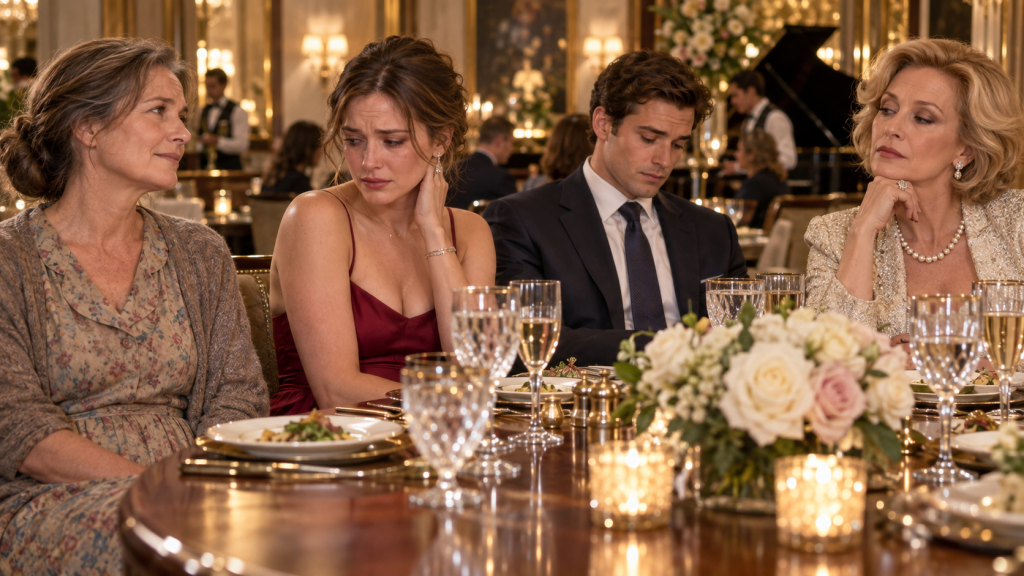
Nathan’s mother, Victoria, set her napkin down sharply.
“Richard, you’re making this unnecessarily ugly.”
“No,” Mom said softly.
Everyone looked at her.
She sat there in that faded floral dress, shoulders relaxed, hands folded in her lap.
For most of the evening, Victoria had treated her as though she were the least important person at the table.
Yet somehow, in that moment, my mother seemed to be the only person who wasn’t afraid of what the truth might do.
Mom looked at Richard.
“Please continue.”
Nathan turned toward me.
“Amelia, don’t let this become something it isn’t.”
That sentence struck me.
Not because it was particularly cruel.
Because I had heard versions of it before.
You’re overthinking it.
Mom didn’t mean it that way.
My sister is just protective.
Dad comes from another generation.
Don’t make this into a bigger thing.
For almost two years, whenever something in Nathan’s family made me uncomfortable, he had been there with a softer interpretation.
I had mistaken that for peacemaking.
Now I wondered whether it had simply been training.
“Then tell me what it is.”
I said.
Nathan rubbed his forehead.
“I told them your mother didn’t have much money.”
“That part is true.”
Mom said.
Nathan looked at her.
Mom smiled faintly.
“At least compared with your family.”
Nathan seemed relieved.
Then Mom continued.
“But that isn’t what Richard said you told them.”
His relief vanished.
I turned back to him.
“Did you tell your parents I support Mom financially?”
Nathan hesitated.
That was enough.
“Nathan.”
“Sometimes you help her.”
“When?”
“You’ve bought things for her.”
“What things?”
“I don’t know. Groceries. Bills.”
My confusion turned into disbelief.
“I bought her a refrigerator for her birthday three years ago.”
Mom raised a finger.
“And I objected.”
“You object to everything that costs more than forty dollars.”
“That refrigerator cost fourteen hundred.”
“Because your old one sounded like an airplane.”
“It still worked.”
“It froze lettuce.”
Mom shrugged.
“Lettuce is overrated.”
Under any other circumstances, I would have laughed.
Instead, I looked at Nathan.
“Is that what you’re talking about?”
“It’s one example.”
“Give me another.”
He looked trapped.
I waited.
Victoria stepped in.
“This is ridiculous. There is no shame in helping one’s parents.”
“I agree.”
I said.
“So why was Nathan discussing my mother’s finances with you as though she were going to become your responsibility?”
Victoria’s mouth tightened.
“That is not how we meant it.”
“We?”
I looked at Nathan.
“What else did you tell them?”
“Amelia.”
“What else?”
He lowered his voice.
“Can we discuss this privately?”
“No.”
The word came easily.
That surprised me.
For most of my relationship with Nathan, I had believed privacy was a sign of respect.
We don’t embarrass each other publicly.
We discuss disagreements at home.
We present a united front.
Those principles sound healthy until one person begins using privacy to avoid accountability.
“You discussed my mother with them without me.”
I said.
“We can correct the story in front of the same people.”
His jaw tightened.
Then his sister, Caroline, who had been unusually quiet all evening, spoke.
“He told us your mother might eventually move in with you.”
My eyes snapped toward her.
“What?”
Nathan closed his eyes.
Caroline continued.
“He said after you got married, there was a possibility she’d need financial support or housing.”
“Caroline.”
Nathan warned.
She looked at him.
“What? Dad already opened the door.”
“You don’t know what you’re talking about.”
“I know what you told us.”
I turned toward Mom.
She looked almost amused.
“Are you planning to move in with me?”
“No.”
“Are you having financial problems?”
“No.”
“Have you ever asked me for money?”
“No.”
“Do you need me to support you?”
“No.”
She paused.
“Although if you’re offering, I have been looking at a very irresponsible espresso machine.”
Despite everything, Richard laughed.
Victoria did not.
Nathan looked miserable.
I leaned back.
“Then why?”
He stared at me.
“Why what?”
“Why did you tell them those things?”
“I was trying to prepare them.”
“For what?”
“Our future.”
“What part of our future requires you to invent financial problems for my mother?”
He looked around the table.
“This is exactly why I wanted to talk privately.”
“No.”
I said.
“This is exactly why you want privacy.”
His face changed.
That landed.
I looked at my mother.
Her eyes met mine.
There was no satisfaction there.
That hurt more.
Some part of me had wanted her to be wrong.
I wanted the faded dress to be nothing more than an unnecessary little experiment by an overprotective mother.
I wanted Nathan to surprise her.
To defend her.
To say something so unmistakably decent that Mom would walk out of that restaurant embarrassed by her own suspicion.
Instead, he had done worse than remain silent.
He had prepared the contempt before she arrived.
Suddenly the entire evening looked different.
Victoria hadn’t looked at Mom’s dress and independently concluded that she was poor.
She had already been told what to see.
By Nathan.
The dress merely confirmed the story he had given them.
“You told them who she was before they ever met her.”
I whispered.
Nathan shook his head.
“No.”
“Yes.”
“I gave them context.”
“You gave them a version.”
“I didn’t lie.”
“You told them she might need our financial support.”
“She might someday.”
My mouth fell open.
“So might your parents.”
Victoria actually gasped.
Nathan looked offended.
“That is obviously different.”
There it was.
Quiet.
Small.
Almost accidental.
Different.
“Why?”
I asked.
Nathan seemed to realize too late what he had said.
“You know what I mean.”
“No.”
I said.
“Explain it.”
“My parents have retirement planning.”
“So does my mother.”
He looked at Mom.
For the first time that evening, I saw uncertainty in his eyes.
He knew almost nothing about her finances.
Neither did I, beyond the basics.
Mom owned her small house.
She had worked for years.
She lived carefully.
She never complained about money.
That was essentially all I knew.
Because Mom did not measure security by discussing numbers at dinner.
Nathan cleared his throat.
“I assumed—”
Mom smiled.
“Yes.”
She said.
“That seems to be the problem.”
Victoria straightened.
“I think everyone is becoming far too sensitive.”
Mom turned toward her.
“Possibly.”
Victoria seemed surprised by the agreement.
Then Mom continued.
“But sensitivity is not the same thing as accuracy.”
Victoria’s expression hardened.
“Excuse me?”
“You assumed my dress told you something about my worth.”
Mom said.
“Nathan assumed my background told him something about my future dependence.”
She looked between them.
“And my daughter assumed that because she loved him, there must be generous explanations for things that made her uncomfortable.”
My face burned.
Mom reached over and touched my hand.
Not accusation.
Comfort.
That made it worse.
Because she was right.
“I wasn’t testing whether his family had money.”
Mom continued.
“I already knew that.”
Her gaze shifted to Nathan.
“I was testing whether money had become the language through which you measure people.”
Nathan leaned forward.
“With respect, you deliberately dressed down to manipulate everyone.”
Mom nodded.
“Yes.”
The answer startled him.
“I did.”
I turned toward her.
“Mom.”
She looked at me.
“I am not pretending it was perfect behavior.”
She said.
“I could have been wrong. If everyone had treated me kindly, I would have owed all of you an apology for doubting you.”
That mattered.
Mom was not turning herself into some all-knowing judge.
She had created a situation.
It could have produced unfair conclusions.
She knew that.
“But I didn’t insult anyone.”
she continued.
“I didn’t lie about who I was. I wore an old dress that I own.”
Then she looked at Victoria.
“What happened after that belonged to each person who chose it.”
Victoria’s cheeks reddened.
“I never insulted you.”
Mom nodded.
“You called my dress comfortable.”
“It was.”
“Yes.”
Richard covered his mouth.
I wasn’t sure whether he was hiding a smile.
Mom continued.
“You asked whether I had ever eaten somewhere like this.”
“A perfectly normal question.”
“Would you have asked a woman wearing Chanel?”
Victoria opened her mouth.
Then stopped.
Mom did not press.
She simply took a sip of water.
Nathan turned to me.
“Amelia, this is becoming absurd.”
“Is it?”
“Yes. Your mother came here looking for reasons not to like us.”
Mom shook her head.
“No.”
“You just admitted it.”
“I came looking for a reason to trust you.”
Nathan stared at her.
Mom’s voice softened.
“There is a difference.”
That silenced him.
Then Richard spoke.
“I’d like to know why you told us she was dependent.”
Nathan turned sharply.
“Dad, stay out of this.”
“I was in it before Amelia was.”
Richard said.
“You discussed it with me.”
“Because you asked about wedding finances.”
My attention sharpened.
“What wedding finances?”
Nathan went still.
Victoria looked down.
Caroline stared at her plate.
Mom squeezed my fingers once.
“Tell her.”
Richard said.
Nathan’s voice hardened.
“There’s nothing to tell.”
Richard ignored him.
“Several weeks ago, Nathan asked me whether I would be willing to contribute toward a down payment on a house after the wedding.”
I frowned.
“We already discussed buying a house.”
“Yes.”
Nathan said quickly.
“But not asking your father for money.”
“I was exploring options.”
Richard continued.
“He said the two of you would need a larger property than I thought necessary because your mother might eventually become your responsibility.”
My stomach dropped.
Mom’s hand became still beneath mine.
“Why would that affect the house?”
I asked.
Richard looked uncomfortable now.
“He mentioned perhaps needing a guest suite.”
I stared at Nathan.
“You wanted your father to give us more money because you claimed my mother might move in?”
“It wasn’t like that.”
“Then what was it like?”
“I was thinking long-term.”
“You invented a future dependent to justify asking for a bigger house?”
“Amelia, stop saying invented.”
“Has Mom ever told you she wants to live with us?”
“No.”
“Has she ever asked for financial help?”
“No.”
“Has she ever suggested she expects me to care for her financially?”
“No.”
“Then what word would you prefer?”
He had none.
My mother slowly withdrew her hand from mine.
She was no longer looking at Nathan.
She was looking at me.
And suddenly I understood something terrible.
This wasn’t only about how Nathan saw her.
It was about what he had been willing to use.
Her poverty.
Or what he believed was poverty.
Her age.
Her history.
My love for her.
He had turned all of it into leverage.
“Did you know about this?”
I asked Victoria.
She looked offended by the question.
“I knew my son was planning responsibly.”
“Responsibly?”
“If you marry into a family with fewer resources, practical considerations exist.”
Mom’s eyes flickered.
There it was again.
Not cruelty shouted across the table.
Something colder.
A worldview so deeply accepted that the person expressing it did not recognize it as cruelty.
People with fewer resources.
As though Mom were a line item.
Victoria continued.
“We were simply concerned that Nathan might eventually carry obligations that aren’t his.”
I stared at her.
“My mother raised me alone.”
“Yes.”
“She worked two jobs.”
“I understand.”
“No.”
I said.
“I don’t think you do.”
My voice began shaking.
“She skipped meals without telling me.”
Mom looked at me.
“Amelia.”
“I know now.”
I said.
My eyes filled.
“She wore the same winter coat for nine years because mine kept getting too small. She cleaned offices at night after working reception during the day. She sat beside me doing multiplication homework at eleven o’clock because she refused to let exhaustion become an excuse for making me feel alone.”
Victoria shifted uncomfortably.
“She did all of that without asking anyone in this room for anything.”
I continued.
“And somehow you met her tonight believing the important question was whether she might someday cost your son money.”
Nathan whispered:
“That’s not fair.”
I looked at him.
“No?”
“No. I love you.”
“I know.”
That made my voice break.
“I know you do.”
He reached for my hand.
I pulled it away.
Love.
There it was.
The word we expect to rescue everything.
But Mom had taught me something without ever saying it directly.
Love tells you how someone feels.
Character tells you what they do with those feelings.
Nathan loved me.
I believed that.
But apparently, he had also decided my background needed to be translated into something his family would understand.
Risk.
Liability.
Obligation.
Something to manage.
“I never asked you to support Mom.”
“I know.”
“Then why did you make her sound like a burden?”
His face changed.
Finally.
Not anger.
Shame.
“I wanted them to accept you.”
The answer was quiet.
So quiet I almost missed it.
“What?”
He looked at his parents.
Then back at me.
“I knew they had concerns.”
“About me?”
He nodded.
My stomach tightened.
“What concerns?”
Victoria spoke quickly.
“Nathan.”
“No.”
I said.
“I want to hear this.”
Nathan looked exhausted.
“When we first started dating, Mom worried we came from different backgrounds.”
“Meaning?”
“Money.”
There it was.
“Education?”
“No.”
“Career?”
“No.”
“Religion?”
“No.”
“Money.”
“Yes.”
I laughed softly.
A miserable little sound.
“So how did telling them my mother was poor help?”
Nathan stared at his plate.
“I thought if I showed them I understood the practical differences, they’d stop thinking I was being naive.”
The sentence took several seconds to settle.
Then I understood.
He had not defended my background.
He had negotiated around it.
He had essentially told his parents:
Yes, she comes with disadvantages.
I see them too.
Don’t worry.
I’m managing them.
Mom’s faded dress suddenly seemed brighter than anything else in the room.
“Did you ever tell them what Mom actually did?”
I asked.
“What do you mean?”
“That she worked for twenty-seven years at a medical billing company.”
“I think so.”
“That she became operations supervisor.”
“I don’t remember.”
“That she paid off her house?”
He blinked.
“She did?”
Mom looked at me.
I stared at her.
“You paid it off?”
“Eight years ago.”
“Why didn’t you tell me?”
“You didn’t ask.”
I almost laughed.
Of course.
Mom continued.
“And before anyone becomes too excited, it is a small house.”
Richard smiled.
“A paid-off small house is still a paid-off house.”
“Exactly.”
Mom said.
“Small roof. Still mine.”
Victoria looked unsettled.
Not because Mom suddenly became wealthy.
She wasn’t.
But because the narrative was becoming inconvenient.
Mom was supposed to be helpless.
Instead, she had simply lived modestly.
Those are not the same thing.
Then Richard asked:
“Margaret, may I ask you something?”
So that was the first time that evening anyone in Nathan’s family used my mother’s name.
Not “your mother.”
Not some implied category.
Margaret.
Mom nodded.
“Of course.”
“Are you financially secure?”
Nathan groaned.
“Dad.”
Mom held up a hand.
“It’s fair in context.”
She thought for a moment.
“I am not rich.”
She said.
“I have my house. Retirement savings. Social Security when I decide to take it. A pension from an earlier employer that’s small but useful. I also inherited a little money from my sister when she died.”
I stared.
“Aunt Diane left you money?”
Mom nodded.
“Some.”
“How much?”
She gave me a look.
“Now everyone wants my bank statement.”
That finally made me laugh.
Tears were still on my face.
But I laughed.
Mom smiled.
“Enough that I do not need Amelia to support me.”
Then she turned toward Nathan.
“And if that ever changes, I would speak to my daughter before I allowed a man who hasn’t married her yet to build a financial narrative around me.”
Nathan lowered his eyes.
Richard nodded.
“Fair.”
Victoria looked embarrassed.
Caroline whispered:
“Mom, you owe her an apology.”
Victoria’s head snapped toward her daughter.
“Excuse me?”
“You were rude.”
“I was not.”
“You were.”
Caroline looked at Mom.
“I’m sorry.”
Mom nodded.
“Thank you.”
Caroline continued.
“I noticed the dress too.”
Mom smiled.
“Most people did.”
“I judged it.”
“I assumed you might.”
“But I didn’t say anything.”
Mom tilted her head.
“That’s better than saying something cruel.”
Caroline looked ashamed.
“But it’s not the same as being kind.”
Mom’s expression softened.
“No.”
Caroline nodded.
“I’ll remember that.”
Something about that exchange affected me.
Because Mom was not demanding perfection.
She wasn’t dividing the table into good people and bad people.
She was watching what happened when people were confronted with themselves.
Caroline listened.
Richard listened.
Victoria defended.
Nathan minimized.
Those differences mattered.
I looked at the engagement ring on my hand.
For the first time since Nathan gave it to me, it felt heavy.
Not ugly.
Not false.
Heavy.
It represented a promise I had made before knowing something important.
“Nathan.”
He looked at me.
“Did you ever defend Mom when your parents talked about her?”
“Yes.”
“Give me an example.”
He hesitated.
I knew.
“Did you ever tell them they were wrong?”
“I told them you were worth it.”
My heart broke.
Mom closed her eyes.
Even Richard looked pained.
“Worth it.”
I repeated.
Nathan immediately understood.
“I didn’t mean—”
“Worth what?”
“Amelia.”
“Worth what?”
He stood.
“Enough.”
The restaurant went quiet around us.
Not completely.
Glasses still clinked.
People still talked.
But our table had become its own little world.
Nathan lowered his voice.
“I have spent two years proving to my family that I love you.”
I stood too.
“I never asked you to prove that.”
“I chose you despite all their concerns.”
There it was.
Despite.
My eyes filled.
I removed the ring.
Nathan stared at my hand.
“No.”
I placed it carefully beside his plate.
Not thrown.
Not slammed.
Just placed.
“Amelia.”
“I need time.”
“You’re ending our engagement because my mother made comments about a dress?”
“No.”
I looked at him.
“I am pausing our engagement because you spent two years telling me your family’s judgment didn’t matter while quietly participating in it.”
“That is not what happened.”
“It is what I heard.”
“You’re emotional.”
Mom moved.
I touched her arm.
“No.”
I said.
“I’ve got this.”
Then I looked at Nathan.
“Yes.”
I continued.
“I am emotional.”
My voice steadied.
“That doesn’t make me wrong.”
His face fell.
“I love you.”
“I love you too.”
Mom looked at me.
Maybe she remembered saying something similar to me years earlier about my father.
Love does not always mean stay.
Sometimes love is simply a fact that makes leaving harder.
“I need to understand whether the man I almost married respects where I came from or merely tolerates it because he loves where I ended up.”
Nathan stopped breathing for a second.
That was the question.
The real one.
Not the dress.
Not the restaurant.
Not even his mother.
Did Nathan love all of me?
Or did he love the version of me that had successfully escaped everything about my childhood that made his family uncomfortable?
I picked up my purse.
Mom stood.
Richard stood too.
“Amelia.”
he said.
I looked at him.
“I am sorry.”
He glanced at Mom.
“For tonight.”
Mom nodded.
“Thank you.”
Then Richard looked at his son.
“And for not questioning some things sooner.”
Nathan stared at him.
“Dad.”
Richard shook his head.
“Not now.”
Victoria remained seated.
Her posture was perfect.
Her expression cold.
As Mom and I began walking away, she spoke.
“I hope you’re not making a decision you’ll regret.”
I stopped.
Turned.
Then looked at her.
“I hope so too.”
That surprised her.
I continued.
“That’s why I’m not making the marriage decision tonight.”
I glanced at the ring.
“I’m simply refusing to make it on the information I had yesterday.”
Then Mom and I left.
Outside, rain had begun.
Not dramatic rain.
Just Chicago drizzle.
Cold enough to be annoying.
Mom stood beneath the restaurant awning.
I looked at her dress.
Really looked.
Faded blue flowers.
Thin fabric.
A small repaired seam near the waist.
Suddenly I remembered it.
“You wore that to my middle-school graduation.”
Mom smiled.
“You remember?”
“You made it.”
“Altered it.”
“You stayed up all night.”
“Because you told me at nine p.m. that parents were supposed to dress nicely.”
“I was twelve.”
“You were inconsiderate.”
I laughed.
Then started crying.
Mom opened her arms.
I fell into them.
The dress smelled faintly like her laundry detergent.
For one second, I was twelve again.
Then eight.
Then five.
Every age at which those arms had been home.
“I am so sorry.”
I whispered.
Mom held me tighter.
“For what?”
“I was embarrassed by you.”
She pulled back.
“Tonight?”
“Yes.”
“Good.”
I blinked.
“What?”
“Not good that you were embarrassed.”
She wiped my face.
“Good that you can say it.”
I cried harder.
“You didn’t deserve that.”
“No.”
“I should have defended you sooner.”
“Yes.”
That surprised me.
Mom had never believed comfort required lying.
Then she softened.
“But sweetheart, shame is often faster than character.”
I looked at her.
“What?”
“You felt embarrassed.”
She said.
“Then you learned something and changed your behavior.”
She shrugged.
“That is called being human.”
I stared at the old dress.
“Why this one?”
She looked down.
“Because this is what I wore when I had almost nothing.”
I said nothing.
“When you were twelve, I had thirty-eight dollars in my checking account the night before your graduation.”
My chest tightened.
“I didn’t know.”
“You weren’t supposed to.”
She touched the fabric.
“I bought this dress secondhand for nine dollars. It was too big, so I altered it.”
She smiled.
“I thought I looked fantastic.”
“You did.”
“I still do.”
I laughed through tears.
Then she became serious.
“I kept it because it reminds me that having little money never made me little.”
That sentence stayed with me for the rest of my life.
Having little money never made me little.
We took a taxi home.
Not to Nathan’s apartment.
To mine.
I barely slept.
Nathan called nineteen times.
Texted twenty-three.
I eventually turned off my phone.
The next morning, there were flowers outside my door.
I left them there until afternoon.
Then gave them to the woman across the hall.
She was delighted.
Three days later, I met Nathan.
Public place.
Coffee shop.
No parents.
No Mom.
Just us.
He looked exhausted.
I probably did too.
The first thing he said was:
“I am sorry.”
I waited.
Not because apologies require perfection.
Because I needed to know what he thought he was apologizing for.
“I lied about your mother.”
he said.
Good start.
“I exaggerated things I didn’t know because I wanted my parents to believe I had considered every possible complication.”
“Why was Mom a complication?”
“She wasn’t.”
“She became one in your story.”
He nodded.
“Yes.”
I waited.
He looked down.
“I have spent my entire life trying to look sensible to my parents.”
There it was.
Something deeper.
“Especially my father.”
I frowned.
“Richard seemed like the least judgmental person at dinner.”
“He is.”
Nathan rubbed his face.
“That’s part of it. Dad built the company. Mom came from money, but Dad didn’t. He grew up working class.”
That surprised me.
“He did?”
“Yes.”
“Then why—”
“Because he spent his whole life proving himself to Mom’s family.”
Nathan laughed bitterly.
“I grew up watching it without realizing what I was learning.”
He explained.
Victoria’s parents had disliked Richard when they married.
Not polished enough.
Not connected enough.
Not wealthy enough.
Richard built a successful logistics company.
Made more money than Victoria’s family eventually had.
But the old wound remained in the household.
Achievement.
Presentation.
Control.
Never give anyone a reason to think you are not enough.
Nathan had absorbed it.
“When Mom started questioning your background, I panicked.”
he said.
“Instead of telling her to stop, I tried to show her I wasn’t naive.”
“So you agreed with her.”
“Not exactly.”
I looked at him.
He sighed.
“Yes.”
“In practice, I did.”
Better.
He continued.
“I told myself I was managing her.”
“That sounds familiar.”
He winced.
“I know.”
“Every time she insulted me and you explained her afterward, were you managing me too?”
His eyes filled.
“Yes.”
The honesty hurt.
But it was clean.
“I didn’t think of it that way.”
he continued.
“I thought I was keeping peace.”
“Peace for whom?”
He looked at me.
“Myself.”
There.
That was perhaps the first fully honest thing Nathan had said about his family.
“I wanted you happy enough to stay.”
he whispered.
“And Mom calm enough not to make me choose.”
I felt tears rise.
“And if someone had to absorb the discomfort?”
“You.”
“Yes.”
He cried.
“I am sorry.”
I believed him.
That was the problem.
I still loved him.
If he had been cruel and unapologetic, life would have been easier.
Instead, he was a flawed man finally seeing the shape of his flaw.
“What do you want?”
I asked.
“You.”
“No.”
He looked confused.
“What do you want to change?”
That was harder.
He thought.
“I need to stop making you responsible for my relationship with my parents.”
Good.
“I need to correct what I told them about Margaret.”
Good.
“I need to stop asking you to tolerate disrespect so I don’t have to confront it.”
Good.
“And?”
He looked down.
“I need therapy.”
I almost smiled.
“Probably.”
He laughed weakly.
“I knew you’d like that one.”
“I do.”
Then his face became hopeful.
“Does that mean you’ll put the ring back on?”
“No.”
Hope vanished.
“Amelia.”
“I believe you can change.”
“Then why—”
“Because believing you can change is not the same as knowing you have.”
He went quiet.
I had learned that from Mom too, though she had never said it exactly.
Promises tell you what people hope to become.
Patterns tell you who they are today.
We canceled the wedding.
That caused chaos.
Deposits.
Calls.
Questions.
Victoria told relatives we had “postponed due to stress.”
I corrected anyone who asked me directly.
“We ended the engagement.”
Not because I wanted to humiliate Nathan.
Because accurate language matters.
For six months, we did not date.
We did not pretend to be friends.
We did not sleep together.
We lived separate lives.
Nathan began therapy.
I did too.
Because the dinner had revealed something uncomfortable about me as well.
I had spent years treating upward mobility as proof that I had successfully escaped my childhood.
I loved Mom.
Deeply.
But some part of me had still absorbed the idea that the life she gave me was something to outgrow.
Nice apartment.
Professional clothes.
Good salary.
Elegant restaurants.
Nathan’s family.
I had told myself these things represented success.
Nothing wrong with enjoying them.
The problem was that somewhere along the way, I had begun measuring distance traveled by how little I resembled where I came from.
That realization hurt.
Mom never asked me to remain poor in order to honor her sacrifices.
She wanted me to have more.
But having more should not require looking down on less.
That became my work.
Six months after the dinner, Richard called Mom.
Not me.
Mom told me afterward.
“He apologized.”
“For what?”
“For participating in conversations about me without ever asking whether they were true.”
“That sounds like him.”
“He invited me to lunch.”
“Did you go?”
“Yes.”
I stared.
“You didn’t tell me.”
“You’re not my parole officer.”
“Mom.”
She laughed.
“We had sandwiches.”
“Where?”
“A diner.”
I laughed.
“Whose choice?”
“Mine.”
“What did you wear?”
She looked offended.
“Clothes.”
“Which clothes?”
“Not the dress.”
We both laughed.
Richard and Mom became friends.
Not romantic.
Never.
Just unexpectedly comfortable friends.
He liked gardening.
Mom liked complaining about gardening.
He helped her replace a fence.
She made him soup after knee surgery.
Victoria hated it at first.
Which made Mom enjoy it slightly more than she should have.
But something else happened.
Victoria changed too.
Slowly.
Not because Mom proved she had retirement savings.
That would have taught the wrong lesson.
The lesson was not:
Don’t judge poor-looking people because they might secretly have money.
That is just classism wearing a clever disguise.
The lesson was:
Don’t measure human dignity by money at all.
Victoria struggled with that.
She had been raised in a world where status functioned like weather.
Always present.
Always discussed.
Who belonged where.
Who married whom.
Which school.
Which club.
Which neighborhood.
She did not become a different person overnight.
But Caroline kept challenging her.
Richard stopped smoothing things over.
Nathan stopped using me as a buffer.
Consequences created space for reflection.
Almost a year after the dinner, Victoria wrote Mom a letter.
Not me.
Mom let me read it.
It said, in part:
I have spent months trying to write an apology that doesn’t secretly defend me. Every version failed because I kept explaining why I behaved as I did. I finally understand that explanation belongs after accountability, not inside it. I treated you as less important because I believed you had less money. That was wrong. I am sorry.
Mom folded the letter.
“What do you think?”
I asked.
“She finally said it.”
“Will you forgive her?”
Mom shrugged.
“Probably.”
“That’s it?”
“What do you want? Fireworks?”
I smiled.
“No.”
“Forgiveness is not the same as inviting someone to manage your calendar.”
She placed the letter away.
“I can forgive her and still decide how close we become.”
Another lesson.
Mom was annoyingly full of them.
Nathan and I started seeing each other again fourteen months after the engagement dinner.
Not because he had completed some checklist.
Because I saw evidence.
At Caroline’s birthday dinner, Victoria made a dismissive comment about a server’s accent.
Nathan immediately said:
“Mom, that’s rude.”
No glance at me first.
No calculation.
No waiting to see whether I was offended.
He simply recognized disrespect and named it.
Victoria bristled.
Nathan did not retreat.
Later, he did not ask me whether I thought he had “handled it well.”
He wasn’t performing growth for me.
That mattered.
Another time, his mother criticized the neighborhood where I grew up.
Nathan said:
“Amelia’s mother raised her there. Don’t speak about it like surviving there is embarrassing.”
I heard about that from Caroline.
Nathan never told me.
That mattered more.
Change observed when the person does not know you’re watching is different from change performed for applause.
We began with coffee.
Then dinner.
Then therapy together.
Painfully unromantic.
Extremely useful.
Our couples therapist asked Nathan:
“What happens inside you when your mother disapproves?”
He answered:
“I become twelve.”
I laughed.
Then realized he was serious.
He looked at me.
“And when Amelia disapproves, I try to make her understand Mom so I don’t have to feel like I failed either woman.”
The therapist asked me:
“What happens inside you when Nathan’s family judges your background?”
I thought.
“I become sixteen.”
“Why sixteen?”
“That was when I first realized other people knew we were poor.”
Mom had sent me to school with lunch in a reused bread bag because we had run out of sandwich bags.
A girl laughed.
I went home furious.
Mom apologized.
Not for being poor.
For not realizing it might embarrass me.
Then she bought sandwich bags with money she probably needed for something else.
I had forgotten that.
Or tried to.
Our therapist said:
“So sometimes your arguments contain two adults, a twelve-year-old boy, and a sixteen-year-old girl.”
Nathan looked at me.
“That sounds crowded.”
I laughed.
Healing is strange.
Sometimes the deepest truths make you laugh because the alternative is crying forever.
Two years after our first engagement ended, Nathan proposed again.
Not at a restaurant.
Not with his family.
Not with mine.
We were washing dishes in my apartment.
He dried his hands.
Then said:
“I have something to ask.”
I looked at him.
“If this is about adopting a dog, the answer is still no.”
“It isn’t.”
He reached into the drawer where I kept dish towels.
And took out a small box.
I stared.
“Nathan.”
He did not kneel.
I liked that.
He simply stood in front of me.
“I don’t want you to marry the man I promise to become.”
he said.
“I want you to marry the man you’ve had enough time to observe.”
My eyes filled.
He continued.
“I will still disappoint you.”
“Strong opening.”
He smiled.
“I will sometimes be afraid of conflict. I will probably occasionally explain too much. I will never have a mother who becomes easy.”
“Accurate.”
“But I know now that loving you means I cannot ask you to shrink so I can remain comfortable.”
I cried.
“I don’t want to rescue you from where you came from.”
he continued.
“I want to respect the people and places that made you.”
Then he opened the box.
The ring was not the old one.
I looked at him.
“What happened to the first ring?”
“I returned it.”
“Good.”
He smiled.
“This one is smaller.”
“Better.”
“Your mother helped choose it.”
I stared.
“Traitor.”
From behind the hallway wall, Mom shouted:
“I heard that.”
I spun around.
She stepped out of my bedroom.
“What are you doing here?”
Nathan looked guilty.
“She brought dessert.”
“You hid my mother in my bedroom?”
Mom held up a pie.
“It’s a very small apartment.”
I started laughing.
Then crying.
Then laughing again.
Nathan looked at me.
“So?”
I looked at Mom.
She immediately raised both hands.
“Do not look at me.”
She said.
“This is not a test.”
That made me laugh harder.
Then I looked at Nathan.
Really looked.
Not at the man he had been.
Not at the man I hoped he might become.
At the man standing in front of me.
“Yes.”
I said.
“Yes.”
Our second engagement lasted eight months.
We married in Mom’s backyard.
Not because we were rejecting expensive things.
We could have afforded a beautiful venue.
We chose the backyard because it meant something.
Mom’s little paid-off house.
The place Nathan once described to his family as a possible future financial burden.
The place where I had grown up.
The place where Mom had worked two jobs to keep.
Richard hung lights across the fence.
Caroline arranged flowers.
Victoria asked Mom what she could do.
Mom handed her a box of napkins.
No symbolism.
She genuinely needed someone to fold napkins.
Victoria did.
Without complaint.
Mom wore a beautiful navy dress.
New.
I paid for it.
She argued about the price for three weeks.
“You are not wearing the floral dress.”
I told her.
“Why?”
“Because half the guests know the story.”
“Even better.”
“No.”
“Coward.”
“Absolutely.”
Nathan and I wrote our own vows.
He did not promise never to fail me.
I preferred that.
He promised never to make my dignity the price of his comfort.
I promised not to hide discomfort until it became resentment.
Then Mom walked over after the ceremony and hugged him.
She whispered something.
Later I asked what.
Nathan smiled.
“She said, ‘This one wasn’t a test either.’”
“What did you say?”
“I said, ‘I’m going to assume everything is a test from now on.’”
“Smart.”
Our marriage was not perfect.
I want to say that clearly.
Stories often treat weddings as evidence that people have permanently learned their lessons.
People don’t work that way.
Nathan occasionally slipped into old habits.
Once, three years into our marriage, Victoria made a comment about Mom buying a used car.
Nathan laughed.
I looked at him.
He stopped.
Later he apologized.
Not:
Sorry you were offended.
Not:
Mom was joking.
He said:
“I laughed because I was uncomfortable, and I left your mother standing alone in the joke. I am sorry.”
Progress.
Not perfection.
I had my own failures.
I sometimes assumed criticism from his family was about class even when it wasn’t.
Once Victoria told me a dress didn’t suit me.
I spent two days furious.
Then Caroline said:
“She told me mine made me look like a lampshade.”
Apparently Victoria simply hated everyone’s clothing.
That one made me laugh.
Over time, Victoria and Mom developed something resembling friendship.
A prickly one.
Victoria took Mom to the country club.
Mom wore jeans.
I am almost certain she did it intentionally.
Victoria stared at them.
Mom said:
“Comfortable.”
Victoria laughed.
That was the moment I knew they were going to be okay.
Not best friends.
Okay.
Sometimes okay is a beautiful destination.
Nathan and I had two children.
A daughter, Lily.
Then a son, James.
Mom became the grandmother everyone deserves.
She did not spoil them with money.
She spoiled them with presence.
School plays.
Soccer games.
Terrible recorder concerts.
Emergency pickups.
Pancakes shaped like animals that looked nothing like the animals she claimed.
When Lily was seven, she asked Mom:
“Were you poor?”
I froze.
Mom didn’t.
“Yes.”
she said.
“Was it bad?”
“Sometimes.”
“Were you sad?”
“Sometimes.”
“Were you embarrassed?”
Mom looked at me.
I knew she remembered the restaurant.
Then she looked at Lily.
“No.”
She thought.
“Sometimes I was tired. Sometimes scared. Sometimes angry. But poor isn’t the same as shameful.”
Lily nodded.
Then asked:
“Can I have ice cream?”
Children have excellent priorities.
Mom lived to seventy-nine.
Cancer.
Pancreatic.
Fast.
Unfair.
From diagnosis to death was eight months.
Nathan drove her to appointments when I couldn’t.
Not because she was my mother.
Because by then she was Margaret.
His mother-in-law.
His friend.
A woman whose opinions irritated him.
A woman who cheated at cards.
A woman who believed all thermostats should be set at seventy-eight degrees.
A person.
Near the end, Mom lost weight.
Her clothes hung loosely.
One afternoon, while I was helping clean her closet, I found the faded floral dress.
Still there.
“You kept it.”
Mom was lying on the bed.
“Of course.”
“Why?”
“You know why.”
I sat beside her.
“Can I have it?”
She smiled.
“What are you going to do with it?”
“Keep it.”
“That’s how hoarding begins.”
“Mom.”
“Yes.”
She looked at the dress.
“Take it.”
I folded it carefully.
Then she said:
“Don’t turn it into a shrine.”
I looked at her.
“What?”
“It’s a dress.”
“It means something.”
“Everything means something if you stare long enough.”
Even dying, she was impossible.
I laughed.
Then cried.
Mom reached for my hand.
“Amelia.”
“Yes?”
“You know I wasn’t completely right that night.”
I frowned.
“What do you mean?”
“The dinner.”
“You were very right.”
“About Nathan, yes.”
I stared at her.
She smiled.
“Kidding.”
“Mom.”
She became serious.
“I manipulated the situation.”
“You wore a dress.”
“I knew what I was doing.”
She squeezed my fingers.
“I was afraid you were marrying someone who didn’t respect where you came from, and instead of simply telling you that clearly, I created a test.”
“You had tried telling me.”
“Yes.”
“And I defended him.”
“Yes.”
“But?”
“But I want you to remember something.”
She looked toward the window.
“Tests can reveal character, but they can also become traps if you use them too often.”
I listened.
“If you want to know whether someone loves you, eventually you have to talk to them.”
she said.
“You cannot spend your life secretly setting obstacles and watching whether they fall.”
That was Mom.
Even her most famous victory came with a footnote correcting herself.
“I don’t regret that night.”
she continued.
“Neither do I.”
“But what saved your relationship with Nathan wasn’t the test.”
I knew.
“It was what happened afterward.”
“Yes.”
She smiled.
“Accountability.”
“Therapy.”
“Boring.”
“Very.”
“Useful.”
“Unfortunately.”
We laughed.
Then Mom whispered:
“And you.”
“What about me?”
“You learned to stop being ashamed of me.”
I started crying.
“I was never ashamed of you.”
She gave me the look.
I laughed through tears.
“Okay.”
I admitted.
“Sometimes.”
“I know.”
“I’m sorry.”
“I know.”
“Did it hurt?”
“Yes.”
That destroyed me.
Mom pulled me closer.
“Sweetheart.”
“I am so sorry.”
“I know.”
“I wish I could take it back.”
“No.”
She said.
“Don’t.”
I looked at her.
“Why?”
“Because then you would be pretending you were always the woman you became.”
She touched my cheek.
“You weren’t.”
I cried.
“None of us are born finished.”
That was the last great lesson my mother gave me.
None of us are born finished.
Not Nathan.
Not Victoria.
Not me.
Not even Mom.
She died six weeks later.
At home.
In her own paid-off little house.
Nathan on one side of the bed.
Me on the other.
Lily and James downstairs with Richard.
Mom’s last clear words to Nathan came the day before.
She opened her eyes.
Looked at him.
Then whispered:
“Don’t get smug.”
Nathan laughed and cried at the same time.
“I won’t.”
“Good.”
Then she looked at me.
“Dress.”
I knew.
“I have it.”
“Good.”
She closed her eyes.
That was Mom.
Even at the end, making sure I hadn’t misplaced a secondhand dress.
After she died, we sold the house.
That was harder than I expected.
Every wall contained a version of us.
The pencil marks measuring my height.
The kitchen cabinet Mom had painted three times.
The dent in the hallway from when I tried roller skating indoors.
I wanted to keep everything.
Instead, I kept a few things.
Photographs.
Her recipe box.
A chipped yellow mug.
The floral dress.
The rest became someone else’s home.
That felt right.
Years later, Lily became engaged.
She was twenty-nine.
Her fiancé, Marcus, was a nurse.
Kind.
Funny.
From a family with less money than ours.
That detail frightened me.
Not because I cared.
Because I suddenly realized Nathan and I had become the wealthier family.
Life turns tables quietly.
Our careers had gone well.
Investments had grown.
Nathan eventually became a partner at his firm.
We lived comfortably.
Very comfortably.
When Lily announced the engagement, I felt an old ghost stir.
I wondered about Marcus’s student loans.
His parents’ retirement.
Whether they would need help someday.
The questions came naturally.
Too naturally.
Then I heard Mom’s voice.
Having little money never made me little.
I told Nathan.
“You know what’s horrifying?”
“What?”
“I understand your mother a little.”
He stared at me.
“Take that back.”
“I don’t mean the rude part.”
“Still.”
“I started thinking about Marcus’s family’s finances.”
Nathan became serious.
“Practical questions aren’t automatically cruel.”
“I know.”
“The issue is what we do with them.”
Exactly.
So we did something radical.
We asked Lily and Marcus what they wanted.
No secret conversations.
No assumptions.
No narratives.
They had plans.
Marcus’s parents had plans too.
Some things were uncertain.
As life always is.
We respected that.
At their engagement dinner, I wore a simple blue dress.
Not faded.
Not expensive.
Just mine.
Marcus’s mother arrived wearing a blouse with a small stain near the cuff.
I noticed.
Of course I noticed.
Then I stood.
Walked over.
Hugged her.
And said:
“I’ve been looking forward to meeting you.”
Nothing more.
That was enough.
Halfway through dinner, Nathan leaned over.
“You passed.”
I kicked him under the table.
“We don’t do tests.”
He smiled.
“Your mother would’ve laughed.”
“Yes.”
She would have.
When Lily was pregnant with her first child, she asked me to tell her the engagement-dinner story again.
She had heard it a hundred times.
Family stories become polished through repetition.
The old dress.
Victoria’s comment.
Mom’s secret test.
Richard exposing Nathan.
The ring placed beside the plate.
But this time, I told it differently.
I included my part.
“I was embarrassed.”
Lily frowned.
“By Grandma?”
“Yes.”
“You?”
“Yes.”
“But you loved her.”
“Very much.”
“I don’t understand.”
I smiled.
“You can love someone and still carry beliefs that hurt them.”
She became quiet.
“Did Grandma forgive you?”
“Yes.”
“Did she forget?”
“Absolutely not. Your grandmother forgot nothing useful.”
Lily laughed.
Then I told her the part families often leave out.
That Nathan changed.
That Victoria changed somewhat.
That Richard admitted his own silence.
That Mom later admitted secret tests were not a healthy foundation for relationships.
That I had to examine my own shame.
“Why tell it like that?”
Lily asked.
“Because otherwise Grandma becomes perfect.”
“Wasn’t she?”
“No.”
I smiled.
“She was better than perfect.”
“What does that mean?”
“She could be wrong and still be good.”
Lily thought about that.
I continued.
“Perfect people aren’t useful, sweetheart. You can’t become them.”
“What should I become?”
“Someone who can learn.”
That was enough.
Richard died at eighty-six.
Victoria followed three years later.
Before Victoria died, she asked me to visit.
She was tiny beneath the hospital blankets.
Old age had softened the woman who once seemed capable of controlling a room by lifting one eyebrow.
“Amelia.”
“Hi, Victoria.”
“Do you still have that dress?”
I laughed.
“Mom’s?”
“Yes.”
“I do.”
She closed her eyes.
“I hated that dress.”
“I know.”
“Not because it was ugly.”
“It was a little ugly.”
She smiled.
“Margaret would kill you.”
“She knew.”
Victoria opened her eyes.
“I hated what it showed me about myself.”
That surprised me.
She continued.
“I spent years telling the story as though your mother tricked me.”
I sat quietly.
“She didn’t make me say those things.”
“No.”
“She simply gave me permission to believe I was above her.”
Her eyes filled.
“And I accepted.”
I took her hand.
“I am sorry.”
she whispered.
“I know.”
“Margaret forgave me.”
“She did.”
“Did you?”
I thought.
“Yes.”
She nodded.
“Good.”
Then she smiled weakly.
“Still an awful dress.”
I laughed.
“I’ll tell Mom when I see her.”
“Tell her I said comfortable.”
We both laughed.
Victoria died three days later.
Nathan cried harder than he expected.
Grief does not audit character before entering.
He loved his mother.
Her flaws did not cancel that.
Neither did his love cancel her flaws.
Both were true.
Nathan and I grew old.
Slowly.
Then suddenly.
Children became adults.
Careers became retirement accounts.
Parents became photographs.
Our wedding picture faded slightly in its frame.
One evening, after forty-one years of marriage, Nathan and I sat on the porch watching our grandchildren chase fireflies.
He looked at me.
“Do you ever think about the first engagement?”
“Yes.”
“Do you regret giving me another chance?”
I pretended to consider it.
“Frequently.”
He smiled.
“Serious.”
I looked at him.
“No.”
He nodded.
Then:
“Do you think your mother knew we’d end up together?”
“No.”
That surprised him.
“Really?”
“She hoped I’d be okay.”
I said.
“That was different.”
He looked toward the grandchildren.
“She scared the hell out of me.”
“She liked you.”
“Eventually.”
“She liked you then too.”
“No way.”
“She did.”
“How do you know?”
“She told me.”
“When?”
“After the dinner.”
“What did she say?”
I smiled.
“She said, ‘He’s not evil. He’s just weak where his family is concerned.’”
Nathan groaned.
“That woman.”
“She was right.”
“Yes.”
Then he became quiet.
“I think about what would’ve happened if Richard hadn’t said anything.”
“So do I.”
“Would we have married?”
“Probably.”
“Would we have lasted?”
I thought.
“Maybe.”
He looked surprised.
“Maybe?”
“Yes.”
I took his hand.
“People don’t always get one dramatic warning before a bad pattern hurts them. Maybe we would’ve learned later. Maybe not.”
“Do you think the dinner saved us?”
I looked at the fireflies.
“No.”
“What did?”
“What came after.”
He nodded.
Accountability.
Time.
Behavior.
Hard conversations.
Boundaries.
Change.
Not the dramatic revelation.
The work afterward.
That was always the less exciting part of the story.
It was also the part that mattered most.
When I was seventy-eight, I finally took Mom’s dress out of storage.
The fabric was fragile.
The blue flowers had faded almost gray.
The repaired seam remained.
I held it against myself.
It didn’t fit.
Mom had been smaller.
Or perhaps age had simply rearranged me.
My granddaughter Emma came into the room.
“What is that?”
“A dress.”
“I can see that.”
“Your great-grandmother’s.”
“The famous one?”
I smiled.
Family mythology.
“Yes.”
She touched the fabric carefully.
“This?”
“Be respectful.”
“Grandma, it’s hideous.”
I laughed so loudly Nathan called from the other room asking what happened.
Emma looked at me.
“Can I try it on?”
“Carefully.”
She did.
It almost fit.
She stood before the mirror.
For a moment, I saw Mom.
Not literally.
Emma had different eyes.
Different hair.
Different posture.
But something about the stubborn tilt of her chin.
My chest hurt.
“What do you think?”
Emma asked.
“I think your great-grandmother would’ve told you to stand straight.”
She immediately straightened.
Then asked:
“Why did she keep it?”
I told her.
Not the whole eleven-thousand-word family legend.
Just the heart.
“She wore it during a time when she didn’t have much money.”
“Then why keep it?”
“Because she wanted to remember that not having much never made her less.”
Emma looked at herself in the mirror.
“Can I have it someday?”
I hesitated.
Mom’s warning returned.
Don’t turn it into a shrine.
“Yes.”
I said.
“But you have to promise me something.”
“What?”
“Don’t keep it because you think suffering makes people noble.”
She frowned.
“What does that mean?”
“Being poor was hard for your great-grandmother. She didn’t romanticize it. She wanted better for me.”
I touched the faded sleeve.
“Keep it because dignity doesn’t come from the price tag.”
Emma nodded.
Then:
“Can I wear it to school?”
“No.”
“Why?”
“Because dignity has limits.”
She laughed.
So did I.
Nathan died when we were eighty-three.
He went first.
He always said I would because I worried more.
He was wrong.
Heart failure.
Months, not years.
Enough time to say goodbye.
Not enough time.
There is never enough.
Near the end, he asked me:
“Do you still have the first ring?”
“No.”
“Good.”
I laughed.
“You returned it, remember?”
“I thought maybe you bought it back for sentimental reasons.”
“Why would I do that?”
“You kept the dress.”
“That’s different.”
“Everything with your mother was different.”
“Yes.”
He smiled.
Then his eyes filled.
“I am glad she tested me.”
I shook my head.
“No.”
“What?”
“She’d correct you.”
He laughed weakly.
“Right. Tests aren’t healthy.”
“She would say she’s glad you listened afterward.”
Nathan squeezed my hand.
“I loved her.”
“I know.”
“She scared me.”
“I know.”
“I love you.”
“I know.”
“Arrogant.”
“Very.”
He closed his eyes.
Then whispered:
“I am glad you took the ring off.”
My throat tightened.
“Why?”
“Because I needed to know loving you didn’t entitle me to marry you.”
I cried.
He continued.
“And I’m glad you put another one on later.”
“So am I.”
He died two days later.
For months, I reached for him in bed.
Grief is muscle memory.
Your hand goes looking for someone before your mind remembers they are gone.
Lily stayed often.
James called every day.
Emma brought groceries I didn’t need.
I learned to live alone.
Again.
Older this time.
Different.
One afternoon, almost a year after Nathan died, I wore Mom’s dress.
Not outside.
It would probably have torn.
I simply slipped it over my shoulders and stood before the mirror.
The zipper didn’t close.
I didn’t care.
I looked ridiculous.
Old woman.
Old dress.
Old story.
Then I remembered myself at the restaurant.
Young.
Embarrassed.
Watching my mother walk in.
Thinking:
Why would she wear that?
I wanted to reach through time and touch that younger woman’s shoulder.
Not to shame her.
Mom wouldn’t have wanted that.
I would tell her:
Look again.
That dress isn’t poverty.
It isn’t nobility either.
It is fabric.
The woman inside it is what matters.
Look at her.
She worked until her feet hurt.
She raised you.
She made mistakes.
She protected you.
Sometimes too cleverly.
Sometimes imperfectly.
She has fears you don’t know about.
Savings you don’t know about.
Memories you don’t know about.
A whole life that exists beyond being your mother.
Look at her.
Then look at the man beside you.
Don’t ask whether he has money.
Don’t ask whether his family has manners when important people are watching.
Ask what happens when he believes someone has nothing to offer him.
Ask what happens when defending you costs him comfort.
Ask whether he can admit when he fails.
Ask whether an apology becomes different behavior.
And ask the same things of yourself.
Because the easiest story would be that Mom wore an old dress and exposed a terrible family.
That wasn’t what happened.
She exposed a pattern.
Then people chose what to do after seeing it.
Some defended themselves.
Some apologized.
Some changed.
And one young woman finally realized that she had been so busy climbing toward a more comfortable life that she had started feeling embarrassed by the hands that had lifted her.
That woman was me.
That was the part of the story I never omitted.
Because Mom deserved better than being turned into a clever trick at a fancy restaurant.
Her real gift was not the test.
It was the life she lived afterward.
She never became wealthy.
She became comfortable.
She traveled a little.
She bought the irresponsible espresso machine.
I gave it to her for her sixty-fifth birthday.
She complained about the price.
Then used it every day.
She remained suspicious of expensive restaurants.
She loved Richard as a friend.
She eventually tolerated Victoria.
She adored Nathan.
She occasionally reminded him that she had once made him sweat through an engagement dinner.
She forgave me for being embarrassed.
She forgave herself for needing to test what she should have simply confronted.
She died knowing I was loved.
And, more importantly, knowing I had learned how to recognize respect.
Years after Nathan died, Emma got married.
At her rehearsal dinner, she wore Mom’s floral dress.
She had it professionally restored.
I nearly fainted when she walked in.
The faded flowers remained.
The seam remained.
But the fabric had been reinforced.
The dress was still old.
Still unfashionable.
Still unmistakably Mom’s.
Emma walked toward me.
“Well?”
I stared.
“You actually wore it.”
“You said I could have it.”
“I said someday.”
“This is someday.”
I started crying.
She crouched beside me.
“Grandma?”
“I’m fine.”
“Do I look ridiculous?”
“Yes.”
She laughed.
Then I touched the sleeve.
“You look beautiful.”
Across the room, people were dressed in silk and tailored suits.
Nobody laughed.
Nobody stared cruelly.
Or if they did, I didn’t notice.
Emma’s fiancé walked over.
He looked at the dress.
Then at her.
“You look incredible.”
Emma narrowed her eyes.
“You know the story, right?”
“Yes.”
“Careful.”
He laughed.
“I know.”
Then he kissed her forehead.
No test.
No trap.
Just a dress.
That was how I knew the story had finally completed its journey.
The dress no longer needed to reveal anyone.
It could simply belong to someone we loved.
Later that night, Emma asked me to dance.
“I don’t dance.”
“You do tonight.”
“I am ninety.”
“Excuses.”
She pulled me up.
I moved terribly.
Everyone applauded anyway.
For one moment, while Emma’s old floral skirt moved beneath the lights, I imagined Mom standing at the edge of the room.
Not young.
Not old.
Just Mom.
Arms crossed.
Probably complaining that we were being sentimental.
I smiled.
“Thank you.”
I whispered.
Emma looked at me.
“For what?”
“Not you.”
“Rude.”
I laughed.
Then kept dancing.
I lived long enough to become older than Mom ever was.
That felt unfair.
Also precious.
On my ninety-second birthday, Lily asked me what I had learned from Grandma Margaret.
I gave her the answer I had spent a lifetime earning.
“Never confuse price with value.”
Lily smiled.
“That’s very Grandma.”
“Yes.”
Then I added:
“And don’t secretly test people forever.”
She laughed.
“That’s also very Grandma.”
“Very.”
I looked around at my family.
At people Mom never met.
Great-grandchildren she would have adored.
Photographs of Nathan.
Photographs of her.
A life stretching beyond everyone who began it.
Then I thought of that engagement dinner one final time.
Crystal glasses.
Expensive wine.
Polished wood.
Victoria’s careful smile.
Richard’s uncomfortable honesty.
Caroline’s apology.
Nathan’s silence.
My embarrassment.
Mom’s faded dress.
For years, people who heard the story always focused on the same question:
Did your mother know what would happen?
No.
She didn’t.
That was the point.
She suspected.
She worried.
She watched.
But she did not know.
Neither did I.
None of us knew whether Nathan would change.
Whether Victoria would apologize.
Whether I would forgive.
Whether the marriage would eventually happen.
Whether Mom would one day love the man she had once tested.
We only knew what each person chose next.
That is character.
Not one perfect moment.
Not one failure.
Not one speech.
The next choice.
Then the next.
Then the next.
Mom wore a faded dress because she wanted to know how people would treat someone they believed had nothing.
But the deepest lesson took me years to understand.
Nobody has nothing.
The waiter has a life you cannot see.
The woman in the old dress has history you do not know.
The wealthy mother-in-law may carry fears inherited from a world you never experienced.
The fiancé who fails you may still be capable of change.
The daughter who feels ashamed may still become a woman who understands.
People are always more than the role we assign them in our most painful memory.
That does not erase accountability.
It makes accountability meaningful.
Nathan had to answer for what he did precisely because he was capable of better.
So did I.
So did Victoria.
So did Mom.
That was why forgiveness eventually became possible.
Not because nothing mattered.
Because it mattered enough to change us.
And if I could return to that restaurant now, I would not change Mom’s dress.
I would change only one thing.
When she walked through the door, instead of looking down at faded flowers and wishing she had worn something prettier, I would stand.
I would walk across the room.
I would hug her.
And I would say, loudly enough for everyone to hear:
“This is my mother, Margaret.”
Not:
She worked two jobs.
Not:
She owns her house.
Not:
She has retirement savings.
Not:
She sacrificed everything for me.
Those things were true.
But dignity should not require a résumé.
I would simply say:
“This is my mother.”
And that would be enough.
Because eventually I learned what Mom had known all along.
A beautiful dress cannot give someone dignity.
An old one cannot take it away.
Money can buy comfort.
Education can create opportunity.
Status can open doors.
But none of those things decide who deserves respect.
Character appears in what we do when we believe there is nothing to gain.
Nathan failed that test once.
Then spent years becoming the kind of man who didn’t need another test.
Victoria failed too.
Then learned to apologize.
I failed my mother when I was ashamed.
Then learned to honor where I came from without romanticizing how hard it had been.
And Mom, in her stubborn, imperfect, extraordinary way, gave all of us the opportunity to see ourselves more clearly.
It started with a dress worth almost nothing.
It became one of the most valuable things our family ever owned.
Not because the fabric changed.
Because we did.
THE END STORIES! THANK YOU FOR READING GOOD LUCK !❤️
Related Posts