
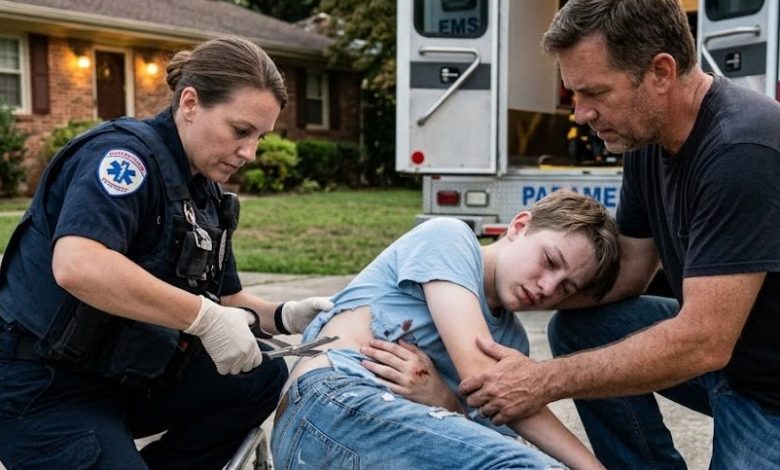
My son fled his grandfather’s house bleeding, without one shoe, and barely conscious. I found him curled beside our mailbox, one hand pressed against his ribs, his bare foot blackened with dirt.

The July evening was still warm, and a yellow supermarket coupon had caught on the crooked mailbox flag above him.
I dropped beside him and said his name.
Eli opened one eye. “Dad, lock the door.”
I didn’t ask who he thought was coming after him. I carried him inside, locked both entrances, shut the blinds, and called 911.
When the dispatcher asked who had hurt him, I gave her my father’s address and said nothing I couldn’t verify.
The paramedics arrived seven minutes later. They cut open Eli’s ripped shirt while I kept one hand against his arm, somewhere he could still feel me.
I ignored three calls from my father during the ambulance ride.
At 4:18 p.m., I answered the fourth and turned on the recorder.
My father sounded almost gentle.
“I’m concerned about both of you,” he said.
I looked at Eli on the stretcher. “Where is his other shoe?”
My father hesitated long enough for the ambulance doors to close behind us.
“Your son became disoriented and ran away.”
I saved the recording and followed Eli through the emergency-room doors.
The exam room smelled faintly of lemon disinfectant. A paper snowflake left over from winter still hung crooked above the sink while the doctor checked Eli’s pupils and ordered scans.
The results showed a concussion and two fractured ribs, but no bleeding inside his skull.
I asked the nurse to photograph every injury and seal his clothes in separate bags.
Then a hospital social worker walked in holding a tablet.
My father had already called.
He had reported me as unstable and claimed I had taken Eli during a mental health breakdown.
I handed her my phone and played the recorded call. Then I showed her the discharge papers from the trauma program I had completed sixteen months earlier.
I wasn’t going to deny my past. I wasn’t going to pretend it didn’t exist, either.
I asked her to document one thing carefully: who had contacted the hospital first, and exactly what my father had claimed before anyone outside that house knew Eli had survived.
My father called again while she was typing.
I put him on speaker.
“Explain exactly how Eli became confused,” I said.
“He was scared, and your brother tried to stop him from injuring himself,” my father replied.
I looked at the social worker.
“Then why was Eli’s blood found on the inside of the locked laundry-room window?”
The softness disappeared from my father’s voice.
Then my brother took the phone.
“We’re trying to prevent this family from ending up in court,” he said.
I stayed quiet, and he rushed to fill the space.
“Bring him back tonight, and all of this remains a misunderstanding.”
“No.”
My father came back on the line and lowered his voice.
“A judge will look at your file, your treatment, and every name you went by before you turned into this devoted father.”
And suddenly the shape of it was impossible to miss.
Their story had been prepared before Eli ever reached my mailbox.
In their version, my injured son was confused. My brother had been protecting him. I was unstable, unreliable, and too damaged by my own history to be believed.
But they had moved too early.
They had contacted the hospital before they could know what Eli had told anyone. They had already chosen the explanation before the scans were finished, before the photographs were taken, before anyone could ask why a frightened boy had climbed through a locked laundry-room window and run home without one shoe.
I ended the call and forwarded the recording to the social worker before my father could change another word.
Then Eli shifted beneath the hospital blanket and grabbed my sleeve.
PART 2
Eli’s fingers tightened around my sleeve, and I leaned close enough that he didn’t have to raise his voice.
“My shoe,” he whispered.
His eyes moved toward the social worker, then back to me. He was exhausted, frightened, and clearly hurting, so I didn’t push him for a full account. I asked one question at a time.
“Is the shoe still at Grandpa’s house?”
He nodded once.
I felt the social worker stop typing.
That missing shoe had sounded almost incidental when I challenged my father in the ambulance. Now it was one of the few physical pieces connecting Eli’s escape to the house my father was insisting had been safe.
I told Eli he did not have to explain anything else until he felt ready.
Then I asked the social worker to add his statement exactly as he had given it—no interpretation, no guesses, no attempt to make it fit either version of the story.
My phone buzzed again on the tray beside the bed.
This time it was my brother.
I didn’t answer.
A second message arrived almost immediately.
Bring him back and we can fix this privately.
I showed the screen to the social worker without touching anything else.
Her expression changed—not because the message proved every unanswered question, but because my family was still demanding that an injured child be returned to the same house before anyone had established what happened there.
Then Eli tugged my sleeve again and whispered something that changed what I thought the missing shoe meant.
Eli’s hand tightened around his father’s sleeve in the hospital bed as he whispered about the missing shoe that could connect his escape to the house where everything went wrong. His father had already recorded a call, saved the details, and watched his own family try to explain away an injured child before anyone had a chance to hear what really happened.
Only hours earlier, the evening had looked completely ordinary. The kind of evening where a parent expects a child to come home tired, maybe hungry, maybe ready to talk about something small that happened during the day. Instead, the first sign that something was wrong was a child appearing near the mailbox, barely able to stay conscious, with one shoe missing and his body showing signs that he had been through something terrifying.
The mailbox stood at the edge of the property, the same place where ordinary deliveries arrived and where neighbors might pass without noticing anything unusual. A yellow supermarket coupon had caught on the raised flag, moving slightly in the warm air. It was such a normal detail that it almost felt impossible that something frightening had happened just steps away from it.
Then the father saw Eli.
His son was curled beside the mailbox, one hand pressed against his ribs, his bare foot covered in dirt. He dropped down immediately and called his name. There was no time to think about explanations, family arguments, or old conflicts. There was only the reality in front of him: his child was hurt.
Eli opened one eye and said something that changed the entire situation.
He did not ask for a drink. He did not ask about his belongings. He did not explain what happened first.
He told his father to lock the door.
That sentence carried a fear that no parent wants to hear from their child. It was not a normal request. It was not a child being dramatic after a bad moment. It was a warning from someone who believed danger might still be coming.
His father carried him inside, secured both entrances, closed the blinds, and called for emergency help. When the dispatcher asked who had caused the injuries, he gave the address of his father’s house and carefully avoided saying anything he could not prove yet.
That choice mattered.
In a moment filled with anger and fear, he did not make the mistake of turning suspicion into certainty. He focused on getting Eli help and preserving the facts.
The ambulance arrived minutes later. Paramedics cut open Eli’s damaged shirt while his father stayed close, keeping a hand on him so he knew he was not alone. During the ride, the father ignored repeated calls from his own father.
Then one call finally came through.
At 4:18 p.m., he answered and turned on a recorder.
The voice on the other end sounded calm. Almost too calm.
The grandfather said he was concerned about both of them. He presented himself as someone worried about the situation, someone trying to help.
But the father was looking at his injured son and noticed the one thing that did not fit.
Where was Eli’s other shoe?
The question was simple, but the answer was not.
There was a pause before the grandfather explained that Eli had become confused and run away.
That explanation immediately raised more questions. A child with a concussion, fractured ribs, and one missing shoe had not simply wandered home without a reason. The story being offered did not match the physical reality.
At the hospital, doctors examined Eli and found a concussion along with two fractured ribs. Thankfully, there was no internal bleeding in his skull. The immediate danger had passed, but the questions had only started.
His father made a decision that showed he understood the importance of details. He asked the nurse to photograph every injury and preserve Eli’s clothing separately.
He knew emotions could be challenged. Memories could be questioned. But physical details created a timeline.
Then another unexpected move happened.
A hospital social worker entered with a tablet and explained that Eli’s grandfather had already contacted the hospital.
The report was not what anyone expected.
The grandfather claimed the father was unstable. He suggested that the father had taken Eli during a mental health crisis.
The accusation was designed to change the focus. Instead of asking what happened to Eli, the accusation asked whether Eli’s father could be trusted.
But the father did not panic.
He did not pretend his past did not exist. He had completed treatment sixteen months earlier, and he provided documentation showing that history. He understood something important: hiding a difficult chapter would only give someone else power to use it against him.
Instead, he asked the social worker to carefully document one fact.
Who contacted the hospital first?
And what exactly had been claimed before anyone outside the house knew Eli had survived?
That question exposed something deeply troubling. The family explanation seemed to exist before the full story was known.
The father’s concern was no longer only about what happened inside the grandfather’s home. It was also about how quickly people had prepared an explanation afterward.
Then another call came.
This time it was his brother.
The father placed the phone on speaker while the social worker listened.
His brother suggested they could prevent the family from ending up in court. He urged him to bring Eli back that night and treat everything as a misunderstanding.
But there was a problem with that request.
Eli was injured.
The facts were still being collected.
And the same people asking for privacy were also the people whose version of events needed to be examined.
The father refused.
That single word changed the conversation.
His brother became more urgent. He tried to frame the situation as something that could be solved quietly. He suggested that returning Eli would keep the family together.
But the father had already seen what happened when everyone rushed to protect the family image before protecting the child.
Then the grandfather returned to the call and lowered his voice.
He warned that a judge would look at the father’s past, his treatment, and every name he had used before becoming the person he was today.
It was a calculated attack.
The goal was clear: make the father doubt whether anyone would believe him.
But the father noticed something else.
Their story had been prepared too soon.
They had contacted the hospital before they could know exactly what Eli would say. They had created an explanation before medical results were complete. They had built a version of events before anyone asked why a frightened boy had climbed through a locked laundry-room window and escaped with one shoe missing.
The timing itself became a question.
Why did they already have an answer?
Why were they explaining Eli’s behavior before anyone had heard Eli’s voice?
The father ended the call and sent the recording to the social worker.
He was not trying to win an argument.
He was trying to protect the truth long enough for his son to be heard.
Then Eli moved beneath the hospital blanket.
His father leaned closer.
The missing shoe that had seemed like a small detail suddenly felt much larger.
It was not just a lost piece of clothing.
It was something left behind at the place where Eli had escaped from.
It was a physical connection to the story everyone was trying to explain.
When Eli finally whispered about the shoe, his father understood that pushing for answers too quickly could hurt more than help. His son had been through enough. The goal was not to force every detail out immediately. The goal was to let him speak when he was ready.
The father asked only one careful question.
Was the shoe still at Grandpa’s house?
Eli gave a small nod.
The social worker stopped typing for a moment.
That tiny response changed the meaning of everything around them.
The missing shoe was no longer just a detail from a frightening night. It was a possible piece of the timeline. It connected Eli’s escape, the location, and the explanation that had been offered before the truth was known.
The father asked that Eli’s statement be recorded exactly as he said it. No assumptions. No added interpretation. No effort to make it fit someone else’s version.
Then the phone buzzed again.
Another message from his brother appeared.
Bring him back and we can fix this privately.
The father did not reply.
He simply showed the message to the social worker.
The situation had moved beyond a family disagreement. A child was injured, and people were still trying to control where he went before anyone had established what happened.
Eli then pulled his father’s sleeve again and whispered something else about the shoe.
And that small missing object began to represent something much bigger.
It represented the part of the story that could not be rewritten.
Because people can argue about intentions. They can argue about memories. They can argue about who seems believable.
But sometimes one ordinary object tells a story everyone else is trying to avoid.
For Eli’s father, the next step was not revenge. It was documentation, patience, and making sure his son was finally given the chance to tell what happened in his own words.
The family had already chosen their explanation.
Now they had to face the possibility that the evidence had chosen another one.
THE END STORIES! THANK YOU FOR READING GOOD LUCK !❤️
Related Posts


