
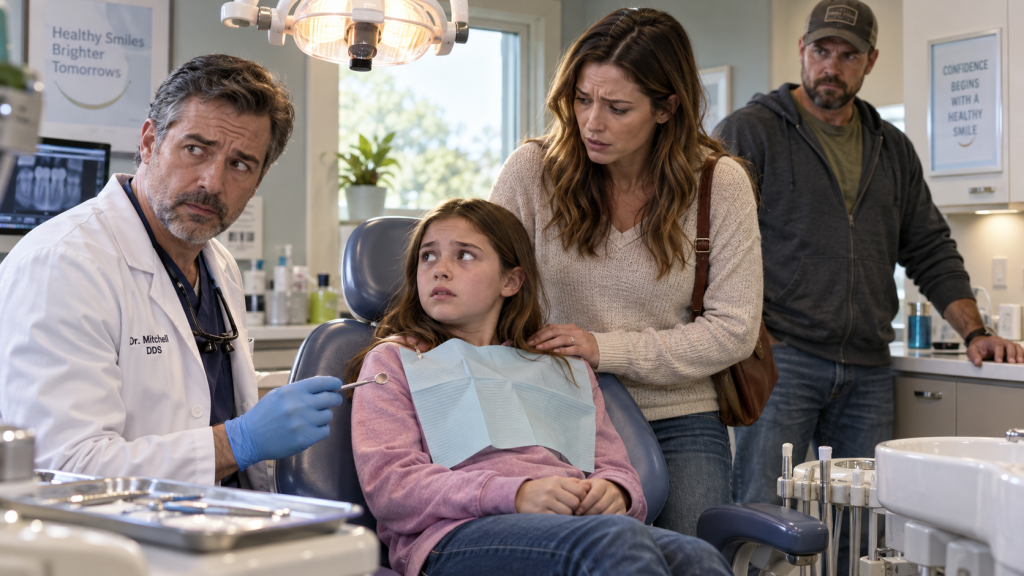
My ten-year-old daughter complained that her tooth hurt, so I arranged to take her to the dentist like any responsible mother would. Then, out of nowhere, my husband suddenly insisted on coming with us. During the appointment, the dentist kept throwing him these strange,
uneasy glances that made my stomach twist. As we were leaving, the doctor quietly slipped something into the pocket of my coat. Later, when I read it alone at home, my hands began trembling so badly I could barely breathe, and I drove straight to the police station.
The first time Chloe mentioned the toothache, it felt like the most ordinary thing in the world.
“Mom, this one hurts when I chew,” Chloe said, standing barefoot on the kitchen tiles in her school uniform, pointing carefully toward the back left side of her mouth.
She was only ten years old, the type of child who could complain dramatically about homework, leave her dirty socks scattered in places no one expected, and still try to act tough when real pain showed up because she hated the idea of going to a doctor. So when she mentioned that same toothache for the second time that week, I did not panic. I simply did what any mother in our quiet Chicago suburb would have done. I called our family dentist and booked the earliest appointment they had for Saturday morning.
It should have been a quick, boring errand.
It turned into something else entirely.
The moment I told my husband, Mark, about Chloe’s dentist appointment, he looked up from his phone so fast it felt unnatural.
“I’m coming with you,” he said.
I frowned at him. “You really don’t have to.”
“I want to go.”
On the surface, there was nothing wrong with that. Fathers go to dental appointments. Stepfathers show concern. Husbands offer to help. Ordinary men do ordinary decent things every day. But Mark had never once shown interest in any dentist visit before. He avoided his own cleanings for years, and once joked that he would rather use a pair of pliers in the garage than sit in a dental waiting room under those cold lights.
And now, without warning, he wanted to come with Chloe.
“It’s just a routine checkup,” I told him, trying to sound calm, even though something small and cold had already begun moving inside my chest.
He smiled at me, but the expression stopped before it reached his eyes.
“Exactly. There’s no reason why I shouldn’t be there.”
I told myself not to make a problem out of nothing.
The truth was, I had been telling myself that for a long time. I told myself not to overthink the way Chloe went stiff whenever Mark entered a room suddenly. I told myself not to wonder why she had stopped asking him for help with her math homework, even though she once brought him her notebook without hesitation. I told myself not to attach too much meaning to the locked bathroom door, even when she locked it every single time, even if she was only brushing her teeth before bed. I had become dangerously good at creating innocent explanations, because explanations are softer than fear.
She was still adjusting.
She was moody.
She was becoming a preteen.
She was struggling with a blended family.
Mark and I had been married for only two years. He was not Chloe’s biological father. Her real father had died when she was six, and after years of carrying everything alone, I think I had mistaken Mark’s patience for safety. He was always polite, always helpful, always perfectly attentive when other people were around. He remembered Chloe’s teachers’ names, repaired broken things around the house, smiled at neighbors, and seemed to understand exactly how to appear dependable.
For a long time, that image stayed untouched.
On Saturday morning, the dental clinic smelled strongly of peppermint polish, disinfectant, and old magazines no one really read anymore. Chloe sat right next to me, flipping through a worn puzzle book without solving a single page, while Mark stood near the lobby fish tank with his hands pushed deep into his pockets, watching us in a way that made me suddenly aware of every breath I took.
Dr. Evans had been Chloe’s dentist since kindergarten. He was a gentle man in his late fifties, calm in the sort of way that made frightened children trust him. Usually, the moment Chloe saw him, her shoulders loosened and her nervousness melted.
But not that morning.
When the hygienist called Chloe’s name, my daughter looked at me first.
Then her eyes moved slowly toward Mark.
Mark immediately looked back at me.
“I’ll go back with you, honey,” I said, already starting to rise from my chair.
Before I could even fully stand, Mark answered for both of us.
“Let’s both go.”
The exam room was painfully bright and uncomfortably cold, every surface shining too clean beneath the white lights. Chloe climbed into the leather chair, small and tense, while Dr. Evans began asking his usual gentle questions. How long had the tooth been hurting? Did hot drinks bother it? Did cold water make it worse? Did the pain throb when she chewed? Chloe answered in soft, barely audible words. Mark stayed near the counter, hovering too close for a man who claimed he was only there to support her, and when Dr. Evans looked at him again, something dark and silent passed across the doctor’s face..
PART 2 — THE NOTE IN MY COAT POCKET
When Dr. Evans looked at Mark again, something dark and silent passed across the doctor’s face.
It lasted barely a second.
Then his expression softened before he turned back toward Chloe.
“All right,” he said gently. “Let’s take a picture of that tooth and see what it’s trying to tell us.”
Chloe nodded.
Mark stepped closer.
“What kind of picture?”
“Dental X-ray.”
“I know what an X-ray is.”
The sharpness in his voice surprised even him.
I saw it.
So did Dr. Evans.
Mark immediately smiled.
“I just mean, is that really necessary?”
Dr. Evans studied him.
“Yes.”
One word.
Calm.
Professional.
Final.
Mark’s jaw tightened.
The hygienist helped position Chloe.
“Parents can wait outside for this part,” she said.
“I’ll stay.”
Mark answered immediately.
The hygienist looked toward Dr. Evans.
Something passed between them.
“Actually,” Dr. Evans said, “we need the room clear for the image.”
Mark crossed his arms.
“Her mother can stay?”
“No.”
“Then I’m staying too.”
Dr. Evans did not argue.
He simply removed his gloves.
“Then we don’t take the X-ray.”
The room became still.
Mark stared at him.
“What?”
“We can wait until you’re comfortable following clinic procedure.”
His tone never changed.
That was what made Mark eventually step back.
People like Mark did well against nervous people.
Against uncertain people.
Against people who apologized while setting boundaries.
Dr. Evans gave him nothing to push against.
Mark looked at me.
“Come on.”
I followed him into the hallway.
Before the door closed, Chloe looked at me.
Not frightened exactly.
Something worse.
Pleading.
I almost opened the door again.
Then Mark placed his hand against my back.
Not hard.
Just enough to guide me away.
I remember thinking how normal the gesture would have looked to anyone else.
That thought became important later.
We waited less than five minutes.
Mark paced.
I sat.
Neither of us spoke.
Then the door opened.
The hygienist emerged.
“You can come back.”
Mark moved first.
I followed.
Chloe sat upright now.
Dr. Evans was studying the X-ray on a monitor.
His face was serious.
“What is it?” I asked.
He enlarged the image.
“The painful tooth has a fracture.”
My stomach tightened.
“A cavity?”
“No.”
He pointed.
“The tooth itself has been damaged.”
“How?”
Chloe looked down.
Mark answered.
“She fell.”
I turned toward him.
“What?”
He shrugged.
“You know how kids are.”
I stared.
“When did Chloe fall?”
He looked at me.
Then at her.
“A few weeks ago.”
Chloe’s shoulders rose slightly.
I felt something cold move through my chest.
“Chloe never told me she fell.”
Mark laughed softly.
“Because it wasn’t a big deal.”
I looked at my daughter.
“Chloe?”
She would not look at me.
Dr. Evans removed his glasses.
“Chloe, sweetheart, do you remember hurting your mouth?”
Mark answered again.
“She hit the bathroom sink.”
Dr. Evans looked at him.
“I asked Chloe.”
Mark’s face changed.
Only slightly.
But I saw it.
The polite stepfather disappeared for half a second.
Something harder appeared underneath.
Chloe whispered:
“I don’t remember.”
“You don’t remember falling?”
She shook her head.
Mark stepped closer.
“She’s embarrassed.”
Dr. Evans stood.
“I’d like to speak with Chloe privately for a few minutes.”
Mark gave a short laugh.
“No.”
My heart began beating faster.
Dr. Evans did not look away from him.
“It is common for me to speak privately with older children for portions of an appointment.”
“She’s ten.”
“Yes.”
“She doesn’t need privacy from her parents.”
Something about the word parents bothered me.
Mark had earned the right to call himself Chloe’s family because I had trusted him.
Suddenly the title sounded like a door I had handed him a key to.
Dr. Evans glanced toward me.
“Mrs. Carter?”
For one terrible second, I almost agreed with Mark.
Not because I thought Dr. Evans was wrong.
Because disagreeing with Mark in public had become something I avoided without realizing it.
He would not scream there.
He would wait.
Then later, at home, he would become quiet.
Withdraw affection.
Make comments.
Ask why I always embarrassed him.
Tell me I had made him look stupid.
And somehow, by the end, I would apologize.
That entire process flashed through my mind in one breath.
Then I looked at Chloe.
Her hands were gripping the sides of the dental chair.
“Of course,” I said.
Mark turned toward me.
“What?”
“I said of course.”
His expression hardened.
“Sarah.”
It was only my name.
But I knew the warning inside it.
I pretended not to.
“Dr. Evans has treated Chloe for five years.”
“I trust him.”
Mark smiled without warmth.
“Interesting.”
Dr. Evans stepped toward the doorway.
“If you’ll both wait outside.”
I walked first.
Mark followed.
The door closed.
This time, he did not touch my back.
We waited twelve minutes.
I counted.
Mark did not sit.
He stood near the window with both hands in his pockets.
“What do you think she’s saying?”
I looked up.
“What?”
“To him.”
“About her tooth?”
He gave me a look.
“What else?”
My stomach tightened.
“I don’t know.”
Mark walked closer.
“You know how Chloe gets.”
I stared at him.
“How does Chloe get?”
“Dramatic.”
The word landed badly.
“She exaggerates.”
“When?”
He sighed.
“Come on, Sarah.”
“No.”
I stood.
“When does she exaggerate?”
He looked irritated.
“She’ll say someone yelled when they raised their voice.”
“She’ll say something hurt when she barely got touched.”
My pulse changed.
“Barely got touched?”
Mark froze.
Not visibly enough for a stranger.
Enough for me.
“What does that mean?”
“Nothing.”
“No.”
I stepped closer.
“You said she says things hurt when she barely gets touched.”
“I’m talking generally.”
“Generally about what?”
His jaw flexed.
“Sarah, do not start this here.”
There.
Not:
You misunderstood.
Not:
I would never hurt her.
Do not start this here.
I suddenly remembered every time Chloe went quiet at dinner when Mark entered.
Every locked bathroom door.
Every afternoon she asked whether Mark would be home before deciding whether to invite a friend over.
Every time I told myself she was adjusting.
The waiting room seemed to shrink around me.
Then the exam-room door opened.
Chloe stepped out.
Her face was pale.
Dr. Evans stood behind her.
“Sarah, can I speak with you for just a minute?”
Mark stepped forward.
“About what?”
“The treatment plan.”
“I’ll come.”
Dr. Evans looked at him.
“Actually, I need Sarah to sign a consent form.”
“I’m her husband.”
“Sarah is listed as Chloe’s legal guardian.”
That was technically true.
And suddenly enormously important.
Mark’s mouth tightened.
I followed Dr. Evans back into the room.
He closed the door.
Chloe was already sitting beside the hygienist.
I looked at her.
“What happened?”
Dr. Evans held up one hand.
“First, the tooth needs treatment.”
“Is she okay?”
“She is not in immediate medical danger.”
Immediate.
The word frightened me.
“What does that mean?”
He spoke carefully.
“The fracture pattern is not consistent with normal decay.”
“What caused it?”
“Trauma.”
My knees weakened.
“What kind of trauma?”
“An impact.”
I looked at Chloe.
Her eyes filled.
“Baby?”
She stared at the floor.
I moved toward her.
She flinched.
Not away from me.
From movement.
That difference broke something inside me.
I stopped.
Then crouched instead.
“Chloe.”
Her chin trembled.
Before she could speak, someone knocked.
Mark.
“Sarah?”
Dr. Evans’s face hardened.
He turned toward the hygienist.
“Could you take Chloe to Room Three?”
She nodded.
Chloe stood.
I wanted to ask why.
Then Dr. Evans said quietly:
“There’s a rear hallway.”
I understood.
Not completely.
Enough.
The hygienist took Chloe’s hand.
My daughter looked back at me.
“Mom?”
“I’m right here.”
The words came automatically.
But even as I said them, shame struck me.
Had I been?
Really?
Had I been right there?
Or had I been standing ten feet away explaining away every sign because the alternative frightened me?
The door closed behind Chloe.
Dr. Evans looked at me.
Then toward the main hallway.
He lowered his voice.
“I need you to listen carefully.”
My heartbeat thundered.
“Has Chloe had any other injuries recently?”
“No.”
“Bruises?”
“Kids get bruises.”
“Unexplained ones.”
I thought of one on her upper arm.
She said gym class.
Another near her shoulder.
She said she hit a door.
A faint mark beneath her chin two months earlier.
She told me she scratched herself sleeping.
My stomach turned.
“I don’t know.”
Dr. Evans nodded.
“When I examined Chloe’s mouth, I saw evidence of more than one episode of trauma.”
I stopped breathing.
“What?”
“The fractured tooth is newer.”
“There is also healed tissue along the inside of her cheek and an older injury to another tooth.”
My vision blurred.
“No.”
I whispered it because saying anything else would have made it real.
“No.”
“Sarah.”
“She would have told me.”
His expression changed.
Not judgment.
Compassion.
That was somehow worse.
“Children often don’t.”
I covered my mouth.
Outside, Mark knocked again.
Harder.
“Sarah.”
Dr. Evans looked toward the door.
Then back at me.
“I asked Chloe whether she feels safe at home.”
I could barely speak.
“What did she say?”
His eyes held mine.
“She asked whether I would tell Mark.”
The room tilted.
I caught the edge of the counter.
Dr. Evans continued.
“She did not make a detailed disclosure to me.”
“But she became extremely distressed when I asked whether anyone had ever hurt her mouth.”
Tears ran down my face.
“What does that mean?”
“It means I am concerned enough that I am following safeguarding procedure.”
My heart pounded.
“Police?”
“Child protective services.”
“I have a legal obligation to report concerns involving possible abuse.”
I closed my eyes.
The word.
Abuse.
Suddenly there it was.
Not moodiness.
Not adjustment.
Not blended-family tension.
Abuse.
“Was it Mark?”
Dr. Evans answered carefully.
“I am not going to put words into Chloe’s mouth.”
I nodded.
Facts.
Even now.
Good.
I needed that.
“But I strongly recommend you do not leave here assuming everything is normal.”
Another knock.
Then Mark’s voice:
“What the hell is taking so long?”
Dr. Evans moved toward the door.
Before opening it, he said:
“Do you have somewhere safe you and Chloe can go?”
My lips trembled.
“My sister.”
“Does Mark know where she lives?”
“Yes.”
“Anyone else?”
I thought.
“My mother.”
“Does he know?”
“Yes.”
Then I remembered a friend from work.
Nina.
Different suburb.
Mark had never met her husband.
He probably did not know their address.
“Yes.”
Dr. Evans nodded.
“Good.”
Then he opened the door.
Mark stood there.
Smiling again.
Of course.
“What’s the plan?”
Dr. Evans’s expression became perfectly professional.
“We’ll need to schedule restorative treatment.”
“That’s it?”
“For the tooth, yes.”
Mark looked at me.
My face must have betrayed something.
“What happened?”
“Nothing.”
The lie came out before I chose it.
His eyes narrowed.
“You’ve been crying.”
“I’m overwhelmed.”
That was true.
The best lies contain enough truth to breathe.
Mark stepped closer.
“Over a tooth?”
I looked down.
“I’m tired.”
For once, he accepted it.
Maybe because it fit the version of me he preferred.
Emotional.
Fragile.
Easy to explain.
Chloe reappeared with the hygienist.
Mark smiled at her.
“Ready to go home?”
Chloe froze.
Dr. Evans saw it.
So did I.
This time, I did not explain it away.
“No,” I said.
Mark turned.
“What?”
“We’re going to stop somewhere first.”
“Where?”
“Pharmacy.”
“Why?”
“Pain medicine.”
Dr. Evans answered before Mark could argue.
“That would be sensible.”
Mark looked between us.
I could feel him trying to understand what had changed.
Then he smiled.
“All right.”
He placed his hand on Chloe’s shoulder.
She recoiled.
Tiny.
Almost invisible.
But I saw it.
For the first time, I saw everything.
We reached the parking lot.
Mark unlocked the car.
“I’ll drive.”
I stopped.
“I have my car.”
He frowned.
“We came together.”
No.
We hadn’t.
That morning Mark had insisted on following because he said he might need to go to the office afterward.
My car was two rows over.
A small accident of logistics.
Suddenly it felt like a gift.
“I’ll take Chloe.”
He stared at me.
“Why?”
“I need to pick up groceries too.”
“I’ll come.”
“No.”
The word surprised both of us.
His face changed.
“Sarah.”
“I said no.”
Chloe stood beside me, very still.
Mark looked at her.
Then back at me.
For a second, I thought he would argue.
Instead, he laughed.
“Fine.”
He kissed my cheek.
I flinched.
He noticed.
Then he crouched slightly toward Chloe.
“See you at home, kiddo.”
She said nothing.
His smile remained.
But the muscles around his eyes hardened.
He walked away.
I waited until his SUV left the parking lot.
Then I got Chloe into my car.
I almost drove directly to Nina’s.
Instead, something caught against my hip when I sat.
Paper.
I reached into my coat pocket.
A folded note.
Dr. Evans.
I opened it.
My hands began shaking before I reached the second line.
Sarah — please do not show this to Mark.
Chloe told the hygienist privately that the injury happened when Mark grabbed her face and shoved her after she refused to give him her phone. She said this has happened before. She is terrified he will punish her if he knows she spoke.
I stopped reading.
The words blurred.
I looked at Chloe through the rearview mirror.
She was staring out the window.
Ten years old.
My baby.
My funny, stubborn child who still slept with the stuffed rabbit her father bought her before he died.
I forced myself to continue.
She also said Mark told her no one would believe her because he “takes care of everything” and because you would choose him.
My breath left my body.
I made a sound.
Something between a sob and a gasp.
Chloe turned.
“Mom?”
I folded the note.
She saw my face.
Everything in hers collapsed.
“You know.”
Three words.
Not a question.
My daughter had been carrying the truth while waiting for the day I would finally see it.
I pulled the car into an empty corner of the lot.
Turned off the engine.
Then turned toward her.
“Chloe.”
She began crying.
Not loudly.
Her whole body simply folded inward.
“I’m sorry.”
The words shattered me.
“For what?”
“I didn’t mean to tell.”
“No.”
I unbuckled myself and climbed into the back seat beside her.
She immediately moved away.
Then realized it was me.
And broke.
I held out my hands.
Did not touch her.
“Can I hug you?”
She nodded.
I pulled her into my arms.
She sobbed against my chest.
“I’m sorry.”
“No.”
“I’m sorry, baby.”
“I’m the one who’s sorry.”
Her body shook.
“He said you’d be mad.”
“I’m not.”
“He said you’d think I was lying.”
“I don’t.”
“He said you loved him.”
I closed my eyes.
“I did.”
She cried harder.
“But I love you more than I love keeping any marriage.”
That sentence came from somewhere below thought.
Somewhere honest.
She lifted her face.
“Are we going home?”
“No.”
Immediate.
Certain.
“No.”
“What about my stuff?”
“We can replace stuff.”
“Bunny?”
That broke me again.
The rabbit.
Her father’s rabbit.
The last toy he bought her.
Of course she would think of that.
“We will get Bunny safely.”
“How?”
“I don’t know yet.”
That was the first time I told her the truth without pretending certainty.
“But you are not going back there with Mark.”
She stared at me.
“Promise?”
I held her face between my hands as gently as I could.
“I promise.”
I drove to the police station.
Not home.
Not Nina’s.
Police.
My hands shook the entire way.
Chloe kept asking whether she was in trouble.
Every time, I answered:
“No.”
At the station, I showed the desk officer Dr. Evans’s note.
I could barely speak.
Everything moved quickly after that.
Not dramatically.
No sirens.
No shouting.
A quiet room.
A female detective.
A child advocate.
Water in paper cups.
Questions I was not allowed to answer for Chloe.
That part hurt.
I wanted to fill every silence.
Explain.
Protect.
Translate.
But the detective gently stopped me.
“We need Chloe’s words.”
So I sat outside while my daughter spoke.
That was one of the longest hours of my life.
I stared at my hands.
My wedding ring.
Mark chose it.
Simple gold.
He said large stones looked insecure.
I used to think that was thoughtful.
Suddenly everything he had ever said seemed to require reexamination.
I took the ring off.
Put it in my purse.
Then waited.
When Detective Ruiz finally came out, her expression told me enough.
She sat across from me.
“Sarah, Chloe described multiple incidents.”
My eyes filled.
I could not speak.
“She says Mark has grabbed her arms.”
“Shoved her.”
“Struck her across the mouth once.”
My stomach turned.
“Recently?”
“The tooth injury appears connected to an incident approximately ten days ago.”
Ten days.
I was home.
Somewhere in the same house.
“How?”
The detective paused.
“Chloe says he demanded her phone because she was texting a friend after bedtime.”
“She refused.”
“He grabbed her jaw.”
“She pulled away.”
“He pushed her.”
“She hit the edge of the bathroom counter.”
I covered my face.
The bathroom.
The locked door.
Of course.
That room had not been privacy.
It had been refuge.
I thought I might be sick.
“Why didn’t she scream?”
Detective Ruiz’s expression softened.
“She said she did once, earlier.”
My head lifted.
“What happened?”
“She said Mark told her you were asleep.”
“Then the next morning he said if she ever tried to ‘turn you against him,’ he would send her away to live with relatives.”
I stared.
“What relatives?”
“She doesn’t know.”
My daughter had no close relatives besides my sister and mother.
It was not a realistic threat.
It did not need to be.
She was ten.
Adults controlled addresses.
Cars.
Schools.
Doors.
To a child, I’ll send you away can sound like law.
Detective Ruiz continued.
“She also said he told her you were tired of raising her alone.”
“No.”
My voice broke.
“No.”
“I know.”
“He said that?”
“Yes.”
I started crying.
The cruelty of it stunned me.
Not just hurting her.
Separating her from the one person she might tell.
Convincing her my love had conditions.
“He told her…”
I could barely say it.
“That I was tired of her?”
“Yes.”
Something inside me changed.
Until that moment, part of my grief still belonged to the marriage.
To Mark.
To the man I thought I knew.
That sentence burned most of it away.
There are betrayals against a spouse.
Then there are betrayals committed using a child’s trust as the weapon.
I would never see him the same way again.
“What happens now?”
I asked.
Detective Ruiz explained.
Reports.
Documentation.
Safeguarding.
Possible protective orders.
Child welfare involvement.
She did not promise an arrest that minute.
She did not promise a particular criminal charge.
Evidence mattered.
Interviews mattered.
Dr. Evans’s records mattered.
Chloe’s statement mattered.
The process would move.
Not at the speed my fear wanted.
But it would move.
“Can I take her?”
“Yes.”
“Where?”
“Somewhere Mark cannot access.”
I thought of Nina.
“Friend.”
“Good.”
“Do not return home alone.”
“I need Chloe’s rabbit.”
The detective almost smiled.
“Then we’ll work out a safe property retrieval.”
I cried again.
Because that was the kindest sentence anyone could have given me.
Bunny would be handled like evidence of a life worth preserving.
Not childish nonsense.
Important.
I called Nina.
She answered:
“Hey, stranger.”
Then heard my voice.
“What happened?”
I said:
“I need somewhere Mark doesn’t know.”
No questions.
No hesitation.
“Come.”
That was all.
Come.
Some words become doors when spoken by the right person.
Mark called before we left the police station.
Twenty-eight times.
Texts followed.
Where are you?
Why aren’t you answering?
Sarah, stop being ridiculous.
Then:
Is Chloe with you?
Then:
What did that dentist say?
My blood went cold.
He knew.
Not details.
Enough.
Another:
Do not let her lie to you.
I stared at the message.
There it was.
His defense before accusation.
Another:
She’s angry because I disciplined her. She has been trying to cause problems between us for months.
I took screenshots.
Detective Ruiz told me not to engage.
Then Mark sent:
Come home and we’ll discuss this like adults.
I almost laughed.
Because Chloe had been waiting for adults to behave like adults for months.
Apparently discussion became important only after secrecy failed.
I did not reply.
Nina lived forty minutes away.
Chloe slept during the drive.
Really slept.
Her head against the window.
Mouth slightly open.
I kept glancing back.
For months, I thought my daughter had become difficult.
Withdrawn.
Moody.
Maybe she had simply been exhausted from being vigilant.
That realization hurt in ways I did not have language for.
When we reached Nina’s house, she ran outside barefoot.
I barely got out of the car before she hugged me.
Then she saw Chloe.
Her face changed.
Nina did not ask anything in front of her.
“Guest room’s ready.”
She looked at Chloe.
“I have hot chocolate.”
Chloe almost smiled.
“With marshmallows?”
“Illegal amounts.”
That tiny smile nearly destroyed me.
That night, Chloe slept in Nina’s daughter’s old room.
I sat on the floor beside the bed until she fell asleep.
At one point, she opened her eyes.
“Mom?”
“Yes?”
“Are you going back to Mark?”
“No.”
“Even if he says sorry?”
My throat closed.
“No.”
“Even if Grandma says you should?”
I froze.
“Grandma?”
She looked away.
“His mom.”
“What about her?”
Chloe shrugged.
“Nothing.”
I sat straighter.
“Chloe.”
She began picking at the blanket.
“Mark said if I told you, Grandma Helen would tell you I was making it up.”
My heart pounded.
“Did Helen ever say that to you?”
Chloe hesitated.
“Yes.”
Everything inside me stopped.
“When?”
“Christmas.”
I remembered Christmas.
Mark’s mother Helen had stayed with us five days.
Chloe had been unusually quiet.
I blamed grief.
Her biological father always made the holidays complicated emotionally.
“What happened?”
Chloe whispered:
“Mark grabbed my arm in the garage.”
“Grandma saw.”
My skin went cold.
“What did she do?”
“She told him to calm down.”
Relief flashed.
Then died.
“And later she told me…”
Chloe’s voice became tiny.
“She said men get frustrated and I shouldn’t make things worse.”
I could barely breathe.
“What else?”
“She said you were finally happy again.”
I closed my eyes.
“Did she tell you not to tell me?”
Chloe nodded.
“She said it would break your heart.”
That sentence nearly did.
Not because Helen had protected her son.
Because she had recruited my child into protecting my marriage.
A ten-year-old.
Hurt.
Afraid.
And the adult witness told her the real emergency was my happiness.
I leaned over the bed.
“Chloe.”
She looked at me.
“You were never responsible for protecting my marriage.”
Tears filled her eyes.
“Never.”
“My feelings are grown-up responsibilities.”
“Your job was to be safe.”
She started crying.
“I wasn’t.”
“No.”
I kissed her forehead.
“You should have been.”
And then I said the hardest sentence I had ever said to my child.
“I failed to see that.”
She shook her head.
“Mark was nice when you were there.”
I cried.
Of course he was.
Children understand concealment better than adults sometimes.
“He tricked me.”
“Yes.”
“But I am listening now.”
She reached for my hand.
That was all she asked from me.
Not perfection.
Not a time machine.
Listening now.
The next morning, Detective Ruiz called.
They had spoken with Dr. Evans.
Obtained records.
Started coordinating with child protective services.
Mark had also contacted police himself.
That surprised me.
“What did he say?”
“He claims Chloe is lying because he recently restricted her phone.”
Of course.
“He says you are highly emotional and being manipulated by your daughter.”
I laughed.
Not because it was funny.
Because predictable things become less frightening once you can name them.
“Anything else?”
“He claims he has never struck her.”
“What about grabbing her?”
“He describes any contact as reasonable discipline or efforts to stop her from acting out.”
I closed my eyes.
Reasonable.
The word adults use when they want the force they chose to sound inevitable.
Then Ruiz said:
“We conducted a welfare-related visit to the residence.”
My heart jumped.
“Did you get Bunny?”
A pause.
Then she laughed softly.
“Yes.”
I almost cried from relief.
“But we also observed something we need to discuss.”
My stomach tightened.
“What?”
“There’s a lock on Chloe’s bedroom door.”
“Yes.”
“She locks it.”
“No.”
Ruiz’s voice changed.
“The lock is on the outside.”
I stopped breathing.
“What?”
“There is an exterior slide bolt positioned high on the frame.”
My entire body went cold.
“That wasn’t there.”
“When did you last notice the door closely?”
“I don’t know.”
I saw Chloe’s room in my mind.
Pink quilt.
Desk.
Books.
The door usually open when I came in.
Would I have noticed a small bolt above eye level?
Maybe.
Maybe not.
“What did Mark say?”
“That it was installed because Chloe sleepwalks.”
I stared into nothing.
Chloe had never sleepwalked in her life.
“Sarah?”
“He’s lying.”
Then Ruiz said:
“There’s more.”
I gripped the phone.
They had found a small notebook in Mark’s desk.
Nothing illegal by itself.
Nothing dramatic.
But its contents mattered.
Dates.
Times.
Chloe’s name repeated over and over.
Disrespectful.
Door slammed.
Phone withheld.
Talked back.
Ignored instruction.
Then punishments.
No television.
No dessert.
Phone removed.
Bedroom restriction.
And beside several dates, one phrase repeated:
Sarah not informed.
My hands began trembling.
He had documented it.
Not the violence.
The concealment.
A private system of rules he enforced while I thought we were raising Chloe together.
Detective Ruiz continued.
“One date corresponds to the week before the dental injury.”
I could barely speak.
“What does it say?”
She paused.
Then read:
Refused phone surrender. Escalated. Sarah not informed.
I closed my eyes.
Escalated.
One word.
My daughter’s fractured tooth hidden inside a euphemism.
Then Ruiz said:
“There is another name in the notebook.”
My eyes opened.
“What name?”
“Helen.”
Mark’s mother.
My stomach dropped.
“What about her?”
“Several entries say things like, ‘Discussed with Mom’ and ‘Mom agrees Sarah should not know until Chloe settles down.’”
I stopped breathing properly.
Helen had not simply witnessed one incident.
She knew there was a system.
Maybe not every act.
Enough.
“Can I see the notebook?”
“Eventually through the proper process.”
I nodded even though she could not see me.
Then another thought hit.
“Why keep records?”
Ruiz was silent for a moment.
“We don’t know yet.”
That answer frightened me.
Facts.
Not theories.
Still, my mind raced.
Control.
Proof.
A narrative.
Then Chloe appeared in the doorway.
Hair messy.
Holding Bunny.
Nina must have brought it up after police delivered our belongings.
My daughter smiled.
A real smile.
Tiny.
But real.
“Look.”
She held the rabbit up.
“They got him.”
I covered my mouth.
Detective Ruiz heard me crying.
“Sarah?”
“I’m okay.”
Then I looked at Chloe.
No.
Better.
“I’m getting there.”
After I hung up, Chloe climbed onto the couch beside me.
“What did the police say?”
I hesitated.
Then decided on truth sized for ten years old.
“They found some things that show Mark was keeping secrets from me.”
She looked down.
“About me?”
“Yes.”
“Am I in trouble?”
“No.”
She leaned against my shoulder.
After a while, she whispered:
“He has a camera.”
My entire body went still.
“What?”
She looked up.
“In the hallway.”
Relief and fear collided.
“Hallway camera?”
She nodded.
“He said it was for security.”
I remembered it.
A small home-security camera facing the upstairs landing.
Mark installed it after a package theft.
I never questioned why one camera faced inside.
“What about it?”
Chloe looked scared again.
“He checks it.”
“When?”
“When you’re at work.”
My stomach tightened.
“What does he check?”
“If I leave my room.”
I stared at her.
The outside lock.
The notebook.
The hallway camera.
Not one angry moment.
A system.
“What happened if you left?”
She looked away.
“Depends.”
I did not push.
Not then.
There would be trained people for questions.
I was learning that love does not mean extracting every truth immediately.
Sometimes love means leaving space for truth to arrive safely.
I kissed the top of her head.
“Thank you for telling me.”
She held Bunny closer.
Then asked:
“Mom?”
“Yes?”
“Why did he write things down?”
I looked at the closed curtains.
At my phone.
At the police station card on the table.
“I don’t know yet.”
But that afternoon, Vanessa Hale, the family-law attorney Nina recommended, called me after reviewing the first documents.
She asked one question that made my stomach drop.
“Sarah, has Mark ever talked about adopting Chloe?”
I stopped.
“Yes.”
“When?”
“Several times.”
“Did you agree?”
“No.”
“Why not?”
“Because Chloe didn’t want to change her last name.”
“And?”
“I told him there was no rush.”
Vanessa became quiet.
Then:
“Has he ever suggested you are overwhelmed as a parent?”
I thought.
More than once.
You’re too soft.
You let Chloe control the house.
You need me because you feel guilty about her father dying.
My hands turned cold.
“Yes.”
Vanessa exhaled.
“Then do not panic, but preserve everything.”
“Why?”
“I’m not saying this notebook was created for court.”
“But detailed behavioral logs, claims that one parent is uninformed, and records of ‘discipline problems’ can sometimes be used to build a narrative about a child or caregiver.”
My heart pounded.
“What narrative?”
“That Chloe was difficult.”
“That Mark was the stable disciplinarian.”
“That you did not have control.”
I stood.
“No.”
“I know.”
“He hurt her.”
“I know what you’re alleging.”
“No.”
My voice cracked.
“You don’t understand.”
“He was writing down her reactions after he frightened her.”
“And making the reactions look like the problem.”
Vanessa became silent.
Because that was exactly it.
He could shove her.
Then write:
Door slammed.
He could threaten her.
Then write:
Defiant.
He could frighten her into hiding.
Then write:
Bedroom restriction.
Remove the cause.
Document the response.
And suddenly the child becomes the story.
I sat down hard.
“Why?”
Vanessa answered carefully.
“We do not know.”
Again.
Facts.
But I remembered something.
Three months earlier, Mark had asked whether I had updated my will after our marriage.
I told him no.
He looked annoyed.
Said blended families became messy when paperwork was neglected.
At the time, I thought it was practical.
Now every practical conversation felt contaminated.
Then Nina came into the room carrying the mail.
One envelope was addressed to me.
Forwarded from home.
Legal office.
I opened it.
Inside was a copy of a document Mark had apparently requested six weeks earlier.
A consultation summary.
Family law.
Step-parent adoption.
Guardianship.
And one sentence under Client Concerns made my hands go numb.
Client reports spouse may be emotionally overattached to minor child due to death of biological father and may resist reasonable parental structure.
I stared.
Client.
Mark.
He had spoken to a lawyer.
About Chloe.
About me.
Before the tooth broke.
Before the dentist.
Before I knew anything.
Then I read the next line.
Client advised that any future adoption or guardianship action would require careful evaluation of consent, child preference, and existing parental rights.
Not a plan.
Not a filed case.
But preparation.
Mark had been thinking ahead.
For what, I did not yet know.
My phone rang.
Unknown number.
I almost ignored it.
Then answered.
“Sarah Carter?”
“Yes.”
A woman spoke.
“This is Detective Ruiz.”
My heart jumped.
“Did something happen?”
“We’ve located Mark.”
I gripped the phone.
“Where?”
“At his mother’s house.”
Helen.
Of course.
Ruiz continued.
“He agreed to come in for an interview.”
I breathed.
Then she added:
“But before we speak with him, there’s something else.”
My stomach tightened.
“We obtained initial footage from the upstairs security camera.”
I stopped breathing.
Chloe sat twenty feet away coloring at Nina’s kitchen table.
“What did it show?”
Ruiz paused.
When she answered, her voice was quieter.
“Enough that I need you not to blame yourself for missing what was deliberately hidden from you.”
Tears filled my eyes.
“What did it show?”
Another pause.
Then:
“Mark waiting until your car left the driveway before going upstairs.”
My entire body went cold.
“How often?”
“We’re still reviewing.”
“Detective.”
My voice broke.
“How often?”
She exhaled.
“Many times.”
I looked at Chloe.
My daughter looked up.
Smiled faintly.
Then returned to coloring.
Ruiz continued.
“The camera doesn’t capture inside the bedroom or bathroom.”
“But it does show a pattern.”
“After you leave, he goes upstairs.”
“He sometimes remains near Chloe’s door.”
“On several occasions, Chloe appears in the hallway visibly upset afterward.”
I covered my mouth.
Then the detective said:
“And Sarah?”
“Yes?”
“There is one recording from ten days ago.”
The day of the tooth.
I could no longer feel my hands.
“What does it show?”
Ruiz answered carefully.
“It shows Chloe running from the bathroom holding her mouth.”
“A few seconds later, Mark comes out behind her.”
My vision blurred.
“Is he touching her?”
“Not on the footage.”
“Then—”
“But the audio captured something.”
I stopped.
“What?”
Ruiz paused.
Then repeated the sentence my husband had apparently spoken while following my injured child down the hallway.
“If your mother asks, you slipped.”
I closed my eyes.
The room disappeared beneath grief.
Not suspicion.
Not interpretation.
Not a frightened child’s memory against a polished man’s denial.
His voice.
His words.
His instruction.
And for the first time since Dr. Evans slipped that note into my coat, I understood something that frightened me and steadied me at the same time.
Mark had spent months teaching Chloe that nobody would believe her.
He had made one mistake.
He had believed his own lie.
Because now there was a dentist.
A hygienist.
A notebook.
A camera.
A police report.
A mother who was finally listening.
And a ten-year-old girl who no longer had to carry the truth by herself.
I looked at Chloe.
Then at the photograph of her father she had asked Nina to place beside the guest bed.
I wiped my face.
“What happens now?”
I asked Detective Ruiz.
Her answer was calm.
“Now we make sure Chloe is safe.”
I looked at my daughter.
For the first time in months, her bedroom door upstairs was open.
No lock.
No footsteps outside.
No one keeping score.
I breathed.
“Okay.”
Then the detective added:
“And Sarah?”
“Yes?”
“We’re not finished.”
I stared at the legal consultation papers on the table.
The guardianship notes.
The notebook.
Helen’s name.
And suddenly I knew she was right.
The fractured tooth had opened the first door.
Behind it was an entire system Mark had built while I was standing inside the same house, believing silence meant peace.
Now that system was beginning to come apart.
One piece at a time.
And I was finally ready to see all of it.
PART 3 — THE DOOR SHE NEVER HAD TO LOCK AGAIN
“Now we make sure Chloe is safe.”
Detective Ruiz’s voice was calm.
Steady.
Almost ordinary.
I looked at my daughter sitting at Nina’s kitchen table, coloring the ears of a cartoon rabbit purple because, according to Chloe, “brown is depressing.”
For months, Mark had taught her that speaking would make everything worse.
Now an adult with a badge was telling me the opposite.
Truth was finally doing what truth was supposed to do.
Opening doors.
Not locking them.
“What happens to Mark?” I asked.
“We interview him.”
“Then?”
“That depends on what the evidence supports.”
I closed my eyes.
I wanted something dramatic.
An immediate arrest.
Handcuffs.
A judge appearing from nowhere to tell Chloe she never had to be frightened again.
Fear makes you impatient for certainty.
Real life rarely provides it that quickly.
Detective Ruiz continued.
“We also need the remaining camera footage preserved.”
“The dental records.”
“Photographs.”
“Chloe’s forensic interview.”
“The notebook.”
“And we need to understand what Mark was trying to accomplish with the legal consultation.”
I looked at the papers on Nina’s table.
Step-parent adoption.
Guardianship.
My name.
Chloe’s name.
Words printed neatly enough to disguise how terrifying they suddenly felt.
“Do you think he was trying to take her from me?”
“I don’t know.”
Another careful answer.
I had learned to appreciate them.
“Can he?”
“Sarah, questions about parental rights are better answered by your family lawyer.”
“But generally, a consultation is not an order.”
“A notebook is not a custody judgment.”
“And a person does not gain parental authority over a child simply by writing down complaints about her.”
I breathed out.
“Okay.”
“Still, preserve it.”
“I will.”
Then Ruiz said:
“We’re also speaking with Helen.”
My stomach tightened.
“Mark’s mother.”
“Yes.”
“Has she admitted knowing?”
“Some.”
The word made my skin crawl.
“What does some mean?”
“She confirms she witnessed at least one incident where Mark grabbed Chloe.”
My throat closed.
“And she said nothing.”
“She says she believed he was disciplining her.”
I laughed.
A bitter sound.
“By grabbing a ten-year-old?”
Ruiz did not defend Helen.
“She also confirms telling Chloe not to upset you.”
There it was.
The sentence my daughter had carried alone since Christmas.
I looked at Chloe.
She was still coloring.
Purple ears.
Blue paws.
Completely unaware that grown adults were finally discussing what they should have protected her from in the first place.
“Did Helen know about the tooth?”
“Not according to her.”
“Do you believe her?”
Ruiz paused.
“That’s not the question I’m deciding yet.”
Facts.
Again.
I nodded.
Then whispered:
“I should have known.”
Detective Ruiz became quiet.
When she spoke, her voice changed.
Not softer in a patronizing way.
More deliberate.
“Sarah, Mark appears to have worked very hard to make sure you did not know.”
Tears filled my eyes.
“That doesn’t make me feel better.”
“It isn’t supposed to.”
She paused.
“But there is a difference between ignoring something you clearly understood and being deceived by someone who changed his behavior when you entered the room.”
I looked down.
The sentence did not absolve me.
I did not want absolution.
I wanted accuracy.
Maybe that was the first step.
“I still missed things.”
“Yes.”
That answer hurt.
Then she added:
“And now you’re seeing them.”
Both could be true.
I had failed to understand.
And I was acting now.
Regret did not have to become paralysis.
“Thank you,” I whispered.
When the call ended, I stayed at the table for a long time.
Then Chloe looked over.
“Mom?”
“Yes?”
“Can Bunny have purple ears too?”
I swallowed.
“Absolutely.”
She smiled.
And for one small moment, the world became manageable again.
Mark’s interview lasted nearly three hours.
I knew only because Detective Ruiz called me afterward.
He denied intentionally hurting Chloe.
He admitted “grabbing her face” during the bathroom incident but claimed he was trying to stop her from shouting.
He admitted taking her phone.
Admitted restricting her to her room.
Admitted installing the exterior bolt.
But each admission came wrapped in another word.
Discipline.
Structure.
Safety.
Defiance.
Behavior.
Every choice became reasonable after he renamed it.
“What about the camera audio?”
I asked.
There was a pause.
“He acknowledged saying, ‘If your mother asks, you slipped.’”
My hand tightened around the phone.
“And?”
“He says he panicked.”
“About what?”
“That Sarah would overreact.”
I laughed softly.
Third person.
As though I were a weather pattern.
“What about Chloe being injured?”
“He says he did not realize the tooth had fractured.”
“But he knew she hit the counter.”
“He acknowledges that.”
I closed my eyes.
Then asked the question I was almost afraid to hear answered.
“What was the notebook for?”
Ruiz exhaled.
“He says he was documenting behavioral problems because he felt you were too permissive.”
“Why the notes that I wasn’t informed?”
“He says he planned to discuss everything with you later.”
I almost laughed again.
Later.
The favorite hiding place of people who never intend to tell the truth.
“What about the adoption lawyer?”
“He says he loved Chloe and hoped to become her legal father someday.”
That sentence hurt differently.
Because there had been a time when I wanted to believe that.
When Mark first mentioned adoption, I had cried.
Not because I wanted Chloe to forget her biological father.
Never.
But because I thought Mark loved her enough to commit to her.
I had mistaken permanence for safety.
“What did the lawyer say?”
“We obtained confirmation of the consultation.”
My heartbeat quickened.
“And?”
“Mark asked what rights a step-parent might have if a marriage ended before an adoption was completed.”
I stopped breathing.
“What?”
Ruiz continued carefully.
“He also asked what might happen if a biological parent were considered unable to provide appropriate discipline or structure.”
My body went cold.
“He was asking about me.”
“It appears so.”
“He wanted Chloe.”
“I’m not saying that.”
“But—”
“Sarah.”
Her tone grounded me.
“He asked legal questions.”
“That does not mean he had a viable claim.”
“And the lawyer apparently told him that step-parent rights after separation would be limited and fact-specific, and that he should not assume he could obtain parental rights over your objection.”
Relief came hard.
Then another thought.
“So the notebook…”
“He may have believed documentation would help him present himself as the more structured caregiver.”
My stomach turned.
“Even though he was causing the behavior.”
“We are still reviewing that possibility.”
I thought of Vanessa’s phrase.
Remove the cause.
Document the reaction.
Build the story.
I whispered:
“He was writing down my daughter’s fear as proof she was difficult.”
Ruiz said nothing.
She did not need to.
Vanessa came to Nina’s house that evening.
She sat at the same kitchen table where Chloe had colored the purple rabbit.
Legal folders replaced crayons.
I hated the symbolism.
“First,” Vanessa said, “Mark’s consultation does not give him custody.”
I nodded.
“Second, the fact that he is your husband does not automatically make him Chloe’s legal parent.”
Another breath.
“Third, do not sign anything.”
“I won’t.”
“Fourth, do not communicate about adoption.”
“I won’t.”
“Fifth—”
I almost smiled.
“You really like lists.”
“I bill better in numbered form.”
I laughed.
It felt strange.
Good strange.
Then she became serious.
“We are filing for protective relief.”
“For Chloe?”
“For both of you, based on what the evidence supports.”
“Will we get it?”
“I don’t promise judges.”
Of course she didn’t.
I liked that about her.
“What about the house?”
“Whose name?”
“Mine.”
Vanessa looked up.
“Only yours?”
“Yes.”
“I bought it after Chloe’s father died.”
“Before Mark?”
“Yes.”
“That simplifies one issue.”
My throat tightened.
“Can I go back?”
“Eventually.”
“Not tonight.”
I looked toward the hallway.
Chloe was playing with Nina’s cat.
“I don’t want her there yet.”
“That sounds wise.”
“What about school?”
“We’ll work with the school.”
“Mark knows where it is.”
“Then the school needs copies of any relevant orders and clear pickup instructions.”
My stomach twisted.
All these systems.
School office.
Dentist.
Police.
Court.
For years, I believed keeping family problems private protected Chloe.
Now safety required other adults to know.
Privacy had served Mark.
Documentation served us.
I asked:
“What should I tell people?”
“The truth.”
Vanessa’s answer was immediate.
“But not every detail.”
“Chloe deserves privacy too.”
That mattered.
I did not owe the neighborhood a confession.
I did not owe Facebook evidence.
I did not owe Mark’s relatives an argument.
I needed a small circle of people who knew enough to keep Chloe safe.
That was all.
The next morning, Helen called.
I stared at her name until it stopped ringing.
Then she called again.
And again.
Finally, Vanessa suggested I allow communication only in writing.
Helen texted.
Sarah, please don’t let this destroy Mark’s life.
I read it once.
Then again.
Not:
How is Chloe?
Not:
I’m sorry.
Mark’s life.
I put the phone down.
Another message.
He loves that little girl. He made mistakes, but he was trying to help you.
Then:
You know Chloe can be difficult.
My hands began shaking.
There it was.
Even now.
A ten-year-old had become the problem because a grown man required protection.
I typed a reply.
Deleted it.
Typed another.
Deleted that too.
Then finally:
Do not contact Chloe. All communication regarding Mark or this matter should go through counsel.
Helen responded instantly.
You are overreacting exactly the way Mark said you would.
I stared.
Then took a screenshot.
Saved it.
Blocked nothing.
Deleted nothing.
Evidence changed the way I understood silence.
I did not have to win every conversation.
Sometimes the strongest response is preserving someone’s words exactly as they chose them.
The footage review took days.
Detective Ruiz never showed Chloe and me everything.
For that, I was grateful.
What mattered was the pattern.
Mark waited for me to leave.
He monitored the upstairs camera.
He used room restriction.
He repeatedly took Chloe’s phone.
There were audio fragments of him calling her spoiled.
Ungrateful.
Manipulative.
Once:
Your mother has enough problems without you becoming another one.
I cried when I heard about that.
Because that sentence explained so much.
Chloe had stopped coming to me with small things.
A disagreement with a friend.
A bad grade.
A nightmare.
I thought she was becoming independent.
Mark had taught her that needing me was selfish.
He had taken the strongest bond in her life and made her ashamed to use it.
There was no physical evidence on every date in his notebook.
No proof that every punishment crossed a legal line.
That mattered.
We did not turn every stern word into abuse after the fact.
But there was enough.
Enough to show intimidation.
Enough to show concealment.
Enough to show the bathroom injury had not been an accident.
Enough that the prosecutor’s office eventually approved charges related to the physical incident and Mark’s conduct toward Chloe.
I will not pretend the process was cinematic.
No courtroom gasped.
No judge delivered a speech about motherhood.
There were hearings.
Continuances.
Interviews.
Forms.
Dates.
The kind of waiting that makes you understand why people become exhausted before justice is finished.
But the protective order came first.
No contact with Chloe.
No unsupervised approach.
No entering the house while temporary restrictions were in place.
When Vanessa called to tell me, I sat on Nina’s bathroom floor and cried.
Not triumphantly.
Just relief.
For the first time, a piece of paper worked in Chloe’s favor.
We returned home twelve days after the dentist appointment.
Police accompanied us.
Not because Mark was there.
Because I was afraid he might be.
He wasn’t.
The house smelled exactly the same.
Laundry detergent.
Coffee.
The cedar candle Nina gave me for Christmas.
That was almost unbearable.
Danger should smell different.
It should announce itself.
Instead, the house looked like the place where I had cooked dinner, folded towels, helped with homework, and kissed my husband goodnight.
Chloe stood in the foyer holding Bunny.
“You okay?”
I asked.
She looked upstairs.
“I don’t know.”
“That’s okay.”
We climbed together.
Her bedroom door was open.
The exterior bolt had been removed after documentation.
Two small screw holes remained in the frame.
Chloe touched them.
Then quickly pulled her hand away.
“Can we get a new door?”
“Yes.”
“Different color?”
“Any color.”
“Purple?”
I smiled.
“Obviously.”
She looked at me.
Then toward the hallway camera.
“Can that go?”
“Yes.”
I removed it that afternoon.
Not smashed.
Not dramatically.
I unscrewed it.
Put it in an evidence bag where the detective told me to keep it until collection.
Then I stood on the landing looking at the small empty bracket.
Amazing how tiny a thing could make an entire hallway feel watched.
Chloe came out.
“Is it gone?”
“Yes.”
She looked down the hallway.
Then walked from her bedroom to the bathroom.
Stopped.
Went inside.
Closed the door.
A second later, I heard the lock turn.
My heart cracked.
Not because she locked it.
Because she still needed to.
I sat outside on the carpet.
Did not knock.
Did not ask her to hurry.
Five minutes later, the door opened.
She saw me.
“Were you waiting?”
“Yes.”
“Why?”
I smiled sadly.
“Because I wanted you to know nobody was coming in.”
She started crying.
So did I.
Therapy began the following week.
Chloe hated the first therapist.
That was allowed.
“She talks like I’m five.”
So we found another.
Dr. Maya Greene.
No baby voice.
No overly cheerful office.
She had a shelf of graphic novels, a grumpy-looking plant, and a jar of candy nobody was required to earn.
Chloe liked her.
I saw someone separately.
At first, I spent every session asking variations of the same question.
How did I miss it?
My therapist, Anne, rarely answered directly.
Finally, one day, she said:
“You are trying to turn guilt into control.”
I frowned.
“What does that mean?”
“If you can prove you should have known everything, then maybe you can believe you could have prevented everything.”
I stared.
“And that feels safer than accepting someone deceived you.”
I hated that.
Because it was true.
“If I should have known, then I failed.”
“Yes.”
“But if Mark deliberately hid his behavior…”
“Then you lived with someone capable of manipulating both you and your child.”
“That is scarier.”
“Exactly.”
I cried.
“So what am I supposed to do?”
“Learn.”
“From what?”
“From the things you missed.”
“Without using them as weapons against yourself forever.”
That took longer.
Much longer.
Mark eventually accepted responsibility for some of what he did.
Not everything.
Not immediately.
His first version remained defensive.
He had been stressed.
Chloe was defiant.
I was too permissive.
He was trying to help.
His mother had supported his parenting.
The dentist misunderstood.
The camera lacked context.
The notebook proved he was attentive.
Every fact became evidence for whichever version allowed him to remain a misunderstood good man.
Then the case moved.
The footage stayed.
Dr. Evans stayed.
The hygienist stayed.
Chloe’s statement remained consistent.
The notebook remained his handwriting.
His recorded voice remained his voice.
Facts are patient.
They do not get tired of being denied.
Eventually, through the legal process, Mark accepted a resolution that required him to acknowledge specific harmful conduct, comply with restrictions, undergo intervention programming, and remain away from Chloe.
The exact legal labels mattered less to me than one sentence he finally said in a supervised therapeutic setting almost a year later.
Not to Chloe.
She was not there.
To me.
“I knew she was afraid of me.”
I stopped breathing.
He stared at the floor.
“I told myself fear meant she respected me.”
That sentence explained everything.
The rules.
The notebook.
The camera.
The outside lock.
He had confused obedience with trust.
He continued.
“When she started avoiding me, I thought she was challenging me.”
“She wasn’t.”
“No.”
He cried.
“She was scared.”
“Yes.”
“I know that now.”
I stared at him.
“Did you know then?”
He hesitated.
And finally:
“Sometimes.”
That was the answer.
Not ignorance.
Permission.
He had seen fear and continued because fear produced compliance.
I did not need anything else.
I divorced him.
There was no difficult decision left.
The marriage ended quietly.
Mark tried once to say:
“If we had gotten counseling sooner—”
I stopped him.
“No.”
He looked hurt.
“This was not a communication problem between spouses.”
That mattered.
I refused to let abuse be diluted into a relationship issue.
He nodded eventually.
The house remained mine.
Mark removed his belongings through an arranged process.
I was not present.
Neither was Chloe.
Helen sent one final letter.
Six pages.
The first four defended Mark.
His childhood.
His temper.
The pressure he had been under.
How hard he tried to become a father.
Then, on page five, something shifted.
She wrote:
I keep thinking about Christmas.
I stopped reading for a moment.
Then continued.
I saw the way he held Chloe’s arm. I knew it was too hard. I knew she was frightened. I told myself intervening would undermine him.
My eyes filled.
Then I spoke to her afterward because I wanted the problem to disappear. I told a child to protect an adult.
That sentence mattered.
She continued.
I thought I was protecting my son from becoming the man his father had been. Instead, I protected him from seeing what he was becoming.
There it was.
The inheritance.
Not legal.
Emotional.
Mark’s father had apparently been harsh.
Controlling.
Helen had spent years excusing it.
Then, without meaning to, she repeated the same role when her son frightened Chloe.
She ended:
I do not expect you or Chloe to forgive me. I only wanted to stop calling what I did love. It was fear.
I kept the letter.
I did not show Chloe until she was much older.
A child is not responsible for processing an adult’s remorse.
Helen did not regain access.
Not then.
Maybe not ever in the way she wanted.
Apology does not restore entitlement.
Dr. Evans fixed Chloe’s tooth.
That appointment nearly broke both of us.
She sat in the same chair.
Same bright lights.
Same peppermint smell.
But Mark was not there.
I sat beside her.
When Dr. Evans walked in, Chloe looked at him.
Then asked:
“Did you know?”
He understood.
“Know what?”
“That something was wrong.”
He pulled up a stool.
“I was worried.”
“Why didn’t you tell Mom in front of Mark?”
Dr. Evans looked at her carefully.
“Because sometimes helping someone safely means not showing the person who might be hurting them exactly what you know.”
Chloe thought about that.
Then:
“You put the note in her coat.”
He smiled.
“I did.”
“Were you scared?”
The question surprised him.
“A little.”
“Really?”
“Yes.”
“You’re old.”
Dr. Evans burst out laughing.
“So fear expires?”
Chloe grinned.
“Maybe.”
I covered my face.
That was the first joke she made about the dentist in months.
Before we left, Dr. Evans handed her a new toothbrush.
Purple.
Of course.
She looked at him.
“Thanks for believing me.”
He became very still.
Then said:
“Thank you for telling us.”
Not:
I saved you.
Not:
Your mother should have known.
Thank you for telling us.
I loved him for that.
Months passed.
Then a year.
Healing looked disappointingly ordinary.
Chloe went back to school.
Got braces.
Hated seventh-grade math before even reaching seventh grade.
Left dirty socks in impossible places.
Argued about bedtime.
Sometimes slammed doors.
The first time she slammed her bedroom door after an argument with me, we both froze.
She opened it again immediately.
Her face went pale.
“I’m sorry.”
I almost cried.
Instead, I said:
“You’re allowed to be mad.”
Her eyes filled.
“I shouldn’t slam doors.”
“Probably not.”
A tiny smile.
“But you are allowed to be mad at me.”
She nodded.
“Are you mad?”
“Yes.”
“That’s okay too.”
She closed the door.
Gently this time.
I stood in the hallway smiling like an idiot.
Because normal conflict had returned.
No notebook.
No camera.
No punishment system.
A mother and daughter disagreeing without fear becoming evidence against either of them.
That felt miraculous.
When Chloe was twelve, we replaced the bedroom door.
She chose purple.
Not subtle lavender.
Purple.
The color looked like a grape had exploded in the hallway.
I hated it.
I told her so.
She loved that I told her.
No pretending.
No careful emotional management.
Her door had a lock.
Inside.
Her choice.
But she rarely used it anymore.
One night I noticed it was open while she slept.
That image stayed with me.
Not because open doors are automatically safe.
Because she no longer needed a locked one to believe she controlled who entered.
That was different.
At fourteen, Chloe asked to read part of the case record.
I said no at first.
Then therapy taught me to explain instead of simply forbid.
“You’re allowed to know your own story.”
“But some of the documents were written by adults trying to describe you during the worst moments of your childhood.”
“I want to help you understand them when you’re ready.”
She became angry.
“You’re doing what everyone else did.”
My stomach dropped.
“What?”
“Deciding what I can know.”
That hurt.
Because she had a point.
So we compromised.
With Dr. Greene present, Chloe read selected records.
The dentist’s note.
Parts of Mark’s notebook.
A summary of the camera evidence.
She cried.
Then laughed at one notebook entry.
Chloe refused instruction and rolled eyes.
She looked at me.
“He documented eye rolling?”
“Apparently.”
“I do that constantly.”
“I know.”
“He’d need a whole warehouse now.”
We laughed until both of us cried.
Then she reached the line:
Sarah not informed.
Her face changed.
“He wanted me to think you wouldn’t believe me.”
“Yes.”
“And wanted you not to know enough to prove him wrong.”
“Yes.”
She sat quietly.
Then whispered:
“He was scared of us talking.”
I had never framed it that way.
But she was right.
Secrecy had required separation.
Different stories.
Different rooms.
Fear survives by keeping people from comparing notes.
Chloe looked at me.
“Mom?”
“Yes?”
“Do you still feel guilty?”
I thought.
“Sometimes.”
“Why?”
“Because I’m your mother.”
“That isn’t a reason.”
I almost laughed.
“You sound like Dr. Greene.”
“She’s expensive.”
I smiled.
Then answered honestly.
“I wish I had understood sooner.”
She nodded.
“So do I.”
That hurt.
She continued.
“But when you found out, you believed me.”
Tears filled my eyes.
“Yes.”
“That’s the part I remember most.”
I covered my mouth.
Children do not always need us to rewrite the beginning.
Sometimes they need us to change what happens after the truth arrives.
When Chloe was sixteen, she asked about Helen.
Not because Helen contacted her.
She hadn’t.
Because Chloe had found an old Christmas photograph.
Helen beside Mark.
Chloe between them.
All smiling.
“Did she know?”
“Some.”
“What does some mean?”
So I told her.
The garage.
The arm.
The comment afterward.
The letter years later.
Chloe’s jaw tightened.
“Can I read the letter?”
This time, I said yes.
She read all six pages.
Slowly.
Then handed them back.
“Do you forgive her?”
“I don’t know.”
“You always say you don’t know.”
“That’s because I learned pretending certainty makes terrible decisions.”
She smiled slightly.
Then:
“I don’t hate her.”
“That’s okay.”
“I don’t want to see her.”
“That’s okay too.”
She looked relieved.
People often talk about forgiveness as if it is a door you either open or keep locked.
Sometimes it is simply deciding not to spend energy guarding the door anymore.
You can leave it closed.
Walk away.
Live somewhere else.
Mark never became part of Chloe’s life again.
That sounds simple.
It wasn’t.
He sent apologies through appropriate channels when she was older.
She declined contact.
He respected that eventually.
I heard he completed counseling.
Moved.
Remarried years later.
I hope he changed.
Truly.
Not because I wanted him happy.
Not because I wanted him punished.
Because the world is safer whenever people who have caused harm learn to stop.
But his change was no longer our responsibility to witness.
That was freedom too.
Dr. Evans retired when Chloe was eighteen.
We attended his retirement reception.
She was taller than me by then.
Still hated flossing.
He hugged us both.
Then Chloe handed him a card.
On the front she had drawn a terrible tooth wearing a superhero cape.
Inside, she had written:
Thank you for noticing what I was too scared to say loudly.
Dr. Evans cried.
So did I.
He looked at Chloe.
“You did the hardest part.”
“What?”
“You told the truth while you were afraid.”
She shook her head.
“My mom did the hard part.”
“No.”
I interrupted.
“We are not doing this.”
They both looked at me.
I smiled through tears.
“We’re not turning survival into a competition.”
Dr. Evans laughed.
Fair.
Chloe took my hand.
And for one moment, in the same clinic where my entire understanding of my home had collapsed, I felt something else.
Gratitude.
Not for what happened.
Never.
For what happened next.
For one dentist who paid attention.
One hygienist who listened.
One detective who preferred facts to drama.
One friend who said come.
One lawyer who kept turning panic into steps.
One therapist who helped me distinguish guilt from responsibility.
Safety is rarely one heroic person.
Usually it is a chain.
One person believes.
Then another documents.
Another opens a door.
Another keeps it open.
Years later, Chloe became a teacher.
Middle school.
Which I considered evidence she had inherited my tolerance for chaos.
One afternoon, when she was twenty-seven, she called me.
“Mom.”
The tone made my heart tighten.
“What happened?”
“One of my students told me something.”
I sat down.
“Are they safe?”
“I followed the school procedure.”
“Good.”
“I reported it.”
“Good.”
“I keep thinking, what if I misunderstood?”
There it was.
The fear responsible adults sometimes carry.
Not wanting to accuse wrongly.
Not wanting to ignore danger.
I closed my eyes.
“You don’t have to decide the entire truth yourself.”
Silence.
“You listen.”
“You document.”
“You follow procedure.”
“You let trained people investigate.”
She exhaled.
“Dr. Evans.”
“Yes.”
“He didn’t interrogate you.”
“No.”
“He just noticed.”
“Yes.”
Chloe became quiet.
Then:
“I think I understand him now.”
I smiled.
“So do I.”
I kept the original note.
The one Dr. Evans slipped into my coat.
For years it stayed in a sealed plastic sleeve inside a safe.
Sometimes I hated it.
A few sentences that divided my life into before and after.
Then, when Chloe was thirty, she asked if I still had it.
“Yes.”
“Can I see it?”
I brought it out.
The paper had yellowed slightly.
The fold lines were soft.
She read it.
Her hands did not shake.
Mine still did a little.
At the bottom, beneath the warning and the disclosure, Dr. Evans had written one last sentence I had forgotten.
Please believe her before you ask her to prove it twice.
I started crying.
Chloe looked at me.
“You did.”
“Eventually.”
“The first time I told you directly.”
That distinction mattered to her.
I looked at my daughter.
Grown.
Safe.
Still carrying some scars.
But not organized around them.
“I’m sorry you had to.”
“I know.”
She touched my hand.
“But Mom?”
“Yes?”
“You came.”
I frowned.
“To the dentist?”
“No.”
She smiled.
“When I finally needed you to come toward the truth instead of away from it.”
My throat closed.
“You came.”
That was the sentence I carried afterward.
Not:
You should have known.
Not:
You failed.
You came.
It did not erase anything.
It gave the rest of my life somewhere to stand.
The old purple door still exists.
Chloe made me promise not to repaint it after she left for college.
“It’s iconic.”
“It’s hideous.”
“Same thing.”
I kept it.
The inside lock is still there.
The exterior frame has two tiny repaired places where Mark’s bolt once sat.
I could have replaced the entire frame.
For years, I thought about it.
Eventually, I stopped wanting to.
Not because I needed a monument to what happened.
Because the marks had changed meaning.
Once they were proof someone tried to control whether my child could leave a room.
Now they are two patched spots beside a door she opened whenever she wanted.
That difference is enough.
Sometimes, on quiet mornings, I walk past that room and think about the woman I was before the dentist.
A mother who thought responsible parenting meant appointments.
Meals.
School forms.
Clean clothes.
Dental checkups.
I know better now.
Responsibility also means being willing to discover you were wrong about someone you love.
It means not defending your own judgment when new evidence frightens you.
It means understanding that children may protect adults at terrible cost to themselves.
It means asking different questions when behavior changes.
Not:
Why are you being difficult?
Sometimes:
Who do you feel safe with?
Not:
Why are you locking the door?
Sometimes:
What happens when it is open?
Not:
Why didn’t you tell me?
Sometimes:
What made telling me feel dangerous?
Those questions came too late for me to prevent everything.
They did not come too late to change what happened next.
That is the part I have learned to live with.
People sometimes ask whether the dentist saved Chloe.
No.
I understand why they say it.
Without Dr. Evans noticing the injuries, maybe the truth would have stayed hidden longer.
His note mattered.
His courage mattered.
But I am careful with the word saved.
Because Chloe had already been saving pieces of herself.
Locking the bathroom.
Avoiding Mark.
Protecting her phone.
Remembering what happened.
Surviving each day until one adult finally created enough space for her to speak.
Dr. Evans did not manufacture the truth.
He made room for it.
And when that truth reached me, I finally did what my daughter had needed from me all along.
I believed it.
Then I moved.
Police.
Lawyer.
Safe house.
School.
Therapy.
Home.
No perfect speech.
No heroic instinct.
Just one step after another.
Maybe that is what protection actually looks like most of the time.
Not knowing everything.
Acting responsibly once you know enough.
On Chloe’s thirty-second birthday, she came home for dinner.
She brought her fiancé.
A kind man named Aaron who asked before entering rooms when doors were closed.
That detail would sound ridiculous to most people.
I noticed.
Chloe noticed me noticing.
Later, she rolled her eyes.
“Mom.”
“What?”
“You’re evaluating his door etiquette.”
“I evaluate everything.”
“I know.”
We laughed.
After dinner, Chloe disappeared upstairs.
A few minutes later, I heard her call:
“Mom!”
My heart jumped.
Old reflexes die slowly.
I hurried toward the stairs.
She was standing in the purple bedroom doorway holding Bunny.
The rabbit had lost one eye years earlier.
His fur had gone flat.
But there he was.
“I found him.”
I smiled.
“I thought you took him.”
“So did I.”
She held him against her chest.
Aaron appeared behind her.
“What is that?”
Chloe gasped dramatically.
“Show respect.”
“This man is a war veteran.”
Aaron immediately saluted the rabbit.
I laughed so hard I had to sit on the stairs.
For a moment, Chloe was ten again.
Then not.
Both versions existed together.
She sat beside me.
“Do you ever wish we moved?”
I looked around.
The hallway.
Purple door.
Old floorboards.
“No.”
“Why?”
I thought carefully.
“Because I didn’t want Mark to own the memories here forever.”
She nodded.
“I’m glad.”
Then she looked toward the bathroom.
“You know what I remember most now?”
“What?”
“You sitting outside the door after we came back.”
My eyes filled.
“I thought you would ask me what happened.”
“I wanted to.”
“You didn’t.”
“No.”
“You just waited.”
She leaned her head against my shoulder.
“That was when I knew the house was mine again too.”
I closed my eyes.
There it was.
The ending I had never known I was waiting for.
Not the police station.
Not the court order.
Not the divorce.
A child realizing a house could belong to her without fear deciding which rooms were safe.
I kissed her hair.
“You know you never have to lock that bathroom door here.”
She smiled.
“I know.”
Then, because she was still Chloe, she added:
“But I will if you keep asking whether I floss.”
I laughed.
“Fair.”
That night, after everyone left, I stood alone in the hallway.
The purple bedroom door was open.
The bathroom door too.
Nothing dramatic.
Just doors.
I thought about Mark’s notebook.
His careful entries.
Sarah not informed.
He had believed that phrase protected him.
For a while, it did.
But secrecy is fragile.
It needs everyone separated.
The child afraid.
The mother uninformed.
The witness quiet.
The professional distracted.
The family protective.
One honest connection can begin breaking the whole structure.
A dentist asked the right question.
A hygienist listened.
A note reached my pocket.
I drove to the police station.
And after that, Mark could no longer control who knew what.
That was the beginning of the end.
I used to think the most frightening sentence in our story was:
If your mother asks, you slipped.
Now I think the most important one came afterward.
Not from police.
Not from court.
From Chloe.
Years later.
You came.
I keep that sentence with me.
Because motherhood is not a promise that you will notice every danger before it reaches your child.
I wish it were.
It is a promise that when truth reaches you—especially when it destroys something you wanted to believe—you do not turn away because admitting you were wrong hurts your pride.
You turn toward your child.
You listen.
You believe carefully.
You act.
You keep acting.
And then, over years, you help build a life in which fear no longer gets to choose which doors remain locked.
I turned off the hallway light.
Started downstairs.
Then looked back one final time.
Purple door.
Open.
Bathroom door.
Open.
Quiet house.
No camera watching.
No footsteps waiting outside.
No notebook keeping score.
Nothing left to hide.
For the first time, the silence in our home was not something dangerous wearing the disguise of peace.
It was peace.
Real peace.
And Chloe never had to lock a door to find it again.
THE END STORIES! THANK YOU FOR READING GOOD LUCK !❤️
Related Posts


