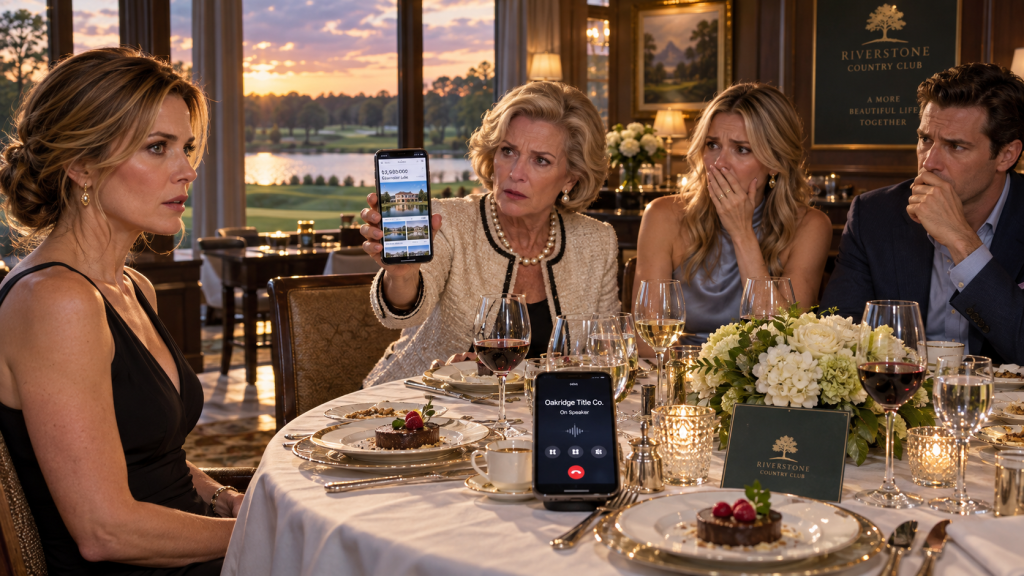
“Already have three showings scheduled,” Mom announced, holding up her phone like she’d just won an award.

My sister smiled.
My brother congratulated her.
And I sat frozen at the country club dinner table, staring at the Zillow listing on her screen.
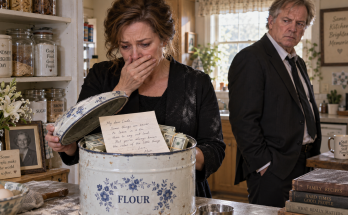
Because the house they were celebrating selling belonged to me.
Not my mother.
Not my siblings.
Me.
And none of them seemed to realize that before dessert was over, one phone call from the title company was going to turn their brilliant little real-estate deal into something that could require bail money.
PART 1
The first time I realized my mother was trying to sell my lake house, she was sitting directly across from me in the private dining room of our country club, explaining to my sister why the sunset photographs made the property look worth at least another fifty thousand dollars.
I had a fork halfway to my mouth.
For several seconds, I honestly thought I had misunderstood.
Maybe they were talking about another lake house.
Maybe Mom was helping a friend sell something.
Maybe there was some explanation that would make the photographs on her phone look less familiar.
But then she swiped to the next picture.
My stone fireplace.
Another swipe.
My cedar dock.
Another.
The renovated boathouse.
I slowly lowered my fork.
The room smelled like grilled salmon, polished wood, and the expensive floral arrangements the club replaced every Thursday morning. Beyond the tall windows, late-September sunlight spilled across the golf course, turning everything outside soft and golden.
Inside, my mother, Evelyn Harper, calmly scrolled through photographs of my property as if she were showing everyone pictures from a vacation.
Except it wasn’t just my house.
Before it became mine, it had belonged to my great-aunt Beatrice.
The woman who had spent nearly every summer of my childhood teaching me that some things mattered more than money.
The woman who had left that lake house specifically to me three years earlier.
“The photographer did a beautiful job with this one,” my sister Lauren said.
She took Mom’s phone and enlarged a picture of the back deck.
“Look at the water. That view is incredible.”
My brother Ryan leaned across the table to see.
“That’s the money shot.”
Mom smiled.
“Exactly what the agent said.”
I stared at her.
Agent?
My fingers tightened around the stem of my water glass.
“What agent?”
No one answered.
Mom simply took the phone back and continued scrolling.
There was the kitchen.
My kitchen.
The same room where Aunt Beatrice had taught me how to make blueberry pancakes when I was nine. I could still remember standing on a little wooden stool because I wasn’t tall enough to reach the counter.
There was the upstairs bedroom with the slanted ceiling.
The room where I used to fall asleep listening to summer thunderstorms roll over the lake.
There was the narrow hallway Aunt Beatrice refused to renovate because she said old houses were allowed to have imperfect hallways.
Every picture felt like someone had opened a private family album without permission.
Lauren barely noticed my expression.
“What are you listing it for?”
Mom didn’t hesitate.
“Eight hundred seventy-five thousand.”
She said it proudly.
Like she’d accomplished something.
Like she’d spent months negotiating a major business deal instead of quietly putting somebody else’s property on the market.
Lauren’s eyebrows lifted.
“Seriously?”
“Comparable properties support it,” Mom said. “Maybe more if we get competing offers.”
Ryan was already tapping on his phone.
“What’s the address again?”
Mom told him.
I looked from one face to another.
Still waiting.
Still expecting one of them to laugh and tell me this was some bizarre joke.
Ryan’s expression brightened.
“Found it.”
He grinned.
“Three hundred and ninety views already.”
I stared at him.
“Found what?”
Instead of answering me, he turned his screen toward Lauren.
“The listing.”
Lauren leaned closer.
“Oh, wow. Mom, these pictures really are good.”
Mom reached for her wine.
“First showing is tomorrow afternoon. A couple moving up from Illinois. Cash-heavy, according to Natalie.”
Cash-heavy.
According to Natalie.
So there was an actual real-estate agent.
Actual buyers.
Actual scheduled showings.
My heartbeat should have accelerated.
Instead, it slowed.
That was what always happened when something truly bad occurred.
I became calm.
Too calm.
Aunt Beatrice used to tease me about it.
“You only get quiet when someone should be worried,” she’d say.
I could hear her voice so clearly that for half a second, it felt like she was sitting beside me.
I placed my fork carefully beside my plate.
The tiny click of metal against china finally made Mom look at me.
“You listed my lake house?”
Her smile changed immediately.
Not surprise.
Not confusion.
Patience.
That familiar, patronizing smile she’d used when I was sixteen and told her I wanted to study law instead of joining the family insurance business.
“Claire,” she said, “don’t start.”
Lauren glanced between us.
Ryan lowered his phone.
I kept my voice level.
“I asked you a question.”
Mom sighed as though I were embarrassing her.
“We’re having a nice family dinner.”
“You’re advertising my property on Zillow.”
“You barely use it.”
“That wasn’t my question.”
She leaned back in her chair.
“Beatrice left that place sitting there like some sacred monument. You’ve had it for three years, Claire. The market is strong right now. It would be ridiculous not to take advantage of that.”
I stared at her.
“So you decided to sell it.”
“We decided to be practical.”
“We?”
Lauren suddenly became very interested in her wineglass.
Ryan cleared his throat.
Mom’s jaw tightened.
“This benefits everyone.”
That sentence told me more than she intended.
“Everyone?”
She waved one hand.
“Your brother has expenses. Lauren has the children. There are things this family could do with that kind of money instead of letting it sit in an old house by a lake.”
My voice stayed quiet.
“A house Aunt Beatrice left to me.”
Mom’s expression hardened.
“She was emotional when she made that decision.”
“She was eighty-four, not incompetent.”
“Claire.”
“She had an attorney.”
Mom’s eyes flashed.
“You always have to make everything legalistic.”
I nearly laughed.
“You’re trying to sell real estate you don’t own. This is literally the moment to make things legalistic.”
Ryan finally spoke.
“Can we not turn this into a whole thing?”
I looked at him.
“You’re congratulating her negotiation skills for selling my house.”
“No one’s stealing anything.”
“Then whose name is on the listing agreement?”
Silence.
That silence was the first moment I knew there was more to this than arrogance.
Someone had signed something.
Mom lifted her wine again, but I noticed the slight hesitation before she took a sip.
“You’re being dramatic.”
My phone vibrated against the table.
I glanced down.
Unknown number.
Local area code.
I almost ignored it.
Then it stopped.
A second later, it rang again.
Mom frowned.
“Can you please put that away during dinner?”
I answered.
“Hello?”
A woman spoke.
“May I speak with Claire Harper?”
“This is Claire.”
“Ms. Harper, this is Denise Caldwell from Hartwell Title. I’m sorry to call you this evening, but we’re reviewing documents connected to the lake property on Shoreline Drive.”
Every muscle in my body went still.
Across the table, Mom’s wineglass stopped halfway to her lips.
Lauren looked at her.
Ryan looked at me.
I switched the phone to speaker.
“Yes,” I said. “I’m familiar with the property.”
There was a pause.
Then Denise continued carefully.
“We were provided documentation indicating Evelyn Harper has authority to sell the property.”
Mom’s face went pale.
I didn’t take my eyes off her.
“She doesn’t.”
Another pause.
“That’s why I’m calling.”
The dining room suddenly felt unnaturally quiet.
Denise continued.
“Our preliminary title review shows the property was transferred three years ago into an irrevocable trust established under Beatrice Whitmore’s estate plan.”
Lauren whispered, “What?”
I said nothing.
Because I already knew.
Aunt Beatrice hadn’t simply handed me a deed and hoped everyone behaved themselves.
She had planned for exactly the kind of family pressure sitting across from me now.
Denise’s voice became more formal.
“According to the trust documents, you are the sole beneficiary with the applicable rights to the property. Mrs. Harper does not appear to have authority to list, transfer, encumber, or sell it.”
Mom stood so quickly her chair scraped backward.
“This is ridiculous.”
Denise heard her.
“Is Mrs. Harper present?”
I looked directly at my mother.
“Yes.”
Nobody touched dessert.
Nobody moved.
Denise took a breath.
“Then I need everyone there to understand something very clearly. The documents submitted to establish Mrs. Harper’s authority appear to contain signatures and representations that conflict with the recorded trust documents.”
Mom’s face drained of color.
Ryan slowly set his phone on the table.
Lauren whispered, “Mom… what did you sign?”
Mom didn’t answer.
Denise wasn’t finished.
“If those documents were knowingly created or submitted to facilitate the sale of property held by an irrevocable trust, this may no longer be simply a title issue.”
I felt Aunt Beatrice’s old warning echo through my head.
You only get quiet when someone should be worried.
Mom stared at the phone.
“What exactly are you saying?”
Denise answered.
And for the first time that evening, my mother looked genuinely afraid.
“Mrs. Harper, I’m saying we may be looking at attempted real-estate fraud.
PART 2 — THE SIGNATURE THAT SHOULD NEVER HAVE EXISTED
For several seconds after Denise said the words attempted real-estate fraud, no one at the table moved.
My mother was still standing.
Her hand rested on the back of her chair.
The room had gone so quiet I could hear silverware from another table being set down.
Lauren stared at Mom.
Ryan stared at the phone.
And I stared at the woman who had spent my entire life telling me that family problems should stay inside the family.
Now the problem had reached a title company.
There are certain sentences that end the possibility of pretending.
Attempted real-estate fraud was one of them.
Mom recovered first.
Of course she did.
Fear rarely stopped her for long.
It usually just changed her tone.
“This is a misunderstanding.”
Denise replied:
“Mrs. Harper, I need to be very careful here.”
“So do I.”
Mom said.
“This family owns that property.”
“No.”
I said.
Everyone looked at me.
Mom’s mouth tightened.
I continued.
“Aunt Beatrice owned it.”
“Then she placed it in trust.”
“For me.”
My mother gave me the same look she used when I contradicted her in front of company.
Not anger.
A warning.
Not here.
Not now.
Not in front of people.
That look had worked on me when I was fifteen.
It did not work anymore.
Denise spoke again.
“Ms. Harper, may I confirm whether you authorized your mother to sign a listing agreement, affidavit, power of attorney, trustee certification, or any document connected to the sale?”
“No.”
“Did you authorize anyone else to sign on your behalf?”
“No.”
“Did you grant Mrs. Harper any management authority?”
“No.”
Mom snapped:
“Claire.”
I looked at her.
“What?”
Her face hardened.
“We need to discuss this privately.”
I almost laughed.
“You listed my house publicly.”
Silence.
“We are past private.”
Lauren whispered:
“Mom, what documents did you give them?”
Mom ignored her.
Denise continued.
“There is one more thing.”
That sentence changed Mom’s expression again.
“What?”
I asked.
Denise hesitated.
“The paperwork we received does not merely claim Mrs. Harper had informal family permission.”
My stomach tightened.
“What does it claim?”
“That she is acting as co-trustee.”
I stared at my mother.
Lauren went pale.
Ryan said:
“What?”
Mom sat down slowly.
No one spoke.
I felt cold.
Not angry yet.
Cold.
Because arrogance could explain a listing.
Entitlement could explain her talking about the proceeds.
But co-trustee meant paperwork.
Structured paperwork.
Something designed to survive scrutiny.
“Mom.”
I said.
“What did you sign?”
She looked at me.
“I signed what Natalie told me was necessary.”
“Who is Natalie?”
“The agent.”
“That is not what I asked.”
Her jaw tightened.
“She was referred to me.”
“By who?”
Mom looked away.
That tiny movement told me there was another person in the room even if they were not physically there.
Denise said:
“I recommend that everyone stop discussing the substance of this on an open speaker call.”
Mom seized on that immediately.
“Exactly.”
Denise continued.
“Because I am escalating this to our legal department.”
Mom’s face fell.
That part she had not expected.
I asked:
“Will the listing be frozen?”
“We cannot control Zillow directly, but we have notified the brokerage and advised that no transaction can proceed through our office.”
“Can they still show the house?”
“Technically the brokerage may have its own procedures, but if ownership authority is disputed, a responsible broker should pause everything.”
Mom leaned forward.
“This is absurd.”
Denise replied calmly:
“Mrs. Harper, the recorded ownership documents do not support your authority.”
My mother’s voice sharpened.
“Beatrice was my aunt.”
“That does not make you trustee.”
“She intended the property to stay in the family.”
“It is in the family.”
I said.
“With me.”
Mom turned on me.
“You always do this.”
“What?”
“Reduce everything to paperwork.”
I stared at her.
“Paperwork is the only reason you have not sold my house.”
That ended the conversation.
Not legally.
Emotionally.
Something between us shifted.
Maybe permanently.
Denise gave me a direct number for the legal review team.
She told me not to sign anything.
Not to accept any “correction documents.”
Not to allow anyone onto the property under claim of sale authority.
Then she asked one final question.
“Ms. Harper, do you know who the acting trustee is?”
“Yes.”
“Who?”
“Martin Hale.”
Mom looked up sharply.
That reaction mattered.
She knew the name.
Of course she knew the name.
Martin had handled Aunt Beatrice’s estate.
He was seventy-two, meticulous, dry, and one of the only people Aunt Beatrice trusted enough to disagree with her.
Denise said:
“I recommend you contact him immediately.”
“I will.”
I hung up.
Then I looked at my mother.
No one reached for dessert.
Finally Ryan said:
“Okay.”
His voice sounded weak.
“What exactly is going on?”
Mom exhaled.
“Nothing.”
Lauren stared.
“Nothing?”
“Yes.”
“This is an administrative issue.”
I laughed once.
Mom glared.
Lauren’s face changed.
“Did you forge something?”
“No.”
The answer came too fast.
Ryan leaned back.
“Mom.”
“I did not forge anything.”
“Then why does the title company think you’re a trustee?”
“Because there is documentation.”
“Fake documentation?”
“It is not fake.”
I leaned forward.
“Then I should know what it is.”
Mom looked at me.
“It is an amendment.”
My stomach dropped.
“What amendment?”
“To the trust.”
I went still.
“There is no amendment.”
“You don’t know that.”
“Yes, I do.”
Aunt Beatrice had walked me through the trust herself.
Not every page.
Enough.
She had made one thing painfully clear.
The house could not be sold without my written consent while Martin remained trustee.
After Martin’s death or incapacity, control passed to a corporate fiduciary.
Not Mom.
Not family.
Never family.
She had designed it that way intentionally.
“Who supposedly signed this amendment?”
Mom said nothing.
I already knew.
“Aunt Beatrice?”
Still nothing.
My chest tightened.
“After she died?”
Lauren whispered:
“Oh my God.”
Mom slammed her palm lightly against the table.
“No.”
People at the next table looked over.
She lowered her voice.
“It was executed before she died.”
I stared.
“By Beatrice.”
“Yes.”
“And Martin somehow never mentioned it?”
“Maybe he didn’t know.”
“Martin drafted the trust.”
Mom’s eyes flashed.
“He did not control Beatrice.”
“No.”
I said.
“But he controlled the file.”
Ryan said:
“Can someone please explain this like I’m not a lawyer?”
“You’re not.”
Lauren muttered.
I ignored them.
“Where is the amendment?”
Mom looked away.
“With Natalie.”
“How did Natalie get it?”
Silence.
“Mom.”
She picked up her wine.
I reached across the table and moved the glass away.
Her eyes widened.
“Do not.”
I said.
“Distract yourself.”
Something in my voice made her stop.
“Where did the amendment come from?”
Finally:
“From Charles.”
I had no idea who she meant.
“Charles who?”
Mom’s lips tightened.
“Charles Dunn.”
I stared.
The name meant nothing.
Ryan frowned.
Lauren looked equally confused.
Mom added:
“He used to work with Beatrice’s attorney.”
My blood went cold.
“Martin?”
“No.”
“Before Martin.”
I leaned back.
Aunt Beatrice had used the same law firm for decades.
There had been another attorney there years earlier.
I vaguely remembered the name.
Dunn.
Charles Dunn.
Older.
Retired.
Maybe disbarred?
Something about him scratched at my memory.
“You got trust documents from a retired attorney?”
“He knew Beatrice.”
“That is not an answer.”
“He said she regretted how rigid the trust was.”
I nearly laughed.
“Beatrice regretted rigidity?”
Even Ryan smiled briefly.
Aunt Beatrice treated flexibility as a character flaw.
Mom continued.
“He said she wanted me involved.”
“Did he produce an original?”
“A certified copy.”
I stared.
“Certified by who?”
Mom did not answer.
That was the moment I understood she had not simply been swept along by an agent.
She had participated.
Maybe not in creating the documents.
But in choosing not to ask the obvious questions.
Sometimes fraud begins with a lie.
Sometimes with a person who wants something badly enough to stop checking whether the lie is convenient.
I stood.
Mom frowned.
“Where are you going?”
“To call Martin.”
“Claire.”
“No.”
“We should settle this ourselves.”
I looked at her.
“We tried your version of family settlement.”
“You listed my house.”
“I was doing what Beatrice would have wanted.”
“You have said that about every decision of mine you dislike.”
Her face tightened.
“That house was wasted on you.”
There it was.
Not legality.
Not confusion.
The truth.
I stared at her.
“What does that mean?”
“You live two hours away.”
“You barely spend summers there.”
“Ryan needs capital.”
“Lauren has tuition expenses.”
“And you…”
She stopped.
“And I what?”
“You have enough.”
For a second, I could not speak.
That sentence explained everything.
Not legally.
Morally, in her mind.
I had enough.
Therefore what was mine had become available.
The house was not stolen if the family needed something more.
Aunt Beatrice’s choice did not matter because Mom had completed an internal calculation and decided I could afford to lose.
I said quietly:
“That is not how ownership works.”
Mom scoffed.
“Families share.”
“By choice.”
“Sometimes choice has to be guided.”
I stared.
Lauren did too.
Even Ryan looked uncomfortable.
I picked up my purse.
Mom said:
“Claire, if you walk out now, you are making this much bigger than it needs to be.”
I stopped.
Then turned.
“It became big when somebody created a document saying you were trustee.”
Her face changed.
Just enough.
Fear again.
I continued.
“And if you knew that document was false, then this is already bigger than dinner.”
I left.
Martin answered on the first ring.
“Claire?”
I paused.
“How did you know it was me?”
“Your number is saved.”
“That is disappointingly normal.”
He was quiet.
Then:
“What happened?”
I told him.
Not emotionally.
Facts.
The listing.
Title company.
Co-trustee claim.
Amendment.
Charles Dunn.
Martin said nothing for so long I checked the screen.
“You there?”
“Yes.”
His voice had changed.
“Where are you?”
“Parking lot.”
“Alone?”
“Yes.”
“Go somewhere public.”
“I am at a country club.”
“Good.”
“Why?”
Another pause.
“Because Charles Dunn has not practiced law in eleven years.”
My stomach tightened.
“Retired?”
“Disbarred.”
I stopped walking.
“For what?”
“Forgery.”
The word landed like a physical object.
I sat on a stone bench.
“Trust documents?”
“Estate documents.”
My hand went cold.
“Did Aunt Beatrice know him?”
“Yes.”
“How well?”
“He represented her briefly before I did.”
“Why did she leave him?”
“Because she discovered he had altered a draft codicil for another client.”
I closed my eyes.
“Did you know Mom was talking to him?”
“No.”
“Could he have a real amendment?”
“No.”
“How can you be sure?”
“Because Beatrice amended the trust twice.”
“Both through me.”
“Every executed instrument was deposited with the corporate records office and cross-referenced in the estate index.”
“There is no valid amendment naming Evelyn.”
I exhaled.
“So it’s fake.”
“If what you describe is accurate, almost certainly.”
“Can he go to prison?”
Martin stopped me.
“Do not jump ahead.”
“He forged a trust amendment.”
“Maybe.”
“Maybe?”
“We need the document.”
“Authenticity.”
“Metadata if electronic.”
“Notary information.”
“Witnesses.”
“Chain of custody.”
I pressed my fingers against my forehead.
“Why are lawyers always determined to ruin satisfying conclusions?”
“Because satisfying conclusions are expensive when wrong.”
I almost smiled.
Almost.
Then Martin said:
“There is another issue.”
Of course there was.
“What?”
“Your mother should never have believed she was sole co-trustee.”
“Why?”
“Because the trust language contains a condition.”
“What condition?”
“Any appointment of a successor or co-trustee requires written acceptance by the current trustee.”
“You.”
“Yes.”
I stared ahead.
“Meaning even a real amendment would need your signature?”
“Correct.”
“Did the paperwork contain one?”
“You tell me.”
“I haven’t seen it.”
“Then get it without alerting them if possible.”
“How?”
“Ask Denise.”
I nodded.
Then remembered:
“Mom knew your name.”
“She should.”
“No.”
“I mean she reacted when I said you were trustee.”
Martin was silent.
“You think she knew your approval was required.”
“I think we should assume she knew more than she admitted.”
That hurt.
Not because I expected better anymore.
Because part of me still did.
Denise emailed the documents within forty minutes after legal approved the release to me as beneficiary.
I opened them sitting inside my car.
The first page looked professional.
Too professional.
BEATRICE WHITMORE IRREVOCABLE FAMILY RESIDENCE TRUST
SECOND AMENDMENT AND APPOINTMENT OF CO-TRUSTEE
My mother’s name appeared halfway down.
Evelyn Harper.
Then mine.
Sole Beneficiary.
Then language claiming Aunt Beatrice appointed Mom as co-trustee for purposes of sale, management, maintenance, and reinvestment.
My jaw tightened.
It was clever.
Not crude.
The document did not attempt to remove me.
It created just enough authority to let Mom act.
Then I reached the signature page.
Aunt Beatrice’s signature.
I had seen that handwriting for years.
Birthday checks.
Recipe cards.
Postcards.
This looked close.
Very close.
But there was something wrong.
The B in Beatrice.
Too upright.
She always made the first loop enormous.
This one looked restrained.
Like someone imitating a movement instead of writing a name.
Then the notary.
Charles Dunn.
I stared.
He had notarized it himself.
And below that—
Martin Hale
Acknowledged and accepted as existing trustee.
A signature.
I stopped breathing.
It looked like Martin’s.
Not perfectly.
Enough.
I sent him the page.
He called immediately.
“That is not my signature.”
“I know.”
“How?”
“You sign your H like a heart attack.”
Silence.
Then:
“I do not know what that means.”
“It’s ugly.”
“This is not the time.”
I almost laughed.
Martin continued.
“Claire, save that file in three places.”
“Already doing it.”
“Good.”
“What now?”
“I call counsel.”
“I thought you were counsel.”
“I call someone who can litigate without violating professional rules by strangling Charles Dunn.”
That made me laugh.
For the first time all evening, I laughed hard.
Maybe from stress.
Maybe because hearing Martin angry gave me permission not to carry all of mine.
Then his voice softened.
“Claire.”
“Yes?”
“This is serious.”
“I know.”
“No.”
He paused.
“I need you to understand.”
“If Evelyn knowingly submitted a forged trust instrument, or knowingly represented herself as trustee using one, she may have exposure.”
My laughter disappeared.
“How much?”
“That depends on intent and jurisdiction.”
“Potentially felony-level conduct.”
There it was.
The bail-money thought.
No longer dramatic.
Possible.
I sat back.
My mother.
My mother, who corrected servers for minor billing errors.
My mother, who once returned a twenty-dollar overpayment because she believed “character is what you do when no one checks.”
Maybe people keep moral sayings close because they want others to live by them.
I did not go home.
I drove to the lake house.
Two hours in the dark.
I needed to see it.
The property appeared around the bend just after ten.
The porch light was off.
The water black beyond the trees.
I parked.
For a moment, I stayed in the car.
Then I walked to the house.
My key still worked.
That should not have felt like a miracle.
It did.
Inside, everything was quiet.
But wrong.
Someone had staged it.
The throw blankets folded differently.
The kitchen counters almost empty.
Aunt Beatrice’s ceramic fruit bowl moved from the center island to a shelf.
I stood in the doorway.
My mother had been here.
Or the agent.
People had entered rooms I considered private.
Not breaking windows.
Not stealing jewelry.
Rearranging the appearance of my life to make it more attractive to buyers.
That somehow felt intimate in a way I had not expected.
I walked upstairs.
My childhood room.
Fresh white duvet.
Decorative pillows I had never bought.
A small sign on the dresser:
LAKE DAYS ARE THE BEST DAYS.
I picked it up.
Then laughed bitterly.
Aunt Beatrice would have thrown it into the water.
She hated decorative signs.
“If your wall needs to tell you to gather, you have bad friends.”
That was one of hers.
I sat on the bed.
The anger finally arrived.
Not cleanly.
I cried.
Hard.
Because the house was not valuable only because Zillow said $875,000.
It was valuable because Aunt Beatrice had seen me.
When I was thirteen and Mom missed my school play because Ryan had a hockey tournament, Aunt Beatrice came.
When I was sixteen and Lauren’s engagement consumed the household, Aunt Beatrice took me to the lake for a weekend and let me complain without telling me I was jealous.
When I decided not to join the family insurance business, Mom barely spoke to me for weeks.
Aunt Beatrice said:
“Then don’t.”
Two words.
No guilt.
No bargain.
Just permission.
She left me the house because she knew what it meant.
Not as cash.
As place.
That was the part Mom had never understood.
Or refused to.
At 10:47, I heard a car.
My body went still.
Headlights moved across the front windows.
I stepped away from the upstairs glass.
The car stopped.
Then a door.
Another.
Voices.
I recognized one immediately.
Mom.
Of course.
She had tracked me somehow.
Probably through Lauren.
I went downstairs.
Did not open the door.
She knocked.
“Claire.”
I said nothing.
“Claire, open the door.”
Another voice.
Male.
Not Ryan.
Older.
“Ms. Harper, we just need to speak.”
I knew instantly.
Charles Dunn.
I pulled out my phone and started recording.
Then called Martin.
He answered.
“They’re here.”
“Who?”
“Mom.”
“And I think Dunn.”
“Do not open the door.”
“I wasn’t planning to.”
“Call police.”
My stomach tightened.
“For trespassing?”
“For your safety.”
“They’re my mother and an old man.”
“An old man who forged my signature.”
Fair.
I called the non-emergency number first.
Then changed my mind and called emergency dispatch when the doorknob moved.
Someone had a key.
My mother.
Of course she had copied one.
The lock clicked.
I stared.
Then the door opened.
Mom stepped inside.
Charles Dunn followed.
He was thinner than I remembered.
Late seventies.
Gray hair.
Expensive coat.
The sort of face that had learned to appear trustworthy professionally.
Mom froze when she saw me.
“Claire.”
I raised my phone.
“You do not have permission to be here.”
Her expression hardened.
“Don’t be ridiculous.”
Charles lifted one hand.
“Let’s keep everyone calm.”
I almost laughed.
“Did you forge Martin Hale’s signature?”
His face changed.
Barely.
Enough.
Mom turned sharply.
“Claire.”
Charles said:
“I think there’s confusion about old documents.”
“Then explain the fake signature.”
“It isn’t fake.”
“Martin says it is.”
Silence.
Mom looked at Charles.
That mattered.
She had not known that part.
Or not fully.
“Charles?”
He ignored her.
“Your aunt expressed an intention to broaden Evelyn’s authority.”
“Where?”
“In conversation.”
“Conversation does not create a trust amendment.”
His eyes narrowed.
“You are a lawyer?”
“Yes.”
That surprised him.
Mom said bitterly:
“Here we go.”
I looked at her.
“Did you know his license was revoked?”
Her face changed.
She looked at Charles.
“What?”
There.
Real surprise.
He spoke quickly.
“That is irrelevant.”
Mom stared.
“You told me you retired.”
“I did.”
“You said you still consulted.”
“I do.”
I almost felt sorry for her.
Almost.
Then I remembered the listing.
The celebrations.
The cash-heavy buyers.
The way she said I had enough.
“Did you know the amendment required Martin’s acceptance?”
I asked.
Mom looked at me.
“What?”
“His signature.”
She turned to Charles.
“Why is Martin’s signature on it?”
Charles exhaled.
“This is not productive.”
A siren sounded faintly outside.
Everyone stopped.
Mom looked toward the window.
“You called the police?”
“Yes.”
Her expression became disbelief.
“On your own mother?”
“No.”
I said.
“On people who entered my house after being told they had no authority.”
That landed.
She looked hurt.
For years, hurt had been her strongest weapon.
I almost apologized automatically.
Then stopped.
Boundaries feel cruelest when you are first using them against someone who benefited from you having none.
The deputy arrived minutes later.
Then another.
Nobody was arrested that night.
That disappointed the more dramatic part of my imagination.
Instead, statements were taken.
IDs checked.
The forged-document issue noted.
My mother insisted she had a key and believed she had management rights.
I stated clearly that permission was revoked.
Charles said very little.
That was probably the smartest thing he did.
Before leaving, Mom turned toward me.
“Are you really going to do this?”
The deputy stood between us.
I said:
“Do what?”
“Humiliate me.”
I stared.
“You listed my house.”
“I was trying to help this family.”
“You created a situation where the police are now documenting a forged trust amendment.”
“I did not forge anything.”
“Then stop defending the person who did.”
Her face tightened.
Charles said from behind her:
“Evelyn, let’s go.”
She looked at him.
Then at me.
And I saw something.
Not guilt.
Not yet.
Doubt.
For the first time, she was beginning to wonder whether Charles had used her too.
That did not make her innocent.
But it made the story uglier.
And more real.
The listing disappeared the next morning.
Natalie, the agent, called me directly.
She sounded horrified.
“I had no idea.”
I believed her.
Mostly.
She had received a trust certification, amendment, and supposed trustee acceptance.
Enough to satisfy an agent preparing a listing, though apparently not enough for title.
“I should have verified with the trustee.”
She said.
“Yes.”
“I’m sorry.”
“Thank you.”
“We have canceled all showings.”
“Good.”
“The brokerage attorney may call you.”
“Have them call Martin.”
She hesitated.
“Your mother said this was a family restructuring.”
I laughed without humor.
“Apparently that’s what we’re calling fraud now.”
Natalie did not laugh.
Fair.
Lauren called next.
I almost ignored her.
Then answered.
“Did you know?”
I asked before hello.
Silence.
“Claire—”
“Did you know Mom was not legally allowed to sell it?”
“I knew Aunt Beatrice left it to you.”
“That is not what I asked.”
Lauren exhaled.
“Mom said there was an amendment.”
“Did you see it?”
“No.”
“Did you ask?”
“No.”
“Why?”
Another silence.
Then:
“Because I wanted to believe her.”
There it was.
That answer hurt more than a lie.
“Why?”
“Because she said we would each get something.”
“How much?”
Lauren sounded ashamed.
“Two hundred thousand.”
I closed my eyes.
The math.
$875,000 asking.
Expenses.
Taxes.
Then family division.
“What were you going to do with it?”
“College accounts.”
“For the kids.”
Of course.
A good reason.
That is how entitlement becomes comfortable.
Wrap it in tuition.
Medical bills.
Mortgages.
Something worthy.
I said:
“And if I said no?”
“Mom said you wouldn’t.”
I laughed.
“Why?”
“She said once the offer came in, you’d be practical.”
“And if I still said no?”
Lauren was quiet.
“She said the trustee paperwork made your approval unnecessary.”
My stomach tightened.
“So yes.”
“You knew they intended to sell it without my consent.”
Lauren began crying.
“I didn’t think about it like that.”
“How did you think about it?”
“That Beatrice had been unfair.”
There it was.
Aunt Beatrice.
Dead three years and still on trial for leaving something to the wrong niece.
“Unfair to who?”
“All of us.”
“Why?”
“You were always her favorite.”
My throat tightened.
I sat on the porch overlooking the lake.
“Is that what this is?”
“No.”
“Then what?”
Lauren cried harder.
“I don’t know.”
“Yes, you do.”
Silence.
Then:
“Mom made it sound like you had everything.”
That sentence again.
Enough.
Everything.
As though success converted ownership into a communal resource.
“You have the house.”
Lauren continued.
“The law practice.”
“No kids.”
That one landed.
I went still.
She stopped breathing.
Too late.
“What does that mean?”
“Nothing.”
“No.”
“Say it.”
“Claire.”
“Say it.”
She cried.
“I just mean your expenses are different.”
I laughed.
The sound frightened even me.
“My childlessness is now part of the family asset allocation?”
“No.”
“That is exactly what you said.”
“I didn’t mean—”
“I know.”
I interrupted.
“That’s the problem.”
“You didn’t mean to think about what was actually mine.”
“You only thought about what you wanted it to become.”
I hung up.
Then cried.
Not because Lauren had wanted money.
Because she had revealed the arithmetic people sometimes perform around a woman without children.
You have no kids.
You need less.
Your property can solve someone else’s future.
As though a life without children is a temporary holding account for relatives who made different choices.
Aunt Beatrice never treated me that way.
Maybe that was one reason I loved her so fiercely.
She never made me justify needing space simply because I had no one to leave it to yet.
Ryan’s call came two hours later.
He was more defensive.
“Lauren says you’re acting like we planned a robbery.”
“You planned to divide proceeds from my house.”
“Mom said it was legal.”
“Did you ask how?”
“She showed me paperwork.”
That surprised me.
“You saw the amendment?”
“A page.”
“Which?”
“The one naming her co-trustee.”
“Did you see Martin’s signature?”
“I don’t know.”
“You work in insurance.”
“Yes.”
“You review documents for a living.”
“That’s different.”
“How?”
“Because she’s Mom.”
That answer silenced both of us.
There it was.
The family exemption.
The belief that scrutiny is betrayal.
That love requires lower standards of proof.
Ryan finally said:
“I was going to use my share to buy into Bradley’s agency.”
“How much?”
“About a hundred fifty.”
“So you had plans.”
“Yes.”
“Did you ever think about asking me?”
He sounded irritated.
“You would’ve said no.”
“Exactly.”
Silence.
“That mattered.”
I said.
“The fact that I would say no mattered.”
Ryan exhaled.
“You always get to say no.”
The resentment in his voice surprised me.
“What does that mean?”
“You left the family business.”
“You went to law school.”
“You never had kids.”
“You spend holidays where you want.”
“Aunt Beatrice left you the house.”
“You always get to choose.”
His voice cracked.
“And the rest of us get responsibilities.”
For a second, I forgot the property.
Because there it was.
The real wound.
Not the lake house.
Choice.
My siblings looked at my life and saw freedom.
I looked at theirs and had always assumed they had chosen differently.
Maybe some choices had been made.
Maybe others had become expectations before they learned to question them.
That did not excuse this.
But it explained the heat beneath it.
I said quietly:
“Ryan.”
“What?”
“You could have said no too.”
“To what?”
“The family business.”
“Mom would have lost her mind.”
“Yes.”
“So?”
He went silent.
“You think I wasn’t punished for leaving?”
He said nothing.
“I was.”
“I just did it anyway.”
Another silence.
I continued.
“You resent me because I accepted consequences you were unwilling to accept.”
“That’s not fair.”
“No.”
“Maybe it isn’t.”
“But selling my house does not fix that.”
He did not answer.
That was the first conversation in years where I felt like my brother and I had actually spoken instead of reciting family roles.
It hurt.
That was probably why.
Martin came to the lake house that afternoon.
He carried two boxes.
One legal.
One bakery.
“You brought pastries?”
“You sound disappointed.”
“I expected lawsuits.”
“You can have both.”
He put the boxes on Aunt Beatrice’s kitchen table.
The sight of him there made me unexpectedly emotional.
He had sat in that room with her countless times.
Drafting documents.
Arguing about taxes.
Being ordered to eat.
He opened the legal box.
“Police report.”
“Title documents.”
“Broker correspondence.”
“And something else.”
He handed me an envelope.
Aunt Beatrice’s handwriting.
My name.
I stared.
“What is this?”
“An instruction letter.”
“I’ve never seen it.”
“She asked me to hold it unless there was a dispute over the house.”
My eyes filled.
“Of course she did.”
Martin smiled faintly.
“She was suspicious in very organized ways.”
I opened it.
Claire,
If you are reading this, someone is probably trying to explain why the lake house would be more useful if it belonged to everyone.
I laughed immediately.
Then cried.
Martin looked away.
I kept reading.
Usefulness is not the only measure of worth.
Your mother will disagree.
Do not waste time arguing with her about that.
My throat tightened.
She knew.
Of course she knew.
The letter continued.
I am leaving the house to you because you understand what it is.
Not an investment.
Not a family asset.
A place.
You listened here.
You rested here.
You became yourself here in ways you did not at home.
I want you to have somewhere nobody can vote you out of.
I stopped reading.
The kitchen blurred.
Martin sat quietly.
I whispered:
“She knew.”
“Yes.”
“What?”
“About Mom?”
Martin nodded.
“Not this.”
“Nothing criminal.”
“But Beatrice believed Evelyn would pressure you to sell.”
I wiped my face.
“Did Mom know that?”
“No.”
“Good.”
I kept reading.
If you ever want to sell it, sell it.
Do not keep it because I am dead.
That would be ridiculous.
But if you keep it, keep it because you want it.
And if someone tells you love requires sharing ownership, ask whether they would still call it love if you said no.
I closed my eyes.
Aunt Beatrice had always preferred questions that sounded like traps because they were.
Then the final paragraph:
There is one more provision Martin will explain if needed.
I laughed wetly.
“What did she do?”
Martin opened the trust.
“Section fourteen.”
I stared.
“What is it?”
“A defensive distribution clause.”
“English.”
“If a family member knowingly attempts to compel, transfer, encumber, or dispose of the property without your consent…”
He stopped.
I waited.
“Their contingent inheritance from Beatrice’s residual family trust is forfeited.”
I stared.
“What?”
Lauren and Ryan were both contingent beneficiaries of a separate investment account.
Not huge.
But meaningful.
Roughly $90,000 each someday, depending on growth.
“Mom too?”
“Yes.”
My jaw dropped.
“How much?”
“Current values vary.”
“Martin.”
He sighed.
“Evelyn’s contingent share is approximately two hundred ten thousand.”
I sat back.
Aunt Beatrice had not merely protected the lake house.
She had attached consequences to trying to take it.
“Did they know?”
“No.”
I stared.
“Why didn’t she tell them?”
“Because she did not want the clause to influence behavior.”
I almost laughed.
“She wanted to know what they would do without knowing the punishment.”
“Essentially.”
“That is terrifying.”
“Yes.”
“And very her.”
“Yes.”
I looked at the letter.
“What happens now?”
Martin’s expression became careful.
“That depends on knowledge.”
“What does that mean?”
“For forfeiture, the trust requires knowing participation.”
“So Mom?”
“Likely.”
“Lauren?”
“Unclear.”
“Ryan?”
“Unclear.”
“And Charles?”
“He is not a beneficiary.”
“Convenient.”
Martin almost smiled.
I looked out at the lake.
Aunt Beatrice had built a moral test into a legal document.
Not perfect.
But effective.
Then Martin said:
“There is one more complication.”
I closed my eyes.
“Why is there always one more complication?”
“Because your family is efficient.”
“What?”
“Charles Dunn called my office this morning.”
My eyes opened.
“What did he say?”
“He wants to surrender the original document.”
“Why?”
“He claims Evelyn pressured him.”
I laughed in disbelief.
“Of course he does.”
Martin continued.
“He says the amendment was created at her request.”
My stomach turned.
“Does he have proof?”
“He claims he does.”
“What kind?”
“Emails.”
There it was.
The next layer.
“From Mom?”
“Apparently.”
I felt suddenly exhausted.
“What did she write?”
“I don’t know yet.”
“Charles wants immunity from civil claims in exchange for cooperation.”
I laughed.
“Absolutely not.”
Martin looked at me.
“That is not solely your decision.”
“I know.”
“Police and prosecutors decide criminal immunity.”
“I know.”
“But civil settlement—”
“I know.”
I stopped.
Breathed.
Then said:
“Sorry.”
“You don’t have to apologize for understanding the law loudly.”
That made me smile.
Then the smile disappeared.
“If the emails show Mom knew the signatures were fake…”
Martin nodded.
“Yes.”
“That changes everything.”
Outside, sunlight moved across the lake.
The same water.
Same trees.
Same house.
Everything looked peaceful.
That felt almost insulting.
Mom arrived just before sunset.
Alone this time.
She did not use the key.
She knocked.
That mattered.
I opened the door but did not invite her in immediately.
She looked older than she had at dinner.
Maybe fear ages people quickly.
“Can we talk?”
I hesitated.
Then stepped aside.
She entered.
Her eyes moved through the kitchen.
She saw Aunt Beatrice’s letter on the table.
Something in her face tightened.
“Of course.”
“What?”
“She left you another message.”
I stared.
“That bothers you?”
“She always had to make sure she got the last word.”
I almost smiled.
“That sounds like Beatrice.”
Mom sat.
I stayed standing.
Finally she said:
“Charles lied to me.”
I waited.
“He told me his license was inactive because he retired.”
“Disbarred.”
“I know that now.”
“He forged Martin’s signature.”
Her face changed.
“I didn’t know that.”
“Did you know Beatrice’s signature was false?”
She looked away.
That answer came before words.
My heart sank.
“Mom.”
“I did not know for certain.”
I closed my eyes.
“For certain.”
“He said Beatrice had signed an earlier draft.”
“Did you see her sign it?”
“No.”
“Did you ever ask Martin whether it existed?”
“No.”
“Why?”
“Because he would have stopped it.”
There.
Truth.
Small.
Ugly.
I stared.
“So you knew the proper trustee would object.”
“Yes.”
“But you kept going.”
Mom’s eyes filled.
“I thought the house should be sold.”
“That was not your decision.”
“I know that now.”
“No.”
I shook my head.
“You knew it then.”
“You just disagreed with it.”
Silence.
I sat across from her.
“Did you ask Charles to create the amendment?”
She hesitated.
“Not exactly.”
“Mom.”
“I told him Beatrice had always intended me to have more authority.”
“Did she?”
“She should have.”
“That is not what I asked.”
“No.”
There.
Finally.
“No.”
Mom whispered it again.
“No.”
The word seemed to hurt her.
“She didn’t trust me with that house.”
I looked at her.
“No.”
“Why?”
I almost laughed.
“Do you really not know?”
Her eyes flashed.
“I am her niece.”
“And?”
“I took care of her.”
“Sometimes.”
“I handled appointments.”
“Sometimes.”
“I helped with repairs.”
“Yes.”
“And she gave you the house.”
There it was.
Not justice.
Not family need.
Jealousy.
Old and embarrassing and alive.
“She loved you differently.”
Mom said.
I felt something inside me soften and harden at once.
“That is not my fault.”
“No.”
“You punished me for it.”
“I didn’t mean to.”
“You were selling the thing she gave me.”
Mom began crying.
Not performatively.
Real.
“I spent my whole life doing what people needed.”
Her voice cracked.
“My parents.”
“My siblings.”
“My husband.”
“You children.”
“Beatrice got to be eccentric and independent and admired for it.”
“She never married.”
“She never had children.”
“She never had to hold everyone together.”
I stared.
Now we were somewhere else.
Not exoneration.
Truth beneath entitlement.
“She chose herself.”
Mom whispered.
“And then she rewarded you for doing the same.”
My throat tightened.
“Is that what you think this house is?”
“A reward?”
She looked around.
“What else is it?”
I thought of the dock.
The pancakes.
Storms.
Aunt Beatrice’s terrible card games.
The room where I decided to apply to law school.
“A place where nobody asked me to be useful.”
Mom flinched.
I almost regretted saying it.
Almost.
Then she nodded.
“Exactly.”
The word came out broken.
“I never had one.”
Silence.
For the first time, I understood something about my mother that made me sad.
Not enough to excuse her.
Enough to see her.
She had spent decades converting sacrifice into authority.
If she gave everything, she believed she earned the right to decide for everyone.
Maybe because otherwise the sacrifice would have to remain what it was.
A series of choices she could have made differently.
That is a terrifying thing to admit late in life.
“Did you know Charles was faking documents?”
I asked.
Mom wiped her face.
“I knew he was reconstructing something.”
“Reconstructing.”
“Yes.”
“That is a very generous word.”
“I told him what Beatrice had said over the years.”
“What had she said?”
“That the family should always have access.”
“That the house should not sit empty.”
“Those are not trustee appointments.”
“I know.”
“Did he tell you he would need Martin’s approval?”
“Yes.”
My stomach dropped.
“And?”
Mom looked down.
“He said Martin would never sign.”
“So you let him create one.”
“I did not see him do it.”
“That is not a defense.”
“I know.”
Her voice was barely audible.
“Did you know the signature might not be real?”
Long silence.
Then:
“Yes.”
The word hurt more than I expected.
Not because I was surprised.
Because certainty leaves less room for hope.
I looked away.
Mom whispered:
“I thought it was just paperwork.”
I turned back.
“Paperwork decides who owns things.”
“I know.”
“No.”
My voice cracked.
“You thought because it was mine, paperwork was negotiable.”
She cried harder.
“That is what I cannot get past.”
I said.
“Not Charles.”
“Not Zillow.”
“You.”
“You knew Beatrice gave it to me.”
“You knew I would say no.”
“So instead of asking me, you built a way around me.”
Mom covered her face.
I sat there.
Did not comfort her.
That was hard.
Harder than anger.
Because I had comforted her my entire life.
When Dad left.
When Grandma died.
When Ryan moved.
When Lauren got divorced.
When she felt lonely.
I knew exactly how to move toward her.
I stayed still.
Sometimes love changes when the person who always absorbs the consequences finally refuses.
After a while, Mom looked up.
“What happens now?”
I knew what she meant.
Police.
Trust.
Money.
Family.
All of it.
“I don’t know.”
“Are you going to press charges?”
“That is not entirely my decision.”
“Will you ask them to?”
I stared.
“I haven’t decided.”
Her face tightened with fear.
“Claire.”
“No.”
I raised one hand.
“Do not ask me to protect you from something you knowingly did.”
She went still.
“I am not saying I want you in jail.”
Her eyes filled.
“I am saying your fear cannot become my obligation.”
That was the sentence Aunt Beatrice would have liked.
Maybe because I liked it.
Mom whispered:
“What about Lauren and Ryan?”
“What about them?”
“They were counting on the money.”
I laughed.
Not cruelly.
In disbelief.
“You still do not understand.”
She closed her eyes.
“No.”
“I suppose I don’t.”
Then I told her about section fourteen.
The forfeiture clause.
She stared.
“What?”
“Beatrice anticipated this.”
Mom’s face drained.
“How much?”
“Your contingent share is around two hundred ten thousand.”
She looked physically ill.
“Lauren and Ryan?”
“Potentially around ninety each.”
Mom stood.
“No.”
“Sit down.”
“No.”
“She cannot do that.”
“She already did.”
“This is punitive.”
“Yes.”
I said.
“It is.”
Mom stared at me.
“Are you going to enforce it?”
“That depends on what they knew.”
“And me?”
I looked at her.
“You knew enough.”
Her face collapsed.
For a second, I saw pure grief.
Not for the money alone.
For the finality.
Aunt Beatrice had distrusted exactly the impulse Mom followed.
And now even from the grave, she had named it.
Mom sank back into the chair.
“She hated me.”
I shook my head.
“No.”
“How do you know?”
“Because she left you something.”
“What?”
“The chance not to do this.”
Silence.
“She did not tell you about the clause.”
“She did not threaten you.”
“She left you a share.”
“You lost it only if you tried to take mine.”
Mom stared at me.
That truth was worse than hatred.
Hatred would have been easier.
She had been given a choice.
She made it.
Mom left an hour later.
No hug.
No screaming.
At the door, she paused.
“Do you hate me?”
I thought.
“No.”
Her eyes filled.
“That would be easier.”
“For who?”
“Me.”
She nodded.
Then left.
I stood in the doorway until her taillights disappeared.
The lake went dark behind me.
I felt no victory.
People imagine boundaries as empowering because from outside they look clean.
Inside, they can feel like grief.
You are not only saying no to harm.
Sometimes you are saying goodbye to the version of a relationship that depended on you accepting it.
That is a quieter loss.
But still a loss.
Charles Dunn turned over his files three days later.
Martin came to my office with copies.
The emails were worse than I expected.
Mom had written:
Beatrice always intended me to have a management role.
Then:
Martin is too rigid and will never agree.
Then:
If there is a way to memorialize what she told us privately, do it.
Charles replied:
That can be handled.
Later, Mom asked:
Will Claire need to sign?
Charles:
Not if you have co-trustee authority.
Mom:
Good. She gets sentimental about the house.
That sentence hurt.
Not because it was false.
Because she had used tenderness as evidence of incompetence.
Another email:
Once there is an offer, Claire will come around. She always resists first.
I stared.
Martin said nothing.
Then came the worst.
Mom:
If necessary, we tell her Beatrice changed her mind near the end. Claire worshipped her. She won’t challenge that.
I stopped reading.
“Enough.”
Martin closed the file.
For several minutes, I said nothing.
Then:
“She was going to use Aunt Beatrice against me.”
“Yes.”
“Even dead.”
“Yes.”
I laughed once.
“She knew exactly which lie would hurt enough to work.”
Martin nodded.
That was the part I could not forgive yet.
The paperwork was greed.
That sentence was intimate.
Weaponized knowledge.
She knew I trusted Aunt Beatrice’s judgment.
So she planned to counterfeit not only her signature.
Her intention.
There are forms of forgery no statute names.
That was one.
Ryan and Lauren came to see me together.
They looked like children summoned to a principal’s office.
I almost hated that dynamic.
Then reminded myself they were adults.
We sat in my law office.
Neutral ground.
I told them about the forfeiture clause.
Lauren cried immediately.
Ryan swore.
I let them react.
Then said:
“This is not about whether I like you.”
Ryan looked angry.
“It sure feels like it.”
“It is about knowledge.”
“What did you know?”
Lauren spoke first.
“I knew Mom had paperwork saying she could sell.”
“Did you know it might be fake?”
“No.”
“Did you know Martin had not approved it?”
“I didn’t know who Martin was.”
I believed her.
Then Ryan.
He hesitated.
Too long.
“Ryan.”
“I knew there was some issue.”
“What issue?”
“Mom said Martin would contest it.”
“Why?”
“She said he was overly protective of the trust.”
“Did you see a signature page?”
“Yes.”
My chest tightened.
“Did it look real?”
“I don’t know.”
“Did Mom tell you not to contact him?”
Silence.
That was the answer.
“Why didn’t you?”
Ryan stared at the floor.
“Because I didn’t want the deal stopped.”
There it was.
Not forgery.
Willful avoidance.
Maybe not enough for legal forfeiture.
Enough for moral responsibility.
I looked at him.
“You knew there was a serious question.”
“Yes.”
“And you chose the answer that paid you.”
His eyes filled.
“Yes.”
That honesty mattered.
Not enough.
Some.
Lauren looked at him in shock.
“You knew?”
“Not that it was forged.”
“But you knew something was wrong.”
Ryan snapped:
“Mom said it was a technical dispute.”
I said:
“And you wanted that to be true.”
He looked at me.
“Yes.”
The word landed heavily.
Lauren began crying harder.
“I didn’t know any of this.”
I believed her too.
That complicated things.
Because fairness requires precision.
Aunt Beatrice taught me that without ever using the phrase.
Do not punish one person for another person’s knowledge simply because you are angry at the group.
Martin later concluded Lauren probably did not meet the clause’s knowing-participation threshold.
Ryan might.
Mom almost certainly did.
The corporate trustee’s counsel agreed.
That meant the decision was not entirely mine.
Thank God.
I did not want the burden of choosing whether my mother lost $210,000.
Sometimes legal structures are merciful because they remove the possibility of turning accountability into personal revenge.
The trust could decide.
Not my anger.
That mattered.
Mom’s contingent share was formally forfeited.
Ryan’s went into review.
Lauren’s remained intact.
The family exploded.
Of course.
Aunts called.
Cousins texted.
People who had never read the trust suddenly had legal opinions.
The favorite phrase was:
“But she’s your mother.”
As though biology were an exemption statute.
I stopped explaining.
Ryan’s review lasted two months.
In the end, the trustees determined his conduct was irresponsible but did not clearly establish that he knowingly participated in the false instrument itself.
His share was preserved.
With one condition.
He signed a release disclaiming any claim or future interest in the lake house.
He did.
Immediately.
That told me everything.
Lauren signed one too voluntarily.
That told me something else.
She came to the lake afterward.
Alone.
We sat on the dock.
She said:
“I’m sorry.”
I looked at the water.
“For what part?”
She thought.
“For treating your life like it had extra room because it didn’t look like mine.”
That sentence surprised me.
She continued.
“I have kids.”
“You don’t.”
“I made that into some kind of moral equation.”
“As if my expenses were optional and yours were available.”
“Yes.”
I looked at her.
“That hurt.”
“I know.”
“Don’t say you know unless you do.”
She nodded.
“Then I’m trying to understand.”
Better.
We sat there quietly.
Then she said:
“I was jealous of you too.”
“Why?”
“Because you leave.”
“What?”
“When Mom gets controlling.”
“You leave.”
“When the family pressures you.”
“You leave.”
“I stay and complain.”
I looked at her.
“You can leave too.”
“I know.”
She smiled sadly.
“I’m learning late.”
“That seems to be a family tradition.”
She laughed.
So did I.
It did not repair everything.
But it opened a door.
Ryan took longer.
He avoided me for almost six months.
Then he showed up at the lake house carrying a toolbox.
I stared.
“What is that?”
“The dock ladder is loose.”
“How do you know?”
“Lauren told me.”
“You cannot buy forgiveness with carpentry.”
“I know.”
“That sounded suspiciously emotionally healthy.”
He smiled faintly.
“Therapy.”
I nearly dropped the mug in my hand.
“Mom must be thrilled.”
“She doesn’t know.”
“Of course.”
He fixed the ladder.
Then we sat on the steps.
He said:
“I’ve been thinking about what I said.”
“Which damaging part?”
“That you always get to choose.”
I waited.
“I was angry because it was true.”
I frowned.
He continued.
“You chose law school.”
“You chose not to come into the agency.”
“You chose not to have children.”
“I never asked if those choices cost you anything.”
“They did.”
“I know that now.”
He rubbed his hands together.
“I stayed because I wanted Mom’s approval.”
“Then I got angry at you for not needing it the same way.”
I looked at him.
“I needed it.”
He glanced over.
“I just chose differently anyway.”
He nodded.
“That might be worse.”
“It was expensive.”
Emotionally.
Professionally.
Family holidays.
Years of being called difficult.
Freedom has invoices.
People who envy it rarely see them.
Ryan sighed.
“I’m sorry.”
This time, I believed he understood enough for the apology to mean something.
Not everything.
Enough.
Mom did not speak to me for almost a year.
At first, she told everyone I had stolen her inheritance.
Then that Beatrice’s trust was vindictive.
Then that Martin manipulated me.
Eventually, even Lauren stopped carrying messages.
I appreciated that.
Silence settled.
Birthdays passed.
Thanksgiving.
Christmas.
The first Mother’s Day hurt more than I expected.
I did not call.
Then felt guilty for not calling.
Then angry at myself for feeling guilty.
Healing is repetitive.
The same lesson often has to be learned in different rooms.
The criminal investigation against Charles moved forward.
Mom was questioned.
Not arrested.
Not then.
Charles eventually entered a plea related to fraudulent instrument preparation and false notarization.
Because of his prior disciplinary history, the consequences were serious.
Probation was not enough this time.
He served time.
Not decades.
Enough.
The newspaper carried a small article.
Retired Attorney Pleads Guilty in Fraudulent Trust Filing.
No mention of me beyond “beneficiary.”
Good.
Mom was not charged with forgery.
The evidence showed Charles created the false signatures.
But prosecutors considered whether she knowingly used the instrument.
Her attorney negotiated.
In the end, she entered a diversion agreement tied to attempted fraudulent conveyance and false representation.
Restitution for legal and title costs.
Community service.
No jail if she complied.
Some relatives called that humiliating.
I called it consequences.
Not destruction.
Consequences.
She had feared bail.
She never needed it.
But the possibility changed her.
So did almost losing much more.
The first time Mom called me after the agreement, her voice sounded unfamiliar.
Smaller.
Not weak.
Unpracticed.
“Claire.”
“Hi.”
Silence.
Then:
“I am not calling to ask you to forgive me.”
That was new.
I waited.
“I am calling because my counselor says I spend most of my life explaining myself before I admit what I did.”
I almost laughed.
“Smart counselor.”
“She is irritating.”
“Good sign.”
Mom sighed.
“I knew you would say no.”
My chest tightened.
She continued.
“That was why I went around you.”
“Yes.”
“I told myself the family needed the money.”
“Yes.”
“I told myself Beatrice was unfair.”
“Yes.”
“I told myself you were sentimental.”
“Yes.”
Then her voice broke.
“But the truth is, I believed your no mattered less than my reason.”
I closed my eyes.
There it was.
The whole thing.
Not fraud law.
Family law, emotionally.
Your no mattered less than my reason.
Mom cried.
“I am sorry.”
I did too.
Quietly.
Then:
“I don’t know what to do with that yet.”
“You don’t have to do anything.”
Another new sentence.
No pressure.
No demand.
“I just wanted to say it correctly.”
She had.
That mattered.
We did not reconcile that day.
Or the next month.
People often want apology to function like a key.
Turn once.
Door opens.
Real repair is slower.
Mom had to learn not to use guilt as a shortcut.
I had to learn that distance could change without becoming surrender.
We started with coffee.
Public places.
One hour.
Then lunch.
No family business.
No house.
Eventually, she came to the lake.
Only after asking.
That mattered more than she understood.
She stood outside the front door.
“Can I come in?”
I almost cried.
“Yes.”
She entered.
Looked around.
The house had changed.
I had removed the staging signs.
Put Aunt Beatrice’s fruit bowl back.
Painted the upstairs bedroom blue.
Mom touched the kitchen counter.
“She loved this place.”
“Yes.”
“She loved you.”
“Yes.”
Mom swallowed.
“I was jealous.”
I looked at her.
“I know.”
“No.”
She shook her head.
“I need to say it without turning it into an explanation.”
She looked at me.
“I was jealous.”
That was better.
“I thought if I could turn the house into money, then what Beatrice gave you would become something the whole family shared.”
“And maybe it would hurt less that she chose you.”
My throat tightened.
“Yes.”
Mom cried.
“So I destroyed my own inheritance trying to take yours.”
I had never thought of it that cleanly.
“Yes.”
She laughed through tears.
“Beatrice would have enjoyed that.”
“Enormously.”
We both laughed.
That was the first time I felt Aunt Beatrice in the room without grief.
I kept the lake house.
Not because of principle.
That mattered to me.
I kept it because I wanted it.
Aunt Beatrice had explicitly told me not to turn it into a shrine.
So I used it.
Really used it.
I hosted friends.
Worked from the porch.
Repaired the boathouse.
Replaced the terrible upstairs plumbing.
Let Lauren’s kids swim off the dock.
Even Mom came eventually.
Not often.
Only invited.
Those details mattered.
Boundaries become ordinary when people stop testing them.
Three years after the attempted sale, I made a decision that shocked everyone.
I listed the house.
For sale.
On purpose.
Under my name.
With my signature.
Lauren nearly dropped her phone.
Ryan said:
“You’re kidding.”
Mom went silent.
Then asked:
“Are you sure?”
I smiled.
“Yes.”
That question alone told me how much she had changed.
No argument.
No calculation.
No suggestion about proceeds.
Just:
Are you sure?
“Yes.”
I said again.
“I’m sure.”
Why sell?
Because life changed.
I had begun spending more time in the city.
The roof needed major work.
I wanted something smaller.
And one winter afternoon, I realized I was keeping the place partly to prove no one could take it.
That was no longer freedom.
That was reaction.
Aunt Beatrice had written:
If you ever want to sell it, sell it.
So I did.
The listing price was $1.12 million.
Mom laughed when she heard.
“That’s considerably more than I got.”
“You got zero.”
She smiled.
“Fair.”
Humor was possible now.
Carefully.
Earned.
The house sold to a family with two daughters.
At closing, I met them.
The younger one was ten.
She asked whether the upstairs room really sounded loud during thunderstorms.
I nearly cried.
“Yes.”
“Is it scary?”
“No.”
I smiled.
“It’s wonderful.”
The parents apologized for her questions.
I told them not to.
Before leaving, I gave the girls Aunt Beatrice’s pancake recipe.
Not the original.
A copy.
Some things belong in families.
Others become kinder when passed on.
I kept the fruit bowl.
The watchful old ceramic thing sat in my kitchen afterward.
A piece of place without owning the whole place.
That felt right.
People asked what I did with the money.
Not my family.
Interestingly.
They had learned.
I invested most.
Donated some.
Bought a smaller cottage farther north.
No trust drama.
No family history.
No one had taught me pancakes there.
No ghost of anyone’s expectations.
The first night, I sat on the porch alone.
The lake was smaller.
Quieter.
I thought I might feel disloyal.
Instead, I felt free.
Aunt Beatrice had not left me a specific set of walls.
She had left me proof that I was allowed to have a place of my own.
That was the inheritance.
The house had simply been the first form.
Mom’s forfeited trust share eventually went, according to Aunt Beatrice’s instructions, to a regional legal-aid organization supporting older adults facing financial exploitation.
When Martin told me, I laughed until I cried.
“Did she plan that?”
“Yes.”
“The woman was terrifying.”
“Yes.”
Mom’s face when she learned was complicated.
Then, surprisingly, she said:
“Good.”
I looked at her.
“Really?”
She nodded.
“If losing the money is part of what made me understand what I did, then maybe someone else can use it before they learn the same lesson too late.”
That did not erase anything.
But it was a decent sentence.
I kept it.
Lauren eventually started saying no more often.
The first time she skipped one of Mom’s mandatory Sunday dinners, she called me afterward like she had escaped prison.
“Did lightning strike?”
“No.”
“Did Mom survive?”
“Barely.”
We laughed.
Ryan left the family insurance company at forty-six.
Opened his own firm.
Mom did not speak to him for three weeks.
Then recovered.
Apparently parents can survive grown children choosing themselves.
Who knew.
Our family became less close for a while.
Then healthier.
There is a difference.
We stopped confusing constant access with love.
Some holidays were smaller.
Some conversations harder.
But fewer things were decided in rooms where the person most affected was absent.
That was progress.
Years later, Mom and I sat together at my smaller cottage.
She was seventy-nine.
Age had softened some things.
Not all.
We watched the water.
She said:
“I spent a lot of years believing motherhood meant I was responsible for arranging everyone’s life.”
I looked at her.
“That sounds exhausting.”
“It was.”
“For us too.”
She laughed.
“Fair.”
Then she looked out at the lake.
“I thought if everyone ended up secure, it wouldn’t matter how much I pushed.”
“That was the mistake.”
“Yes.”
“Security without choice isn’t always care.”
She nodded.
“I know.”
And this time, when she said it, I believed she did.
Before she died, Mom gave me a letter.
In person.
That mattered.
“No secret drawer?”
I asked.
She smiled.
“I’ve learned.”
Inside was one page.
Claire,
I used to think Beatrice made you selfish.
Now I think she taught you something I never learned until late.
That love does not become stronger when people owe each other access.
I cried immediately.
She continued.
I am sorry I treated your independence like rejection.
I am sorry I made your no into a problem to solve.
I am sorry I tried to take something because I believed my reason was better than your boundary.
No explanation.
No “but.”
That mattered.
Then:
Thank you for eventually letting me visit places I had no right to enter without asking.
That line broke me.
At the bottom:
I hope wherever you live next, people knock.
Love,
Mom
I folded the letter.
Then hugged her.
Not because everything was erased.
Because enough had changed while we were both alive to make the hug honest.
That is rare.
I knew it.
After Mom died, Lauren asked whether I regretted not protecting her more during the investigation.
“No.”
That answer surprised both of us.
I added:
“I regret that she did it.”
“I regret that it cost her.”
“I regret how scared she was.”
“But I do not regret refusing to make her consequences my responsibility.”
Lauren nodded.
“I think she would agree now.”
“So do I.”
That was forgiveness, maybe.
Not changing the verdict.
No longer needing the sentence increased.
Martin died at eighty-four.
At his memorial, his son handed me a folder.
I groaned.
“Please tell me this family has stopped leaving documents for me.”
His son laughed.
Inside was one photocopy.
Aunt Beatrice’s original instruction letter.
At the bottom, beneath the paragraph I had read years earlier, Martin had written a note to himself:
Beatrice says Claire will understand someday that ownership is not the point. She wants her to learn that consent matters even inside love.
I sat down.
Consent.
The word was almost too large for property.
Then I understood.
That had always been the story.
Not a lake house.
Not $875,000.
Not Zillow.
Not fraud.
Consent.
Aunt Beatrice gave me something.
My mother thought family need could override my consent.
Lauren thought children made her claim more worthy.
Ryan thought resentment made silence acceptable.
Charles thought paperwork could manufacture authority.
Everyone had a reason.
None of the reasons were mine.
That was the point.
Now, when I think back to the country club dinner, I remember the strangest detail.
Dessert.
Chocolate cake.
Nobody ate it.
Four perfect slices sat on white plates while Denise from Hartwell Title explained that my mother might have committed real-estate fraud.
For years, that image made me angry.
Now it makes me laugh.
Life changes with absurdly normal things still on the table.
Wine glasses.
Forks.
Cake.
A Zillow listing glowing on a phone.
One minute, your family is discussing sunset photography.
The next, everyone is wondering whether an attorney forged a trustee signature.
That is how truth often arrives.
Not with music.
With interruption.
If I could speak to myself at that table, I would tell her something simple.
Do not shout.
Do not let their certainty make you doubt what you know.
Ask whose name is on the document.
Ask who signed.
Ask who benefits.
And then listen carefully when people explain why your permission was unnecessary.
That explanation tells you more than almost anything else.
Because people who respect you may disagree with your no.
They may hate your no.
They may think your no is impractical.
But they still understand it belongs to you.
The moment someone decides your no can be replaced by their reason, you are no longer discussing generosity.
You are discussing control.
I sold the lake house eventually.
That surprises people when I tell the story.
They expect the ending to be:
I kept it forever.
I did not.
Keeping it forever would have turned the property into proof.
I did not need proof.
My mother could not take it.
My siblings could not vote it away.
Charles Dunn could not forge it out from under me.
The trust protected the title.
Then, eventually, I protected something more important.
My right to stop needing the house in order to prove that I had won.
So I sold it.
By choice.
That word matters.
By choice.
I still drive past Shoreline Road sometimes.
The new owners painted the boathouse green.
Aunt Beatrice would have complained.
The daughters put a rope swing near the dock.
I like that.
The upstairs bedroom has new windows.
The narrow hallway is still narrow.
Thank God.
Old houses are allowed to have imperfect hallways.
I hope the girls know that.
I hope someone teaches them pancakes.
I hope they get to be loud there.
I hope no one ever tells them a place is wasted simply because they use it differently than someone else would.
Most of all, I hope when they say:
This is mine.
The people who love them understand that love is not a counterclaim.
Aunt Beatrice once told me something when I was seventeen.
We were sitting on the dock.
I was upset because Mom had volunteered me for something without asking.
Beatrice listened.
Then said:
“People will often call you selfish when they notice you are no longer convenient.”
At seventeen, I thought that was funny.
At forty, I understood it.
My mother called me selfish when I would not sell.
My siblings called me difficult when I asked questions.
Charles called me sentimental.
All because my ownership, my memory, and my consent stood between them and something they wanted.
None of that made me wrong.
It made me inconvenient.
There is a difference.
The last object I kept from the old lake house was not valuable.
Not the dock bell.
Not antique furniture.
Not Beatrice’s silver.
A small wooden stool from the kitchen.
The one I stood on when I was nine, making blueberry pancakes.
It sits in my kitchen now.
The finish is worn.
One leg slightly shorter than the others.
Sometimes my niece’s children stand on it when they visit.
The first time Lauren’s granddaughter used it, she asked:
“Was this yours?”
“Yes.”
“Did Great-Aunt Beatrice give it to you?”
I smiled.
“Kind of.”
“What does that mean?”
“It means she let me use it until I grew tall enough not to need it.”
The child nodded.
Then went back to stirring batter.
I watched her.
And I realized the stool might have been the better symbol all along.
Some gifts are meant to hold you until you can stand on your own.
Then you step down.
You do not need to carry the stool forever to prove it helped.
The lake house was like that.
Aunt Beatrice gave me a place where I could become someone capable of saying no.
Then years later, I sold the place because I no longer needed walls to protect the lesson.
I had become it.
For most of my life, my family believed love gave them certain privileges.
Access.
Advice.
Opinion.
A vote.
Sometimes even authority.
We had to learn those things separately.
Love can offer them.
It cannot assume them.
My mother learned that late.
Lauren learned it painfully.
Ryan learned it reluctantly.
I learned it because Aunt Beatrice had the foresight to put a lawyer between my family and a house.
Not everyone gets that protection.
I know that.
Which is why the most important part of the story was never the trust.
It was what the trust said without speaking:
Claire gets to decide.
Three words.
That was all.
Claire gets to decide.
Keep it.
Sell it.
Share it.
Close it.
Invite people in.
Ask them to leave.
The choice belongs to her.
That was the inheritance beneath the inheritance.
The country club eventually renovated the private dining room.
Different tables now.
Different carpet.
The floral arrangements still look overpriced.
Lauren and I had lunch there once after Mom died.
Same windows.
Same golf course.
She held up her phone and said:
“Do not panic.”
I stared.
“What?”
She showed me a real-estate listing.
Her house.
Her name.
Her decision.
“I’m downsizing.”
I laughed.
“Already have three showings scheduled?”
She stared.
Then groaned.
“You’re horrible.”
I laughed harder.
So did she.
Years earlier, those words had frozen me.
Now they belonged to another story.
That is how healing sometimes announces itself.
A sentence loses its power to wound.
It becomes just language again.
We ordered dessert.
Chocolate cake.
This time, we ate it.
And halfway through, Lauren looked at me and said:
“You know what Beatrice got right?”
“Only one thing?”
“She knew you.”
I looked out the window.
Sunset beginning over the trees.
“Yes.”
I smiled.
“She did.”
But that was not quite the whole answer.
Aunt Beatrice had known something larger.
She knew families can love deeply and still cross lines.
She knew good intentions can become entitlement.
She knew generosity without consent becomes control.
And she knew one person in every family sometimes has to become inconvenient enough for everyone else to learn where the boundary is.
For us, that person was me.
I did not enjoy it.
I would not volunteer for it again.
But I am glad I did not move.
Because the night my mother held up her phone and celebrated selling a house that belonged to me, everyone at that table believed the important question was what the property was worth.
Eight hundred seventy-five thousand.
Maybe more with competing offers.
They were wrong.
The value of that house was never the number on Zillow.
It was the lesson Aunt Beatrice had placed inside it long before anyone thought about selling:
What belongs to you is not measured only by what someone else can get for it.
And love does not become more loving when it ignores your permission.
That lesson outlasted the house.
Outlasted the trust.
Outlasted the fraud case.
Eventually, it even outlasted my anger.
And when I finally sold the lake house years later, signed the papers myself, handed the keys to the new family, and watched their daughters run toward the dock, I did not feel like I was losing Aunt Beatrice.
I felt like I was finally using the gift exactly as she intended.
Not by keeping it forever.
By choosing.
For myself.
And this time, no one at the table had a vote.
PART 3 — THE HOUSE NO ONE COULD TAKE FROM ME
The email that changed everything was only six sentences long.
My mother had written it eight months before the country club dinner.
Charles,
I understand Martin will never approve giving me authority over the lake property.
Beatrice always intended the family to benefit from it, whether Claire understands that or not.
If there is a way to document that intention without reopening the entire trust, do it.
Claire will resist at first.
She usually comes around once things are already in motion.
I read it twice.
Then a third time.
Martin sat across from me in his office.
He did not interrupt.
That was one of his greatest talents.
He knew silence could be kinder than explanation.
I set the printed page on the table.
“She knew.”
“Yes.”
“She knew Martin would never approve.”
“Yes.”
“She knew I would say no.”
“Yes.”
“And that was why she wanted the paperwork created before I knew.”
Martin’s expression softened.
“Yes.”
My hands were steady.
That frightened me.
I had always thought anger would be loud if my mother ever betrayed me badly enough.
Instead, the deepest anger I had ever felt made me quiet.
Aunt Beatrice had known that about me.
You only get quiet when someone should be worried.
Martin slid another page toward me.
“There’s more.”
I almost laughed.
“Of course there is.”
This email came two weeks later.
Mom again.
If Claire challenges it, we can tell her Beatrice changed her mind near the end.
She trusted Beatrice more than anyone.
That should be enough.
I stopped breathing.
Not because of the fraud.
Not because of the house.
Because my mother had identified the exact place inside me where the knife would fit.
She knew that if she could convince me Aunt Beatrice had changed her mind, I would doubt myself.
Maybe even surrender the house.
My mother had not merely tried to counterfeit authority.
She had planned to counterfeit Beatrice’s wishes.
There are betrayals that attack what you own.
And there are betrayals that attack what you trust.
The second kind goes deeper.
I pushed the email away.
“I don’t want to read any more.”
Martin closed the file.
“Okay.”
“No.”
I looked at him.
“I mean I don’t want to need more.”
“That’s different.”
“Yes.”
I stood and walked to his office window.
Below us, traffic moved through downtown.
People stopping at lights.
Crossing streets.
Carrying coffee.
Entire lives continuing while mine rearranged itself around six sentences.
“I keep thinking about what she said at dinner.”
“What?”
“That I had enough.”
Martin waited.
“As if ownership expires when someone decides you need less than they do.”
He nodded.
“And she knew I would never sell voluntarily.”
“Yes.”
“So the whole thing depended on making my consent irrelevant.”
“Yes.”
That word hurt more than fraud.
Consent.
Aunt Beatrice had put legal walls around something my own family believed they had the right to walk through.
I closed my eyes.
“What happens now?”
Martin’s voice became professional again.
“The prosecutor has the document package.”
“The title company has made a formal referral.”
“Charles has retained counsel.”
“Your mother has as well.”
“Does she know about these emails?”
“Her attorney does.”
I turned.
“What about Lauren and Ryan?”
“Lauren appears to have known almost nothing about the document itself.”
“Ryan?”
Martin hesitated.
“That is less clear.”
My stomach tightened.
“How unclear?”
“There are messages between him and Evelyn.”
My mother.
“What kind?”
Martin looked at me.
“Do you want them now?”
I thought about saying no.
Then remembered that truth avoided becomes imagination.
And imagination is usually crueler.
“Read them.”
He opened the folder.
Ryan:
Are you sure Claire doesn’t have to sign anything?
Mom:
Charles says no once trustee authority is established.
Ryan:
What if she goes to Martin?
Mom:
She won’t until there’s already an offer.
Ryan:
Good. I don’t want another family argument over this.
I stared.
That was all.
Four messages.
No discussion of forgery.
No knowledge that Martin’s signature was false.
But enough to make something inside me sink.
“He knew I hadn’t agreed.”
Martin nodded.
“Yes.”
“He just didn’t know the authority documents were fake.”
“That appears accurate.”
I laughed without humor.
“How comforting.”
“It matters legally.”
“I’m not asking legally.”
Martin’s face softened again.
“No.”
“I know.”
Lauren came to my office the next morning.
She looked exhausted.
No makeup.
Hair tied back.
She sat in the chair across from my desk and held her purse in both hands.
“I talked to Ryan.”
“I’m sorry.”
Despite myself, she almost smiled.
Then the smile disappeared.
“He told me about the texts.”
“Yes.”
“I didn’t know.”
“I believe you.”
She blinked.
That answer surprised her.
“You do?”
“Yes.”
“Why?”
“Because you would have asked a hundred questions if you knew there was legal paperwork.”
Lauren stared at me.
“That’s oddly flattering.”
“It wasn’t meant to be.”
She smiled faintly.
Then her eyes filled.
“I knew Mom said there was an amendment.”
“I knew she said the sale could happen without your signature.”
“And I didn’t ask why.”
I waited.
“I wanted the money.”
There it was.
No excuse.
No children.
No tuition.
Just the thing itself.
“I wanted it.”
She continued.
“College costs are terrifying.”
“Mark’s business has been uneven.”
“And when Mom said there might be two hundred thousand for us…”
She stopped.
“I wanted it to be true badly enough not to ask whether it should be.”
That was honest.
Painfully so.
I leaned back.
“Do you know what hurt most?”
She looked at me.
“Not the money.”
“I guessed.”
“It was that none of you called me.”
She lowered her eyes.
“You discussed my house without me.”
“You made plans for what my property could solve.”
“You congratulated Mom.”
“And nobody thought the person who legally owned the place belonged in the conversation.”
Lauren cried quietly.
“I’m sorry.”
“I know.”
“No.”
She looked up.
“I mean I’m sorry in a way that has nothing to do with whether you forgive me.”
That got my attention.
She continued.
“I think I spent years believing your life had excess.”
“What does that mean?”
“You don’t have kids.”
“You make good money.”
“You didn’t stay in the family business.”
“You travel.”
“You had Beatrice.”
She swallowed.
“I treated your freedom like something you had more of than you deserved.”
My chest tightened.
Lauren whispered:
“And I think I resented you for using choices I was too afraid to use.”
For a while, neither of us spoke.
Then I said:
“You know having children was your choice.”
She nodded.
“I know.”
“Staying with Mom’s expectations was also a choice.”
She looked at me.
“Not every day.”
“No.”
I softened.
“But at some point.”
She cried harder.
“Yes.”
“I think that’s why I was so angry at you.”
“You made leaving look possible.”
That sentence changed something.
Not enough to forgive everything instantly.
Enough to understand the shape of her resentment.
I had spent years thinking my siblings saw me as selfish.
Maybe they had.
But sometimes selfish is the word people use when someone else refuses the sacrifice they themselves accepted.
I reached across the desk.
Not to hug her.
Just touched her hand.
“Understanding it does not make it okay.”
“I know.”
“But it matters.”
She nodded.
“Can I come to the lake sometime?”
The question itself mattered.
Not:
When are we going?
Not:
The kids miss it.
“Maybe.”
I said.
She nodded.
“Okay.”
No pressure.
That was new.
Ryan did not come.
Not for three weeks.
When he finally showed up, it was raining.
He stood under the awning outside my office with wet hair and no umbrella.
“You look terrible.”
“I feel worse.”
“Encouraging.”
He almost smiled.
Then:
“Can we talk?”
I let him in.
He did not sit at first.
He walked to the window.
Then back.
Finally:
“I knew she was trying to go around you.”
I said nothing.
“I did not know the documents were fake.”
“I believe that.”
His shoulders dropped slightly.
Then I added:
“That is not enough.”
He nodded.
“I know.”
“No.”
I said.
“Tell me what you know.”
Ryan sat.
His voice sounded smaller than I had ever heard it.
“I knew Mom said you would refuse.”
“Yes.”
“I knew she said she could sell it without your signature.”
“Yes.”
“I knew Martin would probably object.”
“Yes.”
“And you never called me.”
“No.”
“Why?”
He looked at his hands.
“Because if I called you, you would say no.”
There it was.
The sentence beneath everything.
“And then you would know.”
“Yes.”
“And the deal would stop.”
“Yes.”
I stared at my brother.
Not a criminal mastermind.
Not evil.
Just a man who wanted an outcome badly enough to avoid the one person who could prevent it.
That was almost more disappointing.
“I was going to use the money to buy into the agency.”
“I know.”
“It would have changed my life.”
“It was supposed to.”
That surprised him.
“What?”
“My house was supposed to change your life.”
He winced.
“When you say it like that—”
“How else should I say it?”
He had no answer.
I continued.
“You were willing to improve your life with something taken from mine.”
His eyes filled.
“I know.”
There was that phrase again.
I almost snapped.
Then stopped.
Because maybe this time he did know.
He said:
“I was jealous of you.”
“Lauren said the same.”
“Of course she did.”
Despite everything, I almost smiled.
Ryan continued.
“You left.”
“The insurance company?”
“Everything.”
“You went to law school.”
“You told Mom no.”
“You told Dad no.”
“You didn’t have kids because you didn’t want them.”
“You kept traveling.”
“You lived your life like family disappointment was survivable.”
I looked at him.
“It is.”
“I didn’t know that.”
“You could have asked.”
“I thought asking made me weak.”
“No.”
“It would have made you informed.”
He laughed once.
Then cried.
“I wanted that agency partnership because I thought if I owned something myself, I’d finally stop feeling like Mom could decide whether I was succeeding.”
My anger softened despite me.
“So you were going to buy freedom with my property.”
He closed his eyes.
“Yes.”
“That’s almost poetic.”
“It’s horrible.”
“Those aren’t mutually exclusive.”
He laughed through tears.
Then said:
“I’m sorry.”
This time, I did not say I knew.
I just nodded.
The legal case moved slowly.
Real law almost always does.
People imagine dramatic courtrooms.
Mostly there are emails.
Continuances.
Affidavits.
Conference calls where six adults argue about phrasing.
Charles Dunn became the easiest part.
He had created the false amendment.
He had forged Martin’s signature.
He had falsely notarized Beatrice’s signature using an old exemplar taken from archived records.
His attorney tried to frame it as “reconstructing testamentary intent.”
Martin nearly choked when he read that phrase.
“Forgery has excellent public relations now.”
I laughed.
Eventually Charles pleaded guilty to charges related to fraudulent instruments and false notarization.
Because of his age and prior professional discipline, the sentence was complicated.
Some incarceration.
Some supervised release.
Financial penalties.
No heroic courtroom speech.
No handcuffs dragged past cameras.
Just consequences.
I discovered that was enough.
My mother’s case was different.
She did not forge the signatures herself.
But the emails proved she knew Charles was creating an authority document outside the normal trust process.
And she used it.
That mattered.
Her attorney negotiated a diversion agreement.
Restitution.
Community service.
Mandatory financial ethics education.
No criminal conviction if she complied.
When Martin told me, I felt something unexpected.
Relief.
I had spent months imagining my mother in jail.
I did not want that.
I also did not want her untouched.
The agreement lived somewhere between those wishes.
That seemed right.
Consequences without destruction.
The trust was less forgiving.
Aunt Beatrice had written section fourteen clearly.
Any beneficiary who knowingly participated in an attempt to transfer or encumber the property without my consent could forfeit their contingent share of the residual trust.
Mom’s share was the easiest.
The trustee panel voted unanimously.
Forfeited.
Approximately $214,000 by then.
When I heard the number, I closed my eyes.
Martin asked:
“Are you okay?”
“I don’t know.”
“You did not impose this.”
“I know.”
“Beatrice did.”
“I know.”
“And Evelyn triggered it.”
“I know.”
He smiled faintly.
“You sound like your family.”
“Careful.”
Ryan’s case was harder.
The panel found that he knowingly participated in the plan to sell without my approval but did not know the trust authority itself was fraudulent.
His inheritance was preserved.
Barely.
Lauren’s remained untouched.
She had not knowingly participated beyond assuming Mom’s claimed authority was real.
At first I was angry.
Not because I wanted them punished.
Because part of me wanted symmetry.
Everyone at the dinner had laughed.
Everyone had made plans.
Shouldn’t everyone lose something?
Then I realized how dangerous that impulse was.
Accountability without precision becomes revenge.
I did not want revenge.
I wanted the truth sorted correctly.
So Lauren kept her share.
Ryan kept his.
Mom lost hers.
Charles faced the law.
And my house remained mine.
Messy.
Uneven.
Fair enough.
The family reacted badly.
Of course.
Aunt Diane called me.
“She is your mother.”
“Yes.”
“You could speak to the trustees.”
“I could.”
“So you’re choosing not to.”
“Yes.”
There was a pause.
“You’ve become very hard.”
That hurt.
For about five minutes.
Then I said:
“No.”
“I’ve become less available for being overruled.”
She hung up.
That was fine.
Uncle Stephen told me Aunt Beatrice had always been vindictive.
I asked whether he had ever read the trust.
He said no.
I suggested he preserve his legal analysis for Thanksgiving.
He stopped calling.
The family split into camps.
Those who believed Mom had made a terrible mistake.
Those who believed I had made a family mistake public.
As if filing forged documents with a title company were a private activity.
That distinction fascinated me.
People will forgive astonishing behavior if the alternative requires admitting the family story was false.
Our story had always been:
Evelyn holds everyone together.
Claire is independent and difficult.
Lauren is dependable.
Ryan is responsible.
Then one dinner exposed something else.
Mom’s “holding together” often meant deciding for everyone.
My independence sometimes meant being the only person willing to object.
Lauren’s dependability often meant compliance.
Ryan’s responsibility depended heavily on approval.
Nobody enjoyed the revised edition.
Truth rarely sells as well as mythology.
I stopped attending large family dinners for a while.
Not forever.
Just until every plate stopped feeling like a courtroom.
I spent more time at the lake.
The house felt bruised after the attempted sale.
That sounds ridiculous.
Buildings do not know.
But I did.
The staged bedrooms bothered me.
So I changed them.
I painted one wall dark blue.
Bought ugly blankets.
Put Aunt Beatrice’s books back where they belonged.
Removed every decorative sign the agent had installed.
Especially:
LAKE DAYS ARE THE BEST DAYS.
That one went directly into the trash.
I could almost hear Beatrice applauding.
Then I did something I had avoided for three years.
I emptied her closet.
Until then, some of her clothes still hung there.
Cardigans.
Raincoat.
One floral dress she hated but kept because “someone might die in summer.”
I sat on the floor with boxes around me and cried.
Not about Mom.
Not about fraud.
About Beatrice.
Grief had become entangled with defense.
I had spent so much time protecting what she left me that I had stopped mourning who she was.
I pressed one of her cardigans to my face.
It no longer smelled like her.
That hurt more than I expected.
The dead eventually leave objects completely.
Then we decide what those objects become.
I kept one sweater.
Donated the rest.
That night, I slept better.
Mom did not speak to me for eleven months.
Not one call.
Not one birthday message.
Nothing.
At first, silence felt like punishment.
Then it became quiet.
Then, eventually, space.
I hated how peaceful the space sometimes felt.
That guilt took work.
Children of controlling parents often mistake absence of pressure for loneliness because pressure has been confused with presence for so long.
I began therapy.
Not because I thought I was broken.
Because I was tired of translating Mom inside my own head.
The therapist asked:
“What would reconciliation require?”
I said:
“An apology.”
Then thought.
“No.”
“What?”
“Change.”
That answer stayed.
I did not need a beautiful apology.
I needed evidence that the old pattern was no longer the only pattern available.
Lauren changed first.
Not with me.
With Mom.
She stopped letting Mom schedule every holiday.
She said no to hosting Easter.
Then survived.
She declined a family vacation.
Survived again.
One afternoon she called me.
“You created a monster.”
“What?”
“I said no three times this week.”
“I’m proud.”
“I feel nauseous.”
“That sounds normal.”
“Mom says I’m becoming like you.”
I laughed.
“Condolences.”
Lauren laughed too.
That relationship healed by inches.
Not by one emotional lunch.
By her asking before visiting.
By me answering honestly.
By her never again joking about what I should do with the house.
By the small fact that when I eventually invited her children to the lake, she asked what weekend worked for me.
Consent in ordinary clothes.
That was repair.
Ryan left the family insurance company the next year.
Mom did not speak to him for six weeks.
He called me after resigning.
“She thinks you talked me into it.”
“Did I?”
“No.”
“Then welcome to being blamed for someone else’s decisions.”
He laughed.
Then grew quiet.
“I should have left years ago.”
“Maybe.”
“I stayed because I wanted the inheritance.”
That surprised me.
“From Mom?”
“The business.”
“Approval.”
“Everything.”
He exhaled.
“I think that’s why I got so desperate about the lake money.”
“If I had the buy-in capital, I could leave without admitting I had wasted fifteen years being afraid.”
I softened.
“Leaving later is not proof the earlier years were wasted.”
“I’m trying to believe that.”
He started a small brokerage.
Struggled.
Then grew.
The first time he signed a lease for his own office, he sent me a picture.
Caption:
Bought with money that was actually mine.
I laughed for five minutes.
That was the first time the whole catastrophe became funny.
Not harmless.
Funny.
There is a difference.
Humor is often the first sign pain has lost exclusive ownership of a memory.
Mom’s call came on a Tuesday afternoon.
I almost did not answer.
Then I did.
“Hello?”
“Claire.”
Her voice sounded smaller.
Older.
“Hi, Mom.”
Silence.
Then:
“I am not calling to talk about the trust.”
“Okay.”
“Or the money.”
“Okay.”
“Or Charles.”
“Okay.”
She sighed.
“You make this very difficult.”
“That sounds familiar.”
To my surprise, she laughed.
A little.
Then cried.
“I’ve been seeing someone.”
“A lawyer?”
“A counselor.”
That shocked me more.
“Voluntarily?”
“Do not ruin this.”
I smiled despite myself.
“Sorry.”
She took a breath.
“She told me something I did not like.”
“That sounds promising.”
“She said I confuse being needed with being loved.”
I stopped joking.
Mom continued.
“And when people stop needing me, I create reasons they should.”
My chest tightened.
“That sounds painful.”
“It was rude.”
I almost laughed.
Then she said:
“I knew you would say no.”
There it was again.
The center.
“I knew it.”
“And instead of respecting your answer, I decided my reason was more important.”
“Yes.”
“I told myself Beatrice was unfair.”
“I told myself Lauren had children.”
“Ryan needed a future.”
“You had enough.”
She started crying.
“But none of that gave me the right.”
I closed my eyes.
“No.”
“I know.”
She paused.
“I don’t expect you to forgive me.”
Good.
That mattered.
“I just wanted to say it without adding a sentence afterward.”
No but.
No explanation.
No family need.
Just responsibility.
I whispered:
“Thank you.”
Then we hung up.
No reunion.
No hug.
But something opened.
We met for coffee a month later.
Public place.
One hour.
Mom arrived early.
Of course.
She did not ask about the house.
That was the first thing I noticed.
She asked about work.
Then Lauren.
Then Ryan.
Then complained about parking.
Ordinary conversation felt almost radical.
At the end, she said:
“Could we do this again?”
I thought.
“Yes.”
Her face softened.
“Okay.”
She did not ask when.
That mattered too.
The first time she returned to the lake house was two years after the country club dinner.
She called first.
Asked.
Then waited for my answer.
I said yes.
When she arrived, she stood outside the door.
She still had the old key.
I had changed the locks long before.
She held it out to me.
“I should have given this back.”
I took it.
No speech.
Inside, she looked around.
The house no longer resembled the staged listing photos.
It resembled itself.
Books everywhere.
A muddy pair of boots near the back door.
My coffee mug on the counter.
Beatrice’s fruit bowl.
Mom touched it.
“She hated when I put artificial fruit in that.”
I laughed.
“She said fake lemons were evidence of moral decline.”
Mom smiled.
Then cried.
“She loved this house.”
“Yes.”
“She loved you.”
“Yes.”
The old jealousy crossed her face.
Then, for the first time, she did not disguise it.
“I resented that.”
I looked at her.
“I know.”
“She could give you things I couldn’t.”
“Like what?”
“Permission.”
That word caught me.
Mom sat.
“I thought parenting meant guiding.”
“Then protecting.”
“Then deciding.”
“Somewhere along the way, I stopped knowing the difference.”
My anger was no longer hot enough to protect me from sadness.
I sat across from her.
“You were allowed to have a life too.”
She looked up.
“I know that now.”
“Beatrice did.”
“I judged her for it.”
“Yes.”
“She looked selfish.”
“Sometimes she was.”
Mom laughed.
“Thank you.”
“She was also free.”
“Yes.”
Mom looked around the kitchen.
“I hated that.”
Not me.
Freedom.
That changed something.
She whispered:
“I think I wanted to sell the house because it proved she had given you something I never gave myself.”
I swallowed.
“A place that belonged to you.”
“Yes.”
The truth sat between us.
No excuse.
Just truth.
Sometimes that is the closest thing to mercy adults get.
Mom complied with every part of her diversion agreement.
Community service.
Restitution.
Counseling.
She never asked me to help restore her forfeited inheritance.
That mattered more than any apology.
At first, she volunteered at a financial-literacy nonprofit because it was required.
Then she kept going after the hours ended.
That surprised everyone.
Especially her.
She eventually started helping older women organize paperwork after spouses died.
Nothing involving legal advice.
Just folders.
Bills.
Accounts.
Questions to ask attorneys.
One afternoon she said:
“I wish someone had taught me earlier that knowing where everything is does not mean you own the decisions.”
I looked at her.
“That’s almost profound.”
“Don’t get used to it.”
We laughed.
Three years after the attempted sale, I decided to sell the lake house.
The decision shocked me.
I had gone there one winter weekend.
Snow along the dock.
The house quiet.
And for the first time, I realized I was keeping it partly because selling felt like letting Mom win.
That disturbed me.
Aunt Beatrice’s letter came back to me.
If you ever want to sell it, sell it.
Do not keep it because I am dead.
She would have added:
And do not keep it because somebody tried to steal it.
Ownership means nothing if fear still makes the decision.
I called Martin.
“I want to sell Shoreline.”
Silence.
Then:
“Are you sure?”
“Yes.”
“Why?”
“Because I want to.”
Another pause.
“Good.”
That was all.
No lecture.
No reminder of Beatrice.
Because the point of the trust had never been keeping the house forever.
The point was preserving my right to choose what happened to it.
Now I could.
So I did.
I told Mom last.
Not as punishment.
Because I wanted to see if the decision was truly mine before hearing anyone’s reaction.
We were having lunch.
I said:
“I’m listing the lake house.”
Her fork stopped.
For one second, I saw the old Evelyn.
Calculation.
Questions.
Then it passed.
She set the fork down.
“Are you sure?”
“Yes.”
She nodded.
“Okay.”
Nothing else.
No price.
No proceeds.
No family plan.
Just okay.
That answer nearly made me cry.
Three years earlier, she had believed my no mattered less than her reason.
Now my yes belonged entirely to me too.
That was change.
Lauren reacted dramatically.
“You’re selling?”
“Yes.”
“After all that?”
“Especially after all that.”
Ryan laughed.
“Please tell me Mom is not the listing agent.”
“Die.”
He laughed harder.
Then said:
“What are you asking?”
“One point one two.”
He whistled.
“Should’ve waited three years before committing fraud.”
“That is an appalling sentence.”
“I’m healing.”
Apparently humor had fully arrived.
The buyers were a family from Wisconsin.
Parents in their late thirties.
Two daughters.
Ten and thirteen.
When they toured the house, I stayed away.
I did not want to watch people inspect corners.
But after their offer was accepted, they asked to meet.
So I went.
The younger girl immediately ran toward the upstairs bedroom.
The slanted ceiling.
My room.
She came back down and asked:
“Does it get loud when it rains?”
“Yes.”
“Scary loud?”
“No.”
I smiled.
“Good loud.”
Her face lit up.
The older sister wanted to know if the dock was deep enough for jumping.
Their mother looked horrified.
I said:
“At the end.”
The father laughed.
The house had already begun becoming theirs.
That hurt.
Then comforted me.
Places are generous that way.
They let different people believe the same rooms belong to them for a while.
At closing, I signed every document myself.
That detail mattered absurdly.
Claire Harper.
Again.
Claire Harper.
Again.
No co-trustee fiction.
No forged amendment.
No family meeting.
No one else’s approval.
Martin sat beside me.
At the end, the title officer smiled.
“Congratulations.”
I almost laughed.
Three years earlier, a title company had been the first institution to tell my family no.
Now another was helping me say yes.
The wire hit my account that afternoon.
I stared at the number.
More than the original listing price.
More than Mom had planned to distribute.
And oddly, none of it felt like victory.
It felt like release.
I kept Aunt Beatrice’s fruit bowl.
Her pancake recipe.
The wooden stool from the kitchen.
And one small brass bell from the dock.
Nothing else.
The buyers asked whether I wanted to keep the old porch swing.
I said no.
Some things belong to places.
I did not need to carry the entire house away to prove it had mattered.
I used part of the proceeds to buy a smaller cottage farther north.
Nothing grand.
Two bedrooms.
A screened porch.
A little dock.
No family history.
No trust.
No photographs of Beatrice.
No childhood ghosts.
The first evening there, I sat outside alone.
I expected guilt.
Instead, I felt something close to peace.
The old house had given me what Beatrice intended.
A place to become myself.
This new one felt like proof I could choose the next version.
That distinction mattered.
I donated a portion of the sale proceeds to a legal-aid fund supporting older adults facing financial exploitation.
Not all of it.
I am not that noble.
A reasonable amount.
When Martin heard, he smiled.
“Beatrice would approve.”
“I’m not doing it for her.”
“Even better.”
He was right.
That was the whole lesson.
Not for Beatrice.
Not against Mom.
For me.
Choice free from reaction.
That is harder than it sounds.
Mom’s forfeited trust share went somewhere stranger.
Aunt Beatrice’s trust directed forfeited interests to a regional nonprofit that helped seniors facing coercion or financial abuse.
When Martin told Mom, she sat silent for a long time.
Then said:
“That seems appropriate.”
I looked at her.
“You’re not angry?”
“I was.”
“And now?”
She smiled sadly.
“Now I think Beatrice got the last word after all.”
“She usually did.”
“Yes.”
Mom laughed.
Then added:
“I hope the money helps somebody say no sooner than I learned to hear it.”
That sentence stayed with me.
Our family never returned to what it had been.
Thank God.
The old family was close in the way a fist is close.
Everything pressed together.
Nothing allowed much room.
The new version had space.
Lauren hosted some holidays.
Skipped others.
Ryan built his business.
Mom complained sometimes.
Then caught herself.
I said no without writing legal briefs to explain why.
Sometimes we irritated each other.
Normal irritation.
Not ownership disguised as love.
That was progress.
A few years later, Mom got sick.
Not dramatically.
Age.
Heart problems.
Then a stroke.
Smaller than the one that eventually took her, but enough to change things.
I visited.
So did Lauren.
Ryan.
We helped.
But differently than before.
No one appointed themselves supreme family authority.
We asked.
What do you want?
Who do you want handling finances?
Who can speak to the doctors?
Mom chose.
That mattered.
One afternoon, I sat beside her hospital bed while she watched rain streak the window.
She said:
“Do you still miss the lake house?”
“Yes.”
“Do you regret selling it?”
“No.”
She smiled.
“Good.”
Then:
“I used to think selling it proved I had been right.”
I looked at her.
“Really?”
“Yes.”
“If you sold, then it meant the house had always been an asset.”
“And Beatrice had been foolish.”
“And I had just been early.”
I laughed softly.
“That sounds like you.”
“I know.”
She took my hand.
“But you sold because you wanted to.”
“Yes.”
“That is different.”
My throat tightened.
“Yes.”
Mom stared at our hands.
“I’m glad I lived long enough to understand that.”
So was I.
Before she died, she gave each of us letters.
In person.
No hidden drawers.
No secret estate revelations.
She joked about that.
Mine was short.
Claire,
I spent too much of my life believing love gave me authority.
It did not.
Love gave me responsibility.
Those are not the same thing.
I am sorry I learned the difference by hurting you.
I stopped reading for a moment.
Then continued.
I was jealous of Beatrice because she gave herself permission I never gave myself.
Then I was jealous of you because she taught you to do the same.
I mistook your independence for rejection because dependence made me feel necessary.
That was mine to fix.
Not yours.
My eyes blurred.
At the bottom:
Thank you for letting me know you again after I made it difficult to trust me.
I hope wherever you live next, people knock.
Love,
Mom
I cried for a long time.
Then I folded the letter.
Not because it erased anything.
Because it finally named everything.
Sometimes closure is not getting back what was taken.
Sometimes it is hearing the right sentence before there is no one left to say it.
At Mom’s funeral, Aunt Diane hugged me and whispered:
“She loved you so much.”
Years earlier, I would have thought that sentence demanded forgiveness.
Now I understood better.
Love had never been the question.
Mom loved me.
She also tried to override me.
Both were true.
The damage came from believing love made the second truth less serious.
It didn’t.
But love, once separated from entitlement, helped us rebuild something honest.
That was enough.
Martin retired fully at eighty.
Or claimed to.
He still answered calls.
Still reviewed things no one asked him to.
Still hated decorative signs.
I accused him of becoming Beatrice.
He considered that a compliment.
When he died four years later, his son gave me a folder.
I groaned.
“No more legal surprises.”
He laughed.
“Just a note.”
Inside was a photocopy of Aunt Beatrice’s instruction letter.
At the bottom, Martin had added in pencil:
Beatrice says Claire will eventually understand the house was never the inheritance.
I stared.
Below that:
The inheritance is knowing she gets to decide.
I sat down.
There it was.
After years of documents.
Fraud.
Trust clauses.
Forfeitures.
Family fights.
The whole thing reduced to six words.
She gets to decide.
That had been the gift.
Not cedar.
Not shoreline.
Not $1.12 million.
Choice.
By then, the new owners had changed the house.
Green boathouse.
New windows.
Rope swing.
The girls were teenagers.
I knew because I drove past once.
Not stalker-style.
I was nearby.
I parked across the road for a minute.
The younger daughter ran off the dock.
Someone yelled after her.
A dog barked.
The porch swing moved.
My old house looked alive.
Not preserved.
Used.
That made me happy.
Aunt Beatrice would have complained about the green paint.
Then secretly liked the dog.
The wooden stool came with me to the new cottage.
One leg still shorter than the others.
Lauren’s granddaughter stood on it one morning while we made pancakes.
Blueberry.
Of course.
She asked:
“Was this Aunt Beatrice’s?”
“Yes.”
“Was she nice?”
I thought.
“Sometimes.”
The child frowned.
I laughed.
“She loved me.”
“That’s not the same question.”
Smart child.
“No.”
I said.
“It isn’t.”
She stirred batter.
“Did she give you the big lake house?”
“Yes.”
“Why did you sell it?”
There it was.
The simple question adults complicated for years.
“Because I was finished needing that house.”
She accepted that immediately.
Children are sometimes better with truth when adults do not decorate it.
Then she asked:
“Can I add chocolate chips?”
I said:
“Beatrice would object.”
“Is she here?”
“No.”
“Then chocolate chips.”
I laughed so hard I nearly dropped the bowl.
That child would be fine.
Years passed.
Lauren and I became close in a different way.
Not constant.
Honest.
Ryan’s brokerage succeeded.
He paid for his own office expansion.
Sent me another photo.
Caption:
Still not your money.
I wrote back:
Growth.
Mom’s counselor deserved royalties.
We laughed.
Those jokes would have been impossible once.
Now they were evidence.
Not that we forgot.
That memory had become safe enough to touch.
One day Lauren and I returned to the country club.
Same private dining room.
Renovated.
Different carpet.
Different chairs.
Still absurd flowers.
She held up her phone.
“Do not panic.”
I narrowed my eyes.
“What did you sell?”
“My house.”
I stared.
She burst out laughing.
“Already have three showings scheduled.”
For one second, the old memory flashed.
Mom’s phone.
Ryan congratulating her.
My own house glowing on Zillow.
Then the memory passed.
I laughed.
Really laughed.
Lauren did too.
People at the next table looked over.
We did not care.
When dessert arrived, chocolate cake, we both stared at it.
Lauren said:
“We didn’t eat dessert that night.”
“No.”
“Should we?”
“Yes.”
We ate every bite.
That was when I knew the story had finally loosened its grip on me.
The sentence that once froze me had become a joke.
Not because what happened was funny.
Because it no longer owned the language.
If you asked me what the worst part was, I would not say the forgery.
I would not say Zillow.
I would not even say the $875,000.
The worst part was discovering that people I loved believed my consent was negotiable.
They had reasons.
College.
Business.
Family.
Fairness.
Resentment.
All reasons.
None permission.
That was the lesson I carried longer than the deed.
Good people can cross terrible lines when they convince themselves the outcome is generous enough.
Families are especially vulnerable to that.
Because love creates familiarity.
And familiarity can start masquerading as access.
Your house.
Your money.
Your time.
Your holidays.
Your decisions.
People stop asking because they believe closeness has already answered for you.
It hasn’t.
Love is not standing permission.
Aunt Beatrice understood that earlier than the rest of us.
Maybe because she spent most of her life unmarried.
Maybe because people constantly treated her independence as available.
Her time.
Her house.
Her money.
Her space.
She protected the lake house because she knew what families do when ownership becomes emotional.
She was not always gentle.
But she was precise.
And in the end, precision saved me.
The trust did not keep my family from wanting the house.
It kept their wanting from becoming authority.
That is a profound difference.
For years, I thought the story ended when the title company stopped the sale.
Then I thought it ended when Charles pleaded guilty.
Then when Mom lost her trust share.
Then when she apologized.
Then when I sold the house myself.
I was wrong each time.
The real ending came later.
Quietly.
At my smaller cottage.
A child standing on Beatrice’s stool.
Chocolate chips in blueberry pancakes.
My mother’s letter tucked in a drawer I did not need to hide.
Lauren calling before visiting.
Ryan owning a business he built without anyone else’s money.
The old lake house belonging peacefully to strangers.
Nothing dramatic.
That was the ending.
A family learning, imperfectly, to knock.
Sometimes I still hear Mom’s voice from that country club dinner.
“Already have three showings scheduled.”
So proud.
So certain.
She thought motion created legitimacy.
If buyers were coming, if photos were taken, if paperwork existed, then surely the decision was almost made.
That is how control often works.
Create momentum.
Make resistance feel inconvenient.
Make stopping the process look like destruction.
But something already in motion can still be wrong.
You are allowed to stop it.
A wedding.
A sale.
A family plan.
A tradition.
An expectation.
You are allowed to say:
No.
Even if people have already printed the brochures.
Even if the photographer came.
Even if everyone else has spent the money in their heads.
That is what I would tell anyone sitting at a table while their life is being discussed as though they are not the owner of it.
Do not let other people’s confidence confuse you.
Ask the simplest question.
Who gets to decide?
If the truthful answer is you, then remember it.
Especially when everyone else would rather you forget.
Because the most dangerous people are not always strangers trying to take what belongs to you.
Sometimes they are people who love you and have convinced themselves that love entitles them to rearrange your life.
It does not.
Love may ask.
Love may hope.
Love may disagree.
But love still has to knock.
And if the answer is no, love has to remain outside the door.
Aunt Beatrice once gave me a house.
For years, I thought that was her gift.
It wasn’t.
The house was only the lesson made visible.
She gave me a place where I learned I did not need permission to become myself.
Then she built legal walls around it until I was strong enough to understand why.
And when I no longer needed those walls, I sold them.
Not because my mother won.
Not because my siblings needed the money.
Not because the market was good.
Because I chose to.
There is no more meaningful ending than that.
The property changed hands.
The lake remained.
The money moved.
People aged.
Some apologized.
Some changed.
Some consequences could not be undone.
And the little house that once nearly tore my family apart eventually became exactly what Aunt Beatrice had always intended it to be.
Mine long enough to teach me that nothing truly belonging to me—not a house, not a future, not a boundary, not a life—could be honestly given away until the choice was also mine.
Years ago, my family sat around a country club table believing the most important number in the room was $875,000.
They were wrong.
The most important thing in that room could not be listed on Zillow.
It was one word.
No.
And the life I built afterward began the moment I understood that I was allowed to mean it.
THE END STORIES! THANK YOU FOR READING GOOD LUCK !❤️
Related Posts