For thirty-one years, I had imagined the moment I would find my son. Sometimes I pictured him opening the door of a little house with a garden. Sometimes I imagined recognizing him across a crowded street. And sometimes, during the loneliest nights, I dreamed of hearing a grown man say the word Mom before I even saw his face.
Never once had I imagined finding him beside a hospital bed, wearing a surgeon’s white coat, holding the silver cross I had placed inside his blanket on the day he was born. And never once had I imagined that the truth about losing him would be worse than the loss itself. I stared at Dr. Adrian Hale.
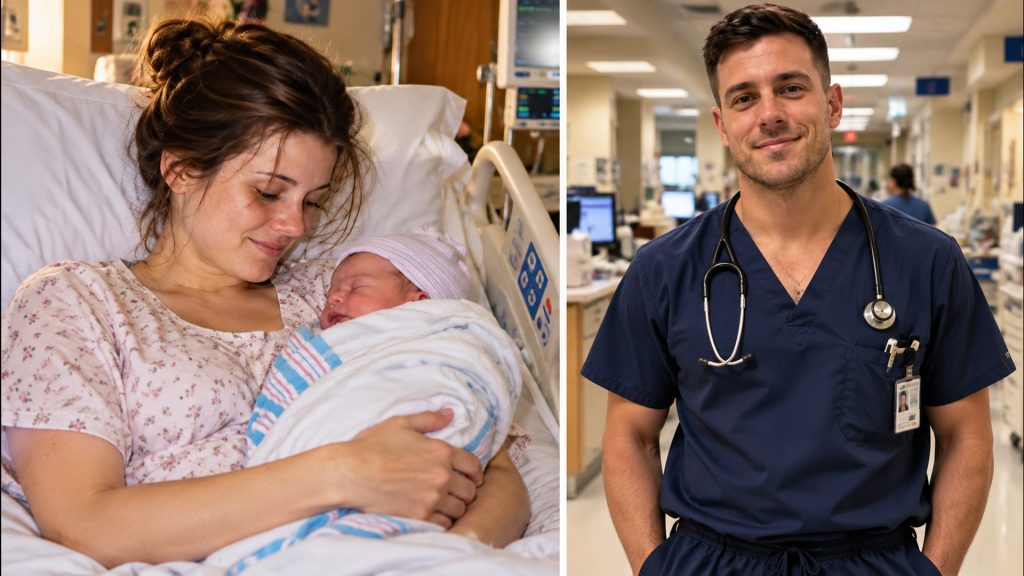
My Fabian. The little boy whose name I had whispered against my stomach for nine months. The baby I had held for only a few precious hours. He sat beside my hospital bed, his fingers trembling around the necklace. “Your father tried to bring me back,” he repeated quietly. “That’s what the letter says.”
I couldn’t breathe properly.
“My father?”
Adrian nodded.
“But I don’t understand everything yet. There are documents, and some of the records contradict one another.”
I pressed my hand against my chest.
“My father told me the adoption was final. He said there was nothing anyone could do.”
Adrian lowered his eyes.
“Apparently, that wasn’t the whole truth.”
The heart monitor beside me continued its quiet rhythm.
I looked at his face.
His dark eyebrows.
The slight dimple in his left cheek.
The way he held his hands together when he was thinking.
My grandmother used to do that.
And the resemblance was so painful and beautiful that I could barely concentrate on his words.
“Are you really Fabian?” I whispered.
His eyes filled.
“I think I am.”
He hesitated.
“But I don’t want to make promises before we’ve verified everything. The necklace and the records are strong clues, not absolute proof.”
I nodded, grateful that he was being careful even though I could see how much he wanted the answer to be yes.
Then he said something that made me cry.
“I’ve spent my whole life wondering what my first name sounded like in my mother’s voice.”
I covered my mouth.
He looked at me.
“Would you say it again?”
I reached toward him.
“Fabian.”
His face crumpled.
I whispered it once more.
“Fabian.”
A tear slipped down his cheek.
Then, very gently, he took my hand.
And for the first time in thirty-one years, I touched my son.
Not a photograph.
Not an imagined face.
Not the empty space where a child should have been.
A real person.
Warm fingers.
A beating heart.
A grown man who had become someone extraordinary while I searched for him.
“I’m sorry,” I whispered.
Adrian looked startled.
“For what?”
“For not finding you.”
He shook his head.
“You didn’t know where I was.”
“I should have looked harder.”
“You said you searched for thirty-one years.”
“I did.”
He squeezed my hand.
“Then maybe we both need to stop apologizing for things we didn’t know.”
I began sobbing.
He moved his chair closer.
For a moment, neither of us spoke.
Then he looked toward the silver cross.
“There’s more I need to tell you. But first, I’m going to ask another surgeon to oversee your postoperative care.”
I frowned.
“Why?”
His smile was sad.
“Because if we’re mother and son, I don’t think I can be objective about your medical decisions.”
The word mother nearly broke me.
He continued.
“Your care won’t be interrupted. Dr. Foster can take over your recovery, and I’ll make sure the handover is complete.”
I nodded.
“And then?”
He looked at me for a long moment.
“Then, if you’re willing, I’d like to get to know you.”
I reached for his hand again.
“Sweetheart, I’ve been waiting thirty-one years for that.”
My name is Elise Morgan.
At forty-nine, I had become a woman who knew how to live with unanswered questions.
I worked as an office manager for a small architectural firm.
I owned a modest townhouse.
I had friends, a garden full of stubborn roses, and a rescue dog named Benny who believed every visitor existed solely to admire him.
From the outside, my life looked ordinary.
Sometimes it even felt happy.
But I had never married.
Not because I believed I didn’t deserve love.
And not because I spent every day mourning.
I simply never found someone with whom I wanted to build that life.
There had been relationships.
A few serious ones.
Men who were kind.
Men who listened.
Men who wanted children.
But whenever we reached the point where I had to explain my past, something inside me became unbearably fragile.
I had given birth to a son.
I had been pressured into surrendering him.
I didn’t know where he was.
And although I understood that the adoption might have been legally finalized, I could never make myself believe that my love for him had ended with my signature.
I remembered every detail of the day he was born.
The pale blue walls.
The smell of hospital soap.
The nurse who told me he had a strong cry.
The tiny fist that closed around my finger.
And the silver cross.
It had belonged to my grandmother, Rose.
She gave it to me on my sixteenth birthday.
“Whenever life frightens you,” she said, fastening the chain around my neck, “remember that courage doesn’t always feel brave.”
I wore it almost every day.
Then, when Fabian was born, I slipped it into his blanket.
I wanted him to have something that belonged to me.
Something that might tell him, someday, that he had been loved before anyone else held him.
For thirty-one years, I’d regretted not holding on to a photograph.
But the necklace had survived.
And somehow, it had led him back to me.
Dr. Foster came to see me that afternoon.
She was a calm woman with kind eyes and a voice that made complicated medical information sound less frightening.
She explained that my emergency operation had addressed a serious abdominal problem and that I would need several more days of hospital monitoring before going home.
Then she sat beside my bed.
“Adrian mentioned that you may have discovered a family connection.”
My eyes filled.
“He’s my son.”
She smiled gently.
“That must be overwhelming.”
I nodded.
“I keep thinking I’ll wake up.”
She waited.
Then I whispered, “Do you know what it’s like to spend thirty-one years searching for someone?”
She shook her head.
“Not personally.”
I looked down.
“I used to look at strangers in supermarkets. Young men standing in line at coffee shops. Students walking across college campuses.”
My voice trembled.
“I’d wonder whether one of them could be my boy.”
Dr. Foster listened without interrupting.
“And now he’s here.”
I laughed through tears.
“He saved my life.”
She smiled.
“Yes. He did.”
I looked toward the door.
Then asked quietly, “Is he a good doctor?”
Her expression softened.
“He’s exceptionally dedicated. His patients trust him, and so do his colleagues.”
Tears ran down my face.
I had missed his first steps.
His first words.
His first day of school.
Every birthday.
Every graduation.
Every ordinary moment that helps a parent recognize the person a child is becoming.
But someone else had seen those things.
Someone had taught him to tie his shoes.
Someone had wiped his tears.
Someone had encouraged him when medical school became difficult.
And because of those people, my son had grown into a man who saved lives.
The thought filled me with gratitude and a grief so deep that I could hardly separate them.
Adrian returned that evening, after his clinical duties were finished.
He wore a navy sweater instead of his white coat.
Without the coat, he looked younger.
Not like the surgeon who had stood beside my bed that morning.
Like a man trying to gather the courage to ask questions he’d carried his whole life.
He placed a folder on the bedside table.
“I brought copies of the documents.”
I looked at him.
“Before we start, can I ask you something?”
He nodded.
“Anything.”
“Did you have a happy childhood?”
His expression changed.
Then he smiled.
“Yes.”
I closed my eyes.
The relief was so powerful that I began crying.
Adrian leaned forward.
“My parents are good people, Elise.”
I opened my eyes.
He hesitated.
“Is it okay if I call you that for now?”
I nodded immediately.
“Of course.”
He looked relieved.
“My dad was a high school science teacher. My mom was a librarian. We lived in a house with a ridiculous number of books.”
I laughed.
“I like books.”
“So do I.”
He smiled.
“My mother says I learned to read before I learned to stop asking questions.”
I studied his face.
“What were you like as a boy?”
He thought for a moment.
“Curious. Stubborn. A little too serious.”
I smiled through tears.
“That sounds familiar.”
He laughed.
“I took apart my dad’s radio when I was seven. I was convinced I could improve it.”
“Did you?”
“No. He had to buy a new one.”
For the first time, our laughter felt easy.
Then Adrian’s smile faded.
“I always knew I was adopted.”
I nodded.
“My parents didn’t hide that from me. They told me I was loved by more than one family, even though they didn’t know much about where I’d come from.”
He looked down.
“But I also grew up believing my birth mother had died.”
My chest tightened.
“Because of the adoption file?”
He nodded.
“There was a statement saying my mother died from complications shortly after childbirth. My parents were shown the same information.”
I shook my head.
“But I didn’t die.”
“I know.”
He looked at me.
“And that’s why I started asking questions when I got access to additional records.”
I stared at him.
“When?”
“Last year.”
He opened the folder.
“I requested copies of what was available from the adoption agency’s successor organization. The records were incomplete, but one page didn’t match the others.”
I leaned forward.
He pointed toward a document.
“The agency’s placement summary said the mother was deceased. But an earlier intake form referred to a living mother who had signed a consent under circumstances the caseworker considered concerning.”
My heart pounded.
“Concerning?”
Adrian nodded.
“The note says she had expressed a desire to parent and was afraid of losing housing support from her family.”
I covered my mouth.
He watched me carefully.
“Does that sound familiar?”
I nodded.
“That’s exactly what happened.”
He lowered his eyes.
“Then someone knew you hadn’t wanted to give me up.”
I stared at the papers.
Thirty-one years.
And somewhere, buried inside a file, had been a record of my desperate attempts to keep my baby.
For the first time, I understood that I hadn’t been imagining the cruelty of that day.
Someone had seen it.
Someone had written it down.
And someone else had decided it didn’t matter.
Adrian opened another envelope.
Inside was a letter written on old-fashioned cream paper.
The handwriting was careful and slightly uneven.
“Eight months ago, the attorney who handled my adoption died,” Adrian explained.
I looked up.
“Martin Bell?”
His eyes widened.
“You remember his name?”
I nodded.
“I remember everything about that day.”
Adrian swallowed.
“After he died, his office reviewed old files. My name was attached to a sealed packet he had specifically instructed them to retain.”
He paused.
“When I requested my records, they verified my identity and gave me the packet.”
I stared at the envelope.
“What did it say?”
He looked down.
“The attorney admitted that the original placement process had involved serious irregularities.”
I felt my heart pounding.
Adrian began reading.
“I have carried the events surrounding the placement of Fabian Morgan with me for more than three decades. My participation in that matter remains one of the greatest professional failures of my life.”
My fingers tightened around the hospital blanket.
He continued.
“The child’s mother was eighteen and had repeatedly expressed her desire to raise him. Her parents exerted financial and housing pressure upon her immediately following childbirth.”
I began shaking.
Adrian stopped.
“Do you want me to continue?”
I nodded.
“Please.”
He swallowed.
“Three days after the consent was signed, the maternal grandfather, Robert Morgan, contacted my office. He stated that his daughter had not freely chosen the adoption and requested that the process be stopped while she received independent advice.”
I closed my eyes.
My father.
He had called the attorney.
He had known.
Adrian continued.
“Mr. Morgan later appeared in person, carrying a letter expressing his daughter’s wish to be reunited with her son. I advised him that any challenge would need to proceed through the applicable legal process and that I could not act for the young mother without hearing directly from her.”
Tears ran down my cheeks.
I had never known any of this.
My father had watched me cry for months after Fabian disappeared.
He had watched me search adoption records.
He had listened when I asked whether the lawyer could help.
And he had never told me he’d already visited that lawyer.
Adrian turned the page.
His expression darkened.
“Before I could arrange an independent meeting with the mother, Vivian Morgan contacted my office. She provided a written statement, bearing what appeared to be her daughter’s signature, asserting that the daughter did not wish to contest the adoption or receive further contact.”
I stared at him.
“No.”
My voice sounded strange.
Small.
Distant.
“I never signed that.”
Adrian looked up.
“I know you say you didn’t.”
He handed me a copy.
At the bottom was my name.
Elise Catherine Morgan.
The signature looked remarkably similar to mine.
But I recognized the difference immediately.
I always made the capital E with a loop.
The one on the page was stiff and angular.
My mother had spent years signing school forms for me.
She knew how to imitate my handwriting.
My stomach turned.
“I didn’t sign this.”
Adrian’s eyes filled.
“Then that needs to be investigated.”
I looked down again.
The letter continued.
“Vivian Morgan also asserted that the young mother was emotionally unstable and should not be contacted. I relied on those representations when I should have insisted upon independently verifying the mother’s wishes.”
I stared at the final paragraph.
“Years later, I discovered that the placement summary provided to the adoptive family falsely reported the birth mother’s death. I cannot establish who entered that statement into the file, but I know it was not supported by any death certificate I had verified.”
My hands began trembling.
“I failed to correct the record when I should have. Fear of exposing my own misconduct became an excuse for further silence.”
Adrian stopped reading.
For a long time, I stared at the wall.
My father had tried to intervene.
My mother had apparently sent a statement bearing my name.
The attorney had doubts.
And the adoptive family had been told I was dead.
Every door I might have opened had been closed by someone else.
Then I asked the question that hurt most.
“Why didn’t my father tell me?”
Adrian looked down.
“There’s another letter.”
He reached into the folder.
“This one is from him.”
My father died six years ago.
His name was Robert Morgan.
He was a strict man.
Proud.
Private.
A man who believed difficult emotions were best handled by not discussing them.
When I was a little girl, he’d carried me on his shoulders at county fairs and taught me how to ride a bicycle.
When I became pregnant, he treated me as though I’d brought disgrace into his house.
And after Fabian was taken away, he returned to ordinary life as though nothing irreversible had happened.
For years, I wanted him to apologize.
He never did.
Now Adrian placed a letter in my hands that my father had apparently written near the end of his life.
It had been preserved among the attorney’s papers.
The envelope was marked with my name.
I unfolded it carefully.
My dear Elise,
If you are reading this, then I have failed to find the courage to tell you the truth while I am alive.
I pressed my hand over my mouth.
The letter continued.
I was wrong about your baby.
I was wrong to believe that becoming a mother at eighteen meant your life was ruined. I was wrong to threaten you with losing your home, and I was wrong to let your fear become the reason you signed those papers.
Tears blurred the handwriting.
Three days after Fabian was born, I found you sitting on the bathroom floor holding one of his little blue socks.
I remembered.
I had been crying so hard I couldn’t stand.
My mother had packed away his clothes.
But she’d missed one sock beneath the dresser.
I’d held it against my face for hours.
I asked you what was wrong, even though I already knew.
You said, “Daddy, I didn’t want him to go.”
A sob escaped me.
That night, I realized I had helped take something from you that no father has the right to take.
I called the attorney. I went to his office. I asked him to stop the adoption if there was still a lawful way to reconsider your consent.
I wiped my eyes.
He said he needed to hear from you directly.
Then your mother told me you had changed your mind and wanted the process completed.
She showed me a signed statement. I believed her because believing her meant I didn’t have to face how badly I had hurt you.
My chest tightened.
Years later, when I learned you were still searching, I understood that the statement might not have reflected your wishes. I confronted Vivian. She told me the adoption could no longer be undone and that telling you about my visit to the attorney would only reopen your pain.
I accepted that explanation because I was ashamed.
I stared at the words.
The confession wasn’t noble.
It wasn’t a story about a father who had done everything possible to save his daughter.
He had tried once.
Then surrendered to fear and silence.
And he’d left me to carry the consequences.
The final paragraph was almost impossible to read.
Elise, I do not deserve forgiveness simply because I am sorry.
But if there is still a way to find your boy, I hope you take it.
And if you find him, tell him his grandfather was wrong. Tell him you wanted him. Tell him that before the world persuaded you otherwise, you had already chosen to be his mother.
Love, Dad.
I pressed the paper against my chest.
For thirty-one years, I’d needed my father to say those things.
Now the words had arrived too late for us to discuss them.
Too late for me to ask why he’d waited.
Too late for him to explain whether he had ever truly understood what his choices cost me.
Adrian watched quietly.
Finally, I whispered, “I loved my father.”
He nodded.
“And I was angry with him.”
“That makes sense.”
I looked at the letter.
“I think I still am.”
Adrian reached for my hand.
“You don’t have to decide how you feel about him today.”
I began crying again.
And my son sat beside me until I could breathe.
I was discharged from the hospital five days later.
Before leaving, Adrian and I arranged an independent DNA test through an accredited laboratory.
It wasn’t something either of us wanted to delay.
The silver cross had brought us together.
The documents told a powerful story.
But we both wanted confirmation that couldn’t be undermined by another family secret.
Adrian also made a practical decision.
He took several weeks of approved leave from his nonemergency duties so he could sort through the records and begin getting to know me.
He insisted that he wasn’t abandoning his responsibilities.
His department arranged coverage.
And he had already transferred my medical care to another physician.
“Besides,” he told me, smiling, “I’ve got thirty-one years of questions.”
I laughed.
“I’ve got thirty-one years of answers.”
“That sounds exhausting.”
“It probably will be.”
He grinned.
And for the first time, our relationship felt less like a mystery and more like the beginning of something real.
On the day I went home, he walked beside my wheelchair through the hospital lobby.
I was carrying a small bag containing my medication, discharge papers, and the blue folder.
He carried my overnight bag.
When we reached the entrance, he paused.
“Elise?”
I looked up.
“Yes?”
He hesitated.
“Would it be strange if I hugged you?”
My heart nearly burst.
I stood carefully.
“Sweetheart, I’ve been trying not to ask you that since the moment I saw the necklace.”
He laughed.
Then opened his arms.
I stepped into them.
My son held me.
Not the careful touch of a doctor checking a patient.
Not the polite embrace of two strangers.
A real hug.
Warm.
Unhurried.
Uncertain in the beautiful way that beginnings often are.
I pressed my cheek against his shoulder.
He smelled faintly of soap and clean cotton.
And for a moment, I remembered the baby I’d held thirty-one years earlier.
I had never stopped loving him.
But now I was beginning to learn who he had become.
The DNA results arrived eleven days later.
I was at home watering my roses when Adrian called.
“Elise?”
His voice sounded different.
My heart began pounding.
“Adrian?”
“I have the results.”
I sat on the garden bench.
He took a breath.
“The laboratory confirms that we’re biologically mother and son.”
I covered my mouth.
For a moment, I couldn’t speak.
He laughed through tears.
“Fabian Morgan, reporting for duty.”
I began crying.
“Oh, sweetheart.”
Then he grew quiet.
“I don’t know whether I should say this yet.”
I held the telephone tightly.
“Say anything you want.”
A long pause.
Then he whispered, “Hi, Mom.”
The world seemed to stop.
Not with fear this time.
With something so beautiful that my body could hardly contain it.
I pressed my free hand against my heart.
“Hello, my beautiful boy.”
He began crying.
So did I.
And for several minutes, we said nothing at all.
We simply listened to each other breathe.
Three weeks after the DNA confirmation, Adrian introduced me to his adoptive parents.
I was more frightened of that meeting than I’d been of surgery.
His mother’s name was Anne Hale.
His father was Samuel.
They lived in a pleasant brick house with a wide front porch, flower boxes beneath the windows, and a blue front door.
Adrian drove me there on a Saturday afternoon.
Before we got out of the car, he turned toward me.
“Are you nervous?”
I looked at him.
“Terrified.”
He laughed softly.
“So am I.”
I stared at the house.
“Adrian, I don’t want your parents to think I’m trying to take their son away.”
His expression softened.
“Elise, I’m thirty-one. Nobody’s taking me anywhere.”
I smiled.
He reached for my hand.
“They raised me. You gave birth to me. Those things don’t have to compete.”
My eyes filled.
He continued.
“I want both parts of my life to be true.”
I nodded.
Then he squeezed my hand.
“Ready?”
I took a breath.
“As I’ll ever be.”
Anne opened the door before we reached the porch.
She was a small woman with silver hair and warm eyes.
When she saw me, she stopped.
For a moment, neither of us spoke.
Then she whispered, “Elise?”
I nodded.
Her eyes filled.
“Oh, my goodness.”
She stepped forward.
I didn’t know whether to offer my hand.
So I did.
But Anne gently moved past it and hugged me.
“I am so sorry,” she whispered.
I began crying.
She held me for a moment, then stepped back.
“I didn’t know you were alive.”
I stared at her.
“I believe you.”
Her face crumpled.
“That was what the agency told us. We had no reason to think otherwise.”
I nodded.
She glanced at Adrian.
“I wish we’d known.”
Samuel appeared behind her.
He was a tall man with kind eyes and a slight limp.
He shook my hand.
“We’re glad you’re here, Elise.”
I looked at him.
“Thank you for raising my son.”
His expression changed.
For a moment, I thought I’d offended him.
Then his eyes filled.
“Thank you for bringing him into the world.”
I began crying again.
Adrian stepped between us.
“Okay,” he said, laughing through tears. “If everybody keeps doing this, we’re going to flood the porch.”
We laughed.
And somehow, that laughter carried us inside.
Anne had prepared tea and lemon cake.
Adrian told me she baked whenever she was nervous.
Judging by the amount of food on the table, she had been very nervous.
We sat in her living room surrounded by family photographs.
There was Adrian at six, missing his front teeth.
Adrian at ten, holding a science fair ribbon.
Adrian at seventeen, wearing a graduation gown.
Adrian in medical school.
Adrian standing beside a beautiful young woman on their wedding day.
I studied the photographs hungrily.
Anne noticed.
She brought over an album.
“I’ve made copies for you.”
I stared.
“All of them?”
“As many as I could find.”
My throat tightened.
She sat beside me.
“I don’t know whether these will help or hurt.”
I opened the album.
There was my boy.
A baby sleeping against Samuel’s shoulder.
A toddler standing beside a Christmas tree.
A little child riding a bicycle.
A teenager laughing with friends.
And on every page, the years I’d missed seemed to open before me.
I cried quietly.
Anne reached for my hand.
“Elise, we didn’t know you were searching.”
I nodded.
She continued.
“The agency told us you had died shortly after he was born. We tried to honor you by making sure Adrian knew he had been wanted.”
My breath caught.
“Even though you thought I was dead?”
“Especially because we thought you were dead.”
I looked at her.
She smiled sadly.
“We didn’t want him growing up believing that being adopted meant someone had rejected him.”
I covered my mouth.
Anne’s eyes filled.
“I always told him that love and loss sometimes arrive together.”
For a long moment, I couldn’t speak.
Then I whispered, “You gave him the childhood I wanted him to have.”
She shook her head gently.
“We gave him our love. But that doesn’t erase what was taken from you.”
I pressed her hand against my cheek.
It was one of the few times in my life when another woman understood my grief without trying to explain it away.
Then Adrian showed Anne the photograph of my mother standing beside him at medical school graduation.
Her expression changed immediately.
“Vivian?”
I nodded.
“My mother.”
Anne stared at me.
“Your mother?”
“Yes.”
She sat back.
For a moment, her face went white.
“She told us she had known the attorney who arranged Adrian’s adoption.”
Adrian leaned forward.
“When did she first contact you?”
Anne thought carefully.
“When you were about nine.”
I looked up.
Nine.
My boy had been nine years old when my mother found a way into his life.
Anne continued.
“She said she’d worked with families connected to the adoption organization. She wanted to know whether you were doing well.”
Adrian stared.
“And you believed her?”
Anne looked at him.
“She never asked us for confidential documents. She didn’t claim to be your relative. She occasionally sent birthday cards and helped support a scholarship program.”
She paused.
“We met her at community events. She became a family acquaintance.”
I looked down at the photograph.
My mother was smiling beside Adrian.
Her arm rested around his shoulders.
He was wearing his medical school graduation gown.
I remembered that year.
My mother had told me she was traveling to a friend’s graduation celebration.
She’d asked whether I wanted to come.
I’d said no.
I was exhausted from work.
And besides, I had another appointment scheduled with an investigator who’d promised to review an old adoption lead.
I could still remember my mother’s irritated expression.
“You really need to stop chasing ghosts, Elise.”
I had spent that afternoon sorting through records that led nowhere.
While my mother stood beside my grown son and smiled for a camera.
I looked at Anne.
“Did she ever tell you who she really was?”
Anne shook her head.
“No.”
Then she whispered, “Elise, I am so sorry.”
I believed her.
But something inside me had gone very still.
Because the mystery was no longer simply about what happened thirty-one years earlier.
My mother had continued the deception.
Year after year.
Birthday after birthday.
She had watched my son grow while I searched for him.
And she’d had countless chances to tell the truth.
She’d chosen silence every time.
I went to see my mother the following Tuesday.
Adrian offered to come with me.
I told him I needed to speak to her alone.
He understood.
But he asked me to call him afterward.
I promised I would.
My mother still lived in the same white house where I’d grown up.
The front garden was immaculate.
The curtains were neatly arranged.
There were porcelain birds on the windowsills and polished family photographs lining the hallway.
Everything looked peaceful.
As though nothing terrible had ever happened there.
Vivian Morgan opened the door wearing a lavender cardigan.
She was seventy-four now.
Her hair had gone completely white.
When she saw me, she smiled.
“Elise. What a surprise.”
I stared at her.
“Mom, we need to talk.”
Her expression changed.
“About what?”
I stepped inside.
She led me toward the sitting room.
I remained standing.
Then I took the graduation photograph from my bag.
And placed it on the table.
My mother stared.
Her hand rose slowly toward her mouth.
“Where did you get that?”
I looked into her eyes.
“From my son.”
The room became silent.
For several seconds, she didn’t move.
Then she whispered, “Elise—”
“Don’t.”
My voice shook.
“Please don’t lie to me again.”
She sank into a chair.
I stood across from her.
“Thirty-one years, Mom.”
Tears filled her eyes.
“Sweetheart—”
“Thirty-one years.”
I pointed at the photograph.
“You went to his graduation.”
She began crying.
“I only wanted to know he was happy.”
I stared at her.
“You knew where he was?”
She nodded.
My knees almost gave way.
“Since when?”
She lowered her eyes.
“Since he was little.”
I pressed my hand against my chest.
“How little?”
A long silence.
Then she whispered, “I knew which family adopted him from the beginning.”
I stared.
The woman sitting before me was my mother.
The person who’d held me when I was small.
The person who’d taught me to tie my shoes.
The person I’d called every Christmas after another year of searching brought no answers.
And she had known.
All along.
I felt as though the floor beneath me had disappeared.
“Why?”
She began sobbing.
“Because I was afraid.”
I looked at her.
“Of what?”
“That you’d hate me.”
I laughed.
It was a terrible, broken sound.
“So you let me believe I might never see my son again?”
She covered her face.
“I thought eventually you’d move on.”
I stared.
“Move on?”
My voice cracked.
“From my child?”
She looked up.
“I thought you were too young. You had your whole future ahead of you.”
I shook my head.
“He was my future too.”
Tears slid down her cheeks.
“Elise, I thought I was protecting you.”
I looked at the photograph.
At the smile on my son’s face.
At the arm my mother had wrapped around him.
Then I whispered, “No, Mom.”
She watched me.
“You were protecting yourself.”
She began crying harder.
I continued.
“You were protecting the story you told everyone. That you made the right decision. That I agreed. That my son was better off without me.”
I took a breath.
“And every year I searched, you had to choose between telling me the truth and admitting what you’d done.”
Her lips trembled.
“You don’t understand how difficult it was.”
I looked at her for a long moment.
Then said the words I’d carried inside me for thirty-one years.
“You made my grief convenient for you.”
She lowered her head.
I reached for my bag.
“Elise, please.”
I stopped.
“One more question, Mom.”
She looked up hopefully.
“Did you know the adoption file said I was dead?”
Her face changed.
She looked toward the window.
And in that hesitation, I saw the answer she didn’t want to give.
Finally, she whispered, “I knew they had been told that.”
My heart broke all over again.
“Did you correct it?”
She shook her head.
“No.”
I closed my eyes.
Then I turned toward the door.
My mother began sobbing.
“Please don’t leave me.”
I stopped.
For one awful moment, I was eighteen again.
A frightened girl standing in a hospital room, begging her mother not to take away her baby.
Then I opened my eyes.
“I’m not doing this to punish you.”
I looked back.
“I’m doing it because I need a life where the people close to me tell the truth.”
And I walked away.
I didn’t speak to my mother for several months.
During that time, Adrian and I worked with an attorney who specialized in adoption records and family law.
Her name was Rachel Kim.
She helped us request corrections to the inaccurate records and determine which documents could be challenged or formally supplemented.
The process wasn’t simple.
Thirty-one years had passed.
Some records were missing.
Some people involved had died.
Others remembered only fragments.
But the DNA results established our biological relationship, and the surviving documents supported our account of the deception.
Eventually, my mother provided a signed statement acknowledging that she had withheld knowledge of Adrian’s whereabouts and had failed to correct the false information about my death.
She also acknowledged supplying the disputed statement to Martin Bell’s office, although the legal consequences of that act required separate examination.
I didn’t attend every meeting.
I didn’t need to.
For the first time, other people were doing the work that should have been done decades earlier.
And I was learning that I could seek the truth without spending every waking moment consumed by those who’d concealed it.
Adrian and I began meeting every Sunday.
Sometimes we had lunch.
Sometimes we walked in the botanical gardens near my house.
Sometimes we simply sat in my kitchen drinking tea and talking.
He told me about medical school.
About the professors who frightened him.
About the night he nearly quit during his first year of surgical training.
About his wedding to Maya, a pediatric physical therapist with a wonderful laugh and endless patience.
I told him about my work.
My friends.
My garden.
And the years I’d spent searching.
One afternoon, he asked about his biological father.
I had known the question would come eventually.
“His name is Jonah Reed,” I told him.
Adrian listened.
“We were young and very much in love. When my father started demanding to know who was responsible for the pregnancy, I was afraid he’d threaten Jonah’s future. I thought keeping his name secret would protect him.”
I looked down.
“Later, after the adoption, Jonah learned what happened. He helped me search for a while, but we eventually went separate ways.”
Adrian was quiet.
“Is he alive?”
“Yes. He lives in another state.”
I took a breath.
“If you ever want to contact him, I’ll help you.”
Adrian nodded.
“Maybe someday.”
I smiled.
“Whenever you’re ready.”
He looked at me.
“Thank you for letting that be my choice.”
The words stayed with me.
Thirty-one years earlier, my family had treated my choices as obstacles.
Now my son and I were learning to give each other something better.
The freedom to decide.
Six months after we found each other, Adrian invited me to dinner.
When I arrived, he opened the door wearing an apron.
I stared at him.
“You’re cooking?”
He laughed.
“Don’t sound so surprised.”
“I’m just hoping you’re a better surgeon than chef.”
He grinned.
“So am I.”
Then a little voice called from the hallway.
“Daddy!”
A small girl with dark curls came running toward him.
Adrian scooped her up.
“Elise, this is my daughter, Mia.”
My heart stopped.
His daughter.
My granddaughter.
She was four years old.
She had bright eyes, tiny pink shoes, and a stuffed rabbit tucked beneath one arm.
Mia studied me seriously.
“Are you Daddy’s new grandma?”
Adrian laughed.
“She’s your grandmother, sweetheart.”
Mia frowned.
“But I already have Grandma Anne.”
I knelt carefully.
“That’s right.”
She stared.
“Can I have two?”
My eyes filled.
“You can have as many people loving you as your heart has room for.”
Mia considered that.
Then held out her stuffed rabbit.
“This is Buttons.”
I smiled.
“Hello, Buttons.”
She giggled.
Then reached for my hand.
“Come see my drawings.”
I looked toward Adrian.
His eyes were shining.
“Go on,” he whispered.
And for the first time in my life, a little girl took me by the hand and called me Grandma.
I followed her down the hallway.
Past family photographs.
Past a bookshelf overflowing with children’s stories.
Into a room decorated with stars and butterflies.
Mia showed me pictures of rainbows, animals, and her family.
Then she handed me a blank sheet of paper.
“Draw with me.”
I sat beside her.
And we drew.
For an hour, I forgot about the adoption documents.
The years of searching.
The betrayal.
I was simply a grandmother sitting on the floor, coloring a purple butterfly with a child who wanted me there.
The following Mother’s Day, Adrian came to my house carrying flowers.
He brought Maya and Mia.
Anne and Samuel joined us for lunch.
There was no awkward competition.
No suggestion that one mother had to matter less for another to matter more.
Anne brought lemon cake.
Maya brought photographs.
Mia brought a card covered in stickers.
And Adrian brought a small velvet box.
I stared at it.
“Sweetheart, you didn’t need to buy me anything.”
He smiled.
“I know.”
I opened the box.
Inside was the silver cross.
The same necklace I’d placed in his baby blanket thirty-one years earlier.
I looked up, startled.
“Adrian, this belongs to you.”
He nodded.
“I know.”
He sat beside me.
“I want you to hold it for a moment.”
I lifted the necklace carefully.
The little scratch was still visible.
So was the delicate chain.
For thirty-one years, I’d imagined that cross lying somewhere in the world, perhaps forgotten inside a drawer.
But it had been treasured.
Carried.
Remembered.
Adrian watched me.
“My mom told me she kept it safe because she thought it might be the last thing my birth mother ever gave me.”
I began crying.
He glanced toward Anne.
She smiled through tears.
Then Adrian continued.
“Now I know it was the first thing you gave me.”
I looked at him.
He took my hand.
“And I want you to know something.”
I waited.
“You didn’t abandon me, Elise.”
My breath caught.
He continued gently.
“You were young. You were frightened. And people who should have protected you made choices that took away your chance to raise me.”
Tears streamed down my face.
“But I had a happy childhood. I love my parents. I love my wife and daughter. And now I get to know you.”
He smiled.
“I don’t want our future to be built entirely around what we lost.”
I nodded through tears.
“Neither do I.”
He took the necklace and fastened it carefully around my neck.
Then he whispered, “Keep it until you’re ready to give it back.”
I touched the cross.
My grandmother had once told me courage didn’t always feel brave.
At eighteen, I’d believed courage meant fighting loudly enough to make my parents listen.
At forty-nine, I learned that courage could also mean accepting the truth, setting boundaries, and opening my heart to someone I feared might not need me.
Adrian embraced me.
And this time, I didn’t hesitate to embrace him back.
That evening, after everyone had gone home, I sat alone in my garden.
The roses were blooming.
The air smelled of warm earth.
And the silver cross rested against my chest.
I thought about my mother.
I didn’t know whether our relationship would ever heal.
I hoped she would continue taking responsibility for what she’d done.
But I no longer believed that forgiveness had to be immediate, or that reconciliation could happen without honesty.
I thought about my father.
His letter.
His regret.
And the years of silence neither of us could recover.
Then I thought about Anne and Samuel.
The parents who had raised Fabian with love.
They hadn’t taken my place.
They had given my son a home when I was prevented from providing one.
I would always be grateful for that.
And finally, I thought about Adrian.
My boy.
My grown son.
A surgeon.
A husband.
A father.
A man with a full life that had existed long before I found him.
For thirty-one years, I’d searched for the child I remembered.
Now I had the extraordinary privilege of getting to know the man he’d become.
My telephone vibrated.
A message appeared.
Adrian: Home safe. Mia wants to know if Grandma Elise can come over next Sunday.
I laughed through tears.
Then typed:
Tell her Grandma Elise wouldn’t miss it for the world.
A second message arrived.
Adrian: Love you, Mom.
I stared at those four words.
I had imagined hearing them for more than three decades.
Now they were real.
I pressed the telephone against my heart.
And whispered into the quiet evening, “I love you too, Fabian.”
For years, I believed the saddest part of my story was losing my baby.
Then I discovered that the people who were supposed to protect us had kept the truth hidden.
But the ending wasn’t theirs to write.
They had taken thirty-one years from us. They could not take the years we still had ahead.
Because a mother’s love doesn’t disappear when someone changes a child’s name, conceals an address, or closes a file.
And sometimes, after a lifetime of searching, love finds its way home through the smallest thing.
A tiny silver cross.
A familiar scratch.
And a grown son who looks at the woman who gave him life and finally says:
“Hi, Mom.”
THE END STORIES! THANK YOU FOR READING GOOD LUCK !❤️
Related Posts