I stared at the certified-mail receipt in my hands. My sister’s signature appeared at the bottom. Sherry Elaine Whitaker. The date was seven months earlier. Seven months. For seven months, Sherry had known Daddy no longer wanted her controlling his financial affairs. And during those same seven months,
she had continued collecting rent from his farm, telling me he had nothing left, and apparently trying to arrange the sale of land that didn’t belong to her. I looked at my father. “Daddy, why didn’t you tell me?” Clayton’s eyes remained fixed on the fields.
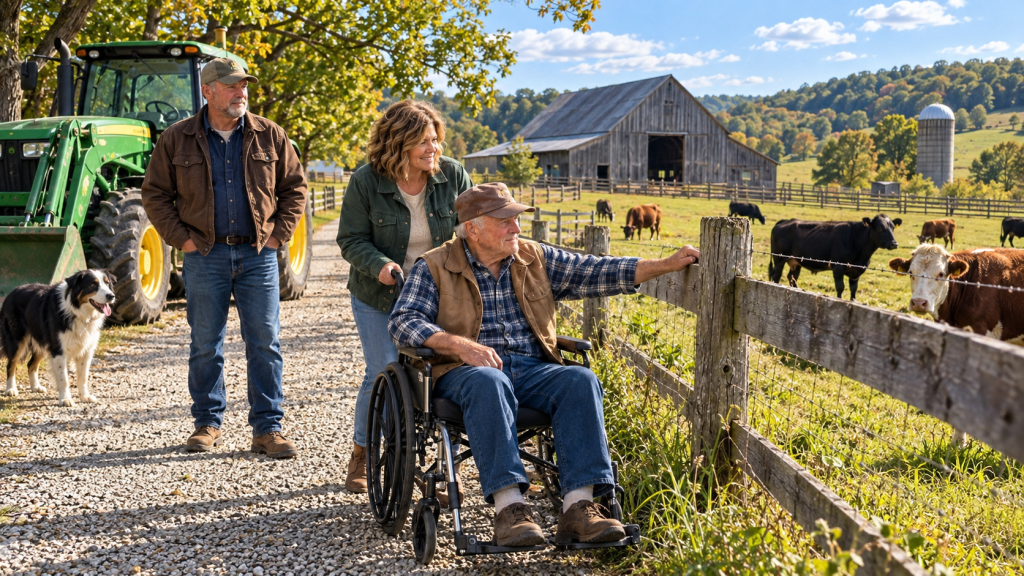
The September wind carried the smell of dry grass and freshly harvested soybeans across the pasture. “I should have,” he admitted. Bobby Whitt stood beside the fence, his cap held awkwardly between his hands. I looked down at the letter again.` It was not a handwritten complaint or an angry note.
It was a formal document prepared by an attorney.
The words were unmistakable.
REVOCATION OF DURABLE POWER OF ATTORNEY.
Beneath them was my father’s full legal name.
Clayton Samuel Whitaker.
Then a paragraph stating that the financial authority previously granted to Sherry was revoked.
I swallowed.
“Daddy, what made you do this?”
He turned toward me.
“Your sister tried to get me to sign something last winter.”
“What kind of thing?”
“A document giving her permission to sell the farm.”
My stomach tightened.
“Did you sign it?”
“No.”
He looked toward the old tobacco barn.
“She brought it to the nursing home on a Sunday. Told me selling would make my life easier.”
His voice grew quieter.
“She said I wouldn’t have to worry about keeping up with the property.”
I stared at him.
“She’s been telling me the farm doesn’t earn anything.”
Daddy gave a humorless laugh.
“Well, now we know why.”
Bobby shifted uncomfortably.
“Clayton, I would’ve come straight to you if I’d known there was trouble.”
Daddy looked at him.
“I know, Bobby.”
He reached for the farmer’s hand.
“You’ve paid what you owed. You did what you were told by someone you believed had the authority to speak for me.”
Bobby nodded, visibly relieved.
Then Daddy straightened in his wheelchair.
“But from today forward, any payment instructions need to come through my attorney after he’s checked everything. I don’t want anybody making assumptions.”
“Yes, sir.”
“And Bobby?”
“Yes?”
“That land isn’t for sale.”
Bobby’s eyes filled.
He glanced toward the southern pasture, where his cattle grazed beyond the fence.
“Thank you, Clayton.”
Daddy nodded.
Then he looked at me.
“Teresa, call Daniel Mercer.”
I frowned.
“Your attorney?”
“Yes.”
He reached into his shirt pocket and pulled out a small business card.
“I think it’s time somebody started telling the truth.”
Daniel Mercer’s office occupied the second floor of an old brick building in downtown Lexington.
Daddy had known him for more than thirty years.
Daniel was a quiet man in his late sixties, with silver-rimmed glasses, an unfashionable collection of neckties, and the habit of listening until someone had completely finished speaking.
He answered my call himself.
“Teresa?”
“Mr. Mercer, I’m at Daddy’s farm.”
A pause.
“Is Clayton all right?”
“He’s fine physically, but we’ve found something.”
I looked toward my father.
He was speaking with Bobby about the condition of the northern fence.
“The rent payments haven’t been going into his accounts.”
Daniel was silent.
Then he said, “I was afraid that might be the case.”
My grip tightened around the phone.
“You knew?”
“I knew Clayton had concerns about Sherry’s handling of certain financial matters. I prepared the revocation at his request.”
I swallowed.
“She signed for it seven months ago.”
“Yes.”
“And she’s still been collecting money.”
Daniel exhaled.
“Then we need to act immediately.”
I looked at Daddy.
“What do we do?”
“First, preserve every document you have. Don’t alter anything. Second, I need to speak directly with Clayton. Third, we need to identify every bank, payer, and institution that may still be relying on the old power of attorney.”
“Can we stop her from selling the farm?”
“We’ll examine the title records and any proposed transaction. A revoked power of attorney isn’t a magic shield if third parties don’t know about it, so we need to provide formal notice where appropriate and address anything she’s already attempted.”
His voice became firmer.
“Don’t confront your sister yet.”
I looked across the pasture.
Daddy was laughing at something Bobby had said.
For a moment, he looked like the man who had spent his entire life walking those fields.
“I wasn’t planning to,” I whispered.
“Good. Bring Clayton and the documents to my office tomorrow.”
I thanked him and ended the call.
Then I walked back toward the fence.
Daddy looked up.
“What did Daniel say?”
“He wants to see us tomorrow.”
Daddy nodded.
“Then that’s what we’ll do.”
I knelt beside his wheelchair.
“Daddy, there’s something I need to ask.”
He watched me carefully.
“Why didn’t you tell me you were worried about Sherry?”
His expression changed.
He looked down at his hands.
They were large, weathered hands, marked by years of work.
Hands that had planted tobacco, repaired machinery, built fences, and carried me when I was small enough to fall asleep against his shoulder.
“I didn’t want to turn my daughters against each other,” he said.
I felt tears gathering.
“Daddy, she was taking money that belonged to you.”
“I know that now.”
“You knew enough to revoke her authority.”
He nodded.
“But I thought she’d stop once she got that letter.”
I stared at him.
“Did she?”
He shook his head.
“She told me I was confused. Said Daniel had talked me into something I didn’t understand.”
His jaw tightened.
“I knew exactly what I was signing.”
I reached for his hand.
“Then why didn’t you tell me?”
He looked at me, and something in his eyes nearly broke my heart.
“Because I thought you were finally enjoying your retirement, honey.”
I swallowed.
“You and Doug worked hard. I didn’t want to bring another problem to your door.”
I stared at him.
For three years, I’d been taking money from my retirement account to cover his care.
For three years, he’d believed his rental income was paying those expenses.
We had both been trying to protect the other.
And Sherry had built her lies in the silence between us.
Daddy squeezed my hand.
“I’ve made a mistake, Teresa.”
I shook my head.
He continued.
“I thought keeping quiet would keep the family together.”
His eyes moved toward the old fence.
“But your granddaddy used to say something about rotten posts.”
I looked up.
Daddy smiled sadly.
“You can keep painting a rotten corner post, but the fence still falls when the weight comes.”
A tear slid down my cheek.
“And now?”
He took a slow breath.
“Now we pull it out and build something strong enough to stand.”
That evening, Doug met us at the nursing home.
My husband had always been the quieter one in our marriage.
He didn’t make speeches.
He didn’t demand attention.
When something broke, he fixed it.
When somebody needed help, he showed up.
But when I told him about the farm rent, the attempted sale, and the revoked power of attorney, his face turned a color I’d never seen before.
“Seventy-eight thousand dollars,” he said.
I nodded.
“Over three years.”
“And we’ve paid seventy-five thousand six hundred?”
“Yes.”
Doug stared at the floor.
Then he stood and walked to the window.
For a moment, I thought he might start shouting.
Instead, he pressed one hand against the glass.
“Our roof,” he whispered.
My throat tightened.
The roof over our kitchen had been leaking for almost two years.
Every time it rained, Doug climbed into the attic with a flashlight, looking for another temporary repair.
We’d received three estimates.
Each time, we’d decided to wait.
Because Daddy needed care.
Doug turned toward me.
“We could’ve fixed the roof.”
I nodded.
“We could’ve.”
He closed his eyes.
“And you could’ve stopped worrying every time the furnace made a strange noise.”
I began crying.
He came to me immediately.
“Teresa, I’m not angry with you.”
“I know.”
“I would’ve helped Clayton either way.”
I wiped my cheeks.
“So would I.”
He took my hands.
“But we deserved to know the truth.”
Daddy had been listening from his wheelchair.
Now he spoke.
“Doug, I’m going to make this right.”
Doug turned.
“Clayton, you didn’t know.”
Daddy shook his head.
“I should’ve asked more questions.”
Doug knelt beside him.
“You were recovering from a bad fall. You trusted someone who was supposed to be helping you.”
Daddy’s eyes filled.
“That doesn’t make me feel much better.”
Doug smiled sadly.
“Then maybe don’t try to feel better yet. Just let us help you sort it out.”
For a moment, my father stared at him.
Then he reached out and placed his weathered hand over Doug’s.
“You’re a good man.”
Doug swallowed.
“Had a good teacher.”
Daddy laughed softly.
And I realized that even in the middle of betrayal, there were still people who knew how to love without keeping score.
The following morning, Daddy wore his best blue shirt.
It was the one he used to wear to church on Easter Sunday.
He insisted on combing his own hair and fastening every button himself.
When I offered to help, he gave me a look.
“Teresa, I may need a wheelchair, but I haven’t forgotten how shirts work.”
I laughed.
It was the first time I’d laughed without feeling guilty in days.
We arrived at Daniel Mercer’s office shortly after ten.
He greeted Daddy at the elevator.
“Clayton.”
“Daniel.”
They shook hands.
Then Daddy looked at him seriously.
“I want my farm protected.”
Daniel nodded.
“That’s why we’re here.”
Inside the conference room, we spread the documents across a long wooden table.
Bobby’s payment receipts.
The rental statements.
The accountant’s tax records.
The proposed sale notice.
And the revocation letter Sherry had signed for seven months earlier.
Daniel examined everything carefully.
His assistant, a woman named Olivia Grant, brought in a laptop and began organizing the evidence.
After nearly an hour, Daniel looked toward my father.
“Clayton, I need to ask you something directly.”
Daddy nodded.
“Ask.”
“Have you authorized Sherry to receive the farm rent into an account held in her own name?”
“No.”
“Did you authorize her to spend those payments on herself?”
“No.”
“Did you agree to sell the farm?”
“Absolutely not.”
“Have you signed any new power of attorney since revoking the earlier one?”
Daddy leaned forward.
“No, Daniel. And I don’t plan to.”
Daniel nodded.
“Good.”
Then he looked at me.
“Teresa, your father has every right to receive assistance with physical tasks while retaining control over his financial decisions. His age and mobility limitations do not remove that authority.”
I glanced at Daddy.
He was sitting straight in his wheelchair, listening carefully.
For years, people had spoken around him.
Nurses.
Administrators.
Family members.
They discussed where he should live, what care he needed, and how much money it cost.
But Daniel spoke to him.
Not over him.
Not through me.
Directly to the man whose life was being discussed.
And I could see how much that mattered.
Daniel continued.
“We’ll notify the institutions involved, request the available records, and review whether any transactions occurred after Sherry received notice of the revocation.”
Daddy nodded.
“What about the farm?”
“The title search will tell us whether anything has been recorded. We’ll also contact the agent and any prospective buyer to notify them that you dispute Sherry’s authority to sell.”
I swallowed.
“Could she have already sold it?”
Daniel shook his head cautiously.
“We don’t have evidence of a completed sale. Bobby’s notice appears to concern a proposed transaction. Let’s verify the facts before assuming the worst.”
I nodded.
It was difficult to be patient.
But the older I became, the more I understood that anger could make a person careless.
Sherry had been careless with the truth.
We couldn’t afford to be.
The first major discovery came three days later.
The accountant, Martin Sloane, met us with records he’d obtained and reviewed after Daddy authorized him to investigate.
Martin had prepared Daddy’s tax returns for nineteen years.
He was a thin man with gray hair and a permanent crease between his eyebrows.
When he entered the room, he looked genuinely distressed.
“Clayton, I owe you an apology.”
Daddy frowned.
“For what?”
“I should have asked more questions about the rental income.”
My father studied him.
“Did you know Sherry wasn’t using it for my care?”
“No.”
Martin opened his folder.
“She reported the income to us and provided information for the tax filings. We had records showing the rent was received, but we weren’t engaged to audit how she spent it.”
I looked at him.
“So the tax return showed twenty-six thousand dollars in rent?”
“Yes.”
“Every year?”
“Yes.”
“And nobody thought it was strange that Daddy supposedly had no money left?”
Martin’s expression tightened.
“Teresa, I didn’t know you were contributing to his nursing home expenses.”
I stared.
There it was again.
The same silence.
Daddy thought the rent was paying for his care.
I thought the farm produced nothing.
The accountant knew about the rent but not about my payments.
Bobby knew where he mailed the checks but not how they were used.
Sherry had positioned herself at the center of every conversation.
Then made sure nobody compared notes.
Martin turned another page.
“There’s something else.”
My stomach tightened.
“What?”
“Sherry provided information for a bank account labeled Clayton Farm Operating Account.”
Daddy frowned.
“I don’t recognize that name.”
Martin nodded.
“That’s what concerned me.”
He explained that the records appeared to show Sherry controlling an account used to receive the rental payments.
Some expenses were described as property maintenance.
Others were labeled family reimbursements.
But the available documentation didn’t establish that those payments had benefited Daddy.
“How much?” I whispered.
Martin looked toward Daniel.
Daniel answered.
“We don’t have the complete bank records yet. We shouldn’t assign a final amount until we trace the transactions.”
I nodded.
Then Daddy asked a question that made everyone quiet.
“Martin, did Sherry ever tell you my farm was losing money?”
Martin hesitated.
“She said the property was becoming too difficult to manage and that a sale might be necessary.”
Daddy’s face hardened.
“Did she say I’d agreed to sell?”
Martin looked down.
“Yes.”
For a moment, nobody spoke.
Then Daddy leaned back.
“I see.”
His voice was so quiet that it frightened me more than shouting would have.
The second discovery was worse.
Daniel’s office obtained a copy of a draft purchase agreement from the real estate firm Sherry had contacted.
The proposed buyer was a regional investment company interested in agricultural land near a planned transportation expansion.
The proposed purchase price was $1.86 million.
I stared at the amount.
One million eight hundred sixty thousand dollars.
The farm where Daddy had worked since he was a teenager.
The land where his father taught him how to plant straight rows.
The place where my sister and I used to chase fireflies after supper.
Sherry had been trying to sell it for nearly two million dollars.
Without telling him the truth.
Without telling me anything.
And, according to the documents, while claiming Daddy was incapable of understanding the transaction.
I looked at Daniel.
“Was she going to keep the money?”
“We don’t know what she intended to do with any proceeds. But the proposed agreement directed communications and certain payment arrangements through an entity connected to Sherry.”
Daddy leaned forward.
“What entity?”
Daniel turned the page.
WHITAKER FAMILY PROPERTY MANAGEMENT, LLC.
I shook my head.
“I’ve never heard of that.”
Daddy hadn’t either.
Daniel explained that Sherry had formed the company several months earlier.
Its registered address was her home.
The proposed agreement had not been signed by Daddy, and Daniel found no evidence that a valid sale had been completed.
But attached to the broker’s file was a copy of an old power of attorney.
The one Daddy had revoked.
Daniel placed the two documents side by side.
One showed the original authority.
The other showed the revocation.
Both bore Daddy’s signature.
The revocation also had the certified-mail receipt proving Sherry had received it.
Daniel looked at my father.
“Clayton, this is significant.”
Daddy nodded.
Then he said, “I want the company told that the farm isn’t for sale.”
“We’ll do that.”
“And the real estate agent?”
“Yes.”
Daddy paused.
“And Daniel?”
“Yes, Clayton?”
“If Sherry comes into this office crying, don’t let me forget what the documents say.”
My chest tightened.
Daddy looked toward me.
“She’s still my daughter.”
His voice cracked.
“But being my daughter doesn’t give her permission to take my life apart.”
Sherry called me that evening.
I was standing in our kitchen, holding a bucket beneath the ceiling where rainwater had begun dripping again.
Doug was on a ladder, examining the latest stain.
My phone rang.
SHERRY.
I stared at the screen.
Doug climbed down.
“Are you going to answer?”
I took a breath.
“Yes.”
Then I put the call on speaker.
“Hello, Sherry.”
She didn’t bother greeting me.
“What have you done?”
I looked at Doug.
“What do you mean?”
“Daniel Mercer contacted the real estate agent.”
I felt my stomach tighten.
“Yes.”
“Teresa, you had no right to interfere.”
I closed my eyes.
“Whose farm is it, Sherry?”
A pause.
“You know whose farm it is.”
“Then why were you arranging to sell it?”
Her voice sharpened.
“Because somebody has to think about the future.”
I looked toward the bucket.
A drop of water struck its bottom.
Plink.
“Whose future?”
She laughed bitterly.
“Daddy’s, obviously.”
“Then why didn’t you tell him?”
“He doesn’t understand how expensive everything is.”
I felt anger rise through my chest.
“Sherry, he understands perfectly.”
“You don’t know what I’ve been dealing with.”
I stared at the wall.
“Then explain it.”
A long silence.
Finally, she said, “I’ve spent years managing his appointments, his paperwork, his insurance. Do you have any idea how much time that takes?”
I swallowed.
“I know you’ve done a lot.”
“Do you?”
Her voice broke.
“Because you come on Sundays, bring him some cookies, and get to be the loving daughter. I’m the one who has to answer the calls.”
For a moment, I felt the old guilt returning.
Then I looked at the bucket beneath our ceiling.
Thirty-six payments.
Seventy-five thousand six hundred dollars.
Our postponed repairs.
The plans Doug and I had set aside.
I took a slow breath.
“Sherry, I appreciate the work you’ve done. But that doesn’t explain the rent.”
Silence.
“Twenty-six thousand dollars a year.”
She didn’t answer.
“Where did it go?”
Finally, she whispered, “I deserved something for everything I did.”
My heart sank.
There it was.
Not confusion.
Not a misunderstanding.
A belief that taking what Daddy owned could somehow make up for what she felt he’d cost her.
I closed my eyes.
“You should have asked him to compensate you.”
“He would have said no.”
“Then you didn’t have permission.”
Sherry began crying.
“Teresa, you’re going to destroy this family.”
I looked at Doug.
Then at the slow drip of rainwater into the bucket.
And I said something I’d never dared say to my sister before.
“No, Sherry. I’m finally going to stop helping you hide what you’ve done.”
I ended the call.
My hands were shaking.
Doug reached for me.
“Are you all right?”
I looked at the bucket.
Then the ceiling.
Then my husband.
“No,” I whispered.
“But I think we’re going to be.”
For nearly two weeks, Sherry refused to speak to Daddy.
She sent messages to me instead.
Some were angry.
Some were accusing.
One said she’d sacrificed more for him than I could ever understand.
Another said Doug and I were rich enough to afford the nursing home payments.
I stared at that message for a long time.
Rich.
Doug and I had worked for more than forty years.
He’d spent most of his career maintaining heating and air-conditioning systems.
I’d delivered mail through Kentucky summers, winter ice storms, and Christmas seasons when my feet hurt so badly I could barely stand by evening.
We weren’t poor.
But we weren’t wealthy.
We had saved carefully because we’d watched too many people reach retirement without enough money to live securely.
We thought we’d finally reached the point where we could rest.
Then Daddy fell.
And I did what I believed any daughter who could help should do.
The thought that Sherry had interpreted our sacrifice as proof that we had money to spare made my chest ache.
One evening, Doug found me sitting at the kitchen table with my phone in my hands.
“Another message?”
I nodded.
He sat beside me.
“Teresa, you don’t have to keep reading them.”
I looked at him.
“She’s my sister.”
“I know.”
“We grew up in the same bedroom.”
He waited.
“She used to braid my hair before school. When I was eight and broke my ankle, she carried my books for six weeks.”
My voice cracked.
“How does someone go from that to this?”
Doug took my hand.
“People can do kind things and still make terrible choices later.”
I stared down.
“I keep wondering whether I missed something.”
He shook his head.
“You trusted your sister.”
I swallowed.
“That feels foolish now.”
Doug looked at me.
“Trusting somebody isn’t foolish. Refusing to examine the truth after you discover it would be.”
I leaned against him.
Outside, rain began falling.
A few minutes later, I heard water dripping into the kitchen bucket.
Doug looked toward the ceiling.
Then he sighed.
“Well, I suppose the roof has decided to contribute to this conversation.”
I laughed unexpectedly.
He smiled.
And for the first time in days, I remembered that our life still contained ordinary things.
Rain.
Dinner.
A leaky roof.
And a husband who knew when I needed him to say something funny.
The complete financial review took longer than any of us wanted.
Bank records had to be obtained through appropriate authorizations and legal requests.
Expenses had to be categorized.
Payments had to be traced.
And Sherry’s explanations had to be compared against actual documents.
When Daniel finally called us back into his office, he placed a summary on the table.
“Clayton,” he said, “we’ve now accounted for the seventy-eight thousand dollars in rent Bobby paid over the three-year period.”
Daddy adjusted his glasses.
“All right.”
“Approximately nine thousand six hundred dollars went toward identifiable property taxes and maintenance.”
My father nodded.
“That’s legitimate.”
“Fourteen thousand dollars remains in the account under Sherry’s control.”
Daddy leaned forward.
“And the rest?”
Daniel paused.
“Fifty-four thousand four hundred dollars went toward expenses that appear personal to Sherry or her household, rather than your care or the farm.”
I closed my eyes.
Fifty-four thousand four hundred dollars.
Daniel continued.
“Those include credit-card payments, vehicle expenses, and transfers to an account associated with a small business she operated.”
Daddy was quiet.
Then he asked, “Any money sent to my nursing home?”
Daniel shook his head.
“None identified from that rental account.”
I felt the room tilt.
Three years.
Thirty-six monthly payments from my retirement savings.
And not one rental dollar sent toward Daddy’s care.
He looked at me.
“I’m sorry, Teresa.”
I reached for his hand.
“Daddy, you didn’t do this.”
His eyes filled.
“I trusted her.”
“So did I.”
He looked toward Daniel.
“What happens now?”
“We’ll pursue return of the funds and address any unauthorized transactions. We should also arrange for independent financial oversight so your care expenses are paid from accounts you control.”
Daddy nodded.
“Good.”
Then he paused.
“Daniel, there’s something I want you to understand.”
“Of course.”
“I don’t want Teresa paying another dollar toward my nursing home unless she decides to give me a gift.”
My throat tightened.
Daddy continued.
“I’m grateful for everything she and Doug have done. But I have land producing income, and I have financial decisions to make about my own care.”
Daniel nodded.
“We’ll prepare a sustainable plan.”
I squeezed Daddy’s hand.
He looked at me.
“And we’re going to address that seventy-five thousand six hundred dollars you’ve already paid.”
“Daddy, please—”
He raised one finger.
“Teresa.”
I stopped.
His expression softened.
“You keep telling me my mind still works.”
I laughed through tears.
“Of course it does.”
“Then stop arguing with me when I make a decision.”
Daniel smiled.
And for the first time in weeks, Daddy laughed.
Our meeting with Sherry happened on a Thursday afternoon.
It was held in Daniel’s conference room.
Her attorney attended.
So did Daddy.
I sat beside him.
Doug waited outside because he knew I needed to face my sister without feeling that I was hiding behind anyone.
When Sherry entered, I barely recognized her.
Her hair had gone almost entirely gray.
Dark circles rested beneath her eyes.
She looked smaller than I remembered.
For one aching moment, I wanted to stand and hug her.
I wanted to forget everything.
To be sisters again.
To go back to those childhood evenings when we shared a bedroom and whispered stories after the lights went out.
Then I remembered our roof.
The seventy-five thousand six hundred dollars.
And the proposed sale of Daddy’s farm.
I stayed seated.
Sherry looked toward our father.
“Daddy.”
He nodded.
“Sherry.”
Her eyes filled.
“I’ve missed you.”
Daddy looked at her.
“I’ve been right where you left me.”
She began crying.
“That’s not fair.”
He didn’t raise his voice.
“Neither was telling me my farm needed to be sold when I said I didn’t want to sell it.”
She looked down.
Her attorney quietly reminded everyone that the meeting was intended to explore a resolution.
Daniel nodded.
Then Daddy spoke again.
“Sherry, I want to hear something from you.”
She looked up hopefully.
“What, Daddy?”
“The truth.”
The room became quiet.
He continued.
“Not what you think will make me feel better. Not what makes your sister look bad. The truth.”
Sherry wiped her cheeks.
For a long time, she said nothing.
Then she whispered, “I was drowning.”
I stared at her.
She continued.
“My little home-decorating business was failing. I had debts. I kept thinking I could turn things around.”
Daddy watched her.
“So you used my rent.”
She nodded.
“At first, I told myself it was temporary.”
I felt tears gathering.
She looked at me.
“Teresa, I thought you and Doug could afford the nursing home payments.”
I shook my head.
“Sherry, you never asked.”
“I know.”
“You knew we were taking money from our retirement savings.”
She looked down.
“I didn’t want to think about it.”
The admission struck me harder than any excuse could have.
She hadn’t necessarily believed we were comfortable.
She had simply chosen not to look closely at what her decisions cost us.
Daddy leaned forward.
“Why did you try to sell the farm?”
Sherry began crying harder.
“I thought if I sold it, there would be enough to pay everything back.”
His face changed.
“Everything?”
She nodded.
“My debts. Your care. Teresa’s money.”
Daddy looked down at his hands.
“You were going to sell something worth nearly two million dollars because you’d taken seventy-eight thousand in rent?”
She didn’t answer.
He leaned back.
“Sherry, I spent sixty years building that farm.”
His voice trembled.
“Your granddaddy spent half his life there before me.”
She covered her face.
“And you were willing to sell it without even asking me?”
“Daddy, I thought—”
“No.”
He didn’t shout.
But she stopped speaking.
“I know what you thought.”
His eyes filled.
“You thought because I couldn’t walk around those fields anymore, I was finished making decisions about them.”
Sherry began sobbing.
Daddy looked at her for a long time.
Then he said the words that finally made me cry.
“My legs are weak, Sherry. My judgment is not.”
Nobody spoke.
He continued quietly.
“I would’ve listened if you’d told me you were struggling. I might have helped you make a plan.”
He took a breath.
“But you didn’t ask me for help.”
His voice broke.
“You took away my right to choose.”
Sherry lowered her head.
And for the first time since this began, she had no answer.
The meeting ended without an embrace.
Sherry wanted one.
I could see it in the way she lingered near the door, turning toward Daddy as though she expected him to call her back.
But he didn’t.
He simply asked Daniel to continue preparing the documents needed to protect his property and recover the money.
Before leaving, Sherry looked at me.
“Teresa, do you hate me?”
I swallowed.
There were so many answers I could have given.
I could have reminded her of every sacrifice Doug and I had made.
Every canceled plan.
Every night I’d lain awake worrying about the money.
Instead, I told her the truth.
“No, Sherry.”
Hope appeared in her eyes.
Then I continued.
“But I don’t trust you.”
Her expression collapsed.
I took a breath.
“Those are two different things.”
She nodded slowly.
Then walked away.
I watched her disappear down the hallway.
For years, I’d believed that loving family meant protecting them from consequences.
Now I was learning that sometimes love meant refusing to participate in another person’s dishonesty.
Over the following months, Sherry entered a formal repayment agreement addressing the money she’d diverted.
The remaining funds in the account were placed under appropriate control.
She sold assets associated with her failing business and began making restitution payments under the negotiated arrangement.
Her previous conduct was also referred to the appropriate authorities for review.
There were no instant resolutions.
No dramatic courtroom confession that returned every missing dollar overnight.
Sherry had created a problem that would take years to repair financially.
And the damage to our family couldn’t be calculated on a bank statement.
Daddy understood that.
He told Daniel not to abandon the legal process simply because Sherry cried or promised to change.
But he also refused to let his disappointment become the center of his remaining years.
“I’ve got a farm to think about,” he said.
“And a family to straighten out.”
The first thing we did was establish an independent system for managing his finances.
Daddy remained the decision-maker.
Daniel helped him arrange updated authorizations and a clear process for paying his bills.
An independent bookkeeper prepared monthly summaries.
Daddy received copies of every statement.
So did the accountant, when needed for his work.
No single family member would again control all the information.
We also reviewed the farm lease.
After looking at current local rental rates and the property’s expenses, Bobby and Daddy negotiated an updated arrangement that provided more income while remaining fair to both sides.
The money would be deposited into an account titled in Daddy’s name and used first for his care, farm obligations, and reserves.
We prepared a budget recognizing that nursing home costs could rise and that farmland sometimes produced unexpected expenses.
For the first time, we were discussing Daddy’s financial future openly.
Not guessing.
Not relying on Sherry’s version of events.
And not treating his disability as permission to make decisions without him.
One afternoon, Daniel asked Daddy whether he wanted someone else to handle the farm entirely.
Daddy smiled.
“Daniel, I’m happy to let somebody else repair the fences.”
He paused.
“But I still want to know whether they need repairing.”
Everyone laughed.
And I realized how much of Daddy’s dignity had been hidden beneath the simple fact that he’d needed a wheelchair.
He wasn’t asking to do everything himself.
He was asking to remain the owner of his choices.
The first reimbursement check arrived five months after we discovered the rent payments.
I was standing in our kitchen when Daddy called.
“Teresa, can you come see me tomorrow?”
“Of course. Is something wrong?”
“No.”
His voice sounded unusually cheerful.
“I’ve got something for you.”
The following afternoon, I found him sitting beside his nursing home window.
A blue envelope rested on the table.
He pushed it toward me.
“Open that.”
I frowned.
“Daddy?”
“Just open it.”
Inside was a check for twenty thousand dollars.
I stared.
“Daddy, what is this?”
“The first part of what I owe you.”
I shook my head immediately.
“You don’t owe me for loving you.”
His expression softened.
“Teresa, listen.”
I looked at him.
“You paid bills you wouldn’t have had to pay if you’d been given the truth.”
My eyes filled.
He continued.
“I’m not reimbursing you because you loved me.”
He touched the check.
“I’m reimbursing you because your money was used to cover an expense that should have been handled differently.”
I sat beside him.
He squeezed my hand.
“There’s a difference.”
I stared at the check again.
Twenty thousand dollars.
It wouldn’t replace the years we’d spent worrying.
It wouldn’t repair every sacrifice.
But it was a beginning.
Daddy explained that the payment came from recovered funds and money he’d now been able to allocate safely after reviewing his own care budget.
Further reimbursement would depend on what was recovered and what he could afford without jeopardizing his care.
I appreciated that.
He wasn’t making grand promises.
He was taking responsibility for the decisions he could make.
I leaned forward and hugged him.
“Thank you, Daddy.”
He kissed the top of my head.
Then smiled.
“Now tell Doug to get that roof fixed before I have to come over there with a hammer.”
I laughed through tears.
“Daddy, you haven’t climbed a ladder in twenty years.”
He winked.
“Doesn’t mean I can’t supervise.”
The roof was replaced the following spring.
I stood in our driveway watching the workers carry away the old shingles.
Doug stood beside me, his arm around my shoulders.
For years, we’d looked at that roof as something we couldn’t quite afford.
A problem that would have to wait until another month.
Another season.
Another year.
Now it was finally being repaired.
Doug turned toward me.
“How does it feel?”
I looked up.
“Strange.”
He smiled.
“Strange?”
I nodded.
“Like we’re finally taking care of our own house again.”
He kissed my forehead.
“That sounds about right.”
I watched the workers for a moment.
Then whispered, “I wish it hadn’t taken all this.”
Doug nodded.
“Me too.”
There was no way to recover every missed vacation.
Every worried night.
Every conversation dominated by money.
But we could stop allowing those losses to dictate our future.
We could repair the roof.
Make plans.
And enjoy the retirement we’d worked so hard to earn.
Not because Daddy mattered less.
But because our lives mattered too.
One Sunday in June, I drove Daddy back to the farm.
The fields were green.
The creek was running full after several days of rain.
Bobby had repaired part of the northern fence, and the cattle were grazing peacefully near the hill.
I helped Daddy into his wheelchair.
Then pushed him toward the old corner post.
The same post he’d touched on the day we discovered where his money had been going.
He rested his hand on the weathered wood.
“Still standing,” he murmured.
I smiled.
“Yes, Daddy.”
He looked toward the fields.
“Your granddaddy built that fence to last.”
I sat on a folding chair beside him.
For a while, we watched the wind move through the grass.
Then he spoke.
“Teresa, there’s something I never told you about Sherry.”
I turned.
Daddy stared toward the barn.
“After your mother died, Sherry came out here every Saturday for almost a year.”
I nodded.
“I remember.”
“She helped me sort paperwork. Took me to appointments. Brought food when I didn’t feel like cooking.”
His voice softened.
“She was good to me.”
I looked down.
“I know.”
Daddy took a slow breath.
“That’s part of what makes this so hard.”
He turned toward me.
“I don’t want the worst thing Sherry ever did to erase every good thing she ever did.”
My eyes filled.
He continued.
“But I can’t let the good things erase what happened either.”
I nodded.
For a long time, neither of us spoke.
Then I asked, “Do you think you’ll forgive her?”
He looked toward the fields.
“I hope I can.”
He paused.
“But forgiveness won’t mean handing her my checkbook again.”
I laughed softly.
Daddy smiled.
“And Teresa?”
“Yes?”
“I hope you don’t spend your life being angry on my behalf.”
My throat tightened.
“I don’t know how to stop.”
He reached for my hand.
“Then start by enjoying something.”
I stared at him.
“Like what?”
He smiled.
“That trip you and Doug keep talking about.”
I laughed.
“You remember?”
“Of course I remember.”
He looked toward the southern pasture.
“You’ve spent your whole life delivering mail, raising your family, working, worrying, and helping everybody else.”
His eyes filled.
“Go see something beautiful while you still can.”
I bent forward and hugged him.
For a moment, he held me like he used to when I was a little girl.
Then whispered, “You’ve done enough carrying, sweetheart.”
And I finally let myself cry.
That autumn, Doug and I took the vacation we’d postponed.
We drove through the Blue Ridge Mountains.
We stayed in a small inn with a porch overlooking a valley.
We walked slowly through towns we’d never visited and ate breakfast without looking at the clock.
Every morning, I called Daddy.
He asked about the weather.
The mountains.
The restaurants.
And whether Doug was behaving himself.
On our fourth day, he asked me something unexpected.
“Teresa, are you enjoying yourself?”
I looked toward the mountains.
“Yes, Daddy.”
“Good.”
A pause.
“Then stop worrying about me for five minutes.”
I laughed.
“That’s impossible.”
“Try.”
I smiled.
“All right.”
Then he said softly, “That’s all I ever wanted for you.”
I looked toward Doug, who was standing beside the window holding two cups of coffee.
For the first time, I understood that helping Daddy and taking care of myself were not competing acts of love.
They could exist together.
One did not have to destroy the other.
Sherry and Daddy eventually began speaking again.
At first, only through letters.
Then short telephone calls.
Later, a few supervised visits arranged at his request.
They weren’t easy.
There were tears.
Uncomfortable silences.
Questions Sherry struggled to answer.
The restitution agreement remained in place, and Daddy kept the financial boundaries he’d established.
I didn’t resume a close relationship with her.
Not yet.
Perhaps I never would.
But I stopped measuring my healing by whether she apologized enough.
I had my own life to live.
And Daddy had made something clear to both of us.
He didn’t want his last years consumed by arguments over what would happen to his money after he was gone.
With independent legal advice, he updated his estate plan to reflect his wishes, account for relevant financial claims, and protect the farm from decisions made without proper authority.
He wanted the land to remain productive.
He wanted the people working it to be treated fairly.
And he wanted his daughters to understand that inheritance was not permission to take what someone hadn’t freely given.
One afternoon, he showed me the new financial reports.
Every payment was listed.
Every deposit accounted for.
Every expense explained.
I smiled.
“Daddy, you’re turning into quite the accountant.”
He chuckled.
“I’ve always known how to count, Teresa.”
Then he looked toward the window.
“I just forgot that I had a right to ask where the numbers were going.”
The following September, exactly one year after our visit to Bobby, I took Daddy back to the farm.
The late afternoon sun stretched long golden shadows over the pasture.
Bobby met us beside the northern gate.
“Looking good, Clayton.”
Daddy laughed.
“That’s because Teresa made me wear a decent shirt.”
Bobby shook his hand.
They talked about the harvest, the weather, and the cattle.
Then Bobby showed him the repaired corner fence.
The original post was still standing.
But the rails around it had been strengthened.
Fresh timber gleamed in the sunlight.
Daddy reached out and touched the wood.
“That’s good work, Bobby.”
The farmer smiled.
“Learned from the best.”
I stood beside them, thinking about everything that had happened over the past year.
The rent payments.
The missing money.
The attempted sale.
The arguments.
The lawyers.
The reimbursement checks.
The repaired roof.
And the strange, painful discovery that someone we loved had been willing to take advantage of our trust.
Daddy looked up at me.
“Teresa?”
“Yes?”
“Do you remember what your granddaddy said about corner posts?”
I smiled through tears.
“If the corner post isn’t strong, the whole fence eventually falls.”
He nodded.
“That’s right.”
Then he looked toward the farm.
“For a while, I thought keeping a family together meant never making anybody angry.”
His voice softened.
“But that’s not what holds a family together.”
I waited.
He squeezed my hand.
“Truth does.”
A tear slipped down my cheek.
Daddy continued.
“And trust has to be supported by honesty. Otherwise, it doesn’t matter how much you love somebody. Sooner or later, the fence comes down.”
I looked at the old wooden post.
It had survived more than sixty years of Kentucky winters, heavy rain, summer heat, and changing seasons.
It was scarred.
Weathered.
Imperfect.
But it was still standing.
So was Daddy.
So was I.
And although my relationship with Sherry would never be the same, I no longer believed that protecting myself meant I’d stopped loving my family.
It meant I had finally learned that love without honesty could become a burden no one was meant to carry.
That evening, as I helped Daddy into the car, he reached for my hand.
“Teresa, I’m proud of you.”
I smiled.
“For what?”
“For standing up for me.”
Then he paused.
“And for finally standing up for yourself.”
I leaned forward and kissed his cheek.
“I love you, Daddy.”
He smiled.
“I know, sweetheart.”
As we drove away, I glanced in the rearview mirror.
The fields stretched toward the horizon.
The old barn stood beneath the evening sky.
And the corner post remained firmly planted beside the road.
For three years, I’d believed that being a good daughter meant quietly giving everything I could.
But my father taught me one final lesson.
Helping someone you love should never require surrendering your right to the truth.
And sometimes, the most loving thing a family can do is stop pretending everything is fine, uncover what’s broken, and finally begin repairing it.
THE END STORIES! THANK YOU FOR READING GOOD LUCK !❤️
Related Posts