PART 3 — THE HOUSE THEY THOUGHT MY LOVE HAD ALREADY SIGNED AWAY
My father’s face changed the moment I said the word bank.
Not dramatically.
That would have been easier.
He simply stopped looking angry.
Anger had been his safest emotion for as long as I could remember.
Anger allowed him to make everyone else defensive.
Fear did not.
“Connor.”
His voice dropped.
“Don’t do something stupid.”
I stared at him.
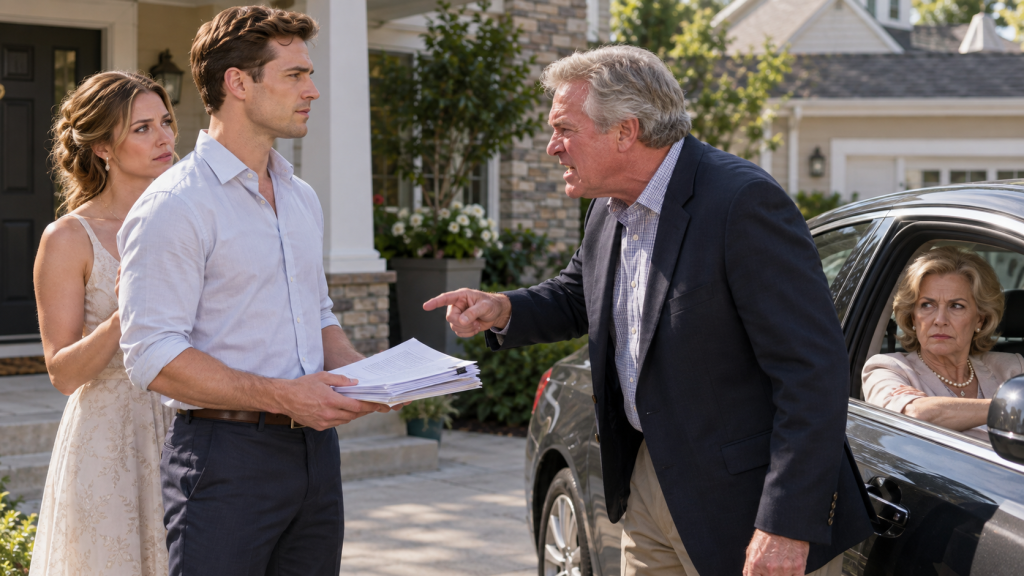
Behind me, Natalie stood in the doorway of the home we had been married from less than three weeks earlier.
My mother had finally gotten out of the passenger seat.
Her arms were folded.
The expression on her face was the same one she had worn when I was seventeen and admitted I had dented Dad’s car.
Disappointment.
As though whatever happened next would be my moral failure.
I looked down at the loan application again.
Two hundred forty thousand dollars.
My parents’ names.
Mine.
And beside mine, a signature close enough to fool a stranger.
Not close enough to fool me.
“I’m calling the bank.”
Dad stepped toward me.
“Give me the papers.”
“No.”
“They belong to me.”
“My name is on them.”
“That doesn’t make them yours.”
I almost laughed.
The sentence was so perfect I wished I could frame it.
“You should remember that.”
His face darkened.
“Connor.”
Natalie spoke from behind me.
“Stop moving toward him.”
Dad looked past me.
“This is none of your business.”
She did not raise her voice.
“My husband is standing on my property while someone demands that he sign documents he doesn’t understand.”
Her eyes moved to the loan packet.
“It became my business when you brought it to our front door.”
Mom scoffed.
“There she goes.”
I turned.
“What does that mean?”
“She’s been waiting for this.”
“For what?”
“To separate you from your family.”
Natalie’s face did not change.
I felt something inside me settle.
For years, I would have rushed to reassure my mother.
Natalie isn’t doing that.
Natalie likes you.
Natalie wants everyone to get along.
I had made Natalie defend herself against accusations she had never earned because peace required somebody to absorb the insult.
Usually her.
Not today.
I took out my phone.
Dad reached for the packet again.
I stepped backward.
“Touch me or those papers again and I’ll call the police before I call the bank.”
His hand dropped.
Mom’s face went white.
“You’d call the police on your parents?”
“If necessary.”
“Over paperwork?”
“No.”
I looked at the false signature.
“Over fraud.”
That word finally silenced both of them.
I called the lender.
—
It took twenty-six minutes to reach the right department.
Dad and Mom waited in the driveway for the first nine.
Then Dad said:
“This is ridiculous.”
He walked back to the car.
Mom stayed another minute.
She looked at me through narrowed eyes.
“You will regret humiliating us.”
I thought about two empty chairs at my wedding.
Then about the thirty-seven missed calls that came only when I stopped paying their bills.
“I already know what humiliation feels like.”
I said.
She flinched.
Good.
Not because I wanted to hurt her.
Because for once, the pain reached the person who had caused it instead of being immediately rerouted into me.
She got in the car.
They drove away before the bank answered.
Natalie brought me a chair from the porch.
I sat there in my wedding-week sweatpants speaking to a fraud specialist named Denise.
“Mr. Connor Whitmore?”
“Yes.”
“I’m showing an application with your name as a co-borrower and co-owner of the collateral property.”
“I did not submit it.”
“Did you authorize anyone to sign for you?”
“No.”
“Did you provide electronic or verbal authorization?”
“No.”
“Did you sign a power of attorney?”
“No.”
A pause.
“Are you in possession of a copy of the application?”
“Yes.”
“Can you photograph the signature page and upload it to the secure link I’m sending?”
I did.
Natalie sat beside me.
No questions.
Just her hand resting on the arm of my chair close enough that I could take it if I wanted.
I did.
Denise returned.
“Mr. Whitmore, I’m placing a hold on the application while our fraud team investigates.”
“Has any money been disbursed?”
“No.”
I exhaled.
“Good.”
“We may also ask you to file an identity-theft or police report, depending on what we confirm.”
“I will.”
Another pause.
“Do you recognize the email address on the application?”
She read it.
My father’s.
“Phone?”
My mother’s.
“IP location?”
She could not give me that yet.
Fine.
Then she asked:
“Do you want us to note that any future transaction involving your ownership interest requires direct verbal confirmation from you?”
“Yes.”
“Done.”
I thanked her.
When the call ended, I stared at my phone.
Natalie said:
“You okay?”
“No.”
She nodded.
No cheerful reassurance.
No:
They’re your parents; maybe it’s a misunderstanding.
That was one of the things I loved most about her.
She never insulted pain by trying to rename it too early.
I looked at the loan documents.
“They forged me.”
She took my hand.
“Yes.”
I laughed once.
“Two weeks ago they wouldn’t get on a plane I paid for.”
My throat tightened.
“But they drove all the way here for my signature.”
Natalie’s eyes filled.
“I know.”
That was when I finally cried.
—
The bank froze the application before a dollar moved.
That saved us from one kind of disaster.
It did not save us from the rest.
Monday morning, I met with a real-estate attorney named Malcolm Reyes.
I brought everything.
Original mortgage documents.
Refinance papers.
Deed.
Payment history.
The forged loan application.
Texts.
My parents’ demand that I transfer title.
Malcolm read quietly for forty minutes.
Then looked up.
“Your parents own seventy percent.”
“Yes.”
“You own thirty.”
“Yes.”
“You are jointly liable on the mortgage.”
“Yes.”
“How much remains?”
“Forty-eight thousand seven hundred and twelve.”
His eyebrows rose.
“You’ve been paying most of it?”
“All of it for the last four years.”
“And before that?”
“About half.”
He leaned back.
“Why?”
The question should have been easy.
It wasn’t.
“Because they couldn’t afford it.”
“Couldn’t?”
He emphasized the word.
Or wouldn’t?
I did not know yet.
Malcolm tapped the deed.
“You understand that transferring your thirty-percent interest would not, by itself, remove your liability from the loan.”
“I understand now.”
“And this packet they brought you does not contain a completed lender release.”
“No.”
“So their plan was to receive full title while leaving you exposed to the remaining mortgage.”
“Yes.”
“That is an extraordinary request.”
“My family specializes in those.”
He almost smiled.
Then grew serious.
“The forged loan application is separate.”
“I recommend you cooperate with the lender’s fraud review and make whatever reports counsel advises.”
“What about the house?”
“What do you want?”
There it was again.
What do you want?
I was beginning to hate how unfamiliar that question felt.
“I want off the mortgage.”
“That is reasonable.”
“I don’t want to pay another dollar.”
“Also reasonable.”
“I don’t necessarily want to throw my parents out of their home.”
Malcolm nodded.
“Good.”
He did not sound disappointed that I was not asking for revenge.
“We can propose options.”
“Such as?”
“They refinance the remaining loan entirely into their names and purchase your legal interest at an agreed value.”
“Can they qualify?”
“I don’t know.”
“Other option?”
“Sale.”
My stomach tightened.
“That house has been in the family twenty-four years.”
“Then perhaps your parents will find a way to refinance.”
“And if they can’t?”
Malcolm looked at me.
“A property cannot remain a sentimental object and a financial trap indefinitely.”
I stared at the deed.
Thirty percent.
For seven years, that number had meant obligation.
Now it meant rights.
I was uncomfortable with that.
Good.
Growth is rarely comfortable in the direction you need.
—
My brother, Mason, called that afternoon.
“You reported them to the bank?”
“Dad forged my signature.”
“He says you gave permission.”
“No.”
“He says there was a conversation last Christmas.”
“There wasn’t.”
Mason went quiet.
Then:
“Connor, Mom is losing it.”
“Why?”
“They think they’re going to lose the house.”
“They might.”
He cursed.
“You can’t do that.”
“I’m not doing anything yet.”
“You stopped paying.”
“Yes.”
“That mortgage is almost done.”
“Exactly.”
“What is that supposed to mean?”
“It means I’ve been paying it long enough.”
Mason sighed.
“You’re still angry about the wedding.”
I looked out the window.
Natalie was in the backyard watering the herb garden.
The woman my parents called “that girl” had spent the entire weekend helping me build folders of financial documents involving people who had insulted her for years.
“Yes.”
I said.
“I’m angry about the wedding.”
“Connor—”
“But this is not about one weekend.”
I continued.
“The wedding just removed my last excuse.”
Silence.
I asked:
“Did you know about the home-equity loan?”
“No.”
“Did you know they wanted two hundred forty thousand?”
“What?”
There.
Real shock.
“No.”
he said.
“What the hell would they need that for?”
“I was hoping you could tell me.”
“I can’t.”
Then he hesitated.
“What are you going to do?”
“I’m going to stop paying for adults who treat me like a utility account.”
Mason sighed.
“You know they helped us when we were kids.”
I closed my eyes.
“They raised us.”
“That is not a loan.”
He went silent.
Then:
“Mom says Natalie is behind all this.”
“Natalie hasn’t told me to do a single thing.”
“She doesn’t have to.”
I snapped.
There it was.
A familiar line.
A wife’s existence becomes manipulation whenever a son develops a boundary after marriage.
“Mason.”
My voice hardened.
“You need to decide whether you’re calling because you want facts or because they sent you to make me feel guilty.”
Another silence.
This one longer.
Finally:
“They asked me to call.”
“Thank you.”
“For what?”
“For telling the truth.”
Then I hung up.
Not angrily.
Just finished.
—
The bank’s fraud department called three days later.
Their digital records showed the application had been started from a device associated with my parents’ home network.
My father’s email account created the profile.
My mother’s phone number received a verification code.
The signature was entered electronically.
No direct contact with me appeared anywhere.
No authorization.
No power of attorney.
The application had also included a scanned copy of my driver’s license.
That frightened me more than the signature.
“Where did they get that?”
Natalie asked.
I knew.
I had emailed Mom a copy two years earlier so she could add me as an emergency driver on her insurance while I helped after Dad’s surgery.
Useful son.
Useful documents.
Useful until the usefulness could be repurposed.
I filed a police report.
My hands shook while I did it.
Not because I thought the officers would arrive with sirens and handcuffs.
They didn’t.
Because writing:
Suspect relationship: father
felt unnatural.
There are words you never imagine placing together.
Fraud.
Father.
Signature.
Mine.
I gave facts.
Nothing more.
When I got home, I sat on the kitchen floor.
Natalie sat beside me.
I said:
“I feel like I’m betraying them.”
She waited.
Then asked:
“Did you sign the loan?”
“No.”
“Did you create the fake signature?”
“No.”
“Did you force them to apply?”
“No.”
“Then whose actions are you reporting?”
“Theirs.”
She leaned her head against the cabinet.
“You are not creating the facts by refusing to hide them.”
I looked at her.
That sentence stayed.
—
The question of the two-hundred-forty-thousand dollars took longer.
For weeks, my parents said nothing.
Their attorney sent a letter claiming I had always understood my title interest was “for lending convenience only.”
Malcolm laughed when he read that.
Not because it was impossible to argue.
Because the deed was explicit.
Thirty percent interest.
No trust agreement.
No side contract.
No written promise to transfer later.
I had also paid a huge portion of the mortgage.
Then Mason called again.
This time, he sounded different.
“Can I come over?”
“When?”
“Tonight.”
“Why?”
“I found something.”
He arrived carrying a grocery bag.
Inside were unopened envelopes.
Credit-card statements.
Personal loans.
Late notices.
A notebook.
My father’s handwriting.
Mason looked sick.
“I went to the house.”
“They were fighting.”
“Dad told me to stay out of the office.”
“So I didn’t.”
I stared.
“That sounds like the opposite.”
“Yeah.”
He put the notebook on the table.
I opened it.
Amounts.
Names.
Monthly payments.
One heading:
HOUSE LOAN
Below it:
$240,000.
Then a list.
$68,000 — cards.
$41,500 — personal loan.
$27,000 — medical? Maybe legitimate.
$36,000 — Lisa / family.
I stopped.
“Lisa?”
Mason nodded.
“Aunt Lisa’s daughter.”
The cousin whose baby shower had mattered more than my wedding.
“What does thirty-six thousand mean?”
“I asked Mom.”
Mason swallowed.
“She promised to help them with a down payment on a house.”
I stared.
“With what money?”
“She said once the equity loan cleared.”
My chest went cold.
They planned to borrow against a house I partly owned, using a forged signature, to give thirty-six thousand dollars to the same extended family whose baby shower they chose over my wedding.
For several seconds, I could not hear anything.
Mason continued.
“There’s more.”
I almost laughed.
Of course.
My parents had spent years playing wealthy patrons to the family.
Baby gifts.
Emergency loans.
Vacation help.
Graduation presents.
Big Christmas checks.
Everyone praised them.
The generous Whitmores.
Except much of the monthly cash keeping them afloat came from me.
Mortgage.
Utilities.
Phones.
Insurance occasionally.
I had been financing their ability to appear generous to people they preferred.
“Did Lisa know?”
“I don’t think so.”
“Does anyone?”
“No.”
Mason sat across from me.
“I didn’t know either.”
I looked at him.
He had called me childish.
He had defended them.
I could see shame settling.
“Connor.”
“Yeah?”
“I’m sorry.”
I closed the notebook.
“For which part?”
“Calling you.”
He rubbed his face.
“Believing Mom.”
“Assuming Natalie did this.”
He looked toward the living room where my wedding photo sat on the mantel.
“And not saying anything when they skipped the wedding.”
That hurt more.
“You knew it was wrong.”
“Yes.”
“Why didn’t you say it?”
Mason stared at the table.
“Because if they were mad at you, they weren’t mad at me.”
There it was.
Our childhood in one sentence.
I had always been the reliable one.
Mason survived by being less visible.
When pressure landed on me, he stepped aside.
Not admirable.
Understandable.
“Thanks for telling me.”
He looked up.
“Are you going to take the house?”
“No.”
“Sell it?”
“Maybe.”
His face tightened.
“Mom’s going to hate you.”
I laughed softly.
“She already skipped my wedding.”
At some point, fear reaches saturation.
—
The baby shower photographs appeared online the next week.
I had tried not to look.
Natalie saw them first.
She asked whether I wanted to.
I said yes.
Mom smiling under a balloon arch.
Dad holding a champagne flute.
My cousin, glowing.
A huge gift table.
In one photo, Mom stood beside a luxury stroller and bassinet set with a ribbon.
Caption:
The most generous grandparents-to-be who aren’t even the grandparents!
I stared.
Three thousand dollars, maybe more.
I had canceled their electric autopay forty-eight hours earlier because they said they could not afford basic bills without me.
I started laughing.
Natalie looked worried.
“I’m okay.”
“You don’t sound okay.”
“It’s just absurd.”
Then I saw the date.
Wedding day.
The picture had been posted while Natalie and I were exchanging vows.
My mother was smiling at someone else’s family celebration while the seat I bought for her sat empty.
For the first time, I stopped wanting an explanation.
There wasn’t one that would help.
Preference was enough.
They preferred being there.
I closed the page.
Never looked again.
—
Malcolm sent my parents a formal proposal.
Ninety days.
Option one:
Refinance the remaining mortgage into their own names, remove me entirely from liability, and purchase my thirty-percent interest at an agreed appraised value.
Option two:
Agree to list and sell the house, pay off the loan, divide the net proceeds according to title and any mutually negotiated credits.
Option three:
If neither happened, we would consider a partition action and ask a court to resolve the co-ownership.
No threat.
No emotion.
Just choices.
Dad called within eleven minutes.
I answered.
“How much do you want?”
No hello.
“I’m not negotiating directly.”
“You sent a letter saying we have to buy you out.”
“My attorney did.”
“That house is ours.”
“Seventy percent of it is.”
“You never cared about ownership before Natalie.”
There she was.
I almost sighed.
“This has nothing to do with Natalie.”
“Everything changed when she showed up.”
“Yes.”
I said.
“That is true.”
Dad went silent.
I continued.
“She taught me that love can be calm.”
“She taught me being needed every day is not the same as being valued.”
“She never asked me to stop helping you.”
“I decided that after you skipped our wedding.”
He scoffed.
“One event.”
“No.”
“An answer.”
“What does that mean?”
“It answered a question I had avoided for years.”
I swallowed.
“If I stopped being useful, would you still show up?”
Silence.
Then he snapped:
“We raised you.”
There it was again.
I closed my eyes.
“You keep sending me invoices for childhood.”
His breathing sharpened.
“That is not what I meant.”
“It is what you keep saying.”
Then Mom’s voice appeared in the background.
“Ask him if Natalie is happy now.”
I laughed.
Dad said:
“Your mother wants to know—”
“I heard her.”
“Connor, we are going to lose our home.”
“Then refinance.”
“You know our credit.”
“Yes.”
“Then how?”
“That is not my problem to solve.”
The sentence hurt coming out.
Not because it was wrong.
Because it had once been unthinkable.
Dad whispered:
“You have changed.”
I looked around my house.
Wedding flowers dried in a vase Natalie refused to throw out.
A stack of thank-you cards on the table.
Our life.
“Yes.”
I said.
“I have.”
Then I ended the call.
—
The refinance failed.
Of course.
My parents’ debt-to-income ratio was terrible.
Their credit had deteriorated.
Too many cards.
Personal loans.
Late payments hidden beneath the bills I paid on time.
Their lender would not remove me.
They asked Mason to co-sign.
He said no.
That was new.
Mom stopped speaking to him for six weeks.
He survived.
That taught both of us something.
Then they proposed that I simply remain on the mortgage while transferring title.
Again.
Malcolm responded for me.
No.
Then they proposed I forgive half the value of my thirty-percent interest because:
“They’re your parents.”
No.
Then:
What if they pay me over ten years?
No.
Eventually, the house went on the market.
Not because I forced them out at dawn.
Not because I shut off utilities.
Not because I “stole” anything.
Because they could not refinance what they wanted to own independently.
The property sold six months later.
For much more than any of us expected.
After the remaining mortgage, taxes, closing costs, and negotiated adjustments, there was substantial equity.
My parents received their share.
I received mine.
They had enough to put a strong down payment on a smaller house if they chose.
Instead, they rented for a year.
Probably because downsizing felt like public defeat.
I felt sad when I watched the listing disappear.
I had Christmas memories there.
Scraped knees.
Graduation photographs.
Dad teaching me to throw a baseball badly.
Mom making cinnamon rolls.
Houses can hold love even when the people inside them later become cruel.
Selling the house did not erase those memories.
It simply stopped requiring me to finance them.
—
The forged loan case ended quietly.
Dad eventually admitted he entered my name and signature.
His explanation:
“I knew Connor would agree once we explained.”
That sentence followed me.
Would agree.
Eventually.
Therefore no need to ask now.
The lender referred the matter.
The prosecutor pursued fraud-related charges.
Because no money was actually disbursed, because Dad had no prior criminal record, and because the situation was resolved before loss to the lender, the outcome was not some dramatic ten-year prison sentence.
He entered a plea.
Probation.
A fine.
Required repayment of investigative costs.
Financial restrictions.
Embarrassment he hated more than any of those.
Mom was not charged with the same conduct because the evidence did not establish she was the one who entered the signature, though her role in the verification process became part of the record.
That angered me at first.
Then Malcolm said:
“Do you want justice or symmetry?”
I hated him for that.
Then understood.
Law does not exist to make pain evenly distributed.
Dad made the signature.
Dad faced the charge.
Mom faced other consequences.
Including the loss of the financial system she had assumed would last forever.
—
For almost a year, my parents did not speak to me.
At first, I checked my phone constantly.
Then less.
Then not at all.
That silence was different from the wedding silence.
The wedding silence had been punishment.
This silence was absence.
I was surprised by how much I grieved it.
Natalie found me one Sunday sitting in the garage holding an old toolbox Dad gave me when I bought my first house.
“You miss him.”
I nodded.
“He forged your signature.”
“I know.”
“He insulted me.”
“I know.”
“They skipped our wedding.”
“I know.”
She sat beside me.
“You can still miss him.”
I looked at her.
“I feel stupid.”
“No.”
She shook her head.
“You had a father before you had a fraud case.”
That sentence gave me permission I did not know I needed.
I missed Dad teaching me to drive.
I missed Mom’s birthday calls.
I missed being thirty-two and still able to believe home existed in the same shape it had when I was ten.
Boundaries did not cancel grief.
They caused some.
That did not make them wrong.
—
My marriage got better and harder.
Both.
Better because I stopped allowing my parents to occupy every conversation.
Harder because I discovered how deeply I had trained myself to equate love with rescue.
Natalie would say:
“I had a terrible day.”
I would answer:
“What do you need me to fix?”
She would say:
“Nothing.”
My nervous system did not understand.
Nothing?
No payment?
No logistical emergency?
No spreadsheet?
Just sit?
One night she finally said:
“Connor, I married you, not your emergency-management department.”
I laughed.
Then cried.
Because she was right.
I had built an identity around being useful.
Useful sons do not have to ask whether they are loved.
They have invoices.
Tasks.
Proof.
Natalie loved me on days when I fixed nothing.
That took practice to accept.
—
The fifteen thousand dollars I spent trying to get my parents to the wedding?
I recovered part of it.
The hotel canceled most of the unused reservation.
The rental car refunded.
The airline credits were mostly tied to their names and became complicated enough that eventually I stopped caring.
That money became tuition too.
Not literal tuition.
The cost of learning one expensive truth:
You cannot remove every obstacle for someone and then call their choice unavoidable.
I paid for flights.
Hotel.
Car.
Time.
Convenience.
They still chose somewhere else.
I had spent years explaining their behavior by circumstances.
The wedding removed circumstances.
Only preference remained.
That was why it changed me.
—
Mason changed too.
Slowly.
He stopped being the messenger.
The first time Mom called him and said:
“Tell your brother—”
he interrupted.
“Tell him yourself.”
She hung up.
Mason called me afterward laughing.
“I think I just got disowned for twenty minutes.”
“Congratulations.”
“Is this what boundaries feel like?”
“Mostly nausea.”
“Accurate.”
We became closer after that.
Not because we united against our parents.
Because we finally stopped using each other as shields.
He admitted that growing up he had let me absorb responsibility.
I admitted I sometimes liked being the capable one because it gave me moral superiority.
He said:
“That sounds like you.”
I told him to shut up.
Brotherhood restored.
—
My mother reached out first.
Fourteen months after the house sold.
A letter.
Handwritten.
I almost threw it away.
Then I saw:
Connor,
Not:
My son.
Not:
You owe us.
Just my name.
I read.
She wrote:
I have rewritten this letter six times because every version turned into an explanation, and I finally understood you do not need another explanation.
Good start.
Then:
We should have gone to your wedding.
I stopped.
Simple.
No cousin.
No baby.
No travel.
No:
We thought.
We should have gone.
My eyes filled.
I told myself Natalie was pulling you away from us. The truth is I resented that she made you less available to us.
There it was.
You had always been the child who solved things. When she became the person you called first, I treated that as theft instead of adulthood.
I kept reading.
The baby shower felt easier. Everyone there already approved of us. Your wedding would have required me to sit in a room and acknowledge that your wife was now the center of a family you were building. I was petty enough to choose the room where I still felt important.
I put the letter down.
That hurt more than:
Weddings are overrated.
Because it was honest.
She continued:
None of that excuses what we did afterward.
Your father had no right to sign your name.
I knew he was trying to force the issue with the house, and I supported him because I believed you would eventually give in.
My hands shook.
I am sorry.
Then:
I do not expect money, access, or forgiveness.
That sentence was new.
I read the final line twice.
I hope someday you can remember that I loved you, even when I behaved as if loving you meant being entitled to you.
I cried.
Natalie sat beside me.
“Want to answer?”
“Not yet.”
So I didn’t.
Another new skill.
Not every feeling required immediate action.
—
Dad’s apology took longer.
Two years.
He called on my birthday.
I almost let it ring.
Then answered.
“Hello?”
“Happy birthday.”
His voice sounded older.
“Thank you.”
Silence.
Then:
“Your mother said I should apologize.”
I almost laughed.
“Great start.”
He did laugh.
Barely.
Then:
“No.”
He sighed.
“That’s not fair.”
“Probably.”
Another silence.
“I’m sorry I signed your name.”
My hand tightened around the phone.
Not:
For everything.
Specific.
Good.
“I convinced myself it was temporary.”
he said.
“I thought once the loan cleared and the debt was settled, we could make everything right.”
“You were going to give thirty-six thousand to Lisa’s daughter.”
He went quiet.
So he knew I knew.
“Yes.”
“Why?”
“She and Ben needed help.”
I laughed softly.
“So did you.”
“I know.”
“With my money.”
“I know.”
“Why skip my wedding for their shower?”
He took a long breath.
“Because your mother didn’t like Natalie.”
“Did you?”
A pause.
“I thought she changed you.”
“She did.”
“Yes.”
He sounded almost sad.
Then:
“I didn’t understand that maybe some of the change was overdue.”
My eyes filled.
That was probably the closest my father would ever come to saying:
I liked you easier to use.
He continued.
“I was angry you stopped needing my approval.”
I stared at the wall.
“You thought I was the one who needed you.”
“I know.”
He laughed bitterly.
“Turns out we had that backward.”
Silence.
Then:
“I miss you.”
That was the sentence that broke me.
Not sorry.
Miss.
I cried quietly.
“I miss you too.”
We did not reconcile that day.
That matters.
Missing someone is not a contract.
It is simply an emotion.
We started with birthday calls.
Then occasional coffee.
Public places at first.
Natalie did not come.
Her choice.
I did not pressure.
My parents had spent years demanding access under the name of family.
I would not repeat that with my wife.
—
Mom and Natalie spoke again three years after the wedding.
At my brother’s house.
Accidentally.
Mason hosted Thanksgiving.
He asked everyone first.
Natalie said yes.
Mom arrived early.
For several minutes, they were alone in the kitchen.
I nearly had a heart attack when I walked in and saw them.
Natalie was chopping celery.
Mom drying dishes.
Domestic normality after a family war.
I stood frozen.
Natalie noticed.
“Connor.”
“Yes?”
“You’re blocking the doorway.”
I moved.
Later, Mom approached her.
I heard only part.
“I was cruel to you.”
Natalie looked at her.
“Yes.”
No quick forgiveness.
God, I loved that woman.
Mom nodded.
“You did not take my son.”
“No.”
“I know.”
Then:
“I’m sorry I made you feel unwelcome.”
Natalie’s face softened.
“Thank you.”
Not:
It’s okay.
It wasn’t.
They did not hug.
Good.
Sometimes apologies should be allowed to stand without immediate physical proof of absolution.
Months later, they had coffee.
Then lunch.
A relationship grew.
Different.
Smaller.
Voluntary.
That made all the difference.
—
The mortgage account disappeared from my banking screen after the sale.
For years, on the first of every month, I would open my app and see the payment.
Automatic.
Predictable.
Evidence of duty.
The first month it was gone, I thought the bank had made an error.
Then remembered.
Not mine anymore.
I moved the same amount into savings.
At first, habit.
Then Natalie and I used part of it for something entirely irresponsible.
Italy.
Two weeks.
No family emergency.
No debt.
No one needed rescuing.
On our second night in Florence, we sat outside a restaurant while Natalie drank wine and said:
“Do you realize this is the first trip we’ve taken where you haven’t checked your parents’ bills?”
I looked at my phone.
She was right.
I turned it off.
We got lost walking back to the hotel.
Best financial decision I made all year.
—
Natalie and I eventually bought a different house.
Our house.
Both names.
Before signing, the closing attorney slid the documents toward me.
I read every page.
Natalie watched.
After fifteen minutes she said:
“You’re going to read the entire mortgage, aren’t you?”
“Yes.”
“Even the boilerplate?”
“Yes.”
She smiled.
“Trauma has made you very responsible.”
I laughed.
When it came time to sign the deed, I paused.
Not fear.
Memory.
Dad in the driveway.
Sign these.
Mom in the passenger seat.
If you love this family…
I picked up the pen.
Natalie placed her hand over mine for one second.
“Your choice.”
Two words.
That was what had been missing before.
I signed.
My choice.
Then she did.
Hers.
That piece of paper felt lighter than the forged one despite carrying a much larger number.
Consent has weight too.
The absence of it is heavier.
—
We had children eventually.
Two.
A daughter first.
Then a son.
When our daughter was born, Mom asked whether she could visit.
Asked.
Not announced.
Not:
We’re coming.
Asked.
I noticed.
So did Natalie.
We said yes.
Mom entered the hospital room carrying one small bag.
No advice unless requested.
No comments about names.
No:
My baby.
She stood near the door until Natalie said:
“You can hold her.”
Mom cried.
So did I.
Watching my mother become a grandmother did not erase who she had been.
It gave her another chance to behave differently.
She mostly did.
Dad was terrified to hold the baby.
The same man who once demanded I sign over a house looked at a seven-pound infant and said:
“What if I drop her?”
I laughed.
“Character growth.”
He glared at me.
Good.
Some things were normal again.
—
One day, years after everything, my daughter was six and asked:
“Daddy, why doesn’t Grandma live in the big house from your pictures?”
I looked at Natalie.
She raised an eyebrow.
Your turn.
“Grandma and Grandpa sold it.”
“Why?”
“Because houses can get too expensive.”
Not a lie.
Not the whole truth.
Children deserve age-appropriate truth, not inherited litigation.
“Did you live there?”
“Yes.”
“Was it your house?”
“Partly.”
She frowned.
“How can a house be partly yours?”
I smiled.
“Very carefully.”
Natalie laughed from the kitchen.
Years later, when the children were old enough, we told them more.
Not to make grandparents villains.
To teach something.
Never sign for debt you do not understand.
Never assume love replaces permission.
Never let someone tell you boundaries mean you do not care.
Good lessons.
Expensive ones.
Might as well pass them on.
—
Dad died when I was forty-eight.
Heart failure.
Not sudden.
Enough time for goodbyes.
That matters more than people know.
I sat beside him in hospice.
Mom asleep in a chair across the room.
Dad looked at me.
“Remember the house?”
I laughed.
“Unfortunately.”
He smiled weakly.
“I was such an ass.”
“Strong medical insight.”
His laugh became a cough.
Then:
“I thought being your father meant what was yours was somehow still partly mine.”
I stared.
He continued.
“Money.”
“Time.”
“Decisions.”
“You.”
His eyes filled.
“I didn’t notice when you became a man.”
My throat tightened.
“Maybe I didn’t notice either.”
He looked at me.
“Don’t do that to your kids.”
“I won’t.”
“Let them leave.”
“I will.”
“Show up when invited.”
My chest broke.
Our wedding.
Still there.
After all those years.
Dad whispered:
“I should’ve been there.”
I squeezed his hand.
“Yes.”
“I’m sorry.”
“I know.”
He cried.
So did I.
Then:
“Did you ever forgive me?”
I thought about the bank.
The house.
The empty seats.
Italy.
My children.
Thanksgiving.
Birthdays.
All the years after.
“Yes.”
I said.
“Long time ago.”
His face relaxed.
Forgiveness had not meant giving back the mortgage.
It had not meant rewriting the wedding.
It had not meant pretending his signature had been mine.
It meant the debt of anger had stopped collecting interest.
That was all.
Enough.
Dad died the next morning.
I missed him terribly.
Whole people are harder to grieve than saints or monsters.
Dad had been neither.
He had loved me.
He had used me.
He had apologized.
He had changed some.
He had failed some.
He had been my father.
All true.
—
Mom lived another eleven years.
By then, she and Natalie had developed their own strange friendship.
Garden centers.
Recipes.
Complaining about me.
Betrayal, frankly.
One afternoon Mom came over while I was working in the garage.
She sat on a stool.
“You know I still have the wedding picture.”
I looked up.
“What picture?”
“The empty chairs.”
My chest tightened.
“You kept it?”
“You sent it to us.”
“I know.”
“I printed it.”
“Why?”
She looked at her hands.
“Because I never wanted to forget what it cost to choose being right over showing up.”
I stopped.
For years, that photograph had symbolized rejection.
To her, eventually, it had become accountability.
“I hated Natalie.”
she said.
“I know.”
“Not because of anything she did.”
I waited.
“Because she made you happy without needing you exhausted.”
My throat tightened.
There it was.
“I knew if you learned relationships could be easier, you’d start asking why ours was so hard.”
I sat beside her.
“Mom.”
“I’m not asking you to make me feel better.”
Good.
She had learned.
“I’m just telling you.”
We sat quietly.
Then she smiled.
“She still puts too much rosemary in potatoes.”
“Agreed.”
Normal returned in pieces.
—
After Mom died, Mason and I cleaned out her apartment.
Not the old house.
The smaller place she and Dad moved into after the sale.
We found the empty-chair photograph in a drawer.
Printed on cheap glossy paper.
On the back, Mom had written:
Connor and Natalie’s wedding. The day we should have been there.
Nothing else.
Mason handed it to me.
“You want it?”
I stared.
Then:
“Yes.”
I brought it home.
Natalie found me holding it.
For a moment, we were thirty-two again.
Newly married.
Hurt.
Confused.
I said:
“I used to hate this picture.”
“What now?”
I looked at the empty seats.
“They don’t look empty anymore.”
She frowned.
“What do you mean?”
I smiled.
“Everybody who needed to be there was there.”
Natalie’s eyes filled.
She leaned against me.
For years, I had thought the photograph showed who failed to come.
Now it showed everyone who did.
Perspective is not denial.
It is deciding which part of the truth gets to stay in the foreground.
—
The cousin’s baby grew up.
Funny how life does that.
Her name was Olivia.
At eighteen, she sent Natalie and me a graduation invitation.
Her mother included a note:
I know the old family history is complicated, but Olivia always liked you both. No pressure.
No pressure.
Beautiful phrase.
We went.
My mother had been gone two years by then.
At the graduation party, Aunt Lisa pulled me aside.
“I never knew they skipped your wedding for my shower until afterward.”
I believed her.
“Mom said you knew.”
“She told us you couldn’t make the trip.”
Of course.
Another story.
Lisa looked ashamed.
“And the house money.”
I nodded.
“She offered us help.”
“We never got thirty-six thousand.”
“I know.”
“We got five.”
I laughed.
Dad’s ledger had plans larger than reality.
Typical.
Lisa said:
“If I had known—”
I held up a hand.
“You didn’t.”
That was enough.
I had spent too much of my life assigning inherited guilt.
Olivia had been unborn when my parents made their choices.
She owed me nothing.
Neither did Lisa for information she never had.
Family history can stop spreading if somebody refuses to make every new person pay old accounts.
I wanted that person to be me.
—
I am fifty-six now.
Natalie and I have been married twenty-four years.
Those first empty chairs are not the most important thing about our wedding anymore.
Our daughter once asked what I remembered most.
I expected to say:
Your mother walking down the aisle.
Instead, I remembered Natalie laughing during the vows because I dropped the ring.
Then our first dance.
Mason crying and denying it.
The cake leaning slightly because it was too warm.
Friends dancing badly.
The chairs were only two objects in a room full of people.
It took me years to stop cropping the memory around the absence.
That may be the biggest lesson my parents never meant to teach me.
Do not let the people who fail to show up become larger than the people who do.
—
I still have a spreadsheet.
Of course.
Old habits.
But it no longer tracks Mom and Dad’s mortgage.
It tracks our retirement plans.
College contributions.
Trips.
House projects.
Money assigned to the life Natalie and I chose.
Occasionally, when I see an automatic payment leave our account, I remember the years when money disappeared toward a house I did not live in.
I do not feel angry anymore.
Mostly I think:
I was trying to buy certainty.
If I paid the mortgage, Mom and Dad were safe.
If they were safe, they would love me.
If they loved me, I mattered.
Childish equation inside an adult bank account.
I know better now.
Love can contain money.
It should not require it as proof.
—
When my son turned eighteen, I helped him open his first credit card.
Low limit.
We sat at the kitchen table.
I said:
“Rule one: never sign someone else’s debt because you feel guilty.”
He rolled his eyes.
“Yes, Dad.”
“Rule two: never give anyone your Social Security number unless you know exactly why.”
“Yes, Dad.”
“Rule three—”
Natalie called from the other room:
“Connor, let him breathe.”
My son laughed.
Then:
“Is this about Grandpa?”
Partly.
“Yes.”
He knew the story.
Not every detail.
Enough.
I looked at him.
“You can help people.”
“I hope you do.”
“But helping should be a choice you can still recognize as your own.”
He nodded.
Teenagers hear more than they show.
Then he asked:
“What if someone gets mad when you say no?”
I smiled.
“Then at least you know what the yes was buying.”
That line sounded harsher than I intended.
Still true.
—
The old house has changed owners twice since our family sold it.
I know because real-estate websites are evil.
I looked once.
New kitchen.
Different floors.
Wall removed between dining room and living room.
At first, I was offended.
Then laughed.
Not our house.
Not my responsibility.
Some other family lives there now.
They do not know about the forged loan.
The baby shower.
My father teaching me baseball in the yard.
My mother’s cinnamon rolls.
All those stories belong to us, not the building.
That was freedom too.
—
If I could go back to the driveway where Dad shoved those deed papers toward my chest, I would not change what I did.
I would still refuse.
Still call the bank.
Still file the report.
Still stop paying.
Not because I wanted my parents to suffer.
Because continuing would have taught all of us the wrong lesson.
It would have taught Dad that fear of family conflict was stronger than my ownership.
It would have taught Mom that insulting my wife had no practical cost as long as guilt still worked.
It would have taught Mason to keep using me as the family shock absorber.
And it would have taught me that love means surrendering whenever someone invokes blood.
No.
The bank call was not the destruction of my family.
It was the moment we stopped pretending the family could survive only if I financed everyone’s avoidance.
The years afterward proved something I could not see then.
Some relationships survived.
Changed.
Better.
Some did not.
That was information too.
—
People sometimes hear the story and say:
“So you took your parents’ house because they skipped your wedding?”
No.
I always correct that.
I stopped paying their bills after they skipped my wedding.
The house situation revealed itself afterward.
I did not take their seventy percent.
They did not take my thirty.
We sold an asset none of us could responsibly own together anymore.
Details matter.
Especially when anger makes simple stories tempting.
My parents behaved badly.
I do not need to exaggerate what I did in return to feel strong.
Strength did not come from hurting them harder.
It came from becoming precise.
This is mine.
That is yours.
This I will pay.
That I will not.
I love you.
No.
Both can stand in the same sentence.
—
My father once told me:
“If you really love this family, sign.”
I spent years thinking about that.
Not the document.
The logic.
If you really love me, prove it by surrendering something.
Money.
Time.
Privacy.
Marriage.
Credit.
A deed.
There will always be people who translate love into access.
The answer is not to stop loving.
It is to stop confusing access with entitlement.
Natalie taught me that without ever giving a lecture.
She loved me and still closed the bathroom door.
Loved me and said no.
Loved me and expected me to manage my own discomfort.
Loved me without billing me for the privilege.
That was what finally made my parents’ version look strange.
Not rebellion.
Comparison.
I experienced something healthier.
Then the old system became impossible to unsee.
—
On our twenty-fifth anniversary, Natalie and I renewed our vows.
Small ceremony.
Backyard.
Children.
Mason.
A few friends.
No expensive travel packages.
No purchased attendance.
Mom and Dad were both gone by then.
We placed no empty chairs.
I had learned that memorializing absence sometimes gives it too much furniture.
Before the ceremony, Natalie found the old wedding photo in my desk.
The one with the two empty seats.
She held it up.
“You keeping this forever?”
I thought.
Then took it.
Walked to the kitchen.
Put it through the shredder.
Natalie stared.
“That was dramatic.”
“A little.”
“Feel better?”
I listened to the machine finish.
“Yes.”
She smiled.
“Good.”
Then we went outside.
Everyone we invited had chosen to come.
That was all I wanted.
—
During the vows, Natalie said:
“I never needed you to choose me instead of your family.”
My eyes filled.
“I needed you to understand that I was family too.”
There it was.
Twenty-five years later.
The whole story in one sentence.
My parents’ greatest mistake was not disliking Natalie.
People are allowed not to like each other.
It was believing my marriage should remain secondary to the family system they already controlled.
They thought Natalie joining my life meant she should fit into a space they assigned.
Instead, marriage created a new center.
Not superior.
New.
I did not know how to honor that at first.
The wedding forced me to.
Too late in some ways.
Right on time in others.
—
When it was my turn, I looked at Natalie.
Older.
Still beautiful.
Still calm.
The person who stood behind me in the driveway while my father demanded my signature.
She did not speak then.
She did not need to.
I said:
“For most of my life, I thought love meant being the person everybody could rely on.”
I swallowed.
“You taught me love also means being allowed to rest.”
Her eyes filled.
“You taught me that being chosen feels different from being needed.”
Then:
“And you taught me that no one who loves me should need me to become smaller so they can stay comfortable.”
Natalie cried.
So did I.
Mason cried.
Denied it again.
Some traditions survive.
—
Afterward, our daughter asked:
“Were Grandma and Grandpa bad parents?”
I thought carefully.
“No.”
She looked surprised.
“They made some very bad choices.”
“They also loved me.”
“They also raised me.”
“They also hurt me.”
“All of those things can be true.”
She nodded.
Then:
“Would you do what Grandpa did?”
“No.”
Immediate.
She smiled.
“Good.”
That was enough.
We do not honor our parents by repeating them.
Sometimes honoring what was good means ending what was not.
—
The mortgage I once thought chained me to them is gone.
The forged application exists only in old legal files.
The two empty wedding chairs exist only in memory.
The automatic payments stopped decades ago.
But every once in a while, I still feel the old reflex.
Someone I love has a problem.
My hand reaches for my wallet before my heart asks a question.
Then I pause.
Do they need help?
Am I choosing?
Can I afford it?
Will saying yes create resentment?
Would saying no destroy a relationship that only survives on access?
Simple questions.
Life-changing ones.
—
I spent fifteen thousand dollars trying to make sure my parents had no excuse to miss my wedding.
They found one anyway.
For a long time, I thought that money had been wasted.
It wasn’t.
It bought clarity.
Expensive clarity.
I learned that you can pay for the plane and still not make someone board it.
You can reserve the room and still not make someone arrive.
You can hold a seat in the front row and still not make someone value what they are missing.
The only part you control is what you do with the empty chair afterward.
For years, I stared at mine.
Then I turned around.
The room was full.
My wife was there.
My brother eventually stood with me.
Friends were there.
Later, children.
Then even my parents came back differently for a while, after learning that access required respect.
That was the part I could not see on my wedding day.
Empty seats are loud.
But they are not the whole room.
—
The morning after my first wedding, I canceled automatic payments while angry enough to shake.
I thought I was punishing my parents.
Maybe part of me was.
But underneath the anger, something healthier was happening.
I was separating love from obligation.
One bill at a time.
Mortgage.
Electricity.
Phones.
Subscriptions.
Then the bigger things.
Approval.
Guilt.
Fear.
The belief that a good son must remain financially available even when emotionally discarded.
Those took longer to cancel.
No customer-service number.
No confirmation email.
Just repetition.
No.
No.
No.
Until one day no stopped sounding like anger.
It sounded like an answer.
—
My parents once drove hours to my house with deed papers and told me:
“If you love this family, sign.”
I did love my family.
That was why I refused.
Because signing would have preserved the worst version of us.
Dad entitled.
Mom resentful.
Mason silent.
Me exhausted.
Natalie outside.
No.
I loved them enough to stop helping us stay sick.
They hated me for it.
Then some of them changed.
Then some things healed.
Not perfectly.
Real enough.
And even if none of that had happened, the refusal would still have been right.
Boundaries do not become correct only when everyone eventually thanks you.
Sometimes nobody does.
They remain boundaries.
—
The last time I looked at a deed with my name on it, it was the house Natalie and I bought together.
Two signatures.
Two owners.
No one demanding.
No one forging.
No one saying love should fill in the blank.
I ran my finger over my signature.
Then hers.
Ordinary ink.
Nothing dramatic.
But I thought about my father.
The driveway.
The papers folded in half.
The phone in my hand.
The moment I finally understood that family had spent years confusing my reliability with permanent consent.
They were not the same.
They never had been.
I had paid because I chose to.
Then I stopped because I chose to.
That was ownership too.
Not of a house.
Of myself.
And once I understood that, the rest became simple.
Not easy.
Simple.
My money was mine to give.
My marriage was mine to protect.
My signature was mine to write.
My love was mine to offer.
And no one—not even the people who raised me—had the right to decide that loving them meant handing any of those things over on demand.
So I didn’t sign.
I called the bank.
And in the end, that unsigned page did not destroy my family.
It was the first honest document we had produced in years.
THE END STORIES! THANK YOU FOR READING GOOD LUCK !❤️
Related Posts