➡️ PART 3 ENDING PART ➡️
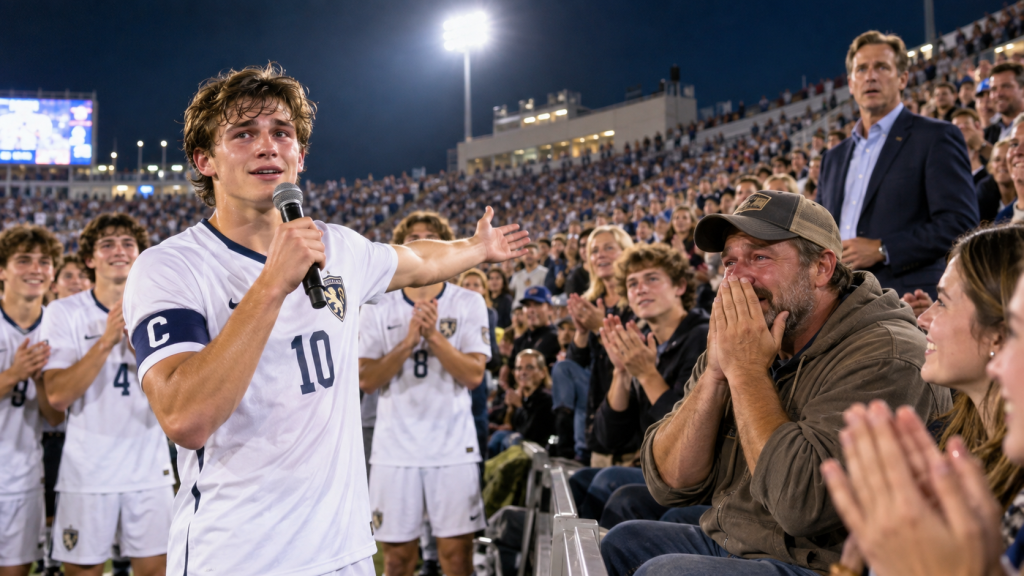
“And tonight, there’s something I’ve been waiting fourteen years to give him.”
Mason’s voice cracked on the final word.
The stadium had gone so quiet that I could hear someone coughing several rows behind me.
I stood beside the railing, unable to move.
Mason reached inside the collar of his jersey and pulled out a thin chain.
Something small hung from it.
At first, I couldn’t see what it was.
Then he lifted it toward the stadium lights.
A key.
An old brass key.
My breath stopped.
I knew that key.
Fourteen years earlier, it had opened the front door of the cramped one-bedroom apartment where Mason and I had first learned how to become a family.
I hadn’t seen it in years.
Mason looked at me.
“When I was four, my whole world disappeared in one night.”
His voice trembled.
“My mom died.”
He swallowed.
“My biological father left.”
David lowered his head.
Mason continued.
“And this man…”
He pointed toward me.
“…walked into a house where he had absolutely no obligation to stay.”
My eyes burned.
“He was twenty-eight.”
A few people in the stands laughed softly when Mason added:
“He had no idea what he was doing.”
I laughed through my tears.
That was certainly true.
“He couldn’t cook.”
“Still can’t!” someone from Mason’s team shouted.
The stadium laughed.
I covered my face.
Mason smiled.
“He burned grilled cheese.”
“One time!” I shouted.
“Six times, Dad.”
More laughter.
Then his expression softened.
“But he stayed.”
Those three words silenced everyone again.
“He stayed when I woke up crying because I wanted my mom.”
My vision blurred.
“He stayed when I got sick.”
Mason’s voice cracked.
“He stayed when I was angry.”
He wiped his eyes with his sleeve.
“He stayed when I asked why my biological father didn’t want me.”
David closed his eyes.
“He stayed when I broke my arm.”
Mason smiled through tears.
“He stayed through parent-teacher conferences, bad grades, good grades, birthdays, Christmas mornings, soccer practices, hospital visits, driver’s ed…”
He paused.
“And every single game.”
My knees weakened.
“I counted once.”
Mason looked at me.
“Dad has watched me play two hundred and sixteen soccer games.”
I laughed.
“You counted?”
He smiled.
“I counted.”
Then he looked around the stadium.
“Two hundred and sixteen.”
His voice became quieter.
“And he never once made me wonder whether he’d be there for number two hundred and seventeen.”
That broke me.
I lowered my head.
My shoulders shook.
For fourteen years, I had never thought of staying as an accomplishment.
You don’t congratulate yourself for doing what love requires.
You just wake up.
Make breakfast.
Pack lunches.
Go to work.
Pay bills.
Show up.
Again.
And again.
And again.
Until ordinary days become a childhood.
Mason held up the brass key.
“This was the key to our first apartment.”
I stared at it.
“How did you get that?”
He smiled.
“You kept it in the blue toolbox.”
Of course I had.
“I used to carry this around when I was little.”
I remembered.
God.
I remembered.
Mason had been terrified I would disappear too.
For nearly a year after David left, he would wake before me and check whether I was still in the apartment.
Sometimes he slept with his shoes beside his bed.
Once, I asked why.
He told me:
“So if we have to leave fast, I’ll be ready.”
Four years old.
Already preparing for abandonment.
That sentence haunted me for years.
Then one afternoon, I gave him a spare apartment key.
I knelt down and placed it in his hand.
“You know what this means?”
He shook his head.
“It means you live here.”
“Forever?”
“As long as you need.”
He had carried that key everywhere.
I had forgotten.
He hadn’t.
Mason continued:
“Dad gave me this when I was five because I kept asking whether I really lived with him.”
I covered my mouth.
“He told me a key meant I belonged.”
His eyes found mine.
“I don’t need this anymore.”
My heart cracked.
Not painfully.
Beautifully.
“Because I finally understand something.”
He removed the key from the chain.
“A key doesn’t make you belong somewhere.”
He walked toward me.
“A person does.”
The stadium erupted.
I don’t remember climbing over the railing.
I don’t remember whether I did it gracefully.
Probably not.
One second Mason was on the field.
The next, my arms were around him.
He was six-foot-two now.
Stronger than me.
Broad shoulders.
A grown man’s body.
But when I held him, I felt the four-year-old boy again.
Pajamas.
Dry cereal.
Big frightened eyes.
Where’s my daddy?
I buried my face against his shoulder.
“You idiot.”
Mason laughed through tears.
“Love you too.”
“You couldn’t warn me?”
“That would’ve ruined it.”
“I’m going to kill you.”
“After we win state?”
“Tomorrow.”
He laughed.
Then whispered:
“Thank you, Dad.”
I pulled back.
“For what?”
His expression changed.
“For not making me feel guilty about inviting him.”
I looked toward the stands.
David remained near the railing.
He wasn’t smiling.
He was crying.
Silently.
Mason followed my gaze.
Then looked back at me.
“I needed to see him.”
“I know.”
“I needed to know.”
“I know.”
“I wasn’t looking for another dad.”
“I know that now.”
Mason’s face crumpled.
“I was looking for the reason he left.”
That sentence hit differently.
I hugged him again.
“There was never a reason inside you.”
“I know.”
“Do you?”
He nodded.
“I think I finally do.”
The announcer gently reminded Mason that his teammates were waiting for the trophy.
Everyone laughed.
I let him go.
Before returning to the field, Mason pressed the old brass key into my palm.
“Keep it.”
“Mason—”
“Please.”
I closed my fingers around it.
He smiled.
“That’s the first key you ever gave your son.”
Then he ran back toward his teammates.
I stood there crying like a fool.
The trophy went up.
Blue-and-white confetti exploded over the field.
Teenagers screamed.
Parents shouted.
Cameras flashed.
Mason disappeared beneath another pile of teammates.
And for several glorious minutes, I allowed the night to belong entirely to him.
He had earned that.
After the ceremony, people crowded the field.
Coaches.
Parents.
Recruiters.
Students.
Mason’s teammates took approximately nine thousand photographs.
I waited near the tunnel.
David approached me.
For fourteen years, I had imagined seeing him again.
In some versions, I punched him.
In others, I delivered a speech so devastating that he spent the rest of his life regretting everything.
Reality was less satisfying.
He simply looked old.
Not ancient.
But older than the man I remembered.
There were lines around his mouth.
Gray at his temples.
Something tired in his eyes.
“Leo.”
“David.”
He looked toward Mason.
“You raised an incredible kid.”
I shook my head.
“He became one.”
“You know what I mean.”
“Yes.”
Silence.
Then David whispered:
“I’m sorry.”
I looked at him.
Fourteen years.
Two words.
They were nowhere near enough.
Yet somehow I had spent years wanting to hear them.
Now they sounded small.
“Why?”
He blinked.
“What?”
“Why did you leave?”
His face changed.
“I told Mason.”
“I’m asking you.”
David looked toward the emptying stands.
Then down.
“Sarah died.”
“I know.”
“I watched her collapse.”
I became still.
“She was making coffee.”
His voice cracked.
“One second she was complaining that I bought the wrong cereal.”
He smiled painfully.
“The next second she was on the floor.”
I said nothing.
“I called 911.”
His eyes filled.
“I tried CPR.”
I hadn’t known that.
“They took her away.”
He swallowed.
“I went to the hospital.”
“Without Mason?”
“He was asleep. Mrs. Caldwell from next door stayed with him.”
I remembered her.
An elderly widow.
Kind woman.
David continued.
“By the time I got home, I couldn’t breathe.”
“You called me.”
“Yes.”
“At two oh seven.”
He looked surprised.
“You remember?”
“I remember everything about that night.”
He nodded.
“So do I.”
Then:
“I looked at Mason.”
David’s face crumpled.
“He had Sarah’s eyes.”
I closed mine briefly.
“And I hated him for it.”
My eyes opened.
David was crying now.
“I hated my four-year-old son because every time he looked at me, I saw the woman I’d just lost.”
There it was.
Ugly.
Unforgivable perhaps.
But honest.
“I knew it was wrong.”
He wiped his face.
“I knew he hadn’t done anything.”
“Then why leave?”
“Because grief made me selfish.”
“No.”
I shook my head.
“Grief hurt you. You made the selfish choice.”
He stared at me.
Then nodded.
“You’re right.”
That mattered.
No hiding behind grief.
No pretending tragedy removed responsibility.
“I drove.”
“Where?”
“Nowhere.”
He laughed bitterly.
“I drove south for hours.”
“I called you seventy-three times.”
“I know.”
“You knew?”
“I saw every call.”
My jaw tightened.
“You son of a bitch.”
“I know.”
“Mason asked for you every day.”
David started crying harder.
“I know.”
“No, you don’t.”
My voice rose.
“He sat by the window.”
David covered his mouth.
“For months.”
I stepped closer.
“He thought every car was yours.”
David lowered his head.
“He thought maybe he had been bad.”
“I know.”
“No.”
I grabbed the front of his coat.
“You do not get to say that.”
David did not resist.
“He asked me whether you left because he spilled juice on the couch.”
David sobbed.
My grip tightened.
“He was four.”
“I know.”
“He thought your abandonment was punishment.”
“I know.”
I wanted to hit him.
I really did.
Then I saw Mason across the field.
Watching.
I released David.
Not because David deserved mercy.
Because Mason deserved not to watch violence become the answer to his history.
David straightened his coat.
“I came back.”
I stared.
“What?”
“Three days later.”
My blood went cold.
“What did you say?”
“I came back to the house.”
“When?”
“Friday night.”
I stared at him.
“Mason was already with you.”
“Yes.”
“Why didn’t you call?”
“I drove to your apartment.”
My heart stopped.
“You what?”
“I parked across the street.”
I searched his face.
“You saw us?”
“Yes.”
“When?”
“You were carrying groceries.”
A memory surfaced.
Mason asleep against my shoulder.
A grocery bag cutting into my wrist.
Cold rain.
I had struggled with the apartment door.
“You were there?”
“Yes.”
“Why didn’t you get out?”
“Because Mason was asleep on your shoulder.”
David’s voice broke.
“And you were carrying his dinosaur backpack.”
I stared.
“I watched you unlock the door.”
His tears fell.
“And I thought…”
“What?”
“That he was safer with you.”
Anger surged through me.
“So you made yourself noble?”
“No.”
He shook his head quickly.
“No. I was a coward.”
“Good.”
“I told myself leaving him with you was love.”
“It wasn’t.”
“I know.”
“It was abandonment.”
“I know.”
“You could have come back.”
“Yes.”
“The next week.”
“Yes.”
“Next month.”
“Yes.”
“Next year.”
“Yes.”
“Fourteen years, David.”
“I know.”
“Stop saying that!”
My voice echoed.
People looked.
I didn’t care.
David cried.
“I was ashamed.”
“Then you let a child pay for your shame.”
“Yes.”
That answer silenced me.
No defense.
Just yes.
He whispered:
“Every year made the next year harder.”
I understood that mechanism.
Not the choice.
But the mechanism.
“His fifth birthday came.”
David wiped his face.
“I bought a card.”
“What did you do with it?”
“Threw it away.”
“Sixth?”
“Same.”
“Christmas?”
“Presents.”
“Sent?”
“No.”
“Seventh birthday?”
“Nothing.”
He looked at me.
“I became a man who kept telling himself I would fix yesterday tomorrow.”
That sentence stayed with me.
“Then tomorrow became fourteen years.”
“Yes.”
I looked toward Mason.
He was laughing with his teammates.
“Why now?”
“Because I saw him online.”
David swallowed.
“A video from a tournament.”
“Mason posted it?”
“His school.”
He smiled faintly.
“I recognized him immediately.”
“Of course you did.”
“I watched every video I could find.”
My anger returned.
“You don’t get points for watching.”
“I know.”
“Did you know about his awards?”
“Yes.”
“Broken arm?”
“No.”
“First goal?”
“No.”
“Night terrors?”
“No.”
“College applications?”
“No.”
“His first girlfriend?”
David blinked.
“He has a girlfriend?”
Despite myself, I laughed.
“Had.”
David smiled through tears.
That tiny exchange was strangely devastating.
A father discovering fourteen years of ordinary facts he had forfeited.
Then he said:
“I messaged him.”
“I know.”
“I expected him to tell me to go to hell.”
“He probably considered it.”
“He asked why I left.”
“What did you say?”
“The truth.”
“All of it?”
“Yes.”
“And?”
“He didn’t forgive me.”
I looked at him.
“Good.”
David almost smiled.
“He said you’d say that.”
“Smart kid.”
“He said he wanted to meet me.”
“Why?”
“He said he had questions.”
That sounded like Mason.
“He didn’t call me Dad.”
My jaw tightened.
“Don’t.”
“I’m not complaining.”
David looked toward him.
“I don’t deserve that word.”
I relaxed slightly.
“He called me David.”
“That’s your name.”
“Yes.”
“He asked if I would come tonight.”
“And you did.”
“Yes.”
“For him?”
“Yes.”
“Not because recruiters are here?”
David looked hurt.
I didn’t care.
“For him.”
“Not because he’s successful now?”
“No.”
“Would you have contacted him if he were failing school?”
“Yes.”
“You can’t prove that.”
“I know.”
“Would you have contacted him if he couldn’t play soccer?”
“Yes.”
“You can’t prove that either.”
“No.”
I studied him.
“You understand why I don’t trust you?”
“Yes.”
“Good.”
Then David said something I didn’t expect.
“I don’t want you to.”
I frowned.
“What?”
“I haven’t earned it.”
That was perhaps the first sign he had actually changed.
Not his suit.
Not his company.
Not his money.
That.
“I want the chance to earn something with Mason.”
“What?”
“I don’t know.”
He looked toward his son.
“Whatever he’s willing to give me.”
I nodded slowly.
“That is between you and him.”
David’s eyes met mine.
“You mean that?”
“He’s eighteen.”
“I know.”
“I won’t choose his relationships for him.”
David looked relieved.
“But listen carefully.”
He straightened.
“If you disappear again, don’t expect me to explain you away.”
“I won’t.”
“You hurt him again, I won’t tell him he should forgive you because you’re his biological father.”
“I understand.”
“Blood does not purchase access.”
“I understand.”
“Good.”
Mason approached.
He was still carrying the trophy.
“Are you guys fighting?”
I looked at David.
“Discussing.”
Mason raised an eyebrow.
“Dad’s ‘discussing’ voice can strip paint.”
I smiled.
“Go celebrate.”
“Actually…”
He looked at David.
“I wanted a picture.”
My stomach tightened.
“With him?”
“With both of you.”
I stared.
Mason smiled nervously.
“Is that weird?”
“Yes.”
He laughed.
“Okay.”
“But weird isn’t always bad.”
David’s eyes filled.
We stood together.
Mason in the middle.
Me on one side.
David on the other.
A teammate held Mason’s phone.
“Ready?”
I wasn’t.
The picture was taken anyway.
Later, that photograph became one of my favorites.
Not because we looked like a conventional family.
We didn’t.
Because it captured the truth without requiring anyone to disappear.
Mason had a biological father.
And he had me.
One fact did not threaten the other.
That took me longer to understand than I like admitting.
The weeks after the championship were complicated.
Mason met David for coffee.
Then lunch.
Then dinner.
I pretended not to care.
I cared enormously.
Every time Mason left, some insecure part of me whispered:
What if he likes him more?
I hated that voice.
I had raised Mason for fourteen years.
Loved him.
Adopted him.
Changed my entire life for him.
And still, biology could make me feel like an imposter if I allowed fear to speak loudly enough.
One evening, Mason returned from dinner with David.
“How was it?”
“Fine.”
“What did you eat?”
“Burger.”
“Where?”
“Dad.”
“What?”
“You’re interrogating me.”
“I asked about a burger.”
“You asked what restaurant, what time, whether he paid, what we discussed, and whether I’m seeing him Saturday.”
I folded my arms.
“Conversation.”
Mason stared.
I sighed.
“Okay.”
He sat beside me.
“Are you scared?”
“No.”
“Dad.”
I hated when he used my own honesty against me.
“Yes.”
“Of what?”
I looked at him.
“That one day you’ll realize you don’t need me.”
His expression broke.
“Seriously?”
“I’m not proud of it.”
Mason moved closer.
“You think I needed you because David wasn’t around?”
“Partly.”
“No.”
I looked at him.
“I needed you because I was four.”
He smiled.
“I don’t need you the same way now.”
That hurt even though it was healthy.
“But that’s because you did your job.”
I swallowed.
He continued.
“You raised me so I could grow up.”
His eyes filled.
“You weren’t supposed to keep me four forever.”
I laughed through tears.
“Could’ve mentioned that before you became six-two.”
He smiled.
Then took my hand.
“David isn’t replacing you.”
“I know.”
“No, you don’t.”
He squeezed.
“So listen.”
I looked at him.
“He’s my biological father.”
“Yes.”
“I want to know him.”
“Yes.”
“I might even love him someday.”
That one hurt.
Mason saw it.
“Dad.”
“I’m okay.”
“You don’t look okay.”
“Keep going.”
He swallowed.
“None of that changes what you are.”
“What am I?”
He smiled.
“My dad.”
I looked away.
“You’re really determined to make me cry lately.”
“State champion privilege.”
“Expires soon.”
He laughed.
Then leaned his head against my shoulder.
Six-foot-two.
Still my kid.
David did not disappear.
That surprised me.
Three months passed.
Then six.
He called when he said he would.
Showed up when he said he would.
He never asked Mason to call him Dad.
Never criticized me.
Never tried to rewrite history.
When Mason asked hard questions, David answered them.
Sometimes Mason came home angry.
Once he slammed the front door.
“What happened?”
“He keeps apologizing.”
“That’s bad?”
“Yes!”
Mason paced.
“Everything is ‘I’m sorry, I’m sorry, I’m sorry.’”
I waited.
“I don’t want him sorry every second.”
“What do you want?”
“I want him to be normal.”
I understood.
“You don’t know what normal with him is yet.”
Mason stopped.
That landed.
“He doesn’t either.”
I continued.
“You’re both trying to build a relationship on top of a hole fourteen years deep.”
“What am I supposed to do?”
“Stop trying to fill fourteen years.”
He stared.
“Build Tuesday.”
“What?”
“Have lunch Tuesday.”
I shrugged.
“Talk about soccer. Movies. Bad traffic. Whatever.”
“And the past?”
“It’ll still be there Wednesday.”
Mason smiled faintly.
“When did you get smart?”
“Trauma.”
He laughed.
They built Tuesday.
Then Wednesday.
David attended Mason’s graduation.
He sat three rows behind me.
That was his choice.
I had saved him a seat beside me.
He shook his head.
“This is yours.”
I frowned.
“What?”
“Front row.”
His voice was quiet.
“You earned it.”
I looked at him.
“Parents don’t earn seats.”
“You did.”
I almost argued.
Then didn’t.
Mason graduated with honors.
When his name was called, I screamed.
David did too.
Different rows.
Same pride.
Mason received three Division I offers.
He chose a university two hours away.
The night before move-in, I stood in his bedroom staring at boxes.
“How did you accumulate this much garbage?”
“Memories.”
“This is a broken controller.”
“Memory.”
“This sock doesn’t have a partner.”
“Memory.”
“This is literally trash.”
“Dad, don’t erase my childhood.”
I threw a pillow at him.
He laughed.
Then the laughter faded.
His room looked empty.
I hated it.
Mason saw my face.
“You okay?”
“Fantastic.”
“You look like someone died.”
“My retirement plan is leaving.”
“You don’t have a retirement plan.”
“Exactly.”
He laughed.
Then hugged me.
“I’m only two hours away.”
“That’s basically Canada.”
“We live in Washington.”
“Exactly.”
The next morning, David arrived.
I hadn’t invited him.
Mason had.
For one second, jealousy flashed.
Then David pointed toward the boxes.
“Need another vehicle?”
I looked at his SUV.
“Yes.”
That was how the three of us moved Mason to college.
Strange.
Awkward.
Good.
We carried boxes up three flights because the elevator broke.
David complained about his back.
I said:
“Successful commercial real estate executive can’t handle stairs?”
He glared.
Mason laughed.
“Please keep fighting. This is entertaining.”
We assembled a desk.
Badly.
Mason watched.
“You both know the instructions exist, right?”
David and I answered simultaneously:
“We know what we’re doing.”
We looked at each other.
Mason groaned.
“I have two idiots.”
Something softened inside me.
Two.
Not one replacing another.
Two.
When we finished, Mason walked us to the parking lot.
He hugged David first.
“Thanks for coming.”
“Anytime.”
Then Mason hugged me.
Longer.
I didn’t count.
I am proud to say I didn’t count.
“Call me.”
“I will.”
“Eat.”
“I know.”
“Sleep.”
“I know.”
“Don’t—”
“Dad.”
“What?”
“I love you.”
Everything else disappeared.
“I love you too.”
He let go.
Then ran back toward the dorm.
David and I stood beside our cars.
“Well,” he said.
“Well.”
“Want a beer?”
I stared.
“With you?”
He smiled faintly.
“Never mind.”
I thought.
“One.”
That beer lasted two hours.
We talked about Sarah.
For the first time in fourteen years.
Not the night she died.
Her.
The person.
Her laugh.
Her terrible dancing.
Her obsession with detective shows.
The time she backed David’s car into my motorcycle and tried to convince me the motorcycle had moved.
I laughed until my stomach hurt.
Then I cried.
David did too.
“I miss her,” he whispered.
“So do I.”
“You were her best friend too.”
“Yes.”
“I forgot that.”
I looked at him.
“You didn’t own the grief.”
“I know.”
We sat quietly.
Then David said:
“Thank you.”
“For what?”
“Mason.”
I stiffened.
“He’s not a favor I did for you.”
“I know.”
“He’s my son.”
“I know.”
“Then don’t thank me like I babysat for fourteen years.”
David nodded.
“Fair.”
He stared at his beer.
“Then thank you for being his father when I refused to be.”
That was different.
I accepted it.
“You’re welcome.”
Years passed.
Mason became an excellent college player.
I attended almost every home match.
David attended many.
Sometimes we sat together.
Sometimes apart.
Mason never performed emotional arithmetic for us.
That was important.
He didn’t have to divide his attention equally.
Didn’t hug us for matching lengths of time.
Didn’t call David a certain number of times because he called me.
Relationships aren’t accounting ledgers.
I learned that.
Slowly.
Sophomore year, Mason tore his ACL.
I was in the stands.
I knew immediately.
He went down.
Didn’t get up.
I ran.
By the time I reached the medical area, David was there too.
Mason was crying.
Not from pain.
From terror.
“My career is over.”
“No,” I said.
“Dad—”
“No.”
David knelt on the other side.
“Listen to him.”
Mason looked between us.
The MRI confirmed the tear.
Surgery.
Rehabilitation.
Months away from soccer.
Mason spiraled.
For the first time since he was four, I saw that old fear again.
If soccer disappeared, who was he?
Recruiters had wanted him.
Fans knew him.
David had found him through soccer footage.
Maybe some part of Mason wondered whether success was what made him worth returning for.
One night, during rehab, he asked David directly.
“If I never play again, are you still going to call?”
David went pale.
I stayed silent.
That answer belonged to him.
David sat beside Mason.
“Yes.”
“How do I know?”
“You don’t.”
Mason stared.
David continued.
“You can’t know from anything I say.”
His voice shook.
“You’ll know if I keep calling.”
Mason’s eyes filled.
“Tomorrow?”
“Yes.”
“Next month?”
“Yes.”
“If I’m miserable?”
“Yes.”
“If I never touch a soccer ball again?”
“Yes.”
“Why?”
David cried.
“Because I should have loved you before you ever became good at anything.”
Mason broke.
So did I.
David held him.
I watched.
And for the first time, I felt no jealousy.
Only relief.
Mason deserved that answer.
David spent months proving it.
He drove Mason to physical therapy when I couldn’t.
Called after appointments.
Watched terrible movies with him.
Helped him study.
When Mason was cleared to jog, David was there.
When he kicked a ball again, I was there.
When he returned to competition, both of us were.
Mason scored eleven minutes into his first game back.
He didn’t run toward either of us.
He ran toward his teammates.
Good.
His life did not need to revolve around repairing his fathers.
After college, Mason did not become a professional soccer superstar.
He had opportunities.
Lower-division contracts.
Trials.
He considered them.
Then surprised everyone.
He became a physical therapist specializing in young athletes.
“After spending a year in rehab, you voluntarily chose more rehab?”
I asked.
He laughed.
“I like helping people come back.”
That sentence fit him.
He understood coming back.
He married at twenty-seven.
Her name was Elena.
Smart.
Warm.
Completely unimpressed by his high-school championship story.
I liked her immediately.
The night before the wedding, Mason asked me to walk with him.
We went down to the river.
He handed me a small box.
“Oh no.”
“What?”
“Last time you gave me something sentimental, I cried in front of a stadium.”
He smiled.
“Open it.”
Inside was the old brass key.
I stared.
“I thought I had this.”
“You did.”
“You stole it?”
“Borrowed.”
“For how long?”
“Two weeks.”
“Criminal.”
He laughed.
The key had been mounted inside a small wooden frame.
Below it was a metal plaque.
It read:
THE FIRST PLACE I KNEW I BELONGED.
My eyes blurred.
“Mason.”
“Turn it over.”
On the back was another inscription.
A father is not the man who gives you a beginning.
He is the man who refuses to leave before you find your own.
I couldn’t speak.
Mason put his arm around me.
“You saved my life.”
“No.”
“Yes.”
“No, Mason.”
I looked at him.
“I raised you.”
“Exactly.”
“You weren’t something broken I rescued.”
He became quiet.
“You were my son.”
My voice cracked.
“You gave my life something too.”
“What?”
“Direction.”
He smiled.
“Before you, I was twenty-eight years old, fixing transmissions and spending half my paycheck on a motorcycle.”
“You still fix transmissions.”
“Yes.”
“No motorcycle.”
“Because somebody needed braces.”
He laughed.
“Sorry.”
“Those teeth cost me a Yamaha.”
He smiled.
Then hugged me.
At the wedding, David sat with his wife.
I sat in the front row.
When Mason entered, he stopped beside me.
“Dad.”
“Yes?”
“Come with me.”
I frowned.
“Where?”
“The altar.”
“Mason.”
“Please.”
I walked with him.
Halfway down, he stopped.
Then turned toward David.
“David.”
David looked stunned.
Mason held out his hand.
“Come on.”
David covered his mouth.
Then stood.
The three of us walked the remaining distance.
Not because David had earned equality with me.
That was never the point.
Because Mason had become secure enough to make room without believing anyone’s place would disappear.
At the altar, David whispered to me:
“Thank you.”
I whispered back:
“This was his choice.”
“I know.”
Then Mason married Elena.
Years later, they had a son.
They named him Samuel.
When I held Samuel for the first time, I cried.
Mason laughed.
“You cry constantly now.”
“Age.”
“Sure.”
I looked down at my grandson.
Tiny fingers.
Wrinkled forehead.
Perfect.
David arrived later.
He stood awkwardly near the doorway.
Mason looked at him.
“Want to hold him?”
David froze.
“Me?”
“No, the other David.”
David laughed nervously.
Mason placed Samuel in his arms.
I watched David look down at his grandson.
Something enormous moved across his face.
Grief.
Wonder.
Regret.
Gratitude.
All of it.
“I missed this with you.”
Mason nodded.
“Yes.”
David’s eyes filled.
“I’m sorry.”
Mason smiled sadly.
“I know.”
David kissed Samuel’s forehead.
This time, he stayed.
That became the quiet theme of his later life.
Staying.
Not spectacularly.
Ordinarily.
He attended birthdays.
Called on Sundays.
Remembered anniversaries.
Showed up when Mason’s car broke down even though Mason was thirty-one and perfectly capable of calling roadside assistance.
He became annoying.
That was progress.
One Sunday, Mason called me.
“David is driving me insane.”
I laughed so hard I had to sit down.
“What?”
“He calls every three days.”
“Tragic.”
“He sends articles.”
“Monster.”
“He keeps asking whether I’ve checked my tire pressure.”
I wiped tears from my eyes.
“Welcome to having a dad.”
Mason laughed.
Then became quiet.
“I have two.”
I stopped.
“Yes.”
“Different.”
“Yes.”
“But two.”
“Yes.”
That no longer hurt.
Not even a little.
By then, I understood.
David becoming something meaningful to Mason did not shrink what Mason and I had.
Love is not a room with one chair labeled FATHER.
There was space.
Not equal history.
Not identical roles.
But space.
When I turned sixty-five, Mason threw me a surprise party at the garage.
I had eventually bought the business from my old boss.
The same garage where I’d worked when Mason came into my life.
He decorated it terribly.
Balloons tied to hydraulic lifts.
Cake beside a tire balancer.
“Health code violation,” I said.
“You’re retired.”
“Not yet.”
“You’ve been saying that for eight years.”
“Mind your business.”
Everyone was there.
Mason.
Elena.
Samuel.
Friends.
Former coaches.
Patricia, my old family attorney, now in her eighties.
And David.
Patricia hugged me.
“You remember what I told you?”
“What?”
“That adoption was an uphill battle.”
“Yes.”
She smiled.
“You were stubborn.”
“I had a good reason.”
Mason heard.
“Talking about me?”
“No.”
“Liar.”
Later, he asked everyone for attention.
I groaned.
“No speeches.”
“Too late.”
He stood beside an old photograph.
Me at twenty-nine.
Mason at five.
He was sitting on my shoulders.
I looked exhausted.
He looked delighted.
Mason held up a folder.
“Dad, fourteen years ago you sold your motorcycle because lawyers are expensive.”
Patricia shouted:
“I was free!”
Everyone laughed.
“Processing fees,” I corrected.
“Whatever.”
Mason smiled.
“You sold something you loved because I needed stability.”
“Mason.”
“Let me finish.”
His eyes filled.
“I know I can’t repay childhood.”
“You don’t owe me anything.”
“I know.”
He nodded.
“That’s why this isn’t repayment.”
The garage door opened.
Outside stood a motorcycle.
Not the same one.
Same model.
Same year.
Restored beautifully.
I stopped breathing.
“No.”
Mason grinned.
“Yes.”
“You did not.”
“I did.”
I walked toward it.
My hands shook.
“You found one?”
“David helped.”
I looked at David.
He shrugged.
“Commercial real estate contacts are good for something.”
I laughed.
Then cried.
Of course.
Everyone cheered.
Mason handed me the key.
Another key.
I stared at it.
He smiled.
“Seems to be our thing.”
I hugged him.
“I hate you.”
“Love you too, Dad.”
I rode that motorcycle for six years.
Then Elena threatened to hide the keys because apparently grandfathers are not allowed to behave like twenty-eight-year-olds.
Unfair.
Eventually, I sold the garage.
Retired.
Mason complained I didn’t know how.
He was right.
I volunteered.
Fixed neighbors’ cars for free.
Annoyed everyone.
David and I became something almost like friends.
That sentence would have sounded impossible fourteen years earlier.
We never pretended the past hadn’t happened.
He never called what he did a mistake.
A mistake is forgetting milk.
Taking the wrong exit.
Leaving your four-year-old child is a choice.
He called it that.
“My worst choice.”
And he spent the rest of his life making different ones.
One evening, we sat on my porch.
Both of us older.
David asked:
“Did you ever hate me?”
“Yes.”
He laughed.
“Fast answer.”
“You asked.”
“Do you now?”
“No.”
“Why?”
I thought.
“Too tiring.”
He smiled.
Then I became serious.
“Because Mason doesn’t need me to.”
David looked down.
“I hated you for him for a long time.”
“I deserved it.”
“Probably.”
I looked toward the yard.
“But eventually Mason stopped needing protection from the man you were.”
David’s eyes filled.
“And I stopped needing to punish that man on his behalf.”
He nodded.
“Thank you.”
“Don’t.”
“Sorry.”
“Also stop apologizing every six minutes.”
He laughed.
“Working on it.”
When Mason was thirty-eight, David became ill.
Pancreatic cancer.
Late stage.
There was no dramatic recovery.
No miracle.
Sometimes life refuses narrative symmetry.
David had returned.
Changed.
Stayed.
Then time ran out anyway.
Mason was devastated.
That surprised some people.
Not me.
Grief does not ask whether the relationship had enough years.
It asks whether love existed when the person left.
By then, it did.
Mason spent David’s final weeks beside him.
So did I sometimes.
One afternoon, David asked to speak with me alone.
He was thin.
Weak.
Nothing like the man in the expensive gray coat at the championship.
“Leo.”
“Yeah?”
“There’s an envelope in the drawer.”
I found it.
My name was written on it.
“What’s this?”
“Later.”
“Why?”
“Because I’m dramatic.”
I laughed.
“Always were.”
His expression softened.
“Take care of him.”
I stared.
“He’s forty.”
“I know.”
“He has a wife, kid, mortgage, and retirement account.”
“I know.”
“He takes care of me now.”
David smiled.
“Still.”
My throat tightened.
“I will.”
He nodded.
Then:
“You were his father.”
I shook my head.
“Don’t do this.”
“I need to.”
“No.”
“You were.”
Tears filled his eyes.
“When I came back, I was terrified you’d try to keep him from me.”
“I considered it.”
“I know.”
“But you didn’t.”
“No.”
“Why?”
“Because he wanted to know you.”
David cried.
“You could have made him choose.”
“I loved him too much.”
That was the answer.
Not generosity toward David.
Love for Mason.
Children should not have to amputate part of themselves to reassure an adult.
Even adult children.
David reached for my hand.
“You taught me how to be his father.”
I looked away.
“No.”
“You did.”
“I taught you nothing.”
“You showed me.”
He squeezed weakly.
“That’s worse.”
I laughed through tears.
David died two days later.
Mason held one hand.
His wife held the other.
At the funeral, Mason gave the eulogy.
He stood at the podium for a long time before speaking.
“My biological father abandoned me when I was four.”
The room became still.
“He would want me to say that.”
Mason swallowed.
“Because near the end of his life, he stopped asking people to protect him from the truth.”
My eyes filled.
“He lost fourteen years with me.”
Mason’s voice cracked.
“We never got them back.”
Silence.
“But we got twenty years after that.”
He smiled through tears.
“And he taught me something too.”
Mason looked toward me.
“A person can do something terrible and still choose not to remain the person capable of doing it.”
I lowered my head.
“I forgave David.”
Mason breathed.
“But forgiveness didn’t give us back the years.”
His voice softened.
“It gave us somewhere to put the years we still had.”
That was one of the most beautiful things I had ever heard.
After the funeral, I remembered the envelope.
I opened it at home.
Inside was a letter.
Leo,
There is no sentence big enough for what you did.
So I won’t insult you by trying to turn fourteen years of fatherhood into a thank-you note.
You raised Mason.
You sat through the fevers I avoided.
The games I missed.
The questions I caused.
You did not keep my place warm.
There was no place.
You built one.
When I returned, you could have treated me like an intruder.
In many ways, I was.
Instead, you trusted Mason enough to let him decide what I might become.
That gave me twenty years I did not deserve but will die grateful for.
I used to think biology made me his real father.
Then I thought abandoning him meant I had forfeited that word forever.
Now I think I finally understand what Mason understood before either of us.
Father is not a prize only one man can win.
You are his dad.
You always will be.
I became his father again because you raised a son secure enough to give me the chance.
Thank you for loving him more than you hated me.
David.
I cried for a long time.
Then I folded the letter.
Placed it beside the old brass key.
Years later, Samuel found them.
He was seventeen.
“Grandpa?”
“Yeah?”
“What’s this key?”
I smiled.
“Long story.”
“I have time.”
So I told him.
About the call at 2:07.
Sarah.
David leaving.
A four-year-old eating dry cereal.
The dinosaur backpack.
The sofa that destroyed my spine.
Waffles.
Dad, can you pass the milk?
Soccer.
The championship.
The microphone.
My real father is here tonight.
Samuel listened.
Then asked:
“Were you scared when Dad invited David?”
“Terrified.”
“Why?”
“Because I thought love could be replaced.”
He frowned.
“Can it?”
“No.”
I smiled.
“Took me a while.”
Samuel turned the brass key in his fingers.
“Dad gave this back to you?”
“At the championship.”
“Why?”
“He said he didn’t need a key to know where he belonged.”
Samuel smiled.
“That’s cheesy.”
“Extremely.”
“Dad’s always cheesy.”
“Correct.”
Then he asked:
“Do you still think David was a bad person?”
I thought carefully.
“I think he did a terrible thing.”
“That’s not what I asked.”
Runs in the family.
“No.”
I looked at David’s letter.
“I think he was a frightened man who made a cruel choice and then spent too long hiding from it.”
“Then?”
“Then he changed.”
Samuel nodded.
“Dad says people can.”
“Your dad is smart.”
“He says you taught him.”
“Your dad lies.”
Samuel laughed.
When he left, I remained at the kitchen table.
The key rested in my palm.
Old brass.
Scratched.
Worth almost nothing.
And priceless.
That little key had opened three different doors in my life.
First, an apartment.
Then a child’s sense of belonging.
Finally, my understanding of fatherhood.
I had spent years believing being Mason’s real father meant proving David wasn’t.
I was wrong.
David’s return did not erase my fourteen years.
His biology did not outrank my bedtime stories.
And my adoption papers did not erase the fact that Mason came from Sarah and David.
The truth was larger than competition.
Mason had been abandoned.
Then chosen.
Then, years later, given the freedom to choose for himself.
That was the part I was proudest of.
Not that he called me his real father in front of a stadium.
Beautiful as that moment was.
I was proud that when the man who had hurt him returned, Mason was strong enough to ask questions instead of spending his life afraid of the answers.
And I was proud that I eventually became strong enough to stand beside him while he did.
On my seventy-fifth birthday, Mason came over early.
He had gray beginning at his temples.
That offended me.
“You’re old.”
“You’re seventy-five.”
“Different.”
He laughed.
We sat on the porch.
Samuel had children by then.
I was a great-grandfather.
Terrifying.
Mason handed me coffee.
“Dad.”
“Yeah?”
“Do you ever regret it?”
“What?”
“Taking me.”
I stared.
“What kind of question is that?”
“A real one.”
“No.”
“Never?”
“No.”
“You gave up a lot.”
“I gained more.”
“You sold your motorcycle.”
“Still bitter.”
He laughed.
Then became serious.
“You never got married.”
“That wasn’t because of you.”
“I know, but—”
“No.”
I looked at him.
“Listen.”
He did.
“You were never the thing that happened instead of my life.”
His eyes filled.
“You became my life.”
He looked away.
“Stop.”
“You asked.”
“I’m seventy-one and you’re still making me cry.”
“You’re fifty-seven.”
“Feels seventy-one.”
We laughed.
Then Mason reached into his pocket.
Another key.
I stared suspiciously.
“What now?”
“Our house.”
“I have a key.”
“We changed the locks.”
“Why?”
“Elena lost her purse.”
“Reasonable.”
He placed the new key in my hand.
“Still belong.”
I stared at it.
Then at him.
“Forever?”
Mason smiled.
He remembered.
“As long as you need.”
That did it.
I cried.
Of course I did.
He hugged me.
For a moment, I could almost smell dry cereal.
Hear cartoons playing softly.
See dinosaur pajamas.
Life is strange that way.
Children grow.
Their voices deepen.
Their shoulders broaden.
They become fathers.
Grandfathers.
But somewhere inside your memory, every age remains.
Mason was fifty-seven.
Eighteen.
Six.
Four.
All at once.
And I was seventy-five.
Forty-two.
Twenty-eight.
All at once.
The final years of my life were quiet.
Good.
Mason visited often.
Too often, if you ask me.
He claimed I shouldn’t be climbing ladders.
Nonsense.
Samuel installed grab bars in my bathroom without permission.
Treason.
Elena brought meals.
I complained.
Ate all of them.
One Sunday, Mason found me sitting at the kitchen table with the old brass key.
“You still have that?”
“Yes.”
“Why?”
“I’m sentimental.”
“You?”
“Age ruins everyone.”
He sat across from me.
“Do you remember what you said when you gave it to me?”
“Yes.”
“What?”
“That it meant you lived there.”
He smiled.
“You said, ‘This is your home too. Nobody can send you away.’”
I had forgotten the exact words.
Mason hadn’t.
“I needed that.”
“I know.”
“No.”
He leaned forward.
“I really needed it.”
His eyes filled.
“For years, I slept with that key under my pillow.”
My heart broke.
“I didn’t know.”
“I was afraid I’d wake up and you’d be gone.”
“Mason.”
“I know it wasn’t rational.”
“You were five.”
He nodded.
“Then one day I stopped checking.”
“When?”
“I don’t remember.”
That sentence healed something in me.
Of course he didn’t remember.
Safety rarely arrives with fireworks.
It accumulates.
One breakfast.
One school pickup.
One bedtime.
One returned promise at a time.
Until a frightened child simply stops checking whether the adult is still there.
That was fatherhood.
Not the championship speech.
Not the adoption decree.
Not the word Dad.
Those things mattered.
But fatherhood happened in the years nobody applauded.
At six in the morning packing lunches.
At midnight washing vomit from sheets.
In freezing rain beside soccer fields.
At parent-teacher conferences.
In waiting rooms.
At kitchen tables.
During arguments.
During silence.
Showing up.
Staying.
Again.
Again.
Again.
Until staying becomes so ordinary the child no longer notices.
Mason reached across the table.
“You know what I was actually going to say that night at the stadium?”
“What?”
“I had another speech.”
“Longer?”
“Much.”
“Thank God you shortened it.”
He laughed.
“I got nervous.”
“You?”
“Yes.”
“What was the ending?”
Mason became quiet.
Then smiled.
“I was going to say, ‘David gave me my life, but Leo taught me how to live it.’”
I stared.
“That’s terrible.”
His mouth fell open.
“What?”
“Way too dramatic.”
“You cried over a key!”
“Different.”
He laughed until tears came.
Then I did too.
When the laughter faded, I looked at my son.
My son.
No adjective needed.
Not adopted son.
Not best friend’s abandoned son.
Not the child I rescued.
My son.
“Mason?”
“Yeah?”
“I’m glad you invited David.”
His expression softened.
“Really?”
“Yes.”
“Took you thirty-nine years to admit it.”
“Don’t push your luck.”
He smiled.
“I needed him there.”
“I know.”
“Not to replace you.”
“I know that too.”
“I wanted him to see.”
“What?”
Mason looked at me.
“What leaving me didn’t destroy.”
I stopped breathing.
He continued.
“I wanted him to see the man I became.”
His eyes filled.
“And I wanted him to see who made that possible.”
I looked down at the key.
“Mason.”
“That was the surprise.”
He smiled.
“Not embarrassing him.”
“No.”
“Not choosing one father over another.”
“No.”
He squeezed my hand.
“I wanted him to understand that when he walked away, somebody else walked in.”
Tears blurred everything.
“And that somebody stayed.”
Outside, evening sunlight stretched across the yard.
The house was quiet.
No stadium.
No microphone.
No thousands of strangers watching.
Just an old man and his son sitting at a kitchen table.
And somehow, that felt bigger.
People sometimes ask when I became Mason’s father.
Was it the morning I found him alone?
The day the adoption became final?
The first time he called me Dad?
The championship?
I don’t know.
Maybe there was no single moment.
Maybe fatherhood was simply fourteen years of moments so small that none looked important until you stacked them together and realized they had become a life.
I didn’t give Mason my blood.
I gave him breakfast.
Shoes.
School supplies.
Rules he hated.
Birthday cakes that leaned sideways.
Driving lessons that nearly killed me.
Soccer cleats.
College applications.
Bad advice.
Occasionally good advice.
A home.
And every morning, whether he noticed or not, I gave him one more day in which the adult who promised to stay was still there.
David gave him something too.
A beginning.
A history.
Later, an apology.
Then twenty years of showing up differently.
Mason was allowed to love both truths.
That was not betrayal.
That was healing.
The last time I held the old brass key, I finally understood why Mason had given it back.
At five, he needed a key to believe he belonged.
At eighteen, he didn’t.
By then, belonging wasn’t something metal could prove.
It was fourteen years deep.
Then twenty.
Then thirty.
Then a lifetime.
So I placed the key back inside its wooden frame.
Beneath the words:
THE FIRST PLACE I KNEW I BELONGED.
And beside it, I placed David’s letter.
Not hidden.
Not worshipped.
Just part of the story.
Because families are rarely made from perfect people.
They are made from people who stay, people who fail, people who return, people who forgive, and people who learn that love does not have to erase the past to create something good after it.
David was Mason’s biological father.
Eventually, he became something more than biology.
I was the man who raised him.
And if Mason wanted to call me his real father, I would spend the rest of my life quietly grateful for the honor.
But the older I became, the less I cared about the word real.
Love had already made the answer obvious.
Fourteen years earlier, a four-year-old boy had looked up from a bowl of dry cereal and asked me:
“Where’s my daddy?”
I didn’t know.
So I knelt down and gave him the only promise I was certain I could keep.
“I am not going to leave you.”
I kept it.
That was all.
That was everything.
And when Mason stood in that stadium fourteen years later and told thousands of people that his real father was there, I thought he was pointing out the man who had finally returned.
Instead, he turned toward the man who had never left.
Me.
THE END STORIES! THANK YOU FOR READING GOOD LUCK !❤️
Related Posts