➡️ PART 3 ENDING PART ➡️
“Because the person who created that trust wasn’t your father—and according to this, your parents have spent eighteen years making sure you never discovered who was.”
For several seconds, I could only stare at Leo.
Outside our motel room, tires hissed over wet pavement.
Somewhere down the hallway, an ice machine rattled like it was struggling to stay alive.
The fluorescent light above the sink buzzed.
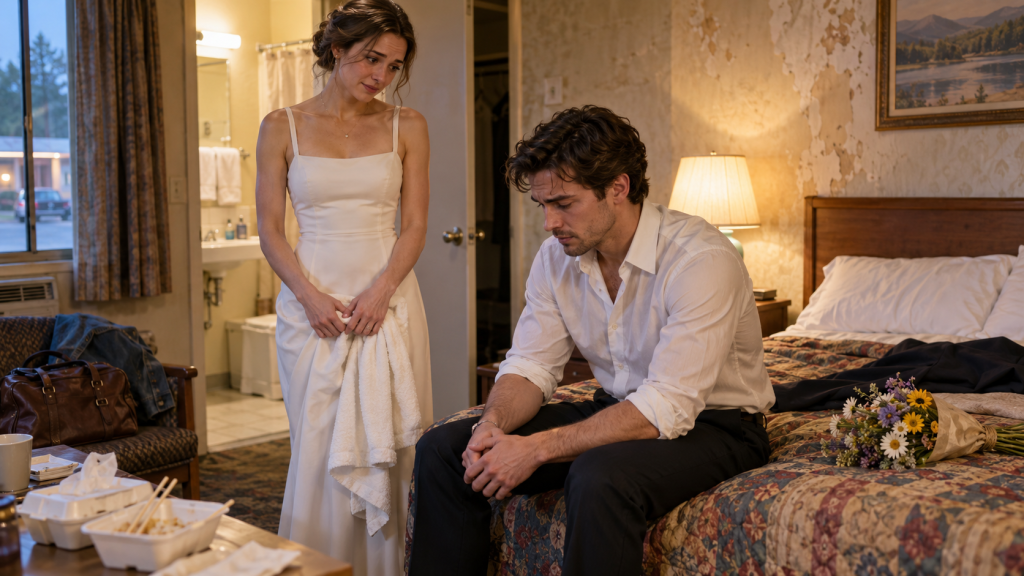
Our takeout containers were still sitting on the little table beside a plastic bag containing what remained of our wedding cake.
Everything around us looked painfully ordinary.
But nothing in my life felt ordinary anymore.
I looked down at the document.
My name was there.
Charlotte Elizabeth Whitmore.
My maiden name.
My date of birth.
A trust identification number.
And beneath that—
A figure.
$4,860,000.
I read it again.
Then again.
“Leo.”
My voice barely came out.
He said nothing.
“What is this?”
“A statement.”
“I can see that.”
“I mean—”
I stood so quickly that the mattress bounced behind me.
“What is this?”
Leo flinched.
Not because I was threatening him.
Because he knew what I was really asking.
How long have you known?
What else have you hidden?
Was our entire relationship built on something I never understood?
He stood too.
“Charlotte, I found out six weeks ago.”
My stomach dropped.
“Six weeks?”
“Yes.”
“We got married yesterday.”
“I know.”
“You proposed a year ago.”
“Yes.”
“So you didn’t know when you proposed?”
“No.”
“When did you find out?”
“My mother told me.”
I stared at him.
“Your mother knows about my trust?”
“Yes.”
“How?”
Leo looked at the photograph again.
The one showing his mother standing beside my father.
“Because she helped create it.”
I felt as if someone had pulled the floor away.
“What?”
“Not the money.”
he said quickly.
“She didn’t fund it.”
“Then who did?”
Leo hesitated.
That hesitation made my skin crawl.
“Say it.”
“Your grandmother.”
I stopped.
“My grandmother?”
“Your mother’s mother.”
I almost laughed.
“That’s impossible.”
“Why?”
“Because Grandma Eleanor died when I was six.”
“I know.”
“And she left everything to Mom.”
Leo shook his head.
“No.”
I stared at him.
“That’s what I was told.”
“I know.”
“She did leave a large portion to your mother.”
“But not everything.”
I sat slowly.
Memories came in fragments.
Grandma Eleanor’s perfume.
Lavender and something citrusy.
A pearl brooch shaped like a bird.
Her hands guiding mine while we rolled cookie dough.
A huge old house with green shutters.
A piano nobody was allowed to touch except me.
Then illness.
Adults whispering.
A funeral where my mother kept correcting the way I stood.
I remembered asking where Grandma had gone.
Mom had said:
“She left us everything we need.”
I had thought she meant love.
Apparently, she meant something much more literal.
Leo sat across from me.
“Your grandmother created the trust about eight months before she died.”
“For me?”
“Yes.”
“Why?”
“I don’t know all of it.”
I looked sharply at him.
“What do you know?”
Leo breathed slowly.
“She appointed an independent trustee.”
“Who?”
“A law firm originally.”
“Originally?”
“The attorney handling it retired.”
“Now it’s administered by a private trust company.”
I stared at the paper.
“Then why have I never heard from them?”
“That’s where things get complicated.”
I laughed.
“Complicated?”
My voice cracked.
“Leo, I was told my parents had cut me off with nothing.”
“I walked away from everything.”
“I have been budgeting groceries.”
“I spent forty minutes last week deciding whether we could afford a new tire.”
“I know.”
“No, you don’t.”
I stood again.
“You knew for six weeks.”
His face fell.
“Yes.”
“You watched me panic about money for six weeks.”
“I was trying to verify it.”
“You could have told me.”
“I should have.”
“Yes.”
The word came out hard.
He nodded.
“You’re right.”
No excuse.
That somehow made me angrier.
“You should have told me before we got married.”
“Yes.”
“You let me marry you while you were holding a secret about millions of dollars with my name on it.”
“Yes.”
My eyes filled.
“Why?”
Leo looked down at his hands.
“Because I was afraid.”
“Of me?”
“Of losing you.”
I laughed bitterly.
“So you lied?”
“I didn’t lie.”
“You withheld something enormous.”
“Yes.”
“That is not much better.”
“No.”
I stared at him.
My husband.
Less than thirty-six hours.
And already we were standing in a cheap motel room confronting the kind of secret that destroys marriages in novels.
Maybe real ones too.
I removed my wedding ring.
Leo went pale.
“Charlotte.”
I set it on the table.
Not threw.
Set.
“I need you to tell me everything.”
He nodded.
“No more protecting me.”
“I promise.”
“No more deciding what I’m ready to know.”
“Yes.”
“No more waiting for the right moment.”
“Yes.”
I pointed toward him.
“If there is anything else—anything—you tell me now.”
Leo looked terrified.
Then he nodded.
“There is.”
My heart sank.
“Of course there is.”
He reached for the envelope again.
He pulled out a second photograph.
My grandmother.
Eleanor.
Older than I remembered.
Thin from illness.
Sitting behind a desk.
Beside her was Leo’s mother.
Marisol.
And between them—
A man I recognized.
My father.
“What am I looking at?”
Leo spoke carefully.
“My mother worked for your grandmother before she worked for your father.”
I looked up.
“What?”
“She started as an assistant at Eleanor Whitmore Holdings.”
That name stirred something.
Whitmore Holdings.
I had heard it growing up.
But Dad always called it “our company.”
Leo continued.
“Your grandmother founded it.”
I shook my head.
“No.”
“My father did.”
“Charlotte.”
“He told me he did.”
Leo’s eyes softened.
“That doesn’t make it true.”
I looked at the photograph again.
My grandmother.
Marisol.
Dad.
Three people connected by a history I had never been allowed to know.
“What happened?”
Leo leaned forward.
“Your grandmother built the original company.”
“Commercial property.”
“Warehousing.”
“Some manufacturing investments.”
“She brought your father in after he married your mother.”
My stomach tightened.
“He wasn’t wealthy before?”
“Comfortable.”
Leo said.
“But not Whitmore wealthy.”
I laughed.
The irony was almost offensive.
My father had spent years judging Leo for being born without money.
Apparently Dad had married into much of his own.
Leo continued.
“After your grandmother became sick, your father took over more daily operations.”
“My mom worked in finance.”
“She noticed money being moved.”
“What kind of money?”
“Company funds.”
“Where?”
“Related entities.”
“Accounts controlled by your father.”
I stared at him.
“Are you telling me my father stole from my grandmother?”
“I’m telling you my mother believed he was moving money without your grandmother’s authorization.”
“Believed?”
“Yes.”
“That matters.”
Leo nodded.
“It does.”
“Was it proven?”
“Not criminally.”
“Then don’t call it theft.”
“I didn’t.”
That stopped me.
Even now, Leo was careful.
I sat.
“Continue.”
“Marisol brought it to your grandmother.”
“Grandma believed her?”
“Enough to investigate.”
“And?”
“She changed her estate plan.”
There it was.
The trust.
“She protected a portion for you.”
“Yes.”
“Why me?”
Leo looked at the papers.
“There’s a letter.”
My breath stopped.
“From Grandma?”
“Yes.”
“You have it?”
“A copy.”
“Give it to me.”
He did.
The paper was old.
Scanned.
At the top:
For Charlotte, when she is old enough to understand that love and money are both dangerous when people confuse them with ownership.
I started crying before I reached the first sentence.
Leo stood.
Then stopped himself.
“Do you want me to sit with you?”
That question.
Not an assumption.
I nodded.
He sat beside me.
Not touching.
Waiting.
I read.
My dearest Charlotte,
You are six years old as I write this, and today you informed me with complete seriousness that when you grow up you intend to own seventeen horses, become an astronaut, and marry the boy who shares his crayons with you.
A laugh escaped through my tears.
I remembered the horses.
Not the boy.
I hope adulthood leaves some of that certainty intact.
My vision blurred.
There are things happening around you that you are too young to understand. That is a blessing. Childhood should not be spent interpreting adult greed.
I swallowed.
Your mother loves you.
I stopped.
Not your parents.
Your mother.
Your father may love you too, though I fear he has begun to confuse love with management.
My chest tightened.
He is a man who feels safest when the people around him need his permission.
Leo looked away.
I continued.
I made the mistake of giving him too much authority because I was tired, sick, and grateful that someone seemed willing to carry burdens I no longer had the strength to carry myself.
Some burdens were carried faithfully.
Others were not.
No accusation beyond what she could prove.
Grandma had been careful too.
I am arranging part of my estate so that neither your father nor your mother can use it to choose your life for you.
I covered my mouth.
There it was.
Twenty years before my wedding.
She had seen it.
You will not receive unrestricted access merely because you reach a certain birthday. Wealth given too easily can become another form of control, even when the giver is dead.
I smiled through tears.
That sounded like her.
Instead, the trust will become fully available when one of several conditions demonstrates that you have begun building an adult life independent of your parents’ financial direction.
My eyes moved faster.
Graduation from an accredited program.
Five years of independent employment.
Establishing a business.
Marriage without financial inducement from the family.
My breath stopped.
“Marriage?”
Leo nodded.
I kept reading.
Marriage is included not because marriage itself proves maturity. It does not. I have met far too many married fools to believe that.
I laughed.
Leo did too.
It is included because if Charlotte chooses a spouse against the financial wishes of her parents and does so without accepting payment to alter that choice, I want her to know that independence does not require poverty.
I stopped reading.
My entire body trembled.
Grandma had written this when I was six.
Long before Leo.
Long before my parents’ ultimatum.
Long before Dad sat across from me in his study and said:
“If you marry him, you walk away with nothing.”
He had known.
Or at least known enough.
I kept reading.
No spouse is entitled to these funds merely through marriage. They are Charlotte’s separate property unless she knowingly chooses otherwise with independent legal counsel.
Leo pointed quietly.
“That part matters.”
I almost smiled.
“Mechanic giving trust advice?”
“My mom made me read everything.”
I continued.
I hope Charlotte chooses someone kind.
My throat closed.
Rich or poor is less important than honest or dishonest.
A person can have empty pockets and a generous heart.
A person can have every material advantage and still live like there is never enough.
I thought of Dad.
Then immediately hated myself for doing it.
Grandma’s letter continued.
If Charlotte marries for love, let her understand that love should never require surrendering her judgment, her name, her friendships, her work, or her financial knowledge.
Love should add a witness to your life, not an owner.
I cried.
Leo’s eyes filled too.
The final paragraph was shorter.
If you are reading this, I am gone.
Do not turn me into a perfect woman because I left you money.
I made mistakes.
Ask questions about them.
Do not inherit my pride along with my assets.
Build something kinder.
And Charlotte—whatever your parents tell you, choosing your own life is not betrayal.
Love,
Grandma Eleanor
I lowered the letter.
For a long time, neither of us spoke.
Then I asked:
“Did my father know about this letter?”
“I don’t know.”
“Did he know about the trust?”
“Yes.”
“How?”
“Your grandmother notified your parents because they were your legal guardians.”
I stood.
“So he knew.”
“Yes.”
“He sat there and told me I would have nothing.”
Leo nodded.
My anger became strangely quiet.
That was worse.
“Why didn’t the trustee contact me when I turned eighteen?”
“They did.”
I froze.
“What?”
“Letters were sent.”
“Where?”
“Your parents’ house.”
I stared.
“Certified notices.”
“According to the records.”
“I never saw them.”
“I know.”
“How do you know?”
“Because my mom found copies.”
I turned toward him.
“How did your mother get all of this?”
Leo took a long breath.
“That’s the part I was most afraid to tell you.”
“Tell me.”
“After your grandmother died, my mom stayed with the company.”
“Your father took control.”
“She continued documenting transfers she thought violated your grandmother’s instructions.”
“Eventually he fired her.”
“That part I know.”
“Then?”
“He accused her of stealing confidential information.”
“She hadn’t.”
“But she couldn’t afford the legal fight.”
“So she signed a settlement.”
“Confidentiality.”
“Yes.”
“How does that connect to my trust?”
“Before she left, your grandmother’s attorney asked her to serve as a secondary notice contact.”
I stared.
“For me?”
“Yes.”
“Why?”
“Because Eleanor trusted her.”
“Then why didn’t Marisol tell me?”
“She wasn’t allowed to contact you directly while you were a minor except under specific circumstances.”
“And after eighteen?”
“She tried.”
My stomach turned.
“What?”
Leo looked miserable.
“She sent you a letter.”
“I never got it.”
“I know.”
“When?”
“Your eighteenth birthday.”
“Where?”
“To your parents’ house.”
Of course.
“She sent another when you were twenty-one.”
I shook my head.
“Nothing.”
“Then your father’s attorney sent her a cease-and-desist accusing her of harassment and violating the old settlement.”
I sat again.
“He kept everyone away.”
Leo said nothing.
“He kept everyone who might tell me something away.”
My mind raced backward through my childhood.
Private schools.
Drivers.
Carefully chosen friends.
Parents who knew everyone’s parents.
Boyfriends Dad approved or disapproved before I had even decided whether I liked them.
Money as reward.
Money as threat.
Money as weather.
I had called it privilege.
Some of it was.
Some of it had also been a fence.
I looked at Leo.
“Why six weeks ago?”
“My mom was cleaning out her storage unit.”
“She found the old file.”
“She thought the trust might have dissolved or been transferred.”
“So she contacted the trustee.”
“They couldn’t tell her much.”
“But they confirmed it still existed.”
“And then?”
“She told me.”
“Why you?”
“Because we were engaged.”
I closed my eyes.
“And you investigated behind my back.”
“Yes.”
Anger returned.
“You should have told me that night.”
“I know.”
“Why didn’t you?”
Leo’s voice broke.
“Because you had just lost your family for me.”
I stared.
“And then I discovered there might be almost five million dollars waiting for you if you married me.”
His eyes filled.
“Do you understand what that looked like?”
I did.
I hated that I did.
“If I told you before the wedding, I was terrified you’d wonder whether I knew earlier.”
“I would have asked.”
“I know.”
“You could have shown me when you found out.”
“Yes.”
“Instead you decided for me.”
His face fell.
“Yes.”
That was the heart of it.
Not money.
Choice.
My father had decided what I should know.
Now Leo, for entirely different reasons, had also decided what I should know.
One from control.
One from fear.
But secrecy had still taken my choice.
I looked at my ring on the table.
Leo followed my eyes.
“I’m sorry.”
I said nothing.
“I don’t expect you to put that back on tonight.”
Tears slid down his face.
“I should have told you.”
“Yes.”
“I was scared you’d think I married you because of the trust.”
“Did you?”
“No.”
The answer came instantly.
“I didn’t know.”
“Would you have married me if I really had nothing?”
He laughed through tears.
“Charlotte, look around.”
I did.
Peeling wallpaper.
A lamp with a crooked shade.
Two paper cups.
A motel bed that made a suspicious noise whenever either of us moved.
Despite myself, I laughed.
Leo smiled.
“I thought this was our honeymoon.”
“So yes.”
“Yes.”
Then his expression became serious.
“But you shouldn’t have to believe me because we’re poor tonight.”
I stared.
“You should believe me because my behavior keeps giving you reasons to.”
He glanced at the envelope.
“And for six weeks, it didn’t.”
That was exactly right.
I picked up my ring.
Did not put it on.
Held it.
“I need time.”
Leo nodded.
“We can get another room.”
“No.”
He looked surprised.
“I don’t want to be alone.”
“Okay.”
“But I don’t want to pretend everything is fine.”
“Okay.”
“And tomorrow we contact the trustee together.”
“Yes.”
“No.”
I corrected myself.
“I contact the trustee.”
Leo nodded immediately.
“You come if I ask.”
“Yes.”
“That money is mine.”
“Yes.”
“And if we stay married, we decide together what shared finances look like.”
“Yes.”
“But you never assume access.”
“Never.”
I looked at him.
“And no more secrets.”
“No more.”
“If your mother knows something else?”
“I’ll ask her.”
“Tonight.”
He nodded.
He called Marisol.
Speakerphone.
She answered on the second ring.
“Leo?”
“Mom.”
She heard his voice.
“Oh no.”
I almost smiled.
He said:
“I told her.”
Silence.
Then Marisol asked:
“Charlotte?”
“I’m here.”
Her voice softened.
“I am so sorry.”
“Is there anything else?”
She paused.
That pause nearly killed me.
“There are things I know about your father’s business dealings.”
“I don’t want speculation.”
“Good.”
she said.
“Neither did your grandmother.”
That surprised me.
Marisol continued.
“I have records of what I personally witnessed.”
“Some may matter.”
“Some may not.”
“But regarding your trust, the documents Leo has are everything I have.”
“Did my father steal from it?”
“Not according to anything I’ve seen.”
I exhaled.
That mattered.
“Could he access it?”
“No.”
“Could my mother?”
“No.”
“Then why hide it?”
Marisol was quiet.
“I can only tell you what I heard your father say once.”
“What?”
“He said money should follow obedience.”
My eyes closed.
Of course.
Marisol continued.
“He couldn’t take Eleanor’s trust away.”
“But he could make sure you believed your financial survival depended on him.”
I started crying.
Leo looked toward me.
Did not touch me.
Waited.
I reached for his hand.
He took mine.
Marisol whispered:
“I should have tried harder to reach you.”
“No.”
I said.
“You tried.”
“Not enough.”
“I’m learning that adults can spend their entire lives arguing about what would have been enough.”
She became quiet.
“That sounds like Eleanor.”
“Apparently she left me several speeches.”
Marisol laughed through tears.
“She loved speeches.”
We talked until midnight.
Then Leo slept in the chair.
I told him he could use the bed.
He refused.
Not theatrically.
He simply said:
“You need space.”
At three in the morning, I woke and saw him twisted awkwardly beneath a motel blanket.
My husband.
The mechanic my father considered beneath me.
The man who had picked wildflowers because bouquets were expensive.
The man who had also hidden something enormous because he was afraid.
Love did not erase the second truth.
The second truth did not erase the first.
That was my first lesson of marriage.
People do not become simple because you marry them.
The next morning, I put my ring back on.
Leo noticed.
He did not smile.
He asked:
“Are you sure?”
“No.”
He nodded.
“That’s fair.”
I looked at him.
“I’m sure I want to try.”
His eyes filled.
“That’s enough.”
We drove home.
No honeymoon.
No romantic weekend.
Just two newlyweds with a folder between them and a marriage suddenly requiring more honesty than either had expected on day two.
Monday morning, I called the trust company.
By Wednesday, I was sitting across from an attorney named Rebecca Sloan.
Independent counsel.
My counsel.
Not Dad’s.
Not Leo’s.
Mine.
That mattered more than I can explain.
Rebecca was in her fifties, wore red glasses, and had the unnerving habit of letting silence sit until you answered your own question.
She reviewed my identification.
Marriage certificate.
Trust documents.
Then said:
“Your trust is real.”
I stared at her.
“How much?”
“Current value is approximately five-point-one million dollars.”
I nearly laughed.
It had grown since the statement.
Rebecca continued.
“Most assets are invested.”
“You do not have five million dollars sitting in a checking account.”
“I assumed.”
“Good.”
She explained distributions.
Tax implications.
Separate property.
Trustee authority.
The marriage-trigger provision.
Grandma’s safeguards.
Then:
“There is something else.”
Apparently my life had become a series of people saying that sentence.
“What?”
“Your grandmother anticipated interference.”
“Of course she did.”
Rebecca almost smiled.
“She instructed the trustee to retain all returned correspondence.”
My stomach tightened.
“Returned?”
Rebecca opened a folder.
There were envelopes.
Dozens.
Addressed to me.
Ages eighteen.
Nineteen.
Twenty-one.
Twenty-five.
Some marked:
REFUSED.
Some:
RETURN TO SENDER.
One had handwriting across the front.
My father’s.
Recipient does not wish contact.
My hands went numb.
“I never saw these.”
“I believe you.”
“How?”
“Because two years ago the trustee attempted electronic contact.”
I frowned.
“At what address?”
She read it.
An email account my father’s office had created for me when I was sixteen.
I had not used it in years.
“They never searched for another address?”
Rebecca’s mouth tightened.
“That is one of several questions I have for the trustee.”
Good.
She was not pretending the institution had performed perfectly.
I appreciated that.
“Can my father be prosecuted?”
I asked.
“For returning mail?”
“I don’t know.”
Rebecca said.
“And I won’t guess.”
“Do you want legal action?”
I thought.
“I want information first.”
She nodded.
“Good answer.”
Not revenge.
Information.
I had spent my childhood receiving conclusions.
Now I wanted facts.
Rebecca helped me obtain records.
The picture became clearer.
Dad had known about the trust.
Mom had known something existed but claimed Dad told her it was “educational money” that had expired when I chose not to follow the family’s preferred career path.
That was false.
Dad had returned notices.
He had instructed household staff not to give me correspondence from certain law firms.
He could not seize the trust.
So he attempted to make it invisible.
Why?
Control.
The answer was almost disappointingly ordinary.
Dad believed wealth was the mechanism by which families maintained standards.
His standards.
Education.
Marriage.
Career.
Social circle.
Appearance.
He had not thought of himself as cruel.
That became important later.
He thought he was protecting me from bad decisions.
The terrifying thing about control is that it often wears the face of concern.
I called my mother first.
She answered:
“Charlotte?”
I had not heard her voice since before the wedding.
My chest hurt.
“Hi, Mom.”
Silence.
Then:
“Are you all right?”
I almost laughed.
“Are you asking?”
“What does that mean?”
“It means I’m surprised.”
She became defensive immediately.
“You chose this.”
There she was.
I closed my eyes.
“I found Grandma Eleanor’s trust.”
Nothing.
Not a breath.
“Mom?”
“Where are you?”
That told me everything.
“You knew.”
“Charlotte—”
“You knew.”
“I knew there had been something.”
“How much?”
“I didn’t know.”
“What did Dad tell you?”
“That your grandmother had left educational funds.”
“Did you ever read the trust?”
“No.”
“Why?”
“Your father handled finances.”
I felt anger rise.
“You signed documents.”
Silence.
Rebecca had found them.
Acknowledgments.
Mom’s signature.
“I signed what your father put in front of me.”
“You were an adult.”
“Don’t speak to me like that.”
“How should I speak to you?”
“I am your mother.”
“And I’m your daughter.”
Silence.
I continued.
“Did you know Dad returned letters addressed to me?”
“No.”
“Did you know Grandma’s attorney tried to contact me?”
“No.”
“Did you know Marisol worked for Grandma?”
A sharp breath.
There.
“You know about her?”
“Yes.”
Mom whispered:
“That woman nearly destroyed our family.”
I closed my eyes.
“How?”
“She accused your father of terrible things.”
“Were they false?”
Silence.
“Mom.”
“I don’t know.”
“Then why call her the person who nearly destroyed the family?”
“Because after she started asking questions, your grandmother changed.”
“Changed what?”
“Everything.”
Her voice cracked.
“She stopped trusting your father.”
“Maybe Dad caused that.”
“You don’t understand.”
“Then explain.”
Mom cried.
“Your grandmother was sick.”
“Your father was running everything.”
“She started questioning him.”
“Because Marisol poisoned her against him.”
“Or because Marisol showed her records.”
“You sound exactly like Leo.”
That sentence was intended as an insult.
It made me strangely proud.
“Good.”
Mom gasped.
“Charlotte.”
“I want facts.”
“Not loyalty tests.”
“Not family mythology.”
“Facts.”
She cried.
“What do you want from me?”
“The truth.”
“I’ve told you.”
“No.”
“You’ve told me what Dad told you.”
That silence was different.
Longer.
Sad.
I realized something.
My mother had lived in my father’s version of reality almost as completely as I had.
The difference was that she had been an adult when she chose it.
That mattered.
But so did the possibility that she had stopped asking questions long before I was born.
“I need to go.”
she whispered.
“Okay.”
“Are you happy?”
The question surprised me.
“With Leo?”
“Yes.”
I looked across our tiny apartment.
Leo was at work.
His boots were by the door.
A mug sat in the sink because apparently marriage had not cured him of believing dishes could soak indefinitely.
“Yes.”
I said.
“I am.”
Mom cried.
Then hung up.
Dad called fourteen minutes later.
I knew Mom had told him.
I answered.
“Charlotte.”
“Dad.”
“So you’ve decided to dig through family business with that mechanic.”
I almost laughed.
“His name is Leo.”
“I know his name.”
“Then use it.”
Silence.
Dad was not accustomed to this version of me.
Neither was I.
“Your grandmother’s trust was never intended to undermine us.”
“Then why did you hide it?”
“I didn’t.”
“I have returned letters with your handwriting.”
Silence.
“I was protecting you.”
“From what?”
“People trying to manipulate you through money.”
The audacity was almost beautiful.
“You mean the independent trustee Grandma selected?”
“You were a child.”
“I was twenty-five for one of the letters.”
“You were still dependent on us.”
“Because you made sure I thought I was.”
Dad’s voice hardened.
“You had every advantage.”
“Yes.”
“I never denied that.”
“Private schools.”
“Travel.”
“College.”
“Cars.”
“A home.”
“Yes.”
“And you repay us by marrying someone who—”
“Stop.”
He stopped.
I had never interrupted him like that.
“Leo is not repayment.”
“My marriage is not a referendum on your parenting.”
“You do not get to invoice me for childhood and collect payment by choosing my husband.”
Dad breathed heavily.
“You’re being dramatic.”
“No.”
I said.
“I’m being expensive.”
He went silent.
I smiled despite myself.
“Apparently Grandma made sure of it.”
He hung up.
Leo laughed for five minutes when I told him.
Then became serious.
“Are you okay?”
“No.”
He nodded.
“Want tea?”
“Yes.”
That was marriage too.
Not fixing.
Tea.
The next months were strange.
We did not touch the trust money immediately.
People found that difficult to understand.
“You’re millionaires!”
our friend Jamie said.
“No.”
I corrected.
“I have a trust.”
“That is a millionaire with paperwork.”
Leo laughed.
But Rebecca had taught me something important.
Sudden access to wealth can create urgency where none exists.
Cars.
Houses.
Investments.
Gifts.
Business ideas.
Everyone wants decisions.
So we made none.
For six months.
Leo kept working at the garage.
I found a job.
That shocked my parents’ social circle more than the courthouse wedding.
I had studied communications and nonprofit management.
Dad had always assumed I would eventually work for the family foundation.
Instead, I joined a housing nonprofit.
Entry-level.
My salary was not impressive.
I loved it.
For the first time, money arrived because of work I had chosen.
Not because Dad approved.
Not because Grandma died.
Mine.
Leo and I rented a small apartment.
The motel became a joke eventually.
On our first anniversary, Leo asked:
“Want to go back?”
“No.”
“Romantic.”
“I would rather divorce you.”
“Fair.”
We went camping instead.
He brought wildflowers.
Always wildflowers.
Our marriage did not magically become perfect because we survived the first secret.
Trust does not reset because someone apologizes once.
For nearly a year, whenever Leo hesitated before telling me something, my stomach tightened.
“What?”
I would ask.
Sometimes it was:
“I scratched the car.”
Or:
“My mom needs help with her water heater.”
Or:
“I hate the couch you picked.”
That one nearly ended us.
Ugly couch.
But he learned.
Tell me early.
Tell me awkwardly.
Tell me before fear turns information into a secret.
I had to learn too.
I had inherited my father’s talent for controlling situations through resources.
The first time it appeared, we were discussing Leo opening his own garage.
He had dreamed about it for years.
I said:
“I can fund it.”
He immediately said:
“No.”
I was offended.
“Why?”
“Because I want to build it.”
“We’re married.”
“I know.”
“The money could help.”
“I know.”
“Then why not?”
He looked at me.
“Because I need to know whether this is my dream or something your money made easy enough to become yours.”
That hurt.
I became defensive.
“I’m not my father.”
“I didn’t say you were.”
“You implied it.”
“No.”
He said.
“I’m telling you what I need.”
I almost kept arguing.
Then remembered Grandma.
Love should add a witness to your life, not an owner.
So I asked:
“What would help look like?”
Leo thought.
“A loan.”
“From you?”
“Maybe.”
“With a contract.”
I stared.
“You want your wife to loan you money?”
“I want Charlotte to invest in a business with clear terms.”
That sentence taught me more about respect than any romantic gesture could have.
We went to separate attorneys.
Rebecca nearly applauded.
I loaned Leo $80,000 at a reasonable rate.
Written agreement.
Repayment schedule.
Ownership stayed his.
He opened River Street Auto in a converted service station.
The first year was brutal.
He nearly failed.
The trust could have rescued him instantly.
He did not ask.
I did not offer without invitation.
He changed pricing.
Cut expenses.
Worked too much.
Hired carefully.
Year two, the shop broke even.
Year three, profit.
Year four, he paid the loan off early.
He brought the final check home.
I looked at it.
“Frame it?”
he asked.
“Absolutely.”
We did.
Not because I needed repayment.
Because the check represented something precious.
We had helped each other without owning each other.
Marisol became part of my life.
Slowly.
The first time I visited her apartment, I cried in the bathroom.
Not because it was poor.
Because it was full of evidence of Leo.
School photographs.
Baseball trophies.
A crooked ceramic bowl he made at nine.
His high school graduation picture.
In the corner of one photo, I was visible.
Seventeen.
Laughing.
Marisol had kept it.
When I came out, she pretended not to notice my red eyes.
Good woman.
We sat at her kitchen table.
“Tell me about Grandma.”
I said.
Marisol smiled.
“She was terrifying.”
I laughed.
“Really?”
“Absolutely.”
“She once fired a vice president during his own birthday lunch.”
“That sounds awful.”
“He deserved it.”
I laughed again.
Then Marisol told me stories.
Grandma arriving before everyone else.
Grandma insisting janitors receive the same holiday bonus percentage as executives.
Grandma making mistakes.
Being impatient.
Holding grudges.
Apologizing badly.
Learning.
A person.
Not a saint.
Exactly as her letter requested.
Then I asked about Dad.
Marisol became careful.
“He was smart.”
“That sounds ominous.”
“It isn’t.”
“He was.”
“He understood numbers.”
“Negotiation.”
“People.”
“Your grandmother respected that.”
“What went wrong?”
Marisol looked at her hands.
“Power.”
“Whose?”
“Everyone’s.”
I waited.
“Your grandmother became sick.”
“Your father became indispensable.”
“People stopped questioning him.”
“He started believing not being questioned meant he was always right.”
That sentence stayed with me.
Not being questioned can look like being right.
Especially to powerful people.
“Did he steal?”
I asked.
Marisol breathed.
“I can prove he moved company funds between entities without the board process Eleanor required.”
“Did he personally take money?”
“I cannot prove that.”
“Then I won’t say he did.”
She nodded.
“Your grandmother said the same.”
“What happened to the company?”
“After Eleanor died, your mother inherited voting shares.”
“She gave your father proxy authority.”
“Eventually they restructured.”
“Legally?”
“As far as I know.”
That mattered.
Dad’s worst wrongdoing toward me did not need embellishment.
He had hidden my trust.
Manipulated my dependence.
Rejected my marriage.
That was enough.
Truth does not become stronger when exaggerated.
Two years after my wedding, Mom appeared at my office.
No warning.
I nearly asked security to remove her.
Then I saw her face.
She looked older.
Not physically.
Deflated.
“Can we talk?”
I took her to a café.
She ordered tea.
Did not drink it.
Then placed an envelope on the table.
“What’s this?”
“A letter.”
“From Dad?”
“No.”
“From me.”
I stared.
“You’re sitting here.”
“I know.”
“Why write it?”
“Because when you interrupt me, I lose courage.”
Fair.
I opened it.
Charlotte,
I have spent most of my marriage telling myself that peace is evidence that things are good.
My throat tightened.
I am beginning to understand that sometimes peace only means the person with less power has stopped arguing.
I looked up.
Mom stared at her untouched tea.
I continued.
Your father made most financial decisions. I allowed that because I disliked conflict and because the life he created was comfortable.
Comfort became my excuse for ignorance.
My eyes burned.
I knew your grandmother left something for you.
There it was.
I did not know the amount.
I did not read the trust.
When Robert said the money would encourage you to make irresponsible choices, I accepted his judgment.
When correspondence arrived, I saw some of it.
I stopped.
Looked at her.
“You saw the letters?”
Tears filled her eyes.
“Some.”
I kept reading.
I told myself your father understood the legal matters better than I did.
That was cowardice dressed as trust.
I covered my mouth.
When you chose Leo, I watched your father use money to threaten you.
I did not stop him.
Part of me believed you would come back once life became difficult.
That hurt.
I thought poverty would teach you that we were right.
I closed my eyes.
Mom began crying.
I continued.
Instead, losing our money showed you that you could survive without our permission.
I am ashamed that I hoped hardship would make my daughter easier to control.
The café disappeared.
I am sorry.
I do not expect forgiveness.
I am not asking you to come home.
I am asking whether, someday, I might be allowed to visit the life you built.
Mom
I folded the letter.
She waited.
“Did Dad read this?”
“No.”
“Does he know you’re here?”
“No.”
“Are you leaving him?”
She looked startled.
“No.”
Then:
“I don’t know.”
I nodded.
Her marriage was not mine to decide.
“What do you want from me today?”
“Nothing.”
“Mom.”
“I mean it.”
She wiped her face.
“I wanted to tell you the truth without asking you to make me feel better.”
That was new.
I reached across the table.
Not forgiveness.
Not yet.
I placed my hand over hers.
She cried.
We began there.
Dad remained stubborn.
For years.
He sent birthday cards.
No apology.
Christmas cards.
No apology.
Then Leo and I had our first child.
A daughter.
Eleanor Marisol Bennett.
Ellie.
Named for two women who had protected truths before I was old enough to understand them.
Mom met her when she was six weeks old.
She held Ellie and sobbed.
I watched carefully.
Motherhood had changed something in me.
Not made me softer.
More precise.
I understood how easy it would be to call control protection.
You hold a baby who cannot survive without you.
You decide everything.
Food.
Sleep.
Clothes.
Doctors.
Safety.
Then one day that child becomes a person who says no.
Parenting, I realized, is partly the long practice of surrendering authority you once needed to have.
My father had never learned the surrender.
I was determined to.
Mom became Grandma Margaret.
Carefully.
She asked before visiting.
Did not post pictures without permission.
Did not buy enormous gifts after I asked her not to.
Mostly.
There was one ridiculous rocking horse.
I forgave that.
Dad did not meet Ellie.
Not because I prohibited it.
Because he refused to come unless Leo apologized.
For what?
Apparently “turning me against the family.”
Leo said:
“I’m not apologizing for marrying you.”
“Good.”
“But if you want your dad to meet her—”
“No.”
I stopped him.
“This is not your problem to solve.”
That mattered.
Dad missed her first birthday.
Second.
Third.
Then one afternoon, River Street Auto’s receptionist called Leo.
“There’s a man here asking for you.”
“Who?”
“Looks expensive.”
Leo knew.
Dad.
Robert Whitmore entered my husband’s garage wearing a suit worth more than Leo’s first car.
He waited until Leo finished with a customer.
Then said:
“I want to meet my granddaughter.”
Leo wiped his hands.
“Then call your daughter.”
Dad frowned.
“I’m here talking to you.”
“Wrong person.”
“I thought we should settle things man to man.”
Leo later told me that sentence nearly made him laugh.
Instead he said:
“Your relationship with Charlotte is not mine to grant.”
Dad became angry.
“I know you hate me.”
Leo shook his head.
“I don’t.”
“You expect me to believe that?”
“I don’t know you well enough to hate you.”
Apparently my husband had borrowed one of my favorite lines.
Dad said:
“You benefited from turning her against us.”
Leo looked around the garage.
Oil.
Tools.
Engines.
A business built one invoice at a time.
“I was with your daughter before I knew she had money.”
“You knew who her family was.”
“Yes.”
“And?”
“I picked flowers because I couldn’t afford roses.”
Dad stared.
Leo continued.
“She ate gas-station sandwiches with me when we were seventeen.”
“She sat with my mother in the emergency room when she got pneumonia.”
“She helped me study for certification exams.”
“I loved her before either of us understood what Eleanor left.”
He paused.
“And if you still think your daughter can only be loved for her money, that says something about how you see her.”
Dad went silent.
Then left.
But two days later, he called me.
“Charlotte.”
“Dad.”
“I went to Leo’s shop.”
“I know.”
“He tells you everything?”
“Now he does.”
Leo looked guilty from across the kitchen.
I smiled.
Dad sighed.
“I want to meet Eleanor.”
“Ellie.”
“Ellie.”
“What changed?”
Silence.
“I’m getting older.”
“That isn’t an apology.”
“I didn’t say it was.”
At least honest.
I said:
“You can meet her.”
Dad exhaled.
“But.”
He stiffened.
“Here we go.”
“If you insult Leo, you leave.”
“I wouldn’t.”
“If you criticize our house, you leave.”
“I don’t care about your house.”
“You absolutely care about my house.”
Silence.
“If you bring up the trust, you leave.”
“Fine.”
“If you suggest Ellie’s future belongs to you because you’re her grandfather, you will not see her again until you understand why that’s a problem.”
Dad went quiet.
Then:
“You’ve become very rigid.”
“No.”
“I’ve become clear.”
He came Sunday.
Mom came separately.
That told me something about their marriage.
Dad stood on our porch holding a gift.
Not enormous.
A stuffed rabbit.
Good.
Leo opened the door.
Dad said:
“Leo.”
“Robert.”
Progress.
Then Dad saw Ellie.
His face changed.
I had never seen that expression on him.
Wonder.
Pure.
Unmanaged.
He held out one finger.
Ellie grabbed it.
Dad started crying.
I looked away.
Not because I wanted privacy for him.
Because I needed privacy for myself.
For several months, that was enough.
Visits.
No apology.
But better behavior.
Then Dad slipped.
Ellie was four.
He told her:
“When you’re older, Grandpa will make sure you go to the right schools.”
I said:
“Dad.”
He froze.
Old Charlotte might have waited.
New Charlotte did not.
“We don’t promise her life for her.”
He rolled his eyes.
“It’s a school.”
“It’s a pattern.”
“She’s four.”
“Exactly.”
Dad looked angry.
Then he saw Ellie watching.
He stopped.
Kneeled.
“You know what?”
he said.
“When you’re older, you’ll get to tell us what schools you like.”
Ellie nodded solemnly.
“I’m going to dinosaur school.”
Dad looked at me.
I smiled.
“Expensive.”
He laughed.
A small correction.
But real.
Dad changed slowly.
Painfully.
Not because grandchildren magically redeem controlling men.
Because people can change when they become willing to see the pattern beneath individual arguments.
Leo and I had a son three years later.
Samuel.
Sam.
Dad attended his birth.
In the waiting room.
Where grandparents belonged.
He did not complain.
Much.
My trust continued growing because we used it carefully.
I bought a home.
Not a mansion.
A comfortable house with a garden.
Leo refused to move until we agreed the deed structure with lawyers.
Romantic man.
We funded college accounts for Ellie and Sam.
But with safeguards.
Not behavioral conditions.
No approved careers.
No approved spouses.
No obedience clauses.
Education.
Health.
Opportunity.
Their lives remained theirs.
We also created the Eleanor Initiative through the nonprofit where I worked.
Not with all the money.
Money does not need to become a dramatic moral gesture to be used well.
We funded legal and financial literacy programs for young adults raised in high-control wealthy families and for low-income families dealing with predatory financial systems.
Two worlds.
Mine.
Leo’s.
Different problems.
Same need.
Knowledge.
Choice.
Dignity.
Marisol joined the board.
The first time she sat in a conference room beneath a plaque bearing Eleanor’s name, she cried.
“She would have loved this.”
I smiled.
“She would have criticized the font.”
Marisol laughed.
“Absolutely.”
Dad never joined.
That was healthy.
He donated once.
Anonymously.
I knew because he was terrible at anonymity.
Mom eventually separated from Dad for almost two years.
Not because of me.
I made sure of that.
She moved into an apartment.
Learned her own passwords.
Her own investment accounts.
At sixty-three, she admitted she had never paid a utility bill.
“That’s not cute.”
I told her.
“I know.”
She learned.
Dad went to therapy.
This shocked civilization.
His therapist apparently told him that providing for people was not the same as knowing them.
Dad hated the therapist.
Kept going.
Eventually Mom and Dad reconciled.
Not returned.
Reconciled.
There was a difference.
Mom moved back after they wrote down how finances would work.
Dad laughed when she first suggested it.
Then saw her face.
Stopped laughing.
Signed.
They were married another twenty-one years.
Better years, according to Mom.
Not perfect.
Dad still loved being right.
Mom finally loved correcting him.
Balance.
When Ellie was thirteen, she asked why Grandpa and I used to fight.
I told her an age-appropriate version.
“He wanted me to make choices he approved of.”
“And you didn’t?”
“No.”
“What choices?”
“I married your dad.”
She looked horrified.
“Grandpa didn’t like Dad?”
“Not at first.”
“Why?”
“Because your dad didn’t have much money.”
Ellie stared at me.
Then toward the garage, where Leo was helping Sam build something unnecessarily dangerous-looking.
“That’s stupid.”
I smiled.
“Yes.”
“Did Grandpa say sorry?”
I thought.
“Not properly.”
“Then why do you talk to him?”
Good question.
“Because people can improve before they become good at apologizing.”
“That sounds annoying.”
“It is.”
“Do I have to forgive people if they improve?”
“No.”
“Do I have to forgive people because they’re family?”
“No.”
She thought.
“Then why did you?”
“Because eventually having a relationship with Grandpa felt healthier for me than not having one.”
“For me.”
I repeated.
“That’s important.”
She nodded.
Then:
“Dad still doesn’t have money.”
From the garage, Leo shouted:
“I HEARD THAT.”
We laughed.
River Street Auto had become three locations by then.
Leo had money.
He simply did not look like my father’s idea of it.
Dad eventually respected him.
Not because Leo became successful.
At least I hope not.
The real turning point happened when Dad’s car broke down.
A ridiculous luxury sedan.
Leo repaired it.
Dad asked the price.
Leo charged full rate.
Dad stared at the invoice.
“No family discount?”
Leo said:
“You spent twenty years worrying I wanted your money.”
Dad looked at him.
Then laughed so hard he had to sit down.
After that, something changed.
Men are strange.
Sometimes healing arrives disguised as an invoice.
Marisol died when we were in our fifties.
Heart failure.
Leo was shattered.
She had been his first home.
His example.
The woman who worked two jobs without ever making him feel like a burden.
At the funeral, Dad came.
He stood near the back.
Afterward, he approached Leo.
“I owe your mother an apology.”
Leo looked exhausted.
“She’s dead.”
“I know.”
“You had years.”
“I know.”
Leo’s eyes hardened.
Dad did not defend himself.
“I believed what was convenient.”
he said.
“I told myself she was trying to undermine me because that was easier than asking whether she had found something I should have handled differently.”
Leo stared.
Dad continued.
“I used my resources to make it difficult for her to challenge me.”
“That was wrong.”
Leo’s jaw trembled.
“Yes.”
Dad nodded.
“I’m sorry.”
Leo cried.
Then said:
“I don’t know what to do with that today.”
Dad answered:
“Nothing.”
That may have been the best apology he ever gave.
No request for forgiveness.
No relief demanded.
Just truth delivered too late to the person most owed it, but still honestly to her son.
A year later, Dad wrote a letter about Marisol for the Eleanor Initiative archives.
He acknowledged the financial irregularities she identified.
His defensiveness.
His legal intimidation.
He did not confess to crimes he had not committed.
He did not exaggerate his wrongdoing into theater.
He described what he had actually done.
That mattered.
Truth should be precise even when confession would sound more dramatic if embellished.
He ended:
Marisol Bennett was right to ask questions I did not want asked. My power allowed me to make asking those questions costly for her. That was an abuse of power even where my underlying actions were lawful.
I read that sentence many times.
Dad had finally learned something.
Legality is a floor.
Not character.
Mom died first.
Cancer.
Seventy-nine.
I sat beside her near the end.
She asked:
“Are you happy?”
“Yes.”
“With him?”
I smiled.
“Still.”
Leo was downstairs arguing with a hospice nurse about whether Mom could have ice cream.
She could.
He won.
Mom smiled.
“I was wrong about him.”
“Yes.”
“You enjoy saying that.”
“Deeply.”
She laughed weakly.
Then:
“I was wrong about you too.”
I squeezed her hand.
“You thought losing money would send me home.”
“I know.”
“Instead it gave you a home I had never seen.”
I cried.
Mom whispered:
“I’m glad Eleanor protected you.”
That sentence took almost sixty years.
But it came.
“I am too.”
“Do you forgive me?”
I thought.
By then, yes.
Not because she was dying.
Death does not automatically make people entitled to emotional gifts.
I forgave her because she had spent decades becoming safer.
“Yes.”
I said.
“All of it?”
I smiled.
“Don’t get greedy.”
She laughed.
Then cried.
“Enough.”
she whispered.
“Yes.”
“Enough.”
Mom died two days later.
Dad changed after she died.
He became quieter.
Not kinder exactly.
He had already become kinder.
Smaller in the way grief makes people understand the limits of authority.
Money could not bring Margaret back.
Connections could not.
Planning could not.
Control finally met the one opponent it could never negotiate with.
Time.
Dad moved into a smaller house.
His choice.
He gave much of his money away while alive.
Carefully.
No naming rights.
That surprised me.
When he was eighty-six, he asked me to visit alone.
Leo drove me.
Waited at a café.
Dad and I sat in his study.
Not the old one.
A smaller room.
Ordinary furniture.
He handed me a box.
Inside were the original trust letters he had returned.
I stared.
“You kept them?”
“Yes.”
“Why?”
“I don’t know.”
“That’s not true.”
Dad looked away.
Then:
“Because destroying them felt like admitting what I was doing.”
I swallowed.
“And keeping them didn’t?”
“No.”
He smiled bitterly.
“People are talented at arranging morality around convenience.”
I touched one envelope.
My name.
Eighteen years old.
A whole alternate life sealed inside.
“Why did you do it?”
Dad looked at me.
“I was afraid.”
I almost laughed.
Everyone in this story had been afraid.
Leo hid the trust because he was afraid.
Mom stayed silent because she was afraid.
Dad controlled because he was afraid.
Fear explained so much.
Excused so little.
“Of what?”
Dad answered:
“That if you knew you didn’t need me, you would stop loving me.”
My anger vanished so quickly it frightened me.
Not forgiveness.
Understanding.
A father with enormous wealth.
Terrified his daughter’s love depended on dependence.
So he manufactured dependence.
And nearly destroyed the love he wanted to preserve.
“Dad.”
“I know.”
he whispered.
“I know how it sounds.”
“It sounds sad.”
His eyes filled.
“I thought money kept the family together.”
“No.”
“I know that now.”
He looked at the box.
“When you chose Leo despite losing everything, I thought you were proving I had failed.”
“Failed at what?”
“Making you understand what mattered.”
I smiled sadly.
“You did teach me what mattered.”
He looked confused.
“Just not the lesson you intended.”
He laughed through tears.
Then:
“Was he worth it?”
I stared at him.
“Leo?”
“Yes.”
“Dad, he’s not a stock.”
“You know what I mean.”
I thought of high school wildflowers.
The motel chair.
The six-week secret.
Our fights.
River Street Auto.
Babies.
Funerals.
Mortgages.
Burned dinners.
Hospital rooms.
Decades.
“Yes.”
I said.
“He was worth choosing.”
Dad nodded.
“Good.”
Then he asked:
“Was I worth forgiving?”
That question hurt.
I reached for his hand.
“Eventually.”
He cried.
So did I.
Dad died at eighty-eight.
He left no surprise fortune to me.
No dramatic inheritance.
I already had more than enough.
He divided his estate between charities, grandchildren, and family according to a plan everyone knew beforehand.
No games.
No conditions about spouses.
No obedience.
In his will, beside my name, he wrote:
Charlotte taught me that giving someone freedom is not the same as losing them.
I kept that page.
Not because it erased the returned letters.
Because it proved people are sometimes capable of learning after doing damage.
Leo and I grew old.
That sentence contains more romance than I understood at twenty-seven.
We grew old.
Together.
Not effortlessly.
Together.
There were years we adored each other.
Years we irritated each other.
One year we barely spoke without turning every conversation into an argument.
The children had left home.
Leo wanted to expand the business again.
I wanted him to retire.
He accused me of controlling him.
I accused him of avoiding aging by working.
Both accusations contained truth.
Neither was the whole truth.
We went to counseling.
Leo hated it.
I loved it too much.
The therapist told me analyzing every sentence was also a form of control.
I stopped loving therapy quite so much.
We learned.
Again.
Marriage did not become easy because we had learned one lesson young.
Life keeps changing the exam.
When Leo finally retired, he lasted twelve days.
Then built a workshop.
Of course.
He restored old motorcycles.
I gardened.
Badly.
Wildflowers grew better when I stopped trying to organize them.
There was poetry in that.
On our fiftieth anniversary, our children offered us a huge party.
I said no.
Leo said:
“Absolutely not.”
We went back to the town where we married.
The courthouse still stood.
The motel did not.
Demolished.
Probably for public safety.
We found the approximate location.
It was a pharmacy.
Leo stared at it.
“Romantic.”
I laughed.
“You slept in a chair.”
“My back has never recovered.”
“You deserved it.”
“I did.”
We bought takeout.
Sat in the car.
Just like young people.
Leo handed me wildflowers.
His hands were old now.
Scarred from decades of work.
Wedding band scratched.
I took the flowers.
“Do you regret telling me?”
He looked surprised.
“About the trust?”
“Yes.”
“That night?”
“No.”
“Do you regret waiting six weeks?”
“Every day.”
I smiled.
“Good answer.”
He laughed.
Then became serious.
“I was so afraid you’d leave.”
“I almost did.”
“I know.”
“Why didn’t I?”
Leo shrugged.
“Poor judgment?”
I hit his arm.
He laughed.
Then I answered myself.
“Because you told the truth before I discovered the lie another way.”
He nodded.
“And because when I told you the secrecy hurt me, you didn’t make me responsible for comforting you.”
His eyes filled.
“I learned.”
“We both did.”
He took my hand.
“I still should have told you immediately.”
“Yes.”
“No loophole?”
“No.”
“Fifty years and you’re still mad?”
“No.”
I looked at him.
“I just don’t need to rewrite wrong things into right things because the ending was good.”
Leo stared.
Then smiled.
“That sounds like Eleanor.”
“I’ll take it.”
Our marriage lasted sixty-four years.
Leo died first.
Eighty-nine.
A stroke.
Quick.
Not painless for me.
But quick for him.
The night before, he had left wildflowers on the kitchen table.
He still did that sometimes.
He picked them during his morning walks.
The last bunch sat in a chipped glass.
I kept them until they turned brown.
Then longer.
Ellie finally said:
“Mom.”
“I know.”
“They’re dead.”
“I know.”
“Dad would call this a fire hazard.”
“He was a mechanic, not a botanist.”
She laughed.
I threw them away.
Then cried for three hours.
Grief is not betrayal of healing.
It is the receipt for having loved something mortal.
After Leo died, I found an envelope in his workshop.
My name.
For one horrible second, I thought:
Another secret.
Even at eighty-nine.
Then I laughed at myself.
I opened it.
Charlotte,
If you found this because I died, I’m sorry.
If you found it because you were snooping, some things never change.
I laughed through tears.
I have spent most of my life thinking about our first night as husband and wife.
Not for the reasons newlyweds are supposed to remember their wedding night.
I smiled.
I remember your ring sitting on that motel table.
My breath caught.
I thought I had lost you less than two days after finally getting to call you my wife.
You taught me something that night.
Honesty delayed because of fear is still honesty damaged.
Tears fell.
I spent the rest of our marriage trying to tell you things before I was ready.
I laughed.
He had.
Bad test results.
Business trouble.
Fear.
Jealousy.
Anger.
Everything.
Sometimes with terrible timing.
But early.
Thank you for staying long enough for me to become better at it.
And thank you for never making staying the price of forgiveness.
I stopped.
That sentence.
You could have left.
Knowing that made your staying mean something.
I pressed the letter to my chest.
Your father once believed freedom would make you leave him.
I learned from him, eventually, that love without freedom is only a prettier kind of fear.
You chose me.
Again and again.
I hope I made that choice feel safe more often than I made it difficult.
I love you.
Leo
Then, below:
P.S. The ugly couch was always ugly. I was right.
I laughed so loudly Ellie came running.
I kept the letter.
And the couch.
Out of spite.
I lived another nine years.
Long enough to see grandchildren marry.
Divorce.
Remarry.
Choose careers nobody predicted.
One became a musician.
Dad would have panicked.
One became an electrician.
Leo would have adored that.
One became an attorney.
Rebecca claimed credit.
I told every one of them the same thing when they became adults:
Know your own money.
Know your own documents.
Never sign something because someone you love says reading it is rude.
Never use money to purchase obedience.
Never mistake accepting help for surrendering your voice.
And never assume someone who has less money has less to teach you.
I also told them not to romanticize poverty.
Leo hated that.
“There was nothing noble about Mom choosing between electricity and groceries.”
he used to say.
He was right.
Money can create options.
Safety.
Education.
Time.
Medical care.
Beauty.
Rest.
Those things matter.
The lesson was never that money was bad.
The lesson was that money makes a terrible substitute for respect.
Grandma Eleanor had understood that.
Marisol had too.
Eventually, Dad did.
So did I.
At ninety-seven, Ellie asked if I wanted to update the Eleanor Initiative’s history exhibit.
They had a section about Grandma.
Marisol.
Me.
Leo.
I hated being in exhibits while alive.
“People will think I’m dead.”
“You’re ninety-seven.”
“Rude.”
She laughed.
We sat together reviewing photographs.
Grandma at her desk.
Marisol young.
Dad standing behind them.
Me and Leo at seventeen.
Wildflowers in my hand.
Our courthouse wedding.
Leo in a suit that did not fit perfectly.
Me in a simple white dress.
Then a photograph from our fiftieth anniversary.
Old hands.
Same people.
Different understanding.
Ellie asked:
“What was the biggest surprise of your wedding?”
I laughed.
“Seriously?”
“The trust?”
“No.”
She looked surprised.
“What then?”
I thought.
“The biggest surprise was discovering that independence wasn’t the same as being alone.”
Ellie waited.
“I thought choosing Leo meant losing my family.”
“For a while, it did.”
“I thought losing my parents’ money meant starting with nothing.”
“It didn’t.”
“I had skills.”
“Friends.”
“Work.”
“Leo.”
“Then Grandma’s trust.”
“But even without the trust, I wasn’t nothing.”
I touched the photograph.
“And later I learned accepting help didn’t mean surrendering independence either.”
“Grandma left money.”
“Leo accepted a loan.”
“Mom came back.”
“Dad changed.”
“We all helped each other eventually.”
“The difference was whether help came with ownership attached.”
Ellie nodded.
“Do you think Grandpa loved you?”
“Yes.”
“Even when he cut you off?”
“Yes.”
She frowned.
“That sounds contradictory.”
“It is.”
“People are.”
I smiled.
“Love is a feeling and a relationship.”
“Someone can feel love while behaving in ways that damage the relationship.”
“Behavior still matters.”
“Maybe more.”
She looked at Leo’s photograph.
“Dad loved you well.”
“Eventually.”
She laughed.
“Mom.”
“What?”
“Eventually?”
“He hid five million dollars from me for six weeks.”
“He didn’t hide the money.”
“Technicality.”
She smiled.
Then asked:
“Would you choose him again?”
I looked at the boy in the high school photograph.
The man at the courthouse.
The husband in the motel chair.
The father holding Ellie.
The mechanic beneath a car.
The grandfather teaching Sam’s children to change oil.
The old man putting wildflowers on our table.
“Yes.”
I said.
“But that doesn’t mean every choice he made was right.”
“That’s important.”
“Why?”
“Because people like to turn long marriages into proof that every painful moment was necessary.”
I shook my head.
“It wasn’t.”
“Leo could have told me six weeks earlier.”
“Dad could have respected me from the beginning.”
“Mom could have read the documents.”
“Grandma could have communicated differently.”
“Marisol could have had more protection.”
“We could have suffered less.”
I looked at Ellie.
“Never thank pain for being the only teacher available.”
She became quiet.
“Grandma Eleanor said something like that?”
“No.”
“I learned that one myself.”
I was proud of it.
Near the end of my life, I moved into a smaller house near Ellie.
In my bedroom were three framed things.
Grandma’s letter.
Leo’s final letter.
And the first wildflower he ever gave me.
Not the actual flower.
That would have been dust.
A photograph.
I had taken it with a disposable camera at sixteen.
A tiny yellow flower on top of my chemistry textbook.
I remembered the boy who handed it to me.
Nervous.
Poor.
Kind.
No idea that decades later people would call him wealthy.
Leo became financially comfortable through his business.
I became wealthy through inheritance and work.
Eventually, the distinction mattered less.
We shared a life.
Not ownership of each other.
That mattered more.
One afternoon, my great-granddaughter Sophie visited.
Sixteen.
In love.
Of course.
“He’s amazing.”
she told me.
“They always are at sixteen.”
“Great-Grandma.”
“I’m listening.”
She showed me a photograph.
A boy with messy hair.
“He wants to be a chef.”
“Good.”
“Mom thinks that’s unstable.”
“Also possible.”
Sophie frowned.
“Whose side are you on?”
“Neither.”
She looked offended.
“Your life is not a courtroom.”
I said.
“You don’t need everyone divided into sides.”
She sat beside me.
“How do you know if someone loves you for you?”
There it was.
The old question.
The one Dad never understood.
The one Leo feared I would ask.
“You don’t know all at once.”
I said.
“You watch.”
“What?”
“How they behave when you say no.”
“How they behave when you succeed.”
“How they behave when you fail.”
“Whether they can apologize.”
“Whether they tell you difficult truths before you discover them yourself.”
“Whether they want you free even when freedom means you might choose differently from them.”
She nodded slowly.
“And money?”
“Know your own.”
She laughed.
“I’m serious.”
“I know.”
“Love people.”
“Trust people when they earn it.”
“But understand what you sign.”
She kissed my cheek.
“You’re weird.”
“Genetic.”
She left.
I looked toward the window.
Wildflowers grew in the garden.
I had planted them badly.
Leo would have mocked me.
I missed him.
At ninety-nine, I knew I was nearing the end.
No dramatic illness.
My heart was tired.
My body was tired.
I was ready in the quiet way old people sometimes become ready without wanting to leave.
Ellie sat beside me one evening.
“Mom?”
“Yes?”
“Do you remember the motel?”
I laughed.
“How could I forget?”
“What did it look like?”
“Terrible.”
She smiled.
“Tell me.”
So I did.
Peeling wallpaper.
Buzzing light.
Crooked lamp.
Takeout.
Cheap mattress.
Her father sitting on the edge of the bed looking like he was about to confess to murder.
The brown envelope.
The photograph.
The trust.
My ring on the table.
Ellie laughed and cried.
“Were you scared?”
“Terrified.”
“Of losing the money?”
“No.”
I thought.
“Of not knowing who to trust.”
That was the real fear.
Money had merely illuminated it.
Dad said love.
Hid information.
Leo said love.
Hid information.
Grandma said love.
Created safeguards.
Mom said love.
Chose silence.
Marisol loved her son enough to tell him an uncomfortable truth.
Everyone had love.
The difference was what they did with it.
I told Ellie:
“The money was never the biggest inheritance.”
“What was?”
“Choice.”
She smiled.
“Grandma Eleanor?”
“Yes.”
“She gave me enough independence to make choices without financial coercion.”
“But even that wasn’t the whole thing.”
“What was?”
“The letter.”
I looked toward the framed page.
“Choosing your own life is not betrayal.”
Ellie squeezed my hand.
“You taught me that.”
“Good.”
“Dad taught me too.”
“Good.”
“Grandpa eventually did.”
I smiled.
“Very eventually.”
She laughed.
Then:
“Are you afraid?”
“A little.”
“Want me to stay?”
“Yes.”
No performance of strength.
Not anymore.
She stayed.
The room became dark.
A nurse came.
Left.
Ellie brought water.
I barely drank.
I thought about Dad.
Mom.
Grandma.
Marisol.
Leo.
So many people gone.
So many mistakes that once felt permanent.
Some were.
Others changed shape.
I did not believe everything happened for a reason.
I never learned that lesson.
Some things happened because people were afraid.
Proud.
Controlling.
Silent.
Human.
Meaning came later.
From what we chose afterward.
My parents cutting me off did not make me strong.
I already had strength.
Leo’s secret did not improve our marriage.
Telling the truth and changing our habits did.
Grandma’s death did not bless me with wealth.
Her planning protected choices she would not live to see.
Marisol’s poverty did not make her noble.
Her courage did.
Dad’s money did not make him bad.
His use of it as leverage caused harm.
Later, his willingness to loosen his grip allowed something better.
Those distinctions mattered.
Especially at the end.
Because simple stories are comforting.
Rich parents bad.
Poor husband good.
Secret fortune solves everything.
But life had been more interesting than that.
My parents loved me badly for a while.
Then better.
Leo loved me deeply and still made a serious mistake.
Grandma protected me and admitted she had flaws.
Marisol was brave and sometimes frightened.
I inherited wealth without becoming immune to insecurity.
We were people.
That was enough.
The last time I saw Leo alive, he had kissed my forehead and said:
“See you in the morning.”
There was no morning for him.
For years, I wished his final words had been profound.
Then I understood they were.
He expected another day.
That is what a long marriage becomes.
Not constant declarations.
Expectation.
I’ll see you in the morning.
I’ll make coffee.
I’ll pick up milk.
Tell me when you get there.
Did you take your medicine?
I saw these flowers and thought of you.
Ordinary language carrying extraordinary attachment.
On my final night, Ellie held my hand.
I closed my eyes.
And somewhere in memory, I was sixteen again.
A chemistry textbook against my chest.
Leo waiting beside my locker.
One small bunch of wildflowers in his hand.
He did not know my trust fund existed.
Neither did I.
He did not know what company my grandmother built.
Did not know what my father would become to him.
Did not know we would have children.
Businesses.
Funerals.
Fights.
Grandchildren.
Sixty-four years.
He just knew he liked a girl.
And he had no money for flowers.
So he picked some.
Maybe that was why I never doubted the beginning.
The beginning happened before money knew our names.
I smiled.
Ellie noticed.
“What?”
“Your father.”
She cried.
“What about him?”
“He still owes me a honeymoon.”
She laughed through tears.
I squeezed her hand.
“Tell Sophie something for me.”
“What?”
“Wildflowers are fine.”
Ellie laughed harder.
“Okay.”
“And tell Sam—”
“I’ll tell everyone.”
“No.”
I opened my eyes.
“Tell them separately.”
“Why?”
“Because advice sounds less like a lecture that way.”
She smiled.
“Anything else?”
I thought.
Then nodded.
“Tell them money is a tool.”
“Not proof.”
“Not love.”
“Not authority.”
“A tool.”
She nodded.
“And?”
“Tell them secrets get heavier the longer you carry them.”
Her eyes filled.
“And if they love somebody, tell the truth before fear makes the decision for them.”
“I will.”
I closed my eyes again.
“And Ellie?”
“Yes?”
“Choose your own life.”
She cried.
“I did.”
“Good.”
That was enough.
I died the following morning.
Not wealthy Charlotte Whitmore.
Not the heiress who married beneath her station.
Not the daughter who proved her parents wrong.
Those were other people’s summaries.
I died Charlotte Bennett.
Leo’s wife.
Eleanor and Samuel’s mother.
A grandmother.
A great-grandmother.
A woman who inherited money but had to learn that independence was not a number in an account.
A woman who almost began marriage with a secret between us and spent the rest of it learning that love survives best in the light.
After my funeral, Ellie found one final instruction in my estate plan.
Nothing dramatic.
No hidden fortune.
No test.
No requirement that anyone marry the right person.
No conditions about careers.
I divided what remained responsibly.
Supported the Eleanor Initiative.
Provided for family.
And attached one letter.
It said:
To the people I love,
If this money gives you choices, use them.
If it begins choosing for you, step away from it.
Do not let inheritance become instruction from the dead.
I have lived my life.
You are responsible for living yours.
Help one another when you can.
Ask before assuming help is wanted.
Never use generosity as a leash.
Read your documents.
Know your accounts.
Choose partners for character, not status.
And when someone you love tells you something difficult, pay attention to whether they are offering truth or trying to manage your reaction.
There is a difference.
Your life belongs to you.
With love,
Charlotte
Ellie later told me—at least, I like to imagine she would have—that everyone laughed at the line about reading documents.
Good.
They remembered it.
The Eleanor Initiative continued.
River Street Auto continued under employees Leo had mentored.
Our children continued.
Our grandchildren continued.
Wildflowers continued growing whether anyone planned them or not.
And the story people once told about us changed.
At first it had been:
The rich girl gave up everything for the poor mechanic.
Then:
The poor mechanic secretly knew she was still rich.
Neither was true enough.
The real story was simpler.
A girl with money met a boy without it.
They loved each other before either understood what adulthood would ask of them.
Her family tried to use wealth to choose her future.
Her grandmother had quietly protected her ability to choose.
Her husband made a mistake because fear convinced him that delaying truth was safer than risking rejection.
She made mistakes too.
They confronted them.
They learned.
They built.
They raised children who understood that love was not ownership.
Her parents changed enough to become part of her life again without becoming its directors.
And the fortune that once seemed enormous became, over a lifetime, what money should have been from the beginning.
A resource.
Nothing more.
The richest thing I ever received was not five million dollars.
It was not my father’s eventual apology.
It was not even Grandma Eleanor’s trust.
It was the freedom to choose a life and then accept responsibility for that choice.
And the best choice I ever made was not walking away from wealth.
It was learning that I never had to purchase love with obedience.
Leo never needed my money.
I never needed his poverty to prove his sincerity.
We needed honesty.
Freedom.
Respect.
And the courage to keep choosing each other without pretending either of us belonged to the other.
That first night, sitting beneath the buzzing light of a cheap motel, I thought Leo’s secret might be the end of our marriage.
Instead, it became the first test of what our marriage would require.
Not perfection.
Truth.
Not control.
Choice.
Not wealth.
Character.
And sixty-four years later, if I could return to that room and speak to the frightened young woman holding her wedding ring in one hand and her grandmother’s hidden fortune in the other, I would tell her only this:
Put the money down.
Look at the man.
Listen carefully.
Ask every question.
Do not excuse the secret.
Do not let fear make your decision either.
Then choose.
Because your grandmother was right.
Your parents were wrong.
And someday, even your husband will understand:
Love is not proved by what someone gives up to stay with you.
Love is proved by whether they are free to leave—
and still, with open eyes and nothing hidden between you,
choose to stay.
THE END STORIES! THANK YOU FOR READING GOOD LUCK !❤️
Related Posts