➡️ PART 3 ENDING PART ➡️
“What money?”
The question came out quietly.
So quietly that Frank stopped moving.
His mistress was standing beside his car with several sheets of paper clenched in one hand. Until that moment, I had known her only as the woman Frank had chosen over me.
Her name was Vanessa.
I knew that because Frank had been kind enough to put her name in our divorce paperwork after spending months insisting that his affair had “nothing to do with” our marriage ending.
Now Vanessa looked less like a triumphant mistress and more like someone who had just discovered she had purchased a ticket for a sinking ship.
She looked at Frank.
Then at me.
“You really don’t know?”
“No.”
Frank stepped toward her.
“Vanessa, get in the car.”
She ignored him.
“Frank told me you knew.”
My stomach tightened.
“Knew what?”
“That he borrowed money from the retirement account.”
Frank’s face changed.
Not dramatically.
It was smaller than that.
His jaw tightened.
His eyes moved away from mine.
After twenty-seven years, I knew his face.
I knew the expression he made when he had forgotten an anniversary.
I knew the expression he made when a mechanic told him a repair would cost more than expected.
I knew the expression he made when our children caught him eating the last piece of cake.
And I knew this expression.
Frank was cornered.
“How much?”
I asked.
Vanessa looked down at the papers.
“Forty-eight thousand dollars.”
For a moment, I genuinely thought I had misunderstood her.
“Forty-eight thousand?”
Frank spoke quickly.
“It wasn’t like that.”
I looked at him.
“Then tell me what it was like.”
“I was going to put it back.”
“When?”
“Before everything was finalized.”
“The divorce has been finalized for three months.”
“I know.”
“And you didn’t put it back.”
“I was working on it.”
Vanessa laughed.
It was not a happy sound.
“You told me the watches would cover it.”
Frank spun toward her.
“Would you shut up?”
That was the first moment I stopped seeing Vanessa as my enemy.
Not because I liked her.
I didn’t.
Not because I forgave what she had done.
I hadn’t.
But I recognized something in her face.
I had worn it myself.
It was the expression of a woman discovering that Frank’s version of reality changed depending on which woman was listening.
“Come inside.”
I said.
Frank stared at me.
“What?”
“I wasn’t talking to you.”
I looked at Vanessa.
“You.”
Her eyebrows rose.
Frank immediately said:
“No.”
I almost laughed.
Twenty-seven years.
For twenty-seven years, that tone had worked on me.
No.
Don’t make a scene.
Don’t embarrass me.
Don’t overreact.
Don’t spend that.
Don’t go back to work yet.
Don’t worry about the accounts; I’ll handle them.
Don’t make this harder than it needs to be.
That morning, his no sounded surprisingly small.
“Vanessa.”
I said.
“Would you like some coffee?”
She looked at Frank.
Then at me.
“Yes.”
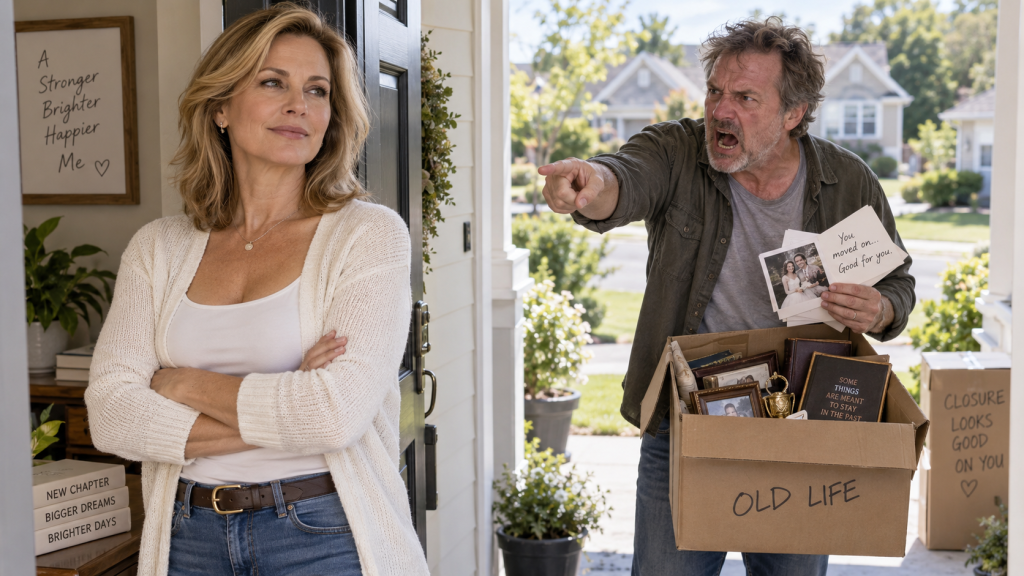
Frank moved toward the porch.
I held up my hand.
“You can wait outside.”
“This is my house too.”
“No.”
He stopped.
The divorce agreement had transferred the house to me after I refinanced it.
Frank knew that.
Apparently, some part of him had not emotionally accepted it.
“You lived here.”
I said.
“You don’t anymore.”
His face flushed.
“After everything I paid for—”
I almost smiled.
There it was.
The sentence men like Frank love.
After everything I paid for.
As though money had been the only currency spent during twenty-seven years of marriage.
As though my years raising children had been free.
As though meals appeared.
Appointments scheduled themselves.
Holidays decorated themselves.
Elderly parents drove themselves to doctors.
Children arrived at school with clean clothes because the washing machine loved them personally.
As though the career I abandoned at his request had been worth nothing because no paycheck entered our account with my name attached.
“I said wait outside.”
I repeated.
Then I closed the door.
My hands started shaking immediately.
Vanessa noticed.
“You okay?”
“No.”
I answered.
That surprised her.
Maybe she expected me to pretend.
I had done enough pretending.
I poured coffee.
She sat at the kitchen table.
The same table where Frank had told me I had let myself go.
For years, I thought that table had witnessed the end of my life.
Now it was witnessing something else.
I sat opposite her.
“Show me.”
Vanessa slid the statements across the table.
I looked at them.
The retirement account had originally been opened through one of Frank’s employers, but during our marriage, some of our marital savings had been rolled into it.
During the divorce, the account had been disclosed.
Or what remained of it had been disclosed.
The statements Vanessa had were older.
There it was.
A withdrawal.
$48,000.
Made seven months before Frank asked for the divorce.
“Where did this go?”
I whispered.
Vanessa looked toward the front door.
“Some of it went to me.”
That hurt.
Even after everything.
Pain does not always arrive because information is new.
Sometimes it arrives because numbers give shape to something you already knew.
“How much?”
“About fourteen thousand.”
“For what?”
“Apartment deposit.”
I closed my eyes.
Frank had told me he was working late during that period.
He had told me the company was restructuring.
He had told me we needed to be careful with money.
I remembered standing in a grocery store putting expensive coffee back on the shelf because Frank said we should cut unnecessary spending.
Meanwhile, marital money had been paying for an apartment where he met his mistress.
Vanessa continued.
“Furniture.”
Of course.
“Trips.”
I looked at her.
“What trips?”
She swallowed.
“Chicago.”
Frank had told me Chicago was work.
“Savannah.”
Conference.
“Miami.”
Training seminar.
I laughed.
Vanessa looked uncomfortable.
“I’m sorry.”
“Don’t.”
She stopped.
“Not yet.”
I said.
“I can’t hear that yet.”
She nodded.
I appreciated that.
“What happened to the rest?”
“He invested some.”
“In what?”
She looked embarrassed.
“A restaurant.”
“Frank doesn’t know anything about restaurants.”
“I know.”
Apparently Frank had invested twenty thousand dollars in a friend’s restaurant concept.
The restaurant had lasted eight months.
The money was gone.
The rest had paid credit cards.
Hotels.
Gifts.
The new life Frank had apparently believed he deserved.
I looked at the statements.
“Why do you have these?”
Vanessa stared into her coffee.
“Because I started wondering.”
“About?”
“Everything.”
She looked up.
“When the divorce was finalized, Frank told me we’d start looking for a house.”
I said nothing.
“He told me he had savings.”
“Then he kept delaying.”
“He said the market was bad.”
“Then he said he was waiting for a bonus.”
“Then yesterday I found these in his desk.”
I looked toward the door.
Frank was pacing outside.
“He told you the watches were his?”
“Yes.”
“And that selling them would replace the retirement money?”
“Yes.”
I almost laughed.
Not because anything was funny.
Because Frank had constructed an entire rescue plan around property he had legally signed away.
Twenty-seven years with him, and he still believed anything he valued remained somehow his, even after paperwork said otherwise.
“What did he tell you about me?”
Vanessa went pale.
“That isn’t relevant.”
“It is to me.”
“Why?”
“Because for three months I’ve been wondering what kind of woman knowingly walks into another woman’s marriage.”
Her eyes dropped.
“Now you’re sitting in my kitchen because you’re discovering the man who lied to me also lied to you.”
I folded my hands.
“So I would like to know what story made you comfortable.”
Vanessa was silent for a long time.
Then she said:
“He said your marriage had been over for years.”
Classic.
“He said you barely spoke.”
We spoke every day.
“He said you hadn’t been intimate in a long time.”
Not true.
“He said you were only together because of the house and the children.”
Our children were adults.
“He said you’d stopped caring about yourself.”
There it was.
I looked down.
Vanessa continued reluctantly.
“He said he tried to encourage you.”
“Encourage me?”
“To exercise.”
I laughed.
“He said you were bitter about getting older.”
I stared at her.
“Did he mention that I gave up my career because he wanted someone home with the children?”
“No.”
“Did he mention that I cared for his mother for nine months before she died?”
“No.”
“Did he mention that the year before he started sleeping with you, I spent six months driving his father to physical therapy?”
Vanessa shook her head.
“Did he mention that I wanted to return to work when our youngest entered high school and he told me it wasn’t worth disrupting the household?”
“No.”
“Did he tell you I gained most of the weight he complained about while taking medication after surgery?”
Her face changed.
“No.”
I nodded.
“Interesting.”
“I didn’t know.”
“No.”
I looked at her.
“You didn’t ask either.”
That landed.
She flinched.
Good.
I wasn’t interested in cruelty.
But I wasn’t going to rewrite her role simply because Frank had lied more.
“I knew he was married.”
she whispered.
“Yes.”
“I knew it was wrong.”
“Yes.”
“I told myself what he told me because it made it easier.”
There.
Finally.
Truth.
I respected that more than excuses.
Vanessa wiped her eyes.
“I’m sorry.”
This time I could hear it.
I didn’t say I forgave her.
I didn’t.
But I believed she meant it.
A pounding came from the front door.
“Vanessa!”
Frank.
She closed her eyes.
“Come on!”
he shouted.
“We’re leaving.”
I looked at her.
“Are you?”
She stared at the coffee.
“No.”
Frank pounded again.
I stood.
Then something happened that would have been impossible three months earlier.
I smiled.
Not because I was happy.
Because I was no longer afraid of his anger.
I opened the door.
Frank stepped forward.
“We need to talk.”
“Yes.”
I said.
“We do.”
He looked relieved.
Then I continued.
“But not without my attorney.”
His face changed.
“Your attorney?”
“Yes.”
“This is a misunderstanding.”
“Wonderful.”
I smiled.
“Then it should be easy to explain.”
“You don’t need lawyers involved.”
That sentence told me everything.
People who have done nothing wrong rarely become terrified of documentation.
“I’m calling Rebecca.”
Rebecca Sloan had represented me in the divorce.
Frank hated her.
That was another recommendation in her favor.
“Don’t be ridiculous.”
he said.
“Forty-eight thousand dollars disappeared from a marital retirement account before our divorce.”
“It was my account.”
“It was disclosed as marital property.”
“You don’t understand how retirement accounts work.”
Old Frank.
The expert.
Me, the confused wife.
For years, I let him handle investments because he told me finance bored me.
It did not.
He simply explained things in the most condescending way possible until asking questions became exhausting.
“I’ll let Rebecca understand it for me.”
I said.
Frank lowered his voice.
“Can we please handle this like adults?”
I looked at him.
“Frank, you arrived at my house screaming because I sold property you signed over to me.”
His mouth tightened.
“You stole those watches.”
“No.”
“You knew they mattered to me.”
“And apparently my retirement money didn’t matter to you.”
“That is completely different.”
“How?”
He had no answer.
Behind me, Vanessa appeared.
Frank looked at her.
“Get in the car.”
“No.”
His face changed.
“Vanessa.”
“I said no.”
He stared at her.
For one brief, bizarre second, I almost felt sorry for him.
Not because he deserved sympathy.
Because Frank genuinely looked confused.
Two women.
Both saying no.
He had built his life assuming at least one would eventually surrender.
Neither did.
“Fine.”
he said.
He pointed at me.
“You’ve changed.”
Three months earlier, those words might have wounded me.
That morning, they sounded like a compliment.
“Yes.”
I said.
“I have.”
He left.
Not gracefully.
He slammed the car door hard enough to make the windows tremble.
Then drove away.
Vanessa remained in my kitchen for another hour.
Before she left, she gave me copies of everything.
“Why?”
I asked.
“Because he lied.”
“To both of us.”
“Yes.”
I shook my head.
“No.”
She looked confused.
“He lied to me.”
“He lied to you.”
“Those are separate things.”
I handed the originals back.
“Don’t make us a team just because we were hurt by the same man.”
She nodded.
“You’re right.”
“I hope you leave him.”
“I already did.”
That surprised me.
“When?”
“About twenty minutes ago.”
Despite myself, I laughed.
She smiled faintly.
Then became serious.
“I’m sorry, Margaret.”
My name sounded strange coming from her.
“Thank you.”
It was all I could offer.
And it was enough.
The moment she left, I called Rebecca.
She answered on the third ring.
“Margaret?”
“Do you have time?”
“For you?”
A pause.
“Why do I hear impending litigation in your voice?”
I laughed.
“Because you’re disturbingly good at your job.”
I told her.
She stopped me several times.
“Date?”
I gave it.
“Amount?”
“Forty-eight thousand.”
“Before filing?”
“Seven months.”
“Was it disclosed?”
“Not to me.”
“Do you have documentation?”
“Yes.”
“Do not contact Frank about the money again.”
“I wasn’t planning to.”
“Do not threaten him.”
“I won’t.”
“Do not post anything online.”
“Rebecca.”
“I know.”
“I’m fifty.”
“You would be amazed what intelligent fifty-year-olds do on Facebook during divorces.”
Fair.
She scheduled a meeting.
Then she asked:
“What did you do with the watches?”
“Sold twenty-nine.”
“What happened to the other three?”
“I kept them.”
“Why?”
I looked toward the garage.
“Because they belonged to my father.”
Rebecca was quiet.
“Ah.”
That box had contained more than Frank’s hobby.
Years earlier, after my father died, I inherited a modest amount of money.
Not life-changing.
Enough that I wanted something tangible.
My father had loved watches.
Not expensive ones.
He wore the same battered mechanical watch for almost thirty years.
After he died, I bought three vintage watches in his memory.
Frank became interested.
Then obsessed.
Over the years, the collection grew.
Some purchased with my inheritance.
Some marital money.
Some Frank bought.
But during the divorce, Frank had been so focused on keeping his new car, his investment account, and certain furniture that he dismissed the garage contents.
Rebecca had asked him specifically.
He signed.
The box became mine.
The auction house had appraised the collection far higher than either of us expected.
Nearly $180,000.
After fees and taxes, I would receive less.
Still substantial.
“Do you regret selling them?”
Rebecca asked.
I thought.
“No.”
“Good.”
Then she said:
“Margaret, this may get ugly.”
“It already was.”
“No.”
Her voice softened.
“I mean legally.”
I looked around the kitchen.
Three months earlier, the idea would have terrified me.
Court.
Lawyers.
Documents.
Frank angry.
Frank blaming me.
Frank telling our children I was vindictive.
Then I remembered the woman he had left.
She would have been frightened.
This woman was tired of fear.
“Then let it.”
I said.
Rebecca reopened the financial portion of our case.
What followed was not dramatic in the way television makes legal disputes dramatic.
There were no surprise witnesses bursting through courtroom doors.
No judge slammed a gavel and declared Frank evil.
Reality was slower.
Bank records.
Subpoenas.
Account statements.
Emails.
Tax documents.
Credit cards.
Dates.
Numbers.
Frank first claimed the withdrawal had been for marital expenses.
Records contradicted him.
Then he claimed I had known.
There was no evidence.
Then he claimed the money had been his separate property.
The account history complicated that argument.
Then he said the withdrawal had been temporary.
Rebecca asked:
“Temporary until when?”
He had no answer.
The financial review uncovered more.
Not another fortune.
Smaller things.
Charges.
Transfers.
A hotel bill from a weekend Frank told me he was visiting his brother.
Jewelry.
Furniture delivered to Vanessa’s apartment.
The cost of a vacation he had described to me as a business trip.
Each number was small compared with twenty-seven years.
Together, they became a map.
Not merely of infidelity.
Of deception.
That was what hurt most.
The affair was emotional betrayal.
The money was something colder.
Frank had been building his exit using resources from the life he planned to abandon.
He had criticized my grocery spending while buying Vanessa earrings.
He had complained that our electric bill was too high while paying utilities at her apartment.
He had told me retirement required sacrifice while taking money from the retirement account.
For weeks, every discovery reopened something.
I stopped sleeping again.
One night, our daughter, Hannah, called.
She was twenty-five.
“Mom?”
“Hi, sweetheart.”
“Dad called.”
Of course he did.
“What did he say?”
“That you’re trying to ruin him.”
I closed my eyes.
“I see.”
“He said you sold his collection and now you’re taking him back to court.”
“I did sell the collection.”
“Why?”
“Because it was mine under the settlement.”
“Dad says you knew he wanted it.”
I breathed slowly.
“Hannah, I’m not going to make you choose between your parents.”
“I know.”
“But I will tell you facts if you ask.”
She was quiet.
“Did Dad take money?”
“Yes.”
“How much?”
“Forty-eight thousand dollars from a retirement account before the divorce.”
She inhaled.
“Did you know?”
“No.”
“What did he do with it?”
“Some went toward his affair.”
Silence.
I hated that sentence.
Not because it was false.
Because this was still her father.
Children do not stop being children because they are adults.
A parent’s betrayal can shake their understanding of childhood too.
“Mom.”
“I’m sorry.”
“No.”
She sounded angry.
“Don’t apologize.”
“I’m not apologizing for him.”
“I know.”
She started crying.
“Was any of it real?”
That question broke my heart.
“What?”
“Us.”
“Our family.”
“Was Dad pretending the whole time?”
“No.”
I said immediately.
I believed that.
“Your father loved you.”
“He loved your brother.”
“And for many years, I believe he loved me.”
“Then why?”
“I don’t know.”
“Maybe he got frightened of aging.”
“Maybe he wanted excitement.”
“Maybe he became selfish.”
“Maybe several things were true.”
“But what he did at the end doesn’t erase every birthday he showed up for.”
“Every camping trip.”
“Every night he sat beside you when you were sick.”
She cried.
“How can both be true?”
“Because people are complicated.”
I whispered.
“Someone can give you beautiful memories and still hurt you later.”
“You don’t have to destroy the first truth to accept the second.”
That became important for me too.
For several months, I had been tempted to rewrite twenty-seven years.
To turn every anniversary into a lie.
Every vacation into fraud.
Every kiss into manipulation.
But that gave Frank too much power over my past.
He had betrayed the marriage at the end.
He did not get to reach backward and steal every good day too.
Our son, Michael, reacted differently.
He was twenty-two.
Angry.
At Frank.
At Vanessa.
At me.
At marriage itself.
He came over one Saturday.
“I’m never getting married.”
I handed him a paint roller.
“Wonderful.”
He stared at it.
“What?”
“You came to help paint.”
“Mom.”
“Bedroom.”
He followed me.
“I’m serious.”
“So am I.”
I poured paint into a tray.
“You don’t have to get married.”
“Why would anybody?”
“Lots of reasons.”
“Dad cheated after twenty-seven years.”
“Yes.”
“So what’s the point?”
I looked at him.
“The point of loving someone isn’t guaranteeing they can never hurt you.”
“That sounds terrible.”
“It is terrible.”
He almost smiled.
I continued.
“You don’t avoid every meaningful thing because it might end badly.”
“Then how do you know?”
“You don’t.”
“Helpful.”
“I’m your mother.”
“Not an oracle.”
He rolled paint onto the wall.
After a while, he said:
“Do you hate him?”
I thought.
“Sometimes.”
Michael looked surprised.
“You admit that?”
“Yes.”
“I also miss him.”
“You miss Dad?”
“I miss who I thought he was.”
“I miss having someone beside me in bed.”
“I miss inside jokes.”
“I miss twenty-seven years of routine.”
“Missing someone does not mean you should take them back.”
“Being angry doesn’t mean you never loved them.”
He nodded.
Then asked:
“Why are we painting this room yellow?”
“Because your father hated yellow.”
Michael laughed.
“Okay.”
That room became bright yellow.
Childish yellow.
Sunshine yellow.
For twenty-seven years, Frank preferred beige.
Beige walls.
Brown furniture.
Neutral curtains.
“Timeless.”
he called it.
Three months after he left, I discovered I loved color.
That surprised me.
So did many things.
I cut my hair.
Not because Frank disliked it.
Because I had worn it the same way for fifteen years and wanted to see my face differently.
I joined a gym.
That sounds predictable.
Woman gets dumped, woman joins gym.
But I did not join because Frank said I had let myself go.
I joined because my knees hurt.
I wanted to be stronger.
The first trainer who mentioned a “revenge body” lost my business immediately.
I found another gym.
A woman named Denise taught strength classes for women over forty.
The first day, I could barely finish.
Denise said:
“Good.”
I glared.
“What part was good?”
“You came.”
I returned.
I became stronger.
Not thinner at first.
Stronger.
There is something deeply satisfying about discovering your body is not decoration.
It carries groceries.
Moves furniture.
Hugs children.
Survives grief.
Lifts weights.
Walks miles.
Breathes.
Frank had looked at my fifty-year-old body and judged it against the girl he met in high school.
I had done something worse.
I had begun seeing myself through his eyes.
I stopped.
That was harder than losing weight.
And far more important.
I also went back to work.
That began accidentally.
Before children, I had worked in interior design.
Nothing glamorous.
A small residential firm.
I loved it.
Color.
Space.
Light.
Making rooms feel like people.
When Hannah was born, I reduced my hours.
When Michael came, Frank suggested I stay home.
“We can afford it.”
he said.
“Why pay someone else to raise our children?”
At the time, it sounded loving.
Eventually, staying home became permanent.
Every few years, I mentioned returning.
Frank always had a reason to wait.
His promotion.
Hannah’s school.
Michael’s sports.
His father’s health.
His mother’s illness.
Then I turned forty-five.
Then forty-eight.
Then fifty.
And Frank told me I had let myself go.
One afternoon, my neighbor Celia came over while I was painting the yellow room.
She stood in the doorway.
“This is gorgeous.”
“It’s paint.”
“No.”
She pointed.
“The shelves.”
I had rearranged the room.
Moved furniture.
Added old wood panels behind the bed.
Reupholstered a chair.
“You did this?”
“Yes.”
“My sister is opening a small therapy practice.”
“Okay.”
“She needs someone to make the waiting room not look like a dentist office.”
I laughed.
“I haven’t worked professionally in twenty-three years.”
“Can you make it look like this?”
“Yes.”
“Then charge her.”
That first job paid $1,800.
I spent three weeks terrified.
I measured everything four times.
I changed the fabric order twice.
I barely slept before installation.
When Celia’s sister walked into the finished room, she cried.
Good crying.
“This feels safe.”
she said.
That sentence gave me something I had not felt in years.
Professional pride.
Not:
Dinner was good.
The house looks nice.
Thank you for remembering Dad’s appointment.
Those mattered.
But this was different.
I had created something that belonged to me.
One client became three.
Three became eight.
I took updated courses.
Learned software that had not existed when I left the profession.
The first week, I felt eighty years old.
Then I learned it.
I registered a small business.
MARGARET HALE INTERIORS.
Hale was my maiden name.
I had legally kept Frank’s surname after the divorce because changing everything seemed exhausting.
For the business, I used Hale.
The first time I saw it on a card, I cried.
Not because I hated my married name.
Because Margaret Hale had existed before Frank.
I had almost forgotten her.
The legal dispute ended eleven months after Frank came pounding on my door.
He did not go to prison.
I did not want him to.
The matter was resolved financially.
The court recognized undisclosed marital dissipation and required compensation through adjustments and repayment.
Frank had to restore my share of what had been improperly removed, along with certain fees.
It cost him far more than simply being honest would have.
The watch sale remained mine under the settlement.
He challenged it.
He lost.
Rebecca called me after the final order.
“It’s done.”
I sat in my yellow room.
“Done?”
“Done.”
“What happens now?”
“You live.”
I laughed.
“That’s very profound for someone billing by the hour.”
“My wisdom is included.”
I thanked her.
Then sat quietly.
I expected triumph.
Fireworks.
Vindication.
Instead, I felt tired.
Justice does not always feel like winning.
Sometimes it feels like finally being allowed to put down a heavy bag.
That evening, Frank came over.
He did not pound.
He rang the bell.
Once.
I opened the door but did not invite him inside.
He looked older.
Not dramatically.
Just human.
His hair had more gray.
His face looked tired.
“It’s over.”
he said.
“Yes.”
“You got what you wanted.”
I studied him.
“No.”
His jaw tightened.
“You got the money.”
“That isn’t what I wanted.”
“What did you want, Margaret?”
The question almost made me laugh.
Twenty-seven years.
He still didn’t know.
“I wanted you not to do it.”
That silenced him.
“I wanted you not to cheat.”
“I wanted you not to hide money.”
“I wanted you not to sit at our kitchen table and explain my aging body as though it justified betrayal.”
“I wanted you to tell me you were unhappy before building another life behind my back.”
“I wanted honesty while honesty could still have mattered.”
Frank looked down.
“I made mistakes.”
I shook my head.
“Don’t.”
“What?”
“Don’t shrink choices into mistakes.”
He looked at me.
“A mistake is forgetting milk.”
“You made decisions.”
“Repeatedly.”
His eyes filled.
That surprised me.
“I wasn’t happy.”
“You were allowed to be unhappy.”
“I felt trapped.”
“You were allowed to leave.”
“I felt old.”
“You were allowed to feel old.”
“Vanessa made me feel—”
He stopped.
“Young?”
I asked.
He nodded.
“And I made you feel what?”
He looked at me.
“Responsible?”
“Ordinary?”
“Old?”
He said nothing.
I continued.
“You were afraid of aging, Frank.”
“So you found a woman who didn’t know the version of you with cholesterol medication, twenty-seven years of compromises, a mortgage history, children, funerals, mistakes, and responsibilities.”
“She got the edited version.”
“I got the man who left socks on the floor.”
He almost smiled.
Then didn’t.
“I loved you.”
he whispered.
That hurt.
“I believe you.”
He looked surprised.
“Then how can you—”
“Because love doesn’t excuse everything done in its name.”
I folded my arms.
“You loved me.”
“And you betrayed me.”
“Both can be true.”
He looked toward the yellow room visible behind me.
“You painted.”
“Yes.”
“You hate yellow.”
“No.”
“You hate yellow.”
“You hate yellow.”
He stared.
Something shifted in his face.
Maybe that was the moment he realized how much of me he had mistaken for himself.
He had liked beige.
So our house became beige.
He disliked spicy food.
So I stopped cooking spicy food.
He preferred beach vacations.
So we went to beaches.
He thought my old career was impractical.
So I let it disappear.
Compromise is normal in marriage.
But somewhere along the way, my compromises had become my personality.
“You really like yellow?”
he asked.
“Yes.”
“Since when?”
“I don’t know.”
That was the saddest answer.
Not because I had recently changed.
Because I had not known myself well enough to answer.
Frank nodded.
Then:
“Vanessa left.”
“I know.”
His eyes snapped toward me.
“She came here that morning.”
He looked embarrassed.
“Are you friends now?”
“No.”
“Do you talk?”
“Occasionally.”
That was true.
Vanessa had emailed twice.
Once to provide additional records.
Once months later to tell me she had started therapy and wanted to apologize again without expecting a response.
I responded:
I received this. I hope you build a more honest life.
Nothing more.
Frank laughed bitterly.
“Everybody gets to rebuild except me.”
I stared at him.
“Who told you that?”
He looked confused.
“You can rebuild.”
“I lost the house.”
“You signed it over.”
“I lost Vanessa.”
“She left.”
“I lost money.”
“You concealed it.”
“My kids barely speak to me.”
“That is between you and them.”
His face hardened.
“So this is all my fault?”
I thought carefully.
“Your future isn’t.”
He stopped.
I continued.
“What you did is your responsibility.”
“What you become afterward is also your responsibility.”
“Don’t confuse accountability with a life sentence.”
He looked at me for a long time.
Then said:
“Is there any chance?”
There it was.
The question I had once dreamed he would ask.
In the first month after he left, I imagined him returning.
Flowers.
Tears.
Regret.
I imagined making him suffer a little.
Then letting him in.
By the time he actually asked, I no longer wanted that ending.
“No.”
His face collapsed.
“Margaret—”
“No.”
“Twenty-seven years.”
“Yes.”
“Does that mean nothing?”
“It means twenty-seven years.”
I swallowed.
“It means two children.”
“Thousands of dinners.”
“Christmas mornings.”
“Hospital rooms.”
“Mortgage payments.”
“Arguments.”
“Vacations.”
“Your mother’s funeral.”
“My father’s funeral.”
“It means I know the scar on your knee came from falling off a bicycle when you were twelve.”
“It means you know I cannot sleep if closet doors are open.”
“It means a lot.”
“But it does not mean I owe you year twenty-eight.”
He cried.
I cried too.
That surprised him.
Maybe he thought refusing reconciliation required indifference.
It didn’t.
Sometimes the hardest boundary is the one you set while still loving pieces of the person on the other side.
“I’m sorry.”
he whispered.
I believed he was.
Not completely.
Not yet.
But something had begun.
“I hope someday you’re sorry because you understand what you did.”
I said.
“Not only because you dislike what it cost you.”
He looked at me.
Then nodded.
He left.
Quietly.
That was the last time Frank asked me to come back.
Two years passed.
My business grew.
I hired an assistant.
Then another designer.
At fifty-three, I earned more in one year than I had ever earned before leaving work.
I bought myself a watch.
Not one from Frank’s collection.
A simple new watch.
Nothing extravagant.
On the back, I had three words engraved:
MY TIME NOW.
Cheesy?
Absolutely.
I loved it.
Hannah got married at twenty-eight.
That forced Frank and me into the same room for more than ten minutes.
Before the wedding, Hannah sat us down.
“I need both of you to behave.”
I laughed.
Frank looked offended.
“We’re adults.”
Hannah stared.
“You are divorced parents at a wedding.”
“Historically unreliable demographic.”
Michael nearly fell off his chair laughing.
Frank even smiled.
We behaved.
At the reception, Frank danced with Hannah.
I watched.
He cried.
She cried.
For a moment, I saw the eighteen-year-old boy I had loved.
Then the twenty-five-year-old father holding his newborn daughter.
Then the fifty-year-old man who broke our marriage.
All of them existed in the same body.
That no longer confused me.
People are not one moment.
But some moments change what access they are allowed to have to you.
Later, Frank approached.
“You look beautiful.”
“Thank you.”
He hesitated.
“You always did.”
I looked at him.
“That’s not what you said.”
“I know.”
His face reddened.
“I think I needed to make you smaller.”
“Why?”
“So leaving felt justified.”
That was more honest than anything he had said during the divorce.
I nodded.
“Thank you for saying that.”
“I was cruel.”
“Yes.”
“I’m sorry.”
This apology was different.
There was no:
But I was unhappy.
No:
But you had changed.
No:
But Vanessa understood me.
Just:
I was cruel.
I’m sorry.
“I accept your apology.”
I said.
His eyes filled.
“That doesn’t mean—”
“I know.”
And he did.
That was growth.
We did not become friends immediately.
We became civil.
Then, slowly, something resembling family happened around the edges.
Grandchildren helped.
It is difficult to maintain theatrical hostility while a four-year-old is forcing both of you to attend a pretend tea party.
Hannah had a daughter named Lucy.
Michael later had twin boys, Noah and Ethan.
At Lucy’s fifth birthday, I found Frank sitting at a tiny plastic table wearing a pink crown.
I took a photograph.
“Delete that.”
he said.
“Never.”
“Margaret.”
“This is going on Christmas cards.”
He laughed.
It felt strange.
Then nice.
Not romantic.
Not nostalgic enough to become dangerous.
Simply human.
Frank dated other women.
I dated too.
My first date after divorce was a catastrophe.
His name was Gerald.
He spent forty minutes explaining cryptocurrency to me after I repeatedly said I wasn’t interested.
At the end, he asked:
“So, second date?”
I said:
“No.”
He looked shocked.
That alone made the evening worthwhile.
My second relationship lasted seven months.
A kind man named Peter.
Widowed.
Funny.
Loved cooking.
We ended because he wanted to move to Arizona and I did not.
No betrayal.
No villain.
Just incompatible futures.
That taught me something too.
Not every ending requires someone to be wrong.
At fifty-seven, I met Daniel.
He was an architect.
We met through a commercial renovation.
He was sixty.
Divorced for twelve years.
Our first disagreement was about a wall.
He wanted it removed.
I wanted it preserved.
We argued for forty minutes.
Then he said:
“You’re right.”
I stared.
“What?”
“You’re right.”
“That easily?”
He laughed.
“Would you prefer resistance?”
I almost fell in love with him over a load-bearing wall.
Almost.
I did not rush.
Daniel did not ask me to.
We dated three years before living together.
When he suggested marriage, I said no.
Not because I didn’t love him.
Because I didn’t want marriage again.
He nodded.
“Okay.”
That was it.
No wounded pride.
No persuasion campaign.
No suggestion that my refusal meant I loved him less.
Two years later, I proposed to him.
He stared at me.
“You’re kidding.”
“No.”
“I thought you didn’t want marriage.”
“I changed my mind.”
He smiled.
“Am I allowed to make you wait?”
“No.”
He laughed.
Then said yes.
We married when I was sixty-two.
Small ceremony.
Hannah stood beside me.
Michael walked me halfway down the aisle.
Then stopped.
I walked the rest alone.
That was my idea.
Not because I had no one to give me away.
Because I was not being given.
I was arriving.
Frank attended.
People found that strange.
I didn’t.
By then, thirteen years had passed.
He had apologized to our children.
Not demanded forgiveness.
Gone to therapy.
Rebuilt his finances.
Started volunteering with a program teaching basic budgeting and automotive skills to young adults.
The irony was not lost on me.
At the reception, Frank shook Daniel’s hand.
“Take care of her.”
I immediately said:
“Frank.”
He winced.
“Right.”
Then corrected himself.
“Be good to each other.”
Better.
Daniel smiled.
“We plan to.”
Frank hugged me.
Briefly.
“I’m happy for you.”
“Thank you.”
And I believed him.
Daniel and I had seventeen years.
Good years.
Not perfect.
He snored.
I stole blankets.
He believed dishwashers could be loaded according to intuition.
He was wrong.
We argued.
We repaired.
We traveled.
Worked.
Retired gradually.
He never told me I was beautiful as though beauty were rent I had to pay to keep being loved.
He told me when I looked beautiful.
He also loved me with gray hair, swollen ankles, reading glasses, surgical scars, and the old sweatshirt I refused to throw away.
At seventy-one, I had a mastectomy after breast cancer.
The night before surgery, I stood in front of the mirror.
Daniel came behind me.
I touched my breast.
“I don’t want to look.”
I whispered.
“After.”
He wrapped his arms around me.
“Then don’t.”
“What if I hate my body?”
“Then hate it for a while.”
I turned.
“What?”
“You don’t have to turn everything into empowerment immediately.”
I laughed through tears.
“You can be angry.”
“Grieve.”
“Adjust.”
“I’ll be here.”
After surgery, I did hate my body for a while.
Then I didn’t.
Then sometimes I did again.
Healing is not a staircase.
It is weather.
At seventy-two, I stood naked in front of the mirror and thought about Frank saying I had let myself go at fifty.
I almost laughed.
This body had changed far more since then.
Wrinkles.
Scars.
Loose skin.
One breast.
Arthritic fingers.
And I loved it more.
Not because it was prettier.
Because it was mine.
I had finally stopped treating my body like an application for somebody else’s approval.
Daniel died when I was seventy-nine.
Heart attack.
Quick.
Cruel.
He had been making coffee.
One moment he was complaining that I had bought the wrong beans.
The next, the world split.
I grieved him differently than I had grieved my marriage.
The divorce contained humiliation.
Anger.
Betrayal.
Daniel’s death contained absence.
Pure absence.
There was nothing to solve.
Nobody to blame.
Just an empty side of the bed.
Frank came to the funeral.
He was seventy-nine too.
He hugged me.
“I’m sorry.”
“Thank you.”
Then he sat with our children.
That was all.
A year later, Frank was diagnosed with prostate cancer.
Treatable at first.
Then not.
Hannah told me.
I visited him.
Not because he was my husband.
Because he had once been.
Because he was my children’s father.
Because thirty years after divorce, hatred would have been an exhausting thing to carry into a hospital room.
Frank looked small in the bed.
“Margaret.”
“Hi.”
“You came.”
“Yes.”
He smiled weakly.
“I look terrible.”
“You do.”
He laughed.
“Still mean.”
“Improved with age.”
We talked.
Children.
Grandchildren.
Daniel.
His life.
Then Frank said:
“I’ve thought about that night.”
“What night?”
“The dinner.”
The night he asked for divorce.
Of course.
“I told you you’d let yourself go.”
“Yes.”
“I was lying.”
I looked at him.
“To me?”
“To myself.”
He stared at the blanket.
“You had changed.”
“So had I.”
“But I wanted Vanessa.”
“And I needed a reason that made wanting her sound like your failure.”
I said nothing.
“So I looked at everything time had done to both of us and assigned your half a moral meaning.”
His voice broke.
“I made aging into something you had done wrong.”
That sentence stayed with me.
I reached for his hand.
Not as wife.
Not as lover.
As someone who had traveled a long distance from the same starting point.
“You hurt me.”
“I know.”
“I hated myself for a while.”
His eyes filled.
“I know.”
“No.”
I squeezed his hand.
“You don’t get to say you know.”
He nodded.
“You’re right.”
“I almost believed you.”
I continued.
“I thought maybe if I had been thinner.”
“More interesting.”
“More sexual.”
“More cheerful.”
“Less tired.”
“Maybe you would have stayed.”
Frank cried.
“I’m sorry.”
“I know.”
This time I could say it.
Because thirty years had passed.
Because his apology no longer asked me to repair anything for him.
He looked at me.
“Do you forgive me?”
I thought.
Then smiled sadly.
“Enough.”
“What does that mean?”
“It means I don’t need you to hurt anymore.”
His face crumpled.
“Does it mean you forgive everything?”
“No.”
He nodded.
“Fair.”
“Frank.”
“Yes?”
“I had a good life.”
He looked at me.
“After me?”
“After us.”
Important distinction.
“I had a good life after us.”
He smiled.
“I’m glad.”
Then:
“Yellow?”
I laughed.
“You remember?”
“I hated that room.”
“I know.”
“It looked like a lemon exploded.”
“It was gorgeous.”
“It was criminal.”
We laughed until he started coughing.
When it passed, he whispered:
“I deserved the watches.”
I stared at him.
Then he smiled.
A joke.
“Get out.”
I said.
“I’m dying.”
“Not quickly enough.”
He laughed again.
That was our last real conversation.
Frank died six weeks later.
At his funeral, Hannah asked whether I wanted to speak.
I said no.
Not because I had nothing to say.
Because his children should speak.
His grandchildren.
His brother.
His friends.
I had already had my chapter with Frank.
It was long.
Complicated.
Sometimes beautiful.
Sometimes devastating.
It did not need to be the final word on his life.
After the funeral, Michael handed me a small box.
“Dad wanted you to have this.”
My stomach tightened.
“Please tell me it isn’t a watch.”
“It’s a watch.”
“Of course.”
Inside was an inexpensive mechanical watch.
Not from the old collection.
Newer.
On the back, Frank had engraved:
THANK YOU FOR NOT LETTING MY WORST CHOICE BECOME MY WHOLE LIFE.
I sat down.
And cried.
For the boy I had loved.
For the husband who had failed me.
For the father our children still needed.
For the man who eventually learned to name what he had done without demanding that naming erase it.
I kept the watch.
Not because it was valuable.
Because by then, I understood objects could hold stories without owning the people who kept them.
My own watch still said:
MY TIME NOW.
I placed Frank’s beside it.
Two watches.
Two truths.
One reminded me that my future belonged to me.
The other reminded me that accountability and humanity could coexist.
I lived another seventeen years.
My business eventually became Hannah’s.
That surprised everyone, including Hannah.
She had studied marketing.
At thirty-eight, she joined the company to help with growth.
Then discovered she loved design.
By sixty, she ran it better than I ever had.
I pretended to be offended.
I was enormously proud.
At eighty-five, I finally stopped giving unsolicited advice.
Mostly.
At eighty-eight, my granddaughter Lucy interviewed me for a family history project.
She placed her phone on the table.
“Grandma, what’s the biggest turning point in your life?”
I smiled.
“Which one?”
“Mom says the divorce.”
“Your mother is dramatic.”
“She says you were devastated.”
“I was.”
“So that was the turning point.”
I thought.
“No.”
“What was?”
“The garage.”
She frowned.
“The garage?”
“Yes.”
“The box of watches?”
“Partly.”
I looked out the window.
“The divorce was something Frank did.”
“The garage was when I did something.”
“What?”
“I stopped treating the end of my marriage as the end of myself.”
Lucy considered this.
“Was selling the watches revenge?”
Ah.
The question.
At fifty, I might have said no immediately.
At eighty-eight, I could afford more honesty.
“Partly.”
Her eyebrows rose.
“Really?”
“Yes.”
“I was angry.”
“I knew Frank cared about them.”
“I also knew they legally belonged to me.”
“I enjoyed knowing he would be upset.”
“Do you regret it?”
I thought.
“No.”
“Not even the revenge part?”
“That part isn’t what I’m proud of.”
I smiled.
“But anger isn’t always evil, Lucy.”
“Sometimes anger tells you a boundary has been crossed.”
“The question is what you build from it.”
“What did you build?”
“A business.”
“A second marriage.”
“A relationship with my body that didn’t depend on being twenty.”
“A better relationship with your grandfather Frank, eventually.”
“Friendships.”
“Work.”
“Color.”
“Yellow walls.”
She laughed.
“You really loved those walls?”
“Your grandfather had terrible taste.”
She smiled.
Then asked:
“Did you ever wish Grandpa Frank hadn’t left?”
I looked at her.
“Of course.”
She seemed surprised.
“For a long time.”
“But then you wouldn’t have met Daniel.”
“I know.”
“So aren’t you glad?”
“No.”
She frowned.
I explained.
“I don’t need to be grateful for being betrayed just because I built something beautiful afterward.”
That silenced her.
“I can love the life I built without pretending the pain was necessary.”
“People say everything happens for a reason.”
“People say many things when silence makes them uncomfortable.”
Lucy laughed.
I continued.
“Frank could have told me the truth.”
“We could have gone to counseling.”
“We might have divorced honestly.”
“Maybe we would have stayed together.”
“Maybe not.”
“But betrayal was not required to make me stronger.”
“I became stronger because I responded to what happened.”
“That’s different.”
She nodded slowly.
“That’s going in my project.”
“Make me sound wise.”
“I’ll edit heavily.”
“Rude child.”
At ninety-two, I moved into a smaller apartment near Hannah.
The old house had been sold years earlier.
I cried when I left.
Not because Frank had lived there.
Because I had.
The yellow bedroom still existed.
The buyers said they planned to paint it white.
I considered canceling the sale.
Hannah confiscated my phone.
At ninety-four, my health began failing.
Nothing dramatic.
Heart.
Lungs.
Time.
The body eventually collects its receipts.
One afternoon, Hannah sat beside my bed.
“Mom?”
“Yes?”
“Do you think you let yourself go?”
I stared at her.
Then laughed so hard I started coughing.
“Why would you ask that?”
She was crying.
“Because I keep thinking about what Dad said.”
“After all these years?”
“Yes.”
I took her hand.
“Sweetheart.”
She looked at me.
“I did let myself go.”
Her face fell.
I smiled.
“Just not the way he meant.”
She frowned.
“I let myself go from the idea that my value depended on staying visually unchanged.”
“I let myself go from asking permission.”
“I let myself go from beige walls.”
She laughed through tears.
“I let myself go from a marriage after it had already been broken.”
“I let myself go back into work.”
“I let myself go toward Daniel.”
“I let myself go gray.”
“I let myself go through cancer.”
“Through grief.”
“Through aging.”
I squeezed her hand.
“And eventually I let myself go from needing your father’s insult to be false before I could know I was worthy.”
Hannah cried.
“So yes.”
I whispered.
“I let myself go.”
“I let myself go live.”
She put her head beside my hand.
We stayed like that for a long time.
I died at ninety-five.
Hannah and Michael were with me.
Lucy arrived an hour earlier with something ridiculous.
A small can of yellow paint.
“What is that?”
I whispered.
“For your coffin.”
I laughed.
Hannah was horrified.
“Lucy!”
“What?”
“Grandma thinks it’s funny.”
She was right.
I did.
They did not paint my coffin yellow.
Cowards.
At my memorial, Lucy told the story.
Not all thirteen thousand details.
Thank God.
She told people about the dinner table.
Twenty-seven years.
The affair.
The sentence.
You let yourself go.
Then the garage.
The watches.
Frank pounding on the door.
The hidden retirement withdrawal.
The court case.
The yellow room.
The business.
Daniel.
Cancer.
Frank’s apology.
Two watches sitting beside each other on my dresser.
Then Lucy held up my watch.
MY TIME NOW.
She said:
“My grandmother bought this after her divorce.”
“She wore it for forty-two years.”
“She said people misunderstood what happened to her at fifty.”
“They thought her husband left, so she reinvented herself.”
“But Grandma hated that phrase.”
“She said she did not become a new woman.”
“She recovered the woman she had been setting aside in small pieces for decades.”
Hannah began crying.
Michael put his arm around her.
Lucy continued.
“She didn’t hate my grandfather.”
“She didn’t excuse him either.”
“She taught us those things were not opposites.”
“You can hold someone accountable without needing them destroyed.”
“You can forgive without reopening the door.”
“You can remember love without returning to it.”
“You can build happiness after betrayal without becoming grateful for the betrayal.”
“And you can age without treating age like evidence that you failed.”
Then she held up Frank’s watch.
She read the engraving.
THANK YOU FOR NOT LETTING MY WORST CHOICE BECOME MY WHOLE LIFE.
Lucy looked at the room.
“My grandparents were married twenty-seven years.”
“Then divorced for more than thirty.”
“Their marriage ended badly.”
“Their family did not.”
That was true.
Not immediately.
Not magically.
But eventually.
The children stopped being messengers.
Grandchildren arrived.
Birthdays happened.
Weddings.
Funerals.
Apologies.
Boundaries.
Years.
Time did not erase what Frank did.
It gave us enough room to place it in proportion.
One terrible chapter.
Consequential.
Permanent.
But still a chapter.
Not the entire book.
After the memorial, Hannah took my two watches home.
She put them in a small wooden case.
Years later, Lucy inherited them.
And when Lucy turned fifty, she wore mine.
Someone at work complimented it.
She turned her wrist over.
MY TIME NOW.
Her coworker asked:
“What does that mean?”
Lucy smiled.
“My grandmother bought it after someone told her she had let herself go.”
“Did she?”
Lucy looked down at the watch.
Then laughed.
“Oh, absolutely.”
“She let herself go everywhere.”
And if I could have heard her, I would have laughed too.
Because that became the truth of my life.
At eighteen, I had believed love meant becoming one life with another person.
At twenty-three, I believed motherhood meant giving whatever was needed.
At thirty, I believed sacrifice proved commitment.
At forty, I believed there would eventually be time for me.
At fifty, Frank told me I had let myself go.
For a few terrible weeks, I believed him.
I stood in front of mirrors searching for the crime.
Wrinkles?
Weight?
Gray hair?
Tired eyes?
When had I stopped being worth choosing?
But that had always been the wrong question.
Frank’s betrayal did not begin in my face.
It began in choices he made and concealed.
My aging did not cause his dishonesty.
My body did not transfer forty-eight thousand dollars.
My wrinkles did not rent Vanessa an apartment.
My gray hairs did not book hotel rooms.
My exhaustion did not sign his name on withdrawal forms.
Those were his decisions.
And once I finally stopped wearing his decisions as a verdict on myself, I could see what had actually happened.
Yes, I had neglected parts of myself.
But not because I had become lazy.
I had spent years pouring attention outward.
Children.
Marriage.
Parents.
House.
Schedules.
Meals.
Other people’s ambitions.
Other people’s comfort.
Some of that was love.
Some was habit.
Some was the quiet bargain I had made without realizing it:
If I make myself useful enough, this life will remain secure.
Then Frank left anyway.
And strangely, the collapse of that bargain set me free.
I learned usefulness was not identity.
Beauty was not rent.
Marriage was not proof of worth.
Being chosen was not the same as belonging to myself.
I could love people without disappearing into them.
I could care for a home without making the home my entire world.
I could forgive someone without handing him back the keys.
I could be furious without living angry forever.
I could become softer without becoming weak.
I could become stronger without becoming hard.
I could be fifty.
Sixty.
Seventy.
Eighty.
Ninety.
Scarred.
Gray.
Wrinkled.
Widowed.
Divorced.
Loved.
Alone.
Surrounded.
And still completely myself.
Frank came to my door screaming:
“How could you?”
At the time, he meant the watches.
How could I sell them?
How could I touch something he considered his?
How could I move forward without preserving the pieces of the life he had abandoned?
But years later, I sometimes imagined answering a different version of that question.
How could you rebuild after twenty-seven years ended?
How could you start a career at fifty?
How could you love again?
How could you forgive without forgetting?
How could you sit beside the man who betrayed you while he was dying and still remember the boy you once loved?
How could you grow old without becoming bitter?
How could you let yourself go?
The answer was surprisingly simple.
One day at a time.
One boundary at a time.
One yellow wall.
One client.
One weight lifted.
One apology accepted.
One door kept closed.
One new door opened.
One watch ticking on my wrist, reminding me that time had never belonged exclusively to my marriage.
It belonged to me too.
Frank thought the most valuable thing in that garage was a box of watches.
He was wrong.
The valuable thing I found that afternoon was time.
Mine.
The years still ahead.
The woman still inside them.
And once I understood that, no one ever had to choose me again before I could choose myself.
So yes.
After twenty-seven years of marriage, I let myself go.
I let myself go back to work.
I let myself go toward color.
I let myself go into rooms where nobody knew me as Frank’s wife.
I let myself go on terrible first dates.
I let myself go fall in love again.
I let myself go through sickness without apologizing for what it did to my body.
I let myself go gray.
I let myself go old.
I let myself forgive.
I let myself remember.
I let myself laugh.
And eventually, when my time came, I let myself go from this life knowing I had not wasted the years Frank once made me believe were already behind me.
The best thing I ever did after my husband said I had let myself go—
was finally understand that I was allowed to.
THE END STORIES! THANK YOU FOR READING GOOD LUCK !❤️
Related Posts