➡️ PART 3 ENDING PART➡️
Richard heard Lily whisper about the recording.
For the first time in twenty-two years, I watched my husband become afraid of our daughter.
Not angry.
Not irritated.
Afraid.
It lasted less than a second.
Then the expression disappeared behind the face he used in negotiations—the calm jaw, lowered voice, almost paternal patience that had convinced bankers, subcontractors, employees, and eventually our sons that whatever Richard Hale wanted was probably reasonable.
He leaned toward his attorney.
His attorney did not lean back.
That told me more than anything.
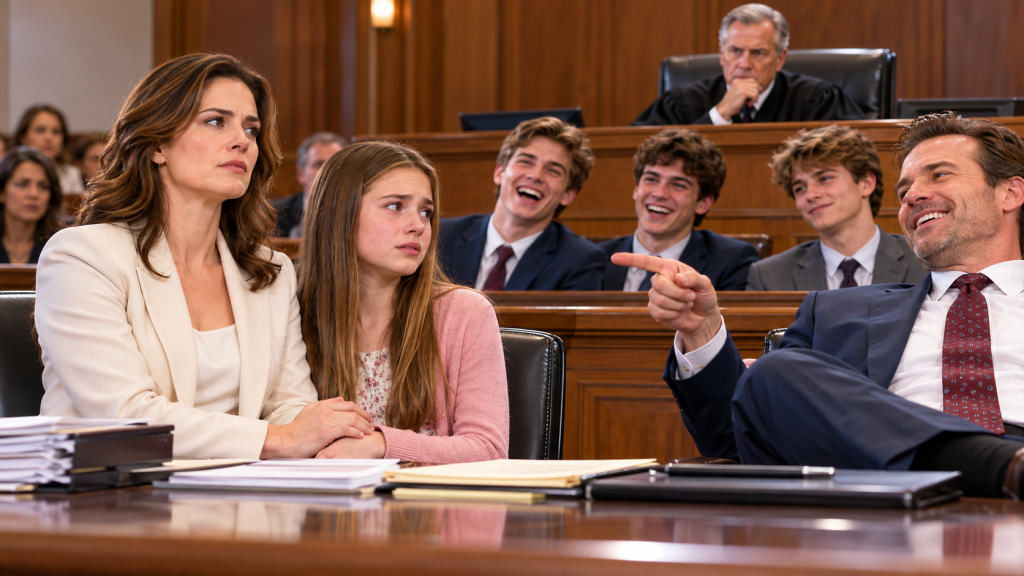
Judge Morrison looked toward Lily’s phone.
“What recording?”
My hand rested over my daughter’s.
Lily was fourteen.
She should have been thinking about algebra tests, orchestra rehearsal, and whether the boy in her science class liked her.
Instead, she had spent four months quietly watching her father turn her brothers into containers for money.
I hated that.
I hated Richard for creating the circumstances.
I hated myself for not protecting her sooner.
And I hated that the one person in our family who had been dismissed as “too young to understand” had understood nearly everything.
I stood.
“Your Honor, my daughter recorded a conversation in our home several weeks ago.”
Richard’s attorney rose immediately.
“We object to the characterization—”
Judge Morrison held up one hand.
“No one has characterized the contents yet.”
The attorney stopped.
The judge looked at me.
“Was Lily a participant?”
“Yes.”
My voice was steady.
“She was in the kitchen. Richard and the boys were discussing the companies in the adjoining family room. Lily entered the conversation after hearing her name.”
The judge looked toward my attorney, Grace Feldman.
Grace stood.
“We are not asking the court to make an ultimate evidentiary ruling from the bench this second. We are asking that the recording be preserved and considered with the other materials supporting the temporary financial restraints.”
Judge Morrison nodded.
“Reasonable.”
Richard suddenly spoke.
“This is ridiculous.”
His lawyer touched his arm.
He pulled away.
“My fourteen-year-old daughter secretly recorded a private conversation in my home, and somehow I’m the one on trial?”
Judge Morrison’s expression did not change.
“This is a divorce proceeding, Mr. Hale.”
Richard opened his mouth.
The judge continued.
“And if you continue speaking over counsel, it may become a much more expensive one.”
The courtroom went quiet.
Lily squeezed my hand.
Judge Morrison looked at her.
“Miss Hale, I am not asking you to testify today.”
Lily swallowed.
“Yes, Your Honor.”
“You understand?”
“Yes.”
“Good.”
Then he looked at Grace.
“Do you have the original file?”
“Yes.”
“Untouched?”
“Yes.”
“Preserve it.”
“We have.”
Richard’s attorney asked for a recess.
The judge gave him fifteen minutes.
They needed twenty-eight.
The hallway outside the courtroom was narrow and ugly.
Gray carpet.
Beige walls.
A vending machine humming near the elevators.
It did not look like the kind of place where a family could split into before and after.
Yet there we were.
Richard disappeared into a conference room with his lawyer.
Ethan followed.
Caleb started to.
Then stopped.
Noah stood with his back against the wall.
Lily remained beside me.
No one laughed anymore.
Finally Ethan turned toward me.
His face was furious.
“You recorded Dad?”
I looked at him.
“No.”
“Lily did.”
His eyes moved to his sister.
“You recorded us?”
Lily flinched.
I stepped slightly in front of her.
Ethan noticed.
That hurt him.
Good.
Maybe it needed to.
Lily said:
“I recorded Dad.”
“You recorded all of us.”
“You were there.”
Ethan laughed once.
Bitter.
“Great.”
Caleb rubbed both hands over his face.
“What’s on it?”
Lily looked at him.
“You know.”
His eyes dropped.
Noah whispered:
“Not all of it.”
That was the first thing he had said directly to me all morning.
I looked at him.
“What do you mean?”
Richard’s attorney opened the conference-room door.
“Boys.”
They all turned.
Then he looked at Lily.
“No discussion of the recording.”
I almost smiled.
For months Richard’s side had treated our children like pieces on a board.
Now suddenly everyone cared about procedure.
Ethan glared at me before following the lawyer inside.
Caleb went after him.
Noah stayed.
The attorney looked back.
“Noah.”
My youngest son looked at his father’s door.
Then at me.
He was seventeen.
Six feet tall.
Still had a faint scar on his chin from falling off a scooter at eight.
I remembered holding a washcloth beneath his face while he screamed because he thought stitches meant surgery.
Children become large enough to wound you without ever becoming visually separate from the child you once comforted.
Noah whispered:
“Dad said you’d try this.”
My heart tightened.
“Try what?”
“Make us look guilty.”
I took a slow breath.
“Do you feel guilty?”
His face hardened.
“That’s not fair.”
“No.”
“It isn’t.”
I nodded toward the conference room.
“But neither is answering a question with your father’s script.”
He stared at me.
Then:
“He said if we didn’t help, you’d take the company apart.”
“Did you believe him?”
“Yes.”
That hurt.
I let it.
“Why?”
Noah looked at the floor.
“Because you filed for divorce.”
I almost laughed.
The simplicity of it.
Marriage ends.
Therefore mother destroys.
Father protects.
It had taken Richard months to build that equation.
Noah continued.
“He said you were angry.”
“I was.”
“He said you wanted half of everything even though Dad built the company.”
My entire body went still.
“Your father built the company?”
Noah looked up.
He realized too late.
I said:
“Who created the original accounting system?”
He said nothing.
“Who negotiated our first commercial credit line?”
Silence.
“Who worked payroll at our kitchen table when Ethan was a baby?”
His jaw tightened.
“Mom.”
“Who mortgaged the first house with your father so Hale Construction could buy equipment?”
“I know you helped.”
“No.”
I shook my head.
“That word is part of the problem.”
I did not help Richard build our company.
We built it.
Together.
For seventeen years I managed finance, compliance, vendor contracts, insurance, payroll oversight, and eventually strategic planning while Richard ran field operations and sales.
Then I stepped back after Lily was born because one of us needed to be present more often.
My title became smaller.
My ownership did not.
Richard spent the next decade telling the children the version where Dad built and Mom helped.
I had let it pass because correcting it at dinner felt petty.
Small silences accumulate.
One day your own son looks at you and believes your marriage is ending because you want half of something his father owns.
I looked at Noah.
“Your father did not build that company alone.”
He swallowed.
“I know.”
“Do you?”
His eyes filled.
Before he could answer, Ethan appeared at the conference-room door.
“Noah.”
My youngest son went.
He looked back once.
That was all.
When court resumed, Richard did not object to preservation of the recording.
His attorney had apparently explained something important during the recess.
Instead, he argued that the transfers were legitimate estate planning.
Grace stood.
“Estate planning in anticipation of divorce?”
Richard’s attorney said:
“Business succession planning.”
Grace lifted one of Daniel Price’s reports.
“The first LLC was formed eight days after Mr. Hale consulted divorce counsel.”
Richard’s face hardened.
Grace continued.
“The second was formed eleven days later.”
“The third entity was created the week after Mrs. Hale informed her husband she intended to separate.”
Judge Morrison looked over his glasses.
“That timing requires explanation.”
Richard’s attorney said:
“And we will provide one.”
Grace nodded.
“Excellent.”
Then she turned.
“Because the entities received approximately $1.8 million in company and marital funds while Hale Construction simultaneously represented to lenders, employees, and Mrs. Hale that cash flow had materially deteriorated.”
Richard interrupted.
“The company did deteriorate.”
Judge Morrison looked at him.
“Mr. Hale.”
Richard stopped.
Grace continued.
“Mr. Price’s preliminary analysis indicates that without the transfers, the core company remained profitable.”
There.
Even my sons reacted.
Caleb’s head lifted.
Ethan stared at Richard.
Noah looked confused.
That mattered.
Richard had told them the company was collapsing because of me.
In truth, the company looked weak because he had been bleeding it.
Grace added:
“We are not asking for final findings today. We are asking that no additional funds move while the court determines what happened.”
Judge Morrison took several minutes.
Then issued temporary orders.
No transfers from the three disputed LLCs without court approval.
No disposition of major company assets.
No new debt outside ordinary operations above a set threshold.
Preservation of financial records.
Independent review.
And no alteration of access to company books.
Richard looked as if someone had closed an invisible hand around his throat.
Then custody.
Lily.
Grace requested temporary primary residential custody with me.
Richard’s attorney did not fight as hard as I expected.
Maybe because the recording existed.
Maybe because Richard had larger problems.
Maybe because Lily was sitting beside me with a face that made everyone understand where she wanted to be.
Noah, at seventeen, remained primarily with Richard pending further review because that was his stated preference and because uprooting him immediately would have created another war.
I did not fight that.
That surprised everyone.
Even Noah.
Judge Morrison looked at me.
“You understand, Mrs. Hale?”
“Yes.”
“You are not requesting immediate residential transfer of Noah?”
“No.”
I looked at my son.
“He is almost eighteen.”
“I want contact.”
“I want the ability to parent him.”
“But I do not want this court used as a machine for physically moving a nearly grown boy who is telling us where he wants to sleep tonight.”
Noah’s face changed.
Richard looked annoyed.
The judge nodded.
That was how the hearing ended.
Not with victory.
With restraints.
Questions.
And one family walking out in pieces.
In the parking garage, Richard caught up with me.
“Claire.”
I kept walking.
“Claire.”
Lily was beside me.
I stopped.
“Not in front of her.”
Richard laughed.
“You’ve been using her as evidence all morning.”
Lily flinched.
I turned.
Something in my face made him stop.
“Do not.”
My voice was quiet.
“Do not make her responsible for what you said on that recording.”
Richard lowered his voice.
“You have no idea what I was trying to prevent.”
“I know exactly what you were trying to prevent.”
“You taking what I built.”
There it was again.
I almost smiled.
“Our company.”
“Your half exists on paper.”
He said it.
Actually said it.
For twenty-two years, my contributions could be real when bills needed paying.
Real when loans needed signing.
Real when payroll was short.
Real when his first estimator quit and I worked twelve-hour days while nursing Caleb.
But now my half existed on paper.
I looked at him.
“Thank you.”
He frowned.
“For what?”
“For saying that while my attorney is twenty feet away.”
His eyes moved.
Grace stood near the elevators.
Watching.
Richard’s jaw tightened.
Then Ethan came out of the stairwell.
“Dad.”
Richard turned.
Whatever else he wanted to say vanished.
I took Lily home.
That evening, we listened to the recording with my attorney.
Not the whole thing at first.
Lily sat between us.
Grace asked:
“Are you sure?”
Lily nodded.
“Yes.”
“You can stop at any time.”
“I know.”
Grace pressed play.
Richard’s voice filled my living room.
Familiar.
Confident.
Your mother is going to try to freeze everything.
Then Ethan:
Can she?
Richard:
Not if the assets aren’t where she expects.
Silence.
I had already heard the recording once.
It still made my stomach hurt.
Caleb’s voice:
This feels illegal.
Richard laughed.
It’s not illegal to give your children money.
Caleb:
But it’s company money.
Richard:
It becomes distribution. Then investment. Daniel Price isn’t God. Accountants make everything sound criminal.
I almost smiled.
Coming from a man now terrified of an accountant.
Then Ethan:
What exactly do you need us to sign?
Richard explained.
LLC operating agreements.
Bank signature cards.
Management authorizations.
He told Ethan and Caleb the companies were “family succession vehicles.”
Then Noah asked:
Why do I need one if I’m seventeen?
Richard:
Because if your mother gets half the company, she’ll sell it. I’m making sure there’s something left for you boys.
Then Lily’s voice.
Quiet.
From the kitchen.
What about me?
The recording changed.
I could hear it.
Richard had not known she was there.
What?
Lily repeated:
What about me?
A pause.
Then Ethan laughed.
Not cruelly.
Nervously.
It still hurt.
Richard said:
You’ll be fine. Your mother will take care of you.
Lily:
So the boys get companies and I get Mom?
Richard sounded irritated.
Don’t be dramatic.
Lily:
Are you hiding money from her?
Then the part Richard had feared.
His voice became hard.
Listen to me. None of you are going to repeat this conversation.
Caleb:
Dad—
Richard:
I mean it.
Then:
Ethan, your graduate-school tuition is coming from me.
Silence.
Caleb, your apartment is in my name.
Another silence.
Noah, you want that truck when you turn eighteen?
Noah answered quietly.
Yeah.
Richard:
Then everybody needs to understand what loyalty looks like.
Lily’s breathing was audible on the recording.
My daughter beside me now started crying.
I paused it.
She shook her head.
“No.”
“Lily.”
“Keep going.”
Grace looked at me.
I looked at Lily.
She nodded.
I pressed play.
Richard:
Your mother chose to blow this family up. I’m making sure she doesn’t profit from it.
Then Caleb:
She owns part of the company.
And Richard:
Because I was stupid enough to put her name on things when we were young.
My eyes closed.
Twenty-two years of marriage.
Four children.
Seventeen years building a business.
Reduced to paperwork he regretted signing.
Then Ethan:
What if we don’t want our names on this?
Richard’s answer came without hesitation.
Then don’t come to me when tuition is due.
Silence.
Don’t ask me for rent.
Don’t ask me for cars.
And don’t expect there to be a job waiting for you in Hale Construction.
Then:
Families survive because people choose sides.
The recording ended eleven minutes later.
Not with a crime confession.
With something sadder.
Three sons being taught love was a compensation package.
Lily cried in my lap afterward.
“I should have told you sooner.”
“No.”
“I waited two weeks.”
“You were fourteen.”
“I knew it was wrong.”
“That does not mean you were responsible for fixing it.”
She wiped her face.
“Did I betray Dad?”
My heart cracked.
“No.”
“Then why does it feel like I did?”
Because Richard had built a family where secrecy had been confused with loyalty.
I said:
“Telling the truth about something harmful is not the same as causing the harm.”
She nodded.
I had said similar words to myself for months.
Now my daughter needed them.
I added:
“And you should never have been put in the position of protecting one parent from the other.”
Her lip trembled.
“I’m sorry you were.”
She leaned against me.
For the first time since I filed for divorce, I stopped thinking about winning.
I wanted my children back from the idea that love required choosing sides.
That would be harder than recovering money.
Daniel Price’s full report arrived six weeks later.
Three hundred and twelve pages.
Richard hated every one of them.
The $1.8 million was only the beginning.
Some funds had returned to him through consulting agreements.
Some had been used to purchase equipment titled to the sons’ LLCs but leased back to Hale Construction at inflated rates.
One company had purchased a parcel of land Richard planned to develop later.
Another had received a six-figure “management fee” despite having no employees.
It was not sophisticated.
That was almost insulting.
Richard had hidden complexity inside family relationships and assumed no one would look too hard because the account names belonged to our children.
Daniel looked at me across the conference table.
“He counted on the names stopping you.”
“What do you mean?”
“Ethan Hale LLC.”
“Caleb Hale Holdings.”
“Noah Hale Ventures.”
He tapped the report.
“Most spouses hesitate when assets are parked under their children.”
My stomach turned.
“So he used them as emotional camouflage.”
Daniel nodded.
“Yes.”
That phrase stayed with me.
Emotional camouflage.
Exactly.
The boys were questioned separately.
Ethan went first.
Twenty-one.
Old enough to sign.
Old enough to know something.
Young enough to believe his father’s confidence was a substitute for legality.
He admitted signing documents.
Admitted opening the account.
Admitted receiving distributions.
But he also produced text messages from Richard.
Sign today. Need this done before your mother’s people start digging.
Another:
If you want your MBA paid for, stop acting nervous.
Another:
You’re either with this family or against it.
Ethan handed over everything.
Not immediately.
Three days after his first interview.
That mattered.
Caleb cooperated faster.
He had kept emails.
Apparently because the whole arrangement frightened him.
He told the neutral examiner:
“I thought Dad was doing aggressive tax planning.”
Then:
“I also knew Mom didn’t know.”
That was the most honest sentence any of my sons gave during the entire process.
Noah had signed less.
Because he was a minor, Richard had controlled most of the custodial structure.
Noah’s role had largely been psychological.
His name.
His future.
His promised truck.
He still knew the purpose was to “keep money away from Mom.”
But he had not understood how much.
Understanding mattered.
It did not erase anything.
Ethan called me first.
Two months after the hearing.
11:47 at night.
I stared at his name until the final ring.
Then answered.
“Hi.”
Silence.
“Mom?”
“Yes.”
He sounded like a boy.
Not twenty-one.
“Can I come over?”
I looked toward Lily’s closed bedroom door.
“Tonight?”
“Yes.”
I hesitated.
Then:
“Okay.”
He arrived twenty minutes later.
No coat.
Columbus winter.
Typical.
I opened the door.
He stood there with red eyes.
“I think Dad used me.”
No hello.
No preamble.
I stepped aside.
He came in.
We sat at the kitchen table.
The family table.
Different house.
Different marriage.
Same role.
He said:
“Daniel showed me where the money went after my account.”
I waited.
“I thought it was mine.”
I almost laughed, then realized he meant it.
“Dad said the first company would be my future.”
“He said he was accelerating inheritance.”
I nodded.
“He told me that.”
Ethan looked up sharply.
“He told you?”
“Through lawyers.”
“Why didn’t you say something to us?”
There it was.
The question I knew would come.
I looked at him.
“I did.”
He frowned.
“When?”
“At dinner in January.”
“You said your father was moving money.”
“You rolled your eyes.”
His face tightened.
“In February I asked you not to sign anything.”
“You told me Dad understood business better than I did.”
Ethan looked down.
“In March I asked if you would meet with Daniel.”
“You said you weren’t getting dragged into my divorce drama.”
Each sentence landed.
Not cruelly.
Factually.
Ethan cried.
“I thought you were trying to turn me against him.”
“I know.”
“Why didn’t you try harder?”
That one hurt.
I sat back.
“Because you were twenty-one.”
His face changed.
“I could warn you.”
“I could ask.”
“I could refuse to participate.”
“But I could not make you believe me.”
He covered his face.
“I’m sorry.”
I let the silence remain.
Then he whispered:
“I laughed in court.”
“Yes.”
“At you.”
“Yes.”
His shoulders shook.
“I’m sorry.”
I wanted to cross the table.
Hold him.
Make it disappear.
Motherhood is full of impulses that would destroy accountability if followed every time.
So I stayed where I was.
Then I said:
“I believe you’re sorry.”
He lowered his hands.
“Do you forgive me?”
Too fast.
I could see he regretted asking.
I answered honestly.
“I love you.”
His face broke.
“That’s not the same answer.”
“No.”
He nodded.
I continued.
“I can forgive you and still need time before I trust you.”
“What does that mean?”
“It means I don’t want financial conversations with you right now.”
“It means I won’t discuss strategy in the divorce.”
“It means I need to see whether your apology survives discomfort.”
He stared.
Then:
“Okay.”
That word.
A beginning.
Caleb came four days later.
He brought food.
Because he had always been my softest child.
Even during the worst months, Caleb’s cruelty had mostly taken the form of silence.
Silence still hurts.
He placed a bag of takeout on the counter.
“I didn’t know what you liked anymore.”
That sentence nearly broke me.
I smiled sadly.
“Thai food remained stable through the divorce.”
He laughed once.
Then cried.
We ate.
Halfway through, he said:
“I knew.”
I put down my fork.
“How much?”
“That Dad was hiding money.”
My chest tightened.
“I didn’t know the amount.”
“I didn’t know he was making the company look insolvent.”
“But I knew the LLC wasn’t really for me yet.”
“Why did you sign?”
Caleb stared at his plate.
“Because I was scared.”
“Of him?”
“Of losing everything.”
That surprised me.
He continued.
“Dad kept saying if you got your half, the company would fail.”
“That Ethan and I would never get jobs there.”
“That Noah’s college fund would disappear.”
“That Lily would be fine because she had you.”
He looked at me.
“And I thought…”
“What?”
“I thought you were stronger.”
My eyes filled.
There it was again.
Different family.
Same punishment.
Competence mistaken for infinite capacity.
Caleb whispered:
“I thought if someone had to lose, you’d survive it better.”
That sentence hurt more than the laughter.
I breathed through it.
Then:
“Do you understand what you just said?”
“Yes.”
He cried.
“I hate that I thought it.”
I believed him.
I reached across the table.
Not full forgiveness.
A hand.
Enough.
Noah did not come.
Not for months.
He stayed with Richard.
Turned eighteen.
Got the truck anyway.
Richard bought it the week before the financial restraints tightened.
Grace filed a motion regarding the purchase.
I told her:
“Let it go if we can.”
She looked at me like I had lost my mind.
“It may be dissipated marital property.”
“I know.”
“Then why?”
“Because I do not want every interaction with my son reduced to a forensic entry.”
She sighed.
“Claire, sentiment is not a financial strategy.”
“I hired you because I know that.”
We compromised.
The truck stayed documented.
No immediate fight over possession.
Noah drove it.
Every time I saw it, I remembered the recording.
You want that truck when you turn eighteen?
A vehicle became a sentence.
That was not Noah’s fault.
But he had accepted the sentence.
Both could be true.
Richard’s story unraveled publicly inside the company long before the divorce ended.
He had told senior employees I was trying to liquidate Hale Construction.
I wasn’t.
In fact, I was the one arguing not to destroy it.
The company employed eighty-three people.
People with mortgages.
Children.
Health insurance.
I wanted my share.
I did not want a bonfire.
Daniel’s review made clear that the company could survive if the siphoned assets returned and management controls changed.
Richard resisted.
Of course.
Then the court-appointed neutral recommended temporary financial oversight.
That was the humiliation he could not tolerate.
Not losing me.
Not even losing money.
Being supervised.
A man who had spent years believing control was proof of competence suddenly needed approval for extraordinary transactions.
He blamed me.
For everything.
He texted:
You’re destroying what we built.
I replied once:
We agree on one word. We built it.
Then stopped engaging.
The recording became important later.
Not because Judge Morrison played it dramatically in open court.
Life rarely delivers television.
It was reviewed.
Authenticated.
Argued over.
Used with the financial evidence.
Richard’s threats to the boys mattered because they undercut the claim that the transfers were freely structured gifts.
The boys’ messages mattered more.
The timing mattered.
The money trail mattered most.
Daniel once told me:
“Emotion explains motive. Documents prove movement.”
I wrote that down.
Useful in divorce.
Useful in life.
The final financial picture was ugly.
Of the roughly $1.8 million shifted into the sons’ entities, most was still recoverable through assets, accounts, and reversals.
Some had been spent.
Legal fees.
Vehicle purchases.
A deposit on a development parcel.
Private-school tuition for a business associate’s child through a side arrangement that opened another unpleasant question.
Richard had also paid himself bonuses during the period he claimed the company could not afford distributions to me.
That did not impress the court.
Neither did his incomplete disclosures.
By the ninth month, his own attorney withdrew.
Officially:
“irreconcilable differences regarding representation.”
Grace translated:
“He won’t listen.”
Richard hired someone more aggressive.
That lawyer lasted.
Barely.
Then Richard made his biggest mistake.
He called Lily.
The temporary parenting schedule allowed contact.
I did not block him.
Children are not evidence to be sequestered.
But the order prohibited discussion of litigation with her.
He called anyway.
Lily came into my bedroom afterward.
White-faced.
“What happened?”
She handed me her phone.
“He said I ruined the family.”
Everything inside me went cold.
“What exactly?”
She cried.
“He said if I hadn’t recorded him, Ethan and Caleb wouldn’t be in trouble.”
“They aren’t ‘in trouble’ the way he means.”
“I know.”
“He said Noah hates me.”
My heart broke.
“Lily.”
“And he said you’re going to sell the company just to hurt him.”
I sat her beside me.
“Did you record this call?”
She shook her head.
Good.
My first emotion was relief.
That told me how sick the whole situation had become.
“No more evidence.”
I said.
She looked confused.
“What?”
“You are done collecting evidence for adults.”
I took her phone.
“Your job is to be fourteen.”
Then I called Grace.
That call changed Richard’s access.
Not forever.
But enough.
The court ordered communication with Lily through a family-therapy structure for a period and reinforced the no-litigation boundary.
Richard called me furious.
“You turned my daughter against me.”
“No.”
“You did that call yourself.”
He hung up.
Good.
Noah called Lily that night.
She put him on speaker without asking.
I heard his voice from the hallway.
“Did Dad really say I hate you?”
Lily was crying.
“Yes.”
Silence.
Then Noah:
“I don’t.”
She sniffed.
“You act like it.”
He went quiet.
“I’m mad at you.”
“Why?”
“Because you recorded us.”
“Dad was hiding money.”
“I know.”
“Then why are you mad?”
Noah’s voice broke.
“Because everything changed.”
There.
Not logic.
Grief.
Lily softened.
“Everything was already changing.”
“I know.”
He started crying.
“So why did you have to make it worse?”
I almost entered.
Stopped.
This was between siblings.
Lily said:
“I didn’t make Dad say it.”
Noah went quiet.
Then:
“I know.”
That may have been the first crack.
Noah came to my house three weeks later.
He did not tell Richard.
I did not ask him to hide it.
He stood in the foyer.
Hands in hoodie pockets.
Bigger than me.
Terrified.
“Can I see Lily?”
“She’s upstairs.”
He nodded.
Did not move.
I waited.
Then:
“Do you hate me?”
My heart stopped.
“No.”
His face tightened.
“You should.”
“No.”
“You told the judge you didn’t want me.”
There it was.
Richard’s version of “none.”
I closed my eyes.
“Noah.”
“You said none.”
“In court.”
“I heard.”
He started crying angrily.
“You picked Lily.”
I stepped closer.
“No.”
“You did.”
“No.”
I shook my head.
“I refused your father’s premise.”
He stared.
“What?”
“He told me to choose one of my sons like children were property we could divide to make his settlement theatrical.”
“I said none because I was not participating in that.”
His face shifted.
“But then you asked for Lily.”
“Because she is fourteen.”
“And she wanted to live with me.”
“You were seventeen.”
“You had already told the evaluator you wanted your father’s house.”
“I respected that.”
Noah’s mouth opened.
Closed.
“Dad said you didn’t fight for me.”
My eyes filled.
“I fought for access to you.”
“I fought against being cut out.”
“I did not fight to drag you from a home you said you wanted to remain in.”
“Those are different things.”
Noah stared at me.
“Why didn’t you tell me?”
“I tried.”
“When?”
“Every message you ignored.”
He looked down.
I softened.
“Your father was louder.”
“That does not make you stupid.”
“It makes you seventeen.”
He started crying.
I opened my arms.
He stood frozen.
Then came into them so fast I stumbled backward.
My son.
My youngest boy.
Eighteen now.
Crying into my shoulder like he was eight.
“I’m sorry.”
he said.
“I’m sorry.”
I held him.
Not because everything was fixed.
Because love and accountability are not enemies.
Sometimes the safest place to admit what you did wrong is in the arms of someone who still loves you.
Noah moved in with me two months later.
Not because a judge ordered it.
Because Richard told him he was ungrateful after Noah refused to sign a new affidavit supporting Richard’s version of the LLC arrangements.
Noah called at midnight.
“Can I come?”
“Yes.”
No questions.
That was what I had learned.
Safety first.
Explanation after.
He arrived with three duffel bags.
Richard texted:
He’ll come back when he realizes your condo has rules.
Noah never went back to live there.
He saw his father.
Sometimes.
On his own terms.
The boys’ relationships with each other changed.
Ethan blamed Caleb for cooperating with Daniel sooner.
Caleb blamed Ethan for normalizing the scheme.
Noah blamed both for acting like grown men while telling him to trust Dad.
Lily blamed all three for laughing in court.
For a while, every family dinner became archaeology.
Someone dug.
Someone uncovered.
Someone got hurt.
Finally, I stopped hosting “healing dinners.”
That was my phrase.
Terrible idea.
Healing does not happen because a mother serves lasagna and asks everyone to communicate.
I invited them individually instead.
Coffee with Ethan.
Lunch with Caleb.
Grocery shopping with Noah.
Movie nights with Lily.
Siblings repaired at their own pace.
Much better.
Ethan’s apology took the longest to become behavior.
He had absorbed the most from Richard.
Ambition.
Pride.
The belief that being financially useful made you important.
He had also received the most.
Tuition.
Internships.
Promises of company leadership.
When those disappeared, he became angry.
At Richard.
At me.
At himself.
He nearly dropped out of graduate school because he refused to accept any support linked to the family.
I told him:
“Pride is still dependence if your decisions are controlled by what you are trying not to owe.”
He hated that.
Good.
He took loans.
Worked part-time.
Finished.
On graduation day, he handed me an envelope.
Inside was a copy of the first LLC operating agreement he had signed.
Across it, in red ink, he had written:
I signed this because I wanted what Dad promised more than I wanted to ask whether it was right.
I looked at him.
“Why are you giving me this?”
“So I never rewrite it.”
That mattered.
I kept the paper.
Not as a weapon.
As evidence of growth.
Caleb changed differently.
He left Hale Construction entirely.
Richard had always assumed Caleb would run project management.
Instead, he took a job with an architecture firm in Cincinnati.
Lower starting salary.
No family title.
He loved it.
One evening he told me:
“I didn’t know whether I liked construction or just liked Dad being proud of me.”
My throat tightened.
“And?”
“I like design.”
He smiled.
“I hate managing subcontractors.”
I laughed.
“Your father will be devastated.”
“He is.”
“Healthy.”
Caleb smiled.
He eventually became the son most able to have a relationship with Richard without becoming absorbed by him.
Maybe because he left the family business.
Distance gave him shape.
The company became the hardest question.
Sell?
Divide?
Buy out?
Continue jointly?
The idea of remaining business partners with Richard made me tired.
The idea of destroying a company we had spent decades building made me sad.
Then Daniel presented an option.
A management-led purchase over time.
Senior employees would acquire controlling interest through a structured transaction.
Richard and I would receive value.
Neither of us would control the company forever.
At first, Richard refused.
“Hale Construction without a Hale?”
he snapped during mediation.
I looked at him.
“Maybe that’s exactly what saves it.”
His face hardened.
Then Daniel showed projections.
Employees supported the plan.
Lenders preferred it.
Our sons did not actually want to run the business.
That surprised Richard more than anything.
Ethan said no.
Caleb already left.
Noah wanted to study physical therapy.
Lily wanted absolutely nothing to do with concrete.
Richard looked around the mediation table.
His dynasty had existed mostly in his own imagination.
Eventually, he agreed.
Not graciously.
But he agreed.
Over three years, ownership transitioned to a management group led by two longtime executives who had been with us almost from the beginning.
I retained a declining financial interest during the buyout.
Richard did too.
Then eventually:
No more Hale Construction.
At least not ours.
The name stayed.
The ownership changed.
Funny.
A name can remain after control leaves.
Families are like that too.
The divorce ended nineteen months after the day Richard told me to “pick one.”
Nineteen months.
Anyone who thinks divorce is one dramatic hearing has never paid lawyers by the hour.
By the final day, there was no packed courtroom.
No audience.
No sons lined up like an inheritance display.
Just lawyers.
Paper.
Judge Morrison.
Richard.
Me.
The hidden assets had been accounted for.
Financial consequences reflected the dissipation.
The business transition was underway.
Retirement accounts divided.
Properties assigned or sold.
Support resolved.
Lily’s parenting arrangement formalized with safeguards around conflict.
Noah was already eighteen.
The court no longer decided where he slept.
That mattered to him.
Then Judge Morrison asked the standard final questions.
Had the marriage broken down?
Yes.
Any reasonable prospect of reconciliation?
No.
I expected sadness.
Instead, I felt quiet.
Twenty-two years reduced to a few legal answers.
But marriage had never actually been the certificate.
It had been mornings.
Children.
Mortgages.
Inside jokes.
Business invoices.
Flu seasons.
Late-night arguments.
Hospital waiting rooms.
A thousand grocery lists.
The court ended the legal structure.
The life had already changed.
Judge Morrison signed.
Richard and I walked out divorced.
No applause.
Good.
In the hallway, he said:
“Claire.”
I stopped.
He looked older.
So did I.
He had lost weight.
The expensive confidence had softened.
Not disappeared.
Richard would always carry some version of himself into every room.
But now he looked tired.
“Did you ever love me?”
I stared.
Of all questions.
“That’s what you ask?”
He gave a small, broken laugh.
“I don’t know what else there is.”
I thought.
“Yes.”
His eyes filled.
“I loved you for a long time.”
“Then why did you leave?”
There it was.
His wound.
I could have listed everything.
The affair I had discovered first.
Yes.
There had been one.
Not glamorous.
Not central to the money story.
A woman from a supplier company.
Six months.
Richard had called it “a mistake.”
The lies afterward had mattered more than the affair.
The financial control.
The contempt.
The years of telling me my work did not count.
The way our marriage became a system where every disagreement ended with his money, his company, his house.
I could have recited all of it.
Instead:
“Because eventually loving you required agreeing to disappear.”
Richard looked down.
That sentence reached him.
He nodded.
Then:
“I didn’t think you’d actually find the money.”
I almost laughed.
“At least you’re honest.”
He smiled faintly.
“You always were better at the books.”
“No.”
I said.
“I respected them more.”
That was the last conversation we had as husband and wife.
My relationship with Richard afterward was not dramatic.
We were not friends.
We did not become enemies either.
We became parents of the same children.
That requires a strange kind of diplomacy.
He came to graduations.
So did I.
He attended Lily’s orchestra concerts.
Sat across the auditorium.
Sometimes we spoke.
Sometimes not.
When Noah tore his ACL at twenty, Richard and I both showed up at the hospital.
For twenty minutes, we fell into old roles.
I handled paperwork.
He asked the surgeon too many questions.
Then we remembered we were divorced.
Funny.
Parenthood survives legal endings in inconvenient ways.
Richard’s relationship with the children fractured before it repaired.
Lily refused visits for months.
Therapy continued.
Eventually she agreed to coffee.
Then dinner.
Then a weekend afternoon.
She never lived with him again.
When she was seventeen, he apologized without blaming me.
That was the first apology she accepted.
He said:
“I taught you that loyalty meant secrecy.”
Lily answered:
“Yes.”
He cried.
“I’m sorry.”
She said:
“Okay.”
Same beginning.
Years later, they became reasonably close.
Not because Lily forgot.
Because Richard stopped demanding she pretend.
Noah took longer.
He loved his father deeply.
That made anger harder.
At nineteen, he returned the truck.
Not because anyone asked.
He drove it to Richard’s house.
Left the keys.
Then bought a used Honda with money from his part-time job.
When he told me, I almost said:
“You didn’t have to.”
Stopped.
His choice.
He said:
“Every time I drove it, I heard the recording.”
That was enough.
Richard sold the truck.
Sent Noah the proceeds.
Noah sent them back.
They argued.
Eventually the money went into a neutral education account Richard contributed to without control conditions.
Compromise.
Messy.
Real.
The phrase “pick one” haunted me longer than I expected.
Not because I thought I had chosen wrong.
Because people repeated it.
Family.
Friends.
A cousin said:
“I can’t believe you said none.”
I corrected her.
“I did not reject my sons.”
“I rejected being asked to divide children like property.”
Words matter.
Stories harden around the easiest sentence.
I refused to let that one become:
Mother chose daughter over sons.
The truth was harder.
Three sons had participated, to different degrees, in hiding money from their mother.
One daughter had exposed it.
A father had manipulated loyalty.
A mother had reached a limit.
Then everyone had to live long enough to become more than what they did during the divorce.
That was the real story.
Four years later, Ethan got married.
He asked me to arrive early.
I did.
At the church, he found me in a side room.
Nervous.
Thirty now.
Still my boy.
“Mom.”
“Yes?”
“I need to tell you something before today starts.”
My stomach tightened.
Marriage apparently makes mothers assume emergencies.
“What?”
“I invited Dad.”
“I assumed.”
“And I want you both in the family photos.”
I smiled.
“Of course.”
He looked surprised.
“That’s it?”
“What did you expect?”
“I don’t know.”
He laughed nervously.
“History.”
I touched his face.
“Your wedding is not a referendum on my divorce.”
His eyes filled.
Then:
“I wish I’d understood that back then.”
I knew what he meant.
He had treated my leaving Richard as leaving the family.
“I know.”
He swallowed.
“I said terrible things to you.”
“You did.”
“I helped Dad.”
“Yes.”
“I laughed.”
“Yes.”
He cried.
I hugged him.
Then whispered:
“And you spent four years becoming someone who would not do it again.”
He held me tighter.
“That matters more now.”
Not more than the hurt.
More now.
That distinction mattered.
At the reception, Richard and I stood beside Ethan and his wife for photographs.
The photographer said:
“Parents together.”
Richard glanced at me.
I stepped into place.
No lightning.
No collapse.
Just two people who had made a son.
The camera clicked.
Then we moved apart.
Easy.
Years make things possible that once felt like betrayal.
Caleb married later.
Noah did not for a long time.
Lily swore she never would.
Then fell in love at thirty-two and became unbearable.
Children enjoy disproving themselves.
At her wedding rehearsal, Richard stood beside me.
He whispered:
“She looks like you.”
I watched Lily argue with the florist.
“She looks like herself.”
Richard smiled.
“Fair.”
Then after a moment:
“Thank you.”
I looked at him.
“For what?”
“For not making her hate me.”
My face hardened slightly.
“I did not make her love you either.”
He nodded.
“I know.”
That was the point.
Children are not verdicts one parent wins.
They are people.
They choose relationships based on what we give them.
Or fail to.
Richard never fully admitted he had planned to steal from me.
He used softer language.
Protect assets.
Preserve the business.
Avoid destruction.
Create succession vehicles.
I stopped needing the exact word from him.
The court had words.
The accountant had numbers.
The documents had dates.
Reality did not require his preferred vocabulary.
That became freedom.
For years, I thought healing needed the person who hurt you to describe the hurt correctly.
Sometimes it helps.
Sometimes you have records.
And a life to live.
The $1.8 million did not make me rich.
It made the marital estate accurate.
There is a difference.
After taxes, business restructuring, division, legal fees, and everything else, the numbers became far less cinematic.
Good.
I bought a smaller house.
Three bedrooms.
A garden.
Lily lived with me until college.
Noah for a while.
Caleb stored furniture in my garage without permission.
Ethan raided my refrigerator whenever he visited.
Apparently divorce does not cure adult sons of theft-by-leftovers.
My home was noisy.
Imperfect.
Mine.
One day, about five years after the divorce, Daniel Price came by for coffee.
By then, he had become a friend.
He looked around my kitchen.
“Do you ever miss the big house?”
Richard had kept it initially, then sold two years later.
I thought.
“No.”
“Never?”
“I miss the dining room.”
“Why?”
“It fit everyone.”
Daniel smiled.
“You can buy a larger table.”
I looked at my modest kitchen.
Then at the folding table I kept in the garage for holidays.
“I learned something.”
“What?”
“Rooms expand.”
He laughed.
I did too.
Maybe that sounds sentimental.
It was true.
The boys eventually spoke openly about the LLCs.
Not publicly.
As a family.
The first time happened on Thanksgiving.
Terrible timing.
Of course.
Ethan said:
“I’m sorry.”
Caleb said:
“We’ve done this.”
Ethan replied:
“Not together.”
Noah stared at mashed potatoes.
Lily went still.
I almost stopped the conversation.
Then didn’t.
Ethan looked at his sister.
“I’m sorry I laughed.”
Lily’s eyes filled.
He continued.
“I was scared.”
“That does not excuse it.”
“But I want you to know I wasn’t laughing because what Dad did was funny.”
“I was laughing because Mom saying ‘none’ scared me.”
Lily asked:
“Why?”
“Because for a second I thought she really didn’t want us.”
My heart tightened.
Noah nodded.
“Same.”
Caleb looked at me.
“We heard ‘none’ differently than you meant it.”
I set down my fork.
“Then I’m sorry.”
All four children looked surprised.
Ethan frowned.
“For what?”
“For not understanding what that word might sound like to you.”
Lily immediately said:
“Mom, you don’t have to apologize.”
“Yes.”
“I do.”
I looked at my sons.
“I meant: I refuse to choose among you.”
“But what you heard was: I choose none of you.”
Their faces shifted.
“That was not my intention.”
“But intention does not erase impact.”
Therapy.
Again.
Worth the money.
Noah wiped his eyes.
Then:
“So nobody handled that day well.”
Lily stared.
“I did.”
We all laughed.
Even me.
Especially me.
She had earned that.
Years passed.
Richard eventually retired from construction entirely.
The management group bought the last of our interests.
The day my final payment cleared, I stared at the deposit.
Not because of the number.
Because the company was finished for me.
A thing I had built.
A thing Richard had used as identity.
A thing nearly weaponized against me.
Now someone else owned it.
I expected grief.
I felt relief.
Then grief.
Both.
I drove past one of our old project sites that afternoon.
An apartment building.
Brick.
Six floors.
Hale Construction’s name still on a plaque.
I parked.
Looked.
And thought:
I helped build that.
No one could rewrite it now.
Not Richard.
Not my sons.
Not even me.
I had spent too many years shrinking my own contribution because speaking it aloud felt competitive.
There is nothing noble about erasing yourself so others can remain comfortable.
I learned that late.
Still learned.
Judge Morrison retired several years later.
I saw an article.
Small photograph.
Same glasses.
I wondered if he remembered us.
Probably not.
Courts see hundreds of families.
The worst day of your life may be someone else’s 10:30 hearing.
There is something comforting in that.
We were not mythic.
Not uniquely broken.
Just people.
That made recovery feel possible.
My sons became fathers.
That changed them more than the divorce ever did.
Ethan called when his first daughter was born.
He was crying so hard I could barely understand him.
“She’s here.”
“I know.”
“How?”
“You called from labor and delivery, Ethan.”
“Oh.”
Sleep deprivation had already begun.
I visited the next day.
He handed me the baby.
Tiny.
Warm.
His face changed when he watched me hold her.
Then he whispered:
“I can’t imagine using her against someone.”
My throat tightened.
I knew exactly what he meant.
“Then don’t.”
He nodded.
“I won’t.”
Simple.
Generational change often is.
A sentence.
Repeated through behavior.
Caleb had two boys.
Noah eventually had a daughter.
Lily had twins after insisting for fifteen years she did not want children.
I never mentioned this.
Much.
Our holidays became chaotic.
Richard attended some.
Not all.
When he came, he brought too many gifts.
I told him:
“You are overcompensating.”
He said:
“Probably.”
At least we were efficient now.
The grandchildren did not know the details of our divorce.
Not while they were small.
They knew Grandma Claire and Grandpa Richard lived in different houses.
They knew their parents had complicated stories.
Enough.
Children do not need adult wounds handed down as family heirlooms.
One Christmas, one of Ethan’s daughters found the old red-marked LLC document in my desk.
I had forgotten it was there.
She was nine.
“What’s this?”
I took it.
“Old paperwork.”
“Dad’s name is on it.”
“Yes.”
“Was he a businessman?”
I smiled.
“Briefly.”
She ran away.
Later I asked Ethan whether he wanted the document.
He looked at it.
Then shook his head.
“Throw it out.”
“Sure?”
“Yes.”
I did.
Not ceremonially.
Shredder.
Confetti.
Some evidence finishes its job.
I kept Lily’s recording longer.
For legal reasons first.
Then because deleting it felt strange.
Years after everything ended, I found the file on an old encrypted drive.
I hovered over it.
Eleven minutes and forty-seven seconds.
A family at its worst.
I called Lily.
“Do you want this?”
“What?”
“The recording.”
Silence.
Then:
“You still have that?”
“Yes.”
“Why?”
“Good question.”
She laughed.
“Delete it.”
“Are you sure?”
“Yes.”
Then she became quiet.
“Mom?”
“Yes?”
“I don’t want Dad’s worst eleven minutes preserved forever.”
My eyes filled.
“That’s generous.”
“No.”
She said.
“It’s for me.”
Of course.
I deleted it.
Then emptied the trash.
No ceremony.
Just gone.
The consequences remained.
The evidence no longer needed to.
Richard became ill in his late sixties.
Nothing dramatic at first.
Heart problems.
Then surgery.
All four children called me.
Old reflex.
Mom coordinates.
I caught myself.
“You need to talk to his doctor.”
Ethan laughed.
“Right.”
They handled it.
I visited once.
Richard looked small in the hospital bed.
Strange.
This man had once filled rooms with certainty.
Now machines did the confident work.
He smiled when he saw me.
“Claire.”
“Hi.”
“You look good.”
“So do you.”
“That’s a lie.”
“Yes.”
He laughed.
We sat.
Then he said:
“I think I owe you something.”
My body stiffened.
“Please not money.”
He smiled.
“No.”
Then:
“The truth.”
I waited.
He looked toward the window.
“I knew the company was ours.”
My throat tightened.
He continued.
“I always knew.”
There.
All those years.
“I said it was mine because if it was ours, then you could leave with your part.”
His eyes filled.
“And I couldn’t tolerate that.”
I said nothing.
“So I told myself you were taking.”
“When really…”
He swallowed.
“You were leaving.”
That was different.
“I used the boys because I thought they belonged to me more.”
My heart hurt.
Not because it was new.
Because he finally said it.
“I thought they were more like me.”
“I thought Lily was more like you.”
“So I divided everyone before the judge ever asked.”
I whispered:
“The judge never asked.”
Richard smiled sadly.
“No.”
“I did.”
Silence.
Then:
“I’m sorry.”
I breathed.
“Thank you.”
He looked at me.
“That’s all?”
“What do you want?”
“I don’t know.”
“Absolution?”
He laughed weakly.
“Maybe.”
“I’m not a priest.”
“Never were.”
“No.”
I smiled.
Then:
“I forgave enough years ago to stop organizing my life around being angry at you.”
His eyes filled.
“That’s the best I can give.”
Richard nodded.
“It’s more than I deserved.”
I did not answer that.
We had outgrown deserving.
He recovered from that surgery.
Lived seven more years.
When he eventually died, all four children were with him.
I was not.
That was right.
I went to the funeral.
Sat in the second row.
Not the widow.
Not family exactly.
Not stranger.
Something without a clean name.
Twenty-two years married.
Decades divorced.
Four children.
A business.
A war.
An apology.
A life.
After the service, Ethan found me outside.
“You okay?”
“Yes.”
“Really?”
I thought.
“Sad.”
He nodded.
“Me too.”
Then he whispered:
“I’m glad you didn’t make us hate him.”
I looked at him.
“I couldn’t have.”
“You could’ve tried.”
Fair.
I touched his arm.
“He gave you enough reasons to decide what relationship you wanted.”
“That was yours.”
Ethan cried.
Then hugged me.
After Richard died, the children sorted his house.
They asked if I wanted anything.
“No.”
Then Lily found a wooden box.
Inside were old photographs.
Our wedding.
Babies.
The first Hale Construction office.
Me standing beside a dented pickup truck holding a clipboard.
Twenty-six years old.
Pregnant with Caleb.
Richard had written on the back:
Claire found the mistake that saved us $18,400. She’s better at this than I am. Don’t tell her I said that.
I sat down when I read it.
Before resentment.
Before rewriting.
There had been a time he knew.
A time he celebrated what I did.
That did not excuse later years.
It did something more human.
It reminded me our marriage was not twenty-two years of one emotion.
People often want failed marriages rewritten as mistakes from the beginning.
Ours wasn’t.
We loved each other.
Built things.
Hurt each other.
Changed badly.
Then ended.
All true.
I kept the photograph.
Nothing else.
I am older now.
My children make fun of me because I still balance my own accounts every Sunday morning.
Forensic habit.
I know where every dollar is.
But the strangest thing is that the money matters less in memory.
At the time, $1.8 million felt like the center.
It wasn’t.
The center was trust.
Richard hid money because he believed ownership gave him control.
The boys helped because he tied love, opportunity, and financial safety together.
I stayed silent too long because I believed keeping peace was part of motherhood.
Lily recorded him because no adult had made the room safe enough for her to simply speak.
Money was the map.
The real terrain was power.
People hear the courtroom line and always focus on the drama.
“Pick one of our three sons.”
“None.”
They imagine I won in that moment.
I didn’t.
That morning did not give me my sons.
It nearly cost me them.
The real work came after.
Answering Ethan’s midnight call without pretending his choices did not hurt me.
Letting Caleb admit he thought I was strong enough to lose.
Opening the door for Noah without saying I told you so.
Teaching Lily that truth-telling did not make her responsible for everyone else’s consequences.
And teaching myself that forgiveness and immediate trust are not the same thing.
That was the work.
Years.
Not one sentence.
If I could return to that courtroom now, I might choose different words.
Maybe.
I might look at Richard and say:
“You do not get to ask me that.”
Because that was what I meant.
Not none of my sons.
None of your false choices.
None of your bargains.
None of the idea that motherhood can be measured by which child a woman chooses under pressure.
None of the belief that family loyalty requires silence.
None of the story where money belongs to the loudest man in the room.
But at the time, I had one word.
“None.”
It did the job.
Then we spent years understanding it.
Lily once asked me:
“Were you scared?”
“During court?”
“Yes.”
“Terrified.”
“You didn’t look scared.”
“I’m an accountant.”
She laughed.
“What does that mean?”
“We panic internally.”
She smiled.
Then:
“When did you know we would be okay?”
I thought.
Not when the accounts froze.
Not when the transfers were found.
Not when the divorce ended.
Not when the business sold.
I said:
“The night Noah came home.”
She frowned.
“Why?”
“Because he walked through the door angry, ashamed, confused—and still knew he could come.”
My throat tightened.
“That was when I knew your father had not succeeded in turning the family into sides forever.”
Lily nodded.
Then:
“I think I knew before.”
“When?”
“The night Ethan called.”
Of course she remembered.
She had heard him arrive.
We smiled.
Families recover in overlapping moments.
At my seventy-fifth birthday, all four children came.
Grandchildren everywhere.
Noise.
Cake.
Someone spilled juice on a rug I hated anyway.
Ethan stood to make a toast.
I immediately said:
“No courtroom stories.”
Everyone laughed.
He ignored me.
“Mom once refused to choose between us.”
My eyes filled.
He continued.
“We misunderstood that for a while.”
Caleb nodded.
Noah looked down.
Lily smiled.
Ethan said:
“What I understand now is she refused to let Dad define what loving us had to look like.”
The room quieted.
“She did something harder.”
“She let us make bad choices.”
“She let us face them.”
“And she left the door open without pretending the damage wasn’t real.”
I cried.
Obviously.
Then Noah raised his glass.
“To none.”
Everyone laughed.
I threw a napkin at him.
Lily corrected:
“To all.”
That quieted us.
All.
Yes.
Not all at once.
Not all without pain.
Not all in the same way.
But all.
After everyone left that night, I sat alone in my kitchen.
Photographs from decades covered the refrigerator.
Ethan’s wedding.
Caleb holding his first son.
Noah in physical-therapy scrubs.
Lily with her twins.
One old picture of Richard and me in front of Hale Construction’s first office.
I almost took it down.
Then didn’t.
The past no longer threatened the present.
That was how I knew it had become memory.
I poured tea.
Looked around my quiet home.
And thought about the woman in court at fifty-something—hands steady, heart broken, daughter beside her.
She thought she was fighting for money.
At least partly.
She was actually fighting to recover the right to describe her own life accurately.
I built the company too.
I was their mother too.
I was not greedy for refusing to leave empty-handed.
I was not cruel for refusing a rigged choice.
I was not responsible for Richard’s decisions.
And my sons were not permanently defined by the worst thing they did under his influence.
Accuracy saved all of us eventually.
Not the comfortable version.
The true one.
Richard had once told our boys:
Families survive because people choose sides.
He was wrong.
Families survive when people stop needing sides.
When someone can say:
You hurt me.
And another person can answer:
I did.
Without adding:
But you made me.
When a child can love two parents without becoming evidence for either.
When money can move without carrying obedience.
When apologies survive the possibility that forgiveness may take years.
When a door remains open without becoming permission to repeat the same harm.
That is what kept us.
Not choosing sides.
Choosing responsibility.
Again.
Again.
Again.
The last document I ever shredded from the divorce was a copy of Richard’s original proposed settlement.
The page containing his ridiculous custody suggestion.
I had kept it for decades.
Why?
No idea.
Maybe I wanted proof.
Maybe I thought one day the children would ask.
They already knew enough.
I fed the pages into the shredder.
The machine whined.
Paper strips fell into the bin.
Then the sentence disappeared.
Pick one.
Gone.
I stood there longer than necessary.
Then laughed.
Because after all those years, the answer was obvious.
I never needed to pick one child.
I needed to stop letting someone else tell me love was a competition.
My sons learned it too.
Eventually.
So did Lily.
So did Richard, before the end.
And so did I.
I reached for my phone.
Our family group chat had seventeen unread messages.
Lily complaining about Ethan.
Ethan sending a picture of a burned roast.
Caleb asking whether anyone remembered Dad’s old chili recipe.
Noah responding:
Dad never wrote recipes. He just lied about quantities.
Then Lily:
Mom will know.
I smiled.
Of course.
I always knew where the records were.
But this time, nobody was asking me to trace hidden money.
Nobody was choosing sides.
They just wanted chili.
I typed:
Two cans tomatoes. One pound beef. Too much cumin. He always pretended it was one teaspoon.
Ethan replied:
Knew it.
Noah:
Family fraud continues.
I laughed alone in my kitchen.
Then wrote:
Some crimes are forgiven.
And for once, that was exactly true.
Not because nothing terrible had happened.
Because terrible things had happened, been named, faced, and prevented from becoming the only inheritance we passed down.
That was enough.
More than enough.
THE END STORIES! THANK YOU FOR READING GOOD LUCK !❤️
Related Posts