➡️ PART 3 ENDING PART➡️
“You found it,” Callum whispered. “Now I have to tell you what really happened that night.”
For several seconds, I could not speak.
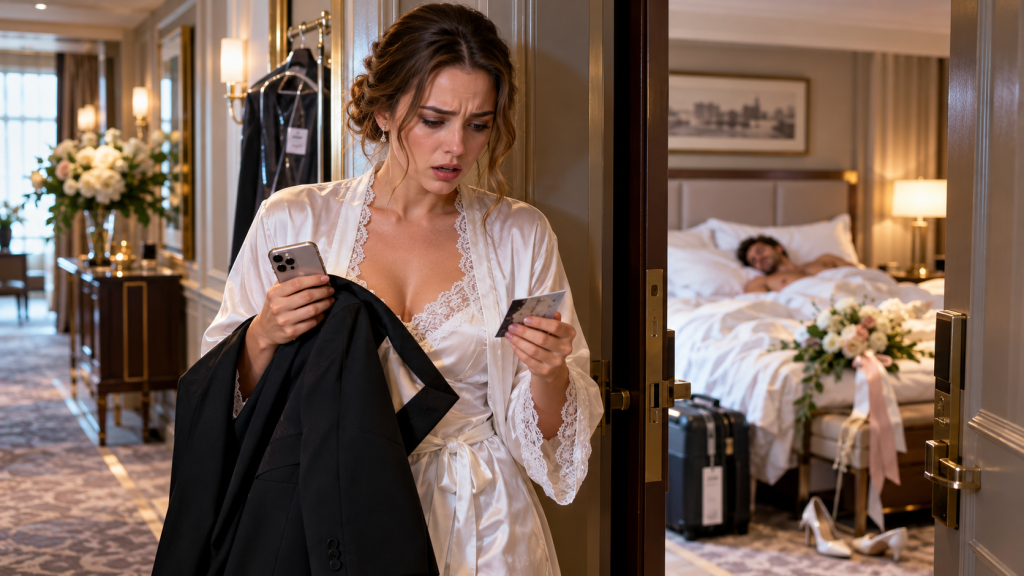
The hotel hallway was impossibly bright.
Morning sunlight spilled through the tall windows at the far end, catching in the polished brass numbers on the doors and making everything look clean, expensive, uncomplicated.
Nothing inside me felt that way.
I looked down at the tiny silver locket lying in my palm.
The engraved words seemed to grow darker the longer I stared at them.
For Daddy — Love, Emma.
Inside was the photograph I had assumed was Callum holding a newborn baby.
A baby he had somehow forgotten to mention during four years of loving me.
A baby whose existence had apparently fit inside one hidden pocket of his wedding tuxedo.
Callum stood barefoot in the doorway of our suite.
His white dress shirt from the night before hung open at the collar.
His hair was a mess.
His wedding ring still looked too new on his hand.
Yesterday, that ring had made me feel safe.
This morning, I could not stop staring at it.
Rebecca’s voice was still in my ear through the phone.
“Callum?”
she said quietly.
He heard her.
His face tightened.
“You called Rebecca.”
“What was I supposed to do?”
He closed his eyes.
Rebecca spoke again.
“I’m going to hang up.”
“No.”
I said.
“Please stay.”
Callum looked at me.
I watched the hurt cross his face.
But I needed one person in that hallway whose memories were not tangled with mine.
Rebecca said:
“I’ll stay.”
Callum nodded once.
Then pointed toward the room.
“Can we go inside?”
I did not move.
“Who is Emma?”
His eyes dropped to the locket.
“My niece.”
“Your dead brother’s daughter?”
“Yes.”
“Is she alive?”
His face collapsed.
That was my answer.
My chest tightened.
“When did she die?”
Callum swallowed.
“The same night Daniel did.”
The hallway seemed to narrow.
I looked again at the photograph.
Suddenly I could see it.
The man holding the baby did resemble Callum.
Almost eerily.
But not exactly.
His nose was slightly broader.
His hair a little longer.
There was a small crease between his eyebrows that Callum did not have.
Daniel.
I had mistaken one brother for another.
Because I had never seen Daniel young enough to recognize him.
The few family photographs Callum had shown me were mostly childhood pictures.
Two boys on bicycles.
Two teenagers on a beach.
Daniel at college graduation, partly hidden behind their father.
Never this.
Never Daniel holding his baby.
I whispered:
“That’s not you.”
Callum shook his head.
“No.”
“Rebecca said you blame yourself.”
His face went white.
I waited.
He looked at the floor.
Then:
“I was driving.”
Everything in me stopped.
Rebecca exhaled through the phone.
“Callum.”
“I know.”
he said.
“It’s time.”
Then he looked at me.
“Please come inside.”
This time I did.
I sat in the chair where his tuxedo had been hanging.
Callum sat on the edge of the bed.
The locket remained in my hand.
Neither of us touched the suit lying half-folded across the carpet.
Our honeymoon luggage stood near the door.
Two suitcases.
Two passports.
A folder with our Costa Rica reservations tucked into the outside pocket.
Yesterday I had believed the most difficult decision awaiting us was whether to spend our first afternoon snorkeling or sleeping beside the hotel pool.
Now I was sitting across from my husband asking him how two members of his family had died.
Rebecca was still on speakerphone.
Callum rubbed both hands over his face.
Then he said:
“Emma was eleven months old.”
I closed my eyes.
Not even one.
He continued.
“Daniel was twenty-seven.”
“How old were you?”
“Twenty-nine.”
Nine years.
Callum was thirty-eight now.
I had met him at thirty-four.
Which meant this had happened five years before I knew him.
He took a breath.
“Daniel wasn’t just my younger brother.”
“He was my best friend.”
I said nothing.
“I know people say that about siblings after they die.”
“He really was.”
“We fought constantly.”
“We insulted each other.”
“He stole my clothes until we were twenty.”
“I broke his nose when we were fourteen.”
Rebecca gave a watery laugh through the phone.
“You did.”
Callum almost smiled.
Then it disappeared.
“Daniel was reckless.”
“I was the responsible one.”
“At least that was the family story.”
I thought of the man I married.
Steady.
Careful.
The one who checked hotel reservations twice.
The one who never drove after having even one drink.
The one who became strangely tense whenever I distracted him while he was behind the wheel.
Suddenly old details began rearranging themselves.
Callum continued.
“Emma’s mother was named Lauren.”
I had never heard that name either.
“Daniel and Lauren weren’t married.”
“They were engaged.”
“They fought a lot after Emma was born.”
“Money.”
“Sleep.”
“Normal things until they stopped being normal.”
I listened.
“Lauren went to her sister’s house for a few weeks.”
“Daniel had Emma that weekend.”
“He called me because he wanted help installing a new car seat.”
Callum laughed softly.
“He could rebuild a motorcycle engine but somehow a car-seat strap defeated him.”
My eyes filled.
I hated that the story already contained ordinary happiness.
Ordinary details make tragedy heavier.
Callum continued.
“I went over.”
“We ordered pizza.”
“Emma had just started standing while holding onto furniture.”
“She kept pulling herself up against the coffee table, then sitting down hard and looking offended.”
Rebecca was crying silently now.
I could hear it.
Callum looked toward my hand.
“The locket was from Lauren.”
“She gave it to Daniel after Emma was born.”
“That picture was taken at the hospital.”
“He wore it under his shirt almost every day.”
My thumb moved across the scratched silver surface.
“What happened?”
Callum’s breathing changed.
Slowly.
Deliberately.
Like a man approaching a place in his mind where the floor had never been repaired.
“It started snowing.”
I frowned.
“You said the accident happened in October.”
“It did.”
“Early storm.”
“Temperature dropped fast.”
“The roads were wet when we left Daniel’s apartment.”
“Then they started icing.”
He paused.
“We were supposed to stay.”
“Rebecca called.”
Their sister spoke quietly through my phone.
“I told them the weather was getting bad.”
Callum closed his eyes.
“Yes.”
“Daniel wanted to drive home anyway.”
“To where?”
“Our parents’ house.”
“They were watching a game.”
“Mom wanted to see Emma.”
“Daniel had been drinking.”
My stomach tightened.
“Was he drunk?”
“No.”
Rebecca answered before Callum could.
“Not drunk.”
“Two beers over several hours.”
Callum looked at the phone.
“He shouldn’t have driven with Emma.”
“So I took his keys.”
I stared at him.
“You drove because he’d been drinking.”
“Yes.”
“You were sober?”
“Completely.”
Then why—
Callum seemed to hear the question.
“The accident wasn’t because I was drunk.”
“I know.”
“Or speeding.”
“What happened?”
He stared at his hands.
“We argued.”
There it was.
Not road conditions.
Not weather.
The thing he had kept hidden was probably smaller.
More human.
Harder to forgive himself for.
“What about?”
“Lauren.”
Callum’s voice shook.
“Daniel thought she was going to leave him.”
“He said everybody was against him.”
“I told him to stop behaving like a victim and start acting like a father.”
Rebecca whispered:
“Callum, you don’t have to—”
“Yes.”
he said sharply.
Then softer:
“I do.”
He looked at me.
“We were maybe twenty minutes from my parents’ house.”
“Emma was in the back.”
“Daniel was beside me.”
“She started crying.”
“Not screaming.”
“Just tired.”
He swallowed.
“Daniel kept turning around trying to reach her.”
“I told him to stop because he was blocking my view.”
“We were still arguing.”
“He said I thought I was better than him.”
“I said…”
Callum stopped.
His face twisted.
“What did you say?”
He stared at the floor.
“I said maybe Lauren and Emma would be safer without him.”
Rebecca began crying harder.
I felt my throat close.
Callum continued.
“Daniel lost it.”
“He grabbed my shoulder.”
“Not violently.”
“Just angry.”
“I told him to get off me.”
“Emma started crying louder.”
“He turned around again.”
“And then she made this sound.”
Callum’s eyes went distant.
“A choking sound.”
“She had one of those little soft crackers.”
“He thought she was choking.”
“He shouted my name.”
“I looked back.”
Everything inside me went still.
“For how long?”
“I don’t know.”
“One second.”
“Two.”
“Maybe less.”
“The car hit ice.”
His voice broke.
“When I looked forward again, the back end had started sliding.”
I could see it without wanting to.
Dark road.
Snow.
Headlights.
An infant crying.
A brother shouting.
Callum continued.
“There was an SUV coming the other way.”
“I corrected.”
“Too hard.”
“The tires caught.”
“We crossed the shoulder.”
“Hit the guardrail.”
He covered his mouth.
I waited.
The next words came almost silently.
“The passenger side took most of it.”
Daniel.
My eyes filled.
“Was he…”
“Yes.”
Callum whispered.
“He died there.”
I looked at the locket.
“And Emma?”
Callum’s entire body folded forward.
For the first time since I had known him, my husband looked smaller than his grief.
“She was alive.”
He sobbed once.
“She was alive.”
Rebecca said his name.
He shook his head.
“I got out somehow.”
“I don’t remember getting out.”
“I remember blood.”
“I remember my left arm not working.”
“I remember trying to open Daniel’s door.”
“It wouldn’t open.”
“Then Emma cried.”
My eyes blurred.
“She was still strapped into the car seat.”
“I climbed through the back.”
“I got her out.”
“The car smelled like antifreeze.”
“I remember that.”
“I still can’t smell it.”
There.
Another detail.
Callum had once asked a mechanic to move our car outside before checking a leak because the smell made him nauseous.
I had teased him.
He had smiled.
Never explained.
“I held her beside the road.”
“She stopped crying.”
“I thought that meant she was okay.”
His voice fractured.
“God, I thought that meant she was okay.”
I covered my mouth.
“The ambulance came.”
“They worked on her.”
“They took us both.”
“She died at the hospital.”
The hotel room became completely silent.
Even Rebecca had stopped making noise.
I looked down at my wedding ring.
Twenty-four hours old.
Then at the locket.
Nine years old.
Two pieces of metal.
One representing a future.
One holding a past my husband had never trusted me enough to enter.
I whispered:
“Were you charged?”
Callum shook his head.
“No.”
“Did police blame you?”
“No.”
“What did they say?”
“Black ice.”
“Loss of control.”
“Daniel’s movement inside the car may have contributed.”
“Poor visibility.”
“The other SUV had crossed slightly toward the center line.”
He rubbed his face.
“There were a dozen factors.”
“But you looked back.”
“Yes.”
I swallowed.
“So you believe if you hadn’t…”
“I could’ve corrected sooner.”
“You don’t know that.”
“No.”
His eyes met mine.
“That’s the problem.”
He did not know.
Which meant he had spent nine years living inside the word maybe.
Maybe Daniel lives if I keep my eyes forward.
Maybe Emma grows up.
Maybe Lauren marries someone else but still sends pictures.
Maybe Rebecca gets to be an aunt.
Maybe his parents do not become quieter every Christmas.
Maybe.
There is no prison more efficient than an unanswerable maybe.
Rebecca finally spoke.
“The police told us the road was unsafe.”
Callum looked toward the phone.
“Rebecca.”
“No.”
she said.
“You’re telling the truth now.”
“So am I.”
She addressed me.
“The highway department had already received reports of icing.”
“There were four accidents along that stretch that night.”
“One of them happened fifteen minutes before Callum’s.”
“He was below the speed limit.”
“He had no alcohol in his system.”
“His phone was in the glove compartment.”
“The investigators never blamed him.”
I listened.
Rebecca continued.
“But Callum heard Daniel shout that Emma was choking.”
“He looked back.”
“And that was enough for him to convict himself.”
Callum stood.
“I was driving.”
Rebecca’s voice sharpened.
“Yes.”
“You were.”
“And you have spent nine years saying those three words as though they mean the same thing as ‘I killed them.’”
Callum went still.
She continued.
“They do not.”
His eyes closed.
I had never heard Rebecca speak to him that way.
Maybe she had.
Maybe many times.
He whispered:
“I should have told her.”
“Yes.”
Rebecca said immediately.
“Before yesterday.”
I looked at the phone.
Rebecca continued.
“I’m sorry.”
“He should have.”
There.
His own sister did not rescue him.
Something in me respected her for that.
I asked the question that had been growing heavier since he began.
“Why didn’t you tell me?”
Callum looked at me.
“I tried.”
My anger surfaced.
“No.”
I shook my head.
“Do not say that.”
“I’m not excusing it.”
“You told me Daniel died in an accident.”
“Yes.”
“You told me you hated driving in winter because of it.”
“Yes.”
“You told me you didn’t like talking about the details.”
“Yes.”
“You never told me there was a baby.”
His eyes filled.
“No.”
“You never told me you were driving.”
“No.”
“You let me spend four years believing your brother died in some crash that happened to him.”
He looked down.
“Yes.”
“You let me stand in front of your entire family yesterday and promise you there would never be hidden rooms between us.”
My voice cracked.
“And Daniel and Emma were literally in your pocket.”
Callum cried.
I hated that he was crying.
Because it made my anger harder to hold.
But I needed my anger.
It was protecting something.
Me.
“I know.”
he whispered.
“Do you?”
“Yes.”
“Then explain it.”
He sat again.
“I was afraid.”
“Of me?”
“No.”
“Of what?”
“Of changing the way you saw me.”
There.
The selfishness beneath shame.
Not cruel selfishness.
Still selfishness.
“You thought I’d blame you.”
“Yes.”
“Did you think I would leave?”
He did not answer immediately.
Then:
“Maybe.”
I laughed once.
Painfully.
“So instead you decided for me.”
His face changed.
“What?”
“You decided what I could handle.”
“You decided what I was allowed to know before marrying you.”
“You decided that the version of you I loved should be edited.”
“I never wanted to deceive you.”
“I believe that.”
He looked surprised.
I continued.
“But intent doesn’t change what happened.”
His shoulders dropped.
“No.”
“I would have married you knowing this.”
That broke him.
His face collapsed.
I started crying too.
“I would have married you.”
“Do you understand?”
He nodded frantically.
“I know.”
“No.”
“You didn’t know.”
“That’s why you hid it.”
He covered his face.
“You thought you had to be the steady man.”
“The safe man.”
“The man with no secrets.”
“You thought if I knew you had one night in your past that still terrified you, I’d love you differently.”
Callum whispered:
“Yes.”
I looked at the locket.
“I might have.”
His head lifted.
“Differently isn’t the same as less.”
Silence.
That was the tragedy.
He had protected himself from an imagined rejection and created a real wound instead.
We missed our flight to Costa Rica.
Neither of us cared.
At eleven that morning, while newlyweds from the ballroom probably uploaded photographs and opened gifts, I called the airline.
Postponed what could be postponed.
Lost money on what could not.
Callum sat silently by the window.
He offered to make the calls.
I said no.
Not angrily.
I needed a task.
Something with confirmation numbers and rules.
Grief, betrayal, and marriage had none.
When I finished, Callum said:
“I’ll leave.”
I looked at him.
“Where?”
“Rebecca’s.”
“You don’t have to decide anything today.”
His voice was careful.
“You’re saying that like I’m divorcing you.”
He swallowed.
“Are you?”
I stared at my husband.
Twenty-four hours.
The shortest marriage in the world, if I wanted it to be.
But I did not know what I wanted.
That was the point.
“I don’t know.”
His face went pale.
I added:
“And you are going to let me not know.”
He nodded.
“Yes.”
No argument.
No promise.
Good.
I pointed toward the locket.
“Take it.”
He looked at my hand.
“You don’t want—”
“It isn’t mine.”
He stood.
Slowly.
I held it out.
Instead of taking it immediately, Callum stared at the inscription.
Then whispered:
“I carried it yesterday because Daniel was supposed to be my best man.”
My anger paused.
“What?”
“He would’ve been.”
His eyes filled.
“And Emma would’ve been ten.”
“Nine?”
“Ten next month.”
He smiled through tears.
“She probably would’ve hated whatever dress we put her in.”
Rebecca laughed softly through the phone.
“Absolutely.”
Callum continued.
“I wanted them there.”
“So I put the locket in my pocket.”
“And still didn’t tell me.”
“No.”
That contradiction contained the whole problem.
He was ready to carry the dead into our wedding.
Not ready to introduce them to his wife.
I placed the locket into his palm.
“Callum.”
“Yes?”
“You don’t get to turn your shame into a private religion anymore.”
He stared.
“If we stay married, this cannot remain something everyone tiptoes around because you hurt.”
His fingers closed around the locket.
“I know.”
“No.”
I said.
“You’re going to have to learn.”
Rebecca arrived three hours later.
She lived only an hour away.
The moment she entered the suite, she hugged me.
Not Callum.
Me.
“I’m sorry.”
I cried against her shoulder.
Then pulled back.
“For what?”
“For letting myself assume he’d told you.”
I stared at her.
She looked ashamed.
“Did everyone think I knew?”
“Not at first.”
“What does that mean?”
Rebecca glanced toward Callum.
He stood near the window.
She continued.
“When you started dating, I asked him when he was going to tell you.”
“He said when it was serious.”
“Then you moved in together.”
“I asked again.”
“He said he was working up to it.”
My chest tightened.
“And when we got engaged?”
Rebecca closed her eyes.
“I asked again.”
I looked at Callum.
He did not defend himself.
Good.
Rebecca continued.
“He told me you knew Daniel died in an accident and that he’d eventually tell you the rest.”
“Eventually.”
The word tasted bitter.
“Then yesterday?”
Rebecca looked down.
“I saw the locket chain for a second when he was getting ready.”
“I thought…”
She swallowed.
“I thought that meant he finally had.”
I sat.
The betrayal widened slightly.
Not because Rebecca had lied.
Because Callum had been given chances.
Several.
He had chosen silence each time.
Trauma explained the first year.
Maybe the second.
By our engagement, silence had become a decision.
I looked at him.
“Why didn’t you tell me before the wedding?”
He whispered:
“Because every day I waited made it harder.”
That was honest.
“And yesterday?”
“I told myself after.”
I laughed bitterly.
“After the wedding?”
“Yes.”
“On the honeymoon?”
“Yes.”
“You were going to tell me in Costa Rica?”
“I don’t know.”
“Callum.”
“I thought I would.”
That answer hurt more than a lie.
Because I believed he believed it.
People often postpone difficult truths by pretending the next version of themselves will be braver.
Rebecca spent the afternoon filling in what Callum could not.
After the accident, Callum had been hospitalized for nine days.
Broken collarbone.
Three fractured ribs.
Deep cuts.
Concussion.
But the injuries healed faster than the guilt.
Daniel was buried on a Thursday.
Emma on the same day.
Two caskets.
One full-sized.
One horrifyingly small.
Callum did not attend the burial at first.
He sat in a car outside the cemetery until Rebecca climbed in and dragged him out.
“He kept saying Lauren would kill him.”
Rebecca told me.
“Did she?”
“No.”
“What did she say?”
Rebecca’s face changed.
“She hugged him.”
That surprised me.
“Lauren?”
“Yes.”
“Emma’s mother.”
Rebecca nodded.
“She came straight from the hospital after identifying Emma’s things.”
“She walked up to Callum.”
“He could barely stand.”
“And she hugged him.”
I looked at Callum.
His eyes were closed.
Rebecca continued.
“She said, ‘You loved her too.’”
Callum stood suddenly.
“I need air.”
He left the suite.
I almost followed.
Stopped.
Rebecca watched him go.
“He has never forgiven Lauren for forgiving him.”
That sentence settled in me.
Some people need punishment because mercy leaves them alone with themselves.
“What happened to Lauren?”
“She moved to Oregon a year later.”
“Does Callum speak to her?”
“Not anymore.”
“Why?”
“She got married.”
“Had another child.”
“Callum decided his presence kept reopening everything.”
“Did she ask him to leave her alone?”
“No.”
I closed my eyes.
Pattern.
He made decisions for other people when he was afraid of what their choices might mean.
Not controlling in everyday life.
The opposite.
He withdrew.
Edited himself.
Removed his pain before anyone could reject it.
Rebecca sighed.
“He did therapy.”
“For years?”
“About eighteen months.”
“Then stopped.”
“Why?”
“Because he got functional.”
I looked at her.
“That’s not the same as better.”
“I know.”
“So does he.”
“Now.”
That evening, I went home alone.
Not to our shared apartment.
To my sister’s house.
Callum stayed with Rebecca.
Our wedding gifts remained stacked unopened in the living room.
Flowers from the reception arrived while I was gone.
White roses.
A card from one of my aunts:
May your first days of marriage be filled with beautiful surprises.
I laughed until it turned into crying.
My sister did not ask me to explain much.
She made tea.
Put sheets on the guest bed.
Told everyone else I was sick.
Technically true.
Before sleeping, I removed my wedding ring.
I stared at it.
Then put it back on.
Not because I had forgiven Callum.
Because I was still married.
I refused to make a lifetime decision at 1:00 a.m. because my nervous system wanted certainty.
The next morning, I texted him.
I need time. Do not come over unless I ask.
His reply came immediately.
Okay. I love you. I’ll wait until you contact me.
No:
Please.
No:
Let me explain.
No:
You’re overreacting.
Good.
That mattered.
For the next week, Callum did exactly what I asked.
Nothing.
It sounds small.
It wasn’t.
He did not send flowers.
Did not recruit Rebecca.
Did not send long messages.
Did not appear at my work.
Every morning, one text:
I’m here when you’re ready.
Nothing more.
On the fifth day, I answered:
I need the whole truth. Not only the accident. Everything you have avoided telling me because you thought it might change how I see you. Write it down first. Then we talk.
He replied:
Okay.
Three days later, he sent me a document.
Twenty-six pages.
I almost threw my phone.
Twenty-six?
Apparently marriage to Callum came with supplemental disclosures.
I printed it.
Read slowly.
There were no affairs.
No secret debt.
No hidden child.
No criminal history.
No second identity.
Just pain.
Daniel and Emma.
The panic attacks afterward.
The nightmares.
The first year when Callum drank too much, though never drove after drinking.
A therapist named Dr. Shah.
Antidepressants for fourteen months.
A period when Callum slept on Rebecca’s sofa because he could not sleep alone.
The fact that he had once gone to the bridge where the accident occurred at two in the morning and stood there for several hours thinking about whether he wanted to live.
That line stopped me.
Not an attempt.
Not a plan he acted on.
Still frightening.
He wrote that Rebecca found him because he called her.
He entered therapy the next morning.
He also wrote about Lauren.
They spoke for two years after the accident.
Once a month.
Then less.
When she became pregnant with her second child, Callum congratulated her and stopped answering.
She sent him one final email:
You surviving was not another thing the accident took from me. Stop acting like it was.
I cried reading that.
At the bottom of his document, Callum wrote:
I have spent nine years making silence sound like protection. It protected me from shame and forced everyone who loved me to live around a locked room they were not allowed to name. You deserved to know before you chose me. I am sorry I took that choice from you.
That was the first apology that reached the actual wound.
Not:
I’m sorry you found out badly.
Not:
I’m sorry I was traumatized.
I took the choice from you.
Yes.
He had.
We met at a park.
Neutral ground.
No hotel room.
No wedding photographs.
Just a bench near a pond.
Callum looked thinner after one week.
I hated noticing.
He sat several feet from me.
Did not reach for my hand.
“Thank you for reading it.”
“I have questions.”
“I’ll answer.”
“Even if they hurt?”
“Yes.”
“Why did you tell me your parents became distant after Daniel died but never mention Emma?”
He looked down.
“Because saying her name makes the accident real in a different way.”
“That isn’t an answer.”
He nodded.
“You’re right.”
Then:
“Because Daniel was an adult.”
“When I said my brother died, people looked sad.”
“When I said a baby died…”
His face tightened.
“People looked at me differently.”
“How?”
“Like they were imagining it.”
“I couldn’t handle watching them imagine her.”
I breathed.
“Why did you let me believe the photograph of Daniel on your parents’ mantel was just your brother?”
“It was.”
“You know what I mean.”
“Yes.”
He rubbed his hands together.
“I compartmentalized.”
“I told myself Emma belonged to the accident, not to my current life.”
“She was family.”
“I know.”
“Was?”
He looked at me.
“Is.”
Better.
“Why did you keep the locket?”
His eyes softened.
“Because Daniel wore it.”
“And because if I gave it to Lauren, I would have nothing that belonged to both of them.”
“Did Lauren know you kept it?”
“Yes.”
“She gave it back to me after the funeral.”
I frowned.
“It was recovered from Daniel’s jacket?”
“Yes.”
“Then she had it?”
“For three days.”
“She brought it to my hospital room.”
“What did she say?”
Callum’s mouth trembled.
“Keep them with you.”
My eyes filled.
There was no way to stay angry cleanly around that.
I hated that.
But truth does not organize itself for emotional convenience.
I asked:
“Why yesterday?”
“The wedding?”
“Yes.”
“Why bring it if you were so committed to hiding this?”
Callum stared at the pond.
“Because Daniel should’ve been there.”
“Emma should’ve been there.”
“And because I was happy.”
I frowned.
He continued.
“Really happy.”
“More than I thought I deserved to be.”
There.
Guilt again.
“So you punished yourself.”
“Probably.”
“You put grief in your pocket so you could feel guilty during our wedding?”
His eyes filled.
“When you say it like that…”
“How else should I say it?”
He shook his head.
“No.”
“You’re right.”
We sat quietly.
Then I asked the question that mattered most.
“Can you promise you’ll never hide something important from me again?”
Callum looked at me.
For several seconds he said nothing.
Then:
“No.”
That shocked me.
“What?”
“I can promise I will work not to.”
“I can promise if I realize I’m hiding because I’m ashamed or afraid, I will tell you.”
“I can promise I’ll go back to therapy.”
“I can promise I won’t use trauma as a reason you don’t get information that affects your choice.”
“But if I promise I will never be afraid enough to hide anything again…”
He swallowed.
“That would just be another lie designed to make you feel safe.”
I stared at him.
Then, for the first time in nine days, I almost smiled.
“That was annoyingly healthy.”
“Rebecca helped.”
“Of course.”
A tiny laugh escaped me.
Then disappeared.
I said:
“I’m not ready to come home.”
His face tightened.
“Okay.”
“I’m not ending the marriage today either.”
He breathed out.
Not relief exactly.
Permission to continue.
“Okay.”
“We postpone the honeymoon.”
“Yes.”
“We find a couples therapist.”
“Yes.”
“You go back to individual therapy.”
“I already scheduled an appointment.”
“Good.”
“And…”
I hesitated.
“I want to meet Daniel.”
Callum went completely still.
“What?”
“Not him.”
I corrected myself.
“I want to see where he and Emma are buried.”
Callum looked away.
“I don’t know if I can.”
There it was.
I nodded.
“Then we have another problem.”
His eyes returned to mine.
“You carried them into our wedding.”
“If we are going to stay married, I am not going to be married to a grief you insist on hiding from me.”
Callum cried.
Then whispered:
“Okay.”
The cemetery was four days later.
Gray sky.
Cold wind.
Callum drove.
I noticed how tightly he held the steering wheel.
At one point, a truck changed lanes in front of us.
Callum’s breathing stopped.
Only for a second.
Then resumed.
I saw it now.
What I had once called carefulness had edges.
At the cemetery, Rebecca waited near the entrance.
I had not known she was coming.
Callum looked relieved.
Good.
He did not have to prove strength by doing pain alone.
We walked together.
Daniel’s stone was simple.
DANIEL JAMES MERCER
Dates.
BELOVED SON, BROTHER, FATHER.
Beside it was a smaller stone.
Emma’s.
I stopped walking.
I had known.
Still.
Knowing and seeing are different countries.
EMMA ROSE MERCER
Eleven months between two dates.
Below:
OUR LITTLE LIGHT
I cried immediately.
No restraint.
No attempt at dignity.
Callum stood several feet behind me.
As if he did not have permission to approach.
I turned.
“Come here.”
He shook his head.
“I usually stand back.”
“Why?”
He looked at the stones.
“I don’t know.”
“Yes, you do.”
His mouth trembled.
“Because I’m the reason they’re here.”
Rebecca whispered:
“Callum.”
I turned toward him.
“No.”
He looked at me.
“I am not going to tell you how to grieve.”
“But I’m also not going to participate in a sentence no court, no investigator, no family member, and not even Emma’s mother gave you.”
His eyes filled.
“You looked backward.”
“Yes.”
“You lost control.”
“Yes.”
“Two people died.”
“Yes.”
“That is horrible.”
He nodded.
“It is not the same as choosing their deaths.”
His face collapsed.
Rebecca started crying too.
I stepped beside Emma’s grave.
“The accident already took them.”
I said.
“You do not get to keep giving it more people.”
Callum stared.
“What does that mean?”
“You.”
My voice broke.
“It took you too.”
“Not your body.”
“But every year you have made yourself pay.”
“You stopped speaking to Lauren.”
“You stopped saying Emma’s name.”
“You lied to me because some part of you still believes happiness is evidence you forgot them.”
Callum covered his face.
“That isn’t remembrance.”
“That is self-punishment.”
He sobbed.
Then finally walked toward the graves.
He knelt.
Touched Daniel’s stone first.
Then Emma’s.
And said her name.
“Emma.”
One word.
Nine years late.
Maybe he had said it privately.
But Rebecca reacted as though it had been years since she heard him say it here.
He whispered:
“I’m sorry.”
Wind moved through the trees.
No answer.
Of course.
Then Callum reached into his coat.
The silver locket.
He placed it on Emma’s stone.
My heart tightened.
He stared.
Then shook his head.
“No.”
He picked it up again.
Rebecca smiled through tears.
Callum looked at us.
“I thought I should leave it.”
I asked:
“Do you want to?”
“No.”
“Then don’t.”
He closed his hand around it.
For the first time, keeping it did not feel like secrecy.
It felt like love.
That difference mattered.
Couples therapy was less dramatic than the cemetery.
Mostly chairs.
Tissues.
Questions I sometimes hated.
Our therapist, Maya Collins, asked me:
“What would rebuilding trust look like?”
I said:
“Knowing everything.”
She shook her head.
That irritated me.
“What?”
“You can never know everything about another person.”
I crossed my arms.
“That sounds convenient for him.”
Callum flinched.
Maya remained calm.
“Trust is not omniscience.”
“It is confidence that important truths will not be deliberately withheld.”
I hated that sentence because it was better than mine.
She looked at Callum.
“What did secrecy do for you?”
He answered:
“It controlled how she saw me.”
There.
Good.
Maya nodded.
“So the problem was not simply that you had private grief.”
“It was that you manipulated the information available to your partner because you feared her decision.”
Callum swallowed.
“Yes.”
I looked at him.
That was harder than calling himself a liar.
More accurate too.
Then Maya asked me:
“What are you afraid happens if you forgive him?”
I answered immediately.
“That I teach him this was survivable.”
Callum closed his eyes.
Interesting.
I continued.
“If I return home.”
“If we go on the honeymoon.”
“If I act loving again.”
“What stops him from learning that silence only hurts temporarily?”
Maya nodded.
“Good question.”
Then she looked at Callum.
He said:
“Nothing except me.”
I stared.
He continued.
“She cannot punish me into honesty.”
“She can leave if I’m dishonest.”
“She can set boundaries.”
“But if I only tell the truth because I’m afraid she’ll leave, I’m still letting fear decide.”
Maya smiled slightly.
I did not.
Not yet.
Still, something in me softened.
I moved home after six weeks.
Not because the wound disappeared.
Because Callum’s behavior changed in boring, consistent ways.
Boring is underrated.
He went to therapy.
Twice a week at first.
He gave me space without making his loneliness my responsibility.
He told his parents I knew everything.
That mattered.
His mother called me crying.
“I am so sorry.”
“Did you know he hadn’t told me?”
Silence.
Then:
“Yes.”
Another wound.
Smaller.
Still real.
“Why didn’t anyone tell me?”
She cried.
“Because it was his story.”
I understood that.
Mostly.
Then she said:
“And because after what happened, we all got used to protecting him.”
There.
Families build habits around the most wounded person.
Sometimes those habits become cages.
I told her:
“I’m not angry that you didn’t tell me the details.”
“I am angry everyone watched him marry me while knowing I didn’t know something he should have told me.”
She accepted that.
No defense.
Good.
Callum also called Lauren.
I did not ask him to.
He told me afterward.
“I thought you should know.”
“What did she say?”
He smiled sadly.
“First she asked if I was finally in therapy again.”
I laughed.
“Then?”
“She said congratulations on the wedding.”
My heart tightened.
“She knew?”
“Rebecca sent her a photo.”
“Oh.”
Then:
“I apologized for disappearing.”
“What did Lauren say?”
Callum looked down.
“She said, ‘I thought you would come back when you stopped needing me to hate you.’”
I closed my eyes.
Lauren seemed annoyingly wise.
“Did she hate you?”
“No.”
“Ever?”
“She said she hated what happened.”
“She hated the road.”
“The weather.”
“Daniel for not staying home.”
“Me for looking back sometimes.”
“Herself for fighting with Daniel that week.”
“Everything.”
Callum swallowed.
“But she said she never believed I wanted them hurt.”
“And now?”
“She has two sons.”
“She’s okay.”
“Not untouched.”
“Okay.”
That distinction mattered.
Callum asked if I wanted to speak with her someday.
I said:
“Not yet.”
Choice.
He nodded.
No pressure.
Three months after our wedding, we opened the gifts.
Yes.
Three months.
Our dining room had become an accidental storage unit for other people’s optimism.
We sat on the floor.
Toaster.
Wine glasses.
Towels.
A hideous decorative bowl from my cousin.
Then a package from Rebecca.
Inside was a wooden frame.
No photograph.
Just an empty space.
A note:
For whatever memory you decide belongs here.
Callum looked at me.
I knew immediately.
“The locket?”
He shook his head.
“Maybe a picture.”
A week later, he asked his mother for one.
Not of the accident.
Not of grief.
Daniel sitting on a sofa holding baby Emma while she tried to eat his thumb.
Callum beside them laughing.
Three people.
Alive.
The photograph went on a shelf in our living room.
Not hidden.
Not made into a shrine.
Just family.
When friends asked, Callum answered.
“That’s my brother Daniel and my niece Emma.”
Sometimes they asked what happened.
Sometimes they did not.
When they did, he said:
“They died in a car accident I survived.”
The first time I heard him say it, my chest tightened.
No:
I killed them.
No edited history.
A full sentence.
Our honeymoon happened nine months late.
Costa Rica.
Different reservations.
Same passports.
We nearly canceled again because Callum was nervous about driving from San José to the coast.
Before, he would have said:
“I just don’t feel like renting a car.”
This time:
“Mountain roads still trigger me.”
I smiled.
“Then we hire a driver.”
He stared.
“That simple?”
“Yes.”
He laughed.
Apparently honesty often is.
We stayed near the ocean.
Swam.
Read.
Argued once about sunscreen.
Normal marriage.
One evening, while sitting near the beach, Callum gave me a small box.
My stomach tightened.
He noticed immediately.
“Oh God.”
“What?”
“Bad choice.”
I laughed despite myself.
“What is it?”
“Open it.”
Inside was not jewelry.
A key.
I frowned.
“To what?”
“Our apartment.”
“I already have one.”
“I changed the lock.”
My face changed.
“Why?”
“Not because of anything dramatic.”
He smiled.
“The old one stuck.”
Then he became serious.
“The locksmith gave me new keys yesterday.”
“I realized I could have just added yours to your key ring.”
“But I wanted to hand it to you.”
I stared.
“Why?”
“Because last year I thought commitment meant making sure you saw only the parts of me I believed were safe.”
He swallowed.
“Now I think it means giving you access without deciding in advance what you’ll do once you’re inside.”
My eyes filled.
“That was disgustingly romantic.”
“I practiced.”
“Obviously.”
I took the key.
Then:
“Callum.”
“Yes?”
“Do not make every household maintenance event into a trauma metaphor.”
He laughed so loudly people turned.
That sound was worth the postponed honeymoon.
A year after the wedding, we visited Daniel and Emma’s graves together again.
No Rebecca this time.
Callum carried flowers.
I carried nothing.
At Emma’s stone, he sat on the grass.
“I had a dream about her.”
I looked at him.
“Bad?”
“No.”
That surprised him too.
“She was ten.”
“Even though I don’t know what she would’ve looked like.”
He smiled.
“She had Daniel’s eyebrows.”
“Poor child.”
He laughed.
Then:
“She was angry because I wouldn’t let her have ice cream for breakfast.”
My eyes filled.
“That sounds serious.”
“Very.”
We sat.
Then Callum said:
“I used to think if I stopped having nightmares, I was letting them go.”
“What do you think now?”
“That my brain has terrible writing.”
I laughed.
Then he became quiet.
“I think memories can change without disappearing.”
Yes.
That was true of marriage too.
The morning I found the locket did not disappear.
It changed.
First betrayal.
Then explanation.
Then boundary.
Then eventually part of our history.
Still painful.
Not controlling everything around it.
Lauren came to visit two years later.
Her husband came too.
So did their boys.
I was nervous.
Ridiculously.
What do you serve the mother of the child whose death shaped your husband?
Apparently pasta.
Lauren was not fragile.
Not saintly.
Not endlessly wise.
She complained about traffic within five minutes.
I liked her immediately.
At one point, she asked to see the locket.
Callum brought it from the bedroom.
Not a safe.
Not a secret pocket.
A small memory box where we kept photographs and letters.
Lauren held it.
Her face changed.
“She scratched this.”
“What?”
Callum leaned closer.
Lauren pointed to a tiny mark.
“Emma used to grab it when Daniel held her.”
Callum stared.
“I thought the crash did that.”
“No.”
Lauren smiled through tears.
“She did.”
One scratch.
Suddenly the object was no longer only connected to death.
It had been touched by a living baby.
That mattered.
Lauren returned it to Callum.
“Keep it.”
He nodded.
This time he could receive the gift without treating it like a sentence.
Later that night, Lauren and I sat outside alone.
She asked:
“Were you angry?”
“At Callum?”
“Yes.”
“Very.”
She nodded.
“Good.”
That surprised me.
“Good?”
“He needed somebody to be angry about the secrecy.”
I stared.
She continued.
“Everyone else was too afraid anger would break him.”
“So we all forgave things he hadn’t apologized for.”
That sounded familiar.
I asked:
“Were you angry about the accident?”
“Yes.”
She said it immediately.
“At him?”
“Yes.”
“And Daniel.”
“And myself.”
“And weather.”
“And physics.”
“And God.”
“Whatever was available.”
She smiled sadly.
“Grief isn’t fair.”
Then:
“But anger and blame aren’t the same.”
I thought about that.
She continued.
“Callum could survive my anger.”
“He thought he needed me to absolve him.”
“I couldn’t.”
“I was too busy surviving.”
“So when I didn’t blame him, he turned that into another reason to blame himself.”
I looked through the window.
Callum was inside playing cards with Lauren’s oldest son.
Laughing.
Lauren whispered:
“I’m glad he married someone who makes him finish sentences.”
I smiled.
“So am I.”
Our marriage was not magically perfect afterward.
That would have insulted what happened.
Trust recovered in layers.
For a while, every unfamiliar object made me tense.
A receipt in his coat.
A name I did not recognize on his phone.
A locked drawer.
Callum never called me paranoid.
He answered.
Once, six months after the wedding, I asked:
“Who is Melissa?”
He blinked.
“My dentist.”
“Oh.”
“Want to see the appointment reminder?”
“No.”
Then I cried.
Not because of Melissa.
Because I hated needing to ask.
Callum sat beside me.
Did not say:
You should trust me.
He said:
“I know why your brain went there.”
That helped.
Another time, Callum found an old photograph of me with an ex-boyfriend.
He asked who it was.
I answered.
Then realized something.
Honesty did not always require confession before discovery.
People have pasts.
Privacy.
Forgotten boxes.
The difference was whether the information changed the reality of the relationship.
That distinction healed something in me too.
I had become so frightened of secrecy that I almost demanded total transparency as proof of safety.
That would have become its own kind of control.
Maya, our therapist, warned me.
“Trust needs boundaries too.”
I rolled my eyes.
Then wrote it down.
On our third anniversary, Rebecca gave us a framed copy of a photograph from our wedding.
Callum and me dancing.
His head bent toward mine.
My face laughing.
If you look closely, you can see the outline of something small beneath the inside pocket of his tuxedo.
The locket.
I stared at it.
Once, that detail would have ruined the picture.
Now it made me sad.
And tender.
And angry at the version of Callum who thought love required hiding.
All at once.
I hung the photograph.
Not because everything had become fine.
Because marriage had become large enough to hold contradiction.
Callum eventually spoke publicly about the accident.
Not on social media.
Not dramatically.
At a support group for people involved in fatal crashes.
His therapist suggested it.
He resisted for months.
Then went.
The first evening, he came home pale.
“How was it?”
“Awful.”
“Going back?”
“Yes.”
Good.
Months later, the group asked him to speak to new members.
He told them:
“There is a difference between responsibility and omnipotence.”
I asked what that meant when he came home.
He said:
“For years I thought if I blamed myself enough, I could pretend I had once possessed the power to prevent everything.”
I stared.
That was profound.
“Did Dr. Shah say that?”
“Yes.”
“Thought so.”
He laughed.
Then explained.
Guilt had given him an illusion of control.
If the accident was entirely his fault, then the world was not random.
If one look backward caused everything, then the universe still had rules.
Keep your eyes forward and people live.
Life is more frightening than that.
Sometimes several ordinary decisions collide with ice, physics, timing, and chance.
That did not mean Callum had no responsibility.
He looked away from the road.
It meant responsibility was not the same as total authorship.
He spent years learning the difference.
So did I.
His parents changed too.
They had turned Daniel and Emma into a sealed room after the funeral.
No photographs downstairs.
No birthday mentions.
No Christmas stories.
They said they were protecting Callum.
Really, everyone was protecting everyone until nobody could breathe.
After our wedding, something broke open.
Callum’s mother put Daniel’s college photograph back on the mantel.
His father told a story about Emma throwing peas at Thanksgiving.
Rebecca brought videos.
We watched one where Emma crawled directly through a pile of folded laundry while Daniel pretended to be offended.
Callum laughed so hard he cried.
For years, memory had meant the accident.
Now memory widened.
Birth.
Laundry.
Pizza.
Car-seat straps.
Peas.
A baby grabbing a silver locket.
Death remained.
It stopped owning every scene before it.
When our first child was born, Callum almost unraveled.
Yes.
We had children.
That surprised us both.
Our daughter, Maeve, arrived four years after the wedding.
The first time the nurse placed her on Callum’s chest, he went completely still.
I knew before he spoke.
Emma.
The hospital.
A newborn.
His brother.
The photograph.
I touched his arm.
“Stay here.”
He looked at me.
“What?”
“Stay in this room.”
His eyes filled.
“I’m trying.”
Maeve made a tiny sound.
Callum started sobbing.
The nurse looked worried.
I shook my head.
“He’s okay.”
Was he?
Not entirely.
Still.
He held our daughter.
He did not run.
That mattered.
Later, when Maeve was eleven months old, Callum became anxious.
Of course.
Same age.
For weeks, he checked the car seat three times.
Avoided night driving.
Watched her sleep.
Finally I said:
“You’re counting.”
He pretended not to understand.
“What?”
“Eleven months.”
His face collapsed.
“Yes.”
We called his therapist.
Not dramatic.
Practical.
He got through that month.
Then Maeve turned one.
At her birthday, Callum took the locket from the memory box.
He placed it beside Emma’s photograph for a moment.
Then whispered:
“You should have had this.”
A first birthday.
Then he came downstairs and blew bubbles with our daughter until she screamed laughing.
Grief and joy.
Same house.
No locked rooms.
Years later, Maeve asked about the photograph.
“Who’s the baby?”
Callum froze.
Only for a second.
Then:
“That’s your cousin Emma.”
“Where is she?”
He looked at me.
I said nothing.
His story.
His responsibility.
“She died when she was little.”
Maeve frowned.
“Why?”
“There was a car accident.”
“Were you there?”
Callum breathed.
“Yes.”
“I was driving.”
My chest tightened.
No editing.
No burdening a child with details either.
Maeve asked:
“Were you sad?”
“Very.”
She climbed into his lap.
“Are you still sad?”
“Sometimes.”
She considered.
“Me too.”
Callum smiled.
“You didn’t know her.”
“I’m sad because you’re sad.”
He held her.
Then looked at me over her head.
That moment alone was worth every miserable hour of therapy.
The truth had become something he could hold without passing its full weight to a child.
We had a son two years later.
Daniel.
Not his first name.
His middle name.
Our son was Lucas Daniel.
Callum asked me before we decided.
Actually asked.
“Would that feel like too much?”
“No.”
“What if my family thinks—”
“Callum.”
He stopped.
“What do you want?”
He cried.
“I want Daniel’s name somewhere life continues.”
So we did.
Not replacing.
Remembering.
When Rebecca heard, she hung up the phone because she was crying too hard to speak.
Callum’s mother sent us a blanket.
Lauren mailed a card.
Inside:
Daniel would have bragged about this for the rest of his life.
Probably.
Our honeymoon story became family comedy eventually.
Not the locket.
The canceled Costa Rica trip.
People knew we postponed because of a “family matter.”
Years later, Maeve found the old airline cancellation email.
“Why didn’t you go?”
I looked at Callum.
He looked at me.
Then answered:
“Because Dad needed to tell Mom something important.”
Maeve, fourteen by then, raised an eyebrow.
“Before or after you married her?”
Callum winced.
“After.”
She looked scandalized.
“Dad.”
“I know.”
“What was it?”
Callum asked:
“Do you want the short version or real version?”
“Real.”
So we told her.
Age appropriately.
More than before.
She listened.
Then looked at him.
“You seriously never told Mom you were driving?”
“No.”
“For four years?”
“No.”
She stared.
“You’re lucky she stayed.”
Callum looked at me.
“Extremely.”
I said:
“Correct answer.”
Maeve rolled her eyes.
Teenagers.
Then she asked:
“Was Mom mad?”
I laughed.
“For months.”
“Good.”
Callum sighed.
“Family loyalty is dead.”
“No.”
I said.
“This is family loyalty.”
He smiled.
He understood.
Our children grew up knowing Daniel and Emma existed.
Not as ghosts.
Family.
There was a photograph.
A grave we visited sometimes.
Stories.
Emma liked bananas.
Daniel hated olives.
Daniel once wore two different shoes to a job interview because he was late.
Emma laughed whenever somebody sneezed.
Ordinary details.
That became Callum’s greatest healing.
He had once believed remembering meant returning to the crash.
Instead, he learned to remember lives.
Not only deaths.
Rebecca married late.
At her wedding, Callum stood beside her.
Before the ceremony, he carried the locket in his pocket again.
This time he told me.
“Taking it.”
I smiled.
“I know.”
“How?”
“You put it on the dresser.”
He laughed.
“No secret pockets.”
“No secret pockets.”
Not a rule.
A joke.
Earned.
During the reception, Rebecca toasted Daniel.
Then Emma.
Callum cried openly.
Nobody rushed to stop him.
Nobody changed the subject.
Nobody acted as though tears meant danger.
That might sound small.
It was not.
For years, his family had treated grief as a sleeping animal they should never wake.
Turns out it was awake the whole time.
Naming it simply stopped everyone pretending otherwise.
On the tenth anniversary of Daniel and Emma’s deaths, Callum did something I never expected.
He drove the road.
With me.
Not at night.
Not in snow.
Daylight.
Clear weather.
Therapist-approved.
I thought he was insane.
He said:
“Possibly.”
We reached the stretch.
The guardrail had been replaced years earlier.
No marker.
Traffic moved normally.
Callum pulled into a safe turnout farther down.
We got out.
He stared toward the road.
“This is it.”
I held his hand.
He shook.
Then:
“It looks so ordinary.”
Of course.
The places where life breaks rarely agree to look permanently broken.
He stood for ten minutes.
Then twenty.
Finally:
“I thought I’d feel Daniel here.”
“Do you?”
“No.”
He smiled sadly.
“I feel traffic.”
Good.
Maybe that was the point.
He had turned one patch of road into a shrine inside his mind.
Reality gave it back to the world.
Cars.
Pavement.
Wind.
Nothing more.
We drove home.
Callum slept for eleven hours.
The next morning, he said:
“I don’t need to go back.”
He never did.
Years after that first morning, I took Callum’s suit to the dry cleaner.
Different suit.
Different event.
Our daughter’s graduation.
I checked the pockets out of habit.
Receipts.
A mint.
The locket.
I smiled.
Callum walked into the room.
“What?”
I held it up.
He froze for half a second.
Old reflex.
Then smiled.
“Forgot that.”
“You carried it yesterday?”
“Yes.”
“You didn’t tell me.”
He looked concerned.
Then realized I was teasing.
“Does this count as a secret pocket?”
“No.”
I handed it to him.
“Because I know what it means.”
That was the difference.
Not that marriage required him to announce every object.
The hidden meaning was gone.
No locked room.
He kissed my forehead.
“Thank you.”
“For what?”
“For letting them belong in my life without making me feel like they compete with it.”
I looked at him.
“You were the one who thought they competed.”
He nodded.
“I know.”
Growth.
We eventually stopped couples therapy.
Maya said we were ready.
I accused her of firing us.
She said:
“I prefer graduating.”
Callum asked:
“Do we get a certificate?”
She said no.
Terrible service.
At our final session, Maya asked:
“What did each of you learn?”
Callum answered first.
“That telling the truth after discovery is not the same as honesty.”
Ouch.
Accurate.
Then:
“And that shame makes secrets feel protective when they’re really isolating.”
Maya looked at me.
I thought.
“That trust is not knowing everything.”
She smiled.
I rolled my eyes.
“I know.”
Then:
“It is believing the other person won’t decide what truth I’m allowed to handle.”
Callum looked at me.
His eyes filled.
Yes.
That was it.
We stayed married.
Not because the secret was acceptable.
Not because trauma erased responsibility.
Not because love means forgiving everything immediately.
We stayed married because once the truth was found, Callum stopped protecting the lie.
He did not ask me to minimize it.
He did not say:
I had no choice.
He did not call my hurt unfair.
He did not turn his suffering into a trump card.
He went back into the room he had locked for nine years and invited me inside.
Then he let me decide whether I wanted to remain.
That mattered more than any perfect apology.
There were moments I still wondered what would have happened if I had not checked the tuxedo pocket.
Would Callum have told me in Costa Rica?
Maybe.
Would another month have passed?
A year?
Would Maeve have eventually found the locket instead?
I asked him once.
He said:
“I don’t know.”
That answer no longer frightened me.
I believed he truly did not know.
Then he added:
“I’m grateful you found it.”
I stared.
“Really?”
“Yes.”
“Worst morning of your life?”
“Top ten.”
I laughed.
Then he became serious.
“It ended the version of my life where I thought silence was survival.”
That was true.
For both of us.
Years later, after Callum’s father died, we found an old box in his parents’ attic.
Inside were Daniel’s things.
College notebooks.
Baseball glove.
A keychain.
Baby clothes that had belonged to Emma.
Callum sat on the floor for hours.
Not frozen.
Remembering.
Then he found a folded piece of paper.
Daniel’s handwriting.
A birthday list.
Probably written weeks before the accident.
At the bottom:
Emma — new winter coat. Ask Callum what size babies are.
Callum laughed so hard he cried.
“Idiot.”
I sat beside him.
“He asked you?”
“No.”
“He probably forgot.”
Then:
“He always thought I knew everything.”
I smiled.
“Family trait.”
Callum nudged me.
We kept the paper.
Not because it was profound.
Because Daniel had once needed to buy his daughter a coat.
Life before tragedy.
That mattered.
Our son Lucas eventually asked why his middle name was Daniel.
Callum told him.
All of it, when he was old enough.
Lucas listened.
Then said:
“Do you still think it was your fault?”
Callum considered.
This was decades after the accident.
Decades after the locket.
After therapy.
Children.
Life.
He answered carefully.
“I think I made a mistake.”
Lucas waited.
“I looked away from the road when I should have been watching.”
“That matters.”
My heart tightened.
Callum continued.
“But I do not believe anymore that I controlled every factor that caused the crash.”
Lucas nodded.
“So both?”
“Yes.”
“I can take responsibility for the part that was mine without claiming the whole tragedy as proof I’m a terrible person.”
I almost cried.
There.
Decades of work compressed into three sentences.
Lucas thought.
Then:
“That sounds hard.”
“It was.”
“Worth it?”
Callum looked at me.
“Yes.”
When we were old enough to laugh about getting old, I sometimes teased Callum that I had nearly canceled our marriage before the honeymoon.
He always corrected:
“You did cancel the honeymoon.”
“Temporarily.”
“I lost the deposit.”
“Consequences.”
He would sigh dramatically.
Then kiss me.
Ordinary marriage.
The thing I thought we had before the locket.
Only deeper.
Because before, our trust had been partly built on the belief that Callum was incapable of hiding something important.
That kind of trust is fragile.
It requires another person to be flawless.
Afterward, our trust became different.
Callum could fail.
So could I.
What mattered was whether we could tell the truth without reshaping it to protect our image.
That trust survived because it made room for human beings instead of ideals.
I asked Callum once whether he regretted carrying the locket on our wedding day.
He thought.
“No.”
That surprised me.
“Even after everything?”
“Yes.”
“Why?”
“Because if I hadn’t, you might not have found it.”
I stared.
“That is convenient hindsight.”
“Probably.”
He smiled.
Then:
“But Daniel was my brother.”
“Emma was my niece.”
“They belonged at the wedding in whatever way I needed them there.”
His smile disappeared.
“The mistake wasn’t carrying them.”
“It was making you the only person in the room who didn’t know who they were.”
Exactly.
I reached for his hand.
That answer told me he had finally separated remembrance from secrecy.
On our twenty-fifth anniversary, Callum wore another black suit.
Not the wedding tuxedo.
That one had eventually been donated after I refused to let an article of clothing become sacred.
Before leaving for dinner, he stood in front of me.
“Check.”
I laughed.
“What?”
“My pockets.”
“You’re ridiculous.”
“Humor an old man.”
I reached inside.
Wallet.
Handkerchief.
The silver locket.
I looked up.
Callum smiled.
“Anything alarming?”
“Terrible taste in handkerchiefs.”
He kissed me.
Then I opened the locket.
Daniel holding newborn Emma.
The photograph no longer looked like Callum to me.
Not even slightly.
I knew Daniel’s face now.
The broader nose.
The crease between his eyebrows.
The expression of terrified joy every new parent has when holding a child too small for the amount of love they require.
I touched the engraved words.
For Daddy — Love, Emma.
Then closed it.
“Keep it.”
I said.
Callum nodded.
“I planned to.”
We went to dinner.
No secrets.
No perfection either.
Just history.
Shared this time.
If someone had told me on the morning after my wedding that the strange object in Callum’s tuxedo would nearly break our marriage, I would have believed the obvious story.
An affair.
A hidden child.
A second life.
Those betrayals are easier to understand.
They have familiar shapes.
What I found was more complicated.
I found grief that had been mistaken for shame.
Shame that had become secrecy.
Secrecy that had quietly become deception.
And a good man who had convinced himself that because his reasons were painful, his silence was harmless.
It wasn’t.
Pain can explain why someone hides.
It does not automatically make hiding fair.
That was something Callum had to learn.
And I had to learn something too.
Discovering that a person kept one terrible room locked does not mean every room you shared was fake.
Our laughter had been real.
His loyalty had been real.
His love had been real.
So was the omission.
Human beings are frustratingly capable of holding truth and failure at the same time.
Marriage, at least ours, survived when we stopped demanding that one erase the other.
Daniel and Emma remained part of our family.
Their photographs came with us when we moved.
Their names appeared in stories.
We visited their graves less often as years passed.
Not because they mattered less.
Because remembrance stopped needing geography.
On Emma’s birthday, Callum sometimes bought a small cake.
The first time he did, I asked:
“What are we supposed to do with this?”
“Eat it.”
“Reasonable memorial.”
He laughed.
Maeve eventually asked why the cake had ten candles one year, then eleven the next.
That was how she learned Emma would have kept aging in our imagination.
Not frozen at eleven months.
That mattered to Callum.
He stopped seeing only a dead baby.
Sometimes he imagined the woman she might have become.
Daniel too.
What kind of uncle.
What kind of irritating brother at fifty.
Memory gained a future it never received in real life.
Tender.
Sad.
Human.
Callum kept the locket until his hands became too arthritic to open it easily.
One evening, many years later, he gave it to Maeve.
She stared.
“Dad, are you sure?”
“Yes.”
“What do you want me to do with it?”
“Nothing specific.”
“Keep it.”
“Give it to Lucas someday.”
“Put it in a drawer.”
“Just don’t let the story disappear.”
Maeve’s eyes filled.
“It won’t.”
Callum smiled.
“Good.”
I watched from the kitchen.
Once, that locket had represented everything he had refused to tell me.
Now he handed it to our daughter with the full story attached.
That was healing in its purest form.
Not removing the object.
Removing the secrecy.
Callum died before me.
Many years later.
Peacefully.
No road.
No accident.
No sudden phone call.
He had been sick long enough for us to say almost everything worth saying.
Almost.
Nobody finishes.
The night before he died, I sat beside him.
His hand rested inside mine.
He was tired.
Still himself.
He whispered:
“Do you remember the tuxedo?”
I laughed softly.
“Unfortunately.”
“Worst dry-cleaning trip ever.”
“We never took it.”
His eyes opened slightly.
“What?”
“We missed the flight.”
“I left the tuxedo in the hotel.”
“Rebecca brought it home.”
Callum smiled.
“I owe her.”
“You owe everyone.”
“True.”
Silence.
Then he whispered:
“Thank you for staying.”
I looked at the man I had loved almost my entire adult life.
There had been a time when those words would have made me feel noble.
They did not.
I answered:
“Thank you for making staying possible.”
His eyes filled.
That distinction mattered.
I did not stay because women should endure.
I did not stay because his trauma was sad.
I stayed because he changed what needed changing.
Because he returned my choice.
Because when I said the truth hurt, he stopped explaining why I should hurt less.
Callum squeezed my fingers.
Then:
“Tell Daniel I’m sorry.”
My throat tightened.
“I think he knows.”
“Tell Emma…”
His voice broke.
I leaned closer.
“What?”
“That I remembered everything except how to forgive myself.”
Tears filled my eyes.
I kissed his forehead.
“No.”
He frowned weakly.
“What?”
“That isn’t the ending.”
His eyes opened.
I whispered:
“You did forgive yourself.”
“Not all at once.”
“But enough to live.”
“Enough to love me.”
“Enough to raise Maeve and Lucas.”
“Enough to laugh on beaches.”
“Enough to teach our daughter to drive even though you nearly had a nervous breakdown.”
He smiled.
“That was terrible.”
“She was terrible.”
“True.”
I continued.
“You remembered them.”
“And you lived.”
“Both.”
Callum cried.
Then nodded.
“Both.”
His last clear word to me.
Both.
Grief and life.
Responsibility and mercy.
Past and future.
Daniel and Emma.
Callum and me.
Both.
After his funeral, Maeve gave me the silver locket.
“I think you should have it.”
I shook my head.
“Your father gave it to you.”
“I know.”
“But I think you should decide where it goes.”
I held it.
So light.
A tiny thing.
How could so much life fit inside something smaller than my palm?
I opened it.
Daniel.
Emma.
For Daddy.
Love, Emma.
I considered burying it with Callum.
For about ten seconds.
Then smiled.
No.
He had spent too many years believing love belonged underground with the dead.
I kept it.
Not in a hidden pocket.
On a small hook beside our family photographs.
Where anyone could see it.
When grandchildren eventually asked, I told them.
Not every detail immediately.
Enough.
Then more as they grew.
No locked rooms.
That was the inheritance Callum left us.
The morning after my wedding, I believed finding that locket meant I had married a stranger.
I was wrong.
I had married someone I knew deeply.
And someone I did not know completely.
Those are not opposites.
No person is completely knowable.
The danger begins when we use that truth as permission to hide what the other person deserves to know.
Callum had done that.
Then he spent the rest of our life refusing to do it again.
Not perfectly.
Intentionally.
That was enough.
More than enough.
If I could return to that hotel hallway, I would not tell the younger version of myself to calm down.
I would not tell her:
It isn’t what you think.
I would not tell her:
He had a good reason.
I hated when people later said that.
His reason was understandable.
The secrecy still hurt.
I would tell her:
Ask every question.
Do not let his tears hurry your forgiveness.
Do not let love pressure you into staying.
And do not let anger pressure you into leaving before you understand what choice you actually want.
Then I would tell her something I could not have believed yet.
The object in her hand was not proof their marriage had been built on a lie.
It was proof that one locked room still existed inside the man she married.
Opening it would be painful.
Staying would require work.
Leaving would have been valid too.
But if she chose to remain, one day that same silver locket would sit openly among photographs of children, anniversaries, ordinary vacations, arguments survived, grief spoken aloud, and a life neither of them could have imagined on that terrible first morning.
A life in which Daniel was remembered.
Emma was named.
Callum stopped confusing punishment with love.
And I never again mistook perfect transparency for trust.
Because trust is not the promise that the person you love has no darkness.
Trust is knowing that when the darkness matters to both of you, they will stop hiding the door.
Callum eventually did.
And once the door was open, we walked through it together.
Not back toward the accident.
Forward.
Into everything that came after.
THE END STORIES! THANK YOU FOR READING GOOD LUCK !❤️
Related Posts