“And Mrs. Vale,” Agent Brooks said, “we believe he planned to leave the country tonight.” For a moment, nobody moved. Not Carter. Not Vanessa. Not me. Even the waiter standing near the wine station seemed frozen with a bottle tilted in his hand.
My husband was still beside the booth where, less than a minute earlier, he had been kneeling with a velvet ring box in his palm. The pregnant woman he had been kissing stared at him as though she had never seen his face before.
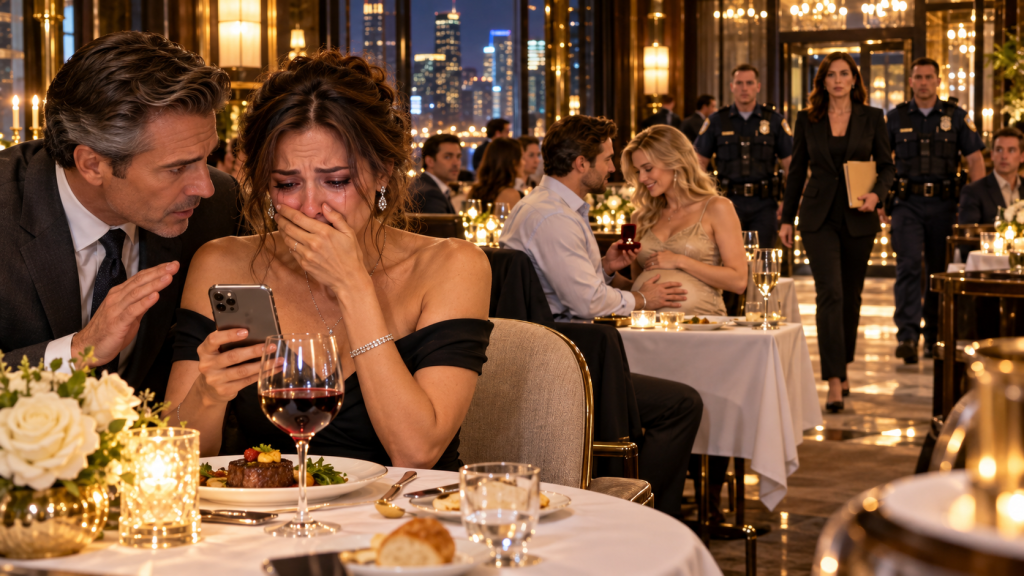
Then Carter laughed. It was the wrong laugh. Too loud. Too quick. The laugh of a man trying to remind everyone that he was still in control. “This is ridiculous.” Agent Brooks closed the folder. One of the uniformed officers stepped closer. Carter looked at me.
“Did you do this?
I actually looked behind myself.
As if there might be another wife in the restaurant he could possibly mean.
“Did I do what?”
“Call the police.”
“No.”
His eyes snapped toward Harrison.
“You.”
Harrison did not move.
Carter pointed at him.
“You’ve been following me.”
Harrison replied calmly.
“I’ve been auditing you.”
That sentence changed Carter’s expression.
The anger disappeared.
Not completely.
But enough for fear to become visible underneath.
Vanessa looked between them.
“Carter, who is he?”
Carter ignored her.
“Whatever you think you found, you don’t understand the accounts.”
Harrison leaned back.
“I understand them extremely well.”
“You’re an accountant.”
“Yes.”
“You aren’t law enforcement.”
“No.”
Agent Brooks stepped between them.
“But I am.”
Carter finally looked at her.
“You have no right to discuss private financial information in front of strangers.”
Vanessa gave a tiny, broken laugh.
“Strangers?”
She touched her stomach.
“You proposed to me thirty seconds ago.”
Carter turned toward her.
“Vanessa, not now.”
Her face collapsed.
Not now.
As if she were an employee interrupting a meeting.
She looked at me.
Then at my wedding ring.
Then at the anniversary message still glowing on my phone beside the untouched halibut.
Her voice became very quiet.
“You’re really his wife.”
I stared at her.
“What did he tell you?”
Carter snapped:
“Don’t.”
Vanessa ignored him.
“He said you were separated.”
Something inside me went numb.
She continued.
“He said the divorce was basically finished.”
I laughed once.
My voice sounded strange.
“We had breakfast together this morning.”
Vanessa closed her eyes.
I continued.
“He kissed me before work.”
Carter said:
“This isn’t the place.”
I finally looked directly at him.
“You chose the place.”
His face tightened.
“You were supposed to be at home.”
There.
Four simple words.
And suddenly I understood something.
He had not accidentally brought his pregnant mistress to the same restaurant where his wife happened to be celebrating their anniversary alone.
He knew I had made the reservation.
I had sent him the confirmation three days earlier.
He had known exactly where I would be.
My skin went cold.
“You knew I was here.”
Carter said nothing.
Vanessa stared at him.
“You knew?”
“Vanessa—”
“You proposed to me two tables away from your wife?”
“I can explain.”
I laughed.
That was the first truly absurd thing he had said all evening.
Agent Brooks spoke.
“Mr. Vale, put the ring box on the table.”
Carter looked at her.
“Why?”
“Because I asked.”
For one strange second, I thought he might refuse.
Then he set the little velvet box beside Vanessa’s untouched champagne.
The click when it touched the table sounded louder than it should have.
Brooks turned toward me.
“Mrs. Vale, I know this is overwhelming.”
“That’s one word for it.”
“We need you not to discuss the financial documents with your husband tonight.”
I almost smiled.
“Trust me.”
“I have nothing left to discuss with him tonight.”
Carter stepped forward.
“Baby—”
“No.”
The word came out before I even thought.
He stopped.
For two years, Carter had called me baby when he wanted something softened.
Baby, don’t worry.
Baby, it’s just work.
Baby, I forgot to text.
Baby, you’re overthinking.
Baby.
One syllable used so often it had stopped sounding like affection and started sounding like a lid.
I looked at him.
“My name.”
He stared.
“What?”
“Use my name.”
He opened his mouth.
Nothing came out.
Agent Brooks nodded toward the officers.
One of them asked Carter to turn around.
That was when Vanessa finally understood.
“Wait.”
Her hand flew to her stomach.
“Are you arresting him?”
Brooks said:
“He is being taken into custody pursuant to a federal warrant.”
The room began whispering.
Phones appeared.
Of course they did.
People love somebody else’s disaster when it arrives with expensive lighting.
Carter looked at me.
His face changed again.
Less anger.
More pleading.
“Listen to me.”
I stood.
My knees almost buckled.
Harrison rose too, but he did not touch me.
Good.
I needed that.
Carter said:
“Whatever they tell you, the money was ours.”
I stared.
“The property was my father’s.”
“It became part of the marriage.”
“No.”
His jaw tightened.
“You don’t understand how the financing was structured.”
“Then perhaps you shouldn’t have structured it without me.”
He looked toward Vanessa.
Then back at me.
“I was fixing things.”
“What things?”
He did not answer.
Agent Brooks placed one hand lightly against his arm.
Carter suddenly became furious.
“You think this is funny?”
I blinked.
“Do I look amused?”
“You’ve always wanted to think the worst of me.”
That almost made me admire him.
Even handcuffs could not interrupt his instinct to make himself the injured one.
I said:
“I spent the last hour waiting for you because I believed you were working.”
His face hardened.
“I am not the person who wanted to think the worst.”
“You simply kept making the worst more efficient.”
The officers led him away.
The entire restaurant watched.
Carter did not look back at Vanessa.
He looked back at me.
That hurt in a way I did not expect.
Because for one stupid second, it almost looked like love.
Then I remembered the ring box.
The pregnant woman.
The anniversary text.
The $780,000 transfer.
The $1.6 million credit line.
Love does not become evidence merely because a person looks devastated when consequences arrive.
The doors closed behind him.
Nobody applauded.
Thank God.
I sat down.
Then realized Vanessa was crying.
Not dramatically.
Her shoulders simply shook.
She stared at the velvet box.
“Is it real?”
I looked at her.
“The ring?”
She shook her head.
“Any of it.”
That question was too large for either of us.
Agent Brooks sat at the edge of the booth.
“Ms. Moore, we need to speak with you separately.”
Vanessa wiped her face.
“Am I under arrest?”
“No.”
“Am I in trouble?”
“That depends on what you knew and what you did.”
Vanessa looked at me.
Then at the document showing the $780,000 transfer.
“What is my company doing on there?”
Brooks replied:
“That is what we need you to explain.”
Vanessa shook her head quickly.
“I have a consulting LLC.”
“I barely use it.”
“Carter said he wanted to invest in it.”
“How much?”
Vanessa swallowed.
“He said maybe two hundred thousand.”
My stomach twisted.
Brooks asked:
“When?”
“Last week.”
“And you agreed?”
“I said we’d discuss it with an attorney.”
Carter had never mentioned Vanessa’s company to me.
Of course he hadn’t.
Vanessa continued.
“He said he wanted to make sure I was financially secure before the baby came.”
Her face crumpled.
“I thought…”
She stopped.
I knew what she thought.
That the money proved commitment.
The ring proved commitment.
The pregnancy proved a future.
Carter had apparently built separate realities with remarkable attention to detail.
Harrison finally spoke.
“The account receiving the transfer was opened using your LLC’s tax identification number.”
Vanessa looked at him.
“I have a business account.”
“This was a second account.”
She went pale.
“What?”
Harrison slid a photocopy across the table.
Bank name.
Account number partially redacted.
Vanessa Moore Consulting LLC.
Authorized signers:
Vanessa Moore.
Carter Vale.
Vanessa stared.
“I never added him.”
Brooks asked:
“Did you sign bank-opening paperwork?”
“No.”
“Did you ever send him a copy of your driver’s license?”
Vanessa froze.
Then whispered:
“Yes.”
“When?”
“He booked our trip.”
My skin prickled.
“What trip?”
Everyone looked at me.
Vanessa swallowed.
“Tonight.”
Harrison closed his eyes briefly.
Brooks asked:
“Where were you going?”
“Madrid.”
She looked sick.
“He said after dinner we were flying to Madrid.”
“An engagement trip.”
My heart hammered.
Brooks said:
“Did you see the tickets?”
“Yes.”
“Round trip?”
Vanessa hesitated.
“I thought so.”
Harrison opened his leather portfolio.
“Your return ticket was for Monday.”
Vanessa nodded.
Then Harrison looked at her.
“Carter’s was not.”
The silence became absolute.
Vanessa whispered:
“What?”
“He had a separate onward booking from Madrid to Dubai tomorrow night.”
I stared at Harrison.
“How do you know that?”
“The travel purchase was charged to an account we were tracing.”
Vanessa’s face turned white.
“He was leaving me too.”
Nobody answered.
Because yes.
That was what the documents appeared to say.
Carter had proposed to a pregnant woman.
Planned to fly her to Madrid.
Planned to transfer $780,000 into an account carrying her company’s name.
Then planned to continue alone to Dubai.
The choreography was almost beautiful in its cruelty.
Brooks looked at Vanessa.
“We believe the transfer into an account associated with your company may have been intended to make the funds look like a business investment before further movement overseas.”
Vanessa covered her mouth.
“So if you caught it…”
Brooks nodded.
“The first paper trail would have pointed at you.”
Vanessa began to sob.
I should have hated her.
Part of me did.
She had been kissing my husband.
Pregnant with his child.
Accepting a proposal on my anniversary.
Even if she believed we were separated, she knew I existed.
I asked:
“When did he tell you we separated?”
She looked at me.
“Seven months ago.”
“How long have you been together?”
Her face changed.
“Nine months.”
There it was.
She had known for two months that he was married and not supposedly separated.
I stared.
“So you knew.”
“At first.”
She nodded, ashamed.
“He told me your marriage was over emotionally.”
I laughed.
The oldest sentence in the world.
Vanessa continued.
“I know.”
“I know what that sounds like.”
“What did you think would happen?”
“That he would leave.”
“Did you ask him to?”
“Yes.”
“And?”
“He kept saying your father had died and the estate was complicated.”
My chest tightened.
My father.
Even dead, Dad had been used as an excuse.
Vanessa’s voice became smaller.
“He said he couldn’t file immediately because it might affect property issues.”
I looked at Harrison.
He looked furious.
Not at Vanessa.
At Carter.
I said:
“So my grief became his legal delay.”
Vanessa looked down.
“I’m sorry.”
I wanted to say:
You should be.
Instead:
“Not tonight.”
She nodded.
That was all I could give.
Agent Brooks asked Vanessa to accompany her for an interview.
Vanessa stood.
Then stopped beside me.
One hand resting on her stomach.
“I didn’t know about the money.”
I looked up.
“I believe you don’t know about some of it.”
The distinction hurt her.
It was supposed to.
She swallowed.
“I deserve that.”
Then she walked away.
Harrison remained.
The restaurant manager approached and quietly asked whether I wanted a private room.
I almost laughed.
As if privacy had not already died spectacularly.
“Yes.”
Five minutes later, Harrison and I sat in a small private dining room with the folder between us.
The anniversary cake I had ordered earlier sat abandoned in the corner.
White frosting.
Two little gold candles.
2 YEARS
I stared at it.
Harrison noticed.
“Do you want me to have them remove that?”
“No.”
“Why?”
“I don’t know.”
He nodded.
That was the first useful answer anybody gave me all evening.
I looked at him.
“Start at the beginning.”
He exhaled slowly.
“Your father’s estate retained me six weeks ago.”
“Dad has been dead eighteen months.”
“I know.”
“Why now?”
“The estate was finalizing a transfer involving the Lakeview property.”
My father had owned a six-unit brick building near Lakeview for almost thirty years.
Two storefronts below.
Four apartments above.
He had managed it himself until cancer made stairs difficult.
He left it to me.
At least, I thought he did.
“What transfer?”
“Not a sale.”
Harrison shook his head.
“Your father’s trust held title during administration.”
“You were designated successor beneficiary.”
“The trustee was preparing final distribution to you when a title update showed a lien.”
My stomach dropped.
“The $1.6 million line.”
“Yes.”
“When was it opened?”
“Eight months ago.”
I did the math.
Two months after Dad died.
“When I could barely get out of bed.”
Harrison’s jaw tightened.
“Yes.”
“Whose signature?”
“Yours.”
“No.”
“I know.”
“How?”
“The estate trustee knew the trust documents.”
“He also knew your father had required independent confirmation before the property could be pledged.”
“What does that mean?”
“Your father built in an extra safeguard.”
“Any lien or mortgage while the property remained in trust required your signed direction plus written confirmation from the independent trustee.”
I stared.
“And Carter?”
“Produced both.”
My skin turned cold.
“He forged the trustee too?”
“We believe a confirmation letter was fabricated.”
“Your electronic signature appears on the borrower authorization.”
I whispered:
“How?”
“Do you remember signing estate documents about ten months ago?”
I closed my eyes.
Hundreds.
Maybe not literally.
But it felt that way.
Carter had sat beside me at our kitchen island.
He had printed things.
Scanned things.
Set tabs.
Told me where initials were needed.
I remembered crying because one form still called Dad “decedent.”
Such a cold word.
I said:
“He helped me.”
Harrison’s expression told me everything.
My throat tightened.
“He used the signatures.”
“We believe he reused authentication material from legitimate estate documents.”
I felt sick.
“What did he do with the line?”
Harrison opened a spreadsheet.
“The full facility was $1.6 million.”
“He had drawn approximately $982,000.”
“Where?”
“Several places.”
He pointed.
“Three hundred thousand went to Vale Strategic Holdings.”
“What is that?”
“Carter’s company.”
“He doesn’t own a company.”
“He does.”
My mouth went dry.
“Since when?”
“Eleven months ago.”
Before Dad died.
Another line.
“Two hundred twenty thousand paid down personal debts.”
“What debts?”
“Credit cards.”
“A margin loan.”
“Private gambling losses may also be involved, though we haven’t confirmed that fully.”
I stared.
“Gambling?”
“Possibly.”
Another.
“Approximately one hundred seventy thousand went through travel, luxury purchases, rent payments, and transfers connected to Vanessa.”
I flinched.
The ring.
Hotels.
Restaurants.
Perhaps the maternity doctor.
I did not ask.
Not yet.
Harrison continued.
“About two hundred ninety thousand was deposited into the hidden brokerage account.”
“The joint one.”
“Yes.”
“Why joint?”
“We think partly because a jointly titled account made the movement look less obviously like misappropriation from separate property.”
“And I never knew.”
“No.”
He pointed to the balance history.
“The account also received other funds.”
“Some came from marital savings.”
“Some came from investment gains.”
“Some from the credit line.”
“Current liquidation value was about $780,000.”
“And tonight he tried to move all of it.”
“Yes.”
“To Vanessa’s fake account.”
“Yes.”
I leaned back.
The room felt distant.
“He was going to leave me with the debt.”
Harrison did not soften it.
“If the lien had remained enforceable, the property would have been exposed.”
“Dad’s building.”
“Yes.”
“And Carter would have been in Dubai.”
“That appears to have been the plan.”
I looked at the cake again.
Two years.
I had spent the afternoon choosing a dress.
Carter had spent it arranging an international transfer.
I whispered:
“Why were you sitting next to me?”
For the first time, Harrison almost smiled.
“That was not planned.”
“What?”
“We knew Carter would be here.”
“Federal investigators had obtained information suggesting the transfer and travel would occur tonight.”
“I came because they expected there might be financial documents or devices that needed immediate identification.”
“You were part of the operation.”
“In a support role.”
“And me?”
“You weren’t supposed to be here.”
I laughed once.
“I made the reservation.”
“I know.”
“How?”
“When you checked in, the hostess said ‘Mrs. Vale.’”
“I recognized you from estate records.”
My skin prickled.
“So you knew who I was.”
“Yes.”
“And Carter didn’t know I was sitting there?”
“Apparently not until later.”
“He never looked across the room.”
That sentence hurt.
Harrison continued.
“When I realized you were about to confront him, I was afraid you would disrupt the arrest.”
“So you told me the show was about to begin.”
“Yes.”
“That was a ridiculous sentence.”
“It sounded less ridiculous in my head.”
I stared at him.
Then, despite everything, laughed.
He looked relieved.
I stopped quickly.
“What happens now?”
“To Carter?”
“To me.”
That answer seemed to surprise him.
Good.
People kept making Carter the center of my tragedy.
I was tired of it.
Harrison said:
“You need your own attorney.”
“Not the estate’s.”
“Not Carter’s.”
“Not anyone recommended by Carter.”
I nodded.
“And the property?”
“The estate will challenge the lien.”
“Can it be removed?”
“The evidence is strong.”
“But I won’t promise an outcome.”
“Thank you.”
He continued.
“The brokerage account is frozen.”
“The $780,000 did not transfer.”
“Good.”
“Federal investigators will trace ownership.”
“Some of it may be marital property.”
“Some may be traceable to fraudulently borrowed funds.”
“Some might be subject to restitution claims.”
I swallowed.
“So I don’t just get it.”
“No.”
“Good.”
He looked surprised.
I said:
“I don’t want money because my husband got arrested.”
“I want what is mine.”
“That is a better sentence.”
I looked at him.
“Did Dad know Carter was like this?”
Harrison hesitated.
That hesitation changed my breathing.
“What?”
“Your father had concerns.”
Of course there was more.
“What concerns?”
“Not proof.”
“Questions.”
“About six months before he died, your father asked the estate attorney whether property left to you could remain protected from a spouse.”
I closed my eyes.
“Why?”
“He did not give a detailed reason.”
“He said Carter had asked too many questions about leverage.”
I felt tears rise.
Dad and Carter had never gotten along.
I had blamed Dad.
Called him controlling.
Old-fashioned.
Suspicious.
One Christmas, they argued because Carter asked whether the Lakeview building had ever been refinanced.
Dad later told me:
“That man looks at everything and asks what it can be turned into.”
I had defended my husband.
“He’s in finance, Dad.”
Now Dad’s sentence came back like a voice through a wall.
Everything can be turned into something else.
A building into collateral.
A signature into authorization.
A wife into cover.
A mistress into a transfer vehicle.
An anniversary into an alibi.
I whispered:
“Did Dad leave anything about it?”
Harrison shook his head.
“No secret letter.”
“No dramatic warning.”
“He simply tightened the trust terms.”
Oddly, that comforted me.
Dad had not spent his final months plotting revenge from beyond the grave.
He had noticed a risk.
He had added protection.
That was enough.
I went home at three in the morning.
Not our home.
Mine, suddenly.
Or maybe not.
That was another thing lawyers would tell me.
The condo was quiet.
Carter’s shoes were beside the door.
His coffee mug sat in the sink.
A jacket hung across the dining chair.
The physical evidence of marriage was everywhere.
That felt more obscene than the affair.
I walked into our bedroom.
His side of the bed unmade.
Watch charger on the nightstand.
A framed wedding picture beside it.
I picked it up.
We looked happy.
I did not throw it.
I was tired of dramatic objects.
Instead, I placed it face down.
Then I called my sister.
At 3:17 a.m.
She answered on the second ring.
“What happened?”
Not hello.
She knew nobody calls at 3:17 with good news.
I said:
“Carter was arrested.”
Silence.
Then:
“Are you safe?”
That question broke me.
Not:
Why?
Not:
What did he do?
Are you safe?
I sat on the floor.
“No.”
Then corrected myself.
“Yes.”
“I think I am.”
She drove over.
I told her everything.
The affair first.
Then pregnancy.
Proposal.
Fraud.
Dad’s building.
Dubai.
By the end, she was sitting beside me on the kitchen floor.
She said:
“I’m going to kill him.”
I rested my head against the cabinet.
“Get in line.”
She looked at me.
“Was she pretty?”
I laughed so hard I started crying.
“What kind of question is that?”
“The kind sisters ask after an arrest apparently.”
“Yes.”
“She was beautiful.”
“Damn.”
“Very inconvenient.”
We laughed until grief returned.
That became the rhythm of the next year.
Something absurd.
Then something devastating.
The divorce filing went in three days later.
My attorney was named Rebecca Sloan.
Apparently Chicago had its own supply of women named Rebecca who knew how to separate money from marriage.
She was sharp, unsentimental, and unimpressed by Carter’s charm.
Her first instruction:
“Do not empty joint accounts.”
“I wasn’t going to.”
“Do not destroy his belongings.”
“I wasn’t going to.”
“Do not post the restaurant video.”
“There’s a video?”
“Half the city has one.”
I closed my eyes.
Of course.
Some stranger’s anniversary entertainment had become social media.
Rebecca continued.
“Do not communicate with Vanessa except through counsel if the financial investigation requires it.”
“I don’t want to communicate with Vanessa.”
“Good.”
“And do not assume the criminal case will handle your divorce.”
I nodded.
She leaned forward.
“We have three overlapping stories.”
“Your marriage.”
“Financial misconduct.”
“Criminal allegations.”
“Do not let one replace the others.”
I appreciated that.
Because I did not want to divorce Carter because the government said he committed fraud.
I wanted to divorce him because he had built an entire life around my ignorance.
The first hearing was ugly.
Not dramatic.
Ugly.
Carter appeared by video from custody pending bond determination.
He looked tired.
Smaller.
His attorney argued that he had legitimate business reasons for the transfers.
That the marital investment account belonged partly to him.
That the trip had been personal, not flight.
That the Dubai booking was business-related.
That the Lakeview loan documents were misunderstood rather than forged.
Then the prosecutor introduced the onward ticket.
One-way.
Paid with a corporate card from Vale Strategic Holdings.
A serviced apartment reserved in Dubai for ninety days.
Application materials for a residency visa.
My stomach turned.
He had not been going for a meeting.
He had been relocating.
His bond conditions became strict.
Passport surrendered.
Financial transactions restricted.
No access to certain accounts.
No contact with me except through counsel.
I felt no triumph.
Only exhaustion.
Vanessa cooperated.
That became public later.
At first, I resented her for it.
Not because cooperation was wrong.
Because I wanted her to be simpler.
Mistress.
Enemy.
Pregnant blonde in my anniversary restaurant.
Instead, she became inconveniently human.
She had known Carter was married for the first two months of their affair.
Then believed his claim that we were separated.
That was not innocence.
But it was not the same thing as knowing he still kissed me goodbye in the morning.
She had accepted expensive gifts.
Trips.
Rent help.
She had not asked where the money came from.
Again, not innocence.
But she had not known about Dad’s property or the forged account.
Investigators confirmed the second business account bearing her LLC name had been opened using a scanned license she had given Carter for travel bookings and electronic documents she said she had not signed.
She became both participant and victim.
I hated nuance for several months.
Eventually I stopped asking the truth to arrange itself around my anger.
Four months after the restaurant, Vanessa’s attorney contacted Rebecca.
Vanessa wanted to send me a letter.
I said no.
Two months later, she asked again.
I said:
“Fine.”
The letter was handwritten.
That surprised me.
It began:
I knew he was married when our relationship started.
No excuse.
Good.
He told me you had become more like roommates and that he intended to leave. I chose to believe something convenient because I wanted him.
I put the letter down.
Picked it back up.
Two months later, he told me you were formally separated. I did not verify it. I should have.
Then:
I did not know he was using your father’s property or your signature. I did not know he opened another account under my company.
I did not know he had a one-way ticket after Madrid.
She wrote about the pregnancy.
Not defensively.
The baby is a girl. I am keeping her. I am not asking you to feel anything about that.
That sentence made me cry.
Not because of the baby.
Because Vanessa understood at least one thing Carter never had.
My emotions were mine.
She ended:
I am sorry for the part I knowingly played in hurting you. I am not asking you to forgive the parts I did know because of the parts I didn’t.
Specific.
Uncomfortable.
Real.
I never replied.
Not then.
Carter’s financial trail became clearer.
The $1.6 million credit line had not been a brilliant secret investment.
It had been desperation.
Carter’s salary was high.
So were his tastes.
And apparently his appetite for risk.
Vale Strategic Holdings had invested in two private real-estate deals.
One failed.
The other became tied up in litigation.
He had borrowed on margin.
Lost money trading options.
Used new borrowed funds to cover old obligations.
Then started treating my father’s building as unused capital.
That phrase appeared in one of his emails.
Unused capital.
Dad’s building.
The place where my father repaired stair railings himself because he hated paying contractors.
The apartments where tenants sent him Christmas cards.
The storefront where I had done homework in the back office as a teenager.
Unused capital.
The line made me angrier than “mistress.”
Because it revealed how Carter saw inheritance.
Not memory.
Not stewardship.
Opportunity.
Harrison traced approximately $982,000 in draws.
About $292,000 had landed in the hidden brokerage account.
Roughly $221,000 went to debts.
$168,000 went through expenses connected to the affair and Carter’s lifestyle.
$106,000 went into failed or illiquid investments.
The remainder moved through business accounts, fees, and repayments.
The joint brokerage had grown to about $780,000 partly because it held other marital funds and gains from earlier investments.
The government froze disputed portions.
The divorce court later sorted what belonged where.
Slowly.
Painfully.
Not every dollar came back.
Not every dollar was mine.
That was important.
The story people told online was:
CHEATING HUSBAND STEALS $1.6 MILLION FROM WIFE.
The truth was less neat.
He had fraudulently exposed my inherited property to a $1.6 million facility.
He had drawn less than the full amount.
He had mixed stolen opportunity with legitimate marital assets, personal earnings, losses, and lies.
Real financial betrayal is messy.
That mess is part of what makes it effective.
People stop looking because they get tired.
I did not stop.
Not anymore.
The lien on Dad’s property took eight months to resolve.
The lender initially argued it had relied on facially valid electronic documents.
The estate trustee produced proof that the required independent consent had never been issued.
A forensic examiner found the confirmation letter had been assembled from previous estate correspondence.
The electronic signature logs showed Carter’s home office device accessing documents after I had signed unrelated estate forms.
The lender’s insurer became involved.
Attorneys argued.
Everyone billed somebody.
Finally, the lien was released from the property as part of a settlement that preserved claims against Carter and related entities.
Rebecca called me at work.
I had gone back by then.
I answered in the stairwell.
She said:
“Lakeview is clear.”
I leaned against the wall.
“What?”
“The lien release recorded this morning.”
My knees weakened.
“Dad’s building?”
“Protected.”
I started crying.
A coworker opened the stairwell door.
Saw me.
Immediately backed out.
Bless her.
I whispered:
“Thank you.”
Rebecca said:
“Thank your father for the trust clause.”
I laughed through tears.
“He’d enjoy that.”
That weekend, I went to the building.
For months, I had avoided it.
Too much paperwork.
Too much Carter.
Too much Dad.
I unlocked the side entrance.
The familiar smell hit me.
Old brick.
Dust.
Someone’s laundry detergent.
Coffee from the café downstairs.
I climbed to the roof.
Dad used to bring me up there when I was a kid.
The skyline had changed.
Everything does.
I sat on the low bench he had built from leftover deck boards.
Then I said aloud:
“You were right about him.”
Wind.
No answer.
“Don’t get smug.”
Still nothing.
I laughed.
Then cried.
My father and I had not ended perfectly.
We loved each other.
Argued.
He distrusted Carter.
I defended Carter partly because Dad distrusted him.
Families sometimes turn warnings into loyalty tests.
I wish I had listened more.
I also refuse to rewrite myself as stupid.
Carter fooled me because he was my husband.
Trust is not evidence of low intelligence.
It is simply something dishonesty knows how to exploit.
The criminal case resolved fourteen months after the restaurant.
Carter did not go to trial.
The evidence around the property lien, electronic signatures, account opening, and attempted transfer was strong enough that his lawyers negotiated.
He pleaded guilty to federal fraud-related offenses connected to unauthorized financial transactions and falsified documentation.
Some allegations were dismissed as part of the agreement.
The affair was irrelevant legally.
As it should have been.
Cheating is cruel.
Not automatically criminal.
The judge imposed a prison sentence.
Not thirty years.
Not some television number.
Forty-six months.
Followed by supervised release.
Restitution obligations were calculated around provable financial losses, not my heartbreak.
At sentencing, I was allowed to speak.
I almost did not.
Then I realized silence had already served Carter enough.
I stood.
My hands shook.
I did not look at him first.
I looked at the judge.
“I know this case is about money and documents.”
“But I want to explain what the documents did.”
I swallowed.
“My father died eighteen months before my husband was arrested.”
“I was grieving.”
“Estate paperwork came into my house.”
“My husband sat beside me and told me where to sign.”
“He used the fact that I trusted him during grief as access.”
I finally looked at Carter.
His face crumpled.
I continued.
“He did not merely take money.”
“He took information I had given him inside a marriage and turned it into authority I never granted.”
I looked back at the judge.
“That distinction matters to me.”
“I am not asking you to punish him for cheating.”
“I am not asking you to punish him for humiliating me in a restaurant.”
“I am asking you to understand that financial fraud inside a marriage can be especially effective because the victim has already opened the door.”
My voice broke.
“That does not mean she invited the theft.”
The courtroom became silent.
I sat down.
Carter cried.
I did too.
Neither changed the evidence.
The divorce finalized three months after sentencing.
I kept the Lakeview property as separate inheritance.
That had been clear once the fraudulent lien was removed.
The joint assets were divided after accounting for dissipation and traced funds.
I did not receive everything.
Carter did not leave with nothing.
His legitimate retirement interest remained subject to normal division rules.
Some business assets were nearly worthless.
Some disputed funds went toward restitution.
Some marital savings returned to me through settlement credits.
The hidden brokerage account was untangled line by line.
I hated every line.
But line by line was how Carter had built the lie.
Line by line was how we took it apart.
The velvet engagement ring became evidence temporarily.
I learned that from Harrison.
One afternoon, months later, he said:
“Apparently it was purchased with a Carter Vale personal card.”
I stared at him.
“Please tell me you did not audit the romance.”
“I audit transactions.”
“That sentence is exactly why accountants struggle at parties.”
He almost smiled.
“What happened to it?”
“Returned eventually, I believe.”
“Good.”
“Why?”
“Because if Vanessa ever wears an engagement ring, she deserves one that wasn’t handed to her during a felony operation.”
Harrison laughed.
It was the first time I heard him do it properly.
No.
Harrison did not become my next husband.
People always want that ending when I tell the story.
Mysterious silver-haired stranger saves betrayed wife.
Romance.
No.
He became my friend.
A deeply annoying one who sent me articles about fraud controls and once gave me a password manager subscription for Christmas.
I told him it was the least romantic gift ever invented.
He replied:
“That was the goal.”
Good.
I did not need another man standing between me and my own life.
I needed better locks.
Vanessa gave birth to a daughter named Grace.
I learned through attorneys.
Carter requested paternity testing from prison.
It confirmed he was Grace’s father.
Vanessa sought child support under the ordinary legal process based on his available income and future obligations.
She did not ask me for anything.
We remained separate.
Then, two years after the restaurant, something unexpected happened.
She emailed me.
Not through counsel.
One sentence.
I found something I think belongs to you.
Attached was a photograph.
My father’s watch.
I stopped breathing.
A steel Omega.
Scratched near the clasp.
Dad wore it for twenty-six years.
After he died, I could not find it.
Carter told me the hospital must have lost it.
I had cried.
Not because it was valuable.
Because Dad had worn it everywhere.
Graduations.
Christmas.
Chemotherapy.
He used to tap the face and say:
“Five minutes early is on time.”
I called Vanessa.
The first time we had spoken directly since the restaurant.
She answered quietly.
“Hello?”
“Where did you get that watch?”
Silence.
“Carter gave it to me.”
My stomach turned.
“When?”
“For my birthday.”
“Before Dad died?”
“No.”
“About two months after.”
I closed my eyes.
Of course.
“What did he tell you?”
“That it was his grandfather’s.”
I almost laughed.
Every sentimental story in Carter’s mouth was inventory.
Vanessa said:
“I’m sorry.”
“Do you still have it?”
“Yes.”
“Why?”
“I couldn’t bring myself to sell anything after the case.”
“Can I have it back?”
“Yes.”
No negotiation.
She mailed it.
Insured.
Signature required.
When the box arrived, I sat at my kitchen table for twenty minutes before opening it.
The watch had stopped.
I took it to Dad’s old jeweler.
He replaced the battery.
When the second hand began moving again, I cried.
Not because objects restore people.
They do not.
But sometimes they carry enough touch to make memory physical.
That watch became the final property Carter returned to me.
Not legally the most valuable.
Emotionally, yes.
I emailed Vanessa:
It arrived. Thank you.
She replied:
I’m glad.
Then another message appeared.
For what it’s worth, I’m sorry about the first two months too.
I stared.
That was the part where she had known.
I answered:
I know.
Not forgiveness.
Not friendship.
Acknowledgment.
Years passed.
Carter served most of his sentence.
He wrote me twice.
The first letter was twelve pages.
I did not finish it.
Too many explanations.
Pressure.
Fear.
Investment losses.
My father’s distrust.
Our “emotional distance.”
Vanessa.
The baby.
He apologized, then explained, then apologized again.
I put it away.
The second letter arrived a year later.
Two pages.
Better.
I keep wanting to explain why I did things because explanation lets me stay interesting.
That sentence surprised me.
The boring truth is that I wanted more than I could afford, more than I had earned, and more than I was willing to ask permission for.
I kept reading.
I cheated because I wanted a second life without ending the first.
I borrowed against your father’s property because I wanted capital without admitting I had failed.
I used Vanessa’s company because I wanted a path for money that did not point directly at me.
I booked Dubai because I was afraid everything was closing in.
Then:
I proposed because I wanted Vanessa to keep believing in the future long enough to get on the plane.
My stomach twisted.
Even Vanessa’s proposal had been operational.
I almost felt sorry for her.
Almost.
Carter continued.
I texted you happy anniversary because I wanted you sitting exactly where I expected you to be—waiting for me and not looking elsewhere.
I stopped.
There it was.
The detail I had wondered about.
Why propose two tables away?
He had not expected me to see him.
The side booth was partially screened by decorative panels.
He thought my table was positioned differently.
He knew my reservation.
He assumed I would sit facing the window.
He had used my anniversary reservation as location control.
He knew where his wife was.
He thought that made cheating easier.
Instead, the hostess seated me facing him.
Sometimes entire schemes collapse because of chair placement.
I finished the letter.
I am sorry.
You do not owe me a response.
I did not give him one.
Not then.
When Carter was released, he moved to Ohio near his sister.
He never tried to reconcile with me.
Good.
He gradually built a relationship with Grace under Vanessa’s boundaries.
Supervised at first.
Then more ordinary.
I learned that from Vanessa years later.
Not because we became close.
Because Grace and I eventually met.
That surprised even me.
She was nine.
Vanessa contacted me first.
Grace knows her father was married when we met. She knows there was another woman he hurt. She asked whether she has to feel ashamed because of how she was born.
That message sat in my inbox for two days.
Then I replied:
No child is responsible for the circumstances that created her.
Vanessa wrote:
I know. She wants to hear it from someone who could reasonably hate us.
I stared.
I did not hate Grace.
I never had.
She had been a small bump beneath a blonde woman’s dress on the worst night of my marriage.
That was not a crime.
We met at a café.
Public.
Daytime.
Vanessa sat nearby but gave us space.
Grace had Carter’s eyes.
That was difficult for about five seconds.
Then she ordered hot chocolate with too much whipped cream and immediately got foam on her nose.
Children are useful that way.
They become themselves quickly.
She asked:
“Were you married to my dad?”
“Yes.”
“When he was with Mom?”
“Yes.”
She looked down.
“Was I the reason you got divorced?”
“No.”
Her eyes lifted.
“Really?”
“Really.”
“Your dad made choices.”
“Your mom made some choices.”
“I made choices afterward.”
“But you did not make any.”
“You weren’t even born.”
She thought about that.
Then:
“Dad says he hurt you.”
“Yes.”
“Do you hate him?”
I considered.
“No.”
“Did you forgive him?”
I smiled sadly.
“Some things.”
“Not everything.”
“Is that allowed?”
“Yes.”
Grace nodded as though this information might be useful someday.
Then she asked:
“Do you hate Mom?”
I looked toward Vanessa.
She was pretending not to listen.
Badly.
“No.”
“Were you mad?”
“Very.”
Grace smiled slightly.
“Mom said you should’ve been.”
That helped.
I leaned forward.
“Grace, adults sometimes do things that create complicated families.”
“But complicated does not mean dirty.”
“Okay?”
She nodded.
“Okay.”
We finished hot chocolate.
That was all.
No adoption of the mistress’s child into my life.
No magical blended family.
Just a conversation that belonged to a child more than it belonged to our old anger.
My own life became quieter.
I sold Dad’s Lakeview building six years after the divorce.
People were shocked.
“You fought so hard to keep it.”
Yes.
But protection is not the same as obligation.
The building had become expensive to maintain.
I did not want to be a landlord forever.
And the deepest lesson of Carter’s fraud was not that Dad’s property had to remain untouched until I died.
It was that the choice had to be mine.
I sold it.
Read every page.
Asked irritating questions.
Harrison reviewed the accounting, not the decision.
The proceeds went into diversified investments under my control.
No hidden joint title.
No mysterious LLC.
No husband waiting with a scan of my signature.
I kept Dad’s watch.
That was enough.
On what would have been my tenth wedding anniversary, I went back to the Gold Coast restaurant.
Alone.
Not because I enjoy punishment.
Because I wanted to know whether the room still belonged to that night.
The hostess did not recognize me.
Good.
I asked for a table.
Not the same one.
Close.
I ordered halibut.
It arrived hot.
I laughed.
The waiter looked worried.
“Is everything okay?”
“Yes.”
I smiled.
“Perfect.”
Halfway through dinner, my phone vibrated.
For one second, my body remembered.
Anniversary message.
Carter.
Lie.
Then I looked.
Harrison.
Reminder: quarterly tax estimate tomorrow.
I stared.
Then laughed harder.
The waiter definitely thought I was unstable.
I replied:
You remain the least romantic man in Chicago.
Harrison answered:
Excellent.
I ate dessert.
Paid my bill.
Walked outside.
No officers.
No mistress.
No velvet box.
Just Chicago.
Cold wind.
Traffic.
People walking home.
The city had kept moving all along.
That used to offend me.
How dare traffic continue when your marriage ends?
How dare waiters refill water while agents arrest your husband?
How dare strangers finish dessert?
Later, I became grateful.
The world does not end every time ours changes shape.
It leaves room.
For grief.
For paperwork.
For anger.
For better passwords.
For selling buildings.
For meeting children who did nothing wrong.
For becoming someone who can walk into the restaurant where she once thought her life ended and discover it was only dinner.
Years after the case, I found the original anniversary text while cleaning old phone backups.
I’m stuck at work. Happy second anniversary, baby.
A heart emoji.
I stared at it.
Once, that message had represented humiliation.
Now it looked almost small.
Because the affair had not been the largest betrayal after all.
Harrison had been right.
The worst part was not Carter kissing Vanessa.
Not even the pregnancy.
The worst part was discovering how thoroughly he had converted intimacy into access.
He knew my father had died.
So he used estate paperwork.
He knew I trusted him.
So he used my signatures.
He knew I loved anniversaries.
So he used the reservation to predict where I would be.
He knew Vanessa wanted security.
So he used a proposal.
He knew she had a business.
So he used her company.
He knew I would be devastated by the affair.
Perhaps he assumed devastation would keep me from following the money.
He was wrong.
That became the true ending.
Not his arrest.
Not the divorce.
Not prison.
The ending was that I stopped treating heartbreak as the only thing worth investigating.
I followed the documents.
I learned what belonged to me.
I recovered what could be recovered.
I accepted what could not.
I let Vanessa own her part without forcing her to carry Carter’s.
I let Grace exist without turning her into evidence.
I let Dad’s building become mine enough that one day I could sell it.
And I learned that forgiveness, when it came in fragments, did not mean restoring access.
Carter never received another password.
Another signature.
Another key.
Another chance to tell me where to look while his other hand moved the money.
The last time I saw him was at Grace’s high-school graduation.
Vanessa had invited me because Grace asked.
I almost declined.
Then went.
Carter stood across the courtyard.
Older.
Gray.
Ordinary.
He saw me.
Walked over slowly.
Stopped several feet away.
“Hi.”
“Hello.”
He looked at Dad’s watch on my wrist.
His face changed.
“Vanessa gave it back.”
“Yes.”
“I’m glad.”
I said nothing.
Then:
“I’m sorry.”
I looked at him.
Not because I needed to hear it.
Because he needed to know whether I heard it.
“I know.”
He swallowed.
“Did you ever read my second letter?”
“Yes.”
He nodded.
“Okay.”
Then Grace called:
“Dad!”
He turned.
A young woman in a graduation gown waved impatiently.
He smiled.
Not the smile from the restaurant.
Something smaller.
Maybe more honest.
He looked back at me.
“Take care.”
“You too.”
Then he walked toward his daughter.
I watched him go.
No rage.
No longing.
No desire to punish.
Just distance.
Clean.
Earned.
I touched Dad’s watch.
The second hand moved steadily.
And I thought about that anniversary night again.
The wine glass in my hand.
My husband two tables away.
The stranger telling me not to move.
The officers at the door.
The document with my name in red.
At the time, I believed my life was being destroyed in public.
Years later, I understood something different.
My old life had already been dismantled privately.
That night simply turned on the lights.
THE END STORIES! THANK YOU FOR READING GOOD LUCK! ❤️
Related Posts