My daughter’s name flashed across the screen. EMILY. For several seconds, I simply stared at it. The photograph of Robert and Daniel lay across my knees. The birth certificate was beside it. And somewhere in the twisted wreckage of my thoughts was the memory of waking beside a man I had met only hours earlier—a man who, all along, had known exactly who I was.
The phone kept ringing. I answered. “Mom?” Emily sounded breathless. Then cheerful. Too cheerful. “Happy birthday!” I looked at the hotel clock. 9:18 a.m. The day after my birthday. I almost laughed. Instead, I said:
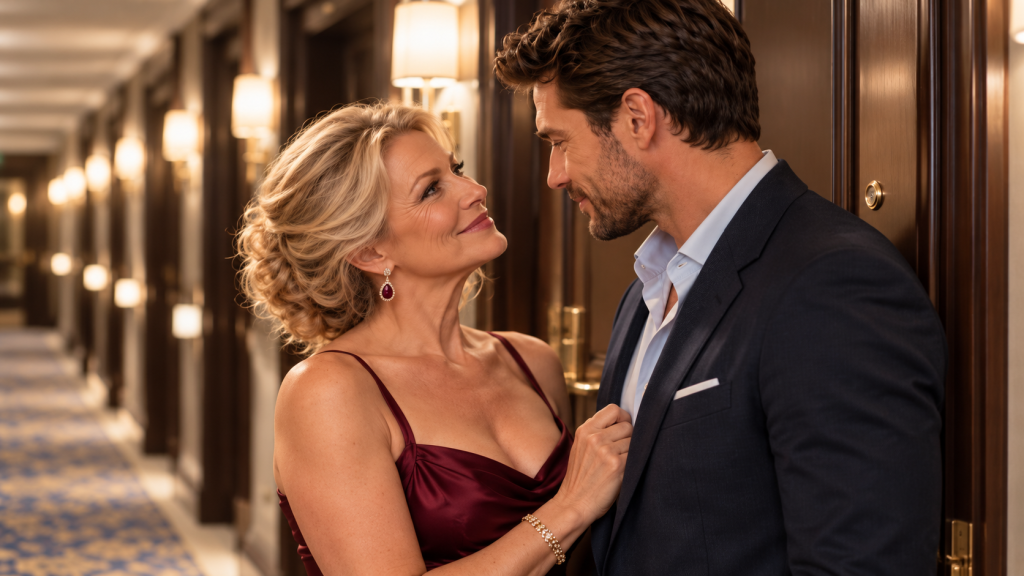
“Thank you.” There was a pause. “Oh, God.” Her voice changed. “Mom, I’m sorry.” “It’s fine.” “No.” “I completely lost track yesterday.” “The kids had soccer, Ben’s mother came over, and then—” “Emily.” She stopped. “It’s okay.” But it wasn’t. Not really.
I had spent so many years saying it’s okay that the words had become a broom I used to sweep myself out of other people’s way.
Emily continued cautiously.
“You sound strange.”
“I didn’t sleep well.”
“Were you home?”
I looked around the hotel room.
Daniel’s side of the bed was still rumpled.
“No.”
That surprised her.
“Where are you?”
“In a hotel downtown.”
“Why?”
“I wanted a change.”
A longer pause.
Then, with the gentle horror adult children reserve for discovering their mothers have private lives:
“Mom… are you okay?”
I almost told her everything.
That I had worn the green dress.
That a forty-year-old man had bought me dessert.
That I had let myself feel wanted for one night.
That the man had vanished by morning and left behind proof that he was her father’s son.
Instead, I said:
“I found something about Dad.”
Emily became silent.
“What?”
“I need to understand it before I tell you.”
“Is this about money?”
“No.”
“Was Dad sick longer than he told us?”
“No.”
“Then what?”
“I don’t know yet.”
That answer was true.
“Mom, you’re scaring me.”
“I’m scared too.”
The words came out before I could stop them.
Emily immediately softened.
“I can come.”
“No.”
“Mom.”
“I need a few hours.”
“At least tell Michael.”
My son.
Forty-one years old.
Living in Boston.
We had spoken nine days earlier when he called to ask whether I still had his college tax records.
Not once had he mentioned my birthday.
“No.”
I said it more sharply than I intended.
“I will tell both of you when I know what I’m telling you.”
Emily was quiet.
Then:
“Okay.”
Before hanging up, she whispered:
“I really am sorry about yesterday.”
I closed my eyes.
“I know.”
After the call, I sat motionless for nearly twenty minutes.
Then I picked up Daniel’s letter again.
There was an address beneath his final sentence.
Briarwood Archival Storage, Locker 217.
The key taped below it was small and brass.
My first impulse was to throw everything away.
Go home.
Take a shower.
Wash Daniel’s scent from my skin.
Pretend the night had been nothing more than a foolish birthday decision that an older woman was allowed to regret privately.
But the photograph would still exist.
The birth certificate would still exist.
Robert would still have had a son.
So I dressed.
I did not put the green dress back on.
I folded it carefully and placed it inside my suitcase.
I remember that because later I would spend months refusing to wear that dress.
As if fabric could be guilty.
At the time, I needed something to blame that was easier than a dead husband, a stranger named Daniel, or myself.
Briarwood Archival Storage occupied the basement of an old office building near Union Square.
It was not the metal-door warehouse I expected.
The receptionist checked the key number, asked for identification, then frowned at her screen.
“Locker 217 is part of a prepaid private archive.”
“Prepaid by whom?”
She turned the monitor away slightly.
“I can’t disclose account details unless you’re the authorized secondary.”
I handed her Robert’s letter.
Then my driver’s license.
Her expression changed.
“Mrs. Collins?”
“Yes.”
She stood.
“Please wait.”
Ten minutes later, a manager named Mr. Freeman approached.
He carried a clipboard.
“Your husband listed you as the successor authorized party.”
My throat tightened.
“My husband died four years ago.”
“I’m sorry.”
“Why didn’t anyone contact me?”
He checked the file.
“We did.”
I stared at him.
“What?”
“Three notices were mailed after the account holder’s death was confirmed.”
“To what address?”
He read it.
Our old house.
The house I had sold eighteen months after Robert died.
I had forwarded mail.
Or thought I had.
“Were they returned?”
“One was.”
“And the others?”
“No record.”
My stomach tightened.
“Who has accessed the locker recently?”
Mr. Freeman checked.
“A Daniel Mercer.”
I looked up sharply.
“Mercer?”
“Yes.”
“Not Collins?”
“No.”
“He was listed as an alternate authorized party.”
“When?”
“Original agreement.”
“By Robert?”
“Yes.”
Daniel’s mother’s surname, I would later learn, had been Mercer.
Daniel had legally used Mercer most of his life.
The birth certificate in the hotel had listed Daniel Collins, but apparently that was not the name under which he had grown up.
Already, even the pieces I thought I understood were shifting.
Mr. Freeman led me downstairs.
Locker 217 was the size of a walk-in closet.
Inside sat three archive boxes.
One gray metal cashbox.
A camera bag.
And Robert’s old leather briefcase.
My husband had owned that briefcase for twenty-two years.
I knew the scratch near the clasp.
I had made it accidentally while moving a dining chair.
Seeing it there felt more intimate than seeing his photograph.
I touched the handle.
Cold.
Real.
Mr. Freeman said:
“I’ll give you privacy.”
When the door closed, I stood alone with the part of my husband’s life he had apparently hidden from me.
I opened the briefcase first.
Letters.
Dozens.
Some addressed to Grace.
Some to Daniel.
Three addressed to me.
My name in Robert’s handwriting.
I sat on the floor.
The first envelope read:
For Margaret — if I lose my courage again.
My name.
There it was.
Margaret Collins.
Wife.
Mother.
Widow.
And apparently the last person to know her husband’s largest secret.
My hands shook as I opened it.
Margaret,
There is something I should have told you years ago. Every year I postponed it, the truth became harder to say because I was no longer confessing one omission. I was confessing years of them.
I stopped.
Pressed my knuckles to my mouth.
Then continued.
Before I met you, I loved a woman named Grace Mercer. We were young and foolish and not especially kind to each other. We separated in 1984. I did not know she was pregnant.
My breathing changed.
Robert and I met in 1987.
Married in 1988.
Daniel was not the result of an affair.
Relief entered first.
Then guilt for feeling relieved.
Robert continued:
Grace married another man before Daniel was born. He raised Daniel as his son. I was never told.
I read the paragraph again.
Daniel had grown up believing another man was his father.
Robert wrote:
I learned Daniel existed in 2001, when he was fifteen. Grace contacted me after her husband died. She said Daniel had started asking questions.
The photograph.
Teenage Daniel beside Robert.
The first year after they met.
My eyes blurred.
I asked for a paternity test. Not because I wanted to reject him. Because I could not enter a boy’s life based on memory and guilt alone. The test confirmed he was mine.
The gray metal cashbox suddenly mattered.
I opened it.
Inside was a folder.
PATERNITY ANALYSIS — ROBERT COLLINS / DANIEL MERCER.
Probability:
99.98 percent.
I sat back against the wall.
No uncertainty.
Daniel was Robert’s son.
Emily and Michael’s half-brother.
My husband had learned that twenty-three years before he died.
And never told me.
The letter continued:
I should have come home that night and told you.
My eyes filled.
Yes.
Instead, I told myself Daniel had already lost one father and I needed to move slowly. Grace begged me not to disrupt his life. Daniel begged me not to tell anyone at first because he was ashamed and confused. I agreed.
That agreement should have lasted weeks. Maybe months.
It lasted years because I was a coward.
There it was.
Not:
I protected you.
Not:
You wouldn’t understand.
Coward.
Robert knew.
I saw Daniel quietly. Birthdays. Lunches. Several weekends. I helped with college when he eventually tried it. I helped when he dropped out. I helped when he started photography.
You thought some of those weekends were work trips.
My hand tightened around the paper.
Lies.
Not infidelity.
But lies.
Hotel bookings.
Conferences.
Delayed trains.
I remembered.
One Thanksgiving weekend when Robert said a client emergency kept him in Philadelphia.
Had he been with Daniel?
I kept reading.
I never had another romantic relationship with Grace. I need you to know that, though I understand fidelity is larger than sex. I built a room in our marriage you were not allowed to enter.
I closed my eyes.
Even dead, Robert understood exactly what he had done.
The next paragraph hurt more.
Grace wanted me to leave you once Daniel learned the truth.
My stomach dropped.
She told herself I had always belonged with her. I did not agree. I loved you. I loved Emily. I loved Michael. I also loved Daniel. Those truths did not fit neatly, and instead of asking my family to live with complexity, I chose secrecy.
I looked at the ceiling.
“Damn you, Robert.”
My voice sounded small inside the locker.
I continued.
Grace came to resent you even though you did not know she existed.
That matched Daniel’s letter.
His mother told him I was the reason Robert never returned.
Robert wrote:
She began telling Daniel that you would destroy his place in my life if you knew. I corrected that whenever I heard it, but not forcefully enough. How could I prove you would accept a truth I had never trusted you enough to tell?
Exactly.
He had allowed a stranger to make me the villain in a story from which I had been excluded.
My grief became anger so quickly that I had to stand.
I paced between the boxes.
“You let her blame me.”
The dead do not answer.
I hated that.
In the second box were letters from Grace.
Some furious.
Some tender.
Some manipulative.
One from 2005:
Daniel knows you chose your proper family. Do not pretend these occasional lunches make you his father.
Robert’s reply, preserved beside it:
Margaret is not the reason I remain married. I remain married because I love my wife. That does not mean Daniel matters less. Stop telling him one love must erase another.
I cried reading that.
Loved me.
Defended me.
Lied to me.
People rarely fit inside the verdict we want.
Another letter from Grace:
If Margaret knew, she would make you choose.
Robert had written beneath it in pen:
I have no right to predict her answer anymore. I took the choice away from her years ago.
I sat again.
That was the wound.
Choice.
He took mine.
And Daniel had done the same thing the previous night.
Different circumstances.
Same arrogance.
Men deciding what I should know before I gave them access to myself.
The thought made me nauseous.
I opened the second envelope addressed to me.
It had been written two years before Robert died.
Margaret,
I tried to tell you tonight. You were sitting at the kitchen table complaining that Michael never calls unless he needs tax advice. I almost said, “You actually have another stepson who hardly calls either.”
Despite everything, I laughed.
Then cried harder.
I lost my nerve because I imagined the look on your face when you calculated how long I had lied.
I am beginning to understand that I am no longer afraid of telling you Daniel exists. I am afraid of telling you how long I let you not know.
Yes.
Exactly.
The final letter was dated eight months before Robert’s death.
He had died from a heart attack.
Sudden.
He had coronary disease, but none of us believed death was close.
The last envelope said:
Margaret, if you are reading this because I died before telling you, then I failed in the most predictable way possible. I waited for courage instead of practicing it.
My tears fell onto the page.
Daniel is not your responsibility.
He is mine.
If he comes to you angry, understand that Grace loved him fiercely but taught him a version of our history shaped by her own wounds. Do not accept blame that belongs to me.
I froze.
Robert had predicted this.
If Daniel wants a relationship with Emily and Michael, that decision belongs to the three of them.
If you want nothing to do with him, that decision belongs to you.
I have spent too long making decisions on behalf of other people. I will not do it in this letter too.
I lowered the paper.
For the first time that morning, I felt something besides shock.
Recognition.
Robert had failed.
Deeply.
But before he died, he had at least learned the shape of the failure.
The camera bag contained a small digital recorder.
One file.
Dated three months before his death.
I pressed play.
Robert appeared on a screen barely larger than my palm.
He sat in our garage.
The old shelves behind him.
He looked tired.
“Margaret.”
I started sobbing immediately.
His voice.
Four years.
Four years since I had heard that voice except in old birthday videos.
He continued.
“If you are seeing this, I probably did what I always do when something frightens me.”
He smiled sadly.
“I postponed it.”
I laughed through tears.
“You coward.”
Onscreen Robert nodded almost as if he heard me.
“I need to tell you about Daniel.”
He told the story again.
Grace.
The pregnancy.
Her marriage.
The paternity test.
The secret meetings.
Then something the letters had not explained.
“Daniel stopped speaking to me in 2017.”
My brow furrowed.
Why?
Robert continued.
“He wanted me to tell you.”
I stared.
“He was thirty-one.”
“He said he was tired of being a secret.”
“I told him I would.”
“I didn’t.”
His eyes lowered.
“He gave me six months.”
“Then another six.”
“Then he said he could no longer be part of a relationship that required him to disappear.”
I whispered:
“Good for him.”
Robert looked toward the camera.
“I was angry.”
“I told him adulthood meant understanding that families are complicated.”
“He told me adulthood should also mean telling the truth.”
I almost smiled.
Daniel had been right.
Robert continued.
“I did not see him again.”
My chest tightened.
The man Daniel had described as never coming back had not abandoned him exactly as Grace claimed.
But Robert had lost him.
Through cowardice.
Three years of silence before Robert died.
Then four more years after death.
Seven years.
I thought of Daniel in the bar.
Watching me.
Knowing me.
Wondering what kind of woman had been worth being chosen over him.
And hating me for a decision I never made.
Robert’s voice softened.
“I set aside money for Daniel.”
There it was.
I glanced toward the gray box.
“There is a trust administered separately from our estate.”
“I did not take anything from you, Emily, or Michael to establish it.”
“I used proceeds from consulting work and an inheritance from Uncle Peter.”
“The current balance should be around one hundred eighty thousand dollars.”
I swallowed.
“Daniel knows about it.”
“He has never touched it.”
That surprised me.
Robert continued.
“He told me money was not the same thing as a father willing to say his name aloud.”
My heart broke a little for both of them.
Robert breathed deeply.
“If Daniel comes after I am gone, please do not pay for my sins by allowing him to mistreat you.”
I went still.
The words seemed to cross time.
“He has every right to be angry with me.”
“He does not have the right to turn you into me.”
My hand began trembling.
Robert looked directly into the camera.
“And Margaret…”
His voice cracked.
“You were never the reason I didn’t become the father Daniel needed.”
“I was.”
The video ended.
I sat alone for a long time.
Then I opened the last box.
Photographs.
Daniel at sixteen.
Seventeen.
Twenty.
Robert standing beside him at a gallery.
Robert watching him graduate from a photography course.
A Christmas photo I had never seen.
Just Robert and Daniel in front of a diner decorated with plastic garland.
On the back:
December 2008. Told Margaret the client meeting ran late.
I dropped it.
The anger returned.
Truth does not become painless because the liar eventually understood himself.
At the bottom of the box sat a sealed envelope addressed:
DANIEL — IF YOU EVER DECIDE TO MEET THEM.
I stared.
Not mine.
I did not open it.
That was the first decision that day that made me feel like myself again.
It belonged to Daniel.
So I put it aside.
Then my phone rang.
Unknown number.
I knew.
I answered.
“Margaret?”
Daniel.
My whole body tightened.
“Where are you?”
Silence.
Then:
“Outside.”
I looked toward the locker door.
“Outside the building?”
“Yes.”
My anger sharpened.
“You followed me?”
“No.”
“I knew you’d come.”
“That’s not better.”
“I’m sorry.”
“No.”
My voice trembled.
“You don’t get to use that word yet.”
He went quiet.
I continued.
“You knew who I was before you walked to my table.”
“Yes.”
“You knew Robert was your father.”
“Yes.”
“You knew I was his widow.”
“Yes.”
His breathing changed.
I asked the hardest question.
“Did you plan what happened between us?”
“No.”
I closed my eyes.
“Do not lie to me again.”
“I’m not.”
“You watched me for three months.”
“Yes.”
“You knew where I sometimes went.”
“Yes.”
“How?”
“My mother had old addresses.”
“That does not explain a bar.”
He hesitated.
“I found your public social media.”
My stomach turned.
“I don’t post much.”
“Your friend Carol tagged you there once.”
Months earlier.
A birthday lunch.
Same neighborhood.
“So you came hoping to meet me.”
“Yes.”
“As Daniel who?”
He whispered:
“Daniel Mercer.”
“But you gave me only Daniel.”
“Yes.”
“You said you had just returned from a photography trip.”
“That was true.”
“How generous.”
“Margaret—”
“No.”
My voice rose.
“You do not get credit because some sentences were true.”
Silence.
I continued.
“You came to investigate me.”
“Yes.”
“You wanted answers.”
“Yes.”
“Did you want to hurt me?”
His silence lasted too long.
“Daniel.”
“At first?”
His voice cracked.
“Yes.”
The answer made my chest ache.
“How?”
“I wanted you to know I existed.”
“That is not what I asked.”
He swallowed.
“I wanted to see whether you were the kind of woman my mother described.”
“And?”
“You weren’t.”
My laugh was bitter.
“You discovered that before or after you came upstairs with me?”
He said nothing.
My face burned.
Not with shame about the night.
With violation.
I said slowly:
“I consented to spending the night with a stranger.”
Daniel started:
“I know.”
“No.”
“You clearly don’t.”
I gripped the phone.
“I consented to Daniel the photographer.”
“I did not consent to sleeping with my dead husband’s secret son while he silently judged whether I deserved the life his father chose.”
His voice broke.
“You’re right.”
“I didn’t know what was going to happen.”
“But you knew what I didn’t.”
“Yes.”
“And you let me make an intimate decision without information you knew would matter.”
“Yes.”
There it was.
No excuse.
I appreciated that only later.
At the time, I wanted him to hurt.
I said:
“I regret last night.”
He whispered:
“I do too.”
“Good.”
Another silence.
Then:
“Can I come in?”
“No.”
“I need to explain.”
“You have explained enough without permission.”
“Margaret—”
“There is an envelope here for you.”
Silence.
“From Robert.”
His breathing stopped.
“I didn’t see that.”
“I know.”
“I didn’t open it.”
Long pause.
“Why?”
“Because it has your name on it.”
He started crying.
Quietly.
I did not comfort him.
“Go home, Daniel.”
“I don’t have one here.”
“That is not my problem.”
“You’re right.”
I almost hung up.
Then he said:
“I never expected you to be lonely.”
My hand froze.
“What?”
“When I started watching you…”
His voice shook.
“I expected arrogance.”
“Money.”
“A widow living comfortably on the life my father chose instead of me.”
I closed my eyes.
“But you ate alone.”
“You carried your own groceries.”
“You sat in the park and watched other people’s grandchildren.”
“Stop.”
“I’m sorry.”
“Stop describing me like a surveillance project.”
He went silent immediately.
Good.
Then:
“I’ll leave.”
“Do that.”
I hung up.
Ten minutes later, Mr. Freeman knocked.
“Mrs. Collins?”
“Yes?”
“There’s a man upstairs.”
“I know.”
“He asked me to give you this.”
A small black camera card.
No note.
I stared at it.
“What is it?”
“He said you can decide whether to look.”
I almost threw it away.
Instead, I put it in my purse.
Then I took Robert’s letters.
The paternity report.
The video recorder.
The envelope addressed to Daniel.
I left the rest where it was.
When I reached the street, Daniel was gone.
Good.
I went home.
My house felt unfamiliar.
Not because anything had changed.
Because Robert had.
Or rather my understanding of him had.
His mug was still in the back of the cabinet.
His gardening gloves still hung in the garage.
For four years, I had turned grief into a kind of sainthood.
Robert had been patient.
Robert had been loyal.
Robert had been a wonderful father.
Robert had adored me.
Some of those things remained true.
Others required footnotes.
That hurt.
By evening, I called Emily.
“Come tomorrow.”
“Mom—”
“Bring Michael if he can get here.”
“What happened?”
“Your father had another son.”
Silence.
Then:
“What?”
“I’ll explain tomorrow.”
“Dad cheated?”
“No.”
“I don’t think so.”
“You don’t think?”
“Emily.”
My voice cracked.
“Tomorrow.”
She came at 10:00.
Michael arrived from Boston shortly after noon.
He walked into my kitchen and kissed my forehead.
“Happy birthday, Mom.”
“Yesterday would’ve been more convincing.”
He froze.
Then actually winced.
“I know.”
Good.
I had decided I was allowed to say that.
Emily looked at the boxes of papers.
“What is this?”
I placed the photograph on the table.
Robert and teenage Daniel.
Michael picked it up.
“Who’s the kid?”
“Your brother.”
Neither spoke.
Then Emily laughed nervously.
“No.”
Michael looked at me.
“Dad had a son?”
“Yes.”
“Before us?”
“Before me.”
“Before you?”
“Yes.”
I explained.
Grace.
The hidden pregnancy.
The paternity test.
Robert learning in 2001.
The secret visits.
The letters.
The trust.
The estrangement.
Robert’s death.
Daniel’s mother dying the previous winter.
Emily cried first.
“He lied to us.”
“Yes.”
Michael stared at the photograph.
“Did Dad know Daniel when I was in high school?”
“Yes.”
“When he missed my graduation dinner?”
My chest tightened.
I checked the date in my memory.
Robert had said he was in Chicago.
One letter in the box had mentioned attending Daniel’s first gallery exhibit around that period.
I did not know exact dates.
“I don’t know.”
Michael’s jaw hardened.
“Of course.”
“Don’t invent something we don’t know.”
He looked at me sharply.
I continued.
“There is enough truth to be angry about.”
“We don’t need extra.”
He nodded slowly.
That became a rule.
No imaginary betrayals added to real ones.
Emily asked:
“Where is Daniel now?”
“I don’t know.”
“Do you have his number?”
“Yes.”
“Have you met him?”
There it was.
My mouth went dry.
“Yes.”
“When?”
I looked down.
“On my birthday.”
Emily stared.
“The man?”
I looked up.
“What man?”
She knew.
Somehow mothers forget their daughters can read faces.
Emily whispered:
“You said you were at a hotel.”
Michael looked between us.
“Wait.”
My humiliation returned.
Not because I was sixty-two and had slept with someone.
Because the truth was grotesquely tangled.
I said:
“I met him at a bar.”
“Neither of you knew?” Michael asked.
I went silent.
Emily’s face changed.
“Oh, God.”
“Mom.”
I forced myself to say it.
“He knew who I was.”
Michael stood.
“What?”
“He approached me intentionally.”
“Did he hurt you?”
“No.”
Then I stopped.
Physical harm was not the only meaning of that question.
“I was not physically forced.”
Emily reached for my hand.
“But?”
I swallowed.
“He concealed information he knew would have changed my decision.”
Michael began pacing.
“I’ll kill him.”
“No.”
The word came sharply.
He turned.
“Mom.”
“No.”
“He targeted you.”
“Yes.”
“He slept with Dad’s wife knowing—”
“I know exactly what happened.”
My voice broke.
“You do not protect me by taking control away from me again.”
Michael stopped.
That landed.
Good.
I continued.
“You may be angry.”
“You may decide you never want to meet him.”
“You may tell him what you think if you choose to speak with him.”
“But you will not threaten him for me.”
Michael sat down.
Hard.
Emily was crying.
Then she whispered:
“Mom, did you know?”
“No.”
“Not even a hint?”
“No.”
She squeezed my hand.
“Then this is not something you did wrong.”
I looked at her.
“I chose the night.”
“With the information you had.”
“Yes.”
“Then don’t let his deception turn your choice into shame.”
My daughter.
The same daughter who forgot my birthday.
People can fail you in one way and save you in another.
I started crying.
Emily moved around the table and held me.
Michael eventually joined.
Awkwardly.
We stayed there for a long time.
Then Michael said into my shoulder:
“This is the weirdest family meeting we’ve ever had.”
I laughed despite myself.
“Please never say that again.”
He smiled through tears.
For the next three weeks, none of us contacted Daniel.
He contacted no one either.
That mattered.
No pressure.
No flowers.
No dramatic apology at my door.
Just one email.
Subject:
No response required.
I almost deleted it.
Then opened it.
Margaret,
I am not writing to ask forgiveness. You were right. I came to you holding information that belonged inside any decision about intimacy, and I chose not to give it because I was afraid you would leave before I got what I wanted from the encounter—first answers, then closeness.
I stopped.
He continued.
I told myself the night changed things unexpectedly. That is true but incomplete. I had already manipulated the conditions under which you met me.
Good.
Precise.
No romantic excuses.
I am sorry.
I will not contact you again unless you contact me.
If Emily or Michael ever want proof of who I am, I will provide it through an attorney or laboratory without requiring personal contact.
Daniel
I saved the email.
Did not reply.
My children had different reactions.
Michael wanted nothing to do with Daniel.
At first.
Emily wanted a DNA test.
Not because she doubted Robert’s old report.
Because she wanted something current.
Hers.
A truth she participated in verifying.
Through attorneys, they arranged a sibling DNA test.
Daniel agreed immediately.
The result supported a paternal half-sibling relationship.
There was no longer any argument.
Daniel was Robert’s son.
Their brother.
Michael stared at the report.
“So Dad really did this.”
I corrected him.
“Dad did not create Daniel as a betrayal.”
“You know what I mean.”
“Yes.”
But language mattered.
Robert’s failure was hiding him.
Not Daniel’s existence.
Six months passed.
Then Emily asked to meet him.
I was surprised.
“Why?”
“Because I keep thinking about him being sixteen.”
I looked at her.
She continued.
“Dad suddenly appears.”
“Tells him he has another family.”
“Then keeps him hidden.”
“I’m angry at him for what he did to you.”
“But I’m also angry at Dad.”
“Yes.”
“I need to see which anger belongs where.”
That sounded wise.
I said:
“Meet him.”
“You won’t come?”
“No.”
“You’re sure?”
“Yes.”
My relationship with Daniel was separate from hers.
I had learned enough about stolen choices.
Emily met him at a coffee shop.
Two hours.
Then four.
She called me afterward.
“He looks like Dad.”
I closed my eyes.
“I know.”
“He does that thing with his eyebrow.”
“I know.”
“He knew about my high-school debate championship.”
That surprised me.
“What?”
“Dad told him.”
My chest tightened.
“He knew about Michael’s broken arm.”
“Your wedding.”
“My first baby.”
I sat down.
Robert had made Daniel invisible to us.
But apparently, he had not made us invisible to Daniel.
Emily whispered:
“He had photographs.”
I started crying.
Not jealousy.
Something stranger.
A young man sitting outside a family story, receiving updates about siblings who did not know his name.
Robert had given him scraps.
Maybe with love.
Still scraps.
“Are you okay?” Emily asked.
“No.”
“Me neither.”
Then:
“I think I want to see him again.”
I swallowed.
“Okay.”
“You’re really okay?”
“I don’t need to be okay with your relationship.”
She went quiet.
Then:
“Thank you.”
Michael held out another four months.
Then Daniel mailed him something through Emily.
Robert’s old Yankees cap.
Michael had thought it disappeared years ago.
He called Daniel that night.
Their first conversation lasted eleven minutes.
The second lasted three hours.
I knew because Michael told me later.
Not everything.
Enough.
Their relationship developed strangely.
Not as brothers raised together.
Not strangers either.
They had shared a father in separate rooms.
Sometimes that was enough to create immediate recognition.
Sometimes it made the distance worse.
Daniel told them things about Robert they never knew.
Robert told terrible jokes at diners.
Always over-tipped.
Hated having his picture taken.
Carried antacids everywhere.
We knew all that.
Then Daniel told them something none of us knew.
Robert had once rented a cabin near Lake George for a weekend because he hoped to bring all three children there and finally tell everyone.
He canceled two days before.
Cowardice again.
Emily cried.
Michael swore.
Daniel simply said:
“He kept trying to become brave in advance.”
That line stayed with me.
Bravery in advance.
As if courage were an appointment you could schedule when fear became convenient.
I had done the same with loneliness.
I kept telling myself I would make friends again eventually.
Travel eventually.
Join a class eventually.
Live eventually.
Then I turned sixty-two and no one called.
That birthday had hurt because it exposed more than neglect.
I had been waiting for other people to return me to life.
My children.
My dead husband’s memory.
Friends I stopped calling because grief made conversation difficult.
Daniel had exploited that loneliness.
But he had not created it.
That distinction mattered too.
A year after the hotel, I finally looked at the camera card Daniel left.
I put it into my computer.
Photographs.
Hundreds.
Not of me.
Mostly of cities.
Workers.
Train stations.
Old women laughing on balconies.
Children running through fountains.
Daniel really was a photographer.
Then I reached the last folder.
ROBERT.
My chest tightened.
Photographs Daniel had taken of his father.
Robert laughing over coffee.
Robert asleep in a diner booth.
Robert standing in Central Park.
Robert older.
Gray.
Familiar.
One photograph destroyed me.
Robert sat alone on a bench holding a photograph of our family.
Me.
Emily.
Michael.
Christmas 2015.
Daniel had captured him looking down at us.
On the image metadata, Daniel had written:
He said he had two families and was failing both because he only knew how to love one honestly.
I cried for a long time.
The final file was a video Daniel recorded after leaving the hotel.
I hesitated before opening it.
He sat in his car.
Morning light through the windshield.
His eyes were red.
“Margaret.”
He stopped.
Started again.
“I don’t know whether I’m going to leave this for you.”
Long silence.
“What I did last night was wrong.”
My breathing changed.
“I did not plan to sleep with you.”
“I planned to meet you.”
“To ask questions.”
“Maybe to make you uncomfortable.”
He looked ashamed.
“I thought if you were cruel, I could keep hating you.”
Another silence.
“Then you told me it was your birthday.”
“You said no one called.”
“And I thought…”
He rubbed both hands over his face.
“I thought this cannot be the woman my mother described.”
His voice broke.
“I should have told you then.”
Yes.
He continued.
“I should have told you before we left the bar.”
“Yes.”
“Before I touched your hand.”
“Yes.”
“Before I went upstairs.”
“Yes.”
Tears ran down my face.
“Instead, I kept thinking: one more minute.”
“Then another.”
“Then it was too late, which is what cowards say when they mean they kept choosing.”
I froze.
Robert.
Same family trait.
Delay disguised as helplessness.
Daniel looked into the camera.
“My father did this to all of us.”
“Not the same thing.”
“But the same excuse.”
“I’ll tell her after dinner.”
“After Christmas.”
“After the children are older.”
“After Grace calms down.”
“After I’m braver.”
Daniel shook his head.
“I spent my whole life furious at him for withholding truth until truth became dangerous.”
“And then I did it to you in one night.”
I closed my eyes.
There was no music.
No plea.
Just the recording ending with:
“I’m sorry.”
I did not forgive him that day.
But I stopped wondering whether he understood.
At sixty-three, I celebrated my birthday differently.
I wore the green dress again.
That was deliberate.
For a year, it had hung in my closet like evidence.
I took it out.
Had it cleaned.
Put on the same earrings.
Not because I wanted to recreate the night.
Because the dress belonged to me before Daniel touched it.
My body belonged to me before Robert’s secrets complicated it.
My age belonged to me.
My desire to be seen belonged to me.
I refused to surrender those things to regret.
Emily organized dinner.
Michael flew in.
My old friend Carol came.
So did two women from the watercolor class I had joined.
Yes.
Watercolor.
I was terrible.
Delightfully terrible.
At 7:30, Emily brought out a cake.
Sixty-three candles would have violated fire code, so there were three.
I laughed.
Then my phone buzzed.
A message.
Daniel.
Only four words.
Happy birthday, Margaret. No reply needed.
I stared at it.
Then typed:
Thank you.
That was our first contact in a year.
Nothing more.
Three months later, Emily got engaged to help organize a family medical-history file.
Daniel provided his records.
Robert’s father had died of colon cancer.
Daniel had undergone early screening.
That information mattered to Emily and Michael.
Biology has practical consequences even when relationships are complicated.
Eventually, Daniel and I met again.
Not privately.
Not at night.
Not in a bar.
Emily’s house.
Sunday afternoon.
Two years after my sixty-second birthday.
He arrived early.
I almost left when I saw him through the window.
Then I stayed.
Not for him.
For me.
When he entered, he looked older.
Or perhaps simply less mysterious.
Mystery can make people look larger.
Truth returns them to human size.
“Margaret.”
“Daniel.”
He did not approach for a hug.
Good.
We sat across from each other.
Emily conveniently disappeared into the kitchen.
Coward.
Daniel said:
“I’m sorry.”
“I know.”
“I don’t expect—”
“I know.”
He stopped.
Good.
I looked at him.
“You hurt me.”
“Yes.”
“Your mother hurt me without knowing me.”
“Yes.”
“Robert hurt all of us.”
“Yes.”
“And none of that gave you the right to test me.”
His eyes lowered.
“No.”
“I was not an exhibit in your case against your father.”
“No.”
“I was a lonely woman in a bar.”
His voice cracked.
“I know.”
I continued.
“And I need you to understand something else.”
He looked up.
“I do not regret wanting closeness.”
He went still.
“I regret that you deceived me.”
I felt my voice strengthen.
“I regret that my choice was made inside a lie.”
“But I will not call myself disgusting.”
“I will not call myself foolish for being sixty-two and wanting to feel desired.”
“I will not turn my own body into punishment because you withheld the truth.”
Daniel started crying.
I did not.
Not then.
He whispered:
“You shouldn’t.”
“I know.”
That was the moment I began forgiving myself.
Not him.
Myself.
Later that afternoon, Daniel handed me Robert’s sealed envelope.
“You should keep it.”
“No.”
“It’s from him.”
“To you.”
“I read it.”
I stared.
“You opened it?”
His face flushed.
“After you gave it to Emily.”
I looked toward the kitchen.
Emily shouted:
“I asked him to!”
Traitor.
Daniel almost smiled.
Then held the letter out.
“I want you to read one part.”
I hesitated.
Then opened it.
Robert’s handwriting.
Daniel, if you ever meet Margaret, do not ask her why I stayed.
My throat tightened.
I stayed because I chose my marriage.
Do not turn that choice into proof that you were less lovable.
I stopped.
Daniel whispered:
“Keep going.”
And do not punish Margaret for receiving a love she did not steal from you.
My eyes filled.
Daniel looked down.
“Dad knew me too.”
I read the rest.
If you meet Emily and Michael, remember that they did not take your father from you.
I divided myself. They did not divide me.
You are allowed to be angry.
You are not entitled to make innocent people carry the shape of that anger.
I folded the letter.
Daniel whispered:
“I wish I’d read it before your birthday.”
“So do I.”
Silence.
Then:
“Would it have stopped you?”
He thought.
“I hope so.”
Not good enough.
But honest.
We never became close.
That surprises people when they hear the story.
They expect forgiveness to end in friendship.
It didn’t.
Daniel became close to Emily.
Moderately close to Michael.
He became Uncle Daniel to their children gradually, awkwardly, after everyone decided what language felt right.
He attended holidays sometimes.
When I was there, we were civil.
Warm occasionally.
Never intimate.
He never flirted.
Never referenced the night.
Never tried to transform wrongdoing into some tragic romance.
That helped.
Five years after we met, he married.
A photojournalist named Leah.
Emily called first.
“Are you okay?”
I laughed.
“Why wouldn’t I be?”
“I don’t know.”
“Do you think I’ve been waiting?”
“No.”
“Good.”
Daniel invited me.
I almost declined.
Then I went.
Not because I had become his mother.
Not because our strange history had become sweet.
Because my children wanted me there.
Because he had respected the boundaries I set for years.
And because people are allowed to change without being rewarded with the exact relationship they damaged.
At the reception, Daniel approached.
Leah beside him.
She knew the history.
All of it.
He had told her before their relationship became serious.
That mattered enormously to me.
Daniel said:
“Margaret, this is Leah.”
She smiled.
“I’ve heard a lot about you.”
I raised an eyebrow.
“Hopefully the edited version.”
Daniel said:
“No.”
Good.
Leah laughed gently.
Then hugged me only after asking:
“May I?”
“Yes.”
Permission.
Such a small word.
Such an enormous difference.
Daniel married her knowing that truth offered before commitment was not guaranteed to preserve love.
It simply gave the other person dignity.
Robert had learned that too late.
Daniel learned it in time for someone else.
That did not undo what happened to me.
It still mattered.
Michael once asked me:
“Do you forgive Dad?”
I was sixty-nine.
We were driving back from a family dinner.
I thought for a long time.
“For having Daniel?”
“No.”
“For hiding him.”
I looked out the window.
“I understand him.”
Michael frowned.
“That isn’t what I asked.”
“I know.”
Then:
“Some days, yes.”
“Some days, no.”
He smiled slightly.
“Can forgiveness do that?”
“Mine can.”
I had spent enough of my life obeying definitions other people wrote.
Robert died before he could receive my anger.
That made forgiveness strange.
There was no conversation.
No repair.
Only evidence that he had understood his cowardice.
Sometimes that was enough to soften me.
Sometimes it made me angrier.
He knew.
And still died without telling me.
Both feelings remained.
At seventy, I finally visited his grave with Daniel.
Just the two of us.
The first time we had been alone since the hotel.
That fact made me nervous.
Then I realized I trusted him to respect the boundary.
Trust can return in one category without returning in all.
We stood before Robert’s stone.
Daniel held a camera but did not use it.
I said:
“Your father was a pain in the ass.”
Daniel laughed.
“Absolutely.”
“He snored.”
“He told me he didn’t.”
“He lied about that too.”
We both laughed.
Then silence.
Daniel said:
“I used to hate this grave.”
“Why?”
“Because it said ‘beloved husband and father.’”
My chest tightened.
He continued.
“I thought I wasn’t included.”
I looked at the inscription.
BELOVED HUSBAND, FATHER, FRIEND.
I said:
“You were.”
Daniel wiped his eyes.
“I know now.”
Then he looked at me.
“And you were his wife.”
“Yes.”
“I spent years acting like one had to cancel the other.”
“Yes.”
“My mother taught me that.”
I nodded.
“She was hurt too.”
“Yes.”
“But she was wrong.”
“Yes.”
He looked at Robert’s name.
“Dad was wrong.”
“Yes.”
Then:
“And I was wrong.”
I looked at him.
“Yes.”
He laughed through tears.
“You really enjoy that answer.”
“A little.”
We stood there until the light changed.
Before leaving, Daniel placed Robert’s old camera strap on the stone.
Then changed his mind and picked it back up.
“Why?”
I asked.
He smiled.
“He’d tell me not to litter.”
I laughed so hard I cried.
Life rarely gives clean symbols.
Sometimes the dead still need you to take your garbage home.
I traveled more as I got older.
Italy at sixty-six.
Montreal at sixty-eight.
Portugal at seventy-one.
Sometimes with friends.
Sometimes alone.
Once with Emily.
I dated.
Carefully.
Not fearfully.
There was a retired teacher named Samuel who loved opera and hated garlic.
That ended for obvious reasons.
Then a widower named Charles who wanted marriage after four months.
No.
Then, at seventy-three, I met Peter.
He was seventy-one.
A former pharmacist.
Kind.
Divorced.
He asked too many questions about birds.
On our fifth date, before he kissed me, I laughed.
“What?”
he asked.
“Nothing.”
“Margaret.”
I looked at him.
“Ask me.”
“What?”
“If you may kiss me.”
He looked surprised.
Then smiled.
“May I kiss you?”
“Yes.”
It was ordinary.
Beautifully ordinary.
We stayed together eleven years.
Never married.
Neither needed to.
When Peter died, Daniel sent flowers.
No dramatic note.
Only:
I’m sorry.
That was enough.
By then, Daniel was in his sixties.
Emily and Michael had long stopped introducing him as “our father’s secret son.”
He was simply their brother.
That took decades.
Family words become natural through repetition.
I never called him my stepson.
Technically, some people might.
Emotionally, it never fit.
He was Daniel.
That was enough.
On my eightieth birthday, the whole family gathered.
Emily.
Michael.
Their spouses.
Grandchildren.
Daniel and Leah.
Friends.
Neighbors.
The watercolor women, though only one of the original group was still painting.
Someone produced photographs from every decade of my life.
There was one from my sixty-second birthday.
Me in the green dress.
At the bar.
Taken by the waiter when Daniel brought the dessert.
I had forgotten it existed.
The room became quiet.
Emily reached for the photograph.
“Should I take this out?”
I studied it.
I looked happy.
Not deceived.
Not yet.
Just alive.
A candle in front of me.
Green dress.
Earrings.
Eyes bright.
Daniel was not visible.
Only his hand at the edge of the frame.
For years, I would have said that photograph showed a woman seconds before a terrible mistake.
At eighty, I saw something else.
A lonely woman who decided not to spend her birthday waiting for people who forgot to call.
The night became painful later.
But that decision?
Leaving the house?
Wearing the dress?
Ordering wine?
Talking to someone?
Wanting to be desired?
No.
I would not surrender those things.
I told Emily:
“Leave it.”
Daniel looked at me across the room.
Our eyes met.
He understood.
Later, while everyone ate cake, he approached.
“You kept the picture.”
“Yes.”
“I’m glad.”
I looked at him.
“Don’t make it about you.”
He laughed.
“Fair.”
Then he handed me an envelope.
I groaned.
“This family needs to stop communicating through envelopes.”
He smiled.
“Open it later.”
“No.”
I opened it immediately.
Inside was the original photograph of Robert with teenage Daniel.
The one from the hotel.
Dad and me, 2002.
On the back, beneath the old handwriting, Daniel had added another line.
Margaret and me, still here, 2044.
I stared at him.
“That is unbearably sentimental.”
“I know.”
“Robert would’ve loved it.”
“I know.”
I looked at the two faces in the photograph.
My husband at fifty-something.
His son at sixteen.
The beginning of a secret that would take decades to stop hurting people.
I asked:
“Why give this to me?”
Daniel smiled sadly.
“Because it started as evidence.”
“What is it now?”
“History.”
That was right.
History.
Not permission.
Not absolution.
Not destiny.
History.
I put the photograph back into the envelope.
Then handed it to Emily.
“You keep it.”
She looked surprised.
“Why?”
“Because I’m tired of storing men’s secrets.”
Everyone laughed.
Even Daniel.
Especially Daniel.
That night, after the family left, I stood alone in my bedroom.
My eighty-year-old face looked back from the mirror.
Lines.
Silver hair.
Softness where there had once been angles.
I thought of the woman at sixty-two checking an empty phone.
She believed being forgotten meant she was disappearing.
So she dressed herself beautifully and went into the city to prove she could still be seen.
A man saw her.
But not in the way she thought.
He saw the wife his father had chosen.
The woman his mother blamed.
The keeper of answers she did not possess.
And for one night, his secrets collided with her loneliness.
I spent years learning what that night meant.
It did not mean I was foolish.
It did not mean women stop deserving desire after sixty.
It did not mean Robert had never loved me.
It did not mean Daniel was permanently evil.
It meant love without truth can injure people who never agreed to participate in the lie.
Robert learned that too late.
Daniel learned it after hurting me.
I learned something else.
Loneliness can make attention feel like rescue.
It isn’t always.
But loneliness itself is not shameful.
Need is not shameful.
Age is not shameful.
Desire is not shameful.
The shame belongs to deception.
And even shame can become accountability if a person stops defending what they did.
The next morning after my eightieth birthday, my phone began vibrating at 6:12.
Messages.
Too many.
Emily.
Michael.
Grandchildren.
Friends.
Daniel.
I laughed.
Apparently the family had overcorrected.
I made coffee.
Sat by the window.
Then opened Daniel’s message.
Happy birthday again. I’m early this time.
I typed:
Eighteen years late, technically.
Three dots appeared.
Then:
Fair.
I smiled.
Outside, the city was waking.
People going to work.
Young women rushing for trains.
Older men walking dogs.
Lives intersecting without knowing which stranger might become family, mistake, lesson, or nothing at all.
I thought of Robert.
Grace.
Daniel.
My children.
My own younger self.
I wished none of them perfect.
I wished them courage sooner.
That was the difference.
Truth does not always save relationships.
Sometimes it ends them.
Sometimes it changes their names.
Sometimes it arrives so late that all anyone can do is arrange the pieces honestly.
But late truth still has one mercy.
It stops the next lie from inheriting the future.
And that, finally, was what happened to us.
Robert’s secret did not disappear.
It became known.
Daniel’s deception did not become romantic.
It became something he had to own.
My children did not lose their father.
They gained a more complicated understanding of him—and a brother they were free to accept on their own terms.
And I did not lose the woman in the green dress.
For years, I thought she was the person I most regretted being.
Now I know better.
She was lonely.
She was brave enough to leave the house.
She made one decision with incomplete information.
And when morning came, she picked up the envelope.
She opened it.
She faced what was inside.
Then she built a life large enough that one terrible night no longer got to decide who she was.
THE END STORIES! THANK YOU FOR READING GOOD LUCK !❤️
Related Posts