For a long time, I sat on the bedroom floor, staring at the photograph through the magnification on my phone. Dr. Evelyn Cross. My eye specialist. The woman who had held my hands two weeks earlier and told me there was hope. The woman whose voice had trembled with what I believed was genuine happiness when I distinguished the outline of her white coat.
And now I was holding a photograph of her embracing my husband outside a courthouse. On the back, written in blue ink, were seven words. Soon everything will belong to us My stomach twisted. I read the message again. Then again. There had to be an explanation. Perhaps the photograph was old. Perhaps they’d attended a medical appointment or legal hearing together. Perhaps the handwriting belonged to someone else.
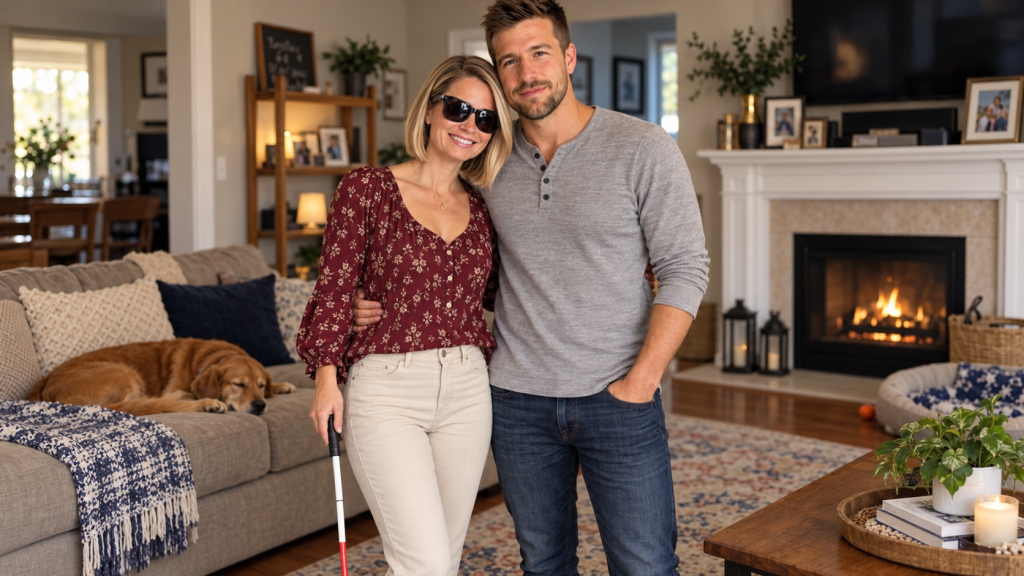
But no innocent explanation could account for the forged documents, the planned admission to a residential care facility, and the authorization to sell the house my mother had left me. I heard Ashton’s voice downstairs. “Sutton?” I froze. My fingers tightened around the photograph. He had returned home unexpectedly that morning, and I still didn’t know why. “Sutton, are you upstairs?”
I shoved the photograph into the pocket of my cardigan.
Then reached for the edge of the bed.
“Coming!”
My voice sounded strange.
I forced myself to breathe slowly.
For two years, I’d learned to navigate our home without sight, memorizing each room and counting the steps between the furniture.
Now blurry light and vague outlines were returning to my world.
But for the first time since the accident, I wished I couldn’t see what was in front of me.
Because my eyesight wasn’t the only thing changing.
Everything I believed about my marriage was beginning to fall apart.
I heard Ashton’s footsteps on the stairs.
I quickly lowered myself onto the edge of the bed.
When he appeared in the doorway, I kept my gaze fixed slightly below his shoulder.
Even through the blur, I could make out his outline.
Tall.
Broad-shouldered.
Wearing the dark jacket I’d helped him choose years earlier, before the accident.
Once, that silhouette had meant safety.
Now it made my heart race.
“Why are you still upstairs?” he asked.
“I was looking for my slippers.”
He didn’t answer immediately.
Then I saw his head turn toward the bed.
Toward the suitcase.
“Did you find them?”
“Yes.”
He walked closer.
I could smell his familiar cologne.
For a moment, the scent brought back memories of our honeymoon, when he’d held me on a balcony overlooking the ocean and promised that nothing would ever come between us.
I pushed the memory away.
“You seem nervous,” he said.
I gave a small laugh.
“Do I?”
“A little.”
“I’m just tired.”
He stood directly in front of me.
Then something moved near my face.
His hand.
He was testing me again.
My pulse hammered as three blurred fingers passed through the air.
I kept my eyes still.
After several seconds, he lowered his hand.
“Have you had any more strange sensations in your eyes?”
I swallowed.
“Sometimes I see flashes of light.”
His body stiffened.
“Flashes?”
“Yes. The doctor said that might happen.”
“Did you tell Dr. Cross?”
“I mentioned it at my appointment.”
He seemed to relax.
“Good.”
Then he touched my shoulder.
“She’s an excellent doctor, Sutton. You need to trust her.”
I nearly recoiled.
Instead, I forced a smile.
“I know.”
He stood quietly for another moment.
Then asked, “You trust me too, don’t you?”
My throat tightened.
There it was.
The question that suddenly sounded less like reassurance and more like a warning.
“Of course,” I whispered.
He kissed the top of my head.
“That’s my girl.”
I sat motionless as he walked away.
Only after I heard his car leave the driveway did I allow myself to breathe normally.
Then I reached into my pocket.
Pulled out the photograph.
And began planning how to escape the life my husband had prepared for me.
My first instinct was to call the police.
My second was to call my sister.
I had almost dialed Tessa’s number when I remembered how little we’d spoken over the past year.
Ashton said she had grown impatient with my disability.
He claimed she’d complained about the effort required to visit me.
Eventually, the calls stopped.
I hadn’t questioned it.
I’d been exhausted.
Depressed.
Trying to adjust to a world I could no longer see.
And Ashton had taken charge of nearly everything.
Our finances.
The mail.
Medical appointments.
Transportation.
Even my phone settings.
He told me it was easier if he managed the complicated parts of life.
I believed him because I loved him.
And because I was frightened.
Now I wondered how much of that dependence had been necessary.
And how much he’d quietly encouraged.
I opened my phone and called Nina Calder.
Nina had been my closest friend since college.
She worked as a paralegal and had once joked that she would never trust a man who insisted on handling every document in the house.
Ashton disliked her.
He called her intrusive.
Overprotective.
A bad influence.
But unlike almost everyone else, Nina had kept calling even when I stopped answering.
She picked up on the second ring.
“Sutton?”
Her voice was warm with surprise.
“Is everything okay?”
I tried to speak.
Instead, I began crying.
“Sutton?”
“Nina, I need help.”
Her tone changed immediately.
“Where are you?”
“At home.”
“Is Ashton there?”
“No.”
“Are you safe?”
I looked toward the bedroom door.
“I don’t know.”
She didn’t waste time asking for explanations.
“I’m coming.”
“Nina, listen. I found documents. Ashton is trying to put me into a care facility.”
There was a stunned silence.
“What?”
“And sell my house.”
“Your mother’s house?”
“Yes.”
“Does he have your permission?”
“No.”
My voice broke.
“He forged my signature.”
Nina inhaled sharply.
“Have you spoken to a lawyer?”
“Not yet.”
“All right. Don’t confront him. Preserve what you found, and don’t sign anything. I’m going to help you get independent legal advice.”
I wiped my cheeks.
“There’s something else.”
“What?”
I stared at the photograph.
“Dr. Cross is involved.”
Another silence.
Then Nina said something unexpected.
“Sutton, I’ve been trying to tell you something about that woman for months.”
My heart stopped.
“What?”
“Last spring, I came to visit you. Ashton said you were too tired to see anyone.”
I remembered that day.
I’d been sitting in the living room, waiting for Nina.
Ashton told me she’d cancelled.
I had cried afterward.
He said she was becoming unreliable.
Nina continued.
“I was standing on your porch when Dr. Cross came out of the house.”
I felt cold.
“She was at my house?”
“Yes.”
“Why?”
“I thought she’d made a home visit. But something about the way Ashton behaved bothered me.”
My hand trembled.
“What did he do?”
“He kissed her.”
The room seemed to tilt.
Nina continued quickly.
“Not on the cheek, Sutton. He kissed her on the mouth.”
I covered my face.
“Why didn’t you tell me?”
“I tried. Ashton answered your phone when I called that evening. Afterward, you sent me a message telling me to stop interfering in your marriage.”
I stared at the phone.
“I never sent that.”
Nina went silent.
Then she whispered, “I was afraid of that.”
I pressed my hand against my chest.
Ashton had not simply been cheating on me.
He’d been controlling who could reach me.
And now I knew why.
If I had someone else to depend on, I might have started asking questions.
I looked toward the suitcase.
“Nina, can you get here before he returns?”
“Yes.”
Then her voice softened.
“Sutton, there’s something I need you to hear.”
I swallowed.
“What?”
“You are not helpless because you can’t see clearly.”
A sob escaped me.
“And you don’t have to prove you can manage everything alone before you’re allowed to ask for help.”
I closed my eyes.
For the first time that morning, I felt something other than fear.
I felt hope.
Nina arrived forty minutes later.
When I opened the front door, she stood on the porch with a canvas bag over her shoulder and tears in her eyes.
I could see her outline.
The deep blue of her coat.
The shape of her face.
Not clearly.
Not the way I remembered.
But enough.
She stepped forward.
“Sutton.”
I stared at her.
Then I whispered, “You’re wearing blue.”
Nina froze.
“What?”
“Your coat.”
She looked down.
Then back at me.
“Sutton, can you see me?”
My eyes filled.
“A little.”
For a moment, she seemed unable to breathe.
Then she pulled me into her arms.
“Oh, my God.”
I began sobbing.
She held me tightly.
“You can see.”
“Not everything.”
“I don’t care.”
She laughed through her tears.
“That’s wonderful.”
I clung to her.
For two weeks, I’d carried the secret of my returning eyesight alone.
I’d imagined sharing it with Ashton.
Imagined the way he’d smile when I recognized his face.
Now the first person I told was the friend he’d spent months trying to keep away.
And instead of questioning me or testing me, she simply celebrated.
When we finally separated, Nina wiped her eyes.
“Does Ashton know?”
I shook my head.
“No.”
“Good.”
Her expression hardened.
“Until we understand what’s happening, let’s keep it that way.”
I led her upstairs.
Together, we examined the suitcase.
Nina photographed the documents and helped me enlarge the text.
The papers included a proposed residential care admission, an authorization supposedly allowing Ashton to manage my finances, and a draft agreement concerning the sale of my house.
The property had belonged to my mother, Margaret Hartwell.
She’d left it to me free of debt after she died.
It was registered in my name.
And it had never been transferred to Ashton.
Nina studied the paperwork.
“Sutton, this doesn’t mean he can legally do all these things just because he filled out forms.”
I nodded.
“I know.”
“But it does show he’s trying to create the appearance that you’ve agreed to them.”
I looked at the signature.
It resembled mine.
But the final letter curved the wrong way.
I remembered how Ashton used to ask me to sign holiday cards.
Then, after the accident, how he sometimes guided my hand when I signed routine forms.
Had he been practicing?
Collecting samples?
My stomach turned.
Nina continued examining the papers.
Then she stopped.
“Sutton.”
Something in her voice frightened me.
“What?”
“There’s a medical assessment attached.”
I felt cold.
“From Dr. Cross?”
“Yes.”
Nina read carefully.
Then looked at me.
“It states that you have significant cognitive impairment following the accident and are unable to make informed financial decisions.”
For a moment, I couldn’t speak.
Then I laughed.
Not because it was funny.
Because the claim was so outrageous that laughter was the only sound I could produce.
“Cognitive impairment?”
Nina nodded grimly.
I stared at her.
“I lost my sight, Nina. Not my mind.”
“I know.”
The words in the report blurred as I tried to read them.
There were references to supposed memory problems.
Difficulty understanding conversations.
Confusion during appointments.
I shook my head.
“Those things never happened.”
Nina looked at me.
“Did Dr. Cross ever perform a cognitive assessment?”
“No.”
“Did anyone explain a diagnosis like this?”
“Never.”
She took a careful breath.
“Then we’re going to challenge it.”
I looked toward the medical report.
Evelyn had spent months treating me.
She knew I could understand every conversation.
She knew I’d made my own medical decisions.
She knew I’d researched rehabilitation exercises, managed household tasks using accessibility tools, and participated in every discussion about my vision.
Yet here was a document portraying me as someone who couldn’t understand her own finances.
The purpose was suddenly clear.
Ashton didn’t simply want my house.
He wanted people to believe I lacked the ability to object.
Nina continued reading.
Then her expression changed.
“What?” I asked.
She pointed to a page.
“This assessment is dated last Tuesday.”
I nodded slowly.
“That was the day of my eye appointment.”
“Were you evaluated for memory problems?”
“No.”
“What did Dr. Cross tell you?”
I thought back.
The bright examination light.
The blurred chart.
The way Evelyn had smiled.
Your vision is showing signs of improvement.
Then something else came back to me.
The moment I’d told her I wanted to surprise Ashton.
She had gone quiet.
Only for a second.
Then she’d asked whether he knew about my progress.
I told her no.
She smiled again.
And said she understood.
Now I remembered her next words.
Well, Sutton, let’s keep monitoring things carefully.
My blood ran cold.
I looked at Nina.
“She knew I was getting better.”
Nina nodded.
“And apparently she signed a document claiming you couldn’t manage your own life.”
I stared toward the window.
Three days.
That was how long remained before the admission date written on the paperwork.
Then a terrible thought struck me.
“What happens if Ashton takes me there on Friday?”
Nina’s expression became serious.
“A care facility cannot simply accept an unwilling, capable adult because her husband presents paperwork. But someone may have been misled, and we need to find out exactly what they’ve been told.”
I swallowed.
“Will you help me?”
She took my hand.
“Every step of the way.”
Then she reached for her phone.
“I know a lawyer.”
And that was the moment my husband’s secret plan began turning against him.
The lawyer’s name was Miriam Ellis.
She had practiced property and family law for nearly twenty years and spoke with the deliberate calm of someone who had heard too many frightening stories to be impressed by dramatic excuses.
When Nina explained the situation over the telephone, Miriam interrupted only twice.
The first time, she asked who owned the house.
The second time, she asked whether I had signed a power of attorney granting Ashton authority over my property.
“I haven’t,” I answered.
“Have you signed any agreement allowing him to admit you to residential care?”
“No.”
“Have you been found legally incapable of making decisions?”
“Absolutely not.”
“Then we’re going to start with the facts,” she said.
For the first time all day, I felt someone was speaking to me rather than around me.
Miriam asked us to bring copies of the documents to her office.
Nina drove.
I sat in the passenger seat, watching vague buildings glide past the window.
Colors were beginning to separate.
The sky was a pale silver.
The traffic lights appeared as bright circles.
And I could make out the dark shapes of trees along the road.
Two weeks earlier, those details had seemed miraculous.
Now they felt like a lifeline.
When we arrived, Miriam greeted me directly.
Not Nina.
Not the person guiding my arm.
Me.
“Mrs. Reed, I’m Miriam Ellis. Would you prefer we discuss the documents verbally, use enlarged print, or both?”
I almost cried.
“Both, please.”
“Of course.”
She helped us examine each document carefully.
Then she pointed to the proposed home sale.
“The paperwork identifies Ashton as your authorized representative.”
I nodded.
“But I never made him one.”
“That’s what we’ll investigate. The purported authority is disputed, and we’ve already got reasons to question its authenticity.”
She continued.
“A document bearing a forged signature doesn’t become valid merely because someone submits it.”
I swallowed.
“But could he sell the house anyway?”
“Someone could try to mislead a buyer, a title company, or a lender. Our job is to make the relevant parties aware that you dispute these documents before anyone relies on them.”
She looked at me.
“We’ll also check the property records and take appropriate steps to protect your title.”
I nodded.
Then Miriam studied the proposed sale agreement.
Her expression tightened.
“That’s interesting.”
“What?”
“The listed buyer is a limited liability company called Northstar Residential Holdings.”
I frowned.
“I’ve never heard of it.”
Miriam looked toward Nina.
“Neither have I. But its registered address is familiar.”
My stomach tightened.
“Why?”
“It’s the same office suite used by a private medical consulting company.”
She turned the page.
“Cross Medical Advisory.”
I went cold.
Dr. Evelyn Cross.
The woman who had told me my eyesight might return.
The woman kissing my husband on the porch.
The woman who had supposedly assessed me as cognitively impaired.
Now a company linked to her business was connected to the proposed purchase of my mother’s house.
I pressed a hand against my chest.
“So they were going to sell it to themselves?”
“We need to establish ownership and control before drawing that conclusion,” Miriam replied. “But the connection deserves immediate scrutiny.”
She examined the price.
Then looked at me.
“What do you believe the house is worth?”
I hesitated.
“Probably around nine hundred thousand dollars. Maybe more.”
Nina nodded.
“Properties in Sutton’s neighborhood have been selling for close to that.”
Miriam looked down again.
“The proposed purchase price is four hundred and twenty thousand.”
I stared at her.
“What?”
Less than half its likely value.
My mother had bought the house after years of saving and working extra shifts as a hospital administrator.
She’d planted the rose bushes outside.
Chosen the little stained-glass window above the stairs.
Made the back bedroom into a studio where she painted landscapes every Sunday.
And Ashton had apparently planned to transfer it for a fraction of its value.
To a company connected to his mistress.
My eyes filled.
Miriam continued.
“There is also an instruction directing the proceeds to an account that doesn’t appear to be in your name.”
I swallowed.
“Can you stop it?”
“I can take urgent steps to challenge the authority they claim and warn the parties involved. We’ll need to confirm the transaction’s actual status, but the proposed closing cannot be treated as legitimate merely because a document says it is.”
I nodded.
Then she turned toward the care facility paperwork.
“Cedar Haven Residential Center.”
I recognized the name.
A facility nearly three hundred miles away.
Far from Nina.
Far from Tessa.
Far from my familiar doctors and home.
I stared at the admission date.
Friday.
Nine in the morning.
“Why would he send me so far?” I whispered.
Miriam considered her answer.
“Distance could make it harder for you to get support from people you know. But we shouldn’t assume motive without examining the records.”
I looked down.
Then said what frightened me most.
“What if he tells them I can’t speak for myself?”
Miriam leaned forward.
“Sutton, you are speaking for yourself right now.”
Tears filled my eyes.
She continued.
“Blindness and cognitive incapacity are not the same thing. Neither is a difficult marriage proof that someone lacks judgment.”
I began crying.
For two years, I’d been grateful whenever somebody treated me as though I still had a mind of my own.
Now I realized how low my expectations had become.
Miriam passed me a tissue.
“We’ll deal with the paperwork,” she said gently.
“But first, I want to make sure you’re somewhere safe.”
I thought of the suitcase beneath my bed.
The way Ashton had tested my vision with his fingers.
The strange smile when he said Friday would be easier than he thought.
I swallowed.
“I don’t think I should sleep there tonight.”
Nina immediately took my hand.
“You’re staying with me.”
I looked at her.
“Are you sure?”
She gave me a sad smile.
“Sutton, I have a guest room, two cats, and more blankets than one person can use in a lifetime.”
Despite everything, I laughed.
“Your cats hate me.”
“They hate everyone.”
Miriam smiled faintly.
Then she became serious.
“Let’s make a careful plan for collecting what you need. We don’t want you returning to an unsafe situation alone.”
I nodded.
For the first time, I wasn’t asking someone else to decide what should happen to me.
I was choosing what would happen next.
That afternoon, I made another appointment.
Not with Evelyn Cross.
With a different ophthalmologist at a hospital unaffiliated with her practice.
His name was Dr. Arjun Patel.
He reviewed the information I provided, examined my eyes, and spoke to me directly about the changes I had noticed.
The examination was exhausting.
Bright lights.
Visual tests.
Blurry shapes.
Carefully repeated questions.
But this time, I listened with a new awareness.
I wanted to know exactly what was happening.
Not what Ashton thought I should be told.
Not what Evelyn believed he needed to hear.
What my own doctor could establish from an independent examination.
At the end, Dr. Patel sat across from me.
“Sutton, your visual function has improved compared with the earlier records you’ve brought.”
My eyes filled.
“Am I going to get all my sight back?”
He shook his head gently.
“We can’t promise that. You’ve had a serious injury, and recovery can be unpredictable.”
I nodded.
“But I’m not imagining it?”
“No.”
A tear rolled down my cheek.
He continued.
“You’re distinguishing more shapes and some details. We should keep monitoring your progress and discuss rehabilitation strategies suited to your current level of vision.”
I smiled through tears.
Then I asked the question I’d been dreading.
“Doctor, can blindness make someone legally incapable of making decisions?”
His expression changed.
“Visual impairment alone does not mean someone lacks decision-making capacity.”
I swallowed.
“My previous specialist wrote a report saying I couldn’t understand financial information.”
He looked at me carefully.
“Was that based on a separate assessment?”
“Not that I’m aware of.”
“Then I’d encourage you to have the report independently reviewed and discuss the issue with your attorney. My specialty is your eyesight. I wouldn’t conclude you lack financial decision-making ability simply because you cannot see well.”
I closed my eyes.
For two years, I had feared that losing my vision meant losing my independence.
Now I was beginning to understand that the greater threat had not been my disability.
It had been the people using it as an excuse to make decisions without me.
Before leaving, I asked Dr. Patel for copies of my examination findings and information about obtaining my complete medical records.
Then Nina and I went to her apartment.
And that night, for the first time in months, I slept without hearing Ashton’s footsteps outside my bedroom door.
At six the following morning, my phone began ringing.
Ashton.
I watched his name fill the screen.
Then disappear.
Then return.
After the fifth call, he sent a message.
Where are you?
Another followed.
I came home and you weren’t there.
Then:
Sutton, stop playing games. Call me.
My stomach tightened.
I forwarded the messages to Miriam.
She advised me to avoid arguing with Ashton and to let communications about the disputed documents pass through counsel.
A moment later, another message arrived.
Dr. Cross says you’re confused. You need to come home before you make this worse.
I stared at those words.
Confused.
The same description in the false medical report.
The same accusation Ashton used whenever I disagreed with him.
I took a breath.
Then locked my phone.
Nina appeared in the kitchen carrying two cups of coffee.
“Anything new?”
I showed her.
Her expression hardened.
“He’s panicking.”
I looked toward the window.
“Because I left?”
“Because you’re no longer where he can control the conversation.”
I nodded slowly.
Then something occurred to me.
“Nina, I want to call Tessa.”
My friend smiled.
“I was hoping you’d say that.”
I stared at her.
“Do you know something?”
She hesitated.
“Sutton, your sister never stopped asking about you.”
My throat tightened.
“What?”
“She contacted me several times after Ashton told her you didn’t want visitors.”
I felt cold.
“He told me she was tired of helping.”
Nina shook her head.
“Tessa was devastated when you stopped answering.”
I covered my mouth.
My little sister.
The person who used to braid my hair when we were children.
Who sat beside me during Mom’s final illness.
Who helped arrange the funeral flowers.
I’d spent a year believing she’d abandoned me because I was too difficult to care for.
And now I was learning that Ashton had stood between us.
Again.
I pressed her number.
She answered immediately.
“Sutton?”
Her voice was different from how I remembered.
More cautious.
Almost afraid.
I swallowed.
“Tessa.”
A long silence.
Then she whispered, “Oh, thank God.”
My eyes filled.
“I’m sorry.”
“What?”
“I’m sorry I stopped calling.”
She began crying.
“Sutton, I thought you didn’t want me around.”
I covered my mouth.
“No.”
Her voice broke.
“Ashton said you needed space. He told me I was making your recovery harder.”
Tears streamed down my face.
“He told me you were tired of me.”
Tessa made a small, wounded sound.
“Oh, Sutton.”
For several moments, neither of us could speak.
Then she whispered, “Where are you?”
“I’m staying with Nina.”
“Are you safe?”
“Yes.”
“Do you need me?”
I began crying harder.
“Yes.”
There was no hesitation.
“I’m coming.”
And in that moment, I knew Ashton had made another terrible mistake.
He’d believed that isolating me would make me easier to control.
Instead, the moment his lies began collapsing, the people who truly loved me came back into my life.
And they weren’t going to let me face him alone.
Tessa arrived shortly after noon.
I knew it was her before she spoke.
The familiar rhythm of her footsteps.
The faint smell of citrus perfume.
The way she paused at the doorway, as though she wasn’t certain she was welcome.
I stood from Nina’s sofa.
“Tessa?”
She crossed the room.
And wrapped her arms around me.
For a long time, we didn’t say anything.
Then she whispered, “I missed you so much.”
I closed my eyes.
“I missed you too.”
When we finally pulled apart, she gently held my face between her hands.
Nina stood beside us, smiling through tears.
Then Tessa suddenly froze.
“Sutton?”
I nodded.
She moved slightly to my left.
My eyes followed her.
Her mouth fell open.
“Can you see?”
“A little.”
She covered her face.
“Oh, my God.”
I laughed through my tears.
She looked at Nina.
Then back at me.
“Why didn’t you tell me?”
“I wanted it to be a surprise.”
My voice broke.
“I wanted Ashton to be the first person I saw clearly.”
Tessa’s expression changed.
For a moment, she looked heartbroken.
Then she hugged me again.
“Oh, Sutton.”
I leaned against her shoulder.
For two years, I had dreamed of seeing my husband’s face.
Now I was watching the faces of people I nearly lost because of him.
It wasn’t the reunion I’d imagined.
But it was beautiful in a way I hadn’t expected.
When we sat down, Tessa asked to see the documents.
Nina showed her the copies.
She read quietly.
Then her expression darkened.
“This is worse than I thought.”
I looked at her.
“What?”
Tessa hesitated.
“Sutton, Mom didn’t just leave you the house.”
I frowned.
“I know. There were some savings.”
“No. I’m talking about the trust account she established for your long-term care if you ever needed help.”
I stared at her.
“What trust account?”
Tessa looked surprised.
“You never knew?”
I shook my head.
She sat back.
“Mom created it after Dad died. She was terrified of either of us becoming dependent on someone who might take advantage.”
My throat tightened.
“She never told me.”
“She named you as the primary beneficiary of a reserve fund. I wasn’t supposed to access it. An independent trustee was responsible for handling it according to her instructions.”
I stared at her.
“Why would she keep that secret?”
Tessa shrugged sadly.
“She didn’t want you worrying about money that was meant for emergencies. I only know because I helped her organize some records after her illness.”
I looked toward Nina.
“Could Ashton have known?”
Tessa hesitated.
“I don’t know.”
Then she reached into her bag.
“I brought something.”
She handed Nina a yellow envelope.
Inside were copies of correspondence from an old estate administration file.
One letter contained the trust’s name.
The Margaret Hartwell Independence Fund.
My eyes filled.
Even in death, my mother had been thinking about how to protect me.
Tessa touched my hand.
“Mom always worried that you’d put everyone else’s needs ahead of your own.”
I laughed sadly.
“She wasn’t wrong.”
“Remember what she used to say?”
I shook my head.
Tessa smiled through tears.
“Never surrender the steering wheel of your own life.”
I covered my mouth.
I remembered.
Mom had said it when I moved into my first apartment.
When I started my job.
When Ashton proposed.
At the time, I’d laughed.
Now those words sounded like a warning she’d hoped I’d never need.
Nina called Miriam.
Within an hour, we were sitting in the lawyer’s office again.
Miriam studied the trust documents.
Then looked at me.
“Sutton, this may explain another part of the plan.”
My stomach tightened.
“What part?”
“The proposed residential admission contains instructions identifying the fund as an expected source of payment.”
I stared at her.
“They were going to take that too?”
“Someone was trying to arrange access to it through the claimed authority over your affairs.”
My hands began shaking.
The house.
My savings.
Now Mom’s reserve fund.
Ashton wasn’t simply planning to send me away.
He was constructing a financial arrangement in which he would control as much of my life as possible.
And Evelyn was helping him create the paperwork.
Miriam looked directly at me.
“We’ll contact the trustee. If the fund is administered independently, Ashton can’t simply claim it because he’s your husband.”
I nodded.
Then she added, “There’s another concern.”
I swallowed.
“What?”
“The care facility documents describe you as needing full assistance with daily living and continuous supervision.”
I stared at her.
“For what?”
“They cite difficulty communicating, inability to recognize familiar people, and alleged confusion.”
I shook my head.
“That’s not true.”
“I know.”
“I cook. I read using audio. I manage appointments. I know exactly what I want.”
My voice rose.
“I’ve been blind, Miriam. I haven’t been unconscious.”
She nodded calmly.
“That’s precisely why the report needs to be investigated.”
I took a breath.
Then asked the question that had been haunting me.
“Why would Evelyn write it?”
Miriam exchanged a glance with Nina.
“We can’t know her full motive yet. But the documents and financial connections create serious concerns about conflicts of interest and deliberate misrepresentation.”
I closed my eyes.
For two years, I’d trusted Evelyn with my sight.
And now I was trying to understand why a doctor would assist in taking away everything else.
By Thursday afternoon, Miriam had contacted the appropriate parties about the disputed documents.
The title company named in the proposed property transaction had been notified that I denied authorizing any sale or power of attorney.
The independent trustee had been alerted to the suspected attempt to access the fund.
Cedar Haven’s administrators had been informed that I did not consent to admission and that the medical documents were disputed.
And Miriam helped me make a formal report about the suspected forgeries.
A detective named Gabriel Torres met with us to review the documents and photographs.
He didn’t promise an immediate arrest.
He didn’t announce that the case was solved.
Instead, he asked careful questions.
When had I first seen the papers?
Where had they been found?
Who had access to my signatures?
Had I ever consented to Ashton handling property transactions?
Had Dr. Cross assessed my ability to make financial decisions?
I answered everything.
Nina provided the photographs she’d taken.
Tessa supplied copies of the trust correspondence.
My independent examination findings were also available for appropriate review.
Then Detective Torres looked at the photograph of Ashton and Evelyn.
“Do you recognize the location?”
I nodded.
“The courthouse downtown.”
He studied it.
“Do you know when this was taken?”
“No.”
He examined the back.
“Who wrote this message?”
“I don’t know.”
He nodded.
“We’ll treat it as evidence relevant to the circumstances, but we’ll need to establish its origin and context.”
I appreciated that.
For days, my imagination had been racing ahead of the facts.
I needed someone who would examine what could be proven.
Not someone who would simply agree with everything I feared.
Then the detective asked something that made me pause.
“Mrs. Reed, has your husband ever threatened to physically prevent you from leaving the house or seeking help?”
I thought about Ashton’s hand in front of my face.
The tests.
The angry questions.
The way he’d told me I was confused whenever I disagreed.
“He hasn’t physically restrained me,” I answered.
“Has he tried to interfere with your access to family or medical care?”
I looked at Tessa.
Then Nina.
“Yes.”
I told him about the missed visits.
The messages I’d supposedly sent.
The false statements about my sister.
The way Ashton answered my phone.
Torres took notes.
Then looked up.
“And what happens tomorrow?”
I swallowed.
“The paperwork says I’m supposed to be admitted to Cedar Haven at nine.”
“Do you intend to go?”
“Not as a patient.”
My voice trembled.
“But I want the director to look me in the face and hear that I never agreed to live there.”
Miriam nodded.
“We can arrange a meeting with the facility through appropriate channels.”
The detective considered this.
“Don’t put yourself in a dangerous situation for the purpose of confronting your husband. We can investigate the documents without you being physically present.”
I nodded.
“I understand.”
But something inside me had changed.
For two years, I’d allowed other people to speak for me.
This time, I wanted to be heard.
Not because I needed to prove my courage.
Because my consent had been treated like an inconvenience.
And I wanted the people handling my supposed admission to know exactly whose life they were discussing.
Late that evening, Ashton found Nina’s apartment.
We never learned whether he’d followed Tessa’s car, noticed a familiar location through an old account connection, or simply guessed where I’d gone.
But when the doorbell rang, I knew something was wrong.
Nina checked the camera.
Then turned toward me.
“Sutton.”
My stomach tightened.
“It’s him?”
She nodded.
Ashton’s voice sounded through the door.
“Sutton, I know you’re in there.”
I froze.
He knocked again.
“Open the door.”
Nina remained calm.
“Ashton, she’s safe. You need to leave.”
“She’s my wife.”
“That doesn’t mean she has to speak with you right now.”
His voice rose.
“You don’t understand. She’s confused. Her doctor has been concerned for months.”
I closed my eyes.
There was the lie again.
So practiced.
So confident.
It almost sounded believable.
Nina looked toward me.
“We can call for help if he refuses to leave.”
I nodded.
Then Ashton said something that made my blood run cold.
“Friday is already arranged. She needs to stop making this difficult.”
Tessa gripped my hand.
I stepped closer to the door but stayed behind it.
“Ashton.”
Silence.
Then his voice softened immediately.
“Sutton, sweetheart.”
My chest tightened.
“I want you to go home,” I said.
“You are home with me.”
“No.”
He paused.
“You don’t understand what’s happening.”
I took a breath.
“I understand more than you think.”
For several seconds, he said nothing.
Then he laughed nervously.
“Whoever’s been filling your head with nonsense needs to stop.”
I closed my eyes.
I could almost see him standing outside, one hand in his pocket, wearing that familiar expression of wounded patience.
The expression he used when he wanted me to feel unreasonable.
Then he spoke again.
“Dr. Cross says you’re getting worse.”
My throat tightened.
I thought of her smile at my last appointment.
The hope I’d felt.
The photographs in the suitcase.
And the report describing cognitive problems I didn’t have.
I looked toward Nina.
She nodded reassuringly.
Then I said quietly, “I won’t be returning with you.”
Ashton’s voice hardened.
“You don’t get to make every decision alone.”
The words hung in the hallway.
For years, I would have apologized.
Explained.
Begged him not to be angry.
Instead, I answered.
“I do get to make decisions about my own life.”
A long silence followed.
Then Nina informed him that further unwanted visits would be reported.
After several tense minutes, he left.
When the camera showed his car disappearing down the street, my knees began trembling.
Tessa helped me sit.
I covered my face.
For the first time, I understood why I’d been so afraid of confronting him.
Not because he had the legal right to control me.
But because he had spent years making me feel that disagreeing with him was dangerous.
Nina sat beside me.
“You did well.”
I shook my head.
“I’m shaking.”
She squeezed my hand.
“Those two things can be true at once.”
I began crying.
Tessa wrapped an arm around my shoulders.
And as the night settled around Nina’s apartment, I realized that tomorrow would be the day Ashton discovered something he never expected.
His wife was not waiting to be rescued.
She had already begun rescuing herself.
At eight forty-five on Friday morning, I arrived at Cedar Haven Residential Center.
Not in a medical transport vehicle.
Not strapped to a wheelchair.
Not escorted by my husband.
I arrived in Nina’s car, wearing a cream blouse, dark trousers, and the small gold necklace my mother had given me on my thirtieth birthday.
Tessa sat beside me.
Miriam had arranged a meeting with the facility’s director, Lillian Price.
I carried copies of my documents and a statement confirming that I did not consent to admission.
My eyes were still sensitive to bright light.
The building appeared as a broad pale shape, and I relied on Nina’s arm to navigate the unfamiliar entrance.
But I knew where I was.
I knew why I was there.
And I knew exactly what I wanted.
Lillian met us in a private office.
She was a tall woman with a gentle voice.
“Mrs. Reed?”
“Yes.”
She shook my hand.
“I’m glad you contacted us.”
I sat across from her.
“Did my husband tell you I couldn’t make my own decisions?”
Her expression tightened.
“We received records claiming you required continuous care and lacked capacity to consent to certain arrangements.”
My stomach turned.
“Did you believe them?”
“We had concerns about inconsistencies in the paperwork. We had not completed admission or accepted those statements as sufficient authority to admit you against your wishes.”
I exhaled slowly.
Lillian continued.
“Your attorney’s communication raised additional concerns, and we’ve suspended the proposed admission pending clarification.”
Tears filled my eyes.
For days, I’d imagined being trapped inside an unfamiliar building while Ashton took control of my house.
Now the person responsible for that building was looking directly at me and explaining that my consent mattered.
I swallowed.
“Thank you.”
Lillian smiled gently.
“You don’t need to thank us for asking what you want.”
Then someone knocked at the office door.
An employee leaned inside.
“Ms. Price, Mr. Reed has arrived.”
My entire body went cold.
Lillian looked toward Miriam.
We had known he might appear.
The original paperwork specified nine o’clock.
But hearing his name made my heart race.
Miriam turned toward me.
“You don’t have to see him.”
I looked toward the window.
For a moment, I considered leaving.
Then I took a breath.
“I want him to hear that the admission isn’t happening.”
Miriam nodded.
“We’ll keep the conversation appropriate and end it if necessary.”
Lillian asked the employee to bring Ashton into the meeting room.
A minute later, I heard his familiar footsteps.
Then his voice.
“Lillian, thank God. My wife is missing, and—”
He stopped.
I turned toward him.
Through the blur, I could make out his face.
Not every feature.
But enough to see his expression change.
“Sutton?”
I sat very still.
He looked toward Nina.
Then Tessa.
Then Miriam.
“What is this?”
Lillian spoke first.
“Mr. Reed, your wife has told us she does not consent to admission.”
Ashton gave a strained laugh.
“She’s confused.”
“No,” I said.
He stared at me.
“Sutton, you shouldn’t be here with these people.”
I took a breath.
“They’re people I chose to be with.”
He turned toward Lillian.
“She’s been having episodes. Dr. Cross can explain.”
As if summoned by the words, another voice sounded outside the office.
“Has Ashton arrived?”
My stomach tightened.
Evelyn.
She entered carrying a folder.
I recognized the white coat, the dark hair pulled neatly behind her head, and the polished shoes that clicked against the floor.
For two years, I’d trusted that voice more than my own fears.
Now I heard it and felt nothing but betrayal.
She stopped when she saw me.
“Sutton.”
Her smile appeared a moment too late.
“What a surprise.”
I looked directly toward her.
“Is it?”
She hesitated.
Then regained her composure.
“I’m glad you’re here. I was concerned when your husband told me you had left home unexpectedly.”
I kept my voice steady.
“Were you concerned for me?”
“Of course.”
“Then why did you sign a report saying I couldn’t make decisions about my finances?”
The room went quiet.
Evelyn’s expression changed.
“What report?”
Miriam opened her folder.
“The purported assessment dated last Tuesday.”
She placed a copy on the table.
Evelyn glanced at it.
Then at Ashton.
For one brief second, neither spoke.
Finally, Evelyn said, “That report was prepared to summarize functional difficulties following the accident.”
I shook my head.
“It says I’m confused, unable to recognize familiar people, and incapable of understanding financial decisions.”
She shifted uneasily.
“Your situation has been complex.”
“My vision has been complex,” I replied. “My understanding hasn’t.”
Ashton stepped forward.
“Sutton, don’t speak to your doctor like that.”
I turned toward him.
And for the first time, I saw the expression I’d been imagining for days.
Shock.
Not because I shouted.
Not because I threatened him.
Because I looked directly into his face.
He went still.
Then raised his hand.
The same hand that had tested me beside our bed.
This time, I didn’t look away.
I watched it move.
Ashton’s mouth fell open.
“You can see?”
The room fell silent.
My heart hammered.
For two years, I’d imagined the moment I would tell him.
I’d imagined laughter.
Joy.
Tears.
A kiss.
Instead, I was standing beside my lawyer, confronting the man who had tried to make my disability a reason to take my freedom.
“Yes, Ashton.”
My voice trembled.
“My eyesight has been improving.”
He stared at me.
“How long?”
“Long enough.”
His face drained of color.
Evelyn suddenly spoke.
“Sutton, visual improvement doesn’t necessarily mean—”
“I know.”
I turned toward her.
“I’ve seen another specialist.”
She stopped.
“He examined me independently.”
I continued.
“And I have an attorney reviewing the report you signed.”
Evelyn lowered her eyes.
Lillian looked between us.
“Regardless of anyone’s interpretation of the medical records, Mrs. Reed has clearly stated she does not wish to live here. We are not proceeding with admission.”
Ashton opened his mouth.
Then closed it.
For the first time in years, nobody in the room was asking him to make the final decision.
I looked at him.
“Did you really think you could send me away?”
His voice was barely audible.
“Sutton, I was trying to help.”
I stared at him.
“By selling my mother’s house?”
His eyes widened.
“How did you—”
“By signing my name?”
Silence.
“By telling people I couldn’t understand my own decisions?”
Evelyn shifted beside him.
I took one step closer.
“And by preparing to leave with the woman who was supposed to be helping me recover?”
Ashton looked toward Evelyn.
For a moment, his expression held something I hadn’t expected.
Not love.
Not even loyalty.
Fear.
Because he was realizing that the person he’d depended on to make his paperwork believable was now standing beside him with questions she couldn’t easily answer.
Miriam stepped forward.
“All further communications concerning the property and alleged authorizations should be directed through counsel.”
Lillian rose.
“I believe this meeting is concluded.”
Ashton stared at me.
“Sutton, please.”
My eyes filled.
He sounded almost like the husband I remembered.
Almost.
I took a breath.
“I loved you when I thought I’d never see again.”
His face crumpled.
“I know.”
“And you used that love to make me dependent on you.”
He began shaking his head.
I continued.
“I don’t know how much sight I’ll recover. But I don’t need perfect vision to understand what you’ve done.”
For a long moment, neither of us spoke.
Then I turned away.
Nina offered her arm.
I accepted it.
And together, we walked out of the building.
Not because Ashton had released me.
Not because Evelyn had changed her mind.
Because I had always been free to make that choice.
They had simply hoped I would never find out.
The weeks that followed were unlike anything I’d ever experienced.
For the first time since my accident, people were asking me what I wanted before making arrangements concerning my life.
Miriam helped challenge the forged authorizations and took steps to protect the house from unauthorized transactions.
The independent trustee confirmed that Ashton had no automatic right to control the Margaret Hartwell Independence Fund.
Cedar Haven corrected its records to reflect that I had neither requested nor consented to admission.
And the suspected forgeries became part of a formal investigation.
Nothing happened overnight.
There were interviews, records requests, and long days when I felt exhausted by the number of questions I had to answer.
But each piece of evidence brought us closer to understanding what Ashton and Evelyn had been doing.
Investigators examined communications between them.
Financial records.
Medical reports.
The companies connected to the proposed property purchase.
And eventually, details emerged that made the entire plan painfully clear.
Ashton had been having an affair with Evelyn for more than a year.
The relationship began while she was treating me.
They had discussed opening a private rehabilitation and wellness business together.
But both had serious financial problems, and neither had enough money to establish the business they imagined.
My house became their solution.
Through a company connected to Evelyn, they planned to acquire it for substantially less than its likely market value.
Then, using the alleged authority over my finances, Ashton intended to redirect the proceeds and seek access to my reserve fund.
Meanwhile, I would be living far away, supposedly unable to manage my own affairs.
They counted on my blindness to make their claims easier for other people to accept.
But the evidence revealed something even more disturbing.
Evelyn had known my vision might be improving long before my last appointment.
Her records contained observations and recommendations for further evaluation that had never been clearly communicated to me.
A referral had been marked as declined following communication with Ashton.
I had never knowingly declined that referral.
When Dr. Patel reviewed the available information, he was careful not to promise that earlier treatment or rehabilitation would have changed the degree of recovery.
But the missed opportunity hurt.
For months, I’d wondered why nothing seemed to improve.
I’d trusted the people responsible for my care.
And I had not been given the full information I needed to make choices for myself.
Then investigators recovered a message Evelyn had sent Ashton shortly before the planned admission.
She’s beginning to recognize movement more consistently. If she starts reading documents independently, we have a problem.
I stared at the message for a long time.
Then began crying.
My improvement hadn’t been a joyful surprise to them.
It had been an obstacle.
One they were trying to remove by moving me away before I could understand what was happening.
Another message followed.
Friday needs to go ahead. We can’t afford another delay.
I remembered Ashton standing beside our bed.
Raising three fingers.
Watching my eyes.
Smiling when I didn’t react.
Now I understood why he’d looked so relieved.
He believed I was still trapped in darkness.
And he believed he had time.
But the moment I pulled that suitcase from beneath the bed, his timetable had begun falling apart.
Evelyn initially denied deliberately falsifying anything.
She described the medical assessment as an unfortunate misunderstanding.
She claimed she’d relied on information Ashton provided.
She said the proposed residential admission was intended to support my recovery.
But the documents told a different story.
Her professional relationship with me had become entangled with a personal and financial relationship with my husband.
The report contained statements that were inconsistent with her own clinical records.
And the proposed property arrangement created a financial interest that she’d never disclosed to me.
The matter was referred for professional disciplinary review, and she faced legal consequences relating to her participation in the fraudulent scheme.
Ashton also faced charges connected to the forged documents and attempted misuse of my assets.
The precise extent of each person’s responsibility was determined through the legal proceedings, not merely by my suspicions.
Eventually, both were held accountable for proven misconduct.
The attempted sale did not go through.
The forged authorization did not give Ashton valid control over my property.
The proposed care admission never happened.
And the trust my mother created remained protected.
I kept the house.
Not because I wanted to prove something to Ashton.
But because it was still my home.
And for the first time in two years, I wanted to decide for myself what living there should look like.
My divorce took longer than I’d hoped.
There were financial questions to resolve.
Documents to review.
And difficult conversations about the difference between a shared marriage and property that had always legally belonged to me.
But I no longer approached those discussions as someone who needed Ashton’s approval.
I had independent advice.
Support from Nina and Tessa.
And the growing confidence to ask questions whenever I didn’t understand something.
The first time I attended a meeting about my finances without Ashton, my hands shook beneath the table.
Miriam noticed.
“Are you all right?”
I nodded.
“Just nervous.”
She smiled gently.
“Would you like to take a moment?”
I shook my head.
“No.”
Then I surprised myself.
“I’d like you to explain that last section again.”
Miriam nodded.
“Of course.”
So she did.
Slowly.
Clearly.
Without impatience.
And I asked another question.
Then another.
By the time the meeting ended, something inside me had changed.
For years, I’d interpreted Ashton’s frustration as proof that I was asking too much.
Now I understood that an honest question was not an inconvenience.
It was part of making an informed decision.
I began reviewing my own accounts again.
Learning accessibility tools that allowed me to read documents independently.
Practicing new routes through the neighborhood.
And rebuilding ordinary routines that had slowly disappeared from my life.
I wasn’t suddenly capable of everything I had been able to do before the accident.
Some tasks remained difficult.
Some days my eyes were exhausted.
Bright lights could still overwhelm me, and unfamiliar places required planning.
But I was no longer arranging my life around the belief that somebody else always knew best.
My sight was improving.
My independence was growing.
And those were two different achievements.
Both mattered.
One afternoon, several months after the planned admission date, I returned to my mother’s garden.
It was the first warm day of spring.
The roses along the fence had begun opening.
I stood near the flower bed, letting the sunlight fall across my face.
For years, I’d remembered the garden through scent and touch.
The softness of the petals.
The rough bark of the old tree.
The sound of bees moving among the flowers.
Now I could distinguish patches of red against the green.
Not perfectly.
The edges remained blurry.
But the colors were there.
I began crying.
Tessa was beside me.
“What is it?”
I pointed toward the fence.
“The roses.”
She smiled.
“What about them?”
I swallowed.
“They’re red.”
Her face changed.
Then she began crying too.
“Yes,” she whispered. “They are.”
I laughed through my tears.
Mom had always loved red roses.
She used to say they reminded her that beautiful things could survive difficult seasons.
I had never been especially good with plants.
Before the accident, I’d forgotten to water them more times than I cared to admit.
After I lost my sight, Ashton insisted the garden required too much attention.
He stopped tending most of it.
The rose bushes had grown tangled and wild.
Now Tessa and I were learning how to care for them again.
I knelt beside the nearest bush and touched a petal.
Then I whispered, “I missed you.”
Tessa put an arm around my shoulders.
For a moment, I could almost hear Mom laughing from the kitchen window.
Careful, sweetheart. Those roses have thorns.
I smiled.
She’d been right.
Beautiful things could hurt if handled carelessly.
But that didn’t mean they weren’t worth loving.
A year after I discovered the suitcase, I stood in my living room surrounded by friends.
Nina had brought cake.
Tessa had arranged flowers.
Several neighbors had come to celebrate the reopening of my mother’s old art studio.
It was a small room at the back of the house, with large windows overlooking the garden.
After the accident, Ashton turned it into a storage space.
Boxes accumulated.
Furniture gathered dust.
And eventually, I stopped asking him to help me enter.
Now it had been renovated into a bright, accessible workspace.
There were adjustable lamps.
Magnification equipment.
Large-print labels.
Audio tools.
And shelves filled with art supplies.
I had loved painting before losing my sight.
For two years, I believed that part of my life was finished.
But with my changing vision and new adaptive techniques, I’d started experimenting again.
Not trying to recreate the exact work I’d made before.
Not pretending nothing had changed.
Simply learning what I could make now.
My first paintings were clumsy.
The lines wandered.
The colors sometimes blended in unexpected ways.
But they were mine.
And that was enough.
At the studio opening, Nina stood beside my newest painting.
It showed the garden in spring.
Soft red roses.
A pale blue sky.
A little path winding toward the back gate.
She studied it.
“Sutton, this is beautiful.”
I laughed.
“You don’t have to say that.”
“I know.”
She smiled.
“That’s why I mean it.”
Tessa approached carrying two cups of tea.
Then she looked at the painting.
“Mom would have loved this.”
My eyes filled.
I nodded.
“I think so too.”
For a moment, we stood together.
Three women.
One room filled with sunlight.
And the quiet understanding that everything could have been different if I hadn’t looked beneath my bed.
If I’d ignored the suitcase.
If I’d dismissed the photograph.
If I’d allowed Ashton to keep deciding which questions I was permitted to ask.
I might have spent years living far away, fighting to convince people that I was capable of making my own choices.
Instead, I was standing in the house my mother left me.
Holding a cup of tea.
Surrounded by people who respected me.
And looking at something I’d created with my own hands.
I smiled.
For the first time in a very long while, I felt at home.
On the anniversary of the day I found the suitcase, I received a letter from Ashton.
It came through my attorney.
I knew I didn’t have to read it.
For a long time, I left the envelope on my desk.
Then, one evening, I opened it.
His handwriting was familiar.
I’d once loved seeing it on birthday cards and little notes he left beside the coffee maker.
Now it brought back memories that were difficult to separate from the betrayal.
The letter contained apologies.
Explanations.
Regret.
He wrote that he’d become overwhelmed by my accident and afraid of the future.
He said Evelyn had encouraged decisions he knew were wrong.
He admitted that he’d betrayed my trust.
Then, near the end, he asked whether I thought we could ever begin again.
I read the question twice.
A year earlier, I might have felt torn.
I might have wondered whether the man who cared for me after the accident still existed somewhere beneath all the lies.
But now I understood something.
Ashton might have been genuinely frightened after my injury.
He might have felt overwhelmed.
He might even have loved me once.
None of those things excused his choices.
He’d forged my signature.
Tried to control my property.
Helped portray me as incapable.
And planned to send me away while beginning another life.
I didn’t have to prove that every tender moment we’d shared was false before I was allowed to protect myself.
I folded the letter.
Placed it back inside its envelope.
And put it away.
I didn’t write an angry reply.
I didn’t promise forgiveness.
I didn’t ask him to explain himself again.
For the first time, I didn’t feel the need to make him understand how deeply he’d hurt me.
His understanding was no longer a condition of my peace.
That evening, I walked upstairs to my bedroom.
The same room where I’d first seen Ashton push the suitcase beneath the bed.
For a moment, I stopped in the doorway.
The furniture had been rearranged.
The old bed was gone.
I’d chosen a new one with a simpler frame and enough space around it to move comfortably.
The curtains were pale cream.
The walls were warm white.
And beside the window stood a small table holding my mother’s photograph.
I walked toward it.
Carefully.
Confidently.
Using the sight I had and the familiar layout I’d learned.
Outside, the sunset painted the sky in soft orange and pink.
I could not see every detail.
But I could see the light.
And it was beautiful.
I picked up Mom’s photograph.
The image was blurry, but I knew every part of it.
Her smile.
The way she tilted her head.
The little necklace she wore every day.
I touched the frame.
“You were right, Mom,” I whispered.
Tears filled my eyes.
“I had to take back the steering wheel.”
For a long moment, I stood there remembering the woman I’d been before the accident.
The woman who made decisions without apologizing.
Who loved painting.
Who laughed with her sister.
Who trusted herself.
I had spent years believing that woman was gone.
But she hadn’t disappeared.
She’d been living inside me all along.
Waiting for the chance to choose again.
Then I looked toward the bed.
I remembered the black suitcase.
The forged documents.
The photograph of Ashton and Evelyn.
The terrifying knowledge that the person I depended on most was trying to take away my independence.
At the time, I thought the greatest miracle would be getting my eyesight back.
Now I knew something different.
Regaining vision was precious.
But it wasn’t what made me worthy of respect.
Even if my sight had never improved, I would still have deserved honesty.
Autonomy.
Love.
And the right to make decisions about my own life.
Ashton had forgotten that.
Evelyn had ignored it.
But I would never forget it again.
I placed Mom’s photograph beside the window.
Then I smiled.
The sky was growing darker.
The first lights were appearing in the houses along our street.
I could see them.
Small.
Soft.
Glowing through the evening.
And for the first time in years, I wasn’t afraid of what I couldn’t see.
Because I had learned to trust myself again.
My husband believed my blindness made me powerless. He thought he could hide his betrayal, take my home, and write a future for me that I had never chosen.
What he never understood was that losing my sight had not taken away my voice.
I turned from the window.
Walked toward the bedroom door.
And switched on the light.
The room filled with a gentle golden glow.
Then I went downstairs, where Nina and Tessa were waiting with dinner, laughter, and stories about their day.
For the first time in a long while, I had no secrets to protect.
No performance to maintain.
No husband to convince.
Only a life I was finally free to live.
And the most important thing I recovered wasn’t my eyesight. It was the right to decide where I belonged, whom I trusted, and who I wanted to become.
THE END STORIES! THANK YOU FOR READING GOOD LUCK !❤️
Related Posts