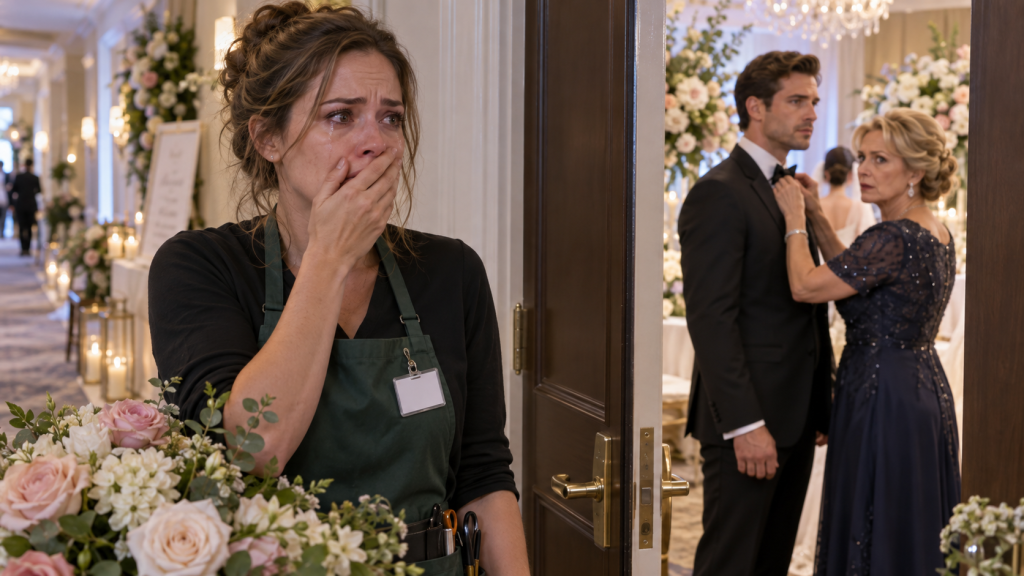
PART 3 — THE MAN I BURIED TWICE
Detective Harris arrived before the string quartet finished the second song.
He came through the side entrance with two uniformed officers and another detective I did not recognize.
The room changed the second Adrian saw him.
It was almost imperceptible.
A tiny retreat.
One foot sliding backward.
His shoulders tightening beneath the dark suit he had once bought for our wedding.
That suit was the detail I could not stop seeing.
I had stood outside the fitting room while he tried it on.
I had told him the shoulders looked perfect.
He had spun around and asked whether it made him look like James Bond.
I had laughed and said:
“Budget James Bond.”
Now he stood in that same suit between two women he had planned to marry within six months of each other.
One thought he was her future.
The other had buried him.
Detective Harris looked at me first.
“Meredith.”
I nodded.
Then he looked at Adrian.
For nearly ten seconds, nobody spoke.
Finally:
“Adrian Bell?”
Adrian swallowed.
“Harris.”
Detective Harris’s face hardened.
“So it is you.”
Colleen began crying.
Sophie stood beside the wall in her wedding dress, still holding the bouquet I had made that morning.
White roses.
Ranunculus.
Small sprays of eucalyptus.
She looked like a photograph from someone else’s life.
“What’s happening?”
she whispered.
Adrian turned toward her.
“Sophie, I need you to listen to me.”
She backed away.
“No.”
“Please.”
“No.”
Her voice cracked.
“You let this woman bury you?”
He looked at me.
Then at Detective Harris.
“It’s complicated.”
The detective actually laughed.
Not loudly.
One exhausted breath.
“I’ve spent three months working a fatal crash with an unidentified body buried under your name.”
His eyes narrowed.
“You’re going to have to do better than complicated.”
Several guests had gathered in the hallway now.
Whispers moved through them.
The coordinator looked seconds away from fainting.
One bridesmaid slowly removed her shoes as though she had decided running might become necessary.
Adrian lowered his voice.
“Can we do this somewhere private?”
Detective Harris said:
“No.”
One simple word.
I felt it all the way through me.
Adrian glanced toward the exit.
One of the officers moved slightly.
Not aggressively.
Enough.
“Don’t.”
Harris said.
Adrian stopped.
Then Harris looked at Colleen.
“Mrs. Bell.”
Her crying stopped.
Not because she was calm.
Because she understood her turn had come.
“Did you know your son was alive when you identified the deceased as Adrian?”
Colleen covered her mouth.
Adrian stepped forward.
“Don’t answer that.”
Harris’s eyes moved to him.
“That is remarkably bad advice.”
“Mom.”
Adrian’s voice sharpened.
Colleen looked at her son.
Then at me.
And I watched something break between them.
Not love.
Something uglier.
The agreement.
Whatever secret had held them together since the crash.
She whispered:
“Yes.”
The hallway went completely silent.
I think my heart did too.
Detective Harris’s voice became careful.
“You knew the body was not your son?”
Colleen sobbed.
“I didn’t know who it was.”
“But you knew it wasn’t Adrian.”
“Yes.”
Adrian closed his eyes.
Sophie made a sound behind me.
A tiny broken gasp.
I looked at Colleen.
Three months earlier, that woman had held my hand at a graveside.
She had leaned against me while I cried.
She had whispered:
“We’ll survive this somehow.”
She had watched me kiss a closed casket.
She knew.
All of it.
Every second.
She knew.
“Why?”
I asked.
Harris glanced at me but did not stop me.
Colleen looked at me.
Her face twisted.
“Meredith—”
“Why?”
My voice was not loud.
It shook anyway.
“He called me after the accident.”
She whispered.
I stared.
“What?”
“Adrian called me.”
“When?”
“That night.”
The floor seemed to tilt.
Adrian said:
“Mom, stop.”
She looked at him.
“No.”
For the first time, she sounded like his mother rather than his accomplice.
“No, Adrian.”
Then she looked back at me.
“He called from a gas station about six miles from the crash.”
My mouth went dry.
“He was hurt.”
“Bleeding.”
“Confused.”
“He told me there had been an accident.”
“And?”
“I picked him up.”
Every word rearranged the night I thought he died.
The officer at my door.
The highway.
The wreck.
The hospital telling me there was no point viewing the body.
Colleen collapsing into my arms.
All of it built on a phone call I never knew happened.
“Did he know someone else was in the car?”
I asked.
Colleen nodded.
“Yes.”
“Who?”
She started crying harder.
“I don’t know.”
Detective Harris said quietly:
“We may.”
Everyone turned toward him.
He looked at Adrian.
“Do you recognize the name Miles Jensen?”
Adrian’s face went gray.
That was answer enough.
Harris continued.
“Miles Jensen worked for your company for approximately fourteen months.”
Sophie looked at Adrian.
“You told me Miles quit.”
Adrian stared at the floor.
Harris looked at her.
“You knew him?”
“Not well.”
Her voice shook.
“Adrian said he left town.”
I felt cold.
Detective Harris continued.
“Miles Jensen has been listed as a missing adult for nearly three months.”
Colleen whispered:
“Oh God.”
Adrian said nothing.
Harris’s expression sharpened.
“We received preliminary dental comparison this afternoon.”
He paused.
“The remains buried under Adrian Bell’s name are very likely Miles Jensen.”
The bouquet slipped from Sophie’s hands.
This time it hit the floor.
White flowers scattered between us.
Nobody picked them up.
—
Miles Jensen.
Thirty-two years old.
Divorced.
No children.
An employee in Adrian’s construction-supply business.
Estranged from most of his family after years of addiction, though according to Detective Harris he had been sober for nearly four years.
His older sister, Laura, had reported him missing when he stopped answering calls.
Adrian told employees Miles had left after a dispute.
He told Sophie the same thing.
He told police nothing.
Because according to the world, Adrian himself had died that night.
A dead man cannot be questioned about a missing employee.
Convenient.
Horribly convenient.
Harris asked Adrian again:
“What happened to Miles?”
Adrian looked around at the guests.
The wedding guests.
His almost-wife.
His mother.
Me.
Then:
“I want a lawyer.”
Detective Harris nodded.
“That’s your right.”
One officer stepped forward.
Adrian looked toward Sophie.
She turned her face away.
Then toward Colleen.
His mother was sobbing.
Finally, he looked at me.
“Meredith.”
I did not answer.
He took one step in my direction.
The officer blocked him.
“Please.”
I stared at the man I had loved for five years.
The man whose toothbrush had remained in my bathroom for six weeks after his funeral because I could not bear to throw it away.
The man whose voicemail I had played at night just to hear him say my name.
The man I had imagined dying alone inside twisted metal.
There he was.
Alive.
Afraid.
And the strangest thing happened.
I stopped wanting to touch him.
Not slap him.
Not hold him.
Nothing.
That absence frightened me more than anger.
“You let me bury somebody.”
I said.
Adrian’s face collapsed.
“I know.”
“You let me think it was you.”
“I know.”
“I stood over that grave.”
His eyes filled.
“I’m sorry.”
“No.”
I shook my head.
“Not yet.”
He stared.
“You do not get to be sorry before I even know what you did.”
The officer took his arm.
Adrian did not resist.
As they led him toward the exit, guests stepped aside.
A path opened.
The aisle he had intended to walk down as a groom became the route police used to escort him out.
I wish I could say I enjoyed that.
I didn’t.
I watched.
That was all.
At the doorway, he looked back once.
Then disappeared.
The string quartet had stopped playing.
Good.
Some moments do not need music.
—
The wedding did not happen.
Obviously.
Sophie stood in the hallway for several minutes after Adrian was taken away.
Nobody knew what to do with a bride whose groom had been arrested for being alive.
Her mother finally came forward and put a coat around her shoulders.
Sophie looked at me.
“Did you know about me?”
I swallowed.
“No.”
“Before today?”
“No.”
She nodded.
Then:
“I knew about you.”
I already knew that.
Still hurt.
“He said you broke up.”
“When?”
“Five months ago.”
My stomach tightened.
Adrian and I had been choosing invitations five months earlier.
Sophie began crying.
“He said the wedding was canceled.”
I stared.
“Our wedding?”
“Yes.”
“He said you couldn’t let go.”
A laugh escaped me.
Sharp.
Ugly.
I covered my mouth.
Sophie cried harder.
“I’m sorry.”
I looked at her.
Part of me wanted to hate her.
It would have been convenient.
Then I looked at the white dress.
The bouquet on the floor.
The room full of guests she now had to face.
Adrian had humiliated both of us differently.
That did not make our responsibility equal.
But it made hatred feel less useful.
“Did you know he was supposedly dead?”
“No.”
“Did you know there had been a funeral?”
“No.”
She shook her head violently.
“No.”
Then:
“He told me you were telling people he died because you were unstable.”
I stopped breathing.
“What?”
Sophie covered her face.
“He said after the breakup you had a breakdown.”
The cruelty of it was so complete that for a second I almost admired the architecture.
He had not only faked his death.
He had built a story where my grief itself became proof that I was irrational.
If Sophie ever encountered someone who mentioned my mourning, Adrian already had the explanation prepared.
Meredith is unstable.
Meredith says strange things.
Meredith cannot accept the breakup.
The dead man had planned for the living woman to look crazy.
I sat down.
There was a chair against the wall.
I did not remember choosing it.
Sophie crouched several feet away.
Her dress pooled around her.
“I’m sorry.”
I looked at her.
“Stop saying that.”
She froze.
“I don’t know what else to say.”
“Neither do I.”
We sat there.
Two women in formal clothes.
One dressed for a wedding.
One wearing a florist apron with green stains.
Both staring at an empty doorway.
—
Colleen tried to leave.
Detective Harris stopped her.
Not physically.
With her name.
“Mrs. Bell.”
She froze.
He spoke quietly with her.
Then another officer did.
Eventually, she was escorted away too.
Not in handcuffs at first.
She turned toward me before leaving.
“Meredith.”
I stood.
Part of me wanted to ignore her.
Instead:
“What?”
She cried.
“I’m sorry.”
I stared.
“For which day?”
She flinched.
Good.
It was cruel.
I meant it.
“The accident?”
“The funeral?”
“The graveside?”
“The phone calls after?”
I stepped closer.
“You called me every morning for two weeks.”
Colleen sobbed.
“I know.”
“You asked whether I was eating.”
“I know.”
“You told me Adrian would have wanted me to keep living.”
She covered her face.
“I know.”
I was crying now too.
“How could you sit across from me and say his name knowing he was alive?”
She had no answer.
That was the answer.
I whispered:
“I held you at his funeral.”
Colleen’s knees seemed to weaken.
An officer steadied her.
“I know.”
“No.”
I wiped my face.
“You don’t get to say that like knowing and understanding are the same thing.”
She closed her eyes.
Then police took her away.
I never finished the floral arrangements.
My assistant did.
Not for the wedding.
For guests to take home.
Sophie asked for none of them.
Neither did I.
The flowers were innocent.
They deserved better than the room.
—
Detective Harris spoke to me until nearly midnight.
At first, we sat inside the venue office.
Then at the police station.
Michael—my brother, not the other story’s Michael; wait there is no Michael in this story. Need not introduce. Let’s avoid. I was alone? Maybe close friend. Let’s use assistant “Lena” from florist? Not previously named. Could introduce. Better no need.
I called my sister, Claire.
She arrived at the station with no makeup, wet hair, and one shoe untied.
The moment she saw me, she hugged me so hard I could not breathe.
I had not told her details on the phone.
Only:
“Adrian is alive.”
She thought I was in shock.
When she saw Detective Harris, she realized I wasn’t.
Claire sat beside me through the interviews.
Every time I stopped speaking, she touched my knee.
Not enough to interrupt.
Enough to remind me I still existed.
Harris explained what they knew.
The crash happened on a remote state highway shortly after midnight.
Adrian’s SUV left the road, struck a barrier, rolled, and caught fire.
One body remained inside.
Another person appeared to have exited or been thrown clear.
At the time, investigators believed the debris outside the car came from the crash itself.
No second body.
No identified survivor.
Adrian’s wallet was found inside the vehicle.
His watch too.
The vehicle was registered to him.
Colleen confirmed he had been driving it that night.
The body was badly burned.
His longtime dentist had retired, and records were incomplete.
There were no usable fingerprints.
No one immediately suspected misidentification.
Colleen had identified jewelry and other personal effects.
The death certificate followed.
Closed casket.
Burial.
Done.
Except not done.
Because according to Harris, investigators later learned Miles Jensen had been with Adrian that evening.
Security footage from Adrian’s business showed both men leaving after ten.
Miles was driving.
Adrian sat in the passenger seat.
That footage had been overlooked because by the time Miles was reported missing, Adrian was already “dead,” and his company had supplied incomplete records.
Incomplete because Adrian’s business manager had been following instructions left before the crash.
“What instructions?”
I asked.
Harris looked at me.
“That’s part of what we’re investigating.”
“What was Adrian doing?”
A pause.
“Financial misconduct appears likely.”
Claire squeezed my knee.
Harris continued.
“Client deposits.”
“Vendor accounts.”
“Possible falsified invoices.”
“We believe Miles may have discovered something.”
My stomach turned.
“Did Adrian kill him?”
Harris held up one hand.
“We do not know that.”
“Then what do you know?”
“The crash reconstruction does not currently indicate deliberate impact.”
He spoke carefully.
“We have no evidence at this stage that the collision itself was intentional.”
I exhaled.
A fraction.
Then:
“But?”
Harris looked down at his notes.
“But Adrian left a dying or deceased man at the scene, failed to report the crash, allowed authorities to identify that man as him, and then knowingly participated in maintaining that false identity.”
My mouth went dry.
“How did he leave?”
“Colleen.”
Of course.
“He called her from a gas station after walking approximately four miles.”
“She picked him up.”
“Yes.”
“And brought him where?”
“A family cabin initially.”
Claire whispered:
“Oh my God.”
Harris nodded.
“Then several other locations.”
“How long before Sophie knew he was alive?”
“She always knew.”
I stared.
“What?”
Harris clarified.
“She knew Adrian was alive.”
“Not that the world believed he was dead.”
Relief came and disappeared in the same breath.
“She believed he was hiding from a dangerous former business partner after leaving you.”
I closed my eyes.
Miles.
Maybe Adrian had turned Miles into the villain too.
“What was the plan?”
“We’re still determining that.”
But over the next several months, I learned.
More than I ever wanted.
—
Adrian had been stealing.
That was the simplest word.
Stealing.
Not from me directly.
From his company.
Clients.
Investors.
Sometimes vendors.
He had moved money between accounts to cover shortages.
Used deposits from new projects to pay costs on old ones.
Created shell vendors.
Signed payments.
Borrowed against future work.
The business was beginning to collapse beneath the lies.
Miles Jensen, who worked in accounting and logistics, noticed.
He confronted Adrian.
There were emails.
Texts.
A voice message Miles sent his sister two days before the crash.
Something is wrong at work. If Adrian asks, I’m not signing anything.
That message became important.
The night of the crash, Miles and Adrian stayed late.
Adrian later admitted they argued.
Miles threatened to go to police.
Adrian convinced him to drive to another property where he claimed records would prove the shortages were temporary.
They never made it.
Miles was driving too fast.
Adrian was shouting.
A tire failed.
The SUV left the road.
No murder plot.
No deliberate crash.
That truth was strangely worse in one way.
Because fate had handed Adrian a tragedy.
And he turned it into an opportunity.
When he crawled from the wreckage, Miles was trapped.
Adrian later claimed he tried to pull him out.
Maybe he did.
Investigators found evidence consistent with someone attempting to open the driver-side door.
But flames spread.
Adrian fled.
He reached the gas station.
Called his mother.
Not 911.
His mother.
By the time another motorist reported the fire, Miles was dead.
Adrian realized his wallet and watch were still inside.
His vehicle.
A body roughly his height.
A burned scene.
And a business investigation waiting if he remained alive.
He told Colleen:
“Let them think it’s me.”
Three words.
That was the birth of my nightmare.
Colleen said no.
At first.
Then Adrian convinced her he would be arrested.
Ruined.
Possibly blamed for Miles’s death.
He told her dangerous creditors were involved.
He told her he needed time.
He told her he would make things right later.
People can be persuaded into terrible things when the request is delivered in small steps.
First:
Don’t call anyone tonight.
Then:
Let me sleep at the cabin.
Then:
If police ask, say I drove the SUV.
Then:
Identify my watch.
Then:
Don’t tell Meredith yet.
Then:
We can’t tell Meredith now because she’ll go to the police.
By the time the funeral happened, Colleen had crossed so many lines that turning back meant admitting all of them.
So she kept walking.
And I buried Miles Jensen.
—
The life insurance company had not paid.
That was one small mercy.
The claim was still under routine review because the crash involved a severely damaged body and ongoing business issues.
I had not cared about the money.
I barely returned the insurance agent’s calls.
Adrian apparently expected that.
What he had not expected was his own impatience.
Sophie.
That was the part that made Detective Harris shake his head.
Adrian met Sophie nine months before his “death.”
She worked for a marketing company that handled one of his projects.
The affair began four months before our wedding.
He told her our relationship was ending.
Then the crash happened.
Instead of disappearing alone, Adrian contacted Sophie from a prepaid phone.
He told her there had been threats.
He said he needed to stay hidden.
He never said a body had been buried under his name.
Sophie helped him rent a room under a shortened version of his middle name.
Later, when the investigation seemed quiet, Adrian became bolder.
Restaurants outside our city.
Trips.
Eventually, a new engagement.
Why so fast?
That question tortured me.
Then Sophie gave me the answer months later.
“He was obsessed with starting over.”
We were sitting in a coffee shop.
Our first and only long conversation after the wedding day.
She looked tired.
No makeup.
No ring.
“He said he wanted one good thing after everything.”
I laughed bitterly.
“Everything he created.”
“I know.”
She nodded.
“He said marrying me would make life feel normal.”
Normal.
Apparently he intended to manufacture normalcy with a white dress and a different woman.
The wedding venue was nearly two hours from where Adrian and I lived.
The guest list was small.
Mostly Sophie’s family and people Adrian believed would not overlap with my life.
Colleen begged him to wait.
He didn’t.
And then a florist got sick.
One phone call.
One replacement.
Me.
People talk about fate when they do not know what else to call coincidence cruel enough to feel deliberate.
I still do not know what to call it.
—
Miles Jensen was exhumed six weeks after the interrupted wedding.
DNA confirmed his identity.
His sister Laura invited me to meet her.
I almost said no.
I did not know what I could possibly give her.
Then I went.
We met at a diner halfway between our towns.
Laura was forty.
Red hair.
Tired eyes.
She brought a photograph of Miles.
Alive.
I had only seen police photos.
Work ID.
Now he was laughing beside a lake, holding a fishing rod.
My throat tightened.
“I’m sorry.”
Laura looked at me.
“For what?”
“I buried him.”
Her face softened.
“You didn’t know.”
“I stood over his grave and called him Adrian.”
“You didn’t know.”
“I put flowers on—”
She reached across the table.
“Meredith.”
I stopped.
“You did not do that to my brother.”
I cried.
“I hate that he was alone.”
Laura cried too.
“So do I.”
We sat there.
Two women connected by the same dead man for completely different reasons.
Then Laura said:
“I’m glad you loved him.”
I stared.
“What?”
“The body.”
She wiped her eyes.
“I know it sounds strange.”
“But somebody stood there.”
“Somebody cried.”
“Somebody brought flowers.”
My heart broke.
“You shouldn’t have had to be grateful for the wrong funeral.”
“No.”
She smiled sadly.
“But life is ugly sometimes.”
Then:
“We’re giving him another one.”
A proper funeral.
Under his name.
Miles Jensen.
Known.
I asked if I could come.
Laura nodded.
“Yes.”
I made the flowers.
Not lilies.
I could not.
Wildflowers.
Sunflowers.
Blue delphinium.
Branches of rosemary.
Laura said he hated formal things.
So I made the arrangement look like someone gathered a field.
At the service, I stood in the back.
This time, I knew whose casket it was.
That mattered more than I can explain.
The headstone read:
MILES ANDREW JENSEN
No borrowed identity.
No lie.
Afterward, Laura hugged me.
“Thank you.”
I whispered:
“I’m sorry it took this long for him to get his name back.”
She said:
“Names matter.”
I thought of Adrian.
Of death certificates.
Wedding invitations.
False stories.
Yes.
Names matter.
—
Adrian pleaded guilty eventually.
Not immediately.
For months, he fought.
Not the fact that he was alive.
That would have been difficult.
Everything else.
He claimed panic.
Trauma.
Confusion after the crash.
He said Colleen acted on her own in identifying the body.
Colleen’s attorney disagreed strongly.
So did the phone records.
The prepaid phones.
The money transfers.
The cabin surveillance footage.
The false business filings made after his supposed death.
The messages to Sophie.
The wedding planning.
Panic lasts minutes.
Maybe hours.
It does not order a wedding cake.
Eventually, Adrian admitted enough.
Obstruction.
Fraud-related offenses.
False statements.
Financial crimes tied to the business.
Conduct surrounding the crash and his disappearance.
I did not memorize every statute.
I spent too much of my life memorizing his lies.
I did not want his case numbers too.
He received prison time.
Real time.
Years.
Not life.
He had not intentionally killed Miles.
That mattered legally.
And to me.
But he had abandoned the truth at the scene and let another man lose his identity in death.
Then he built himself a future inside the space that lie created.
The judge called it:
“A sustained deception born from a moment of fear and maintained by repeated acts of choice.”
That sounded accurate.
Choice.
Again and again.
—
Colleen took a plea too.
Obstruction.
False statements.
Conspiracy-related conduct.
She did not go to prison for as long as Adrian.
Her age.
Her cooperation.
No financial benefit.
Other factors.
She received a shorter custodial period followed by supervision.
I attended her sentencing.
I did not plan to speak.
Then the prosecutor asked.
So I did.
Colleen sat at the defense table.
I stood several yards away.
For weeks I had written angry pages.
I brought none.
I said:
“Colleen lost a son the night of the crash.”
Her head lifted.
“Not physically.”
I swallowed.
“But I think she became so frightened of losing him that she helped him become someone she could no longer protect without hurting other people.”
Colleen cried.
“I loved her.”
My voice broke.
“I trusted her.”
“I stood beside her at a funeral she knew was false.”
Silence.
“I do not want revenge.”
I looked at the judge.
“But I need the court to understand that grief was not an excuse she accidentally gave me.”
“She actively helped create my grief.”
My eyes filled.
“That matters.”
Then I sat.
Colleen mouthed:
“I’m sorry.”
I looked away.
Not because I wanted to punish her.
Because I had heard it.
That was enough for that day.
—
Sophie canceled everything.
Venue.
Catering.
Photographer.
Honeymoon.
She lost deposits.
Money she did not have much of.
Her parents helped.
I heard she moved for a while.
Changed jobs.
Stopped speaking to Colleen completely.
She testified.
That mattered.
Her text history with Adrian helped establish how deliberate his post-death life had been.
He told Sophie:
Once the dust settles, we’ll be free.
Free.
I read that message during discovery.
I stared at it for a long time.
While I was choosing an urn for some of Adrian’s personal belongings because there were no ashes, he was texting another woman about freedom.
While I slept in his T-shirt, he was alive.
While I spoke to his photograph, he was buying a ring.
There is no language graceful enough for certain betrayals.
You survive them first.
Language comes later.
—
My wedding dress stayed in the back of my closet for almost two years.
I had never worn it.
Only fittings.
Ivory.
Simple.
Tiny buttons down the back.
For months after Adrian’s “death,” I could not look at it.
After finding him alive, I hated it.
Not because of the dress.
Because it belonged to a future that had been used against me twice.
First taken by death.
Then revealed as a lie.
Eventually, Claire asked:
“What are you going to do with it?”
I stared.
“I don’t know.”
“Sell it?”
“Maybe.”
I didn’t.
Instead, I called a nonprofit that made burial gowns for infants from donated wedding dresses.
I almost hung up when they explained.
Too much grief.
Then I thought about fabric becoming something compassionate instead of wasted.
I donated it.
That decision confused people.
Some called it morbid.
It didn’t feel morbid.
It felt honest.
The dress had been made for a wedding that never happened.
It could still become tenderness somewhere.
Not everything has to fulfill its first purpose to have value.
That became important to me.
—
For almost a year, I could not work weddings without shaking.
The day I found Adrian, I finished the flowers only because my assistant took over.
Afterward, every groom in a dark suit made my stomach clench.
Every mother-of-the-groom corsage.
Every closed door.
Every string quartet tuning.
I considered leaving floristry.
Then one bride named Sam changed something.
She was twenty-seven.
Nervous.
Kind.
Her wedding was small.
The morning of, the groom’s boutonniere fell apart because I wired one stem badly.
I was distracted.
I apologized repeatedly.
Sam looked at me.
“Meredith.”
“Yes?”
“It’s a flower.”
I froze.
She smiled.
“We’re still getting married.”
Something inside me loosened.
Not every wedding was a trap.
Not every groom was hiding another life.
Not every mother knew a secret.
Sometimes flowers were just flowers.
I rebuilt slowly.
Small weddings first.
Then large.
Eventually I could stand at the back of a ceremony and feel joy without hearing Adrian’s voice.
That took time.
I stopped being embarrassed by how much.
—
I went to therapy.
Of course.
The first thing I told Dr. Shah was:
“I mourned a man who was alive.”
She nodded.
I waited for some explanation.
None.
Then:
“Do you know how stupid that makes me feel?”
“Why would grief make you stupid?”
“Because he wasn’t dead.”
“You believed credible evidence.”
“His mother confirmed it.”
“Police confirmed it.”
“A funeral occurred.”
She leaned forward.
“Your grief was real because your loss was real.”
I frowned.
“He was alive.”
“You lost the man you believed existed.”
That sentence cracked something open.
I had.
Even if the body in the grave was Miles, the Adrian I loved had died in another way.
Maybe before the crash.
Maybe months earlier when he started lying.
Maybe there never was one clean moment.
But the fiancé I mourned did not exist anymore.
Perhaps he had never existed as completely as I thought.
Grief does not require a corpse.
Sometimes it requires truth.
—
Adrian wrote me letters from prison.
The first arrived four months after sentencing.
I knew his handwriting before I saw the return address.
My hands shook.
I left it unopened for a week.
Then read.
Meredith,
I know I have no right to ask you for anything.
Good start.
Then:
I am sorry.
Less useful.
He wrote about the crash.
Miles.
The fear.
Calling Colleen.
He said the moment he realized police thought he was dead, he felt relief.
That honesty surprised me.
For about ten minutes, I thought I had been given a way out.
Then:
Those ten minutes became three months.
No.
They became decisions.
He admitted that too.
Every day after, I had another chance to tell the truth. I chose not to.
Better.
Then:
I thought I could separate my old life from my new one. I told myself you would heal. I told myself you would be better without the truth.
I laughed bitterly.
How generous.
The final paragraph hurt most.
I loved you. I know that sentence may offend you. But I did. I was also selfish enough to betray you anyway.
I stared.
That was harder than:
I never loved you.
If he never loved me, the story becomes simple.
Bad man.
Fake relationship.
Done.
But people can love and still act monstrously selfish.
Love is not proof of character.
Behavior is.
I did not answer.
—
A year later, another letter.
Shorter.
I understand why you don’t write back.
Good.
I am not asking you to.
Better.
Then:
Miles’s sister sent me a copy of his obituary. I look at it every day.
I wondered why Laura did that.
Later, she told me:
“I wanted him to know the name.”
Names matter.
Again.
Adrian wrote:
I took his name away because I was afraid to face my own.
That line stayed.
I kept the letter.
Not because I forgave him.
Because it was true.
—
Colleen wrote too.
Her letters were harder.
I had loved her.
Maybe in some ways more safely than Adrian.
We gardened together.
Shopped for my wedding dress.
She taught me her mother’s biscuit recipe.
After Adrian “died,” I slept at her house twice because neither of us wanted to be alone.
She knew.
That was the wound I struggled with most.
Her first letter began:
I do not expect you ever to forgive me.
I almost stopped.
Then:
I was afraid of losing my son and I chose to let you lose him instead.
I cried.
There it was.
No excuse could improve it.
I read on.
She described the night of the crash.
Adrian arriving at the gas station bloodied.
Begging.
Shaking.
Saying he would go to prison.
Saying Miles was dead.
Saying everything was over.
She said she thought:
Just one night.
Then one night became the next lie.
I kept telling myself I would tell you tomorrow.
Tomorrow.
The most dangerous day.
Always available.
Never arriving.
She wrote:
At the funeral, when you held my hand, I almost told you.
My stomach turned.
Almost.
She continued:
Then you said, “At least he wasn’t alone in the world. He knew we loved him.” I became too ashamed to speak.
I remembered saying that.
I had forgotten until the letter returned it.
I threw the pages across the room.
Then picked them up.
Anger does not make paper less true.
—
I did eventually visit Colleen.
Three years later.
After she completed her sentence.
Not because she asked.
Because I wanted one answer.
She lived in a small apartment then.
The old family home had been sold partly to pay legal costs and other obligations.
She opened the door.
Looked older.
Of course.
We both did.
“Meredith.”
“Hello.”
She began crying immediately.
I almost left.
Then stayed.
We sat at her kitchen table.
No tea.
No biscuits.
No performance.
I asked:
“Why didn’t you tell me after the funeral?”
She looked down.
“Because then I would have had to admit I let you go through it.”
“That’s shame.”
“Yes.”
“Not protection.”
“No.”
“Why did you keep calling me?”
Her face crumpled.
“I loved you.”
I laughed.
Cruel sound.
She accepted it.
“I did.”
She whispered.
“And I was guilty.”
“So you comforted me.”
“Yes.”
“To make yourself feel less terrible?”
She cried.
“Probably.”
Honest.
Finally.
I sat back.
That answer hurt.
It also helped.
People like to imagine every act of comfort is pure.
Often we are doing things for mixed reasons.
Colleen loved me.
Colleen used caring for me to soften her own guilt.
Both.
“Did Adrian ask you to?”
“No.”
“Did he know you were talking to me?”
“Yes.”
“What did he say?”
She looked sick.
“He said it helped.”
My body went cold.
“Helped what?”
“He said if you were coping, he felt less guilty.”
I stood.
That was enough.
Colleen stood too.
“I’m sorry.”
I looked at her.
“I believe you.”
Her face changed.
Hope.
I raised one hand.
“That does not mean I want you back in my life.”
Hope disappeared.
“I know.”
I walked to the door.
Then stopped.
“Colleen.”
“Yes?”
“I hope someday you forgive yourself enough to stop making your guilt somebody else’s responsibility.”
She began crying again.
I left.
That was the last time I saw her for years.
—
Miles’s sister Laura became an unexpected friend.
Not best friends.
Something quieter.
Every year on the anniversary of the crash, one of us texted the other.
Usually:
Thinking of you.
Nothing more.
The date belonged to both of us badly.
She had lost a brother.
I had lost the illusion of a fiancé.
Eventually, on Miles’s birthday, I sent flowers to his grave.
Blue delphinium.
Laura texted:
He would’ve called them weeds.
I replied:
He had no taste.
She responded:
Correct.
That is how grief changes.
At first, every mention feels like a wound.
Later, there can be jokes.
Not because the dead matter less.
Because pain stops requiring every room.
—
Sophie married someone else five years later.
She sent me an email before the wedding.
I nearly deleted it.
Then read.
I wanted you to know because I didn’t want there to be any chance you heard through someone else and felt blindsided by another wedding attached to my name.
That was thoughtful.
She wrote:
His name is Daniel. He knows everything. We have been together three years.
Then:
I still have the bouquet ribbon from that day. I don’t know why. Maybe as proof I survived being the bride at the wedding that didn’t happen.
I smiled sadly.
I understood keeping strange objects.
Then:
I hope you are well.
I replied:
I am. Congratulations. I hope your day is ordinary in all the best ways.
She wrote back:
That is exactly what I want.
Ordinary.
People who have survived spectacular betrayal learn to appreciate boring happiness.
—
Adrian was released after serving several years.
Not all of his sentence.
Credits.
Programs.
Legal things I did not follow closely.
Detective Harris called before I could hear it from gossip.
“I thought you should know.”
“Thank you.”
“Do you want notification of any supervision changes?”
“No.”
He paused.
“You sure?”
“Yes.”
And I was.
Adrian’s freedom no longer had to be an event in my life.
That realization felt like its own release.
He wrote one final letter after getting out.
No prison address.
Plain envelope.
I almost returned it unopened.
Then read.
Meredith,
I am not coming to see you.
Good.
I will not call.
Better.
I wanted you to know I understand that the kindest thing I can do now is stay out of the life I already damaged enough.
I sat down.
Then:
I work at a warehouse. I rent a small apartment. I go to meetings. I speak to my mother sometimes. I visit Miles’s grave twice a year. Laura knows. She has never asked me to stop.
That surprised me.
Then:
I am not telling you this to prove I became good. I don’t know whether I did. I am trying to become honest.
The letter ended:
I hope someday when you think of me, I am not the first thing you feel.
For a long time, I stared.
Then folded it.
He got his wish.
Eventually.
—
I fell in love again at thirty-nine.
Not quickly.
His name was Ben.
He owned the bakery next to my flower studio.
For a year, we were only neighbors.
He brought leftover croissants.
I made arrangements for his mother’s birthday.
He knew my history because everyone in town did.
That irritated me.
On our first actual date, he said:
“I’m not going to ask you about Adrian.”
I blinked.
“Why?”
“Because if you want me to know something, you’ll tell me.”
That was almost exactly what Sophie’s future husband would later say, though I did not know that then.
Maybe decent people share language.
Ben was widowed.
Different kind of grief.
His wife died of leukemia six years earlier.
No deception.
No scandal.
He understood that grief can remain without threatening new love.
That mattered.
We moved slowly.
Very slowly.
Our third date happened two months after the second.
He joked:
“At this rate we’ll be engaged in 2047.”
I almost stopped breathing.
He saw.
“Sorry.”
“No.”
I shook my head.
“It’s okay.”
Then:
“I don’t know if I ever want to be engaged again.”
Ben nodded.
“Then don’t.”
Simple.
No persuasion.
No:
I’ll change your mind.
No:
You’ll heal.
Just:
Then don’t.
I loved him a little for that.
—
We were together six years before marriage came up seriously.
Not because he pressured.
Because I did.
One evening, we were washing dishes.
Very romantic.
I said:
“If we ever got married, I’d want something tiny.”
Ben kept washing.
“Okay.”
“That’s all?”
He looked at me.
“What am I supposed to do?”
“Be dramatic.”
He put the sponge down.
Dropped to one knee.
I screamed.
He laughed.
“I don’t have a ring.”
“Get up.”
“Is this helping?”
“No.”
He stood.
I was laughing so hard I cried.
Then he said:
“Meredith.”
“Yes?”
“Do you want to marry me?”
I froze.
Not because I saw Adrian.
Because I didn’t.
For the first time, marriage existed in front of me without his shadow standing beside it.
“Yes.”
Ben smiled.
“Okay.”
“No ring?”
“I was washing a casserole dish.”
“Poor planning.”
“I own a bakery, not a jewelry store.”
We laughed.
That was our engagement.
No surprise party.
No two-carat stone.
No performance.
Later, we chose a simple ring together.
I checked his pulse twice at the jeweler as a joke.
He did not find it funny.
I did.
—
Our wedding had nineteen people.
Claire.
Laura.
A few friends.
Ben’s family.
No string quartet.
No grand aisle.
I did my own flowers.
People told me not to.
I wanted to.
Garden roses.
Chamomile.
Greenery.
Nothing white enough to remind me of Sophie’s bouquet.
Before the ceremony, I stood alone in a small room.
For one second, my hands started shaking.
Not because I doubted Ben.
Because bodies remember.
Closed casket.
Adrian alive.
Police.
White roses on the floor.
All of it.
Then Claire came in.
“You okay?”
“Yes.”
She raised an eyebrow.
“I’m scared.”
“Better.”
“What?”
“That sounds more honest.”
I laughed.
Then cried.
“I don’t want anything bad to happen.”
Claire hugged me.
“Something bad will happen eventually.”
I pulled back.
“Terrible pep talk.”
She smiled.
“I mean life.”
She touched my face.
“You’re not marrying because bad things are impossible.”
“You’re marrying someone you trust to tell you when they happen.”
That sentence carried me into the room.
Ben waited.
Alive.
Visible.
No secrets hidden inside a casket.
I walked toward him.
Not because the past had disappeared.
Because it no longer got to make every decision.
—
I did not invite Colleen.
I considered it.
Then decided compassion did not require access.
Years later, she sent a card.
No guilt.
No request.
Just:
I heard you married. I hope you are very happy.
I replied:
Thank you. I am.
That became the beginning of a strange, distant peace.
Holiday cards.
Nothing more.
When she became ill, her sister contacted me.
Colleen had cancer.
She asked whether I wanted to know.
I did.
I visited once.
Ben drove me.
Waited in the car.
Colleen looked frail.
Her hair gone.
She smiled.
“You look good.”
“So do you.”
She laughed.
“Liar.”
“Florist. We sell fantasy.”
She laughed again.
For a moment, I remembered the woman who helped me choose linens.
That hurt.
Then comforted.
Both.
She said:
“I’m not going to apologize again.”
“Good.”
“I’ve run out of versions.”
I smiled.
Then she looked at me.
“Are you happy?”
“Yes.”
“Really?”
“Yes.”
Tears filled her eyes.
“Good.”
She took my hand.
“I’m glad Adrian didn’t ruin that.”
I swallowed.
“He almost did.”
“I know.”
Silence.
Then:
“Do you forgive me?”
There it was.
I looked at her.
Older.
Dying.
Still human.
“Yes.”
Her face crumpled.
I continued.
“But forgiveness did not make what you did smaller.”
“I know.”
“And it doesn’t mean I wish we had stayed close.”
“I know.”
“It just means I’m tired of carrying anger into rooms you’re not in.”
Colleen cried.
“That’s more than I deserve.”
I shook my head.
“It isn’t about deserve.”
That was the lesson.
Forgiveness was not a prize for good behavior.
It was a decision about what I wanted to keep carrying.
I left an hour later.
Colleen died two months after that.
Adrian was with her.
I did not attend the funeral.
I sent flowers.
Peonies.
Her favorite.
No note.
Enough.
—
Detective Harris retired.
Before he did, he stopped by my shop.
I almost did not recognize him without the exhausted detective expression.
He brought a small envelope.
“What’s this?”
“Something from the old file.”
Inside was a photograph of Adrian’s SUV after the crash.
I recoiled.
“Why would I want this?”
“Turn it over.”
I did.
On the back Harris had written:
Truth survived this. So did you.
I stared.
“That is very sentimental for a detective.”
“I’m retiring. Standards are lower.”
I laughed.
Then cried.
He became serious.
“You know, that case bothered me.”
“Because you buried the wrong man?”
“We didn’t bury him.”
“You know what I mean.”
“Yes.”
He looked down.
“We trusted the obvious answer.”
“Adrian’s car.”
“Adrian’s wallet.”
“His mother’s identification.”
“Sometimes evidence points clearly in one direction because someone arranged the room that way.”
I thought of my relationship.
Same thing.
Evidence.
Fiancé.
Shared home.
Wedding venue.
Future plans.
I had trusted the obvious answer too.
Harris said:
“You didn’t miss something because you were foolish.”
I looked at him.
“People who deceive professionally use trust as camouflage.”
That sentence helped more than he knew.
I hugged him.
Detective Harris became completely rigid.
Police officers.
Terrible at spontaneous affection.
Then he patted my back once.
Good enough.
—
Miles’s grave became peaceful.
I visited on the tenth anniversary of the crash.
Laura met me there.
We brought no flowers.
Ironically.
She brought coffee.
We sat on a bench.
Miles’s headstone had weathered slightly.
His name still clear.
Laura said:
“Do you ever think about the other grave?”
Adrian’s original grave had been legally corrected after exhumation.
The temporary marker removed.
The plot eventually returned to the cemetery.
Empty.
“Yes.”
I said.
“Sometimes.”
“What do you think?”
“That I cried over the right thing for the wrong person.”
Laura looked at me.
“That sounds like a florist.”
“What does that mean?”
“Dramatic.”
I laughed.
Then thought.
“I was grieving Adrian.”
“The version I believed.”
“And you were unknowingly giving Miles a funeral.”
“Yes.”
She looked at the stone.
“I’ve decided not to hate that.”
I nodded.
“Me too.”
Then Laura said:
“You know, when they moved him…”
Her voice shook.
“I worried he would feel disturbed.”
I looked at her.
“He was already dead.”
“I know.”
“Grief is stupid.”
“Very.”
She smiled.
“But then at the second funeral, I thought maybe names are a kind of home.”
My eyes filled.
“Yes.”
“Miles came home.”
We sat there.
No need to say Adrian’s name again.
—
Ben and I never had children.
Not because we decided dramatically.
Life simply moved.
At forty-one, I thought about it.
At forty-two, less.
Eventually, we became the aunt and uncle with too many pastries and good Christmas gifts.
That suited us.
My flower studio grew.
I hired three employees.
Then five.
Eventually, I stopped taking emergency wedding replacements.
Everyone laughed when I made that rule.
“Trauma policy.”
I called it.
Then one spring, a florist friend called.
Sick.
Bride in trouble.
Could I help?
Same kind of call that changed my life years earlier.
I stared at the phone.
Then smiled.
“Yes.”
The wedding was at a vineyard.
No ghosts.
No secret groom.
I arranged peonies.
Watched a mother straighten her son’s tie.
For half a second, I saw Colleen.
Then the mother kissed her son’s cheek.
He walked toward the ceremony.
Nothing terrible happened.
I cried anyway.
My assistant asked:
“You okay?”
“Yes.”
I meant it.
Healing sometimes means returning to the scene in a different story.
—
I kept Adrian’s obituary for years.
The original.
ADRIAN THOMAS BELL, 34, beloved son, fiancé, friend…
A dead man’s obituary for a living man.
It was almost absurd.
One day, Ben found it while we were organizing a drawer.
He held it up.
“Keep?”
I looked.
The photograph showed Adrian smiling at a lake.
A life officially ended in print while he was hiding somewhere drinking coffee.
I thought.
Then:
“No.”
Ben put it in recycling.
I stopped him.
“What?”
“I want to tear it.”
He handed it back.
I tore it once.
Then again.
Not dramatic enough.
Ben offered scissors.
I laughed.
“Now who’s theatrical?”
“Bakery James Bond.”
I stared.
He did not know the old suit joke.
I laughed harder.
Then put the pieces in recycling.
Paper.
Ink.
Gone.
Adrian was alive.
Then later, years after prison, he lived somewhere else.
The obituary no longer needed to define either of us.
—
I saw Adrian again once.
Only once.
Eleven years after the fake funeral.
Ben and I were leaving a home-improvement store.
Very glamorous.
Adrian was loading lumber into a pickup.
Older.
Gray at the temples.
He saw me.
We froze.
Ben noticed.
“Is that him?”
“Yes.”
“Want to leave?”
I thought.
“No.”
Adrian did not approach.
Good.
He simply stood there.
Then raised one hand.
Small.
A greeting.
I did the same.
Nothing more.
No confrontation.
No tears.
No cinematic closure in a parking lot beside mulch.
We got into our car.
Ben started the engine.
“You okay?”
I watched Adrian shrink in the side mirror.
“Yes.”
And I was.
That surprised me.
Not because Adrian had become harmless.
Because he had become irrelevant to my nervous system.
That was freedom.
—
The suit.
I forgot about the suit for years.
The same suit Adrian bought for our wedding and wore to marry Sophie.
Police seized it briefly as part of documenting the day.
Eventually, it was returned to him.
I learned this from Colleen.
For some reason, that bothered me.
One suit.
Two weddings.
Neither happened.
Then later, I realized the suit was not cursed.
Adrian was simply a man who reused formalwear.
Objects do not carry morality.
We give them meaning.
That thought helped me with everything.
The venue.
The flowers.
My dress.
Wedding music.
Closed caskets.
Meaning can change.
It does not have to stay where trauma first placed it.
—
On my fiftieth birthday, Ben threw a party.
Against my wishes.
I arrived at the bakery after closing.
Twenty people yelled surprise.
I nearly punched my own sister.
There were flowers everywhere.
Obviously.
Ben had tried arranging them himself.
Terrible.
I told him so.
He looked proud.
Then Claire handed me a cake.
Chocolate.
Not the flavor Adrian and I had argued over.
I noticed.
Then laughed at myself.
Why should cake flavors belong to dead relationships?
I ate two slices.
Later, Ben pulled me onto the tiny floor between tables.
Music.
Bad dancing.
I put my head on his shoulder.
For a moment, I thought about the life I almost had.
Adrian.
The wedding six weeks away.
The house we planned.
Maybe children.
Maybe business trouble.
Maybe divorce later.
Maybe worse.
There is no honest way to know.
Then I looked at the life I did have.
Ben.
My shop.
Claire laughing.
Laura sending me rude texts about flowers.
Ordinary days.
Truth.
I stopped comparing.
That was another kind of peace.
—
People who hear the story always want to know one thing.
“Did you make him regret it?”
At first, I used to say:
“Yes.”
Police arrived at his wedding.
He lost Sophie.
His business collapsed.
He went to prison.
His mother was charged.
His lie destroyed almost everything he was trying to save.
That sounds like regret.
But eventually, I stopped liking the question.
Because if my healing depends on Adrian regretting what he did, he still controls the ending.
Maybe he regrets everything.
Maybe some days he regrets only getting caught.
Maybe he rewrites himself as a frightened man who made one terrible choice.
Maybe he sees the full truth.
I don’t know.
I stopped needing to.
The thing I did in that restroom was not revenge.
Not really.
I thought it was.
I looked in the mirror and thought:
I know how to make Adrian regret this.
What I actually did was refuse to protect him.
That was enough.
I walked back into the hallway.
I told Sophie who I was.
I texted Detective Harris.
Then I let truth enter the room.
Truth did the rest.
—
That distinction matters to me now.
Revenge asks:
How do I hurt you back?
Accountability asks:
What happens when I stop helping your lie survive?
Adrian had built his entire new life on everyone else cooperating.
Colleen staying silent.
Sophie believing him.
Me remaining absent.
Police accepting the identification.
Employees not asking too many questions.
One sick florist changed one piece.
I appeared.
Then everything collapsed because deception is heavy.
It needs constant support.
Truth often needs only one person to stop holding the roof up.
I did.
—
I sometimes think about the funeral.
Still.
Closed casket.
White lilies.
Colleen beside me.
People telling stories about Adrian.
Someone played a slideshow.
Baby pictures.
College.
Our vacations.
One photograph from our engagement.
Everyone cried.
The body inside belonged to Miles.
At first, that memory felt unbearable.
Now I think about something different.
We were wrong about the name.
Not the value of the life inside.
A human being was there.
Miles.
Unrecognized.
Loved by someone elsewhere.
Mourned accidentally by people who thought he was another man.
Not enough.
But not nothing.
Later, he got his own funeral.
His own name.
His own stories.
That helped.
The grave was not a joke.
The lie was.
Death deserved better than Adrian’s use of it.
So did Miles.
So did I.
—
If I could return to the restroom at Sophie’s wedding, I would stand beside that version of myself.
Her hands shaking over the sink.
Mascara under her eyes.
Phone buzzing.
Adrian alive two doors away.
I would tell her:
Do not destroy the flowers.
They didn’t do anything.
Do not slap him.
You’ll want clean hands later.
Do not scream so loudly that nobody hears the facts.
Take a breath.
Send the text.
Then tell the bride the truth before she walks down an aisle built on the same lie that buried you.
After that, let professionals handle the crimes.
You handle yourself.
Eat.
Sleep.
Call Claire.
Go to therapy before she drags you.
Do not spend five years trying to understand how somebody could love you and do this.
People are capable of contradictory things.
Accepting that will save time.
Do not turn Sophie into your enemy simply because Adrian positioned you on opposite sides.
Do not turn Colleen into a monster just so forgiveness becomes unnecessary.
What she did was terrible.
She will have to live with it.
You do not have to.
Go back to weddings.
Slowly.
Keep making bouquets.
Donate the dress when you are ready.
And years from now, when a kind baker asks you to marry him while holding a wet sponge, do not laugh so hard you miss the question.
Say yes if you want.
Not because weddings prove healing.
Because choice does.
Most importantly:
Stop thinking the grave means you were foolish.
You grieved honestly.
He lied dishonestly.
Those are not equal embarrassments.
Your love was not the shameful thing.
Remember that.
—
Adrian died for me twice.
The first time, six weeks before our wedding, I believed metal and fire had taken him.
I mourned him as a good man lost too early.
The second time happened in a hallway three months later.
No crash.
No casket.
I simply saw him alive and understood the man I thought I knew had never been standing where I believed.
That death hurt differently.
There were no casseroles.
No sympathy cards.
No funeral.
Only facts.
But I survived that one too.
And unlike the first death, the second gave something back.
My judgment.
My anger.
My future.
My right to build a life that did not depend on protecting someone else’s version of events.
—
Years later, Ben once asked:
“If Adrian hadn’t been caught that day, what do you think would’ve happened?”
I hated the question.
Not because he meant harm.
Because there is no satisfying answer.
Maybe Adrian would have married Sophie.
Maybe someone eventually recognized him.
Maybe Miles’s identity would have been discovered.
Maybe business charges would have caught him.
Maybe he would have lived years as a man legally dead.
Maybe Colleen would have cracked.
Maybe Sophie would have.
Maybe I would have spent the rest of my life believing the man I loved died faithful.
That last possibility chilled me.
Would ignorance have been kinder?
For a while, I thought maybe.
Then no.
Painful truth restored my agency.
A lie, even a comforting one, makes decisions for you.
Truth gave me my life back.
Not the life I had planned.
Mine.
—
Last summer, I worked a wedding at the same venue where I found Adrian.
First time since that day.
I had avoided it for years.
Then a bride named Elise—of all names—booked us.
No connection.
Just life being strange.
I almost declined.
Then didn’t.
The hallway looked smaller.
The restroom had new mirrors.
The groom’s room door had been painted navy.
I stood in the exact spot where I first heard Adrian’s voice.
Nothing happened.
No shaking.
No panic.
Just memory.
The bride’s mother came rushing down the hall.
“Have you seen the groom?”
My heart skipped once.
Then I saw him.
Standing outside, helping his grandfather with a boutonniere.
Alive.
Exactly where he said he would be.
I laughed.
The mother looked confused.
“Sorry.”
I said.
“Long story.”
During the ceremony, I stayed in back.
The groom watched the bride walk toward him and started crying.
Ordinary crying.
Honest.
After they kissed, everyone applauded.
I did too.
Then I went outside.
The sun was setting.
Same building.
Different story.
I thought about the woman I had been in that restroom.
I wanted to reach backward through time and tell her:
This place will not own you forever.
No place does.
Not if you return on your own terms.
—
At home that night, Ben was asleep.
I washed pollen from my hands.
Then opened the old box where I keep a few things.
Adrian’s first letter.
Detective Harris’s photograph.
A copy of Miles’s funeral program.
Colleen’s last card.
Not trophies.
Not wounds.
History.
I added nothing from the wedding.
I did not need proof.
Then I closed the box.
Put it away.
Ben stirred.
“You home?”
“Yes.”
“How was it?”
“Beautiful.”
He opened one eye.
“Any dead grooms?”
“None.”
“Successful event.”
“Very.”
He reached for my hand.
Half asleep.
I climbed into bed.
No fear.
No checking his pulse.
No secret need to ask whether he was really there.
He was.
That was enough.
—
People think closure is a door.
It isn’t.
It is a room you visit less often.
At first, I lived there.
Adrian.
The accident.
The funeral.
The wedding.
Miles.
Colleen.
Police.
Why.
How.
Why.
How.
Over and over.
Eventually, I started spending afternoons elsewhere.
Then days.
Then weeks.
Now months pass.
Sometimes a flower brings it back.
A dark suit.
A certain highway.
The phrase “closed casket.”
Then the memory leaves again.
That is closure.
Not forgetting.
Mobility.
The ability to enter and exit your own past.
—
I still make wedding bouquets.
That surprises people who know.
They assume I must hate weddings.
I don’t.
I hate deception.
Weddings are only promises.
Promises can be beautiful when the people making them understand they are not magic.
A ceremony cannot create honesty.
A ring cannot.
A grave certainly cannot.
Character exists before vows.
And after.
So when brides ask me:
“What flowers symbolize forever?”
I usually smile.
“There aren’t any.”
They laugh.
I tell them:
“Flowers die.”
Sometimes they look horrified.
Then I add:
“That’s why you enjoy them while they’re real.”
I am still invited to weddings somehow.
—
The last time I heard from Adrian was through Laura.
She had seen him at Miles’s grave.
Years after release.
She did not speak to him.
He stood there for twenty minutes.
Left no flowers.
Only a folded note under a stone.
Laura read it.
Then burned it.
I asked:
“What did it say?”
She shook her head.
“Something for him.”
I understood.
Not every apology belongs to the living.
Some debts are between a person and the dead.
I never asked again.
—
If Adrian regrets what he did, good.
If Colleen regretted it, I know she did.
If Sophie healed, I believe she has.
If Miles has peace, I hope names matter wherever he is.
And me?
I stopped measuring my life in relation to their regret.
That is the ending.
Not Adrian in handcuffs.
Not a canceled wedding.
Not prison.
Not a confession.
Me.
Standing in my own flower shop on a Wednesday morning, trimming roses while Ben drops off coffee.
Claire calling to complain about her teenagers.
Laura texting a photograph of terrible grocery-store carnations just to offend me.
Ordinary.
The life Adrian thought he could leave behind as though it would remain frozen around his absence.
It didn’t.
I didn’t.
—
Three months after I buried my fiancé, I found him alive at another wedding.
For years, that sentence was the most extraordinary thing about me.
Now it isn’t.
I am a florist.
A wife.
A sister.
A friend.
A woman who knows how to rebuild an arrangement after the centerpiece collapses.
Maybe that last part is still florist language.
Fine.
We use what we know.
Adrian once thought his fake death would erase his old life.
Instead, it exposed the truth about him.
I once thought finding him alive would destroy whatever was left of mine.
Instead, it forced me to stop living beside a grave that never belonged to him.
The man in the coffin got his name back.
The bride in the hallway got her future back.
So did I.
And in the end, that mattered far more than whether Adrian Bell regretted a single thing.
Because the life I built afterward was not revenge.
It was proof.
Proof that being deceived is not the same as being destroyed.
Proof that grief can survive correction.
Proof that love can be real even when the person receiving it was false.
Proof that a future can be canceled, buried, exposed, and still replaced by something honest.
The first time I lost Adrian, I thought my life had ended.
The second time, I finally understood it hadn’t.
It had simply stopped belonging to him.
THE END STORIES! THANK YOU FOR READING GOOD LUCK !❤️
Related Posts