➡️ PART 3 ENDING PART ➡️
“Luke came here?”
The words barely left my mouth.
Grandpa Bruno did not answer.
The knocking came again.
Three slow knocks.
Not loud.
Not frantic.
Somehow that made them worse.
Grandpa stared at the door.
Little Brucie shifted against my chest, making the soft, breathy sound newborns make when the world inconveniences their sleep.
I tightened my arms around her.
“Grandpa.”
He looked at me.
“When?”
His eyes filled.
“The night you told him you were pregnant.”
For a moment, nothing in the room made sense.
The wooden box.
The photograph.
Evelyn Sterling.
The black car outside.
Luke’s disappearance.
Brucie’s mismatched eyes.
All of it seemed to circle me without touching the ground.
“You knew?”
I whispered.
“You knew Luke disappeared?”
“I knew he came here.”
“You let me spend nine months thinking he abandoned me.”
“No.”
Grandpa shook his head.
“I spent nine months praying I was wrong about why he vanished.”
Another knock.
Then a man’s voice came through the door.
“Bruno.”
Grandpa went rigid.
I had never seen him afraid.
Not when my parents died.
Not when his workshop caught fire.
Not when the doctor told him he needed heart surgery.
But that voice frightened him.
“Who is that?”
I whispered.
Grandpa walked toward the window and moved the curtain barely an inch.
His face changed.
“Upstairs.”
“No.”
“Clover.”
“I’m not thirteen.”
“Take the baby upstairs.”
“No.”
He turned.
I stared at him.
“You already kept one truth from me because you thought you were protecting me.”
His expression crumpled.
“You don’t get to protect me with another lie.”
Silence.
Then, unexpectedly, Grandpa nodded.
“Fair.”
He looked toward the door.
“Stay behind me.”
He unlocked it.
The man standing on the porch was somewhere in his late sixties.
Tall.
Silver hair.
Black wool coat despite the mild spring morning.
He did not look like a gangster.
That almost disappointed my frightened imagination.
He looked expensive.
Controlled.
Tired.
Behind him stood a woman in a charcoal suit.
The black car waited in the driveway.
The man’s eyes moved from Grandpa to me.
Then to Brucie.
He stopped breathing.
For several seconds, nobody spoke.
Then he whispered:
“Those eyes.”
Grandpa’s voice turned hard.
“You have thirty seconds to explain why you’re on my property, Gideon.”
Gideon Sterling.
The name hit me.
I had heard Luke mention an uncle named Gideon once.
Only once.
He had changed the subject immediately afterward.
The man looked at Grandpa.
“I came because Luke asked me to.”
My knees nearly gave out.
“Where is he?”
Gideon’s gaze shifted to me.
“You’re Clover.”
“Where is Luke?”
“He’s alive.”
Everything inside me collapsed at once.
I had not realized how much of me still feared the opposite.
I grabbed the back of a chair.
Grandpa stepped toward Gideon.
“Where?”
“Seattle.”
“Why?”
“Because my brother found him.”
Grandpa went still.
“Sterling.”
Gideon nodded.
“Arthur.”
The name meant nothing to me.
It meant everything to Grandpa.
He closed his eyes.
“Damn it.”
I looked between them.
“Someone needs to start speaking in complete sentences.”
Gideon almost smiled.
Grandpa did not.
I pointed toward the living room.
“Inside.”
Grandpa looked at me.
“This is my house.”
“And that’s my baby’s father we’re discussing.”
Grandpa grunted.
“Fair.”
Gideon entered.
The woman remained outside.
I asked:
“Who is she?”
“My attorney.”
“Why did you bring an attorney to meet a woman with a newborn?”
“Because the Sterling family has spent fifty years making lawyers necessary.”
That was not comforting.
We sat.
I kept Brucie in my arms.
Grandpa sat beside me.
Gideon remained across from us.
He stared at Brucie again.
Not greedily.
Not threateningly.
Sadly.
“Luke never told me about you.”
I said.
“He tried not to tell anyone about us.”
“Why?”
Gideon looked at Grandpa.
Grandpa nodded reluctantly.
So Gideon began.
His mother had been Evelyn Sterling.
The woman in the photograph.
The woman with Brucie’s eyes.
Evelyn was twenty-two when she fell in love with a mechanic named Samuel Hayes.
Samuel was poor.
Evelyn’s father was not.
The Sterling family owned manufacturing companies, land, and enough political connections to make ordinary people uncomfortable.
Evelyn became pregnant.
Her father demanded she end the relationship.
She refused.
Then Samuel disappeared.
Not murdered.
Not secretly buried.
Nothing so dramatic.
He was paid.
Threatened.
And frightened enough to leave Ohio.
Evelyn discovered what had happened too late.
By then, her family had arranged for her to be sent away until the baby was born.
That was when she found Bruno.
My grandfather had been twenty-six.
Working nights at the rail yard.
He had known Evelyn from school.
Not closely.
Enough.
“She came to me with one suitcase.”
Grandpa said.
“Eight months pregnant.”
“She was scared.”
“She asked me to help her get somewhere her father couldn’t control.”
I looked at Gideon.
“You’re the baby.”
He nodded.
“My mother gave birth to me in Indiana.”
Grandpa helped arrange a place for her.
For several months, she lived under another surname.
Then Evelyn’s father found her.
“What happened?”
I asked.
Gideon looked down.
“My mother made a deal.”
My stomach tightened.
“What kind?”
“She returned.”
“In exchange, her father promised to leave Bruno alone and allow her to keep me.”
Grandpa’s jaw tightened.
“I told her not to.”
“She didn’t listen.”
Gideon smiled faintly.
“She rarely did.”
“So she went back.”
“Yes.”
“And you grew up Sterling.”
“Yes.”
“Where does Luke come into this?”
“My older brother.”
“Arthur.”
Grandpa said the name like a curse.
Gideon nodded.
Arthur had been born seven years after Gideon.
Same mother.
Different father.
Evelyn had eventually married the man her family selected.
Arthur grew up believing in the Sterling name with a devotion Gideon never shared.
Arthur inherited the businesses.
Gideon became an attorney.
The brothers spent most of adulthood barely speaking.
Arthur had one son.
Michael.
Michael had one son.
Luke.
“So you’re Luke’s great-uncle.”
“Yes.”
I looked at Grandpa.
“And you knew all this?”
“Pieces.”
“Did you know Luke?”
“No.”
“Then how did you know from Brucie?”
Grandpa looked toward the photograph.
“Evelyn’s eyes.”
Gideon nodded.
“The heterochromia runs through one branch of the family.”
“My mother.”
“Me.”
“Luke.”
“And now your daughter.”
I stared at Gideon.
Only then did I notice.
His left eye was blue.
His right eye was brown.
Not as dramatically different as Luke’s.
But unmistakable once I knew.
Brucie stirred.
Three generations.
Maybe more.
A genetic thread across decades.
I looked at Grandpa.
“But you said Luke came here.”
His shoulders dropped.
“Yes.”
“Tell me.”
Grandpa rubbed his face.
“It was late.”
“The night you told him.”
“I was in the workshop.”
“He pulled up alone.”
“He looked scared.”
“What did he say?”
Grandpa looked at me.
“He asked whether your last name had always been Hayes.”
“What?”
“He knew your parents died.”
“He knew I raised you.”
“He wanted to know whether there was any Sterling blood in our family.”
I almost laughed.
“Why?”
“He was terrified you might be related.”
The same fear I had experienced ten minutes earlier.
Grandpa continued.
“I told him no.”
“Then I asked why.”
Luke showed Grandpa a photograph.
The same photograph?
No.
Another.
Evelyn older.
Holding a little boy.
Gideon.
Luke had found it in his grandfather Michael’s files.
On the back was written:
Evelyn and Gideon — Indiana — Bruno knows.
Luke had spent years hearing the name Bruno Hayes spoken with anger inside the Sterling family.
Then he met me.
Clover Hayes.
Raised by Bruno Hayes.
At first, he assumed coincidence.
Then I became pregnant.
Luke panicked.
He drove straight to Grandpa.
Grandpa told him the truth.
We were not related.
Not biologically.
Relief should have ended it.
It didn’t.
Because Luke revealed something else.
“What?”
I asked.
Grandpa looked at Gideon.
Gideon answered.
“Luke had been investigating his family’s trust.”
I stared.
“What trust?”
“The Evelyn Sterling Trust.”
Evelyn had created it late in life.
Most of her personal estate was placed into trust for her descendants.
But the trust contained an unusual provision.
Any direct descendant born with her distinctive heterochromia was entitled to an independent beneficial share at birth.
I looked down at Brucie.
“No.”
Gideon nodded.
“No.”
I laughed nervously.
“You’re telling me my two-week-old daughter inherited money because her eyes are different colors?”
“Not exactly because of the eyes.”
“The eyes identify a genetic trait Evelyn used in the language of the trust alongside direct descent.”
“Why?”
Grandpa whispered:
“Because Evelyn didn’t trust her family.”
Gideon continued.
Evelyn knew wealth had been used to control her.
She structured portions of her estate so no single family patriarch could decide which descendants deserved financial independence.
The unusual clause was partly sentimental.
Partly legal.
Partly Evelyn being Evelyn.
“How much?”
I asked.
Gideon hesitated.
I immediately hated the hesitation.
“How much?”
“Current value?”
“Yes.”
“Approximately nineteen million dollars.”
I laughed.
Nobody else did.
“Oh.”
I looked at Brucie.
She yawned.
Nineteen million dollars apparently bored her.
I shook my head.
“No.”
Gideon raised an eyebrow.
“No what?”
“No.”
“Clover, this isn’t an offer.”
“I don’t care.”
“It is a trust entitlement.”
“She doesn’t need nineteen million dollars.”
“That’s a refreshingly uncommon reaction.”
Grandpa almost smiled.
I glared at both men.
“Why did Luke disappear?”
The room became serious again.
Gideon leaned forward.
“Because Arthur discovered what Luke was doing.”
“What was Luke doing?”
“Preparing to challenge him.”
Arthur Sterling had been acting as controlling trustee for years.
Luke believed Arthur had diverted trust assets into Sterling companies.
Not necessarily stolen outright.
But used trust-owned investments in ways benefiting businesses Arthur controlled.
Luke had found documents.
Enough to raise serious questions.
Then I told Luke I was pregnant.
Luke realized that if our child inherited Evelyn’s eye pattern, the baby could become an independent beneficiary.
That meant another person would eventually have standing to demand accounting.
Another branch Arthur could not control.
Luke went to Grandpa.
Then planned to tell me everything.
He never made it back.
“What happened?”
I whispered.
Gideon’s face hardened.
“Arthur summoned him.”
“You say summoned like he’s a king.”
“He behaves like one.”
“Luke went?”
“Yes.”
“Why?”
“Because Arthur threatened Michael.”
“Luke’s father?”
“Yes.”
Michael Sterling had severe financial problems.
Arthur controlled several guarantees connected to his home and medical care.
Luke believed Arthur could ruin him.
So Luke went.
Arthur confronted him with the trust investigation.
Luke refused to stop.
There was an argument.
Then Arthur threatened me.
My blood turned cold.
“What did he say?”
Gideon answered carefully.
“That if Luke continued digging, Arthur would make certain you became part of the dispute.”
“How?”
“He had investigators.”
“Your address.”
“Your employment.”
“Your pregnancy.”
I tightened my arms around Brucie.
Grandpa’s face became stone.
Gideon continued.
“Luke believed disappearing would make Arthur think you were irrelevant to him.”
I stared.
“That is the stupidest thing I have ever heard.”
Grandpa muttered:
“I told him that.”
“You knew?”
“I knew he intended to distance himself.”
“You let him?”
“I told him to tell you.”
“He said the less you knew, the safer you’d be.”
I stood.
Brucie startled.
I immediately sat again.
“Sorry, baby.”
Then looked at Grandpa.
“You agreed?”
“No.”
“Did you call me?”
“No.”
“Did you tell me Luke had been here?”
“No.”
“Then you helped him.”
Grandpa’s face crumpled.
“Yes.”
The betrayal hurt differently than Luke’s.
Luke had disappeared.
Grandpa had stayed.
Every appointment.
Every ultrasound.
Every night I cried.
He had known Luke did not simply run because I was pregnant.
“Why?”
I whispered.
“Why would you let me believe he abandoned us?”
Grandpa cried.
“Because I was afraid.”
“Of Arthur?”
“Yes.”
“Of the Sterlings.”
“Of history repeating itself.”
“I watched that family crush Evelyn.”
“I thought if Luke disappeared and you moved on, they’d leave you alone.”
I stared at him.
“You thought heartbreak was safer.”
“Yes.”
“And you made that decision for me.”
His tears fell.
“Yes.”
I stood carefully.
“I need air.”
“Clover—”
“No.”
Grandpa stopped.
I walked onto the back porch.
Brucie slept against me.
The world looked offensively normal.
Birds.
Wind.
Sunlight.
Someone mowing grass somewhere beyond the trees.
I had spent nine months believing I was unwanted.
Every time Brucie kicked, I wondered how Luke could know she existed and feel nothing.
Every appointment where another woman arrived with a partner, I looked away.
Every night I imagined him relieved to be free of us.
All because two men decided the truth was too dangerous for me.
Luke.
Grandpa.
Different motives.
Same theft.
Choice.
Gideon came outside.
I did not turn.
“Go away.”
“I can.”
He paused.
“But I need to tell you one thing first.”
“What?”
“Luke didn’t stay gone.”
I turned.
“What?”
“He tried to contact you.”
“When?”
“Three weeks after disappearing.”
My heart stopped.
“I never received anything.”
“I know.”
“Why?”
“Arthur intercepted the first attempts.”
“How?”
“Luke’s phone account was tied to a family corporate plan.”
“That sounds absurd.”
“It was.”
“He sent email.”
“Blocked.”
“He mailed a letter.”
“Returned.”
“How do you know?”
“Because Luke kept copies.”
I stared.
“Then why didn’t he come here?”
“He did.”
“When?”
“Seven months ago.”
I looked through the window at Grandpa.
Gideon said:
“Bruno sent him away.”
Everything inside me broke.
I opened the door.
“Grandpa.”
He looked up.
“Did Luke come here seven months ago?”
Silence.
“Answer me.”
“Yes.”
I felt sick.
“You told him to leave?”
“Yes.”
“Why?”
“He was being followed.”
Grandpa stood.
“There was a car across the road.”
“Luke said Arthur had people watching him.”
“He wanted to see you.”
“You were five months pregnant.”
“I told him if he walked into your life with that danger behind him, I’d call the police myself.”
“You had no right.”
“I know.”
The words stopped me.
Grandpa did not defend himself.
“I know.”
He came closer.
“I thought protecting you meant controlling what reached you.”
“I was wrong.”
My anger had nowhere easy to go.
I loved him.
That made it worse.
“Did Luke know about Brucie?”
“He knew you were having a girl.”
“Did he know her name?”
“No.”
That hurt.
I had named her Brucie after Bruno.
Suddenly even the name felt complicated.
Grandpa looked at my daughter.
“I don’t deserve that name.”
I started crying.
“Don’t.”
“I don’t.”
“Don’t make me comfort you.”
He stopped.
That mattered.
“Okay.”
Gideon stepped inside.
“Clover, Luke asked me to come because Arthur died four days ago.”
Silence.
“What?”
“Stroke.”
“Luke is free to return.”
I stared.
“Then why isn’t he here?”
Gideon looked toward Brucie.
“Because he doesn’t know whether you want him.”
I laughed through tears.
“He didn’t care what I wanted when he left.”
“No.”
Gideon said.
“He knows that now.”
“Where is he?”
“Seattle.”
“Does he know she was born?”
“Yes.”
“Does he know about the NICU?”
Gideon hesitated.
“Yes.”
I went cold.
“He knew my daughter was fighting for her life and he still didn’t come?”
“He was on his way.”
“What stopped him?”
“Nothing.”
I frowned.
Gideon looked toward the driveway.
The black car’s rear door opened.
A man stepped out.
Dark curls.
Unshaven face.
Blue eye.
Brown eye.
Luke.
My body recognized him before my heart could decide what to do.
I forgot how to breathe.
He stood beside the car.
Not moving toward me.
Good.
He looked thinner.
Older.
Broken.
His eyes dropped to the bundle against my chest.
His mouth opened.
No sound came.
I whispered:
“You coward.”
Luke nodded.
“Yes.”
That answer made me angrier.
“You left me.”
“Yes.”
“You knew I was pregnant.”
“Yes.”
“You let me think you didn’t want her.”
His face collapsed.
“Yes.”
I walked down one porch step.
“You knew she was in intensive care.”
“I found out four days ago.”
“Gideon said you knew.”
“Four days ago.”
Gideon clarified:
“I meant he knows now.”
Luke continued.
“I was on a flight within two hours.”
“Then where have you been?”
“Dayton.”
“Why didn’t you come?”
“I went to the hospital.”
My heart pounded.
“I saw you through the NICU window.”
I stared.
“You were holding her.”
“You looked exhausted.”
“Your grandfather was beside you.”
“I started toward the door.”
“Then I stopped.”
“Why?”
“Because every decision I had made about protecting you had already been made without you.”
He cried.
“I couldn’t make one more.”
“So you waited?”
“I asked Gideon to come first.”
“To tell you everything.”
“To let you decide whether I got anywhere near you.”
I looked at him.
For the first time since he disappeared, he had finally given me a choice.
“Come here.”
He moved slowly.
When he reached the porch, he stopped several feet away.
His eyes were on Brucie.
“Is that her?”
I almost laughed.
“No, Luke, I borrowed a newborn for the afternoon.”
A broken laugh escaped him.
Then he cried harder.
“What did you name her?”
I looked at Grandpa.
Then back at Luke.
“Brucie Evelyn Hayes.”
Grandpa made a sound behind me.
I had added Evelyn in the hospital.
I did not know why.
The name had come to me.
Maybe coincidence.
Maybe something Grandpa once said when I was small and forgot.
Luke covered his mouth.
“Evelyn?”
“Yes.”
“Why?”
“I liked it.”
Gideon began crying.
Apparently nobody in this family knew how to behave normally.
Luke whispered:
“Can I see her?”
I looked down.
Then stepped closer.
I did not hand her to him.
Not yet.
I moved the blanket from her face.
Brucie opened one eye.
Blue.
Then the other.
Dark brown.
Luke broke.
His knees actually buckled.
He crouched on the porch.
“Oh my God.”
He cried into his hands.
“She’s beautiful.”
I watched him.
Part of me wanted to kneel.
Hold him.
Tell him we could fix everything.
Another part wanted him to hurt.
Neither part got to decide alone.
I waited.
When Luke stood again, I said:
“You don’t get to disappear ever again.”
“I know.”
“No.”
I shook my head.
“You don’t know.”
“If you’re afraid, you tell me.”
“If someone threatens me, you tell me.”
“If you’re protecting me, you ask whether I want your protection.”
“If you’re confused, you speak.”
“If you’re ashamed, you speak.”
“If you think leaving is the only option, you still speak.”
Luke nodded.
“Okay.”
“And that doesn’t mean we’re together.”
His face tightened.
“I know.”
“You’re her father.”
“Yes.”
“You can prove what that means.”
“I will.”
“Don’t promise.”
He looked at me.
“Do it.”
He nodded.
“Okay.”
I finally handed him Brucie.
Luke’s hands shook.
“Support her head.”
“I know.”
“You clearly don’t know anything.”
“I watched twelve newborn-care videos on the flight.”
I stared.
“Twelve?”
“Thirteen.”
“That is somehow worse.”
He smiled through tears.
Then Brucie opened her eyes.
Luke looked down.
She stared at him.
Blue to blue.
Brown to brown.
“Hi.”
he whispered.
“I’m your dad.”
My chest hurt.
Luke cried.
“I’m late.”
That sentence almost destroyed me.
“I’m really late.”
He kissed her forehead.
“But if your mother lets me, I’m going to spend the rest of my life showing up.”
I turned away.
Because I could not watch that and remain angry in the clean, uncomplicated way I wanted.
Grandpa came onto the porch.
Luke looked at him.
Neither man spoke.
Then Luke said:
“You should’ve told her.”
Grandpa nodded.
“So should you.”
Luke nodded.
“Fair.”
I looked at both of them.
“You’re not going to bond over being idiots.”
Gideon coughed to hide a laugh.
I pointed at him.
“You’re on thin ice too.”
“Understood.”
The next months were messy.
That is important.
Luke did not return and magically become my partner.
Grandpa did not apologize once and erase my anger.
The Sterling trust did not turn us into a glamorous dynasty.
Life became lawyers.
Therapy.
Paternity documentation.
Trust accounting.
Depositions.
Financial records.
And diapers.
So many diapers.
Gideon petitioned for an independent accounting of the Evelyn Sterling Trust.
Luke joined.
Eventually, acting on Brucie’s behalf, so did I.
Not because I wanted nineteen million dollars.
Because if money legally belonged to my daughter, my job was to protect it until she was old enough to decide what it meant to her.
The accounting uncovered years of self-dealing by Arthur.
Some investments had been legitimate.
Others had favored companies he controlled.
The matter settled after nearly three years.
Assets were restructured under independent professional trustees.
Brucie’s share was protected.
No private jets.
No childhood mansion.
No diamond pacifiers.
I made rules.
Her trust would fund education, health, reasonable opportunities, and eventually her own adult decisions.
It would not become her personality.
When Gideon asked whether I wanted a distribution for a larger home, I said no.
Grandpa’s cottage was enough.
Eventually I did buy a house.
With my own money.
Luke laughed when I insisted.
“You realize our daughter could technically buy the neighborhood.”
“Our daughter cannot technically tie her shoes.”
She was three.
Fair.
Luke rented an apartment nearby.
He came every day at first.
Not because I required it.
Because he meant what he had said.
Showing up.
Midnight fever.
He came.
Pediatric appointment.
He came.
Vaccinations.
He came.
Brucie’s first tooth.
He came with three inappropriate gifts.
I returned two.
Her first birthday.
He built a crooked wooden rocking horse with Grandpa.
Grandpa insulted his craftsmanship for six straight hours.
Luke came back the next morning.
That was how Grandpa forgave him.
Slowly.
Through woodworking abuse.
My forgiveness took longer.
Luke and I attended therapy separately.
Then together.
Not couples therapy at first.
Co-parenting.
The therapist asked Luke:
“Why did you disappear?”
“To protect Clover.”
I interrupted.
“No.”
The therapist looked at me.
I said:
“He disappeared because he was afraid.”
Luke stared.
Then nodded.
“Yes.”
That changed something.
Protection had been the noble story.
Fear was the honest one.
He had been afraid of Arthur.
Afraid of losing his father.
Afraid I would be dragged into the trust fight.
Afraid of becoming responsible for a child while his family collapsed.
Afraid I would see how ugly his family’s history was.
So he turned fear into a decision for me.
Once he admitted that, we could finally talk.
Two years after his return, Luke asked me to dinner.
“Just us.”
“Why?”
“Because I’d like to take you on a date.”
I stared.
“You’ve lost your mind.”
“Possibly.”
“No.”
“Okay.”
He did not sulk.
Three months later, he asked again.
“No.”
“Okay.”
Six months later:
“Coffee?”
I hesitated.
“Coffee is not a date.”
“Obviously.”
“It is bean-based co-parenting.”
I laughed.
That was his opening.
We had coffee.
Then another.
Then dinner.
Three years after he returned, I kissed him.
He did not kiss me first.
I needed that.
A year later, he proposed.
I said no.
He looked devastated.
Then:
“Okay.”
I took the ring.
“You misunderstand.”
He blinked.
“I’m saying no today.”
“What?”
“I need time.”
Hope returned carefully.
“How much?”
“I don’t know.”
“Okay.”
I kept the ring for four months.
Then one morning, Grandpa was making pancakes.
Brucie was five.
Luke was fixing a cabinet hinge.
Badly.
I looked at them.
Not perfect.
Present.
I took the ring from my pocket.
“Luke.”
He turned.
I held it out.
“Yes.”
He stared.
Grandpa said:
“For God’s sake, boy, she said yes.”
Luke crossed the kitchen in three steps.
Then stopped.
“Can I?”
I smiled.
“Yes.”
He kissed me.
Grandpa pretended to gag.
Brucie shouted:
“Does this mean cake?”
We married six months later.
Small ceremony.
Grandpa walked me down the aisle.
Halfway, he stopped.
“What?”
I whispered.
He looked at me.
“Still your choice.”
I cried.
“Yes.”
“Good.”
He kissed my forehead.
Then continued.
Gideon sat in the front row.
Luke’s father, Michael, attended too.
His relationship with Luke took years to repair.
Michael had spent his life afraid of Arthur.
Fear had become the family inheritance.
We decided it would end with us.
Brucie carried flowers.
She dumped half of them in one spot.
Nobody died.
Perfect wedding.
Grandpa lived long enough to see Brucie turn sixteen.
By then, she knew the trust existed.
We told her gradually.
At sixteen, she asked:
“How much?”
I told her.
She stared.
“That’s disgusting.”
I laughed.
“An unusual reaction.”
“What am I supposed to do with that?”
“Nothing today.”
“Can I buy a horse?”
“No.”
“You said it’s mine.”
“I said nothing today.”
She groaned.
She did eventually buy a horse.
At twenty-two.
With money she earned herself.
Pure spite.
I respected it.
Grandpa became slower.
His hands, once steady enough to carve tiny joints into oak, began trembling.
Brucie spent hours in his workshop.
He taught her everything.
When she left for college, she hugged him.
“I’ll be back for Thanksgiving.”
Grandpa said:
“Bring laundry and bad opinions.”
She cried in the car for twenty miles.
He died that winter.
Eighty-nine.
Peacefully.
At home.
Luke on one side.
Me on the other.
His last coherent conversation was with Brucie over video.
She showed him a woodworking project.
A terrible shelf.
Grandpa stared.
“Burn it.”
She laughed and cried.
“I love you too.”
“Measure twice.”
“I know.”
“Apparently not.”
Those were almost his final words.
Very Bruno.
After the call, he looked at me.
“Clover.”
“I’m here.”
“I’m sorry.”
I knew.
“You don’t have to.”
“Yes.”
He did.
“I stole your choice.”
Tears filled my eyes.
“You were scared.”
“Still wrong.”
“Yes.”
He nodded.
“Good.”
“What?”
“You finally stopped protecting me from the truth about you.”
He smiled.
“Smart mouth.”
“Your fault.”
He squeezed my hand.
“Did I do okay?”
The question shattered me.
Grandpa had raised me from four years old.
Packed lunches.
School plays.
First period panic.
Broken arm.
College.
Pregnancy.
NICU.
Luke.
Everything.
“You did more than okay.”
“I made mistakes.”
“Yes.”
“Big one.”
“Yes.”
“Still love me?”
I laughed through tears.
“Unfortunately.”
He smiled.
“Good.”
Then he looked at Luke.
“Don’t disappear.”
Luke cried.
“Never.”
Grandpa closed his eyes.
He died before sunrise.
We buried him beside my parents.
On his headstone, beneath his name, I had one sentence carved:
HE STAYED.
Because that was the truth.
Even when he was wrong.
Even when he made choices he had no right to make.
He stayed long enough to admit them.
Long enough to repair.
Long enough to love us without requiring us to pretend he had been perfect.
Brucie inherited the cottage.
Not nineteen million dollars.
The cottage.
That mattered more to her.
She eventually became an ophthalmologist.
Everyone laughed at the obviousness.
She specialized partly in pediatric eye conditions.
Her heterochromia remained striking.
Patients loved it.
Children trusted her immediately.
“Your eyes don’t match!”
they would say.
“Nope.”
“Why?”
“Genetics.”
“Is it bad?”
“No.”
“Cool.”
“Very.”
She married a woman named Sophie at thirty-one.
Sophie had two brown eyes and absolutely no patience for Sterling family drama.
We adored her.
At the wedding, Gideon was ninety-three.
Still alive.
Still wearing expensive suits.
Brucie danced with him.
Then with Luke.
Then with me.
During our dance, she whispered:
“Do you ever wish my eyes were the same color?”
I pulled back.
“What?”
“If they had been, none of this would’ve happened.”
I understood.
Grandpa’s terror.
Gideon’s arrival.
The trust.
Luke’s return.
All triggered by those eyes.
I touched her face.
“Sweetheart, your eyes didn’t cause anything.”
“They revealed things.”
“That is different.”
She cried.
I continued.
“Arthur made his choices.”
“Luke made his.”
“Grandpa made his.”
“I made mine.”
“You were a baby.”
“You didn’t do anything.”
She smiled.
“Except inherit an absurd amount of money.”
“Yes.”
“Very inconsiderate.”
She laughed.
Eventually, Brucie used much of her trust differently than anyone expected.
She created the Evelyn-Bruno Foundation.
One name from wealth.
One from working hands.
The foundation funded legal aid for people facing financial coercion, emergency housing for pregnant women, scholarships, and independent financial counseling for young adults inheriting significant assets.
I cried when I saw the name.
“Why Bruno?”
she asked.
“You know why.”
“He wasn’t perfect.”
“No.”
“He lied to you.”
“Yes.”
“He still saved you.”
I shook my head.
“He raised me.”
“Different thing.”
She nodded.
“Exactly.”
Luke grew old beside me.
That still amazed me sometimes.
The man who disappeared became the man who stayed.
Not because love magically transformed him.
Because he practiced staying.
Day after day.
Arguments.
Illness.
Boredom.
Bills.
Funerals.
Joy.
Ordinary Tuesdays.
Especially ordinary Tuesdays.
We had another child eventually.
A son.
We named him Elias.
No inherited heterochromia.
Two brown eyes.
Grandpa would have complained about the lack of drama.
Elias became a teacher.
He inherited none of the Sterling fascination with money.
When he learned the size of his sister’s trust, he said:
“Can she pay my student loans?”
Brucie said:
“No.”
She paid them secretly two years later.
He discovered it and yelled.
Then cried.
Then made her sign an agreement that he would repay her interest-free.
Sibling love apparently required contracts.
Gideon approved.
Gideon died at ninety-seven.
He left Brucie the old photograph of Evelyn.
The one Grandpa had shown me.
On the back, Gideon had written:
She wanted her descendants to have enough freedom to say no. Do not let the money become another way of saying yes when you mean no.
Brucie framed it.
That became the true meaning of Evelyn’s trust.
Not wealth.
Independence.
Evelyn had once been trapped because men controlled money, family reputation, housing, and access.
So she created something imperfect but powerful enough to give later descendants choices she had not possessed.
Arthur had tried to turn it back into control.
We corrected that.
Money can protect freedom.
It can also purchase obedience.
The difference is who controls the choice.
Luke died at eighty-four.
I was beside him.
So was Brucie.
Elias.
Sophie.
Grandchildren.
He had Parkinson’s near the end.
His hands shook the way Grandpa’s once had.
One evening, he asked me:
“Still angry?”
I smiled.
“About what?”
“Pick something.”
“Your socks are on the floor.”
“Besides that.”
I knew.
“About you leaving?”
“Yes.”
I thought.
“No.”
“Really?”
“I was for years.”
“I deserved it.”
“Yes.”
He smiled weakly.
“Still terrifying.”
“Good.”
I touched his face.
“I don’t need the anger anymore.”
“Did you forgive me?”
“A long time ago.”
“When?”
“I don’t know.”
He closed his eyes.
“Was it when you married me?”
“No.”
His eyes opened.
“What?”
“I married you while part of me was still angry.”
“That seems unwise.”
“It was informed.”
He laughed.
I continued.
“Forgiveness wasn’t one moment.”
“It was a thousand ordinary days where you came home.”
His eyes filled.
“Clover.”
“Yes?”
“I should’ve come home the first time.”
“Yes.”
“I’m sorry.”
“I know.”
“Tell Bruno I stayed.”
I cried.
“You tell him.”
Luke smiled.
“Fair.”
He died two days later.
At his funeral, Brucie spoke.
“My father once disappeared before I was born.”
A few people shifted.
Most knew.
“He thought leaving was protection.”
“He was wrong.”
She looked at me.
“My mother taught him that.”
“Then he spent the rest of his life learning that love is not deciding for someone.”
“Love is standing beside them while they decide.”
I cried.
Brucie continued.
“My father missed my birth.”
“But he did not miss my life.”
“He was there when I walked.”
“When I broke my wrist.”
“When I failed chemistry.”
“When I came out.”
“When I got married.”
“When my first patient died.”
“When Grandpa Bruno died.”
“When Uncle Gideon died.”
“When I needed him.”
“He stayed.”
She paused.
“A person can do something terribly wrong and still become more than that wrong.”
“That does not mean anyone owes them another chance.”
“My mother chose to give my father one.”
“He understood it was a gift.”
“And for the rest of his life, he treated it like one.”
That was exactly right.
I lived another eleven years.
Long enough to become annoyingly old.
Ninety-three.
Brucie visited constantly.
So did Elias.
Grandchildren.
Great-grandchildren.
One of my great-granddaughters had heterochromia.
Blue and brown.
When she was born, Brucie sent me a photograph.
I laughed.
Then cried.
For one second, I saw Grandpa on the porch.
His face going white.
His arms shaking.
This is impossible.
So much fear attached to two beautiful eyes.
Then I looked at the photograph again.
No fear.
Only a baby.
That was progress.
They named her Evelyn.
I protested.
Nobody listened.
At ninety-three, my heart began failing.
Nothing dramatic.
Just an old body finishing.
Brucie moved me into the cottage.
Grandpa’s cottage.
My cottage now, technically.
But it would always be his.
The porch rocker remained.
The workshop smelled faintly of sawdust even decades after he was gone.
One afternoon, Brucie carried baby Evelyn onto the porch.
“Want to hold her?”
“Obviously.”
She placed the baby in my arms.
Blue eye.
Brown eye.
I laughed.
“What?”
Brucie asked.
“Your great-grandfather would’ve fainted.”
“He didn’t faint with me.”
“Nearly.”
Baby Evelyn grabbed my finger.
I whispered:
“You have no idea what those eyes used to mean.”
Brucie sat beside me.
“What do they mean now?”
I looked at her.
“Nothing.”
She smiled.
“That sounds disappointing.”
“No.”
I kissed the baby’s forehead.
“It’s wonderful.”
Sometimes healing means a thing that once terrified a family becomes ordinary.
Just eyes.
Beautiful eyes.
Not inheritance.
Not secrets.
Not fear.
Not history.
A child.
That evening, Brucie asked:
“Mom, if you could go back to the porch that first day, would you change anything?”
“Yes.”
“What?”
“I’d make Grandpa put you down before he started shaking.”
She laughed.
“Seriously.”
I thought.
Would I stop Luke from disappearing?
Yes.
Would I force Grandpa to tell me?
Yes.
Would I erase the fear?
Absolutely.
But life does not offer editing.
Only interpretation.
“I’d tell myself not to assume every secret means something shameful about me.”
Brucie nodded.
“You thought Dad was related to you.”
“For approximately thirty horrifying seconds.”
She laughed.
“Mom.”
“Worst thirty seconds of my life.”
“Worse than labor?”
“Different department.”
We laughed until I coughed.
Then she held my hand.
“Were you glad Dad came back?”
“Yes.”
“Were you glad Grandpa kept the secret?”
“No.”
“Even though he thought he was protecting you?”
“No.”
She nodded.
That answer mattered.
Love does not require rewriting wrong choices as right because the person meant well.
Grandpa was wrong.
Luke was wrong.
I loved them anyway.
That is adulthood sometimes.
Holding love and judgment in the same hand without dropping either.
My last week, Brucie brought me the old wooden box.
Grandpa’s.
Inside were the photographs.
Evelyn.
Gideon’s note.
Luke’s first returned letter.
I had eventually read all of them.
There were seven.
The first began:
Clover, I have made a terrible mistake.
The last:
I keep telling myself distance keeps you safe, but I am beginning to understand that I am using safety as another word for fear.
He had written that months before returning.
I touched the paper.
Brucie asked:
“Want me to keep these?”
“Yes.”
“All of them?”
“Yes.”
“Even the painful ones?”
“Especially those.”
“Why?”
“Because families become dangerous when they preserve only flattering history.”
She became quiet.
“Keep the truth.”
“All of it?”
“As much as you can.”
I smiled.
“But don’t worship it.”
“What does that mean?”
“Don’t make our mistakes your identity.”
I looked toward the workshop.
“Grandpa’s fear was his.”
“Luke’s fear was his.”
“Evelyn’s pain was hers.”
“Arthur’s greed was his.”
“You can learn from them without carrying them.”
Brucie cried.
“You sound like Grandpa.”
“Terrible news.”
On my final night, both my children were there.
Brucie on my right.
Elias on my left.
Sophie near the window.
Grandchildren filling the house.
Baby Evelyn asleep upstairs.
I could hear the floorboards creaking.
The same floorboards I had crossed carrying newborn Brucie all those decades earlier.
I whispered:
“Porch.”
Brucie understood.
They helped me outside.
The evening was warm.
I sat in Grandpa’s rocker.
Brucie wrapped a blanket around me.
For a moment, I could see everything.
Grandpa spilling his coffee.
Me climbing the steps.
Newborn Brucie in my arms.
The smile leaving his face.
The terror.
The photograph.
Three knocks.
Luke stepping out of the black car.
A whole life waiting behind a door I had not known existed.
Elias crouched beside me.
“Mom?”
“Yes?”
“Ready to go inside?”
“Not yet.”
I looked at the gravel driveway.
Nobody was coming.
That was okay.
I had spent enough of my life waiting for people to arrive.
They already had.
Grandpa.
Luke.
Gideon.
My children.
My grandchildren.
Myself.
Especially myself.
Brucie rested her head against my shoulder.
“Mom?”
“Yes?”
“Thank you.”
“For what?”
“For not letting the Sterling money decide who I became.”
I smiled.
“That was easy.”
“No, it wasn’t.”
She was right.
Money had whispered possibilities.
Bigger houses.
Influence.
Control.
Ways to make problems disappear.
But Grandpa had raised me with calloused hands and an oak crib built in a workshop.
He taught me value before I ever knew what wealth looked like.
“I had good training.”
I said.
Brucie cried.
“Grandpa?”
“Grandpa.”
The sun went down.
I asked to go inside.
They put me to bed.
I died before morning.
Peacefully.
Brucie held one hand.
Elias held the other.
On the nightstand was Evelyn’s photograph.
Not because I was a Sterling.
I wasn’t.
Because her choices had crossed time and touched my family.
At my memorial, Brucie read a letter I had written.
My darling children,
Our family story has been told many ways.
Some people begin with a baby’s mismatched eyes.
Some begin with a frightened pregnant woman named Evelyn.
Some begin with Luke disappearing.
Some begin with three knocks on a cottage door.
I begin with Grandpa Bruno.
A man who lost his daughter and son-in-law and took home a four-year-old girl who cried for her parents every night.
He did not know how to raise a little girl.
So he learned.
Badly at first.
He burned pancakes.
Ruined ponytails.
Bought the wrong sanitary products in quantities large enough to supply a hospital.
People laughed through tears.
He was not perfect.
That matters.
When Luke came to him frightened, Grandpa made the mistake frightened people often make.
He confused protection with control.
He kept the truth from me.
Luke did the same.
Both men loved me.
Both men hurt me.
Both truths belong in the story.
Brucie’s voice trembled.
Do not demand perfection from the people you love.
Demand honesty.
Demand accountability.
Demand that when they discover they were wrong, they stop defending the wrong thing merely because they once believed it was right.
Grandpa did that.
Luke did too.
That is why I forgave them.
Not because their mistakes became acceptable.
Because they stopped asking me to call the mistakes love.
The room became silent.
And please remember this:
Protection without choice can become another cage.
If you love someone, do not hide the truth because you have decided they are too fragile to hold it.
Stand beside them.
Tell them what you know.
Help them understand their options.
Then let them choose.
Grandpa taught me that lesson partly by failing to follow it.
Some of our greatest teachers are people brave enough to admit where they were wrong.
Brucie wiped her eyes.
As for the Sterling money, use it carefully.
Money is a tool.
It can buy safety.
Education.
Medicine.
Time.
Freedom.
It can also buy silence, obedience, dependence, and the illusion that the person holding the check should be allowed to hold the steering wheel.
Evelyn knew both sides.
Remember why she built the trust.
Not so her descendants could become powerful.
So they could become free enough to say no.
Then:
Brucie, your eyes are beautiful.
But they are not destiny.
They did not cause the secrets.
They revealed them.
They did not create your inheritance.
They helped identify a connection already there.
They did not make you special.
You were special before anyone knew their color.
Brucie stopped.
Sophie took her hand.
She continued.
Elias, thank you for being wonderfully unimpressed by all of this.
Laughter.
Every wealthy family needs at least one schoolteacher who thinks a trust meeting is less important than grading essays.
Elias covered his face.
And to all of you who come after us:
Keep the photographs.
Keep the letters.
Keep Grandpa’s tools.
Keep the cottage if it still brings you joy.
But do not keep our fear.
You do not owe the past repetition simply because it is your inheritance.
Take the wisdom.
Leave the damage.
Build something better.
Brucie was openly crying now.
The first time Grandpa saw my newborn daughter, he looked at her face and said I had no idea what I had done.
He was right about one thing.
I had no idea.
I had no idea that little girl would pull half a century of buried history into the light.
I had no idea her father would return.
I had no idea I would forgive him.
I had no idea Grandpa would live long enough to apologize for the secret he kept.
I had no idea a frightening inheritance would become a foundation helping strangers find freedom.
I had no idea that one day I would hold another baby with the same blue-and-brown eyes and feel nothing but joy.
That may be the ending I love most.
The thing that once made an old man tremble eventually became ordinary.
No terror.
No secret.
No black car in the driveway.
Just a baby.
Just family.
Just eyes.
That is what healing sometimes looks like.
Not forgetting what happened.
Not pretending it did not matter.
Simply reaching the day when the old wound no longer gets to decide what the present means.
Brucie reached the final lines.
Grandpa Bruno once built me an oak crib because he thought a baby needed something strong enough to hold her safely.
He was right.
But the strongest thing he gave our family was not wood.
It was the ability to stay.
Luke had to learn it.
I had to learn it.
All of us did.
So when someone you love is frightened, stay.
When the truth is uncomfortable, stay.
When you’ve made a mistake, stay long enough to repair what can be repaired.
And when staying would mean accepting cruelty or surrendering yourself, love yourself enough to leave.
Wisdom is knowing the difference.
I love you.
Clover.
After the memorial, the family returned to Grandpa’s cottage.
Nobody planned it.
They simply went.
Brucie sat in the old porch rocker.
Baby Evelyn slept against her chest.
At sunset, the child opened her eyes.
One blue.
One brown.
Elias smiled.
“Grandpa Bruno would’ve lost his mind.”
Brucie laughed.
“No.”
She looked down at the baby.
“I think by now he’d know better.”
Then the screen door opened.
Sophie brought coffee.
Children ran through the yard.
Someone started a fire in the old workshop stove.
The house filled with voices.
No secrets.
No frightened knocks.
No one waiting for permission to belong.
On the wall inside hung Evelyn Sterling’s photograph.
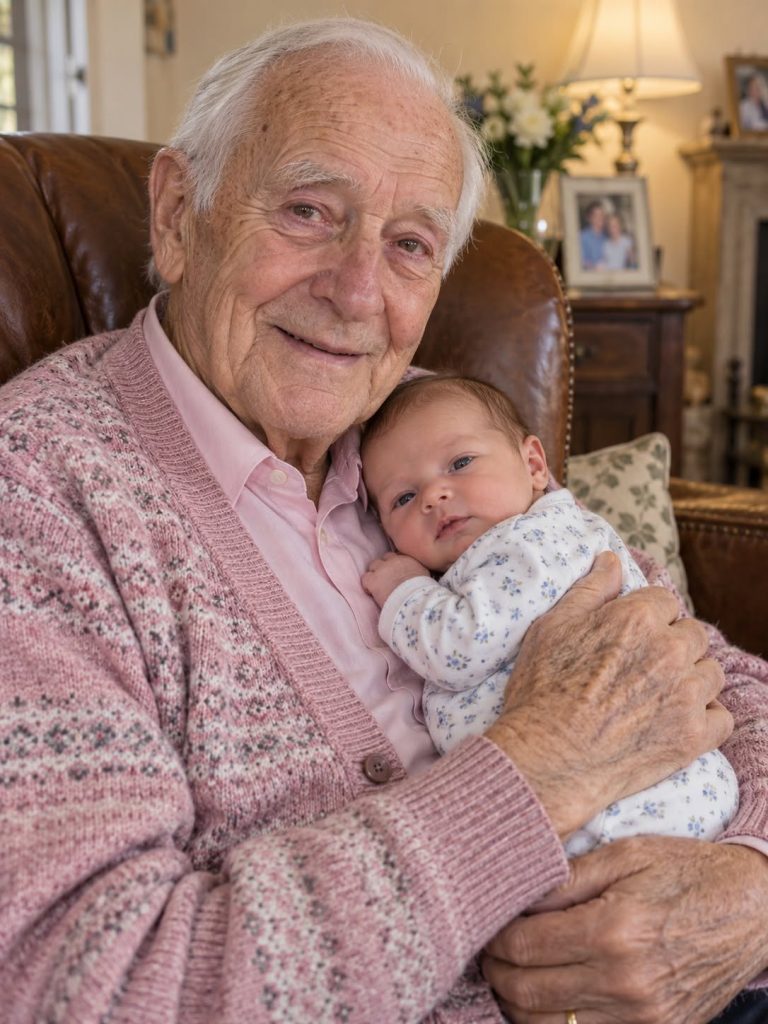
Beside it was one of Grandpa Bruno holding newborn Brucie years earlier.
His face in that photograph was different from the terror of the first moment.
He was smiling.
Brucie had one tiny hand wrapped around his finger.
Underneath the photographs was a small brass plaque.
It did not mention the trust.
It did not mention nineteen million dollars.
It did not mention the Sterling family.
It contained only three words.
WE CHOSE TRUTH.
Because in the end, that was the inheritance worth keeping.
Not the eyes.
Not the money.
Not the name.
The truth.
And the freedom to decide what came next.
THE END STORIES! THANK YOU FOR READING GOOD LUCK !❤️
Related Posts