➡️ PART 3 ENDING PART➡️
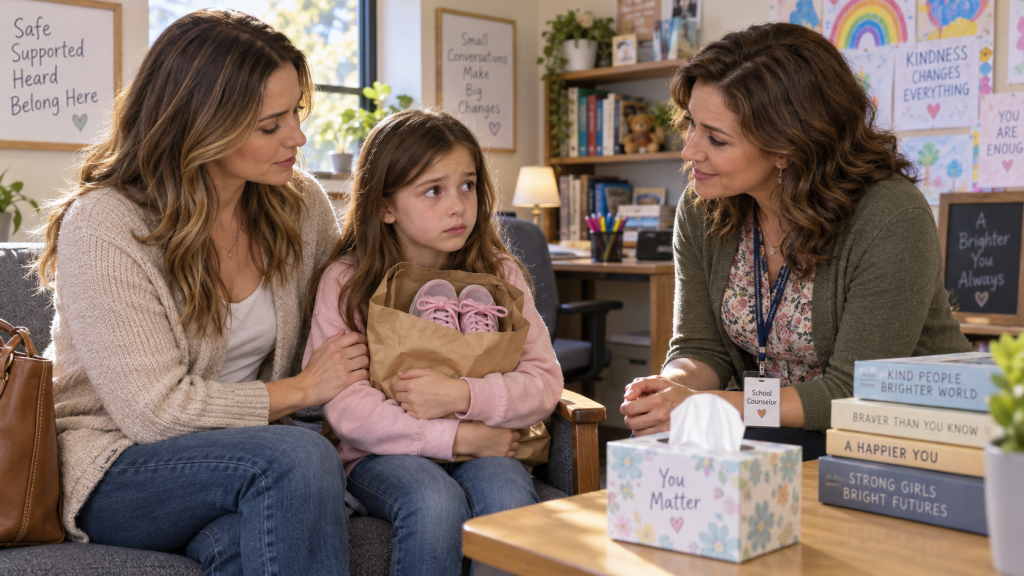
For a few seconds after the officer said Kaylee would not be going home, nobody in the room moved.
Kaylee sat wrapped in the school counselor’s gray blanket, her bare feet tucked beneath the chair, her face still wet from crying.
Then something happened that broke me.
She whispered, “Not even tonight?”
Mrs. Fox shook her head gently.
“No, sweetheart. Not tonight.”
Kaylee looked from her to the officer.
“Promise?”
The word was barely louder than breathing.
The officer lowered himself until he was at eye level with her.
“I promise we are not sending you back there today.”
Kaylee closed her eyes.
Her whole body seemed to collapse inward.
Not from fear.
From relief.
She began sobbing so hard she could not catch her breath.
Mrs. Fox moved beside her immediately, but Kaylee reached toward me.
I crossed the room before I had time to think.
She wrapped both arms around my waist and buried her face against my sweater.
I held her.
And I remember thinking that an eight-year-old should never understand relief like that.
Children should feel relieved when a thunderstorm ends.
When a spelling test gets canceled.
When the dentist says they do not have a cavity.
They should not feel relieved because an armed police officer has promised not to return them to their own house.
Mia was sitting in the outer office with the secretary.
She still believed we were there because Kaylee’s shoes had hurt her feet.
That lie lasted another twenty-three minutes.
Then a woman named Denise Harper arrived.
She introduced herself as a child-protection investigator.
She wore dark slacks, flat shoes, and a blue cardigan with one loose thread near the cuff.
It is strange what the mind remembers when something terrible is happening.
I cannot remember whether I had breakfast that morning.
I cannot remember what song played on the radio during the drive.
But I remember that thread.
I remember staring at it while Denise explained that Kaylee would need a medical examination.
A forensic interview would follow.
There would be questions about her father.
Questions about Tasha.
Questions about the injuries.
Questions about previous injuries.
Questions that Kaylee would be allowed to answer at her own pace.
“You did the right thing bringing her here,” Denise told me.
I looked through the small window in the office door.
Kaylee was sitting with the school nurse now, drinking apple juice from a paper cup.
“I almost didn’t.”
Denise looked at me.
“I knew something was wrong at ten sixteen last night.”
“You brought her in this morning.”
“I spent almost two hours trying to convince myself it was something else.”
Denise’s expression softened.
“But you didn’t convince yourself.”
“That doesn’t feel like enough.”
“It was enough to get her here.”
I looked away.
I have replayed those hours many times since.
The excuses came so easily.
Maybe Kaylee had blisters.
Maybe she had fallen.
Maybe Tasha was strict, but not cruel.
Maybe there was some explanation that would allow me to mind my own business.
Adults are very creative when we are trying not to see something frightening.
We call it respecting privacy.
We call it avoiding drama.
We tell ourselves we do not know the whole story.
Sometimes that is wisdom.
And sometimes it is cowardice wearing a polite coat.
At 8:37, Denise asked whether Kaylee could speak to me privately before they left.
I went back into Mrs. Fox’s office.
Kaylee had put on a pair of enormous fuzzy socks the nurse kept for emergencies.
They had little yellow stars on them.
She looked down at her feet.
“I’m sorry about the sleepover.”
My throat tightened.
“There is nothing to be sorry for.”
“I ruined it.”
“You did not ruin anything.”
“Mia’s going to be mad.”
“No, she isn’t.”
Kaylee looked up.
“You don’t know.”
“I know Mia.”
That almost made her smile.
I knelt beside her.
“The only person responsible for what happened to you is the person who hurt you. Not you.”
She stared at me.
Children hear adults apologize so often that they learn to carry blame like a backpack.
Sometimes all it takes is one grown-up saying, Put that down.
It was never yours.
Denise took Kaylee to the hospital shortly after nine.
I was not allowed to go with them because I was not her parent or guardian.
That made sense.
It also felt unbearable.
I stood in the elementary school parking lot watching the county vehicle disappear onto Briar Creek Road.
Then I realized Mia was beside me.
She was holding my hand.
“Mom?”
“Yes?”
“Is Kaylee sick?”
I crouched.
There is no perfect way to explain danger to a child without planting fear where innocence used to live.
So I told her the smallest truthful thing.
“Kaylee got hurt, honey. Some grown-ups are helping her now.”
“Did she fall?”
“I don’t know everything yet.”
Mia frowned.
“She looked scared.”
“I know.”
“Can she still come over?”
I swallowed.
“I hope so.”
Mia thought for a moment.
Then she asked the question I still remember most clearly.
“Are we safe?”
I pulled her close.
“Yes.”
That afternoon, Greg Whitman called me eleven times.
I did not answer.
The first voicemail was confused.
“Hey, Melissa, this is Greg. School says Kaylee isn’t there anymore. Call me.”
The second was sharper.
“What is going on? Did you take her somewhere?”
The third was furious.
“You had no right to get involved in my family.”
By the sixth message, his voice had changed.
He was no longer angry.
He was frightened.
“What did she say?”
Not: Is she okay?
Not: What happened?
Not: Where is my daughter?
What did she say?
I listened to that voicemail three times.
Then I sent it to Denise.
At 2:14, Tasha called.
I let it ring.
She left no message.
At 2:26, she called again.
At 2:31.
2:47.
3:05.
Finally she sent a text.
KAYLEE LIES WHEN SHE WANTS ATTENTION. PLEASE DO NOT MAKE THIS WORSE.
I took a screenshot.
Five minutes later another message arrived.
YOU HAVE NO IDEA WHAT WE DEAL WITH FROM HER.
Another screenshot.
Then:
SHE PICKS AT HER FEET AND MAKES THEM BLEED.
Screenshot.
Then:
GREG WILL EXPLAIN.
Screenshot.
I did not respond.
By evening, a patrol car was parked near the Whitman house.
Our neighborhood noticed.
Of course it did.
Briar Creek was the kind of place where people noticed unfamiliar vehicles before they noticed suffering.
By Saturday night, the neighborhood Facebook group was already full of vague posts.
Anyone know what happened on Willow Bend?
Prayers for a local family.
Please don’t spread rumors.
The irony nearly made me sick.
People who knew nothing were already telling other people not to talk.
Meanwhile, for months, maybe years, Kaylee had apparently been trying to speak without words.
The long sleeves in warm weather.
The flinching.
The way she devoured breakfast.
The way she always asked permission before opening the refrigerator.
The way she apologized when she laughed too loudly.
The shoes.
Especially the shoes.
Children tell the truth in a hundred ways before they ever find the sentence.
We are the ones who decide whether to hear it.
Sunday morning, Denise called.
“Kaylee is safe.”
I sat down at the kitchen table.
“Where?”
“I can’t give you details yet.”
“Okay.”
“She underwent a medical examination.”
My stomach tightened.
“Was she badly hurt?”
There was a pause.
“There were injuries in different stages of healing.”
I closed my eyes.
“How long?”
“We’re still determining that.”
“Did she say what happened?”
“She disclosed enough that we are treating this as serious physical abuse.”
I covered my mouth.
Mia was in the living room watching cartoons.
The sound of animated laughter drifted through the doorway.
Denise continued.
“Kaylee also described being made to stand for extended periods, being denied meals as punishment, and being forced to wear shoes that aggravated existing injuries.”
My eyes filled.
“Her father knew?”
“Kaylee says he was aware of some of the discipline.”
Some.
That word haunted me.
“What does that mean?”
“It means we’re investigating.”
“Is Tasha arrested?”
“Not at this time.”
I hated that answer.
But Denise’s voice remained steady.
“Melissa, this process is going to feel slower than you want.”
“She’s eight.”
“I know.”
“She said Tasha checks if she told.”
“I know.”
“What happens if they get to her?”
“They won’t have unsupervised access to her right now.”
I let out a breath I had not realized I was holding.
“Can she stay with me?”
The question came out before I had planned it.
Denise was silent for a moment.
“That may not be possible.”
“Why?”
“You’re not family.”
“I know.”
“There are placement procedures.”
“I understand.”
“Do you?”
“No.”
That surprised a laugh out of her.
Not because anything was funny.
Because it was true.
I did not understand.
I did not know the system.
I did not know what words like emergency placement and dependency hearing and safety plan would soon mean.
All I knew was that Kaylee had slept in my house one night.
And somehow she no longer felt like a child who had simply slept over.
She felt like a little person who had stepped into my life carrying a secret too heavy for her body.
I wanted to make sure she never had to carry it alone again.
For the next forty-eight hours, I heard almost nothing.
Then Monday afternoon, Mrs. Fox called.
“Mia is having a hard day.”
I drove to school.
My daughter was sitting on the floor of the counselor’s office holding the same stuffed llama Kaylee had clutched Friday night.
“I found it under my bed,” Mia said.
“She left it.”
“Yes.”
“Can we give it back?”
“I’m sure we can.”
Mia looked at me.
“Why can’t I see her?”
I sat beside her.
“Because the grown-ups helping Kaylee need to make some decisions.”
“She didn’t do anything.”
“No.”
“Then why does she have to go somewhere else?”
I had no good answer.
Because safety sometimes uproots the person who was hurt.
Because systems are built around procedures rather than bedtime friendships.
Because doing the right thing does not always feel kind in the moment.
“I don’t know,” I said.
Mia hugged the llama.
“I think she thinks I forgot her.”
That night, Mia wrote Kaylee a letter.
She used purple marker.
KAYLEE,
YOU DID NOT RUIN THE SLEEPOVER.
I SAVED YOUR POPCORN.
YOUR LLAMA MISSES YOU.
I MISS YOU MORE.
LOVE,
MIA
P.S. YOU CAN WEAR SHOES IN MY BEDROOM FOREVER IF YOU WANT.
I read it at the kitchen counter and cried.
Denise delivered the letter.
Three days later, we received one back.
Mia,
I DIDN’T TELL EVERYTHING YET.
BUT I’M TRYING.
THANK YOU FOR NOT BEING MAD.
LOVE KAYLEE
At the bottom, she had drawn two girls holding hands.
One had brown hair.
One had yellow.
Both wore enormous pink shoes.
Two weeks passed before I learned what “everything” meant.
By then, Tasha had been arrested.
Greg had not.
That made me furious until Denise explained that anger was not evidence and that investigations had to separate what people suspected from what could be proven.
The charges against Tasha included child abuse and aggravated battery.
The language sounded enormous.
The reality was smaller.
A child.
A hallway.
A pair of shoes.
A woman telling herself cruelty was discipline.
The police report, when I eventually heard parts of it, described things Kaylee had never told me.
I will not repeat all of them.
Some stories do not become more meaningful because every wound is described.
What mattered was the pattern.
Punishments that became harsher over time.
Food withheld.
Hours spent standing.
Cold water.
Shoes deliberately tightened over injured skin.
Threats.
Isolation.
Tasha had convinced Kaylee that every discomfort was proof she was difficult.
Every tear was manipulation.
Every request for help was attention-seeking.
And Greg?
Greg knew more than he had admitted.
The first time I heard that, I felt something inside me snap.
According to Kaylee, he had not always participated.
Sometimes he left the room.
Sometimes he told Tasha to “take it easy.”
Sometimes he brought Kaylee food afterward.
At first, part of me wanted to treat those acts as evidence that he cared.
Then Denise said something I never forgot.
“Comfort after failing to protect a child does not erase the failure.”
Greg had seen bruises.
He had heard crying.
He had known about the shoe punishments.
He had accepted explanations that required him to ignore what was right in front of him.
And whenever Kaylee begged him to make Tasha stop, he told her:
“Just behave and she won’t have to punish you.”
That sentence did something to me.
Because it placed responsibility exactly where it never belonged.
On the child.
Greg had not been the person tying the knots.
But he had been the adult standing near enough to untie them.
And he chose not to.
Kaylee entered temporary foster care with a retired teacher named Evelyn Brooks.
For privacy reasons, I did not meet Evelyn immediately.
I knew only that she was sixty-two, had fostered children for nearly twenty years, and had a dog named Biscuit.
Kaylee apparently liked Biscuit.
That was the first thing that made me feel hopeful.
Three weeks after the investigation began, Denise called.
“How would you feel about becoming part of Kaylee’s approved support network?”
I almost dropped the phone.
“What does that mean?”
“It could eventually allow supervised visits. Phone calls. Maybe more, depending on court orders.”
“Yes.”
She laughed.
“I haven’t explained the paperwork.”
“Yes.”
“There are background checks.”
“Yes.”
“Home assessment.”
“Yes.”
“Training.”
“Yes.”
“Melissa.”
“Yes?”
“You can breathe.”
I realized I had been crying.
“I’m sorry.”
“Stop apologizing.”
That became a theme in our lives.
Stop apologizing.
Mia and I completed background forms.
I submitted fingerprints.
A worker inspected our house.
She checked smoke detectors.
Medicine storage.
Bedroom arrangements.
Emergency numbers.
I spent two days cleaning before she arrived.
Then she opened a closet full of board games, winter coats, and one broken vacuum cleaner.
I almost died of embarrassment.
She barely looked at it.
“This isn’t a housekeeping contest,” she said.
“Could’ve told me before I scrubbed the baseboards.”
She smiled.
Two weeks later, Kaylee visited.
Evelyn brought her.
I stood at the front door with Mia behind me.
My daughter had been warned repeatedly not to overwhelm her.
So naturally, the second Kaylee stepped inside, Mia launched herself forward.
Then stopped.
She remembered.
She stood there with her arms half-raised.
“Can I hug you?”
Kaylee looked at Evelyn.
Evelyn nodded slightly.
Kaylee looked at Mia.
Then she ran into her arms.
They hugged so tightly they nearly fell over.
I turned toward the kitchen because I did not want to make the moment about my tears.
Then I noticed Kaylee’s shoes.
Blue sneakers.
Loose laces.
She caught me looking.
I immediately looked away.
“Mrs. Carter?”
“Yes?”
“You can look.”
I turned back.
She lifted one foot.
“Evelyn lets me pick them.”
“They’re beautiful.”
“They were nineteen dollars.”
Evelyn smiled.
“She announces the price of everything now.”
Kaylee grinned.
“They were on sale.”
That grin felt like sunrise.
The visit lasted two hours.
The girls painted nails.
They ate popcorn.
Biscuit did not come because Evelyn said he would eat half my furniture.
For the first hour, Kaylee wore her shoes.
Nobody mentioned them.
Then I walked through the living room carrying lemonade.
Her blue sneakers were beside the couch.
Empty.
For a moment I stopped breathing.
Kaylee was sitting cross-legged on the carpet wearing yellow-star socks.
The same kind the nurse had given her at school.
She noticed me.
Neither of us said anything.
I simply kept walking.
Later, when I washed the glasses, I had to wipe my eyes with the dish towel.
Progress is not always a speech.
Sometimes it is a pair of empty shoes beside a couch.
The legal process moved slowly.
Tasha was released on bond under strict conditions.
She was forbidden from contacting Kaylee.
Still, Kaylee was terrified she would find her.
She checked windows.
She asked Evelyn whether Tasha knew the address.
She panicked when unfamiliar cars slowed near the house.
Once, during a visit with us, a woman at the grocery store wore the same perfume Tasha used.
Kaylee dropped a carton of eggs.
They shattered across the floor.
She crawled beneath the shopping cart.
People stared.
I knelt beside her.
“It’s okay.”
She shook her head violently.
“She’s here.”
“No.”
“She’s here.”
“Kaylee, look at me.”
Her eyes were huge.
I learned from her therapist never to say, “There’s nothing to be afraid of.”
Because for Kaylee there had been plenty to be afraid of.
Instead I said, “You are with me. We are at Briar Market. I can see you. I will stay right here.”
She stared at me.
“What color is my shirt?”
She blinked.
“What?”
“My shirt.”
“Green.”
“What color is the cart?”
“Red.”
“How many lights can you see?”
She looked upward.
“Six.”
Her breathing slowed.
I had learned that from Evelyn.
Safety had to become something Kaylee could locate.
Not just believe.
Where are you?
Who is with you?
What can you see?
What is true right now?
Healing, I discovered, was teaching the body what the mind already knew.
You survived.
It is over.
You are here.
Tasha’s attorney argued that Kaylee exaggerated.
That she was emotionally troubled.
That Greg’s divorce from Kaylee’s mother years earlier had created behavioral problems.
That the shoe injuries came from scratching.
That strict discipline had been misinterpreted.
I knew those arguments were coming.
Still, hearing them made me sick.
Then the prosecution produced photographs from Tasha’s phone.
That changed everything.
Some had been taken as “proof of consequences.”
A child standing facing a wall.
A clock visible in the background.
Another photograph hours later.
The same child.
The same wall.
One image showed Kaylee’s shoes placed beside a handwritten sign:
I WILL LISTEN THE FIRST TIME.
Tasha had documented what she later denied.
Cruelty can become so normal to the person committing it that they stop recognizing evidence when they create it.
Greg’s text messages were worse.
Not because he described hurting Kaylee.
Because he described ignoring it.
One exchange happened six months before the sleepover.
GREG: Her feet look bad again.
TASHA: She keeps picking them.
GREG: Maybe stop the shoe thing for a few days.
TASHA: Then she wins.
GREG: Fine. I’m staying out of it.
I read those words in a victim-services office months later.
Fine. I’m staying out of it.
Four words.
Four words that explained everything.
I remembered my own two hours of hesitation that first night.
Kaylee is not my child.
I do not know the whole situation.
What if I overreact?
For two hours, I almost stayed out of it.
Greg had stayed out of it for years.
There is a point where neutrality stops being neutral.
There is a point where looking away becomes a decision.
Greg eventually faced charges related to child neglect and failure to protect.
He took a plea agreement.
He received probation, parenting restrictions, mandatory classes, and no unsupervised contact with Kaylee.
People had opinions about whether that was enough.
I did too.
But by then I had learned not to confuse punishment with repair.
No sentence could give Kaylee back the nights she spent frightened in her own room.
No courtroom could erase the belief that pain was something she caused adults to inflict.
Justice mattered.
But healing would happen somewhere else.
In kitchens.
In classrooms.
In therapy rooms.
On couches.
At breakfast tables.
Inside ordinary days where nothing terrible happened.
Tasha’s case went further.
She eventually pleaded guilty to multiple charges after the evidence became overwhelming.
At sentencing, I sat behind Evelyn.
Kaylee did not attend.
Her therapist advised against it.
I was grateful.
The courtroom was colder than I expected.
Tasha looked smaller without the sunglasses, the polished clothes, the perfect school-pickup smile.
For months, I had imagined seeing her.
I imagined hatred.
Rage.
Maybe satisfaction.
Instead I felt hollow.
The prosecutor described the injuries.
The pattern.
The threats.
The photographs.
Then Tasha’s attorney spoke about her childhood.
Her stress.
Her regrets.
Her lack of prior criminal history.
All of those things could be true.
None of them changed what had happened.
When the judge asked Tasha whether she wished to speak, she stood.
For the first time, I heard her voice since the day she called from the truck window:
Be good.
“I never intended to seriously hurt Kaylee.”
My hands clenched.
She continued.
“I believed she needed structure.”
Evelyn reached over and touched my wrist.
A warning.
Stay still.
Tasha began crying.
“I lost control.”
The judge looked at her.
“You did not lose control once.”
The courtroom became silent.
“You exercised control repeatedly. Over food. Over movement. Over comfort. Over medical care. Over communication. You created conditions designed to make a child afraid to disclose what was happening.”
Tasha lowered her head.
The judge continued.
“The victim’s age made her dependent upon the very adults who failed her.”
I looked toward the floor.
There it was.
The whole tragedy in one sentence.
Children cannot simply leave.
They cannot hire lawyers.
They cannot open separate bank accounts.
They cannot rent apartments.
They are forced to believe that the adults surrounding them will eventually choose their safety.
When those adults fail, the child often assumes she must be the problem.
Tasha received a prison sentence.
Not forever.
Not long enough for some people.
Too long according to others.
For Kaylee, the number mattered less than one fact.
Tasha could not reach her.
That evening, I drove to Evelyn’s house.
Kaylee was doing homework at the dining table.
She looked up.
“Is it over?”
I sat beside her.
“The court part for Tasha is mostly over.”
“Is she going to jail?”
“Yes.”
“For how long?”
I told her in simple terms.
Kaylee nodded.
Then she looked down at her math worksheet.
I waited.
After almost a minute she asked, “Was she mad?”
“I don’t know.”
“At me?”
“No.”
“You don’t know that.”
I chose my words carefully.
“She may have feelings about what happened, but those feelings are not your responsibility.”
Kaylee pressed her pencil harder against the page.
“She said if I told, everybody would know what kind of kid I was.”
My throat tightened.
“What kind of kid are you?”
She shrugged.
“Bad.”
“No.”
She continued looking at the worksheet.
I wanted to argue.
To list every wonderful thing about her.
Smart.
Funny.
Kind.
Brave.
But her therapist had explained something to us.
Children who have been told something cruel a thousand times may not be able to accept its opposite after hearing it once.
So instead I said, “I don’t think you’re bad. I’ll keep reminding you until you’re ready to believe me.”
Kaylee looked at me.
“That might take forever.”
“I’ve got time.”
She gave me the smallest smile.
Mia walked in carrying a bowl of grapes.
“Who’s bad?”
“No one,” I said.
Mia looked suspicious.
Then she put the bowl on the table.
“Kaylee stole my purple marker.”
Kaylee gasped.
“You said I could borrow it!”
“You kept it for four days.”
They began arguing.
Evelyn caught my eye from the kitchen.
We both smiled.
It was the best sound in the world.
An ordinary argument.
No fear.
No flinching.
No adult deciding disagreement deserved pain.
Just two girls fighting over a marker.
Kaylee remained with Evelyn for almost a year.
During that time, several possible relative placements were investigated.
Her maternal aunt lived two states away.
An older cousin applied.
Greg’s parents asked for custody but withdrew after learning the level of supervision required.
Kaylee’s biological mother, Rachel, had struggled with addiction for years and had been largely absent from Kaylee’s life.
Then, unexpectedly, Rachel returned.
I met her at a case-planning meeting.
She was thirty-four.
Small.
Nervous.
She wore no makeup and twisted a silver ring around one finger throughout the meeting.
When she saw me, she cried.
“You’re Melissa?”
“Yes.”
She stood and hugged me before I knew what was happening.
“Thank you.”
I stiffened.
Then hugged her back.
“I almost didn’t do anything.”
“But you did.”
Rachel had been sober for fourteen months.
She had entered treatment before learning what happened to Kaylee.
When social services contacted her, she immediately entered the process to rebuild contact.
I did not trust her at first.
I am ashamed of how quickly I judged.
I thought: Where were you?
I thought: Your child needed you.
I thought: You do not get to appear now.
Then I watched Rachel sit through parenting classes.
Therapy.
Drug tests.
Supervised visits.
Court reviews.
I watched her accept Kaylee’s anger without defending herself.
During one visit, Kaylee screamed, “You left me!”
Rachel did not say, “I was sick.”
She did not say, “Your father kept you from me.”
She did not say, “You don’t understand.”
She said:
“Yes.”
Kaylee cried harder.
Rachel said, “I left you when you needed me. I am sorry.”
That was the moment I began believing she might actually be capable of rebuilding something.
Not because she was perfect.
Because she did not demand forgiveness as payment for returning.
She let Kaylee be angry.
She let Kaylee ask questions.
She let Kaylee refuse hugs.
She kept showing up.
Every Tuesday.
Then Tuesdays and Saturdays.
Then weekends.
Then overnight visits.
Recovery, whether from addiction or abuse, has one thing in common.
Words matter.
But repetition matters more.
You show up.
Again.
Again.
Again.
Until the nervous system starts believing the pattern.
At first Kaylee called her Rachel.
Not Mom.
Rachel never corrected her.
Six months later, I was sitting beside Kaylee at a school concert when Rachel arrived late.
Kaylee waved frantically.
“Mom! Over here!”
The word came out naturally.
Rachel froze in the aisle.
Then kept walking.
She sat beside us.
Her hands shook for the first three songs.
Kaylee never noticed.
I did.
A year and four months after the night of the sleepover, the court approved a gradual reunification plan with Rachel.
I had mixed feelings.
I loved Evelyn.
I trusted her completely.
Her house had become safe to Kaylee.
Moving again felt cruel.
But Kaylee wanted her mother.
And Rachel had done everything required of her.
The transition happened slowly.
More weekends.
Longer stays.
School transportation.
Therapy.
Home visits.
Then came the final hearing.
Kaylee was nine by then.
Almost ten.
She wore blue sneakers.
Her laces were loose.
I noticed.
I always noticed.
The judge asked Rachel several questions.
Then asked Kaylee whether she wanted to say anything.
She did not have to.
She chose to.
Kaylee stood beside her guardian ad litem.
Her voice was quiet.
“I want to live with my mom.”
The judge smiled gently.
“Anything else?”
Kaylee looked around the courtroom.
Her eyes found Evelyn.
Then me.
Then Rachel.
“I want to still see everybody.”
Rachel began crying.
The judge nodded.
“I think everybody here would like that.”
The reunification order was signed.
Afterward, we gathered outside the courthouse.
No balloons.
No music.
No dramatic celebration.
Real life endings rarely understand when they are supposed to become cinematic.
Kaylee hugged Evelyn for almost a full minute.
Then she came to me.
“Are sleepovers still allowed?”
I laughed through my tears.
“Any time your mother says yes.”
Rachel nodded.
“Within reason.”
Mia groaned.
“Adults ruin everything.”
For the first time since the beginning, all of us laughed.
That summer, Kaylee slept over again.
It had been twenty months since the first night.
She arrived at five thirty carrying a purple backpack.
Rachel walked her to the door.
Not halfway.
Not from the truck.
All the way.
“You have my number,” Rachel told me.
“I do.”
“Her inhaler’s in the front pocket.”
“Got it.”
“She’s been having trouble sleeping again.”
Kaylee rolled her eyes.
“Mom.”
Rachel stopped.
“Right. Sorry.”
She hugged Kaylee.
“Call if you need me.”
“I won’t.”
Rachel smiled.
“That’s okay too.”
After she left, Mia dragged Kaylee upstairs.
By eight, the house smelled like popcorn.
By nine, they had painted their nails three different colors.
At ten, I passed Mia’s room.
Both girls were still awake.
“Lights out in ten.”
Mia groaned.
Kaylee smiled.
I looked down.
Her sneakers were on the floor.
I kept walking.
At 10:16, exactly the same time I had noticed the blood twenty months earlier, I stopped outside the bedroom.
I did not plan it.
I simply looked at the clock.
10:16.
For a moment, I was back in that first night.
The stiff socks.
The double knots.
The frightened eyes.
She checks if I told.
Then I heard laughter from the bedroom.
I pushed the door open slightly.
Mia was lying upside down across the bed.
Kaylee was on the carpet.
Barefoot.
Her toenails were painted bright yellow.
No shoes.
No blood.
No fear.
Mia looked at me.
“What?”
I realized I was crying.
“Nothing.”
“You’re being weird.”
“I know.”
Kaylee grinned.
“She does that.”
I laughed.
“Lights out.”
I closed the door.
Then stood in the hallway for a long moment.
Some memories never stop hurting.
They simply stop being the only thing you can see.
Kaylee still struggled.
That matters.
I do not want to tell this story as if rescue erased everything.
She had nightmares.
She hated closed doors.
She panicked when adults raised their voices.
She sometimes hid food in her backpack.
Once, Rachel found crackers inside a pillowcase.
Instead of confronting her, she began keeping a basket of snacks in Kaylee’s room.
A handwritten sign said:
YOU NEVER HAVE TO EARN FOOD HERE.
When I saw it, I nearly cried.
Therapy continued.
Some weeks were better than others.
At school, Kaylee excelled in reading and struggled with math.
She joined art club.
She quit soccer after three practices.
She became obsessed with horses despite having never ridden one.
She laughed louder.
That mattered most to me.
The first time I realized Kaylee had stopped apologizing for laughter, I was driving her and Mia home from school.
They were in the back seat arguing about whether dolphins could beat sharks in a fight.
Kaylee laughed so loudly she snorted.
Then she froze.
For half a second, the old fear passed across her face.
I watched through the mirror.
Then Mia snorted too.
Kaylee laughed harder.
The fear disappeared.
Small victories.
That was how healing announced itself.
Not with trumpets.
With snorts in the back seat.
A year later, Briar Creek Elementary held a family safety night.
Mrs. Fox asked whether I would speak.
I said no immediately.
Then I thought about the note Tasha had written.
Kaylee is dramatic about shoes.
Please don’t encourage attention-seeking.
I thought about how easily that sentence could have worked.
How close I came to dismissing what I saw because another adult had already provided an explanation.
I called Mrs. Fox back.
“I’ll do it.”
The gym was full of folding chairs.
Teachers.
Parents.
Counselors.
A police officer.
A social worker.
Rachel sat in the back.
Kaylee did not attend.
This was not her responsibility.
I stood behind the microphone.
My hands were shaking.
“I want to tell you about a pair of pink sneakers,” I began.
The room became quiet.
I did not use Kaylee’s name.
I did not describe the worst details.
I told them about the knots.
The note.
The hesitation.
The sentence I kept repeating to myself.
Not my child.
Then I said the thing I had spent two years learning.
“Sometimes ‘not my child’ is legally true and morally useless.”
People looked up.
“I am not telling anyone to investigate every bruise or question every parent. Children fall. Families are complicated. Adults make mistakes. But when a child looks frightened of being helped, pay attention. When explanations keep arriving before questions are asked, pay attention. When a child’s behavior suddenly makes more sense if you assume fear instead of defiance, pay attention.”
I paused.
“Most of us are terrified of falsely accusing someone.”
The room was completely silent.
“We should be careful. We should report concerns to people trained to investigate them. But being careful is not the same as looking away.”
Afterward, three parents approached me.
One was crying.
Another asked for the school counselor’s number.
The third simply said, “Thank you.”
Two weeks later, Mrs. Fox called.
“A parent made a report after the meeting.”
My stomach tightened.
“Was it serious?”
“I can’t tell you details.”
“Is the child okay?”
“The child is getting help.”
I sat down.
For several seconds I could not speak.
One pair of shoes.
Then another child.
Maybe another.
That was when I finally understood something I had resisted from the beginning.
Doing the right thing does not always mean you save someone.
Sometimes it means you create one open door.
Then someone else walks through it.
Years passed.
Kaylee grew.
Eight became nine.
Nine became ten.
Then eleven.
The pink sneakers disappeared long before the memories did.
Rachel eventually married a quiet man named Ben who had the patience of a saint and the cooking skills of a tired raccoon.
His pancakes were terrible.
Kaylee loved him.
He never demanded she call him Dad.
For two years, she called him Ben.
Then one Father’s Day, she handed him a card.
I was there.
On the front she had written:
TO BEN, WHO NEVER MADE ME CALL HIM ANYTHING.
Inside:
SO I DECIDED WHAT TO CALL YOU MYSELF.
DAD.
Ben sat at the table and cried into his coffee.
Kaylee pretended to be embarrassed.
Rachel cried too.
Mia filmed the whole thing.
I threatened to confiscate her phone.
Nobody listened to me anymore.
That was probably healthy.
When Kaylee was twelve, she asked me something unexpected.
“Do you still have the shoes?”
I stopped washing dishes.
“What shoes?”
She gave me a look.
“Mrs. Carter.”
Of course I knew.
The pink sneakers.
They had been kept as evidence through the case.
After everything concluded, victim services eventually contacted Rachel about whether she wanted certain personal items returned.
The shoes came back in an evidence bag.
Rachel had asked Kaylee what she wanted done with them.
Kaylee said she did not care.
Rachel could not bring herself to throw them away.
Somehow they ended up in a sealed box in my garage along with copies of old records.
“Yes,” I said.
“Can I see them?”
I dried my hands.
“Are you sure?”
“Yes.”
We went into the garage.
The box was on the highest shelf.
I pulled it down.
For several minutes, Kaylee simply looked at the sealed evidence bag.
The shoes seemed impossibly small.
Pink canvas.
White soles.
One faded flower near the heel.
I had remembered them as enormous somehow.
Symbols grow larger than objects.
Kaylee touched the plastic.
“I hated these.”
“I know.”
“I used to think they were the reason everything happened.”
I looked at her.
“What do you mean?”
“If I didn’t have messed-up feet, you wouldn’t have noticed.”
She paused.
“And sometimes I thought if you didn’t notice, everything would still be normal.”
I sat on the garage floor beside her.
“That wasn’t normal.”
“I know now.”
We stayed quiet.
Then she said, “Can we throw them away?”
“Yes.”
“Like really throw them away?”
“Yes.”
She picked up the bag.
We walked outside.
Trash day was the next morning.
Kaylee lifted the lid.
Then stopped.
“What?”
“I don’t want Tasha to decide when I get rid of them.”
“She isn’t.”
“I know.”
She smiled slightly.
“I am.”
Then she dropped the bag into the bin.
The lid slammed shut.
That was it.
No thunder.
No music.
No dramatic wind.
Just garbage.
The next morning, the truck came.
The shoes disappeared.
Kaylee watched from the porch.
Then asked whether we could get donuts.
We got donuts.
By thirteen, Kaylee had become taller than Rachel.
By fourteen, she started volunteering with younger kids at the public library.
By fifteen, she wanted to become a veterinarian.
Then a lawyer.
Then a teacher.
Then a tattoo artist.
Rachel learned not to buy college merchandise too quickly.
Mia and Kaylee remained close.
Not inseparable in the way they were at eight.
Life expands.
Different classes.
Different friends.
Different interests.
But some friendships do not depend on constant closeness.
They depend on shared history.
Every year on the anniversary of that sleepover, Mia texted her:
SHOES OFF.
Kaylee always replied:
NEVER.
It became a joke.
Eventually, the joke stopped hurting.
That is one of the strangest gifts time can give.
Not forgetting.
Transformation.
The memory stays.
But it changes shape.
When Kaylee turned sixteen, she asked Rachel if she could contact Greg.
That terrified all of us.
Rachel did not forbid it.
She called Kaylee’s therapist.
They talked through expectations.
Boundaries.
Safety.
Greg had completed probation years earlier.
He had moved two counties away.
He had never regained custody.
He occasionally sent birthday cards through approved channels.
Kaylee never answered.
Until sixteen.
She chose a coffee shop.
Public.
Rachel sat three tables away.
I was not there.
Kaylee told me about it afterward.
“He looks older.”
“I imagine.”
“He cried.”
I waited.
“He said he was sorry.”
“What did you say?”
“I asked what he was sorry for.”
I smiled faintly.
Of course she did.
“What did he say?”
“He said he was sorry he didn’t stop her.”
Kaylee looked down at her hands.
“Then he said he was scared of Tasha too.”
I felt anger rise.
Kaylee saw it.
“I know.”
“Know what?”
“You’re making the face.”
“What face?”
“The Greg-is-a-grown-man face.”
I laughed despite myself.
“Fair.”
She became serious again.
“I told him he was allowed to be scared.”
I waited.
“But I was eight.”
There are sentences so complete they leave no room for addition.
That was one.
“What did he say?”
“He cried more.”
“Do you forgive him?”
Kaylee shrugged.
“I don’t know.”
“That’s okay.”
“He wants another meeting.”
“Do you?”
“I don’t know.”
“That’s okay too.”
She looked at me.
“You always say that.”
“Because sometimes not knowing is honest.”
She smiled.
“I think I learned that from therapy.”
“I’ll take credit.”
She rolled her eyes.
Kaylee saw Greg a handful of times over the next two years.
Their relationship never became simple.
He was not restored to a father-shaped place in her life just because he apologized.
But she chose to know him.
On her terms.
That distinction mattered.
Forgiveness, when it came at all, did not mean pretending he had protected her.
It meant she no longer wanted his failure living inside her every day.
She once explained it better than I ever could.
“I can stop carrying anger without carrying him.”
I wrote that sentence down.
At eighteen, Kaylee graduated from Briar Creek High.
Mrs. Fox had retired by then.
Evelyn sat with us.
Rachel cried before the ceremony even began.
Ben cried when the band played.
I cried when they announced Kaylee’s name.
Mia shouted so loudly three people turned around.
Kaylee walked across the stage in a white gown.
Blue sneakers underneath.
Loose laces.
When she reached the other side, she lifted her diploma.
For just a second, she looked eight years old again.
Then she was gone.
A young woman.
Standing beneath stadium lights.
Free.
After the ceremony, she found me.
“Mrs. Carter!”
She still called me that when she wanted something.
Otherwise I had become Melissa years earlier.
She hugged me.
“You’re crushing my flowers.”
“You’ll live.”
She pulled back.
“I have something for you.”
She handed me a small envelope.
Inside was a photograph.
Two little girls on my living-room floor.
Mia and Kaylee.
Age eight.
Painting their nails.
The first sleepover.
Before I knew.
Before any of us knew.
On the back, Kaylee had written:
You noticed.
That was all.
Two words.
I read them again.
You noticed.
My eyes blurred.
“I almost didn’t.”
“But you did.”
“I should have seen it sooner.”
“You saw it when I could finally show you.”
I shook my head.
“You saved yourself, Kaylee.”
She smiled.
“Maybe.”
Then she leaned closer.
“But you opened the door.”
I hugged her again.
Over her shoulder, I saw Rachel.
She was crying.
Evelyn was crying.
Mia was pretending not to cry and failing spectacularly.
Ben had given up pretending entirely.
So much family.
None of it looked the way family looked on Kaylee’s birth certificate.
That was another thing I had learned.
Family can be biological.
Legal.
Chosen.
Temporary.
Permanent.
Sometimes family is simply the people who keep showing up after the emergency vehicles leave.
That autumn, Kaylee left for college.
She chose social work.
Not veterinary medicine.
Not law.
Not tattooing.
Social work.
I asked whether she was sure.
She said no.
Then laughed.
“But I think I want to help kids.”
My heart twisted.
“You don’t owe the world that because of what happened to you.”
“I know.”
“You’re allowed to choose something easier.”
“I know.”
“You’re allowed to have a boring life.”
She smiled.
“I know.”
“Okay.”
She looked at me.
“Are you done?”
“No.”
“Melissa.”
“Fine.”
She hugged me.
Then climbed into Rachel’s car.
Her shoes were white.
By then, shoes had become just shoes.
That may be the happiest sentence in this entire story.
Shoes had become just shoes.
Years after that first night, I cleaned out the den.
The couch was old.
The carpet had been replaced twice.
Mia was away at college.
Kaylee was finishing her junior year.
I found the stuffed llama behind a box in the closet.
The same llama Kaylee had held against her chest at eight.
One ear was bent.
Its fur was flattened.
I sat on the floor holding it.
Suddenly I could smell microwave popcorn and lavender detergent.
I could see the rusty stripe on a sock.
I could hear a child say:
She checks if I told.
Some memories remain so alive that time cannot convince the body they are old.
I cried.
Then I called Kaylee.
She answered on the fourth ring.
“Hey.”
“I found your llama.”
There was silence.
“No way.”
“Yes.”
“Is he alive?”
“Barely.”
“I thought I lost him.”
“You did.”
She laughed.
“Keep him.”
“You don’t want him?”
“No.”
Then she paused.
“Actually…”
“What?”
“Give him to a kid who needs him.”
That was Kaylee.
Always turning survival outward.
Not because she owed anyone.
Because she had learned that comfort multiplied when passed along.
So I washed the llama carefully.
I repaired the torn ear.
Then I gave it to Mrs. Fox’s successor at Briar Creek Elementary.
The counselor keeps stuffed animals for children who need something to hold.
I did not tell her the whole story.
I only said:
“This one knows how to sit with scared kids.”
She smiled.
“He’ll fit right in.”
Sometimes people ask whether I ever regretted getting involved.
The answer is complicated.
I regret that involvement was necessary.
I regret those first two hours.
I regret every adult who saw pieces and did not put them together.
I regret what Kaylee lost before she ever slept in my house.
But do I regret making the report?
No.
Not for one second.
Greg once told an investigator I had destroyed his family.
For a long time, that sentence bothered me.
Then Kaylee turned eighteen.
I looked around her graduation party.
Rachel.
Ben.
Evelyn.
Mia.
Teachers.
Counselors.
Friends.
A dozen people laughing beneath strings of backyard lights.
And I finally understood.
I did not destroy Kaylee’s family.
The abuse had already done that.
The truth simply stopped forcing Kaylee to live inside the ruins.
There is a difference.
A few months ago, Kaylee came home from college for spring break.
She walked into my kitchen without knocking.
She still does that.
Mia was visiting too.
Within twenty minutes, they were fighting over leftover pizza.
I stood at the counter listening.
Kaylee opened the refrigerator.
“There’s no ranch.”
“You ate it,” Mia said.
“No, I didn’t.”
“You literally drink ranch.”
“That was one time.”
“You are disgusting.”
“You love me.”
“Unfortunately.”
Kaylee laughed.
Loud.
Careless.
Safe.
I leaned against the sink.
She caught me staring.
“What?”
“Nothing.”
“You’re doing the weird crying thing.”
“I’m not crying.”
“You absolutely are.”
Mia looked over.
“She does that when you take your shoes off too.”
Kaylee looked down.
Her sneakers were by the back door.
She wiggled her socked toes.
Then she smiled at me.
“You know what’s funny?”
“What?”
“I don’t even think about it anymore.”
That sentence nearly undid me.
“I’m glad.”
She closed the refrigerator.
“For a while, I thought I always would.”
I nodded.
“I know.”
Then she said something I will carry with me for the rest of my life.
“I used to think being safe meant waiting for something bad to happen and hoping someone stopped it.”
She looked around the kitchen.
“At some point, safe just started meaning Tuesday.”
Tuesday.
Not rescue.
Not court.
Not police.
Not evidence.
Tuesday.
Leftover pizza.
No ranch.
Shoes by the door.
That is what healing had become.
Ordinary.
Later that evening, after the girls left to meet friends, I sat alone in the den.
The new carpet was soft beneath my feet.
The couch was different.
The house had changed.
So had I.
At 10:16, I looked at the clock.
I still do that sometimes.
I imagine that first night.
What if I had believed the note?
What if I had said, “It’s not my business”?
What if I had let Greg pick her up Saturday morning?
What if I had never looked closely at the laces?
Those questions used to frighten me.
Now I answer them differently.
I did look.
I did ask.
She did speak.
And when she spoke, somebody believed her.
That is where the story changed.
Not when Tasha was arrested.
Not when the judge sentenced her.
Not when Rachel got custody.
Not at graduation.
The story changed on my living-room floor when one frightened child said five words.
She checks if I told.
And one adult finally treated those words as important.
That is the thing I want people to understand.
Children rarely hand you a neat explanation.
They do not always say:
I am being abused.
I am afraid.
Please save me.
Sometimes they say:
I’m clumsy.
Sometimes they say:
I’m not hungry.
Sometimes they wear long sleeves.
Sometimes they never invite friends home.
Sometimes they protect the person hurting them.
Sometimes they lie because truth has consequences.
Sometimes they stay awake beside a bed in pink sneakers tied into double knots.
And sometimes they say something tiny enough that the whole world could miss it.
Your job is not to become a detective.
Your job is to notice when fear enters the room.
Then let trained people do the investigating.
For years I felt guilty because Kaylee was not my child.
Now I understand that was never the important part.
She was a child.
That was enough.
Last month, Kaylee sent me a photograph from college.
She was standing in front of a campus building holding a folder.
Her internship placement had been approved.
She will be working with children and families next semester.
In the picture she is smiling.
Big.
Brown eyes bright.
Confident.
Her shoes are pink.
I called immediately.
“Seriously?”
She laughed.
“What?”
“The pink sneakers.”
“Oh.”
There was a pause.
“I didn’t even think about that.”
I believed her.
She had bought them because she liked them.
That was all.
No memory.
No punishment.
No fear.
Just pink shoes.
I saved the photograph.
Not because I needed proof that she survived.
Kaylee’s life is bigger than survival now.
I saved it because there is something beautiful about seeing a thing lose its power over you.
Once, pink sneakers meant pain.
Then they became evidence.
Then memory.
Then nothing.
Now they are simply something Kaylee chose because they matched a sweater.
That is what freedom looks like sometimes.
Not revenge.
Not forgetting.
Choice.
If you ask Kaylee what saved her, she gives different answers depending on the day.
Sometimes she says Mia.
Sometimes Mrs. Fox.
Sometimes Evelyn.
Sometimes Rachel getting sober.
Sometimes therapy.
Once she said Biscuit the dog.
I agree with that one.
But I know the truth is that no single person saved her.
Safety was built around her piece by piece.
A teacher noticing she looked tired.
A nurse believing the injuries.
A counselor closing the door.
A social worker showing up.
An officer taking a statement seriously.
A foster mother offering yellow socks.
A mother returning and accepting responsibility.
A friend saving popcorn.
A therapist teaching her that fear could leave the body slowly.
A judge listening.
A dozen adults doing one piece of the work.
That is how children are protected.
Not always by one heroic moment.
By a chain of ordinary people refusing to be the broken link.
I used to think I needed to forgive myself for those two hours.
Now I think guilt can become vanity if you hold onto it too long.
The story was never about whether I reacted perfectly.
It was about what Kaylee needed next.
So when I remember that night, I no longer picture myself standing in the kitchen wondering whether to make a call.
I picture Kaylee today.
Twenty years old.
Hair pulled into a messy bun.
Laptop open.
Coffee going cold beside her.
Arguing with professors.
Missing deadlines.
Calling Rachel when she is homesick.
Texting Mia ridiculous memes.
Sometimes wearing pink shoes.
Living.
Just living.
That is enough.
More than enough.
At 10:16 tonight, somewhere, another adult may notice something.
A bruise.
A strange sentence.
A child who does not want to go home.
A pair of shoes that never come off.
I hope they listen to the quiet part of themselves that says:
Look again.
Ask gently.
Do not promise what you cannot promise.
Do not interrogate.
Do not decide the whole story yourself.
But do not look away simply because looking closer might make life complicated.
Children live inside the complications adults are afraid to enter.
Kaylee taught me that.
She taught all of us.
Years after the sleepover, I once asked whether she remembered the exact moment she decided to tell me.
She thought for a long time.
Then she said:
“I didn’t decide.”
“What do you mean?”
“I was tired.”
“Tired?”
She nodded.
“I was just so tired of making sure nobody found out.”
That answer broke my heart more than anything else.
An eight-year-old exhausted from protecting adults from the truth.
So I asked her one final question.
“What did you think would happen when you told me?”
She looked at me.
“I thought you’d call my dad.”
I swallowed.
“And then?”
“I thought he’d take me home.”
“But I didn’t.”
“No.”
She smiled.
“You looked scared too.”
“I was.”
“That helped.”
I blinked.
“Why?”
“Because I thought grown-ups weren’t supposed to be scared. But you were scared and you still did something.”
I have thought about that for years.
Courage is often described incorrectly.
People make it sound clean.
Confident.
Fearless.
It is none of those things.
Courage can be a woman sitting on a kitchen floor at eleven o’clock at night, terrified she is misunderstanding everything.
Courage can be a school counselor closing an office door.
A recovering mother admitting she failed.
A foster parent loving a child she knows may leave.
A teenager meeting the father who did not protect her.
An eight-year-old whispering five words.
You do not have to be unafraid.
You only have to decide fear does not get the final vote.
That Friday night, Kaylee came into my home wearing shoes she was too frightened to remove.
Years later, she walked across a graduation stage in sneakers she had chosen for herself.
There was no magic between those moments.
Only truth.
Consequences.
Therapy.
Setbacks.
People.
Time.
And thousands of ordinary days in which no one hurt her.
That is how the ending happened.
Not all at once.
One safe day after another.
Until safety stopped feeling temporary.
Until kindness stopped feeling suspicious.
Until food did not have to be hidden.
Until raised voices did not always mean danger.
Until doors could close without becoming traps.
Until shoes could come off.
Until laughter could stay loud.
Until Tuesday could simply be Tuesday.
And every time I see Kaylee now, I think about the child she once was.
Not with pity.
With awe.
Not because suffering made her special.
I hate that idea.
Children should never need pain in order to become strong.
I admire her because after adults taught her the world could be cruel, she kept learning that it could also be gentle.
That may be one of the hardest lessons of all.
The last time she left my house, she paused at the door.
“Melissa?”
“Yes?”
“Do you know what I remember most about that first sleepover?”
I expected her to say the shoes.
The blood.
The police.
Instead she smiled.
“Pancakes.”
I stared at her.
“Pancakes?”
“You made chocolate-chip pancakes in the morning.”
“You barely ate.”
“I know.”
She opened the door.
“But I remember thinking they smelled good.”
Then she left.
I stood there for a moment.
Chocolate-chip pancakes.
Of everything that happened, memory had kept that too.
That is the ending I choose.
Not the shoes.
Not Tasha.
Not the courtroom.
A kitchen in the morning.
A child beginning to understand that food could simply be offered.
A friend waiting beside her.
An adult paying attention.
The smell of pancakes.
And one frightened little girl slowly learning that there were homes where nothing bad happened after the lights went out.
There were homes where a closed door meant privacy.
Where a mistake meant a conversation.
Where crying brought comfort.
Where food was not earned.
Where love did not hurt.
Where shoes were allowed to come off.
Kaylee found those places.
Then she built one inside herself.
And no one could take it from her again.
THE END STORIES! THANK YOU FOR READING GOOD LUCK !❤️
Related Posts