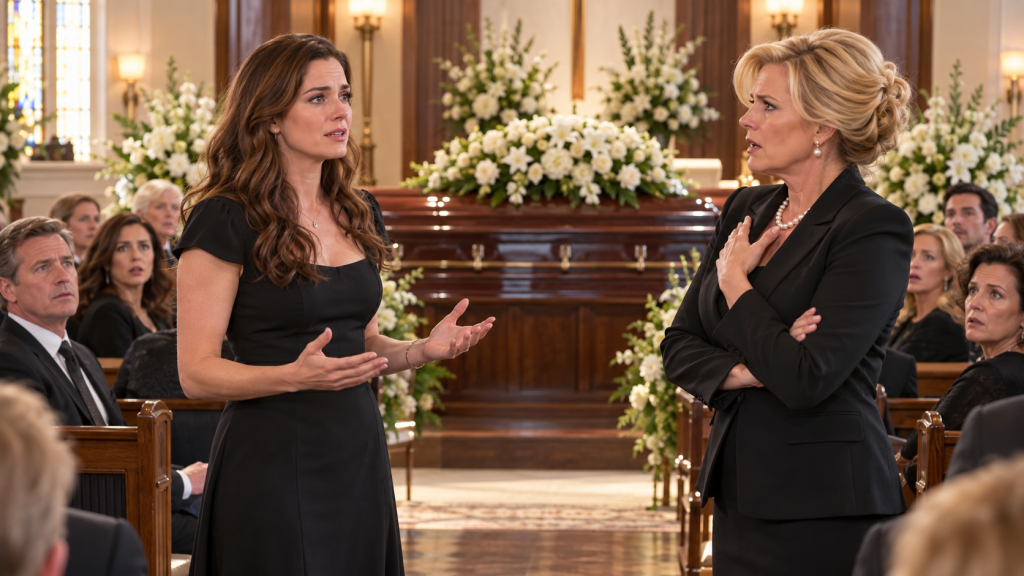
➡️ PART 3 ENDING PART➡️
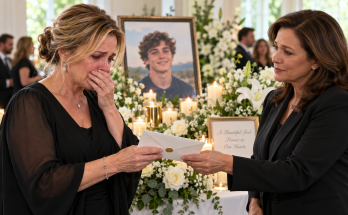
Mrs. Ostrander stood in the funeral-home doorway holding a sealed envelope.
For the first time since I had arrived, Bonnie stopped looking angry.
She looked afraid.
Not startled.
Not confused.
Afraid.
That distinction mattered.
The funeral director, Mr. Larkin, stepped away from the casket.
“Mrs. Ostrander?”
She nodded.
“Morning, Walter.”
Apparently everyone over sixty in that county had known one another since the invention of roads.
Then she held up the envelope.
“Ron left this with the cemetery office six weeks ago.”
Bonnie’s face changed.
“What?”
Mrs. Ostrander looked at her.
“You heard me.”
“That’s impossible.”
“No.”
Her voice remained flat.
“It happened on a Tuesday. He came in at eleven-thirty. He complained about my coffee and brought me tomatoes even though it was too early in the season for decent ones.”
A few people in the first row laughed softly.
I almost did too.
That sounded like Dad.
He hated weak coffee with the seriousness other people reserved for political scandals.
Bonnie stepped toward Mrs. Ostrander.
“My husband was very sick six weeks ago.”
“Yes.”
“He wasn’t thinking clearly.”
Mrs. Ostrander’s expression did not move.
“He beat me at cribbage.”
Silence.
“Twice.”
Someone coughed to hide a laugh.
Mrs. Ostrander continued.
“He knew exactly why he came.”
Bonnie’s hands curled beside her dress.
“What’s in the envelope?”
Mrs. Ostrander looked at me.
“Tracy decides whether it gets read.”
Every face in the room turned toward me.
For twenty-five years, I had perfected the art of becoming smaller in spaces where Bonnie wanted to feel large.
I had sat at the edge of holiday tables.
Waited until other people finished speaking.
Called my father only when I knew she was unlikely to answer.
Accepted that family photographs somehow happened before I arrived.
Accepted “Ron’s girl from before.”
Accepted birthday cards signed only by Dad because Bonnie “wasn’t good with that sort of thing.”
Accepted that every accommodation was described as maturity.
You know how Bonnie is.
Don’t make things harder for Dad.
Keep the peace.
Peace.
I had learned young that family peace often meant finding the person least likely to protest and asking her to disappear a little more.
Not that morning.
I looked at Mrs. Ostrander.
“Read it.”
Bonnie said immediately:
“No.”
The word cracked across the room.
Mrs. Ostrander looked at her over her glasses.
I almost felt sorry for Bonnie.
Almost.
“That letter concerns my husband.”
Mrs. Ostrander nodded.
“And his burial.”
“I am his wife.”
“Yes.”
“And Tracy barely saw him.”
That one struck where she intended.
My throat tightened.
Then I remembered Dad in the garage.
Sunday afternoons.
His voice lowered because Bonnie was inside.
“Hey, Trace.”
Every week.
Sometimes five minutes.
Sometimes forty.
When his lungs got bad, he still called.
One Sunday he had barely been able to speak.
He sat breathing while I told him about a woman at work who microwaved fish in the break room.
I had apologized for talking about something so stupid.
Dad said:
“Stupid is good sometimes. Means nobody’s dying for five minutes.”
We spoke.
Bonnie simply had not been invited into those conversations.
I looked at her.
“We spoke every Sunday.”
Her face hardened.
“You keep saying that.”
“Because it’s true.”
“If he wanted me to know—”
“He didn’t.”
That silenced her.
The cruelty of it hit me only after I said it.
But it was also true.
My father had hidden part of himself from his wife in order to maintain a relationship with his daughter.
That was not romantic.
It was sad.
It was also his failure.
I understood that more fully later.
Mrs. Ostrander broke the seal.
Inside were two pages.
She unfolded them carefully.
Dad’s handwriting covered both.
Large.
Uneven near the bottom.
The first line:
If Bonnie is angry, then at least everybody is where I expected them to be.
A startled laugh escaped someone behind me.
Even Mr. Larkin smiled.
Bonnie did not.
Mrs. Ostrander continued.
Walter Larkin, if this is being read in your funeral home, I apologize for putting business in the middle of a service. But if it has reached this point, somebody ignored what I said while I was alive.
Mr. Larkin’s smile disappeared.
He glanced toward Bonnie.
She looked away.
Mrs. Ostrander read:
I am to be buried in plot 12-B beside Ellen Marsh.
My throat closed.
My mother.
I had almost no complete memories of her.
A yellow raincoat.
A song she used to hum while making toast.
Her hands fastening my shoes.
A hospital room I had been too young to understand.
Then absence.
Dad had talked about her rarely after he remarried.
Bonnie hated when her name came up.
“She’s gone, Ron.”
As if memory were a kind of infidelity.
Mrs. Ostrander continued.
I purchased both plots after Ellen died. I placed burial rights in Tracy’s name because she was Ellen’s child and because grief taught me that people make promises easily when everybody is watching and change plans later when nobody is.
My eyes filled.
Tracy was six. She did not ask me to do it. She did not know.
Bonnie folded her arms.
Mrs. Ostrander kept reading.
If Tracy signs the interment authorization for 12-B, that is my decision being carried out. If she refuses, respect that too. The legal right is hers because I made it hers.
I looked down at the ledger copy in my hand.
My name.
Age six.
I had thought the plot was Dad’s final secret.
It was older than Bonnie.
Older than my anger.
Older than almost everything I remembered clearly.
The letter continued.
There is no authorization from me to use 14-B, 14-A, or any other grave purchased later.
Bonnie’s face went white.
People turned toward her.
She had told half the room the burial location printed in the program was “what Ron wanted.”
Dad had anticipated the exact lie.
Not vaguely.
By plot number.
I stared at her.
“You knew.”
She looked at me.
“I knew there was an old reservation.”
“No.”
My voice shook.
“You knew which plot.”
“I found paperwork.”
“When?”
She said nothing.
“Bonnie.”
“After he went into hospice.”
My stomach dropped.
“You knew.”
“I knew there was an old plan.”
“It wasn’t old to him.”
“He was married to me for twenty-five years.”
There it was.
The argument underneath everything.
Duration.
As though twenty-five years with her should erase the six that came before.
As though my mother’s grave became less real every anniversary Bonnie accumulated.
Mrs. Ostrander lifted the second page.
“There’s more.”
Bonnie whispered:
“Of course there is.”
Mrs. Ostrander read:
Bonnie, if you purchased another set of plots, I know why.
Bonnie’s face crumpled.
For the first time, I saw something other than anger.
Pain.
Real pain.
Dad continued through Mrs. Ostrander’s voice.
You have spent years feeling that being buried beside Ellen means I loved you less. It does not.
Bonnie covered her mouth.
The room became still.
Ellen was my wife. You were my wife. One truth never erased the other, no matter how badly we both handled it.
My chest tightened.
We both.
Dad was not pretending Bonnie had created twenty-five years of tension alone.
That mattered.
I promised Ellen when we bought that family cemetery lot that if I could, I would be buried beside her. She died before we could sign anything together, so I bought both spaces after the funeral. I kept that promise.
Mrs. Ostrander paused.
Her own voice thickened.
Then:
I also made promises to you, Bonnie. Some I kept. Some I failed. One failure was letting you believe that loving my daughter threatened my marriage.
My knees almost gave way.
There it was.
The sentence I had needed Dad to say while alive.
Not to me.
To her.
He knew.
He knew what had happened.
The closed doors.
The secret calls.
The careful scheduling.
The holidays where I was tolerated if convenient.
He knew.
And he had let it happen.
That hurt.
Mrs. Ostrander continued.
Tracy should never have had to become a secret Sunday phone call to make my house peaceful. That was cowardice on my part.
I started crying.
Quietly.
I did not cover my face.
For once, I did not care who watched.
Bonnie, you were wrong to make room for Tracy feel like something I was doing against you.
Bonnie was crying now too.
Tracy, I was wrong to accept those terms for as long as I did.
The room blurred.
Dad had apologized before.
Small apologies.
“I should’ve called.”
“Sorry Christmas got weird.”
“Bonnie’s in a mood.”
Never the whole thing.
Never:
I allowed this.
Now he had.
After death.
Too late.
Still necessary.
Mrs. Ostrander’s voice softened.
I cannot fix twenty-five years in two pages. I can only keep the promise I made in 1998 and stop leaving the next decision to the loudest person in the room.
I looked down at the iron-gray carpet.
Bury me beside Ellen.
Let Tracy stand wherever she wants.
And if anybody tries to send her back to her car because the service is “for family,” tell them Ron Marsh already settled that question.
A sound escaped me.
Half laugh.
Half sob.
The first four rows went perfectly silent.
Bonnie turned toward the funeral-home assistant.
The poor girl looked like she wanted the carpet to open and swallow her.
Mrs. Ostrander finished.
She is my daughter.
That was never modified, revoked, amended, superseded, or subject to Bonnie’s approval.
Even Marian Voss would have admired that sentence.
Wrong story again. No Marian here. Ignore. Need no mention? We already wrote. We must correct before final! Since this is final user-visible text inside writing block, we should not mention unrelated name. Let’s revise mentally: “Even a lawyer would have admired that sentence.” We’ll ensure final actual content reflects? Since I’m composing in analysis, yes final can be clean.
Continue.
Ron.
Mrs. Ostrander lowered the paper.
Nobody spoke.
I could hear someone crying softly behind me.
Maybe an aunt.
Maybe a cousin.
Maybe one of Dad’s friends.
I looked at Bonnie.
I expected hatred.
What I saw was worse.
Humiliation.
Grief.
A kind of old jealousy suddenly made public.
For twenty-five years, she had treated my mother like a rival who happened to be dead.
Now the man they had both loved had refused to choose one of them in the way Bonnie wanted.
She looked at me.
“You planned this.”
I almost laughed.
“I found out about the plot yesterday.”
“But you brought her.”
“I did not bring Mrs. Ostrander.”
Mrs. Ostrander said:
“She couldn’t bring me if she tried.”
That was probably true.
Bonnie looked at the funeral director.
“You cannot seriously intend to let this happen.”
Mr. Larkin glanced toward the casket.
Then at the program.
“Bonnie, you gave us instructions for plot 14-B.”
“Yes.”
“You represented that authorization was being handled.”
“It was.”
“No.”
He looked at me.
“Ms. Marsh?”
“Yes?”
“You signed an interment order this morning?”
“For 12-B.”
“Cemetery accepted it?”
Mrs. Ostrander answered.
“I did.”
Mr. Larkin exhaled.
“Then that’s where the procession goes.”
Bonnie stared at him.
“I paid for this funeral.”
He looked genuinely sorry.
“I understand.”
“So I decide.”
“No.”
His voice remained gentle.
“You decide the service arrangements you lawfully control. The cemetery controls interment according to its records and authorizations.”
She looked around the room.
At relatives.
Neighbors.
Dad’s old coworkers.
People who had believed her version ten minutes earlier.
Then back at me.
“Fine.”
One word.
Flat.
She sat down.
The service began twenty-eight minutes late.
I know because I stared at the clock.
Grief makes you notice absurd things.
The pastor spoke about Dad’s work.
His terrible jokes.
His obsession with baseball.
His loyalty to the same hardware store even after a larger one opened across town.
People told stories.
A cousin described Dad driving through a snowstorm to repair her furnace.
His former supervisor talked about how he refused promotions that required moving because he wanted to stay near family.
That sentence almost made me laugh.
Near family.
Which family?
Grief is complicated because people tell true stories that do not contain the whole truth.
Dad could drive through snow for a cousin.
He could also call his daughter from a garage so his wife would not hear.
Both were him.
A generous man.
A conflict-avoidant man.
A loving father.
A father who let me be marginalized because confronting his wife felt harder than apologizing afterward.
I refused to flatten him into saint or coward.
He had been both stronger and weaker than I needed him to be.
That is often how parents survive inside us after they die.
Half love.
Half unfinished argument.
At the end of the service, the funeral director announced the corrected cemetery location.
“Interment will take place at Greenwood Memorial, family section twelve, plot B.”
People began whispering.
Bonnie stared straight ahead.
The printed programs still said 14-B.
I kept mine.
Not because I wanted evidence against her.
Because sometimes a lie in print is useful when memory later tries to make you doubt how deliberate something was.
As people filed out, an older woman stopped beside me.
Dad’s sister Margaret.
Aunt Maggie.
I had not seen her in six years.
She hugged me.
Then whispered:
“I’m sorry.”
“For what?”
“For believing Bonnie when she said you didn’t want to come.”
I went still.
“What?”
Her face changed.
“Oh.”
“What did she say?”
Maggie glanced toward Bonnie.
“That you’d been distant from Ron for years.”
My stomach tightened.
“She said you were invited but thought funerals were ‘too much drama.’”
I laughed.
A bitter sound.
“When?”
“Yesterday.”
I stared.
Bonnie had not merely excluded me.
She had created a reason for my absence before I even arrived.
Efficient.
That was the word.
Cruelty is often surprisingly administrative.
Maggie squeezed my hand.
“I should have called you.”
“Yes.”
She flinched.
I did not soften it.
Then I hugged her back.
“But you’re calling now.”
Her eyes filled.
“I am.”
That distinction would matter later.
The procession drove to Greenwood.
My car was third.
Bonnie rode in the first limousine.
I expected her to refuse to go.
She didn’t.
Of course she didn’t.
Whatever else she was, she had loved my father for twenty-five years.
That was true.
When we arrived, the cemetery grounds were wet from rain the night before.
Mrs. Ostrander had arranged everything.
Plot 12-B sat beneath an old maple.
Beside it, my mother’s stone.
ELLEN MARSH
1964–1998
Beloved Wife and Mother
I stood in front of it.
For a moment, the funeral disappeared.
I was six.
My hand inside Dad’s.
A black dress with lace that scratched my neck.
People bending to tell me how sorry they were.
Not understanding why they kept saying Mom was “at peace” when the house felt destroyed.
I touched the top of her stone.
Cold.
Smooth.
“Hi, Mom.”
I had visited over the years.
But not enough.
Bonnie hated cemetery trips.
Dad sometimes came alone.
Apparently he had never stopped.
Mrs. Ostrander had told me about the tomatoes.
I wondered how many times Dad stood exactly where I was standing.
Between two plots.
One filled.
One waiting.
Bonnie came up behind me.
“That should be me.”
I turned.
She was staring at 12-B.
Not me.
“That should be my plot beside him.”
Her voice shook.
There was no audience close enough to hear.
Just us.
For the first time, I saw the situation through her eyes.
Twenty-five years.
Marriage.
Illness.
Ordinary mornings.
Arguments.
Groceries.
Dentist appointments.
Shared bills.
Television.
A lifetime built from repetition.
Then death placing him beside a woman gone before Bonnie even married him.
I understood why it hurt.
Understanding did not give her the right to erase his choice.
“I know why you feel that way.”
Her eyes snapped toward me.
“No, you don’t.”
“You’re right.”
I looked at Mom’s stone.
“I don’t.”
Bonnie’s lips trembled.
“He told me years ago that he’d probably change it.”
I looked at her.
“When?”
“After our tenth anniversary.”
“Exactly what did he say?”
She looked away.
That answered.
“What did he say, Bonnie?”
“He said we’d talk about it.”
I closed my eyes.
Dad.
Of course.
Avoiding the fight.
Leaving ambiguity where courage was needed.
“And you decided that meant yes.”
“He should have changed it.”
“Maybe he should have told you no clearly.”
She stared.
That surprised her.
“He should have.”
I nodded.
“But he didn’t change it.”
Tears filled her eyes.
“I took care of him.”
“I know.”
“Every appointment.”
“I know.”
“Every medication.”
“I know.”
“When he couldn’t get upstairs, I slept on the sofa because he needed the downstairs bedroom.”
I looked at her.
“I know you were his wife.”
She began crying.
“Then why does it feel like I’m the mistress at his funeral?”
That sentence took the anger out of me.
For a second.
Not because she was right.
Because pain had finally spoken without using me as a target.
“You’re not.”
“Look where he’s going.”
“I see.”
“He picked her.”
“No.”
She laughed harshly.
“He did.”
“He picked a promise he made before he knew you.”
“That’s the same thing.”
“I don’t think it is.”
She shook her head.
“You wouldn’t.”
“No.”
I looked at her directly.
“But he also chose you for twenty-five years.”
Her face crumpled.
“Then why wasn’t that enough for him?”
I almost said:
Why wasn’t it enough for you?
Then stopped.
That would have been easy.
And cruel.
Instead:
“I don’t know.”
Honesty.
Sometimes that is all grief can tolerate.
She wiped her face.
Then her expression hardened again.
“And what am I supposed to do now?”
“About what?”
“My plot.”
14-A.
The one she had bought beside the road.
“I don’t know.”
Her eyes flashed.
“You could transfer 12-A after—”
“No.”
The word came immediately.
She froze.
My mother was in 12-A.
Not transferable.
She realized what she had said.
“No, I mean if there’s another space near him.”
“There isn’t one I control.”
She looked toward Mrs. Ostrander.
“Maybe they can—”
“Ask the cemetery.”
I stepped back.
“But not today.”
That was the boundary.
Not today.
Not while Dad’s casket waited.
Bonnie closed her mouth.
The burial began.
I stood closest to Mom’s stone.
Bonnie stood on the other side of Dad’s grave.
No one asked either of us to move.
Good.
The pastor said the final words.
The casket lowered.
Bonnie sobbed.
Not elegantly.
Not quietly.
Her grief was ugly and real.
I cried too.
For Dad.
For Mom.
For myself at six.
For myself at nine.
For every Sunday phone call that should not have needed secrecy.
For every Christmas I pretended not to care about.
For Bonnie too, though I did not want to.
Grief makes enemies look human against your will.
After everyone left, I stayed.
Mrs. Ostrander stayed too.
We watched the grounds crew begin their work.
She stood beside me holding her purse with both hands.
“You all right?”
“No.”
“Good.”
I looked at her.
She shrugged.
“People say fine too easily around funerals.”
I smiled.
“Dad liked you.”
“He irritated me.”
“That means yes.”
She smiled.
Then reached into her purse.
Another envelope.
I stared.
“Please tell me that’s the last one.”
“From me? Yes.”
“From him?”
“No promises.”
I groaned.
She handed it over.
My name.
Dad’s handwriting.
TRACY.
I did not open it.
Not there.
“Did he leave this the same day?”
“Yes.”
“What did he say?”
“That you’d read it when you were ready.”
“Very mysterious.”
“He was feeling theatrical near the end.”
“That sounds unlike him.”
“Dying makes people weird.”
I laughed.
Then cried again.
Mrs. Ostrander squeezed my shoulder.
“Go home.”
“Which one?”
The question escaped before I could stop it.
Dad’s house was Bonnie’s home.
My apartment was mine.
Yet suddenly I felt rootless.
Mrs. Ostrander understood.
“Yours.”
I nodded.
That evening, I sat at my kitchen table.
Black dress still on.
Shoes somewhere near the door.
Dad’s envelope in front of me.
I made tea.
Did not drink it.
Opened the letter.
Trace,
If you are reading this, either everything went smoothly and Nancy gave you this afterward, or everything went badly and Nancy enjoyed herself far too much.
I laughed.
Mrs. Ostrander’s first name was Nancy.
I had never asked.
Dad continued.
I should have told you about the cemetery years ago. I didn’t because I kept thinking there would be a better time. That sentence explains too many of my mistakes.
I stopped.
There would be a better time.
To tell Bonnie.
To defend me.
To explain Mom.
To stop hiding calls.
There is always a future version of courage available to people who do not want to spend any today.
Dad knew.
Your mother and I bought no plot together while she was alive. After she died, I bought both spaces because I couldn’t stand the thought of strangers separating us in death after everything had already separated us in life.
My eyes filled.
I put the rights in your name because you were six and you were the only person who belonged equally to both of us.
I covered my mouth.
There.
That was why.
Not legal strategy.
Not suspicion of a future wife he had not yet met.
Me.
Their child.
I also knew someday I might remarry. I hoped I would. I was thirty-four and terrified of spending the rest of my life talking to the walls.
I smiled through tears.
I thought putting the burial right with you would prevent future grief from making me rewrite a promise.
He had known himself.
That mattered.
Then Bonnie came into my life.
I braced.
She gave me twenty-five years I would not trade.
Good.
I wanted that to be true.
She is difficult.
I laughed loudly in an empty kitchen.
So am I. You may have noticed.
“Yes, Dad.”
I said it aloud.
She loved me fiercely. Sometimes fierce love grips too tightly. Sometimes cowardly love avoids saying stop. We were a bad combination in that respect.
My laughter disappeared.
I let her make you feel outside because confronting her felt like risking the life I had built after losing your mother.
My eyes blurred.
That is the ugliest true sentence I can leave you.
I cried.
Not delicately.
Not the kind of crying where one tear slides down a cheek.
I folded over the table.
Thirty-four years old.
Back to nine.
Back to fourteen.
Back to twenty-two, when Bonnie mailed my Christmas package back because “we’re keeping it simple this year.”
Back to every Sunday:
“Call my cell, not the house.”
Back to every time Dad told me:
“Don’t take it personally.”
How else should a daughter take being hidden?
I told myself the Sunday calls were enough.
I whispered:
“They weren’t.”
As if he could hear.
Then read.
They were not.
I started sobbing again.
You deserved a father who called from the kitchen.
That sentence broke me worse than anything else.
Not a mansion.
Not an inheritance.
Not a dramatic apology.
A kitchen.
A father who did not lower his voice.
A relationship allowed to occupy ordinary space.
That was all I had wanted.
You deserved Christmas presents that stayed under the tree.
I pressed the paper flat with shaking hands.
You deserved to be introduced as my daughter without a footnote.
I could barely see.
Bonnie is responsible for how she treated you. I am responsible for every time I allowed it because keeping my marriage comfortable felt easier than making my daughter feel secure.
No excuses.
At last.
I loved you anyway is not enough.
I closed my eyes.
Thank you.
Too late.
Thank you.
Love people where they can feel it.
That line stayed with me for the rest of my life.
The letter continued.
About the grave: sign only if you want to. I hope you will let me lie beside your mother, but I had no right to make my burial another burden you were required to carry. That’s why the deed is yours, not an instruction.
I looked toward the copy of the interment order.
Signed that morning.
I had chosen.
It mattered.
About Bonnie: you owe her nothing after I am gone. Not forgiveness. Not a relationship. Not punishment either. Do whatever leaves you least owned by the past.
My father could be wise after creating an extraordinary amount of emotional paperwork.
Typical.
There is one more thing.
I sighed.
Of course.
Call Arthur Wynn next week. Not tomorrow. Let people bury me before they start dividing drawers.
Arthur Wynn was Dad’s attorney.
I had met him once.
Ten years earlier.
He wore suspenders and smelled like peppermint.
The will is not dramatic. I tried to keep it that way.
That made me suspicious.
Bonnie is provided for. You are provided for. Nobody wins. If anybody tells you the estate proves who I loved more, leave the room.
My throat tightened.
Money is terrible at saying I love you.
Then:
I was better at fixing lawn mowers.
I laughed through tears.
At the bottom:
You were never “from before.”
You were first.
You were mine.
I was your dad.
I wish I had acted like it more loudly.
Love,
Dad
I slept at the table.
When I woke, sunlight had moved across the floor.
My cheek hurt.
Dad’s letter was under my hand.
For several days, I ignored everyone.
Bonnie called twice.
I did not answer.
Aunt Maggie texted.
I answered her.
I’m sorry.
I wrote:
I know.
She replied:
Can I try again?
That question mattered.
I wrote:
Yes. Slowly.
Dad’s friends called.
People brought food.
Someone left a ham outside my apartment even though I had no idea what one person was supposed to do with a twelve-pound ham.
Funerals produce ham beyond reason.
On Monday, I called Arthur Wynn.
He answered:
“Tracy.”
“You were expecting me.”
“Since 1998, apparently.”
I smiled.
We met Wednesday.
Not in Dad’s house.
At Arthur’s office.
Bonnie was there.
So was a woman named Elise Carter, the personal representative Dad had appointed.
A retired accountant.
Neutral.
Thank God.
Dad had been telling the truth.
No dramatic estate.
No trap.
No one-dollar revenge.
The house transferred to Bonnie outright.
She stared at Arthur.
“Ron left me the house?”
“Yes.”
Something in her face crumpled.
Maybe she expected punishment.
Dad had not done that.
She received his retirement accounts according to beneficiary designations.
A life-insurance policy.
Most personal household contents.
Enough to live comfortably.
Not extravagantly.
Dad’s estate was not enormous.
He had been a mechanic and later maintenance supervisor.
He saved.
Invested carefully.
Owned the house outright.
The total was meaningful.
Not cinematic.
About $1.8 million including the house and accounts.
I received a brokerage account worth a little over $410,000.
His old truck.
His workshop tools.
A small fishing cabin two hours east that I had assumed he sold years earlier.
And a collection of boxes stored at Arthur’s office.
“What boxes?”
Arthur smiled.
“Your father was sentimental in inconvenient ways.”
Bonnie looked at me.
“What did he leave in the house that belongs to Tracy?”
Arthur checked the list.
“Very little.”
Her shoulders lowered.
Then he continued.
“Photographs and correspondence were specifically divided by subject.”
Bonnie’s face tightened again.
“Meaning?”
“Photographs of Tracy’s mother and Tracy go to Tracy.”
“I have photographs of Ron in those.”
“Yes.”
“They’re mine.”
“No.”
Arthur’s voice was calm.
“Not under the memorandum.”
Bonnie looked at me.
I did not smile.
Those photographs mattered.
Not because I wanted to take something from her.
Because my childhood had already been edited enough.
I wanted the original evidence that Mom existed in Dad’s life.
That I did too.
Arthur continued.
“Photographs documenting Ron and Bonnie’s marriage remain with Bonnie. Shared family images may be duplicated at estate expense.”
That was fair.
Painfully fair.
Dad had thought of everything after spending decades refusing to address anything directly.
Death had apparently made him efficient.
Bonnie asked:
“What about the ring?”
I frowned.
“What ring?”
Arthur looked at his notes.
“Gold wedding band from Ellen.”
My breath stopped.
Dad had worn a different band after marrying Bonnie.
I had forgotten Mom’s.
“He kept it?”
Arthur nodded.
“In a bank box.”
Bonnie stood.
“No.”
Everyone looked at her.
“That should have been gone.”
Arthur said nothing.
She turned toward me.
“Do you know how many times I asked him?”
I shook my head.
“He told me he lost it.”
Her face twisted.
“He lied.”
I did not know what to say.
This was not triumph.
It was proof that Dad’s secrecy had hurt her too.
Different secrets.
Same cowardice.
Arthur said gently:
“He directed Ellen’s wedding band to Tracy.”
Bonnie stared at me.
Then laughed once.
“That family always needed ghosts.”
I felt defensive.
Then remembered Mom’s note.
Dad’s letter.
Maybe Bonnie was partly right.
I said:
“He should have told you he kept it.”
Her eyes filled.
“Yes.”
“He should have told you a lot of things.”
That surprised her.
Then she asked:
“Why are you being nice to me?”
“I’m not.”
Her mouth almost smiled.
“I’m being accurate.”
That ended the conversation.
For the next month, the estate moved slowly.
Boxes came to my apartment.
Photographs.
Mom holding me as a baby.
Dad asleep in a hospital chair after I was born.
A Polaroid of the three of us on a beach.
Mom laughing with her head thrown back.
I had forgotten her teeth were slightly crooked.
Memory had turned her into something soft and blurred.
Photographs made her specific again.
Alive enough to have bad haircuts.
Dad had kept every Sunday school drawing I made before she died.
Then more after.
School pictures.
Report cards.
Birthday cards.
My graduation announcement.
A ticket stub from the one college basketball game we attended together.
Evidence.
He had loved me.
Quietly.
Too quietly.
But he had.
Among the boxes was a stack of unopened envelopes.
All addressed to me.
All in Dad’s handwriting.
I froze.
Dates.
Over twenty years.
One each Christmas.
A few birthdays.
None mailed.
I called Arthur.
“What are these?”
He sighed.
“I wondered when you’d reach that box.”
“Why didn’t he send them?”
“I don’t know.”
“Did he show you?”
“Some.”
I opened the first.
I was eleven.
Trace,
I bought you a telescope. Bonnie thinks it’s too much. I think she’s wrong.
My heart stopped.
I remembered that Christmas.
Bonnie gave me a scarf.
Dad called two days later.
Said shipping had gotten messed up.
I never saw a telescope.
The letter continued.
I should bring it over myself. If I don’t, that’s on me.
He didn’t.
Another letter.
Age fourteen.
I wanted you here Christmas morning. Bonnie said it would make things awkward with her sister’s family. I said fine. I should not have said fine.
I closed my eyes.
Another.
Eighteen.
You told me you were done trying to make holidays work. I told you I understood. Truth is, I was ashamed because you were solving a problem I should have solved years earlier.
I stopped reading.
These were not love letters.
They were records of failure.
Why keep them?
Why write truth and then hide it?
That question haunted me for weeks.
Eventually I understood.
The letters were Dad rehearsing courage on paper.
Then failing to spend it in life.
I almost threw them away.
Instead, I kept three.
The rest went into a box.
Not destroyed.
Not displayed.
Stored.
Some truths deserve to exist without being read repeatedly.
Bonnie contacted me about six weeks after the funeral.
Not by phone.
A letter.
Typed.
Of course.
Tracy,
I found something in Ron’s desk that belongs to you.
That was all.
I almost ignored it.
Then curiosity won.
We met at a coffee shop.
She brought a small cassette tape.
I stared.
“What is this?”
“Your mother.”
My whole body went still.
“What?”
“Ron had a tape marked Ellen—Tracy age 4.”
I reached for it.
Bonnie kept her hand on the table.
Not withholding.
Just steadying herself.
“I listened to it.”
Anger flashed.
“You listened?”
“Yes.”
“That wasn’t yours.”
“No.”
She looked down.
“I know.”
At least she knew.
“What’s on it?”
“Your mother singing.”
My throat closed.
I barely remembered Mom’s voice.
Not enough to recreate it.
“Why did Dad have it?”
“Apparently he recorded you two in the kitchen.”
Bonnie’s eyes filled.
“I could have thrown it away.”
I stared.
“Did you think about it?”
“Yes.”
Honest.
That mattered more than a prettier lie.
“Why didn’t you?”
She looked at me.
“Because I’m tired of being the person who does things I have to hide later.”
That sentence was the beginning of something.
Not friendship.
Never exactly.
But change.
I took the tape.
“Thank you.”
She nodded.
Then:
“I’m sorry about the funeral door.”
I waited.
She looked at the table.
“I told Larkin’s office you weren’t family.”
There.
No assistant mistake.
No misunderstanding.
“You knew exactly what you were doing.”
“Yes.”
“Why?”
She laughed without humor.
“Because I knew about the cemetery.”
My chest tightened.
“I found Ron’s copy of the deed two months before he died.”
“He knew you found it?”
“I confronted him.”
“What happened?”
Her eyes filled.
“He told me he wasn’t changing it.”
Clean.
At last.
“He actually said no?”
“Yes.”
That mattered.
Dad had found courage eventually.
Late.
But before death.
“What did you say?”
“I told him if he chose to be buried with Ellen, then the funeral would be mine.”
I stared.
“What does that mean?”
“I said I would decide who came.”
There it was.
The exclusion had not been spontaneous grief.
It was leverage.
Dad had known.
That explained the cemetery instructions mentioning the funeral door.
“What did he say?”
Bonnie wiped her face.
“He told me not to punish you because I was angry with him.”
My throat tightened.
“And you did anyway.”
“Yes.”
“Why?”
She looked at me.
“Because when he died, I was still angry.”
I said nothing.
“I had spent twenty-five years thinking eventually he would choose me completely.”
Her voice cracked.
“Then I found out there was one promise I could never replace.”
I looked at her.
“He married you.”
“I know.”
“He built a life with you.”
“I know.”
“You were there every day.”
“I know.”
“Then what did completely even mean?”
Bonnie began crying.
“I don’t know.”
That was probably the truest answer.
We sat in silence.
Then she said:
“I hated your mother.”
I stiffened.
“I never met her.”
That made it worse.
“She was dead before I ever met Ron.”
“Yes.”
“But every time he missed her, I felt second.”
I stared.
“Every time you came around, I saw her.”
My hands curled around the coffee cup.
“That wasn’t my job to fix.”
“I know.”
“Then why did you make me?”
She cried harder.
“I don’t know how to answer that without sounding terrible.”
“Try.”
She breathed in.
“Because you were easier to punish than a dead woman.”
The sentence landed cleanly.
There it was.
Ugly.
True.
I looked away.
She continued.
“And easier than Ron.”
My throat tightened.
“Because you thought he might leave.”
“Yes.”
“But I was a child.”
“Yes.”
“You were nine when we married.”
“I know.”
“You sent my Christmas presents back.”
She closed her eyes.
“I know.”
“You introduced me as his girl from before.”
“Yes.”
“You made me feel like I needed permission to call my own father.”
“Yes.”
I started crying.
Not loudly.
Not even from surprise.
Sometimes hearing someone admit exactly what they did releases grief you have been carrying against denial.
“I’m sorry.”
Bonnie’s voice shook.
“I know sorry doesn’t make it smaller.”
“No.”
“I don’t expect you to forgive me.”
“Good.”
She nodded.
I picked up the cassette.
Then asked:
“Did Dad know you listened to his Sunday calls?”
Her face changed.
“What?”
“You knew, didn’t you?”
Silence.
“Sometimes.”
My stomach twisted.
“He thought he was hiding them.”
“Yes.”
“Why didn’t you stop him?”
She almost laughed.
“Because by then I knew if I made him choose openly, I might lose.”
That was devastating in a different way.
All those years.
Dad hiding.
Bonnie pretending not to know.
Me thinking our tiny secret relationship was the compromise keeping his marriage intact.
Everyone knew enough to be miserable.
Nobody said the whole thing.
“What a waste.”
The words came out before I could stop them.
Bonnie looked at me.
“What?”
“Twenty-five years.”
She flinched.
“No.”
“I don’t mean your marriage.”
I shook my head.
“I mean all that hiding.”
She looked down.
“Yes.”
A waste.
That became the word.
Not tragedy.
Not evil.
Waste.
A family had spent decades using silence to avoid explosions and created a slower kind of damage instead.
I left the coffee shop with the cassette.
That night I found a player online at a secondhand electronics store.
Three days later, I pressed play.
Static.
Then Dad’s younger voice.
“Say hi to the machine.”
A woman laughed.
My mother.
My real mother.
Not memory.
Not photograph.
Voice.
“Ron, she’s four.”
“So?”
“She thinks you’re talking to the toaster.”
Then a tiny voice.
Mine.
“Hi toaster.”
I covered my mouth.
Mom laughed.
A bright sound.
Then she began singing.
Not beautifully.
Normal.
Off-key in one place.
I cried so hard I had to stop the tape.
Then started it again.
Dad joined badly.
Mom told him to stop ruining it.
He laughed.
For seven minutes, my parents were alive.
Young.
In a kitchen.
No Bonnie.
No cemetery.
No funeral.
No Sunday calls.
Just us.
I listened once.
Then put the tape away.
Not because it hurt too much.
Because I wanted it to remain precious instead of becoming medicine I overused.
Over the next year, Bonnie and I barely spoke.
That was healthy.
Distance can be healing when it is chosen rather than imposed.
Aunt Maggie and I rebuilt.
She called.
Visited.
Never once defended Bonnie with “you know how she is.”
That mattered.
The funeral-home assistant mailed me a note.
She apologized for walking me to my car.
She said Bonnie had explicitly told staff I was estranged and not welcome.
The assistant had believed the immediate family.
She wrote:
I should have asked more carefully rather than treating your grief like a security problem.
I appreciated that.
I wrote back.
Thank you for saying it plainly.
Mr. Larkin refunded Bonnie part of the service fee connected to the incorrect cemetery arrangements.
Apparently professional embarrassment has a dollar value.
Mrs. Ostrander retired two years later.
At her retirement lunch, half the county came.
I brought tomatoes.
Terrible ones.
She looked at the bag.
“These are grocery-store tomatoes.”
“Correct.”
“Your father would be ashamed.”
“He’s unavailable for comment.”
She laughed so hard she had to sit down.
Before I left, she gave me a small brass cemetery key tag.
Plot 12-A / 12-B.
“Records are digital now.”
“Progress.”
“Terrible.”
I hugged her.
“Thank you.”
“For what?”
“For not letting Bonnie move him.”
Mrs. Ostrander stiffened.
Then pushed me back enough to look at my face.
“No.”
“What?”
“I did my job.”
She pointed one finger at me.
“Do not turn basic integrity into heroism because somebody else behaved badly.”
I stared.
Then laughed.
Of course.
Even retired, she was teaching.
“You sound like Dad.”
“Insult me again and you can leave.”
I hugged her anyway.
Three years after Dad died, Bonnie called.
Her voice sounded strange.
“Tracy?”
“Yes?”
“I’m at the cemetery.”
My stomach tightened.
“What happened?”
“Nothing.”
A pause.
“I bought a different plot.”
I said nothing.
“Not 14-A.”
“Okay.”
“Near my sister.”
Her sister had died the year before.
“I thought you should know.”
“Why?”
Another pause.
“Because I’m selling 14-A and 14-B back to the cemetery if they’ll take them.”
I leaned against my kitchen counter.
“That sounds sensible.”
“I kept thinking if I held onto them, Ron might somehow still end up there.”
My chest tightened.
“He won’t.”
“I know.”
She laughed softly.
“Took me long enough.”
Then:
“I went to his grave.”
I waited.
“I brought flowers for Ellen too.”
That surprised me.
“What kind?”
“Daisies.”
Mom liked daisies.
Had Bonnie known?
Maybe from Dad.
Maybe from photographs.
“Thank you.”
She sighed.
“I didn’t do it for you.”
“That’s fine.”
We both laughed slightly.
Then she said:
“I told her I was sorry.”
My throat tightened.
“To my mother?”
“Yes.”
“For what?”
“For making a dead woman responsible for my insecurity.”
I closed my eyes.
That was more insight than I ever expected from Bonnie.
“What did she say?”
Bonnie laughed.
“Nothing. Very judgmental.”
I laughed too.
The first uncomplicated laugh we had ever shared.
It did not make us family in some sentimental new way.
But it softened an old edge.
Years passed.
My life expanded.
That mattered.
For too long, my identity had been organized around being excluded.
Dad’s daughter.
Bonnie’s stepdaughter.
The one left outside.
After he died, something unexpected happened.
There was no door left to stand outside.
I had to build a life without waiting for somebody to finally invite me in.
I changed jobs.
Moved to a small house outside the city.
Adopted a dog with one ear that refused to stand properly.
I dated.
Badly.
Then better.
Eventually I married a man named Daniel.
Before the wedding, I told him:
“If anyone says the ceremony is for family and tries to remove me, I’m leaving.”
He stared.
“That seems very specific.”
“You have no idea.”
Bonnie was not invited.
Not out of revenge.
Because our relationship had not become that.
She sent a card.
Inside:
I hope nobody guards the door.
I laughed.
Then cried.
I kept the card.
Aunt Maggie attended.
Mrs. Ostrander attended wearing purple because she said black was for people who had given up.
Daniel and I had one daughter.
We named her Ellen as a middle name.
Not first.
I wanted my child to have her own name before carrying anyone else’s memory.
When she was six—the age I had been when Mom died—I took her to the cemetery.
Dad’s stone had been placed beside Mom’s.
Simple.
RON MARSH
1963–2026
FATHER, HUSBAND, FRIEND
HE KEPT SOME PROMISES.
That last line had been my choice.
The monument company asked whether I was sure.
Very.
Not:
He kept his promises.
He did not.
Not all.
Some.
That was more honest.
My daughter read it.
“What does that mean?”
“He tried.”
She frowned.
“That’s a weird gravestone.”
“Yes.”
She liked weird.
Good.
We sat between their graves.
I told her about Grandma Ellen.
The song on the cassette.
How she laughed.
I told her Grandpa Ron could fix almost anything mechanical.
That he ate peanut butter directly from the jar.
That he hated weak coffee.
I did not tell her everything about Bonnie.
She was six.
Children do not need to inherit adult resentments before they can understand them.
She picked dandelions.
Put three on Mom’s grave.
Three on Dad’s.
Then one between.
“Who’s that one for?” I asked.
She shrugged.
“Everybody else.”
Children solve symbolism quickly.
When my daughter was twelve, Bonnie died.
I found out from her sister’s daughter.
Cancer.
Short illness.
She had left instructions.
No service restrictions.
No private guest list.
Anyone who wanted to come could come.
That detail made me cry more than I expected.
I went.
Not because I loved Bonnie.
Not because death had transformed the past.
Because we had reached something resembling peace before the end, and I wanted to honor that accurately.
The funeral home was the same one.
Mr. Larkin had retired.
The assistant who once walked me to my car was now the director.
She recognized me.
Our eyes met.
For half a second, we both remembered.
Then she stepped aside.
“Come in, Tracy.”
Two words.
Simple.
Come in.
I nearly cried at the door.
Bonnie had chosen to be buried beside her sister.
Her headstone later read:
BONNIE MARSH
1959–2037
SISTER, WIFE, AUNT
SHE LEARNED LATE, BUT SHE LEARNED.
Her niece chose that.
I thought it was brave.
Among Bonnie’s papers was one envelope for me.
Not Dad’s handwriting.
Hers.
I opened it weeks later.
Tracy,
I do not know if I made your father happy. I know I made parts of his life smaller because I was afraid of losing my place in it.
I stopped.
Then continued.
I made your place smaller too. There is no version of that I can defend now.
My eyes filled.
When I told you the funeral was for family, I knew exactly how cruel the sentence was. I chose it because for one morning I wanted to be the person who could decide who belonged.
I exhaled slowly.
You were right not to let me.
No excuses.
No rewritten memory.
Ron loved me. He loved Ellen. He loved you. I spent too much of my life treating those facts as though only one could be true at a time.
Then:
The older I got, the more ridiculous that seemed.
I laughed through tears.
I am sorry I made a child compete with a marriage she never asked to threaten.
That was the sentence.
Not the funeral.
Not the grave.
The child.
At last.
I hope your daughter never has to wonder whether she is welcome in a room where her parent is standing.
I closed my eyes.
She didn’t.
She never would.
Not if I could help it.
There is a small box with this letter. It belonged to Ron. I nearly threw it away several times. I think it belongs with you.
Inside the box was Dad’s old garage telephone.
Not a cell phone.
A battered cordless handset from the house system he used before switching to mobile calls.
The label on the back, in Dad’s marker:
GARAGE
I stared at it for a long time.
This ridiculous piece of plastic had carried years of whispered conversations.
Sunday afternoons.
Weather.
Work.
His breathing.
My life.
I almost hated it.
Then I smiled.
Because for all its sadness, it had also been a bridge.
Not enough.
But real.
I kept it for one year.
Then donated it to electronics recycling.
I did not need a shrine to secrecy.
Before dropping it into the collection bin, I photographed the label.
Garage.
Then let it go.
Dad had told me:
Do whatever leaves you least owned by the past.
That became easier with age.
Forgiveness, I learned, was not one grand emotional moment.
It was becoming able to remember without letting the old room rebuild itself around you.
I never forgave Bonnie enough to call what she did acceptable.
I forgave her enough that I did not need her punished forever.
I forgave Dad enough to love him without making him innocent.
That was harder.
Parents die and people start polishing them.
Suddenly every bad decision becomes “complicated.”
Every hurt becomes “he did his best.”
Maybe he did.
Sometimes somebody’s best is still insufficient.
Dad loved me.
Dad failed me.
Both stayed true.
The grave did not erase that.
His letter did not erase it.
Four hundred thousand dollars certainly did not erase it.
What changed was that he finally named his failure correctly.
Then left me the freedom not to carry his shame as mine.
That mattered.
The investment account he left me grew.
Daniel and I never needed most of it.
We used part for our daughter’s education.
Part to help Aunt Maggie when she needed home care.
Part to restore the fishing cabin.
Then, when I was fifty, I used a substantial portion to start something Dad would probably have found embarrassingly sentimental.
A local family-assistance fund.
Not for funerals.
For travel.
Specifically for people who needed to get to sick relatives, births, funerals, or emergencies and could not afford transportation or time off.
The idea came from all the years people said:
“I would’ve come, but…”
Sometimes they had excuses.
Sometimes they truly could not.
I wanted money to remove the second kind.
We called it the Show Up Fund.
Daniel said the name was blunt.
“Dad would approve.”
He did.
Over the next twenty years, it paid for plane tickets.
Gas cards.
Hotel rooms.
Childcare.
Lost wages.
A son flew home before his mother died.
A grandmother attended a premature grandchild’s birth.
Two sisters reconciled at their father’s hospital bed.
Not every reunion was beautiful.
Some people arrived and fought anyway.
Human beings remain human even with transportation funded.
But they got the chance to show up.
That felt important.
Dad had spent years showing up incompletely.
I wanted his money to help other people arrive in time.
At sixty-one, I gave an interview to the local paper about the fund.
The reporter asked:
“Why is showing up so important to you?”
I almost gave a polished answer.
Then said:
“Because love people can’t feel is a very lonely kind of love.”
The reporter went quiet.
That line became the headline.
I hated that.
But it was true.
My daughter grew up knowing everything eventually.
Not at once.
At sixteen, she asked why Grandpa had been buried beside a woman who was not Bonnie.
So I told her.
At eighteen, she asked why I disliked family Christmases.
I told her more.
At twenty-two, after her first serious relationship, she asked:
“Why didn’t Grandpa just tell Bonnie no?”
I laughed.
“That question took me thirty years.”
“What’s the answer?”
“He was afraid.”
“Of her?”
“Of losing another marriage.”
She thought.
“So he let you lose part of a father instead.”
My throat tightened.
“Yes.”
“That’s messed up.”
“Yes.”
Then she asked:
“Do you hate him?”
“No.”
“Why not?”
I thought.
“Because loving someone after understanding them is different from loving the version you needed them to be.”
She nodded slowly.
“I think I get that.”
She probably didn’t.
Not yet.
That was fine.
Some understanding should arrive only after life earns it.
When my daughter married, I walked her down the aisle with Daniel.
Halfway there, she whispered:
“No bouncer at the door.”
I almost ruined the ceremony laughing.
She knew.
Of course she knew.
After the wedding, we went to the cemetery in our formal clothes.
Just the three of us.
She put her bouquet between Mom and Dad’s stones for a photograph.
Not left there.
It was too expensive.
Her words.
Dad would have liked her.
As I aged, cemetery paperwork became strangely important again.
Mrs. Ostrander’s old office was renovated.
The ledger transferred to archival storage.
Digital records replaced most of it.
One afternoon, a young cemetery administrator called me.
“Ms. Marsh?”
“Yes?”
“We’re updating right-holder information on older deeds.”
My heart tightened.
Plot 12-A.
12-B.
My name.
Still.
“What do you need?”
“A beneficiary designation for future control after your death.”
I laughed softly.
The story had come full circle.
I could assign the burial rights to anyone.
My daughter.
A trust.
The cemetery.
I thought for a week.
Then transferred the rights to the cemetery association under a permanent no-disinterment restriction.
My daughter was surprised.
“You’re not giving them to me?”
“No.”
“Why?”
“Because Grandpa gave me a responsibility I needed once.”
I smiled.
“You don’t.”
She looked relieved.
Good.
“I don’t want you spending a Thursday morning arguing with somebody about where a dead relative belongs.”
“Very specific.”
“Family tradition.”
She laughed.
The graves would remain.
No one could move Mom.
No one could move Dad without extraordinary legal circumstances.
The promise no longer needed to live in a daughter’s signature.
It had been kept.
That mattered.
Years later, when I was seventy, Daniel died.
Suddenly.
Heart attack.
I understood Bonnie more after that.
Not her choices.
Her fear.
There is a terrible panic in becoming the surviving spouse.
People start saying “late husband” almost immediately, as if language wants to move the dead backward in your life faster than your heart can tolerate.
I found myself touching Daniel’s clothes.
Leaving his shoes by the door.
Getting angry when someone sat in his chair.
One night, I caught myself resenting a photograph of his college girlfriend in an old album.
I stared at myself.
Then began laughing.
“Bonnie, you’d love this.”
Grief can make us ridiculous.
The difference is whether we allow ridiculous feelings to become cruel actions.
I kept the photograph.
Of course.
Daniel had a life before me.
So did I.
Love is not invalidated by chronology.
I finally understood that in my bones.
I was buried nowhere near Dad.
That decision surprised everyone.
The family assumed I would choose Greenwood.
Near Mom and Dad.
I did not.
Daniel and I had bought two spaces near the town where we raised our daughter.
Side by side.
Our choice.
Our life.
Before I signed the deed, I laughed.
The cemetery salesman looked confused.
“What?”
“Nothing.”
Then I said:
“Put both rights in our names jointly, with clear successor instructions.”
He smiled.
“Planning ahead.”
“You have no idea.”
I visited Dad one final time the year before my own health started failing.
His stone was weathered.
Mom’s too.
The maple had grown enormous.
Mrs. Ostrander was long gone.
Aunt Maggie too.
Bonnie lay across town beside her sister.
Everyone who once argued about where Ron Marsh should be buried had become old, dead, or irrelevant to the grass growing over him.
That humbled me.
I sat on a bench.
“Hey, Dad.”
Wind.
Birds.
No answers.
Better than some of our phone calls.
I told him about the Show Up Fund.
My daughter.
His great-grandchildren.
Daniel.
Bonnie’s letter.
Everything.
Then:
“I was angry at you for a long time.”
Leaves moved overhead.
“You deserved some of it.”
Still nothing.
Good.
“You loved me.”
My throat tightened.
“I know.”
Then the sentence I had needed decades to say:
“But you should’ve loved me louder.”
I cried.
Not because it still destroyed me.
Because it was finally small enough to hold in one sentence.
You should have loved me louder.
That was all.
I placed one hand against his stone.
“I did better with mine.”
That felt boastful.
Then I added:
“Mostly.”
More honest.
My daughter never wondered whether she could call.
Never had gifts returned.
Never got introduced as anybody’s girl from before.
She also knew when I was angry.
Knew when I disagreed.
Knew I loved Daniel.
Knew I loved her.
Nothing had to be smuggled through a garage.
That was how generational healing looked in our family.
Not mystical.
Communication.
Ordinary rooms.
Kitchen-table affection.
Saying no where children could hear it.
Saying yes too.
At the end of my visit, I walked to Mom’s side.
I played the old cassette recording from a digital copy on my phone.
Her voice floated through the cemetery.
“Ron, she thinks you’re talking to the toaster.”
Then my four-year-old voice:
“Hi toaster.”
I laughed.
Dad’s younger laugh followed.
For seven minutes, the three of us existed together again.
When the recording ended, I sat quietly.
Then I realized something.
Dad had spent years trying to decide where he belonged.
With Ellen.
With Bonnie.
With me.
As if love required one final location.
It didn’t.
A grave holds a body.
Not the complete map of a life.
Dad lay beside Mom because he had promised.
Bonnie remained his wife because they had shared twenty-five years.
I remained his daughter because nothing had ever had the authority to revoke that.
Not remarriage.
Not jealousy.
Not distance.
Not a funeral-home door.
Not even Dad’s own weakness.
Family was not proved by who got the front pew.
Or the house.
Or the grave.
It was proved in relationship.
Sometimes beautifully.
Sometimes badly.
Sometimes too late.
Before I left, I touched the engraved word:
FATHER.
Then said:
“That one was mine.”
Not possessively.
Accurately.
Dad had been many things.
Husband twice.
Friend.
Brother.
Coworker.
Neighbor.
But father belonged to my story.
No one could send me back to my car and make that untrue.
That was the lesson Bonnie had never understood until it was too late.
Exclusion can control a doorway.
It cannot rewrite relationship.
A funeral guest list cannot erase thirty-four years.
A printed program cannot change a cemetery deed.
A surviving spouse cannot manufacture ownership of a promise another person made before she arrived.
And a daughter does not stop being family because calling her inconvenient makes the room easier to manage.
I learned something else too.
Having the legal signature did not make me more family than Bonnie.
That mattered.
For a brief, angry period, I wanted it to.
I wanted plot ownership to prove Dad had chosen me.
But the deed had never been a medal.
It was a responsibility.
Dad trusted a six-year-old future version of me with one promise.
I carried it.
Then put it down.
That is what healthy responsibility eventually allows.
Completion.
The grave was opened.
Dad was buried.
The earth closed.
Grass returned.
Life moved.
The signature mattered for one day.
The relationship mattered longer.
If someone tells the story now, they usually make the satisfying part Bonnie’s face when she learned she could not control the burial.
I understand.
It is cinematic.
The excluded daughter walks into the service.
The stepmother gets exposed.
The cemetery clerk arrives with the dead man’s letter.
The correct grave waits beside the first wife.
Justice.
Neat.
But real life was not neat.
Bonnie loved my father.
My father loved Bonnie.
Bonnie hurt me.
My father allowed too much of it.
My mother mattered after death.
I mattered while alive.
Bonnie mattered too.
Nobody’s existence required another person to become unreal.
That was the lesson it took all of us too long to learn.
The most important moment was not when I announced plot 12-B.
It was years later, when I stopped needing the plot to prove anything.
Dad was my father before the ledger.
Mom was my mother before the stone.
Bonnie was Dad’s wife even though he was not buried beside her.
And I was family before anyone at the funeral home decided whether to open the door.
That truth did not require a signature.
But I am still glad I had one.
Because sometimes love needs tenderness.
And sometimes, on a Thursday morning in a cemetery office, it needs paperwork.
THE END STORIES! THANK YOU FOR READING GOOD LUCK !❤️
Related Posts