My name is Dolores Fenn. I am 73. My son’s wife gave me a dollar-store birthday card with a scratch ticket inside, as a joke. They laughed while I scratched it at the table. I won eleven million dollars. I thanked them for the card and told no one. That was ten months ago.

Tomorrow morning, a letter arrives at their house, and my suitcase is packed so I can watch them read it.
The ticket cost two dollars. The price sticker was still on the card. It was the only gift they gave me that year.
“Maybe you will win your bus fare, Dolores!” my daughter-in-law Renata said, and my son Daniel laughed with her, and my grandchildren laughed because the grown-ups did.
I scratched it with my thumbnail while they served the cake I had baked for my own birthday. Three matching amounts came up under the silver film. I looked at that little card for a long moment. Then I folded it into my cardigan pocket, smiled, and said, “No bus fare. Thank you for the card, honey. It is a pretty card.”
It is astonishing what a person can do with a calm face and one cardigan pocket.
I have lived with Daniel and Renata for four years, since my Harold passed. I cook, I fold, I babysit, and I hear about it anyway. I am “a cost.” I have heard the word “burden” through two different doors. Renata clips coupons and hands me the pile like homework. Last Christmas she returned the sweater I bought her, in front of me, for store credit.
So no, I did not run down the hallway waving that ticket. You do not hand a golden egg to people who have been weighing you like a grocery bill.
Instead, on Monday, while they worked, a taxi took me downtown. The lawyer’s office had cold coffee and a young man who did not blink when I put the ticket on his desk. By Friday there was a trust, and a plan, and a second lawyer checking the first lawyer’s work. They collected the money quietly. And they gave me one piece of advice I have followed to the letter: change nothing yet.
So I changed nothing. I cooked. I folded. I clipped the coupons and I said thank you for the pile. For ten months, the richest woman in that zip code scrubbed a casserole dish every Sunday night while her family watched television in the next room.
But I did make one purchase.
Here is a thing about my son’s house that my son does not think about: it is not his house. He rents it. Has for nine years, from an old landlord in Florida who was, it turns out, very ready to sell. My lawyer made him an offer in March. Cash, quiet, closed in three weeks.
The buyer on the paperwork is a company called H and D Bait and Tackle LLC. That was Harold’s little company, thirty years of tackle boxes in our garage with those letters on the side. Daniel grew up carrying those boxes to the truck every summer. He has seen that name ten thousand times. I counted on him never once really looking at it, the same way he never once really looked at me.
Since April, my son has been mailing his rent check to a post office box that empties into his mother’s trust. He complains about his landlord at dinner. I pass him the potatoes.
Then, at 6:40 on a Tuesday evening, two weeks ago, Daniel set down his fork and said they had found me “a wonderful, affordable place.” Sunrise Pines. The budget wing. A deposit already paid, he said, proud of himself, like a boy showing a report card.
“You will be happier with people your own age,” Renata said, reaching for my hand across the table. Her nails were freshly done. “January first. It is all arranged.”
“January first,” I said. “That is soon.”
“It is for the best, Mom,” Daniel said.
“I agree,” I said, and they both blinked, and then they smiled at each other like the hard part was over. The children went back to their phones. Somewhere under us, the house I own held everybody up.
That was two weeks ago. Tonight my suitcase is packed, but not for Sunrise Pines. There is a set of keys in my cardigan pocket where a scratch ticket used to live, and the keys fit a yellow house near my sister in Savannah, bought in June, with a porch and rose bushes and a kitchen the color of butter.
And tomorrow morning, the first of the month, a letter from H and D Bait and Tackle LLC arrives at my son’s front door. New terms. Effective immediately. Signed by the owner.
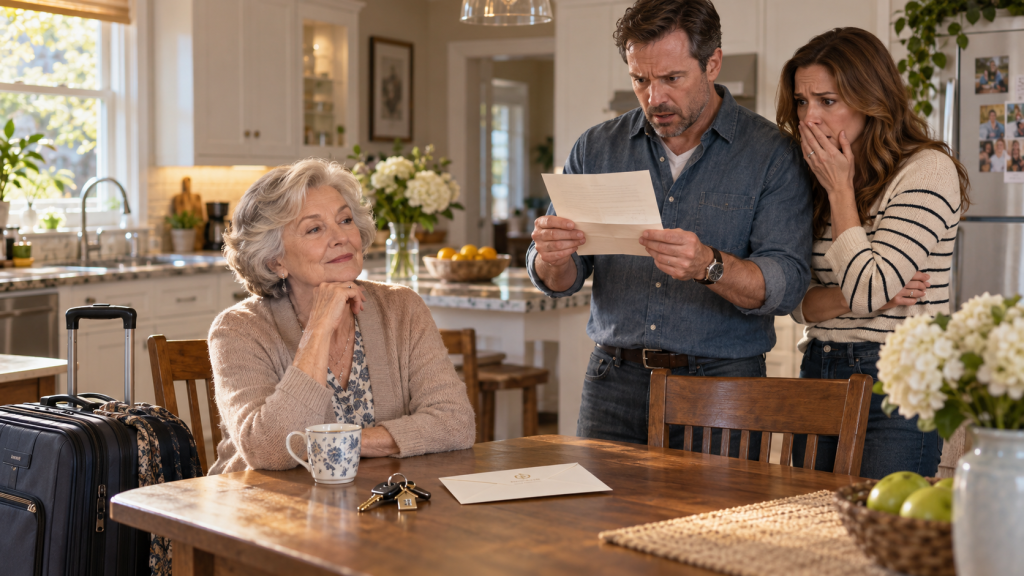
I will be at the kitchen table with my coffee when Daniel opens it. I want to watch his face when he reads the owner’s name. I want to hear Renata ask him why his landlord has his mother’s handwriting. And when he looks up from that letter and says “Mom?” in that small voice I have not heard since he was seven, my cab will already be idling at the curb, and I will pick up my suitcase, and I will finally say the thing I have been saving for ten.
PART 2 — THE LANDLORD AT THE KITCHEN TABLE
The letter arrived at 8:12 the next morning.
I know because I was watching the clock above the stove.
I had been awake since five.
Not from nerves exactly.
At seventy-three, excitement and indigestion have learned to imitate one another.
My suitcase stood beside the coat closet.
Brown leather.
Harold bought it for our twentieth anniversary because he believed luggage should last longer than marriages on television.
It had survived thirty-six years.
One broken wheel.
Two replaced handles.
A coffee stain from Tennessee.
And now it was packed with enough clothing to take me from my son’s house to a yellow cottage in Savannah that nobody in that kitchen knew existed.
I had also packed Harold’s photograph.
My good earrings.
Three books.
My mother’s recipe cards.
And the ceramic bird Maggie—my oldest granddaughter—painted for me when she was nine.
Everything else could wait.
That is another thing money teaches you if you are lucky enough to learn it late.
A person needs surprisingly little to leave.
Especially when she has spent years being told she takes up too much room.
Daniel came into the kitchen first.
Still wearing pajama pants.
Phone in one hand.
He opened the refrigerator and stared into it as though eggs might have reorganized themselves overnight.
“Coffee?”
I asked.
“Please.”
I poured him a cup.
The house was mine.
The coffee maker was mine too, technically, because I bought it two Christmases ago.
But I did not mention either fact.
Not yet.
Renata entered ten minutes later in a satin robe and little slippers with feathers across the toes.
I had given up understanding expensive slippers.
She glanced at my suitcase.
“Oh.”
She smiled too brightly.
“Getting organized early?”
“I like to be prepared.”
“For Sunrise?”
she asked.
I smiled.
“For what comes next.”
She seemed pleased with that answer.
People hear what they want when they have already written the ending for you.
My grandson Lucas came through grabbing cereal.
My granddaughter Maggie followed him.
Neither looked at my suitcase.
That hurt a little.
Then Maggie did a double take.
“Grandma, are you leaving today?”
Renata answered before I could.
“Grandma’s getting ready for her new place.”
Maggie frowned.
“I thought January.”
“It is.”
Renata squeezed her shoulder.
“She is excited.”
I looked at Maggie.
“I am leaving today.”
The spoon stopped halfway to her mouth.
Daniel turned.
“What?”
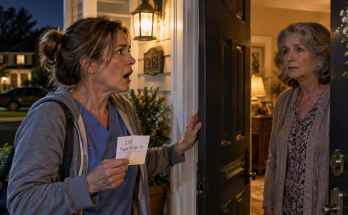
Then the doorbell rang.
Perfect timing.
I almost wished Harold could see it.
He loved timing.
Couldn’t tell a joke to save his life, but he could back a boat trailer into a crowded launch while twelve impatient fishermen cursed behind him.
Daniel opened the door.
A courier stood outside with a certified envelope.
He signed.
Brought it inside.
Looked at the return address.
H & D BAIT AND TACKLE LLC
He frowned.
“Landlord.”
Renata groaned.
“What now?”
“Probably another rent notice.”
She rolled her eyes.
“These people are unbelievable.”
I buttered my toast.
Since April, Daniel had mailed six rent checks to H & D Bait and Tackle LLC.
He complained about them every month.
When the exterior faucet leaked, he said:
“These corporate landlords buy everything and don’t care about people.”
When the property manager reminded him not to leave the garbage bins at the curb all week, Renata said:
“I miss old Mr. Putnam. At least he was human.”
I nearly swallowed my tongue that evening.
Old Mr. Putnam had sold me the house for $418,000 cash and sent me a bottle of bourbon afterward.
I don’t drink bourbon.
My lawyer does.
It worked out.
Daniel tore the envelope open.
I watched his eyes move.
At first, nothing.
Then confusion.
Then he slowed down.
Renata noticed.
“What?”
He did not answer.
“What does it say?”
His eyes reached the signature.
He stopped breathing.
Not literally.
But close enough.
I knew exactly what line he had reached.
My lawyer, Calvin Price, had drafted the letter in the driest language available to the human species.
It began:
NOTICE OF OWNERSHIP, MANAGEMENT, AND TENANCY TERMS
Then explained that ownership of the property had transferred months earlier to H & D Bait and Tackle LLC, an entity held by the Harold and Dolores Fenn Trust.
It confirmed that all owner communications were effective immediately through the new management address.
It also stated that Daniel and Renata’s long-expired lease had converted to month-to-month years ago, just as Mr. Putnam’s records showed.
Their tenancy was not being “canceled immediately.”
I am rich, not stupid.
Calvin checked the lease.
Then checked the law.
Then had another lawyer check Calvin because eleven million dollars buys you the wonderful privilege of distrusting people professionally.
The letter gave Daniel and Renata the notice legally required under their agreement before the tenancy would end.
Plenty of time.
More notice than they had given me before arranging Sunrise Pines.
The last page was signed:
Dolores Fenn
Manager, H & D Bait and Tackle LLC
Trustee, Harold and Dolores Fenn Trust
Daniel looked up.
“Mom?”
There it was.
That small voice.
The one I remembered from when he was seven and broke Harold’s fishing rod, then hid it beneath his bed and somehow expected the Labrador to take the blame.
I took a sip of coffee.
“Yes?”
Renata grabbed the letter from him.
Her eyes raced down the page.
Then back up.
Then down again.
“This isn’t funny.”
“No.”
I said.
“It isn’t.”
“You own the company?”
“Yes.”
Daniel looked at me as if I had changed shape while he slept.
“H and D.”
I nodded.
“Harold and Dolores.”
His face went blank.
I waited.
Then watched recognition arrive.
Bait and Tackle.
The boxes.
The old garage.
His father.
Thirty summers.
Thousands of mornings.
Daniel had loaded those boxes into Harold’s truck when he was twelve.
He had worn an H & D cap until the brim separated.
He had watched his father write those initials on every invoice for most of his childhood.
And for six months, he had mailed rent checks to that exact name without seeing it.
I cannot explain how much that hurt.
It also confirmed something I already knew.
People do not suddenly stop seeing you.
Usually, they practice for years.
“You bought this house?”
Daniel asked.
“In March.”
Renata sat down hard.
“With what?”
I smiled.
“Money.”
Her expression sharpened.
“You know what I mean.”
“Then ask a clearer question.”
Daniel pushed one hand through his hair.
“Mom, where did you get enough money to buy a house?”
I looked toward the cheap floral birthday card still tucked inside one of my cookbooks.
I had kept it.
Maybe for evidence.
Maybe because I have a mean streak.
Probably both.
“Do you remember my birthday?”
Daniel frowned.
“Of course.”
“Do you?”
Renata’s face changed before his did.
The scratch ticket.
There.
She knew.
Not the amount.
Not yet.
But she knew.
“No.”
she whispered.
I looked at her.
“Yes.”
Daniel looked between us.
“What?”
Renata said:
“The ticket.”
His mouth opened.
I spread another little line of butter across my toast.
“The card was lovely.”
Renata stood.
“How much?”
I looked at her.
“Enough.”
“Mom.”
Daniel sounded almost angry now.
“How much did you win?”
There are moments a person imagines for months and then discovers she no longer needs them to be dramatic.
This was one.
I had pictured saying eleven million like a cannon blast.
Instead I said:
“Eleven million dollars.”
Quietly.
Lucas dropped his spoon.
Milk splashed onto the table.
Maggie gasped.
Renata sat down again.
Daniel stared at me.
Then laughed.
Not because it was funny.
Because reality sometimes becomes too large for the first emotion available.
“Eleven million?”
“Before taxes and planning.”
“Obviously.”
“Yes.”
“You won eleven million dollars on that ticket?”
“The two-dollar one.”
Renata’s mouth fell open.
I could not help myself.
“Excellent return on the birthday budget.”
That was for Harold.
He would have approved.
Then Daniel’s face changed.
The excitement came.
Fast.
Too fast.
Not greed, exactly.
Hope.
Calculation.
Fear.
All tangled.
“Mom, why didn’t you tell us?”
There it was.
Not:
Were you frightened?
Did you need help?
Are you safe?
Why didn’t you tell us?
As though my money had been a family announcement I had withheld.
I placed my knife beside the plate.
“Because I wanted time to think.”
“For ten months?”
“Yes.”
“You’ve been sitting here for ten months with eleven million dollars?”
“I have been sitting here for four years without it.”
That silenced him.
Renata crossed her arms.
“This is unbelievable.”
I looked at her.
“Which part?”
“You let us think you had nothing.”
I almost laughed.
“What did you think I had?”
She blinked.
“That’s not what I meant.”
“Then say what you meant.”
Silence.
I leaned back.
“I had my Social Security.”
“I had Harold’s small pension.”
“I had forty-three thousand dollars in savings when I moved here.”
“I paid toward groceries.”
“I paid the electric bill most summers because Daniel complained about the air-conditioning.”
“I bought school clothes.”
“I bought birthday gifts.”
“I cooked.”
“I cleaned.”
“I watched your children.”
“I did not have eleven million dollars.”
“But ‘nothing’ is an interesting word.”
Renata looked away.
Daniel sat across from me.
“Mom, I never said you had nothing.”
“No.”
“You said I was expensive.”
His face dropped.
“I heard you.”
“I heard Renata say I was a cost.”
“I heard ‘burden’ through the laundry-room door.”
Renata flushed.
“People say things when they’re stressed.”
“Yes.”
I nodded.
“They do.”
“And people remember them when they’re being moved into budget senior housing.”
Daniel stood.
“Sunrise Pines is not some prison.”
“I did not say it was.”
“We researched it.”
“I know.”
“They have activities.”
“Wonderful.”
“Meals.”
“Excellent.”
“Transportation.”
“Useful.”
His voice rose.
“Then why are you acting like we were throwing you into the street?”
Because that was the part they still did not understand.
“I am not angry that you found a senior apartment.”
I said.
They both stared.
“I’m angry that you found one without me.”
Silence.
“You toured it without me.”
“You paid a deposit without me.”
“You picked January first.”
“You announced it at dinner as though I were a sofa you had finally found storage for.”
Daniel sat slowly.
My voice remained calm.
“You could have asked if I wanted my own place.”
“I did.”
“I wanted one very badly.”
His face changed.
“But you did not ask.”
Renata looked toward my suitcase.
“Is that where you’re going?”
“Not Sunrise Pines.”
“Then where?”
“Savannah.”
Daniel frowned.
“Georgia?”
“Last time I checked.”
“Why Savannah?”
“My sister Mae lives twenty minutes away.”
“You haven’t lived near Aunt Mae in forty years.”
“Then we have catching up to do.”
Renata stared.
“You bought another house.”
Not a question.
I smiled.
“Yellow.”
That irritated her more.
“Yellow?”
“Butter kitchen.”
“Rose bushes.”
“Screened porch.”
“Three bedrooms.”
“Why three?”
“Visitors.”
For the first time, Maggie spoke.
“Can we visit?”
The whole room stopped.
I looked at her.
“Of course.”
Her face brightened.
Then she looked at her parents, unsure whether she had just chosen a side.
That broke my heart.
I reached across and touched her hand.
“You never have to choose between loving me and loving your parents.”
Daniel looked away.
Good.
Let him hear it.
Adults make children carry too much when they confuse relationship with loyalty.
I would not do that to mine.
Then Renata picked up the landlord notice again.
“You’re evicting us.”
I sighed.
“No.”
“This says our tenancy ends.”
“On the date written there.”
“That’s eviction.”
“It is notice ending a month-to-month rental arrangement.”
“My lawyers followed the lease and applicable rules.”
“I am not putting you on the sidewalk this morning.”
She laughed bitterly.
“How generous.”
I looked at her.
“You gave me fourteen days’ notice that I was moving to Sunrise Pines.”
“I gave you more than that.”
Her mouth tightened.
Daniel leaned forward.
“Mom, where are we supposed to go?”
That question did something painful to me.
Because I had asked a version of it in my own head two weeks earlier.
Where does my sewing machine go?
Where do Harold’s fishing photographs go?
What about the chair that helps my back?
Can I bring my china?
What happens when Maggie wants to sleep over?
But no one had asked me.
I said:
“You have incomes.”
“You have savings.”
“You have time.”
“And you have an option.”
Both looked at me.
Calvin had insisted I offer one.
Not because I owed them a rescue.
Because decisions are easier to trust when they are not made entirely out of anger.
“You can move when the tenancy ends.”
“Or you can apply for a new lease through the property manager at the market rent the company establishes.”
Renata stared.
“Market rent?”
“Yes.”
“We’ve lived here nine years.”
“I know.”
“Old Mr. Putnam kept it low.”
“I know.”
“You’re raising your own son’s rent?”
I almost smiled.
“Interesting.”
“What?”
“When I lived here, household costs were a family responsibility.”
“When you live here, apparently rent is a sacred bond between mother and child.”
Daniel flinched.
Maybe cruel.
Also true.
“I don’t want your money.”
I continued.
He looked up.
“Then why charge market rent?”
“Because I don’t want to be your landlord forever either.”
That surprised him.
“I bought the house for a reason.”
“What reason?”
“To learn whether I could make a major decision while sitting at the same table where you thought I had no options.”
His face twisted.
“That’s revenge.”
“Partly.”
I said.
Both stared.
I was done pretending age turns a woman into a saint.
“Partly it was anger.”
“Your father would tell me to admit that.”
“But anger was not the only reason.”
I looked around the kitchen.
“I also wanted to understand the property before deciding what to do with it.”
“And?”
“I am going to sell it eventually.”
Daniel’s face fell.
“The house?”
“Probably.”
“But—”
“It is an investment, Daniel.”
“You rent.”
“I own.”
“Neither of those facts is a moral identity.”
He stared at me.
I added:
“And I will not use property to keep you obedient any more than I was willing to let this household use shelter to keep me grateful.”
That sentence settled over the table.
Heavy.
Necessary.
Then Daniel did something I had not expected.
He cried.
Not dramatically.
He simply looked down at his hands and began.
“Mom.”
I waited.
“I thought you wanted to live with us.”
“I did.”
“At first.”
His shoulders shook.
“I thought after Dad died, you needed us.”
“I did.”
“Then it became normal.”
“Yes.”
“I didn’t know you were unhappy.”
That hurt worse than if he had said he did not care.
Because I believed him.
Not entirely.
Enough.
He had not looked.
That was different from seeing and enjoying it.
Still wrong.
Less simple.
“You did know some things.”
I said.
He nodded.
“I knew Renata got frustrated.”
Renata’s head snapped toward him.
“Daniel.”
“No.”
He wiped his face.
“I heard the things too.”
There.
The first crack.
“I knew she thought Mom should contribute more.”
“I knew I kept telling you it wasn’t a big deal.”
He looked at me.
“And I knew you were doing most of the babysitting.”
Renata stood.
“Oh, so now I’m the villain?”
“No.”
I said.
She looked at me.
“This family does not need a villain to explain a bad arrangement.”
That silenced her.
I continued.
“You were tired.”
“You wanted privacy.”
“You resented having your mother-in-law in the house.”
“All of that could have been said honestly.”
Her eyes filled.
“You did not have to turn me into a burden to justify wanting space.”
That was the part she needed to hear.
Maybe I did too.
Renata sat again.
For the first time in years, she looked younger than me.
Not literally.
Emotionally.
“I never wanted you to feel like a servant.”
I almost laughed.
“No?”
Her face reddened.
“I knew you helped.”
“Helped?”
I repeated.
“I woke the children.”
“Packed lunches.”
“Made dinner four nights a week.”
“Did your laundry when the machine was overflowing.”
“Sat with Lucas when he had the flu.”
“Drove Maggie to dance.”
“Waited three hours at the dentist because Daniel got stuck at work.”
“I was family when there was work.”
“I became a cost when there was accounting.”
Renata started crying.
That line had been building in me for four years.
I was glad it came out quietly.
Quiet things often travel farther.
Then Lucas asked:
“Are we poor now?”
All four adults looked at him.
He looked terrified.
There it was.
The damage money talk does when children absorb the nouns but not the context.
“No.”
I said immediately.
“You’re not.”
“Are we losing our house?”
“This house belongs to me.”
“But your parents have time and choices.”
“You’re safe.”
Daniel closed his eyes.
Renata wiped her face.
Good.
Whatever happened between us, I would not make grandchildren afraid of homelessness just to teach their parents a lesson.
That would make me no better than the people I was angry with.
Maggie asked:
“Are you rich?”
I smiled.
“Apparently.”
“Can you buy a horse?”
“No.”
“You have eleven million dollars.”
“I did not become stupid.”
Lucas laughed.
The tension cracked.
For ten seconds, we were family again.
Not repaired.
Still family.
That is another distinction people forget.
My cab arrived at 9:05.
The driver placed my suitcase in the trunk.
Daniel stood on the porch.
No shoes.
Renata stayed inside.
The children came out.
Maggie hugged me hard.
Lucas did too, but in the sideways adolescent way boys sometimes hug when their hands are not sure where to go.
I gave them both my new address.
Written on paper.
“Your parents have it too.”
I said.
“Call before you visit.”
Maggie grinned.
“You have rules already?”
“Age creates hobbies.”
Then Daniel stepped forward.
“You’re really going.”
“Yes.”
“Today.”
“That is how going works.”
He almost smiled.
Then didn’t.
“Mom, please don’t leave angry.”
I looked at him.
That was the old family reflex.
Resolve emotion before action.
Make the person staying behind comfortable enough to call the ending peaceful.
“I am angry.”
His face fell.
“I am also excited.”
“I am also sad.”
“I am also seventy-three and tired of waiting until everyone agrees with my feelings before I act on them.”
He swallowed.
I touched his cheek.
“You are my son.”
“I love you.”
“Buying this house did not change that.”
“Leaving does not change that.”
“But love is not the same as access to my labor.”
His eyes filled.
“Or my money.”
He nodded.
“And you will have to learn the difference.”
Then he hugged me.
For a second, he was seven again.
Then thirty-eight.
Then my son.
All at once.
Renata came outside just before I got into the cab.
“Dolores.”
I turned.
She held something.
The birthday card.
The cheap one.
Apparently she had taken it from the cookbook.
The two-dollar sticker remained on the back.
She held it awkwardly.
“I didn’t know you kept this.”
“I did.”
“Why?”
I thought.
“At first, because it made me angry.”
She nodded.
“And now?”
I looked at the card.
“Because it reminds me money can arrive from a place that never intended to respect you.”
Her face crumpled.
I almost regretted it.
Almost.
Then I softened.
“The ticket was luck.”
“What I did after was choice.”
That mattered more.
Renata handed it to me.
“I am sorry.”
I waited.
Not enough.
She understood.
“For the card?”
I asked.
“No.”
Her voice broke.
“For making you feel cheap.”
That reached me.
She continued.
“For returning your sweater in front of you.”
“For calling you a cost.”
“For letting the kids hear us talk like that.”
I looked toward Maggie and Lucas.
Good.
Specific.
Then:
“And for Sunrise Pines.”
“What about it?”
“We should have asked.”
I nodded.
“Yes.”
“I thought if we asked, you might say no.”
There.
The truth.
She wanted the outcome more than she wanted my consent.
I smiled sadly.
“That is usually when asking matters most.”
She cried.
“I know.”
Maybe she did.
Maybe she was beginning.
I got into the cab.
The house moved backward through the rear window.
My house.
Their home.
One address carrying two truths.
I expected triumph.
Instead I felt grief.
Not regret.
Grief.
Four years of mornings lived there.
Harold absent.
Children growing.
Daniel aging into the kind of man I never thought I would have to confront.
Renata becoming someone I resented, then suddenly becoming a woman crying barefoot on a driveway.
Families are inconvenient when you want clean revenge.
They insist on being made of people.
Savannah took most of the day.
I flew.
My sister Mae met me at the airport wearing a purple scarf and lipstick bright enough to guide aircraft.
She was seventy-six and had been waiting forty years for me to admit she was right about moving south.
“You’re late.”
she said.
“I was married.”
“Excuses.”
Then she hugged me for so long I stopped pretending I wasn’t crying.
Her husband had died six years before Harold.
We had become widows in different states and somehow still believed phone calls counted as proximity.
Now she drove me through streets draped in moss until we reached the yellow house.
Mine.
The keys trembled in my hand.
Mae noticed.
“You all right?”
“No.”
“Good.”
I laughed.
Apparently sisters and lawyers share methods.
The front door opened into sunlight.
Butter-colored kitchen.
White cabinets.
A deep sink beneath the window.
The rose bushes outside needed pruning.
The porch needed paint.
One bedroom had wallpaper so ugly it felt personal.
Perfect.
I walked from room to room touching things.
Not because they were expensive.
Because nobody could tell me I was taking up too much space inside them.
My own bedroom.
My own chair.
A pantry where nobody would hand me coupons unless I asked.
At seventy-three, privacy felt indecently luxurious.
That first night, Mae ordered Chinese food.
We ate on the floor because my furniture had not arrived.
She lifted her carton.
“To eleven million dollars.”
I raised mine.
“No.”
She frowned.
“To what?”
I thought about the scratch ticket.
The landlord letter.
Daniel’s face.
Renata’s apology.
Then:
“To options.”
Mae smiled.
“Better.”
We tapped cardboard cartons.
The calls began before dessert.
Daniel.
Then Renata.
Then Daniel again.
I answered the third.
“Hi.”
“Mom.”
He sounded exhausted.
“What happened?”
“Nothing.”
“Then why are you calling like someone died?”
Silence.
Fair.
We had already done that kind of phone call once in our family.
“Sorry.”
he whispered.
Then:
“I looked at the lease.”
“Good.”
“And the notice.”
“Good.”
“The property manager says we can apply to stay.”
“Yes.”
“At almost seven hundred dollars more a month.”
“That is the current market assessment.”
“We can’t comfortably afford that.”
I closed my eyes.
Here was the moment.
The old Dolores would have solved it.
Immediately.
Transferred money.
Lowered rent.
Moved back.
Cooked dinner.
Made the problem disappear before her son had to feel it.
I loved Daniel.
That reflex was still alive.
I let it pass through me.
Then said:
“What are your options?”
Silence.
“What?”
“Could you rent somewhere smaller?”
“Maybe.”
“Closer to your work?”
“Maybe.”
“Could Renata take more hours?”
He went quiet.
“Could you change some expenses?”
“Mom.”
“What?”
“This feels cruel.”
There it was.
I answered carefully.
“I am not making you poor.”
“I am not taking your savings.”
“I am not demanding money you do not owe.”
“I am ending a below-market month-to-month arrangement after proper notice.”
“Those consequences are uncomfortable.”
“That is not the same as cruelty.”
Daniel said nothing.
Then:
“I guess.”
Not agreement.
Beginning.
A week later, Calvin called.
I was sitting on my new porch watching Mae bully a rose bush.
“I have the household contribution records you asked me to review.”
My stomach tightened.
Before I left, I had given him access to the checking account where my pension and Social Security landed.
Not the lottery trust.
My old account.
The one Renata had helped me manage after Harold died.
I had asked Calvin to total what I contributed during the four years I lived with Daniel.
I did not suspect theft.
Not then.
I wanted numbers.
Families become strangely creative about memory when money enters a disagreement.
I wanted my own memory checked.
“How much?”
I asked.
“Depends what you count.”
“Count direct transfers first.”
There had been a monthly payment to Daniel.
Seven hundred dollars at first.
Then eight fifty.
Then one thousand.
“Total?”
“Forty-three thousand six hundred.”
I closed my eyes.
More than I thought.
“Groceries?”
“Card records suggest roughly eighteen thousand beyond the transfers.”
“Utilities?”
“Nine thousand and change.”
“So about seventy thousand.”
“Approximately.”
Four years.
Seventy thousand dollars.
Before childcare.
Cooking.
Cleaning.
Driving.
Gifts.
No, I had not been free.
That did not mean Daniel owed me back.
I had agreed to those contributions.
But “burden” sounded even uglier with arithmetic beside it.
Calvin continued.
“There’s something else.”
Of course there was.
Lawyers should be forbidden from using that sentence.
“What?”
“The Sunrise Pines deposit.”
I sat straighter.
“What about it?”
“Did you authorize it?”
A cold feeling moved through me.
“No.”
“Are you certain?”
“Calvin.”
“Yes.”
“I did not choose Sunrise Pines.”
“I did not sign anything.”
“I did not give anyone permission to spend my money there.”
Silence.
Then:
“The $3,200 deposit came from your checking account.”
I stood.
Mae looked over from the roses.
“What?”
I held up one hand.
“How?”
Calvin answered:
“Online transfer.”
“Using your account credentials.”
My mouth went dry.
“Renata had access.”
“Yes.”
After Harold died, I had given her login access for a practical reason.
I hated computers.
She paid my pharmacy bill once.
Helped me set automatic payments.
I never revoked it.
For years, I believed family access was the same as safe access.
I had been wrong.
“Could Daniel have done it?”
“Possibly.”
“Can you tell who logged in?”
“We’re requesting more records.”
I sat slowly.
“Maybe they intended to tell me.”
“Maybe.”
Calvin did not speculate.
Good lawyer.
Then he said:
“That is not the part I’m most concerned about.”
My stomach tightened.
“What part?”
“The facility paperwork.”
Sunrise Pines had provided the records after my lawyer notified them I would not be taking occupancy and disputed the deposit.
Most of the application was ordinary.
My name.
Date of birth.
Medications.
Emergency contacts.
Daniel listed first.
Renata second.
No surprise.
Then Calvin reached the financial-responsibility section.
“Daniel identified you as the primary payer using retirement and Social Security income.”
“Fine.”
“I would have paid if I had chosen to go.”
“Yes.”
“Then there is a section asking whether someone holds financial authority for you.”
I went still.
“What does it say?”
“Yes.”
“Who?”
“Renata.”
I laughed once.
No humor.
“She does not.”
“I know.”
“How do you know?”
“Because ten months ago, when we set up your trust, we reviewed your estate documents.”
I had an older durable power of attorney naming Daniel.
Not Renata.
And even that instrument had limitations.
My new documents replaced much of the old structure.
Calvin continued.
“Sunrise Pines has a copy of a different power of attorney.”
My fingers went cold.
“What do you mean different?”
“It names Renata Fenn as your agent.”
“I never signed that.”
Mae had stopped pruning.
She was watching me now.
Calvin’s voice became careful.
“Dolores.”
“No.”
“I need you not to jump ahead.”
“I did not sign a power of attorney giving Renata control.”
“I understand.”
“Did they forge me?”
“I am not saying that.”
“Then what are you saying?”
“That the facility received a document bearing what appears to be your signature.”
My heart began pounding.
“When?”
“The document is dated fourteen months ago.”
Before the lottery.
Before the house.
Before any of this.
“What does it allow?”
Calvin paused.
“Broad financial authority.”
“Bank accounts.”
“Contracts.”
“Residential arrangements.”
“Benefits.”
“Property management.”
I stared at the yellow porch railing.
Mae whispered:
“Dolores?”
I could not answer her.
I asked Calvin:
“Did they use it?”
“We don’t know yet.”
“What does Sunrise Pines think?”
“They believed Renata was acting as your authorized agent.”
My stomach turned.
“So when Daniel announced the move at dinner…”
He had not simply paid a deposit.
Somebody had already represented to the facility that I had legally authorized Renata to make arrangements for me.
“Send me the signature page.”
I said.
“It is already in your secure portal.”
“I don’t know what that is.”
“I’ll email a view-only copy.”
“Thank you.”
The image arrived thirty seconds later.
I opened it on my phone.
There was my name.
DOLORES M. FENN.
The signature looked like mine.
Very much like mine.
The D leaned too far forward.
The F crossed high.
Exactly the way I signed checks after my arthritis worsened.
For one terrible second, I doubted myself.
Maybe I had signed something.
After Harold died, there had been papers.
Insurance.
Bank accounts.
Beneficiaries.
Maybe Renata put something in front of me.
Maybe I forgot.
That frightened me more than anger.
Then I looked at the notary block.
A name.
PAULINE VOSS.
I knew that name.
Not well.
But enough.
Renata’s cousin.
The one who notarized mortgage documents from a shipping store.
My skin went cold.
“Calvin.”
“I’m here.”
“Find out exactly what this is.”
“We are.”
“And do not call Daniel yet.”
“Understood.”
I looked toward Mae.
Her pruning shears hung at her side.
“What happened?”
she asked.
I sat on the porch step.
For ten months, I had believed the great secret in our family was mine.
Eleven million dollars.
A house.
A trust.
A yellow cottage.
I had believed I was the one quietly making plans while everybody else underestimated me.
Now I was staring at a document dated four months before I ever bought the scratch ticket.
A document that suggested Daniel and Renata might have been making plans too.
Long before Sunrise Pines.
Long before my landlord letter.
Long before they thought I had money worth controlling.
That somehow made it worse.
Because if the paper was genuine, I needed to understand what I had signed.
And if it wasn’t—
then the family argument I thought I had just left behind was no longer about hurt feelings or rent.
It was about my name.
My authority.
And what someone had believed they were entitled to do with both.
Then Calvin said:
“Dolores, there is one more page.”
I closed my eyes.
“Of course there is.”
His voice lowered.
“The power of attorney was not the only document Sunrise Pines received.”
“What else?”
“A physician statement.”
I frowned.
“What physician?”
“Dr. Alan Kerr.”
My family doctor.
My stomach dropped.
“What does it say?”
Calvin took a breath.
“That you have shown increasing confusion, impaired financial judgment, and possible early cognitive decline.”
The porch went silent.
Mae sat beside me.
I stared at the roses.
“I saw Dr. Kerr four months ago.”
“I know.”
“He told me my memory was fine.”
“I know.”
“He joked that I remembered his nurse’s birthday better than he did.”
“I know.”
My hand began trembling.
Then Calvin said:
“The signature on the physician statement does not match the signature on the report in your actual medical chart.”
I stopped breathing.
“What are you saying?”
“I’m saying we need to verify where this document came from before we accuse anyone.”
Then:
“But Dolores…”
“Yes?”
“The form Sunrise Pines received says your son and daughter-in-law were seeking placement because you were no longer safe making independent decisions.”
I looked down at the keys to my yellow house.
My house.
My money.
My mind.
All mine.
And suddenly the lottery did not feel like the most important thing that had happened to me that year.
Not even close.
Because somewhere, fourteen months before I ever scratched eleven million dollars out of a two-dollar ticket, somebody had started building a paper trail that said Dolores Fenn could no longer be trusted with her own life.
And I had only just found it.
PART 3 — THE NAME THEY TRIED TO SIGN AWAY
For the next forty-eight hours, I did something very difficult.
Nothing.
I did not call Daniel.
I did not call Renata.
I did not call Sunrise Pines and scream.
I did not call Dr. Kerr and accuse him of declaring me senile behind my back.
I sat in my yellow kitchen with Mae, drank coffee, and waited for people who knew more than I did to separate fact from fear.
This is an underrated skill.
At seventy-three, I had finally learned that anger makes excellent fuel and terrible steering.
Calvin assembled a team.
Not a dramatic team.
No trench coats.
No private detectives slipping envelopes beneath tables.
A document examiner.
An elder-law attorney.
A forensic accountant.
And, because I insisted, a second physician who had no relationship to my family.
“If people are going to argue about my mind,” I told Calvin, “I would like my mind invited.”
He laughed.
Then stopped when he realized I was not joking.
The first appointment was with Dr. Miriam Shah.
Geriatric medicine.
Sharp eyes.
No patience for people answering questions on my behalf.
Mae came with me.
Dr. Shah made her wait outside for part of the evaluation.
Good.
She asked about dates.
Medication.
Bills.
News.
My yellow house.
Harold.
The lottery.
My son.
My anger.
Then she asked:
“Why do you think your family believed you might have cognitive decline?”
I looked at her.
“I don’t know if they believed it.”
That answer surprised even me.
“What do you mean?”
“I think there may be a difference between believing something and finding it useful.”
Dr. Shah leaned back.
“Interesting.”
“I thought so too.”
She almost smiled.
Then she continued.
Memory screening.
Judgment.
Language.
Executive function.
Nothing theatrical.
No one asked me to count backward while violins played.
At the end, Dr. Shah said:
“I see no evidence of a major neurocognitive disorder.”
I exhaled.
“Am I forgetful?”
“You are seventy-three.”
“That sounds rude.”
“It is also medically relevant.”
I laughed.
She continued.
“You report ordinary lapses.”
“Names.”
“Where you put glasses.”
“One missed appointment last year.”
“Yes.”
“None of that, by itself, suggests you cannot manage your own affairs.”
My eyes filled.
I hated that I needed a stranger to tell me something I already knew.
Then Dr. Shah added:
“Do not turn this report into proof you must never need help.”
That stopped me.
“What?”
“Competence and independence are not the same as doing everything alone.”
There it was.
The trap on the other side.
I could reject being controlled without pretending I would never need anyone.
That mattered.
Dr. Kerr called Calvin the next day.
Then called me directly.
“Dolores.”
He sounded furious.
Not at me.
“Did you sign a release allowing Sunrise Pines to receive information from my office?”
“No.”
“Did I prepare a cognitive-decline statement for you?”
“No.”
“I know.”
That answer calmed me.
He continued.
“The form they have did not come from our medical-record system.”
“How can you tell?”
“Wrong template.”
“Old address.”
“Signature image is not how I sign electronic forms now.”
“And some language was copied from a generic assessment format we do not use.”
My stomach turned.
“So someone forged it?”
“I can tell you I did not create or sign that document.”
Careful.
Good.
“Beyond that, I’m reporting it to our compliance office and legal counsel.”
“Thank you.”
Then he paused.
“Dolores.”
“Yes?”
“Your chart from four months ago says exactly the opposite.”
“What?”
He read.
Patient alert, oriented, managing medications and finances independently. No current concern for cognitive impairment.
I closed my eyes.
There it was.
Reality.
Plain.
Boring.
In my actual chart.
“How did anyone get your signature?”
“I don’t know.”
“We’ll find out if we can.”
Then:
“I’m sorry.”
“For what?”
“For the fact you had to hear your mind described inaccurately before anyone bothered to ask you.”
That sentence stayed with me.
The power of attorney took longer.
Because life is messy and paper is patient.
The signature was mine.
That was the first finding.
Not copied.
Not traced.
Mine.
I stared at the examiner.
“So I signed it.”
“You signed a signature page.”
“That is not the same sentence.”
“No.”
Good.
The page had been notarized by Pauline Voss.
Renata’s cousin.
But the date on the notarial certificate became a problem.
I had been in another state that day.
I knew because Mae and I had attended our cousin Ruth’s funeral in Birmingham.
There were photographs.
Airline receipts.
A hotel bill.
A funeral program.
I had not been anywhere near Pauline’s shipping store.
Calvin interviewed her through counsel.
At first she said she could not remember.
Then, after being shown the travel records, she changed that.
Renata had brought her the document.
Already signed.
Pauline notarized it as a favor.
Without me present.
There are favors people offer family that become expensive when someone finally asks what the favor actually meant.
Her notarial act was improper.
Serious enough that she faced her own professional consequences.
But the larger question remained.
What had I believed I was signing?
I remembered eventually.
Not perfectly.
Enough.
Fourteen months earlier, Renata sat at the dining table with a folder.
She said Daniel wanted “emergency paperwork updated.”
I was making soup.
The grandchildren were arguing over a charger.
Renata showed me three signature pages.
One for medical information.
One for emergency contact authorization.
One she described as “in case Daniel ever needs to help with the bank if you’re sick.”
I signed.
Without reading everything.
There.
My responsibility.
Not equal responsibility.
Still mine.
I had trusted the context.
Trusted Renata.
Trusted that family paperwork was housekeeping.
And I signed because the potatoes were boiling over.
That ordinary.
That is the frightening part.
Most harmful documents do not arrive with thunder.
Sometimes they arrive beside soup.
The version Sunrise Pines received was broad.
Much broader than I remembered.
It named Renata as agent.
Not Daniel.
That puzzled me.
Then angered me.
Then puzzled me again.
Why Renata?
Calvin found the answer in my old bank records.
Daniel had credit problems two years earlier.
Nothing catastrophic.
A tax lien from a failed side business that had since been resolved.
At the time the document was created, putting him on some financial arrangements would have raised questions.
Renata’s record was cleaner.
So if someone wanted a local person with broad authority—
she was the easier name.
I hated how practical that sounded.
Families can build terrible decisions out of very practical bricks.
Then Calvin found the money.
Not millions.
Not secret offshore accounts.
Something quieter.
For fourteen months, a recurring transfer of $450 had moved from my old checking account into a savings account titled:
FENN FAMILY CARE RESERVE.
I stared at the statement.
“What is that?”
Calvin looked at me.
“You tell me.”
“I’ve never heard of it.”
“Account owners are Daniel and Renata.”
My stomach turned.
“How much?”
“Six thousand three hundred dollars.”
Not enormous.
That almost made it worse.
Large theft is easy to name.
Small taking hides inside explanations.
“What was it for?”
Calvin had asked them through their attorney.
Their initial answer:
Future elder-care costs.
Emergency transportation.
Medication.
Sunrise Pines deposit.
I laughed bitterly.
“Were they paying my medication?”
“No.”
“Transportation?”
“Not from this account, based on what we see.”
“Then what happened to the money?”
Most remained there.
About four thousand one hundred.
The rest had been used for the Sunrise Pines deposit and one “consultation fee” paid to a placement adviser.
I stared.
“They were saving my money to move me out.”
Calvin did not answer.
He did not have to.
I called Daniel.
Finally.
Not Renata.
My son.
He answered before the first ring finished.
“Mom.”
No anger.
Just fear.
“Are you alone?”
A pause.
“Yes.”
“Good.”
Then:
“Did you know there was a power of attorney naming Renata?”
Silence.
There.
He knew something.
“Daniel.”
“Yes.”
The word came small.
I closed my eyes.
“What did you know?”
“That we had paperwork.”
“Not good enough.”
He breathed.
“We were trying to get things organized.”
“For what?”
“In case you got worse.”
My jaw tightened.
“Worse from what?”
Silence.
He had no answer because there had been no diagnosis.
“You forgot things.”
he said finally.
“What things?”
“Appointments.”
“Sometimes you repeated stories.”
“You left the stove on once.”
I stared.
There it was.
The stove.
I remembered.
I had left a burner on after making tea.
Once.
Renata found it.
We opened windows.
Nobody was hurt.
I was embarrassed.
That had apparently become exhibit one in the private case against my independence.
“Did you think I had dementia?”
Daniel began crying.
“I didn’t know.”
“That is not the same as yes.”
“No.”
“Did you ever ask Dr. Kerr?”
“No.”
“Did you ask me?”
“No.”
“Then what exactly did you know?”
He cried harder.
“That things were getting harder.”
“For whom?”
Silence.
There.
The real answer.
For the household.
Not necessarily for me.
Daniel continued.
“Renata was exhausted.”
“She felt like she could never have the house to herself.”
“The kids were getting older.”
“I was working more.”
“You were doing a lot too, but…”
“But?”
“Sometimes helping you felt like another thing.”
That sentence hurt.
Not because I had needed much help.
Because he had converted proximity into caregiving in his own memory.
“Give me an example.”
He could not.
Finally:
“Your prescriptions.”
“Renata picked up three prescriptions in four years.”
“I counted.”
He went quiet.
“Your appointments.”
“I drove myself until last year.”
Silence.
“Your bills.”
“I paid most of my own.”
Then:
“Daniel, you are allowed to want your own household.”
“I know.”
“No.”
“You still think you needed a medical reason.”
That was the truth.
He and Renata wanted me out.
That was not evil.
Maybe painful.
Maybe overdue.
But instead of saying:
Mom, this living arrangement no longer works for us.
They created a story where the move was medically necessary.
So they would not have to feel selfish.
People do terrible things to avoid admitting a normal desire.
“Did you know about the doctor statement?”
I asked.
Silence again.
“Daniel.”
“I knew Renata got something for Sunrise Pines.”
“What did she tell you?”
“That your doctor had concerns.”
“Did you read it?”
“No.”
There.
His favorite form of innocence.
Not looking.
Just like the H & D rent checks.
Just like me.
He did not always fail by doing.
Sometimes by deciding not to see.
“Did you know she transferred money every month from my account?”
A longer silence.
“Yes.”
My throat tightened.
“You knew.”
“She said it was for your future care.”
“Did I agree?”
“I thought the paperwork covered it.”
There it was.
Paper replacing permission.
“I am not asking whether a document gave you cover.”
“I am asking whether your mother said, ‘Daniel, take four hundred fifty dollars a month from my checking and save it for a facility I have not chosen.’”
He started crying again.
“No.”
That was the answer.
Then I asked the hardest question.
“Did you want Sunrise Pines because you thought I was unsafe?”
Daniel whispered:
“Partly.”
“And the rest?”
He took a long time.
“Because I wanted my house back.”
There.
Finally.
Clean.
Painful.
Human.
My eyes filled.
“Thank you.”
He seemed startled.
“For what?”
“For saying the ugly thing without decorating it.”
I had learned that line somewhere in life.
Truth is often ugliest before it becomes useful.
Daniel continued.
“I loved having you there at first.”
“I know.”
“After Dad died, I worried about you.”
“I know.”
“The kids loved it.”
“I know.”
“Then four years happened.”
I closed my eyes.
“Yes.”
“And I started feeling like I couldn’t ask you to leave because Dad would hate me.”
That hurt.
Harold.
Dead five years and still being used as a moral witness in rooms he never entered.
“He would not hate you for wanting your own home.”
“I know that now.”
“Do you?”
“I’m trying.”
Good.
“Why didn’t you ask?”
I asked.
Daniel gave the same answer Renata had given in the driveway.
“Because you might have said no.”
There.
Again.
I almost laughed.
“That is when asking matters.”
“I know.”
Then he said:
“Mom, I’m sorry.”
I waited.
“For what?”
He took a breath.
“For letting Renata handle things I should have understood.”
“Keep going.”
“For knowing money was being moved and not asking whether you agreed.”
“Keep going.”
“For letting you do too much in the house while still thinking of you as a burden.”
My eyes burned.
“Keep going.”
“For not asking what you wanted before Sunrise Pines.”
Then:
“And for hearing you when you said you were fine and deciding our inconvenience was stronger evidence.”
That one broke me.
Because that was exactly it.
He had believed the household’s discomfort more than my own account of my life.
I cried.
So did he.
For a while, neither of us spoke.
Then I said:
“Daniel, you did not forge Dr. Kerr’s letter.”
“No.”
“You did not notarize a document improperly.”
“No.”
“But you participated in creating the situation that made those things useful.”
Silence.
“Yes.”
“Do not make Renata carry all of that for you.”
“I won’t.”
Good.
That mattered.
Because marriage produces shared outcomes without always producing equal acts.
Accountability needs shape.
Not one bucket.
Renata called me the next day.
I let it ring twice.
Then answered.
“Dolores.”
Her voice sounded destroyed.
“Hello, Renata.”
“I need to explain.”
“I’m listening.”
She began with the doctor statement.
Good.
Direct.
She said she did not create it herself.
A senior-placement consultant had told her Sunrise Pines would need medical documentation if they wanted the facility to process the application quickly without me attending every preliminary meeting.
That sentence alone should have stopped her.
It did not.
Renata sent the consultant information from my prior medical visits.
A scanned after-visit summary.
Medication list.
An old signature page from Dr. Kerr on a different routine form.
The consultant later sent back a completed “physician statement.”
Renata claimed she assumed the consultant had contacted the clinic.
“Did you verify?”
I asked.
“No.”
“Did you find it strange that my doctor suddenly thought I had cognitive decline?”
Silence.
“Yes.”
There.
“Why did you use it?”
She started sobbing.
“Because we already had the deposit ready.”
Not because she believed it.
Because it solved a problem.
That hurt.
“What about the power of attorney?”
Renata admitted she had assembled the packet.
From a legal template recommended by a friend.
Not drafted by a lawyer.
She had wanted a broad power “in case anything happened.”
She said she explained some of it.
I said:
“You described it as emergency paperwork while I was cooking.”
Silence.
“Yes.”
“Did you tell me it gave you authority over banking and residential contracts?”
“No.”
“Did you tell me your cousin would notarize it without me present?”
“No.”
“Did you know that was improper?”
She cried.
“I knew it wasn’t the normal way.”
There.
The modern phrase for guilt.
Not the normal way.
“Did you intend to steal from me?”
“No!”
Fast.
Strong.
I believed her.
Oddly.
“Then why move my money?”
“I thought it was fair.”
There.
Not legal authority.
Fairness.
“I was doing things for you.”
“What things?”
“Cooking sometimes.”
“Driving.”
“Organizing appointments.”
“Picking up medicine.”
I almost laughed.
“Renata.”
“I know.”
“No.”
“You did help me.”
That quieted her.
“I’m not going to lie because I’m angry.”
“You helped.”
“You also received free childcare from me several days a week.”
“You received cooking.”
“Laundry.”
“Household work.”
“Direct monthly contributions.”
“Groceries.”
“Utilities.”
“All of those things existed too.”
She cried.
“I stopped seeing it.”
I closed my eyes.
Yes.
That was the family disease.
Not seeing people once their contribution became ordinary.
Renata continued.
“I started thinking if I was the one dealing with the things I didn’t want to deal with, I was entitled to make decisions faster.”
There.
That was perhaps the most honest sentence she ever gave me.
“Did you call me a burden?”
Silence.
“Yes.”
“Why?”
She cried.
“Because if I admitted I simply wanted privacy, I felt selfish.”
Exactly.
There it was again.
The false medical story began as emotional camouflage.
If Dolores is cognitively declining, moving her is caregiving.
If Dolores is fine and you simply want your house back, then you must have a difficult conversation.
They chose paperwork over discomfort.
And paperwork became power.
The placement consultant denied fabricating the physician form.
Said she received medical documentation through an “intake support contractor.”
The contractor blamed an employee.
The clinic’s lawyers became involved.
Sunrise Pines became very cooperative very quickly.
I did not care enough to follow every finger pointing at every other finger.
Authorities and licensing bodies did.
Good.
Let them.
The important facts for me were simpler.
The medical form was not genuine.
The power of attorney had not been properly executed.
I had not knowingly authorized monthly transfers.
And Sunrise Pines agreed to return the deposit once the dispute was documented.
The remaining balance in the care account came back too.
With interest.
Not because I needed six thousand dollars.
Because my money was mine before eleven million appeared.
The amount did not decide whether taking it without real consent mattered.
Calvin asked whether I wanted to pursue Daniel and Renata civilly.
The answer came faster than he expected.
“No.”
He raised an eyebrow.
“Why?”
“Because most of the money is back.”
“Yes.”
“The documents are revoked.”
“Yes.”
“The relevant professionals are investigating the false medical statement and notarial issue.”
“Yes.”
“And because suing my son is not the same thing as setting a boundary.”
Calvin nodded.
“Good distinction.”
I continued.
“I do not want to spend three years turning family dysfunction into billable hours.”
He looked personally wounded.
“Fair.”
I smiled.
“Your profession will survive.”
Then:
“But I want everything documented.”
“Absolutely.”
That was different.
Forgiveness does not require bad recordkeeping.
The house became the next issue.
Daniel and Renata did not apply for the new lease.
Instead, they found a smaller rental twenty minutes away.
Three bedrooms.
No formal dining room.
No backyard pool.
Lower utilities.
Daniel sent me the listing.
We can afford this without help.
I stared at that sentence for a long time.
Then replied:
Good.
Nothing else.
Some milestones do not need confetti.
They moved before the notice period ended.
Left the house clean.
Mostly.
Lucas had apparently been living in a bedroom capable of generating its own ecosystem.
The property manager charged them for one broken cabinet hinge.
I paid nothing.
They paid it.
Tiny.
Healthy.
I sold the house six months later.
For more than I paid.
Not because I wanted profit.
I am not going to lie and say I disliked it.
Harold would haunt me if I pretended.
The buyer was a school principal and her husband with two small children.
When the closing lawyer asked whether I felt sentimental, I thought about the kitchen table.
My birthday card.
Daniel’s face reading the landlord letter.
The false power of attorney.
The nights I folded laundry.
The grandchildren laughing.
The potatoes.
So many potatoes.
“Yes.”
I said.
“Very.”
Then I signed.
Ownership does not require devotion.
Sometimes owning something long enough to leave it well is enough.
My relationship with Daniel became quieter.
For nearly three months, we spoke once a week.
Ten minutes.
Weather.
Kids.
Mae.
My rose bushes.
No money.
That was important.
Then one Sunday he called and said:
“Can I come visit?”
I looked around my yellow house.
My first instinct was yes.
Then I remembered the new rule.
Ask what I want.
I thought.
“Yes.”
I said.
“But stay at a hotel the first time.”
Silence.
Then:
“Okay.”
No argument.
Progress.
He and the children came.
Renata did not.
Her choice.
Maggie ran through the yellow house and announced:
“Grandma, your kitchen looks like butter.”
“Thank you.”
“I don’t know if that was a compliment.”
“Then get out.”
She laughed.
Lucas ate everything in my refrigerator.
Normal.
Daniel stood on the porch that evening.
Looked at the roses.
Then said:
“You seem happy.”
“I am.”
His face tightened.
“I should have asked.”
“Yes.”
“I keep thinking if I had just said, ‘Mom, maybe it’s time we live separately.’”
“We would have fought.”
He looked surprised.
I smiled.
“I might have been angry.”
“I might have cried.”
“You might have felt guilty.”
“All of that would still have been better than what happened.”
He nodded.
That was adulthood.
Learning that a painful honest conversation is cheaper than a comfortable dishonest one.
Then Daniel asked:
“Did the money change you?”
I laughed.
“Of course.”
His face fell.
Then I explained.
“It changed what I could do.”
“Who I could hire.”
“Where I could live.”
“How quickly I could leave.”
“That changes a person.”
He nodded.
“But?”
I looked at him.
“It did not suddenly make my feelings more correct.”
“That is what surprised me.”
He frowned.
“Before the ticket, I already deserved to be asked whether I wanted Sunrise Pines.”
His eyes filled.
“Before the ticket, taking money without clear permission would still have been wrong.”
“Before the ticket, calling me a burden still hurt.”
“The eleven million did not create my dignity.”
“It only gave me enough distance to see how often I had allowed other people to price it.”
Daniel started crying.
So did I.
Then I touched his arm.
“Do not spend the rest of your life apologizing.”
He looked at me.
“I mean it.”
“Apology can become another way of making the injured person manage your feelings.”
That sentence surprised him.
Probably me too.
“Then what do I do?”
“Act differently.”
Simple.
Hard.
Enough.
Renata came eight months later.
Alone.
She asked first.
That mattered.
She brought no gift.
Also wise.
We sat on the porch.
For several minutes, neither of us spoke.
Then she said:
“My cousin lost her notary commission.”
I looked at her.
“I heard.”
“She blames me.”
“Does she have reason?”
Renata nodded.
“Yes.”
No excuses.
Good.
“The consultant is being investigated too.”
“I heard.”
“Dr. Kerr’s office sent me a letter.”
“What kind?”
“Demanding that I stop representing the false statement as medical.”
I almost smiled.
“Reasonable.”
“Yes.”
Then she looked down.
“I am ashamed.”
I waited.
She continued.
“Not because you got rich.”
That mattered.
“I was ashamed before I knew about the ticket.”
I looked at her.
“Why?”
“Because even before the landlord letter, I knew Sunrise Pines wasn’t something you chose.”
There.
The central thing.
“I told myself you would be happier once you got there.”
“Maybe I would have.”
She looked up.
I continued.
“Sunrise Pines may be lovely.”
“The problem was never the building.”
Her eyes filled.
“It was that I wanted the outcome more than I wanted your answer.”
“Yes.”
Renata cried.
Then:
“I’m sorry.”
I nodded.
“I believe you.”
She looked hopeful.
I added:
“I still don’t trust you with my paperwork.”
A startled laugh escaped her.
Good.
“I don’t expect you to.”
“Excellent.”
Boundaries sound less cruel when everyone stops pretending trust must be total to be real.
Over time, we rebuilt.
Not back to what we had.
I would never again hand Renata my banking password.
She would never again be my legal agent.
That was not punishment.
That was information applied.
But she became my daughter-in-law again.
A person.
Not the woman who tried to put me away.
Not the person I needed to keep hating so my anger would stay legitimate.
She visited.
Asked before helping.
Once, I complained about a confusing insurance bill.
She said:
“Do you want me to look at it, or do you just want to complain?”
I stared.
Then laughed.
“Look at you.”
“What?”
“Consent.”
She rolled her eyes.
“Dolores.”
I handed her the bill.
That was trust returning in a small, specific shape.
The only kind I wanted.
I did not give Daniel millions.
That disappointed distant relatives who appeared after the lottery story eventually leaked.
Of course it leaked.
Large families are basically news organizations without editors.
Cousins called.
People from church remembered me enthusiastically.
A woman who had not spoken to me since 1998 sent a Christmas card with three phone numbers.
I became very busy being unavailable.
Calvin helped structure annual gifts for the grandchildren.
Education.
Health.
Some support.
Nothing extravagant enough to make them think wealth was personality.
Daniel received no giant rescue.
Neither did Renata.
I did help once when Lucas needed an expensive medical procedure not fully covered.
Direct payment to provider.
No strings.
Daniel cried.
I said:
“Do not make this a moral event.”
“What?”
“Your son needs care.”
“I have money.”
“Those facts can touch without becoming a debt.”
He nodded.
We were learning.
As for Sunrise Pines—
I visited.
Two years later.
Voluntarily.
Mae nearly died laughing when I told her.
“Why?”
“Curiosity.”
“You own a yellow house.”
“I know.”
“You hate bingo.”
“I do.”
“You think crafts are organized litter.”
“Correct.”
Still, I went.
It was nice.
Clean.
Garden.
Library.
Residents playing cards.
Some looked happy.
Some bored.
Basically like any neighborhood.
A woman named June invited me to lunch.
I stayed.
She was eighty-one and had moved there because she hated maintaining a house.
Loved it.
Another man told me his daughter had forced the issue after falls.
He was still angry.
Same building.
Different consent.
That was the lesson again.
Places do not make people powerless.
Decisions made without them do.
I left after lunch.
Went home to my roses.
At seventy-eight, I sold the yellow house.
Yes.
The one I thought would be my final home.
Mae had died the year before.
My knees disliked stairs.
The yard had become more responsibility than pleasure.
I moved into a smaller apartment community near Daniel.
Not Sunrise Pines.
A different place.
My choice.
When I told Daniel, he stared.
“You’re moving into senior living?”
“Independent living.”
“You know what I mean.”
I smiled.
“Apparently I am finally with people my own age.”
He winced.
I laughed.
“Relax.”
Then:
“Do you want help packing?”
I thought.
“Yes.”
That one word meant something after all those years.
Help.
Asked.
Accepted.
Not imposed.
On moving day, Renata packed my kitchen.
Carefully.
Every cabinet.
Every cup.
She held up a chipped casserole dish.
“This?”
“Keep.”
“Why?”
“It survived your house.”
She laughed.
Fair.
Daniel carried boxes.
Maggie, now in college, labeled everything in enormous handwriting because apparently seventy-eight means blind to people under twenty.
Lucas assembled shelves.
The whole family worked.
At one point, I sat down because my back hurt.
No one called me lazy.
No one called me a burden.
No one turned my rest into evidence.
Renata brought water.
“Want this?”
“Yes.”
That simple.
I could have cried.
Maybe I did.
At my age, people politely pretend not to notice.
The lottery money remained.
Much of it invested.
Some given.
Some spent.
Some wasted, if we are honest.
I bought a ridiculous first-class ticket to Paris at seventy-five and disliked half the food.
Worth every penny.
I funded a small scholarship in Harold’s name for students entering marine mechanics and small-engine repair.
H & D Second Cast Scholarship.
Daniel laughed at the name.
Harold would have loved it.
I also gave money to a local elder-law clinic.
Not because every old person needs a lawyer.
Because sometimes the difference between:
“I thought she wanted this”
and
“She chose this”
needs someone willing to ask for the document.
Then ask how it got signed.
I kept the original dollar-store birthday card.
For years.
The sticker stayed on the back.
Two dollars.
The lottery ticket itself went into a safe-deposit box until the claim records made it irrelevant.
Eventually, I moved the card into a drawer beside Harold’s fishing license.
Sometimes I would look at it.
Not to remember eleven million dollars.
To remember the woman at the table.
Me.
Seventy-three.
Scratching silver coating with her thumbnail.
Listening to people laugh.
Folding a fortune into a cardigan pocket.
I used to think that was the strongest version of me.
The woman who kept the secret.
I know better now.
The strongest version was the woman who later let the secret stop being armor.
The woman who could say:
I was hurt.
I was angry.
I wanted revenge a little.
I also wanted freedom.
I love my son.
He failed me.
Renata crossed lines.
She was also overwhelmed and afraid of admitting what she wanted.
I signed something without reading.
That was careless.
It still did not give anyone the right to expand my consent.
Both.
Always both.
At eighty-one, Daniel asked me a question over dinner.
“Mom, what are you leaving us?”
Renata kicked him under the table.
Hard.
I laughed.
He turned red.
“No, no.”
“I mean…”
“I know what you mean.”
I sipped wine.
My estate plan was already done.
Grandchildren.
Charities.
Some to Daniel.
Some to other people.
Enough structure to prevent money from becoming one last family argument if lawyers could help it.
But I did not tell him numbers.
Instead I said:
“I am leaving you paperwork.”
He groaned.
Renata laughed.
Then:
“And one instruction.”
“What?”
“Read it.”
The table went quiet.
Then Daniel smiled.
Painfully.
“I will.”
I believed him.
That was perhaps the finest inheritance I could give.
A man who finally understood signatures should come after understanding, not instead of it.
Years earlier, when the landlord letter arrived, I had planned one perfect sentence.
I had rehearsed it while washing dishes.
While clipping coupons.
While folding towels no one thanked me for.
I imagined Daniel looking up and saying:
“Mom?”
And me lifting my suitcase and saying:
“You wanted me out. I just decided I would choose the door.”
That was the line.
Sharp.
Clean.
Satisfying.
I never actually said it.
Life ruined the moment by becoming more complicated.
Instead, I told him I loved him.
Told him love did not include my labor or money automatically.
Then got into a cab.
For years, I thought perhaps I had wasted the perfect line.
Now I am glad.
Winning does not always require saying the cruelest true thing available.
Sometimes the stronger sentence is the one that leaves room for the relationship to become something else later.
My name is Dolores Fenn.
I am older now than I was when all this began.
And the funniest thing about winning eleven million dollars is that the money was not what changed my life most.
The ticket gave me options.
Lawyers.
A house.
Distance.
Safety.
Those mattered.
But the real change came from learning that I did not need a fortune before my answer counted.
I could have had eleven dollars.
Or none.
I still deserved to be asked where I wanted to live.
I still deserved to know who had authority over my money.
I still deserved to read the document before anyone used my signature.
I still deserved to grow older without having ordinary forgetfulness turned into a courtroom exhibit against my own voice.
Money made those truths easier to enforce.
It did not create them.
That is the part people miss when they hear the lottery story.
They ask:
“What would you do with eleven million dollars?”
They expect houses.
Cars.
Trips.
I tell them:
“First, I would make sure nobody else gets to answer that question for me.”
And then I smile.
Because once, my family gave me a two-dollar scratch ticket as a joke.
They thought perhaps I would win bus fare.
Instead, I won enough money to discover something far more valuable than wealth.
The right to choose had been mine before I scratched the card.
I had simply forgotten how firmly I was allowed to hold it.
And after that—
I never handed it away again.
THE END STORIES! THANK YOU FOR READING GOOD LUCK !❤️
Related Posts