➡️ PART 3 ENDING PART➡️
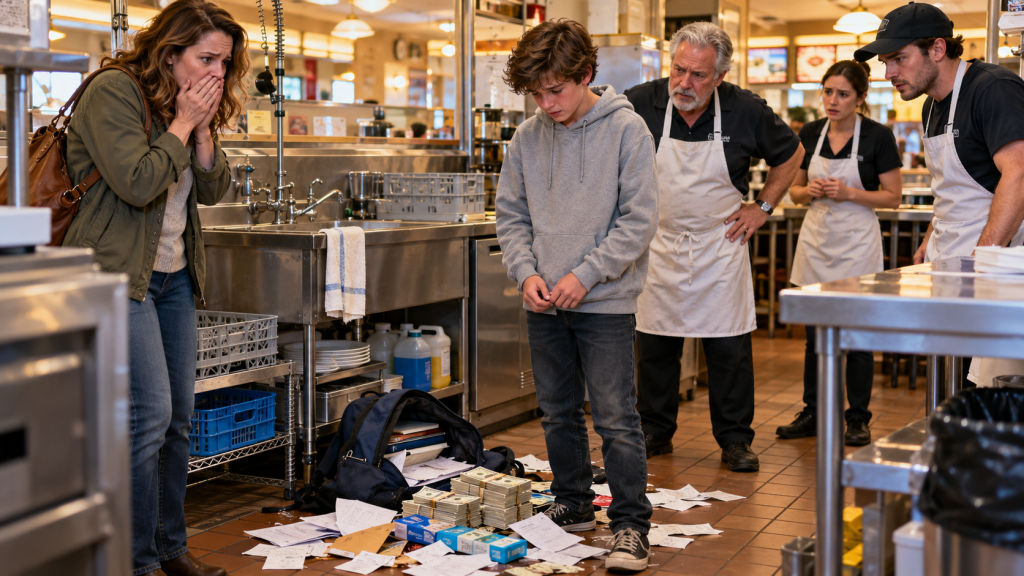
“I’m not angry you helped them. I’m heartbroken you thought you had to do it by yourself.”
Evan buried his face against my shoulder.
For six months, I had watched my thirteen-year-old come home smelling like dish soap and fryer grease and believed I was watching him save for a bicycle.
Now I understood that every Saturday he had been leaving our house carrying more than a backpack.
He had been carrying another family.
Sal stood a few feet away, one hand pressed against the stainless-steel counter.
The employees around us had stopped pretending not to listen.
A waitress named Carla was crying openly.
A cook I had never met stared at the floor.
Evan pulled away from me just enough to wipe his face with the sleeve of his torn sweatshirt.
“Mom, you can’t tell anybody.”
My heart tightened.
“Evan.”
“You don’t understand.”
“Noah said his mom is trying.”
“I know.”
“They’re not bad.”
“I never said they were.”
“He said if people find out they live by the creek, somebody might take Mia away.”
Mia.
The little sister.
I looked down at the baby wipes.
The small packages.
A box of children’s fever reducer.
Two packets of oatmeal.
A folded receipt from a grocery store.
There was something unbearably adult about those objects lying beside my son’s backpack.
Not toys.
Not bike parts.
Not candy.
Diapers.
Medicine.
Food.
A motel envelope.
Sal took a slow breath.
“Evan, your mother needs the whole story.”
My son looked toward him with betrayal in his eyes.
“You promised.”
Sal’s face fell.
“I promised I wouldn’t embarrass you.”
“That isn’t the same as promising I’d let you keep putting yourself in danger.”
Evan turned away.
“You don’t know them.”
Sal nodded.
“You’re right.”
“I don’t.”
“That’s why the adults need to.”
Evan shook his head.
“No.”
Then he looked at me.
“Mom, Noah’s mom isn’t like what people think.”
“What do people think?”
He swallowed.
“That homeless people don’t care.”
My throat tightened.
“I don’t think that.”
He stared.
“Would you if you saw where they sleep?”
“No.”
I answered too quickly.
He looked at me.
I slowed down.
“I might be scared for them.”
“That’s different.”
“Being scared for somebody does not mean thinking they’re bad.”
Evan’s eyes filled again.
Sal pulled out a chair.
“Sit.”
Not an order.
An invitation.
Evan sat.
So did I.
The diner kitchen remained strangely still around us.
Then Sal said:
“Tell her how you met Noah.”
Evan picked at the skin near his thumb.
“He came to school in September.”
“New kid?”
He nodded.
“He sat by me in science.”
“He didn’t have a pencil.”
“So I gave him one.”
I almost smiled.
Of course that was how it began.
A pencil.
Not a grand rescue.
Noah wore the same sweatshirt three days in a row.
Then five.
Evan noticed he never bought lunch but sometimes picked at the free fruit basket near the cafeteria office.
One afternoon, Evan found him stuffing two apples into his backpack.
He did not report him.
He gave him his granola bar.
The next week Noah stopped coming to school regularly.
When he returned, his shoes were muddy.
Evan asked where he lived.
Noah said:
“Near the creek.”
My son knew that area.
Everyone did.
A narrow strip of woods beyond an abandoned service road.
Teenagers went there to smoke.
People sometimes camped there.
Police occasionally cleared tents.
Evan followed Noah after school.
I closed my eyes.
Of course.
Thirteen years old.
Grieving father.
Too much heart.
Not enough fear.
“He told you to follow him?”
“No.”
Evan admitted.
“He got mad when he saw me.”
“What did you find?”
My son looked at the floor.
“A tent.”
“One big one.”
“Blue tarp over it.”
“Mia was there.”
“How old?”
“Four.”
Not a baby.
But little enough for wipes.
Evan continued.
“Noah’s mom was there too.”
“Her name is Tasha.”
“She was working nights cleaning offices.”
“They got kicked out of their apartment because she got behind after her car broke.”
“Then she lost hours because she couldn’t get to work.”
“They stayed with somebody for a while.”
“Then that person’s boyfriend said they had to leave.”
“And after that…”
He shrugged.
The creek.
I whispered:
“How long?”
“Almost seven months.”
My chest tightened.
“And school?”
“Noah goes when he can.”
“How does he get there?”
“Walks.”
“How far?”
“Like three miles.”
I stared.
Evan continued.
“He doesn’t want the school knowing because he thinks they’ll call somebody.”
I thought of how many systems had probably already noticed pieces.
Absences.
Dirty clothes.
No address that stayed true.
Missing forms.
A child carrying too much.
Just like I had noticed pieces in my own son and misunderstood them.
I asked:
“How did the job money become part of it?”
Evan’s face reddened.
“The bike was real.”
“I know.”
“I really wanted it.”
“I know that too.”
“I was going to save.”
“Then one day Noah told me Mia was sick.”
“He said they needed medicine.”
“How much?”
“Like fifteen dollars.”
“So I used my first paycheck.”
I closed my eyes.
First paycheck.
Every thirteen-year-old should remember a first paycheck.
Candy.
A game.
Saving toward a bike.
Evan had bought fever medicine for a four-year-old living under a tarp.
“Then what?”
Evan rubbed his palms together.
“Tasha needed bus fare for work.”
“Then food.”
“Then it got cold.”
“I bought socks.”
“Gloves.”
“Those silver emergency blankets.”
“Evan.”
I could barely speak.
He looked at me.
“What?”
“Did you ever keep any of your pay?”
He hesitated.
“Sometimes.”
“How much?”
“Like five dollars.”
I looked at Sal.
He closed his eyes.
Sal had known.
Not all six months.
But enough.
“When did you find out?”
I asked him.
“About two months ago.”
Evan looked angry.
Sal continued before he could interrupt.
“He asked if I could split his wages into smaller bills.”
“I asked why.”
“He lied.”
Evan said:
“I didn’t lie.”
Sal raised one eyebrow.
“You told me you were teaching yourself budgeting.”
“That is lying with educational vocabulary.”
One of the cooks snorted.
Evan almost smiled.
Almost.
Sal continued.
“Then I saw him buying bags of groceries after work.”
“Not snacks.”
“Rice.”
“Canned soup.”
“Peanut butter.”
“I followed him once.”
Evan looked up sharply.
“You followed me?”
“Yes.”
“You said you wouldn’t.”
“I never said that.”
Sal’s voice softened.
“I saw you walk toward the creek.”
“I didn’t go farther because I was afraid you’d stop trusting me.”
“So I asked questions.”
“Eventually you told me about Noah.”
Evan stared at the floor.
Sal continued.
“I started putting aside a little from the tip jar.”
“Carla did too.”
The waitress wiped her face.
“Then Luis.”
The cook looked away, embarrassed.
“Then most of us.”
Evan’s eyes widened.
“You all knew?”
“Some.”
Sal said.
“Not everything.”
“The cash you saw in Evan’s room was mostly donations from us.”
I turned toward my son.
“You were keeping that at home?”
He nodded.
“Why?”
“Because I didn’t know where else.”
My head hurt.
“How much?”
“Six hundred and eighty-three dollars.”
Sal corrected:
“Seven hundred and twelve after today.”
Evan glared.
“I told you not to add more.”
Sal shrugged.
“I am very bad at following instructions from thirteen-year-olds.”
I almost laughed.
Then remembered the torn sleeve.
“The creek.”
I said.
“Yesterday.”
Evan went still.
“What happened?”
He swallowed.
“The rain made the bank slippery.”
“You fell?”
“Yes.”
“Carrying what?”
“Two grocery bags and a gallon of milk.”
The room tilted.
“You could have been hurt.”
“I wasn’t.”
“You had a scrape on your face.”
“It was nothing.”
“That is not the point.”
He looked angry now.
Defensive.
Good.
Anger was easier than fear.
I continued.
“You walked alone to an isolated creek carrying cash and groceries.”
“There could have been adults there.”
“Dogs.”
“Floodwater.”
“You could have slipped into the creek.”
“Mom.”
“No.”
My voice shook.
“I am not mad that you cared about Noah.”
“I am scared because you decided caring meant you had to become responsible for whether his family ate.”
Evan stared.
“What was I supposed to do?”
There it was.
The question underneath six months.
I looked at him.
“You were supposed to tell me.”
His face twisted.
“You have bills.”
“I am your mother.”
“You work all the time.”
“I am your mother.”
“Dad died and—”
He stopped.
The entire room disappeared.
There.
Finally.
His father.
The thing we had all been walking around.
Evan looked horrified that he had said it.
I whispered:
“And what?”
He shook his head.
“Nothing.”
“Evan.”
“No.”
He stood.
“I need to go.”
I caught his hand.
Not hard.
“Please.”
His eyes filled.
“You couldn’t fix Dad.”
The sentence came out almost soundless.
My heart broke.
He continued.
“Nobody could.”
“I know.”
“And after he died, everything got worse.”
“Bills.”
“You crying.”
“Grandma crying.”
“Everybody saying they wished they had done something.”
His breath shook.
“So when I saw Noah…”
He covered his face.
“I could do something.”
I stood and pulled him against me.
This time he did not resist.
He sobbed into my shoulder.
A thirteen-year-old boy who had been trying to outrun helplessness since he was ten.
“I could buy food.”
he cried.
“I could buy medicine.”
“I could keep Mia warm.”
“I could fix it.”
There it was.
Not heroism.
Grief.
A child who had learned too early that sometimes love cannot save the person you need most.
So he found a problem small enough to attack with Saturday wages.
My hands shook against his back.
“Oh, Evan.”
“I’m sorry.”
“No.”
I held him tighter.
“You do not apologize for caring.”
“But you cannot turn every person you love into a test of whether you could have saved your dad.”
He went still.
Sal looked away.
So did everyone else.
Some truths deserve privacy even when spoken in a room full of people.
Sal closed the diner early.
I protested.
He ignored me.
“Kitchen equipment issue.”
he said.
“There is no equipment issue.”
“There is now.”
He turned off one light.
That was apparently the issue.
Then he gathered the employees who had been contributing.
Not because he wanted a dramatic charity campaign.
Because we needed facts.
Who had seen Noah?
Who knew where the campsite was?
When had anyone last seen Tasha?
A cook named Luis said he had driven Evan partway toward the creek once because it was raining.
Carla had bought children’s boots.
Sal had paid for a motel room two nights during a severe cold snap.
My head turned.
“A motel?”
He nodded.
“Two nights.”
“Why didn’t you call anyone?”
His face tightened.
“Same reason your son didn’t.”
I stared.
Sal looked ashamed.
“I thought I was helping without causing trouble.”
There it was.
Adults too.
Fear of systems.
Fear of making things worse.
So everyone provided little secret pieces.
Food.
Boots.
Cash.
A room.
And Tasha’s family remained in a tent.
Kindness scattered without coordination.
Enough to survive.
Not enough to escape.
I asked:
“When did you last see Tasha?”
Evan answered.
“Yesterday.”
“How did she look?”
He hesitated.
“Tired.”
“What does that mean?”
“She was coughing.”
My stomach tightened.
“How bad?”
He looked at me.
“Bad.”
That decided it.
“We’re going.”
Evan panicked.
“No.”
“Yes.”
“You’ll scare them.”
“Then you come with me.”
“Mom—”
“You know them.”
“I don’t.”
“I will not go barging in like I own their lives.”
“But we are going to make sure they are alive and ask what help they will accept.”
He shook his head.
Sal said:
“She’s right.”
Evan glared.
“Everybody keeps saying that now.”
“Occupational hazard.”
Sal replied.
We took two cars.
Sal insisted on coming.
I let him.
Not because I needed a man.
Because he had been part of the support web already.
More importantly, Tasha had met him once during the motel stay.
A familiar adult might help.
The creek looked worse than I imagined.
Not picturesque woods.
Mud.
Discarded cans.
A shopping cart tipped on one side.
A narrow path between trees.
It had rained the day before, and the earth still sucked at our shoes.
Evan walked ahead.
I wanted to tell him to stay beside me.
Then realized he knew the path better.
That hurt.
A blue tarp appeared through the trees.
Beneath it, a tent.
Noah came out before we reached it.
Thin.
Maybe thirteen too.
His face changed when he saw me.
Then Sal.
Then Evan.
He whispered:
“What did you do?”
Evan looked devastated.
“Noah—”
“You told.”
“I had to.”
“You promised.”
“I’m sorry.”
Noah shoved him.
Not hard.
Fear.
“Get out.”
I stepped forward.
“Noah.”
He looked at me with instant suspicion.
“My name is—”
“I know who you are.”
I stopped.
Evan had talked about me.
Of course.
Noah’s eyes moved toward the trees.
As though calculating whether to run.
I said:
“I’m not here to call the police.”
That was true.
“I’m here because Evan said your mom is sick.”
“She’s fine.”
A cough came from inside the tent.
Deep.
Raw.
Noah looked away.
I asked:
“Can I talk to her?”
“No.”
Then a woman’s voice called:
“Noah.”
He froze.
“Tasha?”
I said.
Silence.
Then:
“Who’s there?”
Evan answered.
“Me.”
Another cough.
“Come in.”
Noah turned on him.
“She said you.”
I stayed back.
Evan crouched and entered the tent.
Sal and I waited.
I could hear murmuring.
Then coughing.
Then Evan’s voice:
“Please.”
A few minutes later, he crawled out.
His face pale.
“She says you can come.”
I knelt and entered.
The tent smelled damp.
Blankets.
Cold air.
Something musty.
Tasha sat propped against sleeping bags.
She looked younger than I expected.
Maybe thirty-five.
Maybe younger.
Illness ages people quickly.
A little girl—Mia—sat beside her holding a stuffed rabbit with one ear missing.
Tasha looked at me.
“You’re Evan’s mom.”
“Yes.”
Her eyes filled.
“He’s a good boy.”
My throat tightened.
“He is.”
“I told him to stop bringing stuff.”
Evan, behind me, muttered:
“No, you didn’t.”
Tasha almost smiled.
“I tried.”
She looked at me.
“Please don’t blame him.”
“I don’t.”
She coughed again.
It went on too long.
I looked at her.
“How long have you been sick?”
“A week.”
“Fever?”
“Maybe.”
“You need a doctor.”
Her face shut down.
“No.”
“Why?”
“No insurance.”
“We can figure that out.”
“You can’t.”
Her voice sharpened.
“People always say that.”
I stopped.
Fair.
“Okay.”
I changed approach.
“What do you want right now?”
That surprised her.
She looked at Mia.
Then Noah.
“Not to lose my kids.”
“I understand that.”
“No, you don’t.”
She was right.
“I don’t.”
“But I know hiding out here sick is not sustainable.”
Tasha’s eyes filled with fury and shame.
“You think I don’t know?”
“No.”
I softened.
“I think you know better than anyone.”
She covered her face.
“I had a room lined up.”
She said.
“Somebody from work knew a lady renting a basement.”
“She wanted first month and deposit.”
“Then she rented it to somebody else.”
“How much did you need?”
“Eight hundred.”
I thought of the envelope.
Seven hundred twelve.
Evan had nearly done it.
A thirteen-year-old was within one paycheck of solving an adult housing deposit.
The thought made me want to cry and scream at the same time.
Tasha continued.
“Then Noah said he knew somebody who could help.”
She looked at Evan.
“I thought he meant church.”
My son stared at the ground.
Tasha’s face changed.
“You didn’t tell her?”
“No.”
“How much have you spent?”
Evan said nothing.
Tasha looked at me.
I answered.
“A lot.”
She whispered:
“Oh God.”
Then she started crying.
“No.”
She shook her head.
“No.”
“He’s a kid.”
“Yes.”
“I didn’t know.”
I believed her.
She looked at Evan.
“I thought your boss was giving you leftover food.”
“Sometimes.”
he said.
“And the motel?”
“Sal.”
“Some of it.”
“And the medicine?”
Evan looked down.
Tasha cried harder.
She had not been using a child deliberately.
She had been surviving through a network so fragmented nobody knew who was carrying the largest piece.
That mattered.
No villains.
Just fear.
Poverty.
Grief.
And too much secrecy.
I said:
“We need to do this differently.”
Tasha wiped her face.
“How?”
“I don’t know yet.”
Honest.
“But not with Evan’s paycheck.”
Evan opened his mouth.
I turned.
“No.”
He stared.
“That part is over.”
Tasha nodded immediately.
“Yes.”
“No more.”
Evan looked betrayed by everyone.
Good.
Sometimes safety feels unfair to a child accustomed to responsibility.
Then Tasha began coughing again.
Harder.
Mia started crying.
That ended the discussion.
We drove them to urgent care.
Tasha resisted until Sal offered to stay with Noah and Mia if she was sent elsewhere.
I drove.
Evan sat in the back beside Noah.
Neither boy spoke.
At one red light, I looked in the mirror.
Noah’s arms were folded.
Evan stared out the window.
Friendship damaged by truth.
I hoped repair was possible.
But I also knew my son could not purchase it with secrecy.
Tasha had pneumonia.
Not catastrophic.
Serious enough.
She needed medication and several days of rest in a warm place.
The urgent-care social worker became the first person who knew how to turn scattered kindness into actual help.
Her name was Mrs. Green.
She spoke to Tasha privately first.
Then, with permission, brought us in.
There was a family shelter with a waitlist.
A motel-voucher program for families with minor children.
A school district homeless liaison.
Food assistance.
Transportation support.
Emergency medical coverage.
A local nonprofit that helped with deposits once income was verified.
Programs.
Forms.
Waiting.
Nothing magical.
Everything necessary.
Tasha stared at the stack.
“I can’t do all this.”
Mrs. Green said:
“You don’t have to do all of it today.”
I watched Evan.
He listened.
Important lesson.
You do not solve an entire life in one afternoon.
One form.
One call.
One night indoors.
Then tomorrow.
The motel voucher covered seven nights.
Sal used part of the donated money to extend it by three more after Tasha agreed.
Not secretly.
Agreed.
The remaining cash went into a temporary fund held through the nonprofit once they accepted the family.
Evan objected.
“That money was for the motel deposit.”
Mrs. Green said:
“It still can be.”
“But now adults are handling it.”
He frowned.
“I handled it.”
“Yes.”
she said.
“And you did more than should ever have been asked of you.”
“That does not mean we keep asking.”
He did not like that.
I did.
The first night Tasha and the kids stayed in the motel, I went home with Evan.
Neither of us spoke during the drive.
His backpack sat between his feet.
Empty of baby wipes.
Empty of the cash envelope.
Just school papers.
Normal.
He hated it.
When we got home, he went straight upstairs.
I let him.
For one hour.
Then I knocked.
“Can I come in?”
“No.”
I sat outside the door.
“Okay.”
Silence.
I leaned against the hallway wall.
“Your dad used to sit outside your room when you were sick.”
No answer.
“I know that is manipulative.”
Still nothing.
Then:
“Very.”
I smiled.
At least he was listening.
I said:
“I’m not going to tell you that what you did was wrong.”
The door opened three inches.
Evan looked exhausted.
“But?”
“But doing a kind thing in a dangerous way still needs to change.”
He opened the door more.
I sat on the floor.
He sat on the other side.
Same hallway.
Two people.
Three years of grief between us.
I asked:
“Why didn’t you tell me about Noah?”
He stared at his hands.
“You would have told somebody.”
“Yes.”
“That’s why.”
Fair.
“Why were you afraid of that?”
“Because Dad.”
I waited.
He sighed.
“When Dad died, everybody came.”
“Police.”
“Ambulance.”
“Grandma.”
“Aunt Jess.”
“Neighbors.”
“And it still didn’t help.”
My chest tightened.
“So?”
“So adults show up after.”
He looked at me.
“Not before.”
I had no answer.
Because from a ten-year-old’s point of view, that was what he had seen.
His father collapsed from an undiagnosed heart condition.
Paramedics arrived after.
Family arrived after.
Casseroles after.
Bills after.
Grief after.
Nobody stopped it.
Evan continued.
“With Noah, I got there before.”
I cried.
Quietly.
He looked annoyed.
“Don’t.”
“I can’t help it.”
“Mom.”
“I’m sorry.”
I wiped my face.
“You wanted to be the person who got there before.”
He nodded.
“Yes.”
I moved closer.
“Evan, some things can be prevented.”
“Some can’t.”
“And knowing the difference is not something thirteen-year-olds are supposed to figure out alone.”
He looked at me.
“I’m not a baby.”
“I know.”
“You treat me like one now.”
“Because you scare me.”
“That’s not fair.”
“No.”
I nodded.
“It isn’t.”
He blinked.
I continued.
“You grew up fast after Dad died.”
“And I let you.”
“That part is on me.”
His face softened.
“I needed help too.”
“I started leaning on you because you were responsible.”
“You remembered things.”
“You didn’t complain.”
“You tried to protect me.”
I swallowed.
“And I praised you for being mature when sometimes what I should have said was, ‘You’re allowed to be thirteen.’”
He stared.
Then:
“I wasn’t thirteen when Dad died.”
“No.”
“You were ten.”
“I mean now.”
“I know.”
He looked toward the bicycle magazine pinned near his desk.
The matte-black bike.
Orange lettering.
Still there.
I asked:
“Do you still want it?”
He looked away.
“I don’t know.”
That answer mattered.
The bike had become tangled with guilt.
Every dollar not spent on Noah probably felt selfish.
I said:
“You are allowed to want something.”
He whispered:
“I know.”
“No.”
I shook my head.
“You know the sentence.”
“I’m not sure you believe it.”
He stared at me.
Then his eyes filled.
“If I buy a bike and Noah’s family needs something…”
“There will always be someone who needs something.”
He flinched.
“That sounds mean.”
“It isn’t.”
“It is one of the hardest truths I know.”
I moved closer.
“If you give away every good thing because another person has less, eventually you will have nothing except guilt.”
“That does not help anyone for long.”
Evan cried quietly.
I put my arm around him.
He leaned against me.
For the first time in months, he let me hold him like my son instead of speaking to me like a worried adult.
We found a therapist.
Evan hated the idea.
Naturally.
He said:
“I’m not crazy.”
I said:
“Neither am I, and I have one too.”
“You do?”
I did after his father died.
I had stopped after a year.
Maybe too soon.
I returned.
So did he.
His therapist’s name was Mr. Lewis.
Evan spent the first session saying almost nothing.
The second discussing bikes.
The third, apparently, also bikes.
I asked Mr. Lewis whether that was useful.
He smiled.
“He keeps coming.”
Point taken.
Eventually Evan talked about his father.
Noah.
Responsibility.
The difference between generosity and control.
The fear that if he stopped helping, something terrible would happen.
There was a name for some of what he carried.
Not important to the story.
What mattered was that he learned fear can disguise itself as duty.
Adults do that too.
Noah returned to school regularly.
At first he barely spoke to Evan.
That hurt my son more than anything.
“You made me tell.”
Evan said one afternoon when Noah finally came over.
They were in our kitchen.
I stayed nearby without hovering.
Noah stared at him.
“You brought everybody.”
“I brought my mom.”
“Same thing.”
“No.”
Evan’s voice shook.
“You were living in a tent.”
“We were fine.”
“You weren’t.”
Noah’s face hardened.
“At least we were together.”
“You’re still together.”
“Because we got lucky.”
Evan stopped.
Noah continued.
“You don’t know what could’ve happened.”
“You don’t know either.”
Silence.
Good.
Two thirteen-year-olds realizing certainty had been doing too much work.
Noah sat down.
“I was scared.”
Evan nodded.
“Me too.”
Then:
“I’m sorry I told.”
Noah looked at him.
“I’m glad you did.”
Evan blinked.
“What?”
Noah wiped his eyes angrily.
“My mom got medicine.”
“Mia got a bed.”
“We have breakfast now.”
He looked down.
“I’m still mad.”
Evan nodded.
“Okay.”
They sat.
Then Noah asked:
“Can we play Xbox?”
Teenage reconciliation.
Efficient.
I went into the laundry room and cried where they could not see me.
The housing took longer than anyone wanted.
Ten motel days became fourteen after the nonprofit helped extend them.
Then Tasha and the kids moved into transitional family housing.
One room.
Shared kitchen.
Not ideal.
Warm.
Dry.
Safe.
No creek.
No hiding.
Tasha hated rules.
Curfew.
Case meetings.
Budget meetings.
No overnight visitors.
She told me once:
“I feel like I’m twelve.”
I said:
“You can hate the rules and still use the program.”
She glared.
Then laughed.
Fair.
The deposit fund grew.
Sal put a jar at the diner.
This time publicly.
No photographs of the family.
No exploitative sign.
Just:
LOCAL FAMILY HOUSING FUND
Customers donated.
Some dollars.
Some twenties.
One elderly man wrote a check.
The nonprofit managed it.
Evan wanted to stand beside the jar.
Sal said no.
“Why?”
“Because you work here.”
“So?”
“Because you’re not the mascot.”
That was a good boundary.
Evan sulked.
Then washed dishes.
His job changed too.
Sal reduced his hours.
Not punishment.
School first.
He made sure wages went into a youth savings account I helped Evan open.
Evan could choose a small amount each paycheck for giving.
We created a rule together.
Not because generosity needed policing.
Because he needed practice not emptying himself.
Ten percent.
Sometimes less.
If he wanted to give more, we discussed it.
At first he hated that.
“It’s my money.”
“Yes.”
“Then why do I have to ask?”
“You don’t have to ask permission.”
“You have to pause.”
He stared.
“What’s the difference?”
“Permission means I decide.”
“Pause means you make sure fear isn’t deciding.”
He thought.
Then rolled his eyes.
“Therapy words.”
“Probably.”
We laughed.
Three months after the diner call, Tasha got an apartment.
Small.
Second floor.
Two bedrooms.
A bus line half a block away.
The nonprofit covered part of the security deposit.
The diner fund covered the rest with Tasha’s consent.
Tasha paid the first month herself from work and assistance she had finally accessed.
She insisted.
Good.
Move-in day was chaos.
Sal brought his truck.
Luis carried furniture.
Carla brought curtains.
I brought cleaning supplies.
Evan and Noah carried boxes.
Mia ran in circles shouting:
“My room! My room!”
There was almost nothing in it.
One mattress.
Purple blanket.
Plastic crate.
She did not care.
Her room.
Tasha stood in the kitchen holding the lease.
She cried.
Then she looked at Evan.
My son froze.
She walked toward him.
“Come here.”
He did.
She hugged him.
Not long.
Then stepped back.
“I need to tell you something.”
Evan looked worried.
“You helped us.”
“Yes.”
“More than you should have had to.”
He looked down.
“I am grateful.”
His shoulders lifted.
Then she continued:
“But I never want you to do that again.”
His head snapped up.
Everyone laughed softly.
Tasha cried.
“I mean it.”
“If somebody you know is sleeping outside, tell an adult.”
“If somebody needs medicine, tell an adult.”
“If somebody tells you not to tell because they’re scared, find an adult who will listen without making everything worse.”
She looked at me.
Then Sal.
“Do not carry a family in a backpack.”
Evan’s eyes filled.
He nodded.
Tasha hugged him again.
Noah stood nearby pretending not to cry.
Mia dragged a pillow across the floor.
Life.
The bike remained in the sporting-goods store.
Months passed.
Winter became spring.
The price dropped once.
Then went back up.
Evan stopped staring every time we passed.
That worried me more than when he stared.
One Saturday, I parked.
“Come on.”
“Where?”
“Store.”
“I don’t need anything.”
“I do.”
He followed reluctantly.
We stopped in front of the bike.
Matte black.
Orange lettering.
Same one.
Maybe not literally the same physical unit.
Same model.
Evan shoved his hands into his pockets.
“It’s too expensive.”
“You have enough.”
His eyes narrowed.
“What?”
“Your account.”
“You’ve been saving.”
“So?”
“So if you want it, you can buy it.”
He looked almost offended.
“I don’t know.”
“Okay.”
We stood.
A salesperson approached.
“Want to try it?”
Evan immediately said no.
I said:
“He might.”
He glared.
“Mom.”
“Trying is free.”
That was apparently acceptable.
They adjusted the seat.
Evan rode it around the test area.
His face changed.
There he was.
Thirteen.
Not rescuer.
Not grieving son.
Not secret provider.
Boy on a bike.
He smiled.
Really smiled.
I nearly cried.
Then he stopped.
Got off.
“No.”
My heart sank.
“You don’t like it?”
“I love it.”
“Then?”
He stared at the price tag.
“I can’t.”
“Why?”
He looked at me.
“Because it feels wrong.”
I knew.
We sat on a bench near helmets.
“What feels wrong?”
“Spending that much on myself.”
I nodded.
“I understand.”
“Do you?”
“Yes.”
I thought of the months after his father died.
Every purchase felt immoral.
Coffee.
Shoes.
Anything pleasurable while Ray? Wait husband name not given, don’t invent. While his father was dead. I had done the same.
I said:
“When Dad died, I stopped buying anything unnecessary for almost a year.”
Evan looked at me.
“Why?”
“Because happiness felt disrespectful.”
His face softened.
“I thought if I enjoyed something, it meant I wasn’t sad enough.”
“That’s stupid.”
“Yes.”
I smiled.
“Grief is often stupid.”
He thought.
Then:
“Did you get over it?”
“No.”
“I learned better.”
I pointed toward the bike.
“Buying that bicycle does not take food out of Mia’s mouth.”
“Her family has support now.”
“You are not their emergency fund.”
“You are allowed to have a life that includes wanting things.”
Evan looked at the bike.
Then:
“What if something happens again?”
“Something will.”
He stared.
I continued.
“Not necessarily to them.”
“To someone.”
“Life keeps happening.”
“That does not mean you live permanently braced for the next person who needs rescuing.”
His eyes filled.
I put my hand over his.
“You can care about people without volunteering your whole childhood.”
He cried.
I did too.
Publicly.
The salesperson pretended to reorganize helmets.
Bless him.
Evan did not buy the bike that day.
That was important.
I did not turn healing into a purchase.
He went home.
Thought.
Two weeks later, he asked me to drive him back.
He bought it.
With his money.
Not all of it.
Sal had taught him to negotiate.
The store had a spring discount.
Evan chose a less expensive helmet and better lock.
Practical child.
When we loaded the bike into my car, he stood staring at it.
Then whispered:
“Dad would’ve liked it.”
My throat closed.
“Yes.”
“He would’ve said orange was ugly.”
I laughed.
“Yes.”
That too.
Evan smiled.
Then:
“I still miss him.”
“I know.”
I hugged him.
“Buying the bike doesn’t mean you miss him less.”
“I know.”
This time, I believed he did.
Sal threw a “bike day” at the diner.
Not a party.
He refused the word.
Everyone disagreed.
Carla made cupcakes.
Luis decorated a cardboard sign:
FINALLY
Evan was mortified.
Good.
Sal handed him a small box.
Inside was a bell for the handlebars.
Evan stared.
“I’m not five.”
Sal said:
“Then give it back.”
Evan kept it.
Of course.
Then Sal became serious.
“You know why I called your mom?”
Evan’s smile disappeared.
“Yes.”
“Do you hate me?”
“No.”
“Did you?”
“Yes.”
Sal nodded.
“Fair.”
Then:
“I almost didn’t.”
I looked at him.
“What changed your mind?”
He looked at Evan.
“You came in with that torn sleeve.”
“You were limping.”
“You tried to hand me your whole pay again.”
“And I realized I was admiring you for something that should’ve scared me.”
That sentence stayed.
Adults often praise children for coping with burdens adults should remove.
Independent.
Mature.
Selfless.
Responsible.
Sometimes those words are compliments.
Sometimes they are alarms.
Sal continued.
“I thought, ‘What a good kid.’”
“Then I thought, ‘Why am I letting the good kid do the dangerous thing because it makes me proud of him?’”
Evan looked down.
Sal said:
“So I called.”
“Good.”
Evan whispered.
Sal swallowed.
Then ruined the moment intentionally.
“Now clock in.”
Everyone laughed.
Noah’s family stabilized slowly.
Not perfectly.
Tasha missed rent once.
Asked for a payment arrangement before the deadline.
Progress.
Noah struggled in school.
Too many absences.
He repeated part of math support over summer.
Hated it.
Did it.
Mia started kindergarten.
Refused to wear shoes three mornings in a row.
Normal problems.
Beautiful normal problems.
Tasha saved for a used car.
Bought one.
Ugly beige sedan.
Evan helped wash it.
Sal said:
“That color should be illegal.”
Tasha said:
“It starts.”
End of aesthetic discussion.
The creek tent disappeared.
Not because the city removed it.
Tasha and Noah went back together to collect what remained.
Evan asked to go.
Tasha said no.
“That part is ours.”
He respected it.
Another lesson.
Helping does not entitle you to every chapter of someone else’s story.
A year after the call, Noah gave Evan a birthday present.
A photograph.
Not expensive.
Printed at a pharmacy.
The two boys standing beside Evan’s bike.
Noah had written on the back:
You helped me when I thought nobody could know. Thanks for telling anyway.
Evan kept it inside his desk.
Not framed.
Private.
He never told many people the full story.
Neither did I.
This is the version I can tell because enough time has passed and because the people inside it are more than what happened to them.
Noah is not “the homeless boy.”
Tasha is not “the struggling mother.”
Evan is not “the selfless child.”
Labels flatten people.
They all became other things too.
Noah joined track.
Tasha took night classes in medical billing.
Mia became obsessed with dinosaurs.
Evan became terrible at algebra for one semester and deeply offended by the concept of factoring.
Life widened.
Thank God.
My relationship with Evan changed too.
I stopped treating his independence as proof I was succeeding.
Sometimes it was.
Sometimes it meant he was hiding.
I asked more.
Not interrogations.
Real questions.
“How are you?”
Not:
Fine?
“What are you worried about?”
Not:
Everything okay?
“Do you want help or do you want me to listen?”
That one changed us.
Sometimes he said:
“Listen.”
So I did.
Terrible experience.
Parenting is much easier when you are fixing.
Listening requires restraint.
He also learned to tell me things before they became crises.
Not always.
He was still a teenager.
Once he hid a failing chemistry grade for five weeks.
I reminded him:
“You hid a family in the woods for six months. Do not test me.”
He groaned.
We laughed.
Then found a tutor.
At sixteen, Evan stopped working at the diner.
Not because Sal fired him.
Because school, sports, and life changed.
His last Saturday, Sal gave him an envelope.
Evan panicked.
“No.”
Sal laughed.
“It’s not charity.”
Inside was every pay stub from his first year.
Sal had copied them.
On top, a note:
Your first paycheck bought medicine. Your last one should buy something ridiculous.
There was also a fifty-dollar gift card.
Evan protested.
Sal said:
“Take your mother to dinner.”
Evan looked at me.
I smiled.
“Now that is appropriate financial planning.”
We ate at the diner.
Of course.
Evan paid with the gift card.
Sal complained we had misunderstood the assignment.
Too late.
When Evan turned eighteen, he sold the bike.
That surprised me.
The orange lettering had faded.
The chain had been replaced twice.
One brake lever bent.
He posted it online.
A twelve-year-old boy came with his father.
The boy stared at it the same way Evan once had.
Evan asked:
“What’s your budget?”
The father named an amount far below Evan’s listing price.
I watched my son.
He looked at the boy.
Then said:
“That works.”
After they left, I stared at him.
“You cut the price by half.”
“I know.”
“Why?”
He shrugged.
“He wanted it.”
I waited.
Then:
“Was that fear deciding?”
He grinned.
“No.”
“Pause completed.”
I laughed.
He had learned.
Generosity after reflection feels different from compulsion.
Same action sometimes.
Different engine.
Evan went to college two hours away.
I cried after dropping him off.
He did not.
At least not until I left.
He later admitted it.
His first semester, he joined a campus service organization.
My blood pressure rose immediately.
He laughed when I reacted.
“Mom.”
“What?”
“We tutor kids.”
“No creek?”
“No creek.”
“No secret families?”
“No.”
“No handing over tuition money?”
“Please leave.”
Good.
He volunteered.
With structure.
Training.
Supervision.
Boundaries.
That made me happy in a way I could not explain.
Compassion had survived.
It had simply grown guardrails.
Noah did not go to college immediately.
He worked.
Saved.
Took community-college classes later.
He and Evan stayed friends in the uneven way people often do after childhood.
Months without talking.
Then long calls.
Weddings.
Holidays.
Random memes.
No dramatic lifelong blood-brother contract.
Real friendship.
Tasha eventually bought a small townhouse.
Not the apartment.
Years later.
When she closed, she sent me a photograph of the keys.
Caption:
No tarp. No voucher. Mine.
I cried.
Then replied:
Proud of you.
She sent:
Don’t get sentimental.
Good.
There was one conversation with Tasha I never forgot.
It happened years after the creek.
We were sitting outside a school fundraiser.
Mia was inside.
Evan and Noah were nearly grown.
Tasha said:
“I used to hate you.”
I laughed.
“I figured.”
“When you showed up at the tent, I thought you were going to destroy everything.”
“I know.”
“I had spent years believing if people saw how bad things were, they would decide I was the problem.”
I listened.
She continued.
“The weird thing is, sometimes they did.”
That mattered.
She had history I did not know.
Shelters that treated her badly.
Employers.
Landlords.
People who promised help and then judged.
Fear does not appear from nowhere.
“I’m sorry.”
I said.
“For what?”
“For assuming asking for help is simple.”
Tasha looked at me.
“It isn’t.”
Then smiled.
“But hiding isn’t simple either.”
No.
We sat.
She added:
“Your boy saved us some days.”
I started to respond.
She raised one hand.
“Let me finish.”
“He should not have had to.”
“Both can be true.”
There it was.
The whole story.
Both.
He helped.
And it was too much.
We were grateful.
And adults failed him by letting it continue.
Tasha was trying.
And her children were still unsafe.
Calling for help was frightening.
And necessary.
Life rarely gives us the clean version.
When Evan was twenty-five, he called me one evening.
“Mom.”
“Yes?”
“Do you still have that bike receipt?”
I laughed.
“Probably.”
“Why?”
“I’m having a kid.”
Silence.
Then I screamed so loudly he dropped the phone.
Later, after I recovered enough to speak, he said:
“I’ve been thinking about Dad.”
Of course.
Becoming a parent reopens old doors.
“What about him?”
“I’m scared.”
“That’s traditional.”
“No.”
His voice changed.
“I’m scared I’ll die.”
My heart broke.
There it was.
Ten-year-old Evan still alive inside the man.
I sat.
“Okay.”
He continued.
“I know that sounds insane.”
“It doesn’t.”
“He died when you thought everything was normal.”
“Yes.”
“What if I do?”
“We make plans.”
I said.
“Insurance.”
“Wills.”
“Doctors.”
“We take care of health things we can take care of.”
“And then?”
“We live anyway.”
Silence.
“I hate that answer.”
“So do I.”
He laughed sadly.
Then:
“How did you?”
“Live after?”
“Yes.”
I thought.
“I stopped expecting certainty.”
“Eventually.”
“Badly.”
“Then better.”
He breathed.
“I don’t want my kid feeling like he has to fix everything if something happens to me.”
“He might.”
“That is why you teach him before.”
“Teach him what?”
I smiled through tears.
“That love is not measured by how much pain you can carry without asking for help.”
Evan went quiet.
Then:
“Therapy words?”
“Age.”
Same answer.
We laughed.
His daughter was born healthy.
He named her Grace.
The first time he held her, I saw his father in his face.
Not features.
Emotion.
Wonder mixed with terror.
I stood beside him.
He whispered:
“She’s so small.”
“Yes.”
“What do I do?”
I laughed.
“Finally.”
“What?”
“You’re asking.”
He looked at me.
Then understood.
He smiled.
“I’m learning.”
He was.
Years after everything, Sal died.
Heart attack.
Sudden.
That word still had power in our family.
Evan flew home for the funeral.
The diner closed for one day.
Former employees came.
Carla.
Luis.
People I had not seen in years.
Tasha came.
Noah too.
During the service, Sal’s daughter told a story.
“My father believed feeding people was a sacred responsibility.”
Then added:
“He also believed teenagers were terrible decision-makers.”
Laughter.
Evan cried.
Afterward, Sal’s daughter handed him a small envelope.
“My dad left this in his desk.”
Inside was a note.
Short.
Evan—
The hardest part of caring is knowing when the job belongs to you and when it belongs to someone else. You taught me that too.
—Sal
My son cried so hard he had to sit down.
I sat beside him.
No fixing.
Just there.
I used to think the great reveal of this story was the money.
That my son lied about a bike because he was secretly helping another family.
People love that version.
It turns pain into nobility.
But that is not what I remember most.
I remember the mud on his shoes.
The torn sleeve.
His hands red from dishwater.
The stack of cash on his bedroom floor.
The fear in his voice when Sal called.
Please! Don’t tell my mom!
I remember realizing my son had mistaken secrecy for responsibility.
That was the real danger.
Not generosity.
Not kindness.
Secrecy.
The belief that if he let adults see the problem, they would make it worse.
The belief that the good person is the one who carries everything quietly.
Children learn that from somewhere.
Sometimes from parents who do it themselves.
I had done it after his father died.
Paid bills quietly.
Cried privately.
Said:
“We’re fine.”
when we were not.
Evan watched.
Then copied the lesson better than I ever intended.
That realization changed me too.
I began asking for help.
From my sister.
Friends.
Therapy.
I told Evan when money was tight without making him responsible for solving it.
There is a difference between honesty and burdening.
It took me years to learn.
I would say:
“We need to skip takeout this week.”
Not:
“We can’t afford anything.”
I would say:
“I’m stressed about the car repair, but I have a plan.”
Not:
“Don’t ask me for anything.”
Children can know life is hard without believing hardness is theirs to manage.
That distinction became one of the most important things I ever learned.
The sporting-goods store is gone now.
A pharmacy sits there.
Every time I drive past, I still see the matte-black bicycle in the old window.
Orange lettering.
Evan’s face reflected in the glass.
For months, I thought the missing bike meant something was wrong with him.
In a way, something was.
He had taken grief, love, fear, and responsibility and braided them together until he could not tell which was which.
He believed spending money on himself was selfish.
He believed telling adults was betrayal.
He believed if he just worked enough Saturdays, carried enough groceries, and walked carefully enough down a muddy bank, he could prevent another family from breaking the way ours had.
That was too much hope for a thirteen-year-old to carry.
Too much grief too.
So the adults finally did what adults were supposed to do.
We took some of the weight.
Not all.
Never all.
Noah’s family still had to rebuild.
Tasha still had to work.
Evan still had to grieve.
I still had bills.
Sal still had a diner to run.
Nobody waved a wand.
But the weight stopped belonging to one child.
That changed everything.
I still have one thing from those six months.
Not the receipts.
Not the motel envelope.
Not the emergency blanket.
The bicycle bell Sal gave Evan.
When Evan sold the bike, he removed it.
Years later, when he moved out for good, I found it in a drawer.
Small.
Black.
A little scratched.
I asked whether he wanted it.
He said:
“Keep it.”
So I did.
Sometimes I press it.
One bright ring.
It reminds me of something simple.
A bell is not supposed to carry the bicycle.
It is only supposed to sound when someone needs to know you are there.
That is what Evan had been trying to do all along.
Tell someone:
They’re here.
They need help.
Please notice.
He just did not know he was allowed to ring the bell.
So he tried to become the whole bicycle instead.
The wheels.
The frame.
The brakes.
Everything.
Now he knows better.
So do I.
If I could go back to that phone call from Sal, I would still be afraid.
Of course.
A boss saying:
“Everything your boy told you is a lie.”
What mother would not imagine the worst?
But the worst was not that Evan had become bad.
The worst was that he had become too good at suffering quietly.
Too good at turning compassion into obligation.
Too good at looking like he had everything handled.
That is the kind of goodness adults praise until it breaks a child.
I am grateful Sal noticed before it did.
I am grateful he called me even though Evan begged him not to.
I am grateful Tasha let us in.
I am grateful Noah eventually forgave my son for telling.
And I am grateful Evan finally bought the bicycle.
Not because he deserved a reward for kindness.
That is not the lesson.
He bought it because thirteen-year-old boys are allowed to want bicycles.
They are allowed to save money for themselves.
They are allowed to help someone and then go home.
They are allowed to care without becoming responsible for the entire ending.
Years later, Evan told me he finally understood what his father’s death had taught him wrong.
I asked:
“What?”
He said:
“I thought loving somebody meant stopping the bad thing.”
I waited.
“And now?”
He smiled.
“Sometimes loving somebody means staying when you can’t.”
That one broke me.
Because that was what I had done after his father died.
Stayed.
What Sal did.
What Tasha did for her kids.
What Evan did for Noah.
What Noah eventually did for Evan by forgiving him.
Nobody could stop every bad thing.
But people could stay.
People could tell.
People could ask.
People could bring food without pretending food solved homelessness.
They could fill out forms.
Drive someone to urgent care.
Listen.
Call the mother.
Open the door.
Ring the bell.
That was enough.
Not to fix everything.
To begin.
And sometimes beginning is the most honest kind of rescue there is.
THE END STORIES! THANK YOU FOR READING GOOD LUCK !❤️
Related Posts