➡️ PART 3 ENDING PART ➡️
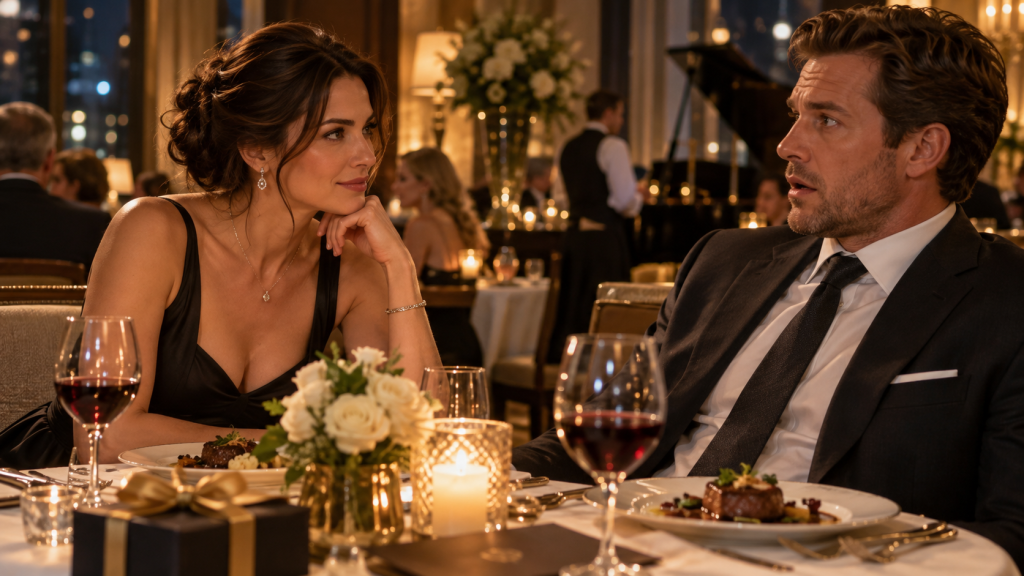
Mark stared at me across the anniversary table.
For perhaps five seconds, neither of us moved.
The restaurant around us continued as though nothing had happened.
A waiter poured wine two tables away.
Someone laughed near the bar.
Silverware touched porcelain.
A birthday candle flickered in the corner.
And my husband of ten years sat across from me with another woman’s name glowing briefly in the space between us.
Vanessa.
Someone from work.
I looked at his phone.
Then at him.
“We’re discussing whether you were cheating before you found a prettier name for it.”
His jaw tightened.
“I wasn’t cheating.”
“That was fast.”
“Because I’m not.”
“Then show me the message.”
His expression changed.
Only slightly.
But after ten years of marriage, slightly was enough.
“Seriously?”
“Yes.”
“Rachel, I’m not going to hand over my phone because you suddenly decided to interrogate me.”
I leaned back.
“Interesting.”
“What?”
“Five minutes ago, you were comfortable asking your wife for permission to sleep with other people.”
His eyes darted toward the neighboring tables.
“Keep your voice down.”
“But showing me one message is too intimate?”
“I said she’s from work.”
“Then this should be easy.”
He reached for his wine.
I watched his fingers.
There was a faint tremor.
That hurt more than I expected.
Because I knew those hands.
They had held mine while I gave birth to our daughter.
They had assembled a crib at two in the morning while swearing at instructions printed in Swedish.
They had rubbed my back after my mother died.
They had held birthday cakes, grocery bags, tiny baby shoes, mortgage papers, my face.
Now they were trembling because I had asked about Vanessa.
“Mark.”
He put down the glass.
“What?”
“How long?”
He looked away.
“How long what?”
I almost smiled.
It was such a disappointing answer.
Not clever.
Not convincing.
Just cowardly.
“How long have you been talking to her in a way you wouldn’t talk to her if I were standing beside you?”
He exhaled.
“That’s a loaded question.”
“No.”
I said quietly.
“It’s actually very precise.”
He said nothing.
And suddenly I knew.
Maybe not the details.
Maybe not whether they had kissed.
Maybe not whether they had slept together.
But I knew there was already something.
Something he had hidden.
Something that had begun before tonight.
The open marriage wasn’t an idea.
It was paperwork.
He had already chosen the destination.
He just wanted me to sign the permission slip.
“Did she know you were going to ask me tonight?”
Mark’s silence lasted too long.
My stomach turned.
“She did.”
“Rachel—”
“Oh my God.”
“Nothing has happened.”
“Did she know?”
He rubbed his forehead.
“Yes.”
The word was barely audible.
I stared at him.
“You discussed opening our marriage with another woman before discussing it with your wife.”
“When you say it like that—”
“How would you like me to say it?”
He looked miserable.
“We’ve talked.”
“About sleeping together?”
“No.”
“About dating?”
“Not exactly.”
“About whether I would let you?”
He didn’t answer.
I laughed once.
It sounded hollow.
“Happy anniversary.”
“Rachel, please.”
I reached for my purse.
His face changed.
“Where are you going?”
“Home.”
“Can we finish dinner?”
I stared at him.
“Finish dinner?”
“I mean finish talking.”
“We can talk at home.”
“We have a babysitter until midnight.”
I couldn’t believe him.
For one absurd second, I imagined staying.
Dessert.
Coffee.
Maybe the waiter would bring us some little anniversary cake while I asked my husband whether Vanessa preferred red or white wine.
“No.”
I stood.
Mark reached for the bill.
“I’ll come with you.”
“No.”
“We came together.”
“And apparently we weren’t the only two people in this marriage when we arrived.”
His face hardened.
“That is unfair.”
“Then prove me wrong.”
I left.
Outside, the air was cold enough to hurt my lungs.
I welcomed it.
I walked two blocks before realizing I was crying.
Not dramatic sobbing.
Just tears slipping down my face while I moved past strangers who knew nothing about me.
That anonymity felt strangely comforting.
Ten years.
Two children.
One mortgage.
Thousands of ordinary mornings.
And somehow the thing breaking my heart was not even the possibility that Mark wanted another woman.
It was the amount of planning hidden behind the question.
He had gone to Vanessa first.
Or close enough.
He had discussed our marriage with her.
He had apparently allowed her to imagine herself inside whatever came next.
Then he brought me to an expensive restaurant on our anniversary and presented the arrangement as though he had spontaneously discovered a modern solution to my exhaustion.
My exhaustion.
That part kept burning.
He had taken the evidence that I was carrying too much and used it to justify giving himself less responsibility.
I called a car.
By the time I got home, the babysitter was sitting on the couch reading.
“Everything okay?”
she asked.
“Fine.”
The word came automatically.
Then I stopped.
“No.”
She looked startled.
“Sorry.”
I said.
“Not your problem. Dinner ended early.”
I paid her for the entire night anyway.
When she left, I stood in the kitchen.
The dishwasher needed unloading.
Lunch boxes sat beside the sink.
A basket of clean laundry waited on a chair.
There was a note from our daughter, Emma, reminding me she needed poster board for school.
Our son, Caleb, had left one sneaker in the middle of the hallway.
And for the first time, I saw our home almost as an outsider might.
Not messy.
Not neglected.
Managed.
By me.
There were invisible threads connecting everything.
Doctor appointments.
Permission slips.
Groceries.
Birthdays.
Teacher emails.
Dentist cleanings.
Soccer practice.
Prescription refills.
Winter coats.
Shoe sizes.
The dog’s vaccinations.
Christmas presents.
Summer camp forms.
The plumber’s number.
The pediatrician’s after-hours line.
Who hated peas.
Who needed new socks.
Which child was worried about which friend.
Which teacher preferred email.
Which bill was on autopay.
Which relative needed a birthday card.
I had become the operating system of our family.
Mark participated.
Of course he did.
He wasn’t some cartoonishly useless husband.
He worked hard.
He loved the children.
He mowed the lawn.
He handled most car maintenance.
He cooked on Sundays when reminded.
He coached Caleb’s soccer team for two seasons.
He was not absent.
That almost made it harder.
Because he was present enough to believe he was doing half.
And I had become efficient enough to hide the difference.
I sat at the kitchen table.
Then something inside me settled.
I took out a notebook.
Not to plan revenge.
To make a list.
Every recurring household task I could think of.
By the time Mark came home, I had filled three pages.
He walked into the kitchen at 11:17.
He looked tired.
I looked at the clock.
“Where were you?”
He frowned.
“Walking.”
“For two hours?”
“Yes.”
“Did you see Vanessa?”
His face flashed with anger.
“No.”
“Did you call her?”
Silence.
I closed my eyes.
“You did.”
“I told her what happened.”
“Of course you did.”
“Rachel.”
“Of course the first person you needed after hurting your wife was the woman involved in hurting your wife.”
“Nothing happened between us.”
“Stop saying that like it’s the only definition of betrayal.”
He pulled out a chair.
“Can we talk?”
“Yes.”
He sat.
I pushed the notebook toward him.
He looked down.
“What is this?”
“Our marriage.”
He frowned.
“What?”
“Or at least the part of it you apparently don’t see.”
He scanned the pages.
School lunches.
Meal planning.
Grocery shopping.
Laundry.
Bed linens.
Teacher communication.
Doctor appointments.
Dentist appointments.
Birthday gifts.
House cleaning.
Homework.
School forms.
Childcare coordination.
Extracurricular schedules.
Pet care.
Clothing purchases.
Household supplies.
Holiday planning.
His expression shifted.
“What is the point?”
“The point is that you told me tonight I’m too tired for you.”
“I didn’t say it like that.”
“You said I don’t have enough energy left for you.”
“I said we both have needs.”
I looked at him.
“Yes.”
“We do.”
He seemed relieved.
Too soon.
“So starting tomorrow, we split this.”
I tapped the notebook.
“Half.”
His relief disappeared.
“You were serious about that?”
I almost laughed.
“You thought I wasn’t?”
“I thought you were making a point.”
“I am.”
He leaned back.
“Rachel, I already work fifty hours a week.”
“So do I.”
“You work from home three days.”
“Working from home is working.”
“I know, but you have more flexibility.”
“Flexibility is how I became the emergency contact for every living creature in this house.”
“That isn’t fair.”
“Neither is telling me I’m too exhausted to entertain you after I spend my evening packing lunches while you watch television.”
“I help.”
“Yes.”
I said.
“When I ask.”
He flinched.
“That’s not true.”
“Who scheduled Caleb’s physical?”
He stared.
“Who knows when Emma’s orthodontist appointment is?”
Silence.
“What size shoes does Caleb wear?”
“That’s ridiculous.”
“What is Emma doing for her science project?”
“Rachel.”
“Who is Caleb’s best friend right now?”
He looked annoyed.
“What does that have to do with laundry?”
“Everything.”
I whispered.
“Because family life is not a list of chores. It’s knowing what needs to happen before someone tells you.”
He looked down.
I continued.
“You wanted freedom.”
“Yes.”
“Fine.”
My voice was calm.
“But freedom has a cost.”
“What does that mean?”
“It means my labor isn’t the infrastructure beneath your dating life.”
His face reddened.
“I never said that.”
“You didn’t have to.”
I pushed the notebook closer.
“If Tuesday is your date night, Wednesday is mine.”
He stared.
“You already have someone?”
The speed of that question told me everything.
I smiled sadly.
“No.”
His shoulders relaxed.
Again.
Too soon.
“But I might.”
He went still.
“You said you weren’t interested.”
“I wasn’t asked before tonight.”
“That doesn’t mean you have to go find some guy just because—”
I held up my hand.
“Listen to yourself.”
He stopped.
“You asked for an open marriage.”
“I know.”
“You were delighted when I agreed.”
“I know.”
“Until you realized I meant open.”
His jaw tightened.
“That isn’t what this is.”
“What is it?”
“You’re trying to punish me.”
“No.”
I said.
“I am applying your proposal equally.”
“I don’t want random men around our children.”
“Neither do I want random women around them.”
“Vanessa wouldn’t be around the kids.”
The second he said her name, we both froze.
There it was.
Not hypothetical.
Vanessa.
I leaned back.
“You’ve thought about that.”
“No.”
“Yes.”
“I just meant—”
“You’ve thought about where she would fit.”
“No.”
“Have you discussed our children with her?”
He looked away.
My heart dropped.
“Mark.”
“Only generally.”
“What does that mean?”
“She knows I’m married.”
“Clearly.”
“She knows we have kids.”
“Anything else?”
“No.”
“Does she know their names?”
He hesitated.
That was enough.
I stood.
“I’m sleeping in the guest room.”
“Rachel.”
“I cannot do this tonight.”
“Please.”
“No.”
He looked frightened.
Good.
Not because I wanted him afraid.
Because for the first time that evening, he seemed to understand there was something real to lose.
I slept badly.
At 6:12 the next morning, Caleb knocked on the guest-room door.
“Mom?”
I opened my eyes.
“What, baby?”
“I can’t find my blue shirt.”
Of course.
I got up.
Then stopped.
The old reflex was immediate.
Find shirt.
Pack lunch.
Wake Emma.
Start breakfast.
Check weather.
Fill water bottles.
Keep machine running.
I walked into our bedroom.
Mark was asleep.
I turned on the light.
He groaned.
“What?”
“Caleb needs his blue shirt.”
He stared at me.
“What?”
“Your morning.”
“Rachel, come on.”
“You wanted equal freedom.”
“It is six in the morning.”
“Children are traditional that way.”
He sat up.
I handed him the notebook.
“Breakfast, lunches, Caleb’s shirt, Emma needs poster board, and both kids need to leave by 7:35.”
He stared.
“You’re really doing this?”
“Yes.”
“What are you doing?”
“Showering.”
I took the longest shower I had taken in years.
Not vindictively.
Luxuriously.
When I came downstairs, the kitchen looked as though breakfast had fought back.
Caleb was eating cereal.
Emma was irritated.
Mark was packing lunches.
“You put mayonnaise on mine.”
Emma said.
“You like mayonnaise.”
“No, I don’t.”
“You ate it last week.”
“That was Caleb.”
Mark looked at me.
I said nothing.
He found the poster-board note.
“Why didn’t you tell me about this?”
Emma stared at him.
“I did.”
“When?”
“Tuesday.”
“Oh.”
She looked at me.
“Mom, can you—”
“Dad’s handling it.”
Mark looked betrayed.
I drank coffee.
It tasted magnificent.
That first week nearly broke him.
Not because the tasks were impossible.
Because they were relentless.
There was always another.
The moment he finished laundry, someone needed a form signed.
The moment dinner was cleaned, Caleb needed help with fractions.
The moment homework ended, the dog threw up.
The moment the children were asleep, he remembered groceries.
By Friday, Mark sat at the kitchen table staring into space.
“I didn’t realize.”
I looked at him.
“What?”
“How much there is.”
I could have said:
I told you so.
Instead:
“I know.”
He rubbed his eyes.
“Why didn’t you make me do more?”
That question angered me.
I kept my voice level.
“I shouldn’t have had to assign you adulthood.”
He looked ashamed.
“I know.”
“Do you?”
“Yes.”
Then he whispered:
“I am sorry.”
It was the first apology of many.
But apologies were not yet the problem.
Vanessa was.
I had not forgotten.
Neither had Mark.
Saturday morning, I said:
“I want the truth.”
He looked at me over his coffee.
“About Vanessa?”
“Yes.”
He nodded.
So he told me.
They had met eight months earlier when she transferred into his department.
She was thirty-six.
Divorced.
No children.
Smart.
Funny.
She laughed at his jokes.
That detail hurt embarrassingly badly.
He looked ashamed saying it.
“She made me feel…”
He stopped.
“What?”
“Young.”
There it was.
Not unloved.
Not abused.
Not trapped.
Young.
I looked at my husband.
Forty-three years old.
Slight gray at his temples.
A little softness around his middle.
A man who had spent a decade becoming a father, homeowner, manager, husband.
A man apparently startled to discover that adulthood continued happening to him.
“Did you kiss her?”
“No.”
“Touch her?”
“No.”
“Tell her you wanted to?”
He hesitated.
“Not directly.”
“What does indirectly look like?”
“We flirted.”
“How?”
“Messages.”
“Sexual?”
“Sometimes suggestive.”
My stomach turned.
“Did you delete them?”
“Yes.”
“Why?”
“Because I knew you’d be upset.”
I closed my eyes.
There.
The answer to every debate about whether it “counted.”
He knew.
“Did you tell her you loved her?”
“No.”
“Did she tell you?”
“No.”
“Did you discuss sleeping together?”
“Not explicitly.”
“Stop hiding behind adverbs.”
He looked at me.
“Yes.”
My eyes burned.
“How?”
“She said if circumstances were different…”
“And?”
“I said maybe they could be.”
I looked away.
The room blurred.
That was the moment.
Not the anniversary proposal.
Not Vanessa’s name.
That sentence.
Maybe they could be.
My husband had been building a door and asking me afterward whether I minded if he opened it.
“How long before our anniversary did you decide to ask?”
“Three weeks.”
“Did she know?”
“Yes.”
“Was she waiting for my answer?”
He nodded.
I cried.
Quietly.
Mark reached across the table.
I moved my hand.
“Don’t.”
He withdrew.
“I am so sorry.”
“You weren’t asking me what I wanted.”
I whispered.
“You were asking me to legitimize what you already wanted.”
“Yes.”
The honesty hurt.
But at least it was finally honest.
I asked:
“If I’d said no?”
He cried then.
“I don’t know.”
That answer frightened me more than a lie.
“You don’t know whether you would have cheated?”
“I want to say no.”
“But?”
“I don’t know who I was becoming.”
For once, I believed him completely.
We did not open the marriage.
Not then.
That may surprise you.
I had agreed.
But consent given without relevant information is not meaningful consent.
Mark had presented an abstract arrangement while concealing the fact that a specific woman was already waiting.
So I told him:
“The agreement is off.”
He nodded.
“If you want Vanessa, leave first.”
He stared.
“If you want to explore that relationship, we separate. We work out custody. We divide finances. Then you are free.”
“I don’t want to leave.”
“Then Vanessa ends.”
He closed his eyes.
“Yes.”
“Not secretly.”
“Yes.”
“Not slowly.”
“Yes.”
“No friendship while feelings cool down.”
He looked uncomfortable.
That told me I was right.
“Okay.”
He sent her a message.
Not because I dictated every word.
Because I told him I would not remain in a triangle while he figured out which woman made him feel younger.
Vanessa replied twenty minutes later.
He showed me.
Her response was short.
She said she understood.
Then one final line:
I think you knew what you wanted before you asked her.
I stared at it.
So did Mark.
“She’s right.”
he whispered.
“Yes.”
That did not make Vanessa innocent.
She knew he was married.
She had participated in an emotional relationship that crossed boundaries.
But she had not made vows to me.
Mark had.
That distinction mattered.
For three months, our marriage became painfully quiet.
We attended counseling.
Not to save it.
That distinction mattered too.
We went to determine whether there was enough left worth saving.
Our therapist, Dr. Patel, asked Mark why he wanted an open marriage.
He gave several answers.
Novelty.
Sex.
Freedom.
Feeling desired.
Then she asked:
“Why didn’t you ask for more intimacy inside your marriage before seeking it outside?”
He said:
“I thought I had.”
I nearly laughed.
“When?”
He looked at me.
“I complained we weren’t having enough sex.”
Dr. Patel said:
“That is a complaint about frequency. Rachel is describing exhaustion and unequal labor. Did you address the conditions affecting intimacy?”
Silence.
No.
He had asked for more fruit without watering the tree.
That image stayed with me.
Then Dr. Patel asked me:
“Do you want to stay married?”
I said:
“I don’t know.”
Mark cried.
I didn’t.
That worried me.
For weeks, I thought my lack of tears meant I had stopped loving him.
Eventually I realized I was tired.
Even grief requires energy.
I had spent years tired.
Mark changed.
At first, dramatically.
Too dramatically.
Laundry.
Cooking.
School runs.
Cleaning.
Flowers.
Coffee in bed.
I distrusted all of it.
Anyone can sprint when a marriage is on fire.
I needed to know whether he could walk after the smoke cleared.
So I waited.
Three months.
Six.
Nine.
The flowers became less frequent.
Good.
The laundry did not.
Better.
He learned the children’s schedules.
He attended parent-teacher conferences without asking me what questions to ask.
He took Caleb to the dentist.
He knew Emma needed new running shoes before I did.
He began meal planning.
He hated it.
That made me trust the effort more.
Real change is often boring.
Performance prefers grand gestures.
Responsibility usually looks like remembering there is no milk.
But Vanessa had left a wound that chores could not close.
One night, nine months after our anniversary, Mark said:
“You should date.”
I stared at him.
“What?”
“If you still want an open marriage.”
I almost laughed.
“You don’t.”
“No.”
“Then why say that?”
“Because I realized something.”
He sat across from me.
“When you agreed that night, I was happy because I thought I had permission.”
I waited.
“When you said you’d date too, I panicked.”
“Yes.”
“I told myself it was because I didn’t want strangers around the kids.”
“Yes.”
“It wasn’t.”
He looked ashamed.
“I wanted freedom without risk.”
There it was.
“I wanted to know you were home.”
he continued.
“Still mine. Still running everything. Still available.”
My eyes filled.
“And I wanted to step outside whenever I felt old or bored or neglected.”
He shook his head.
“That wasn’t an open marriage.”
“No.”
“It was entitlement.”
“Yes.”
He cried.
“I am ashamed of that.”
I believed him.
Then he said:
“If we ever choose non-monogamy, it has to be because we both genuinely want it, not because I cornered you into approving an affair.”
That was perhaps the first time he understood the entire thing.
I said:
“I don’t want it.”
He nodded.
“Neither do I.”
That should have fixed us.
It didn’t.
Trust is not a light switch.
It is more like a floor.
Once it collapses, even after repairs, you test every board before placing your full weight on it.
I checked his phone.
I hated myself for that.
I watched his expression when notifications arrived.
I noticed when he stayed late.
I wondered whether new female coworkers knew about me.
I became someone I did not enjoy being.
So one evening I told him:
“I cannot police you forever.”
“I know.”
“If our marriage requires surveillance, it’s already over.”
“I know.”
“I need to stop checking.”
“Okay.”
“And that means you need to accept that if you betray me again, I might not discover it immediately.”
He looked confused.
“That sounds worse.”
“It is trust.”
I said.
“Trust isn’t certainty.”
That was hard for both of us.
I stopped checking.
He stopped offering his phone as proof.
Instead, he lived transparently.
Not theatrically.
Just normally.
If he was late, he told me before I asked.
If a work dinner included Vanessa’s old department, he told me.
Eventually Vanessa left the company.
I felt relief.
Then anger at myself for feeling relief.
Then I forgave myself.
Healing is messy.
A year after the anniversary dinner, Mark took me back to the same restaurant.
I almost refused.
Then went.
We sat at a different table.
He looked nervous.
“No proposals.”
I said.
He laughed.
“Definitely not.”
“No lifestyle changes?”
“No.”
“No coworkers waiting for an answer?”
His smile disappeared.
“No.”
“Good.”
He reached across the table.
“I’m sorry.”
“I know.”
“I know I’ve said it.”
“Yes.”
“But I think I finally understand what I’m apologizing for.”
I waited.
“I made your exhaustion about what I wasn’t receiving instead of what you were carrying.”
My throat tightened.
“I saw your depletion as an inconvenience to me.”
Tears filled my eyes.
“And then I found someone who made me feel uncomplicated, because she wasn’t asking me to pack lunches or fix the sink or worry about college savings.”
He looked down.
“Of course she felt exciting.”
He whispered.
“She didn’t share the weight of my real life.”
That was it.
The sentence I had needed.
Not because it excused anything.
Because he finally understood the comparison had been dishonest.
Vanessa got restaurant Mark.
Funny Mark.
Flirty Mark.
Work-shirt Mark.
She didn’t get stomach-flu-at-3-a.m. Mark.
Mortgage Mark.
Parent-teacher-conference Mark.
His-mother-needs-surgery Mark.
Nor did he get all of Vanessa.
He got office Vanessa.
Text-message Vanessa.
Possibility Vanessa.
Fantasy is easy when reality does the laundry.
I squeezed his hand.
“I forgive you.”
He cried.
I did too.
Then I added:
“But forgiveness isn’t a promise that we’ll stay married forever.”
He nodded.
“I know.”
That mattered.
We stayed.
Not because ten years deserved eleven.
Time already spent is not a debt future you must repay.
We stayed because, slowly, we built something different.
At first, I called it rebuilding.
Eventually I stopped.
We weren’t restoring the old marriage.
Some parts of the old marriage needed to die.
The version where I managed everything.
The version where Mark believed earning a paycheck and doing visible chores made him an equal partner.
The version where I swallowed resentment because he was “a good man.”
The version where he mistook lack of conflict for happiness.
The version where intimacy was measured mainly by sex instead of whether I had enough room inside my own life to want anything.
We built another marriage.
Same people.
Different agreements.
Mark took complete responsibility for certain areas.
Not “helping.”
Owning.
School communication.
Laundry.
Tuesday and Thursday dinners.
Car maintenance.
Half the appointments.
I owned other things.
We shared the rest.
I learned something difficult too.
I had contributed to the system.
Not to his betrayal.
That was his.
But to the household imbalance.
I had corrected him constantly.
He folded towels wrong.
Loaded the dishwasher wrong.
Bought the wrong yogurt.
So I redid things.
Eventually he stopped trying.
Then I resented him for stopping.
That did not make the unequal labor my fault.
But it showed me that if I wanted shared responsibility, I had to tolerate someone doing things differently.
The first time Mark packed Emma’s lunch with the “wrong” crackers, I said nothing.
Emma survived.
Revolutionary.
I started taking Wednesday evenings for myself.
Not dating.
At first, I didn’t even know what to do.
That embarrassed me.
For years, free time had been something I used to catch up.
Laundry.
Shopping.
Emails.
Appointments.
Dr. Patel asked:
“What did you enjoy before you became everyone’s logistics department?”
I couldn’t answer.
That frightened me more than Vanessa.
Eventually I remembered.
Painting.
I had studied art in college.
Not seriously enough to make it a career.
But enough to love it.
I bought cheap paints.
Then better ones.
Every Wednesday, I went to a community studio.
Mark handled dinner and bedtime.
At first, I checked my phone constantly.
Then less.
One night I came home at ten.
The house was quiet.
Kitchen clean.
Lunches packed.
Mark was reading.
He looked up.
“Have fun?”
“Yes.”
“Good.”
No medal.
No announcement that he had “babysat.”
They were his children.
His home.
His evening.
I went upstairs and cried.
Not because I was sad.
Because I suddenly understood how tired I had been.
You don’t always feel the full weight of something until someone finally lifts part of it.
Two years passed.
Then three.
Our marriage became good.
Not perfect.
Good.
There is enormous beauty in good.
Steady.
Warm.
Imperfect.
Honest.
We argued.
Sometimes badly.
Once I accused him of flirting with a mother at Caleb’s school because she touched his arm.
He was furious.
He had every right to be.
I apologized.
Trust repair requires accountability from the hurt person too.
Pain explains behavior.
It does not make every behavior fair.
Another time, he became jealous because a man named Daniel at my art studio complimented my work.
I stared at him.
“You asked for an open marriage.”
“Four years ago.”
“And now you’re jealous because someone likes my landscape painting?”
“Yes.”
“At least you’re honest.”
“I hate Daniel.”
“You’ve never met Daniel.”
“I hate him efficiently.”
I laughed.
That helped.
Then something unexpected happened.
I became attractive to myself again.
Not because men noticed me.
Some did.
That was pleasant.
But not the point.
For years, I had experienced my body primarily as useful.
Pregnancy.
Birth.
Feeding babies.
Carrying toddlers.
Cooking.
Cleaning.
Working.
Sleeping too little.
My body was transportation for responsibility.
Painting changed that.
I looked at colors.
Hands.
Faces.
Light.
I began looking at myself too.
I bought clothes because I liked them.
Cut my hair shorter.
Started running.
Not to lose weight.
Because thirty minutes alone with music felt like freedom.
Mark noticed.
Of course he did.
But something had changed.
His noticing was no longer the source.
It was a bonus.
On our fifteenth anniversary, he gave me a box.
I raised an eyebrow.
“What?”
“Open it.”
Inside was a hotel reservation.
One night.
Downtown.
I looked at him.
“No kids?”
“My sister has them.”
“No laundry?”
“No.”
“No school pickup?”
“No.”
“No open-marriage proposal?”
He groaned.
“Are you going to say that every anniversary?”
“Yes.”
“Until when?”
“Death.”
“Fair.”
We laughed.
Then I kissed him.
We had a beautiful night.
Not because our sex life magically returned to age twenty-five.
It didn’t.
Bodies change.
Energy changes.
Life changes.
But intimacy became less about performance.
More about presence.
That mattered.
Our children eventually learned a softened version of what happened.
Not when they were young.
Adult problems should not be placed on children’s shoulders simply because parents need witnesses.
But when Emma was twenty-two and struggling in her own relationship, she asked:
“Did you and Dad ever almost divorce?”
Mark and I looked at each other.
“Yes.”
she said before we could answer.
“I can tell.”
We laughed.
So we told her.
Not every detail about Vanessa.
Enough.
Emma stared at her father.
“You asked Mom for an open marriage on your anniversary?”
Mark covered his face.
“Yes.”
“That is the dumbest thing I’ve ever heard.”
“Thank you.”
“Was there already someone?”
He looked at me.
Then nodded.
“Emotionally, yes.”
Emma became serious.
“Did you cheat?”
“I crossed boundaries.”
he said.
“I tried to get permission after I had already started moving toward someone.”
I was proud of that answer.
Not because of what he had done.
Because he no longer edited it to protect his image.
Emma looked at me.
“Why did you stay?”
I thought carefully.
“Because he changed.”
Then I added:
“And because I wanted to.”
That second part mattered.
Not for the children.
Not because divorce was embarrassing.
Not because ten years was too much to throw away.
Not because he begged.
Because after enough time and evidence, I wanted the life we were building.
“What if he hadn’t changed?”
Emma asked.
“I would have left.”
Mark nodded.
“She should have.”
Our daughter absorbed that.
So did our son when he eventually heard the story.
Caleb laughed harder.
“Dad, seriously?”
“Yes.”
“On your anniversary?”
“Yes.”
“Vanessa from accounting?”
Mark stared.
“How do you know her name?”
Emma looked guilty.
“Mom told me.”
“I told you not to tell him.”
“He asked.”
Mark looked at me.
“Our children are terrible at confidentiality.”
“Genetics.”
“From you.”
“Obviously.”
We laughed.
That became possible with time.
Not because betrayal became funny.
Because shame no longer controlled the story.
At twenty years, Mark and I renewed our vows.
Not because the first vows had expired.
Because we wanted to name the marriage we had actually built.
Small ceremony.
Backyard.
Our children.
A few friends.
Dr. Patel received an invitation.
She declined professionally but sent a note:
Remember: the goal is not never to disappoint each other. The goal is to remain honest enough to repair what can be repaired and brave enough to end what cannot.
I kept that note.
Mark wrote his own vows.
“I promise not to confuse being desired with being loved.”
I cried.
“I promise not to treat your labor as proof that you don’t need help.”
More tears.
“I promise that when you are tired, I will ask what I can carry before I ask what you can give me.”
That one broke me.
When it was my turn, I said:
“I promise not to disappear inside usefulness.”
His eyes filled.
“I promise to tell you when I am angry before resentment becomes silence.”
I took his hands.
“And I promise never to agree to an open marriage just to watch you panic.”
Everyone laughed.
Mark whispered:
“Cruel.”
“Accurate.”
We kissed.
Years moved.
Emma married.
Caleb married.
Grandchildren came.
Suddenly Mark and I were the ones babysitting so younger couples could go to anniversary dinners.
The irony was not lost on us.
Once, Emma dropped off her daughter and said:
“We’re going to dinner.”
Mark called after her:
“Don’t make any major relationship proposals.”
She shouted:
“Dad!”
I nearly fell over laughing.
But age does something useful.
It turns certain humiliations into humility.
Mark eventually became willing to tell the story himself.
Not publicly.
Not as entertainment.
When a younger colleague once confided that he was tempted by someone at work, Mark said:
“Before you decide the new person understands you better, ask yourself how much of your actual life they’ve had to understand.”
The man stared.
Mark continued:
“Fantasy gets the version of you that slept eight hours and isn’t cleaning vomit at two in the morning.”
When he told me afterward, I smiled.
“You’ve become annoyingly wise.”
“Trauma.”
“You caused the trauma.”
“Still counts.”
I rolled my eyes.
At twenty-seven years of marriage, something happened that tested us differently.
I got sick.
Breast cancer.
Early.
Treatable.
Terrifying.
The day the doctor said the word cancer, I heard almost nothing afterward.
Mark heard everything.
He took notes.
Asked questions.
Scheduled appointments.
For the first time in our marriage, the logistics department became entirely his.
He learned medication names.
Insurance codes.
Appointment times.
He cooked.
He cleaned.
He sat beside me during treatment.
He washed my hair when I was too tired.
One night, I vomited on his shoes.
He looked down.
Then at me.
“Those were expensive.”
I started crying.
He immediately knelt.
“Hey.”
“I’m sorry.”
“For what?”
“Everything.”
He held my face.
“Rachel.”
I looked at him.
“You do not owe me ease.”
That sentence traveled backward through time.
To our tenth anniversary.
To the exhausted woman sitting across from a husband who believed her tiredness was a problem because it reduced what she could give him.
He had become a man telling her she did not owe him ease.
I cried against his chest.
Not because I had forgotten what happened.
Because I hadn’t.
Change is most meaningful when you remember the distance.
I recovered.
Five years cancer-free.
Then ten.
At our thirty-fifth anniversary, we returned to that restaurant again.
The restaurant had changed ownership.
Different tables.
Different menu.
Same building.
Mark raised his glass.
“To closed marriages.”
I laughed.
“To doing laundry.”
“Too far.”
“To Vanessa?”
His eyebrows rose.
“Absolutely not.”
I smiled.
Then became serious.
“Do you ever think about her?”
He answered immediately.
“Sometimes.”
I appreciated that.
“What do you think?”
He considered.
“I hope she’s happy.”
No jealousy came.
Not anymore.
Then he said:
“And I think I owe her an apology too.”
That surprised me.
“For what?”
“I used her.”
I frowned.
“She participated.”
“Yes.”
“But I let her become a fantasy solution to problems I wasn’t addressing.”
He looked down.
“I made promises through implication that I wasn’t prepared to honor.”
That was fair.
“Did you ever contact her?”
“No.”
“Good.”
He nodded.
“Some apologies are for the person you hurt.”
he said.
“Some are lessons you carry because contacting them would only reopen something.”
I squeezed his hand.
“You really did go to therapy.”
“Expensive wisdom.”
“Worth it.”
“Yes.”
We grew older.
Gray hair.
Reading glasses.
Knees that predicted rain.
The children stopped needing school lunches and started calling us about mortgages.
Grandchildren filled the house.
Laundry remained eternal.
Mark did most of it.
Justice.
On our fortieth anniversary, Emma made a slideshow.
Baby pictures.
Wedding pictures.
Vacations.
Children.
Cancer.
Grandchildren.
Then, because my daughter inherited my sense of humor, a slide appeared:
YEAR TEN: THE INCIDENT
The screen showed a photograph of an open door.
Everyone laughed.
Mark covered his face.
“I regret raising you.”
Emma smiled.
“Mom did most of it.”
The room exploded.
Mark pointed at me.
“See? This is what happens when you’re honest with children.”
I laughed until my stomach hurt.
Then Emma changed the slide.
A photograph of Mark and me dancing at her wedding.
Underneath:
YEAR THIRTY-TWO: STILL HERE
The room quieted.
Still here.
Two words can contain a lifetime.
But I want to be careful about what they mean.
Still here is not always success.
Some people remain where they are being harmed because leaving is difficult.
Longevity alone does not make a marriage healthy.
We were not proud because we had endured at any cost.
We were proud because staying became a choice we kept making freely.
There is a difference.
If Mark had continued lying, I would have left.
If he had blamed me for Vanessa, I would have left.
If he had demanded forgiveness without change, I would have left.
If I had become permanently consumed by suspicion, perhaps leaving would have been healthier for both of us.
But none of those became our story.
Our story was harder to summarize.
He betrayed trust without physically cheating.
I agreed to something I did not actually want because I wanted him to feel the consequences of his own fantasy.
He panicked.
The fantasy collapsed.
The truth came out.
Then we had to decide what to do with the truth.
That decision took years.
At forty-three years of marriage, Mark had a heart attack.
Minor, the doctors said.
There is nothing minor about seeing your husband connected to monitors.
I sat beside his hospital bed.
He looked terrible.
“Rachel.”
“What?”
“If I die—”
“Don’t.”
“I need to tell you something.”
My heart stopped.
He looked serious.
Then whispered:
“I never learned how to fold fitted sheets.”
I stared.
“You absolute idiot.”
He smiled.
“I’ve been faking it for thirty years.”
“I know.”
“What?”
“I refold them.”
His mouth fell open.
“You said you stopped correcting me.”
“I stopped correcting you.”
“That is deceit.”
“I protected your confidence.”
He laughed.
Then winced.
“Don’t make me laugh.”
“You started it.”
He recovered.
I took over laundry for six weeks.
I complained constantly.
He loved it.
At forty-seven years, we downsized.
Selling the family house hurt.
The kitchen where I had made that three-page list.
The guest room where I slept after our anniversary.
The hallway where children had grown.
The dining room where Mark first truly took over homework.
I stood in the empty kitchen before we handed over the keys.
Mark came beside me.
“Thinking about the list?”
I looked at him.
“You remember?”
“Of course.”
“I was furious.”
“You were terrifying.”
“You deserved it.”
“Yes.”
He leaned against the counter.
“Do you still have it?”
I did.
Folded inside an old journal.
Three pages.
Yellowed.
Tasks written in angry handwriting.
It became one of the strangest artifacts of our marriage.
Not our wedding certificate.
Not anniversary cards.
A chore list.
Because it marked the moment I stopped asking for “help” and started expecting partnership.
I gave a copy to Emma when she got married.
Not as a warning.
As a conversation starter.
“Don’t divide everything exactly in half.”
I told her.
“Life doesn’t work like that.”
She nodded.
“But make sure both people know what the whole thing contains.”
That was the lesson.
Fairness is not always fifty-fifty.
Sometimes one person carries ninety because the other is sick.
Sometimes one has a demanding work season.
Sometimes pregnancy changes everything.
Sometimes grief does.
The problem is not temporary imbalance.
The problem is invisible entitlement.
One person believing the other’s labor simply appears.
That was us before year ten.
We were better afterward.
At fifty years, our children held another party.
No slideshow this time.
I threatened them.
Mark gave a toast.
He was seventy-eight.
Still handsome to me.
Different handsome.
Softer.
Slower.
Familiar.
He looked around at our family.
Then at me.
“Fifty years ago, Rachel promised to love me for better or worse.”
He paused.
“I spent a few years personally investigating the worse category.”
Laughter.
I shook my head.
He continued.
“I used to think a successful marriage meant finding someone who kept choosing you.”
His voice softened.
“I was wrong.”
He looked at me.
“A successful marriage is also becoming someone worth choosing again.”
I cried.
He did too.
Then he added:
“And doing laundry.”
Everyone laughed.
I raised my glass.
“To laundry.”
Years later, when Mark was eighty-two, he developed Parkinson’s disease.
Slow progression.
Manageable at first.
His hands trembled.
Buttons became difficult.
Driving eventually stopped.
The man who had once complained that I was too tired began needing help with things he had done without thought.
Shoes.
Medication.
Shaving.
Bathing.
There was irony there.
I never used it against him.
Love is not keeping an invoice.
But I remembered.
Sometimes while helping him button a shirt, I remembered the anniversary restaurant.
Not bitterly.
With wonder.
People can change so much and still remain themselves.
One morning, I was helping him with breakfast.
He watched me.
“You’re tired.”
“I am.”
“Sit.”
“You need your medication.”
“Sit.”
I sat.
He slowly pushed the pill organizer toward himself.
“I can do this.”
His hands shook.
I wanted to take over.
Then stopped.
He opened it.
Slowly.
Took the pills.
Drank water.
Then said:
“Go paint.”
I smiled.
“I don’t paint much anymore.”
“Why?”
“Busy.”
His eyes narrowed.
Even with Parkinson’s, he could still give me that look.
“Rachel.”
“What?”
“Don’t disappear inside usefulness.”
My own vow.
Forty years earlier.
He remembered.
I cried.
The following Wednesday, I painted.
He sat nearby reading.
That was love then.
Not fireworks.
Not sex.
Not jealousy.
Not proving anything.
Space.
Presence.
Remembering the person beside you still belonged partly to themselves.
Mark died when we were eighty-six.
Fifty-three years married.
It happened at home.
His health had declined.
Our children were there.
So were some grandchildren.
The room was quiet.
Near the end, he drifted in and out.
At one point, his eyes opened.
He looked at me.
“Rachel?”
“I’m here.”
“Anniversary?”
I smiled through tears.
“No.”
“Good.”
I laughed.
So did Emma.
Even then.
Then Mark whispered:
“I’m sorry.”
My heart tightened.
“For what?”
He struggled.
“Restaurant.”
After all those years.
“Mark.”
“Stupid.”
“Yes.”
He smiled faintly.
“Very.”
“Very.”
“I loved you.”
“I know.”
“Badly sometimes.”
I cried.
“So did I.”
He squeezed my hand as much as he could.
“Then better.”
“Yes.”
“Good.”
His eyes closed.
Those were almost his last words.
Almost.
A few minutes later, he opened them once more.
“Laundry.”
I leaned closer.
“What?”
“Dryer.”
I stared.
Emma started laughing through tears.
“You left laundry in the dryer?”
He smiled.
Barely.
Then closed his eyes.
Mark died twenty minutes later.
There was, in fact, laundry in the dryer.
Of course there was.
I folded it the next morning.
Slowly.
His shirts.
My pajamas.
Towels.
A fitted sheet.
I held the sheet and started laughing.
Then crying.
Then I folded it properly.
For both of us.
Grief is strange.
You expect to miss the enormous things.
Voice.
Touch.
Face.
You do.
But you also miss someone leaving cabinet doors open.
Their shoes beside the couch.
The mug they always used.
The way they folded towels incorrectly for half a century.
I missed arguing with Mark about thermostat settings.
I missed him complaining about my television shows.
I missed hearing the washing machine run because he had taken over laundry so completely that I barely remembered how our machine worked.
The first Wednesday after he died, I went to the studio.
I almost didn’t.
Then I heard his voice.
Go paint.
So I did.
I painted an open door.
I didn’t realize what it meant until Emma saw it.
“Oh my God.”
she said.
“What?”
“Mom.”
She pointed.
I understood.
Open marriage.
Open door.
I groaned.
“That was not intentional.”
She laughed.
“Dad would have loved it.”
He would have.
I titled the painting:
Year Ten.
It hangs in Emma’s house now.
People ask what it means.
She usually says:
“It’s complicated.”
Correct.
Years after Mark died, one of my granddaughters asked me about marriage.
She was twenty-six.
In love.
Terrified.
“Grandma, how do you know someone won’t hurt you?”
I looked at her.
“You don’t.”
She seemed disappointed.
“I thought you’d say something wiser.”
“That is wise.”
“But you and Grandpa lasted forever.”
“Fifty-three years is not forever.”
“It basically is.”
I smiled.
“Your grandfather hurt me.”
She knew the story.
Family history had not been kind to Mark’s dignity.
“He changed.”
she said.
“Yes.”
“How did you know he would?”
“I didn’t.”
That mattered.
“I watched.”
“For how long?”
“Long enough.”
She frowned.
“That isn’t very specific.”
“Life rarely is.”
I took her hand.
“Don’t choose someone because you believe they’ll never fail.”
I said.
“Choose carefully based on character, yes. Have standards. Have boundaries. Pay attention.”
Then I continued.
“But also notice what they do when failure is undeniable.”
She listened.
“Do they hide?”
“Blame?”
“Minimize?”
“Demand forgiveness?”
“Or do they face what they did and become different?”
She nodded.
“And if they don’t?”
“Leave.”
Simple.
Not easy.
Simple.
She asked:
“Did you ever regret staying?”
I thought.
“No.”
Then corrected myself.
“Sometimes.”
Her eyes widened.
“Really?”
“Of course.”
There were days during trust repair when leaving would have been easier.
Days I hated what suspicion had made me.
Days Mark hated being reminded.
Days we wondered whether love was enough.
It wasn’t.
Love alone is rarely enough.
We needed honesty.
Work.
Boundaries.
Time.
Humility.
And choice.
“Regret can visit without becoming your permanent address.”
I told her.
She wrote that down.
Apparently grandmothers become quote machines if they live long enough.
At ninety-one, I moved into assisted living.
Not because I couldn’t function.
Because I was tired of maintaining property.
I had learned my lesson.
My apartment was small.
Bright.
Enough room for paintings.
Photographs of Mark everywhere.
One from our wedding.
One from year twenty.
One bald photograph of me during cancer treatment with Mark kissing my head.
One from our fiftieth anniversary.
And, because my children are cruel, a framed copy of the restaurant receipt from our tenth.
Emma found it while clearing files.
Mark had kept it.
At the bottom, in his handwriting, sometime years later, he had written:
Most expensive lesson I ever bought.
I laughed for ten minutes when I found it.
Then cried for twenty.
I framed it.
Not because betrayal should become sentimental.
Because accountability became part of our love story.
We did not erase year ten.
We integrated it.
That is different.
At ninety-three, I gave away most of my paintings.
Year Ten went to Emma.
Another painting, of our old kitchen table, went to Caleb.
He stared at it.
“Why the table?”
“That’s where your father learned what school lunches involve.”
Caleb laughed.
“Historic site.”
“National monument.”
“Should’ve preserved it.”
“Your father spilled wood stain on it.”
“Also historic.”
We laughed.
Then Caleb became serious.
“Mom.”
“What?”
“Are you glad Dad asked?”
I stared at him.
“No.”
He looked surprised.
“No?”
“No.”
“I thought everything got better afterward.”
“It did.”
“But?”
“I would rather he had grown without hurting me first.”
That mattered.
People romanticize pain once something good grows from it.
I don’t.
Cancer taught me things.
I still wish I never had cancer.
Betrayal changed our marriage.
I still wish Mark had chosen honesty before betrayal.
Growth does not retroactively make harm necessary.
We could be grateful for who we became without thanking the wound.
Caleb nodded.
“That makes sense.”
I touched his hand.
“Your father became a better man because he responded well after doing something wrong.”
I said.
“That doesn’t mean he needed to do the wrong thing.”
Important distinction.
At ninety-five, I stopped painting.
My hands hurt.
My eyesight weakened.
But I still went to the studio sometimes.
Young artists worked around me.
Nobody knew my story.
I liked that.
One afternoon, a young woman sat beside me.
She was crying.
I asked whether she needed help.
She said:
“My boyfriend wants an open relationship.”
I almost laughed.
Life has a strange sense of humor.
Instead, I asked:
“Do you?”
She shook her head.
“Then that matters.”
“He says if I really loved him, I wouldn’t restrict him.”
I felt old anger stir.
“Love is not measured by how thoroughly you abandon your boundaries.”
She looked at me.
“What should I do?”
I smiled.
“I can’t decide that for you.”
Then I asked:
“Does he want openness for both of you?”
She hesitated.
“I don’t think he’d like me dating.”
There it was.
Some things never change.
“Then perhaps you two aren’t discussing openness.”
I said.
“Perhaps you’re discussing permission.”
Her eyes widened.
I left it there.
Her life.
Her decision.
People must choose for themselves.
I had learned that too.
When I was ninety-six, Emma asked me to record family stories.
So I told this one.
The whole thing.
The restaurant.
Vanessa.
The list.
Counseling.
Painting.
Cancer.
Laundry.
Parkinson’s.
Mark’s final joke.
When I finished, Emma was crying.
“You still miss him.”
“Every day.”
“Even after all this time?”
“Especially after all this time.”
She looked at the photograph beside my chair.
“Do you think Dad knew how much you loved him?”
“Yes.”
“How?”
“I told him.”
She smiled.
Then:
“Do you think he knew how much he hurt you?”
“Yes.”
“How?”
“I told him that too.”
That was perhaps the simplest explanation of why we survived.
We told the truth about both.
Love.
Pain.
Neither canceled the other.
On my ninety-seventh birthday, my family took me to dinner.
Not the same restaurant.
It had closed years earlier.
Good.
Some historical sites deserve demolition.
We sat around a long table.
Children.
Grandchildren.
Great-grandchildren.
People Mark never met.
People who existed partly because we stayed together.
That thought moved me.
But I did not turn it into proof that staying had been morally superior.
If we had divorced, life would have taken another shape.
Maybe a good one.
There are many possible good lives.
This was ours.
At dessert, Emma raised her glass.
“To Mom.”
Everyone echoed.
Then Caleb grinned.
“And to Dad.”
I smiled.
“And to monogamy.”
The table erupted.
I laughed harder than anyone.
Later that night, back home, I sat beside the window.
The city lights blurred slightly through my old eyes.
I thought about the woman I had been at thirty-eight.
Exhausted.
Angry.
Sitting across from Mark while he smiled because he believed he had just negotiated freedom without consequences.
I wanted to reach backward through time and sit beside her.
Not to tell her everything would be okay.
Because I wouldn’t know that yet.
I would tell her something better.
You are allowed to ask what you want.
Not only what he wants.
You are allowed to say yes.
You are allowed to change that yes when you discover information he concealed.
You are allowed to say no.
You are allowed to leave.
You are allowed to stay.
You are allowed to require change.
You are allowed to be angry even if he apologizes.
You are allowed to forgive without forgetting.
You are allowed to rebuild without pretending nothing broke.
And above all, you are not required to exhaust yourself so thoroughly that another person’s comfort becomes the only desire left in the room.
Then I would turn to Mark.
The younger Mark.
Smiling into his wine.
And I would tell him:
Be careful what you call freedom.
If your freedom depends on someone else remaining burdened, it is not freedom.
It is privilege.
If you want an open marriage, understand that the door opens both ways.
If you want more intimacy, become curious about what is draining it.
If you want to feel desired, remember that the person folding your socks may also want to feel like a person instead of a service.
And if you are already emotionally involved with someone, don’t insult your spouse by pretending the conversation is theoretical.
Tell the truth.
Truth may cost you.
But deception charges interest.
Mark learned that.
Eventually.
So did I.
I learned that competence can become a cage if everyone, including you, starts believing your ability to carry something means you should carry it forever.
I learned that rest is not laziness.
That partnership is not help.
That forgiveness is not amnesia.
That trust is not surveillance.
That marriage is not ownership.
That desire is not entitlement.
That staying is not weakness.
That leaving would not have been failure.
And that a second chance is meaningful only when the person receiving it understands it is a gift, not a debt.
People sometimes asked me why Mark’s smile disappeared when I agreed to his proposal.
The answer was simple.
He thought he was asking for freedom.
What he was really asking for was equality.
And he had not imagined equality.
He imagined himself going out while I stayed home.
He imagined another woman’s attention without another man’s attention toward me.
He imagined novelty without risk.
Pleasure without redistribution.
Choice without consequences.
He imagined the marriage opening only on his side.
When I said yes, I opened the entire door.
And suddenly he could see through it.
He saw me having evenings that belonged to me.
He saw himself packing lunches.
He saw another man perhaps noticing the woman he had begun treating like household infrastructure.
He saw that I was not merely his wife.
I was still a woman with choices.
That frightened him.
For a while, I enjoyed that.
Then I grew past needing him frightened.
I wanted him awake.
There is a difference.
Fear can make someone behave.
Understanding can make them change.
Mark changed.
Not instantly.
Not perfectly.
Not because I was magical enough to transform him.
He chose to.
Again and again.
That is why, when I think of him now, Vanessa is not the first thing I remember.
I remember the man washing my hair during chemotherapy.
I remember him packing school lunches badly.
I remember him sitting in couples therapy with tears on his face, refusing to blame me.
I remember him sending me to paint when Parkinson’s had already stolen much of his independence.
I remember him leaving laundry in the dryer on the day he died.
And yes, I remember the restaurant.
I remember his smile.
Then the moment it vanished.
For years, I thought that was the night our marriage almost ended.
Eventually, I understood it was the night our first marriage did end.
The marriage built on assumptions.
Invisible labor.
Avoided conversations.
His entitlement.
My silence.
That marriage ended at a restaurant table.
We did not resurrect it.
We buried it.
Then, slowly, painfully, imperfectly, we built another one.
And that second marriage lasted forty-three more years.
Same wedding date.
Same rings.
Same two people.
Different promises.
Different habits.
Different understanding.
If there is any lesson in our story, it is not that every betrayal deserves another chance.
It doesn’t.
It is not that people should remain married for the children.
They shouldn’t if the marriage is harmful.
It is not that an open marriage is inherently wrong.
For some consenting adults, it may be exactly what they genuinely choose.
Our problem was never the vocabulary.
Our problem was dishonesty.
Mark was not asking for mutual openness.
He was asking me to approve a relationship he had already begun emotionally, while expecting the structure of his comfortable life to remain untouched.
That was not the agreement I thought I was accepting.
Once the truth was visible, we had to start again.
And starting again meant I finally asked a question I should have asked years earlier.
Not:
How do I keep my husband happy?
Not:
How do I save my marriage?
Not even:
Can I forgive him?
The question was:
What kind of life do I want to live?
That question changed everything.
I wanted partnership.
I wanted time.
I wanted honesty.
I wanted to paint.
I wanted to be a mother without disappearing into motherhood.
I wanted to be a wife without becoming an unpaid employee of my own family.
I wanted intimacy that grew from being seen.
I wanted a husband who understood that love was not measured by how much of myself I could exhaust in his service.
And eventually, Mark wanted to become that husband.
So we stayed.
Not because I owed him.
Because we chose each other again.
And again.
And again.
Until one day there were no more choices left to make together.
Only memories.
Now, whenever I think about our tenth anniversary, I no longer see Vanessa’s name first.
I see a glass of wine.
An expensive tablecloth.
My husband’s hopeful face.
And myself leaning forward.
Calm.
No longer furious.
Finally understanding the flaw in the fantasy he had offered me.
He thought he was opening a door for himself.
I simply reminded him that I had a key too.
His smile disappeared.
Mine didn’t.
Not because I had won.
Marriage was never supposed to have a winner.
I smiled because, perhaps for the first time in years, I remembered something I should never have forgotten.
I had choices too.
And whether I stayed married or walked away, whether I forgave him or didn’t, whether we rebuilt or ended everything, those choices belonged to me.
In the end, that was the freedom that mattered most.
Not permission to see other people.
Permission to see myself again.
And once I did, I never disappeared from my own life again.
THE END
Related Posts