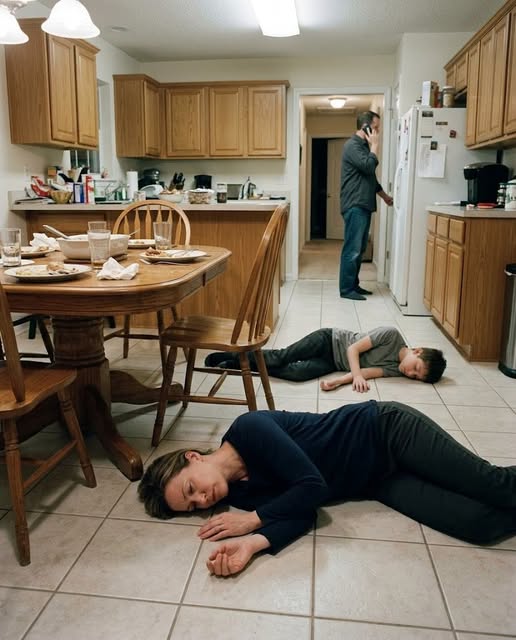
➡️ PART 3 ENDING PART ➡️
“Tell my brother we can finally finish what we started seventeen years ago.”
Daniel’s words entered the room like a blade.
I kept my eyes closed.
Kept my cheek against the tile.
Kept my fingers loose beside Noah’s.
But inside, something shifted.
Seventeen years.
Noah was sixteen.
Daniel and I had been married eighteen.
My father had died six months ago.
And suddenly I understood that whatever was happening in my kitchen had not begun with tonight’s dinner.
It had not begun with Daniel cooking.
It had not begun when Noah and I collapsed.
It had not even begun with my father handing me that yellow envelope two days before he died.
It had begun before my son could walk.
Before I understood the man I had married.
Maybe before I married him at all.
Daniel ended the call.
For several seconds, he stood over us.
I could hear him breathing.
Then paper rustled.
He was opening the envelope.
My heart slammed so violently against my ribs that I was certain he could hear it.
“No.”
Daniel whispered.
A pause.
Then louder:
“No.”
He began tearing through papers.
“What the hell is this?”
Noah’s little finger moved against mine.
Once.
A question.
I squeezed back once.
Stay still.
Daniel cursed.
Then his phone rang again.
“What?”
Silence.
“No, it’s not here.”
Another pause.
“I found the envelope. The document isn’t inside.”
His voice sharpened.
“Don’t tell me to calm down.”
My father had fooled him.
Even dead, Dad had fooled him.
Daniel paced.
“The old man must have moved it.”
A voice crackled faintly through the phone.
Daniel stopped.
“No. She doesn’t know.”
My stomach twisted.
She.
Me.
“Because if she knew, she would’ve confronted me.”
Pause.
“You don’t know her like I do.”
I almost opened my eyes.
Eighteen years.
Apparently he believed eighteen years gave him complete knowledge of me.
Maybe it had.
Until tonight.
Then Daniel said something that made my blood turn cold.
“The boy definitely doesn’t know.”
Noah’s hand twitched.
I squeezed it harder.
Don’t move.
“Once this is done, we search everything.”
Daniel continued.
“The house. Her father’s storage unit. Bank box if there is one. Everything.”
He listened.
“No, I haven’t checked the freezer.”
My breath stopped.
The food.
The bag.
The evidence tucked beneath my shirt was suddenly the least of our problems.
Daniel walked toward the refrigerator.
His shoes stopped inches from my face.
The freezer drawer opened.
Plastic packages shifted.
Frozen vegetables knocked together.
He was searching.
I felt Noah tense.
Then came three heavy knocks.
Front door.
“Police!”
Daniel froze.
For one perfect second, nobody breathed.
Then he moved.
Fast.
The freezer slammed shut.
His shoes crossed the kitchen.
He looked toward the front of the house.
Another knock.
“Police department! Is anyone inside?”
Daniel whispered:
“Damn it.”
Then I heard the unmistakable click of the back-door lock.
He was going to run.
I opened my eyes.
“Noah.”
My son moved instantly.
Daniel spun around.
His face was unforgettable.
Not angry.
Not yet.
Confused.
He looked at me.
Then Noah.
Then back at me.
“You—”
I screamed.
“POLICE!”
Daniel lunged.
I grabbed Noah and pulled him backward.
Daniel caught my ankle.
I kicked.
My heel struck his shoulder.
He cursed and reached again.
Noah grabbed a kitchen chair and shoved it between us.
“Get away from her!”
Daniel stared at him.
“Noah.”
My son was shaking.
“Don’t say my name.”
The front door crashed open.
“POLICE!”
Daniel ran toward the back door.
He made it three steps.
Two officers entered the kitchen from the hallway.
“Hands!”
Daniel stopped.
“Put your hands where we can see them!”
“This is my house.”
“Hands!”
“My wife is sick.”
I almost laughed.
Even then.
Even caught.
He was already constructing the next version.
“She called you because she’s confused.”
I pushed myself upright.
“He put something in our food.”
Daniel looked at me.
“Rachel.”
That was my name.
Rachel Morgan.
Though for eighteen years I had been Rachel Hale.
I had almost forgotten how much I liked Morgan.
“Don’t.”
I said.
His face changed.
“Rachel, listen to me.”
“No.”
An officer moved between us.
Another cuffed Daniel.
He did not fight.
That was Daniel.
He understood appearances.
Even with handcuffs around his wrists, he was thinking about how things looked.
“This is a misunderstanding.”
he said.
“Ask my wife.”
The officer looked at me.
I held up the freezer bag from beneath my shirt.
“Test this.”
Daniel’s face emptied.
Not anger.
Not fear.
Recognition.
He knew exactly what I had done.
And he knew I had outplayed him.
For once, that gave me no satisfaction.
Because Noah suddenly collapsed.
“Mom.”
I turned.
His knees buckled.
I caught him before his head hit the floor.
“Noah!”
Everything became noise.
Paramedics.
Questions.
Gloves.
A stretcher.
Daniel shouting from the hallway.
Me refusing to release Noah’s hand.
The bag of food being placed into evidence.
An officer asking what we had eaten.
Another asking whether Daniel had access to medications.
Noah vomiting into a plastic basin.
My own vision beginning to blur.
I had been pretending to be unconscious.
But whatever Daniel had put into our food was real.
And it was still inside us.
The last thing I remember from my kitchen that night was being lifted onto a stretcher beside my son.
Daniel stood near the front door in handcuffs.
He looked at me.
Not lovingly.
Not apologetically.
He looked betrayed.
As if I had broken some agreement by surviving.
Then the ambulance doors closed.
I woke in the hospital.
Noah was in another room.
That was the first thing I asked.
“My son.”
A nurse leaned over me.
“He’s stable.”
“Stable?”
“He’s being monitored.”
“What did we ingest?”
“We’re still working on that.”
“Where is my husband?”
“Police custody.”
I closed my eyes.
Then opened them immediately.
“Don’t let him near Noah.”
“He can’t come here.”
“Promise.”
She looked directly at me.
“I promise.”
I cried.
Not gracefully.
Not quietly.
I cried until my ribs hurt.
A doctor came later.
The substance Daniel had apparently used was a sedating medication combined with another prescription drug capable of dangerously suppressing consciousness, particularly at higher doses.
I will not name it.
The name does not matter.
What matters is that Daniel knew enough to expect us to become unconscious.
What matters is that the amount in Noah’s system was dangerous.
What matters is that if I had eaten everything on my plate, the outcome might have been very different.
What matters is that my son was sixteen years old.
His father had poisoned his dinner.
No explanation could make that sentence less monstrous.
Noah woke fully the next morning.
I was beside him.
He opened his eyes.
“Mom?”
I grabbed his hand.
“I’m here.”
“Dad?”
“Gone.”
“Dead?”
The question startled me.
“No.”
“Police?”
“Yes.”
He closed his eyes.
“Good.”
Then he started crying.
I climbed carefully beside him.
He was sixteen.
Six feet tall.
He still curled toward me like the little boy who used to climb into my bed during thunderstorms.
“Did he really…”
His voice broke.
“Yes.”
“Why?”
“I don’t know yet.”
“Was I supposed to die?”
My heart shattered.
I wanted to lie.
Parents spend years wanting to place soft material between children and unbearable truths.
But he had heard Daniel.
He knew.
“I think he intended to seriously harm us.”
Noah stared at me.
“Both?”
“Yes.”
“Why me?”
“I don’t know.”
He cried harder.
“I’m his son.”
I pulled him against me.
“I know.”
“I’m his son.”
“I know.”
There was nothing else to say.
Some grief is too large for language.
Detective Mara Bennett came that afternoon.
No relation.
She had kind eyes and a voice that never hurried.
She interviewed me first.
Then Noah separately.
She asked about the dinner.
Daniel cooking.
Our symptoms.
The call.
The yellow envelope.
My father.
Daniel’s brother.
“What’s his brother’s name?”
she asked.
“Eric.”
“Eric Hale?”
“Yes.”
“Where does he live?”
“About forty minutes away.”
“What does he do?”
“He runs a property development company.”
“Do you get along?”
“Not especially.”
“Why?”
I thought.
“He’s always made me uncomfortable.”
“How?”
I hated how vague it sounded.
“Too interested in money.”
“That is not illegal.”
“I know.”
“Anything specific?”
“He asked about my father’s estate three days after Dad died.”
Detective Bennett stopped writing.
“What did he ask?”
“Whether Dad had left me the lake property.”
“What lake property?”
I explained.
My father, Samuel Morgan, had spent forty years buying and restoring small commercial properties.
Nothing glamorous.
Old storefronts.
Warehouses.
Two apartment buildings.
And one piece of land outside town near Lake Mercer.
For decades, everyone called it the lake property.
About sixty acres.
Mostly woods.
An old farmhouse.
A collapsed barn.
Daniel had always considered it nearly worthless.
At least he said he did.
“Who inherited it?”
Detective Bennett asked.
“Me.”
“Current value?”
“I don’t know.”
She looked at me.
“Roughly?”
“Dad once said maybe eight hundred thousand.”
Her pen stopped.
“When?”
“Five years ago.”
“Could it be worth more now?”
“I shrugged.”
“Maybe.”
She wrote something.
“What did your father say when he gave you the yellow envelope?”
I closed my eyes.
I could see him.
Hospice bed.
Thin hands.
His voice reduced to a whisper.
Don’t open this unless you ever believe your family is in danger.
At the time, I thought medication had made him confused.
“Exactly that.”
I said.
“Did he mention Daniel?”
“No.”
“Eric?”
“No.”
“Seventeen years?”
“No.”
“What was supposed to be inside?”
“I don’t know.”
“But Daniel expected a document.”
“Yes.”
“And it wasn’t there.”
“No.”
Detective Bennett leaned back.
“Mrs. Hale—”
“Rachel.”
“Rachel.”
She closed her notebook.
“I need you to understand something.”
“What?”
“We are treating the poisoning and what happened in your home as one investigation.”
I nodded.
“But your husband’s comments suggest there may be another matter underneath it.”
“I know.”
“We need to move carefully.”
“Okay.”
“Do you have somewhere safe to stay after discharge?”
“My mother.”
“Does Daniel have access?”
“He knows where she lives.”
“We can help with a protective order.”
“Yes.”
I did not hesitate.
That surprised me.
Eighteen years of marriage.
And one night had erased every instinct to protect his comfort.
Or maybe the instincts had not been erased.
Maybe survival had simply become louder.
Daniel was charged initially in connection with the poisoning.
Eric disappeared.
That made everything worse.
Police went to his house.
Gone.
Office.
Gone.
Phone off.
Car found two days later at a commuter station.
No Eric.
Detective Bennett called.
“Did Daniel say anything about where his brother might go?”
“No.”
“Any family property?”
“Their mother had a cabin.”
“Where?”
“She sold it years ago.”
“Anything else?”
I thought.
Then remembered.
“When we were first married, Daniel and Eric used to go fishing somewhere near Bell County.”
“Where?”
“I don’t know.”
“Who might?”
Their mother.
Evelyn Hale.
Seventy-nine.
Widowed.
Still sharp.
Still adored her sons.
Police interviewed her.
She claimed ignorance.
I believed she was lying.
Not because I had evidence.
Because when I called, she said:
“Rachel, whatever Daniel did, you must remember he loves Noah.”
I hung up.
Love had become a word people used too carelessly.
Love without safety is not enough.
Love without honesty is not enough.
Love does not neutralize poison.
Three days after the hospital, Detective Bennett returned.
She brought a folder.
“We found something.”
My stomach tightened.
“What?”
“Your father’s name appears in an old police report.”
“What report?”
“Seventeen years ago.”
I stopped breathing.
The year.
“What happened?”
“A man named Peter Lang died in a vehicle accident.”
I stared.
“I don’t know that name.”
“Your father was listed as a witness.”
“What did he see?”
“That’s complicated.”
“Tell me.”
She opened the folder.
Peter Lang had been an accountant.
Not my father’s accountant.
Eric’s.
Seventeen years earlier, Eric had been starting his first property company.
Daniel had invested.
Peter handled the books.
One rainy night, Peter’s car went off an embankment.
He died.
Police ruled it an accident.
My father had been driving several minutes behind him.
Dad told police he had seen another vehicle near Peter’s car shortly before the crash.
A dark SUV.
He could not identify the driver.
The case went nowhere.
“Why would that involve Daniel?”
I asked.
Detective Bennett slid another document toward me.
“Your father apparently didn’t tell police everything.”
“How do you know?”
“Because six months after the accident, he hired a private investigator.”
I stared.
“Dad?”
“Yes.”
My father had been the least dramatic person alive.
He alphabetized spices.
He wore the same brown shoes for fifteen years.
The idea of him hiring a private investigator felt impossible.
“What did the investigator find?”
“We don’t know yet.”
“What do you mean?”
“The investigator died nine years ago.”
I felt sick.
“Not suspiciously.”
she added quickly.
“Cancer.”
I exhaled.
“But we located his widow.”
“And?”
“She remembered your father.”
“Why?”
“Because he paid for a secure records box.”
My heart pounded.
“What records?”
“We’re trying to find out.”
Then she said:
“There is another piece.”
Of course there was.
“Peter Lang had discovered financial irregularities in Eric’s company.”
“What kind?”
“False invoices. Property transfers. Money moving through shell companies.”
“And Daniel?”
“His name appeared on two early business accounts.”
My mouth went dry.
“How much money?”
“At the time? Several hundred thousand dollars.”
Seventeen years ago.
A fortune to two men in their twenties.
“Did Dad know?”
“We think he suspected.”
I suddenly remembered something.
My father never liked Daniel.
He was polite.
Always.
But distant.
When Daniel proposed, Dad asked me:
“Are you sure he is kind when nobody is impressed by him?”
I became furious.
I accused Dad of being judgmental.
Daniel was charming.
Ambitious.
Attentive.
He remembered birthdays.
Opened doors.
Sent flowers.
Dad apologized.
At least I thought he had.
Maybe he simply stopped warning me.
“Why didn’t he tell me?”
I whispered.
Detective Bennett did not answer.
She couldn’t.
I was discharged after four days.
Noah after five.
We went to my mother’s house.
My mother, Margaret, opened the door and held us both.
She had aged ten years in a week.
Noah slept almost sixteen hours the first night.
I did not sleep at all.
At three in the morning, I remembered the yellow envelope.
Police had it.
But Daniel had said the document was missing.
Dad had wanted me to find something.
Not Daniel.
Me.
The envelope itself had to matter.
I called Detective Bennett at 7:10.
“Can I see it?”
“The envelope?”
“Yes.”
“Why?”
“I think Dad left me a clue.”
Two hours later, I sat in an interview room.
Gloves on.
The yellow envelope lay inside an evidence sleeve.
Dad’s handwriting on the front:
RACHEL — ONLY IF NECESSARY
Inside had been three sheets of paper.
A photocopy of a deed.
A photograph.
And a handwritten note.
Daniel had apparently been furious because whatever he expected was not there.
I read Dad’s note.
Rachel, if you are reading this, I was right to worry. I hope I wasn’t. Look at what is missing, not what is here. You know where I keep things that matter. Trust the year your mother laughed at me.
I stared.
“What does that mean?”
Detective Bennett asked.
“I don’t know.”
Then I looked at the photograph.
My father stood beside an old red truck.
Behind him was the lake farmhouse.
The photograph had a date.
Seventeen years earlier.
My mother laughed at him.
A memory surfaced.
Dad had bought a safe.
Not a normal safe.
An enormous fireproof thing.
Mom mocked him for weeks.
Called it Fort Knox.
But that had been around 2014.
Wrong year.
Then another memory.
Dad had become obsessed with backing up family photographs.
He bought an external hard drive.
My mother laughed because he stored digital copies of photographs in a bank safe-deposit box.
“You’re putting computer pictures in a bank?”
she teased.
Dad said:
“If the house burns down, you’ll thank me.”
My chair scraped backward.
“The bank.”
Detective Bennett stood.
“What?”
“He had a safe-deposit box.”
“Which bank?”
I told her.
The box still existed.
Dad’s estate had paid the annual fee automatically.
I was authorized as executor.
Detective Bennett obtained the necessary legal coordination.
The next morning, we opened it.
Inside were family documents.
My birth certificate.
My parents’ marriage certificate.
Old photographs.
A flash drive.
And a sealed envelope.
RACHEL
My hands shook.
Inside:
If Daniel or Eric ever searches for this, do not confront them. Go directly to law enforcement.
I stopped reading.
Dad knew.
Not suspected.
Knew.
The flash drive contained scanned financial records.
Photographs.
Audio files.
A statement from Peter Lang.
Peter had apparently given my father copies of documents days before he died.
Why?
Because Dad owned a warehouse Eric’s company leased.
Peter trusted him.
Peter believed Eric and Daniel were using inflated renovation contracts to move money.
He was preparing to report them.
Then he died.
The most devastating file was audio.
Peter’s voice.
Recorded in my father’s office.
“If anything happens to me, Samuel, you take this to the police.”
My father’s voice:
“Peter, go now.”
“I need another day.”
“Why?”
“Because Daniel is getting married.”
My blood froze.
Detective Bennett looked at me.
The recording continued.
Peter said:
“He wants out.”
Dad:
“Then let him out.”
Peter:
“Eric won’t.”
Silence.
Then:
“Daniel says once the wedding happens, he wants nothing to do with the company.”
My wedding.
I whispered:
“When was this recorded?”
Detective Bennett checked.
Eleven days before Daniel and I married.
The room tilted.
Daniel had been involved before our marriage.
But maybe he had wanted out.
Then Peter died.
And Daniel stayed silent.
Why?
Fear?
Complicity?
Both?
The flash drive did not prove murder.
It proved financial crimes.
It proved Peter had feared retaliation.
It proved my father knew more than he had told police.
Then we found Dad’s own recorded statement.
Made six months before his death.
His voice filled the room.
Older.
Weaker.
Still Dad.
Rachel, I owe you an apology.
I covered my mouth.
I should have told you years ago. I convinced myself I was protecting you. Then Noah was born, and I became afraid of what Daniel might do if cornered.
Tears streamed down my face.
I watched him for seventeen years.
I sobbed.
My father had spent almost my entire marriage watching my husband.
I never found proof that Daniel caused Peter’s death. I found proof that he helped hide the financial crimes Peter intended to expose.
Detective Bennett leaned closer.
Eric frightened me more. Daniel always seemed ashamed. Eric seemed angry that anyone could question him.
Dad coughed.
Then continued.
Two years ago, the lake property changed everything.
I stopped.
The land.
A survey found commercially valuable mineral deposits beneath part of the acreage, and a development consortium approached me. I refused to sell. Their offer eventually reached 6.4 million dollars.
I stared.
Six point four million.
Daniel had told me the land was worthless.
Had he known?
Dad continued.
Eric learned of the offer. I do not know how. Soon afterward, Daniel began asking unusual questions about my estate.
My stomach turned.
I remembered.
Casual questions.
“What will your dad do with the lake place?”
“Does he have a will?”
“Wouldn’t it be easier to sell?”
I had never thought twice.
I changed my estate plan.
Dad’s voice trembled.
The lake property passes to Rachel under a trust structure that prevents a spouse from obtaining control through marriage. If Rachel dies before Noah reaches thirty, the land passes into a charitable conservation trust.
I gasped.
There it was.
If I died, Daniel did not get the property.
Neither did Noah immediately.
The land disappeared from their reach.
Dad had designed the estate specifically to remove the financial incentive to harm me.
But Daniel apparently did not know.
Dad continued.
If Daniel believes Rachel’s death gives him control, he is mistaken.
I looked at Detective Bennett.
She was already writing.
Then Dad said:
The most important evidence is not on this drive.
Of course.
My father and his puzzles.
It is with someone Daniel does not know.
The recording ended.
I almost screamed.
“Who?”
Detective Bennett asked.
“I don’t know.”
We searched the remaining files.
One name appeared repeatedly.
Helen Ward.
I knew Helen.
Dad’s old bookkeeper.
She had retired to Arizona.
Police contacted her.
Helen laughed when Detective Bennett explained why.
Not because it was funny.
Because Dad had apparently been impossible.
“That stubborn old man.”
she said over speakerphone.
“What did he give you?”
Detective Bennett asked.
“A key.”
“To what?”
“A storage locker.”
My heart pounded.
“Where?”
Helen gave us the address.
Not Arizona.
Our town.
Dad had rented it under a small holding company.
Inside was a metal file cabinet.
No treasure.
No dramatic stacks of cash.
Paper.
Years of paper.
Bank statements.
Corporate records.
Copies of checks.
Invoices.
And one small digital recorder.
The evidence showed Daniel and Eric had both participated in financial fraud seventeen years earlier.
Daniel’s involvement was smaller.
But real.
Then, after Peter died, Daniel withdrew from the company.
Eric continued.
For years.
Daniel built a different career.
Married me.
Had Noah.
Became, as far as I knew, an ordinary husband and father.
But secrets do not disappear simply because we stop feeding them.
Eric had spent seventeen years afraid Peter’s evidence still existed.
My father had it.
When Dad became ill, Eric panicked.
And Daniel?
Daniel had apparently panicked too.
The investigation uncovered messages between the brothers.
At first:
ERIC: Your father-in-law knows.
DANIEL: He’s dying. Leave it alone.
Then:
ERIC: What did he leave Rachel?
DANIEL: I don’t know.
Months later:
ERIC: She inherited the land.
DANIEL: So?
ERIC: You know what it’s worth?
Then a number.
6.4 million.
Daniel replied:
You’re joking.
Eric:
Get the paperwork.
Daniel:
No.
For one terrible second, relief washed through me.
No.
Daniel had said no.
Then later:
ERIC: Peter’s files are probably with it.
Daniel:
You don’t know that.
Eric:
If Rachel finds them, we’re both finished.
A week later:
DANIEL: What do you want me to do?
That sentence ended my marriage more completely than the poison.
Not because the poison mattered less.
Because there, in plain text, I could see the moment he chose.
He had been afraid.
Maybe manipulated.
Maybe haunted by a crime from youth.
But he chose.
Again.
And again.
Eric instructed him to find the envelope.
Daniel searched Dad’s office.
Nothing.
He searched our house.
Nothing.
Then Eric suggested something monstrous.
Make Rachel ill.
Get access while she is hospitalized.
Daniel initially refused.
Then the plan changed.
Noah had overheard Daniel discussing the lake property two weeks earlier.
Daniel told Eric.
Eric said Noah was becoming a problem too.
My son.
A problem.
Detective Bennett would not show me every message.
I am grateful.
I saw enough.
Daniel had not planned to kill us immediately.
At least that is what his attorney later argued.
The drugs were intended to render us unconscious.
Then Daniel planned to stage a carbon monoxide incident using a malfunction in the attached garage.
Whether we would have survived was apparently irrelevant to him.
The plan required us not to wake.
But I had eaten less.
Noah had pushed food around his plate because he hated Daniel’s mushroom sauce.
That probably saved us.
The irony would have made Noah laugh under any other circumstances.
Eric was arrested six days later.
Police found him at a rented fishing cabin in Bell County.
The place I had remembered.
Inside were cash.
Documents.
A burner phone.
And copies of messages with Daniel.
When Detective Bennett called, I sat on my mother’s porch.
Noah beside me.
“They got him.”
I said.
Noah stared ahead.
“Good.”
Then:
“Mom?”
“Yes?”
“Was Dad always bad?”
I turned toward him.
That question was harder than any detective’s.
“No.”
He looked surprised.
“No?”
“I don’t think people work that way.”
“He tried to kill us.”
“Yes.”
“So how can he not be bad?”
I took my time.
“Your father did something evil.”
I said.
“Several things.”
Noah’s jaw tightened.
“He made choices I don’t know if I can ever forgive.”
“Then why defend him?”
“I’m not.”
I touched his hand.
“But if I tell you every good memory was fake, I’d be lying.”
He looked away.
I continued.
“Your father taught you to ride a bike.”
Silence.
“He stayed awake with you when you had pneumonia at eight.”
Noah’s eyes filled.
“He cried when you were born.”
“Stop.”
“Okay.”
I stopped.
Then he whispered:
“I hate that.”
“What?”
“That those things happened.”
“I know.”
“I want him to have always been terrible.”
“I know.”
“Then it’d be easier.”
“Yes.”
He cried.
I held him.
People want monsters to look like monsters from the beginning.
Sometimes they don’t.
Sometimes they look like the man who remembers how you take your coffee.
The father who builds a treehouse.
The husband who holds your hand at funerals.
And then, somewhere inside fear, greed, cowardice, and secrecy, they make a choice so unforgivable that everything before it becomes difficult to hold.
But difficult is not the same as false.
Noah eventually asked to see Daniel.
I said no.
At first.
Then his therapist told me:
“You cannot make this decision based only on your own fear.”
I hated hearing that.
Because she was right.
Noah was sixteen.
Old enough to have needs separate from mine.
The meeting happened in a secure facility.
Supervised.
I did not go inside.
I waited.
Forty-two minutes.
Longest forty-two minutes of my life.
When Noah came out, he looked exhausted.
I stood.
He walked into my arms.
“What happened?”
“Can we go home?”
“Yes.”
In the car, halfway back, he said:
“He apologized.”
I gripped the wheel.
“Okay.”
“He said Uncle Eric pressured him.”
I said nothing.
“He said he never meant for me to die.”
My throat tightened.
“Okay.”
“Mom.”
“Yes?”
“I don’t believe him.”
I pulled over.
Noah cried.
“I wanted to.”
I unbuckled.
Held him.
“I really wanted to.”
“I know.”
“He said he loves me.”
“I believe he does.”
Noah pulled back.
“How can you say that?”
“Because love doesn’t automatically make someone safe.”
He stared.
I continued.
“People can love and still be selfish.”
“Cowardly.”
“Dangerous.”
“Love is not proof of character.”
His face crumpled.
“Then what’s the point?”
“The point is that love needs other things.”
“What things?”
“Honesty.”
I said.
“Responsibility.”
“Courage.”
“Respect.”
“Self-control.”
I wiped his face.
“Love without those things can become something that hurts people.”
He leaned against me.
“I don’t want to be like him.”
“You aren’t.”
“How do you know?”
“Because you are already asking the question.”
The criminal cases took nearly two years.
Real justice is slow.
Painfully slow.
There were motions.
Hearings.
Experts.
Arguments.
Evidence disputes.
Financial investigators.
The old Peter Lang case was reopened.
Prosecutors could not conclusively prove Daniel or Eric caused Peter’s crash.
That mattered.
Suspicion is not proof.
The state did not pretend otherwise.
But the financial crimes were documented.
So was the conspiracy involving me and Noah.
So was the drugging.
So were the messages.
Daniel eventually pleaded guilty to multiple serious offenses.
Eric went to trial.
He was convicted on several charges related to fraud, conspiracy, and the attack on us.
Neither man walked away.
I will not turn their sentences into entertainment.
Years in prison do not restore a family.
A judge’s number cannot measure what Noah lost.
The most important moment in court came before sentencing.
Daniel turned toward me.
His attorney had advised him not to.
He did anyway.
“Rachel.”
I looked at him.
He seemed older.
Smaller.
Not because prison clothing has magic.
Because I no longer saw him through marriage.
“I am sorry.”
I said nothing.
He continued.
“I know that doesn’t mean anything.”
I surprised myself.
“It means something.”
He looked up.
“It just doesn’t fix anything.”
Tears filled his eyes.
“I was afraid.”
“I know.”
“Eric said—”
I held up my hand.
Daniel stopped.
“You were afraid.”
I said.
“Yes.”
“You were ashamed.”
“Yes.”
“You thought the evidence would destroy your life.”
“Yes.”
“So you decided to destroy ours first.”
He sobbed.
That was the truth.
Fear explained him.
It did not excuse him.
“I loved you.”
he whispered.
I looked at him.
“I know.”
He seemed stunned.
“I loved you too.”
I continued.
“That’s what makes this terrible.”
He cried harder.
“If there had never been love, I could throw away eighteen years.”
I shook my head.
“But there was.”
I looked toward Noah.
He sat behind me with my mother.
“So now we have to carry both.”
Daniel whispered:
“Both?”
“The love that was real.”
I said.
“And what you did.”
He closed his eyes.
“I am sorry.”
“I know.”
I never told him I forgave him.
Because I didn’t.
Not then.
Maybe not ever.
Forgiveness is not a tax victims owe before they are allowed to heal.
I divorced him.
The paperwork felt absurdly small.
A marriage could contain eighteen years.
Birthdays.
Vacations.
Arguments.
Inside jokes.
Illness.
Mortgage payments.
A child’s first steps.
Then end beneath a judge’s signature.
I changed my name back to Morgan.
Noah kept Hale.
I told him he could change it if he wanted.
He didn’t.
“It’s my name too.”
he said.
I was proud of that.
He refused to surrender something simply because his father had damaged it.
The lake property remained mine.
Dad’s trust worked exactly as intended.
A development company increased the offer.
Seven million.
Then eight.
I refused.
People thought I was foolish.
Maybe financially I was.
But the land had become tangled with too much greed.
I did not want the thing Daniel had nearly destroyed us for to become the center of my life.
I placed most of it into a conservation easement.
Sold a small portion.
Used part of the proceeds to create a scholarship in Peter Lang’s name for students studying forensic accounting and financial ethics.
I contacted Peter’s daughter first.
Her name was Grace.
She had been six when her father died.
She was twenty-five when we met.
She stared at me across a coffee-shop table.
“Your husband knew my dad?”
“Yes.”
“Did he kill him?”
The question hurt.
“We don’t know.”
She nodded.
Police had told her the same.
I continued.
“But your father discovered what they were doing.”
Tears filled her eyes.
“For years, people said he drove too fast.”
“I know.”
“My mom blamed him.”
I reached across the table.
“I am sorry.”
Grace cried.
“So was he scared?”
“Yes.”
“Did he try to do the right thing?”
“Yes.”
I showed her the recording.
Peter’s voice.
Seventeen years preserved.
Grace covered her mouth.
She had not heard him since childhood.
She listened three times.
Then said:
“He sounds exactly the same.”
I cried with her.
That scholarship became one of the few good things to grow from the ruins.
Not because tragedy needs to produce a lesson to justify itself.
It doesn’t.
I would trade every scholarship to give Grace her father back.
I would trade every acre to undo dinner.
Good things can grow after evil without making evil necessary.
That distinction mattered to me.
Noah struggled.
Of course he did.
For months, he could not eat anything someone else prepared without watching.
At restaurants, he wanted sealed drinks.
At friends’ houses, he avoided dinner.
If I cooked, he stood in the kitchen.
The first time I realized, I cried privately.
Then I stopped hiding my tears.
“I’m sorry.”
he said.
“For what?”
“Making you sad.”
“You didn’t.”
“I did.”
“Noah.”
I touched his face.
“Your fear makes me sad because I love you.”
I said.
“That doesn’t mean you’re doing something wrong.”
Therapy helped.
Time helped.
Cooking helped most.
Strangely.
His therapist suggested he reclaim food.
So Noah learned to cook.
At first, he cooked only for himself.
Then me.
The first meal was scrambled eggs.
He stood over the plate.
“You eat first.”
My heart broke.
I did.
One bite.
Then another.
“Good?”
“Too much salt.”
He laughed.
That laugh was everything.
Eventually he cooked dinner every Sunday.
The kitchen stopped belonging to the worst night of our lives.
It became ours again.
At eighteen, Noah graduated.
Daniel was not there.
He sent a letter.
Noah did not open it.
Not then.
I did not pressure him.
At nineteen, he opened it.
Read it once.
Put it away.
“What did it say?”
I asked.
“That he’s proud.”
“How do you feel?”
“Angry.”
“Okay.”
“And happy.”
“Okay.”
“I hate being happy.”
I sat beside him.
“You’re allowed.”
“He doesn’t deserve that.”
“Your feelings aren’t rewards you give him.”
Noah stared.
I continued.
“You don’t have to punish yourself to punish him.”
That took years for both of us to understand.
Noah studied environmental engineering.
The lake land influenced him.
Not the money.
The decision to preserve it.
He became fascinated by water systems and land use.
At twenty-four, he brought home a woman named Sophie.
She was funny.
Direct.
Loved spicy food.
The first time she cooked dinner at my house, I saw Noah hesitate before taking a bite.
Just one second.
Then he ate.
I went to the bathroom and cried.
Progress is sometimes that small.
A fork lifted without fear.
A meal accepted.
Trust returning to the body.
Noah married Sophie at twenty-eight.
Before the ceremony, he asked me:
“Do you think Dad loved you when he married you?”
I looked at him.
“Yes.”
“You’re sure?”
“Yes.”
“Then how do I know love won’t turn into that?”
I understood the real question.
How do I know I won’t become him?
“You don’t build a safe marriage by trusting your feelings forever.”
I said.
He frowned.
“What?”
“Feelings change.”
I straightened his tie.
“You build it through choices.”
“What choices?”
“The small ones.”
I smiled.
“Telling the truth when lying would protect you.”
“Admitting mistakes before someone discovers them.”
“Asking for help before fear becomes desperation.”
“Letting the person you love remain a separate human being.”
“And when shame tells you to hide?”
I touched his chest.
“You speak.”
Noah cried.
“So I’m not doomed?”
“No.”
“You’re not your father’s worst choice.”
He hugged me.
At the wedding, Sophie ate first.
Then Noah.
He caught me noticing.
Rolled his eyes.
I laughed.
Daniel heard about the wedding.
Noah did not invite him.
That was his decision.
Years later, he did visit Daniel again.
I learned afterward.
“Why didn’t you tell me?”
“Because you’d worry.”
“Yes.”
“I wanted it to be mine.”
I understood.
“What happened?”
“We talked.”
“About?”
“Everything.”
“Did you forgive him?”
Noah thought.
“I don’t know.”
Good answer.
“Do you want a relationship?”
“Maybe letters.”
“Okay.”
“Are you mad?”
“No.”
“Really?”
“Really.”
He studied my face.
“He hurt you too.”
“Yes.”
“So doesn’t talking to him betray you?”
“No.”
I said.
“You do not owe me hatred as proof that you love me.”
His eyes filled.
That sentence freed something in both of us.
Noah began exchanging occasional letters with Daniel.
Not frequent.
Not intimate.
Bounded.
Daniel never asked me to participate.
I appreciated that.
Years passed.
My mother died at eighty-seven.
While sorting her things, I found a box of my father’s belongings.
Inside was his old brown wallet.
Receipts.
A photograph of Mom.
A folded note.
My name.
Of course.
My father apparently communicated exclusively through hidden paper after death.
I opened it.
Rachel, if you ever find this, please forgive an old man for thinking he could protect his daughter by keeping her ignorant.
I sat on the floor.
Silence is not always protection. Sometimes it merely delays another person’s right to choose.
Tears blurred the words.
I should have told you what I suspected about Daniel before you married him. I was afraid you would reject me instead of him. That was cowardice dressed as fatherly patience.
I cried.
Dad had known that too.
You deserved the truth even if you chose him anyway.
That sentence changed how I remembered my father.
He had saved evidence.
Built the trust.
Protected the land.
Ultimately protected me.
But he had also made a mistake.
A profound one.
He had decided what truth I could handle.
Love had made him controlling in a quieter way.
That mattered.
Nobody in this story was improved by being turned into a saint.
Dad was brave.
Dad was afraid.
Both.
Daniel had loved us.
Daniel had betrayed us.
Both.
I had been observant enough to save food.
I had ignored smaller warning signs in my marriage for years.
Both.
Noah was courageous that night.
He was traumatized afterward.
Both.
Human beings contain contradictions.
Healing began when I stopped forcing everyone into simple categories.
At sixty, I sold the remaining unprotected portion of the lake property.
Not to developers.
To a nonprofit outdoor education organization.
They restored the farmhouse.
Built trails.
Created a small research station.
One building became the Samuel Morgan Center.
I objected.
Noah insisted.
“Grandpa saved us.”
“He also kept secrets.”
“Then put that on the plaque.”
I stared.
“You’re serious?”
“Yes.”
So we did something unusual.
The plaque did not call Dad a hero.
It said:
SAMUEL MORGAN PRESERVED THIS LAND AND EVIDENCE THAT LATER PROTECTED HIS FAMILY. HE ALSO LEARNED TOO LATE THAT LOVE SHOULD NOT WITHHOLD TRUTH IN THE NAME OF PROTECTION. THIS CENTER IS DEDICATED TO COURAGE, ACCOUNTABILITY, AND THE RIGHT OF PEOPLE TO KNOW THE TRUTH THAT SHAPES THEIR LIVES.
Some board members thought it was too complicated.
I loved it.
People are complicated.
Memorials can survive honesty.
Noah and Sophie had two children.
A boy, Samuel.
A girl, Grace.
Yes.
Grace.
Named partly for Peter’s daughter, who had become a family friend.
The first time Noah cooked for his children, he sent me a photograph.
Pasta everywhere.
Samuel wearing sauce on his forehead.
Caption:
Nobody collapsed. Five stars.
I laughed until I cried.
Humor returned.
That was one of healing’s gifts.
Not forgetting.
Being able to touch memory without bleeding every time.
Daniel was eventually released when he was an old man.
I was seventy-three.
Noah called.
“Mom.”
“I know.”
“How?”
“His attorney notified mine.”
“Are you scared?”
I considered.
“No.”
That surprised me.
Not because I trusted Daniel.
Because he no longer controlled the architecture of my life.
“Do you want to see him?”
Noah asked.
“No.”
“Ever?”
“I don’t know.”
That was true.
Three months later, a letter arrived.
No return address necessary.
I knew the handwriting.
Rachel,
I will not come near you. I will not contact you again unless you ask.
Good beginning.
There is no version of what I did that deserves explanation more than it deserves condemnation.
I sat.
For years I told myself Eric frightened me into it. He did frighten me. That is true.
But fear did not put the medication into your food. I did.
My hands shook.
Fear did not lie to Noah. I did.
Fear did not choose my secret over your lives. I did.
I cried.
Not for him.
Not exactly.
For the man he might have been if he had understood responsibility before destroying everything.
I loved you. I know saying that may sound offensive. I understand if it does. But I need to tell the truth without using it as a defense.
I loved you, and I still did something monstrous.
That has been the hardest truth to accept because I used to believe love made me a good man automatically. It doesn’t.
I thought of what I had told Noah.
Love needs other things.
I do not ask forgiveness.
I hope Noah becomes a better man than I was. From his letters, I know he already has.
I hope you became happy.
Daniel
I put the letter away.
I did not answer.
Not then.
Two years later, Detective Bennett died.
Cancer.
Her daughter contacted me because Mara had kept a photograph from our case.
It showed the sealed freezer bag.
My handwriting on the evidence label from the hospital.
I had written:
FOOD FROM BLUE PLATE
I stared at it.
That little bag.
A few bites of dinner.
Frozen peas.
Shaking hands.
Sometimes survival is not heroic.
Sometimes it is practical.
Save the food.
Find the old phone.
Give the address first.
Stay still.
Wait.
Run when the door opens.
I framed nothing.
I did not want evidence on my walls.
But I kept a copy in a drawer.
Not to remember Daniel.
To remember myself.
At seventy-eight, I finally wrote him back.
One page.
Daniel,
I received your letter years ago.
I believe you are sorry.
I believe you loved us.
I also believe what you did was unforgivable in the sense that nothing can make it undone.
But I no longer need anger to keep me safe from you.
I paused for hours before writing the next line.
I forgive you.
Then immediately:
That does not mean I want a relationship. I do not.
Important.
Forgiveness, for me, means I no longer want your punishment to occupy space in my heart. Your consequences belong to your life. Mine belongs to me.
I hope whatever years remain to you are honest ones.
Rachel Morgan
I mailed it.
No response came.
He respected my boundary.
Two years later, Noah called.
“Dad died.”
I sat beside my window.
Winter outside.
Bare branches.
“How?”
“Heart failure.”
“Were you with him?”
“No.”
“Do you wish you had been?”
“I don’t know.”
“Okay.”
He cried.
So did I.
Grief came quietly.
Not like when my father died.
Not like my mother.
Different.
I mourned the twenty-seven-year-old man I married.
The man who danced terribly.
Who burned pancakes.
Who held newborn Noah and cried.
I mourned the husband I thought I had.
I mourned the person Daniel could have become.
I did not mourn the threat.
I did not miss fear.
I did not rewrite the ending.
But I allowed myself to grieve.
That was freedom too.
After his death, Noah received a box.
Inside were every letter Noah had sent Daniel.
Carefully preserved.
Photographs.
A copy of Noah’s graduation announcement.
Wedding announcement.
Pictures of grandchildren.
And a notebook.
Daniel had written reflections during prison.
Noah read it.
I did not.
“That belongs to you.”
I said.
“There’s something about you.”
“I don’t need it.”
“You sure?”
“Yes.”
He respected that.
Later he told me only one line.
Dad wrote:
The worst thing I ever did began years before the dinner, every time I chose hiding over truth because hiding seemed easier for one more day.
That line stayed with me.
Disaster often looks sudden from the outside.
It rarely is.
The dinner was one night.
But Daniel had been building toward it through seventeen years of secrecy.
One compromise.
One hidden account.
One lie.
One fear.
One decision not to confess.
Then another.
Until the distance between who he thought he was and what he was willing to do became enormous.
That is why honesty matters before catastrophe.
Not because truthful people never fail.
Because secrets grow architecture.
Rooms.
Hallways.
Locked doors.
Eventually you can become trapped inside a house you built yourself.
I lived to eighty-nine.
Long enough to watch Noah’s hair turn gray.
Unacceptable.
Children should remain thirty forever.
He visited every Sunday.
Often cooked.
One evening, he made mushroom sauce.
I stared at the plate.
He froze.
“Oh.”
We looked at each other.
For one second, we were back there.
Kitchen tile.
Blue plate.
Daniel.
Then Noah said:
“I can make something else.”
I looked at him.
“No.”
“You sure?”
“Yes.”
I picked up my fork.
Took a bite.
Noah watched.
“Well?”
I chewed.
“Too much salt.”
His mouth fell open.
Then he laughed.
The same joke.
Decades later.
I laughed too.
We laughed until we cried.
That night, after Noah left, I stood in my kitchen.
Different house.
Different tile.
Different life.
I thought about the woman I had been.
Cheek pressed against the floor.
Terrified.
Listening to her husband say:
“It’s done.”
He had been wrong.
It wasn’t done.
Not even close.
He thought our lives were about to end.
Instead, something else ended.
My ignorance.
My marriage.
His control over the truth.
And something began.
Painfully.
Slowly.
A life built without secrecy.
Noah once asked whether I wished I had opened Dad’s envelope earlier.
I said yes.
Then no.
Then:
“I wish Dad had told me himself.”
That was the truth.
Secrets had almost destroyed three generations of people.
Peter kept evidence because he was afraid.
Dad kept evidence because he was afraid.
Daniel kept crimes hidden because he was afraid.
Eric built his life around keeping everyone afraid.
Fear loves secrecy.
Healing required the opposite.
Tell.
Ask.
Show.
Admit.
Speak before shame turns into strategy.
I taught my grandchildren that.
Not the gruesome details.
Those were not theirs to carry.
But the principle.
If something frightens you, tell someone safe.
If an adult asks you to keep a secret about danger, tell another adult.
If you make a serious mistake, confession is not guaranteed to save you from consequences.
Tell anyway.
Consequences are usually smaller before lies make them enormous.
And never confuse love with permission to control what another person is allowed to know.
That was Dad’s lesson too.
My good father.
My imperfect father.
He protected me brilliantly.
And too quietly.
Near the end of my life, Noah brought me to the lake property.
The conservation center had grown.
Children walked the trails.
Researchers studied wetlands.
The farmhouse stood restored.
Dad’s old photograph hung inside.
The same one from the yellow envelope.
Dad beside his red truck.
Noah wheeled me toward it.
“You okay?”
“Yes.”
“You’re crying.”
“Old people leak.”
He laughed.
We sat outside overlooking the water.
The property Daniel and Eric had valued at millions.
The property Dad valued as leverage.
The property I eventually learned to value simply as land.
Trees.
Water.
Birds.
Children learning.
Not money.
Not evidence.
Not motive.
A place.
Noah sat beside me.
“Mom?”
“Yes?”
“Do you think Grandpa knew we’d end up here?”
“No.”
“Do you think Dad would’ve liked this?”
I thought.
“The man I married would have.”
Noah nodded.
“And the man at the end?”
“I hope so.”
We watched the lake.
After a while, Noah said:
“You saved me.”
I looked at him.
“That night.”
“You saved me too.”
“I was sixteen.”
“You opened your eyes first.”
He smiled.
“You called 911.”
“You found the phone.”
“You saved the food.”
“You held the freezer.”
He laughed.
“Team effort?”
“Always.”
Then he became serious.
“I was so scared.”
“I know.”
“I thought if I moved, he’d know.”
“I know.”
“I thought he was going to kill you.”
My eyes filled.
“I thought he was going to kill you too.”
He took my hand.
For a while, we said nothing.
Then I whispered:
“But he didn’t.”
Noah squeezed my fingers.
“No.”
We survived.
I used to think survival was the ending.
It isn’t.
Survival is the beginning of everything afterward.
The nightmares.
Courtrooms.
Therapy.
Anger.
Questions.
Cooking eggs.
Falling in love.
Trusting a meal.
Raising children.
Forgiving.
Not forgiving.
Changing your mind.
Learning that a terrible chapter can remain true without becoming the title of your entire life.
That is what came after the kitchen floor.
A life.
A very long one.
And if there is one moment I return to most, it is not Daniel’s arrest.
Not Eric’s conviction.
Not the millions.
Not Dad’s hidden evidence.
Not even the moment I heard:
“They won’t be a problem after tonight.”
It is the second after Daniel left the kitchen.
Noah opened his eyes.
I opened mine.
Two frightened people looked at each other.
And I raised one finger to my lips.
“Don’t move yet.”
Three words.
At the time, they meant:
Stay alive.
Wait.
Think.
Listen.
But looking back, they became something larger.
Don’t move yet.
Not until you know where the danger is.
Not until you have evidence.
Not until you have help coming.
Not until fear stops making every decision.
There are moments when courage means running.
There are moments when courage means fighting.
And there are moments when courage means lying still on a cold kitchen floor while your heart is screaming at you to move.
Then, when the moment comes—
you get up.
You call for help.
You protect your child.
You tell the truth.
You walk away from the life built on lies.
And you do not look back because the person you were trying to save is finally walking beside you.
Noah once told me I was brave that night.
I corrected him.
“I was terrified.”
He smiled.
“That’s what brave means, Mom.”
Maybe he was right.
Daniel had thought the dinner would make us disappear.
Instead, it uncovered seventeen years of buried truth.
It exposed Eric.
It gave Peter Lang’s family answers.
It revealed my father’s secret protection.
It ended my marriage.
It changed my son.
It changed me.
But it did not destroy us.
That is the part Daniel had never understood.
He thought removing consciousness meant removing power.
He thought secrets belonged to whoever hid them best.
He thought fear would keep us still forever.
He was wrong.
We stayed still only long enough to survive.
Then we moved.
And once Noah and I stood up from that kitchen floor, neither of us ever allowed fear to decide the direction of our lives again.
THE END STORIES! THANK YOU FOR READING GOOD LUCK !❤️
Related Posts