➡️ PART 3 ENDING PART ➡️
“That’s where Daddy keeps the other secrets.”
For one terrible second, nobody moved.
Emily’s words seemed too small for the silence they created.
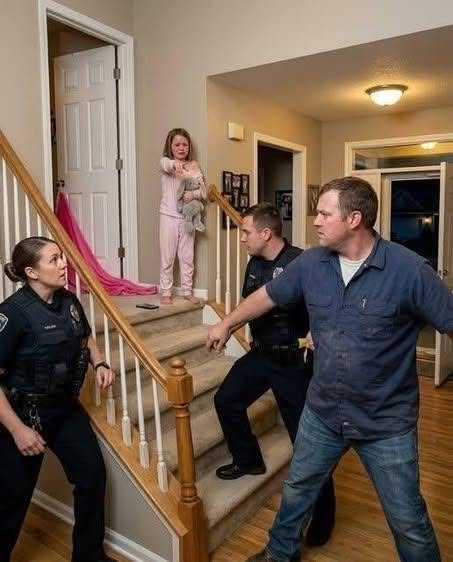
Officer María López was still kneeling beside her at the bottom of the staircase, one arm around the little girl’s shoulders and the other holding the blanket closed beneath Emily’s chin.
Daniel Harris stood in the hallway with the silver key resting in his gloved palm.
Thomas Miller stood several feet away.
His face had changed.
The polite homeowner who had opened the door minutes earlier was gone.
So was the irritated father.
What remained was something colder.
Cornered.
Calculating.
Daniel looked at him.
“What’s behind the basement door?”
Thomas said nothing.
“Mr. Miller.”
“It’s storage.”
Emily made a tiny sound.
María felt it before she heard it.
The child had begun shaking again.
Thomas looked toward her.
“Emily, stop this.”
María stood immediately and placed herself between them.
“You do not speak to her.”
“She’s my daughter.”
“Not another word to her.”
Thomas’s jaw tightened.
“You’re frightening her.”
María stared at him.
“No.”
“She was frightened before we arrived.”
That silenced him.
Daniel spoke into his radio.
“Dispatch, request supervisor and investigative unit. Preserve scene. We may have additional evidence and possibly additional victims.”
The words additional victims changed the atmosphere.
Even Thomas reacted.
“You have no idea what you’re talking about.”
Daniel looked at the key.
“Then you won’t mind us finding out.”
Thomas took one step forward.
Daniel’s hand immediately rose.
“Stay where you are.”
“I’m telling you that basement is private property.”
“And I’m telling you there is a child standing five feet away who called emergency services and described being hurt.”
Thomas looked toward Emily.
María blocked his view again.
“Enough.”
Paramedics were waiting outside.
María crouched beside Emily.
“Sweetheart, we’re going to take you somewhere safe so a doctor can make sure you’re okay.”
Emily clutched the stuffed rabbit.
“Are you coming?”
The question almost broke María.
“I’ll come outside with you.”
“Are you leaving me?”
“No.”
“Promise?”
María hesitated.
Police officers learned to be careful with promises.
Never promise someone will live.
Never promise someone will go home.
Never promise someone will never be hurt again when the world is too complicated to guarantee it.
So María chose something she could promise.
“I promise you will not be alone while we figure out who can stay with you.”
Emily stared at her.
“Not Daddy?”
“Not tonight.”
Emily’s entire body loosened.
Not much.
Just enough for María to notice.
And that tiny release told her more than Thomas’s denials ever could.
As they walked toward the ambulance, Emily stopped.
“My bunny.”
“You have him.”
Emily shook her head.
“No.”
She looked toward the basement.
“Not Bunny.”
María frowned.
“What do you mean?”
Emily whispered:
“The other bunny.”
María looked at Daniel.
He had heard it too.
“Who has the other bunny, Emily?”
The little girl lowered her eyes.
“Lily.”
Thomas suddenly shouted from inside the house.
“There is no Lily!”
Emily screamed.
María pulled her close.
Daniel turned toward Thomas.
“Put your hands behind your back.”
“What?”
“You heard me.”
“You cannot arrest me because a child invented some imaginary—”
“Hands behind your back.”
Thomas resisted just enough to make his intention clear.
Daniel and another arriving officer restrained him.
Emily buried her face against María.
“Don’t let him be mad.”
María held her tighter.
“You don’t have to take care of his feelings anymore.”
Emily looked up.
She seemed confused.
As though no adult had ever told her that before.
Thomas Miller was placed in a patrol vehicle while officers secured the house.
A supervisor arrived.
Then detectives.
Then child-protection investigators.
The basement door remained closed until the appropriate search authority was confirmed.
Nobody wanted a mistake.
Not tonight.
Not with a child’s safety depending on every step being done correctly.
At 10:04 p.m., investigators opened it.
The room beyond was not a dungeon.
That almost made it worse.
It looked ordinary.
Concrete floor.
Laundry shelves.
A water heater.
Boxes.
A workbench.
A freezer.
Then, behind a shelving unit, officers found another door.
The silver key fit.
Daniel did not go inside first.
A detective did.
Within minutes, the entire basement became a protected crime scene.
They found no child inside.
That was the first mercy.
But they found evidence suggesting Emily had not been the only child Thomas had manipulated or frightened.
Personal belongings.
Names.
Old photographs.
Notes.
Digital storage devices.
A collection of inexpensive stuffed animals.
One was a small white rabbit.
A faded name had been written on the tag.
Lily.
The investigation had just become much larger.
Across town, Claire Johnson was still sitting at her dispatch console.
The original 911 call had ended.
But she could not stop hearing Emily’s voice.
Daddy’s snake bites me.
Daddy says it’s our secret.
Claire had handled shootings.
Car crashes.
Suicides.
House fires.
Overdoses.
She had talked people through CPR while relatives screamed in the background.
She had listened to a man die while his wife begged him to breathe.
She had heard things that followed her home.
But children were different.
Children did not always have the vocabulary adults expected.
They described danger using the language available to them.
Monsters.
Games.
Secrets.
Snakes.
Bad dreams.
Claire had learned never to laugh at strange words.
Never correct too quickly.
Never assume a child meant something harmless merely because the child could not name it properly.
At 11:17 p.m., María called dispatch.
“Claire?”
“Yes.”
“She’s safe.”
Claire closed her eyes.
Nobody around her knew how badly she needed those two words.
“Thank you.”
“She asked about you.”
Claire opened her eyes.
“What?”
“She asked who the lady on the phone was.”
Claire looked at the blinking screens around her.
“What did you tell her?”
“That your name was Claire.”
A pause.
“And that you believed her.”
Claire covered her mouth.
“Good.”
Her voice broke.
“Tell her… tell her she was very brave.”
María was quiet.
Then said:
“I’m going to tell her she did something brave.”
Claire understood the difference.
Emily was not required to become “the brave girl” forever because something terrible had happened.
She was eight.
She deserved to be frightened.
Angry.
Confused.
Silly.
Loud.
Quiet.
Ordinary.
She deserved an identity larger than what someone had done to her.
“That’s better.”
Claire whispered.
At the hospital, Emily refused to let go of the rabbit.
A pediatric nurse named Hannah sat beside her.
No one demanded explanations.
No one asked the same question fifteen different ways.
A specially trained team took over.
María remained nearby until child protective services located Emily’s maternal aunt.
Her name was Sarah Bennett.
She lived forty minutes outside Springfield.
When Sarah arrived, she ran down the hospital corridor so quickly that a nurse had to stop her before she entered Emily’s room.
“Please.”
Sarah gasped.
“That’s my niece.”
“We know.”
“Is she alive?”
“Yes.”
Sarah collapsed against the wall.
The question itself told María something.
Sarah had not asked:
What happened?
She had asked:
Is she alive?
María approached.
“I’m Officer López.”
Sarah looked at her.
“Where’s Thomas?”
“In custody.”
Sarah began crying.
“Thank God.”
María’s expression changed.
“You were worried about him?”
“I was worried about Emily.”
“Why?”
Sarah pressed both hands over her face.
“My sister died three years ago.”
Emily’s mother.
Rebecca.
Cancer.
Sarah continued.
“After Rebecca died, Thomas stopped letting me see Emily.”
“He said she needed stability.”
“He changed his number.”
“He returned birthday presents.”
“I called child services twice.”
María’s chest tightened.
“What did you report?”
“That something felt wrong.”
“Did Emily tell you anything?”
“No.”
Sarah looked ashamed.
“That was the problem.”
“I didn’t have anything concrete.”
“Thomas told everyone I was trying to interfere because I hated him.”
“Did you?”
“Yes.”
The answer came immediately.
“I hated him.”
“But I hated him because my sister was afraid of him before she died.”
María became very still.
“Afraid how?”
“Controlling.”
“Money.”
“Friends.”
“Her phone.”
“Who she saw.”
“He never hit her in front of me.”
“She never told me he did.”
“But she changed around him.”
Sarah wiped her eyes.
“She used to fill a room.”
“Then she started asking permission to speak inside her own house.”
María wrote everything down.
“Did Rebecca ever mention concerns about Emily?”
Sarah shook her head.
“Not like this.”
“Rebecca was sick for almost two years.”
“Thomas became the primary caregiver near the end.”
“She kept telling me she was worried about leaving Emily.”
“I thought she meant because she was dying.”
Sarah’s voice collapsed.
“What if she meant something else?”
María gently interrupted.
“You cannot answer that tonight.”
“But—”
“You cannot punish yourself with questions nobody can answer.”
Sarah looked toward Emily’s room.
“I should have tried harder.”
“You did try.”
“Not enough.”
“Maybe.”
María did not lie to comfort her.
“Maybe there were other things someone could have done.”
“But right now Emily needs an adult who can stay steady.”
“Can you do that?”
Sarah straightened.
“Yes.”
“Then start there.”
When Sarah entered the room, Emily stared at her for several seconds.
Then whispered:
“Aunt Sarah?”
Sarah stopped.
She did not rush forward.
She waited.
“Yes, sweetheart.”
Emily’s lower lip trembled.
“You came?”
Sarah cried.
“Yes.”
Emily opened her arms.
Sarah crossed the room.
The sound Emily made when her aunt held her was not quite a sob.
It was deeper.
The sound of a child discovering that someone she thought had disappeared had been trying to find her all along.
“I thought you forgot me.”
Sarah shook her head fiercely.
“Never.”
“Daddy said you didn’t want me.”
“No.”
Sarah pulled back enough to look into her eyes.
“No, Emily.”
“I wanted you every day.”
Emily began crying.
“He said Mommy’s family didn’t love me.”
“He lied.”
The words came out before Sarah could soften them.
Then she stopped.
She looked at the child.
“He lied about that.”
she repeated more carefully.
“I love you.”
“Grandma loves you.”
“Uncle Ben loves you.”
“Everybody has been asking about you.”
Emily looked stunned.
A whole family restored to existence in four sentences.
“Really?”
“Really.”
Emily leaned against her.
Sarah held her for a long time.
Outside the room, María turned away.
Police work taught people to witness the worst moments of strangers’ lives.
Sometimes, if you were lucky, you also witnessed the first inch of the road back.
The next morning, Thomas Miller appeared before a judge.
Initial charges were filed.
More would come only if supported by evidence.
Investigators were careful.
Rumors moved faster than facts.
News vans appeared outside the neighborhood.
Social media invented details.
People who had never met Emily suddenly claimed to know exactly what had happened.
Police released almost nothing.
That was deliberate.
Emily’s privacy mattered more than public curiosity.
Thomas hired an attorney.
He denied wrongdoing.
He claimed Emily had misunderstood innocent behavior.
He claimed the police had overreacted.
He claimed Sarah had poisoned the child against him.
He claimed officers had misinterpreted objects in the basement.
He claimed the digital evidence had been taken out of context.
He claimed many things.
Evidence had to answer him.
Not outrage.
Not rumor.
Evidence.
Detective Nora Patel was assigned lead investigator.
She had worked child-abuse cases for fourteen years.
Her first rule was simple:
Do not make the child carry the whole case.
Children forget dates.
They confuse sequences.
They use unusual language.
They protect people who hurt them.
They retract true statements because telling the truth creates consequences they cannot emotionally survive.
A good investigation looked outward.
Digital records.
Witnesses.
School notes.
Medical records.
Phone data.
Financial records.
Old addresses.
Prior complaints.
Former neighbors.
Photographs.
Travel.
Employment.
Connections.
The locked room gave them names.
One name appeared repeatedly.
Lily Morgan.
Nora found her.
She was fifteen now.
Living in Missouri.
Thomas had dated her mother briefly when Lily was nine.
When investigators first contacted the family, Lily denied everything.
Nora did not push.
Two weeks later, Lily called back.
“I had a rabbit.”
Nora became still.
“What kind?”
“White.”
“Thomas gave it to me.”
Lily’s voice trembled.
“He called bad things the snake too.”
That statement changed the case.
Not because it proved everything by itself.
Because it provided a path investigators could independently test.
Lily eventually gave a formal statement with a trained interviewer.
Another name followed.
Then another.
Not every lead became an allegation.
Not every allegation could be substantiated.
Investigators refused to inflate the case.
That mattered.
Truth did not need exaggeration.
What they could prove was already devastating.
Thomas had spent years building separate worlds around children.
Secrets.
Rewards.
Threats.
Isolation.
Language designed to confuse.
He told children that adults would blame them.
He told them police would take them away.
He told them mothers and relatives would stop loving them.
He taught fear to wear the costume of secrecy.
Emily’s 911 call tore a hole through that system.
But Emily did not understand any of this.
She was eight.
Her immediate problems were different.
She hated sleeping alone.
She screamed when doors clicked shut.
She would not eat food Thomas used to cook.
She hid her shoes beneath Sarah’s bed because she was afraid someone would take her away before she could put them on.
For three weeks, she slept holding Sarah’s sleeve.
Sarah did not complain.
A child therapist named Dr. Naomi Reed began working with her.
The first sessions contained almost no talking.
Emily drew.
Mostly houses.
Every house had too many doors.
One afternoon, Naomi asked:
“Which door is yours?”
Emily pointed to the smallest.
“Does it lock?”
Emily nodded.
“From which side?”
Emily stared at her.
Then erased the lock.
That was progress.
Tiny.
Almost invisible.
But progress.
Claire thought about Emily constantly.
She was not supposed to become personally involved with callers.
Boundaries existed for good reasons.
Then a letter arrived at the emergency communications center.
It was written in purple crayon.
Dear phone lady,
Thank you for not hanging up.
I have my bunny.
Aunt Sarah says I can call people if I’m scared.
I am not in trouble.
Emily
Claire went into the break room and cried for twenty minutes.
Her supervisor found her.
“Bad call?”
Claire handed him the letter.
He read it.
Then sat beside her.
“Good call.”
Claire shook her head.
“No.”
“What?”
“She made the call.”
He looked at her.
Claire wiped her face.
“She saved herself.”
The supervisor nodded.
“Then you helped her stay on the line.”
That Claire could accept.
She wrote back.
Not directly to Emily’s home.
Through the approved victim-services channel.
Dear Emily,
I’m glad you called.
You never have to apologize for asking for help.
You did the right thing.
I hope your bunny is getting plenty of hugs.
Claire
Emily kept the letter.
Years later, it would still be folded inside a box beneath her bed.
The legal case took more than a year.
That frustrated the public.
It frustrated Sarah.
Sometimes it frustrated Emily.
“Why isn’t it over?”
she asked.
Sarah wanted to say:
Because adults make everything too complicated.
Instead she said:
“Because people have to be careful when they decide something this important.”
“Do I have to see Daddy?”
“Not right now.”
“Ever?”
Sarah’s heart stopped.
“We’ll talk about that with the people helping us.”
Emily stared at her.
“I don’t want to.”
Sarah took her hand.
“Then we tell them that.”
“Will they listen?”
“We’ll make sure they hear you.”
Emily looked uncertain.
She had spent too long learning that adults could hear words without listening to them.
The criminal case eventually ended without Emily having to testify in open court.
Thomas accepted a plea agreement after prosecutors presented the defense with the strength of the corroborating evidence and additional charges he faced if the matter proceeded to trial.
The sentence was substantial.
Long enough that Emily would be an adult before any realistic possibility of release became relevant.
At sentencing, several survivors submitted statements.
Emily’s was short.
Sarah helped her write it, but the words were hers.
The prosecutor read them.
My name is Emily.
I used to think secrets were things you had to keep because grown-ups said so.
Now I know there are surprises and there are secrets that make you scared.
If a secret makes you scared, you can tell.
I called 911 because I thought I was going to get in trouble.
Claire told me to stay on the phone.
Officer María told me I wasn’t in trouble.
Aunt Sarah told me she never forgot me.
I want other kids to know that too.
Thomas stared at the table.
Emily was not in the courtroom.
Sarah had insisted that her healing would not become a performance for adults.
After sentencing, reporters surrounded Sarah.
“Do you feel justice was done?”
“Do you forgive Thomas?”
“Does Emily feel safe now?”
“Will she ever speak publicly?”
Sarah stopped.
She looked directly at the cameras.
“My niece is nine years old.”
The questions stopped.
“She is not a symbol.”
“She is not a headline.”
“She does not owe anyone the details of the worst period of her childhood.”
“She is going home to eat macaroni and cheese and complain about homework.”
“That is all I have to say.”
Then she left.
Emily was indeed at home.
She was complaining about math.
Sarah had never been so grateful for fractions.
Life after trauma did not become inspirational overnight.
Some months were ugly.
Emily had nightmares.
Then weeks without them.
Then they returned.
She hated Father’s Day projects at school.
The first year, her teacher quietly offered her a different assignment.
Emily drew Sarah.
Underneath she wrote:
The person who came.
Sarah cried in the school parking lot.
At ten, Emily became obsessed with swimming.
The first lesson terrified her.
She would not put her face underwater.
Sarah sat beside the pool.
“You don’t have to.”
Emily glared.
“I want to.”
“Then take your time.”
“I hate when people say that.”
“Why?”
“Because everybody says healing takes time.”
Sarah smiled sadly.
“Fair.”
Emily took a breath.
Then submerged her face for one second.
Came up sputtering.
And laughed.
That laugh mattered more than any courtroom sentence.
At eleven, she asked Sarah:
“Why didn’t Mommy know?”
Sarah had dreaded that question.
“I don’t know what your mom knew.”
“Did she know Daddy was bad?”
“She knew he could be controlling.”
“Why didn’t she leave?”
Sarah sat beside her.
“Your mom was sick.”
“Before that.”
“I don’t know.”
Emily became angry.
“You always say you don’t know.”
“Because I don’t want to lie to you.”
Emily stood.
“Maybe she didn’t love me enough.”
Sarah’s face crumpled.
“No.”
“You don’t know!”
Emily shouted.
Then ran upstairs.
Sarah did not follow immediately.
Dr. Naomi had taught her something important.
Not every slammed door required pursuit.
Sometimes love waited on the other side without forcing entry.
Ten minutes later, Sarah sat outside Emily’s room.
“You’re right.”
Silence.
“I don’t know everything.”
Silence.
“I know your mother loved you.”
The door opened slightly.
“How?”
Sarah smiled through tears.
“Because I knew her.”
“She carried your kindergarten picture in her wallet even though you hated that picture.”
Emily almost smiled.
“She saved every drawing.”
“She once drove forty minutes back to a restaurant because you left a plastic bracelet there.”
“It cost maybe fifty cents.”
Emily opened the door farther.
“Why?”
“Because you were crying.”
Sarah continued.
“Your mom loved you.”
“Love doesn’t always make people see every danger.”
“Sometimes adults miss things.”
“Sometimes people who hurt others are very good at hiding what they’re doing.”
“Your mom dying did not mean she chose to leave you with danger.”
Emily cried.
“I miss her.”
Sarah opened her arms.
Emily came to her.
“I know.”
At twelve, Emily asked to meet Claire.
The request went through proper channels.
Claire agreed.
They met at a child advocacy center.
Claire had imagined the meeting hundreds of times.
In every imaginary version, she knew exactly what to say.
When Emily walked in, Claire forgot all of it.
She was taller now.
Brown hair tied back.
Stuffed rabbit absent.
A blue bracelet around one wrist.
Emily looked at her.
“You sound different.”
Claire laughed through tears.
“So do you.”
“I was eight.”
“I know.”
Emily stood awkwardly.
Then asked:
“Can I hug you?”
Claire nodded.
Emily hugged her.
Claire closed her eyes.
Four years earlier, she had known this child only as a frightened voice in her headset.
Now Emily was real.
Warm.
Alive.
Growing.
When they sat down, Emily asked:
“Were you scared?”
Claire considered lying.
“No.”
Then stopped.
“Yes.”
Emily looked surprised.
“You sounded calm.”
“That was my job.”
“So you were pretending?”
“No.”
Claire smiled.
“Being calm doesn’t mean you aren’t scared.”
“It means you decide what to do while you’re scared.”
Emily absorbed that.
“Were you mad?”
“Yes.”
“At me?”
“Never.”
Emily looked down.
Even four years later, the question still existed.
Claire leaned forward.
“Emily.”
The girl looked up.
“I was never angry with you.”
“Not for calling.”
“Not for being afraid.”
“Not for how you explained it.”
“Not for anything.”
Emily nodded.
Then whispered:
“Okay.”
Sometimes healing arrived as a word finally reaching the place it had been trying to reach for years.
At thirteen, Emily stopped therapy.
At fourteen, she returned.
That was healing too.
At fifteen, she had her first boyfriend.
Sarah nearly lost her mind.
Emily found this hilarious.
His name was Noah.
He played trumpet badly and had terrible hair.
Sarah distrusted him on principle.
Dr. Naomi reminded her that protecting Emily did not mean imprisoning her.
That was difficult.
Trauma affected families too.
Sarah had become hypervigilant.
Every sleepover seemed dangerous.
Every adult man deserved suspicion.
Every unanswered text became catastrophe.
One night Emily came home twenty minutes late.
Sarah exploded.
“Where were you?”
“My phone died.”
“You could have borrowed someone’s!”
“I was walking!”
“You know what can happen!”
Emily froze.
The sentence hung between them.
Sarah immediately regretted it.
Emily’s face hardened.
“Yes.”
she said.
“I know exactly what can happen.”
Then she went upstairs.
Sarah sat at the kitchen table.
She realized she had done something she had promised never to do.
She had turned Emily’s past into a leash.
The next morning, Sarah apologized.
“I was scared.”
Emily crossed her arms.
“I know.”
“That doesn’t make what I said okay.”
Emily looked at her.
Sarah continued.
“What happened to you does not mean you lose the right to grow up.”
Emily’s expression softened.
“I still have to text?”
“Yes.”
“Annoying.”
“Correct.”
They hugged.
At sixteen, Emily changed her last name.
Not legally yet.
At school, she began using her mother’s maiden name.
Bennett.
Emily Bennett.
The first time a teacher called attendance and said it aloud, Emily raised her hand.
“Here.”
One word.
A new beginning.
At eighteen, she made it legal.
Sarah accompanied her to the courthouse.
The clerk asked:
“Reason for name change?”
Emily wrote:
Personal preference.
Nothing else.
She did not owe the government a memoir.
Outside, Sarah took a photograph.
Emily held the order in one hand.
“What do you want to do now?”
Sarah asked.
“Get pancakes.”
“That’s it?”
“I’m eighteen.”
“I have a new name.”
“I want pancakes.”
So they ate pancakes.
Emily graduated high school that spring.
Claire attended.
So did María.
Daniel came too.
Dr. Naomi sat in the back.
Lily Morgan, now twenty-five, sent flowers.
The card said:
You opened a door for more people than you knew.
Emily cried when she read it.
Then tucked the card into her graduation gown pocket.
She attended college in Chicago.
Sarah hated the distance.
Emily loved it.
Both feelings were allowed.
Her first semester was difficult.
Not because she could not handle academics.
Because freedom was frightening.
For years, adults had watched her closely.
Therapists.
Caseworkers.
Family.
Teachers.
Police.
Doctors.
Now she could walk out of her dorm at midnight and nobody knew.
Some survivors respond to freedom by avoiding risk.
Emily sometimes did the opposite.
She stayed out too late.
Drank too much twice.
Dated someone who treated her badly because cruelty felt familiar enough to mistake for chemistry.
When Sarah confronted her, Emily exploded.
“I am not eight!”
“I know.”
“Stop acting like I’m going to break!”
“I’m not.”
“You are!”
Sarah cried after they hung up.
Then did something hard.
She backed away.
Not disappeared.
Backed away.
Emily needed to make ordinary mistakes without every mistake becoming evidence of damage.
At twenty, Emily ended the unhealthy relationship herself.
No dramatic rescue.
No police.
No Sarah arriving at the door.
She looked at the young man and said:
“I don’t like who I become around you.”
Then left.
She called Sarah afterward.
“I broke up with him.”
Sarah gripped the phone.
“Do you want advice or listening?”
Emily laughed.
“Naomi taught you that.”
“Yes.”
“Listening.”
So Sarah listened.
At twenty-two, Emily graduated with a degree in social work.
People assumed she had chosen the field because of what happened to her.
That annoyed her.
At graduation dinner, Daniel asked:
“Why social work?”
Emily answered:
“Because people need help navigating systems designed by people who already know how the systems work.”
María smiled.
“Good answer.”
Emily added:
“And because organic chemistry nearly killed me.”
Everyone laughed.
She worked first with families facing housing instability.
Not abuse survivors.
Not children.
She needed distance.
Her story did not obligate her to make trauma her profession.
At twenty-seven, she changed direction.
She completed graduate training and eventually began working in a child advocacy program.
Not because she wanted to become Claire.
Or María.
Or Naomi.
Because she had learned something from each of them.
Claire had listened to language without demanding perfect vocabulary.
María had believed fear without making promises she could not keep.
Naomi had helped without turning recovery into a deadline.
Sarah had stayed.
Emily wanted to help build systems where those things were normal rather than exceptional.
Her first week, a six-year-old boy refused to speak.
Everyone waited.
Emily sat on the floor and colored.
Twenty minutes later, he handed her a green crayon.
That was the entire session.
Afterward, a new intern said:
“We didn’t accomplish much.”
Emily looked at the green crayon in her hand.
“Yes, we did.”
“What?”
“He decided I was safe enough to hand something to.”
The intern never forgot that.
At thirty, Emily married.
His name was Julian Carter.
He was a librarian.
Sarah approved of him immediately, which made Emily suspicious.
“Why do you like him?”
“He returns books on time.”
“That’s your standard?”
“At my age, reliability is attractive.”
Emily laughed.
Before the wedding, Emily had one conversation with Julian she had postponed for months.
They sat on their apartment floor surrounded by invitation envelopes.
“There are things about my childhood you know generally.”
Julian put down the pen.
“You don’t have to tell me anything you don’t want to.”
“I know.”
She looked at him.
“That’s why I want to.”
Emily told him enough.
Not everything.
Enough.
Julian did not ask for details.
He did not say he wished he could kill Thomas.
He did not turn her history into a story about his rage.
He took her hand.
“What do you need from me?”
Emily began crying.
She laughed at herself.
“Apparently that question.”
He waited.
“I need you to know sometimes I freeze.”
“Okay.”
“Sometimes closed doors bother me.”
“Okay.”
“I hate people joking about keeping secrets from spouses.”
“Okay.”
“And if we have children…”
She stopped.
Julian waited.
Emily’s voice became tiny.
“What if I don’t know how to keep them safe?”
Julian moved closer.
“You don’t have to know everything.”
“What if I miss something?”
“We both might.”
“What if—”
“Emily.”
She looked at him.
“We will listen.”
That was the promise.
Not:
Nothing bad will ever happen.
No parent could promise that.
Not:
I will protect them from the entire world.
Impossible.
Just:
We will listen.
Emily married him.
Claire attended.
María attended.
Sarah cried before the ceremony even began.
At the reception, Toby—Sarah’s husband by then, not to be confused with any childhood friend—asked Claire how she knew the bride.
Claire smiled.
“She called me once.”
That was all.
Emily did not want her wedding toast to become a survival narrative.
So nobody made it one.
She danced.
Ate too much cake.
Kicked off her shoes.
Laughed until midnight.
Ordinary joy was not a lesser ending.
It was the ending she had fought for.
Emily and Julian eventually had a daughter.
Rebecca.
Named after Emily’s mother.
When Rebecca was born, Emily held her and felt love so intense it frightened her.
For the first months, she barely slept.
Not because the baby was unusually difficult.
Because Emily kept checking the locks.
Checking the monitor.
Checking windows.
Watching anyone who held Rebecca.
Julian noticed.
One night, he found Emily sitting beside the crib at three in the morning.
“She’s breathing.”
he whispered.
“I know.”
“You checked five minutes ago.”
“I know.”
Julian sat beside her.
“You’re scared.”
Emily began crying.
“What if I fail her?”
“You will.”
Emily stared at him.
“That is a terrible thing to say.”
He smiled gently.
“We’re parents.”
“We’re going to fail her in small ways.”
“We’ll misunderstand her.”
“Get impatient.”
“Miss things.”
“Say something stupid.”
Emily looked at the sleeping baby.
Julian continued.
“The goal cannot be perfection.”
“Then what is it?”
“When we know better, we do better.”
“When she tells us something, we listen.”
“When we make mistakes, we repair them.”
Emily rested her head against him.
“And we never make her keep scary secrets.”
“Never.”
Rebecca grew.
At four, she spilled grape juice on a white rug and tried to hide it with a pillow.
Emily discovered it.
Rebecca burst into tears.
“I’m sorry!”
Emily stared at the purple stain.
Then started laughing.
Rebecca looked horrified.
“It’s not funny!”
“It’s a little funny.”
“Are you mad?”
“No.”
“Am I in trouble?”
“You have to help clean it.”
Rebecca nodded seriously.
Emily knelt.
“And sweetheart?”
“Yes?”
“Surprises can be fun.”
“Secrets about birthday presents can be okay for a little while.”
“But if anyone ever tells you to keep something secret because you’ll get in trouble if you tell Mommy or Daddy, you tell us.”
Rebecca frowned.
“What if they say you’ll be mad?”
“You still tell.”
“What if I did something bad?”
“You still tell.”
“What if—”
Emily smiled.
“You still tell.”
Rebecca nodded.
“Okay.”
They cleaned the rug.
The stain never completely disappeared.
Emily kept it.
Years later, Julian suggested replacing the rug.
“No.”
“Why?”
“I like that stain.”
“You’re strange.”
“I know.”
It reminded her of something important.
A child should be more afraid of losing a rug than losing a parent’s love.
Thomas remained incarcerated.
For many years, Emily refused every attempt at contact.
Letters arrived through attorneys.
She returned them unopened.
At thirty-seven, she changed her mind.
Not about seeing him.
About reading one letter.
She sat with Naomi, who had become semi-retired but agreed to meet.
“Why now?”
Naomi asked.
“I don’t know.”
“Curiosity?”
“Maybe.”
“Forgiveness?”
“No.”
“Closure?”
Emily rolled her eyes.
“I hate that word.”
Naomi smiled.
“I remember.”
Emily opened the letter.
Thomas wrote that prison had changed him.
That he had found religion.
That he thought about Emily daily.
That he was sorry for “the pain surrounding her childhood.”
Emily stopped.
“Surrounding?”
Naomi said nothing.
Emily continued.
Thomas wrote that he hoped someday she could remember he had also packed her lunches.
Read bedtime stories.
Taken her to the zoo.
Loved her.
Emily put the letter down.
“I hate this.”
“You can stop.”
“No.”
She finished.
At the bottom:
I hope you can forgive me before I die.
Emily folded the letter.
Naomi waited.
Finally Emily said:
“He still wants me to do something for him.”
“What?”
“Forgive him so he can feel better.”
Naomi nodded.
Emily stared out the window.
“I used to think forgiveness was the final level of healing.”
“And now?”
“I think people like neat endings.”
She looked at Naomi.
“I don’t hate him every day.”
“I don’t think about him every day.”
“My life is bigger than him.”
“Isn’t that enough?”
Naomi smiled.
“It can be.”
Emily never answered the letter.
That was not bitterness.
It was a boundary.
Years later, after Thomas died in prison, a reporter contacted her.
The case had been remembered locally because of the unusual 911 call.
The reporter asked:
“Do you feel closure now?”
Emily replied:
“My life was not waiting for him to die before it could continue.”
The reporter became quiet.
Emily continued.
“I hope you print that sentence.”
She did.
Claire retired after thirty-two years in emergency communications.
At her retirement ceremony, the department played recorded messages from colleagues.
Then the chief said:
“We have one more.”
Emily walked onto the stage.
Claire covered her mouth.
“Oh, no.”
Emily laughed.
“Oh, yes.”
She stood beside her.
“I was eight when I met Claire.”
The room became quiet.
“I didn’t know what words to use.”
“I didn’t understand what was happening to me well enough to explain it the way adults might have expected.”
“But Claire did something very simple.”
“She listened to what I was trying to say.”
Claire cried.
Emily continued.
“People sometimes tell Claire she saved my life.”
“I know she doesn’t like that.”
Claire shook her head through tears.
“She didn’t make the call.”
“I did.”
“She didn’t enter the house.”
Officers did.
“She didn’t conduct the investigation.”
Detectives did.
“She didn’t raise me afterward.”
My aunt did.
“She didn’t do my healing.”
I did.
Claire reached for Emily’s hand.
“But she stayed on the line.”
Emily squeezed it.
“And sometimes the person who stays on the line long enough for help to reach you matters for the rest of your life.”
Claire hugged her.
The room stood.
Emily whispered:
“You can hang up now.”
Claire laughed into her shoulder.
“Finally.”
María retired several years later.
Emily attended that ceremony too.
María had gray hair now.
Still the same eyes.
Emily brought the old stuffed rabbit.
María recognized it immediately.
“You still have him?”
“Of course.”
“What was his name?”
Emily smiled.
“Bunny.”
María stared.
“All these years, I assumed he had some elaborate name.”
“I was eight.”
They laughed.
Emily handed María a small box.
Inside was the silver key.
Or rather, a replica.
The original remained evidence for years before being destroyed according to procedure.
On the replica was engraved:
YOU OPENED THE DOOR.
María cried.
Then shook her head.
“No.”
“What?”
“You did.”
Emily smiled.
“We both did.”
That was more accurate.
Sarah lived long enough to see Rebecca graduate college.
At eighty-four, she developed heart failure.
Emily moved her into a small cottage behind her own house.
Sarah complained.
“I don’t need babysitting.”
“You used to check whether I was breathing.”
“You were eight.”
“You’re eighty-four.”
“Not comparable.”
“Completely comparable.”
Sarah rolled her eyes.
The cottage had a bright red front door.
No lock Sarah could not operate herself.
That detail mattered to Emily.
One evening, Sarah and Emily sat on the porch.
Rebecca had gone home.
Julian was inside cooking.
Sarah asked:
“Did I do okay?”
Emily frowned.
“At what?”
“You.”
Emily laughed.
“That’s a large category.”
“I mean after.”
Emily became quiet.
Sarah looked toward the yard.
“I spent years afraid I’d make it worse.”
“You did sometimes.”
Sarah looked offended.
Emily smiled.
“You asked.”
“Cruel child.”
“You became overprotective.”
“Yes.”
“You interrogated every boy I dated.”
“Necessary.”
“You once called the mother of a girl whose sleepover I attended four times.”
“She seemed evasive.”
“She was making lasagna.”
“Suspicious dish.”
Emily laughed.
Then took Sarah’s hand.
“You stayed.”
Sarah’s eyes filled.
Emily continued.
“You apologized when you got it wrong.”
“You went to therapy too.”
“You never told me I had to forgive anybody.”
“You let me be angry at Mom without acting like that meant I didn’t love her.”
“You didn’t make me grateful every day because you took me in.”
Sarah cried.
“You were my niece.”
“I know.”
“I never thought of it as taking you in.”
“I know.”
Emily leaned against her.
“That’s why you did okay.”
Sarah died peacefully two years later.
Emily was beside her.
On Sarah’s bedside table was the Father’s Day drawing from decades earlier.
The person who came.
After the funeral, Emily found boxes of records Sarah had saved.
Court documents.
Therapy invoices.
School reports.
Letters.
Newspaper clippings Sarah had never shown her.
At the bottom was a folder labeled:
EMILY — NOT FOR HER UNLESS SHE ASKS.
Inside were copies of Sarah’s early attempts to contact child services.
Emails to Thomas.
Returned birthday cards.
Photographs.
Proof.
Proof that Sarah had not forgotten.
Emily sat on the floor and cried like she was eight again.
Julian found her.
“She tried.”
Emily whispered.
“I know.”
“No.”
Emily held up the papers.
“She really tried.”
Julian sat beside her.
Emily had known intellectually.
Now she could see the dates.
The calls.
The certified mail.
The notes.
Love had left a paper trail.
She pressed the folder against her chest.
For years, one of Thomas’s cruelest lies had been that nobody wanted her.
Even after she learned it was false, some tiny part of the child inside her had remained uncertain.
The folder closed that wound more than any courtroom ever had.
At sixty-one, Emily became executive director of the child advocacy center where she had once worked as a young social worker.
She resisted the position at first.
“I hate administration.”
Her colleague laughed.
“You already do half of it.”
“That’s different.”
“How?”
“I complain while doing it.”
She accepted.
Her first major initiative was not dramatic.
It was training.
Dispatchers.
Teachers.
School nurses.
Coaches.
Emergency-room staff.
Police.
Social workers.
She wanted adults to understand that children rarely describe frightening experiences in perfect legal language.
They use metaphors.
Fragments.
Misnamed things.
Silence.
Behavior.
Drawings.
A child might say monster.
Game.
Secret.
Snake.
The job of the adult was not to force the child into the right vocabulary.
The job was to listen carefully, protect appropriately, and let trained investigators establish facts without contaminating the child’s account.
Emily insisted on another principle:
Believing a child enough to protect and investigate does not mean abandoning careful evidence.
She had seen both failures.
Adults dismissing children too quickly.
And adults rushing beyond what evidence supported.
Children deserved better than either.
They deserved seriousness.
At one training session, a young dispatcher raised her hand.
“What if I misunderstand?”
Emily answered:
“You might.”
The room became quiet.
“What if I send police and it turns out not to be abuse?”
“Then the investigation establishes that.”
“What if I don’t send them and it is?”
The dispatcher looked down.
Emily softened her voice.
“Your job is not to know the entire truth from one sentence.”
“Your job is to recognize risk and follow your protocols.”
“Claire didn’t solve my case on the phone.”
“She heard enough to understand I needed immediate help.”
“That distinction matters.”
Afterward, the dispatcher approached.
“Were you really the girl from that call?”
Emily smiled.
“I was.”
“Does telling the story bother you?”
“Sometimes.”
“Why do it?”
Emily considered.
“Because now I choose when.”
Choice.
That word had become central to her life.
At seventy, Emily retired.
She and Julian moved closer to their grandchildren.
Rebecca had two children.
Emily was the grandmother who gave them too much ice cream and pretended not to know who drew on the garage wall.
Julian said she had become soft.
Emily said:
“I earned softness.”
She had.
Claire died at ninety-one.
Emily attended the funeral.
Claire’s daughter gave Emily a small envelope afterward.
“Mom wanted you to have this.”
Inside was the original purple-crayon letter.
Dear phone lady,
Thank you for not hanging up.
Emily stared at the childish handwriting.
For decades, Claire had kept it.
On the back, Claire had written one sentence in old age:
She thought I stayed on the line for her. She never knew how many times her voice kept me going afterward.
Emily cried.
People imagine help moving in one direction.
Rescuer to rescued.
Strong to weak.
Adult to child.
Life was rarely that simple.
Sometimes knowing one frightened child had reached safety helped a dispatcher answer another impossible call the next morning.
Sometimes a survivor’s adulthood reassured an aging police officer that the terrible nights had not been the whole story.
Sometimes the person who was helped grew up and became the person who helped.
Not because suffering was a gift.
Emily hated that idea.
What happened to her had not been necessary.
It had not made her special.
She did not thank trauma for making her strong.
She would have preferred an ordinary childhood.
A safe father.
A living mother.
No basement door.
No courtroom.
No therapy.
No nightmares.
No headline.
No famous 911 call.
If she could have traded every lesson for safety, she would have.
But she could not change what happened.
She could decide what happened next.
That was different.
At seventy-eight, Emily was invited to speak at a national conference.
The organizer wanted to title her speech:
THE GIRL WHO DEFEATED THE MONSTER.
Emily refused.
“What’s wrong with it?”
the organizer asked.
“Everything.”
“Too dramatic?”
“Too simple.”
“What title do you want?”
Emily thought.
Then smiled.
STAY ON THE LINE.
That became the title.
She stood before hundreds of professionals.
Behind her was no photograph of Thomas.
No photograph of the basement.
No childhood picture of Emily crying.
Just three words.
STAY ON THE LINE.
Emily began:
“When I was eight years old, I called 911 because I did not have the language to explain what frightened me.”
She paused.
“I used the word snake.”
“An adult could have corrected me.”
“An adult could have laughed.”
“An adult could have decided I was describing a pet.”
“Instead, someone listened to the fear underneath the word.”
The room was silent.
“That is why I am here.”
She spoke for forty minutes.
Not about Thomas.
About listening.
Systems.
Trauma-informed care.
Evidence.
Boundaries.
Agency.
She ended with something Claire had taught her without ever intending to.
“Calm is not the absence of fear.”
“Sometimes calm is fear deciding to do its job.”
The audience stood.
Emily wished Claire could have heard it.
Maybe, in the only way that mattered, she already had.
Julian died when Emily was eighty-three.
Cancer.
Slow.
Cruel.
They had been married fifty-three years.
Near the end, he lay in bed while Emily read aloud.
He had always been the librarian.
Now she chose the books.
Her selections were terrible.
He complained.
“That is not literature.”
“You’re dying.”
“I still have standards.”
She laughed through tears.
One evening, he asked:
“Are you scared?”
Emily looked at him.
“Yes.”
He smiled faintly.
“You’ve always been good at scared.”
“That sounds insulting.”
“I mean you know how to keep living beside it.”
She held his hand.
“I learned.”
After he died, Emily slept with the bedroom door open for months.
Not because of childhood.
Because the closed door made the house feel too final.
Grief invents its own rituals.
At eighty-six, she moved into a smaller home.
Rebecca wanted her closer.
Emily agreed on one condition.
“No monitoring cameras.”
“Mom.”
“No.”
“You fall.”
“I have an emergency button.”
“Cameras would be safer.”
Emily smiled.
“My house.”
Rebecca sighed.
“Fine.”
Emily laughed.
The negotiation itself delighted her.
An old woman setting boundaries with a daughter who loved her enough to worry.
No threats.
No secrets.
No punishment.
Just disagreement.
That was family.
At eighty-nine, a young researcher named Maya interviewed Emily for an oral-history project about emergency communications.
Maya placed a recorder between them.
“Do you remember the 911 call clearly?”
“Pieces.”
“What do you remember most?”
“The carpet.”
Maya looked surprised.
“Not Claire’s voice?”
“That too.”
“But mostly the carpet.”
“Why?”
“I was hiding beside a bed.”
“I remember one loose thread.”
“I kept twisting it around my finger.”
Emily looked at her old hands.
“Memory is strange.”
“The world remembers the dramatic sentence.”
“I remember carpet.”
Maya asked:
“Do you remember what you meant by snake?”
Emily became quiet.
Then said:
“I know what I meant.”
She did not elaborate.
Maya waited.
Emily smiled.
“Thank you.”
“For what?”
“For not asking again.”
Maya nodded.
The interview continued.
“Do you consider yourself brave?”
Emily groaned.
“Everyone asks that.”
“Sorry.”
“No, it’s fine.”
She thought.
“I did something brave.”
“That is different from having to become brave as an identity.”
“How?”
“If people call a hurt child brave too often, sometimes the child starts believing she isn’t allowed to fall apart.”
Maya became still.
“I fell apart plenty.”
Emily smiled.
“That was healthy too.”
“What do you think saved you?”
Emily shook her head.
“I don’t use that language much.”
“Why?”
“Because it turns life into one dramatic rescue.”
“My call mattered.”
“Claire mattered.”
“The officers mattered.”
“My aunt mattered.”
“My therapist mattered.”
“The investigators mattered.”
“The justice system mattered.”
“Friends mattered.”
“My husband mattered.”
“I mattered.”
She leaned back.
“No one person gets the entire credit.”
Maya asked:
“What about your father?”
Emily looked toward the window.
Thomas had been dead for more than forty years.
For the first time in the interview, she said his name.
“Thomas was my father.”
Not Daddy.
Not monster.
Not snake.
Thomas.
“He hurt people.”
“He also existed in ordinary moments.”
“He cooked breakfast.”
“He drove me to school.”
“He could make jokes.”
“That confused me for years.”
Maya waited.
Emily continued.
“Children are often taught that dangerous people look dangerous.”
“Sometimes they don’t.”
“Sometimes they have jobs.”
“Houses.”
“Neighbors.”
“Family photographs.”
“Sometimes they are charming.”
“Sometimes they are loved.”
“That is why we should teach children less about identifying monsters and more about identifying boundaries.”
Maya leaned forward.
“What boundaries?”
“That their bodies belong to them.”
“That adults should not demand frightening secrets.”
“That they can tell another adult when something feels wrong.”
“That they are not responsible for protecting a grown-up from consequences.”
“That love does not require silence.”
Emily paused.
“And we need adults prepared to hear them.”
At ninety-two, Emily’s health began failing.
Heart disease.
Arthritis.
Age.
Nothing poetic.
She hated her walker.
Rebecca decorated it with stickers.
Emily threatened disinheritance.
Rebecca reminded her the estate documents were already signed.
“Traitor.”
“Learned from you.”
One rainy evening, Emily sat by the window.
Rain had always affected her strangely.
For decades, the sound could pull her toward old fear.
Then, slowly, it became only weather.
That was one of the quietest miracles of her life.
Rain became rain.
Doors became doors.
Basements became basements.
Men became individuals instead of possible danger.
A ringing telephone became a telephone.
Words lost some of the power trauma had assigned them.
Not all.
Enough.
Her great-granddaughter Sophie visited.
Sophie was eight.
The age.
Emily tried not to think about it.
Sophie climbed beside her.
“Great-Grandma?”
“Yes?”
“Mom says you used to help kids.”
“I did.”
“Were you a police officer?”
“No.”
“Doctor?”
“No.”
“Teacher?”
“Sometimes.”
“What were you?”
Emily smiled.
“A listener.”
Sophie frowned.
“That’s a job?”
“One of the most important.”
Sophie thought.
Then whispered:
“I broke Mom’s blue vase.”
Emily looked at her.
“Ah.”
“She doesn’t know.”
“Why are you telling me?”
“Because you’re a listener.”
Emily laughed so hard she started coughing.
When she recovered, she said:
“You need to tell your mother.”
Sophie groaned.
“I knew there was a catch.”
“Sorry.”
“Will she be mad?”
“Probably.”
Sophie looked horrified.
Emily took her hand.
“Someone being upset with you is not the same as you being unsafe.”
Sophie considered that.
“Really?”
“Really.”
“And if you make a mistake, you can tell.”
“What if it’s a really bad mistake?”
“You can still tell.”
Sophie nodded.
Then ran to confess.
Emily watched her go.
Her eyes filled.
There it was.
The whole life.
Not in a courtroom.
Not in a conference.
Not in a newspaper headline.
In an eight-year-old child learning that truth might bring consequences without costing her love.
Emily lived to ninety-four.
Her final weeks were spent at Rebecca’s home.
Hospice brought a bed into a sunny room overlooking a maple tree.
Emily complained that everyone whispered around her.
“I’m dying.”
she said.
“Not studying for an exam.”
“Talk normally.”
So they did.
Children laughed.
Dishes clattered.
Someone burned toast.
The dog barked.
Life refused to become solemn simply because one person was leaving it.
Emily liked that.
María had died years earlier.
Claire too.
Sarah.
Julian.
Naomi.
Daniel.
So many people from the beginning were gone.
Yet they remained in gestures.
Words.
Habits.
Systems.
A dispatcher somewhere saying:
“Stay with me.”
An officer kneeling to a frightened child.
A therapist waiting through silence.
An aunt answering the door.
A mother telling her child:
“You can always tell me.”
People leave.
What they teach sometimes stays.
Two nights before Emily died, Rebecca sat beside her.
“Mom?”
“Yes?”
“Can I ask you something?”
“At my age, you should hurry.”
Rebecca laughed.
“Were you happy?”
Emily looked surprised.
“What kind of question is that?”
“A serious one.”
“For my whole life?”
“Yes.”
“No.”
Rebecca blinked.
Emily smiled.
“Nobody is happy for an entire life.”
“I was terrified.”
“Angry.”
“Lonely.”
“Heartbroken.”
“I was also ridiculously happy.”
“I loved your father.”
“I loved you.”
“I loved my work.”
“I loved Claire.”
“Sarah.”
“María.”
“Naomi.”
“I loved swimming.”
“Bad television.”
“Pancakes.”
“That purple-stained rug.”
Rebecca laughed through tears.
Emily continued.
“I had a full life.”
“That’s different from a painless one.”
Rebecca took her hand.
“Did you ever forgive him?”
Emily knew exactly who she meant.
“No.”
Rebecca seemed surprised.
“Never?”
“I stopped needing to.”
“What does that mean?”
Emily looked toward the dark window.
“For years I thought I had two choices.”
“Hate him forever or forgive him.”
“Then I realized there were thousands of other places to live.”
“I could stop thinking about him.”
“I could understand without excusing.”
“I could release anger without offering reconciliation.”
“I could build joy that had nothing to do with him.”
“I could remember.”
“I could forget for whole weeks.”
“I could simply live.”
She smiled.
“Forgiveness is meaningful when someone freely chooses it.”
“It becomes another burden when we tell injured people they must provide it to prove they healed.”
Rebecca nodded.
“Were you healed?”
Emily smiled.
“Enough.”
That word again.
Enough.
The following afternoon, rain began.
Sophie came into the room carrying something.
The stuffed rabbit.
Bunny.
Almost ninety years old.
Patched repeatedly.
One eye replaced.
Fabric faded nearly white.
Rebecca had found him in a storage box.
Sophie placed him beside Emily.
“Was this yours?”
Emily touched the worn ear.
“Yes.”
“Was he your favorite?”
“For a while.”
“What happened to him?”
“He got old.”
Sophie laughed.
“Like you?”
“Exactly.”
Emily held Bunny against her chest.
She remembered pink pajamas.
A staircase.
A phone on carpet.
María’s uniform.
Claire’s voice.
Sarah running down a hospital corridor.
She remembered fear.
But fear was no longer the largest thing in the memory.
People were.
That surprised her.
At eight, the night had seemed populated by one terrifying man.
At ninety-four, when she looked backward, she saw everyone who came after.
Claire.
Daniel.
María.
Sarah.
Hannah.
Nora.
Naomi.
Lily.
Julian.
Rebecca.
Hundreds of others.
The monster had become smaller with distance.
Not because what he did became smaller.
Because Emily’s life became so much larger.
That evening, Rebecca asked:
“Do you want the door open or closed?”
Emily looked toward it.
For years, that question would have carried weight.
Now it was ordinary.
“Open.”
she said.
“Too warm in here.”
Rebecca smiled.
“Okay.”
Emily slept.
Near dawn, she woke once.
Rain touched the windows.
Rebecca was asleep in the chair.
Sophie had left a drawing on the bedside table.
It showed a telephone.
A little girl.
And a line connecting her to another person.
Across the top, Sophie had written:
SOMEONE IS LISTENING.
Emily stared at it for a long time.
Then smiled.
That was enough.
She died shortly after sunrise.
Quietly.
The door open.
The rabbit beside her.
No fear.
At her memorial, Rebecca refused every suggestion that the service should begin with the famous 911 call.
Instead, she began with Emily’s wedding photograph.
Then one of her holding baby Rebecca.
One from a swimming pool.
One of Emily laughing beside Sarah.
One of her standing with Claire at the retirement ceremony.
One of Julian asleep with his head on Emily’s shoulder.
One of Emily eating pancakes at eighty-seven.
Then, finally, a photograph of an old telephone headset.
Rebecca stood before the room.
“Most people who know my mother’s story begin when she was eight.”
She looked at the photographs.
“I understand why.”
“But she lived eighty-six years after that call.”
“That matters.”
People cried.
“My mother was not the worst thing that happened to her.”
“She was not a case number.”
“She was not a frightened voice preserved on an emergency recording.”
“She was a wife.”
“A mother.”
“A social worker.”
“A director.”
“A grandmother.”
“A terrible cook.”
Several people laughed.
“A very aggressive Scrabble player.”
More laughter.
“A woman who kept an ugly stained rug for sentimental reasons.”
“And yes.”
Rebecca’s voice softened.
“She was once an eight-year-old girl who found enough courage to call for help using the only words she had.”
Rebecca looked toward Sophie.
“My mother spent her career teaching people that children should not need perfect words before adults take their fear seriously.”
“She also taught us something harder.”
“Rescue is not the end of a story.”
“After the police leave, someone has to stay.”
“After court, someone has to stay.”
“After therapy appointments, someone has to stay.”
“After nightmares, school days, birthdays, anger, mistakes, first loves, graduations, marriages, grief, and ordinary Tuesdays…”
Rebecca smiled through tears.
“Someone has to stay.”
“That someone was Sarah for my mother.”
“Then Julian.”
“Then friends.”
“Then us.”
“And eventually, my mother learned how to stay for herself.”
There was no applause.
It would have felt wrong.
Only silence.
Warm.
Respectful.
Complete.
Years later, the emergency communications center established a training room named after Claire Johnson.
Not Emily.
Emily had specifically refused that while alive.
“I made one call.”
she had said.
“Claire answered thousands.”
On one wall hung a sentence from Emily’s retirement speech:
A CHILD DOES NOT NEED PERFECT WORDS TO DESERVE A CAREFUL LISTENER.
New dispatchers read it during training.
Police recruits heard Emily’s case discussed without sensational details.
Social workers studied how agencies coordinated.
Teachers learned how to respond when children used confusing language.
And parents were taught perhaps the simplest lesson of all:
Do not teach children merely to fear strangers.
Teach them that no trusted adult gets unlimited authority over their boundaries.
Teach them they can speak.
Teach them they can keep speaking if the first adult does not understand.
Teach them that frightening secrets can be told.
Teach them that they will not lose love by asking for help.
The original recording of Emily’s 911 call remained sealed from public release.
That was what she wanted.
People sometimes complained.
They wanted to hear it.
They wanted the raw moment.
The fear.
The dramatic proof.
Emily had answered that request once in her seventies.
“My terror is not public entertainment.”
That ended the discussion.
The words the public needed were already known.
Not every trembling breath needed to belong to strangers.
That too was part of taking her life back.
In the end, the most important part of the story was never the monster behind the door.
Monsters attract attention.
Emily spent a lifetime learning that attention belonged elsewhere.
To the child who reached for a phone.
To the dispatcher who listened.
To the officers who took fear seriously.
To the aunt who came running.
To the therapist who never rushed.
To investigators who followed evidence instead of spectacle.
To survivors who found language years later.
To families who learned how to stay.
To an adult woman who refused to let the first eight years write the remaining eighty-six.
Thomas Miller had tried to build his power out of silence.
He taught a child that secrecy protected him.
Emily discovered something stronger.
A voice does not have to be loud to break a secret.
It only has to reach someone willing to listen.
At 9:15 on an ordinary evening in Springfield, Illinois, an eight-year-old girl had whispered into a telephone because she was terrified that her father was coming back.
She did not know the right words.
She did not know criminal statutes.
She did not understand investigations.
She did not know what her adulthood would look like.
She knew only that something hurt.
Something frightened her.
And she wanted someone to come.
Someone did.
Then another person came.
And another.
And another.
Until the secret that had once seemed larger than the whole world became only one chapter in a very long life.
Emily grew older.
She laughed.
She argued.
She swam.
She loved.
She married.
She raised a daughter.
She held grandchildren.
She lost people.
She found others.
She became frightened again sometimes.
She became peaceful sometimes.
She spent entire mornings without remembering Thomas at all.
Those mornings were victories nobody photographed.
And near the end, when an eight-year-old great-granddaughter confessed to breaking a vase because she trusted that love would survive the truth, Emily witnessed something more meaningful than revenge could ever have given her.
The secret ended with her.
Not because she became fearless.
Not because every wound disappeared.
Not because she forgave the person who caused it.
It ended because fear no longer controlled who was allowed to speak.
The little girl who once whispered,
“Daddy says it’s our secret,”
grew into an old woman surrounded by people who knew the opposite.
If something frightens you, you can tell.
If someone threatens you into silence, you can tell.
If the first words come out wrong, keep talking.
If you are afraid no one will believe you, keep reaching.
And for every adult who might someday be the person on the other end of that frightened voice:
Do not demand perfect language.
Do not make a child prove pain beautifully.
Listen.
Stay calm.
Take the fear seriously.
Follow the right steps.
Get help.
Stay on the line.
Because sometimes the first door out of darkness is not opened by a hero.
Sometimes it is opened by a frightened eight-year-old child who picks up a telephone, whispers the only words she knows—
and discovers that someone is listening.
THE END STORIES! THANK YOU FOR READING GOOD LUCK !❤️
Related Posts