➡️ PART 3 ENDING PART ➡️
“Don’t open that door!”
My mother’s scream tore through the house so violently that the laughter in the backyard seemed to vanish beneath it.
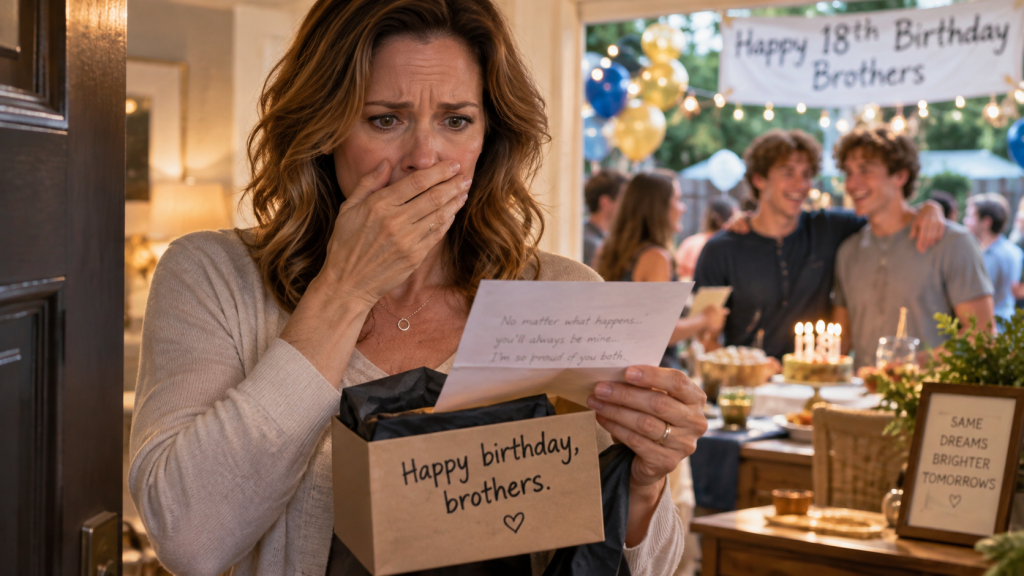
I stood in my bedroom with Julian’s letter trembling between my fingers.
For eighteen years, I had known my mother as a woman who almost never raised her voice.
She had been the calm one when my babies were born.
The practical one when Julian became sick.
The person who had held me upright in the hospital corridor when a doctor told me my son was dead.
The person who had chosen flowers when I could not.
The person who had spoken to the funeral home when my mouth refused to form words.
The person who had stood beside a tiny white casket and whispered, “You still have two babies who need you.”
Now that same woman was downstairs screaming at us not to open the front door.
And in my hands was a letter from my dead son.
Except he was not dead.
If the letter was true, he had never been dead.
Another knock sounded.
Three slow taps.
My heart struck painfully against my ribs.
Then Caleb called from downstairs.
“Laura?”
I couldn’t answer.
“Laura, what’s going on?”
My mother shouted again.
“Caleb, don’t!”
I ran.
I don’t remember crossing the bedroom.
I don’t remember the stairs beneath my feet.
I remember only reaching the hallway and seeing my mother standing in front of the door with both arms spread as if her sixty-nine-year-old body could physically keep eighteen years of truth outside.
Caleb stood beside her.
Our sons, Ethan and Noah, had come in from the backyard.
Behind them, several friends watched through the patio doors, confused by the sudden silence.
Noah looked at me.
“Mom?”
I must have looked terrifying.
“Everyone outside.”
I said.
“Mom—”
“Please.”
Something in my voice convinced him.
Ethan ushered their friends back toward the yard.
Then he and Noah stayed.
Of course they stayed.
They were eighteen now.
Old enough to vote.
Old enough to leave home.
Old enough, apparently, to discover that the brother they had mourned their entire lives might be standing on the other side of the front door.
Caleb looked at the letter in my hand.
“What is that?”
My mother saw it.
The color left her face.
Not slowly.
Instantly.
“You opened it.”
she whispered.
I stared at her.
“You knew about the box?”
She did not answer.
Caleb looked between us.
“What box?”
I held up the letter.
“Someone left a package on the porch.”
“Who?”
My voice broke.
“Julian.”
Caleb stared.
For a moment, he genuinely did not understand the name.
Then he did.
His face changed.
“What did you say?”
“Julian.”
Noah stopped breathing.
Ethan whispered:
“That’s not funny.”
“I know.”
Caleb came toward me.
“Laura.”
“He says he’s alive.”
My husband looked at me as though I had struck him.
“No.”
“I have a photograph.”
“No.”
“A hospital bracelet.”
“Laura.”
“He says Mom knows.”
Caleb turned.
My mother stepped backward.
“Margaret?”
She shook her head.
“Please.”
Caleb’s voice became frighteningly quiet.
“Why does that letter say you know?”
Another knock came.
Nobody moved.
Then a young man’s voice sounded through the door.
“I’m sorry.”
Every hair on my arms rose.
“I shouldn’t have come.”
The voice cracked.
“I just wanted to see them.”
My mother covered her mouth.
And began crying.
Not ordinary tears.
Not confusion.
Recognition.
I looked at her.
“You know that voice.”
She shook her head.
“You do.”
“No.”
“You know who is outside.”
“Laura, please listen to me.”
“Who is outside?”
My mother collapsed into the chair beside the entry table.
Caleb moved toward the door.
She grabbed his arm.
“Don’t.”
He pulled free.
“Get your hand off me.”
“Caleb—”
“If there is even a chance my son is standing outside this house, there is nothing you can say that will stop me from opening this door.”
He unlocked it.
My mother made a sound behind us.
The door opened.
A young man stood on our porch.
Rain had begun to fall.
Not hard.
A thin summer rain, silver beneath the porch light.
He wore jeans, worn sneakers, and a dark blue shirt.
His hair was almost black.
Caleb’s hair.
His shoulders were narrow like mine had been at eighteen.
His left eyebrow rose slightly higher than the right.
Noah had the same eyebrow.
Then he smiled.
Barely.
Nervously.
And my knees gave way.
Because Ethan smiled like that.
Exactly like that.
Caleb caught me.
The young man stepped forward instinctively.
Then stopped himself.
“Mom?”
I had imagined that word in Julian’s voice thousands of times.
But always as a baby.
In dreams, he never grew.
He remained three months old forever.
Tiny hands.
Soft cheeks.
The blue blanket from the hospital.
A child preserved at the age grief stole him.
Now an eighteen-year-old stranger was standing in front of me calling me Mom.
I reached toward his face.
Then stopped.
I was afraid to touch him.
Afraid he would disappear.
Afraid my hand would pass through him.
Afraid I would wake up.
He noticed.
“You don’t have to.”
he whispered.
That sentence destroyed me.
I touched his cheek.
Warm.
Real.
He closed his eyes.
My son.
Something inside me knew before any test could tell me.
Maybe that was irrational.
Maybe it was grief.
Maybe biology.
Maybe hope.
I did not care.
I pulled him toward me.
Julian broke.
His arms wrapped around my shoulders.
He sobbed into my neck.
I held the eighteen-year-old body of the baby I had spent eighteen years believing was buried beneath a stone with his name.
“Mom.”
he kept saying.
“Mom.”
I could not answer.
I could only hold him.
Caleb stood beside us with both hands over his face.
Then Julian looked at him.
“Dad?”
Caleb cried out.
Not a word.
A sound.
He pulled Julian into his arms.
I had seen my husband cry only a handful of times.
The day our sons were born.
The day we were told Julian had died.
At his father’s funeral.
Now he held Julian with one arm and reached for me with the other, as though he were terrified one of us would vanish if he did not physically keep us together.
Then I remembered.
Ethan.
Noah.
They stood several feet away.
Neither had moved.
Julian looked at them.
The house became completely silent.
Noah whispered:
“You look like Ethan.”
Ethan gave a broken laugh.
“No.”
“He looks like you.”
Julian wiped his face.
“I don’t know what I’m supposed to say.”
Noah stared at him.
“You sent the box?”
Julian nodded.
“Happy birthday, brothers?”
“Yes.”
Ethan’s eyes filled.
“You know our birthday.”
Julian laughed weakly.
“It’s mine too.”
Noah began crying.
He crossed the space between them first.
He hugged Julian.
Ethan followed a second later.
Three eighteen-year-old boys stood in my entryway with their arms around one another.
Triplets.
My triplets.
Together for the first time since they had been infants.
I covered my mouth.
Caleb held me.
And behind us, my mother whispered:
“I’m sorry.”
The three boys separated.
I turned.
My mother looked twenty years older than she had an hour earlier.
Julian’s expression changed the moment he saw her.
The softness disappeared.
He stepped backward.
Noah noticed.
“You know Grandma?”
Julian said nothing.
I looked at my mother.
“Tell us.”
“Laura—”
“Now.”
“It’s complicated.”
“Eighteen years.”
My voice shook.
“You have had eighteen years to simplify it.”
She cried harder.
“I thought I was protecting you.”
“From what?”
She looked at Julian.
He would not meet her eyes.
“From losing everything.”
I laughed.
It sounded almost hysterical.
“I buried my son.”
“I know.”
“No.”
I stepped toward her.
“You do not get to say that.”
“I stood over a casket.”
“I know.”
“I bought a headstone.”
“I know.”
“I woke up every night for a year thinking I heard him crying.”
My mother covered her face.
“I know.”
“Then tell me what you did.”
She lowered her hands.
“I didn’t do it alone.”
Caleb stiffened.
“Who?”
My mother whispered:
“Dr. Raymond Cole.”
I knew the name.
The neonatologist who had treated Julian.
The doctor who had walked into that hospital consultation room eighteen years earlier and told us our baby had died.
Caleb grabbed the back of a chair.
“Cole?”
My mother nodded.
“Why?”
She looked at Julian.
Then at me.
“The night Julian was brought back to the hospital, there was confusion.”
“What confusion?”
“He was very sick.”
“I know that.”
“There were two infants admitted close together.”
My skin went cold.
“One had no identification when paramedics arrived.”
“Stop.”
Caleb said.
My mother flinched.
“What are you saying?”
He asked.
She whispered:
“The child who died was not Julian.”
Silence.
I had known it from the letter.
But hearing my mother say it made the room tilt.
“Whose baby did we bury?”
I asked.
“I don’t know.”
Julian spoke.
“I do.”
Everyone looked at him.
His eyes were wet.
“His name was Gabriel.”
My mother closed her eyes.
Julian continued.
“Gabriel Torres.”
“He was almost four months old.”
“His mother was nineteen.”
“She had been staying at a shelter.”
“She died two days after he did.”
I felt sick.
“Why was her baby given to us?”
Julian shook his head.
“It wasn’t supposed to happen like that.”
My mother whispered:
“No.”
Caleb looked at her.
“Then tell us how it was supposed to happen.”
She sat down.
And for the next hour, my mother dismantled the history of our family.
Not neatly.
Not heroically.
Through sobs.
Interruptions.
Denials.
Questions.
And one unbearable truth after another.
Dr. Cole had made an identification error during an emergency transfer.
Julian and Gabriel had been moved between treatment areas during a chaotic night.
The initial mistake could have been corrected.
That was the important part.
It could have been corrected.
Before we were formally told Julian was dead, someone discovered the mismatch.
Julian was alive.
Gabriel was not.
But by then, the hospital faced a catastrophic error.
Records had been mishandled.
Medications documented under the wrong patient.
Notifications started under the wrong identity.
And Dr. Cole panicked.
My mother had been at the hospital.
She learned before Caleb and I did.
“What do you mean, you learned?”
I asked.
“Cole pulled me aside.”
“Why you?”
“You were sedated.”
I remembered.
After Julian was brought in, I had suffered a panic attack so severe a physician gave me medication.
Caleb had gone home briefly because Ethan and Noah were with a neighbor and needed supplies.
My mother had been the only close relative there.
“Cole told me there had been an error.”
she said.
“He said Julian was alive.”
My hands curled into fists.
“And you didn’t call me?”
“I was going to.”
“Why didn’t you?”
“Because he said there was another problem.”
Of course there was.
There is always another problem in stories people tell themselves when they need to justify the unforgivable.
“What?”
I asked.
My mother looked at Caleb.
“Julian had tested positive for a rare genetic marker associated with a condition the fertility clinic had supposedly screened for.”
Caleb frowned.
“What does that have to do with anything?”
“Cole believed it could expose errors at the fertility clinic.”
“So?”
My mother cried.
“There was a lawsuit already developing.”
Caleb stared at her.
“You hid our living child because a hospital was afraid of a lawsuit?”
“No!”
“Then why?”
“Because Cole said Julian might still die.”
The room went silent.
“He said Julian was unstable.”
“He said if they corrected the identity immediately and Julian died afterward, there would be investigations, lawsuits, media.”
I could barely breathe.
“And that mattered to you?”
“No.”
“Then what mattered?”
My mother whispered:
“Money.”
I stared at her.
She began sobbing.
There it was.
The ugliest word in the room.
Dr. Cole and a hospital administrator offered my mother money to stay quiet temporarily while they “resolved” the identification crisis.
Temporarily.
That was how evil often introduced itself.
Not forever.
Just tonight.
Just sign this.
Just wait.
Just let us fix it.
My mother had debt I knew nothing about.
My father had died leaving behind failed investments.
She had refinanced her house twice.
She was close to losing it.
The hospital offered enough money to erase everything.
“But that still doesn’t explain where Julian went.”
Caleb said.
My mother looked toward him.
“No.”
“It doesn’t.”
Julian finished for her.
“They gave me to another family.”
I felt my knees weaken again.
“Who?”
“Daniel and Rebecca Hayes.”
Julian said.
“They were foster parents.”
“They were told my parents had abandoned me during the hospital investigation.”
I stared at my mother.
“You let strangers take my baby?”
She sobbed.
“I thought it would be days.”
“Days?”
“I swear.”
“I thought they would straighten out the records.”
“Cole said Julian needed medical supervision and the Hayeses were certified.”
“He said once the hospital’s attorneys figured out how to disclose the mistake, they would bring him back.”
“How long did you wait?”
My mother did not answer.
“How long?”
“Six weeks.”
Six weeks.
I laughed.
It was not funny.
“What happened after six weeks?”
“Cole said the situation had become more complicated.”
“Of course.”
“He said the Hayeses wanted to adopt him.”
“And?”
My mother whispered:
“I signed something.”
The room disappeared around me.
“What did you sign?”
“I thought it was a confidentiality agreement.”
Julian shook his head.
“It wasn’t.”
My mother looked at him.
“I know that now.”
Julian’s voice hardened.
“You signed an affidavit saying Laura and Caleb were emotionally unstable and had relinquished involvement in my care.”
Caleb slammed his hand against the wall.
Noah jumped.
“Dad.”
Caleb turned away.
His shoulders shook.
I could not even feel anger anymore.
There are moments when pain becomes so enormous that anger looks almost small beside it.
I looked at my mother.
“You told strangers I abandoned my son.”
“I was afraid.”
“Of what?”
“Going to prison.”
That silenced me.
“Cole told me I had already participated.”
“He said the money could be treated as payment for fraud.”
“He said if I exposed them, they would say I had arranged everything.”
“And you believed him?”
“Yes.”
“Why?”
“Because part of it was true.”
Her voice cracked.
“I had taken the money.”
At last.
The real chain.
One bad decision.
Then another to hide the first.
Then another to protect the second.
Until eighteen years passed.
“Did the Hayeses know?”
I asked.
Julian answered.
“No.”
His voice softened.
“They didn’t know.”
That mattered.
“They thought my biological parents had abandoned me.”
“Mom and Dad—Daniel and Rebecca—”
He stopped.
Then looked at me apologetically.
My heart twisted.
“You can call them Mom and Dad.”
I whispered.
His eyes filled.
“I don’t want to hurt you.”
“You won’t.”
The words hurt anyway.
But pain was not the same thing as wrongdoing.
Those people had raised my son.
They had earned names.
“Tell me about them.”
I said.
Julian looked surprised.
“Now?”
“Yes.”
He swallowed.
“They were good to me.”
And despite everything inside me, I felt relief.
Profound, collapsing relief.
My son had not spent eighteen years unloved.
Rebecca Hayes was a pediatric physical therapist.
Daniel taught high-school history.
They had been unable to have children.
They fostered medically fragile infants.
When Julian arrived, they were told his birth family had voluntarily severed involvement after a crisis.
They eventually adopted him.
They moved to Wisconsin when he was three.
Julian grew up with a dog named Murphy.
He played baseball badly.
He loved photography.
He hated mushrooms.
He broke his wrist at twelve falling from a skateboard.
Rebecca stayed beside him all night at the hospital.
Daniel taught him to drive.
They celebrated every birthday.
They never knew.
Not until Rebecca died.
Six months earlier.
Cancer.
While sorting her papers after the funeral, Julian found an envelope she had never opened.
It had been mailed anonymously years earlier.
Inside was a photocopy of his original hospital bracelet.
My name.
Caleb’s name.
His birth information.
And three infant identification numbers.
Rebecca had apparently tucked it away, perhaps believing it was another confusing piece of his closed adoption history.
Julian became curious.
Then obsessed.
He requested records.
Some were sealed.
Some had discrepancies.
He took a consumer DNA test.
A distant relative matched.
Then another.
Eventually, he found Ethan and Noah online.
Three faces.
Same birthday.
Same hospital.
Two surviving triplets.
One supposedly dead brother.
Julian told Daniel.
His adoptive father did not dismiss him.
They hired an attorney.
Then a private investigator.
The investigator found my mother.
“And she knew immediately?”
I asked.
Julian nodded.
“She asked me not to contact you.”
I looked at her.
“Why?”
My mother cried.
“I panicked.”
“Again.”
“Yes.”
One word.
No excuse.
“I told him you were fragile.”
“I told him Caleb had heart problems.”
Caleb stared.
“I run six miles every Sunday.”
“I know.”
“You lied.”
“Yes.”
Julian continued.
“She offered me money.”
Noah swore.
I barely heard him.
“How much?”
“Fifty thousand.”
My mother whispered:
“I wanted time.”
Julian looked at her.
“You wanted silence.”
She lowered her head.
“Yes.”
“Did you take it?”
I asked him.
“No.”
He gave a sad smile.
“I already had parents who taught me not to sell people their own truth.”
My mother flinched.
I should have felt satisfaction.
I didn’t.
There was too much grief in the room.
Caleb asked:
“Why today?”
Julian looked at Ethan and Noah.
“Because we turned eighteen.”
“We.”
That word.
“We turned eighteen.”
“I thought if I waited any longer, I’d become another person keeping the secret.”
Ethan wiped his face.
“So you came.”
“I drove nine hours.”
Noah looked at him.
“Without knowing if we’d believe you?”
Julian laughed weakly.
“I almost turned around four times.”
“Five.”
A man’s voice came from the doorway.
We turned.
A gray-haired man stood on the porch.
Julian’s face softened.
“Dad.”
Daniel Hayes.
He had waited in the car.
He had promised Julian he would let him approach alone.
Now he looked at me.
And I saw something in his face that made me understand immediately.
He loved my son.
Not legally.
Not abstractly.
Completely.
He removed his cap.
“Mrs. Bennett?”
I nodded.
“My name is Daniel Hayes.”
“I know.”
His eyes filled.
“I am so sorry.”
I crossed the porch before I knew what I was doing.
He stiffened.
Then I hugged him.
Daniel began crying.
“Thank you.”
I whispered.
He shook his head.
“No.”
“For raising him.”
“You don’t have to thank me.”
“Yes.”
“I do.”
“He was ours.”
Daniel whispered.
Then immediately corrected himself.
“Is.”
My heart broke beautifully.
“Yes.”
I said.
“He is.”
That night, nobody ate birthday cake.
Nobody returned to the barbecue.
We sent the boys’ friends home with vague explanations.
Then seven people sat around our dining table until almost sunrise.
Me.
Caleb.
Ethan.
Noah.
Julian.
Daniel.
And my mother.
For the first time in eighteen years, everyone who held a piece of the truth was in one room.
We did not solve anything.
That is important.
Truth does not arrive and magically organize grief.
Sometimes truth creates more grief before it creates freedom.
At three in the morning, Noah asked Julian:
“Do you want to sleep here?”
Julian looked at Daniel.
Then at me.
“I don’t know.”
“That’s okay.”
I said too quickly.
He heard the disappointment.
“Mom—”
The word still stunned me.
“I want to.”
he said.
“I’m just…”
“Overwhelmed?”
“Yes.”
“Me too.”
Daniel and Julian stayed at a hotel.
I wanted to beg Julian to stay.
I didn’t.
I had lost eighteen years of choices with my son.
I would not begin our new relationship by taking another choice from him.
After they left, I found my mother sitting alone in the kitchen.
Caleb had gone upstairs.
Ethan and Noah were whispering in their room.
I stood across from her.
She looked at me.
“I don’t expect you to forgive me.”
“Good.”
She nodded.
“I deserve that.”
“Don’t do that either.”
“What?”
“Don’t make yourself pathetic so I have to comfort you.”
She went still.
I had never spoken to my mother that way.
But I had never known my mother before that night.
Not really.
“I need you to leave.”
Her lips trembled.
“Laura.”
“Leave.”
“Where?”
“I don’t care.”
She nodded.
Then stood.
At the doorway, she turned.
“I loved you.”
I stared at her.
“That is what makes this worse.”
She cried.
“I know.”
“No.”
I shook my head.
“You loved me and still chose your fear over my right to my child.”
“Both things can be true.”
“You don’t get to use love as proof that what you did wasn’t cruel.”
She closed her eyes.
Then left.
I did not speak to my mother for eleven months.
The next morning, DNA samples were collected.
I hated that we needed them.
I also needed them.
Five days later, the results arrived.
Probability of parentage:
greater than 99.99%.
Julian was our biological son.
Ethan and Noah’s triplet brother.
Caleb read the report.
Then walked into the garage.
I found him sitting on the floor.
He was holding one of Julian’s old baby blankets.
We had kept it in a storage bin for eighteen years.
“I buried him.”
Caleb whispered.
“I know.”
“I carried that casket.”
“I know.”
“It wasn’t him.”
“No.”
“Then who did I bury?”
“Gabriel.”
Caleb cried.
“We mourned somebody else’s baby.”
“Yes.”
“Does that mean our grief was fake?”
“No.”
I sat beside him.
“Our grief was real.”
“Our information was wrong.”
He looked at me.
“I don’t know how to feel.”
“Neither do I.”
So we stopped trying to choose one feeling.
Joy.
Rage.
Relief.
Grief.
Gratitude.
Betrayal.
All of them lived together.
The investigation began almost immediately.
Julian’s attorney turned over documents.
Our attorney requested records.
The hospital launched an independent review.
State investigators became involved.
Dr. Raymond Cole was seventy-four and retired in Arizona.
The former hospital administrator had died.
Some records were missing.
Others survived.
There were emails.
Payment records.
Altered forms.
My mother’s deposit.
The affidavit.
The foster placement paperwork.
Enough remained that nobody could dismiss what happened as an old woman’s confused confession.
But the legal truth was complicated.
Statutes.
Jurisdictions.
Dead witnesses.
Expired limitations on some conduct.
Potentially continuing offenses on others.
Civil claims.
Licensing issues.
Fraud.
Records falsification.
I wanted someone to say:
This is exactly what happened, this is exactly who is guilty, and this is exactly the punishment.
Life refused.
So we let lawyers and investigators do their jobs.
And we concentrated on Julian.
That was harder than any lawsuit.
Because I wanted eighteen years immediately.
I wanted baby Julian.
Toddler Julian.
First-day-of-school Julian.
Nine-year-old Julian with missing teeth.
Thirteen-year-old Julian pretending he didn’t need his mother.
Sixteen-year-old Julian learning to drive.
They were gone.
No court could order them returned.
So I made the first major mistake of our reunion.
I tried to compensate.
I called too often.
Texted too much.
Bought him clothes.
Sent food.
Asked for photographs.
Invited him every weekend.
Wanted to know everything.
One afternoon, three months after we found him, Julian stopped answering.
Panic consumed me.
By evening, I had called eleven times.
Daniel finally answered.
“Laura.”
“Is he okay?”
“Yes.”
“Why isn’t he answering?”
“He needs space.”
The words felt like rejection.
“From me?”
“From all of this.”
“I’m his mother.”
“I know.”
“Then why—”
Daniel interrupted gently.
“Because you’re his mother.”
I became quiet.
“He is trying to figure out what that means.”
Daniel continued.
“He loves you.”
“He also loves me.”
“He misses Rebecca.”
“He feels guilty when he calls you Mom.”
“He feels guilty when he calls me Dad in front of Caleb.”
“He feels guilty that he’s happy to have brothers because his whole childhood suddenly feels like something he wasn’t supposed to have.”
My heart broke.
“I never wanted him to feel that.”
“I know.”
“Then what do I do?”
“Give him room to come toward you.”
That was one of the hardest things I ever did.
I stopped calling every day.
I sent one message.
I love you. No answer required. I’m here when you want me.
Three days later, Julian texted:
Can I come Saturday?
I cried over the phone.
Saturday became our day.
Not every Saturday.
Enough.
Sometimes we talked about the past.
Sometimes we didn’t.
Sometimes the boys played video games for six hours and barely acknowledged me.
Those were strangely wonderful days.
Ordinary neglect from teenage sons.
I treasured it.
The triplets discovered similarities that genetics made eerie.
All three hated olives.
All three tapped pencils against their teeth while thinking.
Ethan and Julian sneezed twice almost every time.
Noah and Julian both slept with one foot outside the blanket.
All three loved the same terrible action movies.
But they were not copies.
Ethan was outgoing.
Noah was analytical.
Julian was quieter.
He photographed everything.
Doors.
Hands.
Old buildings.
Empty chairs.
He had Daniel’s love of history despite sharing none of his DNA.
He said “jeez” exactly like Rebecca had.
He made her lasagna recipe.
He folded towels the way she taught him.
Watching those habits taught me something genetics could not.
Julian was biologically ours.
But he had been shaped by love elsewhere.
The Hayeses were not placeholders.
They were his family.
Daniel and Caleb struggled with that more than either admitted.
At first, they were painfully polite.
“Your dad.”
“No, your other dad.”
“Daniel.”
“Caleb.”
One afternoon, Julian snapped.
“I have two dads.”
Both men went silent.
Julian looked terrified afterward.
As if he had committed a betrayal.
Caleb walked over.
“Okay.”
Julian stared.
“Okay?”
“Two dads.”
Daniel nodded.
“Works for me.”
Julian cried.
So did they.
I cried because apparently that had become my primary hobby.
The boys graduated high school.
Julian’s school in Wisconsin held graduation one week before Ethan and Noah’s.
We attended.
I sat beside Daniel.
When Julian’s name was called, both of us stood.
He looked toward us.
Then laughed.
Afterward, he hugged Daniel first.
For one brief, ugly second, jealousy stabbed me.
Then I hated myself for it.
Daniel had earned that first hug through eighteen years of mornings.
So I waited.
Julian came to me next.
“Mom.”
I hugged him.
“You did it.”
“We did.”
“No.”
I whispered.
“You did.”
One week later, Julian attended his brothers’ graduation.
People stared.
Triplets who had spent eighteen years apart still looked unmistakably related.
A classmate asked:
“Where have you been hiding the third one?”
Noah answered:
“Wisconsin.”
That became the family joke.
Where was Julian for eighteen years?
Wisconsin.
It was easier than explaining criminal fraud at graduation parties.
My mother wrote letters.
I did not open the first six.
The seventh arrived on the anniversary of the day we had believed Julian died.
I opened it.
Laura,
I have spent my life explaining my worst decision to myself.
I was afraid.
I was manipulated.
I was in debt.
I believed the doctor.
I thought Julian might die anyway.
I thought the truth would destroy you.
I thought I could fix it later.
Every sentence contains some truth.
None of them changes what I did.
I stopped reading.
Then continued.
I took money.
I stayed silent.
When silence became harder to undo, I chose more silence.
When Julian found me, I tried to buy more silence.
That was not protection.
It was cowardice.
My hands shook.
The cruelest thing I did was not one decision eighteen years ago.
It was waking up every morning afterward and making the decision again.
I cried.
That was true.
One mistake can happen in panic.
Eighteen years requires maintenance.
Birthdays.
Christmases.
Anniversaries.
Every time I stood at Julian’s grave.
Every time I cried in her arms.
She knew.
I watched you mourn a living child because admitting the truth would require me to become the person who caused your pain.
So I let you believe death caused it instead.
I am ashamed.
I will not ask you to forgive me.
I will answer every question you ever choose to ask.
I have given your attorney every document I kept.
I have also returned the money.
I frowned.
Returned?
The original payment had grown through investments.
My mother liquidated almost everything she had.
She transferred the funds into an escrow account pending legal resolution.
It did not fix anything.
But it mattered.
Not because money equaled eighteen years.
Because for the first time, she stopped protecting herself from consequences.
I met her two months later.
Public park.
No hugs.
No dramatic reconciliation.
I brought a notebook.
She brought nothing.
I asked questions for three hours.
Did you hold Julian after they discovered the mistake?
“Yes.”
That nearly killed me.
“How long?”
“Maybe five minutes.”
“Did he cry?”
“Yes.”
“What did you do?”
“I sang.”
“What?”
She told me the song.
The same lullaby she had sung to Ethan and Noah.
I stood.
I thought I might vomit.
“I’m sorry.”
she whispered.
“Stop saying that every thirty seconds.”
She nodded.
I sat again.
“Did you know where he was growing up?”
“At first.”
“How long?”
“Until he was three.”
“Then?”
“The Hayeses moved.”
“Did you ever try to find him?”
“Yes.”
“Why?”
She cried.
“I don’t know.”
“That’s not good enough.”
“I wanted to know he was alive.”
“But not enough to tell me?”
She looked at me.
“No.”
The honesty hurt more than another excuse would have.
I asked:
“Did you go to his grave with me knowing he wasn’t there?”
“Yes.”
“How?”
She began sobbing.
“I don’t know.”
“You keep saying that.”
“Because there are things I did that I cannot explain without making myself sound better than I was.”
That sentence stopped me.
For the first time, I believed she understood.
Not fully.
Maybe never fully.
But enough to stop polishing the truth.
Our relationship resumed slowly.
Very slowly.
She was not allowed to contact Julian unless he initiated.
He did not for another year.
Then, unexpectedly, he asked to meet her.
I warned him:
“You don’t owe her anything.”
“I know.”
“You don’t have to forgive her.”
“I know.”
“You don’t have to make her feel better.”
“I know, Mom.”
He smiled.
“You’ve told me this twelve times.”
“I’m practicing.”
He met her.
I did not attend.
Afterward, I asked how it went.
Julian shrugged.
“Weird.”
“What did she say?”
“She apologized.”
“What did you say?”
“I said okay.”
“Okay?”
“Not ‘I forgive you.’”
“Just ‘I heard you.’”
I nodded.
That was enough.
Years passed.
The legal cases reached conclusions that satisfied nobody completely.
Dr. Cole lost what remained of his professional standing.
Civil settlements were reached.
The hospital publicly acknowledged catastrophic failures in identification, reporting, oversight, and record integrity.
Policies changed.
Infant identification safeguards were strengthened.
My mother faced legal consequences related to false statements and the money she had accepted, though age, cooperation, the passage of time, and the complexity of the case affected the outcome.
She did not go to prison for decades.
I had once imagined wanting that.
When the day came, I felt almost nothing.
Punishment could not raise my son.
Accountability mattered.
But reunion mattered more.
Gabriel Torres mattered too.
I could not stop thinking about him.
The baby we had buried.
For eighteen years, a stone with Julian’s name had stood above Gabriel’s remains.
His biological mother, Elena Torres, had died believing her baby had died.
That much, at least, she knew correctly.
But Gabriel had been buried under another child’s identity.
That felt unbearable.
We found Elena’s surviving sister.
Her name was Rosa.
I dreaded meeting her.
How do you tell someone:
We buried your nephew.
We loved him under the wrong name.
We cried for him believing he was ours.
Rosa met me at a café.
She was fifty-eight.
She carried a photograph of Elena holding Gabriel.
The baby had round cheeks.
Dark hair.
A tiny red cap.
I began crying immediately.
“I’m sorry.”
Rosa reached across the table.
“You didn’t do it.”
“But I buried him.”
“You buried a baby you believed was yours.”
“I chose his coffin.”
“You chose Gabriel’s coffin.”
The sentence broke me.
Rosa cried too.
“He had someone crying for him.”
she whispered.
I stared.
“What?”
“Elena had no money.”
“Almost nobody.”
“She was so alone.”
Rosa looked at the photograph.
“I used to think Gabriel disappeared into some hospital system and nobody cared.”
“You cared.”
I could barely speak.
“We loved him.”
“I know.”
We corrected the grave.
That ceremony was one of the strangest and most sacred days of my life.
The original stone was removed.
A new one placed.
GABRIEL TORRES
BELOVED SON OF ELENA
Beneath it, with Rosa’s permission:
HE WAS MOURNED WITH LOVE, EVEN BEFORE HIS NAME WAS KNOWN.
Julian attended.
So did Ethan and Noah.
Daniel.
Caleb.
Rosa.
My mother stood far away.
I had allowed her to come on the condition that she did not approach anyone unless invited.
After the ceremony, Rosa walked toward her.
I held my breath.
Rosa stopped in front of my mother.
“You knew?”
My mother nodded.
“Yes.”
Rosa slapped her.
Hard.
Everyone froze.
My mother did not move.
Rosa began sobbing.
“You let my nephew disappear.”
“Yes.”
“You let my sister die without his name being right.”
“Yes.”
“Why?”
My mother cried.
“Because I was a coward.”
Rosa stared at her.
Then walked away.
I did not condemn Rosa.
I did not celebrate the slap either.
Some pain does not become noble merely because it is understandable.
But my mother accepted it without turning herself into the victim.
That mattered.
Julian went to college for photojournalism.
Ethan studied mechanical engineering.
Noah studied economics.
For the first two years, they attended different universities.
They texted constantly.
Then Julian transferred closer.
Not because I asked.
I made very sure everyone knew I had not asked.
He rented an apartment with Noah.
That lasted eleven months.
They nearly killed each other over dishes.
Ethan said this proved they were real brothers.
At twenty-three, the triplets took their first vacation together.
No parents.
They drove to California.
Caleb checked the weather in every state.
I pretended not to.
Daniel sent them gas money.
Julian returned with four thousand photographs and no clean socks.
Normal.
Beautifully normal.
At twenty-five, Julian asked me something I had feared.
“Do you wish Daniel hadn’t raised me?”
“No.”
The answer surprised even me with how quickly it came.
He studied my face.
“Really?”
“I wish you had never been taken.”
“That’s different.”
“I wish I had raised you.”
“I wish I knew your first word.”
“I wish I had taken you to kindergarten.”
“I wish I had been there when you broke your wrist.”
“I wish I had eighteen years I cannot have.”
I took his hand.
“But if the alternative is imagining you somewhere unloved, then no.”
“I will never wish away Daniel and Rebecca.”
“They loved my son when I couldn’t reach him.”
Julian cried.
“Rebecca would have liked you.”
“I wish I could have met her.”
“She would have apologized constantly.”
“For what?”
“For being my mom.”
I shook my head.
“She had nothing to apologize for.”
Julian smiled.
“I know.”
Daniel eventually moved closer to us.
Not into our neighborhood.
He claimed that would be “too much family per square mile.”
But close enough for Sunday dinners.
The first Thanksgiving with all of us was awkward.
Who carved the turkey?
Caleb always had.
Daniel always had too.
The men stood beside the bird like rival surgeons.
Finally Noah took the knife.
“You’ve both lost privileges.”
He butchered the turkey so badly everyone laughed.
Tradition established.
My mother was not invited that year.
Or the next.
The third year, Julian asked:
“Can Grandma come?”
I looked at him.
“Do you want her there?”
“Yes.”
“Then yes.”
Caleb was less certain.
But he agreed.
My mother arrived carrying no gifts.
That was wise.
She sat at the end of the table.
Nobody made speeches.
Nobody staged forgiveness.
She passed potatoes.
Daniel asked her for salt.
Ethan told a joke.
For ten minutes, she was simply an old woman at Thanksgiving.
Then I looked at Julian.
He was laughing with his brothers.
My mother saw me looking.
Her eyes filled.
She mouthed:
I’m sorry.
I shook my head.
Not now.
She understood.
The moment belonged to the boys.
My mother died when the triplets were thirty-two.
Cancer.
Before she died, I visited her alone.
She was small beneath the hospital blanket.
“Are you afraid?”
I asked.
“Yes.”
“Good.”
She smiled weakly.
“That sounds cruel.”
“I mean I’m glad you’re telling the truth.”
She nodded.
“I am afraid.”
We sat quietly.
Then she asked:
“Did you forgive me?”
I had known the question would come.
“I don’t know.”
She closed her eyes.
“Okay.”
“I love you.”
Her eyes opened.
“I know.”
“I also lost something with you that never came back.”
“I know.”
“I don’t hate you.”
She cried.
“Thank you.”
“But I don’t want you to die believing love erased what happened.”
“I don’t.”
“Good.”
She reached for my hand.
I let her take it.
“Laura?”
“Yes?”
“I should have called you.”
“Yes.”
“The first minute.”
“Yes.”
“Before the money.”
“Yes.”
“Before the fear.”
“Yes.”
“I should have called my daughter and said, ‘Your baby is alive.’”
My throat closed.
“Yes.”
She began crying.
“I’m sorry.”
For once, I let the words remain exactly what they were.
Not a request.
Not absolution.
An apology.
“I know.”
I stayed until she fell asleep.
She died the following morning.
After her death, we found one final letter.
Not to me.
To Julian.
He read it privately.
Years later, he told me only one sentence.
I stole time from you, and I have no right to ask you to spend more time forgiving me.
He kept the letter.
That was his choice.
Caleb and I grew older.
Our marriage changed.
Finding Julian did not magically make us happier.
For a while, it nearly broke us.
Caleb became obsessed with the investigation.
I became obsessed with Julian.
We stopped talking about anything else.
One night, three years after the reunion, Caleb said:
“I miss my wife.”
I became furious.
“Our son was stolen.”
“I know.”
“How can you say that?”
“Because our son is back.”
“And we’re still living inside the night he came home.”
That hurt because it was true.
We went to counseling.
I hated it.
Caleb loved it, which irritated me further.
We learned that grief could become identity if you fed it every day.
We were allowed to remember.
Allowed to be angry.
Allowed to pursue accountability.
But we were also allowed to watch stupid television.
Take vacations.
Argue about paint.
Dance at weddings.
Become grandparents.
Live.
So we did.
Ethan married first.
Then Noah.
Julian swore he never would.
Then he met Maya.
She was a documentary editor who hated being photographed.
Julian considered this a personal challenge.
They married at thirty-four.
Daniel sat in the front row.
So did Caleb and I.
When it came time for the parent dance, Julian looked panicked.
He had two fathers.
One mother alive.
One mother dead.
He solved it his own way.
First, he danced with me.
Halfway through the song, he waved Daniel over.
Then Caleb.
The four of us ended up laughing in a ridiculous circle.
Later, Julian placed Rebecca’s photograph beside the cake.
No jealousy.
Not anymore.
Family did not have to become smaller to make room for me.
That lesson took years.
Julian and Maya had a daughter.
They named her Rebecca Laura Hayes Bennett.
I told them the child would hate filling out forms.
Julian said:
“Character building.”
Daniel cried when he heard the name.
I cried harder.
Caleb claimed allergies.
Nobody believed him.
When baby Rebecca was three months old, Julian brought her to my house.
He placed her in my arms.
My entire body remembered.
The weight.
The smell.
The warm head beneath my chin.
I began shaking.
Julian noticed.
“Mom?”
“I’m okay.”
“You don’t look okay.”
I sat down.
For one second, I was twenty-nine again.
Three babies.
Hospital corridors.
A white casket.
My mother’s hands.
Then I looked down.
Rebecca opened her eyes.
Julian knelt beside me.
“I didn’t think.”
“No.”
I kissed the baby’s forehead.
“You don’t have to protect me from babies.”
He smiled sadly.
“Okay.”
“I’m allowed to be sad.”
“Okay.”
“And happy.”
“Okay.”
“And both.”
“Okay.”
I looked at him.
“You say okay a lot.”
“Daniel raised me.”
We laughed.
Daniel died at eighty-one.
Julian was devastated.
He sat beside the hospital bed holding the hand of the man who had raised him.
Caleb and I waited outside.
Not because we were less family.
Because some relationships deserve their own final room.
After Daniel died, Julian came out.
He walked directly into Caleb’s arms.
“My dad is gone.”
Caleb held him.
“I know.”
No correction.
No jealousy.
Just:
“I know.”
At Daniel’s funeral, Julian gave the eulogy.
“My father did not know he was raising another couple’s stolen child.”
He paused.
“He knew only that a sick baby needed someone to stay.”
“He stayed.”
“He changed diapers.”
“He attended parent conferences.”
“He taught me that the Civil War cannot be explained in five minutes despite trying every Thanksgiving.”
People laughed.
“He taught me to drive.”
“He loved my mother.”
“He grieved her.”
“And when he discovered the truth about me, he did the hardest thing a parent can do.”
“He helped me find people he was afraid I might love too.”
I wept.
Julian continued.
“He never asked me to choose.”
“That is one of the purest forms of parental love I have ever known.”
After the funeral, Caleb stood alone beside Daniel’s grave.
I joined him.
“He was a better man than me.”
Caleb said.
“Don’t.”
“He was.”
“At some things.”
Caleb smiled.
“Fair.”
“You carried Julian’s casket believing he was dead.”
“You survived eighteen years.”
“You welcomed Daniel instead of treating him like an enemy.”
“You were a good father too.”
Caleb wiped his eyes.
“Two dads.”
“Yes.”
“Lucky kid.”
“Eventually.”
We stood there holding hands.
At seventy-three, Caleb had a heart attack.
He survived.
Afterward, he became unbearable about healthy eating for approximately six weeks.
Then I caught him eating bacon.
“It’s turkey bacon.”
he lied.
“It is visibly pork.”
“Don’t tell the boys.”
“Daddy says it’s our secret.”
The second the sentence left my mouth, we both froze.
Eighteen years earlier, that phrase might have belonged to another story.
But in ours, secrets had their own weight.
Caleb looked at me.
“No more secrets.”
he said.
I smiled.
“No more secrets.”
He threw away the bacon.
Then retrieved it ten minutes later.
Some promises have limits.
Caleb died at eighty-four.
We had been married sixty-one years.
The night before, all three boys visited.
Men in their sixties now.
Gray hair.
Families.
Careers.
Lives.
But when they stood around Caleb’s bed, I saw babies.
Three cribs.
Three knitted caps.
Three names.
Ethan.
Noah.
Julian.
Caleb looked at them.
“My boys.”
Julian took his hand.
“All three.”
Caleb smiled.
“All three.”
Those were the last clear words he spoke.
He died before dawn.
At the funeral, Ethan and Noah carried one side of the casket.
Julian carried the other with two grandsons.
I remembered the tiny casket Caleb had carried decades earlier.
The one we believed contained Julian.
Grief folded time strangely.
After Caleb died, I moved into a smaller house.
Julian helped me pack.
In the attic, we found the original gift box.
I had kept it.
Of course I had.
Black marker still read:
Happy birthday, brothers.
Julian stared.
“You kept this?”
“You brought my son home in it.”
He laughed.
“I was already on the porch.”
“You know what I mean.”
Inside remained the hospital bracelet.
The photograph.
The letter.
Julian picked up the picture of himself beneath the maple tree.
“I was terrified.”
“You looked terrified.”
“I thought I looked cool.”
“You did not.”
He laughed.
Then grew quiet.
“Do you ever wish I had just knocked?”
“Instead of the box?”
“Yes.”
I thought.
“No.”
“Why?”
“Because the letter gave me thirty seconds to know you existed before I saw you.”
“That helped?”
“No.”
We both laughed.
Then I touched his face.
Even in his sixties, I sometimes saw the eighteen-year-old at my door.
Sometimes the baby.
Mothers are strange that way.
“You came home.”
I said.
“That’s what mattered.”
At eighty-seven, I attended a symposium on medical identification errors.
I had spent decades refusing public speaking.
Then I changed my mind.
Not because I wanted our tragedy displayed.
Because systems had changed partly due to cases like ours.
I stood before doctors, nurses, administrators, attorneys, and patient advocates.
I told them:
“People often describe our story as a miracle.”
“I understand why.”
“My son was alive.”
“We found him.”
“We had decades together afterward.”
“That feels miraculous.”
I paused.
“But please do not let the happy ending make the original failure smaller.”
The room became silent.
“My son should never have been taken.”
“Gabriel Torres should never have been buried under another child’s name.”
“My husband and I should never have been told our living son was dead.”
“Daniel and Rebecca Hayes should never have been given a child under false information.”
“My mother should never have been placed in a situation where one frightened relative could participate in concealing a catastrophic institutional error.”
“She was responsible for her choices.”
“The institution was responsible for its failures.”
“Both can be true.”
I looked around.
“Do not call preventable harm fate simply because people later survive it beautifully.”
That line was quoted afterward.
I hated seeing it online.
Julian loved it.
“Mom went viral.”
he told his brothers.
“I did not.”
“You have seventy thousand shares.”
“I don’t know what that means.”
“It means you’re famous.”
“I was already famous to you.”
Noah groaned.
“She’s becoming sentimental.”
At ninety, I stopped traveling.
At ninety-one, I stopped living alone.
I moved into a small apartment attached to Julian and Maya’s house.
Ethan accused Julian of stealing me.
Noah said he could keep me during tax season.
I reminded them I could still change my will.
They became respectful immediately.
Old age had its advantages.
One afternoon, my great-grandchildren asked why there were three men in a photograph labeled THE BOYS — 18 when everyone knew Ethan and Noah were twins.
I looked at Julian.
He smiled.
“You tell it.”
So I did.
Not every detail.
Children deserve truth appropriate to their age.
I said:
“Everyone thought Grandpa Julian died when he was a baby.”
“But there was a terrible mistake.”
“He grew up with another loving family.”
“When he turned eighteen, he found us.”
My great-granddaughter asked:
“Were you mad?”
“Yes.”
“Were you happy?”
“Yes.”
“Can you be both?”
I smiled.
“You can be many things at once.”
She thought.
“Did Grandma Margaret go to jail?”
Children always skip to the practical questions.
“Not for very long.”
“Was she bad?”
That question took longer.
“She did something very wrong.”
“Was she bad?”
I looked toward the window.
“I don’t think people fit inside one word very well.”
“She loved us.”
“She was also afraid.”
“She made a selfish choice.”
“Then she kept making choices to protect that first choice.”
“She hurt many people.”
“Later, she told the truth and accepted consequences.”
My great-granddaughter frowned.
“So was she good?”
“I think she was human.”
“That’s not an answer.”
“It’s the best one I have.”
At ninety-three, I visited Gabriel’s grave one last time.
Rosa had died years earlier.
Her children maintained the stone.
Julian came with me.
We placed flowers.
I touched Gabriel’s name.
“I’m sorry.”
Julian stood beside me.
“For what?”
“I don’t know.”
“Mom.”
“I know.”
“You loved him.”
“Yes.”
“You didn’t know who he was.”
“No.”
“He was still loved.”
I looked at my son.
“You always know what to say now?”
“No.”
“I’m a photographer.”
“I usually avoid words.”
We laughed.
I looked at Gabriel’s stone.
For years, I had wondered whether mourning the wrong child meant I had somehow stolen grief from his real family.
Eventually, I understood grief is not property.
Love offered under a mistaken name is still love.
Gabriel had been held by nurses.
Loved by Elena.
Mourned by Rosa.
Buried by Caleb and me.
His life was brief.
But not invisible.
That mattered.
At ninety-five, Julian found me looking at the gift box again.
“You’re obsessed with that thing.”
“I’m old.”
“I’m allowed.”
He sat beside me.
“Do you regret opening it alone?”
“No.”
“Why?”
“Because the first words were for me.”
Mom.
That had been the first word.
Not Laura.
Not Mrs. Bennett.
Mom.
“Did you believe me immediately?”
“My mind didn’t.”
“What about the rest?”
I touched my chest.
“This part did.”
Julian rolled his eyes.
“That is medically meaningless.”
“You’re seventy-seven.”
“Don’t become logical now.”
He laughed.
Then rested his head against my shoulder.
A seventy-seven-year-old man.
My baby.
My son.
Both.
“Mom?”
“Yes?”
“I had a good childhood.”
I swallowed.
“I know.”
“I need you to really know.”
I looked at him.
“Daniel and Rebecca loved me.”
“I know.”
“I never went hungry.”
“I was never unwanted.”
“I was happy.”
Tears filled my eyes.
“Why are you telling me?”
“Because sometimes when you look at me, I can see you mourning eighteen years.”
He was right.
“I don’t want your happiness to hurt you.”
I took his hand.
“It doesn’t.”
“It used to.”
“Yes.”
“And now?”
“Now I’m grateful.”
He looked surprised.
“For them?”
“Yes.”
“For every birthday cake Rebecca baked.”
“For every baseball game Daniel sat through.”
“For every time they hugged you.”
“For every Christmas morning.”
“For every ordinary Tuesday.”
“I wanted those things to be mine.”
I smiled through tears.
“But they were yours.”
“That’s more important.”
Julian cried.
“I love you.”
“I love you too.”
That conversation healed something I had carried for nearly eight decades.
Not all healing happens early enough to be useful.
Sometimes it simply makes the final years gentler.
I died at ninety-seven.
At home.
Julian was beside me.
Ethan and Noah were driving in.
History has a sense of humor.
They arrived twenty minutes later and blamed traffic.
My last day was ordinary.
That pleased me.
No dramatic storm.
No mysterious package.
No doctors revealing secrets.
Maya made soup.
Julian complained I wasn’t eating enough.
I told him he sounded like me.
He said that was his worst fear.
In the afternoon, he brought the old gift box.
“Why?”
I asked.
“You keep looking for it.”
“I know where it is.”
“I thought maybe you wanted it.”
I touched the black letters.
Happy birthday, brothers.
“What should we do with this after I’m gone?”
I asked.
Julian shrugged.
“Keep it.”
“Why?”
“Because it started everything.”
I shook my head.
“No.”
“What?”
“It didn’t start everything.”
“It ended the secret.”
He became quiet.
That distinction mattered.
The story had begun eighteen years earlier.
With babies.
Hospitals.
Fear.
A mistake.
Money.
Silence.
The box did not create our family.
It reopened a door that should never have been closed.
“Julian.”
“Yes?”
“Promise me something.”
“No.”
I laughed weakly.
“You don’t even know what.”
“You taught me to be suspicious of dramatic promises.”
“Smart boy.”
“What?”
“When people tell this story after I’m gone, don’t make your grandmother into a monster.”
Julian looked surprised.
“Mom.”
“Listen.”
“She did something terrible.”
“Say that.”
“She kept a terrible secret.”
“Say that too.”
“She took money.”
“She lied.”
“She cost us eighteen years.”
“Do not soften it.”
“Then what do you mean?”
“Don’t simplify her.”
I looked at him.
“If you make her a monster, people learn nothing.”
“They think only monsters do terrible things.”
“But frightened people do terrible things.”
“Ordinary people.”
“People who love you.”
“People who tell themselves they’ll fix it tomorrow.”
“People who make one cowardly decision and spend years protecting it.”
Julian nodded.
“And don’t make Daniel and Rebecca saints either.”
He smiled.
“Dad was terrible at plumbing.”
“Exactly.”
“And Rebecca once backed into a mailbox and blamed the mailbox.”
“See?”
I smiled.
“Let people be human.”
“What about you?”
“Oh, make me perfect.”
He laughed.
I laughed too.
Then coughed for nearly a minute.
When I settled, he held my hand.
“Mom?”
“Yes?”
“Was finding me worth knowing the truth?”
I stared at him.
“What kind of question is that?”
“I mean… the truth hurt everybody.”
I understood.
“Yes.”
No hesitation.
“Yes.”
“Even knowing what Grandma did?”
“Yes.”
“Even Gabriel?”
“Yes.”
“Even everything?”
“Yes.”
I squeezed his hand.
“Truth does not become bad because lies made it painful to uncover.”
He looked down.
“The pain belonged to what happened.”
“Not to knowing.”
That was perhaps the most important thing eighteen years of silence taught me.
Secrets often pretend they protect people from pain.
Usually they only postpone pain while charging interest.
By the time truth arrives, you are not merely grieving what happened.
You are grieving every year you were denied the right to know it happened.
That night, I became very tired.
Julian helped me into bed.
He turned off the lamp.
Then I said:
“Leave the door open.”
He smiled.
“You always want it open.”
“I like hearing the house.”
From somewhere down the hallway came Maya’s voice.
A dishwasher.
A television.
Someone laughing on the phone.
Ordinary sounds.
Family sounds.
I closed my eyes.
“Julian?”
“Yes?”
“Happy birthday.”
He laughed softly.
“Mom, my birthday was seven months ago.”
“I know.”
“Then why—”
“I missed eighteen.”
He stopped.
I opened my eyes.
“I’m catching up.”
He bent and kissed my forehead.
“Happy birthday, Mom.”
“That isn’t how birthdays work.”
“I know.”
He sat beside me.
I looked at him one final time.
Not the baby I lost.
Not the stranger at the door.
Not the evidence in a DNA report.
My son.
Simply my son.
And that was enough.
After my funeral, Ethan found a letter I had left for the three boys.
They read it together.
It said:
My boys,
There are things a mother imagines saying at the end of her life.
Eat well.
Call each other.
Wear sunscreen.
Do not let Noah choose the Thanksgiving turkey knife.
According to Julian, Noah stopped reading for five minutes to complain.
Then he continued.
But there is one thing I need all three of you to remember.
None of you owes your life to the pain that came before it.
Ethan and Noah, you were never replacements for Julian.
Julian, you were never a missing piece whose return made your brothers complete.
You were three separate boys who deserved to be loved as yourselves.
For too long, I thought finding Julian meant getting my family back.
Eventually I understood that families do not go backward.
We built a new one.
It included Daniel.
It included Rebecca, even after her death.
It included Gabriel’s memory.
For a while, carefully, it even included Grandma again.
Family was not restored.
It was enlarged.
The boys cried.
Even Noah.
Especially Noah, though he denied it.
Please do not inherit my anger as proof that you loved me.
You do not need to stay furious on my behalf.
Remember what happened.
Tell the truth.
Protect people from the systems and silences that harmed us.
But live.
Laugh loudly.
Have ordinary birthdays.
Complain about your siblings.
Forgive if you want.
Do not forgive if you don’t.
But never confuse silence with peace.
Then the final lines:
Eighteen years after I thought I lost one son, a box appeared on my doorstep.
I thought it contained the destruction of everything I knew.
Instead, it contained the truth.
The truth hurt.
The truth angered us.
The truth exposed people we loved.
The truth could not return the years.
But the truth opened the door.
And standing on the other side was my son.
If I had one life to live again, I would open that box every single time.
Love,
Mom
The brothers kept the letter.
The gift box too.
Years later, when the three of them were old men, one of Julian’s grandchildren found it.
The black marker had faded.
Happy birthday, brothers.
She asked:
“What is this?”
Three old men looked at one another.
Then Ethan smiled.
“It’s a long story.”
Noah corrected him.
“It’s a family story.”
Julian touched the lid.
For a moment, he was eighteen again.
Standing beneath a porch light.
Terrified.
Holding the truth like something fragile.
Then he smiled.
“No.”
he said.
“It’s a story about what happens when somebody finally stops keeping the secret.”
And that was how they told it.
Not as a miracle.
Not as a story about a dead baby returning.
Julian had never returned from death.
He had returned from a lie.
They told it as a story about three brothers born on the same day and introduced eighteen years later.
About two sets of parents who loved the same boy in different chapters.
About a grandmother whose fear became cowardice, whose cowardice became silence, and whose silence became a wound larger than the mistake she originally wanted to hide.
About a mother who learned that recovering a child did not mean owning the years she had missed.
About a father who learned there was room beside him for another father.
About Gabriel, whose true name eventually found its way onto his grave.
About Rebecca Hayes, who raised a child she never knew had been taken from another mother.
About Daniel, who loved Julian enough to help him search for the family he might choose to love too.
And most of all, they told the story of a door.
For eighteen years, that door had been closed by fear.
Then an eighteen-year-old boy drove nine hours with a photograph, a hospital bracelet, and a letter.
He left a box on the porch.
He almost drove away.
But he stayed.
He knocked.
And when the door opened, nobody got the lost years back.
Nobody erased the betrayal.
Nobody turned suffering into destiny.
Something simpler happened.
A mother saw her son.
A father held his boy.
Two brothers discovered a third face that looked strangely like their own.
And an eighteen-year-old young man who had spent six months wondering whether the people on the other side of that door would want him heard a word he had been afraid to hope for.
“Come in.”
That was all.
Not:
Forget what happened.
Not:
Everything is fixed.
Not:
We can become the family we should have been.
Just:
Come in.
There is room.
For the truth.
For the anger.
For the people who raised you.
For the people who lost you.
For the brother whose name was buried incorrectly.
For complicated love.
For grief.
For another chance.
For you.
Come in.
And in the end, that became the inheritance our family carried forward.
Not the settlement.
Not the hospital records.
Not the DNA report.
Not the money my mother returned.
Not even the faded hospital bracelet.
The inheritance was the lesson eighteen years of silence had purchased at an unforgivable price:
Never protect love with a lie.
Love does not need that kind of protection.
Tell the truth while it is still small enough to hold.
Tell it before fear turns one day into eighteen years.
Tell it before silence becomes a family tradition.
Tell it even when your voice shakes.
Tell it even when the consequences belong to you.
Because consequences do not disappear when truth is hidden.
They wait.
And secrets grow heavier while they wait.
But when truth finally came to our door, it did not arrive looking like punishment.
It arrived as an eighteen-year-old boy with Caleb’s dark hair, my eyes, and his brothers’ crooked smile.
It knocked.
And this time—
we opened the door.
THE END STORIES! THANK YOU FOR READING GOOD LUCK !❤️
Related Posts