➡️ PART 3 ENDING PART ➡️
“There’s something else you need to see. Monica wasn’t alone.”
Mr. Alvarez said those words quietly.
He did not need to raise his voice.
By then, half the street was standing outside.
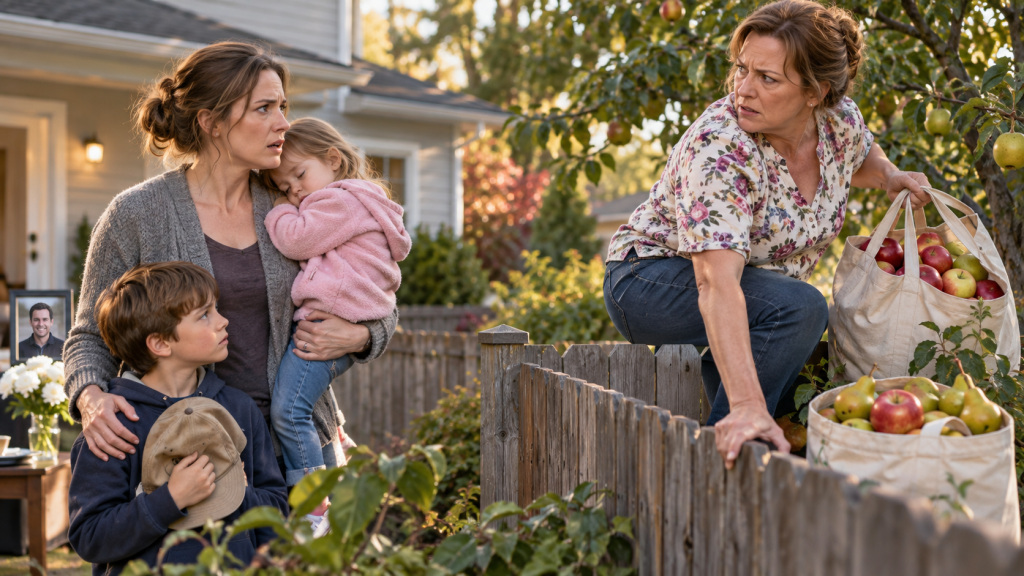
Monica stood barefoot on her front lawn, surrounded by forty-seven empty wooden crates, her floral robe pulled tightly around her body and her face drained of every trace of anger.
For the first time since I had known her, she looked afraid.
Not frightened of me.
Frightened of evidence.
“What do you mean?” I asked.
Mr. Alvarez glanced toward Ben.
My son was still holding my hand.
Daniel’s old baseball cap sat low on his head.
It was too large for him, so every few seconds he pushed the brim upward with one finger.
Mr. Alvarez lowered his phone.
“Maybe Ben shouldn’t watch this.”
That sentence changed the air.
I looked down at my son.
“Ben, sweetheart, would you go inside with Mrs. Turner for a minute?”
“No.”
His answer came immediately.
“Ben.”
“I want to see.”
I crouched in front of him.
“You don’t have to see everything just because it happened to us.”
His mouth tightened.
“Dad grew those apples.”
“I know.”
“She took them.”
“I know.”
His eyes filled with tears.
“I want to know who helped her.”
Behind us, nobody spoke.
I understood then that this was no longer about fruit to Ben.
To an adult, an apple was an apple.
A pear was a pear.
Replaceable.
Cheap, depending on the season.
But to my nine-year-old son, those trees were one of the last places where his father’s hands still seemed visible.
Daniel had tied the branches.
Daniel had built the supports.
Daniel had shown Ben where to cut and where not to cut.
Daniel had sharpened the pruning shears every February.
Daniel had stood beneath those leaves only weeks earlier and promised his son that the trees would keep looking after him.
Then Daniel died.
And before Ben had even learned how to wake up in a world without his father, somebody had climbed into our yard and stripped those branches bare.
I touched his cheek.
“You can stay.”
Monica suddenly stepped forward.
“This is ridiculous.”
Everyone looked at her.
“You people are acting like somebody was murdered.”
The sentence hit me so hard that for a moment I couldn’t breathe.
Perhaps she realized it too late.
Her face changed.
“Claire, I didn’t mean—”
“Don’t.”
My voice was barely above a whisper.
Monica stopped.
“Don’t use that word with me twelve days after I buried my husband.”
She looked away.
Mr. Alvarez unlocked his phone.
“I copied the relevant footage before coming outside.”
“Copied?”
Monica snapped.
“You had no right to record my property.”
“My camera records my driveway and part of Claire’s rear fence.”
“That’s illegal.”
“No, it isn’t.”
“You’re spying on people!”
Mr. Alvarez remained calm.
“I bought the camera after someone stole tools from my garage.”
A few neighbors exchanged glances.
Monica folded her arms.
“This proves nothing.”
Mr. Alvarez looked at me.
“Claire?”
I nodded.
He pressed play.
The video was grainy.
Black and white.
Timestamped 2:14 a.m.
For several seconds, nothing happened.
Then a figure appeared near our rear fence.
Monica.
Even in night vision, I recognized the way she walked.
She carried a flashlight between her teeth while dragging one of our plastic garden carts behind her.
Then another figure entered the frame.
Smaller.
A hooded sweatshirt.
Baseball cap.
The person climbed over first.
Monica passed empty bags across.
My stomach tightened.
“Who is that?”
I asked.
Nobody answered.
Then the person turned toward the camera.
Mrs. Turner gasped.
“Oh my God.”
I recognized him.
“Evan?”
Monica closed her eyes.
Evan was her twenty-three-year-old son.
He had moved back home six months earlier after dropping out of college.
I had seen him hundreds of times.
He had carried groceries into my kitchen after Daniel’s first surgery.
Daniel had helped repair his motorcycle without charging him.
Ben adored him.
And there he was.
Climbing into our garden in the middle of the night.
The video continued.
They worked quickly.
Monica picked.
Evan carried.
At one point, Evan climbed Daniel’s ladder.
He reached for a high branch.
Pulled too hard.
The branch snapped.
I heard the sound again in my memory.
The same sound that had brought me outside the afternoon before.
Something in me broke with it.
“Stop.”
Mr. Alvarez paused the recording.
Monica immediately began talking.
“You don’t know the whole story.”
I stared at her.
“What whole story makes this acceptable?”
“I was going to pay you.”
A laugh escaped me.
It wasn’t funny.
It was the exhausted sound a person makes when reality becomes too absurd for anger.
“You were going to pay me?”
“Yes.”
“With what?”
“The money from selling the fruit.”
“You stole my fruit so you could sell it and then pay me?”
“Some of it.”
Mrs. Turner actually said:
“Oh, Monica.”
Monica whirled toward her.
“Stay out of this.”
Mrs. Turner crossed her arms.
“You made it everybody’s business when you climbed over a fence at two in the morning.”
Monica pointed at me.
“She embarrassed me first!”
I stared.
“What?”
“Yesterday.”
“When you caught me.”
“You mean when I caught you stealing?”
“You screamed at me in front of your son.”
“I told you to leave my property.”
“You treated me like a criminal.”
“You were carrying two bags of fruit you admitted you planned to sell.”
“It was fruit!”
Her voice cracked across the street.
Just fruit.
I looked toward my backyard.
From where I stood, I could see the upper branches of Daniel’s apple trees above the fence.
Bare.
Still.
Morning sunlight touched them.
“It wasn’t yours.”
That was all I said.
Monica opened her mouth.
Closed it.
Then another voice came from behind us.
“Mom.”
Evan stood in Monica’s doorway.
He wore gray sweatpants and a black T-shirt.
His face looked terrible.
Not angry.
Ashamed.
Monica turned.
“Go inside.”
“No.”
“Evan.”
“I said no.”
He stepped onto the lawn.
Then looked at me.
“Mrs. Carter—”
“Don’t.”
He stopped.
I didn’t know what I wanted him to say.
Sorry?
How do you apologize for helping someone strip a dead man’s orchard twelve days after his funeral?
“I didn’t know at first.”
I looked at him.
“What does that mean?”
“Mom told me you said she could have the fruit.”
Monica snapped:
“Evan.”
He ignored her.
“She woke me around two.”
“She said you were overwhelmed and wanted the trees cleared before everything spoiled.”
I looked at Monica.
Her face hardened.
Evan continued.
“I believed her.”
“For how long?”
He looked down.
“Maybe twenty minutes.”
My chest tightened.
“What happened after twenty minutes?”
“I saw the ladder.”
“What about it?”
“Mr. Carter’s initials.”
Daniel had burned D.C. into one side of the ladder years ago because he kept lending tools to neighbors and forgetting where they went.
Evan rubbed both hands over his face.
“I asked why we’d need to sneak over the fence if you’d given permission.”
“And?”
“She said you were sleeping and didn’t want to bother you.”
“Did you believe that?”
“No.”
“Did you stop?”
Silence.
“Evan.”
“No.”
“Why?”
His eyes filled.
“Because she promised me part of the money.”
Monica turned away.
There it was.
No misunderstanding.
No complicated explanation.
Money.
“How much?”
I asked.
“Two hundred dollars.”
I almost couldn’t believe it.
Daniel’s last harvest.
The fruit my children had been waiting to pick with their father.
The branches he had touched days before entering the hospital for the final time.
Two hundred dollars.
Evan wiped his eyes.
“I know how that sounds.”
“It sounds exactly like what happened.”
“Yes.”
“Where is the fruit?”
He looked at his mother.
Monica shook her head.
“Don’t.”
Evan answered anyway.
“Garage.”
I stared.
“All of it?”
“Most.”
“Most?”
“Some was already loaded into Mom’s van.”
“Where was she taking it?”
“There’s a weekend farmers’ market outside town.”
Several neighbors murmured.
Monica threw up her hands.
“Fine!”
Her voice trembled.
“Fine.”
“I took the fruit.”
“I was going to sell it.”
“Call the police.”
“Put me in prison over apples.”
“Is that what everybody wants?”
Nobody answered.
Then she looked directly at me.
“You happy now, Claire?”
Happy.
I thought of Daniel.
His hospital bed.
His hand in mine.
The way his breathing changed during the final night.
The way I kept telling him it was okay to rest while every part of me wanted to scream at him not to leave.
I thought of coming home from his funeral carrying our daughter.
Of Ben holding his father’s cap.
Of the empty branches.
“No.”
I said.
“I haven’t been happy for twelve days.”
Monica’s face changed.
Just slightly.
“I don’t want you in prison.”
I continued.
“I don’t want your house.”
“I don’t want your money.”
“Then what do you want?”
I looked at the crates.
“I want everything returned.”
She laughed bitterly.
“Fine.”
“Every apple.”
“Every pear.”
“Every bag.”
“Every basket.”
“Anything you sold.”
“I haven’t sold anything.”
“Good.”
“And I want you to pay for the broken branches.”
“What?”
“You damaged the trees.”
“They’re trees.”
“Yes.”
“My trees.”
She shook her head.
“You’ve lost your mind.”
“Maybe.”
I looked at Mr. Alvarez.
“But this time I’ll document everything.”
That frightened her more than yelling.
The police arrived forty minutes later.
I had called the non-emergency line.
Not because I wanted Monica dragged away in handcuffs.
Because I wanted a record.
A boundary without consequences is sometimes only a request.
I had requested.
Monica had returned at two in the morning.
So now there would be documentation.
The officer watched the footage.
Photographed the damaged trees.
Photographed the ladder.
Walked through Monica’s garage after she consented.
Then came back outside.
“There are seventeen produce bags and nine crates.”
“How much fruit?”
I asked.
“A lot.”
Ben had come back outside.
He heard.
“Can we get it back?”
The officer looked at him.
“Yes.”
Ben nodded.
That was the first moment all morning his shoulders relaxed.
The fruit came home in three trips.
Neighbors helped.
Even people I barely knew.
Mr. Alvarez carried crates.
Mrs. Turner brought a wagon.
The Henderson twins from the corner house loaded pears into laundry baskets.
Someone brought coffee.
Someone brought muffins.
By ten o’clock, my driveway was covered in fruit.
Hundreds of apples.
Dozens and dozens of pears.
Some bruised.
Some damaged.
Some perfectly fine.
Ben stood among them wearing Daniel’s cap.
His little sister, Sophie, wandered between the baskets trying to lift apples with both hands.
For the first time since Daniel died, our yard was full of voices that did not sound like condolences.
That mattered.
Then Ben asked the question I had been avoiding.
“What are we going to do with all of them?”
I looked at the fruit.
Before Daniel became sick, we had planned to spend harvest weekend together.
Some fruit for us.
Some for neighbors.
Some for pies.
Some for cider.
And every year, Daniel donated several boxes to the community food pantry.
“This year,” he had said in July, “we’re going bigger.”
I remembered laughing.
“You say that every year.”
“And every year I mean it.”
“How much bigger?”
“Enough that Ben complains.”
Ben had shouted from beneath a tree:
“I can hear you!”
Daniel laughed.
That memory returned so clearly I had to sit down.
“Mom?”
Ben came beside me.
“You okay?”
No.
But I had learned that children do not need parents who pretend grief is invisible.
They need parents who show that sadness can be survived.
“I miss Dad.”
Ben nodded.
“Me too.”
Sophie held up a pear.
“Daddy pear.”
My throat closed.
“Yes, sweetheart.”
“Daddy pear.”
She kissed it.
Then handed it to me.
I held that pear as though it were made of glass.
And suddenly I knew.
“We’re going to do what Dad wanted.”
Ben looked at me.
“What?”
“Share them.”
His face changed.
“With Monica?”
I almost laughed.
“No.”
Then I reconsidered.
“Maybe eventually.”
He frowned.
“Why?”
“Because I don’t want what she did deciding who we become.”
He thought about that.
At nine, he already understood more about grief than a child should.
“Can we give some to the food pantry?”
“Yes.”
“Dad wanted that.”
“I know.”
“Can we make cider?”
“Yes.”
“Pie?”
“Yes.”
“Apple butter?”
“If Grandma helps.”
“Why?”
“Because your mother burns apple butter.”
Daniel used to say that.
Ben smiled.
A real smile.
Small.
Fragile.
But real.
That afternoon, we put a folding table at the end of our driveway.
On it, I placed baskets of Daniel’s apples.
Then I made another sign.
Not about Monica.
Not about theft.
Not about revenge.
It read:
DANIEL CARTER’S LAST HARVEST
Please take what your family can use.
If you would like to give something in return, donations will go to the community food pantry and the hospice nurses who cared for Daniel.
Underneath, Ben added in his handwriting:
MY DAD GREW THESE. HE WAS REALLY GOOD AT IT.
I cried when I read that.
People came.
At first, neighbors.
Then friends.
Then people from Daniel’s old job.
Someone posted a picture online.
More people came.
An elderly woman took six apples and left twenty dollars.
A young father took pears and returned an hour later with diapers for the pantry.
A teacher from Ben’s school brought her entire class’s handwritten condolences.
One little boy left seventy-three cents.
Ben insisted we put it in the donation jar.
“Every bit counts.”
he said.
Exactly the way Daniel used to.
By sunset, we had raised more than two thousand dollars.
By the end of the weekend, it was over six thousand.
Nobody had planned it.
Grief had simply been given somewhere to go.
That evening, after everyone left, I found Ben beneath the largest apple tree.
Daniel’s tree.
At least that was what Ben called it.
He was sitting with his back against the trunk.
I sat beside him.
For a while, neither of us spoke.
Then he said:
“Mom?”
“Yes?”
“Dad said the trees would look after us.”
“I remember.”
“Did he know Monica would steal the apples?”
Despite everything, I laughed.
“No.”
“Then how are they looking after us?”
I looked toward the driveway.
Empty baskets.
Donation jar.
Cards.
Flowers.
Neighbors who had stayed until dark helping clean.
“They reminded us we’re not alone.”
Ben leaned against me.
“Is that what Dad meant?”
“I don’t know.”
I kissed the top of his head.
“Maybe.”
He looked up through the branches.
“Will apples grow again?”
“Yes.”
“Even where she broke them?”
I hesitated.
“Some branches will need to be cut.”
His eyes widened.
“Cut?”
“So the tree can heal.”
“But then that part is gone.”
“Yes.”
“Forever?”
“Yes.”
He became quiet.
Then:
“That’s sad.”
“It is.”
“But the tree doesn’t die?”
“Not necessarily.”
He rested his head against me again.
I understood what I was saying only after I said it.
Some parts could be lost forever without the whole living thing being lost.
I needed that to be true for trees.
I desperately needed it to be true for us.
Monica received a citation.
Evan did too.
The exact legal process mattered less to me than the record.
They were required to compensate us for the damaged property and the value of what could not be recovered.
Monica complained to anyone who listened.
For about a week.
Then something unexpected happened.
People stopped listening.
Not because I campaigned against her.
I didn’t.
I took the crates off her lawn that first afternoon.
The sign came down.
The photograph came home.
I had made my point.
Continuing would have turned accountability into humiliation.
And humiliation has a way of changing the person delivering it.
I wanted Monica to understand what she had done.
I did not need to spend the rest of my life making sure she never forgot.
But consequences continued without my help.
Mrs. Turner stopped asking Monica to water her plants.
Mr. Alvarez stopped lending her tools.
The neighborhood association removed her from the community garden committee after learning she had tried to sell produce taken from private property.
The farmers’ market manager told her she would not be allowed to sell anything without documentation of its source.
None of those things came from me.
Trust is strange.
It can take years to build and one dark backyard to empty.
Evan came to my door six days later.
I almost didn’t answer.
He stood holding an envelope.
“I brought the two hundred.”
“I don’t want it.”
“I know.”
“Then why are you here?”
“Because I want to give it back anyway.”
“You never received it.”
He looked ashamed.
“No.”
“So you aren’t returning anything.”
“No.”
“What is it?”
“Mine.”
I stared at him.
“I work weekends at the auto parts store.”
“I know.”
“It’s from that.”
I didn’t take the envelope.
“Why?”
His eyes moved toward the backyard.
“Mr. Carter helped me.”
“I know.”
“When my bike broke.”
“I remember.”
“And when I wrecked Mom’s car.”
I remembered that too.
Daniel had spent two Saturdays helping Evan replace a damaged radiator because the boy couldn’t afford a shop.
“He never made me feel stupid.”
Evan’s voice broke.
“He knew I didn’t know what I was doing, but he never made me feel stupid.”
I said nothing.
“And I climbed his fence for two hundred dollars.”
Tears entered his eyes.
“I knew it was wrong.”
“I want you to understand that.”
“I wasn’t confused.”
“Mom lied at first.”
“But after I realized…”
He swallowed.
“I kept going.”
That honesty mattered.
Not enough to erase anything.
Enough to make me listen.
“I’m sorry.”
I looked at the envelope.
Then at him.
“Keep your money.”
His face fell.
“But—”
“You want to make this right?”
“Yes.”
“Come Saturday at seven.”
“What?”
“Seven in the morning.”
“Why?”
“You broke a branch.”
He stared at me.
“You’re going to help repair what can be repaired.”
He nodded immediately.
“Yes.”
“Bring gloves.”
“I will.”
“And Evan?”
“Yes?”
“If you are one minute late, don’t come back.”
He arrived at 6:42.
Daniel’s friend Marcus was there too.
Marcus knew more about fruit trees than I did.
He examined the damage.
Three branches needed removal.
Two could be supported.
Several smaller shoots had been torn.
Evan worked all day.
No headphones.
No complaining.
Ben watched him suspiciously.
At lunch, Evan sat alone on the back steps.
Ben approached him.
I almost intervened.
Then stopped.
Ben said:
“Why did you steal Dad’s apples?”
Evan looked at him.
“Because I wanted money.”
“My mom says your mom lied to you.”
“She did at first.”
“So it was her fault?”
“No.”
Ben seemed confused.
Evan continued.
“She lied.”
“But then I knew.”
“And I still did it.”
“So that part was my fault.”
Ben stared at him.
“That’s stupid.”
“Yes.”
“You could have asked my mom for work.”
“Yes.”
“Grandpa says people get stupid when they want easy money.”
Evan smiled weakly.
“Your grandpa might be right.”
Ben sat beside him.
“Did you like my dad?”
“Yes.”
“Then why did you do something mean?”
I held my breath.
Evan looked toward the trees.
“Because liking someone doesn’t automatically make you a good person.”
Ben frowned.
“You have to choose?”
“Yeah.”
“I think so.”
Ben considered this.
Then handed Evan half his sandwich.
Children sometimes move through moral complexity faster than adults because they have not yet learned to protect their pride with elaborate explanations.
Evan took it.
“Thanks.”
“Don’t steal my apples again.”
“I won’t.”
“Ever.”
“Ever.”
“Okay.”
That was Ben’s version of a peace treaty.
Mine took longer.
Monica did not come to apologize.
Not that week.
Not that month.
Instead, she became colder.
If we crossed paths, she turned away.
If neighbors spoke to me, she assumed they were talking about her.
She told people I had orchestrated a “public shaming campaign.”
Maybe those empty crates had been public shaming.
I had to admit that.
I had been angry.
Grieving.
And I had wanted her to feel exposed.
There was no point pretending otherwise.
Would I do it exactly the same way again?
I don’t know.
Grief is not a courtroom where every decision arrives after calm deliberation.
I had not damaged her house.
Threatened her.
Invented accusations.
Or taken anything from her.
I had displayed the truth where she could see it.
But truth can still be wielded cruelly.
That possibility bothered me.
So I talked about it with Daniel’s sister, Rebecca.
She listened while I explained everything.
Then she asked:
“What do you regret?”
I thought.
“Wanting everyone to look at her.”
“Do you regret stopping her?”
“No.”
“Documenting it?”
“No.”
“Getting the fruit back?”
“No.”
“Calling the police?”
“No.”
“Making her understand she couldn’t do it again?”
“No.”
Rebecca nodded.
“Then maybe regret the part that was about humiliation and keep the part that was about boundaries.”
I looked at her.
“When did you get wise?”
“Daniel was the stupid sibling.”
I laughed so hard I cried.
Then I cried so hard I couldn’t laugh anymore.
Rebecca held me.
That was grief in those months.
Every emotion had a hidden door leading back to Daniel.
The orchard changed after he died.
The following spring, I almost hired someone to manage it.
Then Ben refused.
“Dad taught me.”
“You’re ten.”
“So?”
“So ten-year-olds don’t manage orchards.”
“Dad said I was his assistant.”
“That is not legally binding.”
Ben folded his arms.
Daniel used to do exactly that.
I lost the argument.
We learned together.
I made mistakes.
So did Ben.
We pruned one pear tree too aggressively.
I forgot to thin fruit from another.
Ben watered when the soil was already wet.
We argued over fertilizer.
And slowly, something beautiful happened.
The orchard stopped being only Daniel’s.
Not because we forgot him.
Because what he had taught us began moving through our own hands.
The first blossom of spring made me cry.
The first tiny apple made Ben shout so loudly Sophie came running outside without shoes.
By August, the branches were heavy again.
Not as heavy as Daniel’s final year.
Enough.
On the anniversary of his death, Ben and I stood beneath the largest tree.
Sophie was four now.
She remembered almost nothing of her father.
That hurt in a way I had not expected.
Ben remembered his voice.
His jokes.
The way he smelled after mowing the lawn.
Sophie remembered photographs.
Stories.
A red sweater.
The idea of him.
I had become the keeper of her memories before she had enough of her own.
“Tell me Daddy tree story.”
she said.
So Ben did.
“Dad said these trees would look after us.”
“How?”
Sophie asked.
Ben thought.
“By giving us apples.”
I smiled.
Then he added:
“And people.”
I looked at him.
“What do you mean?”
“Last year.”
He shrugged.
“Everybody came.”
He remembered.
Of course he remembered.
We harvested that year together.
Neighbors came again.
Not because anything had been stolen.
Because we invited them.
We made it an annual event.
Daniel’s Harvest Day.
No speeches at first.
Just baskets.
Cider.
Food pantry boxes.
Children running between trees.
Daniel would have hated anything too sentimental.
So we kept it messy.
Someone always burned a pie.
Usually me.
Marcus played terrible country music.
Ben organized the ladders like a foreman.
Sophie ate more apples than she picked.
By the fifth year, Daniel’s Harvest Day had raised enough money to fund a refrigerated storage unit for the food pantry.
By the eighth, local farmers joined us.
By the tenth, nobody could remember whose idea it had been.
People assumed it was mine.
It wasn’t.
It began with Daniel saying:
“This year, we’re going bigger.”
He had simply not lived long enough to see how big.
Evan came every year.
At first because he felt guilty.
Later because he liked coming.
He finished community college.
Became an electrician.
Married a nurse named Kayla.
When their first son was born, they named him Daniel.
He asked me first.
“You don’t need my permission.”
“I know.”
“But?”
“I wanted you to know why.”
I did.
He never forgot the night he climbed our fence.
But eventually, that stopped being the most important thing I knew about him.
That mattered to me.
People should be accountable for what they do.
They should also be allowed to become more than the worst thing they have done, when their actions and circumstances make that possible.
Evan earned that slowly.
Monica was different.
For almost three years, she stayed angry.
Then one winter morning, I found her sitting on the curb between our houses.
She was crying.
I almost walked past.
Almost.
Then I stopped.
“Are you all right?”
She wiped her face immediately.
“Fine.”
“You’re sitting outside at six-thirty in January.”
“I’m fine.”
I waited.
She looked older.
“I lost my job.”
I said nothing.
“The company downsized.”
“I’m sorry.”
She laughed bitterly.
“Are you?”
“Yes.”
That seemed to irritate her.
“You don’t have to pretend.”
“I’m not.”
“After what I did?”
“What you did doesn’t mean I need to enjoy every bad thing that happens to you.”
She stared at me.
Then started crying again.
“I hated you.”
I leaned against the fence.
“I know.”
“I hated you before the apples.”
That surprised me.
“Why?”
“Daniel.”
My chest tightened.
“What about him?”
“He was good.”
I frowned.
“That made you hate me?”
“You had…”
She stopped.
“A husband who loved you.”
“Children.”
“The garden.”
“People liked you.”
I almost laughed at the absurdity.
“Monica, my husband had just died.”
“I know.”
“Then what exactly were you jealous of?”
“Before.”
She looked down.
“My marriage ended.”
“Evan was struggling.”
“I had debt.”
“My mother was sick.”
“And every time I looked over that fence, Daniel was fixing something.”
“Laughing.”
“Teaching Ben.”
“You two had dinner outside.”
“You looked…”
She searched for the word.
“Safe.”
I swallowed.
“We weren’t.”
“What?”
“Safe.”
I looked toward my house.
“Daniel was sick for almost a year.”
“We were terrified.”
“He had nights when he couldn’t breathe.”
“He cried in the bathroom because he didn’t want Ben to see.”
“I checked our insurance portal at three in the morning.”
“I screamed at him once because he forgot a medical appointment, then spent the night hating myself because I knew he was scared.”
Monica stared.
“You never looked like that.”
“Neither did you.”
That silenced us both.
How much cruelty begins when we compare our private pain to somebody else’s public life?
Not all.
But some.
Monica rubbed her hands together against the cold.
“I saw those apples.”
she said.
“After the funeral.”
“I knew you cared about them.”
“I knew Daniel cared.”
“And I thought…”
She began crying.
“What?”
“I thought it wasn’t fair.”
I stared.
“That he had left something behind.”
Her voice cracked.
“I know how awful that sounds.”
It did.
But at least it was true.
“My ex-husband left debt.”
“My father left nothing.”
“My mother was dying and wouldn’t even speak to me.”
“And there were Daniel’s trees.”
“Full.”
“Healthy.”
“Still producing.”
She covered her face.
“I wanted something.”
I sat on the curb a few feet away.
“You could have asked.”
“I know.”
“I might have given you some.”
“I know.”
“You took all of it.”
“I know.”
“After I caught you once.”
“I know.”
I looked at her.
“Why?”
“Because when you told me no, I felt humiliated.”
“So you punished me.”
“Yes.”
There it was.
Not hunger.
Not need.
Not misunderstanding.
She had wanted control after being denied.
“I’m sorry.”
I had imagined Monica saying those words many times.
In my imagination, they felt satisfying.
In reality, they were sad.
“I was cruel.”
she continued.
“Not only taking the fruit.”
“What I said about Daniel.”
My eyes filled.
“Yes.”
“I’ve wanted to apologize for that for three years.”
“Why didn’t you?”
“Pride.”
I almost smiled.
“At least you’re consistent.”
To my surprise, she laughed.
Then cried harder.
“I deserved that.”
“No.”
She looked at me.
“You don’t need to deserve every joke.”
For a while, we sat in the cold.
Then Monica asked:
“Do you forgive me?”
I thought about it.
Three years earlier, I might have wanted that question.
Now it seemed less important.
“I don’t know.”
She nodded.
“That’s fair.”
“But I don’t hate you.”
She looked at me.
“Really?”
“No.”
“Why?”
“Hating you takes more energy than I have.”
She laughed.
“So that’s it?”
“No.”
I looked toward the orchard.
“I think I’ve had enough taken from me.”
“I don’t want to give you years too.”
Monica cried silently.
I did not hug her.
Not every apology requires an embrace.
But when I stood, I said:
“Harvest is Saturday.”
She stared.
“Are you inviting me?”
“I’m telling you there will be too many pears.”
A small smile appeared.
“I understand.”
“Eight o’clock.”
“I’ll come at seven-thirty.”
“Seven fifty-five is fine.”
She arrived at seven.
Of course.
Ben was thirteen by then.
When he saw Monica approaching, his entire body stiffened.
“Why is she here?”
“I invited her.”
“Why?”
“She apologized.”
“So?”
“So I accepted enough of it to let her pick pears.”
He looked betrayed.
“She stole Dad’s fruit.”
“I remember.”
“You put crates on her lawn.”
“I remember that too.”
“You called the police.”
“Yes.”
“And now she gets to come here?”
I put down my basket.
“Ben.”
“No.”
His eyes filled.
“She hurt you.”
“I know.”
“She said Dad’s fruit didn’t matter because he was dead.”
“I know.”
“Then why?”
I looked at my son.
Because forgiveness is good?
Too simple.
Because Monica was sorry?
Sometimes sorry is not enough.
Because I wanted to be the bigger person?
I hated that phrase.
It often asks the hurt person to become convenient.
So I told him the truth.
“Because I don’t need to punish her anymore.”
He stared at me.
“Does that mean what she did was okay?”
“No.”
“Does it mean we forget?”
“No.”
“Does she get to be our friend?”
“Only if we want her to.”
“Do I have to forgive her?”
“No.”
That surprised him.
“You don’t?”
“No.”
“Then why do you?”
“I’m not sure I completely have.”
He frowned.
“Adults are confusing.”
“Extremely.”
I touched his shoulder.
“Forgiveness isn’t pretending something didn’t matter.”
“And boundaries aren’t revenge.”
“You can decide how close someone is allowed to stand after they hurt you.”
“Your distance can change.”
“Or not.”
Ben looked at Monica.
She stood by the fence, waiting.
Not entering without permission.
That detail mattered.
“Can I tell her I’m still mad?”
“Yes.”
“Can I tell her not to touch Dad’s ladder?”
I smiled.
“Absolutely.”
He walked over.
I couldn’t hear everything.
I saw Monica nod.
Ben pointed toward the ladder.
She nodded again.
Then he handed her a basket.
That was enough.
Years passed.
The orchard grew.
So did my children.
Ben became a horticulturist.
Nobody was surprised except Ben.
At seventeen, he insisted he was going to study engineering.
At eighteen, environmental science.
At nineteen, he called from college and said:
“Mom.”
“Yes?”
“I think I want to work with trees.”
I laughed for a full minute.
“This isn’t funny.”
“Your father is laughing somewhere.”
“I knew you’d say that.”
He eventually specialized in community orchards and urban agriculture.
The boy who had once stood beneath empty branches holding his dead father’s cap spent his adulthood helping neighborhoods plant fruit trees.
When he was twenty-eight, he started a nonprofit.
He called it Looking After You.
I cried when I saw the name.
“You remembered.”
“Of course I remembered.”
Daniel’s words.
“These trees will keep looking after you, even when I’m not here.”
Ben’s organization planted orchards near schools, shelters, community centers, and food pantries.
His first major project had twelve apple trees.
One for each day between Daniel’s death and the morning Monica stole the harvest.
I asked why.
Ben shrugged.
“Because I wanted those twelve days to grow something different.”
That was my son.
He had inherited Daniel’s hands.
But his heart was entirely his own.
Sophie became a photographer.
She said it was because photographs gave her memories of a father she could barely remember.
For years, she felt guilty about that.
At fourteen, she came into my bedroom crying.
“I don’t remember his voice.”
I put down my book.
“That’s okay.”
“No, it isn’t.”
“Yes, it is.”
“Ben remembers.”
“Ben was older.”
“What if I forget everything?”
“You can’t forget something you were too young to store clearly.”
“That’s worse.”
She cried against me.
I held her.
Then I told her something I wished somebody had told me years earlier.
“You do not have to remember your father perfectly to love him.”
She looked at me.
“Really?”
“Really.”
“You know him through what he left in us.”
“The way Ben checks fruit.”
“The way I still buy terrible coffee because Dad liked it.”
“The way you wrinkle your nose before laughing.”
“He did that?”
“Exactly that.”
She smiled.
“And the trees.”
“And the trees.”
When Sophie was twenty-three, she created a photography exhibition about inherited memory.
One photograph showed Daniel’s old ladder leaning beneath an apple tree.
Another showed Ben’s hands pruning a branch.
Another showed me holding the pear Sophie had called “Daddy pear” when she was four.
I had kept a photograph of that moment.
The final image showed an empty branch at sunrise.
She titled it:
WHAT GROWS BACK IS NOT WHAT WAS LOST.
I stood in the gallery staring at those words.
Sophie came beside me.
“Too sad?”
“No.”
“Too dramatic?”
“Definitely.”
She laughed.
Then I took her hand.
“It’s true.”
A branch grows again.
But not the same branch.
A child grows after losing a parent.
But not into the child they would have been if the parent stayed.
A widow learns to laugh.
But not because grief disappears.
Healing does not restore the original shape.
It teaches life to grow around the missing places.
Monica moved away when I was sixty-three.
Before leaving, she knocked on my door.
In her hands was a small wooden box.
“I found this while packing.”
Inside was one apple.
Not real.
Wooden.
Hand-carved.
On the bottom were the initials D.C.
I gasped.
“Where did you get this?”
“Daniel made it.”
I remembered.
Years before he became ill, Daniel had tried woodcarving.
He made three terrible apples.
One for me.
One for Ben.
One disappeared.
“I think Evan took it home when he was younger.”
Monica looked ashamed.
“Daniel let him.”
“He did?”
“Yes.”
“He told Evan every garden needed one apple the birds couldn’t steal.”
I laughed.
That sounded exactly like Daniel.
“I thought you should have it.”
I held the wooden apple.
“Thank you.”
Monica hesitated.
“Claire?”
“Yes?”
“I know I’ve apologized.”
“You have.”
“But before I go…”
She swallowed.
“I want to say it without asking for anything.”
I waited.
“I was wrong.”
“I stole from you.”
“I damaged something your husband loved.”
“I involved my son.”
“I said cruel things while you were grieving.”
“And when you exposed what I did, I spent years acting as though your reaction was worse than my behavior.”
Her eyes filled.
“You didn’t make me steal.”
“You didn’t make me climb that fence.”
“You didn’t make me come back after you told me no.”
“I did that.”
I nodded.
“Thank you.”
She looked surprised.
“That’s all?”
“What else do you want?”
“Nothing.”
“Then that’s enough.”
She smiled.
We hugged.
Briefly.
Not like sisters.
Not like best friends.
Like two women who had once stood on opposite sides of a fence and finally understood where the boundary was.
She left the next morning.
Evan stayed nearby.
He brought his children to Daniel’s Harvest Day every year.
Eventually nobody introduced him as the boy who stole the apples.
That story became one part of him.
Not all of him.
I grew older too.
That surprised me.
After Daniel died, some part of me had assumed my real life was finished.
I was thirty-eight.
I could imagine surviving.
I could not imagine becoming seventy.
Then seventy-five.
Then eighty.
Grief does something strange to the future.
At first, tomorrow feels offensive.
How dare morning arrive when someone is dead?
Then mornings keep coming.
You make breakfast.
Pay bills.
Wash tiny socks.
Attend parent conferences.
Replace a broken refrigerator.
Laugh unexpectedly.
Feel guilty.
Laugh again.
One day you realize you have lived an entire afternoon without actively thinking about the person you lost.
That hurts.
Then eventually it doesn’t.
Not because love weakened.
Because love found somewhere quieter to live.
I never remarried.
Not because Daniel had been my one possible love.
I don’t believe life works that way.
I dated twice.
One man was kind but wanted more than I could give.
Another hated gardening.
Obviously impossible.
Mostly, I discovered I liked my life.
That was allowed too.
Daniel’s absence did not require me to spend the rest of my years proving how much I missed him.
I traveled.
Badly.
I joined a book club and rarely read the books.
I became a grandmother.
Then a great-grandmother.
I learned to make apple butter without burning it.
That may have been my greatest achievement.
At eighty-one, I handed the house to Ben.
Not for free.
He insisted on buying it.
At a price low enough that he accused me of cheating.
“I am your mother.”
“Exactly.”
“The orchard comes with conditions.”
“Of course it does.”
“Never sell the back half separately.”
“Okay.”
“Don’t remove Daniel’s oldest apple tree unless it’s dangerous.”
“Okay.”
“Harvest Day continues.”
“Mom.”
“What?”
“I run a national orchard nonprofit.”
“I know.”
“I think I can handle apple picking.”
“You once watered a pear tree during a thunderstorm.”
“I was ten.”
“History matters.”
He laughed.
Then became serious.
“You sure?”
I looked at the house.
The porch where Daniel drank coffee.
The kitchen where I received the hospital call that told me his condition had worsened.
The bedroom where I slept alone for decades.
The backyard where I found Monica halfway over the fence.
The trees.
Always the trees.
“Yes.”
I moved into a small cottage six streets away.
It had one apple tree.
Ben complained that I pruned it incorrectly.
I told him to leave my property.
He laughed so hard he nearly fell off the ladder.
On the fortieth Daniel’s Harvest Day, hundreds of people came.
Ben’s nonprofit had planted more than twenty thousand fruit trees by then.
Sophie displayed photographs along the fence.
Evan ran the cider press with his grandchildren.
Mr. Alvarez had died years earlier, but his daughter attended.
She brought the old security camera.
“I found it in Dad’s garage.”
she said.
I stared at the small black device.
The camera that had proved what happened.
The camera that had transformed my certainty into evidence.
“Do you want it?”
she asked.
“No.”
She seemed surprised.
“Really?”
“No.”
“What should I do with it?”
I looked toward the orchard.
Children were laughing beneath the trees.
“Recycle it.”
She smiled.
“Dad would like that.”
I think he would have.
By then, the theft no longer needed preserving.
We had preserved what mattered.
At eighty-six, I was asked to speak at the opening of Ben’s hundredth community orchard.
I hated public speaking.
He claimed that was genetic justice because I had forced him to give a speech in sixth grade.
I stood before families, volunteers, students, and twelve newly planted apple trees.
Someone had told the organizer about Monica.
Of course they had.
People love dramatic origin stories.
The organizer introduced me as:
“The woman whose stolen harvest inspired a movement.”
I corrected him when I reached the microphone.
“No.”
People laughed nervously.
“I mean it.”
I looked toward Ben.
“My neighbor did not inspire this.”
“Daniel did.”
Ben lowered his head.
“My husband planted trees because he believed growing food was one of the simplest ways to care for people you might never meet.”
“He taught our son that.”
“My neighbor stole one harvest.”
“She did not create the meaning of the orchard.”
I paused.
“That distinction matters.”
The audience became silent.
“We sometimes give people who hurt us too much authorship.”
I looked at the young trees.
“Monica made a bad choice.”
“Then another.”
“For a while, I let those choices become the center of the story.”
“But the story was never about what she took.”
“It was about what remained.”
I touched the nearest sapling.
“Roots.”
“Knowledge.”
“Neighbors.”
“My children.”
“Daniel’s love.”
“And another spring.”
Ben was crying.
I pretended not to notice.
“This tree will produce fruit someday.”
I continued.
“Somebody here may eat an apple from it ten years from now.”
“They may never know who planted it.”
“That’s fine.”
“Care doesn’t always need credit.”
“Sometimes you plant something because another person will be hungry later.”
I stepped away from the microphone.
Ben hugged me.
“You made me cry.”
“Good.”
“You’re mean.”
“Family tradition.”
At ninety-one, I could no longer attend Harvest Day for the full afternoon.
My knees objected.
My back had declared independence.
So Ben placed a chair beneath Daniel’s oldest tree.
Children came to me.
Most did not know who I was.
I liked that.
A little girl offered me an apple.
“Did you pick this?”
I asked.
“Yes.”
“Without stealing it?”
Her mother looked horrified.
I laughed until I coughed.
The girl said:
“I asked.”
“Excellent.”
“Mom says we always ask.”
“Your mother is wise.”
The child polished the apple against her shirt and handed it to me.
I bit into it.
Sweet.
Crisp.
Daniel would have approved.
That evening, after everyone left, Ben sat beside me.
He was sixty-two.
Gray-haired.
Still wearing Daniel’s old cap.
The fabric had been repaired so many times that almost none of the original stitching remained.
“You know that isn’t really Dad’s cap anymore.”
I said.
“Yes, it is.”
“Half of it has been replaced.”
“So?”
I smiled.
There was our whole story again.
Something can change piece by piece and still carry continuity.
“Mom?”
“Yes?”
“Were you serious when you said Monica didn’t inspire any of this?”
“Mostly.”
He laughed.
“Mostly?”
“She accidentally made the first Harvest Day much bigger.”
“So she helped.”
“Don’t tell her.”
“She’s ninety-three.”
“She can still get smug.”
Ben smiled.
Then became quiet.
“Do you regret the crates?”
Forty-two years had passed.
I thought about that morning.
My fury.
My grief.
Monica’s scream.
Neighbors emerging from their houses.
The photograph of Daniel.
The sign.
“Yes and no.”
“That’s cheating.”
“I regret enjoying her humiliation.”
“Did you?”
“Yes.”
“Good.”
“Ben.”
“What?”
“She stole Dad’s apples.”
“You’re sixty-two.”
“Still mad.”
I laughed.
Then I said:
“I don’t regret making it visible.”
“Why?”
“Because she had counted on silence.”
“She thought she could come into our yard at night, take everything, and then force me into another private argument where she’d deny, minimize, or blame.”
“I needed the truth outside our fence.”
Ben nodded.
“But?”
“But I learned you can defend a boundary without building your home inside the conflict.”
He looked toward the trees.
“Meaning?”
“I made the theft public.”
“Then I let it end.”
“I didn’t spend years campaigning against her.”
“I didn’t teach you to hate Evan.”
“I didn’t turn every Harvest Day into a story about stolen fruit.”
“I didn’t let the worst morning become the orchard’s identity.”
Ben smiled.
“Dad would like that.”
“I hope so.”
“He would.”
“How do you know?”
“Because he hated wasting things.”
I laughed.
“Even anger?”
“Especially anger.”
That sounded like Daniel.
At ninety-four, I moved in with Sophie.
Ben protested.
His house had stairs.
Sophie’s did not.
For once, practicality defeated sentiment.
My room faced a small garden.
No orchard.
Just herbs, flowers, and one young pear tree Ben planted outside my window.
“Bossy.”
I told him.
“Genetic.”
he replied.
Sophie had become a grandmother herself.
One evening, her granddaughter Nora climbed into my bed.
She was seven.
“Great-Grandma?”
“Yes?”
“Mom told me somebody stole all your apples.”
“Your mother talks too much.”
“Did you fight her?”
“No.”
“Did you call the police?”
“Eventually.”
“Did you put boxes on her grass?”
“Crates.”
“Why?”
“Because I was angry.”
“Did it work?”
I thought.
“What do you mean by work?”
“Did she never steal again?”
“Yes.”
“Then it worked.”
Seven-year-old logic.
I smiled.
“Maybe.”
Nora leaned closer.
“What would you do now?”
That was a better question.
I looked out at the pear tree.
“I’d document everything first.”
“Boring.”
“Very.”
“Then?”
“I’d ask for the fruit back.”
“And if she said no?”
“I’d report it.”
“No crates?”
I smiled.
“Maybe fewer crates.”
Nora giggled.
Then she asked:
“Were the apples special because your husband was dead?”
Children have a brutal gift for directness.
“Yes.”
“Would they still be special if he wasn’t?”
“Yes.”
“Why?”
“Because he grew them.”
She considered this.
“Do you still miss him?”
“Yes.”
“Every day?”
I thought.
“Not in the same way.”
“What does that mean?”
“When he first died, missing him felt like falling.”
“And now?”
“Now it feels more like carrying something.”
“Is it heavy?”
“Sometimes.”
She touched my hand.
“Can I help?”
My eyes filled.
“Yes.”
“How?”
“Tell me something funny.”
She did.
It was a terrible joke about a banana.
I laughed anyway.
Daniel would have too.
A year later, my health began failing quickly.
I knew.
My children knew.
Nobody said it for a while.
Then one morning, Ben sat beside my bed.
“Mom.”
“Yes?”
“The doctor thinks—”
“I know.”
He started crying.
I reached for him.
My son.
Sixty-five years old.
And suddenly nine again.
Standing beneath bare branches wearing his father’s cap.
“I’m not ready.”
he whispered.
“Nobody is.”
“You were.”
“When Dad died?”
He nodded.
“No.”
“You looked like you were.”
“I was terrified.”
“You handled everything.”
“I had two children.”
“That isn’t the same as being ready.”
He cried.
“I don’t want you to go.”
“I know.”
“What am I supposed to do?”
I smiled.
“Check the trees.”
He laughed through tears.
“Mom.”
“I’m serious.”
“You have your father’s orchard.”
“You have Sophie.”
“Children.”
“Grandchildren.”
“Work that matters.”
“People who love you.”
“You know what to do.”
He wiped his eyes.
“What if I don’t?”
“Then do the next thing.”
“That’s it?”
“That’s most of life.”
He laid his head beside my hand.
“Dad said the trees would look after me.”
“Yes.”
“Did they?”
I looked at him.
“Yes.”
“How?”
“Look at you.”
He cried harder.
A few days before I died, Ben brought me an apple from Daniel’s oldest tree.
The tree was nearing the end of its life.
Storm damage.
Disease.
Age.
Ben had been trying to save it for years.
He sat beside my bed and placed the apple in my hands.
“Last one of the season.”
I turned it slowly.
Red.
A little misshapen.
Perfect.
“Good year?”
“Very.”
“Pears?”
“Too many.”
“Your father would approve.”
Ben smiled.
“We’re probably going to remove his tree this winter.”
I knew how difficult that sentence was for him.
“Okay.”
His eyes filled.
“Okay?”
“Yes.”
“I thought you’d be upset.”
“It’s a tree, Ben.”
He stared.
“You spent sixty years telling me it wasn’t just a tree.”
“Both things can be true.”
I ran my thumb across the apple.
“Your father isn’t inside the trunk.”
“I know.”
“Do you?”
He looked down.
“Maybe not.”
“You can cut it down.”
“What if I don’t want to?”
“Then wait.”
“What would Dad say?”
I smiled.
“He’d tell you the fungus has reached the main trunk and you’re being sentimental.”
Ben laughed.
“That is exactly what he’d say.”
“Yes.”
Then I added:
“Save some wood.”
“For what?”
“You’ll think of something.”
He did.
After the tree came down, Ben had part of the trunk milled.
He made a table.
Not a fancy table.
Daniel would have mocked fancy furniture.
A large, sturdy harvest table.
On the underside, where nobody would see unless they looked, Ben carved:
THE TREES KEPT THEIR PROMISE.
I never saw the finished table.
I died before spring.
Sophie held one hand.
Ben held the other.
There were no dramatic final words.
No perfect speech.
I had said what mattered over ninety-five years.
My last clear memory was the smell of an apple Ben had sliced beside my bed.
Then Daniel.
Not as a ghost.
Not standing in the room.
Just a memory.
Young.
Healthy.
Sunlight in his hair.
One hand resting on Ben’s shoulder.
“These trees will keep looking after you, even when I’m not here.”
For decades, I had wondered exactly what he meant.
Near the end, I understood.
He did not mean apples would protect us.
He meant care continues.
What you teach continues.
What you plant continues.
The patience you give a child becomes patience they may someday give another.
The food you share becomes a habit of sharing.
The love you put into ordinary work can remain long after nobody remembers your hands doing it.
Daniel died.
The fruit was stolen.
Branches broke.
Years passed.
The original tree eventually came down.
And still—
something continued.
At my funeral, Ben did not tell the story about Monica first.
I would have been disappointed if he had.
He talked about Daniel.
He talked about Sophie.
He talked about my terrible apple butter.
People laughed.
He talked about the first Harvest Day.
Then, eventually, he mentioned the theft.
“When I was nine,” he said, “our neighbor stole every apple and pear from my father’s trees twelve days after he died.”
The room became still.
“I thought that was the worst thing anyone could do to an orchard.”
He smiled faintly.
“I was nine.”
“I thought the fruit was the orchard.”
He looked toward his children.
“I know better now.”
“The orchard was knowledge.”
“It was routine.”
“It was family.”
“It was neighbors.”
“It was generosity.”
“It was my father teaching me how to recognize a ripe apple.”
“It was my mother learning how to prune badly after he died.”
People laughed.
“She improved.”
A pause.
“Eventually.”
More laughter.
“It was a young man named Evan learning that an apology means less than showing up at 6:42 in the morning with work gloves.”
Evan sat near the back.
He lowered his head.
“It was Monica eventually learning that shame and accountability are not the same thing.”
“It was my sister learning she didn’t need perfect memories of Dad in order to love him.”
“It was twenty thousand trees planted in neighborhoods my father never saw.”
“Then thirty thousand.”
“Then fifty thousand.”
He swallowed.
“So no.”
“The fruit was never the orchard.”
He looked toward my photograph.
“And grief was never the end of my mother.”
“She was angry.”
“She was devastated.”
“She made mistakes.”
“She put forty-seven crates on a woman’s lawn.”
Soft laughter.
“She admitted years later that forty might have been sufficient.”
Louder laughter.
“But she also knew when to take them away.”
That line quieted the room.
“She taught me something I didn’t understand until I was much older.”
“You can make wrongdoing visible without making it the center of your life.”
“You can demand accountability without dedicating your future to revenge.”
“You can forgive someone and still keep a fence.”
“You can refuse forgiveness and still choose peace.”
“You can lose a branch without losing the tree.”
“And sometimes…”
His voice broke.
“You can lose the tree without losing what it planted in you.”
Sophie joined him.
She placed one of her photographs beside the podium.
It showed Daniel’s old ladder beneath the now-gone apple tree.
Below it were the words she had written decades earlier:
WHAT GROWS BACK IS NOT WHAT WAS LOST.
Then she added:
“But it can still be beautiful.”
After the funeral, my grandchildren gathered at the orchard.
The old tree was gone.
In its place stood a young apple tree.
Not a replacement.
Ben was very clear about that.
Nothing replaces a person.
Nothing replaces a history.
The new tree was simply next.
They placed some of my ashes beneath it.
Some of Daniel’s had been scattered there decades earlier.
Then Nora—grown now, with children of her own—asked:
“What should we call it?”
Ben smiled.
“Nothing.”
Everyone looked at him.
“Grandpa’s tree had a name because I was a kid.”
“This one doesn’t need one.”
“It’s just an apple tree.”
Then he touched its trunk.
“And that’s enough.”
Daniel’s Harvest Day continued.
Year after year.
The story about Monica was still told occasionally.
Usually when somebody new asked why the tradition began.
But as decades passed, it became shorter.
Less angry.
Eventually it sounded almost unbelievable.
“Someone really stole every apple?”
“Yes.”
“Every pear too?”
“Yes.”
“What happened?”
“We got most of them back.”
“And the woman?”
“She apologized eventually.”
“Did Claire forgive her?”
“Enough.”
“What does that mean?”
Exactly what it sounds like.
Enough to stop fighting.
Enough to live.
Enough to leave the gate unlocked during Harvest Day.
But not enough to pretend the fence had never been crossed.
And perhaps that is why the story lasted.
Not because a grieving widow found an elaborate way to embarrass the neighbor who stole her husband’s final harvest.
Not because forty-seven empty crates appeared on a lawn.
Not because a security camera caught two people climbing a fence at 2:14 in the morning.
Those were only the dramatic parts.
The real story was quieter.
A husband planted trees.
A father taught his son when an apple was ready.
A widow came home from a funeral believing the best part of her life had ended.
Someone took something precious.
Neighbors helped carry it home.
A boy learned that broken branches could be pruned.
A young man learned that guilt should become work.
A woman learned that apology without excuses is different from self-pity.
A family learned that memory is not stored only in objects.
And an orchard that had once been stripped completely bare produced fruit again.
That was the part I would want remembered.
Because people will take things from us.
Sometimes deliberately.
Sometimes through selfishness.
Sometimes life itself takes them without asking.
People.
Years.
Plans.
Health.
Homes.
Futures we thought were guaranteed.
We cannot always stop the taking.
We cannot always recover what was lost.
But loss does not automatically decide what happens next.
The morning I touched those empty branches, I thought Monica had taken Daniel’s final gift from us.
I was wrong.
She had taken fruit.
That was all.
She could not take the mornings Daniel spent teaching Ben.
She could not take his fingerprints from the ladder.
She could not take Sophie’s stories.
She could not take what the neighbors chose to do when they learned what happened.
She could not take another spring.
She could not take the blossoms that came after winter.
And she certainly could not take the lesson Daniel had planted in our son long before any apple disappeared.
The trees would keep looking after him.
They did.
Not forever.
Trees do not live forever.
Neither do husbands.
Neither do wives.
Neither do grief or anger in the exact form we first know them.
But love has a peculiar way of changing containers.
First it lived in Daniel.
Then in his children.
Then in an orchard.
Then in baskets carried to a food pantry.
Then in thousands of trees planted by a grown boy who once woke his mother before sunrise because something scary had happened outside.
And long after Daniel’s original apple tree was gone, children who had never heard his name still stood beneath branches planted because he had once taught his son a simple thing:
Do not take everything.
Take what you need.
Share what you can.
Care for what will outlive you.
And if a branch breaks—
do not confuse the wound with the whole tree.
THE END STORIES! THANK YOU FOR READING GOOD LUCK !❤️
Related Posts