➡️ PART 3 ENDING PART ➡️
For several seconds, I thought I had misunderstood Louise.
The airplane seemed to disappear around me.
The engines were still roaring beneath the floor.
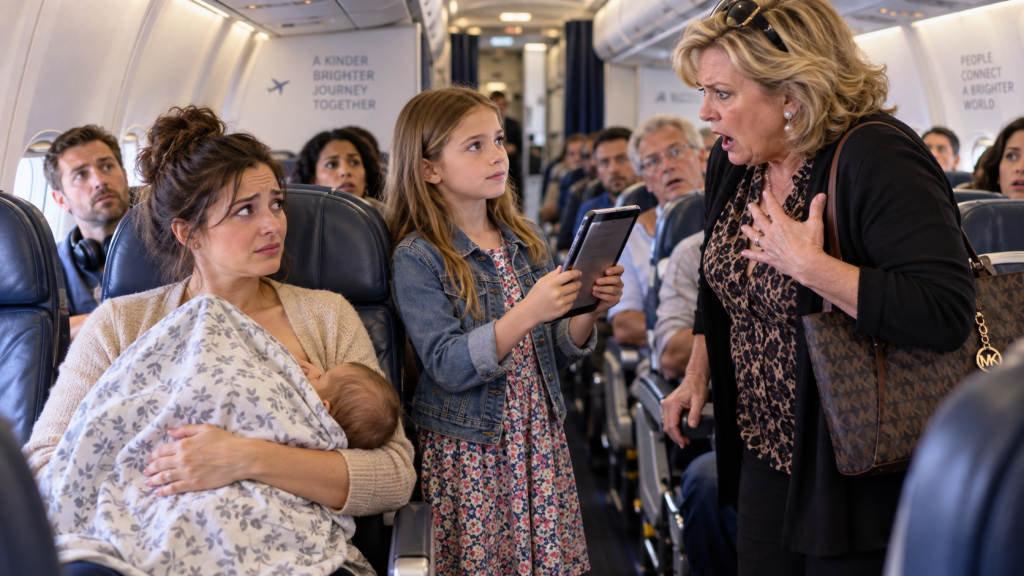
My son was still nursing beneath the cover.
A flight attendant was still standing in the aisle.
Passengers were still pretending not to listen.
But all I heard was my eight-year-old daughter’s trembling voice.
“Mom… she says she knew Daddy.”
I looked at the woman.
Her face had changed completely.
The anger was gone.
So was the arrogance.
She looked frightened.
Not embarrassed.
Frightened.
“What did you say?”
I asked.
She glanced at Louise.
Then at me.
“I said I knew your husband.”
My heart began pounding.
“You don’t even know my husband’s name.”
The woman swallowed.
“Michael Bennett.”
My entire body went cold.
Louise whispered:
“Mom?”
I pulled the nursing cover closer around my son.
Michael.
My husband had been dead for thirty-two days.
Thirty-two mornings of waking up and reaching toward his side of the bed before remembering.
Thirty-two nights of our five-month-old son crying while I paced the nursery alone.
Thirty-two days of Louise asking questions about heaven that I did not know how to answer.
And now a stranger who had spent the last twenty minutes humiliating me knew his name.
“How?”
I asked.
The woman looked toward the flight attendant.
“Can we not do this here?”
I almost laughed.
“You had no problem discussing my breastfeeding with the entire cabin.”
Her face reddened.
“That was different.”
“No.”
I said.
“You made it public.”
“Now answer me.”
The flight attendant stepped closer.
“Ma’am, if you’d prefer, we can separate you until we land.”
The woman immediately nodded.
“Yes.”
I stared at her.
“No.”
The attendant looked at me.
I lowered my voice.
“I don’t want an argument.”
“But I need to know why she knows my husband.”
Louise stood beside the seat.
I noticed her hands shaking.
That stopped me.
This was not just about me.
Whatever came next, my daughter was standing in the middle of it.
I looked at Louise.
“Sweetheart, go sit with Mrs. Alvarez.”
Mrs. Alvarez was the elderly woman who had been seated beside Louise.
She had spent most of the flight knitting something yellow.
Louise shook her head.
“No.”
“Louise.”
“I want to know.”
My heart hurt.
Of course she did.
Michael was her father too.
I reached for her hand.
The woman across from us whispered:
“My name is Caroline Mercer.”
The name meant nothing to me.
Apparently my face showed it.
She continued.
“I worked with Michael.”
“Where?”
“Halston Medical.”
That was true.
Michael had worked for Halston Medical for eleven years.
Regional operations director.
Constant travel.
Long meetings.
Too many emails.
A company mug I still had not been able to remove from our kitchen cabinet.
“What department?”
I asked.
“Compliance.”
My stomach tightened.
Michael had complained about compliance constantly.
Not about a person.
About the department.
“Why would my husband know you well enough for you to recognize his family?”
Caroline looked at Louise.
“I didn’t recognize you.”
“Then how did you know?”
“Your tablet.”
Louise frowned.
Caroline pointed toward the screen.
“The photograph behind the video.”
Louise’s wallpaper.
Michael holding our son the day we brought him home.
He was sitting in the nursery rocking chair with his eyes closed, baby asleep on his chest.
I had taken it.
My throat closed.
“You saw his picture.”
“Yes.”
“And suddenly you knew me?”
“I knew he had a wife named Sarah.”
My name.
My skin prickled.
“And a daughter named Louise.”
Louise squeezed my hand.
“And a baby?”
Caroline looked down.
“He told me his wife was pregnant.”
I could barely breathe.
“What exactly were you to my husband?”
The question came out harsher than I intended.
Caroline heard what I meant.
Her eyes widened.
“No.”
“What?”
“No.”
She shook her head.
“Not that.”
I stared.
“You expect me to believe you?”
“I barely knew him personally.”
“Then why do you look terrified?”
Caroline closed her eyes.
“Because I was supposed to call him the night he died.”
Everything inside me stopped.
Michael died in a car accident.
Rain.
Interstate.
Guardrail.
Police at my door at 1:43 in the morning.
A trooper removing his hat.
My knees hitting the floor.
That was the story.
Simple.
Terrible.
Complete.
Or I thought it was.
“What do you mean?”
Caroline whispered:
“Your husband had found something.”
“What?”
She looked around the cabin.
“I shouldn’t discuss it here.”
Anger returned.
“You don’t get to do that.”
“Sarah—”
“Don’t use my name like we’re friends.”
She flinched.
Good.
I hated that part of myself for thinking that.
But grief had stripped me down to raw edges.
I was tired of people deciding what I could handle.
Doctors.
Funeral directors.
Relatives.
Friends who whispered when I entered rooms.
And now this woman.
“What did Michael find?”
Caroline looked at the flight attendant.
The attendant said:
“Ma’am, I think this conversation should probably wait until everyone is seated safely.”
Caroline nodded eagerly.
I realized then that I was shaking too.
My baby had stopped nursing.
He was asleep against me.
I looked down.
Tiny eyelashes.
Round cheek.
Michael’s mouth.
Not now.
I could not fall apart now.
I fastened my clothes beneath the cover and carefully lifted my son against my shoulder.
The flight attendant arranged for Caroline to move several rows away.
Before she left, I said:
“Give me your phone number.”
She hesitated.
“Now.”
She did.
I called it immediately.
Her phone rang.
“Good.”
I saved the number.
“You will answer when we land.”
Caroline nodded.
“I will.”
Then she moved.
Louise sat beside me.
For a while, neither of us spoke.
Then she whispered:
“Was Daddy in trouble?”
“I don’t know.”
“Did that lady hurt him?”
“I don’t know.”
“Is she why he died?”
I looked at her sharply.
“No.”
“But—”
“No, sweetheart.”
I held her hand.
“We don’t know anything yet.”
That was one of the hardest lessons grief taught me.
Uncertainty is painful.
But inventing certainty does not make uncertainty disappear.
It only gives fear a costume.
“We know Daddy was in an accident.”
I said.
“We know she worked with him.”
“That’s all.”
Louise looked toward Caroline’s new seat.
“I don’t like her.”
“Neither do I right now.”
“Because she was mean to you?”
“Yes.”
“And because she knows Daddy?”
“Yes.”
Louise leaned against my shoulder.
After a moment, she said:
“I recorded her because I wanted her to feel embarrassed.”
I looked down at her.
“I know.”
“Was that bad?”
I thought carefully.
“You were defending me.”
“But?”
“You don’t need to become responsible for punishing every person who hurts someone you love.”
She frowned.
“Why?”
“Because that gets heavy.”
“I just wanted her to stop.”
“That part was okay.”
“I should’ve called the flight attendant?”
“That would’ve been better.”
She became quiet.
“Daddy would’ve told her off.”
I smiled despite myself.
“Yes.”
“He would’ve used his serious voice.”
“Yes.”
“Then he’d complain for three hours.”
I laughed.
The sound surprised me.
It had been days since laughter came without permission.
Louise smiled.
For one second, Michael was there.
Not literally.
In us.
In the memory.
Then she said:
“I miss him.”
“I know.”
“I miss when you laughed.”
That hurt differently.
I kissed her forehead.
“I’m trying.”
“You don’t have to try for me.”
Eight years old.
And somehow she knew exactly the wrong burden to take.
I turned toward her.
“Yes, I do.”
Her face fell.
I corrected myself.
“Not pretending.”
“I don’t have to pretend for you.”
“But I do have to keep living.”
“That’s my job.”
“You don’t have to make me happy.”
“You don’t have to take care of me.”
“You’re my kid.”
She stared at me.
“Can I still hug you when you’re sad?”
I broke.
“Yes.”
“That’s different.”
“Okay.”
She hugged me carefully so she wouldn’t wake her brother.
I closed my eyes.
The plane landed forty-three minutes later.
Caroline tried to leave quickly.
I saw it.
So did Louise.
“Mom.”
“I know.”
I handed the baby carrier to my mother, who was waiting beyond security after we exited the plane.
She took one look at my face.
“What happened?”
“Hold him.”
“Sarah?”
“Please.”
She did.
Louise stayed beside Grandma.
I followed Caroline.
“Caroline.”
She stopped.
People flowed around us.
Suitcases.
Announcements.
Reunions.
Ordinary life.
“Coffee.”
I said.
“What?”
“There.”
I pointed toward an airport café.
“You said we’d talk.”
She looked toward the exit.
Then nodded.
We sat.
Mom joined us after I explained enough to make her stop asking questions.
Louise colored at the table beside us while my son slept.
I wanted her away from the conversation.
She refused.
Eventually Mom put headphones on her and started a movie.
Caroline wrapped both hands around a coffee she never drank.
“I owe you an apology first.”
“Yes.”
She blinked.
Maybe she expected me to rescue her from accountability.
I didn’t.
“What I said on the plane was cruel.”
“Yes.”
“I was embarrassed.”
“About breastfeeding?”
“No.”
She looked at me.
“About recognizing Michael.”
That surprised me.
“So you attacked me.”
“Yes.”
“Why?”
“Because I panicked.”
I leaned back.
“That is not an excuse.”
“I know.”
“Then don’t use it like one.”
She nodded.
“Fair.”
“Tell me about Michael.”
Caroline inhaled.
Six weeks before he died, Michael had been reviewing a regional billing discrepancy.
At first, routine.
Then not.
Halston Medical managed logistics and administrative services for several hospital networks.
Michael discovered that one regional vendor had been billing for equipment transfers that never occurred.
The numbers were not enormous individually.
Together, they were significant.
He reported it internally.
The report disappeared.
So he kept digging.
“He wasn’t supposed to.”
Caroline said.
“That sounds like Michael.”
A sad smile touched her mouth.
“Yes.”
He approached compliance.
Caroline was assigned to review part of the concern.
She found supporting records.
Invoices.
Approval chains.
Internal emails.
A senior executive appeared to have pressured staff to approve questionable payments to a vendor owned by his brother-in-law.
“How much?”
I asked.
“Potentially several hundred thousand dollars.”
I stared.
“Was Michael investigating a crime?”
“He wasn’t an investigator.”
“Neither was I.”
Caroline said.
“We were employees who found something we believed needed independent review.”
“What happened?”
“Management told us the discrepancy had been resolved.”
“Was it?”
“I don’t think so.”
“And Michael?”
“He didn’t believe it either.”
The night he died, Michael called Caroline.
Three times.
She did not answer.
My stomach tightened.
“Why?”
She stared into her coffee.
“Because my boss had warned me that morning.”
“Warned you how?”
“He said I was creating problems where none existed.”
“He reminded me I had two children.”
“A mortgage.”
“A career.”
I understood before she said it.
“You got scared.”
“Yes.”
Michael left a voicemail.
Caroline still had it.
My heart began pounding.
“You have his voice?”
“Yes.”
“Play it.”
She hesitated.
“Play it.”
Caroline took out her phone.
Scrolled.
Then placed it on the table.
Michael’s voice filled the space between us.
“Caroline, it’s Michael. I found the original approvals. You were right about the dates. Don’t send anything through company email. I’m heading home now. Call me tomorrow. We need outside counsel before this gets buried again.”
I stopped breathing.
His voice.
Alive.
Impatient.
Slightly tired.
Michael.
For thirty-two days I had been listening to old videos because I was terrified I would forget the sound of him.
And suddenly there he was saying words I had never heard.
The voicemail continued.
“And don’t panic. Nobody’s dying over invoices.”
The recording ended.
I covered my mouth.
Caroline started crying.
“I didn’t call him.”
I stared at the phone.
“He said tomorrow.”
“Yes.”
“He wasn’t expecting you that night.”
“No.”
“Then why did you say you were supposed to call him the night he died?”
She looked ashamed.
“Because I should have.”
“No.”
I shook my head.
“That’s different.”
She stared.
“He told you tomorrow.”
“Yes.”
“Then don’t rewrite his words because you feel guilty.”
Her eyes filled.
I surprised myself.
That sounded like something Michael would say.
Caroline whispered:
“I learned about the accident the next morning.”
“Then?”
“I deleted nothing.”
“I copied everything I had.”
“I hired an attorney.”
“Did you tell police?”
“My attorney contacted the company first.”
I stiffened.
“Why?”
“Because there was no evidence Michael’s accident was anything except an accident.”
I stared.
“Was it?”
“As far as I know.”
“Police said weather.”
“Yes.”
“Do you know something else?”
“No.”
“Then say that clearly.”
She did.
“I have no evidence anyone caused Michael’s crash.”
Relief and disappointment arrived together.
I hated the disappointment.
Because some primitive part of grief wanted a villain large enough to explain why my husband was dead.
Rain felt inadequate.
A wet road felt insulting.
But tragedy does not become easier because someone is guilty.
Sometimes nobody is.
Sometimes a tire loses traction.
A car crosses a lane.
A husband leaves work.
A police officer knocks at 1:43.
And the universe never explains itself.
“So this has nothing to do with his death?”
I asked.
“I can’t say nothing.”
“His work may explain why he was late leaving the office.”
“But no.”
She said carefully.
“I cannot tell you anyone killed him.”
“Then why were you terrified when you recognized him?”
“Because his report became public internally after his death.”
“What?”
“Michael had scheduled files to be sent to outside counsel.”
“When he didn’t log in the next morning, an automated transfer triggered.”
That sounded exactly like him.
Michael scheduled grocery deliveries three weeks in advance.
Of course he scheduled evidence.
“What happened?”
“The company opened an independent investigation.”
“Two executives resigned.”
“The vendor contract was suspended.”
“There are civil proceedings.”
“And you?”
“I testified.”
I looked at her.
“Then why attack me?”
Caroline began crying harder.
“Because when I saw his picture, I saw the man who was braver than I was.”
There it was.
Not disgust at breastfeeding.
Not really.
Shame.
Misplaced.
Weaponized.
Ugly.
She continued.
“I had spent a month telling myself I did what I could.”
“Then I saw his face on your daughter’s tablet.”
“And you were sitting there with his baby.”
“And I knew who you were.”
“And I panicked.”
“So you humiliated me.”
“Yes.”
“Because you hated yourself.”
“Yes.”
I looked at her for a long time.
Then said:
“That was cruel.”
“I know.”
“You don’t get to turn guilt into permission to hurt strangers.”
“I know.”
“My daughter heard you tell me I was a bad mother.”
Caroline closed her eyes.
“I know.”
“My husband is dead.”
“I know.”
“I was feeding his son.”
“I know.”
“And you made me feel ashamed for it.”
“I’m sorry.”
I believed she was.
That did not make it disappear.
“I accept that you’re sorry.”
She looked up.
“That isn’t the same as forgiving you today.”
“I understand.”
“Good.”
I stood.
“Send the voicemail to my attorney.”
“You have an attorney?”
“My husband just died.”
“Yes.”
“I have several people who suddenly think paperwork is a love language.”
Mom almost smiled.
Caroline nodded.
“I will.”
Then Louise removed her headphones.
“Are you done?”
“Yes.”
She looked at Caroline.
Caroline swallowed.
“Louise?”
“What?”
“I owe you an apology too.”
Louise stared.
“I said something cruel to your mother.”
“Lots of things.”
“Yes.”
“And I was wrong.”
Louise looked at me.
I did not tell her what to say.
She turned back.
“Okay.”
Caroline waited.
Louise added:
“But you still shouldn’t yell at breastfeeding moms.”
“No.”
Caroline said.
“I shouldn’t.”
“And babies can’t eat sandwiches.”
I almost laughed.
Caroline nodded solemnly.
“I understand.”
“Good.”
Then Louise took Grandma’s hand.
“Can we get pretzels?”
That was the end of the airport confrontation.
Not a dramatic arrest.
Not applause.
Pretzels.
Life has a sense of proportion children understand better than adults.
We stayed with Mom for six weeks.
The first week, I barely left the guest room.
The second, I started taking walks.
The third, I went three hours without crying and felt guilty.
By week six, I could say Michael’s name without always losing my breath.
The corporate investigation became news.
I did not speak publicly.
Neither did Louise.
Caroline’s evidence contributed to the inquiry.
So did Michael’s.
The company eventually announced governance reforms, repayment of improperly approved funds, and leadership changes.
There were legal consequences for some people involved.
Not everyone I thought deserved consequences received them.
Not every rumor proved true.
That became another lesson.
Reality is rarely as satisfying as revenge fiction.
But Michael’s work mattered.
His files prevented the concerns from disappearing.
At home, I found a notebook in his desk.
One page contained names.
Dates.
Numbers.
Then, beneath everything:
If something happens before I finish this, Sarah gets the blue drive.
I stared at the sentence.
Something happens.
For several terrifying hours, I wondered again whether he had feared for his life.
Then I found the blue drive.
It contained copies of financial records.
And a note to me.
Not a farewell letter.
Nothing prophetic.
Just:
Sarah — backup in case work gets stupid. Please don’t open unless I tell you. Also, if you opened this because you’re snooping, I love you, but stop snooping. — M
I laughed so hard I cried.
That was Michael.
Not a martyr.
Not a secret hero speaking in dramatic codes.
A husband making a backup and teasing his nosy wife.
I gave the drive to counsel.
Then I kept the note.
For years.
Louise had nightmares after the trip.
Not about the plane woman.
About Michael.
In one, he came home but could not see us.
In another, she kept running through an airport while he stood behind glass.
I found a child therapist.
At first, Louise refused to talk.
So they drew.
Week after week.
One day she came home and asked:
“Did Daddy know he was going to die?”
“No.”
“Are you sure?”
“As sure as I can be.”
“Did he love us?”
“Yes.”
“Even when he was at work?”
“Yes.”
“Even when he forgot my school concert?”
That one hurt.
“Yes.”
“Then why did he forget?”
“Because loving someone doesn’t make you perfect.”
She thought.
“That seems inconvenient.”
“Extremely.”
She nodded.
Then asked:
“Did he love the baby?”
I looked toward the crib.
Our son, Thomas, slept with one fist beside his cheek.
“Yes.”
“Even though he cried a lot?”
“Especially then.”
“Why?”
“Because Daddy was weird.”
She laughed.
Healing sometimes entered through jokes.
I returned to work when Thomas was nine months old.
Not because I was ready.
Because ready had stopped being a useful word.
I taught fourth grade.
My first morning back, twenty-seven children stared at me.
One raised his hand.
“Mrs. Bennett?”
“Yes?”
“Did your husband die?”
Twenty-six other children froze.
Adults would have panicked.
Children are direct.
“Yes.”
I said.
“He did.”
“Are you sad?”
“Yes.”
“Are you going to cry?”
“Maybe sometimes.”
He nodded.
“Okay.”
Then another child asked whether we were still having recess.
Life continued.
I learned to appreciate that.
Caroline sent a letter six months after the flight.
I almost threw it away.
Instead, I read it.
She did not ask for forgiveness.
Good.
She wrote that she had begun therapy.
Better.
She had also volunteered with a workplace ethics organization.
Fine.
Then one paragraph stayed with me.
I spent years thinking shame made people better. It didn’t make me better. It made me defensive, frightened, and cruel. What changed me was being required to look directly at what I had done without pretending that feeling terrible about myself was the same as repairing harm.
I read that twice.
Then put the letter away.
I did not answer.
Three years passed.
Then I saw Caroline again.
Airport.
Of course.
Different city.
I was traveling with Louise and Thomas.
Thomas was three and furious because his banana had broken in half.
The tragedy was apparently irreversible.
I heard:
“Sarah?”
I turned.
Caroline.
Older.
Softer somehow.
She looked at Thomas.
Then Louise.
“Hello.”
I said.
“Hi.”
Awkward silence.
Then Thomas held up his broken banana.
“It broke.”
Caroline looked solemn.
“That is serious.”
“Yes.”
“Do you want mine?”
She had an unopened banana in her bag.
Thomas immediately accepted.
Traitor.
Louise recognized her.
Her expression hardened.
Caroline noticed.
“Hi, Louise.”
“Hi.”
“I won’t keep you.”
She looked at me.
“I just wanted to say I’m glad you’re all okay.”
“We are.”
“I’m glad.”
Then she walked away.
No dramatic reconciliation.
No hug.
No speech.
But Louise watched her go.
“She seems different.”
“Maybe she is.”
“Do you forgive her?”
I considered.
“Yes.”
Louise looked surprised.
“When did that happen?”
“I don’t know.”
“Did she ask?”
“No.”
“Then why?”
“Because forgiveness is sometimes something you stop needing to withhold.”
Louise frowned.
“That makes no sense.”
“It might when you’re older.”
“Adults say that when things make no sense.”
Fair.
Michael remained part of our family.
I never used past tense carelessly.
I did not say:
We used to have a father.
Louise had a father.
Thomas had a father.
He was dead.
Those facts could exist together.
On Michael’s birthday, we cooked his favorite meal.
Terrible chili.
Too spicy.
Every year I complained.
Every year Louise said:
“That’s how Daddy made it.”
Every year I ate it.
Thomas grew up knowing his father through stories.
Some heroic.
Most not.
Daddy once helped expose financial wrongdoing.
Yes.
Daddy also forgot his wallet constantly.
Daddy loved jazz.
Daddy snored.
Daddy once assembled Louise’s dollhouse backward.
Daddy cried during animated movies and claimed allergies.
Daddy hated olives.
Daddy sang badly.
Daddy loved them.
That was the father I wanted Thomas to know.
Not a polished dead man.
Michael.
When Thomas was six, he asked:
“Did Daddy die because he was doing the right thing?”
I understood the danger in that story.
“No.”
“But the company thing.”
“Daddy found something wrong at work.”
“Yes.”
“He did the right thing by reporting it.”
“Yes.”
“But his car accident happened in bad weather.”
“So nobody hurt him?”
“Not based on anything we know.”
He became quiet.
“That’s less cool.”
I laughed.
“Death doesn’t have to be cool.”
“Daddy’s still cool?”
“Moderately.”
Thomas smiled.
“Was he cooler than me?”
“Impossible.”
That satisfied him.
Louise grew into a teenager with Michael’s stubbornness and my unfortunate tendency to argue after the argument was already won.
At fifteen, she told me she remembered the airplane clearly.
“All of it?”
“Most.”
“Even the tablet?”
“Yes.”
I groaned.
“What?”
“You recorded a stranger and threatened to show Grandma.”
“She deserved it.”
“Louise.”
“She did.”
I sighed.
“Maybe.”
“See?”
“But being right about someone’s behavior doesn’t mean every response is wise.”
She rolled her eyes.
“Here comes Teacher Mom.”
“Yes.”
“Can I ask something?”
“Always.”
“Why did you keep apologizing to her?”
I knew immediately what she meant.
On the plane.
Before Louise switched seats.
I had apologized for feeding my hungry baby.
Again.
And again.
“I was embarrassed.”
“But you weren’t doing anything wrong.”
“I know that now.”
“You knew then.”
She was right.
I thought.
“I wanted the conflict to stop.”
“So you made yourself smaller.”
The words hit me.
“Where did you learn that?”
“Therapy.”
“Expensive but effective.”
She laughed.
Then became serious.
“Don’t do that anymore.”
I looked at my daughter.
The child who once thought she needed to defend me had become a young woman reminding me to defend myself.
“I try not to.”
“Good.”
Years passed.
Louise went to college.
Journalism.
Naturally.
She claimed the airplane incident had nothing to do with it.
Nobody believed her.
She became an investigative reporter.
Not the screaming-camera kind.
The patient kind.
Documents.
Interviews.
Public records.
She once told me:
“Daddy would’ve liked this.”
“He would’ve tried to give you sources.”
“He would’ve tried to become a source.”
“Also true.”
Thomas became a pediatric nurse.
That surprised everyone except me.
He had always been gentle with frightened children.
When he graduated, he pinned a tiny photograph of Michael inside his gown.
Not visible.
Just there.
I cried when he showed me.
“I wish he could see you.”
Thomas hugged me.
“Maybe he can.”
“I don’t know.”
“Me neither.”
That was enough.
I dated occasionally.
Badly.
For years, every man was compared to a dead husband.
Unfair to everyone.
Eventually I stopped.
Then, at forty-nine, I met David.
Widower.
Librarian.
Quiet.
He had lost his wife to cancer.
Our first date lasted four hours because neither of us knew how to explain widowhood efficiently.
He asked:
“Do you still talk to Michael?”
I stared.
“Yes.”
“Good.”
“Good?”
“I talk to Rachel.”
His wife.
That was how I knew.
Not that I would marry him.
That I could trust him with grief.
We married three years later.
At the wedding, Louise gave a toast.
She said:
“My mother taught me that loving someone new does not mean loving someone dead less.”
Then she looked at David.
“And David taught her that too.”
David cried.
So did I.
Thomas raised his glass.
“To Dad.”
Then added:
“Both of them.”
David cried harder.
Michael’s photograph remained in our home.
David never minded.
Rachel’s did too.
Our house became strange and beautiful.
Two dead spouses.
Two living spouses.
Children.
Stepchildren.
Grandchildren eventually.
Love refused to behave like arithmetic.
Adding someone did not require subtracting someone else.
Caroline appeared in my life one final time when I was sixty-three.
She emailed Louise.
Not me.
She had terminal ovarian cancer.
She asked whether Louise would interview her.
By then, Louise had written several major investigations into healthcare administration and corporate accountability.
Caroline wanted to speak publicly about Michael’s case.
Louise called me.
“Mom.”
“No.”
“You don’t even know the question.”
“Yes, I do.”
Silence.
“Do you mind?”
I thought.
“No.”
“Are you sure?”
“Yes.”
“But don’t turn your father into a saint.”
Louise laughed softly.
“I know.”
“And don’t turn Caroline into a monster.”
“I know.”
“People are more useful when they’re people.”
“I know, Mom.”
“You say that now.”
She interviewed Caroline for six hours.
The article came out three months later.
It was beautiful.
Not because it praised Michael.
Because it told the truth.
A compliance failure.
An employee who found irregularities.
Another employee who became afraid.
A company that initially preferred convenience.
A system that improved only after documentation made ignoring the problem more difficult.
And one unrelated rainy-night crash that grief had tempted everyone to connect to the corporate story.
Louise explicitly wrote that there was no evidence Michael’s death had been caused by wrongdoing.
I was proudest of that sentence.
Drama would have been easier.
Truth was better.
Caroline died two weeks after publication.
Before she died, she sent me a voice message.
I listened alone.
“Sarah, I’m not going to make this long.”
A weak laugh.
“I have finally learned not to trap people in conversations they didn’t ask for.”
I smiled.
“I wanted to thank you.”
“Not for forgiving me.”
“I don’t actually know whether you did.”
“I did.
But she couldn’t hear me.
“For refusing to let me lie about Michael’s death just to make my guilt make sense.”
“I spent years thinking if his accident was connected to work, then my fear had caused something.”
“It hadn’t.”
“I was responsible for my silence.”
“I was responsible for what I said to you on that plane.”
“I was not responsible for the rain.”
“That distinction saved me.”
She coughed.
“And please tell Louise something.”
“She taught me a lesson that day.”
“Not because she recorded me.”
“Because she said her baby brother only understood that he was hungry and his mother made him feel safe.”
“I had forgotten that sometimes the person in front of you is simply trying to care for someone.”
“I wish I had remembered before I opened my mouth.”
“Take care, Sarah.”
The message ended.
I cried.
Then deleted nothing.
I kept it.
Not as evidence.
As history.
David died when I was seventy-eight.
Quietly.
Heart failure.
By then, I knew grief well.
That did not make me good at it.
Experience does not turn loss into a skill.
It only teaches you that survival is possible.
Louise stayed with me.
Thomas came every day.
One evening, I found Louise making Michael’s chili.
I stared.
“Wrong dead husband.”
She laughed.
“Dad’s chili is medicinal.”
“It is a gastrointestinal threat.”
“Eat.”
I did.
We talked about both men.
Michael.
David.
No competition.
No hierarchy.
Just love in different chapters.
At eighty-four, I stopped flying.
Not because of the old incident.
Because airports had become too exhausting.
My last flight was with Louise.
Halfway through, a baby began crying three rows ahead.
The mother looked mortified.
She rocked him.
Apologized.
Tried a pacifier.
Nothing.
Then she began breastfeeding under a cover.
The man beside her sighed dramatically.
My body remembered.
All those decades vanished.
The cabin.
Caroline.
My burning cheeks.
My husband’s death only a month old.
My baby hungry.
Then the man looked away and said nothing.
That was all.
Nothing happened.
The baby ate.
The mother relaxed.
The flight continued.
I smiled.
Louise noticed.
“What?”
“Nothing.”
She followed my gaze.
Then understood.
“Oh.”
“Yep.”
“You want me to get my tablet?”
I laughed so loudly the mother looked back.
“No.”
“Sure?”
“Sit down, vigilante.”
She grinned.
That became one of my favorite memories.
Not because someone taught someone a lesson.
Because no lesson was necessary.
Sometimes ordinary decency is the happiest ending.
At eighty-nine, my health began failing.
Louise had gray hair.
That offended me.
Thomas had grandchildren.
That offended me more.
I moved into a small apartment attached to Louise’s house.
On my wall hung a photograph from decades earlier.
Michael holding baby Thomas.
The same photograph Caroline had seen on Louise’s tablet.
For years, I could not look at it without remembering the plane.
Eventually, the plane disappeared from it.
It became what it had always been.
A father.
A baby.
A quiet moment.
That is what time can do when it is kind.
It returns objects to themselves.
One evening, Louise sat beside me.
“Mom?”
“Yes?”
“Do you think Dad would’ve liked who I became?”
“No.”
She stared.
I smiled.
“He would’ve been unbearable.”
She laughed.
“He’d send you story ideas every morning.”
“He’d call my editor.”
“He’d definitely call your editor.”
“God.”
“He’d brag about you to strangers.”
She wiped her eyes.
“Thomas?”
“He’d be worse about Thomas.”
“Probably.”
Silence.
Then Louise asked:
“Do you remember the flight?”
“Yes.”
“I used to think I saved you.”
I looked at her.
“You were eight.”
“I know.”
“I thought switching seats meant I protected you.”
“You did help.”
“But I shouldn’t have needed to.”
“No.”
Her eyes filled.
“Did I make things harder?”
“Sweetheart.”
I took her hand.
“You were a child trying to protect your mother.”
“That wasn’t your job.”
“But I’m grateful for the love inside it.”
She cried.
“I wish Dad had been there.”
“So do I.”
“Would he have yelled at her?”
“Almost certainly.”
“Then gotten kicked off the plane?”
“Possibly.”
We laughed.
Then she became serious.
“What was the hardest part after he died?”
I expected the answer to be nights.
The funeral.
The empty side of the bed.
Instead:
“Making decisions alone.”
She nodded.
“What was the best thing anyone did?”
I thought.
“Your grandmother invited us to stay.”
“That’s it?”
“Yes.”
“She didn’t fix anything.”
“She gave us somewhere to be broken.”
Louise rested her head on my shoulder.
“That sounds like Grandma.”
“Yes.”
I lived to ninety-two.
My final illness was pneumonia.
Nothing poetic.
Hospitals rarely are.
Thomas argued with doctors.
Professionally.
Louise argued with everyone else.
Genetics.
My grandchildren visited.
Great-grandchildren too.
One of them brought a five-month-old baby.
A girl named Rose.
She became hungry during the visit.
Her mother looked embarrassed.
“Do you mind if I feed her?”
I stared.
Then laughed.
Everyone looked confused except Louise.
She started laughing too.
Soon we were both crying.
“What?”
the young mother asked.
“Nothing.”
I wiped my eyes.
“Feed your baby.”
She did.
Right there.
No cover because she didn’t want one.
No apology.
No shame.
Rose ate peacefully.
I watched her tiny hand open and close against her mother’s chest.
And suddenly I was thirty-four again.
Michael dead one month.
Thomas five months.
Louise eight.
Airplane.
Grief.
Humiliation.
Survival.
I whispered:
“Look at that.”
Louise knew.
“I see.”
Later that evening, I asked for paper.
My hands shook too much.
So Louise opened her laptop.
“You dictate.”
“Bossy.”
“Inherited.”
I smiled.
Then began.
She read the letter at my funeral.
My family,
There is a story you have heard too many times about an airplane.
A few people laughed.
I was a young widow with two children.
My husband had been dead for one month.
My son was hungry.
A stranger was cruel.
My daughter was brave.
Then the stranger recognized a photograph and opened a door into part of my husband’s life I had not known.
It makes a good story.
But stories become dangerous when we polish them until people stop looking human.
So remember the whole thing.
Caroline was cruel to me.
She was also ashamed, frightened, and capable of changing.
Those things do not excuse what she did.
They explain how a person who behaved badly could later become better.
Louise defended me.
That was beautiful.
But she was eight.
It was never her responsibility to rescue her mother.
Louise stopped reading.
Thomas put an arm around her.
She continued.
Michael found something wrong at work and refused to ignore it.
That was brave.
But he did not die because of it, based on everything we ever learned.
He died in a car accident on a wet road.
For years, part of me hated that answer because it felt too small for the size of my grief.
Eventually I learned that tragedy does not owe us a villain.
Sometimes the hardest truth is that terrible things can happen without anyone choosing them.
Do not manufacture blame simply because blame feels easier to hold than uncertainty.
The room became silent.
And please remember Michael as a person, not an obituary.
He forgot appointments.
He snored.
He made terrible chili.
He worked too much.
He loved jazz.
He adored Louise.
He held Thomas against his chest like the boy was the most precious thing he had ever touched.
He loved me.
Then he died.
Love did not protect us from that.
But death did not erase the love either.
Louise wiped her face.
Years later, I loved David.
Some people quietly wondered whether that meant I had moved on from Michael.
I never understood the phrase.
I did not move on from Michael.
I moved forward with him as part of me.
David understood because he carried Rachel too.
Love is not a hotel room where one person must check out before another can enter.
A soft laugh moved through the room.
The heart is less organized than that.
Thank God.
Then came the part I had written for Louise.
My darling Louise,
She stopped.
Thomas whispered:
“You can do it.”
She nodded.
You once stood in an airplane aisle and offered to sit beside a furious stranger because you thought your mother needed protecting.
You were brave.
You were also eight years old.
If I could go back, I would hug you and say: Thank you, sweetheart. Now sit down and let the adults handle this.
People laughed through tears.
I hope you know now that you never had to become strong enough to replace your father.
You never had to make me laugh.
You never had to stop me from crying.
You never had to raise Thomas.
You were allowed to be a child who missed her dad.
I am sorry for every moment grief made you feel otherwise.
Louise cried openly.
But I will always be grateful for the sentence you spoke that day:
My baby brother only understands that he’s hungry and Mommy makes him feel safe.
You were talking about Thomas.
You were also describing love better than most adults ever manage.
We are all hungry for safety in one form or another.
For someone who answers.
Someone who stays.
Someone who lets us grieve.
Someone who does not demand we hide ordinary human needs to make them comfortable.
Then:
Thomas, you were five months old and remember none of this. Lucky you.
Laughter.
But you taught me something too.
You kept needing me.
At first, I resented that.
I am ashamed to admit it, but grief made every feeding feel like evidence that the world expected me to continue when I wanted everything to stop.
Then I began to understand: your need did not imprison me.
It anchored me.
Feed him.
Change him.
Rock him.
Sleep.
Wake.
Repeat.
Survival became small enough to do one task at a time.
You did not save me.
Children should not have to save parents.
But caring for you gave my days structure while I relearned how to want days at all.
Thomas bowed his head.
And finally, if any mother in this family ever finds herself feeding a hungry baby in public, please do me one favor.
Louise was already smiling.
Do not apologize.
Laughter moved through the room.
Feed the baby.
If someone complains, be kind if you can.
Be firm if you need to.
Ask for help when appropriate.
But do not confuse another person’s discomfort with your shame.
They are not the same thing.
I spent too much of my young life apologizing whenever my existence inconvenienced someone.
Widowhood taught me that life is too short for unnecessary apologies.
So take up the seat you paid for.
Feed the child you love.
Cry when you’re grieving.
Laugh when laughter returns.
Tell the truth even when a dramatic lie would make a better story.
Forgive when forgiveness frees you.
Keep boundaries when boundaries protect you.
And never make a child responsible for carrying an adult’s pain.
That is what I learned.
Not from one airplane.
From ninety-two years of being human.
Love, Mom.
Louise closed the laptop.
For a moment, nobody moved.
Then baby Rose began crying.
A tiny, indignant sound.
Her mother laughed through tears.
“She’s hungry.”
Louise looked toward her.
“So feed her.”
The young mother sat down.
She fed her baby.
Nobody stared.
Nobody complained.
Nobody apologized.
Outside, afternoon sunlight spilled across the windows.
Inside, Michael’s children sat together.
Older now.
Gray at the temples.
Parents themselves.
Grandparents almost.
They had spent decades carrying a man who died too young without turning his absence into the only story their family knew how to tell.
Caroline had become more than the cruel woman on the airplane.
Michael had become more than the dead husband.
David had become more than the second husband.
Louise had become more than the brave eight-year-old.
Thomas had become more than the crying baby.
And I had become more than the grieving widow who once sat in an airplane seat apologizing for feeding her son.
That was the real lesson.
We are rarely only the worst thing we have done.
We are rarely only the worst thing that has happened to us.
Life keeps adding sentences.
If we let it.
And somewhere in the old family photo collection remained the picture that had started everything.
Michael in the nursery rocking chair.
Eyes closed.
Thomas asleep against his chest.
A tired father.
A sleeping baby.
Nothing mysterious.
Nothing tragic yet.
Just love.
On the back, years after Michael died, I had written one sentence.
Louise found it after my funeral.
She read it aloud to Thomas.
Before he became a memory, he was here.
Thomas cried.
Louise took his hand.
And that was enough.
THE END STORIES! THANK YOU FOR READING GOOD LUCK !❤️
Related Posts