➡️ PART 3 ENDING PART ➡️
The sheriff found out where my mother had spent the money before sunset.
At eleven years old, I didn’t understand how quickly adults could find things once the right adults finally started looking.
For six days, I had been alone in a locked house with sixty-four cents, a shrinking loaf of bread, and a kitchen knife beside the couch.
Then Sarah saw me through a window.
Suddenly there were deputies.
Social workers.
Photographs.
Phone records.
Receipts.
Questions.
And adults who did something my mother had spent years teaching me not to expect.
They believed me.
Deputy Harris sat across from me at Sarah’s kitchen table while I held a mug of hot chocolate between both hands.
I wasn’t drinking it.
I just liked feeling the warmth.
“Derek says he gave your mother fifteen hundred dollars before they left.”
I nodded.
“Did you know about that?”
“No.”
“Did your mother ever mention money being left with Chloe’s parents?”
“No.”
“Did she tell you why she only gave you twenty dollars?”
I looked down.
“She said I should be grateful.”
Deputy Harris stopped writing.
Sarah turned away.
I remember that more clearly than almost anything else.
The way she turned away.
At eleven, I thought she was angry with me.
Years later, she told me the truth.
She had turned away because she was crying, and she did not want me to see another adult falling apart when what I needed was someone steady.
Deputy Harris asked another question.
“What did your mother tell Derek about where you would be?”
“At Chloe’s cabin.”
“And where did she tell you Chloe would be?”
“She said Chloe’s parents changed their plans.”
“Did you know Chloe was actually in Colorado?”
“Not until I called.”
He wrote something down.
Then he looked at me.
“Maya, I need you to understand something.”
My stomach tightened.
Children who live with unpredictable parents learn to fear sentences that begin like that.
They usually mean:
You should have known better.
You shouldn’t have said that.
You made things difficult.
But Deputy Harris said:
“You did the right thing by telling us what happened.”
I stared at him.
“I didn’t tell you.”
He looked confused.
“Sarah did.”
“I tried not to tell.”
That mattered to me.
Even then.
I didn’t want credit for bravery I had not felt.
“I lied to Sarah.”
I whispered.
“I said I was okay.”
Deputy Harris closed his notebook.
“Maya, being scared doesn’t make what happened less serious.”
“I should’ve called someone.”
“You were eleven.”
“I knew 911.”
“You were eleven.”
“I had a phone.”
“You were eleven.”
I looked at him.
He repeated it one more time.
“You were eleven.”
Something inside me cracked.
Not loudly.
I didn’t sob.
I didn’t collapse.
I simply lowered my face into my hands and cried.
Because for six days, I had been trying desperately to behave like the adult my mother insisted I was.
And here was an actual adult telling me I had never been one.
Sarah moved her chair beside mine.
She did not hug me immediately.
She asked.
“Can I hold you?”
I nodded.
Then I folded into her arms.
That was the first night I slept in a bed.
Not well.
But in a bed.
Sarah gave me Chloe’s room.
Chloe was still in Colorado.
There were glow-in-the-dark stars on the ceiling.
Photographs taped around the mirror.
A pile of stuffed animals in one corner.
Normal things.
Children’s things.
I lay beneath a purple blanket and stared at the ceiling until almost three in the morning.
Then I heard something downstairs.
I sat upright.
My heart started pounding.
A cabinet closed.
Footsteps.
I got out of bed.
Walked into the hallway.
Sarah was in the kitchen.
She had gotten up for water.
She turned and saw me.
“Maya?”
I said nothing.
She noticed my hands shaking.
“Did I scare you?”
I nodded.
She put the glass down.
“I’m sorry.”
“You don’t have to be sorry.”
“I woke you.”
“It’s your house.”
“That doesn’t mean you aren’t allowed to be scared.”
I stood in the doorway.
“Are you going somewhere?”
Sarah looked confused.
“No.”
“Tonight?”
“No.”
“Tomorrow?”
“No.”
“You’re staying?”
“Yes.”
I nodded.
Then went back upstairs.
The next morning, there was a note taped to the refrigerator.
MAYA — I AM AT WORK UNTIL 3:30. MRS. PATEL WILL BE HERE WITH YOU. I WILL COME HOME. LOVE, SARAH.
Underneath it, she had written her phone number.
Then Mrs. Patel’s.
Then Deputy Harris’s office number.
Then:
YOU ARE ALLOWED TO CALL.
I stared at those words for a long time.
You are allowed to call.
I tore the note down.
Not because I hated it.
Because I wanted to keep it.
For years, it lived folded inside my notebook.
Meanwhile, my mother was still on vacation.
That part became difficult for adults to understand.
Why didn’t she immediately come home?
Because Valerie did not believe she had done anything serious.
That is the simplest answer.
She believed everyone else was overreacting.
She called Sarah that evening.
I heard Sarah answer.
“No, Valerie.”
Pause.
“No.”
Another pause.
Her voice hardened.
“Your daughter is sitting twenty feet away from me, and you are not going to speak to her until the social worker says it is appropriate.”
I froze in the hallway.
Sarah listened.
Then:
“You left an eleven-year-old alone for a month.”
Pause.
“I don’t care how mature you think she is.”
Pause.
“No.”
Then Sarah’s face changed.
“What did you just say?”
Silence.
“No, Valerie. Maya did not create this situation by calling me.”
My stomach dropped.
I backed away.
Of course.
Mom blamed me.
Even from Hawaii.
Especially from Hawaii.
Sarah saw me.
Her expression softened.
“I need to go.”
She hung up.
I whispered:
“She said I ruined it?”
Sarah did not lie.
“She said you caused unnecessary trouble.”
I nodded.
“That means I ruined it.”
“No.”
“She told me not to call Derek.”
“You didn’t.”
“I called Chloe.”
“Because you were hungry and scared.”
“I shouldn’t have.”
Sarah walked toward me.
I stepped backward.
She stopped immediately.
That mattered too.
Adults in my childhood had always treated a child’s body as public property.
Grab an arm.
Pull a shoulder.
Force a hug.
Sarah stopped.
“Maya, look at me.”
I did.
“Your mother is responsible for leaving you.”
I said nothing.
“Not you.”
“She’ll hate me.”
“That may be how it feels.”
“No.”
I whispered.
“She’ll hate me.”
Sarah’s face broke.
Then she said something I remembered for the rest of my life.
“If telling the truth makes someone angry, that does not automatically mean telling the truth was wrong.”
I did not understand it then.
Not fully.
But I remembered.
Derek flew home the next morning.
Alone.
My mother stayed.
That became one of the most important details in court.
Not because staying on vacation by itself proved everything.
But because by then she knew.
She knew the sheriff had been called.
She knew child protective services was involved.
She knew I had been removed from the house.
She knew I had been rationing food.
And she still did not come home.
Derek did.
He arrived at Sarah’s house carrying no suitcase.
He looked terrible.
Sunburned.
Unshaven.
Ashamed.
When Sarah opened the door, he saw me sitting on the couch.
He stopped.
“Maya.”
I did not answer.
He crouched several feet away.
Not close.
“I’m sorry.”
My throat tightened.
“Did you know?”
“No.”
“Are you lying?”
“No.”
“Mom says I make things up.”
His face changed.
“I know.”
That answer surprised me.
“You know?”
“I’ve heard her say it.”
“Did you believe her?”
He looked down.
“Sometimes.”
I hated him for that.
He deserved some of it.
He had been in my life for almost two years.
He had seen things.
Not this.
But enough.
He had seen Mom dismiss me.
He had watched her change stories.
He had heard her call me dramatic.
He had accepted explanations because accepting them was easier than questioning the woman he planned to marry.
“I gave her money for me?”
I asked.
“Yes.”
“Why?”
“For your food.”
“Why didn’t you give it to Chloe’s mom?”
“Your mother said she’d already arranged everything.”
“How much?”
“Fifteen hundred.”
I swallowed.
“She gave me twenty.”
“I know.”
“Where’s the rest?”
His eyes filled.
“I don’t know.”
The sheriff did.
Some of it had paid for an upgraded hotel room.
Some had paid for spa treatments.
One charge was from a resort boutique.
Another was a dinner.
The money itself was not the central legal issue.
Leaving me was.
Lying about my supervision was.
Ignoring calls was.
But to eleven-year-old me, the money mattered.
Not because I wanted fifteen hundred dollars.
Because I had stood in a gas station calculating whether I could afford bananas.
My mother had been spending the money intended to feed me while I was deciding whether one slice of bread counted as dinner.
That knowledge changed something in me.
Until then, some part of me still believed Mom had simply miscalculated.
Maybe she genuinely thought there was enough food.
Maybe she forgot the milk was spoiled.
Maybe she thought twenty dollars went farther than it did.
Maybe she didn’t understand how frightening a house became after dark.
The receipts killed those excuses.
She knew I would need food.
That was why Derek had given her money.
She simply chose something else.
Derek canceled the rest of his trip.
He also canceled the wedding.
Mom called me that night.
Not directly.
She called through the social worker.
I was allowed to decide whether I wanted to speak.
I said yes.
I wish I could say I was brave.
I wasn’t.
I wanted my mother.
That is one of the hardest things for people to understand about neglected children.
Love does not disappear just because someone hurts you.
Sometimes it becomes stronger.
More desperate.
You keep reaching for the person who injured you because they are also the person you were born reaching toward.
I picked up the phone.
“Mom?”
“Maya.”
She sounded furious.
Not relieved.
Not frightened.
Furious.
“What have you done?”
I stopped breathing.
The social worker, Ms. Alvarez, sat beside me.
She could hear through the speaker.
“Mom?”
“Do you understand what you’ve caused?”
I looked at Ms. Alvarez.
Her expression changed.
Mom continued.
“Derek left me here.”
My eyes filled.
“He flew home because of you.”
I whispered:
“I was hungry.”
“You had food.”
“No.”
“Yes, you did.”
“The milk was bad.”
“Then you don’t drink the milk.”
“There wasn’t anything.”
“Stop exaggerating.”
I started shaking.
“You gave me twenty dollars.”
“That was enough for a child.”
“For thirty days?”
“You weren’t supposed to spend it immediately.”
“I bought bread.”
“Well, maybe if you had made better choices—”
Ms. Alvarez reached for the phone.
I held it tighter.
“Mom, were you coming back?”
Silence.
“What kind of question is that?”
“Were you?”
“Of course.”
“After thirty days?”
“Yes.”
“Even though I told you I was hungry?”
“You were not starving.”
I looked at the notebook on the table.
Day 2.
Day 3.
Day 4.
Day 5.
Every meal.
Every call.
Every fear.
“Mom?”
“What?”
“I slept by the door.”
Silence.
“I put a chair under the handle.”
Nothing.
“I was scared.”
My mother’s answer followed me for years.
“You always were too sensitive.”
Ms. Alvarez took the phone.
“That is enough.”
Mom began shouting.
Ms. Alvarez ended the call.
I sat motionless.
Then I asked:
“Can I have my notebook?”
She handed it to me.
I opened to Day 5.
At the bottom of the page, beneath the food count, I had written:
Maybe Mom is right and I am being a baby.
I stared at the sentence.
Then scratched through it so hard the paper tore.
The court proceedings began quickly.
Emergency custody first.
Then hearings.
Then evaluations.
I lived with Sarah for eleven weeks.
Chloe came home from Colorado after two.
She cried when she saw me.
I hated that.
“Don’t.”
“What?”
“Don’t cry.”
“I’m sorry.”
“Everybody keeps crying at me.”
She wiped her face.
“Okay.”
Then she hugged me.
I let her.
That first week with Chloe back was strange.
She complained about normal things.
Her father wouldn’t let her dye her hair.
She hated summer reading.
Her phone charger broke.
At first, I became angry.
How could she care about a charger when I had counted crackers?
Then I realized something important.
Her ordinary problems were not insults to mine.
Children were supposed to have ordinary problems.
I had been the one dragged out of that world.
Not her.
One night, Chloe asked:
“Why didn’t you tell me?”
“I tried.”
“When?”
“I called.”
“I was in Colorado.”
“You weren’t there.”
She looked guilty.
I grabbed her hand.
“That’s not your fault.”
Funny.
I could understand that for her.
It took years to understand it for myself.
My mother returned on Day 30.
Exactly when she originally planned.
Not one day earlier.
The sheriff knew her flight.
So did the social worker.
I was not at the house.
By then, an emergency court order prohibited Mom from removing me from Sarah’s care pending a hearing.
But I had asked to leave something behind.
My notebook.
Not the original.
Ms. Alvarez would not allow that because it was evidence.
A photocopy.
The sixty-four cents.
And a certified copy of the temporary protective order.
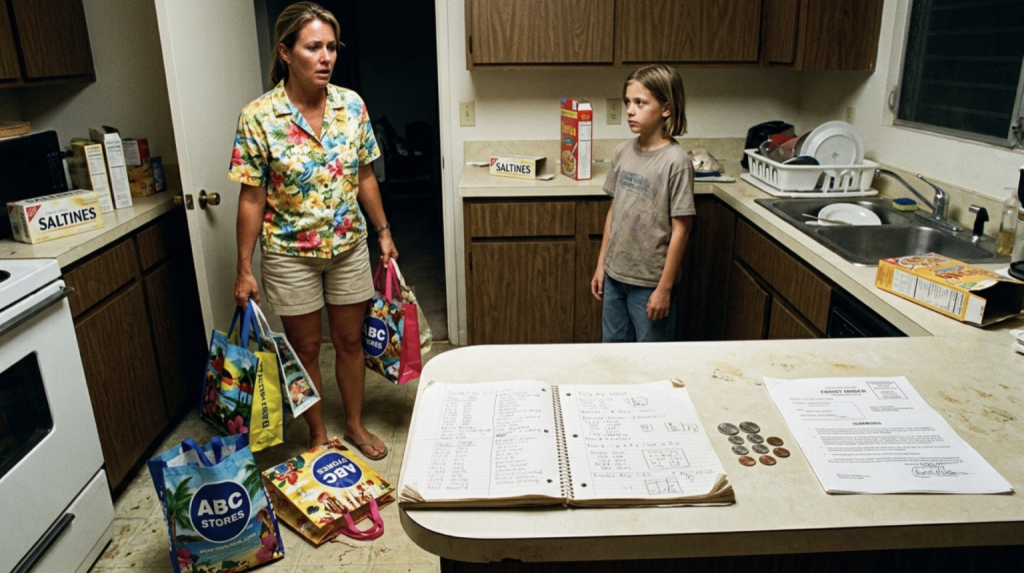
Sarah drove me to the house the morning before Mom returned.
I placed them on the kitchen counter.
Notebook.
Coins.
Court order.
Beside them, I put the gas station receipt.
$19.36.
I don’t know why.
Maybe because eleven-year-old me wanted the numbers to speak.
Numbers were harder to call dramatic.
That evening, Mom walked into the house carrying souvenir bags.
A neighbor later told investigators what she saw through the open doorway.
Mom put her suitcase down.
Saw the papers.
Picked up the court order.
Then the notebook.
Then the coins.
The souvenir bags slipped from her hands.
“No.”
she whispered.
“This can’t be happening.”
But it was.
For the first time in my life, reality did not change because my mother disliked it.
The hearing happened nine days later.
Mom arrived wearing navy blue.
Her attorney sat beside her.
She looked polished.
Calm.
Victimized.
I knew that version of her.
It was the version strangers loved.
She told the court she had made a “temporary judgment error.”
She said I was unusually mature.
She said the neighborhood was safe.
She said I had access to emergency services.
She said food had been available.
She said she checked in.
Then Deputy Harris testified.
Phone records showed otherwise.
Sarah testified.
Derek testified.
The gas station receipt was entered.
Photographs of the refrigerator.
The pantry.
The chair beneath the door.
The knife beside the couch.
Then my notebook.
Mom’s attorney objected to parts.
I didn’t understand why.
I only understood when the judge began reading that the little spiral notebook mattered.
Not because an eleven-year-old’s diary automatically proved every fact.
But because the entries had been written day by day.
Before police.
Before court.
Before I had any reason to manufacture a story.
Day 2.
64 cents left. Mom did not call.
Day 3.
Heard something at the window.
Day 4.
Called Mom five times. No answer.
Day 5.
I am scared to take out the trash because someone might notice I am alone.
Then came Mom’s recorded call with Ms. Alvarez present.
Her attorney asked that it be considered in context.
The judge did.
Context did not help her.
Neither did Derek.
He testified that Mom told him I would be with Chloe’s family.
He produced the bank withdrawal showing the fifteen hundred dollars.
He produced messages.
One from three days before departure.
DEREK: Did Sarah confirm Maya’s food/allergies/etc?
MOM: All handled. Stop worrying.
Another:
DEREK: Should I give Sarah the money directly?
MOM: No, I already told her I’d handle it.
Then:
DEREK: $1500 should cover everything + activities.
MOM: More than enough.
I watched my mother read those messages on a screen.
For once, she had no expression.
The judge ordered that I remain outside her custody while the case proceeded.
Supervised contact only.
Counseling.
Parenting education.
Additional conditions I barely understood.
Mom cried.
I almost ran to her.
That is the part nobody tells you.
A court can protect a child from a parent.
It cannot instantly remove the child’s instinct to comfort that parent.
Mom looked at me.
“Maya.”
I stood.
Sarah touched my shoulder.
Not stopping me.
Just reminding me she was there.
Mom opened her arms.
A bailiff moved slightly.
I froze.
Then Mom said:
“Tell them you want to come home.”
There it was.
Not:
I’m sorry.
Not:
Are you okay?
Not:
I love you.
Fix this for me.
I sat back down.
Mom’s face changed.
I had seen that expression before.
Cold.
Punishing.
But something inside me had changed too.
I was still afraid.
I simply no longer believed fear meant obedience.
I stayed with Sarah.
At first temporarily.
Then longer.
Derek disappeared from Mom’s life.
Not mine.
That surprised everyone.
Especially me.
He asked through the social worker whether he could send a birthday card.
I said yes.
He sent no gift.
Just a card.
Maya, I should have checked. Adults sometimes say “I didn’t know” as though ignorance erases responsibility. It doesn’t. I believed what was convenient to believe. I am sorry. You do not owe me a response. — Derek
I kept that too.
Not because I forgave him immediately.
Because it was the first adult apology I ever received that did not contain the word but.
Mom’s apologies always had one.
I’m sorry, but you scared me.
I’m sorry, but you embarrassed me.
I’m sorry, but I was under stress.
I’m sorry, but you need to understand my side.
Derek simply said:
I should have checked.
That became my standard.
Eventually, my mother’s case concluded.
There were legal consequences.
Court supervision.
Mandatory programs.
Restrictions.
I will not pretend she went to prison for decades.
Real life is rarely that tidy.
The most important consequence was simpler.
She lost the automatic authority she had always assumed she possessed over me.
The court could order supervised visits.
It could require counseling.
It could review custody.
What it could not order was trust.
That had to be rebuilt.
Mom never understood that.
During our first supervised visit, she brought me a necklace from Hawaii.
A tiny silver palm tree.
“I bought this for you.”
she said.
I stared at it.
“When?”
“What?”
“When did you buy it?”
“In Maui.”
“What day?”
She frowned.
“Why does that matter?”
“Was it before I called and said I was hungry?”
Her face tightened.
“Maya.”
“Or after?”
The supervisor shifted in her chair.
Mom pushed the necklace toward me.
“I was thinking about you.”
I looked at the palm tree.
Something about it made me furious.
“You were thinking about me while I was home alone?”
“Yes.”
“Then why didn’t you come back?”
“Maya, we’ve discussed this.”
“No.”
“You’ve explained it.”
“That isn’t the same.”
Her jaw tightened.
“I made a mistake.”
“For thirty days?”
“You were safe.”
“I wasn’t.”
“Nothing happened.”
Something inside me became still.
That sentence.
Nothing happened.
As if danger only counts when it finishes the job.
As if fear leaves no injury.
As if hunger matters only after hospitalization.
As if abandonment is harmless when the child survives it.
I pushed the necklace back.
“I don’t want it.”
Mom stared at me.
“It cost almost two hundred dollars.”
I laughed.
I couldn’t help it.
She looked offended.
I laughed harder.
Then I started crying.
“What’s funny?”
I wiped my face.
“You spent two hundred dollars on a necklace while I had sixty-four cents.”
Mom went silent.
The supervisor wrote something down.
I never accepted the necklace.
For years, I wondered whether that was cruel.
It wasn’t.
A gift is not an apology.
At twelve, I was placed permanently with Sarah under a guardianship arrangement.
Mom retained limited rights and supervised contact for a period, subject to court review.
The exact legal arrangements changed over time.
What mattered to me was that Sarah’s house became home.
At first, I did not know how to live there.
I hid food.
Crackers beneath my pillow.
Granola bars in my backpack.
Bread in a desk drawer.
Sarah found it.
She did not punish me.
The next morning, she put a basket in my bedroom.
Granola bars.
Crackers.
Applesauce.
Bottled water.
A note.
You don’t have to hide food here. But if having some in your room helps you feel safe, this basket is yours. I will refill it whenever you ask.
I cried.
Then hid three granola bars anyway.
Healing is not a switch.
Sarah kept refilling the basket.
Eventually, I stopped hiding food.
At thirteen, I could sleep upstairs without checking the front door.
At fourteen, I stopped counting slices of bread.
At fifteen, I could hear a branch scrape a window without sitting upright in terror.
At sixteen, Sarah left for an overnight work conference.
Before going, she arranged for Chloe’s aunt to stay with us.
I said:
“We’re sixteen.”
Sarah shrugged.
“You’re still minors.”
Those words should not have felt loving.
They did.
Mom continued supervised visits for a while.
Some were good.
Some were terrible.
She learned the correct vocabulary in counseling.
Accountability.
Safety.
Repair.
Impact.
But sometimes people learn therapeutic language the way others learn costumes.
They wear the words without changing underneath.
“I acknowledge that you experienced fear.”
she told me once.
“You experienced?”
I asked.
“Yes.”
“Like it was weather?”
She sighed.
“Maya, I’m trying.”
“Then say what you did.”
“I left you in a situation that you interpreted as unsafe.”
I stood.
The supervisor looked at me.
“Do you want to end the visit?”
“Yes.”
Mom became angry.
“See?”
she said.
“This is what I mean. Nobody lets me say anything.”
I walked out.
At seventeen, I stopped visits.
The court did not force them.
Mom sent letters.
I read some.
Returned others unopened.
On my eighteenth birthday, she sent a long email.
The subject was:
NOW THAT YOU’RE AN ADULT
I almost deleted it.
Instead, I read.
She wrote that she hoped adulthood would help me understand how difficult parenting had been.
She wrote that she had been only thirty-seven.
She wrote that she deserved happiness.
She wrote that Derek had pressured her about the trip.
That was a lie.
His messages proved otherwise.
She wrote that she never intended for me to suffer.
Maybe that was true.
Intent is strange.
People sometimes believe harm does not count unless they wanted it.
She ended:
I hope someday you can stop punishing me for one mistake.
One mistake.
I stared at those words.
Then opened my old notebook.
By then, the cover was bent.
Pages yellowing.
I read:
Day 1.
Day 2.
Day 3.
Day 4.
Day 5.
It had not been one mistake.
It had been a decision every morning.
Every ignored call.
Every deleted comment.
Every lie to Derek.
Every day she woke in a hotel and chose not to come home.
I replied.
Only once.
Mom, I am not punishing you. I am deciding what relationship is safe for me. Those are different things. I hope someday you understand that.
Then I blocked her email for a year.
I graduated high school.
Sarah and Chloe screamed so loudly at commencement that three rows turned around.
I went to college.
Social work.
Of course.
For a while, everyone assumed I chose it because of what happened.
They were partly right.
But trauma does not deserve credit for every good thing a survivor later becomes.
I chose social work because I was good at it.
Because I cared.
Because I understood systems.
Because I wanted children to have adults who noticed.
But I refused the story that said my mother had somehow made me stronger by hurting me.
She didn’t.
I became strong while recovering from what she did.
There is a difference.
At twenty-three, I started working with families.
At twenty-six, I moved into child advocacy.
At twenty-eight, I stood in a courtroom with a thirteen-year-old girl who had been left alone for four days.
Her father kept saying:
“She knows how to cook.”
I felt eleven again.
I wanted to destroy him.
Instead, I did my job.
Because advocacy is not revenge with paperwork.
I listened.
Documented.
Explained.
Protected.
The girl asked me:
“Am I stupid for still missing him?”
“No.”
“How can I miss somebody who did that?”
“Because love doesn’t automatically disappear when someone hurts us.”
She looked at me.
“Did that happen to you?”
Professional boundaries mattered.
So I answered carefully.
“Something similar.”
“Did you stop loving them?”
I thought about Mom.
“No.”
“Then what did you do?”
“I learned that loving someone doesn’t always mean they get unlimited access to you.”
She nodded.
I wished someone had told me that at eleven.
At thirty-one, I married.
His name was Daniel.
Yes.
Same name as my grandfather.
No symbolism intended.
He was a high school science teacher who made terrible coffee and excellent pancakes.
On our third date, he asked why I always carried snacks.
I said:
“Long story.”
He said:
“Okay.”
And did not ask again.
Six months later, I told him.
Everything.
He listened.
Then asked:
“What do you need from me when food anxiety happens?”
Not:
Why didn’t you call the police?
Not:
How could your mother do that?
Not:
Are you over it?
What do you need?
I loved him a little for that.
Years later, I loved him enormously.
Sarah walked me down the aisle.
I asked her.
She cried for twenty minutes.
Chloe was maid of honor.
Derek attended.
That surprises people.
We had rebuilt something over the years.
Not father and daughter.
Not exactly.
But a relationship.
He never demanded it.
He sent birthday cards.
Graduation cards.
A wedding card.
Sometimes we had coffee.
He eventually married another woman.
They had no children.
At my wedding, he approached Sarah.
“Thank you.”
he said.
She looked confused.
“For what?”
“For doing what I should’ve made sure was being done.”
Sarah shook her head.
“You were lied to.”
“I was also comfortable being lied to.”
He said.
“I’ve had a long time to learn the difference.”
That was why I let him remain in my life.
Not because he had been innocent.
Because he became accountable.
Mom did not attend.
I had invited her.
That surprised everyone too.
By then, we had limited contact.
Occasional phone calls.
A lunch every few months.
She had changed somewhat.
Age had softened her.
Consequences had humbled her.
But I still did not trust her completely.
The invitation came with one boundary.
Please come as my guest. Please do not give a speech or discuss our past with other guests.
She replied:
If I’m not allowed to participate as your mother, I don’t see the point.
I wrote:
I understand.
She did not come.
It hurt.
Of course it did.
Boundaries do not eliminate grief.
Sometimes they create the cleanest version of it.
Daniel and I had a daughter two years later.
We named her Sophie.
The first time I held her, I became frightened.
Not joyful.
Frightened.
She was so small.
So completely dependent.
I looked at her and thought:
How could anyone leave?
Then immediately hated myself for thinking about Mom.
Therapy helped.
Motherhood did not magically explain my mother to me.
That is another story people like to tell.
You’ll understand when you have children.
I understood less.
But I also became more careful with judgment.
Parenting was hard.
Exhausting.
Sometimes infuriating.
There were nights Sophie screamed for three hours.
Days I wanted five minutes where nobody touched me.
Moments I resented how completely another human being needed me.
I learned that good parents can feel terrible things.
The difference is what they do with those feelings.
When Sophie was eleven, I nearly lost my mind.
Not because of anything she did.
Because she turned eleven.
The age.
That number.
Suddenly I saw myself everywhere.
When she left cereal bowls around, I thought of the empty pantry.
When she forgot to charge her phone, I thought:
What if she needed help?
When she asked to stay home alone for two hours while Daniel and I went to dinner nearby, my body reacted before my mind.
“No.”
Sophie blinked.
“Mom, I’m eleven.”
“I know.”
“Ella stays alone.”
“I said no.”
She rolled her eyes.
I almost shouted.
Instead, I stopped.
Trauma can disguise itself as responsible parenting.
That does not make every protective instinct wrong.
But it deserves examination.
I called my therapist.
We made a plan.
Two weeks later, Sophie stayed home alone for forty-five minutes in daylight.
She had my number.
Daniel’s.
Sarah’s.
Two neighbors.
Food.
A charged phone.
We were six minutes away.
I checked in once.
Not twelve times.
When we returned, Sophie was on the couch watching television.
“See?”
she said.
“I survived.”
My heart tightened.
I sat beside her.
“Can I tell you something?”
She looked suspicious.
“Am I in trouble?”
“No.”
I told her an age-appropriate version of what happened to me.
Not every detail.
Not the knife.
Not yet.
But enough.
She stared.
“Grandma Valerie did that?”
“Yes.”
“Why do we still see her?”
I thought carefully.
“Because she is part of my life in a limited way that I choose.”
“Do you forgive her?”
“Some days.”
Sophie frowned.
“Can forgiveness change?”
“Yes.”
“That seems inconvenient.”
“It is.”
She leaned against me.
“I wouldn’t leave my kid.”
“I hope not.”
“Can I have a kid when I’m eleven?”
“No.”
“Then this conversation is irrelevant.”
I laughed.
She was Daniel’s daughter.
When Sophie turned thirteen, Mom asked to take her shopping alone.
I said no.
Mom became offended.
“Do you really think I would hurt my granddaughter?”
“I think trust is specific.”
“I’ve apologized.”
“Yes.”
“It’s been decades.”
“Yes.”
“How long are you going to hold this against me?”
There it was.
The old question.
I answered differently now.
“I don’t hold it against you every morning, Mom.”
“I don’t wake up angry.”
“I don’t spend my days planning punishment.”
“I simply don’t put children in your unsupervised care.”
“That is not revenge.”
“That is a boundary based on history.”
She hung up.
Three months later, she called.
“I understand.”
I almost dropped the phone.
“What?”
“I said I understand.”
“Are you okay?”
She laughed.
Then cried.
“I’ve been seeing someone.”
“A therapist?”
“Yes.”
“Voluntarily?”
“Don’t ruin the moment.”
I smiled despite myself.
Mom was seventy by then.
Change came late.
Late still counts.
But late does not erase what came before.
She began doing something she had never done.
Naming actions.
Not intentions.
“I left you alone.”
“I lied to Derek.”
“I ignored your calls.”
“I took money intended for your care.”
“I blamed you when I was caught.”
“I expected you to protect me from consequences.”
The first time she said all of that, I cried.
Not because it fixed me.
I had already done most of my healing without her.
I cried because the eleven-year-old inside me had waited half a lifetime to hear the adult responsible say:
It happened.
You did not imagine it.
You did not exaggerate it.
You did not cause it.
Mom asked:
“Can you forgive me?”
I took a breath.
“I have.”
Her face changed.
“When?”
“I don’t know.”
“Then why don’t you trust me?”
Because forgiveness and trust are not twins.
I almost said that.
Instead:
“Forgiveness was something I did with my anger.”
“Trust would require me to ignore what I know.”
She nodded.
“That hurts.”
“I know.”
“Is it supposed to?”
“No.”
“It just does.”
That was one of our best conversations.
Because neither of us tried to make the truth painless.
Mom died when I was fifty-eight.
Cancer.
I visited her.
Not every day.
Enough.
Sophie came twice.
By then she was thirty-four with a son of her own.
My grandson, Lucas, was six.
Mom adored him.
Supervised.
Always.
Near the end, Mom asked me:
“Do you still have the notebook?”
“Yes.”
“The original?”
“Yes.”
“Why?”
I thought.
“For a long time, because I needed proof.”
“And now?”
I looked at her.
“Because she deserves to be remembered.”
“Who?”
“The girl who wrote it.”
Mom cried.
“I’m sorry.”
“I know.”
“No.”
She reached for my hand.
“I want to say it without asking you to make me feel better.”
So I let her.
She spoke.
“I’m sorry you were hungry.”
“I’m sorry you were scared.”
“I’m sorry you slept beside the door.”
“I’m sorry you believed you had to protect me from Derek.”
“I’m sorry I taught you that asking for help was betrayal.”
“I’m sorry I called you dramatic when you were describing reality.”
“I’m sorry I made you feel responsible for my happiness.”
“I’m sorry I stayed on that trip.”
Her voice broke.
“That is the part I cannot forgive myself for.”
I squeezed her hand.
“Then don’t make self-forgiveness your final job.”
She looked at me.
“What?”
“You don’t need to punish yourself to prove you’re sorry.”
Tears ran down her face.
“I don’t deserve you.”
I shook my head.
“Don’t do that either.”
“What?”
“Turn me into evidence that you’re terrible.”
She stared.
“I’m your daughter.”
“That’s all.”
“I’m not your punishment.”
“I’m not your redemption.”
“I’m me.”
She nodded.
“Okay.”
Those were almost her final words to me.
Not dramatic.
Okay.
She died two days later.
I grieved.
Deeply.
That confused some people.
How could I mourn the woman who abandoned me?
Because she was my mother.
Because she hurt me.
Because she also braided my hair when I was six.
Because she made cinnamon toast on snow days.
Because she failed me catastrophically.
Because she changed late.
Because I loved her.
Because human relationships are inconveniently resistant to simple categories.
I did not need to make her a monster to validate what she did.
The facts were enough.
That became important in my work too.
I trained young advocates.
I told them:
“Do not exaggerate harm because you think truth needs help.”
“It doesn’t.”
“Document.”
“Listen.”
“Be precise.”
“A parent can love a child and still neglect them.”
“A parent can be charming and still unsafe.”
“A child can miss a parent and still need protection from them.”
“Two things can be true.”
I retired at sixty-seven.
Sarah was ninety-two.
Still alive.
Still bossy.
Still convinced nobody loaded a dishwasher correctly except her.
I visited every Wednesday.
One afternoon, I brought the notebook.
She stared.
“You still have that?”
“Yes.”
“Good Lord.”
“You’re the reason it survived.”
“No.”
“You are.”
“I only saw you through a window.”
“Exactly.”
She looked away.
“You would’ve been found eventually.”
“Maybe.”
“Maya.”
“What?”
“I don’t want you turning me into some hero.”
I smiled.
“Too late.”
She glared.
“Sarah.”
I reached across the table.
“You looked.”
“What?”
“You looked through the window.”
“So?”
“So many people don’t.”
She became quiet.
“You didn’t break in.”
“You didn’t accuse me.”
“You didn’t decide I was fine because I wouldn’t answer.”
“You looked.”
“You saw the chair.”
“The bread.”
“The knife.”
“You called someone.”
Sarah’s eyes filled.
“That should be ordinary.”
“Yes.”
“It shouldn’t make me special.”
“No.”
“But it changed my life.”
She cried.
So did I.
Sarah died at ninety-five.
Chloe and I buried her beside her husband.
At the funeral, I put a copy of the refrigerator note inside her coffin.
YOU ARE ALLOWED TO CALL.
Not the original.
I kept that.
Some things belonged with the dead.
Some belonged with the living.
Years passed.
Sophie became a pediatrician.
Lucas grew into the kind of teenager who could empty an entire refrigerator in twelve minutes.
The first time I saw him standing with the door open complaining there was “nothing to eat,” I laughed so hard I had to sit down.
“What?”
he asked.
“Nothing.”
“There really isn’t.”
“There are seventeen things directly in front of you.”
“None of those count.”
I laughed harder.
Healing sometimes arrives disguised as an overfed teenager insulting your groceries.
At seventy-four, I moved to a smaller house.
While packing, I found the sixty-four cents.
One dime.
Two quarters.
Four pennies.
I had kept them in an envelope.
Daniel sat beside me.
“What are you going to do with those?”
“I don’t know.”
“Frame them?”
“No.”
“Donate them?”
“To whom? The National Museum of Childhood Trauma?”
He smiled.
I held the coins.
For decades, they had symbolized abandonment.
Then survival.
Then evidence.
Now they were simply coins.
That realization made me cry.
Daniel wrapped an arm around me.
“I think I’m done with them.”
“What does done look like?”
I thought.
Then smiled.
The next morning, we walked to a bakery.
I placed the coins into the tip jar.
Daniel looked horrified.
“Sixty-four cents?”
“I tipped more.”
“You’d better.”
I had.
Twenty dollars.
The coins disappeared among dozens of others.
No ceremony.
No plaque.
No symbolism except what I gave them.
That was freedom.
The notebook was harder.
I kept it.
Not as evidence against Mom anymore.
As evidence for Maya.
The child.
At eighty-one, I was invited to speak at a conference for child welfare professionals.
I brought it.
I held it up.
“This notebook once helped adults understand what happened to an eleven-year-old.”
I opened it.
“I want you to notice something.”
I read:
Day 3: Ate 2 crackers, 1 banana, and 1 slice of bread with peanut butter.
Then:
Day 5: I am scared to take out the trash because someone might notice I am alone.
I closed it.
“When professionals read records like these, we often look for evidence.”
“Dates.”
“Patterns.”
“Risk.”
“Contradictions.”
“All necessary.”
“But remember that evidence was once somebody’s Tuesday.”
The room became quiet.
“That line about crackers was not written for court.”
“It was written because a child was hungry.”
“The line about being afraid was not written for a case file.”
“It was written because a child believed discovery might be more dangerous than isolation.”
“Never let paperwork make suffering abstract.”
I received a standing ovation.
I hated standing ovations.
Sarah would have loved it.
At eighty-six, Daniel died.
Forty-five years of marriage ended in a hospital room at 4:11 in the morning.
I held his hand.
He had been unconscious for hours.
Just before his breathing changed, I whispered:
“You can go.”
Then immediately:
“But if you want another forty-five years, I’m available.”
He did not take the offer.
Rude.
Grief at eighty-six was different from grief at eleven.
Not smaller.
Just less frightening.
At eleven, loss taught me people could disappear and leave me defenseless.
At eighty-six, loss taught me I could be devastated without becoming abandoned.
Sophie stayed.
Chloe called.
Lucas brought terrible coffee.
I cried.
Ate.
Slept.
Woke.
Repeated.
Nobody left me with twenty dollars and instructions not to cause trouble.
That matters.
At ninety, I moved into an apartment attached to Sophie’s house.
I had one rule.
“No baby monitor.”
She said:
“You’re ninety.”
“Exactly.”
“What if you fall?”
“I’ll yell.”
“You’re impossible.”
“Genetic.”
“From Grandma Valerie?”
“Don’t push it.”
We laughed.
By then, the story of my childhood had become family history.
But I insisted on one rule.
Nobody could tell it as a revenge story.
Not:
Maya’s mother abandoned her and Maya destroyed her in court.
I hated that version.
I had not destroyed my mother.
Consequences were not revenge.
Sarah had not stolen me.
Derek had not heroically saved me.
The court had not magically fixed everything.
And I had not become successful because suffering was secretly a gift.
The truth was less satisfying.
A mother neglected her child.
A neighbor noticed.
Systems intervened.
Some worked.
Some were clumsy.
A child was protected.
Then that child spent years healing.
The mother changed somewhat.
Relationships evolved.
People aged.
People died.
Life continued.
No villain exploded.
No dramatic fortune appeared.
No perfect justice arrived.
But I survived.
And survival eventually became something better.
Living.
On my ninety-third birthday, my great-granddaughter Ava visited.
She was eleven.
Of course she was.
Life loves echoes.
She had freckles.
A loud laugh.
Zero respect for furniture.
She found the notebook.
I had left it on the desk.
“What’s this?”
My entire body tightened.
Then relaxed.
“You can read it.”
She sat on the floor.
Read several pages.
Her face changed.
“You were eleven?”
“Yes.”
“Like me?”
“Yes.”
“Your mom left you alone?”
“Yes.”
“For a month?”
“She planned to.”
“But someone found you.”
“Yes.”
“Were you scared?”
“Very.”
Ava looked at the notebook.
“Why didn’t you call someone?”
There it was.
The question.
Not cruel.
Not blaming.
A child trying to understand another child.
I smiled.
“Because I thought asking for help would make everything worse.”
“Why?”
“My mother taught me that.”
Ava frowned.
“That’s dumb.”
I laughed.
“It was.”
“If you called me, I’d tell my mom.”
“Good.”
“And Grandma Sophie.”
“Good.”
“And the police.”
“Excellent.”
“And maybe my teacher.”
“Now you’re showing off.”
She looked at the food entries.
“You only ate one slice of bread?”
“Some days.”
Ava became quiet.
Then she went downstairs.
I heard cabinets.
Footsteps.
She returned carrying two peanut-butter sandwiches.
One for me.
One for her.
She handed mine over.
“You need more than one slice.”
I cried.
Poor child looked terrified.
“Did I do something?”
“No.”
“Why are you crying?”
“Because this is a very good sandwich.”
She looked skeptical.
“It has peanut butter.”
“Exactly.”
We ate together.
Two eleven-year-old girls separated by eighty-two years.
One had rationed bread in an empty house.
The other had made too much peanut butter and left crumbs on my carpet.
I preferred her version.
Near the end of my life, I wrote one letter.
Not because I had secret money.
Not because I wanted a dramatic revelation.
Because people leave stories behind whether they intend to or not.
I wanted mine told correctly.
Sophie read it after I died.
I was ninety-five.
A peaceful death.
A full refrigerator downstairs.
People in the house.
A phone beside the bed.
No locked doors.
My letter began:
If you are reading this, I am gone. Please check whether Ava left peanut butter on my carpet again.
They laughed.
Good.
Then Sophie continued.
There is a story people have told about me for most of my life.
It begins with twenty dollars.
An eleven-year-old girl.
An empty house.
A mother leaving for thirty days.
It ends, in the dramatic version, with that mother returning from paradise to find a notebook, sixty-four cents, and a court order waiting on the kitchen counter.
That part happened.
But it is not the ending.
She paused.
Please do not mistake the moment someone is rescued for the moment they are healed.
Those are different moments.
The sheriff helped rescue me.
Sarah helped raise me.
Therapy helped me understand myself.
Time helped my body stop expecting danger.
Love helped me risk dependence again.
Work gave me purpose.
Motherhood gave me new questions.
Age gave me perspective.
And I did a great deal of the healing myself.
Then:
Do not turn Sarah into a saint.
She would hate that.
She was simply an adult who noticed something wrong and acted.
That should not be extraordinary.
Make it ordinary.
Look through the window.
Ask the second question.
Believe children enough to investigate.
Do not assume silence means safety.
Sometimes silence means a child has learned that speaking is dangerous.
Sophie stopped to wipe her eyes.
Do not turn Derek into a hero either.
He was deceived.
He was also inattentive.
He eventually understood that both facts could be true.
That understanding allowed us to build a relationship.
Accountability is not declaring yourself evil.
It is becoming accurate about what you did and what you failed to do.
Then came Mom.
And please do not turn Valerie into a monster.
The room became still.
What she did was monstrous enough without requiring us to make her one.
She was selfish.
Neglectful.
Dishonest.
She abandoned her responsibility.
She blamed a child for exposing it.
Those facts do not need decoration.
But she was also a human being who eventually changed in some ways and failed to change in others.
I loved her.
I was hurt by her.
I forgave her.
I did not fully trust her again.
None of those sentences cancels another.
Then:
If someone hurts you, you are not required to hate them in order to take the harm seriously.
You are also not required to forgive them in order to prove you healed.
Forgiveness was useful to me.
It may not be useful to everyone.
Safety comes first.
Choice matters.
Boundaries matter.
Truth matters.
The next page concerned something smaller.
Bread.
For years, I could not throw bread away.
Even moldy bread upset me.
I counted slices without realizing I was counting.
I checked expiration dates repeatedly.
I kept emergency snacks in every bag.
People laughed sometimes.
Most did not know why.
Be gentle with strange habits.
Sometimes they are scars wearing ordinary clothes.
Ask before judging.
Then:
When I became a mother, I feared becoming Valerie.
That fear made me overprotective sometimes.
Trauma does not automatically make us wiser.
Sometimes it simply makes us frightened in new directions.
I had to learn that protecting Sophie did not mean preventing every experience that reminded me of mine.
She deserved her own childhood.
Not a safer reenactment of mine.
Then my work.
I spent my career around vulnerable children.
People occasionally told me what happened made me perfect for that work.
Please don’t say that about survivors.
Pain can teach.
But pain is not a scholarship anyone should be grateful to receive.
I became good at my work because I studied, listened, practiced, failed, learned, and cared.
My mother’s neglect did not deserve credit for my career.
That was important.
Very important.
Then the final pages.
When I was eleven, I thought survival meant making twenty dollars last thirty days.
Later I thought survival meant winning in court.
Then I thought it meant never needing anyone.
I was wrong every time.
Survival was only the beginning.
Living was learning that the refrigerator could be full without checking it three times.
Living was leaving my daughter safely with someone and not imagining disaster.
Living was marrying Daniel and believing he would come home because he said he would.
Living was calling Sarah when I needed help.
Living was allowing my mother to become more than the worst thing she did without pretending the worst thing had not happened.
Living was giving sixty-four cents to a bakery and realizing the coins no longer had power over me.
Living was watching my great-granddaughter complain there was nothing to eat in a kitchen full of food.
That was not ingratitude.
That was victory.
Sophie could barely read by then.
Ava took her hand.
Then Sophie continued.
If there is one thing I want the children in this family to inherit, it is not fear.
It is permission.
Permission to call.
Permission to ask.
Permission to tell.
Permission to say, “Something is wrong.”
Permission to leave a room where someone makes you unsafe.
Permission to love someone from a distance.
Permission to change your mind.
Permission to need other people.
Permission to be a child while you are a child.
Then the line from Sarah’s refrigerator.
YOU ARE ALLOWED TO CALL.
I had written it in capital letters.
Sarah wrote those words for an eleven-year-old girl who had been taught that asking for help was betrayal.
I carried them for eighty-four years.
Now they belong to you.
The final paragraph was short.
I began this story with twenty dollars in my hand and an empty house behind me.
I end it surrounded by people.
That is enough.
More than enough.
At my funeral, Ava placed something beside my photograph.
Not sixty-four cents.
Not the notebook.
A peanut-butter sandwich.
Sophie laughed through tears.
“So Grandma won’t get hungry.”
Ava said.
Nobody corrected her.
The notebook eventually went to an archive used for training child-welfare professionals.
Not because I wanted strangers staring at my childhood.
Because I wanted them to remember that behind every case number is a person living through ordinary minutes.
A kitchen.
A window.
A slice of bread.
A ringing phone.
A frightened child deciding whether anyone in the world is safe enough to call.
The original refrigerator note remained with Sophie.
Years later, she framed it.
Not my notebook.
Not the court order.
Sarah’s note.
YOU ARE ALLOWED TO CALL.
And beneath it, Sophie added one sentence of her own:
AND SOMEONE SHOULD ANSWER.
That became the real ending.
Not my mother dropping souvenir bags.
Not a judge signing an order.
Not even Sarah seeing me through the window.
The ending was every ordinary day afterward in which fear stopped making my decisions.
Every meal I ate without counting.
Every night I slept without barricading a door.
Every phone call I made without apologizing for needing something.
Every person I learned to trust carefully instead of never trusting anyone at all.
Every boundary I kept without confusing it with revenge.
Every time I told the truth without asking permission.
My mother had once looked at an eleven-year-old girl and called her independent because independence was convenient.
It took me decades to understand the difference.
Independence is knowing you can stand alone.
Safety is knowing you don’t always have to.
And love—
real love—
does not hand a frightened child twenty dollars, walk out the door, and demand silence.
Love leaves numbers on the refrigerator.
Love checks whether there is food.
Love notices when something feels wrong.
Love comes home.
Love answers.
And when an eleven-year-old voice whispers from the other end of the line—
“I’m scared.”
Love never tells her she is being dramatic.
Love says:
“I hear you.”
“I’m coming.”
“You don’t have to do this alone.”
That was what Sarah gave me.
That was what I gave Sophie.
That was what Sophie gave her children.
And long after the twenty-dollar bill was spent, the sixty-four cents were gone, the court papers yellowed, and everyone involved had left this world, that was the inheritance that remained.
Not fear.
Not hunger.
Not abandonment.
Permission to reach for someone.
And the promise that someone would reach back.
THE END STORIES! THANK YOU FOR READING GOOD LUCK !❤️
Related Posts