➡️ PART 3 ENDING PART ➡️
For a moment, nobody moved.
The gas station employee stood behind the counter with one hand resting beside the phone.
The officer looked from my nephew to my sister.
My daughter was still pressed against my side, gripping the fabric of my coat with both hands.
And my mother—
my mother looked terrified.
Not angry.
Not irritated.
Terrified.
That frightened me more than anything she had said all afternoon.
“What papers?”
I asked.
My nephew looked at his mother.
She shook her head once.
Small.
Fast.
A warning.
I saw it.
So did the officer.
“Ma’am,” he said to my sister, “don’t coach him.”
“I wasn’t.”
“You just shook your head at him.”
“I was nervous.”
My nephew stared at the floor.
I crouched carefully.
His name was Caleb.
He was eleven.
Only three years older than my daughter.
“Caleb.”
He looked at me.
“You’re not in trouble.”
His eyes filled with tears.
Behind him, my sister whispered:
“Don’t.”
The officer turned toward her.
“Ma’am.”
She stopped.
I looked at Caleb again.
“What papers?”
He swallowed.
“Mom printed them.”
“What were they?”
“I don’t know.”
“Did you read them?”
“Some.”
“What did they say?”
He looked at my daughter.
Then at me.
“Her name.”
My heart began pounding.
“What about her name?”
“They said money.”
My sister closed her eyes.
I stood.
“What money?”
Nobody answered.
I turned toward her.
“Rachel.”
She looked at me.
“What money?”
“It isn’t what you think.”
I laughed.
It was a sharp, ugly sound.
“Do you have any idea how tired I am of hearing sentences that begin that way?”
My daughter flinched.
I immediately softened my voice.
“Sweetheart, you’re okay.”
She nodded, but her grip on me tightened.
I looked back at Rachel.
“Tell me.”
Mom interrupted.
“This is not the place.”
I turned toward her.
“You don’t get to decide where truth is convenient anymore.”
Her face hardened.
“There are children here.”
“Yes.”
I pointed toward my daughter.
“Especially that one.”
Mom glanced at her.
My daughter moved behind me.
That tiny movement broke something in my chest.
My mother saw it too.
For the first time, her expression faltered.
But I wasn’t ready to care about her feelings.
“What papers?”
I asked again.
Rachel whispered:
“Dad’s trust.”
I stared.
Our father had been dead for four years.
“What trust?”
She looked at Mom.
Mom said:
“Rachel.”
The officer stepped forward.
“I’m going to suggest everyone stop interrupting.”
Mom crossed her arms.
Rachel began crying.
“Dad left money.”
“I know.”
“No.”
She shook her head.
“Not the money we knew about.”
My stomach tightened.
“What are you talking about?”
“He had another account.”
“How much?”
Rachel wiped her face.
“I don’t know exactly.”
“Rachel.”
“About eighty-six thousand dollars when he died.”
I stared at her.
“Eighty-six thousand?”
“Yes.”
“And nobody told me?”
“It wasn’t for you.”
The sentence came too quickly.
Too defensively.
I looked at my daughter.
Then back at Rachel.
“It was for her.”
Rachel said nothing.
That was enough.
My knees felt weak.
My father had adored my daughter.
She was four when he died.
He called her Sunshine.
Every Saturday he bought her a blueberry muffin and pretended not to know she only ate the top.
He had once spent six hours building a wooden dollhouse because he refused to buy what he called “that plastic nonsense.”
I still had the dollhouse.
It sat in my daughter’s bedroom.
“What did Dad leave her?”
Rachel whispered:
“An education trust.”
My throat tightened.
“How do you know?”
“Mom found the documents after he died.”
I looked at my mother.
She stared back.
“You knew?”
Mom’s mouth tightened.
“Your father made financial decisions without discussing them with me.”
That was not an answer.
“You knew?”
“Yes.”
My daughter looked up at me.
“Grandpa left me something?”
I bent down.
“Apparently.”
“Why?”
My voice almost broke.
“Because he loved you.”
Mom scoffed.
I stood so fast pain shot through my knees.
“Do not.”
She stopped.
“Do not poison that for her too.”
Mom’s face reddened.
“You don’t understand what your father did.”
“Then explain.”
“He left money to one grandchild.”
I froze.
Rachel’s children stood nearby.
Caleb looked embarrassed.
His younger sister, Lily, looked confused.
Mom continued.
“He had three grandchildren.”
“Why only her?”
I asked.
Mom looked at my daughter.
For a moment, something complicated crossed her face.
Not hatred.
Resentment.
Toward an eight-year-old.
“Because she was his favorite.”
My daughter shrank behind me.
I stepped sideways, blocking Mom’s view.
“She’s eight.”
“She wasn’t eight when he made the trust.”
“She was three!”
“Exactly.”
Mom’s voice rose.
“He had grandchildren he’d known for years, and suddenly everything became Sunshine this and Sunshine that.”
Rachel whispered:
“Mom, stop.”
“No.”
Mom looked at me.
“You want the truth?”
“Yes.”
“Your father changed after she was born.”
My hands went cold.
“He had always been close to Caleb and Lily.”
“Then your daughter arrived and suddenly he was talking about college accounts and music lessons and whether she might want to travel someday.”
“She was a baby.”
Mom’s voice cracked.
“He made plans for her he never made for the others.”
Caleb looked down.
My heart hurt for him too.
None of these children had created this.
Adults had.
“Did Dad leave anything to Caleb and Lily?”
I asked.
Rachel answered.
“Regular savings accounts.”
“How much?”
“About fifteen thousand each.”
“And my daughter’s trust?”
“Eighty-six thousand originally.”
“Originally?”
Rachel closed her eyes.
That word had betrayed her.
“What do you mean originally?”
She started crying harder.
“Rachel.”
“I borrowed some.”
The gas station seemed to go silent.
“How much?”
She did not answer.
“How much money did you take from my daughter’s trust?”
“Technically—”
“How much?”
“Twenty thousand.”
I felt something inside me drop.
“You stole twenty thousand dollars from an eight-year-old?”
“I was going to put it back.”
“How did you even access it?”
Rachel looked toward Mom.
Of course.
Mom.
“You helped her?”
Mom’s chin lifted.
“The family needed it.”
My daughter whispered:
“Mommy?”
I turned immediately.
“Sweetheart, none of this is your problem.”
“Is Auntie in trouble?”
I looked at Rachel.
Then at my daughter.
“Adults are going to handle the adult problems.”
She nodded.
The officer crouched beside her.
“Would you like to sit with Ms. Carmen for a minute?”
The gas station employee smiled gently.
My daughter looked at me.
“I’ll be right here.”
I promised.
“Can I see you?”
“Yes.”
Carmen moved a chair into the open doorway of the employee area.
My daughter sat where she could see me.
That mattered.
I turned back.
“How did you take it?”
Rachel whispered:
“Mom was trustee.”
My mouth fell open.
Dad had named my mother trustee.
That explained access.
“Why didn’t anyone tell me?”
Mom answered:
“Because the trust wasn’t yours.”
“I am her mother.”
“You were supposed to be informed when she turned eighteen.”
I stared.
“And until then?”
“I was responsible for managing it.”
“Managing it does not mean giving twenty thousand dollars to Rachel.”
“The money was invested.”
“Was?”
Mom’s face changed.
I caught it.
“Was?”
Rachel started shaking her head.
“Mom, tell her.”
“Tell me what?”
Mom said nothing.
I stepped closer.
“How much is left?”
No answer.
“Mom.”
“About thirty-one thousand.”
I couldn’t speak.
Eighty-six thousand.
Now thirty-one.
“Where did fifty-five thousand dollars go?”
Mom looked away.
Rachel whispered:
“Some of it was losses.”
“What losses?”
“Investments.”
“What investments?”
Mom snapped:
“I was trying to grow it!”
“With what?”
No answer.
“What did you invest my child’s money in?”
“A business opportunity.”
I laughed in disbelief.
“What business?”
Rachel closed her eyes.
“Uncle Peter’s restaurant.”
I stared.
Our uncle’s restaurant had failed two years earlier.
He had declared bankruptcy.
“How much?”
“Twenty-five thousand.”
Mom said.
My vision blurred.
“Twenty to Rachel.”
“Twenty-five to Peter.”
“That leaves forty-one.”
“There were fees.”
“Eleven thousand dollars in fees?”
“Some investments lost value.”
“What investments?”
She would not answer.
The officer cleared his throat.
“I’m going to recommend that you preserve all financial documents related to this trust.”
Mom turned toward him.
“This is a family financial matter.”
His expression did not change.
“You have already described possible misuse of funds belonging to a minor.”
Mom’s face paled.
Rachel began crying again.
And suddenly I understood the chore list.
The papers.
The timing.
“Why were the documents in Rachel’s kitchen?”
I asked.
Rachel looked at Mom.
“Why?”
“I found them at Mom’s.”
“When?”
“Last week.”
“And you printed copies?”
“Yes.”
“Why?”
“Because I was scared.”
“Of what?”
“That when you eventually found out, you’d blame me for all of it.”
“You took twenty thousand dollars.”
“I know!”
Her voice cracked.
Caleb flinched.
Rachel lowered it.
“I know.”
“Then what does any of this have to do with chores?”
Rachel covered her face.
Caleb answered.
“Grandma saw her.”
Everyone looked at him.
“Saw who?”
I asked.
“Your daughter.”
My daughter looked up from the employee room.
Caleb continued.
“She found the papers.”
My stomach tightened.
“When?”
“This morning.”
“What happened?”
“Mom left them in the kitchen drawer.”
Rachel looked horrified.
“I thought I put them back.”
“You didn’t.”
Caleb continued.
“We were looking for markers.”
“Who?”
“Me and her.”
He nodded toward my daughter.
“She pulled out the papers.”
“She saw her name.”
“What did she do?”
“She asked Grandma why Grandpa’s name was there.”
I looked at Mom.
Mom stared at the floor.
“And Grandma got mad.”
Caleb said.
“What did she say?”
“She told her not to touch things that weren’t hers.”
My daughter called from across the room:
“They had my name.”
I looked at her.
“Yes, sweetheart.”
“I thought maybe Grandpa wrote me a letter.”
That broke me.
She had not been searching for money.
She had seen her dead grandfather’s name beside her own and hoped he had left words.
Mom knew that.
And punished her.
Caleb continued.
“Grandma took the papers.”
“Then she told Mom she was nosy.”
Rachel whispered:
“I wasn’t there.”
“Where were you?”
“Upstairs.”
“And the chores?”
Caleb looked ashamed.
“Mom made the list yesterday.”
“Why?”
Rachel answered.
“Because my kids weren’t helping enough.”
“So you put my daughter on it?”
“I thought if all three had chores—”
Caleb interrupted.
“No.”
Rachel stared at him.
“Caleb.”
“You said she should do ours.”
Rachel’s face drained.
He began crying.
“You said Grandma likes making her useful.”
Rachel whispered:
“Stop.”
“No.”
His voice shook.
“You said if she did our chores, you wouldn’t have to fight with us.”
I stared at my sister.
“Is that true?”
She covered her mouth.
“Rachel.”
“Yes.”
My daughter had been turned into household labor because my sister did not want to parent her own children.
Then mocked for struggling.
Then thrown outside because she accidentally found evidence that adults had taken her money.
The cruelty of it became almost too much to hold at once.
Mom finally spoke.
“She needed discipline.”
I turned toward her.
“No.”
“She was snooping.”
“She was eight.”
“She talks back.”
“She said a laundry basket was too heavy.”
“She is spoiled.”
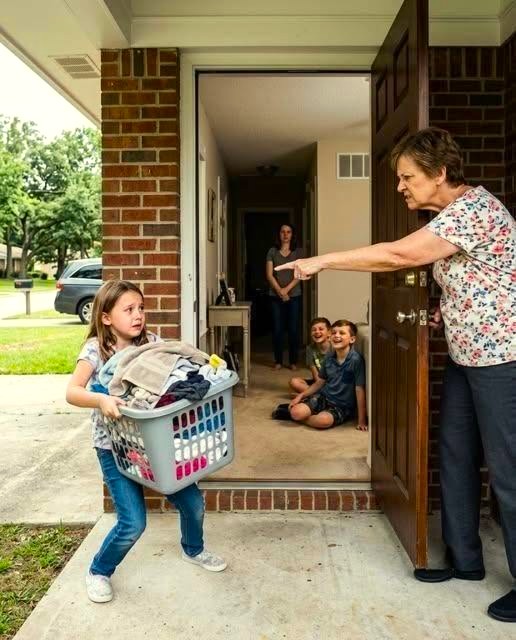
“She walked alone to a gas station because you told her she did not deserve shelter.”
Mom’s eyes flashed.
“I knew she’d come back.”
“She didn’t.”
“She was being dramatic.”
“She thought I had agreed with you!”
Mom fell silent.
My voice broke.
“You told my daughter that her own mother was tired of her.”
“I was trying to make her understand consequences.”
“What consequence?”
I demanded.
“What exactly had she done that deserved believing her mother didn’t want her?”
Mom opened her mouth.
Nothing came.
“Finding the papers?”
Silence.
“That was it.”
I whispered.
“You weren’t teaching her to work.”
“You were frightening her because she found evidence.”
“No.”
“Yes.”
“You wanted her obedient.”
Mom’s face hardened.
“I wanted her to stop asking questions.”
There.
The truth.
Finally.
The officer wrote something down.
Mom noticed.
Her expression changed.
I looked at my daughter.
She was watching me.
I went to her.
Crouched.
“Come here.”
She wrapped her arms around my neck.
I held her.
“Are we going home?”
“Yes.”
“Can I sleep in my room?”
“Of course.”
“Do I have to earn it?”
My throat closed.
“No.”
I pulled back and looked directly into her eyes.
“Listen to me.”
She nodded.
“You never have to earn shelter from me.”
Her eyes filled.
“You never have to earn food.”
“You never have to earn a bed.”
“You never have to earn being safe.”
“What if I’m bad?”
“Then we talk about what happened.”
“What if I don’t do chores?”
“Then we handle chores.”
“What if I make you really mad?”
“Then I get mad.”
I kissed her forehead.
“But you still have a home.”
She began crying.
“Grandma said lazy children sleep outside.”
“No.”
I held her face.
“Children do not lose shelter because an adult is angry.”
“Ever?”
“Ever.”
She collapsed into me.
That was the moment my relationship with my mother ended.
Not when I learned about the trust.
Not when I discovered the stolen money.
When my eight-year-old daughter needed me to explain that home was not conditional.
I drove her home.
Emily—my best friend, not a relative—came over with dinner.
My daughter asked to sleep in my bed.
I said yes.
She woke twice.
The first time:
“Mom?”
“I’m here.”
The second:
“Can Grandma come take me?”
“No.”
“Promise?”
“I promise.”
The next morning, I changed every emergency contact.
School.
Doctor.
Dentist.
After-school program.
My mother and sister were removed.
I told the school neither was authorized to pick up my daughter.
I changed the locks even though Mom did not have a key.
Fear is not always logical.
Sometimes a new lock is simply a message to your own nervous system.
This door belongs to us.
I contacted an attorney.
Her name was Priya Shah.
She specialized in trusts and estates.
I brought every document Rachel eventually gave me.
Priya read silently for almost forty minutes.
Then she removed her glasses.
“This is serious.”
“How serious?”
“The trust terms are very clear.”
“Was Mom allowed to take money?”
“Not for these purposes.”
“Could she invest it?”
“Within her fiduciary obligations.”
“Could she give twenty thousand to my sister?”
“Not based on what I’m seeing.”
“Could she invest twenty-five thousand in her brother’s failing restaurant?”
Priya’s expression answered before she did.
“That raises substantial concerns.”
“Can we recover it?”
“Some.”
“Not all?”
“I won’t promise that.”
I nodded.
Truth before comfort.
I had learned enough.
Priya continued.
“Our first goal is to remove your mother as trustee and obtain a full accounting.”
“Can I become trustee?”
“Possibly.”
I shook my head.
“What?”
“Could someone independent do it?”
She looked surprised.
“Yes.”
“I want that.”
“Why?”
“Because this money has already done enough damage inside the family.”
Priya nodded slowly.
“That’s sensible.”
We petitioned for removal and accounting.
My mother fought.
Of course she did.
Her attorney initially described everything as “reasonable discretionary management.”
Records told a different story.
Transfers.
Checks.
Loans without proper documentation.
Money to Rachel.
Money to Uncle Peter.
A payment toward Mom’s own property taxes.
That one made me physically ill.
Eight thousand dollars.
My daughter’s education fund had paid my mother’s taxes.
The remaining trust balance was just under thirty-two thousand.
From an original eighty-six.
I cried in Priya’s office.
“I’m sorry.”
she said.
“I don’t care about the number.”
I whispered.
That wasn’t entirely true.
I cared.
But something else hurt more.
“My dad trusted her.”
Priya waited.
“He chose her because he thought she’d protect his granddaughter.”
My voice broke.
“And she used that trust as access.”
Priya slid tissues toward me.
“Your father’s decision may have been mistaken.”
She said gently.
“But his intention is still visible in the documents.”
I looked at her.
“What intention?”
“He wanted your daughter to have options.”
That sentence became important.
Options.
Not money.
Options.
College.
Training.
Travel.
A start.
My father had not left her a number.
He had tried to leave her choices.
We could rebuild some of that.
The court removed Mom as trustee.
An independent fiduciary took over.
A judgment required repayment of improperly used funds to the extent recoverable.
Rachel was ordered through a settlement to repay the twenty thousand she had received on a structured schedule.
Mom had to repay personal expenditures.
Recovering the restaurant money was harder.
Uncle Peter had almost nothing.
Eventually, through settlement, property adjustments, and repayments over years, much of the principal was restored.
Not all.
But enough that careful investment over the next decade rebuilt something meaningful.
I did not tell my daughter the numbers.
She was eight.
She needed childhood more than financial litigation.
I told her:
“Grandpa left money to help you when you’re older.”
She asked:
“For college?”
“If you want college.”
“What if I want to be a veterinarian?”
“Then you’ll need a lot of college.”
She frowned.
“What if I want to be a singer?”
“Then please become successful enough to support me.”
She laughed.
That laugh felt like oxygen.
Then she asked:
“Why did Grandma take it?”
I did not lie.
But I did not burden her with adult detail.
“She made choices she wasn’t allowed to make.”
“Because she doesn’t like me?”
My heart cracked.
“No.”
“Then why?”
“Sometimes adults do wrong things because they convince themselves their reasons make the wrong thing okay.”
“Does that work?”
“No.”
She considered this.
“Is Grandma going to jail?”
“No.”
“Is Auntie?”
“No.”
“Are you mad?”
“Yes.”
“How mad?”
“Very.”
She smiled slightly.
“Like when I drew on the wall?”
“Much more.”
“That was pretty mad.”
“I remember.”
She looked down.
“Do I have to see Grandma?”
“No.”
“Ever?”
“Not unless you want to and I believe it’s safe.”
Her shoulders relaxed.
“Okay.”
I started my daughter in therapy.
Her therapist was Dr. Lena Morris.
Warm voice.
Colorful office.
A shelf full of toys.
For the first three sessions, my daughter barely discussed Grandma.
She talked about school.
Dogs.
A girl who stole her pencil.
Then one afternoon she asked Dr. Morris:
“If somebody tells you to leave their house, are you allowed to go somewhere else?”
Dr. Morris said:
“Yes.”
“What if they get mad because you really leave?”
“You still find somewhere safe.”
“What if they say you were supposed to know they didn’t mean it?”
“Adults are responsible for what they tell children to do.”
My daughter thought.
Then:
“I went to the gas station.”
“Yes.”
“Was that smart?”
“Very.”
That mattered.
My daughter had been carrying shame about surviving correctly.
Dr. Morris helped remove it.
We created a safety plan.
My phone number.
My work number.
Emergency services.
Trusted neighbors.
School staff.
Safe public places.
She memorized my best friend’s number too.
Then we added a rule:
If an adult tells you that I don’t want you, you call me.
My daughter wrote it in purple marker.
Then added:
MOM ALWAYS WANTS ME.
I framed that paper.
Not because it was cute.
Because I wanted those words stronger than Grandma’s.
Rachel asked to see me three months later.
I refused.
She asked again.
I refused.
Six months later, Caleb wrote me a letter.
That changed things.
Dear Aunt,
I’m sorry I laughed when she had to carry the laundry.
I knew it was heavy.
I laughed because Mom was letting us get out of chores and I liked it.
When Grandma made her leave, I thought she would come back.
Then she didn’t.
I was scared.
I should have told you about the papers sooner.
He was eleven.
I cried.
I wrote back.
Dear Caleb,
Thank you for telling the truth.
You did something wrong when you joined the teasing.
You also did something brave when you told the truth later.
Both can be true.
Adults were responsible for keeping everyone safe.
That responsibility was not yours.
Learn from this.
Be kinder next time someone has less power than you.
He kept the letter.
Years later, he told me so.
Rachel and I eventually met.
Public place.
No children.
She looked exhausted.
“I’m sorry.”
I waited.
“I used your daughter.”
That was better than excuses.
“I didn’t think of it that way then.”
“But I did.”
She cried.
“My kids complained about chores.”
“Mom already treated your daughter like she needed to prove herself.”
“I took advantage of that.”
“Yes.”
“I told myself it was fair because she was staying there too.”
“She was visiting.”
“I know.”
“She was eight.”
“I know.”
“You took her money.”
Rachel covered her face.
“Yes.”
“Why?”
“I was drowning.”
“In what?”
“Credit cards.”
“Why didn’t you ask me?”
“Because you would have said no.”
I stared.
“That’s your answer?”
She cried harder.
“I know how horrible it sounds.”
“It sounds honest.”
She looked up.
“I needed twenty thousand.”
“For what?”
“Debt.”
“Mom said she’d lend it from the trust and replace it before anyone knew.”
“And?”
“My husband lost his job.”
“Then we couldn’t repay.”
“Then Mom started moving other money around to hide the shortage.”
I felt sick.
“So the restaurant investment?”
“Partly an attempt to make the money back.”
There it was.
One wrong choice breeding another.
“Did Dad really favor my daughter?”
Rachel hesitated.
“I thought he did.”
“Did you resent her?”
“Yes.”
That hurt.
“She was four.”
“I know.”
“Did you resent me?”
“Yes.”
“Why?”
“You were always the one who didn’t need anything.”
I almost laughed.
“Rachel, I needed plenty.”
“You never asked.”
“That isn’t the same.”
She looked down.
“Mom always helped me.”
“And then?”
“I became someone who thought family money was available whenever my life got difficult.”
That was painfully self-aware.
I asked:
“Why did you make the chore list?”
She cried.
“Because I was resentful.”
“Of an eight-year-old?”
“Yes.”
“At the time, I told myself she was spoiled.”
“Really, I was angry that Dad had protected something for her after death while I was struggling.”
I sat quietly.
Finally:
“Thank you for saying that plainly.”
“Can you forgive me?”
“No.”
Her face fell.
“I don’t know yet.”
I clarified.
“I may someday.”
“But I won’t promise forgiveness to make this conversation easier.”
Rachel nodded.
“That’s fair.”
“And forgiveness won’t mean you automatically get access to my daughter.”
“I understand.”
“Do you?”
“Yes.”
“She gets to heal without being used to repair your guilt.”
Rachel cried.
“I understand.”
For the first time, I believed she might.
It took two years before my daughter saw Rachel again.
Not because Rachel demanded it.
Because my daughter asked.
“Auntie said sorry?”
“Yes.”
“Did you forgive her?”
“Somewhat.”
“What does somewhat mean?”
“It means I’m not as angry every day.”
“Do you trust her?”
“Not the way I used to.”
“Can you love somebody and not trust them?”
“Yes.”
She thought.
“That sounds complicated.”
“It is.”
“Being a grown-up sounds terrible.”
“You have no idea.”
She laughed.
We met Rachel at a park.
Thirty minutes.
I stayed.
Rachel did not hug my daughter without asking.
That mattered.
“Can I hug you?”
My daughter thought.
“Not yet.”
Rachel’s face broke for half a second.
Then she nodded.
“Okay.”
That mattered more.
They talked.
Rachel apologized.
Not:
I’m sorry you felt hurt.
Not:
I’m sorry things got out of hand.
She said:
“I’m sorry I made you do work that belonged to my children.”
“I’m sorry I let them make fun of you.”
“I’m sorry I took money Grandpa left for you.”
“I’m sorry I did not protect you when Grandma sent you outside.”
My daughter listened.
Then asked:
“Why didn’t you call Mom?”
Rachel cried.
“Because I was scared your mom would be angry at me.”
My daughter looked confused.
“But I was eight.”
Rachel closed her eyes.
“Yes.”
“You were grown.”
“Yes.”
“So you were supposed to be more scared for me than for yourself.”
I had to turn away.
Eight years old.
And there it was.
The entire moral architecture of the situation in one sentence.
Rachel whispered:
“Yes.”
“I should have been.”
My daughter nodded.
Then went to the swings.
No dramatic forgiveness.
No hug.
Just swings.
Children often understand boundaries better than adults.
Caleb changed too.
He stopped teasing.
Not only my daughter.
Others.
At fourteen, he intervened when boys at school were mocking a younger student.
He got detention for shoving one of them.
I told him the defense was admirable.
The shove was not.
He rolled his eyes.
Teenagers dislike nuance.
At seventeen, he apologized to my daughter again.
She was fourteen.
He said:
“I used to think being stronger meant getting someone else to do what I didn’t want to do.”
She answered:
“That’s stupid.”
“Yes.”
“You were stupid.”
“Yes.”
She smiled.
“Okay.”
They became close cousins eventually.
Lily took longer.
She had been younger during the incident.
She mostly copied her brother and mother.
But she had absorbed Grandma’s language.
Lazy.
Freeloader.
Earn your place.
At twelve, during an argument, she told my daughter:
“At least Grandma wanted us.”
My daughter came home crying.
I ended visits again.
Rachel did not argue.
That mattered.
She dealt with Lily.
Therapy.
Consequences.
Conversations.
Months later, Lily wrote:
I used something I knew would hurt you because I was mad. Grandma used to do that. I don’t want to be like that.
My daughter eventually accepted the apology.
The children grew.
The adults either grew with them or lost access.
My mother did not grow.
Not for a long time.
She blamed me.
Rachel.
The court.
The attorney.
My father.
Even Caleb.
Especially Caleb.
She called him disloyal for telling the truth.
Rachel finally did something I never expected.
She stood up to Mom.
“Don’t call my son disloyal for refusing to lie for us.”
Mom stopped speaking to her.
For almost three years.
That was the price Rachel paid for finally choosing differently.
I respected it.
But I did not erase the past because of it.
People sometimes believe one brave act should purchase instant absolution.
It doesn’t.
Growth is not a coupon.
It is a pattern.
Rachel built one.
Slowly.
She repaid every dollar required under her settlement.
It took nine years.
On the day she made the final payment, she sent me the confirmation.
No speech.
Just:
Finished.
I replied:
Thank you.
Then:
I know it took work.
She answered:
It should have.
That was when I knew she had changed.
Not because she repaid money.
Because she stopped wanting applause for returning what never belonged to her.
Mom was different.
At seventy-four, she sent my daughter a birthday card.
Inside:
I hope someday you understand I was trying to teach you responsibility.
My daughter was sixteen.
She handed it to me.
“Can I throw this away?”
“Yes.”
She did.
No guilt.
At seventeen, Mom tried again.
Families shouldn’t stay divided forever.
My daughter asked:
“Do I owe her another chance because she’s old?”
“No.”
“Would you be mad if I wanted one?”
“No.”
“Would you be mad if I didn’t?”
“No.”
She looked at me.
“You really mean that?”
“Yes.”
“Why?”
“Because access to you isn’t something I use to reward or punish other adults.”
She hugged me.
“I don’t want to see her.”
“Okay.”
And we didn’t.
My daughter graduated high school with honors.
At the ceremony, Rachel came.
Caleb came.
Lily came.
Mom was not invited.
My daughter knew she could invite her.
She chose not to.
That was not revenge.
It was a boundary.
After graduation, we went home.
I gave her a box.
Inside was a photograph of my father.
Grandpa.
He was holding her at three years old.
She wore a yellow dress.
He was laughing.
There was also a copy of the original trust letter.
Not the legal document.
A personal note Dad had written and stored with it.
We had found it years earlier during discovery.
I had waited until she was old enough.
She read:
For my Sunshine,
You are too young to know what college is and currently believe the moon follows our car personally.
She laughed.
Then cried.
Maybe you’ll go to college.
Maybe you’ll learn a trade.
Maybe you’ll become an artist, teacher, doctor, mechanic, scientist, musician, or something that doesn’t exist yet.
I don’t care.
I want this money to make one thing easier: choosing.
Her eyes filled.
Options.
Exactly as Priya had said.
Too many people spend their lives doing what fear can afford.
I hope this gives you a little room to ask what you actually want.
Then:
Do not mistake money for love.
Money is useful.
Love is who sits beside you when usefulness runs out.
My daughter stopped reading.
“Grandpa wrote this?”
“Yes.”
She cried.
“I barely remember his voice.”
“I do.”
“What did he sound like?”
I smiled.
“Like someone permanently disappointed by modern appliances.”
She laughed.
I told her stories.
The muffins.
The dollhouse.
His terrible singing.
The way he called her Sunshine.
Then she finished the letter.
Wherever you go, remember that a home is supposed to be the place you return to, not something you earn by being useful enough.
I froze.
So did she.
Dad had written those words four years before the gas station.
Before Grandma ever told her lazy children did not deserve shelter.
My daughter looked at me.
“Mom.”
“I know.”
We both cried.
Then she read the last line.
You have a place with me because I love you. Nothing else is required.
She pressed the letter against her chest.
For years, I had fought to overwrite Grandma’s sentence.
Now my father had reached across death and helped me.
My daughter chose university.
Psychology.
Then changed majors after one semester.
Architecture.
Then changed again.
Occupational therapy.
I laughed every time.
“What?”
she demanded.
“Nothing.”
“You’re judging me.”
“No.”
“You’re laughing.”
“Grandpa left you money for choices.”
“You’re getting maximum value.”
She threw a pillow at me.
The trust did not cover everything.
It wasn’t enormous.
But between restored funds, investment growth, scholarships, and savings I had added, she graduated with very little debt.
On graduation day, she wore Grandpa’s old watch.
Rachel attended.
So did Caleb and Lily.
My daughter hugged Rachel first.
Years had passed.
Trust had returned slowly.
Not to its original shape.
Something new.
Rachel whispered:
“I’m proud of you.”
My daughter answered:
“Thank you.”
Then Rachel added:
“Your grandpa would be too.”
My daughter cried.
So did Rachel.
I did not interrupt.
That moment belonged to them.
My daughter became a pediatric occupational therapist.
She worked with children recovering from injuries and living with disabilities.
I never told people this was because of what happened to her.
It wasn’t.
Not everything meaningful needs to grow from trauma.
Sometimes people simply discover work they love.
She married at twenty-nine.
A gentle man named Julian.
Before the wedding, I asked:
“Are you happy?”
“Yes.”
“Safe?”
She smiled.
“Yes, Mom.”
“Do you know you can come home?”
She laughed.
“I’m thirty.”
“That wasn’t my question.”
Her expression softened.
“Yes.”
“I know.”
At the wedding, there was one empty chair in the front row.
For Grandpa.
My daughter’s idea.
On it sat his photograph.
And a blueberry muffin.
Only the top had been eaten.
I laughed so hard I cried.
Mom was still alive then.
She was eighty-one.
She heard about the wedding through relatives.
She sent a letter.
My daughter opened it.
This time, the letter was different.
I was wrong.
Three words.
No qualification.
My daughter kept reading.
You were eight years old.
I sent you outside because I was angry and frightened that you had found documents I did not want discovered.
I used chores as an excuse.
My daughter sat down.
I told myself I was teaching responsibility.
That was a lie I told myself because the truth was uglier.
I wanted control.
I stared at the page.
For the first time in more than twenty years, my mother had named it.
I told you that your mother did not want you.
That was cruel.
I knew it was not true.
My daughter began crying.
I took away your backpack.
I left you without your inhaler.
I assumed fear would bring you back.
Instead, you found someone safer than me.
Then:
I misused money your grandfather trusted me to protect.
I resented you for being loved in a way I thought diminished my other grandchildren.
That resentment belonged to me, not you.
You were a child.
You did nothing wrong by being loved.
My daughter stopped.
“Why now?”
I did not know.
The letter continued.
I do not expect an invitation to your wedding.
I do not expect forgiveness.
I am writing because an apology that exists only to obtain access is another form of bargaining.
That sentence sounded like therapy.
Maybe Mom had finally gone.
You do not owe me a response.
I hope your marriage is kind.
I hope your home is safe.
And I hope you never again wonder whether you deserve shelter.
My daughter folded the letter.
“What do I do?”
I looked at her.
“What do you want to do?”
“I don’t know.”
“Then do nothing today.”
She nodded.
Three months after the wedding, she visited Mom.
Alone.
Her choice.
I did not go.
I worried.
Of course I worried.
But my daughter was thirty.
Love had to grow with her.
I could not spend her childhood teaching her that she owned her choices and then confiscate them when I disliked one.
She returned three hours later.
“How was it?”
“Sad.”
“Good?”
“Some.”
“Bad?”
“Some.”
“Do you want to go again?”
“Maybe.”
That was enough.
She saw Mom four more times before Mom died.
They did not rebuild a grandmother-granddaughter relationship.
Too much time had passed.
Too much damage.
But my daughter got answers.
Mom got no absolution.
Only the chance to tell the truth without demanding payment.
At their final meeting, Mom asked:
“Do you forgive me?”
My daughter told me later what she said.
“I don’t know.”
Mom nodded.
Apparently she answered:
“That’s fair.”
Then my daughter asked:
“Why did you hate me?”
Mom cried.
“I didn’t.”
“It felt like you did.”
“I know.”
“Then what was it?”
Mom answered:
“I hated what your existence made me confront about myself.”
My daughter waited.
“Your grandfather loved you openly.”
“He planned for you.”
“He believed you deserved choices.”
“And instead of expanding that love to include everyone, I treated love like there was a limited amount and you had stolen more than your share.”
My daughter cried.
Mom continued:
“I was jealous of a child.”
“That is humiliating to admit.”
“But it is true.”
My daughter asked:
“Did Grandpa love the others?”
“Yes.”
“Then why was my trust bigger?”
Mom looked away.
“I think he worried about your mother.”
“What do you mean?”
“She was raising you alone.”
That surprised both of us when my daughter told me later.
My marriage to her father had ended when she was two.
Dad had watched me struggle.
He had helped.
Apparently he had also planned.
Mom said:
“He told me Caleb and Lily had two parents with strong incomes.”
“You had your mother.”
“He wanted you to have another layer of protection.”
There it was.
Not favoritism.
Context.
Perhaps some favoritism too.
Grandparents are human.
But not the story Mom had built.
My daughter asked:
“Why didn’t you tell everyone that?”
Mom answered:
“Because resentment prefers the version that makes it righteous.”
I wrote that sentence down.
My mother died at eighty-two.
I attended the funeral.
My daughter did too.
Rachel stood beside us.
Caleb and Lily were there.
We were a strange family.
Damaged.
Repaired in places.
Unrepaired in others.
No perfect reconciliation.
No dramatic circle of hands around the grave.
Just people.
Afterward, Rachel asked:
“Do you miss her?”
I thought.
“Yes.”
She looked surprised.
“So do I.”
Missing someone is not a verdict on what they did.
It is simply evidence that a relationship existed.
I missed the mother who made pancakes shaped like animals.
The mother who sat beside me when I had chickenpox.
The mother who taught me to drive.
The mother who later frightened my daughter so badly she believed she had lost her home.
All of those women were the same woman.
That is difficult.
But adulthood is full of difficult truths that refuse to simplify themselves for our comfort.
Years passed.
My daughter had a child.
A girl.
My granddaughter.
The first time I held her, I cried so hard my daughter laughed.
“Mom, she’s not even doing anything.”
“I know.”
“She looks like a potato.”
“She is the most beautiful potato I’ve ever seen.”
When my granddaughter was six, she spilled juice on my carpet.
She froze.
I saw fear flash across her face.
Not because I had ever frightened her.
Because children sometimes fear adult disappointment instinctively.
“I’m sorry.”
she whispered.
I looked at the stain.
Then at her.
“Okay.”
“Am I in trouble?”
“You need to help me clean it.”
Her eyes widened.
“That’s all?”
“What else?”
She shrugged.
We cleaned it together.
Halfway through, she said:
“Mom says when she was little, somebody made her do too many chores.”
My hands stopped.
“She told you?”
“A little.”
“What did she say?”
“That Grandma’s house had bad rules.”
I smiled sadly.
“That sounds about right.”
My granddaughter scrubbed the carpet.
Then asked:
“Can kids get kicked out?”
My heart tightened.
“Not from here.”
“What if they’re super bad?”
“We don’t throw children away.”
“What if they don’t clean?”
“Then the carpet suffers.”
She laughed.
I laughed too.
That evening, after she went home, I sat alone in my living room.
I thought about the gas station.
My daughter at eight.
Cold hands.
Tear-streaked cheeks.
Asking whether she was allowed to come home.
Some memories never lose their ability to enter the room.
But they stop owning all the furniture.
At seventy, I found the purple paper from therapy.
MOM ALWAYS WANTS ME.
I had kept it.
I framed it again.
The old frame had cracked.
I sent my daughter a photograph.
She replied:
You still have that???
I wrote:
Obviously.
She answered:
You are sentimental and embarrassing.
Then:
Love you.
I wrote:
Always.
At seventy-eight, Rachel and I took a trip together.
Just sisters.
We had not done that since our twenties.
One evening, sitting near the ocean, she said:
“I still think about that day.”
“So do I.”
“If Caleb hadn’t told the truth…”
I knew.
The trust might have remained hidden longer.
The financial misuse might have continued.
But I stopped her.
“Don’t make him responsible for saving us.”
She nodded.
“You’re right.”
“He was eleven.”
“I know.”
Then she said:
“I wonder who I’d be if that day hadn’t happened.”
I thought.
“Maybe better.”
She looked at me.
“Really?”
“Maybe worse.”
I shrugged.
“We don’t know.”
Rachel stared at the water.
“I hate when people say everything happens for a reason.”
“Me too.”
“Mom throwing her out didn’t need to happen.”
“No.”
“The money didn’t need to be stolen.”
“No.”
“We could have learned without hurting a child.”
“Yes.”
She cried.
I held her hand.
Growth does not require us to thank the wound.
That became one of the most important lessons of my life.
At eighty-four, I moved into a smaller house.
My daughter helped.
My granddaughter, now grown, complained about how many books I owned.
“Why do you need six boxes of cookbooks?”
“Because I might cook.”
“You make the same twelve meals.”
“Respect your elders.”
“You taught Mom age doesn’t excuse bad behavior.”
“Terrible parenting decision.”
She laughed.
While packing, she found Grandpa’s trust letter.
“What’s this?”
My daughter and I looked at each other.
“Family history.”
I said.
My granddaughter read it.
Then she heard the full story.
Not the child version.
The adult version.
The chores.
The teasing.
The trust.
The stolen money.
The gas station.
Her face changed.
“Mom.”
My daughter looked at her.
“You walked there alone?”
“Yes.”
“You were eight?”
“Yes.”
My granddaughter started crying.
Then:
“I want to fight dead people.”
We all laughed.
My daughter hugged her.
“Grandma apologized before she died.”
“Did you forgive her?”
My daughter thought.
“Enough that I stopped needing an answer to that question.”
My granddaughter frowned.
“What does that mean?”
“It means forgiveness became less important than peace.”
That sounded like wisdom.
I was proud of her.
Then my granddaughter looked at me.
“And you?”
“What about me?”
“Did you forgive your sister?”
I looked toward Rachel, who was still alive and still irritating me regularly.
“Yes.”
“Completely?”
“No.”
My daughter laughed.
I continued:
“Forgiveness isn’t amnesia.”
“Trust isn’t automatically restored because anger softens.”
“Rachel earned back a relationship over years.”
“That mattered.”
My granddaughter nodded.
Then she held up Grandpa’s letter.
“What happened to the money?”
My daughter smiled.
“Want to see?”
She pulled out her phone.
She showed us a photograph.
A small clinic room.
Bright walls.
Child-sized therapy equipment.
“What is that?”
I asked.
She smiled.
“I never told you.”
“Told me what?”
“When I paid off my student loans, there was still some trust money left.”
“How much?”
“About twenty-seven thousand.”
“What did you do?”
“I used part of it as the first donation to start a therapy assistance fund at my clinic.”
My eyes filled.
“For kids whose families can’t afford equipment or enough sessions.”
I stared at her.
“You gave away Grandpa’s money?”
“Some.”
“Why didn’t you tell me?”
“Because I knew you’d cry.”
“I am not crying.”
“You’re literally crying.”
My granddaughter laughed.
My daughter continued.
“I called it the Sunshine Fund.”
That finished me.
I covered my face.
“That’s unfair.”
“What?”
“You can’t use Grandpa’s nickname and expect me to remain dignified.”
She hugged me.
“The trust did what he wanted.”
“What?”
“Gave me choices.”
Then she pointed at the clinic photograph.
“And when I had enough choices of my own, I wanted it to give some to somebody else.”
That night, I could not sleep.
Not because I was sad.
Because something had come full circle without pretending the circle erased what happened inside it.
My father left money.
Mom misused it.
Rachel took some.
My daughter was punished for discovering the evidence.
Years of legal conflict followed.
Money was restored.
Trust was rebuilt.
My daughter used the fund.
Then gave part away.
Not because suffering made her generous.
She was generous because she chose to be.
That distinction mattered.
The Sunshine Fund grew.
Other donors contributed.
My daughter’s original donation became only a small part.
Over the next twenty years, hundreds of children received assistance.
Nobody put my mother’s name on anything.
Nobody put mine either.
My father had a small plaque.
IN MEMORY OF GRANDPA, WHO BELIEVED CHILDREN DESERVE OPTIONS.
That was enough.
I lived to ninety-two.
Near the end, my daughter sat beside me.
She was sixty-two.
It startled me to look at her.
Some part of a parent always expects to turn and find the child at eight.
But there she was.
Silver beginning in her hair.
Lines around her eyes.
A whole life in her face.
“Mom?”
“Yes?”
“Do you remember the gas station?”
I laughed weakly.
“Unfortunately.”
“I’ve been thinking about it.”
“That sounds unhealthy.”
She smiled.
Then:
“You know what I remember most?”
“What?”
“Not Grandma.”
I looked at her.
“Not the chores.”
“Not even walking there.”
“What do you remember?”
“You kneeling down.”
My throat tightened.
“You held my face.”
Tears filled her eyes.
“And you said I had done the right thing.”
I remembered.
“Of course you had.”
“I thought you’d be angry.”
“I know.”
“I was so sure.”
She cried.
“Then you said I could come home.”
I reached for her hand.
My fingers were weak.
She held them.
“I’ve spent my whole life knowing I could come home because of that moment.”
I cried.
“You always could.”
“I know.”
She smiled.
“That’s what I’m saying.”
Silence settled around us.
Not empty silence.
Full.
Then she said:
“Grandma gave me one sentence.”
“What?”
“Lazy children don’t deserve shelter.”
I closed my eyes.
“And you spent the rest of my childhood giving me another.”
“What sentence?”
She leaned close.
“You have a home because you are loved.”
I could barely speak.
“That one was true.”
“I know.”
She kissed my forehead.
I died three days later.
My daughter found a letter in my bedside drawer.
I had written it months earlier.
It said:
My darling girl,
When you were eight years old, an adult who should have protected you told you that shelter was something you had to earn.
I have spent decades thinking about that sentence.
This is what I want our family to carry instead.
Then:
Children should have chores.
Children should learn responsibility.
Children should apologize when they hurt someone.
Children should learn that actions have consequences.
But shelter is not a wage.
Food is not a prize.
Safety is not payment for obedience.
Love should never be held over a child’s head like an eviction notice.
Then:
The day you walked to that gas station, you were not disobedient.
You were resourceful.
You found light, people, and a telephone.
You remembered my number.
You saved yourself from being alone.
I hope you have always been proud of that little girl.
Then:
I am.
The next page was about Rachel.
Your aunt failed you.
Then she changed.
Both statements are true.
Her growth did not erase what happened.
What happened did not make growth impossible.
You were never required to forgive her.
The relationship you eventually built was a gift freely given, not a debt you owed because she apologized.
Then Mom.
My mother.
Her grandmother.
Your grandmother harmed you.
Near the end of her life, she finally named what she had done without excuses.
I am glad she did.
I am also glad we did not spend decades waiting for that apology before allowing ourselves peace.
Never give another person’s remorse control over the date your healing begins.
Then:
Your grandfather left you money because he wanted you to have choices.
Your grandmother treated that money as though family need gave her ownership of it.
Your aunt treated it as though desperation made borrowing without permission acceptable.
I learned something from all of them.
Need does not automatically create entitlement to another person’s resources.
Love may inspire generosity.
But generosity must remain a choice.
Then:
I am proud of the Sunshine Fund.
But please never tell children that your generosity came from being thrown out of a house.
You did not need trauma to become kind.
You were kind before.
What happened to you was wrong.
What you built afterward belongs to you.
Then:
One of the cruelest habits people have is turning survival into evidence that suffering was useful.
Do not do that.
The flower is beautiful because the flower grew.
Not because someone damaged the soil.
My daughter cried when she read that.
Then she reached the last page.
There is one memory I want to leave you.
Not Grandma on the porch.
Not your aunt making the chore list.
Not your cousins laughing.
Not even the gas station.
I want you to remember your grandfather’s sentence:
A home is supposed to be the place you return to, not something you earn by being useful enough.
Then:
You returned to me.
You always could.
You always can.
If there is anything beyond this life and I am allowed a door, I will leave it unlocked.
No chores required.
Love, Mom.
My daughter laughed through her tears.
Years later, she framed that letter beside Grandpa’s.
Two generations.
Two promises.
In the clinic funded partly by the money he had left, families came and went.
Children learned to grip pencils.
Button shirts.
Navigate wheelchairs.
Tie shoes.
Recover movement.
Build confidence.
Parents sat in waiting rooms.
Some frightened.
Some exhausted.
Some hopeful.
On one wall was a small sign.
Not about money.
Not about Grandma.
Not about the court case.
It read:
YOU DO NOT HAVE TO EARN THE RIGHT TO BE SAFE.
My granddaughter asked her mother once:
“Is that because of what happened when you were eight?”
My daughter thought.
“Partly.”
“Does it still hurt?”
“Sometimes.”
“Do you hate Grandma?”
“No.”
“Do you miss her?”
“Sometimes.”
“Isn’t that weird?”
My daughter smiled.
“People are complicated.”
Then my granddaughter asked:
“What do you remember most?”
My daughter answered exactly as she had answered me.
“My mom coming through the gas station door.”
Not Grandma.
Not fear.
Me.
That was the part I never expected.
All those years, I thought the defining moment of that day was when my mother sent my daughter away.
For my daughter, it wasn’t.
It was when I came for her.
That is what children sometimes remember.
Not only who frightened them.
Who arrived.
Who believed them.
Who knelt down.
Who said:
You can come home.
And maybe that is why the story did not end on Grandma’s porch.
It did not end with the stolen trust.
It did not end in court.
It did not even end with forgiveness.
It ended generations later in homes where children did chores because they belonged there—
not so they could belong there.
They helped clear tables.
Fold laundry.
Feed pets.
Clean rooms.
They complained.
Adults complained about their complaining.
Life continued.
But nobody threatened shelter.
Nobody weaponized food.
Nobody told a child that love was rent.
And whenever a child struggled with something too heavy, the answer was not:
Lazy children don’t deserve shelter.
Someone simply reached for the other handle of the basket.
And said:
Here.
We’ll carry it together.
THE END STORIES! THANK YOU FOR READING GOOD LUCK !❤️
Related Posts