➡️ PART 3 ENDING PART ➡️
“Clarissa… Evelyn never signed this.”
My attorney, Rebecca Shaw, did not raise her voice.
She did not need to.
The sentence landed harder than shouting ever could.
I stared at the page beneath her hand.
The signature looked like Evelyn’s.
At first glance, painfully so.
The long curve of the E.
The narrow loop in the l.
The little upward stroke she always made at the end of her surname.
I had watched that woman sign birthday cards, hospital forms, checks, Christmas tags, prescriptions, and school fundraiser envelopes for almost twenty years.
I knew her handwriting.
Or I thought I did.
“What do you mean?”
Rebecca reached into the safe-deposit box and pulled out another document.
“This is Evelyn’s verified signature from the trust amendment.”
She placed the pages side by side.
“Look at the capital E.”
I leaned closer.
The difference was tiny.
On the trust document, Evelyn’s first stroke curved inward.
On the property transfer, it curved outward.
“That could just be…”
My voice failed.
Rebecca nodded.
“Handwriting changes.”
“She was sick.”
“Yes.”
“So how can you know?”
“I can’t know from looking at it.”
That answer steadied me.
Facts.
Not drama.
Not assumptions.
“What I can tell you is that this document raises serious questions.”
“Why?”
“Because the signature is witnessed by someone connected to the proposed buyer.”
She tapped the page.
“And according to the date, Evelyn supposedly signed this while hospitalized.”
I stared.
“What date?”
Rebecca turned the page toward me.
May 14.
My skin went cold.
“No.”
“What?”
“She couldn’t have signed it that day.”
“Why?”
“She was sedated.”
Rebecca stopped.
“Are you certain?”
“I was there.”
“All day?”
“All night too.”
“What was her condition?”
“She’d developed pneumonia.”
“Her oxygen levels dropped.”
“They gave her medication.”
“She barely woke.”
I looked at the signature again.
“She couldn’t hold a spoon.”
My voice broke.
“She couldn’t even hold a spoon.”
Rebecca sat back.
“Do you have access to her medical records?”
“As executor?”
“Possibly, depending on the estate documents and authorizations.”
“I have hospital paperwork.”
“Keep everything.”
I swallowed.
“Julian signed this.”
“Yes.”
“His mistress signed it too.”
Rebecca glanced at the name.
“Celeste Monroe.”
I had never heard it before.
Funny.
A woman could be sleeping with your husband while you were changing his mother’s bedding, and her name could still look completely ordinary printed in black ink.
Celeste Monroe.
Not a monster.
Not a shadow.
A name.
“What does her signature mean?”
Rebecca read carefully.
“She appears here as a representative of Monroe Coastal Holdings.”
“What’s that?”
“We’ll find out.”
I looked at Julian’s signature.
There was no doubt about his.
I had seen it on twenty years of mortgage papers and anniversary cards.
“Did he try to steal his dying mother’s house?”
Rebecca looked at me.
“I don’t want to tell you more than the documents establish.”
I nodded.
Again, facts.
She continued.
“The paperwork suggests Julian participated in an attempted transfer or sale of the property.”
“Whether he believed he had authority, whether Evelyn consented at some earlier point, whether someone forged her signature, and whether money changed hands are questions we need answered.”
I appreciated her restraint.
Because I had none left.
“He was on an island with her.”
“Yes.”
“While Evelyn died.”
Rebecca said nothing.
“I called him thirty times.”
“I know.”
“He screamed at me.”
My throat tightened.
“He told me he was doing business.”
Rebecca’s eyes softened.
“Clarissa.”
“I don’t want pity.”
“I’m not giving you pity.”
“What are you giving me?”
“A chair.”
I almost laughed.
“What?”
“You look like you’re about to fall down.”
That did make me laugh.
Once.
Brokenly.
Then I sat.
Rebecca closed the folder.
“Where is your husband now?”
“I don’t know.”
“Does he know Evelyn died?”
“Yes.”
“How?”
“I texted him.”
“What did you say?”
I pulled out my phone.
The message was still there.
Your mother died at 11:43 p.m. I was with her. The hospital tried to reach you. I tried thirty times. Funeral arrangements will follow.
Rebecca read it.
“Did he respond?”
I showed her.
Three hours later:
WHAT? CALL ME NOW.
Then:
CLARISSA ANSWER YOUR PHONE.
Then:
Why didn’t anyone tell me how bad it was?
That message had almost made me throw the phone through the hospital window.
I had called thirty times.
The hospital had called.
Evelyn’s nurse had called.
His sister in Arizona had called.
But Julian had been busy.
Important business.
Ocean waves.
Champagne.
A woman’s laughter.
Rebecca continued scrolling.
I’m getting the first flight home.
Then:
Please don’t do anything with Mom’s things until I arrive.
Then:
Especially her office.
Rebecca stopped.
She looked at me.
“Especially her office?”
“Yes.”
“Did that seem strange?”
“At the time, everything seemed strange.”
“Did you enter the office?”
“No.”
“Why?”
“Evelyn hadn’t lived at home for almost three months.”
“I was at the hospital or hospice every day.”
“Her office was locked.”
Rebecca glanced at the silver key.
“You thought this was for the safe-deposit box?”
“It was.”
“Could it open anything else?”
I stared at it.
I had never considered that.
The safe-deposit key was small.
Old-fashioned.
Evelyn had carried it on a chain.
“Maybe.”
Rebecca stood.
“Don’t go searching alone.”
“Why?”
“Because if there are documents relevant to an estate dispute or possible fraud, I want everything handled carefully.”
I nodded.
“Also…”
She hesitated.
“What?”
“If Julian believes there is something in that office worth protecting, I’d prefer you not confront him privately.”
I looked at her.
“Do you think he’d hurt me?”
“I don’t know Julian.”
Neither did I.
That was the terrifying part.
I had slept beside him for twenty-three years.
And suddenly I did not know him either.
Julian came home the next afternoon.
I did not meet him at the airport.
I did not prepare food.
I did not straighten the house.
For twenty years, I had made his returns comfortable.
Business trips.
Golf weekends.
Conferences.
Late meetings.
I had washed sheets, stocked his favorite coffee, placed clean towels in the bathroom.
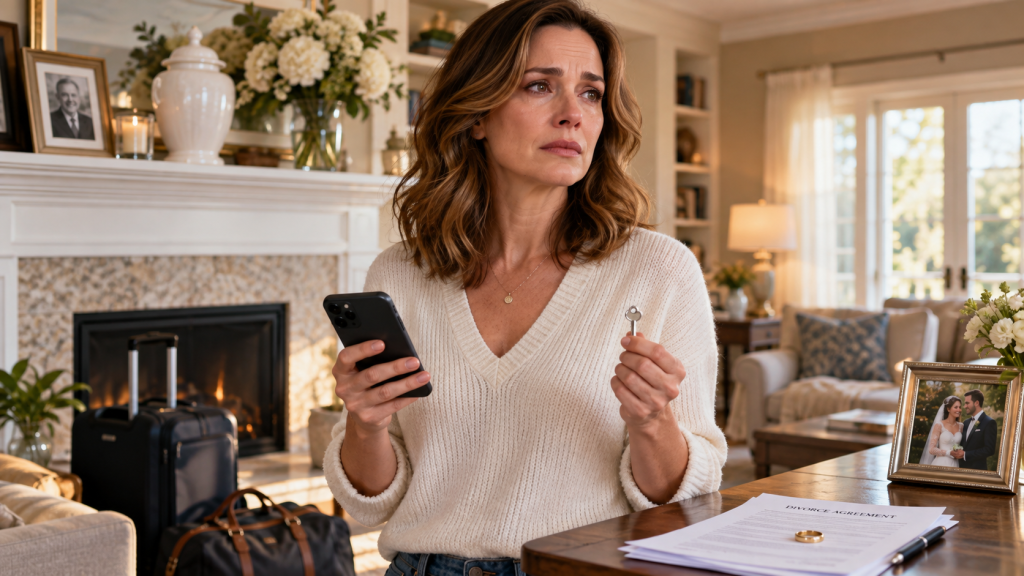
This time, I sat at the dining table with divorce papers.
My wedding ring rested on top.
Beside them was a copy of Evelyn’s funeral program.
Julian entered shouting my name.
“Clarissa!”
I remained seated.
He appeared in the doorway.
Sunburned.
That was the first thing I noticed.
His mother had died while he was supposedly negotiating a business deal.
And my husband came home sunburned.
His expensive linen shirt was wrinkled.
His face looked exhausted.
“Where is she?”
he asked.
For one insane second, I thought he meant Evelyn.
Then I realized.
“The urn?”
“Yes.”
“Above the fireplace.”
He stared.
“You cremated her?”
My hands went cold.
“She requested cremation.”
“You didn’t wait for me?”
“The funeral was yesterday.”
His mouth opened.
“What?”
I looked at him.
“The funeral was yesterday.”
“You buried my mother without me?”
“No.”
My voice was calm.
“You missed your mother’s funeral.”
His face twisted.
“Clarissa—”
“Those are different sentences.”
He slammed his keys onto the counter.
“You had no right.”
I stood.
“No right?”
“She was my mother!”
“And where were you?”
His mouth closed.
“Where were you, Julian?”
“I told you.”
“Business.”
“Yes.”
“Which island?”
He froze.
Tiny pause.
Enough.
“What?”
“Which island?”
“Clarissa—”
“Was it Antigua?”
His face changed.
I had guessed.
Not entirely.
One of the photographs in Evelyn’s envelope showed a hotel confirmation.
Antigua.
Two guests.
Julian Mercer.
Celeste Monroe.
His silence answered.
I nodded.
“Beautiful?”
“What?”
“The island.”
“Was it beautiful?”
He stared at me.
“You went through my things?”
“No.”
“Then how—”
“Your mother knew.”
His face went white.
That was the moment I understood the key frightened him more than the divorce papers.
“What do you mean?”
“Evelyn knew about Celeste.”
He sat down.
Not because I invited him.
Because his legs seemed to stop working.
“She knew?”
“Yes.”
“For how long?”
“I don’t know.”
He rubbed his face.
“Clarissa, I can explain.”
I looked at him.
Twenty-three years.
How many women have heard that sentence at the exact moment explanation has become useless?
“Was she there?”
“Who?”
“Don’t insult me.”
He closed his eyes.
“Yes.”
“Celeste was in Antigua?”
“Yes.”
“You were sleeping with her?”
Silence.
“Julian.”
“Yes.”
The word was barely audible.
“How long?”
“Clarissa—”
“How long?”
“Eight months.”
I laughed.
Not because anything was funny.
“Eight months.”
“It wasn’t—”
“If you say meaningful, I will leave before you finish the sentence.”
He stopped.
“Did you love her?”
“I don’t know.”
“That means yes or you wanted the option.”
“No.”
“Then why?”
“I was confused.”
I stared at him.
“You are fifty-one.”
His eyes filled.
“Adults can be confused.”
“Yes.”
“Confusion is not a hotel reservation.”
He looked away.
“Did you know your mother was dying?”
“I knew she was sick.”
“You knew she had end-stage heart failure.”
“I didn’t know it was that night.”
“I called you thirty times.”
“My phone was on silent.”
“You answered once.”
He looked at me.
There it was.
He remembered.
“You told me I was crazy.”
“I was stressed.”
“You said you were in an important business deal.”
“I panicked.”
“Because Celeste was beside you?”
“Yes.”
I looked toward Evelyn’s urn.
“You heard my voice.”
He began crying.
“You knew I would not call like that unless something was wrong.”
“I know.”
“And you chose not to ask.”
“I know.”
“No.”
My voice broke.
“You don’t get to say ‘I know’ as though knowledge after the funeral is the same as caring before it.”
He covered his face.
I let him cry.
For years, his tears would have activated something in me.
Comfort.
Responsibility.
Repair.
That day, they simply belonged to him.
When he finally looked up, he noticed the papers.
“What is that?”
“Divorce.”
He stared.
“Clarissa.”
“My ring is there.”
“You can’t be serious.”
I almost admired the sentence.
His mother was in an urn.
His affair had been exposed.
He had missed the funeral.
And somehow my decision remained unbelievable.
“I am.”
“We need to talk.”
“We are talking.”
“Not like this.”
“How would you prefer?”
“After we’ve both calmed down.”
“I am calm.”
That frightened him.
He looked toward the fireplace.
Then back at me.
“Mom wouldn’t want this.”
I felt something in me turn to ice.
“Do not use Evelyn.”
“I’m not.”
“You missed her death.”
“I know!”
His voice rose.
“And I will regret that for the rest of my life.”
“Good.”
He stared.
I had never said anything like that to him.
I continued.
“Some regrets should stay.”
“Clarissa.”
“You do not get to turn regret into a key that opens every door you closed yourself.”
His eyes fell to the silver key in my hand.
And there.
Again.
Fear.
“What did Mom give you?”
I closed my fingers around it.
“Why?”
“I’m asking.”
“Why?”
“Because some of her property needs to be handled.”
“Which property?”
His jaw tightened.
“Everything.”
“Interesting.”
“What does that mean?”
“You didn’t ask where her medical files were.”
“You didn’t ask whether she left a final message.”
“You didn’t ask what she wore at the funeral.”
“You asked about property.”
“That isn’t fair.”
“No?”
“I’m the executor of some of her business interests.”
“No.”
His face changed.
“What?”
“Evelyn changed her estate.”
Silence.
“She what?”
“She left you a keepsake.”
“What?”
“I don’t know yet.”
“And the rest?”
I looked at him.
“To me.”
His face emptied.
Not anger.
Not grief.
Shock.
Then disbelief.
“That is impossible.”
“Apparently not.”
“She wouldn’t.”
“She did.”
“You manipulated her.”
There it was.
Twenty years caring for his mother.
And it took less than thirty seconds for devotion to become manipulation when money entered the room.
I stood.
“Leave.”
“No.”
“Leave my house.”
“Our house.”
“Not for long.”
He stood too.
“You poisoned her against me.”
I laughed.
“Julian, I spent years defending you to her.”
He froze.
“Yes.”
“You didn’t know that?”
I stepped closer.
“When you forgot her birthday, I told her work had been overwhelming.”
“When you skipped her cardiology appointment, I told her you had a client emergency.”
“When you missed Christmas dinner, I said your flight was delayed.”
“It wasn’t.”
“You were drinking with colleagues.”
His face reddened.
“When she asked why you stopped visiting, I said you were exhausted.”
“Every time your mother was disappointed in you, I built a softer version of you for her to love.”
Tears ran down my face now.
“I did that.”
“Not because you deserved it.”
“Because she did.”
He could not look at me.
“So don’t stand in front of her ashes and accuse me of turning her against you.”
I pointed toward the door.
“Leave.”
He left.
Not forever.
Not yet.
Divorce rarely gives you the satisfying cleanliness of a door closing once.
There were attorneys.
Calls.
Financial disclosures.
Arguments.
Emails.
Requests.
Apologies.
Anger.
But that night, I packed one suitcase.
Then another.
I took Evelyn’s urn because her written instructions named me to handle her ashes.
I took the safe-deposit documents.
My clothes.
Photographs.
My grandmother’s dishes.
Nothing else.
On the dining table, I left my wedding ring exactly where it was.
Beside the divorce papers.
Then I disappeared.
Not in the mysterious sense people later imagined.
I did not change my name.
I did not flee the country.
I went to a furnished cottage Evelyn owned near Lake Briar, three hours away.
Julian did not know I had access.
Rebecca did.
My sister did.
The court could reach me.
My attorney could reach me.
Julian could not.
For the first time in twenty-three years, he did not know where his wife was sleeping.
That uncertainty was not revenge.
It was peace.
The cottage sat beneath enormous maple trees.
The lake was gray in the mornings.
At night, frogs made ridiculous noises outside the windows.
The first evening, I put Evelyn’s urn on a table facing the water.
Then I sat on the floor and cried until sunrise.
Not only for her.
For me.
For the woman I had been.
For all the calls I had excused.
All the dinners kept warm.
All the lies I had softened.
All the loneliness I had renamed patience.
I had spent twenty years believing loyalty meant staying.
Evelyn’s death forced me to ask whether loyalty to everyone else had become abandonment of myself.
Three days later, Rebecca called.
“We opened the office.”
I sat upright.
“And?”
“You need to come back.”
“What did you find?”
“A second safe.”
My heart began pounding.
“What was inside?”
“Records.”
“What kind?”
“Property records.”
“Bank statements.”
“Correspondence.”
“And a recording.”
I closed my eyes.
“Evelyn?”
“Yes.”
“When?”
“About five weeks before she died.”
“What does she say?”
Rebecca became quiet.
“I think you should hear it yourself.”
I drove back the next morning.
Not to my house.
To Rebecca’s office.
A digital recorder sat on the conference table.
Beside it were folders.
Too many folders.
Rebecca pressed play.
Static.
Then Evelyn’s voice.
Weak.
But unmistakable.
My name is Evelyn Mercer.
I covered my mouth.
Rebecca paused.
“You okay?”
“No.”
“Want to stop?”
“No.”
She continued.
I am making this recording because my hands are becoming unreliable, and because I am concerned my son may attempt to use my illness to challenge decisions I have made while competent.
My eyes filled.
Evelyn.
Still organizing.
Still anticipating.
Clarissa does not know I am recording this.
She has not asked me for money.
She has not asked me to change my will.
In fact, when I told her I wanted to leave her the lake cottage, she argued with me for forty minutes.
I laughed through tears.
True.
I had.
Years earlier, Evelyn once joked that the cottage should be mine.
I told her Julian would love it.
She said:
I wasn’t talking about Julian.
I thought she was joking.
The recording continued.
My son believes Clarissa is weak because she is kind.
That is one of his great mistakes.
I closed my eyes.
He has also mistaken her loyalty for permanence.
My breathing broke.
I have watched Clarissa care for me through surgeries, grief, heart failure, and the indignities of age.
I have watched Julian become increasingly absent.
I love my son.
Her voice cracked.
But love is not blindness.
Rebecca glanced at me.
The recording continued.
Several months ago, I learned Julian was involved with another woman.
I confronted him.
My eyes opened.
“What?”
Rebecca shook her head gently.
Listen.
He asked me not to tell Clarissa.
I felt sick.
He said the affair would end.
I gave him thirty days to tell his wife himself.
He did not.
Instead, I discovered attempted transactions involving property I own.
Then came the name.
Celeste Monroe.
Evelyn explained that Celeste’s company had approached her about purchasing the lakeside property.
She refused.
Later, documents appeared suggesting she had agreed.
She had not.
She became suspicious.
She hired Rebecca.
That was how Rebecca had entered the story months before I knew her.
Evelyn had quietly begun protecting the estate.
I do not know exactly what Julian believes he is entitled to.
Evelyn said.
But entitlement has made him careless.
Then:
If any document appears after my death transferring the lake property without Rebecca Shaw’s verification, challenge it.
I stared at Rebecca.
She nodded.
Evelyn had anticipated the forgery.
The recording continued.
I am not leaving most of my estate to Clarissa to punish Julian.
Inheritance should not be used as a weapon from the grave.
That sounded exactly like her.
I am doing it because much of what I have accumulated was preserved by the person who actually showed up.
Then she explained.
The lake cottage.
Investment accounts.
A small commercial property.
Royalties from a business Evelyn and her late husband had sold years earlier.
Not hundreds of millions.
Not fantasy money.
But substantial.
Enough to change a life.
The trust was worth a little over $4.6 million.
I stared at Rebecca.
“No.”
She nodded.
“No.”
“Clarissa.”
“No.”
I stood.
“I don’t want it.”
Rebecca did not react.
“Sit down.”
“I don’t want her money.”
“It is already in trust.”
“I don’t care.”
“Then decide later what to do with it.”
“I can’t.”
“You don’t have to decide today.”
I sat.
The recording was not finished.
Evelyn’s voice returned.
Clarissa, if Rebecca is playing this for you, you are probably saying you don’t want the money.
I started sobbing.
Rebecca smiled faintly.
Evelyn continued.
Please stop being predictable for five minutes.
I laughed while crying.
Money is not a medal for caring for me.
You did not earn love by changing my sheets.
I am not paying you for holding my hand.
I am giving you resources because they are mine, and I choose where they go.
Then:
You have spent too much of your life asking whether everyone else will be okay with your decisions.
For once, ask what you want.
I covered my face.
The recording paused for several seconds.
Then Evelyn said:
And Clarissa?
If Julian is beside you while you hear this, make him leave the room.
Even Rebecca laughed.
Then Evelyn’s voice softened.
My son is not evil.
Do not make him one because it makes leaving easier.
That sentence hurt.
He is selfish.
He is frightened of aging.
He has spent years believing admiration is the same as love.
He may someday become better.
If he does, good.
You are not required to wait.
I stopped breathing.
There it was.
Permission I had never needed.
But somehow desperately wanted.
Do not confuse forgiveness with returning.
Do not confuse his regret with your obligation.
And please do not spend whatever years you have left proving that you were the good wife.
You already were.
The recording ended.
Nobody spoke.
Finally I whispered:
“She knew.”
Rebecca nodded.
“She knew everything.”
“More than either of us, apparently.”
I laughed weakly.
Then Rebecca showed me the rest.
Evelyn had documented the suspicious property transfer.
Emails had been preserved.
Julian had communicated with Celeste about obtaining Evelyn’s signature.
The exact extent of Celeste’s knowledge was less clear.
One email from Julian said:
Mom agreed in principle. She’s too sick for more meetings. I’ll handle the paperwork.
Another:
Don’t worry about Clarissa. She doesn’t understand Mom’s finances.
I read that twice.
Then a third:
Once the lake property closes, we can stop pretending this is temporary.
That one hurt differently.
Not because of the affair.
I already knew.
Because it revealed planning.
He had been building another life while I was preparing his mother’s medication.
“What happened with the forged signature?”
I asked.
“It’s being referred for investigation.”
“Will Julian be arrested?”
“I don’t know.”
“Celeste?”
“I don’t know.”
“Did the sale close?”
“No.”
I exhaled.
“Why not?”
“Evelyn had already placed the property into the trust.”
Rebecca smiled slightly.
“Julian was trying to sell something his mother no longer personally owned.”
For the first time, I understood Evelyn’s timing.
She had not only changed her will.
She had moved assets.
Protected them.
The key was not revenge.
It was evidence.
The legal consequences took time.
Months.
The attempted property transaction became part of a broader civil dispute and investigation.
Ultimately, evidence showed Julian had knowingly participated in submitting documents that misrepresented Evelyn’s authorization.
Celeste maintained that Julian told her his mother had consented.
Some evidence supported that she had reasons to question the transaction, but the proof against each person differed.
I learned not to demand identical consequences simply because my pain wanted symmetry.
Julian faced legal consequences.
Financial penalties.
Professional collapse.
A criminal case resolved with a plea on charges supported by the evidence.
He did not disappear into prison forever.
Real life rarely delivers punishments designed for satisfying endings.
But he lost his position.
His reputation changed.
He paid restitution and penalties.
His relationship with Celeste ended before our divorce was final.
I learned that from Rebecca.
I felt almost nothing.
That surprised me.
For months, I had imagined Celeste as the woman who stole my husband.
Then one morning at the lake, I realized how insulting that thought was to me.
Julian was not luggage.
He had not been stolen.
He had chosen.
So had she.
So had I.
My choice was simply later.
The divorce took fourteen months.
Julian fought the estate trust harder than the marriage.
That told me everything.
He argued Evelyn lacked capacity.
Her physicians disagreed.
He argued I influenced her.
Her recording disagreed.
He argued Rebecca had manipulated the documents.
Independent review disagreed.
He argued the trust violated his mother’s true wishes.
Her own voice answered.
Eventually, the challenge failed.
At our final divorce hearing, Julian looked older.
Not dramatically.
Just diminished.
The sunburn was gone.
So was the arrogance.
Outside the courthouse, he approached me.
“Clarissa.”
I stopped.
Rebecca was nearby.
So was his attorney.
Safe.
Public.
“What?”
“I’m sorry.”
I looked at him.
“For what?”
He closed his eyes.
“Everything.”
“No.”
His eyes opened.
“That word is too large.”
“What?”
“Everything.”
I said.
“Break it apart.”
He stared at me.
“If you are sorry, know what you’re sorry for.”
His eyes filled.
So he tried.
“I’m sorry I cheated.”
I waited.
“I’m sorry I lied about where I was.”
I waited.
“I’m sorry I ignored your calls.”
His voice broke.
“I’m sorry I wasn’t there when Mom died.”
Tears ran down his face.
“I’m sorry you had to tell her goodbye for me.”
That one reached me.
Not enough to return.
Enough to hurt.
“I’m sorry I let you arrange her funeral alone.”
“I’m sorry I accused you of manipulating her.”
“I’m sorry I tried to sell the lake property.”
He swallowed.
“I told myself Mom had verbally agreed months earlier.”
“Had she?”
“No.”
“Then why?”
“Money.”
At least he said it.
“I had made bad investments.”
“How bad?”
“Almost seven hundred thousand.”
I stared.
“I thought the property sale would cover them.”
“And Celeste?”
“She believed we were going to start a business.”
“Together?”
“Yes.”
“And a life?”
“Yes.”
There it was.
He continued.
“I told myself I deserved a second life.”
I almost smiled.
“So you destroyed the first one.”
He looked down.
“Yes.”
Silence.
Then:
“Did Mom hate me?”
My heart cracked.
Because beneath the betrayal, beneath the greed, beneath everything—
he was still a son whose mother had died without him.
“No.”
He looked up.
“She loved you.”
“How do you know?”
“Because she told me.”
He started crying.
“Did she ask for me?”
I could have lied.
Mercy sometimes tempts us toward fiction.
But truth was the last thing Evelyn had given me.
“Yes.”
His face collapsed.
“When?”
“About an hour before she died.”
“What did she say?”
“She asked whether you were coming.”
He covered his mouth.
“I told her I was trying to reach you.”
He sobbed.
“Did she know?”
“That you weren’t coming?”
“Yes.”
“I don’t know.”
That was the truth.
“She didn’t die angry.”
“How do you know?”
“Because I was holding her hand.”
He closed his eyes.
I continued gently.
“She was tired.”
“She knew I loved her.”
“She knew you loved her too.”
His eyes opened.
“You think I loved her?”
“Yes.”
He stared at me.
“Then why did I—”
“Love does not automatically make people behave well.”
I said.
“Sometimes people love someone and still fail them.”
“That doesn’t make the love fake.”
“It makes the failure real.”
He cried.
Then he asked the question I knew was coming.
“Can you forgive me?”
I looked at him for a long time.
“Someday.”
Hope flashed across his face.
I stopped it.
“That does not mean us.”
It disappeared.
“I know.”
“Do you?”
“Yes.”
He wiped his eyes.
“Mom said that, didn’t she?”
“What?”
“Forgiveness isn’t returning.”
I stared.
“She told you?”
“Years ago.”
I almost laughed.
Of course.
“What did she say?”
“She told me if I ever broke your heart badly enough, I shouldn’t assume an apology was a bridge back.”
“That sounds like Evelyn.”
“I thought she was being dramatic.”
“So did I, usually.”
For a moment, we both smiled.
Two people who had loved the same difficult, extraordinary woman.
Then Julian reached into his pocket.
He held out something.
My wedding ring.
I stared.
“You left it.”
“I know.”
“I kept it.”
“Why?”
“I don’t know.”
I did.
But I let him answer.
“Maybe I thought if I still had it, you weren’t completely gone.”
I looked at the ring.
Twenty-three years compressed into a circle of gold.
“Keep it.”
He looked surprised.
“Are you sure?”
“Yes.”
“Why?”
“Because I don’t need it to remember what happened.”
He closed his hand.
That was the last time I saw Julian for five years.
I stayed at the lake cottage.
At first, I called it temporary.
Then one morning, I painted the kitchen.
Blue.
Evelyn hated blue kitchens.
I stood in the middle of the room laughing.
That was when I knew it had become mine.
I used some trust income to live.
Carefully.
I invested most.
I donated some.
Not immediately.
I refused to turn Evelyn’s money into a moral test.
For once, I allowed myself to enjoy something without proving I deserved it.
I bought a ridiculous mattress.
Expensive.
Soft.
I slept diagonally.
I traveled.
Alone at first.
Portugal.
Scotland.
Montreal.
I took photographs badly.
I ate dinner without waiting for anyone.
I learned that loneliness and solitude are not the same.
Loneliness is wanting someone who isn’t there.
Solitude is discovering you are there.
At fifty-three, I enrolled in a ceramics class.
My first bowl looked like it had survived an earthquake.
I loved it.
At fifty-four, I joined a grief group.
Not a divorce group.
Grief.
Because Evelyn’s death remained the deepest wound.
One evening, a woman named Teresa asked:
“Was she your mother?”
“My mother-in-law.”
She looked surprised.
“You were close?”
“For twenty years.”
“What happened to your husband?”
I laughed.
“How long is the meeting?”
She became my friend.
At fifty-five, I started a foundation.
Not because Evelyn asked.
Because I wanted to.
We funded respite care for family caregivers.
Small grants.
Transportation.
Meal support.
Temporary nursing assistance.
Nothing glamorous.
The first year, we helped nineteen families.
The second, forty-three.
I named it the Evelyn Mercer Care Fund.
Julian heard.
He sent a letter.
Thank you for using her name.
I did not respond.
Not cruelty.
Boundary.
At fifty-seven, I met a man named Thomas Reed.
Widower.
High school music teacher.
Terrible dancer.
He asked me to dinner.
I said no.
Three months later, he asked again.
I said yes.
At dinner, he asked about my marriage.
I told him enough.
He did not say:
Not all men.
He did not say:
How could your husband do that to you?
He did not ask why I stayed.
He said:
“That sounds lonely.”
I nearly cried into the soup.
We dated slowly.
Very slowly.
The first time he stayed overnight, I woke at three in the morning panicking.
Not because of him.
Because for twenty-three years, another man’s breathing had been beside me.
Thomas woke.
“What’s wrong?”
“I don’t know.”
“Do you want me to leave?”
That question saved the night.
Not:
What’s wrong with you?
Not:
Don’t you trust me?
Not:
I’m not Julian.
Just:
Do you want me to leave?
“No.”
“Okay.”
He went back to sleep.
I stared at the ceiling.
Safety can be startling when you have spent years confusing familiarity with security.
Thomas and I never married.
People found that strange.
We did not.
At sixty, he moved into the lake cottage.
We wrote agreements.
Separate finances.
Clear estate plans.
Julian had taught me that love without paperwork does not become purer.
Sometimes clarity is kindness.
Thomas called Evelyn “the woman who keeps paying for my coffee” because trust income technically covered household expenses.
I told him she would have hated his dancing.
He said:
“She never saw my tango.”
“Neither have I.”
“Exactly.”
We were happy.
Not cinematic.
Happy.
He snored.
I stole blankets.
We argued about dishwasher loading.
He believed every trip required arriving at the airport four hours early.
I considered this grounds for separation.
Ordinary love.
It healed something extravagant betrayal had damaged.
Five years after the divorce, Julian wrote again.
This time the letter was different.
Clarissa,
I am not asking you to respond.
Good.
I completed the financial restitution last month.
I have spent years thinking about the thirty calls.
I stopped reading.
Walked outside.
Sat by the lake.
Then returned.
At first, I told myself I missed them because my phone was silent.
That was technically true and morally dishonest.
That sounded like Evelyn.
The truth is that I saw your name several times.
My hands shook.
I knew something was wrong.
I did not answer because Celeste was beside me, and I did not want the life I was pretending to have with her interrupted by the life I had built with you.
I closed my eyes.
There.
The ugliest truth.
And somehow, after years, it hurt less than the lie.
When I finally answered, I was angry because your fear threatened the fantasy I was protecting.
I called you crazy because I needed you to be unreasonable.
If you were unreasonable, then I could remain innocent for another hour.
I cried.
Not for him.
For the woman I had been holding that phone.
Mom died while I was protecting a vacation.
There is no sentence that makes that smaller.
Then:
I used to think my punishment was missing her death.
Now I understand the consequence is knowing why I missed it.
I sat for a long time.
Then I finished.
I am sober now.
That surprised me.
I had not known alcohol had become a problem.
I work for a small accounting firm.
I live in an apartment.
I volunteer twice a month with a caregiver transportation program, though I did not choose yours because I thought that would be intrusive.
Good.
I am not telling you these things to advertise improvement.
I am telling you because for years I wanted people to believe I was a better man than my behavior demonstrated.
Now I am trying to reverse the order.
That was good too.
I hope Thomas treats you well.
I froze.
Then laughed.
Small towns.
Foundations.
Public donor events.
Of course Julian knew.
Mom was right.
You were not weak.
You were loyal.
I mistook the two because weakness was more convenient for me.
I am sorry.
Julian.
I showed Thomas.
He read it.
Then handed it back.
“Well?”
he asked.
“Well what?”
“How do you feel?”
“I don’t know.”
“Excellent.”
I laughed.
“Excellent?”
“Means you don’t have to decide tonight.”
I loved him for that.
I eventually wrote Julian back.
One page.
I believe your apology.
Then:
I forgive you for the affair.
I forgive you for lying.
I forgive you for blaming me when Evelyn changed her estate.
I am still working on the thirty calls.
I stared at that sentence for twenty minutes.
Then added:
Forgiveness may never mean feeling nothing when I remember them.
Perhaps it simply means I no longer want the memory to punish either of us.
Then:
I am glad you are building a better life.
Please keep building it.
Clarissa.
He never asked for more.
That mattered.
At sixty-eight, Thomas died.
Aneurysm.
Sudden.
One morning we argued about whether milk smelled strange.
By afternoon, he was gone.
Grief returned like weather from another continent.
Unexpected.
Massive.
I sat beside his hospital bed holding his hand.
Again.
But this time, nobody was ignoring thirty calls.
His daughter came.
His son came.
His former students came.
His sister drove through the night.
The room filled with people who loved him.
And I realized Evelyn’s death had taught me something about presence.
Death does not care who intended to arrive later.
Later is not guaranteed.
Thomas died with music playing from his phone.
A terrible jazz recording he loved.
I hated it.
I let it play.
Afterward, Julian sent flowers.
No note beyond:
For Thomas.
I kept them.
At seventy, I saw Julian again.
The caregiver foundation held its fifteenth anniversary dinner.
I was speaking.
Afterward, while people gathered near the exits, I saw him.
Older.
Gray.
Thin.
He had asked permission through the foundation director before attending.
I had said yes.
He waited until I approached.
“Clarissa.”
“Julian.”
“You look good.”
“So do you.”
We both knew neither statement was entirely true.
Age had happened.
That was okay.
He looked at a large photograph of Evelyn displayed near the stage.
“She would have loved this.”
“She would have complained about the centerpiece.”
He laughed.
“She hated lilies.”
“I know.”
“Why did you choose lilies?”
“I didn’t.”
“Good.”
We stood together.
Then he said:
“I visited her grave marker.”
Evelyn had no buried ashes, but we had placed a memorial stone beside her husband.
“What did you say?”
“I apologized.”
“Did she answer?”
“Still waiting.”
I smiled.
Then:
“Do you want to know where her ashes are?”
He looked at me.
For all those years, I had never told him exactly.
“Yes.”
“Part of them are at Lake Briar.”
His eyes filled.
“She loved it there.”
“I know.”
“Where’s the rest?”
“Scotland.”
He blinked.
“What?”
“She once told me she wanted some scattered near the coast where she and your father honeymooned.”
“You went?”
“Yes.”
His face crumpled.
“You did that for her?”
“I did it for both of us.”
He cried.
I reached for his hand.
Not as wife.
Not as lover.
As someone who had once shared a family with him.
“Thank you.”
he whispered.
“You’re welcome.”
Then he asked:
“Did she leave anything for me besides the watch?”
Evelyn’s keepsake.
Her late husband’s watch.
Julian wore it that night.
“Yes.”
He looked startled.
“What?”
I had waited seventeen years.
Maybe too long.
Maybe exactly long enough.
“A letter.”
His face changed.
“What letter?”
“She left it with Rebecca.”
“Why didn’t I get it?”
“Because the instructions said I could give it to you when I believed you were ready to read it without turning it into an argument.”
He laughed through tears.
“That sounds like Mom.”
“Yes.”
“Do you think I’m ready?”
I studied him.
“I think so.”
The next morning, I gave him the envelope.
We sat by the lake.
He opened it.
I did not read over his shoulder.
Evelyn’s words belonged to him.
He cried for nearly an hour.
Eventually he handed me the letter.
“You can read it.”
I hesitated.
“You sure?”
“Yes.”
The letter began:
Julian, my son,
If Clarissa has given you this, then I hope enough time has passed that you have stopped asking who is to blame for the consequences of your choices.
Even from the grave, Evelyn wasted no time.
I love you.
I have loved you since the first moment a nurse placed you in my arms and you screamed as though being born had been a personal insult.
Julian laughed through tears.
Nothing you have done has erased that love.
Then:
But love does not require me to lie about you.
You have become careless with people who love you because you assume love means they will remain available.
It does not.
I looked at Julian.
He was staring at the water.
I continued.
Clarissa has spent years making excuses for you.
I allowed it because sometimes her excuses comforted me.
That was cowardly of me.
I should have demanded more from you sooner.
Then:
I know about Celeste.
I know about the property.
I know about the debt.
I know more than you think. Mothers usually do, though we often pretend otherwise because truth can be inconvenient.
Then:
I am leaving most of my estate to Clarissa.
Not because I love you less.
Because inheritance is not a measurement of love.
You have received money, education, opportunities, and rescue from me throughout your adult life.
Clarissa received responsibility.
I am correcting an imbalance, not calculating affection.
Julian covered his eyes.
Then came the sentence that broke both of us.
If I die while you are still angry with me, please know I died loving you.
His shoulders shook.
If you are not there, I will still love you.
But absence has consequences love cannot erase.
I stopped reading.
Julian whispered:
“Keep going.”
So I did.
Become a man who shows up.
Not because showing up earns inheritance.
Because people are mortal.
Because apologies cannot sit beside hospital beds.
Because eventually there is a final call, and you rarely know which one it is until nobody can answer anymore.
I could barely see the page.
The final lines:
Do not chase Clarissa if she leaves.
Change whether or not she ever sees it.
If your improvement requires her audience, it is still performance.
I love you.
Mom.
Julian pressed the letter to his chest.
“I didn’t deserve her.”
I shook my head.
“That’s not what she wrote.”
He looked at me.
“She didn’t talk about deserving.”
“She talked about what you do with love once you’ve been given it.”
We sat beside the lake until sunset.
Then Julian left.
There was no rekindled romance.
That is important.
Some people heard the story later and expected one.
As though forgiveness must eventually restore the marriage or remain incomplete.
No.
Julian and I became something quieter.
Not friends exactly.
Not strangers.
Two people who had once built a life and later learned how to look at its ruins without throwing pieces at each other.
We exchanged Christmas cards.
Birthday messages.
Occasional coffee.
When my foundation opened a second office, he donated anonymously.
I knew anyway.
I said nothing.
At seventy-eight, Julian developed pancreatic cancer.
He called me himself.
“Clarissa.”
“Yes?”
“I have cancer.”
The old world stopped.
Not because I was his wife.
Because once, for twenty-three years, I had known the shape of his sleeping face.
“Are you alone?”
“No.”
His voice cracked.
“My sponsor is here.”
“Good.”
“Would you…”
He stopped.
“What?”
“Would you come sometime?”
I looked at the lake.
“Yes.”
Not immediately.
Not as caregiver.
As visitor.
I saw him the following week.
He had a small apartment.
Clean.
Books everywhere.
Evelyn’s photograph on the mantel.
His father’s watch beside it.
And my wedding ring in a little wooden box.
I saw it accidentally.
He noticed.
“I still have it.”
“I see.”
“Is that weird?”
“Yes.”
He laughed.
“Fair.”
“Why keep it?”
“It reminds me there are things you can lose without them being stolen.”
That was a good answer.
I visited several times.
His sister came from Arizona.
Old colleagues came.
People from his recovery group came.
The caregiver transportation program sent cards.
He had, apparently, become someone who showed up.
Quietly.
Late.
But genuinely.
One afternoon, he said:
“I’m scared.”
I sat beside him.
“I know.”
“I thought Mom would be here.”
“Maybe she is.”
“You believe that?”
“I don’t know.”
“That’s not comforting.”
“I’m seventy-eight, Julian. I’ve stopped lying for comfort.”
He laughed weakly.
Then:
“Will you stay a little?”
“Yes.”
So I stayed.
Not because I owed him.
Because I wanted to.
That distinction was the foundation of everything I had become.
He died four months later.
His sister held one hand.
I held the other.
His final coherent words to me were:
“I answered this time.”
I started crying.
“Yes.”
“You called.”
“I came.”
“Yes.”
He smiled.
“Tell Mom I finally learned.”
“You can tell her yourself.”
He died the next morning.
I arranged no funeral.
His sister did.
That mattered too.
I attended as a guest.
At the service, his recovery sponsor spoke.
A former colleague spoke.
His sister spoke.
Then, unexpectedly, Celeste appeared.
I recognized her from the photographs.
Older.
Gray hair.
Nervous.
She stayed near the back.
Afterward, she approached me.
“Clarissa?”
“Yes.”
“I don’t expect you to speak to me.”
“Then why are you here?”
“Because I wanted to apologize once.”
I waited.
“I knew he was married.”
“Okay.”
“I knew about you.”
“Okay.”
“I believed him when he said the marriage was essentially over.”
“That was convenient.”
“Yes.”
She looked down.
“I also knew Evelyn had refused the property sale.”
That mattered.
“I told myself Julian would handle it.”
“Did you forge the signature?”
“No.”
I watched her.
“I believe investigators concluded Julian arranged the false signature through someone else.”
“Yes.”
“But I knew enough to know something was wrong.”
“Yes.”
“Why didn’t you stop?”
She cried.
“Because I wanted the future he was promising.”
There it was.
Different person.
Same human weakness.
Desire turning warning signs into inconveniences.
“I’m sorry.”
she said.
I nodded.
“Thank you.”
“Do you forgive me?”
“No.”
Her face changed.
“Maybe someday.”
I said.
“But you didn’t come here to receive a verdict from me.”
She nodded.
“You came to apologize.”
“Yes.”
“Then you’ve done that.”
She left.
I never saw her again.
At eighty-two, I closed the foundation’s original office.
Not the foundation.
It had grown beyond me.
Younger people ran it.
Better than I ever had.
We had helped thousands of caregivers by then.
Not because Evelyn died.
I refused that narrative.
Her death was a loss.
The work came afterward.
Good things built after pain do not retroactively make pain necessary.
I spent my final years at Lake Briar.
The kitchen remained blue.
The terrible ceramic bowl I made at fifty-three sat on the windowsill.
Thomas’s old sheet music remained in a cabinet.
Evelyn’s photograph stood beside the fireplace.
Julian’s final Christmas card was in a drawer.
Not displayed.
Not hidden.
Just kept.
My life had become a house containing many chapters without requiring any one of them to erase another.
At eighty-seven, I wrote a letter to my niece, Amelia.
She would inherit the cottage eventually.
I told her:
People will probably tell you my life changed because Evelyn left me money.
They are wrong.
Money changed my options.
Truth changed my life.
Then:
The most important thing Evelyn left me was not the trust.
It was evidence that I was allowed to believe what I had already begun to understand.
I was lonely in my marriage.
I had been loyal beyond the point where loyalty remained healthy.
I had confused being needed with being loved well.
Then:
Julian betrayed me.
Later, he changed.
Both are true.
His change did not make my divorce a mistake.
My divorce did not make his change meaningless.
I underlined that.
Human beings are not court verdicts.
We can be guilty of terrible choices and still become different.
But becoming different does not entitle us to retrieve every relationship our former selves destroyed.
Then:
Evelyn loved her son.
She also protected me from him.
Those truths did not cancel each other.
Mature love can hold someone accountable without pretending affection disappeared.
Then:
Do not use inheritance to decide who was loved most.
Money is a tool.
Not a thermometer for affection.
Evelyn left Julian less money because she believed she had already spent years rescuing him financially.
She left me more because she wanted me to have choices.
That was her decision.
Not a scoreboard.
Then:
If someone cheats on you, please do not call the other person a thief as though your partner were property.
People choose betrayal.
Make them own their choices.
Then:
If someone apologizes, listen if you want.
Forgive if you want.
Do not confuse forgiveness with returning.
A door can remain closed without hatred standing behind it.
Then:
If you love someone who changes after hurting you, you are allowed to be glad they changed from a distance.
You do not have to become the prize they receive for improvement.
Then I wrote about the calls.
The thirty calls.
The part everyone remembered.
For years, I thought the tragedy was that Julian did not answer.
Eventually I understood the deeper tragedy was that I had spent years making myself easy to ignore.
I stopped there.
Crossed it out.
That was unfair to myself.
I rewrote:
No.
That sentence is wrong.
I did not make myself easy to ignore.
Julian chose to ignore me.
Do not take responsibility for another person’s refusal to listen merely because you were patient.
That correction mattered.
Even at eighty-seven, I was still learning not to blame the abandoned person for being abandoned.
Then:
I called thirty times because someone he loved was dying.
I did the right thing.
His failure to answer belonged to him.
Then:
The night Evelyn died, I thought I had been left alone.
I was wrong about one thing.
I still had myself.
I had simply spent so many years attending to everyone else that I had forgotten my own presence counted.
Then:
When I disappeared after leaving my ring beside the divorce papers, people thought I was making a dramatic statement.
I wasn’t.
I needed silence.
Not the silence of being ignored.
The silence in which I could finally hear myself.
Then:
There is a difference.
My last page was for Evelyn.
Though she would never read it.
You gave me a silver key.
For years, I thought it opened a safe-deposit box.
Then I thought it opened evidence.
Then money.
Then freedom.
I was wrong each time.
The key opened a choice.
That was all.
A choice.
Stay or leave.
Fight or release.
Keep or give.
Forgive or don’t.
Return or continue.
Love without surrendering yourself.
Grieve without turning grief into a prison.
Accept that someone can become better without rewriting what they did when they were worse.
At ninety-one, my heart began failing.
Evelyn would have appreciated the irony.
I spent my final months at the cottage.
Amelia visited.
Foundation staff visited.
Thomas’s daughter came.
Julian’s sister came once.
Rebecca, impossibly still alive and sharper than anyone had a right to be at ninety-three, came for tea.
“You were a difficult client.”
she told me.
“You enjoyed it.”
“Immensely.”
“Did Evelyn pay you enough?”
“Never.”
We laughed.
Before leaving, Rebecca placed something on the table.
The silver key.
I stared.
“I thought I had that.”
“You gave it to me years ago when we closed the safe-deposit box.”
“I forgot.”
“You’re ninety-one.”
“Rude.”
She smiled.
“Thought you should have it.”
I held it.
Tiny.
Cold.
Ordinary.
So much life attached to such a small object.
After Rebecca left, I threaded the key onto a chain.
Not as a symbol of Julian’s betrayal.
Not of money.
Of Evelyn’s final act of trust.
I died six weeks later.
Peacefully.
Amelia was beside me.
So was Thomas’s daughter, Grace.
The lake outside was almost perfectly still.
My last words were not profound.
I asked whether someone had turned off the oven.
There was nothing in the oven.
Apparently, even a dramatic life can end with domestic confusion.
Amelia laughed while crying.
I would have liked that.
At my memorial, they scattered some of my ashes at Lake Briar.
Some went to Scotland.
Beside Evelyn.
Not because I had been her daughter-in-law.
Because somewhere along the way, we had simply become family.
Amelia inherited the cottage.
She kept the kitchen blue.
Against my expectations.
On the mantel, she placed two objects.
The terrible ceramic bowl.
And the silver key.
Underneath, she placed a small card containing one sentence from my letter:
THE KEY OPENED A CHOICE.
People asked what it meant.
Sometimes Amelia told them.
Sometimes she didn’t.
Not every story belongs to strangers.
Years later, the Evelyn Mercer Care Fund celebrated its fiftieth anniversary.
By then, nobody working there had known Evelyn.
Few remembered me.
That was good.
Institutions should eventually become bigger than their founders’ grief.
At the anniversary, a young caregiver stood at a podium.
She had received a grant while caring for her dying father.
She said the fund paid for twelve hours of respite care each week.
Twelve hours.
Not millions.
Not dramatic.
Twelve hours in which she could sleep.
Buy groceries.
Sit in a park.
Remember she was a person in addition to being needed.
She said:
“I loved my father.”
Then:
“But love did not mean I stopped existing.”
Somewhere, if the dead are allowed to hear the living, I think Evelyn would have smiled.
Because that was the lesson she had tried to give me before I understood I needed it.
Love does not require disappearance.
Not into marriage.
Not into caregiving.
Not into motherhood.
Not into grief.
Not into another person’s mistakes.
The people we love matter.
But we matter while loving them.
Julian learned that too late to save our marriage.
Not too late to save something in himself.
And I eventually learned that leaving him did not require me to hate him forever.
It only required me to stop abandoning myself in order to make his life easier.
The world loves dramatic endings.
A cheating husband destroyed.
A mistress exposed.
A fortune inherited.
A woman vanishing with millions.
But that was never really my ending.
My ending was quieter.
I sat beside a lake.
I painted a kitchen blue.
I loved another man.
I lost him.
I forgave part of the first man.
I held his hand when he died because I wanted to, not because marriage required it.
I built something useful with money I once tried to refuse.
I grew old.
I became difficult.
I became peaceful.
And I never wore my wedding ring again.
Not because marriage had been meaningless.
It wasn’t.
Twenty-three years happened.
There was love there.
There were Christmas mornings.
Inside jokes.
Road trips.
Arguments.
Illness.
Family.
Evelyn.
There was also betrayal.
Both belonged to the story.
But the ring had once represented a promise between two people.
When that promise ended, I did not need the ring to become evidence that I had survived it.
The silver key meant more.
Because a ring is a circle.
A key is a possibility.
One says:
Stay joined.
The other asks:
What will you open?
Evelyn placed that question in my palm with her final strength.
It took me years to understand the answer.
Not the safe-deposit box.
Not the estate.
Not Julian’s secrets.
My life.
That was what the key opened.
My own life.
And once I finally stepped through that door, I never disappeared again.
THE END STORIES! THANK YOU FOR READING GOOD LUCK !❤️
Related Posts