➡️ PART 3 ENDING PART ➡️
“The woman who took Emily.”
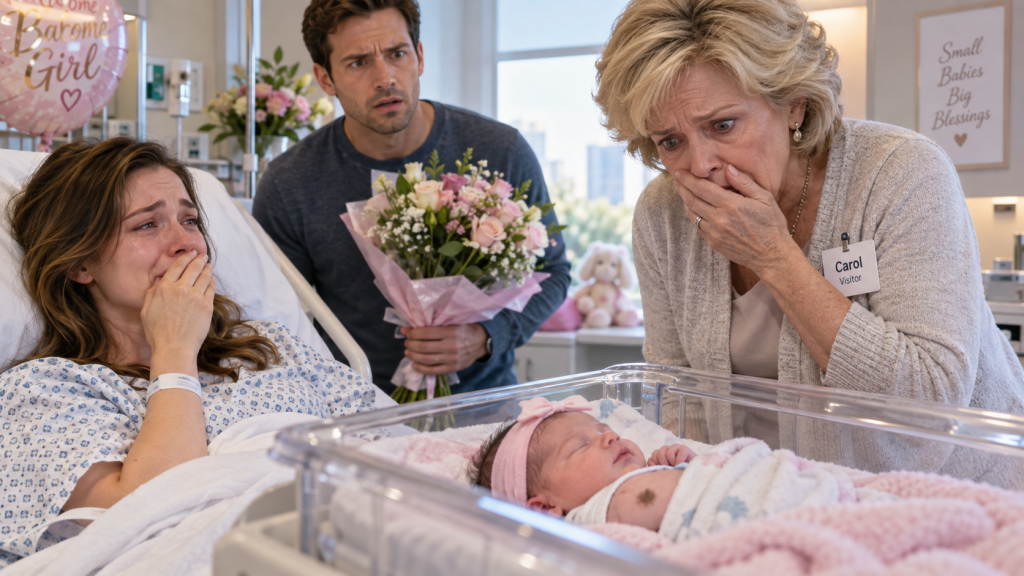
Carol’s words barely reached me.
For one strange second, the hospital room seemed to shrink around us.
The pale walls.
The flowers Daniel had brought.
The pink blanket folded at the foot of my bed.
The bassinet beside me.
Everything that had felt warm and safe only minutes earlier suddenly looked temporary, as though one terrible sentence had loosened every bolt holding my life together.
Daniel stared at his mother.
“What do you mean, took her?”
Carol covered her mouth.
The nurse remained in the doorway.
“Mrs. Bennett,” she said carefully, “security has the woman downstairs. She will not be allowed onto this floor unless you authorize it.”
“Good.”
Carol answered immediately.
“Don’t let her anywhere near this baby.”
Daniel turned on her.
“Mom.”
Carol flinched.
“No.”
he said.
“You don’t get to do this.”
“Daniel—”
“You just told me my sister didn’t die.”
His voice cracked.
“You let me believe that for twenty-nine years.”
Tears streamed down Carol’s face.
“I was trying to protect you.”
“From what?”
She looked at the bassinet.
“From what happened to Emily.”
I tightened my arms around my daughter.
She was asleep.
Completely unaware that adults had turned her tiny birthmark into the center of a family earthquake.
Daniel walked toward his mother.
“Start talking.”
Carol looked at me.
Then at the nurse.
“Can we have a few minutes?”
The nurse hesitated.
“Of course. But I’m going to ask that you call us immediately if you feel unwell again.”
I nodded.
She closed the door.
Carol sat down.
For the first time since I had known her, she looked old.
Not older.
Old.
As though the secret she had carried for nearly three decades had finally stepped out of hiding and demanded payment all at once.
“Emily was born when you were four.”
she began.
Daniel nodded slowly.
“I remember Mom being pregnant.”
Carol’s face twisted.
“You remember more than I thought.”
“Not much.”
He sat beside me.
“I remember Dad painting a room.”
“I remember a yellow blanket.”
“I remember being told I had a sister.”
“Then Grandma came to get me.”
“When I came home, everyone was crying.”
“You told me the baby went to heaven.”
Carol closed her eyes.
“I know.”
“Was any of that true?”
“The crying was.”
That answer landed harder than I expected.
Daniel looked away.
Carol folded her hands in her lap.
“Your father and I had been having problems before Emily was born.”
“What kind of problems?”
“Money.”
“His temper.”
“Control.”
She swallowed.
“And things I didn’t understand until much later.”
I had known Daniel’s father only briefly.
Richard Bennett died when Daniel was nineteen.
The family spoke of him politely but rarely.
Carol had once described him as “difficult.”
I had assumed she meant stubborn.
Now I understood that sometimes older women use small words for enormous wounds.
Carol continued.
“Richard controlled every dollar.”
“I had no account in my name.”
“No credit card.”
“No checkbook.”
“He gave me grocery money every Friday.”
“If I spent too much, I had to explain every receipt.”
Daniel stared at her.
“You never told me that.”
“You were a child.”
“I thought protecting you meant keeping adult ugliness away from you.”
She gave a bitter little smile.
“I made that mistake more than once.”
“What happened when Emily was born?”
Carol looked toward my daughter.
“She was beautiful.”
Her voice softened.
“Dark hair.”
“Tiny hands.”
“She screamed so loudly the nurse laughed.”
For a moment, Carol smiled.
Then it disappeared.
“There was a complication during delivery.”
“Her arm became trapped.”
“The doctor had to maneuver her free.”
“She developed bruising beneath her left elbow.”
My eyes went to my daughter’s arm.
The crescent-shaped mark.
Carol noticed.
“Emily’s mark looked exactly like that at first.”
“But you said it was an injury.”
“It was.”
“So this isn’t the same thing.”
“I know that now.”
I stared at her.
“Now?”
Carol began crying again.
“When I walked into this room and saw your daughter, I wasn’t thinking.”
“I wasn’t seeing her.”
“I was seeing Emily.”
“That mark pulled me backward twenty-nine years in one second.”
She looked at me.
“What I said to you was unforgivable.”
“You had just given birth.”
“You were holding your baby.”
“And I told you to give her up.”
I could hear the shame in her voice.
“I am so sorry.”
My anger loosened slightly.
Not gone.
But changed.
“Then why did you say we couldn’t keep her?”
“Because for one terrible moment, I thought history was repeating itself.”
Daniel leaned forward.
“What history?”
Carol inhaled.
“Your father told me Emily had a serious neurological condition.”
“He said the doctors had found something wrong.”
“He said she might never walk.”
“Might never speak.”
“That she would need lifelong care.”
I frowned.
“Did a doctor tell you that?”
“No.”
Carol whispered.
“Richard did.”
Daniel went still.
“You never spoke to her doctor?”
“I tried.”
“He wouldn’t let me.”
“He said I was hysterical.”
“He said I had almost died giving birth and needed rest.”
“He told the nurses I was overwhelmed.”
“He answered the phone.”
“He handled the paperwork.”
“He brought medication.”
The similarities made my skin crawl.
“What happened to Emily?”
Carol stared at the floor.
“Three days after she was born, Richard came into my room.”
“He told me there was a private organization that could place medically fragile babies with families prepared for long-term care.”
“He said we couldn’t afford what Emily would need.”
“I told him no.”
“I screamed.”
“I begged.”
“He kept saying Daniel needed me.”
“That if we ruined ourselves financially, both children would suffer.”
Daniel looked sick.
Carol continued.
“Then he brought papers.”
“What papers?”
“I thought they were temporary guardianship documents.”
“I was medicated.”
“I was exhausted.”
“I signed.”
Her voice disappeared.
“When I woke the next morning, Emily was gone.”
I felt my daughter’s warm weight against me.
“Where?”
“I didn’t know.”
“Richard said the placement had already happened.”
“He told me it was better if I didn’t know.”
Daniel stood.
“You just let him?”
Carol recoiled.
The question had come out harsher than he intended.
He knew it immediately.
But Carol answered anyway.
“No.”
“I did not just let him.”
Her voice changed.
For the first time, steel appeared beneath the grief.
“I tore the house apart looking for documents.”
“I called the hospital.”
“I called doctors.”
“I called social services.”
“I called the police.”
“I called every number I could find.”
“Your father told everyone I was having a psychiatric breakdown after childbirth.”
Daniel’s anger vanished.
Carol wiped her face.
“He had a physician friend document that I was unstable.”
“He took my car keys.”
“He moved us to another town three weeks later.”
“And when I kept asking questions, he threatened to take you too.”
Daniel sat back down.
“Oh, Mom.”
“I believed him.”
Carol whispered.
“I had already lost one child.”
“I could not risk losing both.”
The room became quiet.
“Then why tell everyone Emily died?”
I asked.
Carol looked at me.
“Because Richard did.”
“He told relatives there had been complications.”
“He told Daniel she died.”
“He told our neighbors.”
“He even arranged a small memorial service.”
Daniel’s face went white.
“A memorial?”
“Yes.”
“Was there a body?”
“No.”
Daniel stood again.
“Jesus Christ.”
He walked toward the window.
I watched his shoulders rise and fall.
A sister he had mourned at four years old had been alive somewhere.
Maybe still was.
“How did you learn she survived?”
I asked.
Carol reached into her handbag.
Her hands shook as she pulled out her phone.
“Last month.”
She opened an email.
“I received this.”
She handed the phone to Daniel.
He read silently.
Then sat down.
“What does it say?”
I asked.
Daniel looked at me.
“It says her name is Emily Bennett Mercer.”
Carol nodded.
“She kept Bennett.”
“Who sent it?”
“A woman named Margaret Mercer.”
“The woman downstairs?”
“Yes.”
“Who is she?”
Carol’s voice became bitter.
“The woman who raised my daughter.”
Daniel stared at her.
“You said she took Emily.”
“That is what I believed.”
“And now?”
“I don’t know.”
Those three words changed everything.
I looked at Daniel.
“Then maybe we need to hear her.”
Carol shook her head.
“No.”
“Carol.”
“You don’t know what these people did.”
“Neither do you.”
She stared at me.
I softened my voice.
“You know what Richard told you.”
“You know what happened to you.”
“But if he lied about Emily’s condition, and he lied about her death, what else did he lie about?”
Carol stopped breathing for a moment.
Daniel looked at his mother.
“She’s right.”
Carol’s eyes filled.
“What if Margaret knew?”
“Then we deal with that.”
Daniel said.
“What if she didn’t?”
Carol looked terrified.
Not angry.
Terrified.
I understood.
For twenty-nine years, Carol had survived by arranging the story into a shape she could endure.
Richard had been the monster.
Margaret had been the woman who took her baby.
Emily had been the daughter she could not save.
If Margaret had not known the truth, the story became more complicated.
And complicated grief is sometimes harder than simple hatred.
Daniel picked up the hospital phone.
“I want to speak to security.”
Carol grabbed his wrist.
“Please.”
He looked at her.
“We are not giving her access to the baby.”
“No.”
“I promise.”
He gently removed her hand.
“But I’m going downstairs.”
“I need to know why she’s here.”
I looked at my daughter.
“I’m coming.”
Daniel immediately shook his head.
“You just nearly fainted.”
“I’m not sending you downstairs to learn whether you have a living sister while I sit here wondering.”
Carol stood.
“Then I’m coming too.”
Daniel looked at her.
“Are you sure?”
“No.”
she said.
“But I’m coming.”
The nurse nearly refused to let me leave the room.
Eventually, they found a wheelchair.
I hated it.
I accepted it.
Motherhood had already taught me there are moments when pride is simply another heavy object you should put down.
Daniel pushed me.
Carol walked beside us.
Security brought us to a private family consultation room.
Margaret Mercer was already inside.
She looked about seventy.
Gray hair.
Green cardigan.
Hands clasped around an old leather purse.
When Carol entered, Margaret stood.
The two women looked at each other.
Twenty-nine years stood between them.
Margaret whispered:
“Carol?”
Carol stopped.
“You know me.”
“I’ve seen photographs.”
“Whose photographs?”
Margaret’s face crumpled.
“Emily’s.”
Carol grabbed the back of a chair.
Daniel moved toward her.
She waved him away.
“Where is my daughter?”
Margaret began crying.
“Alive.”
Carol made a sound so small I almost didn’t hear it.
“Where?”
“At my house.”
“Why?”
“Because she asked me to come first.”
Carol stared.
“She knows?”
“Yes.”
“How much?”
“Almost everything.”
“Almost?”
Margaret looked at Daniel.
Then at me.
“She knows she was adopted.”
“She knows Richard arranged it.”
“She knows I was told her biological mother had voluntarily surrendered her.”
Carol’s knees buckled.
Daniel caught her.
“No.”
Carol whispered.
“No.”
Margaret cried harder.
“I swear to you.”
“You’re lying.”
“I am not.”
“You took my baby.”
“I adopted a baby I was told needed a home.”
“Richard told me you didn’t want her.”
Carol slapped her.
The sound cracked through the room.
Security moved.
Daniel stepped between them.
“Mom!”
Margaret did not retaliate.
She touched her cheek.
“I understand.”
“No, you don’t!”
Carol screamed.
“You held my daughter!”
“You watched her grow!”
“You heard her first words!”
“You saw her first steps!”
“You got every birthday!”
“I got an empty bedroom!”
Margaret began sobbing.
“You are right.”
Carol’s whole body shook.
“You stole my life.”
“I didn’t know.”
“You should have known!”
“How?”
Margaret cried.
“How was I supposed to know?”
The question stopped Carol.
Not because it absolved Margaret.
Because Carol had no answer.
Margaret opened her purse.
She removed a thick envelope.
“These are copies.”
“Of what?”
“The adoption papers.”
Daniel took them.
I watched his expression change as he read.
“What?”
I asked.
He looked at his mother.
“Mom, your signature is here.”
Carol closed her eyes.
“The papers.”
“The ones Dad made you sign?”
“Yes.”
Margaret nodded.
“I was told you had signed voluntarily.”
Carol looked at her.
“I thought I was signing temporary medical guardianship.”
Margaret covered her mouth.
“Oh, God.”
“There was no medical condition.”
Margaret said.
“Emily was healthy.”
Carol stared at her.
“Healthy?”
“Yes.”
“Completely?”
“She had some weakness in her left arm after delivery.”
“It resolved with therapy.”
“Nothing else.”
Carol turned toward the wall.
For twenty-nine years, she had believed she lost her daughter because the child was sick and her husband decided the family could not handle it.
Now even that foundation disappeared.
“Why?”
she whispered.
Nobody answered.
Then Margaret did.
“Money.”
Carol turned.
“What?”
Margaret sat slowly.
“My husband and I paid substantial legal and placement fees.”
“Richard received money?”
“I don’t know.”
“But the intermediary did.”
“What intermediary?”
“A private attorney named Leonard Shaw.”
Carol went white.
“I know that name.”
Daniel looked up.
“How?”
“He was your father’s lawyer.”
There it was.
The shape of the crime.
Not complete.
But visible.
Richard had not made a desperate medical decision.
He had arranged something.
For money.
Control.
Or both.
“What does this have to do with our daughter?”
Daniel asked.
Margaret looked toward me.
“Emily saw a photograph.”
“What photograph?”
“The one Carol posted online.”
Carol blinked.
“I don’t post online.”
“The family group.”
Daniel pulled out his phone.
His cousin had shared the birth announcement.
A photograph of me holding the baby.
Another close-up of her tiny hand curled beside her face.
The birthmark was barely visible near her elbow.
Margaret continued.
“Emily saw it.”
“She recognized the shape.”
“Not because she thought the baby was hers.”
“But because she has one too.”
Carol whispered:
“She still has it?”
“Yes.”
Margaret opened her phone.
She showed us a photograph.
A woman in her late twenties.
Dark hair.
Warm brown eyes.
Her sleeve rolled above the elbow.
And beneath it—
a crescent.
Not identical.
Similar.
Carol stopped breathing.
“My baby.”
Margaret cried.
“Yes.”
Carol touched the screen.
Twenty-nine years collapsed into the distance between her fingertip and a photograph.
“She’s beautiful.”
“She is.”
“Is she married?”
“Yes.”
“Children?”
“No.”
“Happy?”
Margaret smiled through tears.
“Mostly.”
Carol laughed.
A broken, astonished laugh.
“Mostly.”
Margaret nodded.
“She teaches third grade.”
“Third grade?”
“She loves books.”
Carol covered her mouth.
“So do I.”
Daniel sat beside his mother.
“Why didn’t Emily come herself?”
Margaret’s expression became careful.
“Because she was afraid.”
“Of Mom?”
“Of all of you.”
“Why?”
“Because she discovered something else.”
My stomach tightened.
“What?”
Margaret looked at Daniel.
“She and Daniel are not only siblings.”
Daniel frowned.
“What does that mean?”
Margaret reached into the envelope again.
“There was a DNA test.”
Carol’s face changed.
“Why?”
“Emily began searching for biological relatives.”
“She used a genealogy service.”
“She matched with someone.”
“Who?”
Margaret looked at Carol.
“A man named Stephen Cole.”
Carol collapsed.
This time she truly collapsed.
Daniel caught her before she hit the floor.
Nurses rushed in.
The doctor checked her.
Blood pressure.
Pulse.
Questions.
Carol insisted she was fine.
She wasn’t.
But she remained conscious.
When everyone finally settled again, Daniel asked:
“Who is Stephen Cole?”
Carol stared at the floor.
“My brother.”
Daniel froze.
“Your brother?”
“My younger brother.”
“You told me Uncle Stephen died before I was born.”
“He did.”
“Then how did Emily match with him?”
“She didn’t.”
Margaret said.
“She matched with his son.”
“Emily’s DNA indicated a relationship inconsistent with Stephen being merely her maternal uncle.”
The room became painfully still.
Carol closed her eyes.
“Richard wasn’t Emily’s father.”
Daniel stared at his mother.
I could not breathe.
Carol whispered:
“Stephen was.”
For a moment, I genuinely thought I had misunderstood.
“Your brother?”
I asked.
Carol nodded.
Then immediately shook her head.
“No.”
“Not like that.”
She looked at us.
“Please.”
“It wasn’t consensual.”
Everything changed.
Daniel sat down.
The horror on his face was unlike anything I had ever seen.
Carol’s voice became distant.
“When I was twenty-six, Stephen came home drunk.”
“He attacked me.”
“I never told anyone.”
“Not my parents.”
“Not Richard.”
“Nobody.”
“I was ashamed.”
Her voice broke.
“Which makes no sense now.”
“But shame rarely makes sense while you’re inside it.”
I reached for her hand.
She held mine.
“When I learned I was pregnant, I assumed Emily was Richard’s.”
“The dates were close.”
“I had no reason to believe otherwise.”
“Did Richard find out?”
Daniel asked.
“Eventually.”
“How?”
“I don’t know.”
Carol looked toward Margaret.
“Maybe blood typing.”
“Maybe something in the medical records.”
“Maybe Stephen told him before he died.”
“Richard confronted me after Emily was born.”
“He called me disgusting.”
Daniel flinched.
“He thought you had an affair?”
“I tried to tell him.”
“He didn’t believe me.”
“Or perhaps believing me would have required compassion he did not want to give.”
Tears slipped down her face.
“He said he would never raise another man’s child.”
“Especially my brother’s.”
Now we understood.
Not everything.
Enough.
Richard had not given Emily away because she was sick.
He had discovered she was not biologically his.
And instead of standing beside his traumatized wife, he punished her.
He turned her assault into her shame.
He took her daughter.
He constructed a medical lie.
He arranged an adoption.
Then he told a four-year-old boy his sister was dead.
Daniel walked out.
I let him.
Some grief needs a hallway.
He returned ten minutes later with red eyes.
“Is Emily outside?”
Margaret nodded.
Carol looked up sharply.
“She came?”
“She couldn’t stay home.”
“Where is she?”
“In my car.”
Carol stood.
Then sat again.
“I can’t.”
Margaret nodded.
“You don’t have to.”
“No.”
Carol pressed both hands over her heart.
“I mean I don’t know how.”
There was something so painfully human in that sentence that I began crying.
How do you meet your daughter after twenty-nine years?
What do you say?
Sorry?
I love you?
I looked for you?
Your father lied?
Your biological father hurt me?
No sentence is large enough.
Daniel crouched beside his mother.
“Maybe you don’t need to know.”
She looked at him.
“What?”
“Maybe you just open the door.”
Carol stared.
Then nodded.
Margaret called Emily.
Five minutes later, the door opened.
She stood there.
Emily.
Daniel’s sister.
Carol’s daughter.
My daughter’s aunt.
She looked exactly like the photograph.
Except photographs do not breathe.
They do not tremble.
They do not look at the woman who gave birth to them with twenty-nine years of questions in their eyes.
Carol stood.
Emily stopped.
Neither spoke.
Then Carol looked at her arm.
Emily noticed.
Slowly, she rolled up her sleeve.
The crescent mark appeared.
Carol began to cry.
“I thought it disappeared.”
Emily’s mouth trembled.
“It faded.”
Carol nodded.
“You screamed when they bathed you.”
Emily laughed through tears.
“I don’t remember.”
“Of course you don’t.”
“You hated being swaddled.”
Emily cried harder.
“You remember me?”
“Every second.”
That did it.
Emily crossed the room.
Carol opened her arms.
They collided.
Not embraced.
Collided.
Twenty-nine years of absence came together with enough force to make everyone in the room cry.
Carol held her daughter’s face.
“My baby.”
Emily sobbed.
“Mom?”
Carol almost folded.
“Yes.”
It was the first time Emily had called her that.
Margaret turned away.
I saw the pain on her face.
Because there was another truth in the room.
Margaret was Emily’s mother too.
Not biologically.
But she had stayed awake through fevers.
Packed lunches.
Attended school plays.
Taught her to drive.
Helped her through heartbreak.
Loved her for twenty-nine years.
Carol saw Margaret crying.
Something passed across her face.
Anger.
Grief.
Jealousy.
Then understanding.
She reached out.
Margaret hesitated.
Carol took her hand.
“I’m not ready to forgive everything.”
Margaret nodded.
“I don’t expect you to.”
“But she loves you.”
“Yes.”
“You were good to her?”
“With everything I had.”
Carol closed her eyes.
“Then thank you.”
Margaret broke down.
Emily pulled both women together.
Daniel stood beside me.
I took his hand.
“Your sister.”
He laughed through tears.
“My sister.”
Emily heard him.
She turned.
Daniel froze.
“Hi.”
he said.
Possibly the weakest opening in human history.
Emily laughed.
“Hi.”
“I’m Daniel.”
“I know.”
“Right.”
He wiped his face.
“Sorry.”
“I don’t know how to do this.”
“Neither do I.”
He stepped forward.
“Can I hug you?”
Emily nodded.
Daniel hugged his sister.
I watched his face collapse against her shoulder.
“I thought you were dead.”
he whispered.
Emily held him tighter.
“I know.”
“I’m sorry.”
“You were four.”
“I know.”
“I still feel like I should’ve known.”
“You were four.”
she repeated.
Sometimes healing begins with returning responsibility to the person it actually belonged to.
Richard.
Not Daniel.
Not Carol.
Not Emily.
Richard.
The dead man could not answer questions.
But documents could.
Over the next year, we found more than I ever wanted to know.
Leonard Shaw had died years earlier.
His files had been archived.
An attorney helped Carol obtain what remained.
There were letters.
Payment records.
Drafts.
Richard had deliberately arranged Emily’s adoption.
He had represented Carol as mentally unstable and unwilling to raise the child.
He had concealed the circumstances from Margaret and her husband.
The money they paid went through legal and intermediary fees.
We never found evidence that Margaret knowingly purchased a child or knew Carol objected.
That mattered.
The adoption itself was legally complicated because Carol’s consent had been obtained through deception and coercion.
But Emily was twenty-nine.
There was no custody battle to fight.
Only truth.
Sometimes truth arrives too late to restore what was stolen.
But it can still stop the theft from continuing.
Carol went to therapy.
So did Emily.
So did Daniel.
Eventually, so did Margaret.
I joined a few family sessions.
The first year was messy.
People imagine reunions as music swelling while everyone embraces.
Real reunions contain calendars.
Boundaries.
Jealousy.
Misunderstandings.
Cancelled dinners.
Awkward birthdays.
Questions nobody knows how to answer.
Carol wanted too much too quickly.
Of course she did.
She had lost twenty-nine years.
She wanted Saturdays.
Holidays.
Phone calls.
Photographs.
She wanted to know Emily’s favorite meal.
Her shoe size.
Her first word.
The name of her childhood best friend.
Everything.
Emily sometimes pulled away.
Then Carol panicked.
One evening she called me.
“She hasn’t answered me in two days.”
“She has a job.”
“What if she changed her mind?”
“About what?”
“Me.”
I sighed.
“Carol.”
“I know.”
“No.”
“Listen.”
“She is not disappearing.”
“She is living.”
Silence.
“I don’t know the difference yet.”
Carol whispered.
That sentence broke my heart.
“You’ll learn.”
And she did.
Slowly.
Emily learned too.
She learned that loving Carol did not betray Margaret.
Margaret learned that sharing motherhood did not erase twenty-nine years.
Daniel learned he could love the sister he remembered and the woman she actually was without forcing the two to match.
And I learned something I never expected.
The birthmark that had terrified Carol was not evidence of some inherited curse.
A pediatric dermatologist eventually examined our daughter.
Her crescent-shaped mark was an ordinary congenital birthmark.
Nothing dangerous.
Nothing connected to Emily’s delivery injury.
They only looked similar.
That coincidence had detonated twenty-nine years of secrecy.
When Carol heard that, she sat in my kitchen and laughed until she cried.
“All of this because two marks looked alike.”
“No.”
I said.
She looked at me.
“All of this happened because Richard lied.”
“The mark only opened the door.”
She nodded.
That distinction mattered.
We named our daughter Lily.
We had chosen it before she was born.
For several months after everything happened, Carol struggled to hold her.
I noticed.
She would smile.
Touch Lily’s foot.
Kiss her forehead.
Then hand her back quickly.
One afternoon I asked:
“Are you afraid of her?”
Carol looked horrified.
“No.”
“Then what?”
She stared at Lily.
“I’m afraid I’ll look at her and see Emily instead.”
I placed Lily in her arms.
“Then look longer.”
Carol frowned.
“What?”
“Look until you see Lily.”
She did.
For a long time.
Lily opened her eyes.
Yawned.
Then spit milk onto Carol’s blouse.
Carol stared.
I burst out laughing.
Carol started laughing too.
“Well.”
she said.
“Emily never did that.”
“Congratulations.”
I smiled.
“You’ve met your granddaughter.”
From that day forward, something changed.
Carol stopped looking at the birthmark first.
She looked at Lily’s face.
That is how healing often works.
Not forgetting the mark.
Learning to see the whole person around it.
Emily became part of our lives.
Not instantly.
Gradually.
She came to Lily’s first birthday.
Then Thanksgiving.
Then Christmas.
The first Christmas was difficult.
Carol had kept one ornament for twenty-nine years.
A tiny ceramic angel with EMILY painted across the bottom.
She had hidden it in a box because Richard refused to let her hang it.
That Christmas, Carol brought it out.
Her hands shook.
Emily hung it on the tree herself.
Margaret stood beside her.
Nobody spoke.
Nobody needed to.
Daniel later hung a second ornament beside it.
LILY.
Carol cried.
I did too.
Years passed.
Lily grew into a fearless little girl who had no understanding of the storm surrounding her birth.
At four, she asked Emily:
“Why do you have my moon?”
Emily looked confused.
“What?”
Lily pointed at the crescent mark on Emily’s arm.
Then at her own.
“My moon.”
Emily smiled.
“Maybe yours wanted company.”
Lily accepted that immediately.
Children sometimes handle mystery better than adults.
At seven, Lily learned Emily was Daddy’s sister who had grown up in another family.
That was enough.
At eleven, she asked more.
At fifteen, she knew almost everything except the details of Carol’s assault.
That part belonged to Carol.
When Carol chose to tell her, Lily was eighteen.
Afterward, Lily came home and cried in my arms.
“Grandma thought it was her fault.”
“Yes.”
“For years?”
“Yes.”
“Why?”
“Because people sometimes carry shame that belongs to the person who hurt them.”
Lily looked furious.
“That’s stupid.”
“It is.”
“Why didn’t someone tell her?”
“People did.”
“Later.”
“She needed time to believe it.”
Lily stared at her crescent mark.
“I used to like this.”
“You still can.”
“But it reminds Grandma of something awful.”
“No.”
I took her hand.
“It reminded her of something awful.”
“Past tense.”
“There is a difference.”
Lily looked at me.
“Grandma says it’s why she found Emily.”
“In a way.”
“So something that scared her also gave her something back.”
“Yes.”
Lily smiled faintly.
“Then I think I’ll keep liking it.”
“As opposed to what?”
She laughed.
“Good point.”
Daniel and Emily became close.
Not childhood close.
They could never recover that.
They built something different.
Adult siblinghood.
They teased each other.
Argued about politics.
Sent terrible birthday cards.
Discovered they both hated olives.
Both loved thunderstorms.
Both organized books by genre.
Both rubbed the bridge of their nose when irritated.
The first time Carol saw them doing that simultaneously, she left the room and cried.
Not every tear needed intervention.
Some were simply love overflowing through damaged places.
Margaret remained part of everything.
That took work.
Carol sometimes resented her.
Margaret sometimes felt displaced.
Emily occasionally became exhausted by both.
At one family therapy session, Emily finally snapped.
“I am not a trophy either of you gets for suffering more.”
Both mothers went silent.
Emily continued.
“Mom raised me.”
She looked at Margaret.
“You are my mother.”
Then she looked at Carol.
“You gave birth to me.”
“You are my mother.”
“I am not dividing myself into percentages so either of you can feel secure.”
Margaret cried.
Carol cried.
Emily sighed.
“And this is why I need therapy.”
We all laughed.
Even the therapist.
That conversation became a turning point.
The women stopped measuring motherhood by ownership.
They began measuring it by relationship.
At Emily’s thirty-fifth birthday, both mothers stood beside her cake.
Carol brought photographs from the three days she had with Emily after birth.
Margaret brought childhood albums.
Together they covered a table.
Three days.
Then twenty-nine years.
Then six more.
A life separated into photographs that finally occupied the same room.
Emily stood looking at them.
“What?”
Daniel asked.
She smiled.
“I used to think I had a missing beginning.”
She touched one photograph.
“Turns out it was just stored somewhere else.”
Carol turned away and cried.
Naturally.
Crying became something of a family tradition.
When Lily was twelve, she asked Carol the question nobody else had dared ask directly.
“Why did you tell Mom to give me away?”
Carol froze.
I was across the room.
I did not rescue her.
Some questions belong to the person who caused them.
Carol knelt in front of Lily.
“Because I was frightened.”
“Of me?”
“No.”
“Of a memory.”
Lily frowned.
“That’s weird.”
“Yes.”
Carol smiled sadly.
“It was.”
“Did you mean it?”
“For about ten terrible seconds.”
“And then?”
“Then I realized I had looked at you and seen something that happened to me instead of seeing you.”
Lily thought.
“Mom says grown-ups do that a lot.”
I nearly choked on my coffee.
Carol laughed.
“Your mother is correct.”
Lily touched Carol’s cheek.
“I forgive you.”
Carol’s eyes filled.
“Thank you.”
“But don’t do it again.”
“I promise.”
Lily hugged her.
Simple.
Not because the history was simple.
Because Lily had not carried it.
That was our job.
To tell her the truth without making her responsible for repairing it.
Carol lived long enough to become an old woman surrounded by both children.
That mattered.
At seventy-eight, she became ill.
Nothing sudden.
Her heart weakened.
Her body slowed.
Emily began visiting more frequently.
Margaret did too.
One afternoon, I found Carol and Margaret sitting on the porch together.
No Emily.
No grandchildren.
Just the two mothers.
I started to leave.
Carol called:
“Come sit.”
I joined them.
Margaret was holding an old photograph of Emily at five.
Missing front tooth.
Pigtails.
Carol smiled.
“She was adorable.”
“She was impossible.”
Margaret said.
“She once cut her own hair because she wanted bangs.”
Emily had told us that story.
Carol laughed.
“I did the same thing at six.”
Margaret looked at her.
“Really?”
“Yes.”
“My mother made me wear a hat to church for a month.”
They laughed.
Then Carol became quiet.
“I used to hate you.”
“I know.”
“I needed to.”
Margaret nodded.
“I know.”
“If you were innocent, then there was nowhere to put some of the anger.”
Margaret looked at her.
“You could put it on Richard.”
“He was dead.”
“Dead people are inconvenient that way.”
Carol laughed.
Then cried.
“I envied you.”
“I envied you too.”
Carol stared.
“Why?”
Margaret looked toward the garden.
“Because once Emily found you, I saw something in her face I’d never been able to give her.”
“What?”
“Recognition.”
Carol’s eyes filled.
“She looked at you and saw where parts of herself came from.”
“I had given her everything I could.”
“But I couldn’t give her that.”
Carol reached for Margaret’s hand.
“And I couldn’t give her the childhood you did.”
They sat holding hands.
Two women who had once believed motherhood required one of them to lose.
Neither had won.
Neither had lost.
They had simply loved the same woman from opposite sides of a theft neither had chosen.
Carol died at eighty-one.
Emily was beside her.
So was Daniel.
Margaret stood at the foot of the bed.
I held Lily’s hand.
Carol had one request before she died.
She wanted the ceramic Emily ornament.
Daniel brought it.
Carol held it against her chest.
“I bought this before you were born.”
she told Emily.
“I know.”
“I thought I’d never see you hang it.”
Emily cried.
“You saw it every Christmas for twelve years.”
“Not enough.”
“No.”
Emily kissed her forehead.
“But more than none.”
Carol smiled.
“That’s something you taught me.”
“What?”
“To stop counting only what was stolen.”
Emily cried harder.
Carol looked at Daniel.
“I’m sorry.”
“For what?”
“For lying about your sister.”
“You were surviving.”
“I still lied.”
Daniel nodded.
“Yes.”
“I forgive you.”
She looked relieved.
Then at me.
“I’m sorry I told you to give Lily away.”
I laughed through tears.
“You’ve apologized approximately nine hundred times.”
“Nine hundred and twelve.”
Lily corrected.
Carol smiled.
“See?”
“She counts.”
Then Carol looked at Margaret.
For a long time.
“Thank you for raising our daughter.”
Margaret began sobbing.
“Thank you for finding her.”
Carol shook her head.
“Lily found her.”
Everyone looked at my daughter.
Lily touched the little crescent on her arm.
“I didn’t do anything.”
Carol smiled.
“Sometimes being yourself is enough to open a door.”
Those were among her last clear words.
She died the following morning.
Peacefully.
At her funeral, there were two photographs beside the flowers.
One showed Carol holding Daniel as a child.
The other showed Carol and Emily together at Emily’s fortieth birthday.
No attempt was made to pretend the missing years had not existed.
We honored what was there.
And what wasn’t.
Emily spoke.
“My mother lost twenty-nine years with me.”
She looked toward Margaret.
“My other mother gave me those twenty-nine years.”
The room became still.
“For a long time, I thought I had to decide which truth mattered more.”
“I don’t anymore.”
“One woman gave birth to me and had me taken from her.”
“One woman raised me believing I had been freely placed in her arms.”
“Neither created the lie.”
“Both lived inside its consequences.”
She paused.
“The man who created much of that harm is gone.”
“But we are still here.”
“And what we did with the truth after discovering it became our responsibility.”
She looked at Lily.
“My niece was born with a small mark on her arm.”
“That mark frightened my mother because it resembled one she remembered on me.”
“For a few minutes, fear made her say something cruel.”
“But then the fear opened a question.”
“The question opened a secret.”
“The secret opened a door.”
“And behind that door was me.”
People cried.
I certainly did.
Emily continued.
“I used to wish someone had found the truth sooner.”
“I still do.”
“But wishing cannot return years.”
“So my mother taught me something near the end of her life.”
“Do not count only what was stolen.”
“Count what came back.”
“I got twelve years with Carol.”
“She got twelve years with me.”
“My brother got his sister.”
“I got nieces.”
“I got another family without losing the first.”
“And Lily grew up surrounded by people who learned, sometimes painfully, that love is not ownership.”
That was Carol’s legacy.
Not the terrible sentence she spoke in my hospital room.
Not even the secret she kept.
Her legacy became what she did after the truth arrived.
She apologized.
She listened.
She went to therapy.
She learned boundaries.
She accepted Margaret.
She stopped asking Emily to make up twenty-nine years in twenty-nine months.
She became a grandmother to Lily without making Lily responsible for Emily.
She learned.
At eighty-six, Margaret died.
Emily held her hand.
The grief was enormous.
Some relatives seemed surprised.
As if finding Carol should somehow have reduced Margaret.
It didn’t.
Love does not work by replacement.
Emily buried the woman who had raised her and grieved with the full force of a daughter.
Afterward, she came to my house.
“I’m an orphan twice.”
she said.
I hugged her.
Daniel sat beside us.
“No.”
he said.
Emily looked at him.
“You still have an annoying brother.”
She laughed through tears.
“Unfortunately.”
Lily, then in her thirties, brought tea.
Our family had become ordinary in the strangest possible way.
That was perhaps the greatest miracle.
Birthdays.
Arguments.
Weddings.
Funerals.
Bad casseroles.
Group messages.
Forgotten anniversaries.
Children.
Bills.
Life.
The secret stopped being the center.
It became history.
Lily eventually became a genetic counselor.
When she told us what she wanted to study, Daniel laughed.
“Of course.”
“What?”
she asked.
“Nothing.”
“No, say it.”
“You were born and accidentally triggered a twenty-nine-year family mystery.”
“So?”
“So naturally you choose genetics.”
Lily rolled her eyes.
But she understood.
She wanted to help families receive complicated information with care.
She had grown up knowing that biology can answer questions.
It cannot tell people what to feel about the answers.
Years later, she told me:
“DNA can tell you who is related.”
“It can’t tell you who showed up.”
I thought of Carol.
Margaret.
Emily.
Daniel.
She was right.
When I was seventy, Lily gave birth to a daughter.
We all crowded into the hospital room.
Daniel brought flowers.
Emily brought an absurdly large stuffed elephant.
I brought food because experience had taught me nobody remembers the mother needs to eat.
Then Lily unwrapped her daughter.
On the baby’s left shoulder was a tiny brown birthmark.
Everyone became quiet.
Lily noticed.
“Oh, no.”
she said.
Daniel started laughing.
Emily laughed.
I laughed.
Soon all of us were crying and laughing at once.
“What?”
Lily demanded.
“No family investigation.”
Daniel said.
“No secret adoption.”
Emily added.
“No one is giving away anybody.”
I said.
Lily looked at her daughter.
Then at us.
“Good.”
“Because I’m keeping this one.”
We laughed harder.
Later, when the room quieted, I stood beside the bassinet.
The baby slept.
Tiny.
Perfect.
A small mark on her shoulder.
Once, a mark had terrified us.
Now it was simply skin.
That felt like healing.
Not because the past disappeared.
Because the present no longer had to obey it.
Daniel and I grew old together.
That is its own story.
He remained the man who brought flowers after Lily’s birth.
The man who stood beside his mother when her history collapsed.
The brother who learned how to have a sister at thirty.
The husband who sometimes left cabinet doors open despite forty years of complaints.
No family revelation cured him of that.
Some tragedies are permanent.
At seventy-nine, Daniel and Emily sat together at our kitchen table going through Carol’s old photographs.
They had become unmistakably siblings.
Same laugh.
Same hands.
Same tendency to interrupt.
Emily found a photograph of herself as a newborn.
Carol holding her.
Three days before she disappeared.
On the back, Carol had written:
MY EMILY. 6 LBS 11 OZ. SHE HAS DANIEL’S NOSE.
Emily touched the handwriting.
“She thought I looked like you.”
Daniel smiled.
“You’re welcome.”
She hit him with the photograph.
Then cried.
“I wish Dad hadn’t done it.”
Daniel’s smile disappeared.
“So do I.”
“I spent years trying to understand him.”
“Did you?”
“No.”
She looked at her brother.
“I stopped.”
Daniel nodded.
“Good.”
“I realized understanding isn’t always available.”
That was another lesson our family learned.
Some people spend their whole lives searching for an explanation large enough to make cruelty feel logical.
Sometimes there isn’t one.
Sometimes the explanation is simply that a person had choices and made terrible ones.
Richard had been angry.
Controlling.
Ashamed.
Obsessed with appearances.
Unwilling to raise a child who was not biologically his.
Those facts explained pieces.
They did not justify anything.
We did not need justification to move forward.
When I turned eighty-two, Lily asked me to record our family history.
I agreed.
We sat in her office with a little microphone between us.
She asked:
“What do you remember most about the day I was born?”
I smiled.
“You.”
“Not Grandma screaming?”
“That came second.”
She laughed.
“What did you feel when she told you to give me up?”
“Rage.”
“Fear.”
“Confusion.”
“And later?”
“Compassion.”
“For Grandma?”
“Yes.”
“Immediately?”
“Absolutely not.”
Lily laughed.
“Good.”
“I want an accurate history.”
“You’re getting one.”
Then she asked:
“What did you learn?”
I thought for a long time.
“That trauma can make good people say terrible things.”
“That doesn’t mean the terrible thing should be ignored.”
“It means we can demand accountability without pretending a person’s worst frightened moment is their entire character.”
Lily nodded.
“What else?”
“That secrets do not become harmless because they’re old.”
“And?”
“That biology matters.”
“History matters.”
“Who raises you matters.”
“Who loves you matters.”
“None of those truths needs to erase the others.”
She smiled.
“One more.”
I looked at her crescent mark.
“Never build a family mystery around a birthmark.”
She laughed so hard we had to stop recording.
I lived long enough to meet three great-grandchildren.
Long enough to watch Lily’s mark fade.
Long enough to watch Emily become the family historian.
Long enough to see Daniel turn into his mother around the eyes.
Long enough for the hospital story to become something we could tell without anyone leaving the room to cry.
Not without emotion.
Never without emotion.
But without being destroyed by it.
When I was ninety-one, Emily visited me alone.
She was in her sixties.
She brought the ceramic angel ornament.
“Daniel says you should have this.”
“No.”
I said.
“It belongs to you.”
“I have something else.”
She handed me a small box.
Inside was a photograph.
Carol.
Margaret.
Emily.
Daniel.
Me.
Lily.
All together at Christmas.
Two mothers.
Two siblings.
A daughter.
A granddaughter.
A family assembled from truth after being fractured by lies.
On the back, Emily had written:
NOT THE FAMILY WE WERE PROMISED. THE FAMILY WE CHOSE TO BECOME.
I cried.
“You always were dramatic.”
“I got it from Carol.”
“Definitely.”
Emily sat beside me.
“Do you ever think about what would’ve happened if Lily didn’t have that mark?”
“Yes.”
“So do I.”
“Maybe we never find each other.”
“Maybe.”
“That scares me.”
I took her hand.
“Don’t live inside the maybe.”
She looked at me.
“Carol used to say that.”
“I stole it.”
Emily smiled.
“Good.”
I looked at the photograph.
Life contains strange hinges.
A missed train.
A phone call.
A wrong turn.
A mark on a baby’s arm.
We want to believe enormous changes require enormous causes.
Often they don’t.
Sometimes history turns because somebody looks closely.
Sometimes healing begins because somebody asks:
Why?
My final Christmas came quietly.
Daniel had died two years earlier.
That grief had hollowed me in places I did not know could still be hollowed.
Emily became even more precious after that.
When I looked at her, I sometimes saw him.
She knew.
She never minded.
Lily decorated my little apartment.
At the center of the tree hung the ceramic angel.
EMILY.
Beside it was a newer ornament.
A tiny crescent moon.
Lily had made it years earlier.
On the back:
THE MARK THAT OPENED THE DOOR.
I touched both.
Lily watched me.
“You okay?”
“Yes.”
“Thinking about Grandma?”
“Yes.”
“Dad?”
“Yes.”
“Emily?”
“Yes.”
“Everybody?”
I smiled.
“That’s what happens when you get old.”
“Your memories stop arriving one at a time.”
She sat beside me.
“Do you regret letting Margaret upstairs?”
I looked at her.
“No.”
“Why?”
“Because fear wanted us to close the door.”
“Truth needed us to open it.”
Lily leaned against me.
I closed my eyes.
I could almost smell that hospital room again.
Flowers.
Antiseptic.
Baby lotion.
I could see Carol entering with gifts.
Her joy.
Then her face changing.
I could hear her scream:
LOOK AT HER ARM!
For years, that memory had felt ugly.
Eventually, it became tender too.
Not because what she said was right.
It wasn’t.
But because I knew what stood behind it.
A young mother.
A stolen child.
A controlling husband.
Twenty-nine years of unanswered grief.
Carol had looked at Lily and, for ten terrible seconds, mistaken memory for prophecy.
She thought the past had returned.
It hadn’t.
The past never truly returns.
What returns are feelings.
Images.
Fear.
And sometimes, if we are fortunate, the people we thought we had lost.
Emily returned.
Not as a baby.
That baby was gone forever.
She returned as a twenty-nine-year-old teacher with her own opinions, history, mother, scars, jokes, habits, and life.
Carol had to learn to love the woman instead of chasing the baby.
She did.
That may have been the bravest thing she ever accomplished.
The last time I saw Emily, she kissed my forehead.
“Thank you.”
“For what?”
“For opening the door.”
I smiled.
“Daniel opened it.”
“You told him to.”
“Then thank Lily.”
“For having a birthmark?”
“Yes.”
Emily laughed.
“I already have.”
After she left, I looked at the photograph one more time.
I thought about the terrible instinct families sometimes have to hide whatever might complicate love.
Adoption.
Assault.
Infidelity.
Parentage.
Grief.
Shame.
We bury facts because we fear what truth will destroy.
But lies destroy things too.
Quietly.
For years.
Richard’s lie had not protected Daniel.
It stole his sister.
It had not protected Carol.
It imprisoned her grief.
It had not protected Emily.
It erased half her history.
Truth hurt when it arrived.
Of course it did.
Truth is not anesthesia.
But it gave everyone something lies never could.
A choice.
Carol could choose whether to meet Emily.
Emily could choose whether to know Carol.
Margaret could choose whether to participate.
Daniel could choose what kind of brother to become.
Lily could choose what meaning to give the mark on her arm.
And I could choose whether the frightened words of a traumatized woman in a hospital room would define my relationship with her.
They didn’t.
Carol remained my second mother.
Not because she never hurt me.
Because when she did, she took responsibility.
She did not say:
“You misunderstood.”
She did not say:
“I was only trying to help.”
She did not demand immediate forgiveness.
She said:
“I was wrong.”
Then she lived differently.
That is the apology I came to trust.
Not perfect words.
Changed behavior.
Years after Carol died, Lily asked me what I wanted written beneath my photograph in the family album.
I told her:
“Nothing sentimental.”
She ignored me.
Naturally.
After I died, she chose the words herself.
I learned about them only in the story as she later told it to her children.
Beneath my photograph she wrote:
SHE OPENED THE DOOR.
Under Carol’s:
SHE FOUND THE COURAGE TO WALK THROUGH IT.
Under Margaret’s:
SHE LOVED A CHILD SHE THOUGHT NEEDED HER.
Under Emily’s:
SHE REFUSED TO CHOOSE BETWEEN THE PEOPLE WHO LOVED HER.
Under Daniel’s:
HE GOT HIS SISTER BACK.
And beneath Lily’s photograph, showing the tiny crescent birthmark on her arm:
SHE WAS NEVER THE SECRET. SHE WAS THE LIGHT THAT FOUND IT.
That is how I choose to remember everything.
Not as the day my mother-in-law looked at my newborn and told me to give her away.
That was only the beginning.
I remember a frightened grandmother looking at a mark and seeing the worst day of her life.
I remember a husband discovering the sister he had mourned was alive.
I remember two mothers standing across from each other, each holding a different part of one woman’s history.
I remember Emily walking through that hospital door.
I remember Carol whispering:
“My baby.”
I remember Emily answering:
“Mom?”
And I remember looking down at my newborn daughter, sleeping peacefully against me while twenty-nine years of lies collapsed around her.
She knew none of it.
She had done nothing.
She simply existed.
Sometimes that is enough.
Enough to make someone look.
Enough to make someone remember.
Enough to make someone question.
Enough to expose a lie.
Enough to return a sister.
Enough to reunite a mother and daughter.
Enough to turn an old wound into a doorway.
Carol had been wrong that day.
We did not need to give Lily up.
We needed to give up something else.
The silence.
The shame.
The idea that protecting a family means hiding what happened to it.
The belief that love cannot survive complicated truths.
We gave those things up instead.
And what we received in return was not a perfect family.
Perfect families exist mostly in photographs taken before someone starts arguing about where to eat.
What we received was something better.
A truthful one.
A family where two women could both be called Mom.
Where a brother could meet his sister three decades late and still annoy her for the rest of their lives.
Where a grandmother could admit that trauma had made her cruel for one frightened moment without being reduced to that moment forever.
Where a daughter could look at a mark on her arm and see neither curse nor tragedy.
Only herself.
And in the end, that little crescent never meant what Carol feared it meant.
It wasn’t a warning.
It wasn’t fate.
It wasn’t history repeating itself.
It was simply a birthmark.
The meaning came from what we did after we saw it.
And perhaps that was the greatest lesson of all.
We do not always choose the marks life leaves on us.
But if we are fortunate, brave, and truthful enough—
we can still choose what they become.
THE END STORIES! THANK YOU FOR READING GOOD LUCK !❤️
Related Posts