➡️ PART 3 ENDING PART➡️
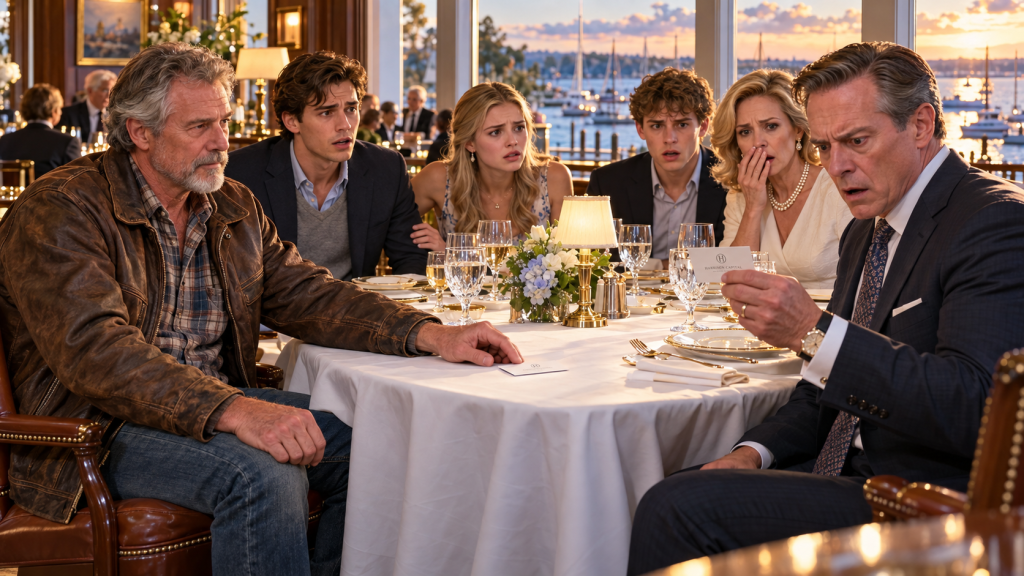
“That depends entirely on what you do after you leave this table.”
Richard Bradford stared at me as though I had just moved the floor beneath his chair.
For most of lunch, he had possessed the calm expression of a man accustomed to controlling rooms simply by entering them.
Now he was holding my business card between two fingers.
The same fingers that had folded his napkin so precisely while explaining why my son might not be financially suitable for his daughter.
THOMAS WARREN
FOUNDER & MANAGING PARTNER
WARREN CAPITAL PARTNERS
Below that was the address of the office I rarely visited anymore.
Richard knew the company.
More importantly, he knew our name from documents he had been reading for six months.
Patricia finally broke the silence.
“You’re saying you own the debt on Riverside?”
“Not personally.”
Christopher gave a short laugh.
Relief appeared in his eyes.
I looked at him.
“My firm controls the senior note through one of our credit funds.”
His relief vanished.
Richard set the card carefully on the table.
“How much?”
I almost smiled.
All afternoon he had asked about my resources.
Now the question had become dangerous.
“You know the face value better than I do.”
His jaw tightened.
Michael turned toward me.
“Dad.”
One word.
No anger yet.
Something worse.
Confusion.
Jessica was looking at me too.
Not impressed.
Not delighted.
Concerned.
For Michael.
That told me more about her character than everything else that had happened at lunch.
Michael whispered:
“You own Warren Capital?”
“I founded it.”
His face changed.
“Founded?”
“Yes.”
“How long?”
“Thirty-one years.”
He stared at me.
Thirty-one years meant I had been wealthy through almost his entire childhood.
He knew immediately.
I saw the arithmetic moving across his face.
The private college brochures I told him were too expensive.
The summer he worked construction because I refused to pay for a trip through Europe.
The years after Sarah died when he was drowning in debt and I kept saying:
“You need a plan, Michael. I can help you make one, but I’m not writing another check.”
His mouth tightened.
“You’ve had this kind of money my whole life?”
“Not this much.”
“That isn’t what I asked.”
“No.”
I looked at him.
“I built most of it over time.”
Christopher leaned forward.
“How much are you actually worth?”
Jessica’s head snapped toward him.
“Christopher.”
“What?”
“Stop.”
“I’m asking what everyone is wondering.”
“I’m not.”
she said.
Michael was still staring at me.
Neither was he.
That should have mattered to me more than the expression on Richard Bradford’s face.
It did.
Unfortunately, I had spent the entire afternoon waiting for Richard to discover who I was.
I had not spent enough time imagining what it would feel like for my son to discover the same thing.
Richard picked up his wineglass.
Did not drink.
“If Warren Capital controls the Riverside note, then you know we’re currently negotiating an extension.”
“I know your company requested one.”
“Then you also know the property is fundamentally sound.”
I looked at him.
“This is not the place.”
“You brought it up.”
“I brought it up because you were lecturing my son about financial security while your own company has been operating under a covenant waiver.”
Patricia turned toward her husband.
“A what?”
Richard froze.
There it was.
The reason he had been performing.
Not only for me.
For his own family.
Christopher looked at his father.
“You said Riverside was just delayed.”
“It is.”
Patricia’s face changed.
“Richard?”
He looked at me with sudden fury.
I had crossed a line.
I knew it immediately.
Not because the information was secret in the legal sense.
The debt situation existed in records and negotiations.
But I had used what I knew professionally in a family confrontation.
It felt satisfying for approximately three seconds.
Then it felt wrong.
That was the first lesson of the afternoon that belonged to me.
I said:
“I should not have mentioned internal financing details at this table.”
Richard stared.
“That’s generous.”
“I’m not apologizing for knowing them.”
“I’m apologizing for using them in this conversation.”
Michael looked at me.
That surprised him.
Good.
I continued.
“Your company’s financing will be handled by the professionals already handling it.”
Richard’s eyes narrowed.
“Meaning?”
“Meaning your treatment of my son will not determine whether your loan is extended.”
Christopher laughed.
“That’s convenient now.”
I looked at him.
“No.”
“It’s called a conflict of interest.”
“I did not know Jessica was your sister when Warren Capital purchased the note.”
“I did not know Michael was dating into the Bradford family until months afterward.”
“Now that the personal connection is obvious, I will recuse myself from any credit decision involving Bradford Development.”
Richard went still.
“You can do that?”
“I can.”
“Will you?”
“Yes.”
Patricia stared at me.
“So you could save Richard’s company, but you’re choosing not to decide?”
“I’m choosing not to use my son’s relationship as leverage over a borrower.”
Christopher scoffed.
“You just spent lunch doing exactly that.”
He was not entirely wrong.
I looked at him.
“I tested your character.”
Jessica’s expression hardened.
I heard my own sentence.
Tested your character.
Ugly phrase.
I had used it in my own mind before coming.
I wanted to see how the Bradfords treated someone they believed had no money.
I had dressed exactly as I normally dressed on weekends, but I had also made no effort to correct their assumptions.
At first, that distinction comforted me.
Sitting there, it felt less noble.
Jessica spoke.
“You tested us?”
Not them.
Us.
Her voice hurt.
I turned.
“Jessica.”
“No.”
She looked at me.
“You came here knowing who my family was.”
“Yes.”
“You knew about Dad’s company.”
“Yes.”
“You knew about Riverside.”
“Yes.”
“And you deliberately let everyone think you were struggling financially because you wanted to see what we’d do?”
I did not insult her with an excuse.
“Yes.”
Michael pushed his chair back.
Not enough to stand.
Enough that the sound made everyone look at him.
“So this whole lunch was a setup.”
“No.”
“It was for me.”
“Michael—”
“You let her parents humiliate me while you sat there waiting for the reveal.”
His voice stayed quiet.
That was Sarah in him.
She became quieter when she was angriest.
I felt something inside me drop.
“I did not expect them to humiliate you.”
“What did you expect?”
I had no good answer.
That was the problem.
I had expected arrogance.
Maybe a condescending comment.
A dismissive smile.
I had imagined revealing the business card and watching everyone learn some tidy lesson about judging people by clothes.
In that fantasy, Michael had barely existed.
He was the reason I was there.
Yet I had turned the lunch into my test.
“I expected to learn who they were.”
I said.
Michael’s face hardened.
“You could’ve asked me.”
I had no answer.
Jessica looked at him.
“Michael.”
He stood.
“I need air.”
Richard said:
“We’re not finished.”
Jessica turned to him.
“Yes, we are.”
She stood too.
Patricia whispered:
“Jessica, sit down.”
“No.”
“We’re in public.”
Jessica laughed once.
Not happily.
“Of course that’s what matters.”
She grabbed her purse.
Then looked at me.
Not cruelly.
Just disappointed.
That was worse.
“You should come too.”
she told Michael.
“I am.”
They walked away together.
Neither waited for me.
I watched my son leave Brookshire Country Club with the woman whose family I had spent two hours evaluating.
Jessica held the door for him.
Not the other way around.
A small thing.
I noticed.
Across the table, Richard Bradford still held my business card.
Patricia looked as though somebody had removed the walls of her house.
Christopher looked furious.
I looked at the empty chair where my son had been sitting.
Richard said:
“You enjoyed this.”
I turned.
“What?”
“This.”
He gestured toward the table.
“Making us feel small.”
I wanted to deny it.
Couldn’t.
“Part of me did.”
Patricia stared.
At least Christopher seemed surprised by the honesty.
Richard leaned back.
“So you’re no better than we are.”
“No.”
I looked at him.
“I’m richer.”
His face tightened.
“That doesn’t make me better.”
Silence.
I stood.
“Your debt will be handled on its merits.”
Richard looked up.
“And our daughter?”
I stared at him.
“Jessica is not one of your assets.”
Then I put twenty dollars beside my untouched chicken.
Ridiculous.
The meal cost far more.
But it was the amount of cash in my wallet.
I walked out.
The valet brought my Honda.
He looked at it.
Then at me.
No recognition.
Good.
I drove home alone.
My apartment was in South Boston, three blocks from the building where Sarah and I had lived when Michael was born.
It was not small because I could not afford larger.
It was small because after Sarah died, space became an accusation.
We had owned a large house in Wellesley then.
Four bedrooms.
Formal dining room we used twice a year.
A kitchen Sarah loved.
A garden she claimed to love even though she murdered basil with extraordinary consistency.
After she died, I spent seven months walking past rooms that no longer made sense.
So I sold it.
Michael thought I had to.
I let him think that.
That sentence sat differently after lunch.
I parked the Honda.
Climbed two flights.
Unlocked the apartment.
The silence met me.
Sarah’s photograph stood on a shelf near the window.
She was forty-nine in that picture.
Ten years younger than I was when cancer took her.
Smiling at somebody outside the frame.
Me.
I took off the old leather jacket.
It really was from 1995.
I had bought it the year Warren Capital closed its first major private-credit fund.
Sarah hated it immediately.
“You look like a divorced motorcycle salesman.”
I wore it for thirty-one years out of spite.
I sat in the chair beside her photograph.
“What did I do?”
The photograph did not answer.
Sarah was irritating that way.
My phone rang.
Michael.
I picked it up immediately.
“Hello.”
“Are you home?”
“Yes.”
“I’m coming over.”
“Okay.”
“Alone.”
That told me something.
“Okay.”
He hung up.
Twenty-eight minutes later, he knocked.
I opened the door.
Michael walked in.
He had changed nothing about his appearance, but something in his face looked younger.
Hurt does that.
He looked around my apartment.
He had been there dozens of times.
Now he was seeing everything differently.
The secondhand-looking bookshelves.
The modest television.
The scratched dining table.
The Honda keys in a bowl.
He pointed at the sofa.
“How much did that cost?”
I frowned.
“What?”
“The sofa.”
“I don’t remember.”
“Five thousand?”
“No.”
“Ten?”
“Michael.”
“You apparently make a hundred and twenty thousand dollars every month.”
“Approximately.”
He laughed.
Not amused.
“Approximately.”
“Investment income varies.”
“Oh, good. I was worried.”
I let him be angry.
He walked toward the window.
“You told me you were comfortable.”
“I am.”
“You told me retirement was fine as long as you kept expenses reasonable.”
“That is true.”
“You let me believe you lived on a pension.”
“I never said pension.”
He spun around.
“Dad.”
There it was.
The legal distinction defense.
A coward’s refuge.
I knew better.
“I let you believe it.”
I said.
He stared.
“Yes.”
“I did.”
“Why?”
I had rehearsed that answer for years.
Because I wanted you independent.
Because money ruins people.
Because you had already shown bad judgment.
Because I was protecting you.
Every sentence sounded different after watching Richard Bradford say:
“I’m protecting my daughter.”
I sat.
“Because I was afraid.”
Michael’s face changed slightly.
“Of what?”
“You.”
He stared.
“When your mother died, you were twenty.”
“Twenty-one.”
“Twenty-one.”
I nodded.
“You stopped going to classes.”
“You put rent on credit cards.”
“You bought a motorcycle you could not afford.”
“You lent money to people who never paid you back.”
“You called me every time a bill became urgent.”
Michael’s jaw tightened.
“I was grieving.”
“I know that now.”
“I knew it then.”
“Not enough.”
He stared.
I continued.
“I kept solving the money problems because they were easier than your grief.”
The room went still.
Michael looked down.
“I paid your rent twice.”
“Three times.”
Of course he remembered.
“I cleared two credit cards.”
“One and part of another.”
“I paid for the motorcycle loan after you stopped making payments.”
“You sold the bike.”
“After I paid it off.”
“Yes.”
I leaned forward.
“Every time I rescued you, you learned I would rescue you again.”
Michael’s eyes hardened.
“So you stopped.”
“Yes.”
“You watched me declare bankruptcy.”
That was the wound.
“I did.”
His voice rose.
“You had millions of dollars and watched your son file for bankruptcy.”
“I paid for the bankruptcy attorney.”
“That is not better.”
“No.”
He laughed bitterly.
“I thought you were stretched.”
“I thought Mom’s medical bills had hurt you.”
“They did.”
“Emotionally.”
“Not financially.”
He stared.
“You let me feel guilty.”
That one hit.
“I didn’t know you felt guilty.”
“You never asked.”
Silence.
He had me.
Not financially.
Emotionally.
I had been so proud of not rescuing him with money that I failed to notice he needed something else.
Michael sat across from me.
“Do you know what I thought when you stopped helping?”
I shook my head.
“I thought Mom dying had broken both of us.”
“It did.”
“I thought you couldn’t afford me falling apart.”
My throat tightened.
“I thought I was ruining you too.”
“No.”
“I know that now.”
He wiped his face.
“But I didn’t then.”
I closed my eyes.
Sarah.
I wished she were there.
Then immediately knew she would have taken Michael’s side.
Annoying woman.
I said:
“I’m sorry.”
He stared at me.
“I’m not sorry I stopped paying your debts.”
His face tightened.
“I know.”
“I still think you needed consequences.”
“I know.”
“But I am sorry I let you think my silence meant scarcity.”
He looked away.
“And I’m sorry I made your recovery into some test you didn’t know you were taking.”
That sentence surprised both of us.
Michael looked at me.
“Like today.”
“Yes.”
I nodded.
“Like today.”
He was quiet.
I continued.
“I told myself hiding money protected you from entitlement.”
“Maybe it did.”
“But secrecy became a way for me to control the conditions under which you learned things about yourself.”
He looked at me for a long time.
“That sounds like therapy.”
“It sounds expensive.”
He almost smiled.
Almost.
Then:
“How rich are you?”
There it was.
Not greed.
He deserved truth.
I gave it.
Not exact down to the dollar.
Enough.
Warren Capital managed several billion dollars across private-credit and real-estate strategies.
Most belonged to clients and funds, not me.
My personal net worth, after taxes, trusts, charitable commitments, and investments, sat comfortably in nine figures.
Michael went silent.
Then:
“You’re joking.”
“No.”
He stood.
Walked to the window.
Came back.
“Dad.”
“I know.”
“Nine figures?”
“Yes.”
“You drive a Honda with a dent in the passenger door.”
“It runs.”
“It smells like crayons.”
“Your mother spilled a box when you were twelve.”
“Those cannot possibly still be the same crayons.”
“Maybe the smell became structural.”
He laughed.
Finally.
Then stopped.
“Why keep living like this?”
I looked around.
“I don’t think I live poorly.”
“You know what I mean.”
“Yes.”
I thought about it.
“Money gave me freedom.”
“After your mother died, I discovered most luxury felt like maintenance.”
“The club.”
“The big house.”
Cars.”
“Staff.”
“Events.”
“None of it made the chair across from me less empty.”
Michael looked at Sarah’s photograph.
I continued.
“This apartment is near places I remember with her.”
“The Honda is stupid.”
He nodded.
“Very.”
“I’ll replace it.”
That surprised him.
“Why now?”
“Because the mechanic told me six months ago the transmission is dying.”
Michael stared.
“You ignored him?”
“I was emotionally attached.”
“To a dented Civic?”
“Do not judge grief.”
He laughed again.
Then sat.
“What does Jessica know?”
“About me?”
“Yes.”
“Whatever she heard at lunch.”
“Nothing before?”
“No.”
He nodded.
“Good.”
“Why?”
“Because if she knew and didn’t tell me…”
He let the sentence die.
I understood.
He was tired of adults managing information for his protection.
“Where is she?”
“Home.”
“With her parents?”
“Yes.”
“How did that go?”
His face hardened.
“Badly.”
I waited.
He looked at me.
“You know what her brother said after we left?”
“No.”
“He asked Jessica whether she could convince me to talk to you about Riverside.”
Something cold moved through me.
“How did Jessica respond?”
“She told him if he ever treated our relationship like a financing channel again, he would not be invited to our wedding.”
That sounded like Jessica.
I nodded.
“Good.”
“Dad.”
“Yes?”
“Stop evaluating her.”
I froze.
He was right.
“Okay.”
“No.”
He shook his head.
“Not okay like you’re agreeing because I passed another test.”
“I mean stop.”
“I hear you.”
He looked at me.
I felt the instinct to say:
I only wanted to protect you.
I swallowed it.
Michael continued.
“You don’t get to secretly test people I love.”
“You don’t get to decide I need to prove I can survive without money.”
“You don’t get to sit on information that changes how I understand my own family because you think it’s good for my character.”
Each sentence hurt.
Each was deserved.
I nodded.
“You’re right.”
He stared as though expecting an argument.
I did not give him one.
“Completely?”
“No.”
He almost smiled.
“There you are.”
I continued.
“I think a parent can choose not to fund an adult child’s mistakes.”
“Agreed.”
“I think parents should consider what sudden wealth can do to someone who has not learned to manage money.”
“Agreed.”
“I think I had the right to keep my finances private.”
He paused.
“Technically.”
I smiled.
“Thank you.”
“But.”
“Yes.”
“You made your privacy into a false story about what our family was.”
That was the sentence.
The one I kept.
“I did.”
He looked at Sarah’s photograph again.
“Did Mom want this?”
I took a breath.
“She knew almost everything.”
“Almost?”
“The company grew significantly after she died.”
“But she knew you were wealthy.”
“Yes.”
“And she was okay with hiding it from me?”
“Not exactly.”
Michael turned.
“What does that mean?”
I stood.
Walked to the small desk.
Opened the bottom drawer.
Inside was an envelope Sarah had written years before she became ill.
Not a death letter.
Nothing dramatic.
Just something from an argument we once had about Michael.
I had kept it because Sarah wrote when angry.
Said writing stopped her from throwing objects.
I gave it to him.
The paper had yellowed.
At the top:
Tom — I am still angry, so read this before you interrupt me again.
Michael laughed through his nose.
“Mom.”
“Yes.”
He read.
I knew the words by heart.
Money is not the problem. The problem is that you think every problem with Michael can be solved by choosing the correct amount of money to give or withhold. He is not one of your investments. He is a person.
Michael stopped.
Looked at me.
I stared at the floor.
He continued.
I agree he needs to work. I agree he should not grow up expecting our accounts to become his lifestyle. But if you make independence into a test of love, he will spend his life wondering whether needing you is failure.
My throat tightened.
Sarah had written that when Michael was sixteen.
He wanted an expensive car.
I said no.
That part was right.
The argument became larger.
Sarah always had that talent.
Michael reached the final lines.
Teach him what money can do. Also teach him what it cannot measure. And for God’s sake, tell him enough about our life that he does not discover his parents from strangers one day.
Michael lowered the page.
Neither of us spoke.
Finally he said:
“She literally warned you.”
“Yes.”
“And you still did it.”
“Yes.”
He stared.
“Unbelievable.”
“I’m a slow learner.”
“She said strangers.”
“Yes.”
“You made me discover you from Richard Bradford.”
“I appreciate the precision of the irony.”
Michael laughed despite himself.
Then cried.
I moved toward him.
Stopped.
He noticed.
“Come here.”
I hugged my son.
Twenty-eight years old.
Architect.
Bankruptcy survivor.
Stubborn.
Good.
His mother’s child.
My child.
For years, I had been proud he stopped needing rescue.
Standing there, I realized I had confused not needing my money with not needing me.
We held each other for a long time.
Then Michael pulled back.
“I’m still mad.”
“You should be.”
“Good.”
He folded Sarah’s note carefully.
“Can I keep this?”
“Yes.”
“Anything else I should know?”
I thought.
“Your mother once backed the car into the garage door and blamed you.”
“I was eight.”
“Yes.”
“I knew.”
“Damn.”
He smiled.
Then became serious.
“What happens to the Bradfords?”
“Their company?”
“Yes.”
“I recuse myself.”
“Really?”
“Yes.”
“Can you?”
“Of course.”
“Who decides?”
“Our independent credit committee.”
“Will they know Richard insulted you?”
“No.”
“Christopher?”
“No.”
“Jessica?”
“The conflict will be disclosed as required.”
“But the committee will evaluate the loan on its own.”
Michael nodded.
“What if the numbers say foreclose?”
“Then they will take whatever action the documents and economics justify.”
“What if Richard apologizes?”
“It should change nothing about the credit.”
“Good.”
“What if he doesn’t?”
“Same.”
Michael looked relieved.
That mattered.
He did not want his future marriage contaminated by my leverage.
Neither did I.
I picked up my phone.
Called Eleanor Price, the partner who chaired Warren Capital’s credit committee.
She answered on the third ring.
“Tom.”
“Eleanor.”
“You sound guilty.”
“Useful instinct.”
I explained the conflict.
Not the country-club insult in detail.
Only that my son was in a serious relationship with Richard Bradford’s daughter and that I had personally learned information that made continued involvement inappropriate.
Eleanor was silent.
Then:
“You’re recused.”
“Yes.”
“Effective now.”
“Yes.”
“You don’t call me asking how it’s going.”
“I know.”
“You don’t send me clever emails about Riverside.”
“I know.”
“You don’t appear in hallways looking accidentally interested.”
I frowned.
“You make me sound unbearable.”
“You founded an investment firm.”
“Same thing.”
Michael laughed.
Eleanor heard.
“Is that your son?”
“Yes.”
“Tell him I’m sorry he inherited your personality.”
“I heard that.”
Michael called.
“Good luck.”
Eleanor said.
Then hung up.
Michael stared at me.
“That easy?”
“Yes.”
“You built systems that can tell you no?”
“If your systems cannot tell the founder no, you do not have systems.”
He nodded slowly.
“That I respect.”
I smiled.
“I’ll take it.”
The next call came from Richard the following morning.
I did not answer.
He left a voicemail.
“Thomas, I would appreciate the opportunity to speak privately.”
No mention of Riverside.
Interesting.
I called back that afternoon.
“We can meet Monday.”
“Brookshire?”
“No.”
A pause.
“Your office?”
“Yes.”
“Fine.”
Monday morning, Richard Bradford entered Warren Capital through a lobby far less impressive than Brookshire Country Club.
I had designed it that way.
Glass.
Stone.
No portraits of founders.
No mahogany meant to intimidate visitors.
Money performs enough without architecture helping.
Richard wore another perfect suit.
This time, he looked tired inside it.
I led him into a small conference room.
No lawyers.
Not a loan meeting.
He understood the distinction.
Before sitting, he said:
“I owe your son an apology.”
“Yes.”
“And you.”
“Less important.”
He nodded.
“Jessica told me the same thing.”
Good.
We sat.
Richard looked through the glass wall toward the harbor.
“You really belonged to Brookshire.”
“Twenty years ago.”
“I checked.”
“Of course you did.”
He almost smiled.
Then:
“I made assumptions.”
“Yes.”
“I was rude.”
“Yes.”
“I humiliated Michael.”
“Yes.”
“You’re enjoying this.”
“Less than Friday.”
That surprised him.
I leaned back.
“Richard, I came to your lunch expecting you to fail.”
He looked at me.
“That’s true.”
“Yes.”
“I wore what I normally wear.”
“I drove what I normally drive.”
“But I also knew what you assumed about me, and I let the assumption grow because I wanted to test you.”
His expression shifted.
“Why admit that?”
“Because it was arrogant.”
Richard said nothing.
“I wanted to know whether you respected people without money.”
“A fair question.”
“A fair question.”
I nodded.
“An unfair experiment.”
He understood.
“Michael angry?”
“Yes.”
“Jessica is furious with me.”
“She should be.”
Richard almost laughed.
“You really don’t make this easy.”
“I think that’s what we both need to stop doing.”
Silence.
Then I asked:
“Why were you so obsessed with Michael’s financial background?”
Richard looked toward the window.
“Because I’m a snob?”
“Partly.”
He smiled despite himself.
“Fair.”
Then his face changed.
“My father lost everything when I was sixteen.”
I had not expected that.
Richard continued.
“Business failure.”
“House gone.”
“School changed.”
“Mother went to work for the first time in twenty years.”
“I watched people who invited us to dinner stop returning calls.”
He rubbed his hands.
“I decided money would never make my family vulnerable again.”
That sounded familiar.
Different details.
Same disease.
“So you built Bradford Development.”
“Yes.”
“Then spent thirty years measuring safety in balance sheets.”
He looked at me.
“You’re not my therapist.”
“No.”
“Cheaper though.”
He laughed.
Then stopped.
“Riverside scared me.”
Finally.
“How much does Patricia know?”
“Now?”
“Yes.”
“Everything.”
“Before Friday?”
“Not enough.”
“And Jessica?”
“Almost nothing.”
“Christopher?”
Richard’s jaw tightened.
“More than he should have.”
Interesting.
I said nothing.
Richard understood I would not discuss the loan.
He continued anyway.
“Christopher pushed the Hartford acquisition.”
“I approved it.”
“It failed.”
“Riverside went over budget.”
“Interest expense climbed.”
“One lender left.”
“We filled the gap with short-term money.”
He looked ashamed.
“I kept telling everybody the next project would fix the last one.”
Classic leverage.
Not criminal.
Not rare.
Still dangerous.
“Why hide it from your family?”
“Image.”
he said.
Simple.
“I spent my life making sure my children never felt the humiliation I felt at sixteen.”
“So you never let them see uncertainty.”
“Yes.”
“Which taught them wealth was permanent.”
His face tightened.
“Christopher especially.”
There it was.
“I raised him to think our standard of living was evidence of competence.”
“Then when the company struggled, I became more obsessed with who Jessica married.”
He looked at me.
“I told myself I was protecting her.”
I thought of Michael’s apartment.
Of Sarah’s letter.
He saw something in my face.
“What?”
“Nothing.”
“No.”
“Tell me.”
I smiled bitterly.
“I spent twenty-eight years telling myself the same sentence.”
Richard looked down.
For the first time, neither of us was richer than the other.
Just fathers who had turned fear into control.
I said:
“Your apology to Michael should have nothing to do with Riverside.”
“I know.”
“If you apologize because you think I can help your loan, he’ll know.”
“I know.”
“If you ask Jessica to influence him—”
“I won’t.”
“Christopher already did.”
Richard’s face hardened.
“When?”
“After lunch.”
He closed his eyes.
Of course.
Then:
“I’m dealing with Christopher.”
“That is your business.”
“Yes.”
He looked at me.
“And Riverside?”
“Not mine anymore.”
“You can’t tell me what the committee thinks?”
“No.”
“Not even whether we have a chance?”
“No.”
Richard nodded slowly.
Then:
“That’s probably the first reassuring thing you’ve said.”
I understood.
If I refused to use power for him, perhaps he could trust I would not use it against him.
He stood.
At the door, he stopped.
“Thomas.”
“Yes?”
“Why the Honda?”
I sighed.
“Everyone is obsessed with the car.”
“It’s terrible.”
“I’m buying another.”
“Good.”
“Don’t make me regret admitting it.”
He smiled.
Then:
“I am sorry.”
I looked at him.
“Tell Michael.”
“I will.”
He did.
Not immediately.
That mattered.
Three days later, Michael called.
“Richard asked to meet me.”
“Do you want to?”
“I don’t know.”
“That’s yours.”
Silence.
Then:
“Good answer.”
Progress.
Michael met him at a coffee shop.
No Jessica.
No Patricia.
No me.
Michael told me about it later because he wanted to, not because I asked.
Richard apologized without mentioning Warren Capital once.
He said:
“I treated you like a balance sheet.”
Michael answered:
“You treated your daughter like one too.”
Richard apparently sat with that.
Then said:
“Yes.”
Not perfect.
Real.
Michael did not forgive him that day.
Also real.
Patricia’s apology took longer.
She invited Michael and Jessica to dinner at the Bradford house.
Michael declined twice.
Accepted the third time.
Jessica asked me to come.
I refused.
“Why?”
she said.
“Because your family needs a dinner that isn’t about me.”
Smartest thing I had done in weeks.
She hugged me.
Jessica and I had our own conversation later.
At a diner.
Her suggestion.
Not Brookshire.
She arrived in jeans.
I pointed.
“Testing me?”
She smiled.
“Maybe.”
Fair.
We ordered coffee.
She looked at me.
“I was angry at you.”
“I know.”
“Still a little.”
“Good.”
“For testing us.”
“Yes.”
“Did I pass?”
I closed my eyes.
“Jessica.”
She smiled.
“I wanted to hear you say it.”
“I am not grading my son’s girlfriend.”
“Fiancée.”
I looked up.
She held out her left hand.
A ring.
Simple.
Elegant.
Not absurd.
Michael had proposed the night before.
My throat tightened.
“He didn’t call me.”
“He will.”
“Are you sure?”
“He spent twenty minutes deciding whether telling you immediately would feel like asking approval.”
That hurt.
The consequences of secrecy linger in odd places.
Jessica continued.
“I told him telling your father something is not the same as asking permission.”
Good woman.
I looked at the ring.
“Are you happy?”
“Yes.”
“That’s all.”
She stared.
“That easy?”
“No financial questionnaire?”
“No.”
“No character test?”
“Retired.”
She laughed.
Then became serious.
“Michael worries people will think he’s with me for money.”
I nodded.
“He has new reasons to dislike irony.”
“He also worries people will think I’m with him because of you.”
That surprised me.
She said:
“Now that everybody knows.”
“How many people know?”
“My parents.”
“Christopher.”
“Probably half of Brookshire because my mother cried in the ladies’ room after you left.”
I winced.
“Sorry.”
“She’ll survive.”
Then:
“I want you to know something.”
I waited.
“I don’t want your money.”
“Good.”
“I don’t mean ever.”
“That’s not your decision.”
She frowned.
“What?”
“If Michael inherits one day, that affects your household.”
“But I’m not building my life around it.”
“Better.”
Jessica stirred her coffee.
“We want to pay for the wedding ourselves.”
“That sounds expensive.”
“We’re doing seventy people.”
“Still expensive.”
“Public garden.”
“Better.”
“No country club.”
“Excellent.”
She smiled.
“We also decided no money from either family.”
I nodded.
“Good.”
Then stopped.
“No.”
She looked confused.
“What?”
“I almost turned your decision into another test.”
She laughed.
“Therapy?”
“Sarah’s ghost.”
“Michael showed me the letter.”
Of course he did.
I pretended to be offended.
Then I said:
“If you want family help someday, ask.”
“If I want to offer, I’ll ask whether you want it.”
“No secret tests.”
“No guilt.”
“No assumptions.”
Jessica nodded.
“That sounds good.”
We shook hands.
Ridiculous.
Then she hugged me.
The Riverside decision came seven weeks later.
I learned about it at the same time as everyone else in the conflict process was allowed to know.
Eleanor called.
“You are still recused.”
“I know.”
“I am calling because the matter is concluded enough that the conflict notice no longer prevents you from knowing the public outcome.”
“Go ahead.”
The committee approved a restructuring.
Not rescue.
Not foreclosure.
Bradford Development had to contribute new equity.
Sell two non-core properties.
Reduce distributions to owners.
Accept tighter reporting.
Replace its chief financial officer.
And meet a strict asset-sale timeline.
Riverside remained financed.
At a higher margin.
With painful conditions.
Commercial reality.
Richard’s apology earned nothing.
My anger cost him nothing.
Exactly as it should have been.
“Christopher?”
I asked before stopping myself.
Eleanor paused.
“Personal curiosity?”
“Yes.”
“Then no answer.”
I laughed.
“You enjoy this.”
“Deeply.”
She hung up.
I later learned from Jessica that Richard removed Christopher from day-to-day financial authority.
Not because Warren Capital required it directly.
Because internal review uncovered something uglier than incompetence.
Christopher had not stolen money.
I was almost relieved.
He had, however, pushed the company to guarantee obligations on a speculative development he personally championed, minimizing the downside to his father and siblings.
Legal.
Disclosed badly.
Reckless.
Richard had approved too much without questioning him.
Again: control and trust tangled together.
Christopher reacted badly to being sidelined.
He blamed me.
Of course.
He sent one email.
Congratulations. You got what you wanted.
I did not respond.
Because I had not.
I wanted Michael respected.
I wanted Jessica judged as a person, not a portfolio.
I had not wanted a struggling company.
I had not wanted Richard humiliated.
I had certainly not wanted my son discovering his father’s wealth from a business card across a country-club table.
Consequences rarely arrange themselves around our preferred morality.
Life is messier.
Michael and I spent the next year learning transparency.
Painfully.
He asked questions.
Lots.
“Do I have a trust?”
“Yes.”
“How much?”
“Enough that you should know it exists.”
“How much?”
I told him.
He nearly fell off his chair.
The trust was not accessible immediately.
It held assets for long-term estate planning, charitable commitments, and eventual family benefit.
He would not wake at thirty and receive a fortune.
That had been intentional.
He looked at the documents.
“So you had all of this planned while I thought I’d inherit the apartment.”
“The apartment too.”
“Generous.”
“I like you.”
“Debatable.”
We laughed.
Then I explained everything.
Life insurance.
Estate structure.
Company interests.
Voting rights.
Philanthropic foundation.
What would happen if I became incapacitated.
Who would make decisions.
Which professionals he should call.
For the first time, Michael knew enough about my financial life to be my son instead of a future detective.
That mattered.
I also showed him the ugly parts.
Investment losses.
A deal I had believed in that failed.
The year Warren Capital almost violated its own bank covenants.
The employee lawsuit we settled.
The time I ignored Sarah’s warning and invested too heavily in one property sector.
Money stopped looking magical.
It became what it was.
Assets.
Liabilities.
Judgment.
Risk.
Luck.
Work.
Michael stared at one old loss statement.
“You lost fourteen million dollars?”
“Not all personally.”
“That is not comforting.”
“Your mother said the same thing.”
“Did you panic?”
“Completely.”
“You always seemed calm.”
“I was performing.”
The word connected us back to Richard.
Michael nodded.
“Everyone performs.”
“Yes.”
“Maybe that’s the problem.”
Sometimes.
The biggest conversation came on the anniversary of Sarah’s death.
Eight years became nine.
Michael and I always went to the cemetery separately.
That year, he asked:
“Can we go together?”
We did.
Sarah’s stone was simple.
She had chosen it herself before she died.
Practical to the end.
Michael placed flowers.
I stood with my hands in my coat pockets.
Then he said:
“Did Mom know I was bankrupt?”
The bankruptcy happened after she died.
“No.”
“I mean, did she know I was heading somewhere bad?”
“Yes.”
“What did she say?”
I smiled.
“She said you needed grief counseling.”
He laughed bitterly.
“And you?”
“I said you needed discipline.”
“Of course.”
“She said both could be true.”
He looked at the stone.
“She was always annoying.”
“Yes.”
Silence.
Then Michael said:
“I thought you were ashamed of me.”
My heart tightened.
“Never.”
“You didn’t say that.”
“No.”
“I talked about budgets.”
“You made spreadsheets.”
“They were good spreadsheets.”
“Dad.”
I closed my eyes.
“I’m sorry.”
He nodded.
“I know.”
Then:
“I’m proud of you.”
He looked at me.
Not because he was an architect.
Not because he rebuilt his credit.
Not because he stopped asking me for money.
“I’m proud you survived losing your mother without letting that become the only thing you were.”
He cried.
So did I.
“Could’ve used that at twenty-three.”
“Yes.”
“Idiot.”
“Yes.”
He hugged me beside Sarah’s grave.
That was the moment I stopped believing my silence had made him strong.
Michael made himself strong.
My money had not done it.
My withholding had not done it.
People deserve credit for their own growth.
Parents love to claim the results of choices their children made under circumstances we only partly created.
I stopped.
The wedding happened the following June.
Seventy-two guests.
Jessica lost the seventy-person argument.
Public garden overlooking the Charles River.
No chandeliers.
No private wine cellar.
Michael wore a navy suit.
Jessica wore her grandmother’s earrings.
Richard walked her halfway down the aisle.
Jessica stopped him at the final row.
She hugged him.
Then walked the remaining distance herself.
Her choice.
I liked that.
Not because I was evaluating.
Because I had learned something.
Patricia sat beside Richard.
She had apologized to Michael months earlier.
Not perfectly.
Her first attempt included:
“We only wanted the best for Jessica.”
Michael stopped her.
“Then apologize when you’re ready to do it without explaining.”
She hated that.
Then came back two weeks later.
“I looked at your father’s clothes before I looked at his face.”
she said.
“I treated your salary like evidence of your character.”
“I’m sorry.”
Better.
Christopher attended the wedding.
He did not speak to me.
Fine.
He hugged Jessica.
Stayed through dinner.
Left before dancing.
Also fine.
Not every family member needs a redemption scene.
Sometimes the healthiest relationship is distance without drama.
At the reception, Richard approached me near the garden wall.
“I heard you bought a new car.”
I glared.
“Michael told you?”
“Jessica.”
“Family privacy is dead.”
“What did you buy?”
“Subaru.”
Richard stared.
“You’re worth over a hundred million dollars and bought a Subaru?”
“It has excellent safety ratings.”
He laughed.
Then raised his glass.
“To staying disappointing.”
I clinked mine.
“To smaller egos.”
He winced.
“Still working on that.”
“Same.”
We stood quietly.
Then he said:
“Riverside is stabilizing.”
“I’m glad.”
“You really don’t know the details?”
“No.”
“You haven’t asked?”
“No.”
“That must be killing you.”
“A little.”
He smiled.
Then:
“Thank you for recusing yourself.”
I looked at him.
“That should not require thanks.”
“No.”
“But if you had wanted revenge, you could have made my life harder.”
“Maybe.”
“You didn’t.”
“Professional decisions should not settle personal scores.”
Richard looked toward Michael and Jessica dancing.
“I wish I had understood that kind of boundary earlier.”
I knew what he meant.
He had treated Jessica’s marriage like risk management.
I had treated Michael’s adulthood like portfolio construction.
Different men.
Same temptation.
“Learn late.”
I said.
“Still learn.”
Richard nodded.
Then walked back to Patricia.
I watched my son dance.
He was not the boy who declared bankruptcy.
Not the man embarrassed at Brookshire.
Not the heir to anything.
Michael.
That was enough.
After the wedding, I offered them one gift.
Not cash.
Not a house.
A choice.
I gave them an envelope.
Michael groaned.
“No secret financial revelation?”
“No.”
Inside were two pieces of paper.
One offered a fully paid two-week honeymoon anywhere they wanted.
The other said:
Or tear this up and let your father behave normally.
Jessica laughed.
Michael chose the honeymoon.
Good.
They went to Portugal.
Sent me photographs.
I did not calculate the return.
Progress.
Two years later, Michael and Jessica wanted to buy a house.
They could afford a modest one.
Boston being Boston, modest still felt criminally expensive.
Michael called.
“Can I ask you something awkward?”
“Yes.”
“Would you help with the down payment?”
I went silent.
Not because I objected.
Because the twenty-year-old version of me would have turned the question into a philosophy lecture.
Michael heard the silence.
“Never mind.”
“No.”
I stopped him.
“I’m thinking.”
“About whether I’ve earned it?”
The sentence hurt.
“No.”
“About how to do it without turning help into control.”
He went quiet.
Then:
“Okay.”
I asked:
“What would be useful?”
They told me.
I offered a gift within a structure that did not give me ownership or decision rights.
No lien.
No hidden conditions.
No spare key.
No expectation of a room.
Michael laughed at that.
“Jessica’s parents already asked which guest room is theirs.”
“Tell them I own senior debt.”
He groaned.
“Dad.”
“Retired joke.”
The house was a three-bedroom in Arlington.
Old floors.
Tiny yard.
Excellent light.
Michael obsessed over the windows because architect.
Jessica wanted a kitchen island.
They argued.
Bought it.
When I visited, I knocked.
Every time.
Even though Michael gave me a key for emergencies.
That mattered to me.
Money had helped.
Money had not purchased access.
Five years after Brookshire, Richard sold a controlling stake in Bradford Development to a larger firm.
Riverside was completed.
Not spectacularly.
Profitably enough.
The company survived.
Richard stayed as chairman for two years, then retired.
Christopher left before the sale.
Started his own development company.
It failed.
Then he started another.
Less ambitious.
It survived.
I heard that through Jessica.
He and I never became close.
At a Thanksgiving years later, he finally said:
“I was awful to you at Brookshire.”
I looked at him.
“Yes.”
He laughed.
“I was hoping age softened you.”
“No.”
Then he said:
“I was worse to Michael.”
“Yes.”
“Sorry.”
Michael overheard.
He came over.
“You can apologize without witnesses.”
Christopher looked embarrassed.
“I know.”
“Then do it.”
So they went outside.
I stayed inside.
No grading.
No report.
Later Michael said:
“We’re okay.”
I asked nothing else.
That was progress too.
Patricia surprised me most.
After Richard retired, she became involved in a financial-literacy program at a community college.
At first, I assumed guilt.
Then I learned she had grown up lower-middle-class and had spent decades hiding it.
Her father repaired boilers.
Her mother cleaned offices.
She met Richard after he was already climbing.
Brookshire had been the place she proved to herself she was never going backward.
No wonder she stared at my boots.
She was not only judging poverty.
She was terrified of being associated with where she came from.
That did not excuse her.
It explained her.
One afternoon she called.
“Thomas.”
“Yes?”
“I owe you a strange thank-you.”
“I’m hanging up.”
“Wait.”
I laughed.
“What?”
“I spent thirty years pretending I had never checked grocery prices.”
“That sounds exhausting.”
“It was.”
She told me she had started speaking honestly with Jessica about money.
Not family money.
Her own shame around it.
“Do you know what she said?”
“No.”
“She said, ‘Mom, nobody asked you to become a museum exhibit.’”
I laughed.
“That sounds like Jessica.”
Patricia continued.
“I think I passed a lot of fear off as standards.”
“Yes.”
“I knew you’d say that.”
“Why call?”
“Because you did too.”
Silence.
Then I laughed.
“Fair.”
We became unlikely acquaintances.
Not friends.
We could sit at the same table without measuring one another.
That was enough.
My income continued.
Sometimes above $120,000 a month.
Sometimes below.
I stopped talking about it like a fixed number because wealth is not a salary when it comes from distributions and investments.
Michael learned that too.
He never asked for monthly statements.
Good.
Warren Capital eventually moved me from managing partner to executive chairman.
Then chairman emeritus.
Which meant they invited me to events and hoped I would not touch anything important.
Eleanor Price became CEO.
First board meeting after the change, she gave me a plaque.
PLEASE REMAIN RECUSED
I kept it.
She earned the right.
The greatest change was my estate plan.
Not the numbers.
The conversation.
I sat Michael and Jessica down.
Showed them everything relevant.
Not because they had a right to every private detail while I lived.
Because Sarah had been right.
Children should not discover their parents through strangers.
Michael knew what he might inherit.
What he might not.
What went to charity.
What stayed in trusts.
What obligations existed.
I told him:
“You are not getting control of Warren Capital because you’re my son.”
He looked relieved.
“Thank God.”
“I thought you’d be offended.”
“I’m an architect.”
“Correct.”
“I do not want to explain mezzanine debt at Christmas.”
“Coward.”
He laughed.
The majority of my economic interest would eventually diversify through trusts.
A large charitable foundation would receive a significant portion.
Michael and future grandchildren would be secure.
Not dynastic royalty.
That was deliberate.
I asked:
“Do you think this is fair?”
He stared at me.
“Why are you asking?”
“Practice.”
He smiled.
“Yes.”
Then:
“Can I say something annoying?”
“Apparently genetics.”
“I don’t care whether it’s fair.”
“That’s not true.”
“Fine.”
“I care.”
“But it’s your money.”
Those four words mattered.
My money.
While alive.
Then structures after.
His life now.
Clean lines.
Money becomes dangerous in families when everyone starts mentally spending the future.
I had seen it too many times professionally.
One day Michael asked:
“Was that what you were afraid of with me?”
“Yes.”
“That I’d wait for you to die?”
The sentence hurt.
“Yes.”
He looked sad.
“Dad.”
“I know.”
“Did you really think I was that kind of person?”
“No.”
“I was afraid money could make you into someone neither of us knew yet.”
He thought.
“That’s different.”
“Yes.”
“Still insulting.”
“Yes.”
Then:
“Maybe tell people when you’re afraid instead of designing their environment around the fear.”
I stared.
“That sounds like your mother.”
“Good.”
He smiled.
I wrote that sentence down later.
Michael and Jessica had their first child when he was thirty-five.
A girl.
Sarah Elizabeth Warren.
I cried when they told me the name.
Jessica said:
“If you make this about money, I’m changing it.”
“I wasn’t.”
“You had a spreadsheet face.”
“I was calculating college inflation.”
“Thomas.”
I stopped.
When Sarah was born, I held her.
Tiny.
Furious.
Perfect.
Michael watched me.
“You know she already has enough grandparents planning her future.”
“I haven’t said anything.”
“You’re thinking aggressively.”
I laughed.
Then asked:
“What do you want?”
That became my question.
Not:
I can pay.
Not:
I’ll take care of it.
What do you want?
Sometimes the answer included money.
Usually it didn’t.
They wanted me to babysit.
Attend birthdays.
Read books.
Pick Sarah up from preschool once a week.
I drove the Subaru.
Safe.
Boring.
No structural crayon smell.
When Sarah turned six, she asked:
“Grandpa, are you rich?”
I looked at Michael.
He froze.
History entering the room.
I answered:
“Yes.”
Simple.
She nodded.
“How rich?”
“Enough.”
Michael groaned.
“Dad.”
I corrected.
“I have more money than I need.”
Sarah considered this.
“Then can I have a pony?”
Michael burst out laughing.
“No.”
I said.
She frowned.
“Why?”
“Because your father has a small yard.”
Michael pointed at me.
“Excellent.”
Then Sarah asked:
“Will I be rich?”
I looked at her.
“Maybe.”
“That’s not an answer.”
She was definitely related to us.
I said:
“You will have opportunities.”
“Money may be part of that.”
“But you still have to learn how to do things.”
She looked disappointed.
“Even dishes?”
“Especially dishes.”
Terrible grandfather.
Good.
Later, Michael said:
“Thank you.”
“For?”
“Telling her.”
I knew.
No mysterious family mythology.
No surprise business card one day.
We would teach money without worshipping it.
That became the repair.
Years later, Brookshire Country Club invited Warren Capital to sponsor a charity dinner.
Eleanor forwarded the invitation to me.
Subject line:
Your favorite place
I almost declined.
Then looked at the beneficiary.
Scholarships for first-generation college students.
I accepted the sponsorship.
Not the table.
The firm could support the cause without me eating lobster under the old portrait.
Michael heard.
“You still hate Brookshire?”
“No.”
“Really?”
“I’m too old to hate buildings.”
“The people?”
“Selective.”
He laughed.
Then said:
“Jessica and I are going.”
“Why?”
“She sits on the scholarship committee now.”
Of course she did.
Life has an irritating sense of symmetry.
They asked me to attend.
I did.
This time I wore a suit.
Not because I needed to prove anything.
Because Jessica asked nicely.
The valet took my Subaru.
No one laughed.
The old portrait remained over the fireplace.
The harbor view remained.
Mahogany.
Silver.
People who still rarely looked at menu prices.
I stood in the same dining area where Richard had told me Michael was not prepared to support Jessica’s expected life.
Richard came over.
Older now.
Less hair.
More humility.
He pointed toward the table.
“Bad memories?”
“Educational.”
He nodded.
“Do you remember what you said?”
“Which part?”
“That what happened next depended on what we did after leaving the table.”
I did.
“What did you think would happen?”
I smiled.
“I imagined you’d become a better person immediately.”
He laughed loudly.
“Arrogant bastard.”
“Yes.”
“What actually happened?”
I looked around.
Jessica greeting scholarship students.
Michael discussing architecture with someone near the window.
Patricia helping a nervous young woman find her seat.
Richard standing beside me without performing.
“You got a little better slowly.”
“So did you.”
Fair.
Then he said:
“Do you regret it?”
“The lunch?”
“The test.”
I looked toward Michael.
“Yes.”
Richard seemed surprised.
“Even knowing what it revealed?”
“Yes.”
“Why?”
“Because people are not investments.”
I thought of Sarah’s letter.
“You don’t secretly stress-test someone you love and then claim the result justifies the method.”
Richard nodded slowly.
“That sounds expensive to learn.”
“It was.”
“Financially?”
“No.”
That was the point.
Some costs have no dollar line.
I lost a piece of my son’s trust that day.
It grew back.
Slowly.
Because I admitted I had damaged it.
Not because my motive was good.
Good motives do not cancel bad methods.
That became one of the most useful lessons wealth never taught me.
The market teaches consequences.
Marriage teaches negotiation.
Parenthood teaches humility if you let it.
I let it late.
Still.
When I turned seventy, Michael gave me a framed copy of the business card from Brookshire.
I stared.
“You’re mocking me.”
“Yes.”
On the back, he had written:
Pick it up.
Jessica laughed so hard she almost dropped the cake.
I turned the frame over.
Underneath Michael had added:
Worst family lunch. Excellent long-term returns.
I groaned.
“Architects should not make investment jokes.”
“Retired finance workers should not conduct undercover morality experiments.”
Fair.
The original card remained in Richard’s desk for years.
I discovered that when he died.
Not soon.
Much later.
Cancer.
Seventy-six.
Jessica called me.
We went to the funeral together.
Michael beside her.
Patricia held herself together through the service.
Christopher cried openly.
Grief changes every hierarchy.
Afterward, Patricia gave me a small envelope.
Inside was my business card.
The one from Brookshire.
Richard had written something on the back.
The day I learned net worth and worth are not the same thing. Unfortunately, Thomas learned something too.
I laughed.
Then cried.
Richard and I had never become close friends.
But we had become honest with each other.
That was rarer.
Michael kept the card.
He put it beside Sarah’s letter.
Two artifacts from his fathers.
One biological.
One by marriage.
Both reminders that parents can love children deeply and still use fear to justify control.
Richard’s death changed Jessica.
For a while, she became obsessed with simplifying finances.
Sold things.
Closed accounts.
Asked Patricia endless questions.
Michael recognized it.
He told her:
“You’re trying to control grief with paperwork.”
She stared.
“Your father did that.”
“Yes.”
“So did mine.”
They laughed.
Then she cried.
Family patterns become useful once you can name them before they become destiny.
Patricia eventually moved out of the huge Bradford house.
Bought a condo near Jessica.
She gave away half her furniture.
Kept the pearls.
Good.
Christopher and Jessica became closer after Richard died.
Not perfect.
He never fully lost his taste for status.
But age reduced the performance.
He once brought his teenage son to my office.
The boy asked:
“Is it true Grandpa Richard almost lost the company because of you?”
Christopher closed his eyes.
I laughed.
“No.”
“Your grandfather almost lost part of the company because the company borrowed too much money.”
The boy looked disappointed.
“No dramatic feud?”
“Plenty.”
“Did you threaten him?”
“No.”
“Did he beg?”
“Christopher, what are you teaching this child?”
Christopher laughed.
Then said:
“The old version of me would’ve preferred the dramatic story too.”
Progress.
I showed the boy our investment floor.
Explained debt.
Risk.
Cash flow.
He became bored in twelve minutes.
Healthy.
Michael’s architecture career grew.
Slowly.
His firm promoted him to partner.
He told me at dinner.
I stood and hugged him.
Then asked:
“How much?”
He laughed.
“You’re terrible.”
“I meant equity.”
“Still terrible.”
He told me anyway.
For once, money was simply information.
Not morality.
Not love.
Not a test.
I was proud.
Not because his income increased.
Because he built something.
Then Sarah—my granddaughter Sarah—grew older.
At sixteen, she wanted a car.
History again.
Michael called me.
“You’re not buying it.”
“I didn’t offer.”
“You thought about it.”
“Yes.”
“Stop.”
“Fine.”
Sarah worked summers.
Saved.
Michael matched part.
She bought a used Toyota.
Not glamorous.
Safe.
I contributed nothing.
Then secretly paid for a defensive-driving course after asking Michael.
He approved.
Transparency.
Miraculous.
One afternoon Sarah asked:
“Why are Dad and you weird about money?”
Michael and I looked at each other.
Then told her the Brookshire story.
Not everything.
Enough.
My old clothes.
The business card.
The Bradfords.
Michael discovering the truth.
She stared at me.
“You pretended to be poor?”
“I allowed people to assume.”
She pointed.
“That sounds like something a guilty person says.”
Michael laughed so hard he had to leave the room.
I nodded.
“Correct.”
“Why?”
“I thought I was testing character.”
“That’s weird.”
“Yes.”
“Did they fail?”
I stopped.
Years earlier, I would have said:
Richard failed.
Patricia failed.
Christopher failed.
Jessica passed.
Now?
“No.”
Sarah frowned.
“What?”
“People are not exams.”
She looked disappointed.
Teenagers prefer scores.
I continued.
“Some of them behaved badly.”
“Some behaved well.”
“Then they behaved differently later.”
“So what was the point?”
I smiled.
“That became the point.”
People are not frozen in one lunch.
Character is not a single performance.
It is what you do repeatedly.
Especially after someone shows you something ugly about yourself.
Richard changed.
Patricia changed.
I changed.
Christopher changed somewhat.
Michael had already changed before any of us noticed.
Jessica never needed my approval.
Good.
Sarah said:
“That’s a boring ending.”
“Life usually is.”
She rolled her eyes.
Then:
“Can I see the jacket?”
I brought it out.
She stared.
“This is terrible.”
“Your grandmother said the same thing.”
She put it on.
Far too large.
I took a photograph.
That became one of my favorites.
Years later, when I finally stopped working altogether, Warren Capital held a retirement dinner.
I tried to refuse.
Eleanor threatened to schedule it without me and invite people I hated.
I attended.
Michael gave the speech.
Bad sign.
He stood at the podium.
“My father spent thirty-five years evaluating risk.”
People laughed.
“He could look at a balance sheet and tell you where someone had hidden fear.”
I smiled.
“But he was much worse at identifying fear when he was the one hiding it.”
Less funny.
True.
Michael continued.
“When my mother died, Dad responded the way he responded to every crisis.”
“He tightened controls.”
My throat closed.
“He controlled money.”
“Information.”
“Expectations.”
“He thought he was protecting me from becoming dependent.”
“And for a while, maybe he did.”
“Then one day he sat at a country club in a thirty-year-old jacket and discovered he had turned his son, his future daughter-in-law, and an entire family into an experiment.”
People laughed.
I did too.
“Dad learned something that afternoon.”
Michael looked at me.
“And because I know him, I’m sure he has converted it into a framework with bullet points.”
More laughter.
I had.
Privately.
“But the lesson is simple.”
“He taught me that money can protect choices.”
“My mother taught him that choices are not love.”
“And eventually, Dad learned that if you want to know someone’s character, the best thing to do is not secretly test them.”
“It’s to live long enough beside them to see what they repeatedly choose.”
I cried.
Completely undignified.
Michael smiled.
“He also finally replaced the Honda.”
Applause.
Traitors.
After the speech, Eleanor approached.
“You deserve him.”
“I know.”
“Sarah would have enjoyed that.”
“She would have edited it.”
“Ruthlessly.”
We raised our glasses.
I did not feel wealthy that night.
I felt known.
There is a difference.
Money can make many people know your name.
Very few know you.
Michael finally did.
Because I had stopped making myself a mystery.
When I became old enough that estate planning stopped feeling theoretical, I had another conversation with him.
No surprise envelope.
No sealed document delivered after death.
I invited him over.
Jessica too.
Sarah, now an adult, joined.
I spread everything on the table.
Michael laughed.
“This looks ominous.”
“It’s paperwork.”
“Same.”
I explained my medical wishes.
That was harder than money.
Who could speak for me.
What treatments I wanted.
What I did not want.
Where I preferred to live.
I had seen wealthy families destroy one another over medical uncertainty.
I wanted clarity.
Michael listened.
Then asked:
“Why are you telling Sarah?”
“Because secrets become power.”
I looked at my granddaughter.
“I’m trying to stop producing unnecessary surprises.”
Sarah smiled.
“Growth.”
I hated these people.
Then the financial plan.
Michael already knew most.
I had changed one thing.
The charitable foundation would receive more.
Family trusts enough for education, health, housing assistance, entrepreneurship under sensible oversight.
No endless distributions designed to make descendants professional heirs.
Sarah asked:
“What if I want to be a professional heir?”
“Wrong family.”
Michael laughed.
I continued.
“The point isn’t to control you from the grave.”
“That matters.”
“I’m dead.”
“Or extremely stubborn.”
“Use judgment.”
Sarah said:
“Grandpa.”
“What?”
“You’re doing the bullet points.”
Damn.
We laughed.
That afternoon, after Jessica and Sarah left, Michael stayed.
He looked around the apartment.
I still lived there.
Yes.
Despite everything.
The sofa had been replaced.
The Subaru parked outside.
The leather jacket hanging by the door.
He said:
“You really never wanted a big house again?”
“No.”
“Why?”
“Too many rooms.”
He nodded.
Then:
“Were you lonely here?”
“Yes.”
That answer surprised him.
“For years?”
“Sometimes.”
“Why didn’t you tell me?”
Because I was protecting you.
The old sentence appeared.
I let it go.
“Pride.”
He sat beside me.
“You could’ve called.”
“I know.”
“Still can.”
“I know.”
We sat quietly.
Then he said:
“You know what makes me angriest about Brookshire now?”
“What?”
“That I was embarrassed by your clothes.”
I looked at him.
He smiled sadly.
“I remember thinking, Dad, please just wear something decent.”
“Your instincts were correct.”
“No.”
He shook his head.
“I thought if the Bradfords judged you, it would reflect on me.”
He looked ashamed.
“I was doing the same thing they were.”
“A little.”
“Thanks.”
“You prefer lies?”
“No.”
I continued.
“You were nervous.”
“You loved Jessica.”
“You wanted her parents to respect you.”
“That made you vulnerable to their rules.”
He nodded.
“Yeah.”
Then he looked at the leather jacket.
“I like it now.”
“You cannot have it.”
“I don’t want it.”
“Good.”
We laughed.
Maybe that is family maturity.
Eventually, humiliations become stories you can hold without shrinking.
The Bradfords no longer existed in my mind as the people who failed my test.
Richard became the father who learned late.
Patricia the woman who spent decades hiding where she came from.
Christopher the arrogant son who grew partly out of it and partly didn’t.
Jessica the woman who reached for Michael’s hand before she knew I had a dollar.
Michael became the man who confronted both families rather than choosing whichever one had more money.
And I became something more uncomfortable than the clever millionaire in the worn jacket.
I became a father who had been wrong too.
That was better.
A story where only the rich man secretly knows everything is satisfying for five minutes.
A life where he learns something is useful longer.
When I look back now, people always want to hear about Richard’s face.
The moment he turned over the card.
The color leaving him.
The powerful businessman discovering the poor-looking father across the table controlled the debt behind his most vulnerable development.
Yes.
It happened.
Yes.
For one guilty second, I enjoyed it.
But that is not the moment I remember most.
I remember Michael’s face afterward.
“Dad… what is this?”
Not awe.
Hurt.
That was the real reveal.
Richard discovered my money.
My son discovered my secrecy.
Only one of those discoveries mattered for the rest of my life.
I could not undo the years I kept him outside that part of me.
I could change every year after.
So I did.
I told him when I was afraid.
When the market dropped and I worried even though we were still extraordinarily secure.
When I had a health scare.
When retirement made me restless.
When Sarah’s birthday hurt.
When I missed her.
When I was lonely.
And Michael learned something he should have known sooner:
Needing people is not financial insolvency.
It is being human.
He called me too.
Not only when things were solved.
When he doubted himself.
When marriage was hard.
When parenting frightened him.
When his firm lost a major client.
The first time he called and said:
“Dad, I don’t need you to fix this. I just need you to listen.”
I almost cried.
Then I listened.
No spreadsheet.
No check.
No lecture.
Sarah would have been unbearable about the victory.
Good.
I hope wherever she is, she knows.
Years after the Brookshire lunch, the old leather jacket finally split down the back.
Michael was at my apartment when it happened.
I reached for something on the top shelf.
Rip.
He stared.
Then started laughing so hard he sat on the floor.
“This is the best day of my life.”
“You’re disinherited.”
“You’ve said that since I was twelve.”
I took off the jacket.
Looked at it.
Thirty-plus years.
Sarah hated it.
Brookshire hated it.
It had survived investment crises, funerals, rain, travel, my refusal to dress like a man with money.
Michael said:
“Throw it away.”
I looked at him.
“No.”
“Dad.”
“Memory.”
“Fine.”
He took it.
A week later, he returned it in a shadow box.
Professionally mounted.
Underneath was a small engraved plate:
NET WORTH: IRRELEVANT
JACKET VALUE: APPARENTLY INFINITE
I laughed until my eyes watered.
The business card from Brookshire sat in the corner.
Sarah’s note copied beneath.
Three objects.
Jacket.
Card.
Letter.
The whole lesson.
I hung it in my office.
Not Warren Capital.
My apartment office.
People asked.
I told the story differently depending on how much time they had.
The short version:
“I once thought hiding money revealed other people’s character.”
The longer version:
“It revealed mine too.”
That was the truth.
On my eightieth birthday, Michael drove me to Brookshire.
I complained the entire way.
“I resigned forty years ago.”
“Thirty-something.”
“Feels like forty.”
“Just come inside.”
Jessica was there.
Patricia too.
Christopher.
Sarah.
Several old Warren Capital partners.
Eleanor.
A surprise dinner.
I hated surprises.
Hypocritical, apparently.
We sat near the same alcove.
Not exact table.
Close.
Michael stood.
“No speeches.”
I warned.
He ignored me.
“Dad, twenty-something years ago—”
“Incorrect.”
“Quiet.”
Everyone laughed.
He continued.
“Dad came here dressed like he was fixing a fence.”
I pointed.
“Good jacket.”
“It is literally framed.”
More laughter.
“He wanted to learn whether Jessica’s family respected people who had less money.”
Richard was gone by then.
Patricia lowered her eyes with a small smile.
Michael continued.
“He learned they had work to do.”
Patricia raised her glass.
“Understatement.”
“Then he learned something worse.”
Michael looked at me.
“So did he.”
He raised his glass.
“To people who can afford to be wrong.”
I frowned.
That sounded bad.
He smiled.
“Not because they’re rich.”
“Because they’re humble enough to pay the cost of changing.”
The room quieted.
“To Dad.”
“Who spent his life believing financial independence was the safest thing he could give me.”
“He was wrong.”
I stared.
“He gave me something better eventually.”
“The freedom to disagree with him and still know I was loved.”
My eyes filled.
That was inheritance.
Not Warren Capital.
Not trusts.
Not $120,000 months.
That.
I stood.
Took my glass.
Looked around the room where status had once mattered so much.
Patricia.
Christopher.
Jessica.
Michael.
Sarah.
Friends.
People changed by time more than money.
I said:
“When I first came here with Michael, I thought I was the only person at the table who knew what everyone was worth.”
Silence.
“I was the fool.”
A few smiles.
“I knew account values.”
“Debt balances.”
“Property exposure.”
“Income.”
“I knew the numbers behind people who thought I had none.”
“But I did not know enough about them.”
“And I did not know enough about myself.”
I looked at Michael.
“Money is very good at telling you what someone can buy.”
“It is terrible at telling you what they will choose.”
I looked at Jessica.
“She chose my son before she knew anything about me.”
At Patricia.
“You chose eventually to examine the fear underneath your judgment.”
At Christopher.
“You learned arrogance is expensive.”
He raised his glass.
“Still paying.”
Laughter.
Then at Michael.
“And you chose to build a life without waiting for mine.”
My voice broke.
“That was always what I wanted.”
“I just should have trusted you enough to tell you.”
Michael’s eyes filled.
I raised my glass.
“To resources.”
Everyone looked confused.
I smiled.
“Richard loved that word.”
Patricia laughed.
I continued.
“The best ones are not hidden in funds.”
“They sit beside you.”
We drank.
That was the last time I ate at Brookshire.
Not because I hated it.
Because the story was finished there.
The harbor was still beautiful.
The silver still polished.
Menu prices still ridiculous.
But the room had no power over me anymore.
Neither did the business card.
On the drive home, Michael was behind the wheel.
I looked out at Boston lights.
He said:
“Dad.”
“Yes?”
“Do you remember what Richard asked that day?”
“A lot.”
“He said whether I could support the life Jessica expected.”
I smiled.
“Yes.”
Michael looked at the road.
“I spent years thinking the answer was supposed to be a number.”
“And now?”
“She supports her life.”
“I support mine.”
“We support each other.”
I nodded.
“Correct.”
He glanced at me.
“That must be hard for a finance guy.”
“Devastating.”
He laughed.
Then:
“Were you ever actually worried I couldn’t provide for her?”
“No.”
“Really?”
“I was worried you’d spend your life trying to prove you could.”
He went quiet.
That landed.
“I almost did.”
“I know.”
“Jessica stopped me.”
“Good.”
“She says I become unbearable when I compare myself to her family.”
“She is observant.”
“You’re worse.”
“Genetic.”
We drove in silence.
Then Michael said:
“I’m glad you didn’t bail me out forever.”
I looked at him.
That mattered.
He continued.
“I’m still angry you lied by omission.”
“Fair.”
“But I’m glad I learned I could rebuild.”
“That belongs to you.”
He nodded.
“I know.”
Good.
The lesson had finally become his without becoming mine.
When we reached my apartment, Michael walked me upstairs.
I did not need help.
He knew.
He came anyway.
At the door, he hugged me.
“Night, Dad.”
“Goodnight.”
Then:
“Love you.”
For years, we had said those words mostly at funerals.
Sarah’s death changed that eventually.
Brookshire finished the job.
“Love you too.”
I went inside.
Sarah’s photograph still stood near the window.
Older picture now.
The shadow box with the jacket on the opposite wall.
I sat beneath it.
Looked at her.
“You were right.”
No answer.
Typical.
I smiled.
Then turned off the light.
If there is any moral in what happened at that country club, it is not the one I expected.
It is easy to say:
Do not judge someone by old clothes.
Do not assume a dented car means poverty.
Do not mistake quiet for weakness.
All true.
But incomplete.
The harder lesson is that hidden power can distort a room just as much as visible wealth.
I walked into Brookshire believing the Bradfords were being tested because they thought I was powerless.
The truth was that I had power they did not know about, and I enjoyed knowing it.
That made me responsible for how I used it.
So when Richard asked what happened next, I could have made his financial fear personal.
I did not.
Warren Capital treated Riverside as a loan, not a revenge opportunity.
Richard faced the consequences of his business choices.
I faced the consequences of mine.
Michael did not need to be rescued by either father.
Jessica did not need permission to love him.
That is how the story became worth telling.
Not because a poor-looking man turned out to be rich.
Because everyone at that table eventually learned that money was the least interesting thing hidden there.
Richard hid fear.
Patricia hid shame about where she came from.
Christopher hid insecurity behind arrogance.
Michael hid embarrassment.
Jessica hid nothing.
And I hid almost my entire financial life from my own son because I mistook secrecy for wisdom.
The business card exposed more than Warren Capital.
It exposed all of us.
Years later, when my granddaughter asked why I had kept that ridiculous framed jacket, I told her:
“Because it reminds me never to confuse what someone has with who they are.”
She looked at me.
“Which someone?”
I smiled.
“Me.”
That answer satisfied her.
It satisfies me too.
I never regretted teaching Michael that he could stand without my fortune.
I regretted making him believe the fortune did not exist.
There is a difference.
One is a boundary.
The other is a hidden test.
Love survives boundaries.
It weakens under tests nobody knows they are taking.
So I stopped testing.
I started telling.
I told my son what I had.
What I feared.
What I hoped.
What I regretted.
And he told me the same.
That was how we became richer than either of us had been before.
Not $120,000 a month.
Not Riverside.
Not Brookshire.
Trust.
No secret investor controls that.
No market can price it.
And once you lose it, the only way back is the slowest investment I ever made:
Truth, deposited consistently, over time.
THE END STORIES! THANK YOU FOR READING GOOD LUCK !❤️
Related Posts