➡️ PART 3 ENDING PART➡️
I read Dr. Evans’s note three times.
The first time, I understood the words.
The second time, I understood what they meant.
The third time, I understood that my daughter had been afraid inside her own home while I kept giving her fear softer names.
Mrs. Carter, Chloe has injuries inside her mouth that are not consistent with a dental problem. She told me Mark caused them and threatened her if she spoke. Do not confront him. Take Chloe somewhere safe and contact police immediately.
My hands shook so violently that the paper rattled.
I was locked inside the upstairs bathroom.
On the other side of the door, I could hear the ordinary sounds of the life I had believed I was living.
The television downstairs.
Water moving through a pipe.
Mark opening the refrigerator.
A cabinet closing.
Chloe’s bedroom door creaking softly across the hall.
Nothing sounded dangerous.
That terrified me more.
Danger is easier to understand when it announces itself.
A raised fist.
A broken window.
A scream.
I had married a man who kept the lawn trimmed, remembered birthdays, returned shopping carts, and knew exactly when to smile at other adults.
No one had ever warned me that evil could know how to load a dishwasher correctly.
I pressed one hand over my mouth.
My first instinct was to run downstairs.
To confront him.
To demand an explanation.
To hold the note in his face and shout:
What did you do to my child?
Then I saw Dr. Evans’s handwriting again.
Do not confront him.
That instruction may have saved us from the worst mistake I could have made.
Because anger makes people feel powerful.
Safety requires something colder.
I folded the note.
Put it inside my bra because suddenly even my pockets felt unsafe.
Then I splashed water on my face.
When I opened the bathroom door, Chloe was standing in the hallway.
She looked at me.
One second.
That was all.
A child can learn to read her mother’s face faster than adults realize.
Her eyes widened.
“You read it.”
Not a question.
My chest broke open.
I nodded.
She immediately looked toward the stairs.
“Is Mark here?”
“Yes.”
Her entire body changed.
Shoulders rising.
Hands closing.
I crossed the hallway.
I wanted to wrap my arms around her.
Stopped before touching her.
That instinct mattered later.
After someone has had control taken from their body, even love should knock first.
“Can I hug you?”
Chloe’s face crumpled.
She nodded.
I held my daughter.
Ten years old.
Small enough that her forehead fit beneath my chin.
Old enough to have learned how to be afraid without telling me.
“I’m sorry.”
I whispered.
She stiffened.
Then:
“Are you mad?”
I pulled back.
“At you?”
She did not answer.
Her eyes did.
God.
“No.”
I knelt in front of her.
“Chloe, listen to me.”
“You did nothing wrong.”
Her lips trembled.
“Dr. Evans said—”
“I know.”
“Are you going to ask Mark?”
“No.”
That surprised her.
“Why?”
“Because we are leaving.”
Her face went pale.
“He’ll know.”
“I know.”
“He’ll get mad.”
“Maybe.”
“What if—”
“We are not staying here to find out.”
I wanted certainty.
I wanted to say:
He cannot hurt you again.
But promises about the future are dangerous when you cannot fully control them.
So I said what I could control.
“I am taking you somewhere safe right now.”
She stared at me.
“Do I pack?”
“No.”
That answer frightened her.
I saw it.
“No suitcase.”
I said.
“No favorite blanket.”
“No toothbrush.”
“Nothing that gives him time to notice.”
“We can replace things.”
Her eyes filled.
“My dad’s picture.”
That stopped me.
Her biological father, Daniel, had died four years earlier.
The photograph beside Chloe’s bed showed him holding her at the zoo when she was three.
She had her arms around his neck.
Both of them laughing at something outside the frame.
“Get the picture.”
I said.
“One thing.”
She ran into her room.
Downstairs, Mark called:
“Rachel?”
My blood turned cold.
I stood.
“Yeah?”
My voice sounded almost normal.
“Where’s the ibuprofen?”
“Kitchen drawer by the stove.”
“No, it isn’t.”
“It should be.”
I heard another drawer.
Then:
“Found it.”
I almost collapsed from relief.
Chloe returned holding the photograph against her chest.
I whispered:
“Shoes.”
She put them on.
No coat.
Chicago in November.
I grabbed both coats from the hallway hook.
My purse.
Keys.
Nothing else.
We reached the stairs.
Mark was in the living room.
He looked up.
“Where are you going?”
Every nerve in my body screamed.
I remembered Dr. Evans.
Do not confront him.
“Pharmacy.”
I held up Chloe’s dental paperwork.
“They recommended something for the mouth irritation.”
Mark stood.
“I’ll go.”
Chloe froze beside me.
I smiled.
My cheeks felt carved from stone.
“You said you had that conference call at two.”
“I can take it from the car.”
“No.”
Too quick.
His eyes narrowed.
I corrected.
“It’s thirty minutes.”
“You hate pharmacies.”
“That is true.”
A smile.
He had one of those smiles people describe as charming because they have never seen it used as a lock.
“I can come.”
Chloe’s fingers found mine.
I said:
“I also need tampons.”
He stopped.
For once, sexism became useful.
“I’m fine.”
he said.
“Bring coffee.”
“Sure.”
I opened the door.
Then Mark called:
“Chloe.”
She stopped.
I felt her hand turn cold.
He smiled at her.
“Feel better, kiddo.”
Chloe made a sound that might have been yes.
Then we stepped outside.
I did not run.
That was the hardest part.
We walked to the car like people going to buy mouth rinse.
I unlocked it.
Chloe climbed in.
Seat belt.
I started the engine.
Backed out.
Turned the corner.
Only when our street disappeared in the mirror did I breathe.
Chloe whispered:
“Where are we going?”
“The police station.”
She started crying.
Immediately.
“No.”
My hands tightened around the wheel.
“Sweetheart—”
“No, Mom.”
“What if they don’t believe me?”
“They will listen.”
“What if Mark gets arrested?”
The question broke me.
Not because she wanted him protected.
Because children are capable of fearing consequences for the people who frighten them.
“What happens to Mark will depend on what he did.”
I said carefully.
“It will not be because you told.”
She cried harder.
“He said they’d put me in foster care.”
My vision blurred.
I pulled into a grocery-store parking lot.
Stopped.
Turned toward her.
“What?”
Chloe covered her face.
“He said if I told you, you’d think I was lying.”
“And if I told a teacher, they’d take me away because Dad’s dead and you chose Mark.”
I felt something inside me split.
“He said you’d choose him again.”
Again.
That word.
Chloe considered marrying Mark my first choice.
Everything after had become proof.
I reached toward her.
Stopped.
“Can I hold your hand?”
She nodded.
I took it.
“Chloe.”
“Look at me.”
She did.
Tears everywhere.
“I choose you.”
Her chin shook.
“I should have seen more.”
“I should have asked better questions.”
“I should never have explained away the way you became frightened around him.”
“Those are my mistakes.”
“Not yours.”
She stared at me.
“Are you divorcing him?”
There are moments when children deserve clarity more than adults deserve time.
“Yes.”
I said.
“I am.”
Her whole face collapsed.
Then she sobbed with relief.
That sound will stay with me until I die.
Not fear.
Relief.
My ten-year-old had been waiting for my marriage to end.
I drove to the police station.
At the front desk, I unfolded Dr. Evans’s note.
The officer behind the counter read the first two lines and stood.
No waiting room.
No clipboard handed through glass.
Within minutes, Chloe and I were taken into a private family room with a couch, a small table, bottled water, and a basket of children’s books that nobody in crisis ever seemed to read.
A woman arrived.
Detective Dana Ruiz.
Forties.
Dark hair pulled back.
No dramatic badge flashing.
She sat across from me.
“Rachel?”
“Yes.”
“I’m with our family investigations unit.”
She looked at Chloe.
“Hi, Chloe.”
My daughter pressed against my side.
Detective Ruiz did not ask her a single question about Mark.
Not one.
That surprised me.
Instead she said:
“Another specialist will talk with you later if you’re comfortable, okay?”
Chloe nodded.
Then Detective Ruiz looked at me.
“Dr. Evans contacted the state reporting line and our department shortly before you left his office.”
I stared.
“He already called?”
“Yes.”
“He is a mandated reporter.”
“He told us he was concerned about injuries he observed and about statements Chloe made when your husband was outside the room.”
I looked at Chloe.
She stared at her shoes.
“Why give me the note?”
I asked.
“So I would report too?”
Detective Ruiz shook her head.
“I can’t speak for him.”
“But based on what he told us, he was worried Mark would prevent you from understanding the seriousness of what Chloe disclosed.”
That sounded exactly right.
Then:
“Is Mark Chloe’s legal parent?”
“No.”
“Did he adopt her?”
“No.”
“Any guardianship?”
“No.”
“Biological father?”
“Deceased.”
She nodded.
“That simplifies some immediate custody concerns.”
The word custody made Chloe’s hand tighten around mine.
Detective Ruiz noticed.
She changed direction.
“Rachel, before we go further, I need to know whether Mark can track your phone or vehicle.”
I stared.
“Our phones share location.”
“Does he have access to your account passwords?”
“Yes.”
“Car app?”
“Yes.”
“Home security?”
“Yes.”
“Bank accounts?”
“Joint checking.”
“Any weapons in the home?”
My stomach dropped.
“A handgun.”
Chloe looked at me.
I had forgotten she knew.
“Where?”
Detective Ruiz asked.
“Safe in our bedroom closet.”
“Who knows the code?”
“Mark.”
“Me.”
I hesitated.
“Maybe Chloe?”
She shook her head quickly.
“No.”
Detective Ruiz wrote.
“We’re going to make a safety plan before you leave here.”
That sentence did something to me.
Not:
Calm down.
Not:
Let’s hear both sides.
Safety plan.
The danger was real enough to plan around.
A victim advocate arrived next.
Her name was Karen Bell.
She did not ask why I had married Mark.
Did not ask why I had not noticed.
She asked:
“Do you have somewhere he won’t expect you to go?”
My first thought was home.
Stupidly.
Then my sister’s apartment.
Mark knew it.
My mother lived in Florida.
A close friend from college, Leah, lived forty minutes away.
Mark had met her twice.
Knew where she lived.
Karen shook her head.
“We may want somewhere less obvious tonight.”
“I can pay for a hotel.”
“Good.”
“We can help choose one where security knows not to release room information.”
I nodded.
Everything suddenly felt like a crime show.
Then Chloe put her head on my shoulder.
No.
This was not television.
This was her childhood.
A trained forensic interviewer arrived later.
Her name was Melissa Grant.
She explained to me that she would speak with Chloe separately.
“I won’t tell her what to say.”
“I won’t promise outcomes.”
“I’ll ask open questions.”
“You will not be in the room.”
That last part scared me.
I looked at Chloe.
“You don’t have to tell me anything you don’t want to.”
I said.
She looked at Melissa.
Then at me.
“Will you be outside?”
“Yes.”
“Right outside?”
“Yes.”
She went.
The door closed.
I sat in the hall.
And that was where I came apart.
Not in the car.
Not in the bathroom.
Not in front of Chloe.
On a plastic chair beneath a framed photograph of the Chicago skyline.
Karen sat beside me.
I whispered:
“How did I not know?”
She did not say:
It’s not your fault.
Not immediately.
She asked:
“What did you notice?”
That question hurt more.
I told her.
The locked bathroom door.
Chloe no longer asking Mark for homework help.
The way she stiffened when he entered unexpectedly.
How she stopped wearing pajamas around the house and always came downstairs fully dressed.
How she started asking whether I would be home after school.
How she became unusually upset if I said Mark would pick her up.
How she suddenly hated sitting beside him in the car.
“I saw all of it.”
I whispered.
“And I explained every piece away.”
Karen listened.
“He was good with her when I was there.”
I said.
“Was he?”
I opened my mouth.
Closed it.
He was polite.
He joked.
He remembered school projects.
He did not yell in front of me.
Was that the same as good?
No.
“I don’t know.”
That admission crushed me.
Karen said:
“You can take responsibility for what you missed without turning yourself into the person who caused his behavior.”
I stared at her.
That was more useful than absolution.
“Both can be true.”
she continued.
“You wish you had recognized the signs.”
“And he was responsible for whatever he chose to do to her.”
I nodded.
Then cried until my face hurt.
Melissa’s interview with Chloe lasted a little over an hour.
I learned the details gradually.
Not all that day.
Professionals advised me not to question Chloe repeatedly.
Repeated retelling can feel like another demand.
I followed their lead.
What emerged was awful enough without becoming graphic.
Mark had begun what he called “discipline” about eight months earlier.
At first, yelling when I was not home.
Taking her phone.
Standing over her while she finished homework.
Then grabbing her face when she talked back.
Squeezing her jaw.
Covering her mouth when she cried too loudly.
The current injury happened several days earlier after Chloe refused to call him Dad.
He had struck her across the mouth and forced her to stay silent afterward.
The back tooth had begun hurting when she chewed.
She tried to wait.
Then the pain became too strong.
My daughter’s ordinary toothache was not ordinary.
Her body had finally created a problem she could not hide.
I hated that tooth.
I thanked God for that tooth.
Both.
Chloe told Melissa Mark repeatedly said:
“Your mom chose me.”
If she told me, he said I would think she was trying to break us up.
If she told police, they might send her somewhere else while adults decided what was true.
He told her he understood courts better than she did.
He said grown-ups believed calm men over emotional children.
There are abusers who rely on strength.
Mark relied on plausibility.
That made me sick.
The forensic interviewer also asked whether there had been any other kind of touching or harm.
Chloe said no.
I was relieved.
Then hated myself for feeling relief, as though the abuse she had described was not already enough.
Karen told me something I carried afterward:
“You do not need the worst imaginable thing to have happened before you are allowed to call something serious.”
That was true.
After the interview, we went to a child advocacy medical clinic affiliated with a hospital.
Not because they distrusted Dr. Evans.
Because the police needed complete documentation and Chloe deserved proper care.
A pediatric specialist examined her.
Gentle.
Slow.
Explained everything before touching her.
The injuries around her mouth were documented.
A faint bruise on her upper arm too.
Chloe said Mark had grabbed her there the week before.
I had seen that bruise.
She told me she walked into her desk.
I believed her.
Or wanted to.
There is a particular kind of grief in remembering the lies your child told because she believed the truth would cost more.
The doctor said:
“These injuries are concerning for inflicted trauma based on the history and pattern.”
Not certainty beyond medicine.
Not courtroom language.
Concerning.
Documented.
Real.
We left the hospital after dark.
Detective Ruiz called.
“Do not go home tonight.”
“I wasn’t planning to.”
“We are seeking an emergency protection order and coordinating next steps.”
“What about Mark?”
“We have officers handling contact with him.”
“Is he arrested?”
“Not yet.”
My stomach dropped.
She continued.
“That does not mean nothing is happening.”
“I need you to focus on where you and Chloe will sleep.”
I hated that answer.
It was the correct one.
We checked into a hotel under my maiden name.
I turned my phone off after police photographed the messages Mark had started sending.
At first:
Where are you?
Then:
Why is your location disabled?
Then:
Rachel, this is ridiculous.
Then:
If Chloe said something at the dentist, she is twisting what happened.
I stared at that one.
He knew.
He knew exactly what the dentist might have heard.
Then:
I disciplined her. I did not abuse her.
Detective Ruiz asked me not to respond.
I didn’t.
The messages kept coming.
She has always resented me because I’m not Daniel.
You cannot let a ten-year-old destroy a marriage.
Come home so we can talk like adults.
Then the message that erased the last uncertainty I had:
I barely touched her mouth.
I read it once.
Then handed the phone to Detective Ruiz the next morning.
She looked at the screen.
“Do not delete anything.”
I almost laughed.
Delete?
I wanted those words carved into stone.
Mark was arrested later that day.
The arrest was not dramatic.
No chase.
No police surrounding the house with weapons drawn.
He met officers with an attorney after being informed investigators wanted to speak with him.
He was taken into custody based on the developing evidence and charged in connection with alleged child battery and domestic abuse.
The exact charges changed as the case developed.
The emergency protection order barred contact with Chloe and restricted contact with me.
The handgun was secured during the legal process.
I was allowed back into the house only after police and my attorney confirmed it was appropriate.
I did not take Chloe.
Not yet.
I went with Leah.
My friend.
The woman I had almost called the night before.
She walked inside beside me and immediately stopped.
“What?”
I asked.
She pointed toward the hallway wall.
Our family photographs.
Mark.
Me.
Chloe.
Three people arranged to look safe.
I took every photograph containing him down.
Not in rage.
Because Chloe should not walk back into a hallway where his face controlled the walls.
Then I reached our bedroom.
His shoes.
His jacket.
His watch on the dresser.
A half-empty glass beside the bed.
Marriage is cruelly ordinary when it ends suddenly.
No cinematic emptiness.
Laundry remains.
I sat on the floor.
Leah sat beside me.
“I loved him.”
I whispered.
“I know.”
“I still do a little.”
“I know.”
“I hate that.”
She shook her head.
“Feelings don’t become court testimony.”
I looked at her.
“What?”
“You don’t have to prove you were never happy with him in order for what he did to Chloe to matter.”
That helped.
I cried.
Then packed enough clothing for Chloe and me to stay elsewhere.
We did not live in the house for almost three months.
Even after locks changed.
Even after the court order.
Even after Mark’s belongings were removed through attorneys.
Chloe could not sleep there.
She tried once.
At 1:17 a.m., I heard her bedroom door open.
She stood in the hallway holding Daniel’s photograph.
“Can we go?”
“Yes.”
No lecture about reclaiming space.
No:
We can’t let him win.
A house is not worth more than a child’s nervous system.
We left.
Leah gave us her finished basement apartment temporarily.
Funny.
A basement could have been claustrophobic.
Chloe loved it because the bedroom door had a lock she controlled and Leah had an old golden retriever named Murphy who slept outside it.
For the first week, Chloe woke every night.
Sometimes she did not remember why.
I slept on a mattress beside her bed twice.
The third time she said:
“Mom, you don’t have to.”
“I know.”
“Then why are you?”
“Because I want to.”
She thought.
“Okay.”
Therapy began quickly.
Separate therapists.
Important.
My sessions were not places to ask for information about Chloe.
Her sessions were hers.
Mine were mine.
My therapist, Dr. Patel, asked me:
“What are you most afraid Chloe thinks about you?”
I answered immediately.
“That I chose him.”
“Did you?”
“Yes.”
She waited.
I hated therapists.
“I married him.”
“That is a choice.”
“I trusted him.”
“Also a choice.”
“I left them alone together.”
“Sometimes.”
I started crying.
“She warned me without words.”
Dr. Patel did not rescue me from that.
“No parent recognizes every warning.”
“That doesn’t mean you recognized enough.”
I looked up.
She continued.
“You can grieve what you missed.”
“But if you make your guilt the center of Chloe’s recovery, she will end up caring for you.”
That sentence stopped me.
I had already started doing it.
Every apology risked becoming a request:
Tell me I’m still a good mother.
Forgive me so I can breathe.
Chloe should not have to give me that.
So I changed.
Instead of constantly saying:
“I’m sorry.”
I said:
“I believe you.”
“I’m here.”
“You decide whether you want the door open.”
“You decide whether you want me in the room.”
“You don’t have to hug anyone.”
“You can change your mind.”
Safety is made of repetitive sentences.
Mark’s family contacted me.
His mother first.
Ellen.
She cried.
Said Mark loved Chloe.
Said he had always wanted children.
Said discipline could look harsh out of context.
Then she said:
“Chloe has always been sensitive.”
I hung up.
No speech.
No argument.
Blocked.
Mark’s brother emailed:
There are two sides to every story.
I forwarded it to my lawyer.
Then blocked him too.
There may be two sides to many stories.
There are not two morally equal sides to an adult striking and terrorizing a child.
The legal process moved slowly.
Slower than fear.
There were hearings.
Evidence review.
Defense motions.
Interviews.
School records.
Dental records.
Medical notes.
Messages.
Mark’s attorneys argued some statements were ambiguous.
That bruises could have innocent explanations.
That he had been a stressed stepparent dealing with a difficult child.
Difficult.
That word made me furious.
Chloe left socks under the couch.
Forgot homework.
Rolled her eyes.
Once lied about eating three cookies.
Ten.
A child.
Not difficult enough to deserve fear.
No child is.
Dr. Evans became one of the central witnesses.
I saw him two weeks after the report.
I went alone.
I had to collect Chloe’s dental records.
The receptionist took one look at me and disappeared into the back.
Dr. Evans came out.
No white coat.
Lunch break.
I started crying before I reached him.
“Thank you.”
He shook his head.
“You don’t owe me that.”
“Yes.”
“I do.”
He looked uncomfortable.
Good people often become awkward when called heroes.
“I did what I was required to do.”
he said.
“You noticed.”
“Yes.”
“You believed her.”
His face softened.
“She gave me reason to be concerned.”
“What did you see?”
I asked.
Then stopped.
“No.”
I shook my head.
“I’m not supposed to keep making everyone tell me.”
Dr. Evans nodded.
“That’s right.”
I wiped my face.
“How did you know?”
He thought.
“I didn’t know.”
“Not at first.”
“The injury pattern concerned me.”
“Then I noticed she watched Mark before answering questions.”
My stomach turned.
“I saw that too.”
Dr. Evans continued.
“When I asked him to step out, he resisted.”
“That raised my concern further.”
“And when Chloe had a private moment, I asked whether she felt safe.”
Just that.
No accusation.
No theory.
Do you feel safe?
I whispered:
“What did she say?”
He looked at me carefully.
“That detail belongs to Chloe.”
I nodded.
Of course.
He was still protecting her.
Even from me.
Then he said:
“Rachel.”
“Yes?”
“Do not turn this into a lifelong project of punishing yourself.”
My eyes filled.
“You don’t know what I missed.”
“No.”
“I know what you did after you understood.”
I looked away.
That sentence stayed.
What you do after you understand.
Months passed.
Chloe started school again.
The first week, she called me twice from the nurse’s office without actually being sick.
I left work both times.
On the third, her therapist suggested we make a plan that gave her reassurance without teaching her that fear always required escape.
So we created a code.
If Chloe texted:
Blue sweater
it meant:
I need to know you are reachable.
I would respond:
Right here.
No questions unless she asked.
That code survived for years.
At ten:
Blue sweater.
At eleven:
Blue sweater.
At thirteen, once after a substitute teacher raised his voice:
Blue sweater.
At fifteen, after her first boyfriend became angry when she would not give him her phone password:
Blue sweater.
I responded:
Right here.
She broke up with him herself.
I was proud.
Not because she never felt fear.
Because she recognized control earlier than I had.
One evening, about four months after Mark’s arrest, Chloe asked:
“Do you miss him?”
We were making tacos.
I almost dropped the cheese.
Truth.
Age-appropriate truth.
“Sometimes.”
Her face closed.
I immediately knelt.
“Not because I want him back.”
“Then why?”
“Because I loved parts of my life before I knew what was happening.”
She looked confused.
I continued.
“You can miss a memory and still know the person connected to it was unsafe.”
She thought.
“Do you miss when he made pancakes?”
Her eyes filled.
“Sometimes.”
“Does that mean you want to see him?”
“No.”
“Then we understand each other.”
She nodded.
That was one of the best conversations we ever had.
Children do not need adults who feel only clean emotions.
They need adults who do not make children responsible for those emotions.
Mark eventually accepted a plea.
Not immediately.
For months he insisted Chloe exaggerated.
Then the evidence kept accumulating.
His own messages.
Dr. Evans’s findings.
The child advocacy evaluation.
The consistency of Chloe’s recorded forensic interview.
A statement Mark had made during an early police interview before his attorney stopped questioning:
“I only grabbed her because she wouldn’t stop.”
Only.
That word hurt him.
It also revealed the way he thought.
He had built an internal world where force became reasonable once a child inconvenienced him.
The final agreement spared Chloe from testifying in open court.
That was what mattered most to me.
She would not have to stand feet away from Mark while strangers dissected her memory.
Mark pleaded guilty to serious child-abuse-related charges and admitted conduct sufficient to establish that he had physically harmed and intimidated Chloe.
The court imposed a custodial sentence followed by supervision and strict no-contact conditions.
I attended sentencing.
Chloe did not.
Her choice.
She wrote a statement.
A victim advocate read it.
I had not read it beforehand.
That was also her choice.
The first line:
I used to think adults could decide what was true just because they were louder.
I stopped breathing.
The advocate continued.
Mark told me nobody would believe me because I was a kid.
He was wrong.
I cried.
Dr. Evans believed me.
My mom believed me when she knew.
That phrase.
When she knew.
Grace I had not asked for.
The police believed enough to listen.
My therapist did not make me tell the story when I didn’t want to.
I still get scared.
I am still mad.
I don’t forgive Mark.
Maybe I will someday.
Maybe I won’t.
I want him to understand that hitting someone smaller does not make you strong.
Silence in the courtroom.
Then the final line:
I am not the reason he is here. What he did is the reason he is here.
I covered my face.
That was it.
Everything I had been trying to teach her.
She had already learned.
The judge addressed Mark afterward.
I barely listened.
Accountability.
Responsibility.
Power over a child.
Trust.
The words mattered.
But Chloe’s did more.
Mark looked at me once as officers prepared to take him away.
I expected hatred.
He looked tired.
Then he mouthed:
I’m sorry.
I turned away.
Apologies made after consequences are complicated.
Maybe he meant it.
Maybe prison frightened him.
Maybe both.
I did not need to decide.
My life no longer required an interpretation of Mark.
That freedom took time.
The divorce became final six months later.
I kept the house.
Then sold it.
People told me not to.
“Don’t let him take your home.”
He wasn’t.
I was choosing.
There is a dangerous pressure on survivors to reclaim every place where harm happened.
Sometimes reclaiming means leaving.
We bought a smaller townhouse two neighborhoods away.
Not fancy.
Two bedrooms.
A tiny back patio.
Chloe chose her room.
She chose the paint.
Blue.
“Blue sweater blue?”
I asked.
She rolled her eyes.
“No, Mom.”
“Colors existed before trauma.”
Fair.
We painted.
Badly.
There was blue paint on the ceiling for years.
I loved it.
Chloe asked for a lock on her bedroom door.
My heart tightened.
Then I said:
“Yes.”
We agreed on safety rules.
I had an emergency way to enter if there were medical danger.
Otherwise, knock.
Her room.
Her door.
Her body.
Her choices.
I knocked every time.
Even when the door was open.
At first, she noticed.
Later, she stopped noticing.
That was healing.
Not gratitude.
Normalcy.
Her next dental appointment was almost impossible.
Six months after everything began, Dr. Evans needed to check the injured tooth.
Chloe refused.
Three times.
I told her we could wait if medically safe.
Dr. Evans called.
Not Chloe.
Me.
“Would it help if she came when the office is empty?”
Maybe.
He scheduled the last appointment on a Thursday.
No other patients.
The hygienist left the exam-room door open.
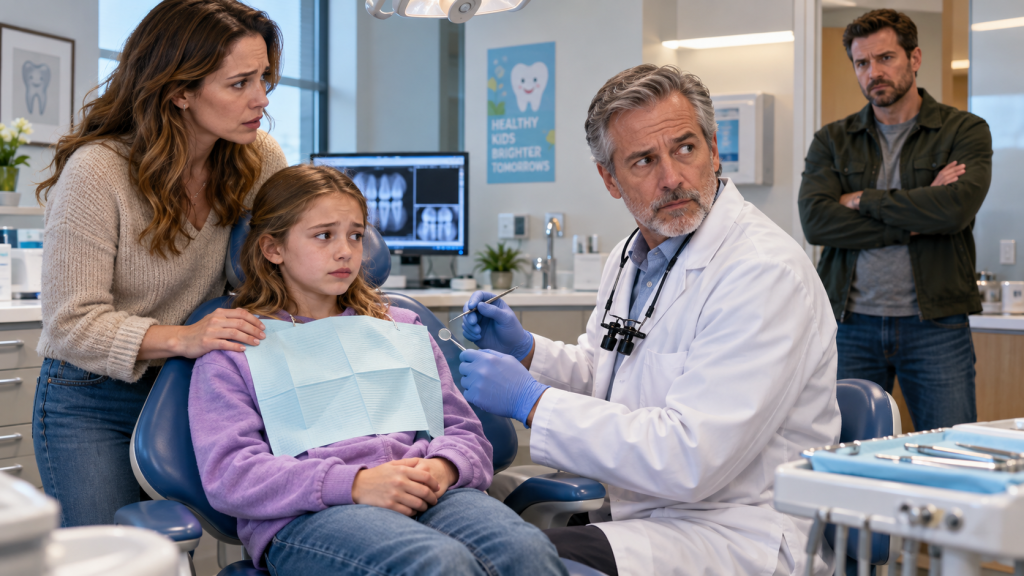
Dr. Evans did not recline the chair until Chloe said okay.
He explained every instrument before using it.
“Mirror.”
“Air.”
“Light.”
“No surprises.”
I sat where she could see me.
Halfway through, she raised her left hand.
Dr. Evans stopped instantly.
No sigh.
No:
Almost done.
Just stopped.
Chloe breathed.
Then said:
“Okay.”
He continued.
That moment taught me more about safety than years of parenting books.
Control returned one tiny decision at a time.
The tooth healed.
Some dental work.
No permanent major damage.
Dr. Evans said we were lucky.
I almost hated the word.
Then remembered.
Lucky does not mean nothing bad happened.
Sometimes it means something worse did not.
I accepted it.
Chloe gave Dr. Evans a card before we left.
He opened it after we were gone.
I know because he called me crying.
The card said:
Thank you for asking when Mark was not in the room.
That was all.
One question.
One private room.
One adult willing to see discomfort as information.
Years moved.
Not smoothly.
There were setbacks.
At eleven, Chloe had nightmares after seeing a man in the grocery store wearing the same cologne Mark used.
At twelve, she became furious with me again.
“You brought him here.”
she shouted during an argument.
“I know.”
“I didn’t ask for him.”
“I know.”
“You wanted a husband.”
“Yes.”
“You should have just stayed alone.”
That one hurt.
I breathed.
“Maybe.”
She froze.
I continued.
“I can’t go backward.”
“I wish I had known what he was.”
“I didn’t.”
“But I understand why part of you wishes I never brought him into our lives.”
She started crying.
“I feel mean.”
“You’re angry.”
“Same thing.”
“No.”
That distinction mattered.
“You can be angry with me.”
“What if I’m always angry?”
“Then we’ll work with always.”
She laughed through tears.
“You sound like Dr. Patel.”
“Expensive woman.”
She hugged me.
Her choice.
At thirteen, she asked about Daniel more.
Her biological father.
What he liked.
How he laughed.
Whether he would have believed her.
That question nearly destroyed me.
“Yes.”
I said.
I hoped I was right.
“What if he didn’t?”
I swallowed.
“Then he would have been wrong.”
Not saints.
Parents.
People.
Chloe deserved a father who would have protected her.
I could not bring him back to prove he would.
I could only refuse to build comfort from fantasy.
At fourteen, Chloe decided to use her father’s last name again socially.
Mark had never adopted her legally, but after our marriage she had sometimes used Carter informally at school events because it made things simpler.
She stopped.
She wanted Daniel’s surname.
I helped with the school paperwork.
No dramatic ceremony.
Just forms.
She looked at her new student ID.
Smiled.
“That’s me.”
Yes.
At fifteen, she joined debate club.
The irony.
My quiet child, who once answered a dentist in whispers while watching Mark’s face, stood in front of classrooms and argued policy.
She was good.
Too good.
Inherited stubbornness from me.
At her first tournament, I sat in the back.
She spoke quickly.
Confident.
Afterward:
“You were amazing.”
I said.
She groaned.
“Mom.”
“What?”
“Everyone’s mom says that.”
“Fine.”
“Your second point was underdeveloped.”
She stared.
“Better.”
Normal.
We became normal in strange increments.
The police station stopped appearing in every memory.
The note stopped living in my purse.
For almost two years, I carried Dr. Evans’s original note in a plastic sleeve.
Why?
I did not know.
Evidence had copies.
The case had records.
I kept the actual piece of paper.
Maybe because it marked the moment the world changed.
One day, Chloe found it while looking for gum.
She read it.
Then asked:
“Why do you still have this?”
I stared.
“I don’t know.”
She held it.
“You think it saved me?”
My chest tightened.
“Yes.”
Chloe shook her head.
“Dr. Evans helped.”
“Yes.”
“But I told him.”
I stared.
She continued.
“I saved me too.”
There it was.
I had been telling the story wrong.
The dentist noticed.
The dentist reported.
The police acted.
I drove.
But before any of us, a ten-year-old child found a private moment and told the truth.
“You did.”
I whispered.
Chloe handed me the note.
“Can we throw it away?”
My instinct screamed no.
Then I understood.
It was her story too.
“Yes.”
We tore it once.
Then again.
Dropped it into the recycling bin.
No fire.
No ceremony.
Just paper.
I thought I would regret it.
I didn’t.
We did not need an artifact to prove we had survived.
Dr. Evans retired when Chloe was sixteen.
His office held a small party.
Chloe insisted we go.
She was taller than me by then.
Hair pulled back.
Braces gone.
She carried an envelope.
Dr. Evans hugged me.
Then asked Chloe:
“Still hate dentists?”
“Yes.”
He laughed.
“Excellent.”
She gave him the envelope.
Inside was a photograph of her at a debate tournament.
On the back she had written:
You were the first adult who asked me a question when the person I was afraid of could not answer for me. I hope retirement is boring.
Dr. Evans cried.
Then claimed allergies.
No one believed him.
Before we left, he said to me:
“I’ve thought about that day many times.”
“Me too.”
“I almost let Mark stay in the room.”
My stomach dropped.
“What?”
“He was insistent.”
“Parents and stepparents usually stay.”
“I had no proof of anything yet.”
“What changed your mind?”
Dr. Evans looked at Chloe across the lobby.
“She looked at him before answering whether the pain woke her at night.”
He paused.
“A child should not need another adult’s face to know whether her own pain is real.”
That sentence stayed with me forever.
At seventeen, Chloe had her first serious relationship.
His name was Aaron.
Nice boy.
I hated him automatically because motherhood is irrational.
He was respectful.
A little awkward.
Good.
One evening Chloe came home angry.
“What happened?”
“Aaron keeps asking where I am.”
My body tightened.
“How?”
“Texts.”
“Like checking in?”
“No.”
“Like ‘send me a picture so I know you’re actually with Mia.’”
My stomach turned.
“What did you say?”
“I told him no.”
“And?”
“He said if I had nothing to hide, I shouldn’t care.”
Old logic.
New mouth.
I kept my face calm.
“What do you think?”
She stared.
“I think I’m done.”
I wanted to cheer.
Did not.
“Do you want help?”
“No.”
“Okay.”
She broke up with him.
He apologized.
She did not go back.
Two days later she texted me from school:
Blue sweater.
My heart stopped.
Then another message:
I’m okay. Just sad.
I replied:
Right here.
Safety does not mean your child never gets hurt.
It means hurt does not require surrender.
At eighteen, Chloe graduated high school.
I sat in the bleachers holding flowers.
Leah beside me.
Dr. Patel somewhere in the crowd because she had become more than a therapist? No. Keep boundaries; therapists don’t attend. Let’s not.
Chloe crossed the stage.
Her name.
Her father’s surname.
Applause.
She found me afterward.
I hugged her after she opened her arms first.
Old habits became respect.
She whispered:
“We made it.”
I corrected her.
“You made it.”
She looked annoyed.
“We.”
I smiled.
“Fine.”
“We.”
She went to college two hours away.
Not too far.
Not because of fear.
Because the program she wanted was there.
Psychology?
No.
That would be too neat.
She studied urban planning.
Loved maps.
Public transit.
Cities.
Perfectly ordinary.
I adored that.
Not every survivor needs to make trauma a career.
She did volunteer once with a campus program teaching consent and healthy relationships.
But mostly she complained about zoning codes and cafeteria coffee.
Good.
The first semester, she called me at midnight.
“Mom.”
“What happened?”
“Nothing.”
I sat up.
“Then why are you calling?”
“I just wanted to hear you.”
My throat tightened.
“Okay.”
Then she talked for forty minutes about a group project.
That was what safety had become.
Calling because nothing happened.
Mark remained out of our lives.
He completed his sentence.
I received official notice before his release because of the case and protection arrangements.
My hands shook when I opened the letter.
Years disappeared.
Bathroom.
Dentist.
Note.
Police station.
I called Chloe.
She was twenty-one.
“Do you want to know?”
“Yes.”
I told her.
Silence.
Then:
“Does anything change?”
“No.”
Our legal protections had been reviewed.
Addresses and contact information secured where appropriate.
She was an adult.
She could decide whether she ever wanted contact.
She said:
“I don’t.”
“Okay.”
“Do you?”
“No.”
Also true.
Mark wrote one letter through proper channels years later.
To me.
Not Chloe.
I consulted my attorney and therapist before reading it.
He apologized.
No excuses at first.
Then some explanations crept in.
Stress.
Stepparenting.
His own childhood.
Anger.
I stopped.
People can change.
I hope he did.
But change does not create a claim on the people you harmed.
I never responded.
Chloe asked eventually:
“What did he say?”
“Sorry.”
“Do you believe him?”
“I believe he may regret it.”
“That’s not what I asked.”
She smiled.
My child.
I thought.
“I don’t know whether he became safe.”
“And I don’t need to find out.”
She nodded.
“Good.”
That was closure.
Not reconciliation.
The years changed me too.
I did not marry again for a long time.
Not because all men frightened me.
Because I did not trust my own judgment.
Therapy was brutal about that.
Dr. Patel said:
“You are treating your past mistake as proof you are permanently incapable of choosing.”
“Maybe I am.”
“No.”
“How do you know?”
“I don’t.”
She smiled.
Annoying woman.
“The goal is not perfect judgment.”
“It is paying attention to information and responding when reality changes.”
That was different.
Years later, I dated a man named Thomas.
Widowed.
Teacher.
Patient.
The first time Chloe met him, she was twenty-three.
I told her beforehand:
“You don’t have to like him.”
She laughed.
“Growth.”
“Be quiet.”
Thomas never tried to become her father.
Good.
Never asked.
Better.
He asked her about urban planning.
She talked for an hour.
Poor man.
Afterward Chloe said:
“He’s boring.”
My heart sank.
Then she smiled.
“I like boring.”
So did I.
Thomas and I married quietly two years later.
Courthouse.
Dinner.
No promises that everyone would be safe forever.
No one can promise that.
But I knew things now.
I knew love should survive questions.
Privacy.
No.
Locked doors.
Separate bank accounts if desired.
Changing your mind.
A child not wanting a hug.
A spouse not wanting to share a password.
Healthy people do not need total access to prove closeness.
Thomas understood.
One evening, years into our marriage, he knocked on the bathroom door.
“Rachel?”
I froze.
Memory.
Then:
“You left your tea in the microwave.”
I started laughing.
He opened nothing.
Waited.
“Why are you laughing?”
“Long story.”
“Okay.”
He walked away.
No demand.
No suspicion.
That small moment made me cry.
Chloe eventually married too.
Not Aaron.
Thank God.
A woman named Maya.
They met at graduate school.
Maya was an attorney specializing in municipal work.
Chloe joked that she married her because zoning meetings required legal interpretation.
At their wedding, I sat in the front row.
When Chloe read her vows, my mind betrayed me.
Dentist chair.
Ten years old.
Soft voice.
Watching Mark.
Then the present returned.
Twenty-eight.
Standing.
Speaking.
No one answering for her.
Maya said:
“I choose you.”
Chloe smiled.
Then said:
“And I choose me too.”
The guests laughed.
I cried.
Because she had learned the sentence neither of us knew when she was ten.
Love that requires you to disappear is not love made safer by endurance.
After the ceremony, Chloe found me.
“You okay?”
“No.”
She laughed.
“Mom.”
“I’m old.”
“You’re fifty—”
“Do not finish that sentence.”
She hugged me.
Then whispered:
“Thank you for leaving.”
I closed my eyes.
“You told me to.”
“No.”
She pulled back.
“I told Dr. Evans.”
“You left.”
Different actions.
Both required.
I nodded.
“Thank you for telling.”
She smiled.
“I was really scared.”
“I know.”
Then:
“I thought you’d pick him.”
The old wound.
“I know.”
“But you didn’t.”
Not eventually.
Not after I knew.
That distinction became enough.
I said:
“I wish you never had to wonder.”
She squeezed my hands.
“Me too.”
No forced forgiveness.
Truth.
Then Maya called her for photographs.
Chloe ran off.
I watched.
My daughter.
Not the child in the dentist chair.
Not the victim in a file.
A woman late for wedding pictures because she was arguing with the photographer about lighting.
Perfect.
Years later, after Dr. Evans died, his daughter contacted me.
She had found a box of letters patients sent him.
One was Chloe’s retirement note.
She asked whether Chloe wanted it returned.
Chloe said no.
“Keep it with him.”
His daughter cried.
Then told us something.
After Chloe’s case, Dr. Evans changed his practice procedures.
Older children were given at least a brief private opportunity to answer sensitive questions without parents or guardians in the room when appropriate.
Staff received additional training on signs of family violence.
Not because every bruise meant abuse.
Because private questions create room for truth.
Other dentists adopted similar practices after he spoke at local professional meetings.
Chloe went quiet when she heard.
“You okay?”
I asked.
She nodded.
“Something good came from it.”
I was careful.
“Yes.”
Then:
“But nothing good had to come from it for what happened to matter.”
She looked at me.
“Dr. Patel?”
“Very expensive woman.”
Chloe laughed.
That distinction mattered too.
We do survivors harm when we require suffering to produce wisdom before we allow their pain meaning.
Chloe did not owe the world advocacy.
Dr. Evans chose to learn from what he saw.
Good.
Separate.
When I became a grandmother, everything returned once more.
Chloe and Maya adopted a little boy named Eli.
Four years old.
Curly hair.
Suspicious of vegetables.
The first time he stayed overnight with me, Chloe handed me a page.
Allergies.
Bedtime.
Emergency numbers.
Comfort toy.
People allowed to pick him up.
I smiled.
“What?”
she asked.
“Nothing.”
She narrowed her eyes.
Then understood.
Emergency contacts.
Once, Mark had occupied the place adults assumed meant safety.
Now Chloe treated access as something specific.
Chosen.
Documented.
She said:
“We don’t do automatic.”
I nodded.
“Good.”
Eli woke at two in the morning.
Nightmare.
I stood outside his door.
Knocked.
“Eli?”
He cried.
“Can I come in?”
“Yes.”
I entered.
Sat beside the bed.
Did not touch him until he reached.
The next morning, he complained my pancakes were shaped wrong.
Normal.
Glorious.
I thought often about the original toothache.
Such a small sentence.
“Mom, this one hurts when I chew.”
What if I had delayed the appointment?
A week?
A month?
What if Dr. Evans had let Mark stay?
What if Chloe had lost courage?
Those questions can consume a life.
I stopped feeding them.
Not because the possibilities were harmless.
Because the actual story deserved more space than imagined tragedies.
Chloe told.
Dr. Evans listened.
I read.
We left.
Police responded.
Professionals documented.
Mark faced consequences.
Chloe grew.
That was the story.
One afternoon, when Chloe was in her thirties, she called.
“Mom.”
“Yes?”
“I need a dentist recommendation for Eli.”
I laughed.
“What?”
“You have weirdly strong opinions.”
“I do.”
“He hates dentists.”
“Genetic.”
“Not how genetics works.”
“I raised an urban planner, not a biologist.”
She laughed.
Then:
“What should I look for?”
I thought about Dr. Evans.
Not fancy equipment.
Not polished lobby.
Not peppermint smell.
“A dentist who talks to him.”
I said.
“Not around him.”
“And someone who doesn’t act annoyed when he’s nervous.”
“Anything else?”
“Yes.”
“Someone who knows a child’s mouth belongs to the child.”
Silence.
Then Chloe said:
“Yeah.”
That was enough.
If I could return to the woman I was in that bathroom—the note trembling between my hands, my entire marriage turning unfamiliar around me—I would not tell her to stop shaking.
She had every reason to shake.
I would not tell her she was a terrible mother.
That would center punishment instead of action.
I would not tell her everything would be fine.
Some things would not.
Her marriage would end.
Her daughter would have nightmares.
Court would be ugly.
Trust would take years.
I would tell her something simpler:
Read the note.
Believe the child.
Leave before you need every answer.
You can understand later.
Safety first.
Explanation later.
And I would tell her that one day the locked bathroom door would no longer mean fear.
It would mean privacy.
One day a man knocking would not make either of us freeze.
One day Chloe would sit in a dentist chair, raise her hand, and watch the doctor stop because she asked him to.
One day she would stand at her own wedding and speak loudly enough for every person in the room to hear.
One day she would become a mother and write emergency contacts not because she expected danger everywhere, but because she understood that love is clearer when access is chosen instead of assumed.
One day she would call me because nothing was wrong.
That may have been the greatest miracle.
Nothing wrong.
No secret message.
No code.
No police.
Just:
“Mom, what are you doing?”
And I could answer:
“Making dinner.”
Ordinary.
Safe.
Home.
For years, I believed Dr. Evans’s folded note was the thing that saved my daughter.
It was important.
I will always be grateful.
But I know better now.
The note did not create the truth.
It only carried it from one adult to another.
The brave act had happened minutes earlier beneath a bright dental light when a frightened ten-year-old realized Mark was outside the room, looked at a doctor she trusted, and finally said what had been happening.
She was the first person in the story who refused to keep Mark’s secret.
Everything afterward began there.
So when people ask me how I knew to leave, I tell them the truth.
I didn’t know enough.
My daughter did.
And when she finally found a safe moment to tell someone, my job was not to investigate her, challenge her, protect my marriage, demand perfect details, or ask why she had waited.
My job was to believe that her fear was information.
Then move.
I moved.
Not soon enough to prevent what happened.
Soon enough to stop pretending nothing had.
That difference built the rest of our lives.
And the tooth?
Years later, Chloe once joked that it was the most important molar in Illinois.
I laughed.
Dr. Evans would have hated that.
But maybe she was right.
Pain had forced open a door fear kept shut.
Behind it was the truth.
And once the truth came through, I never closed that door again.
THE END STORIES! THANK YOU FOR READING GOOD LUCK !❤️
Related Posts