➡️ PART 3 ENDING PART➡️
Ethan’s finger was still pointed toward the front hallway.
For a second, I thought he meant the backpack.
Then I realized he was pointing above it.
At the photograph on the narrow table beside the door.
Daniel and I had taken it thirteen years earlier at his cousin’s wedding.
I was wearing a blue dress.
Daniel was laughing at something outside the frame.
And standing beside him, one hand resting on Daniel’s shoulder, was a man I had not seen in almost four years.
My husband’s older brother.
Caleb.
My stomach dropped so violently I had to grab the back of a chair.
“That man?”
I whispered.
Ethan nodded.
“The man from school.”
One of the officers crossed the room immediately.
He lifted the framed photograph without touching the glass more than necessary and turned it toward Ethan.
“This man?”
Ethan’s face tightened.
“Yes.”
“Are you sure?”
“He looks older now.”
My son swallowed.
“And his hair is shorter.”
Then he pointed again.
“But that’s him.”
The detective beside us turned toward me.
“Who is he?”
“My husband’s brother.”
The words felt strange in my mouth.
“Caleb Bennett.”
“Your son’s uncle?”
“Technically.”
I looked at Ethan.
“I don’t think Ethan remembers meeting him.”
Ethan shook his head.
“I don’t.”
Then, quietly:
“He never told me he was my uncle.”
Every officer in my living room seemed to become still at once.
The detective asked:
“What did he call himself?”
“Mr. Cole.”
My knees nearly failed.
Caleb’s middle name was Cole.
He had not even invented something new.
He had simply removed enough truth to make the lie easier.
The officer holding the photograph asked me:
“When was the last time you saw Caleb Bennett?”
“At Daniel’s funeral.”
Three years earlier.
I remembered him standing near the back of the church in a black suit that did not quite fit.
He had hugged me too long.
He had knelt in front of six-year-old Ethan and said:
“You’re all I have left of him.”
At the time, grief had made the sentence sound heartbreaking.
Now it sounded like ownership.
I closed my eyes.
“Before that?”
the detective asked.
I thought.
“Not much.”
“Daniel and Caleb had a difficult relationship.”
“What kind of difficult?”
“I don’t know everything.”
That embarrassed me.
My husband had been dead three years, and suddenly I was realizing how many parts of his family history I had allowed him to keep private because marriage had taught me that privacy and secrecy were not always the same thing.
Daniel had said Caleb was “complicated.”
That was the word.
Complicated.
Caleb borrowed money.
Ignored boundaries.
Showed up uninvited.
Called seventeen times if Daniel did not answer.
Once, years before Ethan was born, Daniel changed his phone number because Caleb would not stop contacting him during an argument over their mother’s estate.
But I had never heard the word dangerous.
I told the detective that.
He listened without reacting.
“Did Caleb ever threaten Daniel?”
“Not that I know.”
“You?”
“No.”
“Ethan?”
“Never.”
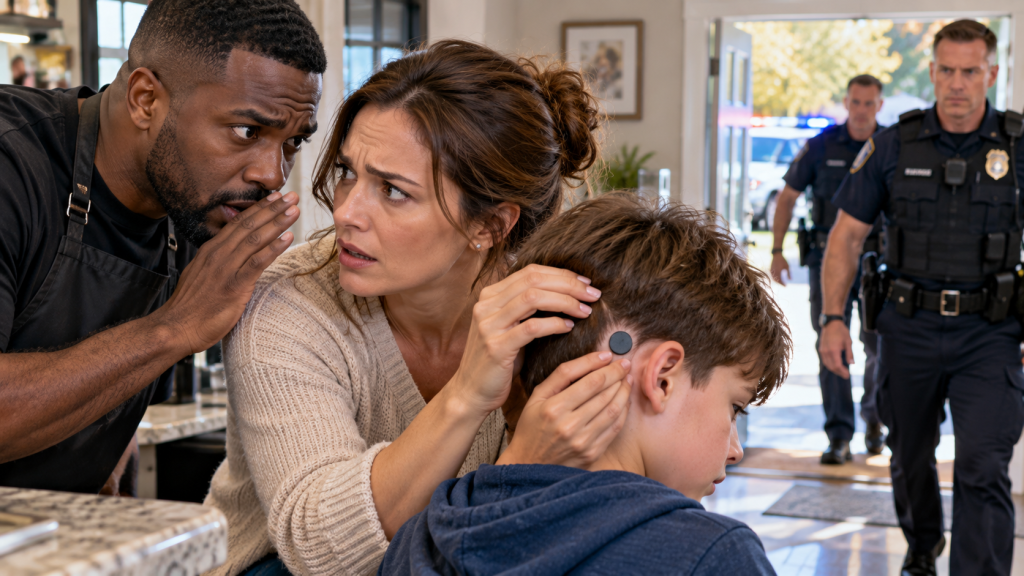
At least, not before I discovered a piece of black plastic glued behind my son’s ear.
The officer who had run back inside from the patrol car returned with another man wearing gloves and carrying a hard equipment case.
He introduced himself as a digital-forensics technician attached to the department.
He did not touch Ethan.
He looked at the device from several angles.
Then he examined the matching object clipped beneath the soccer keychain.
Finally, he looked at the box officers had found beneath the porch bench.
“I don’t want to speculate before we examine everything properly.”
he said.
“But these appear consistent with commercially available tracking and monitoring equipment that has been modified or concealed.”
I stared.
“Modified how?”
He held up one hand.
“I don’t want to guess.”
That answer frightened me more than a dramatic one would have.
The detective asked:
“Could the device behind Ethan’s ear transmit sound?”
“Possibly.”
My skin went cold.
“Could somebody be listening right now?”
The technician looked toward Ethan.
“We’re going to isolate the device safely and preserve it.”
Then he looked at me.
“Until we know what it is, assume whoever placed it wanted more than decoration.”
I turned toward my son.
His eyes were huge.
“Mom?”
I knelt.
“I’m right here.”
“Did he hear us?”
“I don’t know.”
“Did he hear me at school?”
“I don’t know.”
“Did he hear me talking to Dad?”
That one confused me.
“What?”
Ethan looked embarrassed.
“Sometimes I talk to Dad.”
My heart broke.
“Oh, honey.”
“When I’m in bed.”
He looked toward the hallway.
“Did the man hear that?”
I wanted to lie.
No.
Of course not.
Impossible.
Instead I said:
“I don’t know.”
Then I put both hands around his.
“But whatever you said to Dad still belongs to you.”
He did not look convinced.
Neither was I.
The detective crouched several feet away from us.
Not too close.
“Ethan, I’m Detective Morales.”
He showed his badge.
“I’m going to ask you a few questions, but if you need a break, you tell me.”
Ethan nodded.
“Did the man you called Mr. Cole ever come inside your house?”
“No.”
“Did he ever ask to?”
“No.”
“Did he give you anything besides the keychain?”
Ethan hesitated.
I felt it immediately.
“Ethan.”
Detective Morales raised a hand toward me gently.
“Let him answer.”
I closed my mouth.
My son looked down.
“He gave me twenty dollars once.”
My chest tightened.
“For what?”
Morales asked.
“He said Dad used to give him lunch money when they were kids.”
“Anything else?”
“A baseball card.”
“What kind?”
“Ken Griffey Jr.”
Daniel’s favorite player.
Of course.
Caleb knew exactly which memories would sound like proof.
“Did he ask you to keep these meetings secret?”
Ethan’s shoulders rose.
“He said Mom would be sad.”
I closed my eyes.
The detective continued.
“Did he tell you why?”
“He said Mom didn’t like talking about Dad’s family because it hurt too much.”
That was almost clever.
Not evil-genius clever.
Worse.
Human clever.
Built from truths.
I had avoided Daniel’s family after the funeral.
Not because they were dangerous.
Because every Christmas with them contained Daniel’s empty chair.
Every phone call with his mother ended in tears.
I had slowly let the connections fade.
Caleb had taken my grief and turned it into an explanation Ethan could believe.
“What did he tell you about your dad?”
Detective Morales asked.
Ethan looked toward me.
“Can I say?”
I almost broke.
“Of course.”
“He knew the thunderstorm song.”
The room went silent.
Daniel had sung the same ridiculous song whenever Ethan was scared of storms.
Not a real song.
Something Daniel made up when Ethan was two.
Thunder makes noise, lightning makes light, Dad checks the windows and everything’s right.
I had not heard anyone else sing it.
I whispered:
“How did Caleb know that?”
Then answered myself.
Daniel must have told him.
Maybe years ago.
Maybe while laughing about fatherhood.
Maybe Caleb had been present once.
There were a thousand innocent ways he could have known.
Now none felt innocent.
Ethan continued.
“He knew Dad called me Peanut.”
My eyes filled.
“And he knew about the red tent.”
The red tent.
Daniel took Ethan camping once when he was five.
It rained all night.
The tent leaked.
They came home covered in mud and laughing.
I had that photograph in a box upstairs.
Caleb had been with them that weekend.
I suddenly remembered.
Not camping.
He had dropped by the site for dinner.
He knew.
Every story.
Every detail.
Every piece of my husband he had handed Ethan had contained enough truth to make the manipulation feel sacred.
Detective Morales asked:
“What did he say the thing behind your ear was?”
Ethan started crying.
“He called it a safety button.”
I felt sick.
“He said Dad asked him to make sure I was okay.”
I moved closer.
The detective remained calm.
“How did he put it there?”
Ethan touched his shoulder instead of his ear.
“He said he wanted to show me a magic trick.”
My stomach rolled.
“He had a little patch.”
“He said it was like the things athletes wear.”
“He said not to touch it because it needed to stay there until Monday.”
“Where were you?”
“By the soccer field.”
“When?”
“Yesterday.”
Yesterday.
My son had slept in my house with a device attached to his body.
I had kissed his forehead.
Made pancakes.
Helped him look for a missing shin guard.
Never saw it.
Guilt rose fast.
Detective Morales must have seen my expression.
He said:
“Mrs. Bennett.”
I looked up.
“You were not expected to inspect behind your nine-year-old’s ears for surveillance equipment.”
That sentence stopped the guilt from swallowing the room.
Not all of it.
Enough.
The officers removed the object from Ethan with help from paramedics who had arrived to make sure there was no injury to the skin.
It left a small pink rectangle.
Nothing else.
Such a tiny mark for something that had made the walls of my home feel transparent.
Police asked Ethan and me not to remain at the house that night.
Not because they believed someone was definitely coming.
Because they did not yet know how much Caleb could see or hear.
We packed almost nothing.
Medication.
Chargers.
Ethan’s school backpack was left behind as evidence.
He cried about that.
Not because of the backpack.
Because Daniel had written Ethan’s name inside it with permanent marker the year before he died.
I promised we would get it back.
Police could not promise when.
We went to my sister Claire’s house.
Ethan slept in her guest room.
I did not sleep.
At 2:11 in the morning, every ordinary house noise became a person outside.
Ice maker.
Air conditioner.
Tree branch.
Car passing.
I sat beside the window with the curtain closed and hated myself for wanting to look through it.
At 2:43, Detective Morales called.
My heart stopped when I saw the number.
“We identified Caleb Bennett.”
he said.
“Okay.”
“We’ve confirmed current address and vehicle information.”
“Where is he?”
“I can’t give you every operational detail while this is active.”
I understood.
Then he added:
“We also pulled preliminary school security footage.”
My hand tightened around the phone.
“He was there?”
“Multiple times.”
“How many?”
“At least four occasions in the past six weeks.”
My stomach dropped.
“Four?”
“He approached Ethan outside the main building but not inside.”
“How did nobody stop him?”
“From what we can see, the contacts were brief.”
“He did not attempt to sign Ethan out.”
“He stayed in public areas near dismissal.”
That should have comforted me.
It did not.
“How long has he been watching us?”
“We’re working on that.”
Then:
“Mrs. Bennett, has Caleb ever owned a gray Toyota SUV?”
I stood.
“I don’t know.”
“Why?”
“We have video of a gray SUV passing your street repeatedly over the last several weeks.”
The room went cold.
Ethan’s voice came from the guest room doorway.
“Mom?”
I turned.
He was standing there in pajamas.
Listening.
I ended the call quickly after agreeing to speak again in the morning.
Ethan looked at me.
“Is he outside?”
“No.”
“Do you know that?”
I opened my mouth.
Then closed it.
“Police know where we are.”
I said.
“And Aunt Claire has cameras.”
Not enough.
I walked to him.
“Do you want me to sleep in your room?”
He nodded.
So I did.
I lay on top of the covers.
Ethan curled beneath them.
For twenty minutes, neither of us spoke.
Then he whispered:
“Was he really Dad’s brother?”
“Yes.”
“So Dad knew him.”
“Yes.”
“Did Dad tell him to watch me?”
My throat tightened.
“No.”
“You don’t know.”
There it was.
The cruelest part.
Caleb had found the one dead person I could not call to disprove him.
“I know your father would never ask someone to hide something on your body.”
Ethan stared at the ceiling.
“What if he just wanted me safe?”
“Your dad would have told me.”
“How do you know?”
Because Daniel and I had not been perfect.
Because married people keep stupid things from each other.
Bills.
Worries.
Family arguments.
Surprise gifts.
But our son’s safety?
I believed that.
Still, belief was not evidence.
“I know the kind of father he was.”
I said.
Ethan turned toward me.
“But Mr. Cole knows things about him too.”
That sentence shattered me.
My son was right.
Caleb had not invented Daniel.
He had known him.
Loved him, maybe.
Fought with him.
Shared childhood bedrooms and Christmases and jokes.
Possession of true memories does not make every use of them truthful.
I said:
“Knowing someone’s stories does not mean you speak for them.”
Ethan was quiet.
Then:
“I liked talking to him.”
Oh.
I had been waiting for fear.
Not grief.
“You did?”
“He talked about Dad.”
I closed my eyes.
Of course he did.
I had tried so hard not to make Ethan sad that I had stopped talking about Daniel unless Ethan asked first.
I thought I was protecting him.
Maybe I had left an empty place.
Caleb filled it.
“He told me Dad used to steal Grandma’s cookies.”
I laughed softly despite myself.
“That’s true.”
“He said Dad once broke his arm jumping off a shed.”
“Also true.”
“He said Dad wanted a motorcycle when he was sixteen.”
“Very true.”
Ethan’s eyes filled.
“I wanted to know stuff.”
“I know.”
“You always cry.”
There it was.
Not accusation.
Observation.
I turned away for a second.
After Daniel died, I had promised myself I would never make Ethan feel responsible for my grief.
Apparently, children notice what adults think they hide.
“I’m sorry.”
I whispered.
“For what?”
“For making Dad feel like a subject you had to protect me from.”
Ethan started crying.
“I thought if I asked too much, you’d get sad.”
I reached toward him.
Stopped.
“Can I hug you?”
He nodded.
I held him.
“You can ask me anything.”
I said.
“You can talk about him.”
“You can miss him.”
“You can be angry at him for dying.”
“You can laugh about him.”
“You can ask questions I don’t know how to answer.”
Tears soaked my shirt.
“But Caleb doesn’t get to use Dad’s memory to make secrets between us.”
Ethan nodded against me.
That became the first thing we rebuilt.
Not locks.
Not cameras.
Conversation.
The next morning, detectives interviewed Marcus at the barbershop.
I went later only because I needed to thank him.
Police had already taken his statement.
Marcus looked uncomfortable when he saw me.
“Is Ethan okay?”
“He is.”
I swallowed.
“Because of you.”
He shook his head immediately.
“No.”
“Yes.”
“I just saw something weird.”
“You said something.”
Marcus looked toward the floor.
“I almost didn’t.”
That surprised me.
“Why?”
“I thought maybe it was medical.”
“Or one of those little monitors kids use.”
“I didn’t want to embarrass him.”
“What changed your mind?”
Marcus rubbed the back of his neck.
“He flinched when I touched the hair near it.”
My stomach tightened.
“Not from pain exactly.”
“Like he was worried I’d find it.”
Marcus looked at me.
“Kids don’t usually protect something behind their ear unless somebody told them to.”
So he finished the haircut.
Waited until Ethan walked toward the candy machine.
Then whispered to me.
Check behind his ear.
Small sentence.
Entire life divided around it.
I cried.
Marcus looked horrified.
“Ma’am—”
I laughed through tears.
“I’m sorry.”
“No, no.”
He handed me a clean towel from the counter.
I used it like a tissue.
Elegant.
“Thank you.”
I said again.
He nodded.
That was all he would accept.
Detectives found Caleb that afternoon.
Not at my house.
Not at the school.
In the parking lot of a motel less than two miles from us.
He did not resist arrest.
That fact later bothered me.
Part of me had wanted a chase.
Something that made him look as dangerous on the outside as he felt inside my home.
Instead, according to Detective Morales, Caleb simply asked:
“Is Ethan okay?”
As though he were the concerned one.
As though surveillance were care.
Police obtained warrants for his motel room, vehicle, electronic accounts, and later a storage unit associated with him.
What they found became the reason the case went far beyond an inappropriate uncle talking to a child.
Photographs of Ethan.
School schedules.
Soccer schedules.
Copies of public records.
Old family photographs.
Notes about my routine.
My sister’s address.
The barbershop.
A list of license plates belonging to people who regularly visited my home.
There was also a packed child-sized overnight bag.
Two T-shirts.
Socks.
Toothbrush.
Baseball cap.
No one could prove exactly what Caleb intended to do with it.
The prosecution never claimed more than the evidence could support.
But when Detective Morales told me about that bag, I went into my sister’s bathroom and threw up.
Caleb insisted he had no intention of abducting Ethan.
He said the bag was for “emergencies.”
He said the tracking devices were meant to protect his nephew.
He claimed Daniel had once told him:
“If anything ever happens to me, look out for the kid.”
Maybe Daniel had.
Brothers say things.
That sentence would not have authorized any of this.
Caleb said I had isolated Ethan from Daniel’s family.
There was truth inside that accusation.
That made it more painful.
I had withdrawn.
I stopped taking Ethan to see Daniel’s mother after she moved to assisted living three states away.
Phone calls became rare.
Holiday cards became inconsistent.
Caleb used every imperfection in my grief as justification.
That did not turn surveillance into care.
Detective Morales said something I wrote down later:
“People who violate boundaries often point to a real unmet need and pretend that gives them authority to meet it however they want.”
That was Caleb.
Ethan missed his father.
Real.
I avoided some conversations.
Real.
Caleb knew family stories.
Real.
None of those facts gave him the right to attach a device to my child.
The digital examination of the seized equipment took months.
I will not pretend I understood the technology.
I learned only what the case required.
The device hidden behind Ethan’s ear was capable of transmitting location information and limited nearby audio under certain conditions.
The keychain device primarily recorded location.
The equipment discovered near the porch had been used to monitor activity around the entrance and interfere with the privacy of the property.
Investigators also found that Caleb had accessed unsecured information from ordinary sources—public posts, sports schedules, community newsletters—and combined it into something far more invasive.
That scared me in a new way.
I had spent years posting harmless photographs.
First day of school.
Soccer jersey.
Birthday cake.
Nothing secret.
Individually, they were nothing.
Together, they had helped a determined person map my child’s life.
I deleted nearly everything.
Then, after several weeks, Ethan’s counselor stopped me.
“Do not teach yourself that visibility caused the abuse.”
I stared at her.
“It helped him.”
“Maybe.”
She nodded.
“But Caleb chose to misuse information.”
“You are allowed to learn better privacy habits without deciding your normal life invited surveillance.”
That distinction mattered.
I made changes.
School permissions.
Privacy settings.
Emergency contacts.
Pickup procedures.
But I refused to teach Ethan that the world was safe only if he became invisible.
The hardest evidence came from Daniel.
Not literally.
He was gone.
But after detectives asked whether I had any old communication involving Caleb, I searched boxes I had not opened since the funeral.
One was labeled:
DANIEL — OFFICE / KEEP
I sat on my bedroom floor at my sister’s house.
Inside were tax records.
Warranty papers.
Old birthday cards.
A watch.
Then a printed email from seven years earlier.
From Daniel to Caleb.
Subject:
Enough.
My hands shook before I even read it.
Caleb, I love you, but you do not get to make decisions for my family. Stop showing up without calling. Stop asking Ethan’s daycare for information. Stop telling Mom that Laura is keeping me from you. She isn’t. I am asking for space. Do not contact Ethan directly without coming through us. If you ignore this again, I will take further steps.
I stopped.
Seven years earlier.
Ethan had been two.
I had forgotten.
No.
Worse.
I had never known the full story.
I remembered a period when Daniel and Caleb stopped speaking.
Daniel told me:
“Family drama.”
I did not press.
The email continued.
You keep calling this protection. Protection requires permission when the person you’re protecting is not in immediate danger. What you are doing is control.
I covered my mouth.
Daniel had written it.
Years before his death.
As if he had somehow left an answer for Ethan without knowing he would need one.
I brought the email to Detective Morales.
They already had related messages from Caleb’s accounts.
Daniel had warned him repeatedly.
The contact stopped for years.
Then Daniel died.
And eventually Caleb returned.
Not to me.
To Ethan.
I showed the email to my son only after his therapist said he was ready.
He was ten by then.
Almost a year had passed.
He read slowly.
Then reached the line:
Do not contact Ethan directly without coming through us.
He stopped.
“Dad wrote this?”
“Yes.”
“Before he died?”
“Years before.”
“So he didn’t ask Uncle Caleb to watch me.”
“No.”
Ethan read the paragraph again.
His face crumpled.
I thought he would be relieved.
Instead, he cried.
“What?”
I asked.
“He lied.”
Of course.
I had been thinking like an adult.
Proof.
Vindication.
Case.
Ethan had lost something else.
A relationship he believed connected him to his father.
Caleb had made him feel chosen.
Trusted.
Close to Daniel.
Now my son had to grieve that too.
“I liked him.”
he said.
“I know.”
“That was stupid.”
“No.”
I moved closer.
“He knew what you needed.”
“That doesn’t make you stupid.”
“I kept secrets.”
“Yes.”
He looked at me.
I did not tell him it was fine.
Because it wasn’t.
We needed a better lesson than:
Never keep secrets.
Children keep birthday surprises.
Private thoughts.
Embarrassing questions.
Good privacy exists.
So I said:
“If an adult asks you to keep a secret because telling me would make me angry at the adult, that is a warning.”
Ethan listened.
“If someone says you have to hide something on your body from me, that is a warning.”
He nodded.
“If someone says love means you owe them secrecy, that is a warning.”
More tears.
“But liking somebody who manipulated you is not your fault.”
That one he needed.
So did I.
Caleb’s case did not resolve quickly.
There were hearings.
Challenges to evidence.
Arguments over what certain devices proved.
Arguments about intent.
His attorney said he was a grieving uncle whose behavior became obsessive but not predatory.
The prosecutor said grief did not authorize stalking a child.
The final charges reflected stalking, unlawful tracking and surveillance conduct, interference with privacy, and offenses connected to his covert contact with a minor.
I am deliberately not turning court into a revenge scene.
There was no moment when a judge shouted.
No dramatic jury gasp.
No one threw the maximum sentence at him because I cried beautifully.
The legal process was slower.
Colder.
Better for that.
Caleb eventually entered a plea to multiple charges supported by the evidence.
The court imposed a prison sentence followed by supervision and a long-term no-contact order protecting Ethan and me.
Before sentencing, Caleb asked to speak.
I attended.
Ethan did not.
His choice.
Caleb stood.
He looked older than in the photograph by my door.
Smaller too.
Not because prison magically shrinks people.
Because fear had enlarged him in my mind.
He said:
“I loved my brother.”
I believed that.
“I loved my nephew.”
I believed that too.
Then:
“I thought Laura was cutting Ethan off from Daniel.”
Partly true.
“I thought someone needed to make sure Daniel wasn’t erased.”
That sentence hurt.
Because there had been mornings when I could not say Daniel’s name without losing the day.
I had put photographs away.
Stopped playing his favorite music.
Once, when Ethan asked me to tell the camping story again, I said:
“Not tonight.”
I had been surviving.
Caleb continued.
“I convinced myself that because my reason was love, my methods could not be wrong.”
There.
That was the first honest thing he said that mattered to me.
He looked toward where I sat.
“I was wrong.”
I did not forgive him.
Not then.
Maybe never.
He continued.
“I used my brother’s memory to make a child trust me.”
His voice broke.
“I told myself I was preserving Daniel.”
“But Daniel had already told me to stop years ago.”
My throat tightened.
“I knew what he wanted.”
“I ignored it because I decided my grief mattered more.”
The judge listened.
Then imposed sentence.
I walked outside.
No victory.
Just sunlight.
People expect justice to feel like fireworks.
Sometimes it feels like leaving a courthouse and realizing you still have to make dinner.
Ethan wanted grilled cheese.
So I made grilled cheese.
That became our life.
Ordinary things laid over extraordinary fear.
We moved.
That surprised people.
“Don’t let Caleb chase you from your home.”
They said.
He didn’t.
I chose to leave.
The house no longer felt like a home.
Every corner held a question.
Had he seen this?
Heard that?
Watched from there?
Ethan avoided the front porch entirely.
So we sold it.
Bought a smaller house twelve minutes away.
I did not post the address.
Not because secrecy became our religion.
Because privacy became something we practiced intentionally.
The new house had a maple tree in front.
Ethan picked the bedroom facing the backyard.
We changed schools because the district boundary changed.
That worried me.
He surprised me.
On the first morning, he said:
“Can I tell my teacher about Dad?”
“Of course.”
That was new.
We had begun talking about Daniel again.
Not constantly.
Freely.
I put photographs back on the walls.
Not all at once.
One in the hallway.
One near the bookshelf.
The red-tent photograph in Ethan’s room.
I asked first.
His room.
His choice.
We made a rule.
Daniel was not a shrine.
He was family.
That meant he could be funny.
Annoying.
Wrong.
Loved.
Ethan asked questions I had avoided for years.
“Did Dad swear?”
“Yes.”
“How much?”
“Too much.”
“Did he ever get grounded?”
“Constantly.”
“Did he like school?”
“Absolutely not.”
“Did he ever lie?”
“Yes.”
Ethan looked shocked.
“About what?”
I smiled.
“When we were dating, he told me he loved jazz.”
“He hated jazz.”
“Why’d he lie?”
“To impress me.”
“Did it work?”
“No.”
“Then why’d you marry him?”
“People are complicated.”
There it was.
Not every lie meant Caleb.
Not every secret meant danger.
We had to rebuild nuance.
Daniel’s mother, Margaret, helped.
I called her after almost two years of inconsistent contact.
She answered and cried when she heard Ethan’s voice.
Then I cried.
Then Ethan rolled his eyes because adults were exhausting.
Margaret told stories about Daniel’s childhood.
Different stories from Caleb’s.
Not because hers were more legitimate.
Because memory is not property.
The thunderstorm song had come from their father.
Daniel had changed the words.
The cookie story was true.
The broken arm was true.
The motorcycle dream was true.
Caleb had not invented Daniel.
He had stolen authority over him.
That distinction helped Ethan.
Eventually, he learned he could keep the stories and reject the manipulation.
At eleven, he said:
“I still like the baseball card Caleb gave me.”
I froze.
The Ken Griffey Jr. card had been returned with other property after the case ended.
It sat in a drawer.
“What do you want to do with it?”
“I don’t know.”
“You can keep it.”
“Is that weird?”
“No.”
“Even though he gave it to me?”
I thought.
“The card didn’t track you.”
Ethan laughed.
Good.
He put it in his album.
That was healing.
Not destroying every object touched by harm.
Choosing which objects still belonged to him.
Marcus remained our barber.
Of course.
After we moved, driving to the old neighborhood took forty minutes.
I did it anyway.
The first haircut back, Ethan sat in Marcus’s chair.
Quiet.
Marcus asked:
“You want the usual?”
Ethan nodded.
Marcus worked carefully.
When he reached the left ear, the clippers stopped for half a second.
I saw it.
So did Ethan.
Their eyes met in the mirror.
Marcus said:
“You good?”
Ethan took a breath.
“Yeah.”
“Want me to keep going?”
“Yes.”
That question mattered.
Not:
Don’t worry.
Not:
It’s fine.
Want me to keep going?
Choice.
Marcus finished.
At the register, Ethan handed him an envelope.
Marcus frowned.
“What’s this?”
“A card.”
“You don’t have to—”
“Open it later.”
Marcus did.
He called me that evening.
His voice sounded strange.
The card said:
Thank you for noticing something I didn’t know how to tell anyone about.
Marcus cried.
Then got embarrassed about crying.
I let him.
Years passed.
The no-contact order remained.
Caleb did not appear again.
That should have ended the fear.
It didn’t.
Not immediately.
A gray SUV could still make my chest tighten.
A stranger saying Ethan’s name in public made me alert.
At soccer games, I scanned the fence more than the field.
My therapist eventually said:
“You are protecting Ethan from a man who is not currently present so intensely that you are teaching your body he is always present.”
I hated her.
She was right.
We worked on it.
I learned the difference between vigilance and preparedness.
Preparedness:
Updated pickup list.
Strong passwords.
School knows who is authorized.
Ethan understands body boundaries.
We know whom to call.
Vigilance:
Checking every parked car three times.
Refreshing cameras at midnight.
Refusing sleep because danger might exist.
One protects life.
The other can consume it.
I learned slowly.
So did Ethan.
At twelve, he wanted to walk two blocks to a friend’s house alone.
I said no.
He argued.
I said no again.
His therapist asked me:
“What would you say if Caleb had never happened?”
That made me angry.
“He did happen.”
“Yes.”
“But is your current decision based on Ethan’s age and neighborhood risk, or on Caleb?”
I hated that question too.
Eventually, Ethan walked.
Phone in his pocket.
Texted when he arrived.
I stood at the window.
Did not follow.
That felt like jumping off a building.
He came home forty minutes later eating chips.
Nothing happened.
That was the point.
Nothing happening became something we celebrated privately.
At thirteen, Ethan asked to see the device that had been behind his ear.
It no longer existed in the way he imagined.
Evidence handling, testing, court process.
Eventually, some items were eligible for return, others disposed of under procedure.
The original device was not something I wanted in our house.
He was disappointed.
“Why do you want it?”
I asked.
“To see how small it was.”
I understood.
The thing had become enormous in memory.
He wanted scale.
So Detective Morales, who had stayed in occasional contact, showed him one of the evidence photographs.
A tiny black disc beside a measurement marker.
Ethan stared.
“That’s it?”
“Yes.”
“So small.”
Detective Morales nodded.
“Small things can matter.”
Ethan looked at him.
“Like Marcus seeing it.”
“Yes.”
That was exactly right.
At fourteen, Caleb became eligible for release after serving his sentence and meeting other conditions.
I received formal notice.
My hands shook.
Ethan was at school.
I sat at the kitchen table in the new house.
Maple leaves moving outside.
Different door.
Different walls.
Same fear.
I called Detective Morales.
He was no longer assigned to the case but remembered us.
“What happens?”
I asked.
He explained the no-contact restrictions remained enforceable according to the court order and supervision terms.
If Caleb contacted us, we should report it.
No private confrontation.
No testing whether he had changed.
No informal family reconciliation unless legal restrictions ever changed and we chose it.
I appreciated the clarity.
Then I told Ethan.
He was fourteen.
Old enough to know.
I said:
“Caleb is being released.”
He stared at his plate.
“Can he come here?”
“No.”
“Can he call?”
“No.”
“Can he message me?”
“No.”
“What if he does?”
“We tell the police.”
Ethan nodded.
Then:
“What if I want to talk to him someday?”
That hurt differently.
I answered carefully.
“Right now, the order says no.”
“When you’re older, circumstances may be different.”
“And you may feel differently too.”
“You do not need to decide today.”
He looked relieved.
Choice postponed can also be a gift.
Caleb never contacted us.
Not once.
Years passed.
That restraint mattered.
I cannot tell you whether he changed inside.
I can tell you what he did outside:
He stayed away.
Sometimes behavior is all the proof available.
At sixteen, Ethan found an old voicemail from Daniel on my laptop.
I had forgotten it existed.
Daniel laughing because Ethan, then four, had drawn on the wall with purple marker.
“Your son has become a criminal.”
he said.
My voice in the background:
“My son?”
Daniel:
“When he wins scholarships, ours. When he vandalizes property, yours.”
Then Ethan’s tiny voice:
“Daddy, look!”
Daniel laughing harder.
We listened three times.
Then Ethan saved a copy.
Not secretly.
I helped him.
We built a folder.
DAD
Photos.
Voicemails.
Videos.
Scanned letters.
Stories from Grandma Margaret recorded on my phone.
Daniel became accessible without needing a gatekeeper.
That mattered more than I understood.
At seventeen, Ethan returned to the question.
“Why do you think Uncle Caleb did it?”
I looked at him.
We had not called him Uncle Caleb in years.
But Ethan did now.
Maybe deliberately.
Maybe because labels lose power when chosen.
“I think he missed your dad.”
“That’s not enough.”
“No.”
“I think he was angry that I pulled away from Daniel’s family.”
“That’s still not enough.”
“No.”
“I think he decided that because his feelings were real, his actions must be justified.”
Ethan looked down.
“That’s stupid.”
“Yes.”
Then:
“Do you think he loved me?”
The question I feared.
“I think he believed he did.”
“Is that different?”
“Sometimes.”
“How?”
I thought about it.
“Love should make room for the other person to exist separately from you.”
Ethan waited.
“Caleb’s version of love made your privacy seem less important than his need to feel close to you.”
He nodded slowly.
“So he loved what I meant to him.”
The sentence stunned me.
Maybe.
“Yes.”
“And not enough of who I was.”
I swallowed.
“That is one way to put it.”
Ethan looked toward the old photograph of Daniel.
Then:
“Dad would’ve hated that.”
I smiled.
“Based on the email?”
“Yeah.”
We both laughed.
Daniel had already written the answer.
Protection requires permission when the person you’re protecting is not in immediate danger. What you are doing is control.
That line stayed with us.
Not as doctrine.
As a boundary.
Ethan graduated high school.
Marcus closed the barbershop early to attend.
He sat three rows behind me.
When Ethan crossed the stage, Marcus shouted louder than anyone.
Afterward, Ethan found him.
“Still checking ears?”
Marcus laughed.
“Occupational hazard.”
They hugged.
I took a photograph.
For once, I posted nothing.
Not because the moment was secret.
Because some joy becomes richer when it does not immediately become content.
Ethan went to college an hour away.
He studied architecture.
Not criminal justice.
Not cybersecurity.
Not psychology.
Architecture.
He liked spaces.
How people moved through them.
How doors framed light.
How public places could feel welcoming without sacrificing privacy.
Maybe the past influenced him.
Maybe he just liked buildings.
Not everything needs a trauma explanation.
That became another promise I made to him.
He could be more than what happened.
At nineteen, he came home for Thanksgiving with hair nearly touching his shoulders.
I stared.
“What is that?”
“Hair.”
“No.”
“This is a crisis.”
He laughed.
“Marcus says it looks good.”
“Marcus has betrayed me.”
We ate.
Argued about mashed potatoes.
Ordinary.
Then after dinner, Ethan brought up Caleb.
“He sent me a letter.”
Every muscle in my body locked.
“What?”
“Through an attorney.”
My fork hit the plate.
“That violates—”
“No.”
Ethan raised a hand.
“The attorney contacted mine first.”
By then Ethan was legally an adult.
The old order had changed with time and legal review.
Nothing had been sent directly without permission.
He showed me.
The envelope remained sealed.
“Do you want to read it?”
I asked.
“I don’t know.”
“Then don’t.”
“What if I regret it?”
“Keep it sealed.”
“You can decide later.”
He did.
For eight months.
Then one summer afternoon, he opened it.
I was not there.
That was good.
He told me afterward.
Caleb apologized.
No explanation first.
He wrote that prison and therapy forced him to confront the difference between grief and entitlement.
He admitted Daniel had warned him years earlier.
Admitted he knew approaching Ethan in secret violated what his brother wanted.
Admitted that attaching devices and watching our home was not protection.
It was control.
He wrote:
You were a child missing your father, and I used what I knew about him to make myself important to you. I am ashamed of that.
Ethan stopped reading there for an hour.
Then finished.
Caleb said he would not contact Ethan again unless Ethan initiated through approved channels.
He did not ask for forgiveness.
He did not ask to meet.
Ethan told me:
“I cried.”
I said:
“I’m sorry.”
“Why?”
“I don’t know.”
He smiled.
“Habit?”
“Probably.”
Then:
“Do you believe him?”
Ethan looked out the window.
“I believe he understands more than he did.”
That was careful.
Good.
“Do you want to see him?”
“No.”
Immediate.
Then:
“Maybe someday.”
Also good.
The answer belonged to him.
Not me.
I had spent years making sure Caleb could not control Ethan.
I could not become another person controlling which feelings were acceptable.
At twenty-two, Ethan asked to meet Caleb.
It took months to arrange.
Not because of legal danger by then.
Because we did it thoughtfully.
Public place.
Ethan brought a friend.
Caleb agreed to every boundary.
I did not attend.
That was harder than any police station.
I sat at home.
Walked from kitchen to window.
Window to kitchen.
Finally Claire called.
“Stop pacing.”
“How do you know I’m pacing?”
“You’re my sister.”
Fair.
Ethan returned three hours later.
I met him at the door.
Then stopped myself.
“Do you want to talk?”
He nodded.
We sat.
“What was he like?”
“Old.”
I laughed.
“He was always old to you.”
“Older now.”
Then:
“He cried.”
I waited.
“He said Dad was the best person in the family.”
“That sounds like Caleb.”
“He told me stories.”
“New ones?”
“Yes.”
“Good?”
“Some.”
Ethan smiled.
“Dad apparently stole Grandpa’s car at fifteen.”
“I am suddenly less impressed with your father.”
Ethan laughed.
Then became serious.
“I told Caleb I don’t know if I want a relationship.”
“What did he say?”
“That he understands.”
“How did that feel?”
“Annoying.”
“Why?”
“Because part of me wanted him to argue so I could be mad.”
I understood.
Anger likes clean opponents.
Change complicates revenge.
“Did you forgive him?”
I asked.
Ethan thought.
“I don’t know what that means.”
Fair.
“I don’t trust him.”
“That I know.”
“I don’t hate him.”
“That too.”
“I’m glad I met him.”
He looked at me.
“But I’m also glad you called the police.”
My throat tightened.
“Both?”
He smiled.
“Both.”
We had learned that word well.
Ethan never built a close relationship with Caleb.
They exchanged a few letters.
Met twice more over several years.
That was all.
Enough for Ethan.
Maybe not enough for Caleb.
Caleb respected it.
That counted.
Marcus retired when Ethan was twenty-four.
The barbershop held a small gathering.
Ethan drove home for it.
So did I.
Marcus had framed photographs of customers through the years.
Little kids.
Graduations.
First haircuts.
Old men sleeping in chairs.
Near the back was a photograph of Ethan at nine.
Taken after the haircut.
Before we knew what followed.
Fresh fade.
Crooked smile.
I stared.
Marcus came beside me.
“I almost threw that picture away.”
“Why?”
“Felt weird.”
“What changed?”
“He came back.”
I looked at him.
Marcus smiled.
“Year after year.”
“That day didn’t get to own the chair.”
I started crying.
Marcus groaned.
“Oh no.”
“Sorry.”
“You cry every time you come in.”
“Your fault.”
Ethan appeared behind us.
“What’s her problem?”
Marcus pointed at me.
“Emotionally unstable.”
“Accurate.”
Traitors.
Before leaving, Ethan sat in Marcus’s chair one final time.
Marcus lifted the clippers.
“Usual?”
Ethan smiled.
“Short.”
“How short?”
“Enough that you can see behind both ears.”
The room went quiet for half a second.
Then Marcus smiled.
“You sure?”
“Yes.”
Choice.
Always.
Marcus cut.
Hair fell.
When he reached the left ear, neither of them stopped this time.
No black disc.
No patch.
Nothing hidden.
Just skin.
When the haircut finished, Ethan looked in the mirror.
“Perfect.”
Marcus removed the cape.
“Take care of yourself.”
“I will.”
Then Ethan hugged him.
Outside, I said:
“That was dramatic.”
Ethan looked at me.
“You literally cry over barbers.”
Fair.
Years moved again.
Ethan married at twenty-nine.
A woman named Nora.
Funny.
Sharp.
An elementary-school art teacher.
At their wedding, one table held a framed photograph of Daniel.
Not an altar.
Not a shrine.
A chair was not left empty.
Ethan had decided he did not want absence staged as a guest.
The photo was enough.
Beside it sat a small card:
For Dad, who taught me that being remembered should never require anyone else to disappear.
I stood reading it too long.
Nora found me.
“You okay?”
“No.”
She smiled.
“Ethan warned me this would happen.”
“He is rude.”
“Yes.”
“Good choice marrying him.”
“I think so.”
At the reception, Ethan gave me a box.
Inside was the old family photograph from the hallway.
Daniel.
Me.
Caleb.
The photograph he had pointed to when the police were in our house.
I stared.
“Why are you giving me this?”
“Turn it over.”
On the back, Ethan had written:
A picture can contain someone who hurt you and still belong to a happy day.
I cried.
Of course.
He rolled his eyes.
“You’re exhausting.”
I hugged him.
The photograph went back into my home.
Not hidden.
History without control.
That became possible eventually.
Years later, when Ethan and Nora had their first child, a little girl named Lily, I became a grandmother.
The first time I held her, Ethan stood beside me.
He watched my hands.
“Mom.”
“Yes?”
“You’re doing the face.”
“What face?”
“The panic face.”
“I do not have a panic face.”
“You absolutely do.”
Nora laughed from the couch.
Traitors everywhere.
Lily slept.
Tiny.
Warm.
Safe.
I looked behind her left ear.
I could not help it.
Ethan saw.
For one second, I was ashamed.
Then he smiled.
“Clear?”
I laughed through tears.
“Clear.”
He sat beside me.
“Do you still think about it?”
“Yes.”
“How often?”
“Less.”
He nodded.
“Me too.”
That surprised me.
“You remember?”
“Not the device exactly.”
He touched behind his ear.
“I remember the feeling of finding out someone knew where I was when I didn’t know he knew.”
That sentence made my skin crawl even years later.
Then Ethan looked at Lily.
“That’s why we’re teaching her privacy early.”
“Good.”
“But not fear.”
I looked at him.
“Also good.”
He smiled.
“See?”
“I paid attention.”
Years ago, after the case, I thought safety meant knowing everything.
Every person.
Every device.
Every route.
Every risk.
Time taught me something gentler.
Safety is not omniscience.
It is having relationships where fear can be spoken before it becomes secrecy.
It is a child knowing that an adult who says don’t tell your mother is not automatically trustworthy because the adult knows a family story.
It is a parent who can hear uncomfortable truth without making the child responsible for the parent’s emotions.
It is a barber who notices one strange thing and speaks.
A detective who does not promise what evidence has not proved.
A school willing to change procedures after learning someone exploited ordinary dismissal routines.
A family willing to talk about a dead father instead of making his memory so fragile that a stranger can weaponize access to it.
That was our real recovery.
Not cameras.
Not locks.
Conversation.
The last time I spoke to Caleb happened many years later.
Daniel’s mother had died.
Margaret.
Ninety-one.
Caleb and Ethan were both at the funeral.
So was I.
After the service, Caleb approached me outside the church.
Older.
Gray hair.
Careful distance.
“Laura.”
I nodded.
“Caleb.”
He looked toward Ethan, who was speaking with Nora near the steps.
“I won’t keep you.”
“Okay.”
He swallowed.
“I never apologized to you directly.”
“No.”
“I’m sorry.”
I waited.
“For watching your house.”
“For approaching Ethan.”
“For using Daniel to make him trust me.”
“For making you afraid in your own home.”
No excuses.
Good.
Then:
“I blamed you for keeping Daniel away from me.”
I looked at him.
“Daniel kept Daniel away from you.”
“I know that now.”
“He told you then.”
Caleb nodded.
“I didn’t accept it.”
That was the truth.
“I thought Laura was the reason my brother changed.”
he said.
“So after Daniel died, I treated Ethan like my chance to correct something.”
I felt old anger.
Still alive.
Smaller.
“That was never his job.”
“I know.”
We stood in silence.
Then he said:
“I am grateful you found the device.”
“I didn’t.”
He looked confused.
“Marcus did.”
“The barber?”
“Yes.”
Caleb nodded.
“I’m grateful he did.”
I believed him.
That did not make the past disappear.
He walked away.
No hug.
No forgiveness ceremony.
Enough.
After the funeral, Ethan asked:
“What did he say?”
“He apologized.”
“And?”
“I accepted that he apologized.”
Ethan smiled.
“That is the most therapist sentence you’ve ever said.”
“Your fault.”
We drove home.
Years later, Marcus’s words still came back to me sometimes.
Check behind his ear.
Five words.
He did not know what he had seen.
He did not accuse anyone.
He did not create panic in front of Ethan.
He simply noticed something that did not belong and trusted his discomfort enough to tell me.
That is the part I think about now.
People often imagine danger announces itself clearly.
A masked stranger.
A broken window.
A threatening note.
But our danger arrived carrying stories about Daniel.
A baseball card.
A familiar song.
A man who knew the right nickname.
Something no larger than a grain of rice hidden behind a child’s ear.
Familiarity is not safety.
Love is not permission.
Grief is not authority.
And knowing someone’s past does not give you ownership over the people they left behind.
Ethan understands that better than I ever did at his age.
Maybe that is the only victory worth claiming.
Not that nothing bad happened.
Something did.
Not that we forgot.
We didn’t.
The victory is that fear did not become the architecture of his whole life.
He still walked to friends’ houses.
Went to college.
Lived alone.
Loved people.
Trusted people.
Had a daughter.
Kept photographs.
Asked questions.
Cut his hair short.
And talked about his father whenever he wanted.
Caleb tried to use Daniel’s memory as a key.
In the end, Ethan learned he never needed anyone else to unlock his father for him.
Daniel was already his.
The songs.
The stories.
The crooked laugh.
The red tent.
The terrible jazz lie.
The purple marker voicemail.
All of it.
No tracker could own those things.
No uncle could control access to them.
No secret meeting could make them more real.
And no betrayal could make them disappear.
The photograph that once terrified me now sits on a shelf in my study.
Daniel laughing.
Me beside him.
Caleb with one hand on his shoulder.
I considered cutting Caleb out.
I never did.
Not because he deserves a place of honor.
Because cutting the photograph would not change the day.
The day was happy.
Then.
Before.
Life does not need every past image edited into moral simplicity.
Some photographs hold people who later disappoint us.
Some memories remain warm even after we learn what came next.
That is not betrayal.
That is truth.
And behind the photograph sits another picture.
Ethan in Marcus’s chair at twenty-four.
Hair short.
Left ear fully visible.
Smiling into the mirror.
Nothing hidden.
That is the one I look at most.
Because when I think of that terrible Saturday now, I no longer end the story with two police cars outside my house.
I end it years later.
With my grown son laughing in a barber’s chair.
With no one whispering secrets into his grief.
With no device behind his ear.
With no one watching from across the street.
Just Ethan.
Visible because he chose to be.
Safe not because the world had become harmless—
but because he had learned that anyone who truly loved him would never require him to disappear inside a secret.
THE END STORIES! THANK YOU FOR READING GOOD LUCK !❤️
Related Posts