➡️ PART 3 ENDING PART➡️
“Before I sign anything, I have an announcement.”
Patrice’s hand stopped halfway toward her coffee.
Robert finally looked up.
Karen was spreading strawberry jam across a piece of toast near the kitchen island. David and Sophie were arguing quietly about whether they could swim before breakfast was officially over.
Nobody knew that at 2:07 that morning, while they were sleeping comfortably in bedrooms I had paid for, I had changed the rest of the vacation.
Patrice smiled.
It was the smile she used whenever she believed she already knew the ending of a conversation.
“What announcement?”
I rested one hand on the folder she had placed beside my plate.
The top page was still visible.
I had read only the heading.
That had been enough.
DURABLE FINANCIAL POWER OF ATTORNEY
Below it:
Principal: Eleanor Morrison
My name.
Under the section marked Agent, Robert’s name had already been typed.
The next line listed Patrice as successor agent.
I looked at my son.
“Did you know about this?”
His eyes shifted toward Patrice.
That was my first answer.
“Mom, it’s not what you think.”
I almost laughed.
For some reason, people always say that when what you think is beginning to become exactly what happened.
“What do I think, Robert?”
He rubbed his thumb along the edge of his phone.
“We’ve been talking about getting your paperwork organized.”
“We?”
“Me and Patrice.”
I looked at Patrice.
She straightened.
“Eleanor, you’re making this sound sinister.”
“I haven’t made it sound like anything yet.”
Karen stopped spreading jam.
The children had gone quiet.
I closed the folder.
“David, Sophie, would you two take your breakfast onto the deck for me?”
Sophie looked from me to her parents.
“Are we in trouble?”
“No, sweetheart.”
“Promise?”
“I promise.”
David grabbed his plate.
Sophie followed.
The sliding door closed behind them.
Only then did I look back at the adults.
Patrice folded her arms.
“This is exactly why we wanted to handle this calmly.”
I stared at her.
“You put legal papers beside my coffee without telling me they were coming.”
“They’re planning documents.”
“That’s not an answer.”
Robert leaned forward.
“Mom, nobody is trying to take anything.”
I opened the folder again.
“Then explain it to me.”
He looked at Patrice.
Again.
The second answer.
I began reading.
The power of attorney would have given Robert broad authority to act for me financially if properly executed and accepted.
Banking.
Real estate.
Investments.
Tax matters.
Business transactions.
The sort of document that can be perfectly reasonable when someone understands it, chooses it, and signs it after independent advice.
I had done none of those things.
The next page was an authorization allowing a financial-planning firm to obtain information about certain assets.
The firm’s name was familiar.
Connelly Legacy Planning.
Susan’s employer.
Patrice’s sister.
Then came a draft “family asset organization worksheet.”
My house.
Estimated value filled in.
My retirement account.
Estimated balance.
My savings.
Even the small certificate of deposit I had once mentioned to Robert when rates went up.
I stared at the page.
“You made a list of my assets?”
Patrice sighed.
“We were helping.”
“Who gave Susan these numbers?”
Robert looked sick.
“I did.”
That hurt more than Patrice’s answer would have.
“You did.”
“Mom, they were rough estimates.”
“How do you know what my retirement account is worth?”
“You told me.”
“Two years ago.”
“When you were deciding whether to retire.”
He looked down.
“I remembered.”
Of course he did.
My son forgot to call on Mother’s Day until four in the afternoon, but he remembered the approximate balance of my retirement account.
That thought was cruel.
I knew it was cruel.
I let myself think it anyway.
There was one more document.
Not a deed.
Not a will.
Something subtler.
AUTHORIZATION FOR ASSET-CONSOLIDATION REVIEW
It did not itself move anything.
But it authorized Susan’s firm to evaluate transferring certain accounts under management and to coordinate future titling recommendations.
At the bottom was a handwritten note in blue ink:
Need Eleanor signature before she discusses with current adviser. Easier if Robert handles transition after POA.
My hands went cold.
I turned the page toward Patrice.
“Whose handwriting?”
She did not answer.
Karen leaned closer.
Her face changed.
“Patrice?”
Patrice exhaled.
“That’s Susan’s.”
I nodded slowly.
“And the text last night?”
Robert looked up.
“What text?”
Patrice’s face went completely still.
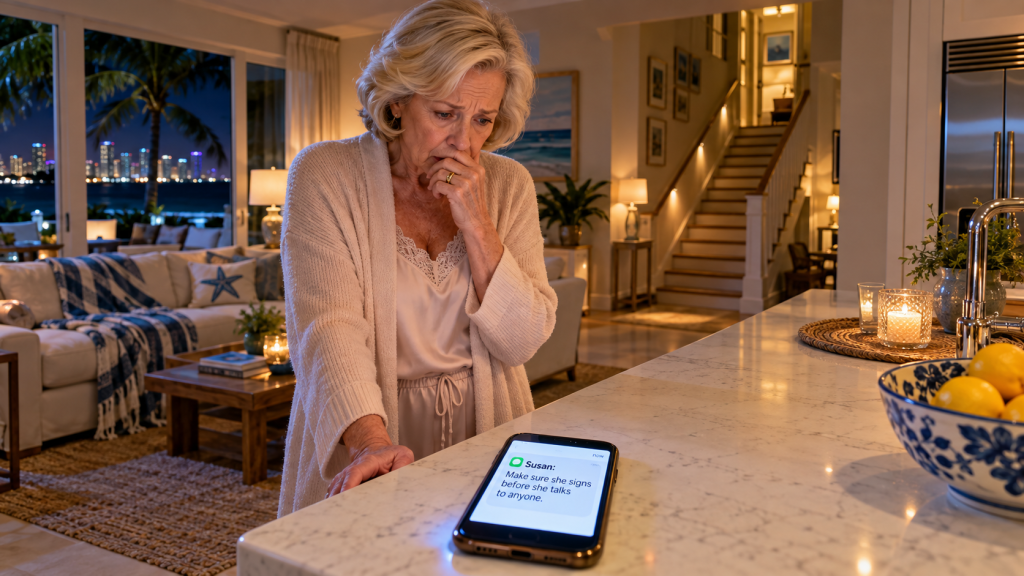
I reached for my phone.
No need to touch hers.
I had photographed the message preview with my own phone after I realized what I was seeing.
Not the whole conversation.
Just what had appeared on the lock screen.
I enlarged the picture.
Susan: Make sure she signs before she talks to anyone.
Robert stared.
“Patrice.”
She looked at him.
“Robert, don’t.”
“Don’t what?”
“Start acting like you didn’t know we were doing this.”
“I knew Susan had paperwork.”
“You knew why.”
“I thought it was basic planning.”
“It is basic planning.”
I finally interrupted.
“Then why did I need to sign it before talking to anyone?”
Silence.
I continued.
“Why not tell me before the vacation?”
No answer.
“Why not suggest I speak to my own attorney?”
Nothing.
“Why is your sister preparing documents about my assets when I never hired her?”
Patrice pushed back her chair.
“Because you put everything off.”
There it was.
Frustration at last.
“You say you’ll update your will.”
“You don’t.”
“You say you’ll organize your accounts.”
“You don’t.”
“You have papers in three different drawers.”
“I know.”
“You still write checks.”
“I like checks.”
“That’s not the point.”
“No.”
I looked at her.
“The point is that you decided my inconvenience gave you authority.”
Karen whispered:
“Patrice.”
Her daughter turned.
“Mom, please.”
“No.”
Karen’s voice became firmer.
“You told me Eleanor wanted me to take the master bedroom.”
The kitchen went silent.
I looked at her.
“What?”
Karen’s face flushed.
“When I asked where you were sleeping, Patrice told me you preferred downstairs because of your hip.”
My heart hurt.
Patrice closed her eyes.
Karen continued.
“She said the couch converted into a bed.”
I almost laughed.
It did not.
Not unless “convert” meant removing decorative pillows.
“I never said that.”
Karen looked horrified.
“I didn’t know.”
“I believe you.”
I did.
Her entitlement had irritated me.
But now I saw some of it had been staged.
Patrice had not simply given her mother my room.
She had made Karen believe I volunteered it.
Exactly the same way she had made other decisions feel inevitable.
Patrice said:
“This is becoming ridiculous.”
I looked at her.
“No.”
Then I picked up my phone.
“This is the announcement.”
Robert stared.
I took one breath.
“The rental ends today.”
Nobody moved.
Patrice blinked.
“What?”
“I shortened the reservation.”
“You can’t do that.”
“I already did.”
Her mouth opened.
Closed.
“The property manager confirmed it this morning.”
Karen set down her knife.
Robert stared at me.
“Mom.”
“The house needs to be vacated this afternoon.”
Patrice actually laughed.
Not because it was funny.
Because she still did not believe me.
“You’re throwing your grandchildren out because you’re mad at me?”
“No.”
I said it carefully.
“I am ending a vacation rental that is entirely in my name after additional guests were invited without my permission, my room was reassigned, and I was moved to a couch in a house I paid for.”
Robert’s face tightened.
“Mom, come on.”
That sentence.
Come on.
Another family translation.
Adjust.
Don’t embarrass us.
Don’t make the cost visible.
I looked at him.
“No, Robert.”
His face changed.
Maybe because I almost never said his name that way.
“I paid thirty-five hundred dollars because I wanted time with you and the children.”
“I did not pay thirty-five hundred dollars to be displaced from my own room while your wife invites relatives into the house and puts paperwork in front of me that she wants signed before I speak to my own adviser.”
Patrice snapped:
“No one forced you onto the couch.”
I stared at her.
“You packed my clothes.”
Her face reddened.
“One night.”
“You packed my belongings from the room I was sleeping in.”
“My cousin had nowhere to go.”
“She had a hotel reservation problem.”
“So?”
“So she was an adult with a credit card in Miami.”
Karen made a sound that might have been a cough hiding a laugh.
Patrice turned on her.
“Mom.”
Karen lifted both hands.
“Don’t bring me into this.”
“You’re already in it.”
“Apparently without being given all the information.”
Robert stood.
“All right.”
He looked at me.
“Cancel the cancellation.”
“No.”
“We’ll fix the rooms.”
“No.”
“Karen can take the couch.”
Karen said:
“I am not taking anyone’s couch.”
Good for her.
Robert rubbed his forehead.
“Then Patrice’s cousin can leave.”
“She is leaving.”
“Great.”
“So why cancel the whole house?”
Because you still do not understand.
I looked at him.
“Because I no longer want to be here.”
That stopped him.
Not:
I’m punishing you.
Not:
You owe me.
I no longer want to be here.
The sentence belonged entirely to me.
Patrice folded her arms.
“And where exactly are we supposed to go?”
I almost answered.
Then realized something.
It was not my problem.
That recognition felt strange.
Almost rude.
Wonderful.
“I don’t know.”
Her mouth fell open.
“You don’t know?”
“No.”
“Robert can book a hotel.”
“Karen can decide what she wants to do.”
“Your cousin can solve the problem she originally had.”
“You are all adults.”
Patrice stared as though I had switched languages.
Then she said:
“You’re doing this because of a bedroom.”
“No.”
I touched the folder.
“I’m doing this because I finally realized the bedroom and the papers come from the same assumption.”
“What assumption?”
“That if you decide something and present it confidently enough, I’ll adjust.”
Nobody spoke.
Outside, David shouted something about a lizard.
Sophie laughed.
Ordinary childhood continuing ten feet away while adults rearranged the family.
I stood.
“I’m taking a shower.”
Then I looked at Patrice.
“In the master bathroom.”
Karen immediately got up.
“I’ll move my things.”
I shook my head.
“No.”
She stopped.
“You don’t have to.”
“I want to.”
Her eyes softened.
“I should have asked you in the first place.”
“You were lied to too.”
Patrice groaned.
“Mom, seriously?”
Karen turned.
“Do not ‘Mom’ me like I’m embarrassing you.”
I almost liked her.
Almost.
For the next two hours, the vacation house became a train station after a cancelled route.
Suitcases.
Phones.
Hotel searches.
Whispered arguments.
Patrice’s cousin and her husband returned from the beach and learned they had until two-thirty to collect everything.
The cousin, Melissa, looked mortified.
“I thought Robert invited us.”
Robert looked at Patrice.
Patrice said:
“We’re family.”
Melissa replied:
“That wasn’t my question.”
Interesting how quickly clarity spreads once one person stops cooperating.
Karen booked a room at a nearby hotel for herself.
She refused Patrice’s offer to include her in whatever new arrangement they found.
“I think everybody needs less togetherness.”
she said.
That might have been the smartest thing anyone said all week.
Robert booked two hotel rooms near Fort Lauderdale because Miami prices had climbed for the weekend.
Patrice complained about the cost.
I did not remind her what I had paid.
That restraint should be considered personal growth.
The children came inside around noon.
David saw suitcases.
“Are we going home?”
Robert crouched.
“Plans changed.”
Sophie looked at me.
“Because Grandma’s mad?”
Children hear everything adults think they hide.
I knelt slowly because my hip really did hurt.
“No, sweetheart.”
“I am upset.”
“I’m not upset with you or David.”
“Did we do something?”
“No.”
I took her hand.
“Adults made some plans without asking the person who rented the house.”
“So you cancelled it?”
Her eyes widened.
“Yes.”
David appeared beside her.
“Can we still swim?”
I laughed.
“Until two.”
They both ran toward the pool.
There is something humbling about realizing your grandchildren can process a family crisis as long as pool access remains uninterrupted.
Robert watched them go.
Then looked at me.
“You really couldn’t wait until the end of the week?”
I stared.
“You really couldn’t give me a bedroom in the house I rented?”
His face tightened.
“That was Patrice.”
“You were standing there.”
“I didn’t move your suitcase.”
“You watched.”
He looked away.
“There were too many people.”
“Yes.”
“That is exactly why you say no when your wife adds them.”
He said nothing.
I lowered my voice.
“Robert, I need you to understand something.”
He looked at me.
“The worst moment wasn’t hearing Patrice say I could sleep on the couch.”
“It wasn’t finding my clothes packed.”
“It wasn’t even seeing those papers.”
His eyes filled before I finished.
“It was when you looked at me in that hallway and said, ‘It’s only one night.’”
He swallowed.
“I know.”
“No.”
I shook my head.
“I don’t think you do.”
“You saw what was happening.”
“You knew I paid for the house.”
“You knew nobody asked me about Melissa.”
“You knew I had already been pushed out of the master bedroom.”
“And you chose the sentence that required the least discomfort from you.”
His face collapsed.
“I didn’t know what else to say.”
“You could have said, ‘No.’”
I stood.
“That was available to you too.”
Then I walked away.
At two-fifteen, the property manager arrived.
Not to evict anyone dramatically.
To conduct early checkout and confirm occupancy.
Her name was Celeste.
She checked the house.
Confirmed the unexpected additional guests had left.
Confirmed keys.
Explained the refund would be processed according to the revised reservation.
Patrice stayed upstairs until almost the last minute.
When she finally came down, she was carrying the document folder.
She held it toward me.
“You should take this.”
I looked at it.
“No.”
Her eyebrows rose.
“They’re your documents.”
“They’re drafts prepared without my instruction.”
“I don’t want them.”
She stared.
“You need to plan eventually.”
“I probably do.”
I picked up my purse.
“But you won’t be managing it.”
Her face hardened.
“That’s unfair.”
“What is?”
“I was trying to help.”
I nodded.
“I believe some part of you probably thinks that.”
That surprised her.
Then:
“But help offered without permission can become control very quickly.”
She looked away.
I continued.
“And when the person offering help is arranging for a signature before the person receiving help talks to anyone independent, I stop calling it help.”
She said nothing.
I left the folder on the kitchen island.
Photographs of every page were already on my phone.
At two-thirty-three, I walked out of the vacation house.
Not onto the couch.
Out.
I had booked myself two nights at a modest hotel farther south with part of the money I was getting refunded.
Ocean view?
No.
Pool?
Small.
Master suite?
Absolutely not.
But the bed was mine.
That was enough.
Robert wanted to drive me.
I declined.
I ordered a car.
Patrice watched from the curb.
Karen hugged me before leaving.
“I’m sorry.”
she whispered.
“You didn’t know.”
“I still should have asked.”
That mattered.
Melissa apologized too.
Then the car arrived.
Sophie ran toward me.
“Grandma!”
I turned.
She wrapped both arms around my waist.
“Are you leaving vacation?”
“Yes.”
“Can we see you tomorrow?”
I looked at Robert.
Not Patrice.
Robert nodded.
“If Grandma wants.”
There it was.
If Grandma wants.
Better.
I kissed Sophie’s head.
“I’ll call in the morning.”
David hugged me next.
“Can we still do the boat tour?”
“We’ll see.”
He sighed.
Adults and their instability.
Then I got into the car.
As we pulled away, I did not look back at the house.
I looked at the ocean.
For the first time all week, nobody had decided where I was sleeping except me.
My hotel room was ordinary.
Two lamps.
A beige bedspread.
Tiny coffee maker.
Air conditioner loud enough to compete with aircraft.
I stood in the middle of it and felt happier than I had in the five-bedroom rental.
That embarrassed me.
Then I decided embarrassment had done enough work for one week.
I took off my shoes.
Lay diagonally across the bed.
All of it.
Every inch.
No grandson’s backpack.
No suitcase moved by someone else.
No folding myself into a couch so adults who had not paid for the house could sleep comfortably.
At four o’clock, my phone began filling with messages.
Robert:
Can we talk tonight?
Patrice:
I think everyone is too emotional right now. We should revisit the papers later when things calm down.
I almost admired that.
She still thought there would be a later version in which the papers became reasonable.
Susan:
Hi Eleanor, Patrice said there may have been a misunderstanding about some planning documents. I’d be happy to explain them professionally.
I stared at that one.
Professionally.
I replied only to Robert.
Tomorrow. Not tonight.
Then I turned my phone off.
At six, I ordered soup.
At seven, I walked down to the beach.
Barefoot.
My hip hurt.
The wind tangled my hair.
Miami families moved past me carrying towels, coolers, plastic shovels.
I saw women my age walking beside daughters.
Grandchildren.
Husbands.
Friends.
For years, I had treated being included as something I needed to earn by being easy.
Cheap.
Flexible.
Convenient.
I thought difficult mothers-in-law lost access to grandchildren.
I thought demanding mothers drove sons away.
So I became the woman who adjusted.
Dinner changed?
Fine.
Holiday moved?
Fine.
No seat in the car?
Fine.
Pictures I wasn’t invited to?
Fine.
Master bedroom?
Fine.
Couch?
Fine.
Paperwork?
That was where something finally said:
Enough.
Not because the paperwork was magically worse than years of small exclusions.
Because I could see, printed in black ink, what adjusting eventually becomes when nobody is required to stop taking.
It becomes permission they never actually received.
I stood ankle-deep in warm water and cried.
Not dramatically.
Just quietly.
The tide took care of the rest.
The next morning, Robert came alone.
I had asked for that.
We met at a café near my hotel.
He looked terrible.
Good.
Not because I wanted him hurt.
Because he had slept comfortably through too many things that hurt me.
He sat.
“Patrice wanted to come.”
“I know.”
“I told her no.”
One point for growth.
I sipped coffee.
Robert stared at his hands.
Then:
“I’m sorry.”
I waited.
No rescue.
No:
It’s okay.
He continued.
“I’m sorry I let you sleep on the couch.”
That was better.
“I’m sorry we invited Karen without asking.”
“I didn’t invite Melissa.”
“Patrice did.”
“But I didn’t stop it.”
Better.
He breathed.
“And I’m sorry about the documents.”
“What exactly did you know?”
He looked at me.
“I knew Susan was putting together estate planning stuff.”
“Did you know about the power of attorney?”
“Yes.”
My chest tightened despite expecting it.
“Why didn’t you tell me?”
“Patrice said if we brought it up beforehand, you’d say no without considering it.”
I stared.
“That sentence did not concern you?”
“It should have.”
“No.”
I leaned forward.
“It concerned you then.”
He looked away.
“You chose not to challenge it.”
“Yes.”
That answer hurt.
But honesty is cleaner pain.
“Did you know Susan wanted signatures before I spoke to my own adviser?”
“No.”
“I swear.”
I believed him.
Not because he was my son.
Because his shock at the message had been real.
“Did you know Patrice had given Susan information about my house and accounts?”
“I gave some of it.”
He swallowed.
“I thought Susan needed it to make a planning worksheet.”
“Did it occur to you to ask me?”
“Yes.”
Another honest answer.
“But?”
“I thought you’d get defensive.”
I almost smiled.
There is something remarkable about being denied information because people are afraid you might react appropriately.
“You mean I might say no.”
“Maybe.”
“Robert, no is not a failure of planning.”
He nodded.
“I know.”
“Do you?”
“I’m starting to.”
We sat quietly.
Then I asked:
“Why does Patrice care so much about my finances?”
He rubbed his face.
“This is the part that’s going to sound bad.”
“Today has room.”
He almost laughed.
Then:
“We’ve been worried about you.”
My expression must have changed because he quickly added:
“Not mentally.”
“Not like dementia.”
“You live alone.”
“You fell last winter.”
“I slipped on ice.”
“I know.”
“You called me three hours later.”
“Because I was embarrassed.”
“That’s exactly what I mean.”
He took a breath.
“Patrice started saying we needed a plan if something happened.”
“That is not unreasonable.”
“I know.”
“But then she started talking about how complicated your accounts are.”
“They aren’t.”
“I know.”
“I have three.”
“I know.”
He smiled weakly.
“Then she started saying if I had power of attorney, I could pay bills if you were hospitalized.”
“Also potentially reasonable.”
He nodded.
“And then?”
His eyes dropped.
“She started talking about your house.”
There it was.
“What about it?”
“That it doesn’t make sense for you to live there forever.”
My stomach tightened.
“Why?”
“Stairs.”
“Maintenance.”
“Taxes.”
“All things I am aware of.”
“I know.”
“She thought eventually you should sell.”
“And?”
Robert looked ashamed.
“She said if the money were invested properly, it could help with care later.”
That sounded almost responsible.
Then he continued.
“And anything left would eventually come to the family anyway.”
There.
The future inheritance entering present conversation.
“How much time does she spend thinking about what is left when I die?”
“Mom.”
“Answer.”
He looked away.
“Too much.”
My chest hurt.
“Does she know what my will says?”
“No.”
“Do you?”
“No.”
“Good.”
He flinched.
Then I asked:
“Are you and Patrice in financial trouble?”
His face changed.
Small.
Enough.
“Robert.”
“We have debt.”
“What kind?”
“Credit cards.”
“How much?”
He hesitated.
“That’s your business.”
I said.
“Unless it explains why my assets became a family project.”
He closed his eyes.
“Thirty-eight thousand.”
I sat back.
Not catastrophic for everyone.
Enormous enough to frighten them.
“Does Karen know?”
“No.”
“Does Susan?”
“Yes.”
Of course.
I felt something cold and sad settle inside me.
“Were you planning to take my money?”
“No.”
Immediate.
“I swear.”
“I never wanted your money.”
I believed that too.
“And Patrice?”
He said nothing.
Not because he thought she planned to steal.
Because he no longer knew where concern ended and entitlement began.
I said:
“A power of attorney would not make my money yours.”
“I know.”
“Do you?”
“Yes.”
“I was not planning to use it.”
“Then why sign it now?”
He took a long breath.
“Because Patrice said it would be easier to have everything in place.”
“Easier for whom?”
That stopped him.
We sat.
Finally Robert whispered:
“Us.”
There it was.
Not me.
Them.
He began crying.
My son.
Forty-two years old.
I had watched him skin knees.
Graduate.
Marry.
Hold David after he was born.
Now he sat across from me realizing that his version of helping his aging mother had centered the convenience of everyone except his aging mother.
“I didn’t think of it like that.”
he said.
“I know.”
“I should have.”
“Yes.”
He wiped his face.
Then:
“I’ve been a coward with Patrice.”
That surprised me.
I stayed quiet.
“She gets an idea.”
“She pushes.”
“I hate conflict.”
“So I tell myself I’ll talk to her later.”
“Then later comes and the thing is already happening.”
He looked at me.
“I do it with you too.”
I nodded.
“I know.”
“You know?”
“Robert, ‘I assumed you knew’ is practically your family motto.”
He laughed through tears.
Fair.
Then:
“She moved your suitcase.”
“I told myself it was one night.”
“Because arguing with her in the hallway would’ve been a whole thing.”
“I know.”
His face crumpled.
“You were easier to disappoint.”
There.
The sentence I had never wanted to hear.
He said it himself.
I stared at him.
“Yes.”
My voice shook.
“I was.”
“I’m sorry.”
I looked out toward the street.
Cars.
Tourists.
A dog wearing sunglasses for some reason.
Then back at my son.
“Do you know why I kept adjusting?”
He shook his head.
“Because I was afraid that if I became difficult, you would stop inviting me.”
Tears filled his eyes.
“Mom.”
“No.”
I continued.
“I have spent years accepting less because I thought less was the price of still being included.”
“That is mine.”
“Not Patrice’s.”
“Not yours.”
“Mine.”
“I chose that.”
He opened his mouth.
I raised a hand.
“But you benefited from it.”
He closed his mouth.
“Yes.”
“If I said Sunday was inconvenient, you moved it.”
“If I said I missed the kids, you said everyone was busy.”
“If I said nothing, you assumed I was fine.”
“You learned that your mother could absorb disappointment quietly.”
He was crying openly now.
“I’m sorry.”
I nodded.
“So am I.”
That surprised him.
“For what?”
“For training everyone to believe I don’t have limits.”
We sat for a long time.
Then Robert said:
“What happens now?”
It was such a child’s question.
Mom, tell me how the next part works.
Not this time.
“I don’t know.”
His face fell.
“That doesn’t mean forever.”
I said.
“It means I am not going to fix the discomfort quickly just because you’re uncomfortable.”
He nodded.
Then:
“What about the kids?”
My heart tightened.
“I love them.”
“I want them in my life.”
“I am not using access to them as a weapon against you.”
His shoulders loosened.
“But I also will not accept being disrespected because I’m afraid you’ll keep them away.”
“I won’t.”
I looked at him.
“Good.”
“Because if that ever becomes the price, I will be heartbroken.”
“But I will not buy my place in this family with silence.”
Robert covered his mouth.
Then nodded.
I took David and Sophie on the boat tour the next afternoon.
Robert came too.
Patrice did not.
Her choice.
Or his.
I didn’t ask.
The kids had a wonderful time.
David saw a dolphin and behaved as if he personally discovered the species.
Sophie took forty-seven photographs of water.
Robert and I did not talk about the family.
That was good.
Sometimes relationships need proof that they can exist outside the problem.
At the end, Sophie leaned against me and said:
“Grandma, this was the best vacation day.”
I smiled.
“So far.”
She looked confused.
“You’re old.”
“Thank you.”
“I mean, how many vacations do you have left?”
Robert choked.
Children.
I kissed her forehead.
“Enough.”
I hoped.
When I got home, I made three appointments.
My attorney.
My financial adviser.
My doctor.
The doctor because if everyone was going to use my fall on the ice as evidence I was one inconvenience away from incompetence, I wanted an actual medical conversation about my health.
The attorney’s name was Denise Alvarez.
I had used her years earlier for a property matter.
She reviewed photographs of the documents from the vacation.
Then looked at me.
“These documents are not inherently improper just because they include a power of attorney.”
“I know.”
“What concerns me is the process.”
“No independent consultation.”
“Documents prepared through your daughter-in-law’s sister.”
“Information gathered without your direct authorization.”
“Pressure to sign before speaking to your existing adviser.”
“And the fact that you did not request any of it.”
I nodded.
“Would signing have given Robert my money?”
“No.”
“Not automatically.”
“A power of attorney creates authority to act, not ownership.”
“Whether any institution accepts it and what the agent can do depend on the document and applicable rules.”
She tapped the photograph.
“But it would have granted significant authority if properly executed.”
“And you should never sign something like this because a relative describes it as ‘just planning paperwork.’”
That sentence made me angry all over again.
I asked:
“What should I do?”
Denise smiled slightly.
“Actual planning.”
So we did.
My will was old.
Updated.
My health-care directive named a close friend, Margaret, first, with Robert second.
That bothered me at first.
Then I realized naming someone is not a love ranking.
It is a job assignment.
Margaret was a retired nurse.
Calm in emergencies.
Lived eight minutes away.
Robert lived forty-five minutes away and hated conflict.
Not an insult.
A fact.
My financial power of attorney named Margaret too, with a professional fiduciary as backup.
Robert was not included.
Not to punish him.
Because a man who had just admitted he let decisions happen around him to avoid arguments was not currently the person I wanted managing difficult financial decisions.
Maybe that would change.
Maybe not.
My will left portions to Robert and directly to education trusts for David and Sophie.
I did not cut Patrice out by name.
Did not add angry clauses.
Did not turn death planning into one final family argument.
Denise said:
“Good estate plans are usually boring.”
“Excellent.”
I had had enough excitement.
My financial adviser, Steven, reviewed every account.
No unauthorized changes.
No unknown access.
No disaster.
I changed online passwords.
Updated beneficiaries where I wanted.
Simplified two accounts because I genuinely had allowed paperwork to become scattered.
That irritated me.
Patrice had been right about one thing.
I needed organization.
But someone can be correct about a problem and wrong about who gets to control the solution.
I bought a fireproof document box.
Put everything in labeled folders.
HOUSE.
BANK.
RETIREMENT.
INSURANCE.
ESTATE.
Then I made a one-page list titled:
IF SOMETHING HAPPENS TO ME
Margaret received a copy.
Robert received only the information he actually needed.
When I handed it to him months later, I said:
“This is what help looks like when I ask for it.”
He nodded.
“I understand.”
I believed he was beginning to.
Susan’s firm called me after Denise sent a letter asking how documents containing my personal financial information had been prepared when I had never engaged their services.
The compliance officer sounded horrified.
She did not tell me confidential employment details.
She did say the firm had opened an internal review.
I learned that Susan had created drafts using information provided by Patrice and Robert before completing the firm’s normal client intake process with me.
The firm apologized.
It destroyed the unused draft file according to its procedures after preserving what was necessary for its review.
Several months later, Susan no longer worked there.
I never learned whether she was fired, resigned, or left for another reason.
I did not need to know.
Patrice accused me of “ruining Susan’s career.”
I replied once:
I asked the firm why documents were prepared in my name without my authorization. What they did with that information was their decision.
She never answered.
Good.
I had spent enough time accepting responsibility for consequences created by other people’s choices.
Karen called me two weeks after the vacation.
I almost ignored it.
Then answered.
“I owe you an apology.”
she said.
“You already apologized.”
“Not completely.”
I sat.
Karen continued.
“Patrice told me Robert had paid half the rental.”
My eyes closed.
Of course.
“I didn’t know you paid all of it.”
“That shouldn’t actually matter.”
I said.
She paused.
“You’re right.”
That surprised me.
“I shouldn’t have accepted your room even if Robert paid.”
“Also true.”
She sighed.
“I’ve been thinking about why I didn’t ask you directly.”
“And?”
“Because my daughter made everything sound decided.”
There it was.
Karen knew Patrice better than I did.
“When Patrice speaks confidently, I sometimes go along because arguing takes forever.”
I almost laughed.
“Apparently it runs in the family.”
“Unfortunately.”
Then Karen said:
“I think we’ve all taught her that pushing works.”
That was more accountability than I expected.
“What happens between you and Patrice is yours.”
I said.
“I just don’t want to be managed anymore.”
“I understand.”
She was quiet.
Then:
“For what it’s worth, the master bedroom was beautiful.”
I laughed.
First genuine laugh about it.
“I heard.”
“I’m sorry.”
“I know.”
Karen and I never became friends.
But we became cordial.
Sometimes that is enough.
Patrice and I did not speak privately for almost three months.
We saw each other twice.
David’s soccer game.
Sophie’s school performance.
Civil.
Polite.
Nothing more.
Then she asked if we could meet.
Public place.
I agreed.
She arrived with no folder.
I noticed.
She probably intended me to.
We sat.
Patrice said:
“I owe you a real apology.”
I waited.
She looked thinner.
Tired.
Maybe marriage stress.
Maybe guilt.
Maybe life.
“I was wrong to give away your room.”
“Yes.”
“I was wrong to invite my cousin.”
“Yes.”
“I was wrong to have Susan prepare documents without asking you.”
“Yes.”
“I was wrong to tell her to try to get signatures before you spoke to somebody else.”
I stared.
“You told her that?”
She nodded.
The message had come from Susan, but Patrice had initiated it.
“Why?”
Patrice looked at her hands.
“Because I knew if you talked to your adviser first, you would probably refuse.”
“Then you knew I might not want it.”
“Yes.”
There.
No hiding.
“Why did you need me to want it?”
She breathed.
“Because I’m scared.”
I did not expect that.
“Of what?”
“Money.”
I almost laughed.
She continued.
“My parents had nothing saved.”
“My mom acts like she’s fine.”
“She isn’t.”
“My dad died with debt.”
“Robert and I have debt.”
“College for the kids terrifies me.”
“Retirement terrifies me.”
“Everything costs more every year.”
She looked at me.
“And you have this paid-off house and retirement savings and you don’t seem worried.”
I stared.
“So you thought my security should become yours.”
“No.”
She stopped.
Then corrected herself.
“Maybe emotionally.”
Good.
“I started thinking of your money as future family money.”
There it was.
Future family money.
Before I was dead.
Before I needed long-term care.
Before I decided to travel.
Before I spent one cent on myself.
“You were counting an inheritance.”
Patrice cried.
“Yes.”
“How long?”
“I don’t know.”
“Long enough that when we talked about your house, I thought in terms of what would be smartest for everybody eventually.”
“Everybody?”
She looked ashamed.
“Us.”
Same word Robert used.
Us.
I leaned back.
“Do you know what bothered me most about that?”
She shook her head.
“You were treating my life like the waiting room before your inheritance.”
Her face crumpled.
“I know.”
“No.”
I softened my voice.
“You understand it now.”
“There is a difference.”
She cried quietly.
“I’m sorry.”
I believed her.
That did not restore trust.
Both things can be true.
“I also need to tell you something you may not like.”
I said.
She wiped her face.
“Okay.”
“You blaming your fear does not make me responsible for curing it.”
She nodded.
“I know.”
“I’m not paying your debt.”
Her face flushed.
“I wasn’t asking—”
“I know.”
“But it needs saying.”
I continued.
“I am not selling my house because you think it would be financially efficient.”
“I am not adding Robert to accounts for convenience.”
“I am not making decisions about my estate based on how urgently you want certainty.”
Patrice nodded.
“I understand.”
“And if you ever move my suitcase out of a room I paid for again, I will set it on fire.”
She stared.
I smiled.
“Joke.”
She actually laughed.
Tiny.
Good.
Then she asked:
“Do you hate me?”
“No.”
That surprised her.
“I don’t trust you the way I did.”
“That is different.”
Her eyes filled again.
“Can I earn that back?”
“Maybe.”
I took a breath.
“But you don’t earn trust by asking when the score improves.”
She nodded.
Fair.
Robert began individual therapy.
He told me months later.
I did not ask what they discussed.
That was his.
He did tell me one thing.
“My therapist says I use passivity to avoid responsibility.”
I laughed.
“Worth every dollar.”
“Mom.”
“Sorry.”
Then:
“Is she right?”
He sighed.
“Yes.”
He started doing small things differently.
Not dramatic.
At family dinners, when Patrice said:
“We’ll do Sunday at two.”
Robert would sometimes ask:
“Mom, does two work?”
The first time, I almost said:
“Whatever.”
Habit.
Then stopped.
“Three works better.”
“Okay.”
Nobody died.
Remarkable.
When Sophie’s birthday party moved because of weather, he called.
Did not assume someone else told me.
When they invited me for Christmas, he said:
“We have the guest room available. Would you like to stay overnight or go home?”
Not:
You’ll stay.
Not:
Patrice thinks.
Choice.
I often went home.
Because I liked my bed.
We all survived that too.
Their marriage almost ended.
I know because Robert told me later.
Patrice blamed him for “siding with me.”
Robert told her he had spent years not siding with anyone, which meant the most forceful person usually won.
They fought.
Counseling.
Debt plan.
Sold one car.
Cancelled an expensive club membership I had not known they had.
Robert picked up consulting work.
Patrice took on additional hours.
They paid down debt slowly.
I did not help.
That was difficult.
I had the money.
Not enough to erase everything comfortably, but enough to make a meaningful dent.
Old Eleanor would have offered.
Then resented.
Then told herself it was love.
This time, I let two employed adults solve their own financial problem.
When Robert told me they had paid off the first credit card, I said:
“I’m proud of you.”
Not:
How much is left?
Progress.
The partial refund from Miami was a little over eighteen hundred dollars.
I considered putting it back into savings.
Then Sophie called.
“Grandma, remember the Everglades?”
“Yes.”
“I want to go somewhere with mountains.”
David shouted in the background:
“Not mountains. Bears.”
Apparently he considered bears a destination category.
I smiled.
“Tell your father to plan something.”
Sophie groaned.
“Dad makes spreadsheets.”
True.
Then an idea formed.
Not immediately.
Later.
I called Robert.
“Next summer, I want to take the kids somewhere for four days.”
“Just you?”
“Yes.”
He hesitated.
Old me would have taken that personally.
New me waited.
He said:
“They’d love that.”
“So would I.”
We chose Asheville.
Mountains.
No guaranteed bears.
I paid with the Miami refund and some extra savings.
But this time, every detail was explicit.
My room.
Their room.
Budget.
Dates.
Robert knew.
Patrice knew.
No surprise guests.
No paperwork.
At the hotel, Sophie asked:
“Can I sleep in your bed one night?”
I stared at her.
Then laughed so hard she looked offended.
“What?”
“Nothing.”
“Yes.”
She crawled into my bed.
Stole the blankets.
Kicked me twice.
At three in the morning, I lay on eight inches of mattress and thought:
This is completely different.
Because I had said yes.
Choice changes the shape of sacrifice.
Two years after Miami, Robert invited me on another family vacation.
I nearly said no automatically.
He said:
“Before you answer, I emailed you the house.”
I opened it.
Four bedrooms.
He continued.
“Patrice and I are paying half.”
“Karen is paying her share.”
“No one else is invited unless everybody agrees.”
“And your room has a private bathroom.”
I looked at him.
“You made a constitution.”
“Basically.”
“Can I amend it?”
“No couches.”
I laughed.
We went.
Not Miami.
Outer Banks.
Different coast.
Different family.
Not magically healed.
Better.
The first afternoon, Patrice knocked on my bedroom door.
“Come in.”
She opened it halfway.
“My mom’s room has a smaller closet.”
I raised one eyebrow.
Patrice laughed.
“Just kidding.”
I threw a pillow.
Progress can have jokes.
Karen slept in her own room.
I slept in mine.
Robert cooked one night.
Terribly.
David burned marshmallows.
Sophie complained there was nothing to do, then cried when we had to leave.
No one brought legal documents.
Beautiful.
My own estate planning changed one more time years later.
Not because I was angry.
Because life changed.
David went to college.
Sophie started nursing school.
Margaret developed health problems and could no longer comfortably serve as my first agent.
I updated the documents.
This time, I named Robert as my first financial agent.
That decision took me a long time.
I told him in person.
He stared.
“Are you sure?”
“Yes.”
“I don’t need to be.”
“I know.”
“I’m serious.”
“So am I.”
He looked close to tears.
“What changed?”
“You did.”
Simple.
“But.”
I raised one finger.
“You do not become owner of anything.”
“I know.”
“You follow my instructions.”
“I know.”
“If Patrice asks you to do something inconsistent with them—”
“I say no.”
I smiled.
“Look at you.”
He laughed.
“Therapy.”
“Worth every dollar.”
This time he laughed too.
I named a professional fiduciary as backup.
Still practical.
Trust does not require pretending risk vanished.
When I told Patrice, she said:
“That makes sense.”
Nothing else.
No questions about values.
Beneficiaries.
House.
That mattered more than she knew.
I eventually sold my house.
Patrice did not suggest it.
Robert did not suggest it.
I did.
The stairs were becoming annoying.
The yard was too much.
The property taxes irritated me on principle.
I bought a condo near a park.
One level.
Balcony.
Small guest room.
When the sale closed, Patrice congratulated me.
Then said:
“Do something fun with some of it.”
I stared.
“What?”
She smiled.
“You heard me.”
Years earlier, she would have been thinking about preservation.
Future family money.
Now:
Do something fun.
So I did.
I took a train trip through Canada with Karen.
Yes.
Karen.
Life has jokes.
We became friends almost by accident.
Not best friends.
Travel friends.
She was organized.
I liked windows.
She woke early.
I hated driving.
It worked.
One evening in the dining car, she said:
“Patrice would hate that we do this.”
“Why?”
“She thinks we talk about her.”
I smiled.
“We do.”
Karen laughed so loudly the couple beside us looked over.
Then she became serious.
“I worry sometimes that I helped make her controlling.”
I looked at her.
“You probably did.”
She almost choked.
“You’re supposed to deny it.”
“I’m retired.”
“Too much effort.”
Then:
“I helped make Robert passive.”
She looked surprised.
“How?”
“I rewarded him for being easy.”
“His brother—” Wait, Robert doesn’t have brother established. Don’t invent. “When he was little, if he didn’t complain, I called him mature.”
“When he avoided conflict, I called him peaceful.”
“I didn’t teach him that sometimes peace requires disappointing people.”
Karen nodded.
“We all hand our children things we didn’t know were broken.”
That was good.
I wrote it down later.
When David graduated college, Robert gave a toast.
He thanked Patrice.
Me.
Teachers.
Then, jokingly, he said:
“And Grandma Eleanor, who once cancelled an entire Miami vacation because we put her on a couch.”
Everyone laughed.
I did too.
Then Robert’s expression changed.
He looked at me.
“Actually.”
The room quieted.
“She cancelled it because I had spent years assuming my mother would absorb whatever inconvenience made everyone else’s life easier.”
My throat tightened.
“Mom, I am still sorry.”
I stared at him.
Public apology.
Not necessary.
But beautiful.
Patrice reached for his hand.
He continued.
“And the best thing she taught us was that generosity without boundaries becomes an invitation for people to stop noticing the cost.”
I cried.
Of course.
David groaned.
“Grandma.”
“What?”
“You always cry at speeches.”
“Your father became articulate late in life.”
Everyone laughed.
Robert raised his glass.
“To Eleanor.”
I shook my head.
“To the graduate.”
David shouted.
Better.
We drank to him.
Not me.
That mattered too.
I did not need every family gathering to become a memorial to the vacation where I finally said no.
The point of boundaries is eventually getting to live beyond the moment you had to build them.
Years later, Sophie asked me about the papers.
She had been a child during Miami.
She remembered the rental ending early.
The adults whispering.
The boat tour.
Not the details.
We sat on my condo balcony.
She was twenty-six.
She asked:
“Did Mom really try to steal your money?”
I hated the question.
“No.”
“But Dad said there were papers.”
“Yes.”
“Power of attorney?”
“Yes.”
“So she did.”
“No.”
I looked at her.
“Listen carefully.”
“Your mother tried to pressure me into giving your father financial authority without having an honest conversation with me first.”
“That was wrong.”
“Your aunt Susan—”
“She’s technically my aunt too.”
“Unfortunately for this sentence, yes.”
Sophie smiled.
“Susan prepared documents through her firm before I had agreed to become a client.”
“Also wrong.”
“But I do not know that your mother planned to steal a dollar.”
Sophie thought.
“Then why did she do it?”
“Fear.”
“Entitlement.”
“Anxiety.”
“Control.”
“Probably love mixed badly with all of them.”
Sophie frowned.
“That sounds complicated.”
“It was.”
“Do you forgive her?”
“Yes.”
“Completely?”
“What does that mean?”
She laughed.
“Grandma answer.”
I continued.
“I trust your mother now in some ways I didn’t then.”
“I also remember what happened.”
“Those two things can coexist.”
Sophie looked toward the park.
Then:
“Mom hates talking about Miami.”
“I know.”
“Dad jokes about it.”
“I know.”
“What do you call it?”
I thought.
“My most expensive couch.”
She laughed so hard she nearly spilled her tea.
Patrice and I never became mother and daughter.
We stopped trying.
That improved everything.
She was my daughter-in-law.
I was her mother-in-law.
We could love each other without forcing a title the relationship had never earned.
She grew gentler with age.
So did I.
One Thanksgiving, she brought me lemon pie.
My favorite.
She said:
“I made it.”
I tasted it.
“You bought this.”
She looked offended.
“How do you know?”
“Because it’s good.”
She threw a napkin at me.
We laughed.
Ten years earlier, a joke like that might have carried poison underneath.
Now it didn’t.
Time does not heal everything.
Behavior heals some things.
Consistency heals more.
Time only gives those things room to work.
Karen died first.
A stroke.
Quick.
Patrice was devastated.
I sat beside her at the funeral.
No complicated history mattered that day.
She held my hand.
I let her.
Later she whispered:
“She always felt guilty about the master bedroom.”
I almost laughed in church.
“Seriously?”
“Yes.”
“She mentioned it every vacation.”
Poor Karen.
I squeezed Patrice’s hand.
“She didn’t need to.”
“I know.”
Then Patrice looked at me.
“I’m glad you two became friends.”
“So am I.”
She started crying harder.
I put my arm around her.
No scoreboard.
No memory of who had once done what.
Just a woman grieving her mother.
That was allowed too.
I grew older.
Actually older.
Not the imaginary fragile old woman Patrice had begun planning around while I was still perfectly capable of cancelling a rental at two in the morning.
My knees worsened.
Driving at night became unpleasant.
I forgot appointments unless they were in my phone.
Normal things.
Robert helped.
But now he asked.
“Want me to drive?”
Sometimes yes.
“Want me to sit in on the appointment?”
Sometimes no.
“Want me to review this bill?”
Yes, please.
“Do you want me to speak for you?”
Almost never.
He learned.
I did too.
Receiving help without disappearing is a skill.
I had once confused independence with dignity.
They are not the same.
Dignity is being helped without being erased.
That was all I had wanted in Miami.
A room.
A question.
A conversation before someone moved my suitcase.
Eventually, there came a day when I needed the power of attorney.
Not dramatically.
A surgery.
Long recovery.
I asked Robert to handle certain bills temporarily.
He sat beside my hospital bed holding the document Denise had prepared years earlier.
“Mom.”
“Yes?”
“I want to ask something.”
“What?”
“Do you want me to do only the bills on this list, or manage anything else while you recover?”
I stared at him.
Such a small question.
So many years inside it.
“Only the list.”
“Okay.”
“And Robert?”
“Yes?”
“Thank you.”
He smiled.
“You’re welcome.”
No:
See? Patrice was right years ago.
No:
This would have been easier if you’d signed then.
Because timing and consent change everything.
A tool I had rejected under pressure later became a tool I chose voluntarily.
That was not hypocrisy.
That was ownership.
One afternoon during my recovery, Patrice brought soup.
She set it down.
Then looked around my condo.
“Do you need laundry?”
“No.”
“Groceries?”
“No.”
“Anything?”
I smiled.
“Sit.”
She did.
We drank tea.
After a while she said:
“I think about Miami sometimes.”
“Still?”
“Yes.”
“I hate who I was.”
I looked at her.
“Don’t.”
She seemed surprised.
“Hating who you were can become another way of staring at yourself forever.”
She laughed softly.
“That sounds like therapy.”
“Robert has infected us.”
Then:
“You did something wrong.”
“More than one thing.”
“True.”
I smiled.
“But you changed.”
She looked down.
“I’m still sorry.”
“I know.”
Then she said:
“The worst part is that I really thought I was being practical.”
“I know.”
“That scares me.”
“It should a little.”
She looked at me.
“Why?”
“Because the most dangerous entitlement is often the kind that feels responsible.”
We sat with that.
Then I said:
“But fear is only useful if it changes your behavior.”
She nodded.
“It did.”
“Yes.”
It had.
That was enough.
After I recovered, I returned to Miami.
Alone.
Not because I needed to conquer anything.
I wanted warm weather.
That was all.
I booked a small hotel room overlooking a side street.
No giant rental.
No family.
No master bedroom because there was only one bedroom.
I unpacked slowly.
Hung up my dresses.
Placed my shoes beside the closet.
Then I sat on the edge of the bed.
Years earlier, I had lain on a couch in a $3,500 house while people I loved slept behind closed doors and discussed what I should sign.
Now the room was quiet.
My phone was on the desk.
No messages.
No folder.
No one planning my morning.
I walked to the beach.
The city had changed.
Or I had.
Probably both.
I passed a vacation-rental office and laughed.
A couple near me looked concerned.
Fine.
At sunset, I called Robert.
“Guess where I am.”
“Home?”
“No.”
“Where?”
“Miami.”
Silence.
Then he started laughing.
“Mom.”
“What?”
“Please tell me you have a bed.”
“King.”
“Good.”
“Your wife is not invited.”
“I assumed.”
We laughed.
That was the first time Miami became funny.
Not entirely.
Enough.
The following morning, I ate breakfast alone on a hotel terrace.
Lemon in my water.
Ocean beyond the buildings.
I thought about the woman I had been that first vacation.
She had saved for years to buy closeness.
That is what hurt to admit.
The $3,500 had not only paid for a house.
I had secretly hoped it would purchase something money cannot guarantee.
A son who noticed me.
A daughter-in-law who respected me.
Grandchildren who would remember me.
A place in the family photograph.
When people buy love indirectly, they often call it generosity.
Sometimes it is generosity.
Sometimes it is fear wearing a nice blouse.
I had been generous.
And afraid.
Both.
The problem was not paying for the vacation.
The problem was believing that because I paid, everyone would finally understand what I meant to them.
Money is terrible at delivering emotional messages.
People hear what they already expect.
Patrice heard:
Resource.
Robert heard:
Mom has it handled.
The kids heard:
Pool!
Only I heard:
Please include me.
That was never fair to any of us.
Now, if I wanted time with Robert, I asked.
If I wanted to see the children, I called.
If I felt excluded, I said so.
Sometimes people still disappointed me.
That is family.
But disappointment no longer accumulated interest in silence.
Robert once asked me, years after everything:
“If you could go back, would you still cancel the house?”
We were sitting on my balcony.
I did not hesitate.
“Yes.”
“Even knowing we eventually fixed things?”
“Yes.”
He smiled.
“I thought so.”
I looked at him.
“Do you think I overreacted?”
“No.”
Then he thought.
“At the time I did.”
“I know.”
“I thought you were blowing up the whole vacation over one bad night.”
“And now?”
“I think the bad night showed you something bigger.”
Exactly.
Then he said:
“I’m glad you did it.”
That surprised me.
“Why?”
“Because I don’t know how much worse I would have gotten at saying nothing.”
My throat tightened.
“I needed something to become expensive.”
He continued.
“Before that, avoiding conflict always felt cheaper.”
“You paid the cost.”
“Patrice paid.”
“Everybody adjusted.”
“That trip was the first time my avoidance ruined something I wanted.”
I looked at him.
“Consequences are educational.”
“Mom.”
“Sorry.”
Not sorry.
He smiled.
Then:
“I love you.”
“I know.”
“You always say that.”
“Because you do.”
“I’m trying to say it.”
I looked at him.
“Then I love you too.”
No money.
No vacation.
No adjustment.
Just words.
Turns out those work better when used directly.
When Sophie had her first child, she invited me to stay for three nights.
She showed me the guest room before I even brought my suitcase inside.
“Your room.”
I laughed.
“What?”
“Nothing.”
“Dad told me.”
“Of course he did.”
She pointed toward a small sofa in the nursery.
“And that couch is not for you.”
I laughed harder.
Family stories survive.
Good.
Not every painful memory needs to become secret.
Some become warning signs.
Some become jokes only after enough years of changed behavior make laughter safe.
I slept in the guest room.
The baby screamed at two in the morning.
I helped.
At breakfast, Sophie said:
“Thank you for adjusting.”
We both froze.
Then burst out laughing.
She covered her mouth.
“Oh my God.”
“Careful.”
“I didn’t mean—”
“I know.”
That was the difference.
I knew.
Near the end of my life, I simplified everything one more time.
Not because Patrice asked.
Because I wanted my family to have fewer drawers to open.
One bank.
One investment account.
Updated will.
Clear instructions.
Funeral preferences.
No lilies because Karen’s funeral had enough for all of us.
I wrote letters to Robert, David, and Sophie.
Not financial instructions.
Those were with the lawyer.
Real letters.
To Robert:
You were easier to forgive once you stopped needing forgiveness to be immediate. Thank you for learning how to ask instead of assume.
To David:
You have always run toward life as though somebody left the pool gate open. Keep that.
To Sophie:
You taught me that a stolen blanket at three in the morning can be a privilege when the person stealing it was invited.
Then Patrice.
Yes.
I wrote her one too.
You and I loved the same people differently and frightened each other because of it. I am grateful we eventually learned that love does not require management. Thank you for changing in ways I know were not easy.
I sealed the letters.
Put them in the fireproof box.
Clear labels.
I became organized after all.
Patrice would have appreciated the irony.
But I am not ending this story at my death.
I am still here while telling it.
That matters.
Stories about older women too often end as though the only meaningful question is who gets what after we are gone.
That was part of the problem in the first place.
My life was not a waiting period for Robert’s inheritance.
My house was not future family money while I still needed a roof.
My retirement account was not a college fund unless I decided it was.
My bedroom was not available because someone else wanted it more.
And my comfort was not less important simply because I had trained everyone to expect me to surrender it quietly.
I still travel.
Less.
I still see Robert.
More.
Patrice calls before making plans.
Most of the time.
When she forgets, I remind her.
Karen is gone, and I miss her more than I expected.
David has children now.
Sophie finally learned not to kick in her sleep.
Mostly.
My hip still aches if I stay on a couch too long.
So I don’t.
That may be the most practical lesson of the entire story.
I still remember that first night near Miami Beach.
One-thirty in the morning.
Dark living room.
Hip aching.
Patrice whispering in the kitchen.
No, it worked.
The couch.
She didn’t complain. I told you she wouldn’t.
At the time, that sentence humiliated me.
Now I hear something different in it.
Evidence.
She did not believe I had no boundaries.
She believed I would not enforce them.
There is a difference.
Boundaries do not become real because you feel them.
Other people learn them by what happens after they cross them.
That night, I finally learned the same thing.
At 2:07 a.m., I shortened the reservation.
By breakfast, the vacation had changed.
By afternoon, the house was empty.
Months later, my estate documents were rewritten on my terms.
Years later, my son learned how to say no.
Patrice learned how to ask.
And I learned that being easy to love is not the same thing as being easy to inconvenience.
I had confused those two for far too long.
Now, when someone asks what I want, I try not to say:
“Whatever works.”
Sometimes whatever truly does work.
But when it doesn’t, I answer.
Three o’clock instead of two.
My own room.
No surprise guests.
I’ll keep my account the way it is.
Please knock.
No, thank you.
Yes, I’d love to come.
Simple sentences.
A life is built from them.
Just like a life can disappear inside the absence of them.
Last year, Robert rented a beach house for the whole family.
He paid.
That alone nearly caused me to faint.
Before the trip, an email arrived.
Subject:
ROOM ASSIGNMENTS — FOR APPROVAL
I opened it.
Robert and Patrice: upstairs room.
David and family: bunk area and guest room.
Sophie and family: downstairs suite.
Eleanor: ocean-view room with queen bed and private bath.
At the bottom:
Mom, please confirm this works before we book. No couch jokes from Patrice allowed.
I laughed until I had tears in my eyes.
Then I replied:
Approved. But I want the room with the balcony.
Thirty seconds later:
Of course you do.
Then Patrice:
Take it. I’m adjusting.
I stared at the message.
Then laughed again.
We booked the house.
I got the balcony.
Not because I paid.
Not because I was the oldest.
Because I asked.
And people who loved me listened.
That was all I had wanted from the beginning.
Not the master bedroom.
Not control.
Not gratitude.
A place in the conversation before the decision was made.
The first morning, I sat outside with coffee.
The grandchildren’s children were running through the house.
Someone had burned toast.
Robert was arguing with a coffee machine.
Patrice stepped onto the balcony.
“Morning.”
“Morning.”
She looked at the empty chair.
“May I?”
Years earlier, she would have sat down.
Now she asked.
I smiled.
“Yes.”
She sat beside me.
For a while, we watched the water.
Then she said:
“Do you ever think about Miami?”
“Only every time I see a couch.”
She groaned.
“I will never escape this.”
“No.”
She laughed.
Fair.
After a moment, she said:
“I really am sorry.”
I looked at her.
“I know.”
“You know what’s strange?”
“What?”
“At the time, I thought you cancelling the rental meant you were breaking the family.”
I looked toward the house.
Robert laughing.
Children yelling.
Coffee machine losing.
“And now?”
Patrice smiled.
“I think you stopped us from becoming the kind of family where one person always has to disappear to keep everybody else comfortable.”
My throat tightened.
That was exactly it.
I reached for my coffee.
“Don’t get too wise.”
“Sorry.”
We sat in the morning sun.
No folder between us.
No papers.
No silent bargain.
Just two women who had once mistaken control and accommodation for family harmony and lived long enough to learn better.
Inside, Robert shouted:
“Mom, do you want eggs?”
Patrice turned toward me.
I smiled.
“Yes.”
Then I raised my voice.
“But not runny.”
Robert yelled back:
“I know!”
Patrice laughed.
I did too.
And as ridiculous as it sounds, that small exchange felt like the ending I had wanted all along.
Not a family that never disappointed me.
Not a family where I always got the best room.
A family where my preferences could exist without becoming a crisis.
A family where saying no did not mean I loved them less.
A family where saying yes actually meant yes.
I had spent years believing love required me to adjust.
Now I knew better.
Love sometimes adjusts.
But it also asks.
It listens.
It makes room.
And when necessary, it gets off the couch.
THE END STORIES! THANK YOU FOR READING GOOD LUCK !❤️
Related Posts