➡️ PART 3 ENDING PART➡️
“I would—if you hadn’t invited fourteen witnesses into it.”
No one laughed.
That was how I knew Denise meant it.
Grant’s face had gone a deep, blotchy red.
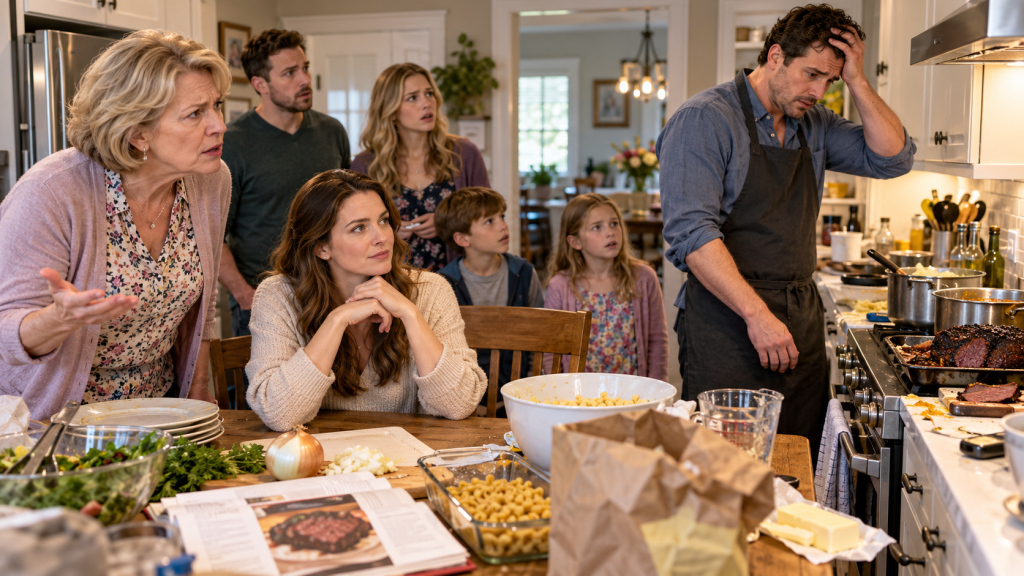
The house was full of people he had invited to admire a dinner he assumed I would create.
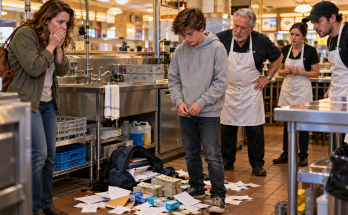
Instead, fourteen relatives were standing around a kitchen where the macaroni had become a brick, the potatoes were still hard in the middle, and a brisket sat stubbornly in the oven as if it had personally decided not to cooperate.
For the first time in seven years, Grant could not hand me the problem without everyone seeing him do it.
He looked at me.
I knew that look.
It had rescued him more times than I could count.
A silent request dressed as expectation.
Fix this.
Smooth it over.
Make people comfortable.
Let me keep my dignity.
I stayed in my chair.
Grant cleared his throat.
“The restaurant is bringing food.”
Tessa checked the clock.
“When?”
“Around eight.”
Her two children groaned from the living room.
One of the cousins said:
“It’s six-thirty.”
“I know what time it is.”
Grant snapped.
Denise turned toward him.
“Don’t take it out on them.”
“I’m not.”
“You are.”
Grant threw both hands up.
“Fine.”
“What do you want me to do?”
Denise stared.
The question hung there.
Then she said:
“Maybe start by not asking everyone else to solve the problem you created.”
Grant laughed bitterly.
“Unbelievable.”
He looked at me again.
“So this is what you wanted?”
I blinked.
“What?”
“To embarrass me?”
“No.”
“You sat here knowing dinner wasn’t ready.”
“Yes.”
“You could have helped.”
“Yes.”
“And you chose not to.”
“Yes.”
His jaw tightened.
I could almost hear the story forming in his mind.
Cruel wife.
Public humiliation.
Petty protest.
He needed me to be unreasonable because the alternative was admitting he had built the entire evening on the assumption that my labor belonged to him.
I stood.
Not because I was going to cook.
Because I was tired of speaking from a chair while he loomed over the room.
“I told you I was not cooking.”
“You heard me.”
“You invited people anyway.”
“You promised them food I never agreed to make.”
“You went shopping only after you finally believed me.”
“And now you’re angry because the problem remained yours.”
Grant stared.
Then said:
“Marriage isn’t supposed to be this transactional.”
I almost laughed.
That sentence.
From him.
“You told me to buy my own food.”
The room became very quiet again.
Grant rubbed his forehead.
“Oh my God, Laurel, I said something stupid in an argument.”
“No.”
Miles spoke from the doorway.
Everyone turned.
Grant’s younger brother had been almost completely silent.
Now he looked at Grant.
“You didn’t just say something stupid.”
Grant’s eyes narrowed.
“Stay out of it.”
Miles shook his head.
“I was there.”
Grant’s mouth tightened.
“You told her you were tired of ‘providing for her’ while she was literally carrying groceries she paid for.”
Grant looked away.
Miles continued.
“And when she showed you the receipt, you still doubled down.”
Tessa folded her arms.
“You never told us that part.”
Grant muttered:
“It wasn’t a courtroom transcript.”
Miles replied:
“No, but it happened.”
I looked at him.
For weeks, I had remembered that afternoon as something Grant had done to me in front of Miles.
I had not realized how much it might have bothered him too.
Denise closed my receipt folder.
Then asked:
“Laurel, have you eaten?”
The question surprised me.
“Yes.”
“When?”
“Late lunch.”
The children were hungry.
Everyone was hungry.
I knew there was food in the refrigerator.
My food.
Cooked food.
A pan of roasted vegetables.
Leftover chicken.
A container of rice.
Enough to feed maybe four people.
Not fourteen.
Old Laurel would have looked at fourteen hungry faces and felt responsible.
That instinct rose automatically.
Feed them.
Make sandwiches.
Scramble eggs.
Order something.
Fix the discomfort.
Then I looked at Grant.
No.
The hunger in this room was not an emergency I had created.
Denise apparently understood.
She clapped her hands once.
“All right.”
Everybody looked at her.
“We have children here.”
She pointed toward Tessa.
“You and I are going to get them food.”
Tessa nodded.
“Pizza?”
“Anything available before next Tuesday.”
A few people laughed.
The tension cracked slightly.
Denise looked at the others.
“If the rest of you want to wait for Grant’s barbecue, wait.”
“If not, order something.”
Then she looked at me.
“Laurel, you are not paying.”
I almost protested.
Habit.
She saw it.
“Don’t.”
I closed my mouth.
Tessa pulled out her phone.
One cousin found a pizza place.
The aunt and uncle offered to pick it up.
Within ten minutes, people had made a plan.
Without me.
It should not have felt revolutionary.
It did.
The children got pizza at seven-ten.
The adults shared it too.
Grant refused.
Pride.
He opened the oven twice.
The brisket remained tough.
At eight-twenty, the restaurant delivery finally arrived.
Three foil pans.
Sliced meat.
Beans.
Macaroni.
Coleslaw.
Cornbread.
Enough for everyone, though by then almost everyone had already eaten.
The driver handed Grant the receipt.
Grant looked at the total.
His face changed.
Denise noticed.
“How much?”
Grant folded the receipt.
“Doesn’t matter.”
Miles snorted.
“That means it matters.”
Grant glared.
Tessa said:
“Let me guess. Two hundred?”
Grant said nothing.
Denise held out her hand.
He did not give her the receipt.
She raised one eyebrow.
Grant finally handed it over.
“Three hundred twenty-six dollars?”
she said.
“For barbecue?”
Grant immediately replied:
“It was last minute.”
I looked down at the table.
Thanksgiving.
Four hundred thirty-eight dollars.
Football weekends.
Six hundred twelve.
Family birthdays.
Seven hundred ninety.
Those had all been “just groceries.”
Because I had paid.
Now three hundred twenty-six dollars was suddenly an outrage because it had come from Grant’s pocket.
Denise looked at him.
Then at me.
“I think I understand.”
Grant pushed away from the counter.
“Great.”
“Everybody understands.”
“Can we just eat?”
His mother stared at him.
“No.”
He stopped.
“We can eat.”
she said.
“But I don’t think you understand yet.”
“Mom.”
“You invited us here.”
“Yes.”
“You told us your wife was cooking.”
“Yes.”
“You told us not to bring anything.”
“I thought she would.”
Denise’s voice sharpened.
“She told you she wouldn’t.”
Grant looked away.
“That is the part you keep skipping.”
His aunt, Carol, spoke from the dining room.
“She’s right.”
Grant stared.
Aunt Carol had adored him since childhood.
“That’s enough.”
Grant said.
“No.”
Carol replied.
“You don’t get to invite us into a situation and then tell everyone to stop talking when the truth makes you uncomfortable.”
The room fell silent.
I had never seen his family do this.
Usually, Grant controlled the energy.
Funny Grant.
Successful Grant.
The one who paid the mortgage.
The host.
The provider.
Now the image had cracked.
Not because I exposed him with some clever speech.
Because a ruined meal had made invisible work visible.
We eventually ate.
Or they did.
I took a small plate because I was hungry.
Grant sat at the far end of the table.
Nobody sang happy birthday at first.
That felt cruel.
Then Maddie—no, wrong story. Need correct. Tessa’s daughter maybe “Evie” not established. Let’s avoid names. One of Tessa’s children asked:
“Are we doing cake?”
Every adult froze.
There was no cake.
Grant looked at me.
I looked back.
Nothing.
His shoulders dropped.
“No cake.”
The child said:
“But it’s your birthday.”
Tessa answered quickly:
“We can pick one up tomorrow.”
Grant muttered:
“Forget it.”
His mother said:
“No.”
She stood.
“Someone has a grocery store cake nearby.”
Miles laughed.
“Mom, he’s thirty-eight.”
“And?”
“You don’t need to rescue him.”
Denise looked at her son.
Then slowly sat back down.
“You’re right.”
That moment mattered.
It was not only me who had taught Grant he could wait for women to fix things.
His mother had too.
Different ways.
Different years.
She looked almost embarrassed.
Grant said:
“So now everybody’s learned a lesson?”
No one answered.
He stood.
“Happy birthday to me.”
Then he walked upstairs.
The door slammed.
Fourteen witnesses.
Exactly as Denise had said.
People began leaving around nine-thirty.
No one wanted to linger.
Tessa hugged me.
Not a quick social hug.
A real one.
“I’m sorry.”
“For what?”
“For all the years I said ‘Grant’s hosting’ when you were doing everything.”
My throat tightened.
“You didn’t know.”
“I didn’t ask.”
That was honest.
Miles carried the empty foil pans to the trash.
Then stopped beside me.
“I should’ve said something that day.”
“You were shocked.”
“I was cowardly.”
I shook my head.
“You were his brother.”
“That doesn’t make it better.”
“No.”
I looked at him.
“But you told Denise.”
He nodded.
“I couldn’t stop thinking about it.”
His eyes moved toward the stairs.
“He talks like Dad used to.”
I froze.
Grant’s father had died four years earlier.
I knew him as a charming man who loved golf, expensive watches, and telling stories about how Denise could “stretch a dollar until it screamed.”
I had always thought the phrase affectionate.
Miles’s expression told me there had been another side.
“What do you mean?”
Miles hesitated.
Then:
“Dad paid the mortgage too.”
I stared.
He continued.
“He used to say that meant Mom’s money was ‘extra.’”
“Her job.”
“Her groceries.”
“School stuff.”
“Christmas.”
“All extra.”
I looked toward Denise.
She stood by the front door putting on her coat.
“Did she ever tell Grant?”
“Probably.”
Miles sighed.
“But Grant worshipped Dad.”
That explained something.
Not everything.
Never everything.
Explanation is not absolution.
Still, patterns do not appear from nowhere.
Denise walked over.
“Laurel.”
“Yes?”
“I’m going home.”
I nodded.
Then she surprised me by taking both my hands.
“I am sorry.”
“You didn’t tell him to say those things.”
“No.”
“But I taught him some things by what I tolerated.”
My throat tightened.
Miles looked away.
Denise continued.
“I spent thirty-six years letting his father joke that anything I bought came from his paycheck.”
“I worked thirty of those years.”
“I paid for things too.”
“Plenty.”
“I laughed because fighting every time was exhausting.”
She swallowed.
“Grant heard the laughter.”
Silence.
“He learned the wrong lesson.”
I squeezed her hands.
“That isn’t all on you.”
“I know.”
she said.
“But some of it is mine to admit.”
Then she looked toward the stairs.
“What happens with you two?”
“I don’t know.”
She nodded.
“Good.”
I almost laughed.
“Why good?”
“Because deciding tonight would be deciding while you’re furious.”
She picked up her purse.
“Sleep.”
“Then think.”
“Then make him think too.”
She hugged me.
Left.
The house became quiet.
Not peaceful.
Quiet.
Grant did not come downstairs until almost midnight.
I was at the kitchen table.
My receipt folder in front of me.
Not because I was waiting to ambush him.
Because I had started looking again.
Mortgage contribution.
Utilities.
Insurance.
Groceries.
Repairs.
Household purchases.
I had spent years calling my money “smaller.”
It was smaller than his salary.
That was true.
But smaller was not the same as insignificant.
Grant entered wearing sweatpants.
He saw the folder.
His face tightened.
“You’re still doing this?”
“Yes.”
He opened the refrigerator.
“What are you looking for?”
“The truth.”
“That’s dramatic.”
“No.”
I looked at the numbers.
“It’s arithmetic.”
He shut the refrigerator.
“Fine.”
“What do you want?”
There it was again.
As if my boundary were a negotiation tactic.
As if I must be aiming toward a prize.
An apology.
Money.
Victory.
“I want you to answer something.”
He leaned against the counter.
“What?”
“When you told me to pay for my own food, did you actually believe you paid for all of it?”
Grant looked tired.
“Yes.”
The answer surprised me.
Not malicious deception.
Belief.
“How?”
“I pay more.”
“That wasn’t the question.”
He rubbed his face.
“I pay the mortgage.”
“Yes.”
“And the car insurance.”
“Yes.”
“And more of the property taxes.”
“Yes.”
“So?”
“So that means you contribute more to those expenses.”
I slid the folder toward him.
“It does not mean I contribute nothing.”
He glanced down.
“I never said nothing.”
“You said everybody knows you support this house.”
“I do.”
“So do I.”
“Not the same amount.”
“No.”
I said.
“Not the same amount.”
He looked almost relieved.
As though I had conceded.
Then I continued.
“But money is not the only amount.”
His face hardened.
“What does that mean?”
“It means you invite.”
“I plan.”
“You host.”
“I cook.”
“You say family dinner.”
“I shop.”
“You say Thanksgiving at our place.”
“I clean the oven.”
“I season the turkey.”
“I make the sides.”
“I buy the wine.”
“I set the table.”
“I wash everything after.”
“You receive compliments.”
“I receive dishes.”
Grant stared.
“You never complained.”
There it was.
I leaned back.
“You’re right.”
He blinked.
“I didn’t.”
“So how was I supposed to know?”
That question could have made me furious.
Instead it made me tired.
“Because you live here.”
He looked away.
I continued.
“Because every bag appeared somehow.”
“Every meal appeared somehow.”
“Every clean towel.”
“Every birthday cake.”
“Every casserole at your mother’s.”
“Every gift for your niece.”
“All of it came from someone’s time.”
He said nothing.
“And you noticed enough to enjoy it.”
“You just didn’t notice enough to respect it.”
That landed.
He sat across from me.
For the first time that night, Grant looked less angry than afraid.
“What are you saying?”
“I don’t know yet.”
His face changed.
“Are you leaving me?”
“I don’t know.”
“Laurel.”
“I said I don’t know.”
He stared.
Then:
“This is insane.”
There it was.
Fear turning to anger.
“Over food?”
“No.”
I closed the folder.
“Over contempt.”
He stopped.
“What?”
“You didn’t tell me to buy my own food because you wanted a fair budget.”
“You said it to humiliate me in front of Miles.”
“That’s not true.”
“You called me someone who stuffs her face.”
He looked away.
“You said you were tired of providing for me like I was some queen.”
“I was angry.”
“You were cruel.”
Grant stood.
“So now I’m abusive?”
“I didn’t use that word.”
“But you’re implying—”
“No.”
I stood too.
“I am saying exactly what I mean.”
“You were cruel.”
“You belittled what I contribute.”
“You expected me to keep serving you afterward.”
“You invited fourteen people here after I said no.”
“And even today, when everything fell apart, you blamed me because I did not rescue you.”
His face went pale.
I continued.
“I don’t need a label tonight.”
“I need you to understand behavior.”
Grant said nothing.
Then:
“I’m going to bed.”
I nodded.
“I’m sleeping in the guest room.”
He stared.
“Our bedroom is upstairs.”
“I know where it is.”
I picked up my folder.
“Goodnight.”
The next morning, Grant left early.
No note.
No breakfast.
No conversation.
I went to the stationery shop.
For four hours, I sold greeting cards and pens to people who knew nothing about my marriage.
It was wonderful.
At noon, I went home.
Baked two dozen lemon cupcakes for an order.
Measured.
Mixed.
Frosted.
Work I had chosen.
That distinction became clearer every day.
Around three, Denise called.
“I’m not asking what you decided.”
“Thank you.”
“I am asking whether you’re all right.”
“Yes.”
“Do you need anything?”
I almost said no automatically.
Then:
“Could you send me the name of the counselor you saw after your husband died?”
Silence.
Then:
“Yes.”
No questions.
She texted it.
That afternoon, I called.
My first appointment was five days later.
Grant came home at six.
Carrying takeout.
For two.
He set one container in front of me.
I stared.
“What?”
“I bought dinner.”
“I can see that.”
He sat.
“I’m trying.”
I opened the container.
Thai noodles.
My favorite.
We ate.
Quietly.
Halfway through, he said:
“I talked to Miles.”
I looked up.
“He told me about Dad.”
“What about him?”
Grant frowned.
“Don’t pretend you don’t know.”
“I know what Miles told me.”
Grant put down his fork.
“He made Dad sound like some kind of tyrant.”
“Was he?”
“No.”
Immediate.
Then slower:
“He could be old-fashioned.”
I waited.
“He believed if the man paid the biggest bills, he got the biggest say.”
There it was.
Grant heard it too.
He looked down.
“My mother still made decisions.”
“Like what?”
He thought.
“Food.”
“School.”
“Christmas.”
“Everything domestic?”
His face tightened.
“I know what you’re doing.”
“I’m asking.”
He sighed.
“Yes.”
“So your father had the biggest say because his money counted most.”
“And your mother was responsible for everything else.”
Grant said nothing.
“That arrangement worked for them.”
he finally said.
I almost smiled.
“Did it?”
He looked uncomfortable.
“I don’t know.”
Exactly.
Then Grant said:
“I don’t want to be Dad.”
My anger softened one inch.
“Then don’t.”
He looked at me.
“That is not the same as saying you’re not.”
He flinched.
Good.
Truth sometimes needs an edge.
Therapy changed nothing quickly.
That disappointed Grant.
After our third couples session, he said in the car:
“I feel like she always takes your side.”
Our counselor, Dr. Patel, did not take sides.
She asked questions Grant disliked.
Different.
I said:
“She told me I need to stop doing things silently and then resenting you for not noticing.”
Grant paused.
“Oh.”
“You missed that part.”
He almost smiled.
Therapy gave both of us work.
Mine:
Say what I need before resentment becomes martyrdom.
Stop equating usefulness with worth.
Stop volunteering and then secretly counting the cost.
Ask directly.
Receive help badly, but receive it.
Grant’s:
Notice labor without requiring a complaint.
Stop treating higher income as higher authority.
Do not use contempt during conflict.
Do not invite people without agreement.
Do not promise another person’s labor.
Learn how many groceries cost.
That last one was my addition.
Dr. Patel allowed it.
We created a household budget.
Not romantic.
Necessary.
Every shared expense listed.
Mortgage.
Insurance.
Utilities.
Groceries.
Repairs.
Household supplies.
Entertainment.
Family hosting.
Then income percentages.
Because equal dollars would not have been fair either.
Grant earned more.
He contributed more.
I contributed less in cash.
But no expense disappeared simply because one person traditionally handled it.
Then we added something we had never tracked.
Hosting.
If Grant invited family, Grant did not automatically become the cook.
We agreed before invitations.
Who shops?
Who cooks?
Who cleans?
What is the budget?
If there was no agreement, there was no invitation.
The first time Grant wanted his brothers over for football, he came into the kitchen.
“Can Miles and two cousins come Sunday?”
I almost laughed.
“Are you asking me?”
“Yes.”
“What food?”
“I thought wings.”
“Who’s making them?”
“I can order.”
“Who’s paying?”
“I invited them.”
“Look at you.”
He rolled his eyes.
Growth.
They came.
Grant ordered wings.
Bought beer.
Set out plates.
Afterward, he loaded the dishwasher.
Badly.
I did not rearrange it.
That may have been my greatest act of marital restraint.
But change was not steady.
Three months after the birthday, Grant slipped.
His boss and wife came over unexpectedly after dinner out.
Grant invited them in for coffee.
Then called toward the kitchen:
“Laurel, can you make something sweet?”
The words hit me like cold water.
Not because baking was hard.
Because the old assumption returned so easily.
Grant heard himself.
His face changed before I answered.
“Sorry.”
He turned to his boss.
“We have cookies in the pantry.”
Then went to get them himself.
Later, he said:
“I didn’t even think.”
“I know.”
“That scares me.”
“Good.”
He looked at me.
“You always say that now.”
“Fear is useful if you listen to it.”
He smiled.
“Dr. Patel?”
“Denise.”
We laughed.
He changed again.
Not perfectly.
Enough that I began to believe effort was becoming habit.
The birthday incident also changed my business.
That surprised me.
One afternoon, while adding expenses, I realized I had been underpricing cakes for years.
Flour.
Butter.
Chocolate.
Packaging.
Electricity.
Hours.
I priced ingredients but not all my labor.
Same pattern.
Different kitchen.
I raised prices.
I lost three customers.
Panicked.
Then gained two better ones.
Six months later, my baking income had increased by almost forty percent while I accepted fewer orders.
Grant noticed.
“You’re charging eighty-five for that?”
“Yes.”
“For cake?”
I stared.
He froze.
Then raised both hands.
“Wrong sentence.”
“Very.”
He laughed.
“Looks great.”
Progress.
Eventually I cut my stationery hours.
Then left the shop entirely.
I rented two mornings a week in a licensed commercial kitchen and expanded custom orders.
Not huge.
No television competition.
No miraculous bakery empire.
A small real business.
Mine.
The first year I filed taxes with baking as my primary income, Grant brought home flowers.
“Why?”
“Because you did it.”
I looked at him.
“Did what?”
“Built something.”
I smiled.
“Thank you.”
Then he added:
“And because the accountant explained your deductions to me and I realized your mixer cost more than my television.”
“Respect the mixer.”
“I do now.”
Denise became my unexpected ally without becoming my spy.
That distinction mattered.
She stopped telling me what Grant said when I was not there.
Stopped mediating.
When I complained once after an argument, she said:
“Tell your husband.”
Annoying woman.
Right.
She also changed family gatherings.
At Thanksgiving the following year, she hosted.
Not me.
Everyone brought something.
A spreadsheet circulated beforehand.
Miles: mashed potatoes.
Tessa: vegetables.
Denise: turkey.
Grant: pies.
Me: nothing.
I texted Denise privately:
You forgot me.
She replied:
No. You hosted seven years. Sit down.
I cried.
Of course.
On Thanksgiving Day, I brought flowers anyway.
Not food.
Grant made two pies.
The first crust was terrible.
The second good.
At dinner, one cousin said:
“Grant, this pie is amazing.”
He smiled.
Then said:
“Laurel taught me how to fix the crust.”
I looked at him.
Small sentence.
Huge difference.
Credit given in the same room where he once took it.
A year after the birthday, Grant turned thirty-nine.
He did not throw a party.
At least, not without asking.
Three weeks before:
“I want people over.”
I raised an eyebrow.
He continued quickly.
“I want to cook.”
“Your funeral.”
He laughed.
“I’m serious.”
“How many?”
“Eight.”
“Budget?”
He named one.
“Menu?”
Burgers.
Corn.
Salad.
Store-bought cake.
I almost applauded.
Then:
“Do you want help?”
he asked.
I thought.
“Yes.”
His face brightened.
“I’ll make the cake.”
He smiled.
“Thank you.”
Not expectation.
Request.
Choice.
I baked him a chocolate cake.
Same kind he had promised everyone the year before.
This time I wanted to.
That made it taste different to me.
Maybe not to anyone else.
At dinner, Denise lifted her glass.
“To Grant.”
He groaned.
“Please don’t give a speech.”
“Too late.”
She smiled.
“To learning what brisket costs.”
Everyone laughed.
Even him.
Then Miles added:
“And mac and cheese.”
Grant pointed.
“You’re dead to me.”
We laughed harder.
The old birthday became family folklore.
But I had one rule.
No one told the story as:
Laurel taught Grant a lesson by refusing to cook.
That sounded too simple.
I told it as:
Grant made a rule.
I believed him.
Then reality showed both of us what the rule had been hiding.
We stayed married.
That is not the ending everyone expected.
Sometimes when I tell the story, people want Grant thrown out by dessert.
I understand.
There were nights I wanted that too.
But staying was not the same thing as returning to the old marriage.
That marriage ended.
It needed to.
The one where Grant’s paycheck gave him status.
Where my labor disappeared into “home.”
Where I anticipated every need.
Where he mistook silence for consent.
Where I mistook over-functioning for love.
That marriage died somewhere between the cold stove and Denise’s question.
The marriage after had to be built differently.
It was.
Not because Grant cried once.
Not because his family embarrassed him.
Because for years afterward he behaved differently when nobody was watching.
That was the only evidence I trusted.
Two years after the birthday dinner, my oven broke.
Old Laurel would have called the repair company.
Scheduled it.
Paid from my account.
Then told Grant afterward.
New Laurel sent him a photo.
Oven dead. Need to decide repair vs replacement.
He came home.
We compared costs.
Repair was nearly half a new oven.
We bought a new one.
Shared household expense.
When it arrived, Grant stood in front of it.
“Can we get brisket?”
I stared.
He laughed.
“Too soon?”
“Always.”
He kissed my forehead.
I smiled.
Three years later, Miles got married.
At his rehearsal dinner, his new wife joked:
“Apparently Miles expects me to cook exactly one thing.”
We all looked.
“What?”
she said.
“He says Grant permanently traumatized the family around hosting.”
Grant raised his glass.
“My legacy.”
Denise laughed.
Then Miles said:
“No.”
His expression softened.
“Your legacy is that you actually changed.”
Grant stopped smiling.
The table became quiet.
Miles continued.
“I was angry at you for a long time.”
“I know.”
“I thought you were becoming Dad.”
Grant swallowed.
“So did I.”
Miles nodded.
“But Dad never admitted he was wrong.”
Silence.
“That matters.”
Grant looked down.
I reached for his hand under the table.
Not because he needed rescue.
Because I wanted to.
Choice.
Again.
My business grew slowly.
By forty, I had regular wedding orders.
Anniversary cakes.
Birthday cakes.
One local café carried my brownies.
I hired a college student on Saturdays.
Not because I became wealthy.
Because I finally understood that one person cannot be every department.
Grant helped with bookkeeping sometimes.
Only when asked.
He never called it “our baking business.”
That mattered.
He said:
“Laurel’s business.”
At parties, when people asked what I did, he stopped saying:
“She bakes a little from home.”
He said:
“She owns a baking business.”
Language matters.
Not because titles create worth.
Because minimization can become a habit just as easily as gratitude.
One evening, almost five years after the birthday, Grant and I were cleaning the kitchen after dinner.
Together.
He dried.
I washed.
He asked:
“Do you remember what I said?”
“What?”
“The groceries.”
I looked at him.
“Yes.”
He put down the towel.
“I think about it more than you probably do.”
“Why?”
“Because I can still hear how sure I sounded.”
He leaned against the counter.
“I wasn’t trying to lie.”
“I really believed I was carrying you.”
I turned off the faucet.
“That’s what hurt most.”
“I know.”
He nodded.
“I thought because my paycheck was bigger, my contribution was the structure.”
“And yours was decoration.”
The sentence was so exact I felt it physically.
“Yes.”
He looked ashamed.
“I’m sorry.”
I had heard the apology before.
Many times.
This one felt different because it no longer asked for anything.
No forgiveness.
No reassurance.
Just truth.
“I know.”
I said.
Then:
“You carried some things.”
“I carried some things.”
“And we both missed things.”
He nodded.
“I don’t want to be thanked for taking out trash now.”
I laughed.
“Good.”
“You were getting unbearable.”
He smiled.
Then:
“But I am grateful.”
“For?”
“That you didn’t cook.”
I laughed harder.
“Best brisket I never made.”
“Changed my life.”
That might have been true.
Denise eventually told me more about her marriage.
Not as an excuse for Grant.
As history.
His father, Frank, had never hit her.
Never screamed often.
Never seemed monstrous.
He simply believed earning more entitled him to be centered.
If Denise bought herself shoes, he joked about “spending my money.”
If she paid for Christmas, he still said:
“Look what I got everybody.”
If relatives praised dinner, he accepted the praise.
When Denise complained, he said:
“You like doing this.”
Sometimes she did.
That was the trap.
Enjoyment does not erase labor.
Love does not make effort free.
She told me:
“I thought a good wife didn’t keep score.”
I understood.
Then she smiled sadly.
“So I stopped keeping score until he was the only one who knew the numbers.”
That sentence stayed with me.
A marriage should not be a ledger.
But refusing to count anything can make one person disappear too.
The goal was not constant accounting.
The goal was mutual visibility.
Grant and I never separated our groceries forever.
The labeled refrigerator shelf disappeared after about four months.
Not because he won.
Because we had rebuilt a household budget.
One afternoon he peeled off the label:
LAUREL
Then held it up.
“Can I throw this away?”
I thought.
“Yes.”
He put it in the trash.
That tiny scrap of tape had protected something important.
Not food.
Reality.
It had forced us both to see who consumed what, who paid, and who assumed.
Once the lesson became practice, we did not need the label anymore.
But I kept the receipt from that first grocery trip.
The one I folded after Grant said everybody knew he supported the house.
It sits in my business files.
Not framed.
Not sacred.
Just there.
A faded strip of paper.
Proof that memory did not invent the moment.
Sometimes I see it while searching for an invoice.
I smile.
Then keep looking.
Healing means evidence can eventually become boring.
Ten years after the infamous birthday, Denise turned seventy.
We threw her a party.
This time, nobody allowed her to cook.
She protested.
Naturally.
Tessa hosted.
Miles brought food.
Grant handled the main dish.
I made the cake.
Denise walked into the dining room and saw everything.
Then cried.
“This is ridiculous.”
I hugged her.
“You earned it.”
She whispered:
“No.”
Then smiled.
“I’m learning not to say that.”
Good.
After cake, she tapped her glass.
Grant groaned.
“Family curse.”
She ignored him.
“I have watched this family learn some things badly.”
Everyone laughed.
Then she looked at Grant.
“I watched my son become a man I worried he might become.”
His face tightened.
“And then I watched him choose not to stay that man.”
The room went quiet.
She looked at me.
“And I watched Laurel stop confusing love with unpaid labor.”
My throat closed.
Then:
“I watched myself learn that raising sons does not end when they turn eighteen.”
Miles shouted:
“Please let it.”
Laughter.
Denise raised her glass.
“To people who change while they’re still alive.”
We drank.
That was the best toast I ever heard.
Grant and I never became perfect.
At forty-seven, I still occasionally overcommitted.
He still occasionally assumed.
I still sometimes waited too long to speak.
He still became defensive when ashamed.
But now we knew those patterns by name.
That matters.
One Friday, I came home exhausted after a wedding order.
Grant had invited Miles for dinner.
Old alarm rose in me.
Then I saw takeout containers.
Paper plates.
A clean kitchen.
Grant kissed my cheek.
“I fed your brother-in-law.”
“My hero.”
“Don’t get used to it.”
I laughed.
Then went upstairs and took a bath.
No guilt.
That may sound small.
It was not.
When my niece got married, she asked me to bake the wedding cake.
Family discount?
She joked.
I said:
“No.”
Everyone laughed.
Then I gave her a modest discount anyway.
Because I wanted to.
Not because family labor should be free.
At the reception, Grant stood beside a group of relatives.
Someone said:
“You must save a fortune having a baker for a wife.”
Grant replied:
“No.”
I heard it from across the room.
“She invoices family too.”
The relative laughed.
Grant smiled.
“She should.”
I looked at him.
He caught my eye.
Raised his glass.
I raised mine.
No speech needed.
Years later, Grant lost his job.
That tested everything.
For nine months, I earned more than he did.
Much more.
The mortgage still existed.
Insurance.
Food.
Life.
Grant took temporary work.
Applied.
Interviewed.
Struggled.
One night, he sat at the kitchen table staring at his laptop.
“I hate this.”
I sat beside him.
“I know.”
“I feel useless.”
I knew that feeling too well.
“You aren’t.”
He laughed bitterly.
“Easy for you to say.”
I looked at him.
“No.”
“Actually, it’s exactly my turn to say it.”
He looked at me.
“I used to think money proved who was carrying who.”
“Remember?”
His face softened.
“Yeah.”
“So do not make me spend nine months proving your own lesson back to you.”
He smiled.
Then cried.
I held him.
During that period, I paid more toward everything.
He cooked more.
Handled laundry.
Managed errands.
Not because unpaid labor was punishment for unemployment.
Because we rebalanced the household.
When he found a new job, we did not rush to restore the old arrangement.
We kept what worked.
Funny how crisis can reveal better systems.
On our twentieth anniversary, Grant took me to dinner.
Nothing extravagant.
A small Italian place.
At dessert, he slid an envelope across the table.
I stared.
“No legal paperwork.”
He laughed.
“Open it.”
Inside was a photocopy of that original grocery receipt.
I looked at him.
“What is wrong with you?”
He smiled.
Under it was another receipt.
From the restaurant catering bill on his failed birthday.
Three hundred twenty-six dollars.
Then a note.
Two most expensive lessons I ever bought.
I laughed until I cried.
Grant reached across the table.
Then became serious.
“Thank you for not making yourself small enough to keep me comfortable.”
My throat tightened.
“I did for a long time.”
“I know.”
“I’m sorry.”
“I know.”
We sat.
Then I said:
“Do you know what I’m grateful for?”
“What?”
“That you changed before I stopped believing you could.”
His eyes filled.
“That was close.”
“Yes.”
No false romance.
It had been close.
There were months when staying would have become another form of self-betrayal if he had refused to change.
He knew.
I knew.
The marriage survived because both of us stopped expecting survival to happen automatically.
Eventually, Denise died.
Peacefully.
Older.
Surrounded by family.
At the end, Grant sat beside her.
So did Miles and Tessa.
I stood near the foot of the bed.
Denise opened her eyes once.
Looked at me.
Then at Grant.
Weak smile.
“Who bought dinner?”
We all laughed through tears.
Grant whispered:
“Miles.”
Denise frowned.
“Then check the receipt.”
Even dying, she got the last line.
Afterward, I found an envelope in her desk addressed to me.
Inside:
Laurel,
Thank you for making my son uncomfortable enough to grow.
I laughed immediately.
Then continued.
Do not give yourself too much credit. He had to do the work.
Exactly like her.
I am also sorry I did not teach him earlier that a woman contributing differently is not a woman contributing less. I learned that lesson late too.
Keep baking. Charge properly. Make him clean up.
Love, Denise
I cried.
Then did exactly as instructed.
People still tell the birthday story.
Grant tells it best now.
He says:
“I told my wife to buy her own food.”
“Then invited fourteen people over expecting her to feed them.”
“At some point, God abandoned me.”
Everyone laughs.
Then he adds:
“My mother asked one question and ruined my entire personality.”
Also true.
But when I tell it, I remember something else.
The stove.
Cold.
Me sitting.
Not moving.
That was the strange power of the night.
I did not shout.
Did not sabotage.
Did not hide ingredients.
Did not lock the kitchen.
I simply refused to perform work I had never agreed to do.
Everything that followed came from the silence where my labor used to be.
People noticed because dinner did not appear.
That taught me something I wish I had understood earlier:
Invisible labor becomes visible very quickly when it stops.
The answer is not to stop loving.
Not to refuse generosity.
Not to turn a marriage into invoices.
The answer is to make sure generosity remains voluntary.
To let “yes” be yes.
To let “no” stay no.
To thank people before their absence teaches you what they were doing.
Grant once asked me whether I regretted making the food rule literal.
“No.”
I said.
He laughed.
“Not even a little?”
“No.”
“You enjoyed watching me eat frozen lasagna.”
“A little.”
He pointed.
“I knew it.”
We laughed.
Then I said:
“But I don’t think the rule saved us.”
“What did?”
“The birthday.”
He thought.
“Mom?”
“No.”
“The witnesses.”
He frowned.
I explained.
“For years, our private story was whatever you believed.”
“You paid the mortgage.”
“So you were the provider.”
“I cooked.”
“So I liked cooking.”
“You invited.”
“So I was helpful.”
“I stayed quiet.”
“So I was fine.”
“That night, everybody saw the machinery.”
Grant nodded slowly.
“The food didn’t happen.”
“Right.”
“And nobody could pretend anymore that it just appeared because we were a happy home.”
He took my hand.
“I’m sorry it took an empty table.”
“Me too.”
Then:
“But some people only notice the table when the plates are gone.”
He smiled sadly.
“Fair.”
I am fifty-four now.
Twenty years married to Grant.
The baking business is still going.
Smaller again by choice.
I take fewer weddings.
More celebration cakes.
Less stress.
Grant works three days a week.
We split most household expenses by percentage.
Not perfectly.
Nobody audits toothpaste.
We host family dinner once a month.
On purpose.
The invitation always says:
Potluck.
Grant cooks something.
I cook something.
Everyone brings something.
After dinner, everyone cleans.
Even the children.
Especially the children.
The first time a teenage nephew complained, Grant handed him a dish towel.
“Family lesson.”
I almost cried laughing.
Sometimes Denise’s ghost is very busy.
Last month, Grant had another birthday.
No brisket.
He requested tacos.
Reasonable man.
Tessa brought salsa.
Miles brought beer.
I baked a chocolate cake.
After dinner, one of the younger relatives asked:
“Is this the famous birthday where Aunt Laurel didn’t cook?”
Grant nearly choked.
“Wrong birthday.”
The kid looked confused.
Miles grinned.
“You don’t know the story?”
Grant pointed at him.
“Don’t.”
Too late.
Everyone laughed.
Then the kid asked me:
“Were you mad?”
I thought.
“Yes.”
“Did you want to divorce him?”
Grant froze.
Children.
I smiled.
“For a while, I didn’t know.”
The room quieted.
The kid asked:
“Why didn’t you?”
I looked at Grant.
He did not answer for me.
Good.
“Because being wrong once wasn’t the whole question.”
I said.
“The question was what he did after he understood he was wrong.”
Grant’s eyes filled.
I continued.
“If he had kept blaming me, maybe the ending would be different.”
“But he changed.”
“Slowly.”
Grant said:
“Very slowly.”
Everyone laughed.
Then I added:
“And I changed too.”
The kid frowned.
“But you didn’t do anything.”
Oh.
There it was.
The tempting version.
Victim right.
Husband wrong.
Clean.
I shook my head.
“I did not cause what he said.”
“I did not deserve it.”
“But I had spent years saying yes when I meant maybe.”
“Fine when I meant hurt.”
“Whatever when I had preferences.”
“I thought if I made everything easy, everyone would appreciate me.”
“That did not work.”
The kid looked deeply unimpressed.
“Marriage sounds exhausting.”
“Correct.”
Grant said.
We laughed.
Then I cut cake.
Later that night, after everyone left, Grant and I cleaned the kitchen.
He loaded the dishwasher.
Correctly now.
Miracles.
I wiped the counter.
There was one slice of cake left.
Grant looked at it.
Then at me.
“Can I have that?”
I laughed.
Twenty years.
All those fights.
All that therapy.
All that growing.
And he asked.
“Half.”
I said.
“Deal.”
I cut the slice.
Two plates.
We sat at the table where, years earlier, I had placed a folder of receipts in front of his mother.
Grant took a bite.
“Still the best chocolate cake.”
“I know.”
He smiled.
Then:
“Thank you.”
I looked at him.
For the cake?
For the dinner?
For the years?
Maybe all of it.
“You’re welcome.”
No score.
No debt.
No one erased.
Just two people eating from separate plates because they had chosen to share the same slice.
And that, strangely enough, was the marriage I had wanted all along.
Not a husband who paid for everything.
Not a wife who did everything.
Not a provider and a dependent.
Partners.
Two people who could each bring something to the table and still see what the other carried.
It took a cold stove, fourteen hungry relatives, three hundred twenty-six dollars of emergency barbecue, and one question from his mother for us to understand it.
But we did.
Grant once told me that if I wanted to eat, I could pay for my own food.
So I did.
What neither of us understood then was that I was not only paying for groceries.
I had been paying for peace.
For family gatherings.
For his reputation as the generous host.
For my own fear of seeming ungrateful.
And once I stopped paying those invisible costs, the real bill finally arrived.
Grant had to look at it.
So did I.
We both decided it was too expensive to keep living the old way.
That is why the stove stayed cold that night.
And why, years later, our home finally felt warm.
THE END STORIES! THANK YOU FOR READING GOOD LUCK !❤️
Related Posts