➡️ PART 3 ENDING PART➡️
“Sarah, please remain after the ceremony. There is someone else here to see you.”
Dean Morrison’s words followed me back to my seat.
I barely heard the rest of the commencement.
My father did.
I knew because he stopped flipping through the program.
My mother did too.
Her phone disappeared into her purse.
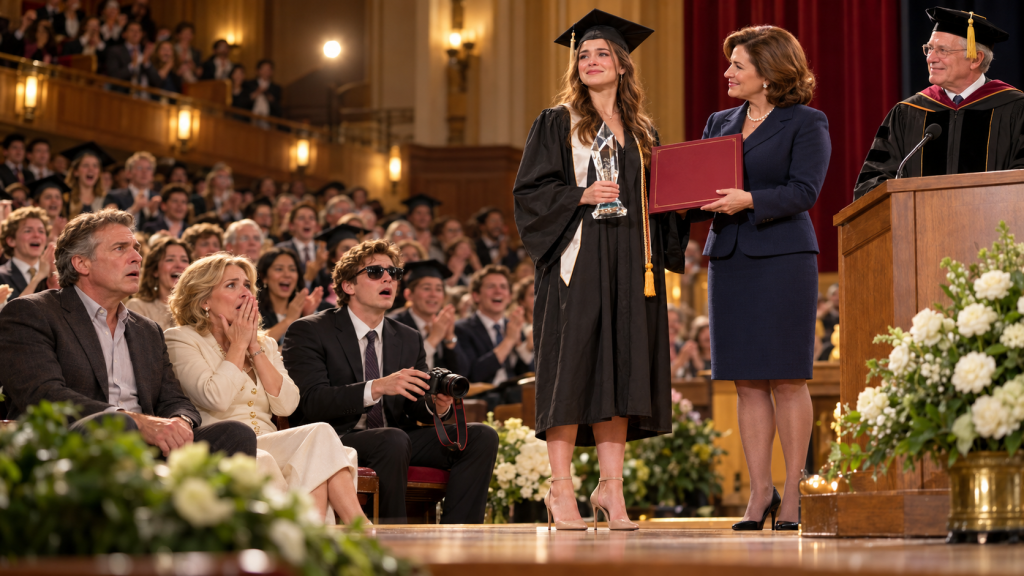
Marcus sat stiffly beside them, his expensive camera lying untouched near his shoes where he had dropped it.
Emma finally looked up from her phone.
For the first time that afternoon, my entire family was paying attention.
I wish I could tell you it felt good.
It didn’t.
It felt late.
There is a kind of attention that warms you.
And another kind that arrives only after strangers have announced your value loudly enough for your family to hear it.
That kind feels colder than silence.
I sat with the crystal award against my knees and the crimson Harvard folder tucked beneath my arm.
My father leaned toward me.
“Who else is here?”
“I don’t know.”
That was true.
He studied my face as if I had become a puzzle he was irritated not to have solved.
“You really didn’t tell anyone about Harvard?”
“I told people.”
His eyebrows lifted.
“Who?”
I looked toward Professor Liang in the faculty section.
“My professor knew.”
“Obviously.”
“My research team knew.”
Dad’s mouth tightened.
I added:
“My landlord knew.”
Marcus made a small choking sound that might have been laughter.
Dad stared at me.
“Your landlord knew before your family?”
“She helped me print the financial-aid paperwork.”
That silenced him.
Mom leaned across Marcus.
“Sarah, this is ridiculous. We’re your parents.”
“Yes.”
There was nowhere comfortable for the conversation to go after that.
So I faced the stage again.
When the ceremony ended, the auditorium exploded into movement.
Graduates shouted.
Families pushed into aisles carrying flowers.
Cameras flashed.
People hugged.
My mother stood immediately.
“We should get pictures.”
That almost made me laugh.
Twenty minutes earlier, she had wanted to be gone before four.
Now she was rearranging us beneath the university banner.
“Marcus.”
she said.
“Get the camera.”
He picked it up slowly.
Then looked at me.
“Do you want pictures?”
It was the first question anyone in my family had asked me all afternoon about what I wanted.
I looked at him for a moment.
“Yes.”
I said.
“One with all of us.”
He nodded.
Dad adjusted his jacket.
Mom smoothed my wrinkled graduation gown as though she had spent the morning worrying about how I looked.
The gesture made my throat tighten.
Not because it was loving.
Because I had wanted it so badly when I was younger.
A mother straightening my collar.
A father saying he was proud.
A brother taking my picture.
Simple things.
I should have been able to enjoy them.
Instead, every touch seemed to arrive with a question attached.
Would they have done this without the crystal award?
Without Harvard?
Without a room full of strangers clapping first?
Marcus handed his camera to another graduate’s father.
We stood together.
The man smiled.
“Proud family?”
Before anyone could answer, Dad said:
“Very.”
The word landed strangely.
The photograph was taken.
My family smiled.
I did too.
I still have that picture.
For years I hated it.
Now I keep it because photographs are allowed to contain contradictions.
We were smiling.
We were not healed.
Both things were true.
“Sarah?”
I turned.
Professor Liang was walking toward me.
He was a slight man in his late fifties with graying hair that never seemed to lie in the same direction twice.
For three years, he had supervised my research, corrected my calculations, forced me to eat when I forgot, and once driven through a snowstorm because I had texted him at midnight that a freezer alarm had gone off in the lab.
He hugged me.
Not politely.
Proudly.
“You did well.”
he said.
Three words.
I nearly cried harder hearing them from him than I had hearing Harvard.
“Thank you.”
He looked at my family.
I introduced them.
“Professor Liang, this is my mother, my father, my brother Marcus, and my sister Emma.”
My father immediately held out his hand.
“We’ve heard so much about you.”
Professor Liang shook it.
His expression did not change.
“I’ve heard very little about you.”
Silence.
I almost died.
Professor Liang was not being cruel.
That was the problem.
He was simply factual.
Dad laughed awkwardly.
“Sarah keeps to herself.”
Professor Liang looked at me.
Then back at Dad.
“Yes.”
he said softly.
“She learned to.”
My mother’s face changed.
Before she could answer, Professor Liang smiled toward me.
“Come.”
“Your guest is waiting.”
He led us toward a side hallway near the stage.
My family followed.
Of course they did.
At the end of the hallway stood an older woman in a blue dress holding a small bouquet of yellow tulips.
Her hair was almost completely white now.
I stopped so abruptly Marcus bumped into my shoulder.
“No.”
The woman smiled.
“Hello, Sarah.”
My crystal award nearly slipped from my hand.
“Mrs. Alvarez?”
My high school biology teacher started crying.
So did I.
There are people who enter your life for one school year and somehow remain forever.
Mrs. Marisol Alvarez had taught eleventh-grade biology.
She was the first adult who ever looked at one of my test papers and asked:
“Do you know how good you are at this?”
Not:
Why isn’t it a hundred?
Not:
Your brother did better in school.
Just:
Do you know?
I hadn’t.
When college application season came, Dad told me four-year universities were expensive and that there was “nothing wrong with starting practical.”
Marcus was already at Harvard Law by then.
Dad had framed his acceptance letter.
Mine never existed on the wall.
Mrs. Alvarez sat with me after school and helped me find scholarships.
She read my essays.
She drove me to a regional science competition when my parents said they were busy.
She paid one application fee when my checking account had $41 and the deadline was that night.
I paid her back three months later.
She pretended she had forgotten.
I never forgot.
She had retired after my first year of college.
We exchanged occasional emails.
Then life became busy.
I had not seen her in four years.
I put the award and Harvard folder on a chair and hugged her.
She smelled exactly the same.
Lavender soap and spearmint gum.
“You came.”
I whispered.
“Professor Liang called me.”
She pulled back.
“He said a young woman I used to know had become impossible.”
Professor Liang nodded.
“Accurate.”
I laughed through tears.
Mrs. Alvarez touched my cheek.
“I would not have missed this.”
Behind me, my family stood silent.
Mom finally asked:
“Were you Sarah’s teacher?”
Mrs. Alvarez turned.
“Yes.”
“High school biology.”
Mom smiled too brightly.
“Oh.”
“Sarah always loved science.”
Mrs. Alvarez looked at her.
Then at me.
I wanted to disappear.
But Mrs. Alvarez did something kinder than exposing them.
She simply said:
“She did.”
No accusation.
No correction.
Nothing my mother could fight.
That somehow felt worse.
Mrs. Alvarez gave me the tulips.
Then she reached into her handbag.
“I brought something else.”
She handed me a clear plastic sleeve.
Inside was a wrinkled sheet of notebook paper.
I recognized my own handwriting before I read a word.
A high school lab report.
At the top, in red ink, Mrs. Alvarez had written:
You think like a scientist. Don’t let anyone train that out of you.
My breath caught.
“You kept this?”
“You left it in my classroom.”
“For eight years?”
“You were dramatic enough that I suspected it might become historically significant.”
I laughed.
Then cried again.
Emma leaned over my shoulder.
“You wrote like that in high school?”
“Apparently.”
“It’s terrible.”
“Thank you.”
For a second we were sisters.
Not roles.
Just sisters.
Then Dad cleared his throat.
“We should celebrate.”
I looked at him.
He smiled.
“The steakhouse reservation is at four-thirty.”
I remembered Mom checking her watch.
Jessica waiting at the mall.
A dinner planned without anyone asking whether the graduate was coming.
“No.”
Dad blinked.
“What?”
“I’m not going.”
Mom frowned.
“Sarah.”
“I’m having dinner with Professor Liang, Mrs. Alvarez, and the lab group.”
The sentence had not been planned.
But once spoken, it felt right.
Dad’s expression hardened.
“We made reservations.”
“For yourselves.”
“That’s not fair.”
“Did anyone ask me where I wanted to eat?”
Silence.
Emma looked at the floor.
Marcus rubbed the back of his neck.
Mom said:
“We assumed you’d come.”
“You also assumed you needed to be finished before four.”
“That was before we knew—”
She stopped.
Every person in the hallway heard the missing words.
Before we knew you were important.
Mom’s face went white.
I did not rescue her.
Not this time.
She whispered:
“That isn’t what I meant.”
“I know.”
I picked up the Harvard folder.
“I’m still not going.”
Dad’s jaw tightened.
“So you’re going to embarrass us now?”
Professor Liang took one small step backward.
Mrs. Alvarez became very interested in her flowers.
I looked at my father.
“I’m going to dinner.”
“That is not humiliation.”
He stared at me.
I could see twenty-two years of habit in his face.
The assumption that discomfort meant I needed to fix something.
My pulse shook.
But my voice didn’t.
“I’ll call tomorrow.”
Then I left with the people who had been there before the applause.
Dinner was at a tiny Korean restaurant near campus.
Not a steakhouse.
No white tablecloths.
Six members of my research group pushed two tables together.
Someone ordered too much food.
Professor Liang made a toast so short it barely qualified.
“To Sarah.”
Everyone raised a glass.
“That’s it?”
I asked.
He nodded.
“Long speeches indicate insecurity.”
Mrs. Alvarez laughed.
I did too.
Halfway through dinner, my phone began vibrating.
Mom.
Dad.
Marcus.
Mom again.
I turned it face down.
Nobody at the table asked me why.
That kindness almost made me cry again.
At dessert, Mrs. Alvarez said:
“So.”
“Harvard.”
I smiled.
“Harvard.”
“Scared?”
“Terrified.”
“Good.”
I stared.
“Good?”
“People should be a little scared when they are walking toward something that matters.”
Professor Liang nodded.
“Fear is not data.”
Mrs. Alvarez looked at him.
“You scientists ruin everything.”
He seemed pleased.
Then she squeezed my hand.
“Go scared.”
That became another sentence I kept.
My father posted the graduation picture that night.
Of course he did.
I saw it while brushing my teeth.
Could not be prouder of our Sarah! Outstanding research award AND headed to Harvard Medical School. Hard work and strong family values pay off!
I stared at the caption.
Strong family values.
Something inside me went cold.
Hundreds of likes.
Comments.
You must be so proud!
What amazing parents!
All that support paid off!
A relative wrote:
Following in Marcus’s Harvard footsteps!
That one almost made me throw the phone.
Instead, I texted Dad.
Please change the caption.
He replied immediately.
Why?
Because you stopped helping with tuition two years ago and called my degree a waste. Do not tell people my acceptance is proof of support you didn’t give.
Three dots.
Gone.
Back.
This is petty.
I stared.
Then:
Take my photo down if you cannot write something truthful.
He called.
I did not answer.
He called again.
Then Mom.
I turned off the phone.
The next morning, the post was gone.
That was the first boundary.
Small.
Public.
Terrifying.
Moving to Boston should have felt like the victory scene.
It didn’t.
Victories involve cardboard boxes.
Security deposits.
Bad backs.
Missing screws.
Professor Liang helped me pack the lab materials I was taking.
Mrs. Alvarez mailed me a slow cooker.
My landlord, Mrs. Greene, gave me towels.
My family offered help only after Harvard was announced.
Dad called two weeks before the move.
“I can rent a truck.”
“I already have one.”
“I can pay.”
“I already paid.”
“Sarah.”
“What?”
“Let us help.”
I leaned against a box in my studio apartment.
That sentence would once have cracked me open.
I had wanted their help for years.
Now it arrived after they had proof I was going somewhere prestigious.
“I don’t know how to accept it.”
I said.
Dad went quiet.
For once, he did not defend himself.
“That’s fair.”
he whispered.
I closed my eyes.
It was the first useful thing he had said since graduation.
Then:
“Can I still come?”
I thought.
“Yes.”
He did.
So did Mom.
Marcus came too.
Emma claimed she had plans.
Then appeared with iced coffees.
We loaded boxes.
Awkward.
Normal.
Dad carried my desk down three flights of stairs without complaining.
At the truck, he looked at the cramped apartment.
“You lived here three years?”
“Two and a half.”
“How much was rent?”
I told him.
His eyebrows rose.
“And tuition?”
I told him what grants did not cover.
Then what I earned at the coffee shop.
He stared.
“You worked that much?”
“Yes.”
“Why didn’t you tell us?”
The old anger rose.
Then I realized he truly did not know.
Because he never asked.
I said it.
“You never asked.”
Dad looked as though I had slapped him.
He nodded once.
Then picked up another box.
No argument.
Progress, maybe.
Too early to know.
Boston was not waiting to crown me.
This was important.
For the first month at Harvard Medical School, I felt like a clerical error.
Everyone seemed brilliant.
Someone had published three papers.
Someone had run a public-health nonprofit.
Someone spoke four languages.
A classmate had been an Olympic alternate.
I had a crystal award in a box beneath my bed and still felt like the stupidest person in every room.
My first exam score was not disastrous.
It was average.
I cried anyway.
Six months earlier, average would have sounded absurd.
Now it felt like exposure.
I called Professor Liang.
He answered:
“Did you fail?”
“No.”
“What was your score?”
I told him.
Long silence.
“Sarah.”
“Yes?”
“I am hanging up.”
“Professor—”
“Eat dinner.”
Click.
I called Mrs. Alvarez.
She laughed for a full minute.
“You got into Harvard and discovered other smart people exist?”
“This is not funny.”
“It is extremely funny.”
“I hate you.”
“Eat dinner.”
Apparently mentorship had limited vocabulary.
Dr. Porter became my faculty adviser.
One afternoon, after I apologized for asking what I thought was a stupid question, she said:
“Stop performing intelligence.”
I stared.
“What?”
“You spend half your energy proving you deserve the chair.”
She pointed at it.
“You already have the chair.”
My throat tightened.
“What if someone realizes I shouldn’t?”
“Then they can file paperwork.”
I laughed.
She did not.
“I’m serious.”
Then:
“Who taught you that being uncertain was dangerous?”
I knew the answer.
I did not give it.
Not yet.
Healing also has prerequisites.
My family began calling more.
Much more.
Mom wanted to know what classes I was taking.
Dad asked about research.
Emma wanted photographs of Boston.
Marcus called least.
When he did, conversations felt brittle.
At Thanksgiving, I went home.
That was a mistake.
Or maybe a necessary one.
Dad had invited relatives.
Too many.
By the time I arrived, twenty-three people were in the house.
Aunt Carol hugged me.
“There’s our Harvard doctor!”
“I’m not a doctor.”
“Close enough.”
Uncle Pete said:
“Your father must be bursting.”
Dad smiled.
“She always had that Thompson work ethic.”
My stomach turned.
Then Mom added:
“We pushed all our kids.”
There it was.
Revision.
Not intentional, perhaps.
Families rewrite history because the old version becomes embarrassing.
I stood in the kitchen holding cranberry sauce while my parents transformed neglect into strategy.
“We knew Sarah needed independence.”
Mom told a cousin.
“She always worked better under pressure.”
I set the bowl down.
Too hard.
Mom looked at me.
“What?”
I whispered:
“Stop.”
The room nearest us quieted.
Mom frowned.
“Stop what?”
“Do not tell people you intentionally made things difficult so I would succeed.”
Her face went pale.
Dad approached.
“Sarah.”
“No.”
I looked at both of them.
“You stopped paying tuition without warning.”
“You told me molecular biology was impractical.”
“Dad called my lab job a hobby.”
“You complained that I worked holidays.”
“You compared every grade to Marcus.”
Dad’s face hardened.
“This is not the time.”
“That’s the problem.”
I said.
“There is never a time when the truth makes you look bad.”
The kitchen went silent.
Marcus stood in the doorway.
Emma behind him.
Mom whispered:
“Why are you doing this?”
“Because I cannot sit here while you turn what I survived into something you gave me.”
Her eyes filled.
I immediately felt guilty.
Of course.
Old training.
I breathed through it.
Dad said:
“We made mistakes.”
“Then say that.”
“We did the best we could.”
“That sentence does not mean the same thing.”
He stared.
I picked up my coat.
Mom began crying.
“Sarah, please.”
I kissed her cheek.
“I love you.”
Then:
“But I’m leaving.”
Dad followed me to the door.
“If you walk out every time someone says something wrong, you will spend your life alone.”
I turned.
The sentence landed in the oldest wound I had.
So I answered carefully.
“I spent years staying while people said things that hurt me.”
“I was alone then too.”
His face changed.
I left.
Marcus called that night.
I almost ignored it.
Then answered.
“You okay?”
he asked.
“Why?”
“Because Thanksgiving was a bloodbath.”
Despite myself, I laughed.
“You didn’t seem upset.”
“I was impressed.”
“Marcus.”
“What?”
“I’m not in the mood.”
He went quiet.
Then:
“I’m sorry.”
The words were so unexpected I checked the screen.
“For what?”
“Pick a category.”
I sat on my bed.
Marcus continued.
“The graduation stuff.”
“The comparisons.”
“Being an ass.”
“You’ll need specificity.”
“Therapy has ruined you.”
“I’ve been in Boston four months.”
“Same thing.”
I smiled faintly.
Then he sighed.
“I knew they stopped paying your tuition.”
My stomach tightened.
“You knew?”
“Yes.”
“How?”
“Dad complained about it.”
“What did he say?”
Marcus hesitated.
“That you needed to learn what the real world cost.”
I laughed bitterly.
“And your BMW?”
Silence.
“I know.”
“Your rent?”
“I know.”
“Law school?”
“I know.”
Anger rose hot.
“Then why didn’t you say anything?”
Marcus answered quietly.
“Because it was good for me.”
There.
Ugly.
Honest.
He continued.
“I liked being the one they thought was brilliant.”
“I liked that Dad introduced me first.”
“I liked the car.”
“The praise.”
“All of it.”
His voice cracked.
“And every time they compared you to me, I got to feel successful without actually doing anything that day.”
I had no answer.
Marcus continued.
“But there’s another part.”
I closed my eyes.
Of course.
“Dad built me into this thing I can’t live up to.”
I almost snapped.
Then stopped.
Both could be true.
He said:
“I graduated from Harvard Law and have been pretending for three years that I’m deciding what’s next.”
“What are you actually doing?”
“Failing.”
“Marcus—”
“I failed the bar twice.”
I sat up.
“What?”
Nobody had told me.
“Dad says I’m ‘taking time before the next attempt.’”
“Mom says I’m consulting.”
“I’m not consulting.”
“I take photographs.”
I thought of the camera.
The selfies.
The expensive lens Dad bought.
“You like photography.”
“I love it.”
“Then why do you act like it’s a joke?”
He laughed sadly.
“Because Dad spent two hundred thousand dollars telling everyone I was going to be a lawyer.”
My anger shifted.
Not vanished.
Shifted.
“Marcus.”
“Yeah?”
“Being trapped by praise is not the same thing as being starved of it.”
Silence.
“I know.”
Good.
“I’m not asking you to feel sorry for me.”
“What are you asking?”
“Nothing.”
He breathed.
“I think that’s the first time either of us has called the other without Dad standing between us.”
That hurt because it was true.
We talked for two hours.
Not fixed.
Started.
Emma apologized next.
By text.
Of course.
I was awful at graduation. I’m sorry.
I replied:
Thank you.
Then she wrote:
I didn’t know they stopped paying tuition.
I stared.
Then:
You were young.
She responded:
I was 18. That’s young, not blind.
Good girl.
She was learning faster than all of us.
My parents did not speak to me for eleven days after Thanksgiving.
Then Mom called.
“I miss you.”
Not:
You owe us an apology.
Not:
Your father is upset.
I miss you.
My anger softened immediately.
Dangerous.
I reminded myself softness was not surrender.
“I miss you too.”
She cried.
Then:
“I’m sorry.”
I waited.
“For saying we pushed you on purpose.”
I sat very still.
“We didn’t.”
There it was.
Mom’s voice trembled.
“We did not understand what you were doing.”
“And instead of asking, we decided it was less important than Marcus because law school made sense to us.”
My eyes filled.
She continued.
“Your father understood Harvard.”
“He understood law.”
“He understood the title.”
“He did not understand research.”
“Neither did I.”
“So we treated what we understood as more valuable.”
I whispered:
“That hurt.”
“I know.”
Then:
“I followed his lead.”
My stomach tightened.
“Why?”
Long silence.
“Because disagreeing with your father is exhausting.”
I almost laughed.
Then did not.
Mom continued.
“You were easier.”
That sentence broke me.
“What?”
“You were easier to disappoint.”
Her voice collapsed.
“You would go quiet.”
“Marcus would fight.”
“Your father would sulk.”
“You…”
She started sobbing.
“You would just work harder.”
I closed my eyes.
There it was.
The whole family system.
Mom whispered:
“I put the cost of peace on the child least likely to complain.”
I cried.
She did too.
Then I said:
“You do not get to fix that by bragging about me now.”
“I know.”
“Do you?”
“I’m trying.”
That became enough to continue.
Not enough to erase.
Enough to continue.
Dad was harder.
Pride usually is.
He sent me articles about medical school.
I did not answer most.
Then one Sunday morning, he called.
“Explain protein folding.”
I almost dropped the phone.
“What?”
“Your paper.”
“You read it?”
“I tried.”
“Why?”
He sounded irritated.
“Because apparently I should know what my daughter does.”
My eyes filled.
I sat at the kitchen table.
“Okay.”
I explained badly.
Proteins as chains.
How shape affects function.
How misfolding can contribute to disease.
Why our undergraduate project mattered but did not “cure Alzheimer’s,” despite what Aunt Carol was telling people.
Dad listened.
Asked questions.
Some were terrible.
One was surprisingly good.
At the end he said:
“I still don’t understand.”
I smiled.
“That’s okay.”
Then:
“I should’ve asked when you were nineteen.”
My throat closed.
“Yes.”
“I’m sorry.”
No speech.
No defense.
Three words.
Late.
Still real.
I did not invite my family to my white-coat ceremony.
That caused another fight.
Tickets were limited.
I invited Mrs. Alvarez and Professor Liang.
Dad said:
“We’re your parents.”
I said:
“Yes.”
He asked:
“Doesn’t that count?”
“It counts.”
“But it is not the only thing that counts.”
He was hurt.
I knew.
I let him be hurt.
That may have been the most important skill I learned in medical school.
Not anatomy.
Not pathology.
Allowing somebody I love to experience disappointment without immediately rewriting my decision.
Mrs. Alvarez came.
She cried before I even put the coat on.
Professor Liang criticized the tailoring.
Dr. Porter hugged me afterward.
I felt surrounded.
Not by the people who shared my blood.
By the people who had carried parts of the road.
That mattered.
Second year nearly broke me.
Medical school became relentless.
Lectures.
Labs.
Clinical skills.
Research.
Sleep became theoretical.
My old coping mechanism returned.
Work harder.
Need less.
Tell nobody.
Then one night I fainted in a library bathroom.
Nothing dramatic.
Exhaustion.
Dehydration.
A classmate found me.
I woke up embarrassed.
Dr. Porter was furious.
“You do not get extra credit for suffering privately.”
I stared.
That sentence sounded bigger than medicine.
She continued.
“Ask for help before your body asks for you.”
I hated her.
Then called Mom.
Not because I needed money.
Because I needed my mother.
She answered at 1:14 a.m.
“Sarah?”
I started crying.
“Can you just stay on the phone?”
Silence.
Then:
“Yes.”
No questions.
No advice.
She stayed for forty-seven minutes while I breathed.
That was the beginning of a different relationship with her.
Not mother worshipping successful daughter.
Mother staying awake with tired child.
At twenty-four.
Still needed.
I let myself need her.
That was growth too.
Dad changed more slowly.
He came to Boston once without announcing a family tour.
Just him.
He took me to lunch.
Asked about classes.
Did not mention Marcus.
Not once.
I noticed.
At the end he handed me an envelope.
My shoulders stiffened.
“What is this?”
“Money.”
“No.”
“Sarah.”
“I don’t need it.”
“I know.”
That surprised me.
“Then why?”
He looked embarrassed.
“When we stopped paying your tuition…”
I froze.
He continued.
“I told myself we were teaching you responsibility.”
“But we were still paying Marcus’s expenses.”
“Yes.”
“I know.”
“I added up what we would have contributed if we had treated you similarly.”
My stomach turned.
I pushed the envelope back.
“I don’t want compensation.”
“I know.”
“Then why are you doing this?”
Dad’s eyes filled.
“Because apologies without repair can become another way of asking the injured person to carry everything.”
I stared.
Where had he learned that?
Apparently old men could use the internet too.
“I don’t want it.”
He nodded.
“Okay.”
No argument.
He put the envelope away.
That mattered more than the money.
A year later, I asked him to donate the amount to a scholarship for students doing unpaid research.
He did.
No plaque with our family name.
My condition.
He agreed.
That was repair I could live with.
Marcus moved out of the pool house.
At twenty-nine.
The family acted as if civilization had been restored.
He did not take the bar again.
Dad nearly had a nervous breakdown.
Marcus rented a small apartment and began doing commercial photography.
At first badly.
Then better.
He photographed weddings.
Restaurants.
Real estate.
Eventually portraits.
Dad refused to tell people for months.
Then one day, at a family dinner, Uncle Pete asked:
“So when are you taking the bar again?”
Before Marcus could answer, Dad said:
“He’s a photographer.”
Silence.
Marcus looked at him.
Dad continued:
“He’s good.”
Marcus cried in the bathroom afterward.
I know because he called me.
“I hate him.”
he whispered.
“No, you don’t.”
“I know.”
We laughed.
Golden children need to be allowed to become human too.
That never made what happened to me fair.
But fairness did not require me to stay angry at Marcus forever.
He had not built the altar.
He had enjoyed standing on it.
Then climbed down.
That mattered.
My relationship with Dad did not become sentimental.
We were too similar.
That was another discovery.
Both stubborn.
Both defensive.
Both able to turn hurt into efficiency.
One Christmas he said:
“You get that from me.”
I said:
“Unfortunately.”
We argued.
Then ate pie.
Family.
During my third year of medical school, Dad had a heart attack.
Mild.
If heart attacks can be called mild.
Mom called at six in the morning.
I answered half asleep.
“Sarah, we’re at St. Joseph’s.”
Everything inside me became medical.
Then I stopped.
I was his daughter.
Not his cardiologist.
“What did the doctors say?”
I asked.
Mom told me.
I translated some terms.
Not decisions.
Then booked a flight.
At the hospital, Dad looked small.
That frightened me more than any monitor.
He tried to make a joke.
“Finally useful having a doctor in the family.”
“I’m still a student.”
“Details.”
Then his face changed.
“Sarah.”
“What?”
“If I die—”
“No.”
“Listen.”
I did.
“I need to tell you something before anesthesia makes me inspirational.”
I almost smiled.
Dad stared at the blanket.
“I knew I treated you differently.”
My heart stopped.
“You knew?”
“Not how badly.”
He looked at me.
“But yes.”
“Why?”
His eyes filled.
“Marcus was the son.”
Simple.
Ugly.
Old.
I stared.
Dad continued quickly.
“Not because I loved him more.”
“I grew up thinking sons carried something.”
“Name.”
“Status.”
“Whatever stupid thing men tell themselves.”
My stomach twisted.
“And me?”
“You reminded me of your mother.”
I did not understand.
“She was smarter than me.”
Dad smiled sadly.
“She always was.”
“But she made herself smaller so I could feel like I was leading.”
My eyes filled.
“You saw me doing something she never did.”
“What?”
“Not shrinking.”
The answer shocked me.
Dad continued.
“I think part of me admired you.”
“Part of me punished you for making me feel unnecessary.”
There are apologies that make you feel better.
That one did not.
It made history rearrange itself.
“You stopped paying tuition because I made you feel unnecessary?”
“No.”
He shook his head.
“That would make it sound conscious.”
“It wasn’t.”
“I told myself science was impractical.”
“I told myself Marcus’s path was clearer.”
“I told myself you needed toughness.”
“But underneath…”
He swallowed.
“I understood him.”
“I didn’t understand you.”
“And instead of admitting that, I treated the thing I understood as superior.”
Tears filled my eyes.
He whispered:
“I’m sorry.”
I held his hand.
Not because everything was repaired.
Because he was my father and he was scared.
“You don’t get to die today.”
I said.
He smiled.
“Bossy.”
“Genetic.”
He survived.
After the hospital, Dad changed in ways no speech could fake.
He stopped comparing us.
Completely.
When relatives did, he corrected them.
If someone said:
“Two Harvard kids, you must be proud.”
Dad answered:
“I’m proud of all three.”
Emma once whispered to me:
“He finally remembers I exist.”
We laughed.
Then felt bad.
Then laughed again.
Emma had spent years as the invisible younger sister beneath the two “successful” children.
Family hierarchies harm people in every seat.
She eventually studied graphic design.
Dad asked what that meant.
Emma said:
“You can Google it.”
He did.
Progress has a sense of humor.
I graduated from Harvard Medical School four years after college.
This time my family knew.
There was no secret folder.
No dramatic reveal.
No woman rising from the front row.
I had six tickets.
I invited Mom.
Dad.
Marcus.
Emma.
Mrs. Alvarez.
Professor Liang.
Dr. Porter already had faculty obligations.
When I mailed the tickets, Dad called.
“Are you sure?”
“Yes.”
“All of us?”
“Yes.”
He was quiet.
Then:
“Thank you.”
Not entitlement.
Gratitude.
That mattered.
On graduation morning, I stood in my apartment wearing the gown.
Different school.
Different person.
The first graduation gown had been wrinkled because I ironed it badly in a studio apartment at midnight after a coffee-shop shift.
This one was professionally pressed.
Mom insisted.
Some things can be accepted once they stop being currency.
My family arrived together.
Marcus carried a camera.
Of course.
He pointed it at me.
“Ready?”
I smiled.
“Take the picture.”
Dad stood beside him.
Then stepped away.
“Get one of her alone first.”
I looked at him.
Small thing.
Huge thing.
Marcus photographed me.
Just me.
No family proof.
No parental caption.
A woman in a black gown, smiling because she wanted to.
Then we took the family picture.
Mrs. Alvarez cried through the whole ceremony.
Professor Liang pretended he had allergies.
When my name was called:
“Sarah Elizabeth Thompson.”
I crossed the stage.
No crystal award.
No surprise.
No vindication.
Just my name.
That was enough.
Afterward, Dad hugged me.
He whispered:
“I’m proud of you.”
I pulled back.
For a second, the twenty-two-year-old in me rose.
The girl who had wanted those words until wanting them felt humiliating.
I looked at my father.
Older.
Humbler.
Still imperfect.
“I know.”
I said.
And I did.
That was new.
I matched into neurology.
Partly because of the research that began in Professor Liang’s lab.
Partly because brains remained the most mysterious thing I had ever encountered.
We spent years studying diseases that can steal memory, movement, language, identity.
There was a painful irony in that.
My entire childhood had been shaped by people refusing to see who I was.
Then I built a career around trying to preserve the parts of people that let them remain themselves.
I loved the work.
I hated the hours.
Medicine cured me of romantic ideas about medicine.
Patients died.
Research failed.
Papers were rejected.
Experiments produced nothing.
I was not the genius graduation speeches suggested.
I was persistent.
That mattered more.
My first major paper after residency took three years.
It did not cure anything.
Important.
It contributed one small piece to understanding how certain cellular pathways behaved in neurodegenerative disease.
Science is usually like that.
Tiny bricks.
Many hands.
No orchestra playing in the background.
When it was published, Dad called.
“I read it.”
I laughed.
“No, you didn’t.”
“I read the abstract.”
“That counts more.”
“I understood four words.”
“Which?”
“Disease.”
“Protein.”
“Patient.”
“And Sarah.”
I laughed until I cried.
Then Dad said:
“I understood that one first.”
That was one of the last conversations we had before his health declined.
He developed Parkinson’s disease in his seventies.
Life enjoys symmetry far too much.
By then I was a neurologist.
I did not treat him.
Never even considered it.
I went to appointments as his daughter when he wanted me there.
Sometimes he asked medical questions.
I answered.
Sometimes he asked:
“Is this going to get worse?”
I told him the truth.
“Yes.”
Then:
“We’ll handle what comes.”
For a man who once valued certainty, losing control was brutal.
He hated needing help.
One afternoon, after Mom buttoned his shirt because his fingers would not cooperate, he started crying.
“I’m useless.”
The word hit me.
Failure.
Waste.
Useless.
Old family vocabulary.
I sat beside him.
“No.”
He looked angry.
“Don’t patronize me.”
“I’m not.”
“What am I useful for?”
I thought.
Then:
“Why does that have to be the test?”
He stared.
I continued.
“You spent years measuring all of us by output.”
“Grades.”
Careers.”
“Titles.”
“What if a person does not have to earn the right to take up space?”
Dad cried.
So did I.
He whispered:
“Did I do that to you?”
“Yes.”
He closed his eyes.
“I’m sorry.”
“I know.”
Then I helped him drink water.
Not because he had finally apologized enough.
Because love had grown into something that no longer required pretending the past had not happened.
Dad died when I was thirty-six.
No dramatic bedside revelation.
Mom held one hand.
I held the other.
Marcus and Emma were there.
His last clear sentence was to Mom.
“Turn that television off.”
She laughed through tears.
Classic.
At the funeral, relatives talked about his children.
The lawyer.
Except Marcus had never become one.
The doctor.
The designer.
Dad would have corrected them.
Not titles.
Names.
He had finally learned.
After the funeral, I found the old graduation program in his desk.
My college graduation.
Folded.
Inside, Dad had written something years after the ceremony.
I recognized the shaky handwriting from the beginning of his Parkinson’s.
I called this a waste before I understood what she had built. The waste was how long it took me to ask.
I sat on the floor and cried harder than I had at the funeral.
Because change does not erase history.
But it can leave evidence.
That matters.
Mom changed too.
After Dad died, she called me one afternoon.
“I found something.”
“What?”
“A box.”
Dangerous words from mothers.
Inside were school things.
Marcus’s trophies.
Emma’s drawings.
My science fair certificates.
I laughed.
“You kept them?”
“Yes.”
“Why didn’t you put them up?”
Silence.
Then:
“I don’t know.”
Honest.
That was enough.
She mailed them to me.
I did not frame them.
I did not need to.
I kept Mrs. Alvarez’s lab report though.
You think like a scientist. Don’t let anyone train that out of you.
That one stayed above my desk for decades.
Mrs. Alvarez attended my wedding.
Yes.
I eventually found time for a personal life.
His name was Noah.
He taught history at a public high school.
When we met, he had never heard of my paper.
Never cared that I went to Harvard.
At our third date, he asked:
“What do you do when you’re not being impressive?”
I nearly left.
Then laughed.
Good question.
I learned.
Cooking badly.
Walking.
Old movies.
Reading novels without taking notes.
Loving someone who did not require performance.
Noah once said:
“You apologize every time you need something.”
I replied:
“No, I don’t.”
Then apologized for arguing.
Therapy continued.
We had one daughter.
Elena.
When she was nine, she came home with a C on a math test.
I felt panic.
Not because of the grade.
Because some ancient voice inside me said:
Fix it.
Push.
Compare.
Prepare.
Instead, I asked:
“How do you feel about it?”
She shrugged.
“Bad.”
“Do you understand what went wrong?”
“Fractions are evil.”
“Reasonable.”
We got ice cream.
Then found a tutor.
That sounds small.
It was not.
Breaking family patterns rarely looks cinematic.
Sometimes it looks like not making a nine-year-old’s report card into evidence about her future.
When Elena was twelve, she quit violin.
I had purchased a good one.
Not extravagant.
Still expensive.
My first thought:
Do you know how much that cost?
I swallowed it.
“What do you want to do instead?”
“Soccer.”
I hate soccer.
I bought cleats.
Noah laughed at me for weeks.
Worth it.
Marcus became genuinely successful as a photographer.
Not celebrity successful.
Working successful.
Bills paid.
Clients.
A small studio.
He took my professional headshot when I became director of a research program.
He charged me.
I was offended.
“You’re my brother.”
“Exactly.”
“I know your budget.”
I paid.
Family healing has limits.
Emma built a design career and eventually moved across the country.
She remained the funniest of us.
At one Thanksgiving, years later, Dad before he died had looked around the table and said:
“I got three impressive children.”
Emma answered:
“No.”
“You got three children.”
The room went quiet.
Then Dad smiled.
“You’re right.”
I still think about that.
Three children.
Not CVs.
Not proof.
Children.
People.
The Harvard folder stayed in a drawer for years.
Crimson.
Heavy paper.
My name.
The object I once believed would finally prove something.
Eventually the color faded slightly along one edge.
I took it out while moving offices one day.
Noah looked over my shoulder.
“What’s that?”
“My acceptance.”
He smiled.
“You kept it?”
“Apparently.”
“You going again?”
“Absolutely not.”
I laughed.
Then I realized something.
At twenty-two, that folder felt like armor.
Proof that my family had been wrong.
Proof I mattered.
At forty-five, it was paper.
Important paper.
Beautiful paper.
But paper.
Harvard had opened doors.
It had trained me.
Challenged me.
Given me mentors.
Changed my career.
It had not created my worth.
That had existed before the crimson crest.
Before Dean Morrison said my name.
Before the award.
Before applause.
Even before Mrs. Alvarez wrote that sentence in red ink.
Recognition is not creation.
A person does not become valuable at the moment someone notices.
That lesson took me longer than medical school.
Years later, my undergraduate university invited me back to give a commencement address.
I almost declined.
Then Professor Liang called.
He was retired.
Still rude.
“You should do it.”
“Why?”
“Free lunch.”
I laughed.
Then accepted.
The auditorium had been renovated.
New seats.
Better lights.
Same stage.
I stood backstage holding note cards I never used.
No crystal award waiting.
No Harvard representative.
No family surprise.
Mom was in the audience.
Marcus too.
Emma watched online.
Mrs. Alvarez had died two years earlier.
That absence hurt.
Professor Liang sat in the front row asleep before I even began.
Perfect.
I walked to the podium.
Hundreds of graduates looked back.
Some families carried flowers.
Some phones.
Some pride.
Some impatience.
Some complicated things nobody else could see.
I thought of the girl in the wrinkled gown.
Then I began.
I did not tell them the entire story.
Not publicly.
But I told them one part.
“There may be people in your life who understand your path before your family does.”
The room grew quiet.
“There may be people who love you and still underestimate you.”
“Those things can exist together.”
I looked toward Mom.
Her eyes filled.
I continued.
“Do not build your entire future around proving somebody wrong.”
“That is still giving them authorship.”
My voice shook slightly.
“Build because the work matters to you.”
“Build because curiosity keeps you awake.”
“Build because there is a life you want to meet.”
“And if applause comes later, enjoy it.”
“But do not confuse applause with permission.”
Professor Liang opened one eye.
Probably checking whether I was almost done.
I smiled.
Then:
“You were allowed to begin before anyone clapped.”
That was the sentence I wished someone had said to me at twenty-two.
So I said it to them.
Afterward, a young woman waited near the stage.
She wore a graduation gown and looked terrified.
“Dr. Thompson?”
“Yes?”
“My parents think I’m making a mistake.”
“What are you studying?”
“Biochemistry.”
I smiled.
Dangerous territory.
She continued.
“They want me to go into finance.”
“They say research doesn’t pay.”
I almost laughed.
Family traditions apparently reproduce outside bloodlines.
She looked at me.
“What should I do?”
For one second, I wanted to give her everything.
Advice.
Strategy.
Scholarships.
Warnings.
Then I remembered Dr. Porter.
You already have the chair.
I asked:
“What do you want?”
The girl looked startled.
Nobody had asked.
I knew that face.
She whispered:
“I want research.”
“Then learn what that life actually requires.”
“Talk to people doing it.”
“Understand the money.”
“The training.”
“The sacrifices.”
“Then choose with open eyes.”
She nodded.
“And if my parents are still angry?”
I smiled.
“Let them be disappointed.”
Her eyes widened.
“It won’t kill them.”
That was perhaps the most useful thing I ever taught.
Mom waited for me afterward.
She was older now.
Smaller.
She hugged me.
“You were good.”
“Thanks.”
Then:
“Your father would have cried.”
I smiled.
“He would have complained the speech was too long.”
“That too.”
We walked through the lobby.
A display case held old university awards.
Not mine.
Mine lived somewhere in my office closet.
Mom said:
“I still think about your graduation.”
“So do I.”
“I wish I could go back.”
I looked at her.
“To change it?”
“Yes.”
“What would you do?”
She thought.
“Bring flowers.”
I laughed.
Then she started crying.
“And ask where you wanted dinner.”
That broke me.
Such a small thing.
Exactly the right thing.
I put my arm around her.
“You can’t go back.”
“I know.”
“But you asked later.”
She nodded.
Sometimes repair is not dramatic.
Sometimes it is simply learning the question you should have asked decades earlier.
Mom died in her sleep at eighty-two.
Peacefully.
By then, there was nothing essential left unsaid between us.
Not because we solved every wound.
Because we stopped pretending the wounds did not exist.
At her funeral, Marcus took pictures.
Not for social media.
For us.
One photograph showed the three of us standing together.
Older.
No parents.
No hierarchy.
Just siblings.
Marcus held the camera timer remote.
Emma leaned into me.
I looked tired.
Real.
It became my favorite family photograph.
No one was proving anything.
Professor Liang lived to ninety-one.
At ninety, he still emailed comments on my papers.
Mostly punctuation.
He died after a brief illness.
At his memorial, one of his former students said:
“He taught us that science was an argument with reality, and reality always gets the last revision.”
That sounded like him.
I went home and cried.
Then pulled out the first paper I had published with him.
My name second.
His first.
I remembered vending-machine dinners.
Coffee shifts.
The studio apartment.
The hidden Harvard email.
All of it.
Not as a revenge story.
A life.
That distinction mattered.
Dr. Porter eventually became dean.
Of course she did.
When she retired, I told the story of fainting in the library bathroom.
She glared at me from the front row.
Then I quoted her:
“Stop performing intelligence.”
The audience laughed.
She did not.
Later, she hugged me.
“You finally learned.”
“Mostly.”
“Good enough.”
High praise.
My daughter Elena never went to Harvard.
She attended a state university.
Studied environmental engineering.
My father, had he remained the man he was at my first graduation, might have asked why not something more prestigious.
I did not.
At her graduation, Noah and I arrived three hours early.
With flowers.
Ridiculous flowers.
Too many.
I checked my watch once.
Elena saw.
“Bored already?”
“Your father made us come at dawn.”
Noah protested.
She laughed.
When her name was called, I screamed.
Actually screamed.
A woman beside me jumped.
I apologized.
Then kept clapping.
Afterward, Elena walked toward us in a wrinkled gown.
My heart stopped for half a second.
Same wrinkles.
Different life.
I hugged her.
“Where do you want dinner?”
She looked surprised.
Then smiled.
“Thai.”
Noah hates Thai.
We went.
That may be the moment the story truly ended.
Not Harvard.
Not my father’s apology.
My daughter walking across a stage and never once wondering whether her family wanted to be somewhere else.
Years after that, I found the crystal award while cleaning my office.
Outstanding Undergraduate Research Award.
The object that once caught the auditorium lights while my family stared.
I held it.
Heavy.
Beautiful.
Then put it in a box to donate to the university archive.
Noah looked shocked.
“You’re giving it away?”
“Yes.”
“Why?”
“I don’t need it anymore.”
He smiled.
“Very evolved.”
“Don’t be sarcastic.”
“I would never.”
I kept the high school lab report.
Of course.
Recognition from institutions became less important with time.
The sentence from one teacher who saw me before any institution did remained priceless.
People sometimes hear the beginning of my story and assume the satisfying part is my family’s faces when Harvard was announced.
My father frozen.
My mother pale.
Marcus dropping his camera.
I understand why.
There is a clean pleasure in imagining the people who underestimated you being forced to watch you succeed.
For a few minutes, I felt it too.
But humiliation is a poor substitute for healing.
Their shock lasted seconds.
The real work took years.
Learning to say:
You hurt me.
Learning not to accept rewritten history just because the rewrite was flattering.
Learning to let parents feel ashamed without comforting them out of it.
Learning that an apology can matter without erasing what came before.
Learning that siblings can be both participants in your pain and casualties of the same family system.
Learning to receive love when it finally arrives without pretending it arrived on time.
That was harder than getting into Harvard.
Much harder.
My father once called me a failure.
Maybe not directly to my face that day.
He leaned toward my mother and believed his whisper was quiet enough.
“We’re finally done wasting money on this failure.”
I heard him.
For years, I remembered every word.
Then age changed the sentence.
Not because it stopped being cruel.
Because I finally understood it had never been an accurate measurement of me.
It had been evidence of the limits of the man speaking.
He did not understand my field.
He understood status.
He understood his son’s path.
He understood money he could count and titles he could explain at dinner parties.
He saw what fit inside his existing map and treated everything outside it as dangerous or foolish.
I happened to live outside the map.
Eventually, he expanded it.
Too late for my childhood.
In time for part of my adulthood.
I chose to let that matter.
Someone else might not have.
That would have been valid too.
Forgiveness is not a moral tax children owe parents for getting older.
Marcus once asked me whether I would have become as driven if Dad had supported me.
I hated the question.
It sounded like pain had been useful.
“No.”
I said.
He looked surprised.
“You don’t think it motivated you?”
“It did.”
“But that doesn’t make it good.”
I thought for a moment.
“If someone breaks your leg and you become an excellent swimmer during rehabilitation, you do not thank them for the fracture.”
Marcus laughed.
“That’s very doctor.”
“It’s very accurate.”
I became disciplined partly because support was unreliable.
I became private because joy felt unsafe.
Those skills helped me survive.
Then I spent years learning when not to use them.
That is the part people forget when they romanticize adversity.
Survival skills have expiration dates.
Some become cages.
My father’s whisper did not create my ambition.
Harvard did not create my intelligence.
The crystal award did not create my work.
And applause did not create my worth.
They were all reflections.
Some late.
Some accurate.
Some useful.
None original.
Long before the auditorium.
Long before Boston.
Long before anyone stood up holding a crimson folder, I was already the person doing the work.
At two in the morning.
In a basement lab.
In a coffee-stained apron.
In a studio apartment where I opened an acceptance email alone and covered my mouth so my neighbors would not hear me cry.
That girl did not need an auditorium to become real.
She needed to stop waiting for permission to believe herself.
That took longer.
But she got there.
The crimson folder sits in my study now.
Not displayed.
In a drawer beneath old photographs.
Sometimes my grandchildren find it.
“Grandma, you went to Harvard?”
They ask it like I secretly went to the moon.
“Yes.”
“Were you smart?”
“Occasionally.”
They laugh.
Then ask for cookies.
Perfect.
They do not know Harvard as a family altar.
It is simply one place Grandma studied.
Exactly as it should be.
I kept one other thing from that first graduation.
The photograph.
My father beside me.
Mom.
Marcus holding no camera because someone else took the picture.
Emma half-smiling.
Me in the wrinkled gown.
For years I thought the picture was dishonest.
Now I think it is simply incomplete.
Like every photograph.
It does not show Dad’s whisper.
It does not show Harvard in my folder.
It does not show Mrs. Alvarez waiting down the hallway.
It does not show the Thanksgiving fight to come.
The hospital room.
The apologies.
The years.
It captures one second when a family stood together before any of us understood how much work it would take to become one.
I keep it because we did the work.
Not perfectly.
Enough.
If I could go back to the twenty-two-year-old Sarah sitting in that auditorium, I would not tell her:
Just wait until they see Harvard.
I would not tell her:
You’re going to prove them wrong.
That still centers them.
I would sit beside her.
Ignore the watch-checking.
Ignore Marcus’s sunglasses.
Ignore her father’s whisper.
And I would say:
“You do not have to become extraordinary to justify how badly it hurt to be overlooked.”
That is the sentence she needed.
If Harvard had rejected me, Dad’s cruelty would still have been cruel.
If my research had failed, neglect would still have been neglect.
If I had become a perfectly ordinary laboratory technician with a tiny apartment and no awards, I would still have deserved parents who asked what I cared about.
Success did not retroactively make me worthy of love.
I had always been worthy.
That realization was the real acceptance letter.
And no one else could sign it.
Dean Morrison probably forgot that graduation years ago.
Dr. Porter remembered.
Mrs. Alvarez remembered until she died.
My family certainly remembered.
But for me, the most important moment was not when the dean lifted the crystal award.
Not when Dr. Porter opened the crimson folder.
Not even when the auditorium stood.
It came afterward.
Years afterward.
My father, hands trembling from Parkinson’s, trying to button his shirt.
Me sitting beside him.
Neither of us performing.
Neither of us impressive.
And him asking:
“What am I useful for now?”
That was when I finally understood how deeply the same belief had damaged both of us.
Worth had always been tied to usefulness.
Marcus’s prestige.
My achievement.
Dad’s ability to provide.
Mom’s ability to keep peace.
We had all been auditioning for our place at the table.
I looked at him and said:
“You don’t have to be useful to be loved.”
The words left my mouth.
Then came back to me.
Across years.
Across graduations.
Across every bathroom mirror where I had practiced smiling.
I finally heard them too.
You do not have to be useful.
Or brilliant.
Or admitted.
Or awarded.
Or first.
You do not have to cross a stage carrying proof.
You can simply exist.
And still belong.
Dad cried.
So did I.
That was our real graduation.
The day I received my Harvard acceptance, I thought my life had opened.
It had.
But not in the way I imagined.
Harvard gave me medicine.
Research.
Mentors.
Friends.
A career I loved.
It also gave me enough distance from my family to see them clearly.
Not monsters.
Not saints.
People carrying old rules they had never questioned.
Some changed.
Some changed slowly.
Some wounds remained tender until the people who made them were gone.
That is family too.
Not the absence of injury.
Sometimes the willingness to stop passing it forward.
At my daughter’s graduation, after Thai food, Elena handed me a folded piece of paper.
“What’s this?”
“Nothing.”
Dangerous.
I opened it.
A copy of a scholarship acceptance.
Not Harvard.
A fellowship for an environmental project overseas.
I looked up.
“When did you get this?”
“Three months ago.”
I froze.
She laughed.
“You should see your face.”
“Why didn’t you tell me?”
She shrugged.
“I wanted to decide by myself before everyone had an opinion.”
For half a second, fear stabbed me.
History.
Then I stopped.
My daughter had not hidden joy because she feared I would crush it.
She had protected a decision because she wanted ownership.
Different.
I smiled.
“Have you decided?”
“Yes.”
“Going?”
“Yes.”
“Scared?”
“Terrified.”
I heard Mrs. Alvarez.
Go scared.
I hugged Elena.
“I’m proud of you.”
She whispered:
“I know.”
And something inside me completed a circle.
Not because she needed my pride.
Because she trusted it enough not to chase it.
That was everything.
The woman from Harvard with the crimson folder changed the room that day.
But she did not change me.
Neither did the crystal award.
My family’s faces changed.
Their voices changed.
Eventually their behavior changed.
Mine did too.
Still, the most beautiful thing that came from all of it was not becoming the daughter they could brag about.
It was becoming a woman who no longer needed to be.
A doctor.
A scientist.
A wife.
A mother.
A mentor.
A daughter.
None of those titles were the foundation.
They were rooms in the house.
I was the house.
I had been standing all along.
And when I think back to that auditorium now, I no longer hear my father’s whisper first.
I hear Dean Morrison saying my name.
I hear applause.
I hear Marcus’s camera hitting the floor.
I hear Mrs. Alvarez laughing in the hallway.
I hear Mom asking years later where I wanted dinner.
I hear Dad saying he should have asked sooner.
I hear my daughter saying, “I know,” when I tell her I’m proud.
One painful sentence does not get to own an entire life.
That may be the final lesson.
My father once thought he was done wasting money on a failure.
He was wrong about almost every word.
I was never a failure.
My education was never a waste.
And in the years that followed, he discovered something neither of us expected:
He was not done investing in me.
He simply had to learn that the most important investment was no longer money.
It was attention.
Listening.
Humility.
Time.
He gave those things late.
I accepted them carefully.
And together, for the years we still had, we built something that had been missing from every graduation photograph before that day.
A relationship in which I did not have to succeed before he looked at me.
By then, I had already learned how to look at myself.
And that was why, in the end, the applause could finally stop.
I no longer needed it to know who I was.
THE END STORIES! THANK YOU FOR READING GOOD LUCK !❤️
Related Posts