➡️ PART 3 ENDING PART ➡️
“There’s another detail.”
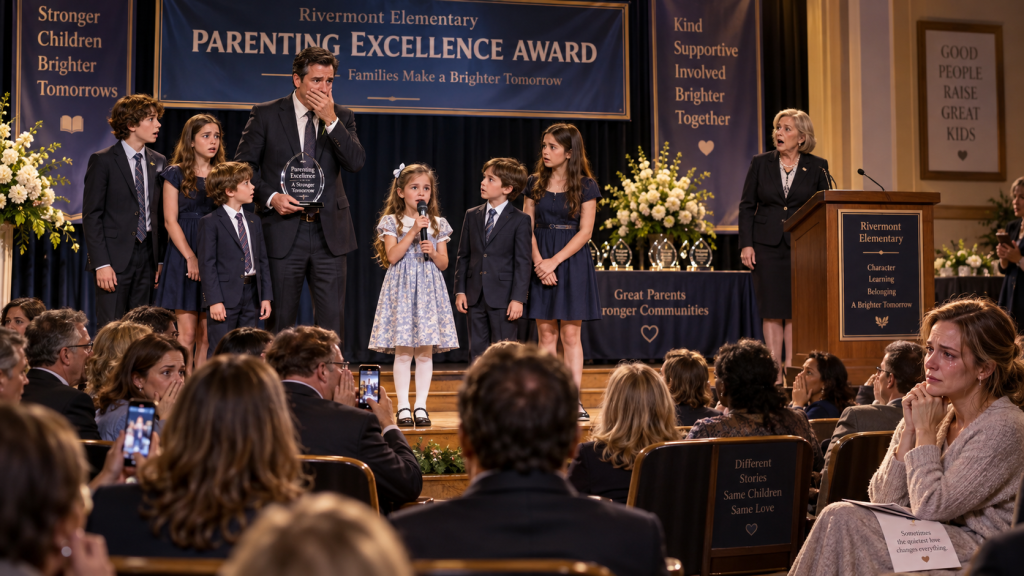
Lily’s small voice traveled through the auditorium.
My oldest son, Daniel, had quietly locked the auditorium doors.
Not because he intended to trap anyone.
I learned later that the principal had asked him to keep the side entrance closed while the award ceremony was being recorded, so people wouldn’t wander through the background.
But at that moment, the sound of the latch clicking seemed enormous.
Final.
Richard heard it too.
His eyes moved from Daniel to Lily.
Then to me.
For the first time in twenty-three years of marriage, I saw something on my husband’s face that I had almost never seen before.
Fear.
Not guilt.
Not remorse.
Fear.
Fear that the room might finally see him without the lighting he had spent years arranging.
“Lily,” I said gently, “sweetheart, you don’t have to say anything else.”
She looked at me.
“But it’s true.”
“I know.”
“Then why can’t I say it?”
That question broke something inside me.
Not because she was wrong.
Because she was seven.
Seven-year-olds should worry about spelling tests and scraped knees and whether they can have another cookie.
They should not become witnesses in their parents’ marriage.
I walked toward the stage.
Richard immediately stepped down to meet me.
“Get them under control.”
he whispered.
I stopped.
Them.
Our children.
Not comfort them.
Not ask why they were hurting.
Control them.
I looked at the man I had married.
And suddenly, something became very clear.
Richard had never been most afraid of being a bad husband.
He was afraid of looking like one.
There is a difference.
A devastating one.
“Mommy.”
Lily called.
I climbed the stairs.
The principal looked uncertain.
Several teachers stood near the curtain.
Hundreds of faces watched us.
Phones were still raised.
I hated that.
Whatever happened next, I did not want my children turned into entertainment.
I crouched in front of Lily.
“Give me the microphone.”
She hesitated.
“I have to tell them.”
“No.”
Her face fell.
I touched her cheek.
“You already told the most important truth.”
“What?”
“That I take care of you.”
She nodded.
“And I know you wanted people to know.”
Another nod.
“Thank you.”
I kissed her forehead.
“But the rest belongs to the grown-ups.”
Behind me, Richard exhaled.
Relief.
He thought I was saving him.
Again.
I stood.
Lily handed me the microphone.
I looked out at the auditorium.
I had spent years avoiding attention.
Richard loved rooms.
I loved edges.
He could enter a party and somehow become the center without appearing to try.
I had learned to stand beside walls.
Hold coats.
Find missing children.
Remember who needed to leave early.
That night, for once, I stood beneath the lights.
“My daughter is seven.”
I said.
My voice shook.
“She loves both of her parents, and she should not be responsible for explaining our marriage to an auditorium full of adults.”
A few phones lowered.
“Please.”
I continued.
“If you are recording my children, stop.”
More phones lowered.
Not all.
But many.
I turned toward Richard.
He stared at me.
Waiting.
“Fix this.”
he mouthed again.
I remembered every time I had fixed something for him.
A forgotten birthday.
A missed school event.
A child disappointed because Dad promised he would come.
A dinner where he arrived two hours late.
A photograph he needed for social media.
A Father’s Day project the children didn’t want to make because he had missed another recital.
I had covered.
Softened.
Explained.
“Daddy had work.”
“Daddy got stuck in traffic.”
“Daddy loves you.”
“Daddy will make it up.”
I had spent years translating Richard’s absence into language our children could survive.
No more.
I turned back toward the audience.
“Richard loves our children.”
I said.
That was true.
“He has provided financially for our family.”
Also true.
“He has given them opportunities I never had growing up.”
True.
“And I have spent the last eighteen years doing most of the daily work of raising them.”
Silence.
Richard’s face changed.
Not because I had lied.
Because I hadn’t.
“I packed the lunches.”
I continued.
“I handled the fevers. I attended the conferences. I helped with homework. I drove to practices. I knew when someone was being bullied before they were ready to say the word. I knew who needed braces, who hated thunderstorms, who couldn’t sleep without the hallway light on, who pretended not to be scared before the first day of middle school.”
My voice broke.
“I was there.”
A woman in the front row started crying.
I almost did too.
Then I looked at the trophy.
PARENT OF THE YEAR.
Gold letters.
Beautiful.
Ridiculous.
“This award was given based on a story about our family that is incomplete.”
The principal lowered his head.
“I don’t blame the school.”
I added.
“They saw what we allowed them to see.”
That included me.
I had to own that.
Richard had built the image.
But I had protected it.
For years.
Not because I wanted to deceive anyone.
Because I thought protecting my husband meant protecting my family.
Sometimes those are not the same thing.
I handed the microphone to the principal.
Then I took Lily’s hand.
“Come on.”
Richard blocked me.
“We are not leaving like this.”
I looked at him.
“The children are.”
“We need to fix this.”
“You keep saying that.”
“Because you’ve just humiliated me in front of the entire town.”
Something changed in Daniel’s face.
He stepped forward.
“Mom humiliated you?”
Richard looked at him.
“Stay out of this.”
Daniel laughed.
It contained no humor.
“I’ve been in it my whole life.”
My heart broke.
“Daniel.”
He looked at me.
“Mom, I’m twenty-one.”
“I know.”
“You don’t have to protect me anymore.”
“I am not protecting you.”
“Yes, you are.”
He looked at his siblings.
“You’ve been protecting all of us.”
Then he looked at Richard.
“And him.”
Richard’s jaw tightened.
“You have no idea what happens between your mother and me.”
Daniel’s expression became painfully calm.
“I know about Melissa.”
The room inside me stopped.
Richard went white.
I stared at Daniel.
“What?”
He looked at me.
“You know, don’t you?”
I could barely speak.
“Who is Melissa?”
That answer changed everything.
Daniel’s face collapsed.
He thought I knew.
I knew about women.
Plural.
But not Melissa.
Richard said:
“Daniel, shut up.”
My son turned toward his father.
“No.”
“Now.”
“No.”
“Daniel.”
“I said no.”
My oldest daughter, Claire, moved beside him.
“I know too.”
My stomach twisted.
“How?”
Neither answered.
Richard looked suddenly desperate.
“Laura, let’s go home.”
That was me.
Laura.
My name sounded strange in his mouth.
Not Mom.
Not sweetheart.
Not something functional.
Laura.
“Who is Melissa?”
I asked.
He rubbed his forehead.
“This is not the place.”
“No.”
I said.
“It isn’t.”
I turned toward the principal.
“I’m sorry.”
He looked devastated.
“Mrs. Bennett, you don’t owe us an apology.”
I gathered the children.
The four younger ones came immediately.
Claire and Daniel followed.
Richard did not.
For the first time in our marriage, the eight of us did not leave an event as a family.
Seven of us went home.
Richard stayed behind with his trophy.
I drove.
Claire sat beside me.
Lily fell asleep before we reached the house.
The other children were silent.
I could feel words pressing against the windows.
When we pulled into the driveway, I turned off the engine.
Nobody moved.
“Inside.”
I said softly.
Lily’s brother carried her.
We gathered in the kitchen.
Our kitchen.
My kitchen, if I was being truthful.
The place where most of their childhood had happened.
Breakfasts.
Homework.
Arguments.
Birthday cakes.
Science projects.
College applications.
Bandages.
Confessions.
I made tea.
It was absurd.
My marriage might have been ending, and I made tea.
But when you have spent eighteen years taking care of people, your hands sometimes continue after your mind has stopped.
Daniel took the kettle from me.
“Mom.”
“I can do it.”
“I know.”
He set it down.
“Sit.”
I sat.
All six children gathered around me.
Daniel, twenty-one.
Claire, nineteen.
Matthew, sixteen.
Sophie, fourteen.
Ethan, eleven.
Lily, seven, asleep upstairs.
I looked at their faces.
“How much do you know?”
Nobody answered.
“Please.”
Claire started crying.
“More than you think.”
“About the women?”
She nodded.
My heart sank.
“Why didn’t anyone tell me?”
Daniel stared at the table.
“Because we thought you knew.”
“I knew some.”
His eyes lifted.
“How many?”
I swallowed.
“Enough.”
Claire covered her mouth.
Sophie began crying.
I reached for her automatically.
She came into my arms.
“Hey.”
I whispered.
“None of this is your fault.”
“I hate him.”
she sobbed.
“No.”
I pulled back.
“You are allowed to be angry.”
“I hate him.”
“You are allowed to feel that too.”
I wiped her face.
“But you don’t have to decide tonight how you will feel about your father forever.”
That was important.
Richard had failed me.
He had failed them in ways I was only beginning to understand.
But I would not recruit my children into my side of a war.
They were his children too.
Their relationship with him would have to become whatever truth allowed it to become.
Not whatever my anger demanded.
Daniel leaned forward.
“Melissa works for Dad.”
I closed my eyes.
Of course.
“How long?”
“Two years, maybe.”
Two.
Years.
“Are you sure?”
“I saw messages.”
“When?”
“Last Christmas.”
I looked at him.
Last Christmas.
Richard had bought me a diamond bracelet.
I remembered opening it.
Everyone had admired it.
Richard posted a photograph.
Twenty-two Christmases with my beautiful wife. Blessed beyond words.
The bracelet suddenly felt heavy on my wrist even though I wasn’t wearing it.
“What messages?”
Daniel hesitated.
“Enough.”
“Tell me.”
“Mom.”
“I need the truth.”
He looked sick.
“They were talking about a hotel.”
My stomach turned.
“Did you confront him?”
“Yes.”
Every child looked at Daniel.
Apparently they did not all know this.
“What happened?”
Daniel laughed bitterly.
“He told me adults have complicated relationships.”
I stared.
“He said you knew.”
I closed my eyes.
There it was.
Richard had used me as permission.
Again.
“He told you I knew?”
“Yes.”
“And then?”
“He said if I loved this family, I wouldn’t create drama.”
My eyes opened.
The sentence hit harder than the affair.
Because he had put the burden on our son.
He had made a twenty-year-old boy responsible for protecting a family his father was betraying.
I stood.
I needed air.
I walked onto the back porch.
Daniel followed.
“Mom.”
I gripped the railing.
“You should never have had to carry that.”
He started crying.
My twenty-one-year-old son.
Six foot two.
The child who had once been afraid of automatic toilets.
The boy I had held through chickenpox.
The teenager who pretended he didn’t need hugs.
He covered his face.
“I should’ve told you.”
“No.”
I turned.
“No.”
“I should have.”
“You were the child.”
“I was twenty.”
“You were my child.”
He looked at me.
“Your father should never have put you in that position.”
I hugged him.
He cried against my shoulder.
And something inside me hardened.
Not toward him.
Toward Richard.
Infidelity was one thing.
Cruel.
Cowardly.
Marriage-ending, perhaps.
But using our child to guard it?
That crossed somewhere inside me I could not uncross.
Richard came home after midnight.
I was waiting.
The children were asleep.
Or pretending.
He walked into the kitchen.
His tie was gone.
Trophy in hand.
He set it on the counter.
I looked at it.
“Take that out of my kitchen.”
He stared.
“Laura.”
“Now.”
He picked it up.
Set it on the floor near the doorway.
Then sat.
“I’m sorry.”
“Who is Melissa?”
He closed his eyes.
“Daniel told you.”
“Yes.”
“He had no right.”
I stood so quickly the chair scraped backward.
“No right?”
Richard looked startled.
“You told our son to hide your affair from me.”
“Keep your voice down.”
“No.”
“Laura.”
“No.”
I had spent half my life keeping my voice down.
For the children.
For appearances.
Because Richard hated scenes.
Because good wives handled private things privately.
Because I had been trained by twenty-three years of marriage to believe composure was dignity.
Sometimes dignity is raising your voice.
“Did you tell Daniel I knew?”
Richard looked away.
“Yes.”
“Why?”
“I panicked.”
“How long were you sleeping with Melissa?”
He rubbed his face.
“It’s over.”
“That isn’t what I asked.”
“About eighteen months.”
The number entered my body like cold water.
Eighteen months.
“Anyone else during that time?”
“No.”
“Before her?”
Silence.
“How many?”
“Laura.”
“How many?”
“Three.”
I stared.
“Three including Melissa?”
He didn’t answer.
“Richard.”
“Four.”
Four.
I sat.
Not because I chose to.
Because my legs stopped working.
Four women.
I had suspected two.
I knew about one for certain.
Apparently I had been underestimating the disrespect.
“Were there others emotionally?”
“I don’t know what you mean.”
“Don’t.”
My voice went quiet.
“Don’t become stupid now.”
He flinched.
Good.
“Did you love any of them?”
“No.”
“Did they know you were married?”
“Yes.”
“Did they know you had six children?”
“Yes.”
“Did you use family photos while sleeping with them?”
He looked confused.
“What?”
“Your business website.”
I said.
“Your social media. The charity brochures. The Father’s Day posts. Did you keep using photographs of us while you were cheating?”
He stared at me.
“Yes.”
Something inside me finally became calm.
Not healed.
Calm.
I looked at him.
“I’m leaving you.”
His face changed.
“No.”
I almost laughed.
It was not his decision.
“You can’t make that choice tonight.”
“I just did.”
“You’re emotional.”
“Yes.”
“Exactly.”
I stared.
“Do you hear yourself?”
He stood.
“We have six children.”
“I know.”
“We have a life.”
“I know.”
“Twenty-three years.”
“I know exactly how many years I gave this marriage.”
His face tightened.
“Don’t talk like you were a prisoner.”
“I wasn’t.”
I said.
“I chose you.”
That hurt more.
“I chose you every day while you were quietly choosing other people.”
He shook his head.
“They meant nothing.”
“Stop saying that.”
“What?”
“That they meant nothing.”
“It’s true.”
“That doesn’t make it better.”
I whispered.
“It makes it worse.”
He stared.
“You risked our marriage for women who meant nothing?”
He had no answer.
I continued.
“And apparently you think telling me they were meaningless is supposed to reassure me.”
“I love you.”
I laughed.
Not cruelly.
Sadly.
“I believe you.”
That surprised him.
It surprised me too.
“I think you love me.”
I said.
“I also think you’ve spent years believing loving me gave you permission to disrespect me.”
His eyes filled.
“I can change.”
“Maybe.”
“I will.”
“Maybe.”
“Give me a chance.”
“No.”
“Laura.”
“No.”
“Why?”
I looked toward the ceiling.
Toward six bedrooms.
Six children.
“You made Daniel carry your lie.”
Richard went still.
“That is the part I can’t get past tonight.”
“I made a mistake.”
“No.”
I shook my head.
“A mistake is forgetting a dentist appointment.”
His face tightened.
“You looked our son in the face and told him protecting your reputation was protecting his family.”
“I didn’t say it like that.”
“You told him not to create drama.”
“I panicked.”
“You keep using panic like it’s a separate person who borrowed your body.”
He looked down.
“I was wrong.”
“Yes.”
“I’m sorry.”
“I know.”
“Then why won’t you try?”
“Because apologies are information.”
He frowned.
“They tell me you understand something happened.”
I said.
“They do not obligate me to remain available while you learn not to do it again.”
He cried.
Richard almost never cried without an audience.
That night, there was no camera.
No principal.
No business partner.
Just me.
Maybe the tears were real.
I think they were.
It didn’t change my answer.
He slept in the guest room.
I did not sleep at all.
At 5:40, I made six lunches.
Then stopped halfway through Lily’s sandwich.
Why?
Why was I making lunches after spending the entire night discovering my marriage was over?
Because children still had school.
That felt obscene.
The world should have stopped.
Instead, Monday still needed peanut butter.
I started laughing.
Then crying.
Claire found me.
“Mom?”
I covered my face.
“I can’t do this.”
She came closer.
“I’ll do it.”
“No.”
“Mom.”
“I have to.”
“Why?”
Because I always had.
That was the answer.
And suddenly, I hated it.
I handed her the knife.
“Okay.”
Claire finished Lily’s sandwich.
Matthew packed snacks.
Sophie filled water bottles.
Ethan found everyone’s lunch bags.
For the first time, my children made the morning happen around me.
I sat at the table.
It felt wrong.
Then it felt beautiful.
Families are not supposed to have one load-bearing person.
I had mistaken being indispensable for being loved.
They loved me.
That meant I was allowed to sit down.
By nine that morning, Richard had called four times.
I did not answer.
At ten, I called a lawyer.
Her name was Rebecca Shaw.
Fifty-something.
Silver hair.
Calm eyes.
She listened.
Then asked practical questions.
Assets.
Income.
Business ownership.
Property.
Retirement.
Children.
I knew almost everything.
Because although Richard earned most of the money, I had managed the household finances.
He had never considered that important.
It became important very quickly.
Rebecca asked:
“Do you want a divorce?”
“Yes.”
No hesitation.
“Do you feel safe at home?”
“Physically?”
“Yes.”
“Yes.”
“Has he ever threatened you?”
“No.”
“Controlled access to money?”
“No.”
That mattered.
Richard was unfaithful.
Image-obsessed.
Emotionally selfish.
But I would not invent abuse to make leaving easier to explain.
The truth was enough.
Rebecca said:
“Then don’t turn this into a war unless he does.”
I liked her immediately.
“Document finances. Don’t move money improperly. Don’t destroy property. Don’t use the children as messengers.”
“I wouldn’t.”
“People say that before divorce.”
“I won’t.”
She nodded.
“Good.”
Then she asked about my career.
That hurt.
Before staying home, I had been a marketing strategist.
I loved it.
I had been good.
I was thirty-two when I left.
Fifty now.
Eighteen years.
“What would you like to do?”
Rebecca asked.
I stared.
Nobody had asked me that in years.
“I don’t know.”
She smiled gently.
“That’s allowed.”
Richard’s reaction to the divorce filing was exactly what I should have expected.
Not rage.
Strategy.
He hired an excellent attorney.
Then called me.
“You actually filed?”
“Yes.”
“Without discussing it?”
“We discussed it.”
“You announced it.”
“Yes.”
“That’s not a discussion.”
“Neither were your affairs.”
Silence.
Then:
“Do you understand what this will do to the kids?”
There it was.
The children as shield.
I closed my eyes.
“The children already know.”
“They don’t understand.”
“Neither do I.”
“Laura.”
“Stop using them to negotiate with me.”
He became quiet.
Then asked:
“What about my business?”
I almost laughed.
There it was.
Finally.
The real terror.
Richard owned a regional commercial construction company.
Reputation mattered.
Family values mattered because much of his network came through civic organizations, schools, churches, local charities.
I had appeared beside him at dinners for years.
Smiling.
The reliable wife.
Six children.
Beautiful family.
Trustworthy man.
His brand.
I had never realized how much of my marriage had been used as marketing.
“I am not going after your business publicly.”
I said.
He exhaled.
“But I am not lying for it anymore.”
“What does that mean?”
“It means if someone asks why we’re divorcing, I will not invent irreconcilable schedules.”
His voice hardened.
“So you plan to humiliate me.”
“No.”
“I plan to stop protecting you from facts.”
There is a difference.
Richard did not understand it yet.
The school withdrew the Parent of the Year award three days later.
I had not requested that.
Neither had the children.
The principal called me personally.
“We handled this badly.”
he said.
“You didn’t know.”
“We should have.”
“How?”
He paused.
“We asked for nominations.”
“Who nominated Richard?”
Another pause.
My stomach turned.
“Richard’s assistant submitted the nomination.”
Of course.
“Did Richard know?”
“We believe so.”
I closed my eyes.
The award had not simply happened to him.
He had helped manufacture it.
“How?”
I asked.
The principal sounded embarrassed.
“The nomination included photographs, community testimonials, information about donations to school programs, coaching sponsorships…”
“Richard never coached.”
“I know.”
“Who said he did?”
Silence.
“Principal Hayes?”
“One of the letters described him as heavily involved in youth athletics.”
“He paid for uniforms.”
“Yes.”
I laughed.
Not because it was funny.
Because sometimes the truth becomes too perfectly absurd for any other response.
The principal continued.
“We are changing the award process.”
“Good.”
“We would like to recognize you.”
“No.”
He seemed surprised.
“Mrs. Bennett—”
“No.”
I looked at the six lunch boxes drying beside the sink.
“I don’t want his trophy transferred to me.”
“But what you’ve done—”
“Is parenting.”
I said.
“I don’t need a stage.”
That was true.
But not entirely.
A part of me wanted the applause.
I had been invisible for so long that being seen felt intoxicating.
That frightened me.
I did not want to become Richard in reaction to Richard.
So I declined.
The school replaced Parent of the Year with something different the following year.
A volunteer recognition program honoring many caregivers.
Parents.
Grandparents.
Foster parents.
Guardians.
Teachers.
People doing ordinary work.
That felt better.
The video from the auditorium spread anyway.
Of course it did.
Small town.
Phones.
Social media.
Within twenty-four hours, hundreds of thousands of people had watched Lily say:
“Daddy doesn’t raise us. Mommy does.”
I hated it.
Richard hated it for different reasons.
He called.
“You need to make a statement.”
“No.”
“People are attacking me.”
“I am sorry.”
“You can stop this.”
“How?”
“Tell them I’m a good father.”
I became quiet.
“Are you?”
He inhaled sharply.
“That is unbelievably cruel.”
“No.”
I said.
“It is a question.”
“I love my children.”
“Yes.”
“I provide for them.”
“Yes.”
“I’ve given them everything.”
“No.”
Silence.
“You’ve given them many things.”
I continued.
“That isn’t everything.”
He hung up.
For the next few weeks, Richard experienced something he had almost never experienced before.
Consequences he could not purchase away.
Some business partners distanced themselves.
Most did not.
That matters.
His company did not collapse.
He was not ruined.
Life is rarely that theatrical.
He lost a charitable board position after someone discovered he had used organization events to meet one of the women.
He resigned from a school fundraising committee.
Some friends stopped calling.
Others remained.
A few defended him.
People said the award incident was “family drama.”
People said I was vindictive.
People said children should respect their father.
People said affairs were private.
People said successful men always had enemies.
People said everything.
I stopped reading comments.
That was one of the best decisions I ever made.
The divorce took fourteen months.
Fourteen exhausting months.
Richard fought hardest over reputation.
Not money.
He was surprisingly fair financially after his lawyer explained what prolonged litigation might expose publicly.
I hated that calculation.
But I accepted the result.
We sold the large house.
That hurt the children.
It hurt me too.
I had raised six people inside those walls.
Height marks covered the pantry doorway.
Lily had drawn a purple sun on the wall when she was three.
Richard wanted it painted before listing.
I said no.
The realtor said buyers might care.
I still said no.
A family bought the house.
The mother saw the purple sun.
“Do you want us to let you photograph it?”
I cried.
She waited patiently.
I took a picture.
Then Lily asked:
“Can we leave it?”
The woman smiled.
“Absolutely.”
Maybe it is still there.
I like imagining that.
I bought a smaller house.
Four bedrooms.
The older children were mostly away at college or beginning adult lives.
The younger three lived primarily with me, with substantial time at Richard’s.
We did not use them as prizes.
Richard wanted shared custody.
I supported it, provided the children felt safe.
Some friends thought I was too generous.
I disagreed.
He had been a terrible husband.
That did not automatically mean I should prevent him from becoming a better father.
But I also refused to force closeness.
Daniel did not speak to Richard for seven months.
Claire spoke only when necessary.
Matthew was furious.
Sophie refused overnight visits initially.
Ethan still wanted his dad.
Lily adored him and hated him simultaneously.
Children are allowed complexity.
Richard struggled with that.
He wanted forgiveness on a schedule.
Therapy taught him otherwise.
Yes.
Richard went to therapy.
Not immediately.
First he tried image management.
He hired a public relations consultant.
When Claire found out, she laughed so hard she cried.
“Dad hired PR for his divorce?”
I tried not to laugh.
Failed.
Then Daniel said something that apparently changed him.
I heard about it later.
Richard had asked Daniel to lunch.
Daniel agreed.
Richard spent twenty minutes explaining stress.
Business pressure.
Loneliness.
Our marriage.
Feeling neglected.
Daniel listened.
Then said:
“Dad, if you explain Mom into being responsible for what you did, I will leave this table.”
Richard stopped.
Daniel continued.
“I don’t need you to be perfect.”
His voice shook.
“I need you to stop making everyone else carry your choices.”
Then he left.
Richard called a therapist the next week.
I do not give Daniel credit for changing his father.
That burden never belonged to him.
Richard changed because Richard eventually chose to.
But sometimes one sentence opens a window.
Therapy did not transform him overnight.
At first, he weaponized therapy language.
“I’m setting a boundary.”
he once told me when I asked whether he would attend Lily’s school conference.
“That isn’t a boundary.”
I replied.
“That’s avoiding a parent-teacher conference.”
He got better.
Slowly.
He began showing up.
Not for cameras.
There were no cameras.
He attended Ethan’s games.
Sat in rain.
Brought terrible coffee.
He learned Lily’s teacher’s name.
Then the next teacher.
He helped Sophie study for chemistry even though neither understood chemistry.
He called Matthew before exams.
He stopped posting photographs of the children without asking.
That last one mattered more than people might think.
He started experiencing fatherhood without requiring witnesses.
At first, the children distrusted it.
So did I.
But change is not proven by one apology.
It is proven by repetition after applause disappears.
Two years after the divorce, Richard called me.
“Can we talk?”
“About the kids?”
“No.”
I almost said no.
Then agreed to coffee.
Public place.
Not because I feared him.
Because I wanted boundaries.
He looked older.
Not dramatically.
Just human.
The polished perfection had faded.
“I owe you an apology.”
I smiled faintly.
“You’ve apologized.”
“Badly.”
That caught my attention.
He looked at his coffee.
“I kept apologizing for hurting you.”
“Yes.”
“I thought that was accountability.”
“It was part.”
He nodded.
“But I didn’t apologize for using you.”
I became still.
“For using our marriage as proof of my character.”
My eyes filled.
“For letting people believe I was doing work you were doing.”
He swallowed.
“For accepting praise I knew belonged mostly to you.”
A tear slipped down my cheek.
“And for making you financially dependent after asking you to leave a career.”
I had not expected that.
“You didn’t force me.”
“No.”
he said.
“But I benefited from it.”
That distinction mattered.
“You agreed because we were supposed to be a team.”
he continued.
“And then I treated your unpaid work like it was simply what wives do, while treating my paycheck like evidence I was carrying everyone.”
He looked at me.
“I was wrong.”
I cried.
Not because I wanted him back.
I didn’t.
Because an apology can arrive after love has changed shape and still heal something.
“I forgive you.”
I said.
His eyes closed.
“Thank you.”
“But Richard.”
He looked up.
“Forgiveness isn’t reconciliation.”
“I know.”
This time, I believed him.
He never asked me to remarry him.
Not once.
That was another form of growth.
He respected the answer I had already given.
My own rebuilding was less visible.
At fifty, I tried to return to marketing.
It was humiliating.
Technology had changed.
Language had changed.
People half my age used acronyms I pretended to understand.
My first interview lasted seventeen minutes.
The interviewer asked about the eighteen-year gap.
“I raised six children.”
I said.
He smiled politely.
Then asked about “recent professional achievements.”
I wanted to reach across the table and ask whether keeping six human beings alive while managing a household counted.
Apparently not on LinkedIn.
I cried in my car afterward.
Then I went home.
Claire found me.
“What happened?”
“I’m obsolete.”
She stared.
“No.”
“I am.”
“No.”
“I don’t know anything anymore.”
She opened my laptop.
“Then learn.”
I looked at her.
It was irritatingly simple.
So I learned.
Online courses.
Certifications.
Digital analytics.
New software.
Social media strategy, ironically.
I studied after Lily went to bed.
Ethan quizzed me.
Sophie helped with spreadsheets.
Daniel redesigned my résumé.
Claire photographed me for LinkedIn.
Matthew told me my original headshot made me look “like a realtor who knows where the bodies are buried.”
I replaced it.
Six months later, I got a contract.
Small nonprofit.
Three-month campaign.
I made mistakes.
Then fixed them.
The campaign succeeded.
They referred me.
Another client came.
Then another.
At fifty-two, I started a tiny consulting business.
I called it North Star Strategy.
Richard heard about it through the children.
He sent flowers.
The card said:
I always knew you were brilliant. I’m sorry I spent so many years acting like your work stopped mattering because nobody paid you for it.
I kept the card.
Not the flowers.
Flowers die.
Words can remain useful.
North Star grew.
Not enormous.
I did not become a millionaire.
I didn’t need a cinematic victory.
I needed a desk.
Clients.
Income with my name attached.
A reason to buy a notebook that had nothing to do with grocery lists.
I needed to remember that motherhood had expanded me, not erased the woman who existed before it.
At fifty-five, I hired my first employee.
At fifty-seven, I hired my third.
At sixty, I reduced my hours.
Not because I failed.
Because I had learned something Richard had not understood when we were married.
Success that consumes your entire life is not always success.
The children grew.
Daniel married a teacher named Maya.
At their wedding, Richard and I sat at different tables.
No drama.
No bitterness.
When Daniel danced with me, he whispered:
“Thank you.”
“For what?”
“For not making us choose.”
I nearly broke.
“You never had to.”
“It felt like we did at first.”
“I know.”
He looked across the room at Richard.
“Dad’s different.”
“Yes.”
“Do you ever wish—”
“No.”
He smiled.
“I didn’t finish.”
“I know the question.”
“Do you?”
“No.”
That surprised him.
“I love who your father became.”
I said.
“I am grateful he became that man.”
I looked at Daniel.
“But I don’t want to be married to him.”
Both things could be true.
Richard eventually dated.
The first serious relationship came five years after our divorce.
Her name was Nora.
A pediatric nurse.
Kind.
Funny.
Divorced herself.
When Lily told me, she watched my face carefully.
“Are you mad?”
“No.”
“Really?”
“Really.”
“What if they get married?”
“That is their decision.”
“Would you come?”
I laughed.
“Let’s not plan your father’s hypothetical wedding before he proposes.”
They did marry.
Two years later.
Richard called me before telling the children.
“I wanted you to hear it from me.”
“That is considerate.”
“I learned something.”
“Apparently.”
He laughed.
Then became serious.
“Are you okay?”
I considered.
“Yes.”
And I was.
I attended the wedding.
Some people thought that was strange.
It wasn’t.
Our children were there.
Grandchildren too.
Nora had never harmed me.
Richard’s marriage to someone else did not rewrite ours.
At the reception, Nora approached.
“Can I hug you?”
I smiled.
“Why are you asking like I’m a bear?”
She laughed.
“Because your children are terrifying.”
“Fair.”
We hugged.
Then she whispered:
“Thank you for raising good people.”
My eyes filled.
“Richard helped.”
She looked at me.
“Eventually?”
I stared.
She smiled.
“I know the story.”
“Which version?”
“All six children’s.”
“Oh God.”
We laughed.
I liked her immediately.
Richard became a better husband to Nora than he had been to me.
That hurt for about five minutes.
Then five days.
Then, if I’m truthful, occasionally for years.
There is a peculiar pain in watching someone give another person what you begged them to learn.
But healing required me to understand something.
His growth did not mean I had been unworthy of better treatment.
It meant he had been incapable or unwilling then.
I did not need Nora to suffer in order to validate what happened to me.
So I hoped he treated her beautifully.
He mostly did.
Nora once called me after they argued.
I laughed.
“You know I’m his ex-wife, right?”
“I need historical context.”
“No.”
“Laura.”
“Absolutely not.”
We both laughed.
Boundaries.
I was learning them.
The Parent of the Year trophy disappeared.
For years, I assumed Richard threw it away.
He hadn’t.
Lily found it when she was twenty-two.
She was helping him clean his garage.
The trophy was inside a cardboard box.
The engraved plate had been removed.
Underneath was a handwritten label.
THE YEAR I LEARNED BEING SEEN AS GOOD IS NOT THE SAME AS BEING GOOD.
Lily photographed it.
Sent it to me.
I stared at the picture for a long time.
Then I cried.
Not because I wanted the old marriage back.
Because the man who once needed applause had finally learned what applause could not tell him.
Lily grew into a remarkable woman.
For years, people in town remembered her as the little girl with the microphone.
She hated that.
At thirteen, a teacher jokingly said:
“Careful giving Lily a microphone.”
Lily came home furious.
I called the teacher.
Not to scream.
To explain.
“My daughter’s most painful childhood moment is not a punch line.”
The teacher apologized.
After that, we stopped telling the story around her unless she brought it up.
That mattered.
Children should not be permanently turned into the bravest thing they did at seven.
Lily became more than that microphone.
She loved biology.
Hated mushrooms.
Played terrible violin.
Broke her wrist roller-skating.
Had her heart broken at seventeen.
Went to college.
Became a veterinarian.
At twenty-eight, she asked me:
“Do you remember what I was going to say?”
I looked at her.
“After you said there was another detail?”
“Yes.”
“No.”
She smiled sadly.
“I was going to tell everyone Dad didn’t know my birthday teacher.”
I frowned.
“My what?”
She laughed.
“Exactly.”
She explained.
In first grade, each child had a birthday classroom helper—a parent who came in on the child’s birthday month to read a story and help with an activity.
Richard had apparently bragged at dinner that he always volunteered.
He had never gone.
I had.
Lily had wanted to say:
Daddy says he comes to my class, but Mommy is the one who comes.
That was it.
No affair revelation.
No secret financial evidence.
No dramatic exposé.
Just a seven-year-old correcting the record.
Somehow that hurt more.
Children notice who comes.
Years later, I asked her:
“Why did you do it?”
She looked surprised.
“The microphone?”
“Yes.”
She thought.
“Because everyone was clapping for Dad.”
“And?”
“And you were sitting by yourself.”
My eyes filled.
“I didn’t like that.”
“Why?”
“Because you looked sad.”
I cried.
Lily took my hand.
“I thought if I told them, they’d clap for you.”
That was all.
A child trying to move applause across a room.
I hugged her.
“You never needed to do that.”
“I know.”
“I’m sorry you felt like you did.”
She hugged me tighter.
“I know.”
That conversation healed something the auditorium never could.
By sixty-five, all six children were adults.
Sunday dinners became chaos.
Spouses.
Grandchildren.
Nora.
Sometimes Richard.
Yes, sometimes both of us.
People asked how we managed.
The answer was time.
And boundaries.
And a shared refusal to make our children’s milestones into stages for old grievances.
Richard and I were not friends in the beginning.
Eventually, we became something adjacent.
Family.
Not spouses.
Not best friends.
But two people who had raised six children and accumulated too much shared history to become strangers.
When our first grandchild was born, Richard stood beside me outside the hospital nursery.
“She has Laura’s nose.”
he said.
“Poor child.”
He laughed.
Then became quiet.
“You were a good mother.”
I looked at him.
“I still am.”
“Yes.”
He smiled.
“You are.”
Then I said:
“You became a good father.”
He swallowed.
“Eventually.”
“Yes.”
He nodded.
“Eventually.”
We did not lie to comfort each other.
That was perhaps the healthiest our relationship ever became.
When Richard turned seventy, the children threw him a party.
No awards.
He specifically requested that.
Daniel gave a speech.
“I spent years angry at Dad.”
The room became quiet.
Richard looked down.
Daniel continued.
“Some of that anger was necessary.”
Richard nodded.
“But eventually Dad stopped asking us to forget what happened.”
Daniel looked at him.
“He started asking what we needed from him now.”
Richard cried.
“So this isn’t a speech about a perfect father.”
Daniel smiled.
“We’ve already tried that.”
Everyone laughed.
Even Richard.
“This is a speech about a father who learned.”
Daniel raised his glass.
“To Dad.”
We drank.
I cried quietly.
Not because Richard had been redeemed in some dramatic sense.
Life is not a courtroom where one final good act cancels the evidence.
He had caused damage.
Some scars remained.
But people are more than their worst chapter if they genuinely write differently afterward.
I believed that.
I also believed nobody was required to stay beside them while they did.
Both truths mattered.
At seventy-three, I retired from North Star.
My employees bought the business.
I used part of the money to establish a small scholarship.
Not for “mothers returning to work.”
Too narrow.
For caregivers returning to education or employment after long gaps.
Mothers.
Fathers.
Grandparents.
Anyone whose résumé had an empty space filled with invisible labor.
We called it the Second Chapter Fund.
The first recipient was a forty-eight-year-old woman named Denise who had spent twelve years caring for her disabled father.
She wanted to become a paralegal.
At the ceremony, she cried.
“I thought I was too old.”
I told her:
“So did I.”
“You started again?”
“At fifty.”
“Wasn’t it scary?”
“Terrifying.”
She smiled.
“How did you know you could do it?”
“I didn’t.”
That surprised her.
I continued.
“Confidence often comes after movement, not before it.”
She wrote that down.
Years later, Denise joined the scholarship board.
Life has a way of turning help into inheritance.
Not money.
Possibility.
Nora died before Richard.
Cancer.
She was seventy-six.
I went to see her near the end.
Just us.
She looked fragile.
Still funny.
“Take care of him.”
she whispered.
I laughed.
“Absolutely not.”
She smiled.
“Fair.”
Then she squeezed my hand.
“He loves you.”
I frowned.
“Nora.”
“Not like that.”
She rolled her eyes.
“He loves you as the person who knows where all the bodies are buried.”
I laughed.
Then cried.
“He loves you because you are the mother of his children and because you knew him before he became someone he could live with.”
That was beautifully said.
“I love him too.”
I admitted.
Not romantically.
Not possessively.
But yes.
After all those years, love remained.
Changed beyond recognition.
Still real.
“Good.”
Nora whispered.
“Then don’t let him become unbearable when I die.”
“No promises.”
She died three weeks later.
Richard was shattered.
Grief humbled him differently than scandal ever had.
I visited.
Brought food.
Sat in silence.
One evening he said:
“I don’t deserve you being kind to me.”
I looked at him.
“This isn’t about deserving.”
He nodded.
“I miss her.”
“I know.”
“She made me better.”
“Yes.”
Then he looked at me.
“So did you.”
I shook my head.
“No.”
He frowned.
“You confronted me.”
“Your children confronted you.”
“You left.”
“Yes.”
“That changed me.”
I thought carefully.
“Consequences gave you an opportunity.”
I said.
“You changed yourself.”
He cried.
That distinction mattered.
I would not carry credit for his growth any more than I would carry blame for his betrayal.
His choices belonged to him.
Mine belonged to me.
Richard died at eighty-one.
A stroke.
Sudden.
He had been gardening.
Imagine that.
The man who once considered mowing the lawn evidence of heroic domestic participation had become obsessed with tomatoes.
Daniel called me.
“Mom.”
One word.
I knew.
I sat down.
All the air left my body.
Grief came.
That surprised some people.
It did not surprise me.
Divorce does not erase twenty-three years.
It does not erase six children.
It does not erase the young man who once held my hand while I gave birth.
It does not erase betrayal either.
Human beings are inconveniently whole.
Richard had been the man who cheated.
The man who used our family as reputation.
The man who lied to Daniel.
He was also the man who learned Lily’s teachers.
The man who attended every grandchild’s graduation he physically could.
The man who apologized without demanding remarriage.
The man who loved Nora.
The man who spent his final years mentoring young fathers and telling them:
“Providing money is not the same as providing yourself.”
All of him died.
So I grieved all of him.
At the funeral, our six children stood together.
Lily spoke last.
She was forty-one.
No longer seven.
No longer small enough to need both hands around a microphone.
She walked to the podium.
For a second, she stared at it.
Then smiled.
“Apparently giving me microphones around Dad has a complicated history.”
The room laughed through tears.
She looked toward me.
I smiled.
Then she began.
“When I was seven, I embarrassed my father in front of an auditorium.”
Richard would have objected to that phrasing.
I could almost hear him.
Lily continued.
“For years, I thought that moment defined him.”
She paused.
“It didn’t.”
Her voice trembled.
“It revealed him.”
That distinction was beautiful.
“And what happened afterward defined more.”
She looked at her siblings.
“Dad lost things because of his choices.”
Then at me.
“He lost Mom.”
My throat tightened.
“He lost our trust for a while.”
Daniel lowered his head.
“But eventually he stopped asking us to restore the old version of him.”
Lily smiled through tears.
“He built another one.”
I cried.
“He was never Parent of the Year.”
A ripple of laughter.
“And thank God.”
More laughter.
“Because that trophy asked him to be a symbol.”
She looked toward Richard’s casket.
“We needed him to become a person.”
Silence.
“A person can be wrong.”
“Can apologize.”
“Can change.”
“Can show up late and still show up.”
“Can lose someone’s marriage and still earn a different relationship with her.”
Lily looked at me.
“Mom taught us that forgiveness does not require pretending.”
I covered my mouth.
“And Dad eventually taught us that shame doesn’t have to be the last chapter.”
She stepped away from the microphone.
Then returned.
“One little detail.”
The room became utterly still.
She smiled.
“Dad kept the trophy.”
A few people laughed.
“He removed the plaque.”
She held up a small piece of metal.
I recognized it.
The old engraving.
PARENT OF THE YEAR — RICHARD BENNETT
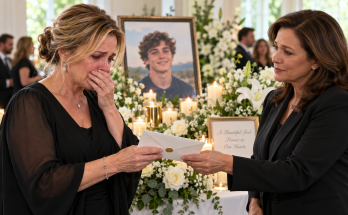
“On the back, he wrote something.”
She turned it over.
Then read:
“The best thing my children ever did was tell the truth about me while I still had time to become better.”
I broke.
All six children gathered around me.
We cried together.
Not because the past had become good.
It hadn’t.
Because something good had grown afterward.
There is a difference.
After the funeral, Daniel handed me an envelope.
“Dad left this for you.”
I waited three weeks to open it.
Inside was a letter.
Richard’s handwriting had become shakier with age.
Laura,
If you’re reading this, I finally found a way to stop talking. Enjoy it.
I laughed immediately.
Then cried.
There are apologies I have already given you, and I don’t want to use death to force another one into your hands. You owe me nothing because I am gone. Not forgiveness, not a softened version of our marriage, not protection of my memory.
I stopped reading.
That sentence alone told me how far he had come.
Then continued.
I spent too much of my life believing reputation was character. I thought if enough people saw me as generous, successful, devoted, and respectable, then those things became true automatically.
You knew the difference long before I did.
The night of the award, I thought you and the children destroyed my reputation. It took me years to understand that you only stopped maintaining it for me.
I cried harder.
I was angry because I had confused being protected from consequences with being loved.
You loved me for many years. Then you loved yourself enough to leave. Both were gifts.
I pressed the paper to my mouth.
I wish I had been the husband you deserved while I still had the privilege of being your husband. I wasn’t. I cannot rewrite that.
But I am grateful you allowed me to remain a father without allowing me to use fatherhood as a weapon against you.
Thank you for raising our children when I was busy performing fatherhood for strangers. Thank you for refusing to let them hate me on your behalf. Thank you for never lying to them about what I did either.
And thank you for building a life after me. Watching you return to work was one of the most humbling experiences of my life. I realized I had once treated your career as optional because your sacrifice benefited me.
North Star was proof that the woman I married had never disappeared. I simply stopped looking closely enough to see her.
I had to stop.
Walk around.
Breathe.
Then I finished.
I loved Nora. I know you know that. Loving her taught me something painful: I was capable of being a better husband. I simply became capable too late for us. I am sorry for that too.
But I don’t wish we had remarried. That may surprise you.
It did.
You were right to leave.
I closed my eyes.
If you had returned because I improved, some part of me might always have believed improvement was a transaction—that if I behaved well enough, I could earn you back. Instead, I had to learn that becoming better was worthwhile even when it did not restore what I lost.
I whispered:
“Richard.”
That lesson saved me.
I hope, when you think of me, you remember the whole man. Not the award. Not the affairs. Not only the better years either. The whole imperfect man.
That is how I remember you. Not as the saint I made invisible, not as the angry woman who left me, not as the mother of my children, not as the business owner you became.
Laura.
Just Laura.
You were always enough without the roles.
I am sorry it took losing you for me to understand that.
Richard
I sat with the letter until sunset.
Then folded it.
Put it away.
I did remember the whole man.
That was the only honest way.
Years passed.
Grandchildren became adults.
Great-grandchildren arrived.
The Second Chapter Fund grew.
North Star continued without me.
The old house changed owners again.
One afternoon, when I was eighty-four, Lily drove me past it.
“Want to see?”
“Not really.”
She slowed anyway.
The purple sun was gone.
I expected sadness.
Instead, I smiled.
It belonged to another family now.
Their walls.
Their memories.
Their turn.
Lily parked near a small café.
We drank tea.
She asked:
“Mom, did you ever wish I hadn’t taken the microphone?”
I thought.
“Yes.”
Her face fell.
I touched her hand.
“Not because you were wrong.”
“Then why?”
“Because you were seven.”
I said.
“You shouldn’t have needed to defend me.”
She looked down.
“I wanted people to see you.”
“I know.”
“Did it help?”
I considered.
“Yes.”
Then shook my head.
“No.”
She laughed.
“Very clear.”
“The applause wasn’t what helped.”
“What did?”
“The truth.”
I squeezed her fingers.
“And what I did afterward.”
That was the real story.
Not the microphone.
Not Richard’s face going white.
Not the scandal.
Not the trophy.
The afterward.
Truth matters.
But truth is a door.
You still have to walk through it.
I walked through.
Into divorce.
Work.
Fear.
Independence.
A smaller house.
A new career.
Loneliness.
Friendship.
Grandmotherhood.
Forgiveness.
A life I could not have imagined from that auditorium chair.
Richard walked through too.
Eventually.
Into shame.
Therapy.
Fatherhood without applause.
Nora.
Grandchildren.
Humility.
Tomatoes.
A life he probably could not have imagined either.
Our children walked through in six different ways.
Daniel learned he was not responsible for adult secrets.
Claire learned anger could soften without becoming denial.
Matthew learned to speak instead of disappearing.
Sophie learned boundaries.
Ethan learned that loving his father did not betray his mother.
And Lily learned she did not have to carry a microphone for me anymore.
That may have been the most important.
At eighty-seven, I attended the school ceremony where one of my great-grandchildren received an academic award.
The auditorium had been renovated.
New seats.
Different stage.
But I knew immediately.
Same room.
I stood in the doorway.
For one moment, I was fifty again.
Alone in the corner.
Invisible.
Watching my husband accept praise for a life I had largely held together.
Then my great-granddaughter ran toward me.
“Grandma Laura!”
I bent as much as my knees allowed.
She huggedged me.
“Come sit with us.”
Us.
Not the corner.
Front row.
My family had saved a seat.
I sat between Lily and Claire.
Onstage, the principal gave a speech about caregivers.
Not mothers.
Not fathers.
Caregivers.
“Children are rarely raised by one heroic person.”
she said.
“They are raised by networks of ordinary people who show up repeatedly.”
I smiled.
Apparently the school had learned too.
When the ceremony ended, Lily and I remained seated for a moment.
She looked toward the stage.
“Want the microphone?”
I laughed.
“Absolutely not.”
“You sure?”
“I’ve said enough.”
She smiled.
“No, you haven’t.”
Maybe she was right.
So here is what I would say now, if someone handed me that microphone.
I would say that invisible work is still work.
That money matters, but earning money does not purchase exemption from emotional responsibility.
That buying a bicycle is generous.
Teaching a child to ride it is different.
That paying for school matters.
Knowing the teacher’s name matters too.
That a parent can provide financially and still be absent.
That a stay-at-home parent can be surrounded by children and still be profoundly lonely.
That sacrifice should be recognized before resentment becomes the only witness.
I would say that infidelity did not make Richard incapable of growth.
But his later growth did not make the infidelity harmless.
Both truths belong in the story.
I would say that forgiveness and reconciliation are cousins, not twins.
You can forgive someone and still keep the door closed.
You can love someone and still know you should not be married to them.
You can be grateful they changed without volunteering to become the reward for that change.
I would say children deserve truth appropriate to their age, but they should never be recruited as spies, judges, messengers, or therapists.
Daniel should never have carried Richard’s secret.
Lily should never have felt responsible for making a room see me.
I would say reputation is rented.
Character is owned.
Reputation asks:
Who is watching?
Character asks:
What is right when nobody is?
Richard spent half his life learning the difference.
I spent half mine learning something else.
Being needed is not the same as being valued.
I had made myself indispensable.
Six lunches.
Six schedules.
Six lives.
A husband.
A house.
Everything passed through me.
I thought that meant I mattered.
I did matter.
But not because I could carry everyone.
I mattered when I sat down too.
I mattered when the lunches were unfinished.
I mattered when I had no husband.
I mattered when no child needed me.
I mattered before North Star.
I mattered after retirement.
Laura.
Just Laura.
Richard’s final letter gave me that gift.
Or perhaps it reminded me of something I should have known without him.
When I was ninety, Lily brought me the old Parent of the Year plaque.
“Why do you have this?”
“Dad left it to me.”
“And you’re giving it to me?”
“No.”
She turned it over.
Richard’s words were still there.
The best thing my children ever did was tell the truth about me while I still had time to become better.
“What should we do with it?”
I asked.
Lily smiled.
“Donate it to the school archive?”
“No.”
“Frame it?”
“Absolutely not.”
“Throw it away?”
I thought.
Then smiled.
“Yes.”
Lily looked surprised.
“Really?”
“It’s metal.”
“So?”
“Recycle it.”
She laughed.
We did.
That may disappoint people who like symbolic objects.
But we didn’t need it anymore.
Richard was not the trophy.
He was not the scandal either.
I was not the woman sitting alone in the corner.
Lily was not the child holding a microphone.
We had all outgrown the objects that once represented us.
That felt like freedom.
The last time I visited Richard’s grave, I was ninety-two.
Lily drove me.
I sat on a folding chair because standing had become an ambitious activity.
His stone was simple.
RICHARD BENNETT
BELOVED FATHER, HUSBAND, GRANDFATHER
I smiled at husband.
He had been two women’s husband.
Poor Nora.
Then I touched the stone.
“You became better.”
I said.
Wind moved through the trees.
No answer.
Good.
I had never needed ghosts.
“I became better too.”
I whispered.
That surprised me.
For years, I had told the story as though Richard was the one who needed transformation.
He did.
But so did I.
I had needed to stop confusing silence with peace.
Needed to stop protecting people from consequences.
Needed to stop believing my value came from service.
Needed to stop hiding my ambitions because motherhood was supposed to satisfy every part of me.
Needed to learn that anger could contain information.
Needed to learn boundaries.
Needed to learn that being kind did not require being available.
Needed to learn how to receive help.
Needed to learn how to be alone without feeling abandoned.
We both became better.
Separately.
That was our ending.
Not remarriage.
Not revenge.
Not Richard ruined while I became fabulously wealthy.
Something quieter.
He lost a marriage because of who he had been.
Then became a better father because of who he chose to become.
I lost the identity I had built around being his wife.
Then discovered it had never been the whole of me.
Our children lost the illusion of a perfect father.
Then gained a human one.
And Lily?
She put down the microphone.
Eventually.
That may be my favorite part.
Because children should not have to spend their lives speaking truths their parents are afraid to say.
The adults finally learned to do that ourselves.
If I could return to that auditorium now, I know exactly what I would do.
Richard would be onstage.
Beautiful suit.
Perfect smile.
Trophy in hand.
He would say:
“Raising six children is the hardest job I’ve ever done.”
The audience would applaud.
I would be sitting in the corner.
Older than I felt.
More tired than anyone knew.
Lily would reach for the microphone.
But before she could take it, I would stand.
Not angrily.
Not dramatically.
I would simply stand.
And when Richard looked at me, I would no longer wait for him to introduce me.
I would introduce myself.
“My name is Laura Bennett.”
I would say.
“I am their mother.”
That would be enough.
I would not list lunches.
Fevers.
Homework.
Laundry.
Appointments.
Sacrifices.
I would not need to present evidence that I deserved dignity.
Dignity is not an award for productivity.
I deserved to be seen before proving how much I had done.
So did Richard.
So do all of us.
Then I would walk to Lily.
Take her little hand.
And tell her:
“You don’t have to defend me, sweetheart.”
Because now I know how.
For years, I thought the most important sentence spoken that night was:
“Daddy doesn’t raise us. Mommy does.”
It wasn’t.
The most important sentence came afterward.
Richard whispered it to me.
“Fix this.”
And for the first time in twenty-three years, I answered:
“No.”
That no changed everything.
It wasn’t revenge.
It wasn’t cruelty.
It wasn’t the destruction of our family.
It was the end of my participation in a lie.
Sometimes a family does not break when someone finally tells the truth.
Sometimes the false version breaks.
And the people inside it finally get a chance to build something real.
We did.
Not perfectly.
Not painlessly.
But honestly.
Richard never became Parent of the Year.
I never became Mother of the Year.
Thank God.
We became something more useful.
Human beings.
Flawed.
Responsible.
Capable of hurting each other.
Capable of changing.
Capable of walking away.
Capable of forgiving.
Capable of loving without pretending.
And when I think of that auditorium now, I no longer remember myself as the woman abandoned in the corner.
I remember standing.
That is the image I keep.
Not Richard’s trophy.
Not the applause.
Not the scandal.
Me.
Standing.
Lily looking at me.
Six children watching.
My husband finally unable to hide behind the story I had helped him maintain.
And my own voice, quiet but steady, saying the word that gave my life back to me.
“No.”
Sometimes the smallest word opens the largest door.
And I walked through it.
I never sat in the corner of my own life again.
THE END STORIES! THANK YOU FOR READING GOOD LUCK !❤️
Related Posts